You can run a vertical business on horizontal tools for a while. Then the workaround becomes the process. A spreadsheet patch on your job costing. A custom field in your generic CRM for AIA billing. A shared calendar standing in for a dispatch board. These workarounds work until they don't - usually right around the moment you're trying to hand the workflow to someone who didn't invent it.
The global vertical software market was estimated at $147.11 billion in 2025, according to Mordor Intelligence, with cloud deployment accounting for 71.22% of that share. The scale reflects a straightforward reality: Industry-specific software often delivers faster adoption, cleaner reporting, and lower implementation drag than horizontal tools configured to approximate the same job.
This guide is built for founders and operators evaluating whether industry-specific software belongs in their stack, and which platforms actually fit their industry.
What's inside
This guide covers the following:
- A clear definition of vertical market software and how it differs from horizontal alternatives
- A ranked shortlist of 12 tools across construction, education, banking, manufacturing, and enterprise operations
- A side-by-side comparison table with verified pricing and G2 ratings
- Selection criteria covering industry fit, integration depth, migration burden, deployment model, and compliance support
Who it's for: Series B founders, RevOps leaders, and operations heads deciding between specialized systems and general-purpose tools.
TL;DR
- Best for contractor operations: Ventus or AscenteVMS for construction and specialty service businesses needing integrated ERP
- Best for education and tutoring businesses: Teachworks, with purpose-built scheduling, billing, and instructor workflows
- Best for banking software: Temenos for core banking and digital banking modernization
- Best for enterprise vertical ERP: Oracle, SAP, Microsoft Dynamics 365, or Infor depending on existing stack and industry focus
- Best for CRM-led industry workflows: Salesforce through its industry clouds
- Founder takeaway: Choose vertical software when industry-specific forms, billing rules, compliance records, or reporting require more than custom fields in a generic platform
What is vertical market software?
Vertical market software is software built for the workflows, data models, regulations, and operating norms of a specific industry.
Where horizontal software handles broad functions across many industries, vertical software embeds the vocabulary, forms, billing rules, and process logic of one market segment. A construction ERP understands AIA billing and job costing. A tutoring management platform knows how to handle per-lesson pricing and instructor payroll. A core banking system models account structures, compliance requirements, and payment rails that a generic CRM could never approximate without years of configuration.
Examples span a wide range: construction ERP software, core banking platforms, tutoring management software, legal case management, retail point-of-sale systems, healthcare practice management, and manufacturing ERP. What they share is industry-specific depth that horizontal tools require significant customization to match.
Key features of vertical market software
- Industry-specific data models: Fields, objects, and relationships that match how the industry actually tracks work
- Workflow automation for specialized processes: AIA billing, dispatch, loan origination, lesson scheduling, lot tracking
- Compliance and audit support: Required forms, audit trails, permission controls, and reporting templates
- Role-specific interfaces: Dashboards and tools built for field techs, branch managers, instructors, or plant supervisors
- Industry templates and reporting: Pre-built reports for job profitability, enrollment trends, loan performance, or production output
- Integration with common systems of record: Connecting to payroll, banking, payment rails, or industry-specific data providers
- Deployment flexibility: Cloud, on-premises, and hybrid depending on the industry's IT posture
Vertical vs horizontal software
| Dimension | Vertical market software | Horizontal software |
|---|---|---|
| Target user | A specific industry or segment | Any business function across industries |
| Workflow depth | Deep, pre-built for industry processes | Broad, requires configuration |
| Flexibility | Narrower by design | High across use cases |
| Implementation | Faster when the industry fits | Longer when heavy customization is needed |
| Compliance support | Often built-in for the target market | Requires custom development |
| Best fit | Companies where industry workflow is the operating system | Companies with standard business functions |
When to use vertical market software
Replace founder-led process knowledge
The hardest moment to catch is when the workflow lives in a person's head rather than a system. At Series B, that person is often the founder or first operations hire. When they leave a meeting, the process leaves with them. Vertical software encodes industry logic into the platform itself, making the workflow repeatable by anyone the company hires next.
Standardize specialized workflows
Job costing, AIA billing, appointment scheduling, dispatch, inspections, lending workflows, inventory controls, student scheduling. These are not edge cases in their industries - they are the daily operating rhythm. Generic tools require workarounds for each one. Vertical software treats them as first-class features.
Reduce compliance and implementation drag
Regulated and workflow-heavy industries need audit trails, required forms, permissions, data controls, and reports baked into the system. Building those in a horizontal tool is expensive and fragile. Vertical software often ships the compliance infrastructure as a default, though the company still owns the obligation to operate it correctly.
Vertical market software comparison
The 12 tools below cover a range of industries, from specialty contractors to global banking institutions. Vertical market software is not a single tool category. It is a pattern across markets: When the industry workflow is specific enough that generic tools generate more friction than value, specialized systems tend to win.
| # | Product | Best for | Key differentiator | Pricing | G2 rating |
|---|---|---|---|---|---|
| 1 | Ventus | Specialty contractors needing integrated ERP | Construction ERP across accounting, service, field, and inventory | Quote-based | N/A (Capterra: 4.3/5) |
| 2 | AscenteVMS | Service contractors needing connected operations | Integrated service, dispatch, job costing, and accounting | Quote-based | N/A |
| 3 | QuickBooks | Small businesses needing cloud accounting with add-ons | Broad accounting base with app ecosystem and vertical extensions | From $0/mo (free tier available) | 4.0/5 |
| 4 | Teachworks | Tutoring and education service businesses | Purpose-built scheduling, billing, and instructor management | From $16.49/mo + per-lesson fee | 4.7/5 |
| 5 | Lean Industries | Financial institutions managing payment disputes | End-to-end dispute and chargeback management workflows | Quote-based | N/A |
| 6 | Jonas Unify | Hotels, resorts, and private member clubs | Unified guest data and connected hospitality applications | Quote-based | N/A |
| 7 | Temenos | Banks modernizing core or digital banking | Cloud-native core banking and digital banking depth | Quote-based | 4.5/5 |
| 8 | Oracle | Large enterprises needing ERP and industry cloud | Broad enterprise platform with industry-specific depth | From $54/mo (OCI) | 4.1/5 |
| 9 | SAP | Enterprises with complex ERP and supply chain needs | Deep ERP footprint across manufacturing, retail, and regulated industries | From $295/user/mo (Supply Chain) | 4.2/5 |
| 10 | Microsoft Dynamics 365 | Mid-market and enterprise teams inside the Microsoft stack | ERP and CRM modules with Power Platform and Azure integration | From $65/user/mo (Sales Professional) | 3.8/5 |
| 11 | Salesforce | Teams needing CRM-led vertical industry workflows | Industry clouds across financial services, healthcare, and manufacturing | From $0/user/mo (free tier available) | 4.4/5 |
| 12 | Infor | Manufacturing, distribution, and asset-heavy operations | Industry-specific CloudSuite ERP suites | Quote-based | 3.9/5 |
Best 12 vertical market software tools for 2026
1. Ventus
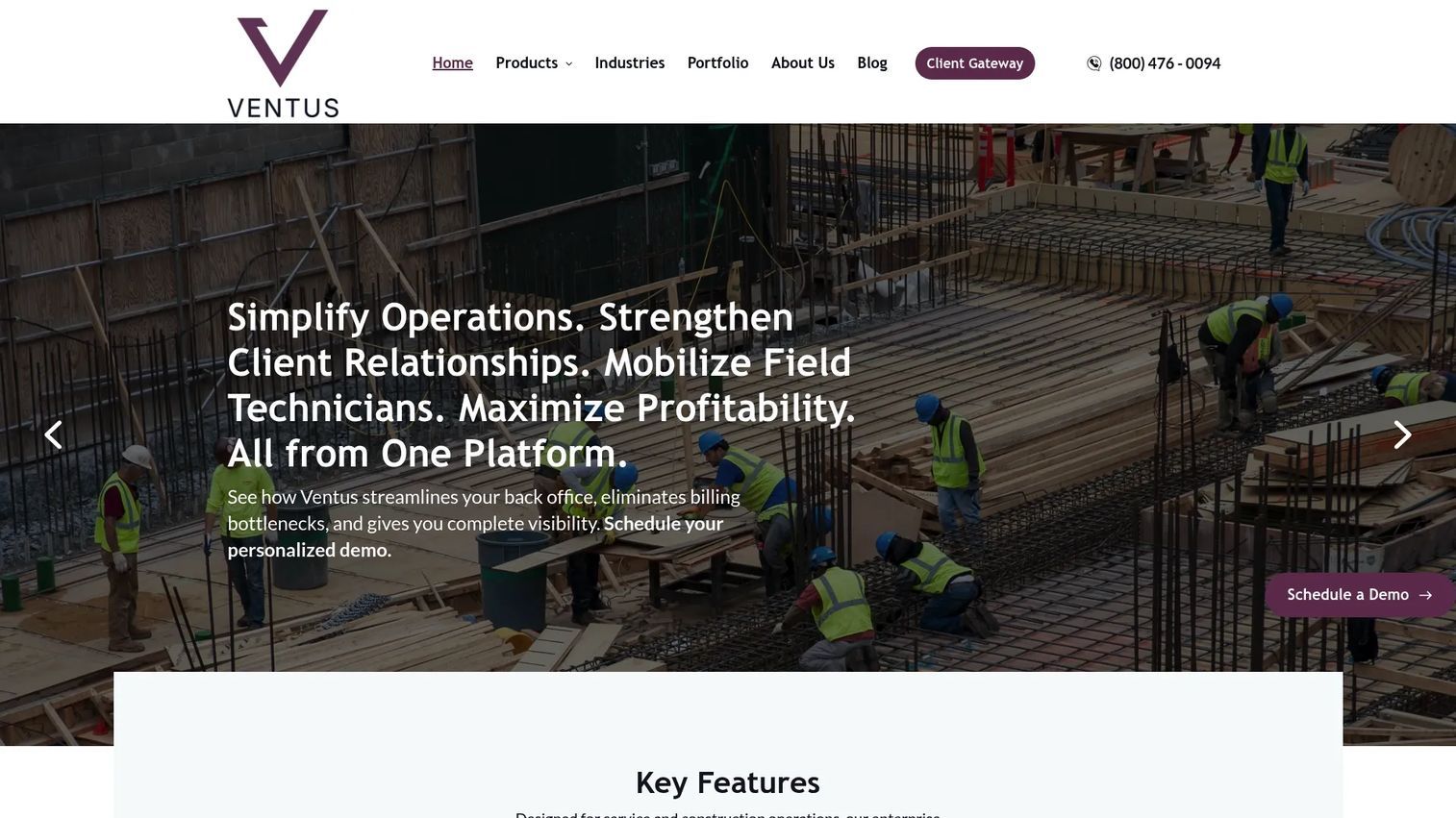
Ventus is an enterprise software platform for construction and specialty service contractors. It covers the full operational scope: Project management, job costing, service dispatch, accounting, payroll, field mobility, inventory control, and client portals. Teams in HVAC, mechanical, electrical, plumbing, petroleum, roofing, and other specialty contracting use it when they've outgrown disconnected accounting and scheduling tools.
Best for: Specialty contractors that need an integrated ERP rather than a stack of loosely connected point tools.
Key features
- Contractor accounting with job-level financial visibility
- Job costing and project management
- AIA billing and progress billing workflows
- Dispatch management and preventive maintenance
- Field mobile invoicing and electronic timecards
- Inventory control with barcoding and serialized tracking
Why choose Ventus: Choose Ventus when job profitability, field execution, and accounting need to live in one system. It fits companies where the construction workflow is the operating system, not an add-on to a generic accounting platform.
Ventus pricing: Ventus prices by quote. Contact the vendor to get pricing based on your module selection and team size. Capterra reviewers report pricing in the mid-market range consistent with integrated contractor ERP platforms.
2. AscenteVMS
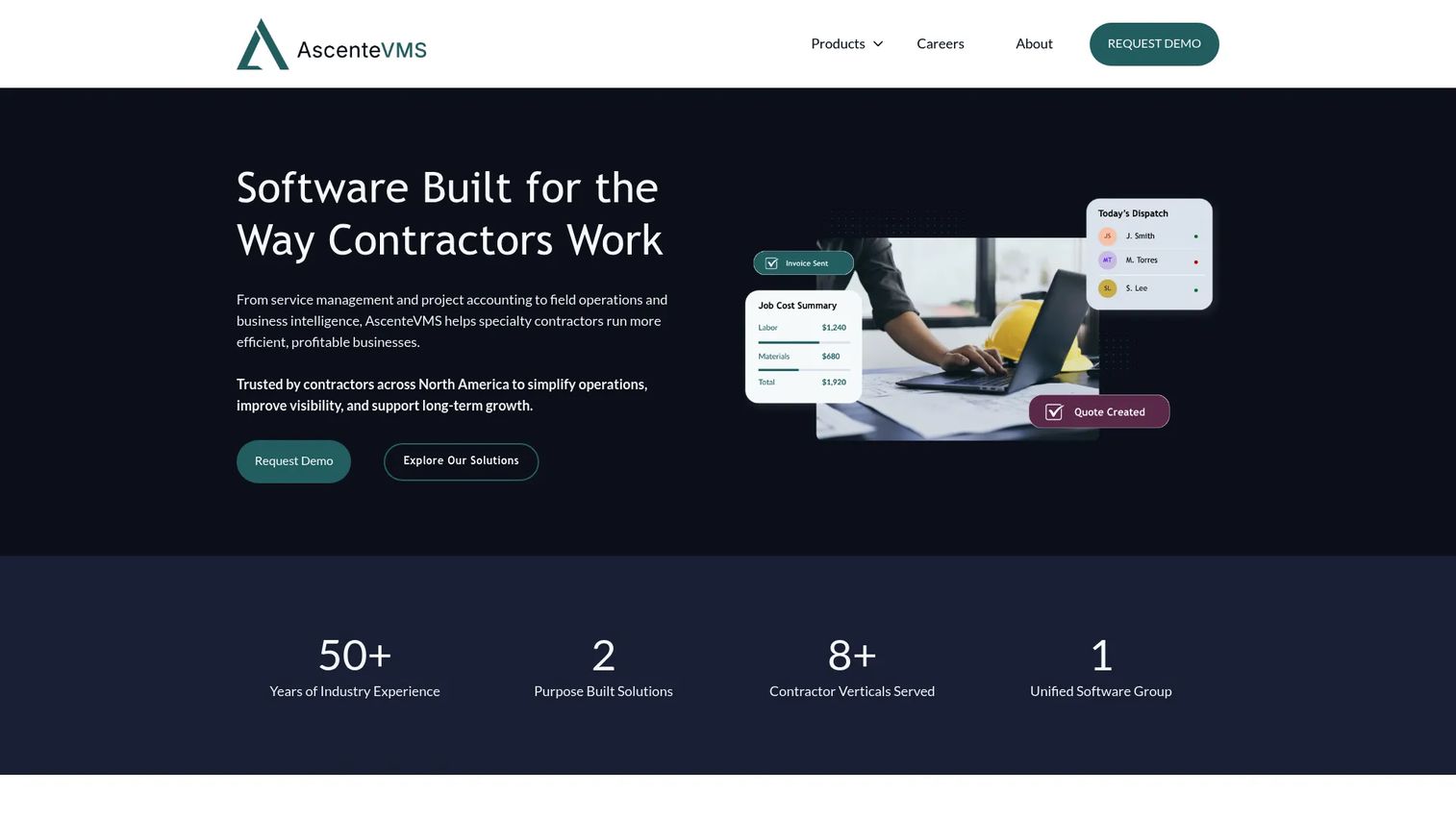
AscenteVMS provides integrated software for specialty service contractors, connecting service operations, field work, job management, accounting, and reporting. It is built for contractors where job-level visibility and service execution drive the business, not generic project tracking.
Best for: Contractors and service businesses that need purpose-built operational workflows connecting the office and the field.
Key features
- Comprehensive job management
- Integrated accounting and job costing
- Real-time dispatch
- Service contract management
- Mobile field capabilities
- Operational reporting and analytics
Why choose AscenteVMS: AscenteVMS fits when service execution and job costing are the two things the business can't afford to get wrong. Evaluate it when job-level visibility matters more than broad horizontal flexibility.
AscenteVMS pricing: AscenteVMS prices by quote. Reach out to the vendor for pricing based on your contractor profile and feature requirements. No third-party reviewer-reported ranges were confirmed at time of writing.
3. QuickBooks
QuickBooks is cloud accounting software for income tracking, expense management, invoicing, payroll, and financial reporting. It is not pure vertical market software, but it appears in vertical software stacks across construction, retail, and professional services because many industry-specific platforms integrate with it or extend it via the app marketplace.
Best for: Small and growing businesses that need solid accounting first, with vertical workflow extensions added through the app ecosystem.
Key features
- Income and expense tracking
- Invoicing and estimates
- Bank connection and transaction sync
- Payroll options
- App marketplace for industry-specific add-ons
- Financial reporting
Why choose QuickBooks: Choose QuickBooks when finance fundamentals are the priority and industry workflows can be handled by connected vertical tools. For founders reading strategically, it represents the horizontal accounting base that most vertical stacks build on top of rather than replace.
QuickBooks pricing: QuickBooks Online offers a free tier and paid plans. Simple Start starts at $19/month, Essentials at $42.50/month, Plus at $70/month, and Advanced at $170/month (promotional rates apply for the first three months). Regular prices are higher after the promotional period.
G2 rating: 4.0/5 on G2.
4. Teachworks
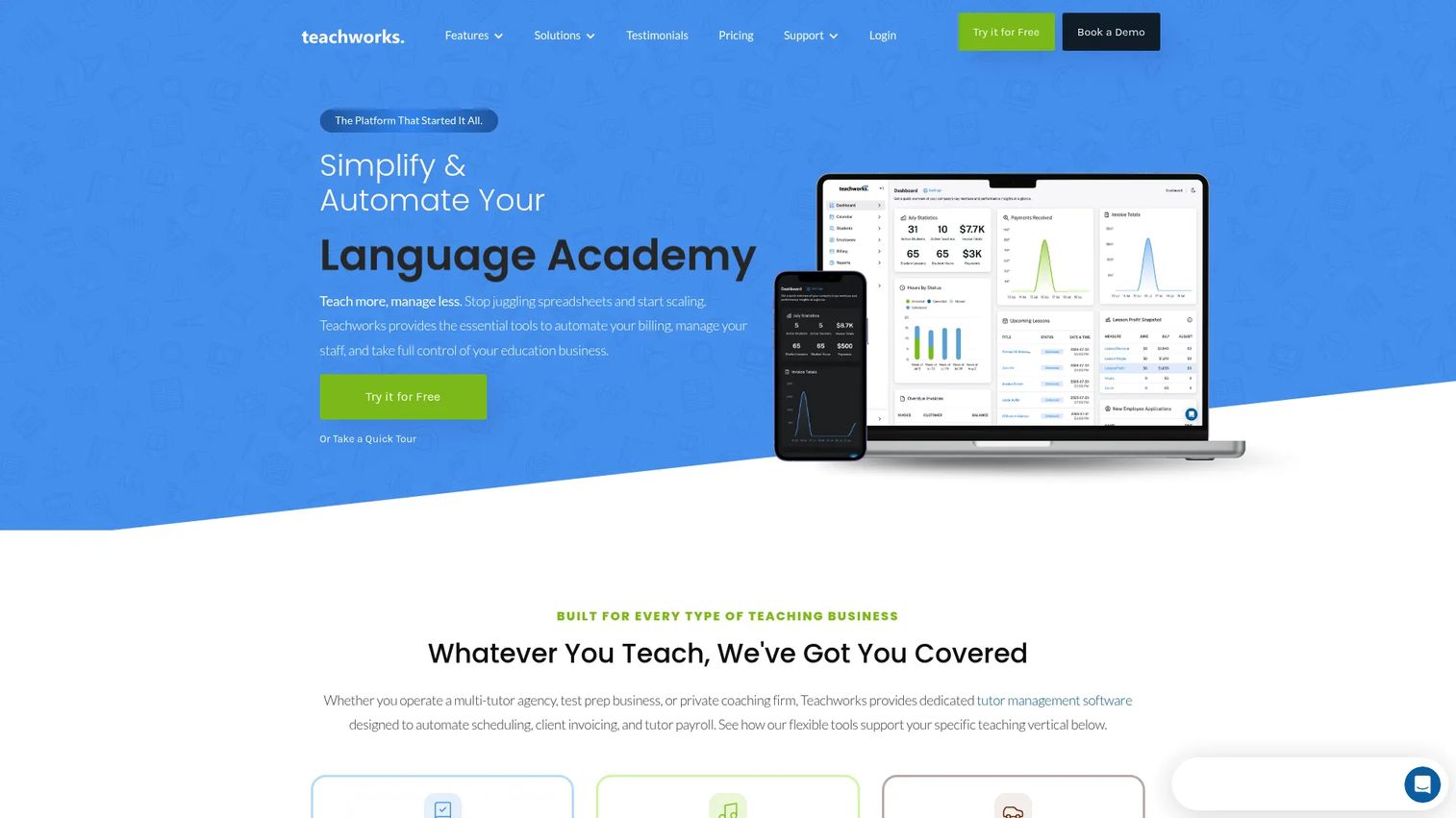
Teachworks is business management software for tutoring companies, music schools, language academies, and other education service businesses. It handles scheduling, student and instructor management, lesson tracking, billing, payroll, and automated communications in one platform built around the education service model.
Best for: Tutoring and education service businesses managing students, instructors, lessons, and billing at growing volume.
Key features
- Lesson scheduling and calendar management
- Student and teacher management
- Billing, invoicing, and online payments
- Employee hours and payroll tracking
- Attendance tracking
- Automated reminders and communications
Why choose Teachworks: Teachworks fits when the class, student, and instructor workflow is creating admin overhead that generic scheduling tools can't absorb. It's a clear example of vertical software winning because the workflow vocabulary is industry-specific: Lesson credits, instructor availability, per-lesson billing.
Teachworks pricing: A free 21-day trial is available on all plans. The Starter plan starts at $16.49/month plus $0.35 per student lesson. Growth is $47.99/month plus $0.21 per student lesson. Premium is $187.99/month plus $0.08 per student lesson.
G2 rating: 4.7/5 on G2.
5. Lean Industries
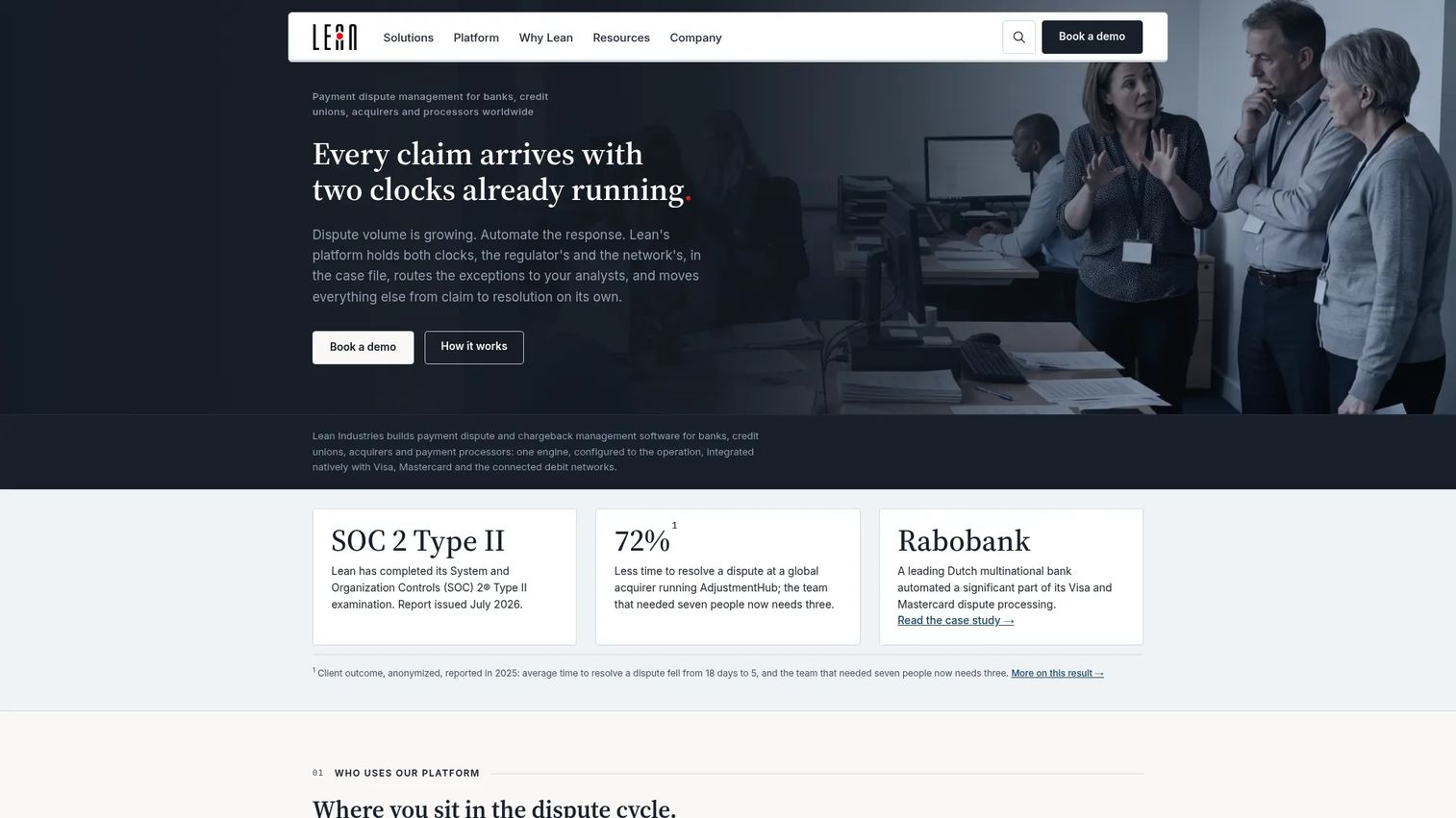
Lean Industries provides enterprise payment dispute and chargeback management software for banks, credit unions, acquirers, and payment processors. Its platform manages the end-to-end dispute lifecycle, from intake through resolution and recovery, with configurable workflows and native integrations to Visa VROL and Mastercard Mastercom.
Best for: Financial institutions and payment processors handling high-volume card and non-card payment disputes.
Key features
- End-to-end dispute lifecycle management
- Configurable workflows and rule-based automation
- Native integrations with Visa VROL and Mastercard Mastercom
- Debit network support
- Chargeback management and recovery workflows
Why choose Lean Industries: Choose Lean Industries when payment dispute volume is high enough that manual or generic case-management tools create bottlenecks. Financial institutions need software that models the actual regulatory and network workflow, not a ticketing system adapted for disputes.
Lean Industries pricing: Lean Industries prices by quote. Contact the vendor for pricing based on institution type and dispute volume. No third-party reviewer pricing was confirmed at time of writing.
6. Jonas Unify
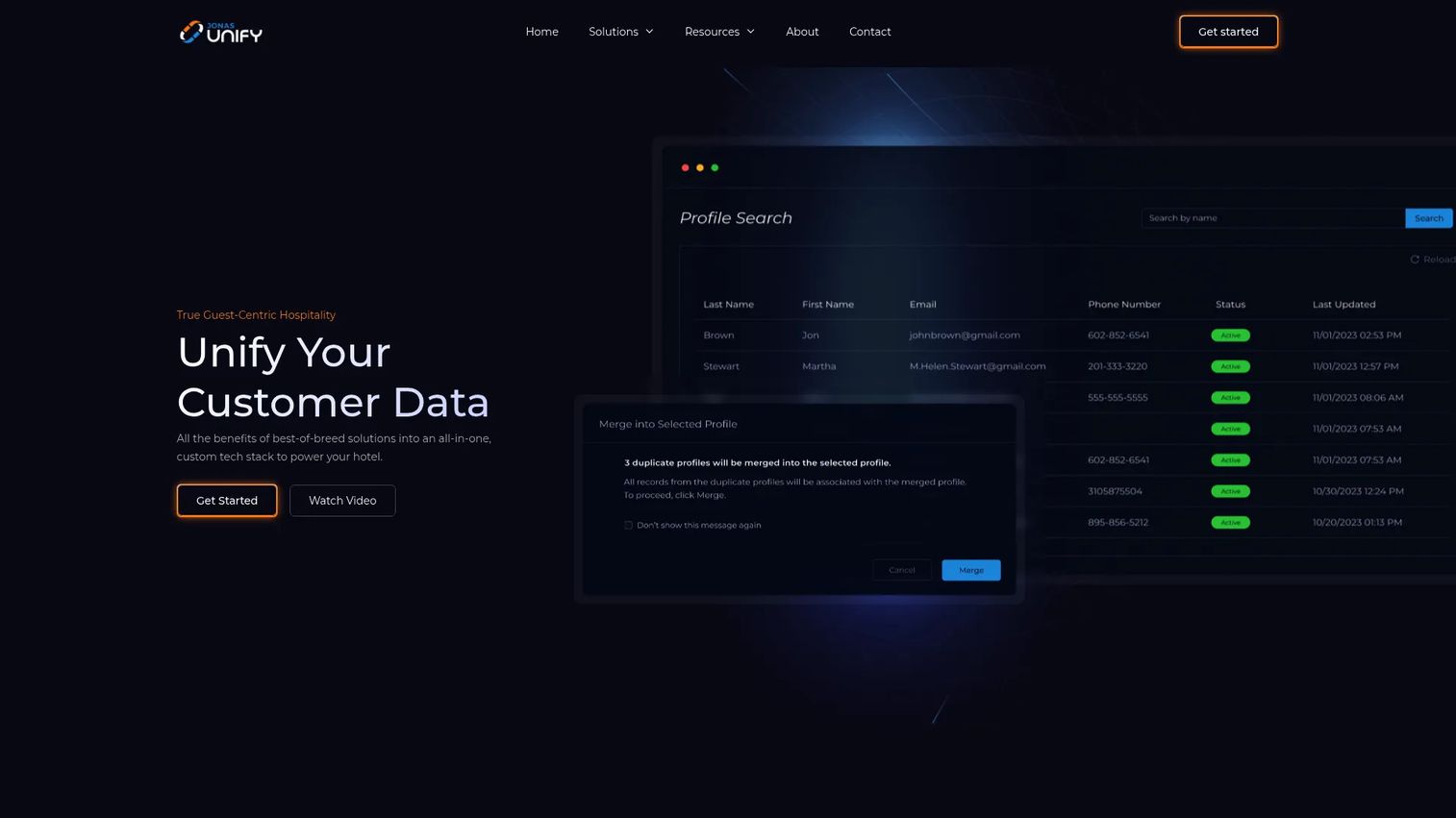
Jonas Unify is a hospitality technology platform that unifies guest data across hotel property management systems and powers connected guest-journey applications. It supports hotels, resorts, and private member clubs that need de-duplicated guest records, cross-system itineraries, white-label mobile apps, and centralized booking capabilities.
Best for: Hotels, resorts, and private member clubs needing unified guest data and connected guest experiences across multiple property systems.
Key features
- Unified, de-duplicated master guest records
- Cross-system guest itineraries
- White-label mobile app with booking, contactless check-in, and digital key
- Cross-channel email and SMS guest marketing
- Centralized reservation portal and booking engine
Why choose Jonas Unify: Jonas Unify fits when multiple property management systems create fragmented guest data. For hospitality operators, the value is in consolidating what guests experience across booking, arrival, and stay into one consistent record.
Jonas Unify pricing: Jonas Unify prices by quote. Contact the vendor for pricing based on property type and integration scope. No third-party reviewer pricing was confirmed at time of writing.
7. Temenos
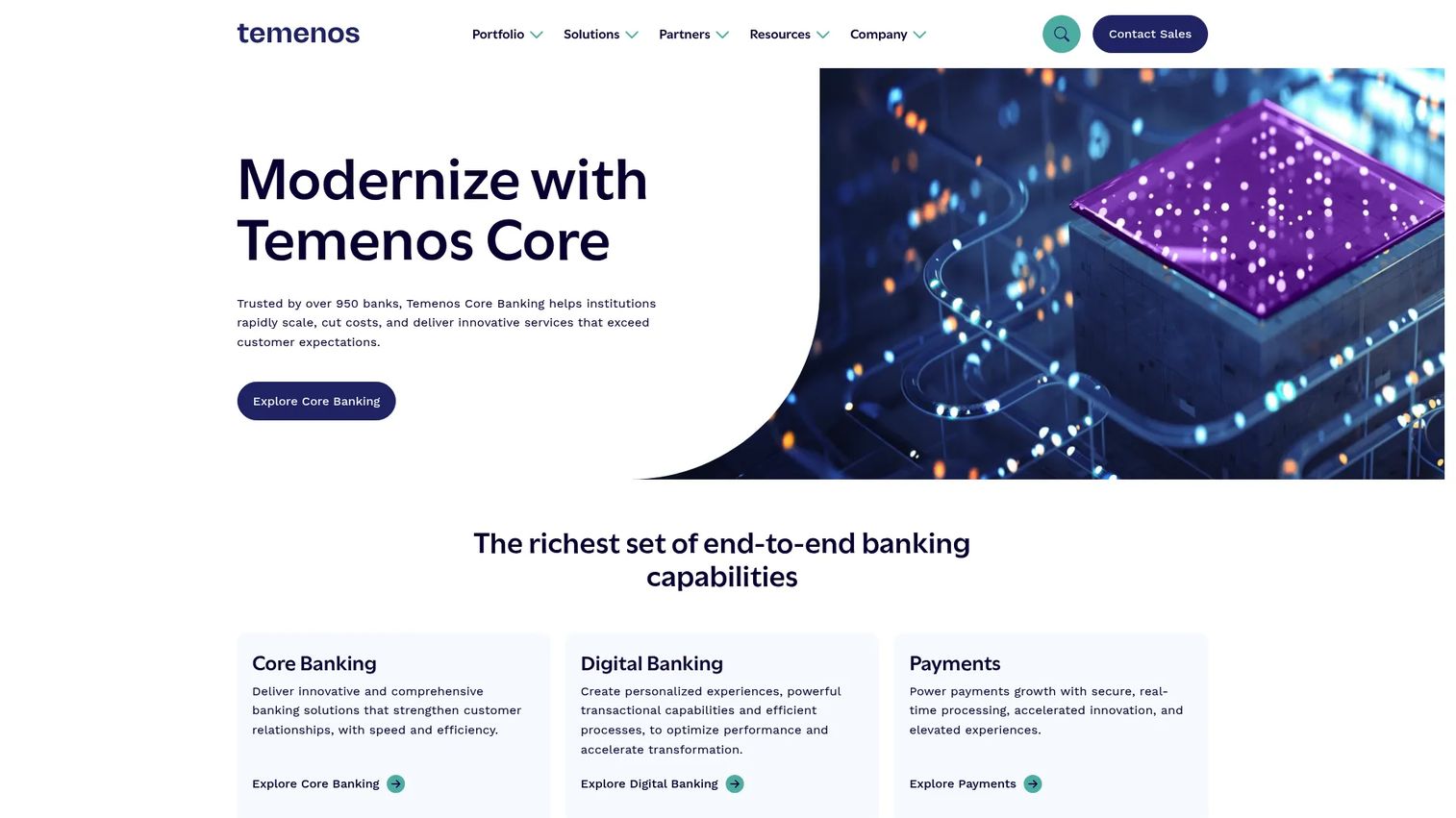
Temenos provides cloud-native banking software for core banking, digital banking, payments, financial crime mitigation, wealth management, and analytics. It serves retail banks, business banks, corporate banking operations, and financial institutions modernizing legacy systems. Deployment options include SaaS, cloud, hybrid, and on-premises. For more context on the banking software category, see the banking as a service software guide.
Best for: Banks and financial institutions modernizing core or digital banking systems.
Key features
- Modular core banking across retail, business, and corporate segments
- Cloud-native and cloud-agnostic deployment
- AI capabilities including AI agents and copilots
- Digital banking journeys, onboarding, and omnichannel engagement
- Open APIs and continuous automated upgrades
Why choose Temenos: Banking software needs domain-specific data models, compliance controls, and regulatory workflow support that horizontal tools require years of custom development to approximate. Temenos fits when the institution needs proven core banking architecture rather than configuration of a general-purpose platform.
Temenos pricing: Temenos prices by quote for banking software licenses.
G2 rating: 4.5/5 on G2.
8. Oracle
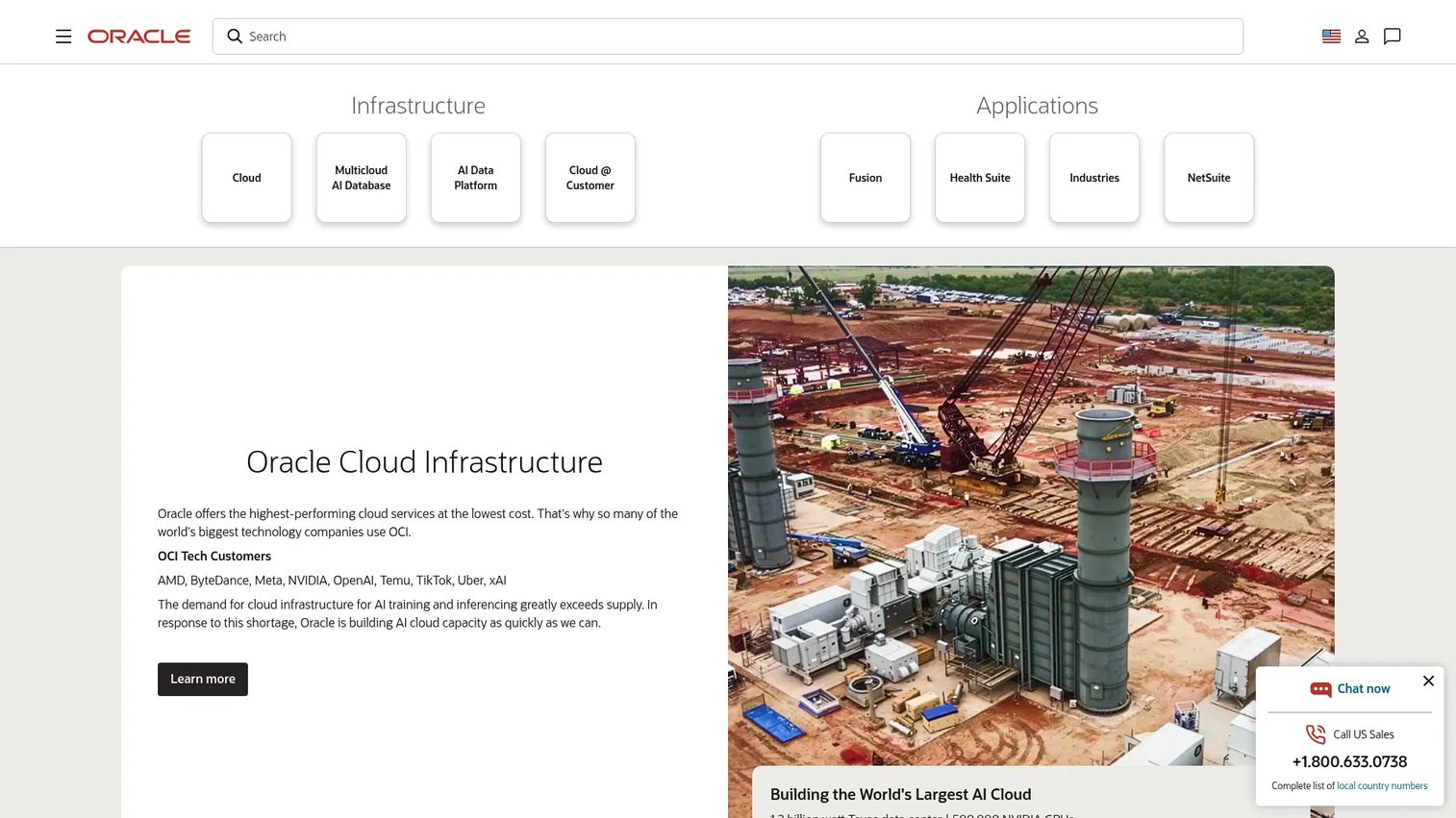
Oracle is a broad enterprise software and cloud infrastructure portfolio covering ERP, HCM, supply chain management, procurement, healthcare, retail, hospitality, construction, and public sector applications. Oracle is not a single vertical product - it is a platform with industry-specific depth across multiple enterprise segments.
Best for: Large enterprises needing integrated cloud infrastructure, ERP, and industry-specific applications at scale.
Key features
- Enterprise ERP and financial management
- Industry clouds across healthcare, retail, construction, and utilities
- Supply chain management modules
- Enterprise data platform and analytics
- Security controls and compliance infrastructure
Why choose Oracle: Oracle fits companies with complex data requirements, multi-entity finance structures, and operational systems that need to scale globally. It is often the right evaluation when the buyer wants enterprise platform breadth paired with industry specialization.
Oracle pricing: Oracle Cloud Infrastructure (OCI) offers a free tier with more than 20 always-free services and $300 in trial credits for 30 days. Published OCI example pricing starts at $54/month for a specified virtual machine configuration. Enterprise ERP and industry cloud pricing is quote-based.
G2 rating: 4.1/5 on G2.
9. SAP
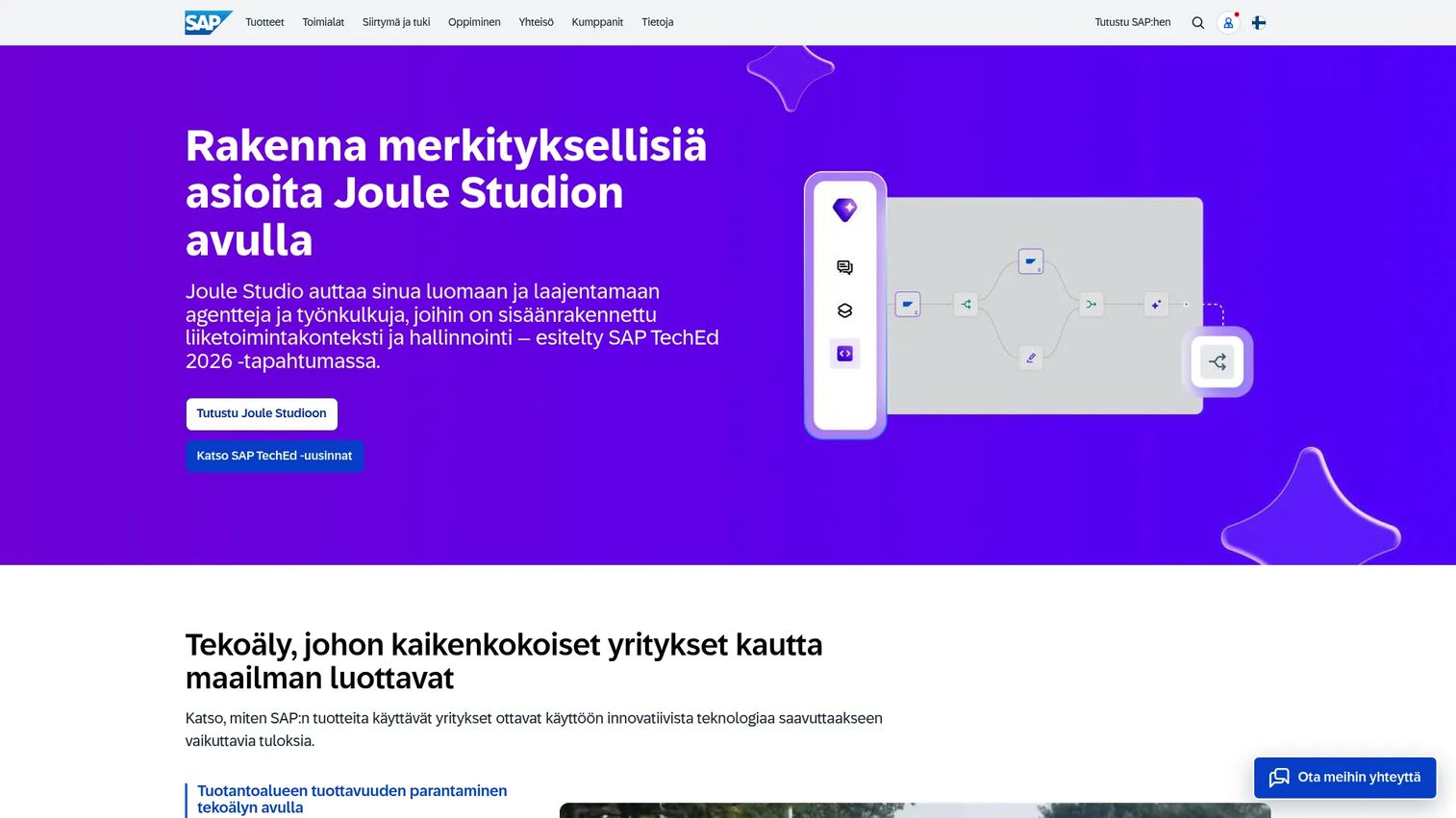
SAP is enterprise ERP and industry cloud software serving manufacturing, retail, energy, utilities, consumer products, finance, supply chain, and procurement at large and midsize organizations. SAP's industry-specific depth comes through industry packages and pre-configured process templates built for each sector. Interested in adjacent coverage? The aerospace ERP software guide covers specialized ERP in regulated manufacturing.
Best for: Enterprises standardizing global industry processes across ERP, supply chain, procurement, and finance.
Key features
- Enterprise ERP and core business process management
- Industry packages for manufacturing, retail, and regulated sectors
- Supply chain planning and logistics management
- Business AI with Joule and AI agents
- Finance workflows and business data cloud
Why choose SAP: Choose SAP when standardizing processes across global operations matters more than lightweight deployment. It's often the right answer when board-level concerns center on operational control and reporting consistency across multiple business units.
SAP pricing: SAP Supply Chain Base starts at $295/user/month and Supply Chain Premium at $403/user/month (per-user, 1 to 3 year contracts). Many other SAP products are priced by quote depending on product, user count, and contract terms.
G2 rating: 4.2/5 on G2.
10. Microsoft Dynamics 365
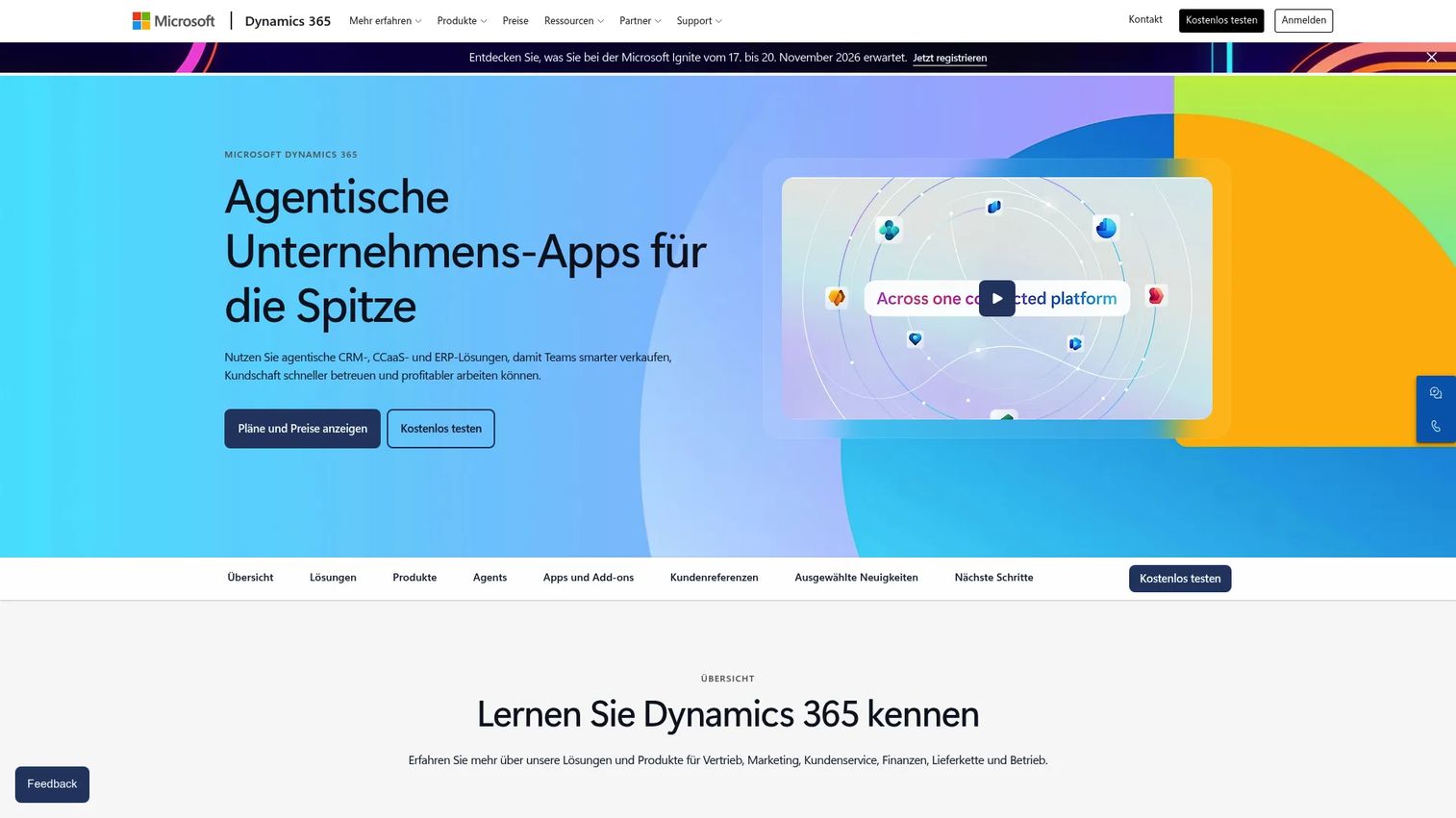
Microsoft Dynamics 365 is a modular suite of AI-powered ERP and CRM applications covering sales, customer service, finance, supply chain, field service, commerce, and project operations. It integrates natively with Microsoft 365, Azure, and Power Platform, making it a natural fit for organizations already running Microsoft infrastructure.
Best for: Mid-market and enterprise teams that want ERP and CRM modules inside the Microsoft infrastructure they already operate.
Key features
- ERP modules across finance, supply chain, and project operations
- CRM modules for sales, service, and marketing
- Field service management
- Power Platform integration for automation and reporting
- Native Microsoft 365 and Azure connectivity
Why choose Microsoft Dynamics 365: Dynamics 365 works well when the company wants vertical workflow support without leaving Microsoft infrastructure. The partner ecosystem is a major factor: Implementation partners can extend the platform for specific industries including construction, healthcare, and financial services.
Microsoft Dynamics 365 pricing: Dynamics 365 Sales Professional starts at $65/user/month (paid yearly). Enterprise Edition is $105/user/month and Premium is $150/user/month. A free trial is available. Other Dynamics 365 applications are priced separately.
G2 rating: 3.8/5
11. Salesforce
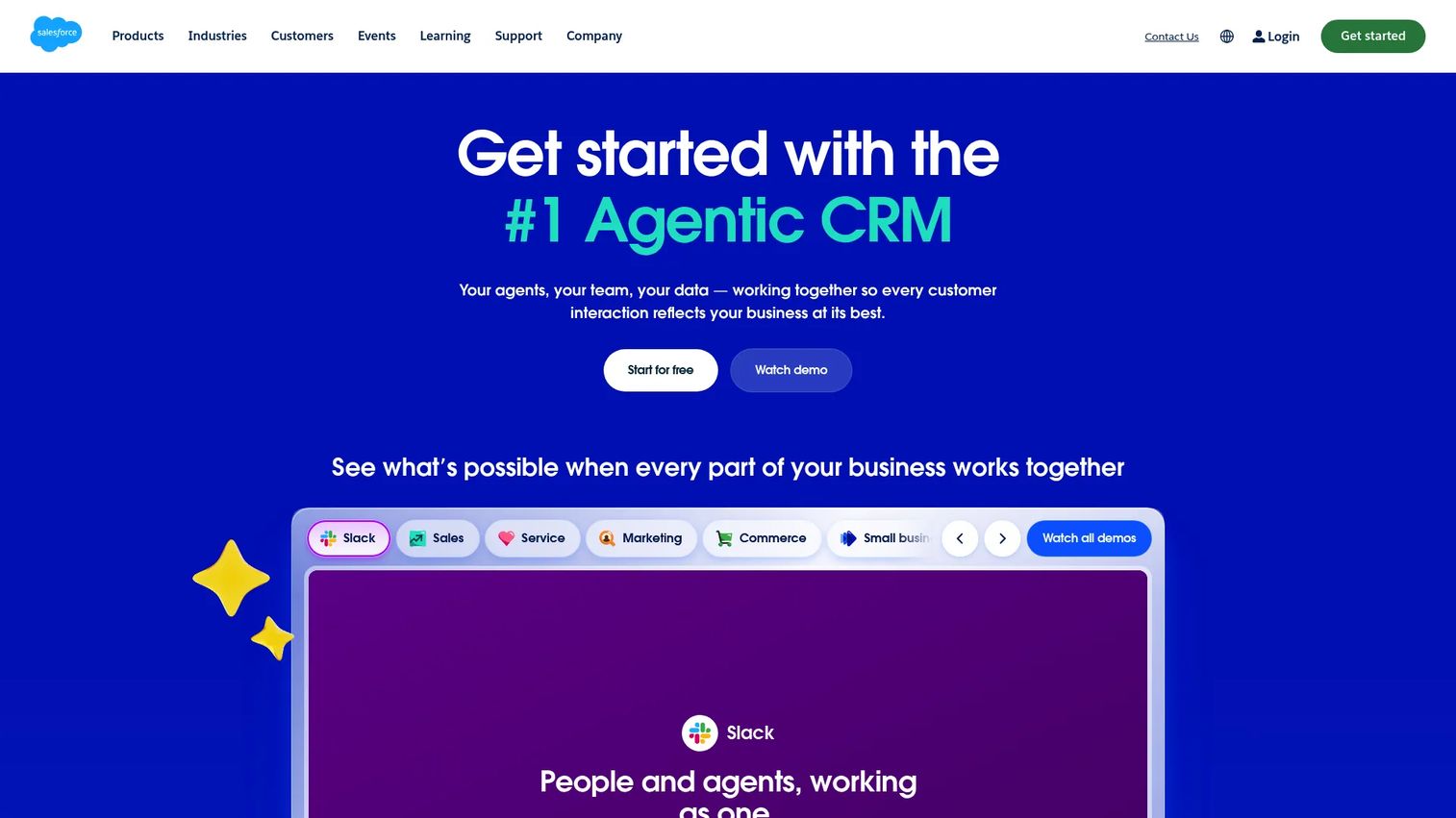
Salesforce is an AI-powered CRM platform with industry clouds for financial services, healthcare, communications, manufacturing, consumer goods, and the public sector. Its vertical depth comes through pre-built data models, compliance templates, and workflow automation for customer-facing processes in each sector.
Best for: Teams that need CRM-led vertical workflows across sales, service, marketing, and customer operations.
Key features
- Industry clouds for financial services, healthcare, and manufacturing
- CRM and sales automation
- Service automation and case management
- AppExchange ecosystem for vertical extensions
- Customer data platform with AI-driven insights
Why choose Salesforce: Salesforce fits when the vertical workflow centers on the customer lifecycle rather than back-office operations. For founders focused on cleaner GTM handoffs and better customer visibility across the funnel, its industry cloud frameworks provide structure without requiring full custom builds.
Salesforce pricing: A free limited suite is available. Starter Suite starts at $25/user/month. Pro Suite is $100/user/month (billed annually). Core is $195/user/month and Advanced is $395/user/month (both billed annually).
G2 rating: 4.4/5 on G2.
12. Infor
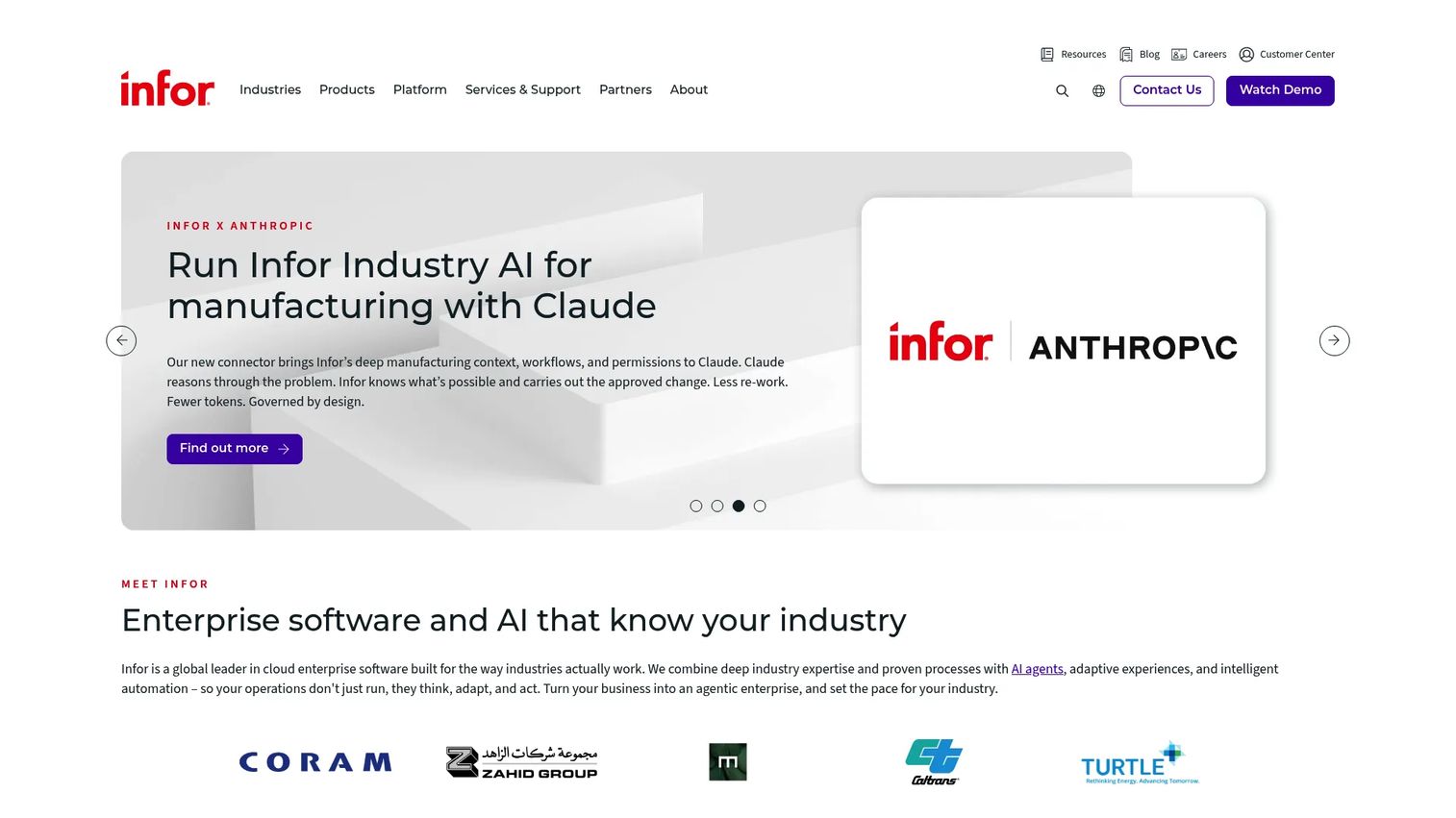
Infor provides industry-specific cloud ERP suites for manufacturing, distribution, healthcare, food and beverage, fashion, equipment, and asset-heavy sectors. Its CloudSuite products are pre-configured for each industry rather than built as generic platforms requiring heavy customization. For related context on manufacturing software, see the additive manufacturing software and automotive ERP software guides.
Best for: Mid-market and enterprise companies in manufacturing, distribution, and asset-heavy verticals where generic ERP configuration is not enough.
Key features
- Industry-specific cloud ERP suites (CloudSuite)
- Manufacturing workflows and manufacturing execution
- Supply chain, warehouse management, and distribution management
- Asset management and equipment lifecycle tracking
- Embedded analytics with prebuilt dashboards and AI agents
Why choose Infor: Infor fits when the industry workflow is too specific for generic ERP to handle through configuration alone. For operational leaders who need cleaner reporting and repeatable processes without custom development, the pre-built industry depth reduces implementation time compared to building from scratch on a horizontal platform.
Infor pricing: Infor prices by quote across its CloudSuite portfolio. Contact the vendor for pricing based on industry, module selection, and deployment model.
G2 rating: 3.9/5 on G2.
Considerations when choosing vertical market software
Industry fit beats feature count
Match the software to your actual workflow vocabulary before comparing features. If your business runs on AIA billing, the question is whether the software natively understands progress billing. If it runs on per-lesson instructor scheduling, the question is whether the system models lesson credits and instructor availability without workarounds. A long feature list built for a different industry rarely compensates for a missing core workflow.
Integration depth determines adoption
Ask which system becomes the source of truth before committing. Vertical software often touches operational data that feeds payroll, accounting, CRM, analytics, and identity. Poor integration between the vertical system and your existing stack creates duplicate entry and reporting gaps. Map the data flow before the contract.
Migration cost can erase software gains
Vertical systems usually hold operational history: Job records, student enrollment, banking transactions, dispatch logs. Moving that data requires careful mapping, legacy cleanup, and import validation. Ask vendors specifically about data migration tooling, duplicate record handling, and what your team owns post-go-live.
Deployment model changes risk profile
Cloud, on-premises, and hybrid each carry different trade-offs for internal IT burden, update cadence, security review, and vendor dependency. Cloud deployments reduce infrastructure overhead but require vendors to hold your data. On-premises gives more control but shifts maintenance to your team. Regulated industries often have specific requirements that narrow the options.
Compliance support is not compliance ownership
Vertical software can include audit trails, permission controls, required forms, and reporting templates. It does not make your company compliant. Legal, security, and operations owners still need to validate requirements against the software's capabilities. Never assume a vendor's compliance language covers your specific regulatory obligations.
Conclusion
The right vertical software depends on what your team is currently explaining manually.
Contractors should start with Ventus, AscenteVMS, or the broader construction ERP market before defaulting to general-purpose tools. Education service businesses should evaluate Teachworks as a purpose-built alternative to generic scheduling platforms. Banks and financial institutions should evaluate Temenos for core banking modernization. Large enterprises comparing Oracle, SAP, Microsoft Dynamics 365, and Infor should anchor the decision to which system of record the company already operates and which industry workflows are non-negotiable. Smaller businesses can start with QuickBooks and add vertical tooling as workflows mature.
Before buying, map the one workflow your team keeps explaining manually. If the system doesn't model that workflow cleanly, the rest of the feature list won't save you.
If you sell complex software into a vertical market, one of the hardest parts is getting buyers to understand the specialized workflow before a call. Guideflow helps SaaS teams turn product flows into interactive demos buyers can explore on their own, covering use cases from sales leave-behinds to onboarding and partner enablement.
Start your journey with Guideflow today!
FAQs
Vertical market software is software built for the specific workflows, data models, and operating norms of one industry. Examples include construction ERP, tutoring management software, core banking platforms, retail point-of-sale systems, and manufacturing ERP. The defining characteristic is that the software embeds industry-specific logic rather than requiring a generic platform to be configured to approximate it.
Vertical software serves a specific industry segment with pre-built workflows, forms, and reporting for that market. Horizontal software serves a broad function, such as accounting, project management, or CRM, across many industries. Construction ERP is vertical; generic project management is horizontal. Core banking software is vertical; a generic CRM adapted for loan tracking is horizontal.
Examples by industry include: Construction ERP and contractor management software, tutoring and education business management platforms, core banking and digital banking systems, healthcare practice management software, retail and restaurant point-of-sale platforms, manufacturing ERP and production management tools, and legal case management software. Each encodes workflows specific to its market rather than offering general-purpose functionality.
Choose vertical software when the business needs industry-specific forms, billing rules, compliance records, role-specific interfaces, or reporting formats that a horizontal tool cannot deliver without significant customization. The clearest signal: If your team is maintaining spreadsheet patches or custom fields to replicate a workflow the vertical system would treat as a standard feature, the switch is worth evaluating.
They overlap but aren't identical. Vertical SaaS is cloud software sold to a specific industry, usually with a subscription model and multi-tenant architecture. Vertical market software is a broader term covering cloud, on-premises, hybrid, desktop, and enterprise systems built for a specific market. All vertical SaaS is vertical software, but not all vertical software is SaaS.
ERP can be either. General-purpose ERP becomes vertical market software when it is built or deeply configured around a specific industry's workflows, terminology, compliance requirements, and reporting structure. SAP's industry packages, Infor's CloudSuites, and construction-specific ERP platforms like Ventus are examples of vertical ERP. A generic ERP with custom fields approximating construction workflows is not.
Prioritize workflow fit over feature count, integration depth with existing systems of record, implementation speed relative to the team's capacity, migration support for operational data, and reporting that gives leadership visibility without manual joins. The goal is software a new VP can run without the founder explaining the workarounds.
Pricing in this category depends on user count, module selection, deployment model, implementation scope, and ongoing support. The first-year cost is rarely just the license fee - data migration, implementation, training, and internal owner time all add to the real cost. Compare that total against the workflow cost of staying with a patched generic tool. Many vertical platforms, particularly at the enterprise end, price by quote rather than posting a public rate card.