Your board asks for net revenue retention. Sales says expansion is up. Finance pulls a different MRR number from the billing system. None of them agree, and the meeting stalls while three people reconcile spreadsheets in real time.
That gap is the real problem. When billing, CRM, and product data drift apart, nobody trusts the recurring-revenue numbers, and every decision built on them gets second-guessed. The subscription analytics tool market is forecast to grow from US$9.39 billion in 2025 to US$18.56 billion by 2034, according to The Insight Partners (2025), and that growth tracks a simple shift: more companies run on recurring revenue, and more of them need one place where MRR, churn, retention, and LTV actually reconcile.
For a sales enablement leader, this is not just a finance concern. The proof points your reps quote in deals, the expansion plays you build, and the competitive readiness you operationalize all depend on numbers that hold up. If you also manage how teams turn that data into analytics platforms that drive ROI, clean revenue signal is the foundation everything else sits on. The same logic applies whether you are evaluating marketing analytics software or agentic analytics for the wider stack.
This guide compares subscription analytics software by metric accuracy, integration quality, reporting depth, and ease of maintenance.
What's inside
This guide is for SaaS founders, finance leaders, RevOps, and GTM teams who need reliable recurring revenue visibility in one place. We compared each tool on the factors that decide whether a subscription analytics platform earns its place in your stack:
- Metric depth and accuracy: how completely it tracks MRR, churn, retention, LTV, and cohorts, and whether the numbers reconcile.
- Integration quality: how cleanly it connects to billing platforms, CRM systems, APIs, CSVs, and warehouses.
- Data cleansing: duplicate merging, subscriber matching, and the work it takes to trust the output.
- Forecasting and reporting speed: scenario modeling and how close to real time the dashboards refresh.
TL;DR
Short on time? Here is where each tool fits best.
- Best for data cleaning and metric trust: ChartMogul, for SaaS teams that need reconciled MRR, forecasting, and a built-in CRM.
- Best for solo founders and lean teams: Baremetrics, for fast setup and broad metric coverage without heavy configuration.
- Best for billing and subscription operations: Recurly, for teams that need recurring billing depth with analytics attached.
- Best for broader billing plus analytics workflows: Chargebee, for recurring-revenue businesses that want billing, invoicing, and revenue reporting together.
- Best for retention-focused revenue insight: ProfitWell, for growth and retention analysis that complements an existing billing system.
- Best for warehouse-first and ecommerce-recurring overlap: glew.io, for commerce brands that want unified analytics and data warehousing.
What subscription analytics software does
Subscription analytics software is a category of tools that ingests billing, payment, and customer data to measure and report on recurring revenue metrics like MRR, churn, retention, LTV, and cohort behavior in one place.
The point is a single source of truth. Instead of three teams pulling three numbers, subscription analytics tools normalize the data and surface the metrics that actually drive recurring-revenue decisions. The core ones:
- MRR and ARR: monthly and annual recurring revenue, broken into new, expansion, contraction, and churned movements.
- Churn and retention: revenue churn, customer churn, and the retention curves that show whether growth is durable.
- LTV and the LTV CAC ratio: lifetime value against acquisition cost, the number that tells you if the model is efficient.
- Cohort analysis: how groups of customers behave over time, grouped by signup month, plan, or segment.
- Expansion, upsell, and reactivation: the movements that separate flat growth from compounding growth.
- Revenue forecasting: scenario modeling that turns historical trends into planning inputs.
These tools pull data from a mix of sources, and the breadth of supported connections is part of what separates them:
- Billing platforms (Stripe, Recurly, Chargebee, and similar)
- CRM systems like Salesforce and HubSpot
- Direct API connections
- CSV imports for one-off or legacy data
- Data warehouses for warehouse-first reporting
The quality of that ingestion, and how well a tool handles duplicate merging and subscriber matching, is what makes the difference between MRR analytics you trust and a dashboard you constantly second-guess.
When to use subscription analytics software
Not every recurring-revenue business needs a dedicated platform on day one. Here are the situations where it earns its cost.
When billing data needs to become a single source of truth
If you run more than one billing system, or you have migrated platforms and inherited messy historical records, your raw billing data rarely tells a clean story. Subscription analytics software unifies payment and subscription records across sources, deduplicates customers, and reconciles the movements so MRR means the same thing to finance, sales, and the board. This is the use case that matters most after a migration, when invoices, plan changes, and refunds need to roll up into one consistent number.
When churn and retention need a repeatable operating rhythm
Churn analysis software turns a reactive scramble into a standing operating rhythm. Instead of investigating churn only after a bad quarter, you run regular retention reviews against live cohorts, segment accounts by health, and catch contraction before it compounds. Cohort analysis makes the difference between knowing you lost revenue and knowing which segment, which plan, and which signup month drove it. For enablement leaders, this is the signal that shapes expansion plays and renewal talk tracks.
When leadership needs forecasting, not just dashboards
A dashboard tells you what happened. Leadership needs to model what comes next. Revenue forecasting and scenario planning help you test pricing changes, set realistic targets, and show investors a defensible path. When a board asks what happens to ARR if you raise prices 10% or cut churn by two points, a forecasting-capable tool answers in minutes instead of a week of spreadsheet work.
Comparison table
Here is the shortlist at a glance. Use it to narrow to two or three tools, then read the full sections below.
| # | Product | Intent | Key use case | Pricing | G2 rating |
|---|---|---|---|---|---|
| 1 | ChartMogul | Metric trust and clean reporting | Reconciled MRR, forecasting, built-in CRM | Free up to $10K MRR; Starter from $59/mo | 4.6/5 |
| 2 | Baremetrics | Fast, founder-friendly visibility | 28+ subscription metrics with quick setup | Launch from $75/mo; free trial | 4.6/5 |
| 3 | Recurly | Billing plus analytics | Recurring billing, dunning, revenue recovery | Starter $249/mo + 0.9% of billing volume | 4.0/5 |
| 4 | Chargebee | Broader billing and analytics workflows | Recurring billing, invoicing, revenue reporting | Free Starter, then 0.75% of billing | 4.4/5 |
| 5 | ProfitWell | Retention-focused revenue insight | Subscription metrics and churn analysis | Free signup | 4.8/5 |
| 6 | glew.io | Warehouse-first commerce analytics | Multichannel analytics, reporting, warehousing | Free trial; custom plans | 4.0/5 |
| 7 | Saras Analytics | Custom data pipelines and dashboards | ETL, ecommerce intelligence, custom reporting | Daton free; Pulse from $300/mo | 4.7/5 |
1. ChartMogul
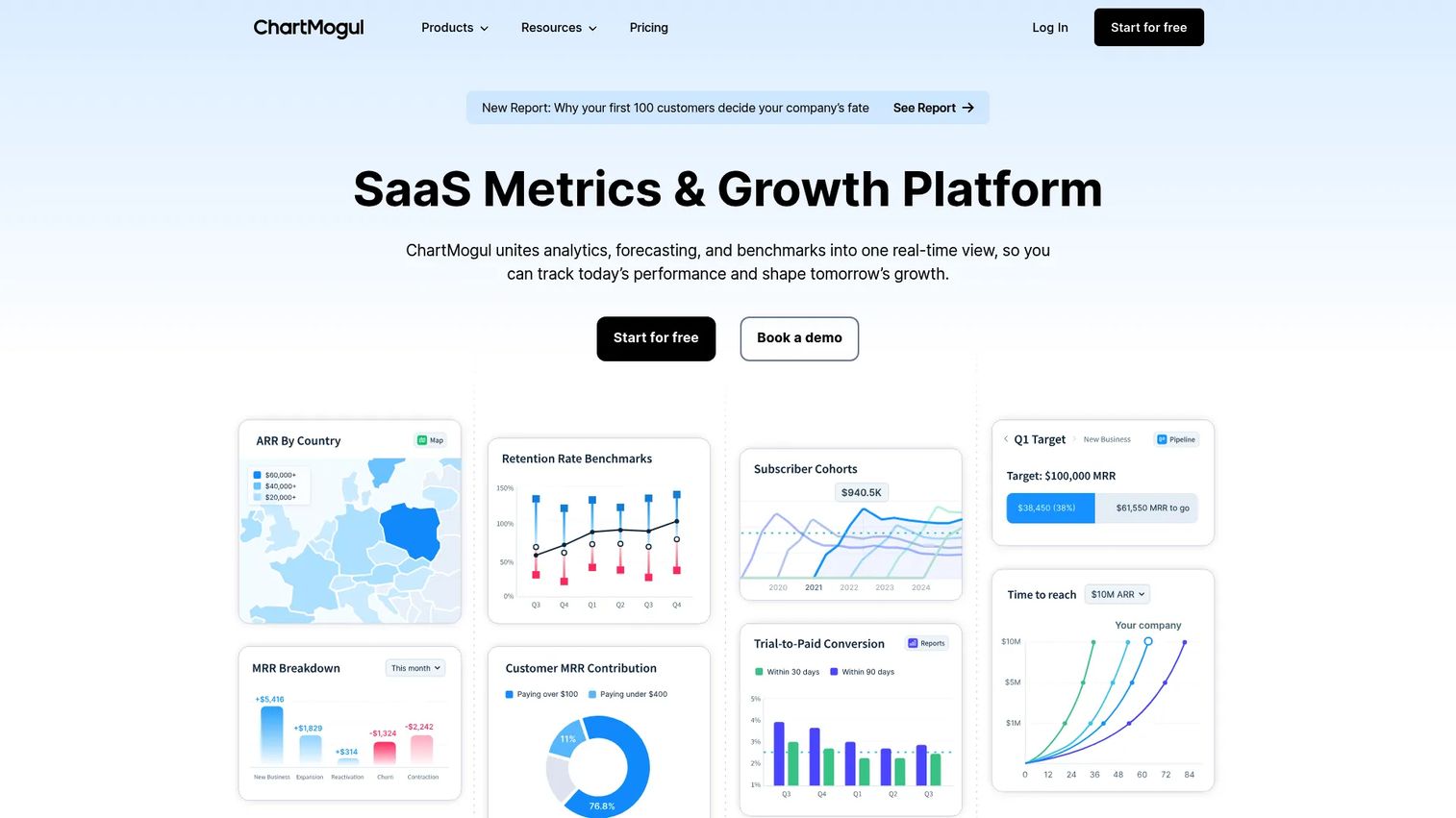
ChartMogul is a subscription analytics and growth platform built for SaaS businesses, with a built-in CRM and forecasting layer on top of clean recurring-revenue reporting. It pulls data from billing platforms and CRM systems, normalizes it, and surfaces MRR, ARR, churn, and LTV in a way that finance and GTM teams can both trust. Where it stands apart is the work it does on data quality before the numbers ever hit a dashboard.
Best for: SaaS teams that need subscription metrics, forecasting, and a CRM in one platform, with reconciled numbers they can defend.
Key strengths
- Metric accuracy and data cleansing: Duplicate merging and subscriber matching mean your MRR analytics reconcile instead of drifting across sources.
- Cohort analysis and benchmarks: Track retention by cohort and compare your numbers against industry benchmarks to see where you actually stand.
- Forecasting and built-in CRM: Model revenue forward and manage subscription relationships in the same tool, so signal does not get stranded in a separate system.
Why choose ChartMogul: If your core problem is that nobody trusts the MRR number, ChartMogul is the strongest fit on this list. It treats data cleanliness as a first-class job rather than an afterthought, which is what separates a dashboard you reference in a board meeting from one you have to caveat. Teams that have outgrown spreadsheet reconciliation and want recurring revenue analytics they can stand behind get the most value here.
ChartMogul pricing: ChartMogul is free up to $10K MRR, which makes it accessible for early-stage teams. Paid plans are usage-based: the Starter plan begins at $59 per month billed annually, and the Pro plan at $99 per month billed annually. Enterprise pricing starts from $19,900 per year, billed annually, for larger customers. The free tier and trial let you validate the data quality before committing.
2. Baremetrics
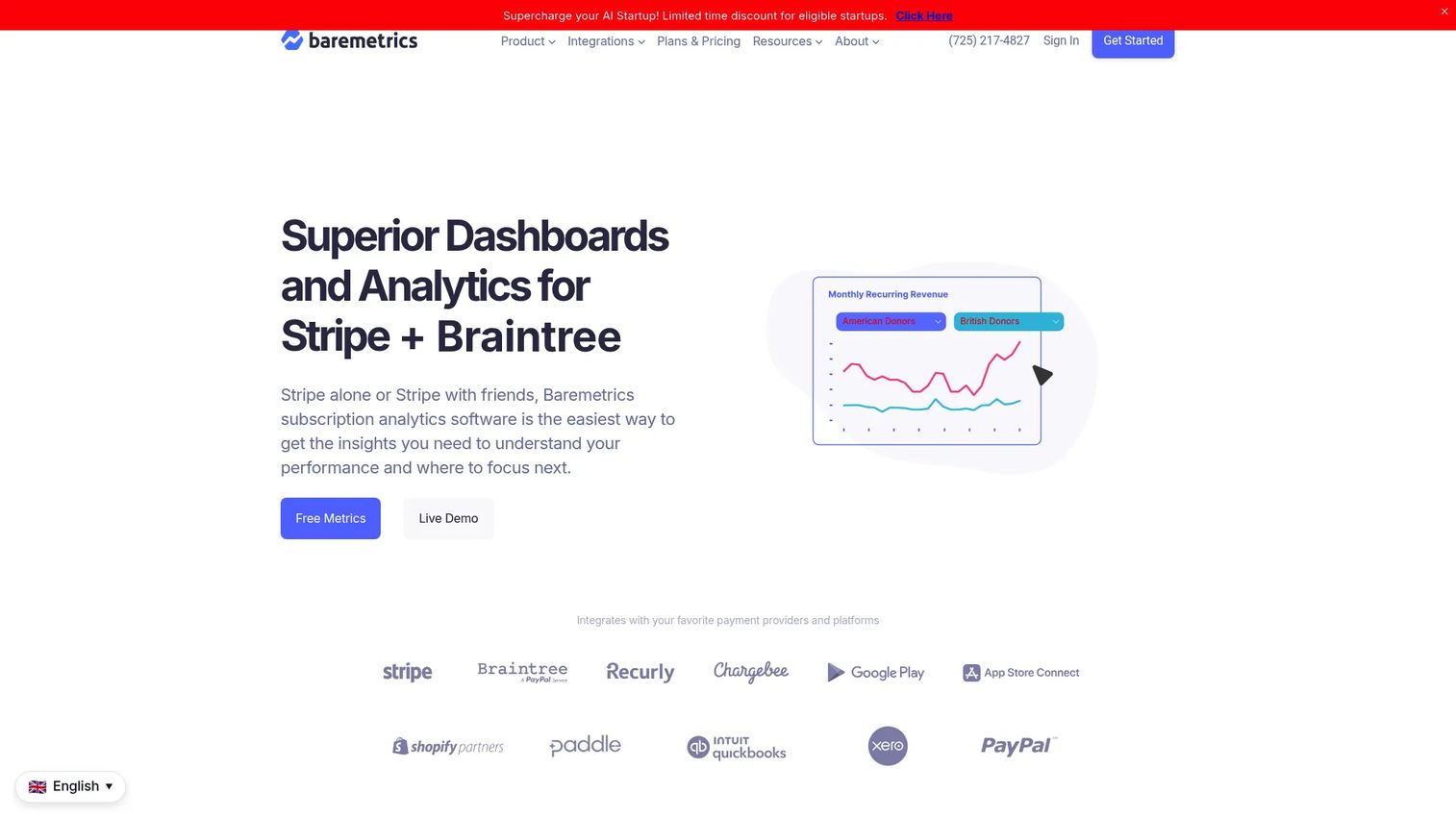
Baremetrics is subscription analytics and payment recovery software built for SaaS businesses that want visibility fast. Connect a billing source and you get a live dashboard covering 28+ metrics, including MRR, ARR, churn, upgrades, and downgrades, without a long configuration project. It is the founder-friendly option: the kind of tool a lean team stands up in an afternoon and actually keeps using.
Best for: Solo founders and lean SaaS teams that want broad subscription metrics coverage and revenue recovery without heavy setup.
Key strengths
- Fast setup and broad coverage: 28+ metrics live shortly after connecting a billing source, so visibility does not wait on an implementation cycle.
- Trial and forecasting insights: Automated email reports and trial insights keep the whole team looking at the same numbers without logging in.
- Payment recovery and cancellation insights: Recover failed payments and understand why customers cancel, turning churn analysis into recovered revenue.
Why choose Baremetrics: The case for Baremetrics is speed and clarity. Founders who want to know their numbers today, not after a two-week onboarding, get exactly that. The payment recovery and cancellation insights also turn the tool from a passive reporting layer into something that directly protects revenue, which matters when every dollar of churn reduction counts.
Baremetrics pricing: The Launch plan starts at $75 per month. Baremetrics also offers add-on capabilities priced separately, including Metrics at $108 per month, Recover at $58 per month, and Cancellation Insights at $108 per month, with a Payment Recovery add-on at +$129 per month. A free trial is available, so you can connect your data and see your metrics before paying.
3. Recurly
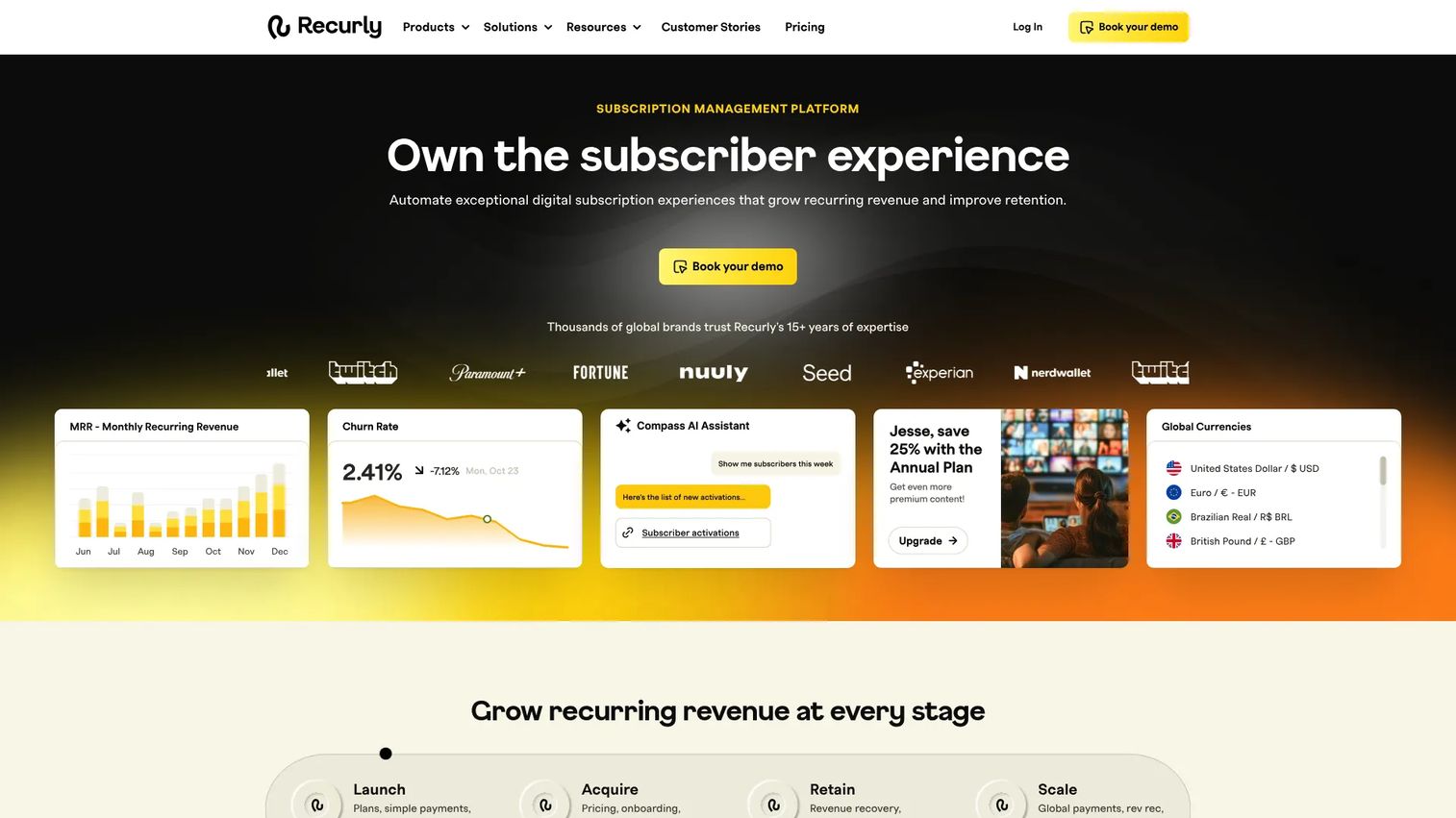
Recurly is a subscription management and recurring billing platform with analytics attached. Where the pure analytics tools read your billing data, Recurly is the billing engine itself: it manages plans, pricing, promotions, dunning, and payment orchestration, then reports on the revenue that flows through it. For teams that want operational billing depth and revenue reporting in one system, that integration is the draw.
Best for: Subscription businesses that need billing, churn management, and revenue recovery at scale, with reporting built into the same platform.
Key strengths
- Plans, pricing, and promotions: Manage the full catalog of subscription offers and pricing logic without bolting on a separate billing layer.
- Subscriber management and dunning: Handle the subscriber lifecycle and automate dunning to recover failed payments before they become churn.
- Recurring billing and payments orchestration: Route payments intelligently and keep recurring revenue flowing across providers.
Why choose Recurly: Choose Recurly when your priority is operational billing, not just reporting on it. If you are running subscription operations at scale and want the billing engine and the revenue workflows in one place, the analytics come as part of the system rather than a separate integration. Teams that already have analytics covered but need a stronger billing backbone are the natural fit.
Recurly pricing: The Starter plan is $249 per month plus 0.9% of billing volume, and includes a 90-day free trial. The All-Access plan is priced as low as under 1% of billing volume, billed annually, and the Engage plan starts as low as $1,600 per month, billed annually. Recurly also invites larger customers to contact sales for custom pricing structures.
4. Chargebee
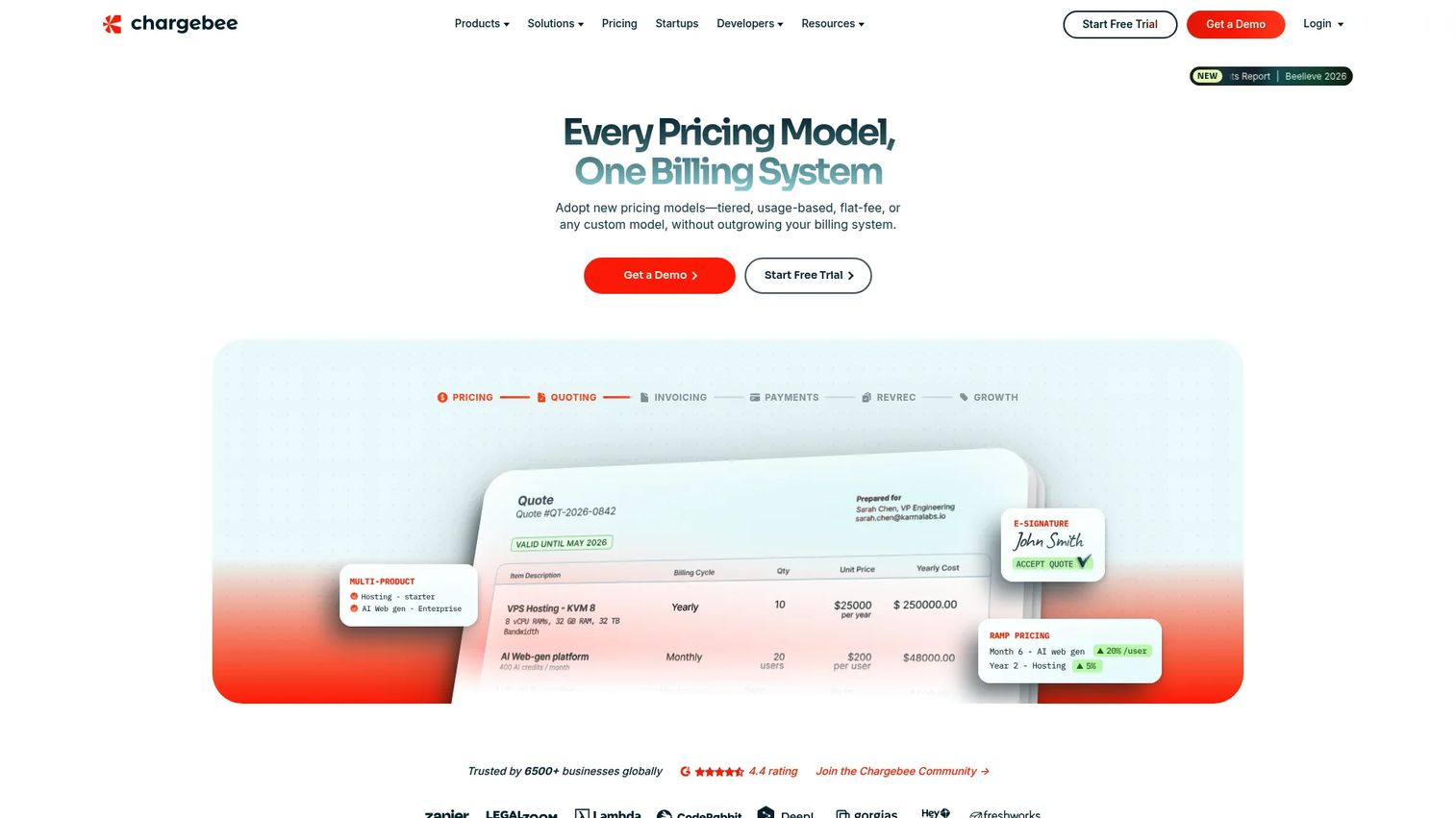
Chargebee is a subscription billing and monetization platform for recurring-revenue businesses. It covers recurring billing, invoicing, usage-based billing, and revenue recognition, with analytics and reporting layered on top. Compared with Recurly, Chargebee leans toward broader monetization workflows, including quote-to-cash capabilities, which makes it a fit for teams that want billing operations and revenue reporting under one roof.
Best for: Teams needing subscription billing, invoicing, and monetization automation alongside revenue reporting.
Key strengths
- Recurring billing and invoicing: Automate the full billing cycle, from subscription creation to invoice delivery, across plans and currencies.
- Usage-based billing: Meter and bill on consumption, which matters for the growing share of SaaS products priced on usage.
- Revenue recognition and reporting: Recognize revenue correctly and report on recurring-revenue movements without exporting to a separate finance tool.
Why choose Chargebee: Chargebee fits teams that have outgrown a simple billing setup and want monetization, billing, and revenue management in one platform. Its quote-to-cash and revenue recognition features make it more than a billing engine, which appeals to finance and RevOps teams that want fewer systems to reconcile. If your needs are purely analytics, a dedicated reporting tool may serve you faster, but for billing plus analytics breadth, Chargebee covers a lot of ground.
Chargebee pricing: Chargebee offers a free Starter plan that covers the first US$250K of cumulative billing, then charges 0.75% on billing. A CPQ Lite offer is free for the first 50 quotes for Chargebee Billing customers, with a full CPQ plan available by talking to sales. The Performance plan is quoted on request, and the Enterprise plan uses scalable custom pricing based on active subscribers.
5. ProfitWell
ProfitWell is subscription revenue metrics and retention software for SaaS and recurring-revenue businesses. It is best known for free, accurate subscription metrics that sit on top of your existing billing and payment tools, plus a strong focus on churn and retention analytics. Teams that already have billing handled and want a dedicated lens on revenue intelligence and retention reach for ProfitWell.
Best for: SaaS teams that want subscription metrics and churn analysis that complement an existing billing system.
Key strengths
- Subscription revenue metrics: Accurate MRR, ARR, and recurring-revenue movements pulled from your billing and payment data.
- Churn and retention analytics: A dedicated focus on understanding and reducing churn, which feeds directly into retention and expansion plays.
- Billing and payment integrations: Connects to common billing and payment tools, so it layers onto your stack rather than replacing it.
Why choose ProfitWell: ProfitWell earns its spot for teams whose primary question is retention. The metrics are accurate and the churn analysis is genuinely useful for shaping growth strategy. Because it complements billing systems rather than replacing them, it is a low-friction addition for teams that want revenue intelligence without re-platforming. It carries the highest G2 rating on this list, which reflects how reliably it does its core job.
ProfitWell pricing: ProfitWell's core metrics product is offered free. Signup is described as absolutely free, and the live demo gives the full experience at no cost, so teams can start measuring recurring revenue without a budget approval. For retention-specific and revenue-recovery capabilities beyond the free metrics, you contact the team for details.
6. glew.io
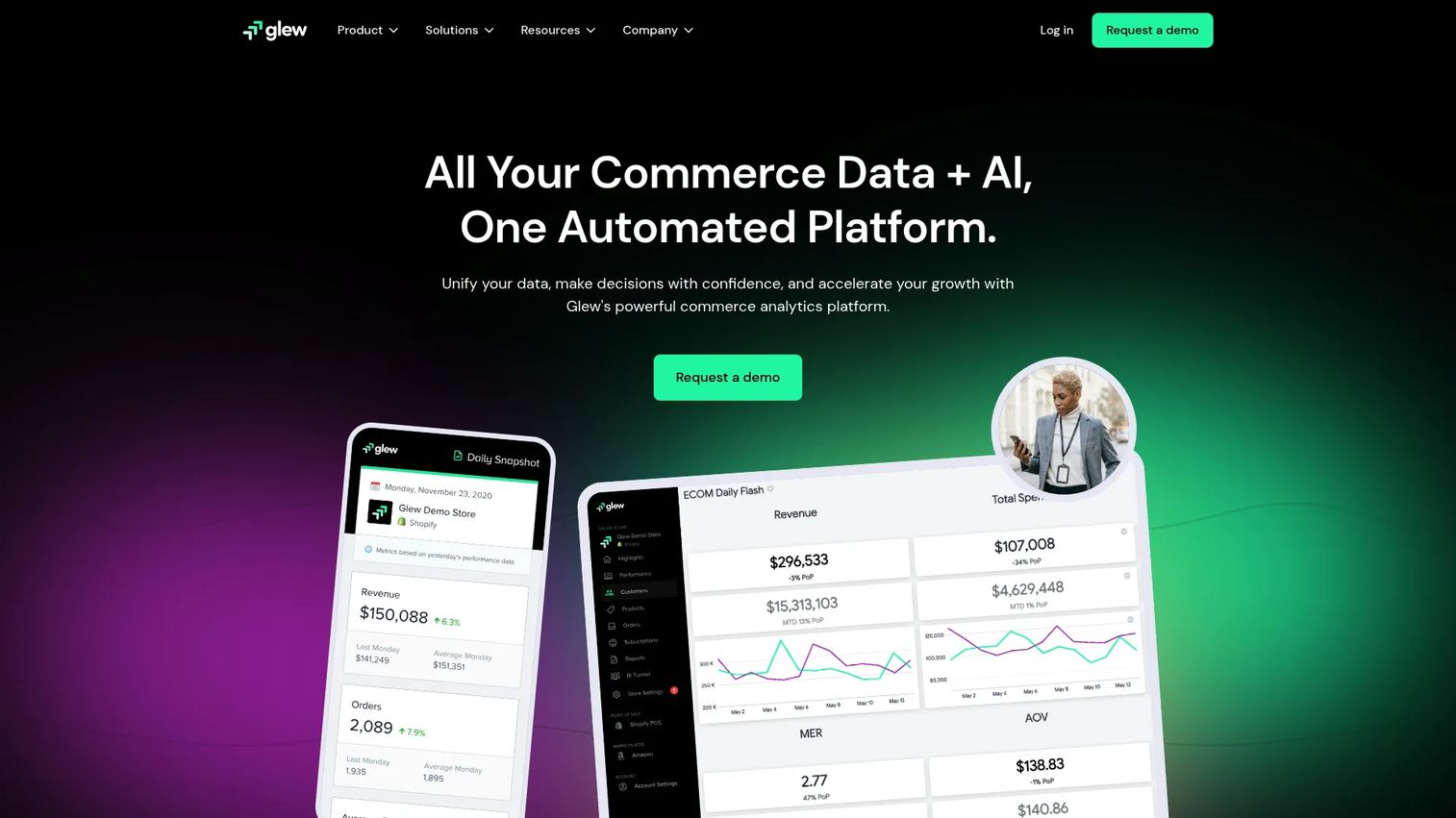
glew.io is a commerce data cloud for ecommerce analytics, reporting, and data warehousing. It fits the warehouse-first reader: teams that want unified business intelligence across channels, not just a subscription metrics view. With 170+ integrations, fully managed ETL, and a built-in data warehouse, it brings recurring revenue into the same picture as the rest of the commerce business.
Best for: Commerce brands that need multichannel analytics, reporting, and warehousing in one platform, including recurring and subscription revenue.
Key strengths
- No-code custom reporting: Build the reports your team actually needs without waiting on a data engineer.
- Fully managed ETL and data warehouse: Centralize data from 170+ sources into a managed warehouse, so reporting sits on a single clean foundation.
- Daily email snapshot: A daily digest keeps stakeholders aligned on the numbers without anyone opening a dashboard.
Why choose glew.io: glew.io is the pick when subscription metrics are one slice of a bigger reporting problem. Brands that blend ecommerce and recurring revenue, and want segmentation, warehousing, and BI in one place, get more from glew.io than from a subscription-only tool. The warehouse orientation also means your data stays portable and you are not locked into one narrow reporting view.
glew.io pricing: glew.io lists Glew Pro, which requires annual prepayment, and Glew Plus, which is custom pricing tailored to your needs. A free trial is available so you can evaluate the platform before committing. Exact numeric pricing is not published, so request a quote for figures specific to your channels and data volume.
7. Saras Analytics

Saras Analytics is an AI data layer and ecommerce analytics platform for Shopify and omnichannel brands. Its product family pairs Daton, an ETL and data replication tool with 200+ connectors, with Pulse, an ecommerce intelligence layer for dashboards and reporting. For teams weighing build versus buy, Saras sits in the middle: more customization and data plumbing than a packaged metrics tool, without standing up a pipeline from scratch.
Best for: Ecommerce and omnichannel brands that need unified data pipelines and reporting, with room for custom dashboards.
Key strengths
- Daton ETL with 200+ connectors: Replicate data from a wide range of sources into your warehouse, which is the foundation for any custom reporting.
- Pulse ecommerce intelligence: Prebuilt dashboards and reporting for omnichannel brands, so you are not building every view by hand.
- AI and forecasting capabilities: AI/ML and forecasting tools that extend reporting into prediction for omnichannel revenue.
Why choose Saras Analytics: Saras fits teams that need more than a fixed dashboard but do not want to own a full data engineering effort. The Daton-plus-Pulse combination gives you control over the pipeline and ready-made intelligence on top, which is the practical middle ground in a build-versus-buy decision. Brands that have outgrown packaged tools but are not ready to staff a data team get the most value here.
Saras Analytics pricing: Daton offers a free Lite plan, a Growth plan at $95 per month, and a custom Enterprise plan. Pulse starts with a Lite plan at $300 per month, with Growth and Enterprise plans priced through a sales conversation. The mix of a free entry point and custom higher tiers means you can start small and scale the data layer as your reporting needs grow.
Considerations before you buy
A shortlist gets you partway. Before you commit, evaluate each tool against the realities of your data and team.
Metric accuracy and data cleansing
The headline number on a dashboard is only as good as the data behind it. Ask how each tool handles duplicate merging, subscriber matching, and reconciliation across billing sources. A tool that produces a clean MRR figure on messy real-world data is worth far more than one that looks polished on a demo dataset.
Integration depth
List your actual sources: billing platforms, CRM, payment processors, warehouses. Confirm each tool connects to all of them natively, not through a fragile workaround. Billing and CRM integration is where most subscription reporting tools either earn their keep or create new reconciliation work.
Forecasting and reporting speed
Decide whether you need true scenario modeling or just clean historical reporting. Then check how close to real time the dashboards refresh. Real-time subscription metrics matter more for fast-moving GTM teams than for monthly finance reviews, so match the tool to your cadence.
Maintenance load
Every tool carries an ongoing cost in attention. A founder-friendly tool that runs itself fits a lean team; a warehouse-first platform rewards teams with data capacity. Be honest about how much maintenance you can actually support before you choose.
Build versus buy
If your needs are standard recurring-revenue metrics, buying a packaged tool is almost always faster and cheaper than building. If you need deeply custom reporting across many sources, a pipeline-oriented platform or a build approach may pay off. Match the decision to the genuine complexity of your data, not to what sounds impressive.
Conclusion
The right subscription analytics software depends less on the feature list and more on your data complexity, reporting needs, and how much maintenance your team can carry.
For metric trust and clean reporting, ChartMogul is the strongest pick, with data cleansing treated as a first-class job. Baremetrics wins on fast, founder-friendly visibility for lean teams. Recurly and Chargebee fit teams that want broader billing workflows with analytics attached, with Chargebee leaning toward wider monetization. ProfitWell is the choice for retention-focused revenue intelligence that layers onto existing billing, while glew.io and Saras Analytics serve teams that need warehouse-first reporting and custom data pipelines across commerce and recurring revenue.
Start with the problem you are actually trying to solve. If nobody trusts the MRR number, fix data quality first. If churn is eating growth, prioritize retention analytics. Then pick the tool that matches your data, your cadence, and the maintenance you can realistically support.
Start your journey with Guideflow today!
FAQs
Subscription analytics software measures recurring-revenue metrics like MRR and ARR, churn and retention, LTV and the LTV CAC ratio, expansion and reactivation, and cohort behavior over time. It pulls this from billing and payment data, normalizes it, and presents the metrics that drive recurring-revenue decisions in one place.
Web analytics tracks visits, sessions, and conversions on your site. Subscription analytics tracks the financial health of a recurring-revenue business: how revenue grows, contracts, and churns over time. One tells you how people behave on a page; the other tells you whether your business model is durable and profitable.
MRR and ARR show the size and direction of recurring revenue, while churn and retention show whether that growth holds. The LTV CAC ratio tells you if acquisition is efficient, and cohort analysis reveals which customer segments actually retain. Most teams watch net revenue retention closely, since it captures expansion and churn in a single number.
Billing platforms like Stripe and Chargebee report on the data flowing through them, but they were not built as dedicated analytics layers. A subscription analytics tool unifies data across sources, handles duplicate merging and reconciliation, and adds cohort analysis and forecasting. If one billing system holds all your data and its reporting meets your needs, you may not need a separate tool yet; if data lives in multiple places, you likely will.
Look for metric accuracy first, meaning the numbers reconcile across sources and survive scrutiny. Then check integration depth with your billing and CRM systems, cohort and retention views, forecasting capability, and how close to real time the data refreshes. A clean dashboard on messy data is worse than a plain one you can trust.
The strongest tools handle duplicate merging, subscriber matching, and reconciliation across billing sources before surfacing any number. This is what separates trustworthy recurring revenue analytics from a dashboard you constantly second-guess. When evaluating, ask specifically how each tool deduplicates customers and reconciles plan changes, refunds, and migrations.
Many can. Tools with forecasting and scenario modeling let you project MRR and ARR forward, test pricing changes, and model the impact of churn reduction. This is the difference between a dashboard that reports what happened and one that helps leadership plan what comes next.
Buying a packaged tool is usually faster and cheaper for standard recurring-revenue metrics, since the data cleansing and reporting are already solved. Building or using a pipeline-oriented platform makes sense when you need deeply custom reporting across many sources and have the data capacity to maintain it. Match the choice to the genuine complexity of your data, not to ambition.