Two customers want the same excavator on the same Tuesday. One booking lives in a spreadsheet, the other in someone's inbox. Nobody catches it until the truck is loaded and the second customer is already on-site. That is not a rare edge case. It is what happens when your inventory and availability tracking runs on memory and manual coordination instead of a system built for it.
The global equipment rental software market is projected to grow from US$284.6M in 2023 to US$504.1M by 2031, a 7.4% CAGR, according to The Insight Partners (2024). That growth is not vanity. It reflects operators moving off spreadsheets and toward rental equipment management software that keeps assets visible, prevents double bookings, and tightens the gap between a quote and a paid invoice.
If you run rental operations, the real problem is rarely one feature. It is that quoting, reservations, invoicing, payments, maintenance, and dispatch live in separate places. Every handoff is where revenue leaks and where your team spends time reconstructing what already happened. The right software for equipment rental collapses those handoffs into one operating picture. This guide compares seven platforms so you can shortlist the two or three worth a live demo, without wading through vendor landing pages that all claim to be the best.
What's inside
This guide is for rental operators, operations leaders, and founders evaluating equipment rental management software to control inventory, reservations, maintenance, dispatch, billing, and reporting across one or many locations. We selected these seven platforms on four criteria: operational coverage across the full rental lifecycle, fit for multi-location or multi-warehouse businesses, integration depth with accounting and payment systems, and reporting that gives leadership clean operating data. We prioritized tools with verifiable pricing, real market presence, and honest strengths for specific rental verticals rather than a generic feature checklist.
TL;DR
- Best overall for broad rental operations: Point of Rental, with deep coverage across inventory, dispatch, maintenance, and ecommerce plus wide vertical breadth.
- Best for real-time availability and warehouse coordination: Rentman, with minute-level scheduling and multi-warehouse control.
- Best for all-in-one storefront and self-service booking: Quipli, with a customer portal, online storefront, and QuickBooks Online sync.
- Best for smaller teams that want simpler setup: Booqable, with straightforward online bookings and a hosted booking page starting at $29/month.
- Best for AV, event, and production rental: Current RMS, with cloud operations built for that vertical.
- Best for complex or enterprise operations: Wynne Systems and InTempo Software, both built for scale, fleet visibility, and operational control.
What is equipment rental software?
Equipment rental software is a system that manages the full rental lifecycle: tracking assets, booking reservations, generating quotes and contracts, invoicing customers, scheduling maintenance, and coordinating delivery and pickup across one or more locations.
Unlike generic inventory tools, rental software for equipment is built around the reality that assets go out and come back, generate revenue over time, need service between rentals, and cannot be double-committed. Core capabilities include:
- Asset tracking: real-time availability across locations, often with QR, barcode, or RFID scanning and GPS or telematics for fleet visibility.
- Quotes and reservations: fast quoting, contract generation, e-signatures, and reservation logic that prevents double bookings.
- Invoicing and payments: recurring rental billing, deposits, damage waivers, and payment processing.
- Maintenance, repairs, and inspections: service scheduling tied to asset status so equipment does not get rented while it is down.
- Dispatch and logistics: delivery, pickup, route coordination, and driver assignment.
- Reporting and accounting integration: utilization, revenue, and fleet analytics plus sync to accounting tools like QuickBooks and Xero.
Add a customer portal and ecommerce layer for self-service booking, and you have a system that runs the operation instead of documenting it after the fact. As of mid-2026, GetLatka reports 21 equipment rental software SaaS companies generating US$378.5M in revenue across 51.1K customers, so the category is mature enough that you should expect real operational depth, not just a booking calendar.
When to use equipment rental software
Prevent double bookings and missed returns
The fastest way to lose a customer is to promise equipment you already committed elsewhere. Real-time inventory and availability tracking closes that gap by showing true asset status: on rent, reserved, in service, or available. When a reservation ties directly to a physical asset, the system blocks the conflict before it reaches the yard. Add automated return reminders and overdue flags, and you stop the quiet revenue leakage from assets sitting out longer than the contract without anyone billing for it.
Manage deliveries, pickups, and multi-location coordination
A single-yard operation can survive on whiteboards. A multi-location or multi-warehouse business cannot. As the fleet grows, dispatch, delivery, and pickup become the operation. You need branch-level visibility into what is where, the ability to transfer assets between locations, and route coordination that keeps trucks efficient. Without it, the same excavator shows as available at two branches and neither one can actually deliver it.
Replace spreadsheets and disconnected systems
The clearest trigger to buy is when quoting lives in one place, invoicing in another, maintenance in a third, and reporting in nobody's. Every disconnect is manual reconciliation and a slower month-end close. Centralizing quotes, reservations, invoicing, service, and reporting into one platform gives leadership a single source of truth and removes the founder or ops lead from being the human integration layer.
Comparison table
The table below compares all seven platforms at a glance. Use it to match intent (broad operations, real-time availability, all-in-one, simpler setup, or enterprise scale) to your business, then read the full section on your top two or three. Pricing and ratings reflect verified values where publicly available; some enterprise vendors quote on request.
| # | Product | Intent | Key use case | Pricing | G2 rating |
|---|---|---|---|---|---|
| 1 | Point of Rental | Broad operations | Full-lifecycle rental management with wide vertical breadth | Contact vendor | Not listed |
| 2 | Rentman | Real-time availability | Inventory, crew, and quoting for equipment rental | From €39/month | 4.5/5 |
| 3 | Quipli | All-in-one | Storefront, portal, dispatch, and QuickBooks sync | $6,000/year per location | Not listed |
| 4 | Booqable | Simpler setup | Online bookings plus inventory for smaller teams | From $29/month | 4.8/5 |
| 5 | Current RMS | Vertical fit | Cloud operations for AV, event, and production rental | From $79/month | 3.5/5 |
| 6 | InTempo Software | Complex operations | ERP-style rental management with service and accounting | Contact vendor | Not listed |
| 7 | Wynne Systems | Enterprise scale | Enterprise rental ERP for fleet and tool operations | Contact vendor | 3.7/5 |
1. Point of Rental
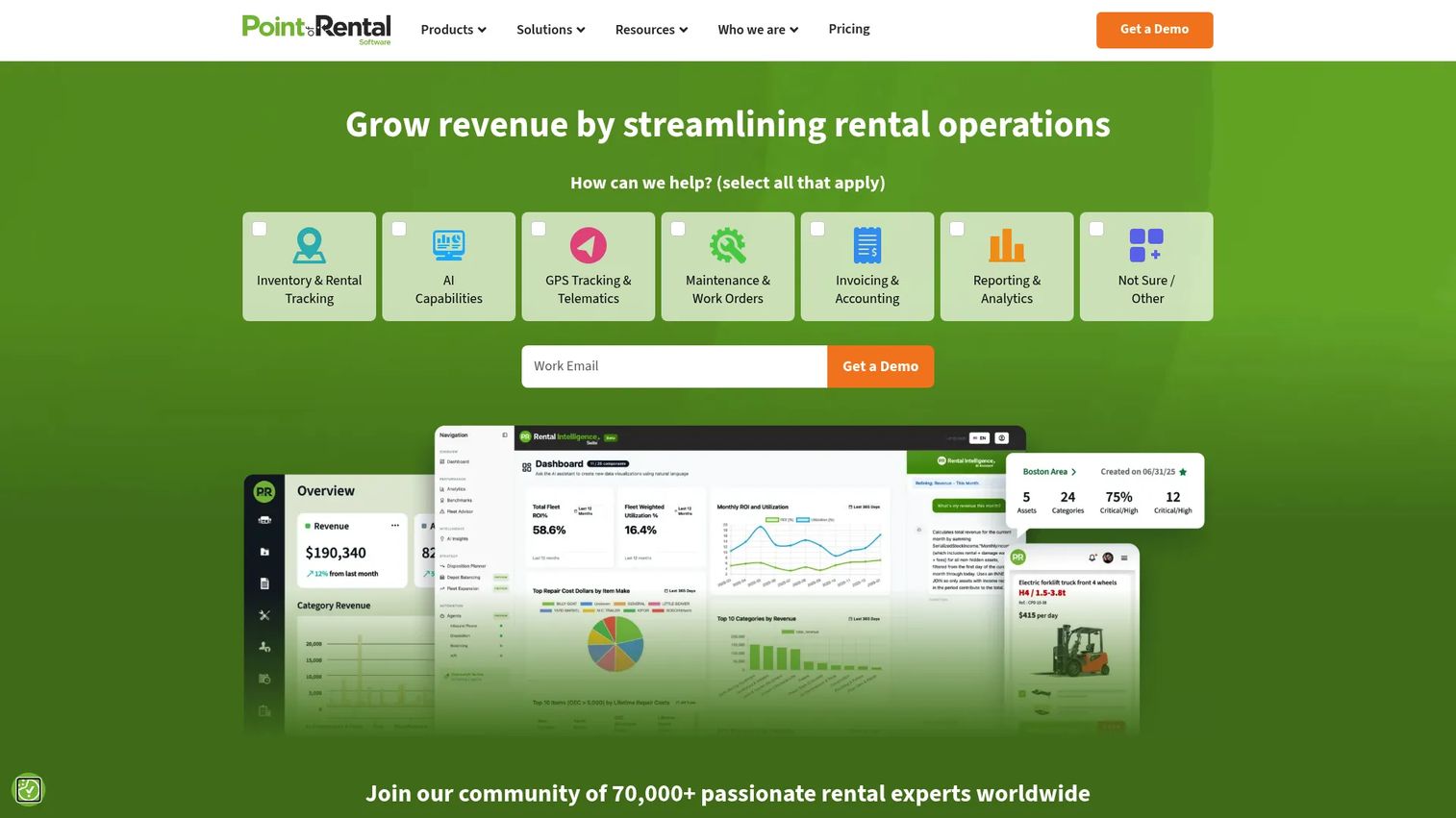
Point of Rental is one of the most established names in equipment rental management software, built to run the full rental lifecycle for businesses that outgrew spreadsheets and want breadth across every workflow. It covers rental management, inventory, and billing, and extends into dispatch, maintenance, ecommerce, and multi-location operations. If your operation spans heavy equipment, tool rental, event rental, and construction rental, its vertical breadth is a real advantage.
Best for: Established rental businesses that need broad operational coverage across many workflows and verticals.
Key strengths
- End-to-end rental management: Inventory, quoting, reservations, invoicing, and payments in one system, so handoffs stop leaking revenue.
- Dispatch and maintenance built in: Delivery, pickup, and service scheduling tie to asset status, keeping down equipment off the availability list.
- Multi-location and ecommerce: Branch-level visibility plus an online storefront and customer portal for self-service booking.
Why choose Point of Rental: The pull here is breadth. If you run a complex operation with multiple locations and mixed inventory, having inventory, dispatch, maintenance, and ecommerce under one roof reduces the number of systems your team has to reconcile. It is a fit for operators who want depth over a lightweight booking tool and are ready to invest in a platform they will grow into.
Point of Rental pricing: Point of Rental does not publish public pricing on its own site, and Capterra lists it as contact vendor for pricing. Expect a sales conversation and a quote scoped to your operation size, location count, and module needs rather than a flat published rate. Ask specifically about implementation and onboarding scope when you request a demo.
2. Rentman
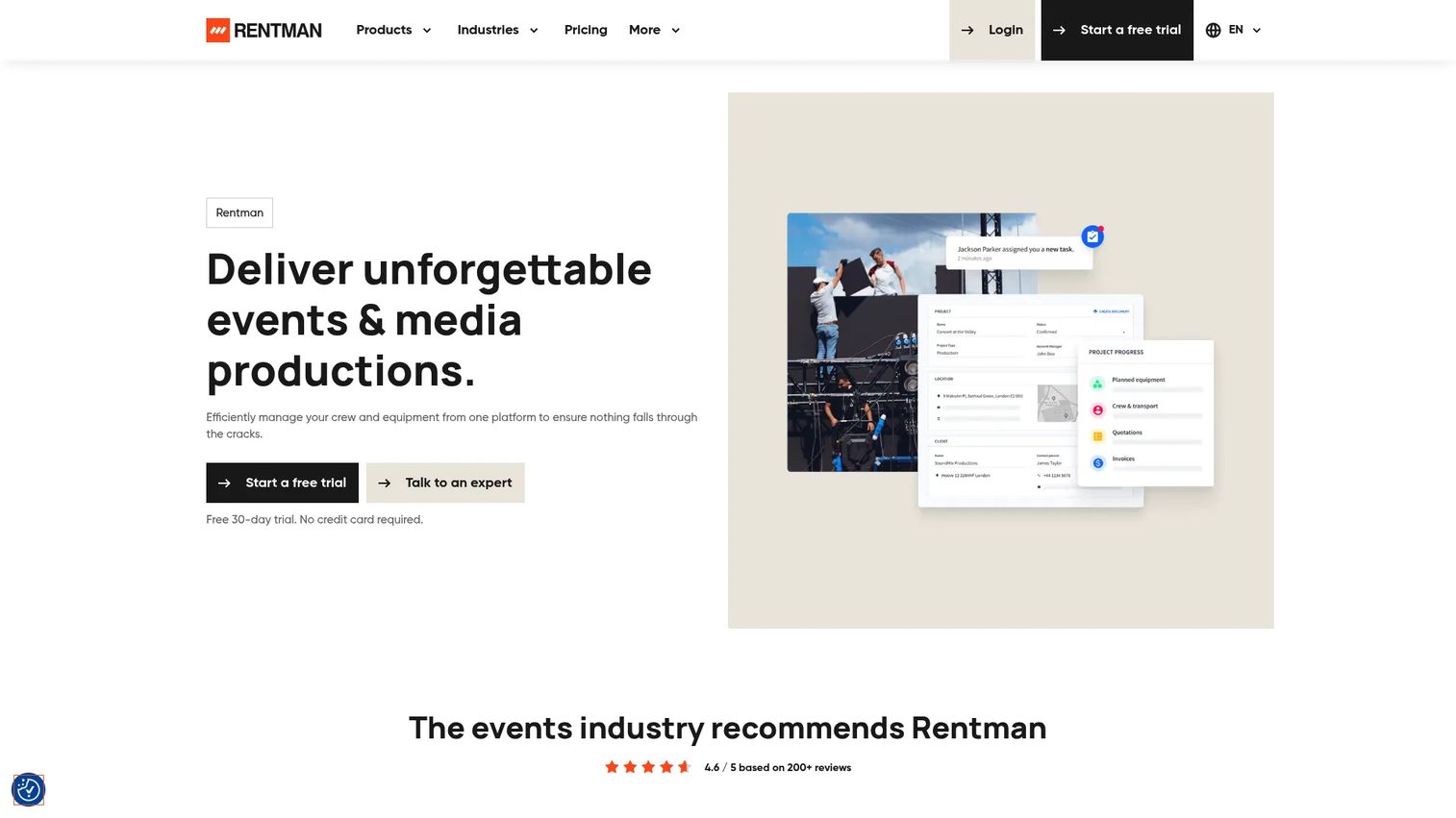
Rentman is rental management software built around inventory scheduling, crew planning, and quoting, with a strong emphasis on real-time availability and minute-level planning. If your operation lives or dies on knowing exactly what is available at what time across warehouses, this is where Rentman is strongest. It unifies inventory and equipment scheduling, crew scheduling and time tracking, and quoting, invoicing, and online payments.
Best for: Equipment rental businesses that need unified inventory, crew, and quoting with tight availability control.
Key strengths
- Real-time availability: Minute-level scheduling and multi-warehouse control that prevents double bookings before they happen.
- Crew and resource planning: Crew scheduling and time tracking alongside equipment, so labor and assets plan together.
- Quoting to payment: Quotes, invoicing, and online payments in one flow, with accounting and integration coverage.
Why choose Rentman: Rentman earns a 4.5/5 on G2, and its planning depth is the differentiator. For operators juggling equipment and crew across multiple warehouses, seeing availability at a granular level removes the guesswork that causes conflicts. It fits teams that treat scheduling precision as the core of the operation, not an afterthought.
Rentman pricing: Rentman uses a modular model. The base Rentman Platform starts at €39/month, with add-on products for inventory (from €14/power user/month), crew (from €14/power user/month), and quoting and invoicing (€9/power user/month). Additional warehouses run €5 per warehouse per power user per month. Basic users are always free, and a 30-day free trial is available. An Enterprise option is offered on an invite-only basis.
3. Quipli
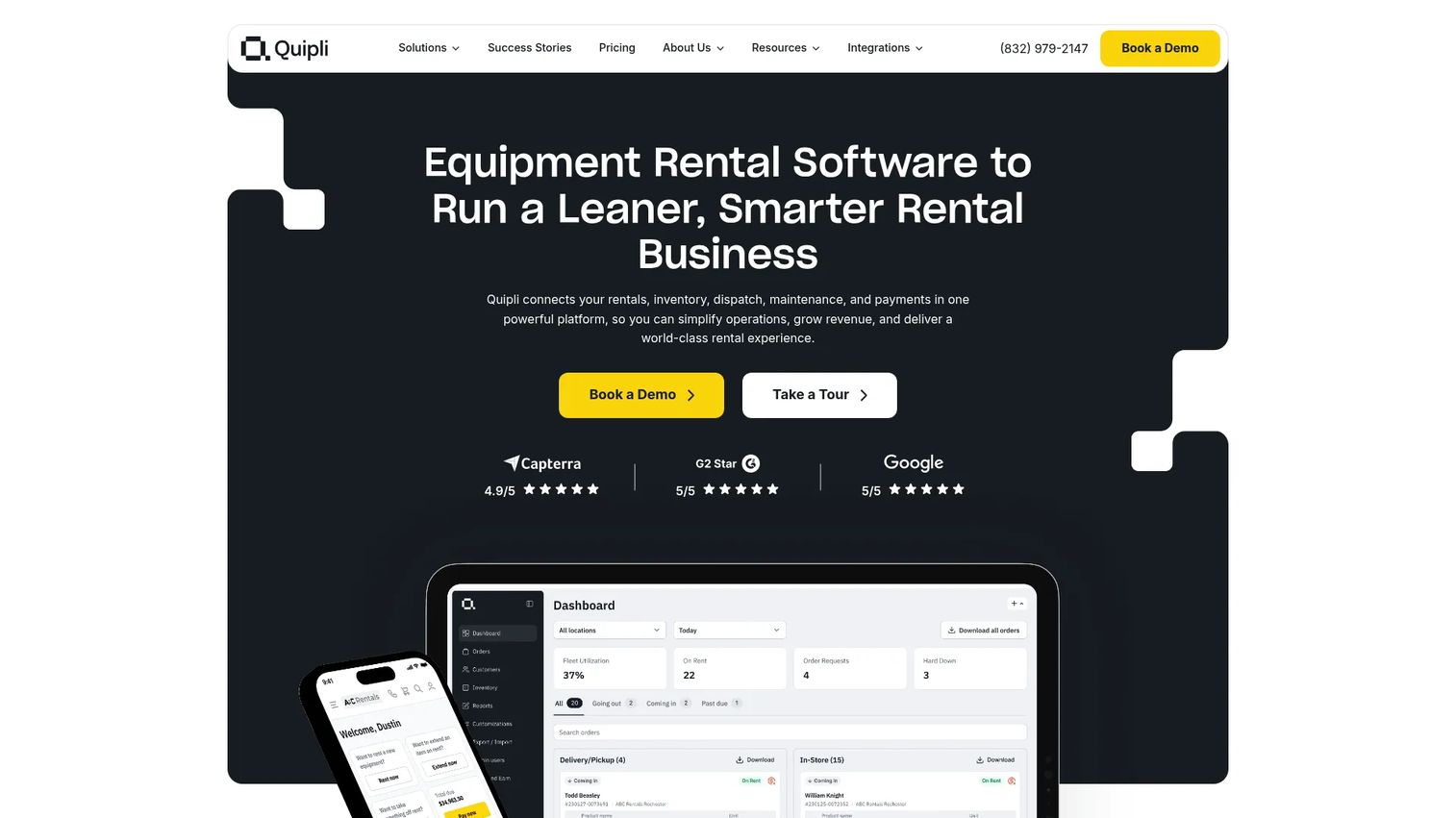
Quipli is all-in-one equipment rental software built to unify inventory, an online storefront, service and repair, dispatch, and payments in a single platform. It leans hard into self-service: customers browse and book through a hosted storefront and customer portal, while your team manages the operation behind it. It also syncs with QuickBooks Online, which matters if your accounting already lives there.
Best for: Heavy equipment and general tool rental companies that want a unified system with self-service booking.
Key strengths
- Storefront and customer portal: Online ecommerce and self-service booking that lets customers reserve without a phone call.
- Service and repair tracking: Maintenance workflows tied to inventory so equipment status stays accurate.
- Dispatch and accounting sync: Delivery and pickup coordination plus QuickBooks Online integration for clean books.
Why choose Quipli: Quipli's appeal is unified operations with transparent pricing, a rarity in this category. If you want inventory, storefront, dispatch, and service in one place without stitching modules together, it is a strong fit. Rental protection features and the self-service storefront also help shift low-value booking calls off your team.
Quipli pricing: Quipli uses a flat annual subscription of $6,000 per year, per location, with unlimited users and inventory and no implementation fees mentioned. That transparency makes it easy to model cost as you add locations, unlike vendors that quote everything on request. There is no free tier, so budget for the annual commitment per site.
4. Booqable
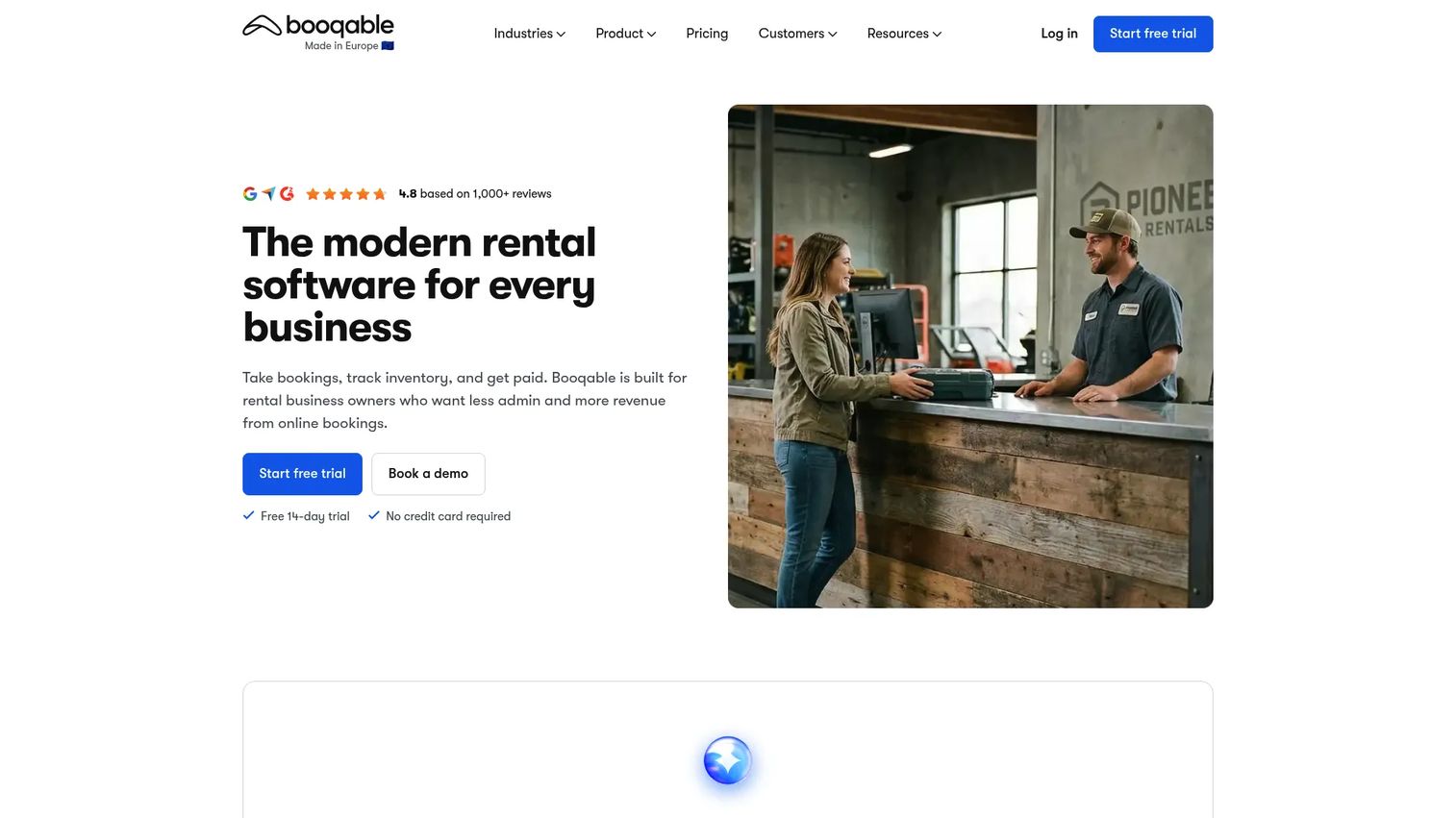
Booqable is rental software focused on managing inventory, bookings, payments, documents, and a booking website, aimed at teams that want to start taking online reservations quickly. It pairs inventory and availability tracking with quotes, contracts, and invoices, and includes a website builder and hosted booking page. For a smaller team that wants ecommerce and reservations without a heavy implementation, it is a practical starting point.
Best for: Equipment and rental businesses that need online bookings plus inventory management without complexity.
Key strengths
- Hosted booking page: A website builder and booking page so customers can self-serve reservations fast.
- Inventory and availability: Real-time availability tracking that keeps bookings accurate and prevents double bookings.
- Documents and payments: Quotes, contracts, invoices, and payments handled in one place.
Why choose Booqable: Booqable holds a 4.8/5 on G2 and stands out for usability and speed to launch. It performs best for smaller operations and teams prioritizing straightforward online bookings over deep dispatch and enterprise logistics. Larger multi-location fleets with heavy delivery routing will lean toward the heavier operations platforms on this list, but for getting a clean booking flow live fast, Booqable is hard to beat.
Booqable pricing: Booqable offers three paid plans: Start at $29/month, Grow at $69/month, and Scale at $149/month, all billed monthly. Yearly billing shows a 20% saving. There is a 14-day free trial and no permanent free tier, so you can validate the fit before committing.
5. Current RMS
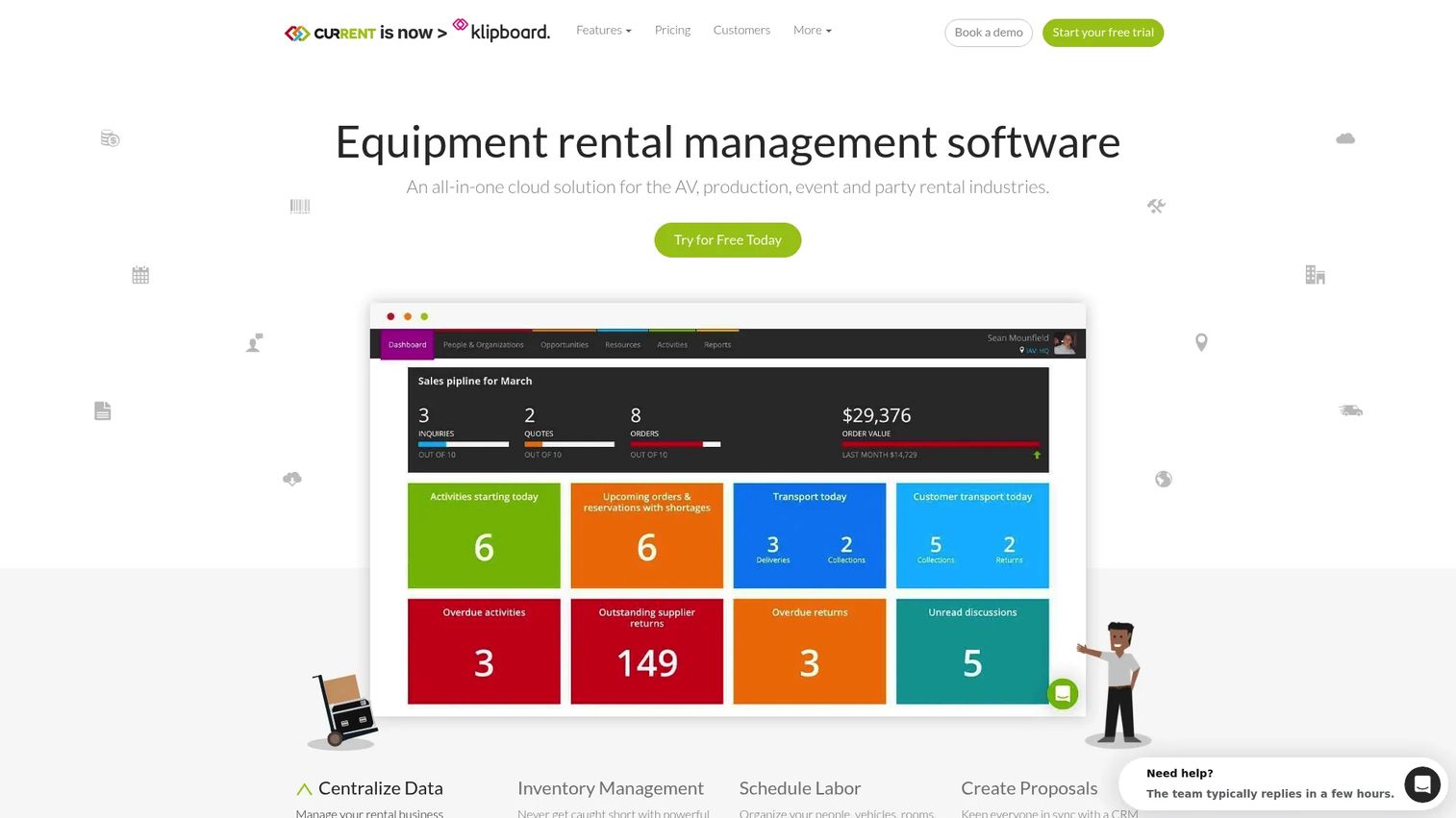
Current RMS is cloud-based rental management software built for AV, production, event, and party rental businesses. If your operation is in one of those verticals, its workflows map closely to how you actually work: inventory tracking, labor and resource scheduling, and online proposals with e-signatures. It handles ordering, invoicing, and workflow control in a browser-based system that does not require on-premise infrastructure.
Best for: Rental operators in AV, production, events, or party hire who need cloud-based operations management.
Key strengths
- Vertical-fit workflows: Built for AV, event, and production rental, so scheduling and resourcing match the work.
- Labor and resource scheduling: Plan crew and equipment together across jobs and events.
- Proposals and e-signatures: Online proposals with e-signatures to move quotes to confirmed bookings faster.
Why choose Current RMS: The case for Current RMS is specialization. Generic rental software makes AV and event operators bend their process to fit the tool. Current RMS is shaped around that vertical, which reduces workarounds. It includes unlimited support and training, automatic free updates, and data backups, which matters for teams without dedicated IT.
Current RMS pricing: Current RMS uses single-package pricing starting at $79 per month for the first user, then $49 per month for each additional user, with region-based currency options. There is a 30-day free trial with no card details required and no permanent free tier, so you can test the full workflow before paying.
6. InTempo Software
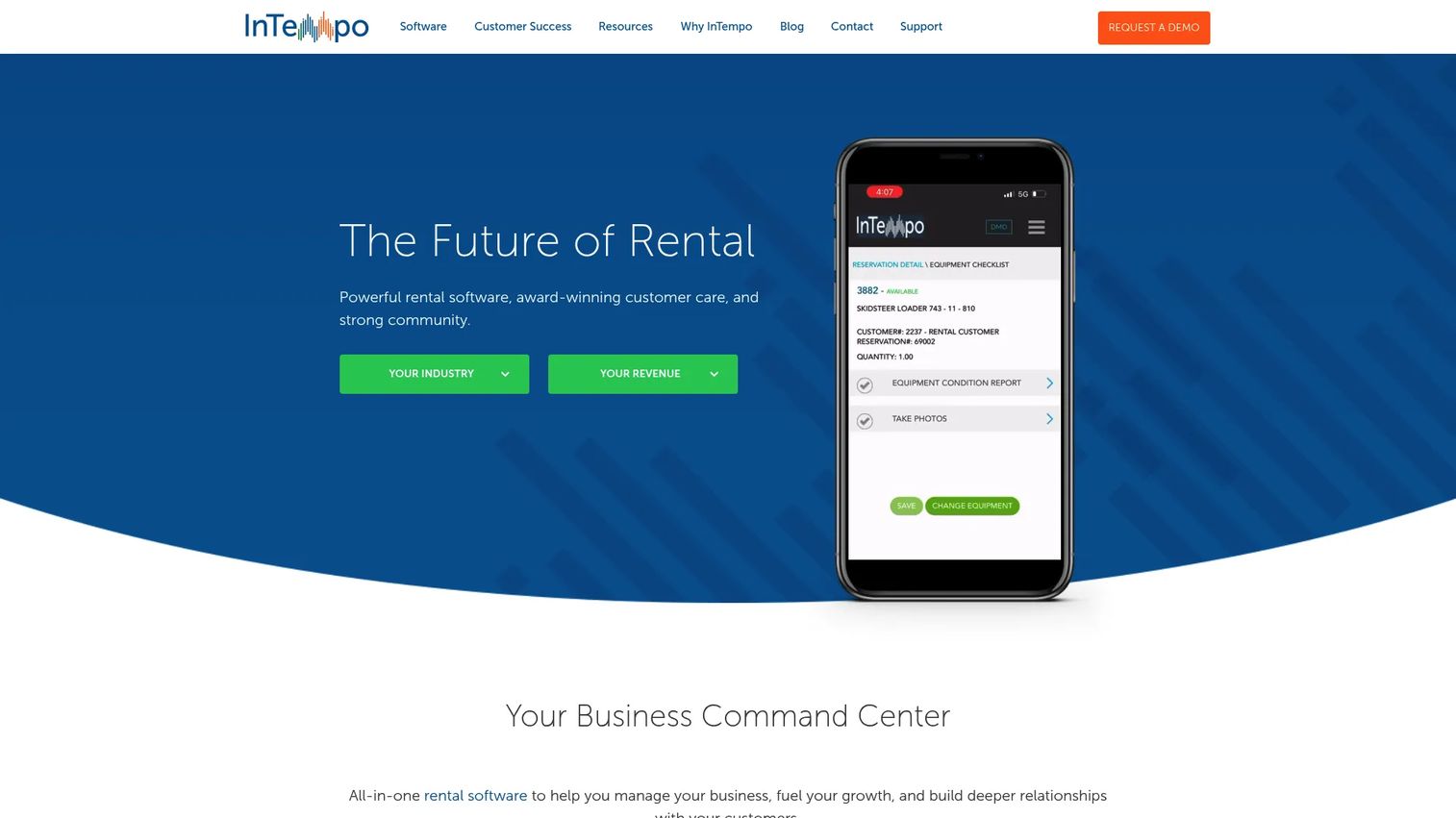
InTempo Software is rental management software for equipment rental businesses that want an ERP-style platform covering rental and sales, maintenance, accounting, and mobile tools. It offers Core and Enterprise solutions, so it can scale with the operation. For independent rental businesses that need one system to run rental, service, financials, and field mobility rather than a stack of point tools, InTempo is built for that consolidation.
Best for: Independent rental businesses that need an all-in-one, ERP-style rental platform with operational control.
Key strengths
- Rental and sales management: Unified handling of rental transactions and equipment sales in one platform.
- Maintenance and service workflows: Service tracking that keeps equipment status and availability accurate.
- Accounting and reporting: Financial reporting and accounting built in for cleaner business visibility.
Why choose InTempo Software: InTempo fits operators who have outgrown lightweight tools and want ERP-level control over rental, service, and financials without running separate systems. The Core and Enterprise tiers give a growth path, and the mobile and reporting layers support teams that need field mobility and leadership visibility in the same platform.
InTempo Software pricing: InTempo does not publish public pricing on its site. Its pages emphasize requesting a demo, and materials mention cost savings without listing a rate. Expect a scoped quote based on your business size, deployment needs, and whether you land on the Core or Enterprise solution. Ask about implementation timeline and module scope during the demo.
7. Wynne Systems
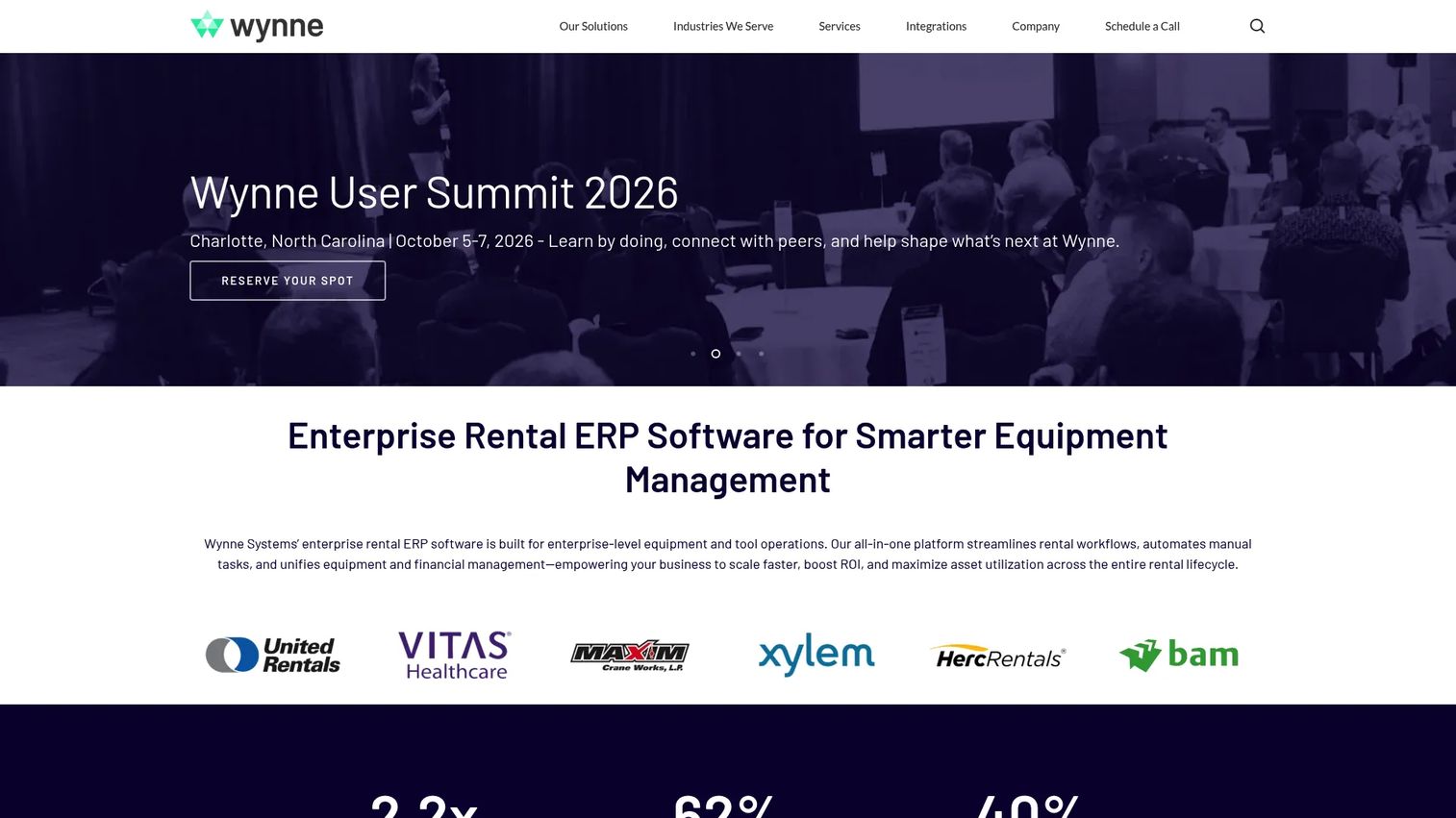
Wynne Systems is enterprise rental ERP software built for equipment, tool, and fleet operations at scale. This is the platform for large, complex rental businesses that need deep control over rental operations, sales contract processing, maintenance, asset management, and logistics. It integrates transport and mobile apps, and is designed for the operational reporting depth that enterprise leadership and finance teams expect.
Best for: Large rental and equipment businesses that need an enterprise ERP platform with fleet-level control.
Key strengths
- Rental and contract processing: Rental operations and sales contract handling built for high transaction volume.
- Maintenance and asset management: Fleet-wide maintenance and asset tracking for utilization and uptime.
- Logistics and mobile: Transport integrations and mobile apps for field teams and dispatch at scale.
Why choose Wynne Systems: Wynne is the enterprise end of this list. If you operate a large fleet across many branches and need ERP-grade control, reporting, and logistics integration, it is built for that complexity. Its G2 seller rating sits at 3.7/5. Smaller operators will find it heavier than they need, but enterprise rental businesses get the scale and control the operation demands.
Considerations before you buy
Before you commit, run every shortlisted vendor through the same checklist so you compare like for like.
Operational coverage across the lifecycle
Map your actual workflow: quoting, reservations, invoicing, payments, maintenance, dispatch, and returns. Then check which of those the platform handles natively versus through a workaround. A tool that covers 80% of your workflow but forces a spreadsheet for the rest is not the consolidation you are buying.
Multi-location and inventory accuracy
If you run multiple locations or warehouses, verify branch-level visibility, inter-location transfers, and real-time availability. Ask how the system prevents double bookings and whether it supports QR, barcode, RFID, or GPS and telematics for fleet tracking. Accuracy here is the difference between confident promises and awkward calls to customers.
Accounting and payment integrations
Confirm the platform syncs with your accounting stack, whether that is QuickBooks, Xero, or an ERP ledger, and that payment processing fits how you bill: deposits, recurring rental charges, and damage waivers. A clean accounting integration shortens month-end close and keeps finance out of manual reconciliation.
Reporting and business visibility
Leadership needs utilization, revenue, and fleet analytics without stitching five dashboards together. Check whether reporting is real-time, exportable, and granular enough to answer the questions your board or bank actually asks. Reporting that only produces a monthly PDF will not support weekly operating decisions.
Setup, mobility, and total cost
Ask about implementation timeline, onboarding support, mobile access for field teams, and whether pricing is per location, per user, or flat. Model the cost as you scale, not just at the entry tier, so the tool earns its place in your stack instead of surprising you at renewal.
Conclusion
The right equipment rental software depends on your scale, complexity, vertical, and accounting stack, not on which vendor has the loudest landing page. Point of Rental is the broadest pick for established multi-location operations. Rentman wins on real-time availability and crew planning. Quipli is the all-in-one choice with transparent pricing and a self-service storefront. Booqable is the fastest path to online bookings for smaller teams. Current RMS fits AV, event, and production rental specifically. InTempo Software and Wynne Systems anchor the complex and enterprise end, where fleet-level control and ERP depth matter most.
Your next step is simple. Shortlist the two or three that match your operation, then book live demos and run the same workflow through each: create a quote, reserve an asset, schedule a delivery, and close an invoice. The one that removes the most manual handoffs, keeps inventory accurate, and gives leadership clean data is the one worth buying. Bring your real double-booking scenario to each demo and watch how the system handles it.
FAQs
Equipment rental software manages the full rental lifecycle: tracking assets, booking reservations, generating quotes and contracts, invoicing, scheduling maintenance, and coordinating delivery and pickup. It centralizes operations that otherwise scatter across spreadsheets and inboxes, so you keep inventory accurate, prevent double bookings, and bill correctly across one or more locations.
The essentials are real-time inventory and availability tracking, quoting and reservations, invoicing and payments, maintenance and repair scheduling, and dispatch for delivery and pickup. For growing operations, prioritize multi-location visibility, accounting integrations like QuickBooks or Xero, mobile access, and reporting that gives leadership utilization and revenue data without manual work.
Double bookings stop when a reservation ties directly to a physical asset and the system tracks true status: on rent, reserved, in service, or available. When you try to commit equipment that is already allocated, the platform blocks the conflict. Real-time availability across locations, plus QR or barcode scanning, keeps the picture accurate.
Yes. Most mid-market and enterprise platforms support multi-location or multi-warehouse operations with branch-level visibility, inter-location transfers, and consolidated availability. Verify during a demo that transfers, branch reporting, and real-time availability work the way your business actually operates, since depth varies between lighter and heavier platforms.
Many platforms integrate with accounting tools. Quipli syncs with QuickBooks Online, and others connect to QuickBooks, Xero, or an ERP ledger. Confirm the specific integration you need and how it handles deposits, recurring rental charges, and damage waivers, since payment processing and sync depth differ between vendors.
Booqable is a strong fit for smaller teams, with plans from $29/month, a hosted booking page, and quick setup for online reservations and inventory. Current RMS suits small AV and event operators, starting at $79/month for the first user. Both offer free trials, so you can validate the fit before committing.
For heavy equipment rental, Quipli offers an all-in-one platform with transparent flat pricing, while Wynne Systems and InTempo Software serve larger, complex fleet operations with ERP-grade control, maintenance, and logistics. Point of Rental also covers heavy equipment within its broad vertical range. Match the choice to your fleet size and location count.
Run every shortlisted vendor through the same test: create a quote, reserve an asset, schedule a delivery, and close an invoice during the demo. Compare operational coverage, multi-location support, accounting integrations, reporting depth, and total cost as you scale. Bring a real double-booking scenario and watch how each system handles it.