Your stakeholder history is probably in three places right now: A shared inbox, someone's personal notes, and a spreadsheet that hasn't been updated in six weeks. When a regulator asks for engagement evidence, or a new team member takes over a project mid-cycle, that fragmented record becomes a real problem fast.
Only 34% of B2B teams say they fully use their CRM systems, according to Insightly's 2025 CRM Research Report. For stakeholder engagement work, the gap is even wider: Generic CRMs track accounts and revenue, not landholders, community concerns, grievance histories, and regulatory commitments. The right stakeholder relationship management software closes that gap, giving teams a structured place to store relationship history, track issues, record commitments, and produce evidence on demand.
This guide compares 15 stakeholder management software options for 2026 and helps you pick the right fit for your program, sector, and evaluation criteria.
What's inside
This guide is for stakeholder engagement managers, government relations teams, infrastructure project leads, ESG professionals, and procurement teams evaluating stakeholder relationship management tools for the first time or replacing a spreadsheet workaround.
- 15 tools compared across stakeholder mapping, engagement history, issue tracking, reporting, and security
- Pricing and G2 ratings verified from live sources
- Clear separation between dedicated SRM platforms and public consultation tools
- Buyer checklist covering workflow fit, integrations, audit trails, and governance
TL;DR
- Best overall dedicated SRM platform: Simply Stakeholders, for teams replacing spreadsheets with a purpose-built stakeholder management platform
- Best for energy, mining, and ESG-heavy projects: Borealis, with GIS mapping, grievance management, and land access workflows
- Best for infrastructure and public engagement: Jambo (from $995/month) or Tractivity (from £9,495/year) for structured engagement records and reporting
- Best for formal public consultation: Citizen Space or EngagementHQ for government bodies running structured participation programs
- Best for teams already on CRM infrastructure: Salesforce, when customization and enterprise integrations matter more than SRM depth
- Watch out: If your main need is stakeholder history, commitments, and regulatory evidence, general project tools and shared inboxes will not scale past a team of two
What is stakeholder relationship management software?
Stakeholder relationship management software is a system for identifying stakeholders, mapping relationships, tracking engagement, recording issues and commitments, and producing evidence of how an organization manages stakeholder relationships over time.
Unlike a CRM, which tracks sales pipelines and customer revenue, stakeholder management software handles a much broader population: Community members, landholders, government agencies, regulators, NGOs, internal teams, project opponents, and public participants. The goal is not to close deals. The goal is to maintain a credible, searchable, auditable record of every material interaction.
The practical value shows up most clearly when something goes wrong: A staff member leaves, a regulator requests consultation records, or a community group disputes what was promised at a previous meeting. Good SRM software turns those moments from crises into managed responses.
Key capabilities to look for
- Stakeholder identification, segmentation, and profile management
- Stakeholder mapping and influence analysis
- Engagement history and communication logging
- Issue, risk, concern, and commitment tracking
- Consultation records and participation evidence
- Sentiment and relationship health scoring
- GIS and location-based records for land and project work
- Dashboards, audit trails, and stakeholder reporting software features
- Email, CRM, BI, and collaboration integrations
- Role-based permissions, regional hosting, and security controls
A strong platform treats stakeholder relationship management software institutional memory as a core design principle: The record should survive any individual's departure.
When to use stakeholder relationship management software
Replace spreadsheets before history disappears
Spreadsheets work until relationship context depends on one person's memory. Project handovers, staff turnover, and org restructures expose exactly how much institutional knowledge lives outside the system. If a new engagement lead cannot reconstruct the last six months of stakeholder history in a single session, the record is already failing. Dedicated stakeholder database software centralizes that context so it transfers with the project, not the person.
Track issues before they become project risk
Structured stakeholder risk tracking changes how teams respond to community concerns. When grievances, objections, and commitments sit in email threads or meeting notes, pattern recognition is impossible. A purpose-built stakeholder management tool lets teams spot recurring concerns, flag unresolved commitments, and produce board-ready risk summaries without manually assembling a report from scratch.
Prove engagement without rebuilding the record
Mature SRM systems help teams demonstrate exactly who was contacted, what was raised, what was promised, and what happened next. This matters for infrastructure approvals, ESG reporting, regulatory submissions, and audit management software workflows. Teams that run stakeholder communications software with full audit trails walk into regulatory reviews with evidence already organized.
Stakeholder relationship management software comparison
The table below summarizes all 15 tools by practical fit. Pricing reflects verified figures from vendor pages at time of publication. G2 ratings reflect live listings. Where no G2 rating exists, the tool is marked N/A.
| # | Product | Best for | Key differentiator | Pricing | G2 rating |
|---|---|---|---|---|---|
| 1 | Simply Stakeholders | Dedicated SRM across sectors | AI sentiment, mapping, workflows, mobile | Custom pricing | 5.0 |
| 2 | Borealis | Energy, mining, ESG, infrastructure | GIS mapping, grievance, land management | Custom pricing | 3.8 |
| 3 | Jambo | Infrastructure, government, consultation | Esri map viewer, Secure AI, Outlook add-in | From $995/month | 4.7 |
| 4 | Tractivity | Public sector, consultation, UK teams | 150+ reports, Outlook/Teams, Power BI | From £9,495/year | 4.5 |
| 5 | Darzin | Government, energy, mining, community | AI sentiment, interaction tracking, free trial | Custom pricing | 4.8 |
| 6 | Open Point | Government, infrastructure, utilities | Unified SRM and community engagement | Custom pricing | 4.5 |
| 7 | Consultation Manager | Rebranded as Open Point | Now unified under Open Point | Custom pricing | N/A |
| 8 | Syrenis SMART | Consent and preference governance | Consent management across 350+ systems | Custom pricing | N/A |
| 9 | StakeWare | Stakeholder and sustainability data | Salesforce-native, issue intelligence | Custom pricing | N/A |
| 10 | EngagementHQ | Public-sector online consultation | Surveys, forums, ideation, participant analytics | Custom pricing | 5.0 |
| 11 | Granicus | Government communications and operations | Broad civic platform, agenda, video, digital services | Custom pricing | 4.5 |
| 12 | Citizen Space | Formal government consultation | SSO, accessibility, geospatial, response publishing | Custom pricing | N/A |
| 13 | Commonplace | Planning and place-based engagement | Map-based feedback, voice comments, AI analysis | Custom pricing | N/A |
| 14 | Go Vocal | Participatory public engagement | Surveys, ideation, multilingual, traceable insights | Custom pricing | N/A |
| 15 | Salesforce | Teams with existing CRM infrastructure | Configurable CRM, AppExchange, Agentforce AI | From $25/user/month | 4.4 |
Best 15 stakeholder relationship management software for 2026
1. Simply Stakeholders
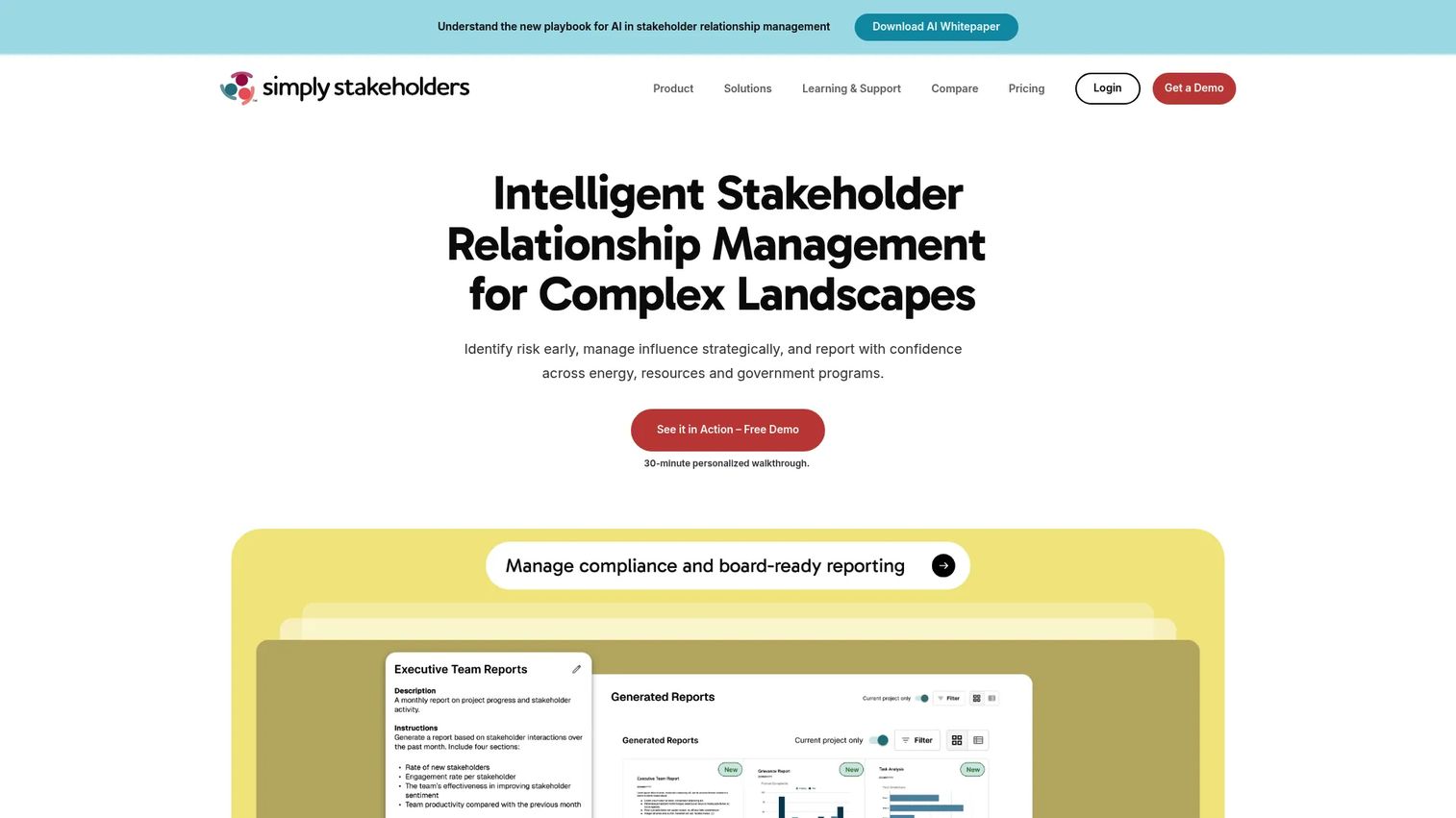
Simply Stakeholders is a purpose-built stakeholder relationship management platform for organizations managing complex engagement programs. It covers the full SRM workflow: Stakeholder identification and segmentation, relationship history, sentiment and issue tracking, task automation, and board-ready reporting. The platform supports email integration with Outlook and Gmail, GIS-based mapping, a mobile app with offline capability, and complaints and commitment tracking in a single environment.
Best for: Teams in government, infrastructure, energy, or community relations that are replacing spreadsheets and inbox-based workflows with dedicated stakeholder management software.
Key features
- Stakeholder mapping and network visualization
- AI-driven sentiment and issues tracking
- Task management and automated workflows
- Email, SMS, webforms, and surveys
- Mobile app with offline capability
Why choose Simply Stakeholders: It covers the broadest range of SRM needs without requiring heavy configuration. If stakeholder continuity matters more than CRM flexibility, this is the strongest out-of-the-box fit in this category.
Simply Stakeholders pricing: Plans are Starter, Growth, and Enterprise. Pricing is quote-based and varies by plan and user count. Contact the team for a proposal that reflects your module and hosting requirements.
G2 rating: 5.0/5
2. Borealis
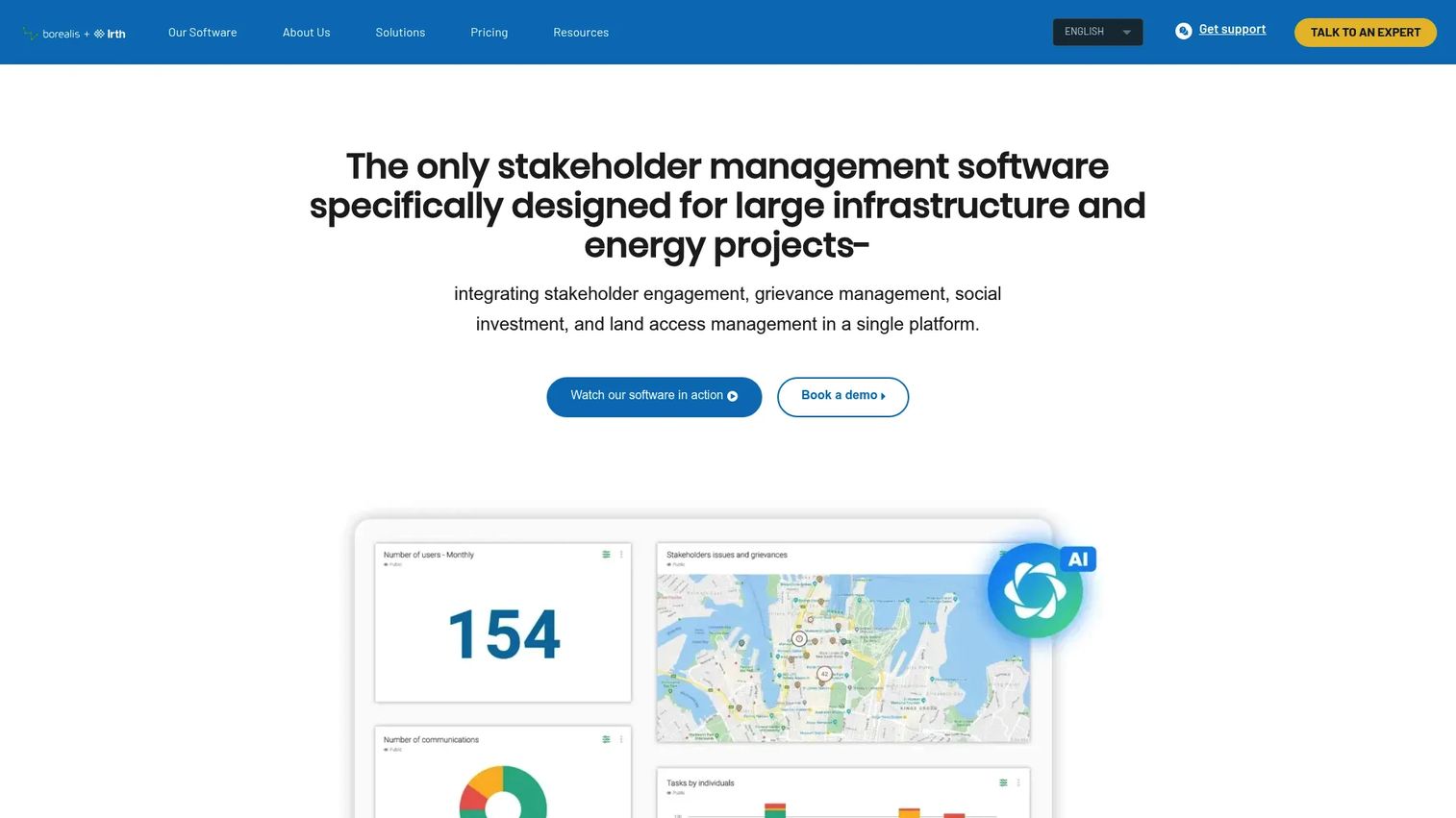
Borealis is stakeholder management software built specifically for large infrastructure, energy, utilities, mining, and transportation programs. It combines engagement planning and stakeholder mapping with integrated GIS, grievance and feedback portals, land agreements management, and AI-driven analytics. Outlook and Gmail integration, a mobile app with offline mode, and Microsoft Teams connectivity make it practical for field-heavy programs where engagement happens away from a desk.
Best for: Energy, mining, utilities, and ESG teams managing regulated, land-access-intensive stakeholder environments where grievance management and social investment tracking matter.
Key features
- Integrated GIS and geographic stakeholder mapping
- Grievance and feedback portal
- Land agreements and land access management
- Engagement planning and scheduled reporting
- Role-based access and data segregation
Why choose Borealis: Choose it when the program involves community land rights, formal grievance processes, environmental permits, or ESG disclosure requirements. It is better suited to complex field programs than to lightweight consultation work.
Borealis pricing: Essential, Professional, and Enterprise packages are available. Pricing is configured per user count and selected add-ons. Request a quote from the Borealis team to scope implementation and onboarding costs alongside the license.
G2 rating: 3.8/5
3. Jambo
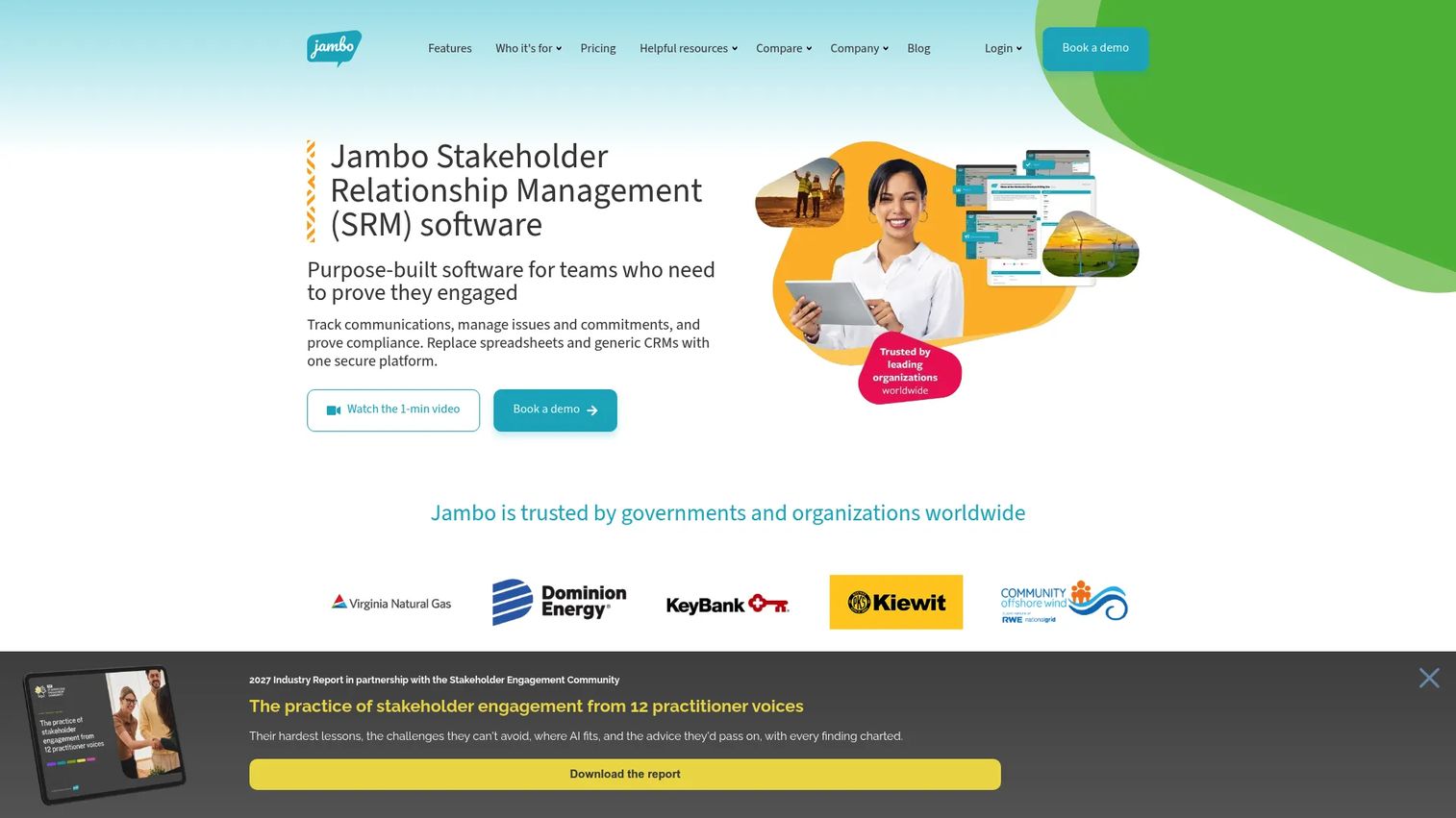
Jambo is stakeholder relationship management software designed for government, infrastructure, energy, and mining teams that need clean, searchable engagement records. The platform tracks people, organizations, communications, issues, commitments, and tasks, with an integrated Esri map viewer for geospatial context. Jambo Secure AI adds sentiment analysis and summarization, and an Outlook add-in keeps email logging practical for teams already working in Microsoft environments.
Best for: Government, infrastructure, and regulated project teams that need dedicated SRM depth, compliance documentation, and GIS-linked engagement records.
Key features
- Communication and interaction tracking
- Issues, concerns, grievances, and commitments management
- Integrated Esri map viewer
- Jambo Secure AI sentiment and summarization
- Configurable dashboards and analytics
Why choose Jambo: It preserves institutional memory across project handovers and staff changes without forcing stakeholder work into a sales CRM. The Outlook add-in and Esri integration are strong differentiators for teams living in Microsoft and GIS environments.
Jambo pricing: Jambo Professional starts at $995 per month and includes 5 users. Enterprise and Ultimate tiers are priced by quote and add cross-project oversight, SSO, integrations, and advanced modules. All plans include a one-time onboarding fee.
G2 rating: 4.7/5
4. Tractivity
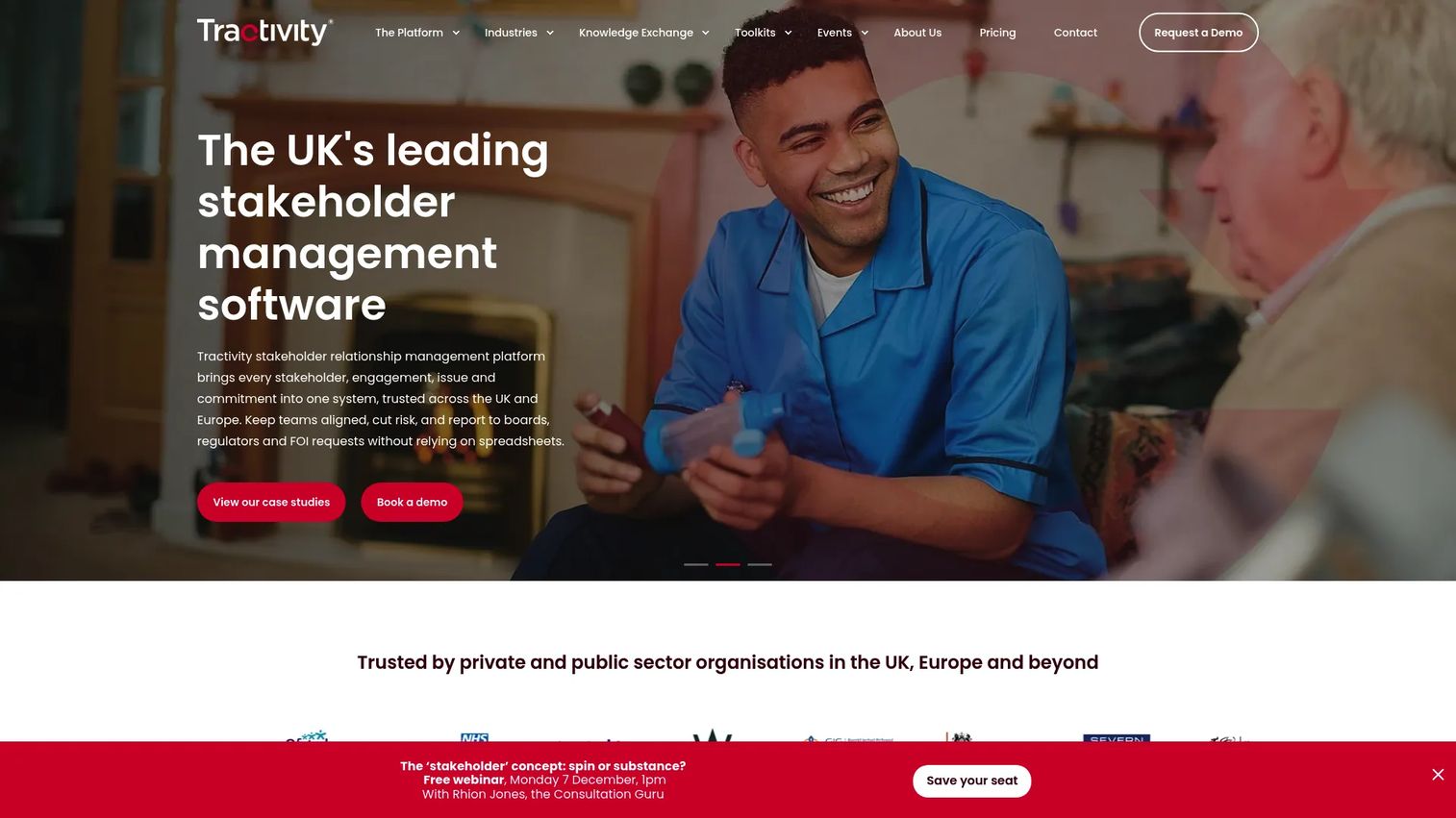
Tractivity is a stakeholder management platform with strong fit for public sector, infrastructure, and regulated consultation programs. It covers stakeholder records, consultation tracking, email logging, issue and grievance management, surveys, newsletters, and events in one environment. AI sentiment analysis and activity summaries help teams track relationship health, while 150+ pre-built reports and Power BI integration make it easy to produce auditable evidence for regulators or boards.
Best for: Public sector and infrastructure teams with formal engagement obligations, reporting requirements, and long-running consultation programs.
Key features
- Stakeholder mapping and engagement tracking
- Issue, complaint, grievance, and commitment management
- AI sentiment analysis and activity summaries
- 150+ reports and configurable dashboards
- Integrations: Outlook, Teams, Power BI, Zapier, REST API
Why choose Tractivity: Its reporting depth and public-sector-ready procurement profile make it a practical choice for UK-based teams or organizations that need engagement evidence for formal regulatory submissions.
Tractivity pricing: One annual subscription from £9,495 per year with no feature tiers. Additional users cost £500 per user per year. The Engage-360 public portal is priced separately. All pricing is billed annually.
G2 rating: 4.5/5
5. Darzin
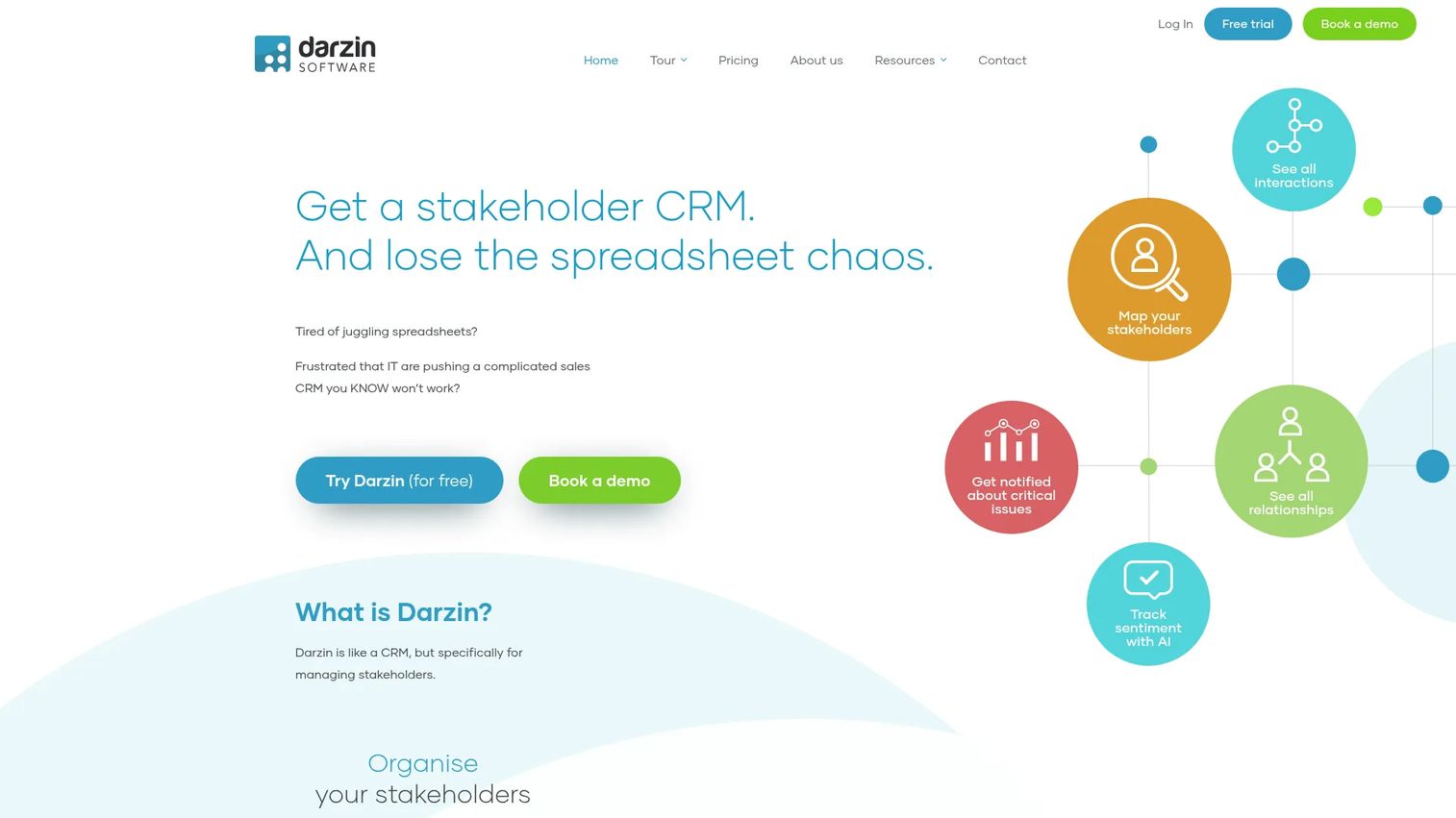
Darzin is stakeholder engagement software for organizations in government, energy, mining, infrastructure, and public affairs. It tracks stakeholder profiles segmented by influence, interest, and impact, logs interactions across email, surveys, meetings, media, and other channels, and applies AI-powered sentiment analysis to surface qualitative feedback patterns. A free trial is available, which makes it accessible for teams wanting to test SRM workflows before committing.
Best for: Project teams managing infrastructure, natural resources, government, or community engagement programs where understanding stakeholder sentiment and tracking issues back to specific projects matters.
Key features
- Stakeholder mapping and segmentation by influence, interest, and impact
- Interaction tracking across multiple channels
- AI-powered sentiment analysis and feedback analysis
- Complaints and engagement reporting
- Project-linked stakeholder records
Why choose Darzin: It ties interactions directly to projects and issues rather than treating stakeholder engagement as a contact management exercise. Teams evaluating account management software for a stakeholder context will find Darzin's project-centric approach more aligned.
Darzin pricing: Pricing is handled by quote. The vendor confirms onboarding and web training are included in licenses. Request a proposal that covers user count, project scope, and hosting requirements.
G2 rating: 4.8/5
6. Open Point
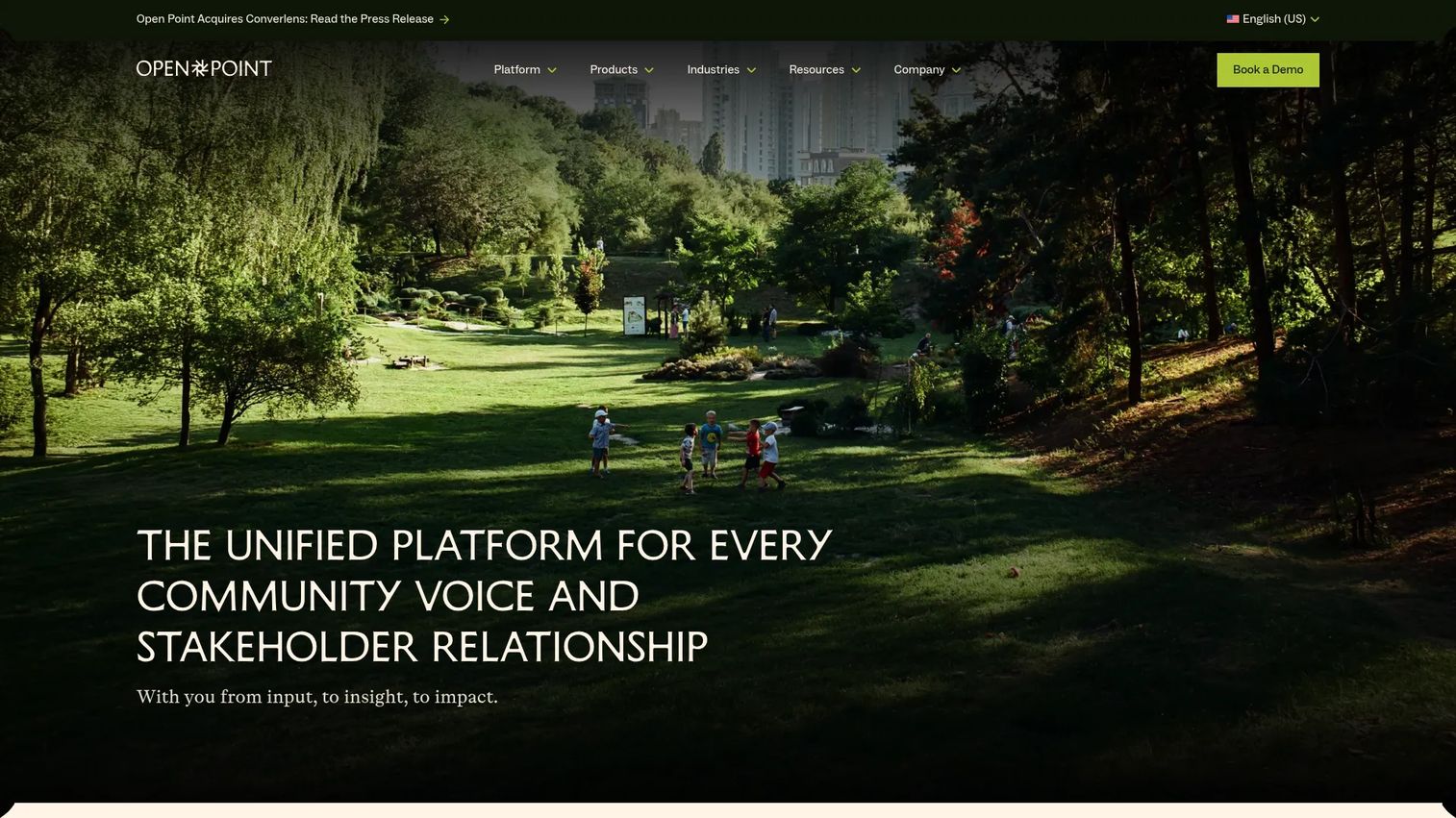
Open Point is a unified stakeholder relationship management and community engagement platform for government, infrastructure, utilities, energy, and transportation organizations. It combines community-facing engagement tools, including social maps, quick polls, Q&A, and forums, with backend stakeholder profiles, task management, audit history, Outlook integration, and AI-powered feedback analysis. The platform covers cross-project theme identification and sentiment analysis in a single environment.
Best for: Government and infrastructure organizations that need both a public-facing engagement layer and a structured internal SRM database in one platform.
Key features
- Community engagement tools: Forms, social maps, quick polls, forums
- Stakeholder profiles, search, task management, and Outlook integration
- AI-powered feedback analysis and theme identification
- Cross-project sentiment and issue analysis
- Audit history and reporting dashboards
Why choose Open Point: It removes the need to manage a separate public consultation tool alongside a private SRM database, which reduces data silos and simplifies reporting. Teams with complex multi-stakeholder programs benefit from the unified data model.
Open Point pricing: Pricing is configured from modular tools and project requirements. Contact the team for a custom proposal.
G2 rating: 4.5/5
7. Consultation Manager
Consultation Manager has been consolidated into Open Point. If you are evaluating Consultation Manager as a standalone product, the current platform and product team operate under the Open Point brand. The capabilities previously associated with Consultation Manager, including public consultation records, stakeholder database management, communication tracking, and issue logging, now sit within the Open Point environment.
Best for: Teams previously running Consultation Manager should evaluate Open Point as the active product.
Key features
- Community engagement and feedback collection
- Stakeholder relationship management
- AI-powered feedback analysis and theme identification
- Cross-project reporting
- Audit history
Why choose Consultation Manager: Existing users of this product should check the migration path and confirm current support arrangements with the Open Point team directly.
Consultation Manager pricing: Contact Open Point for current pricing. The transition to the unified platform may affect licensing terms for existing customers.
8. Syrenis SMART
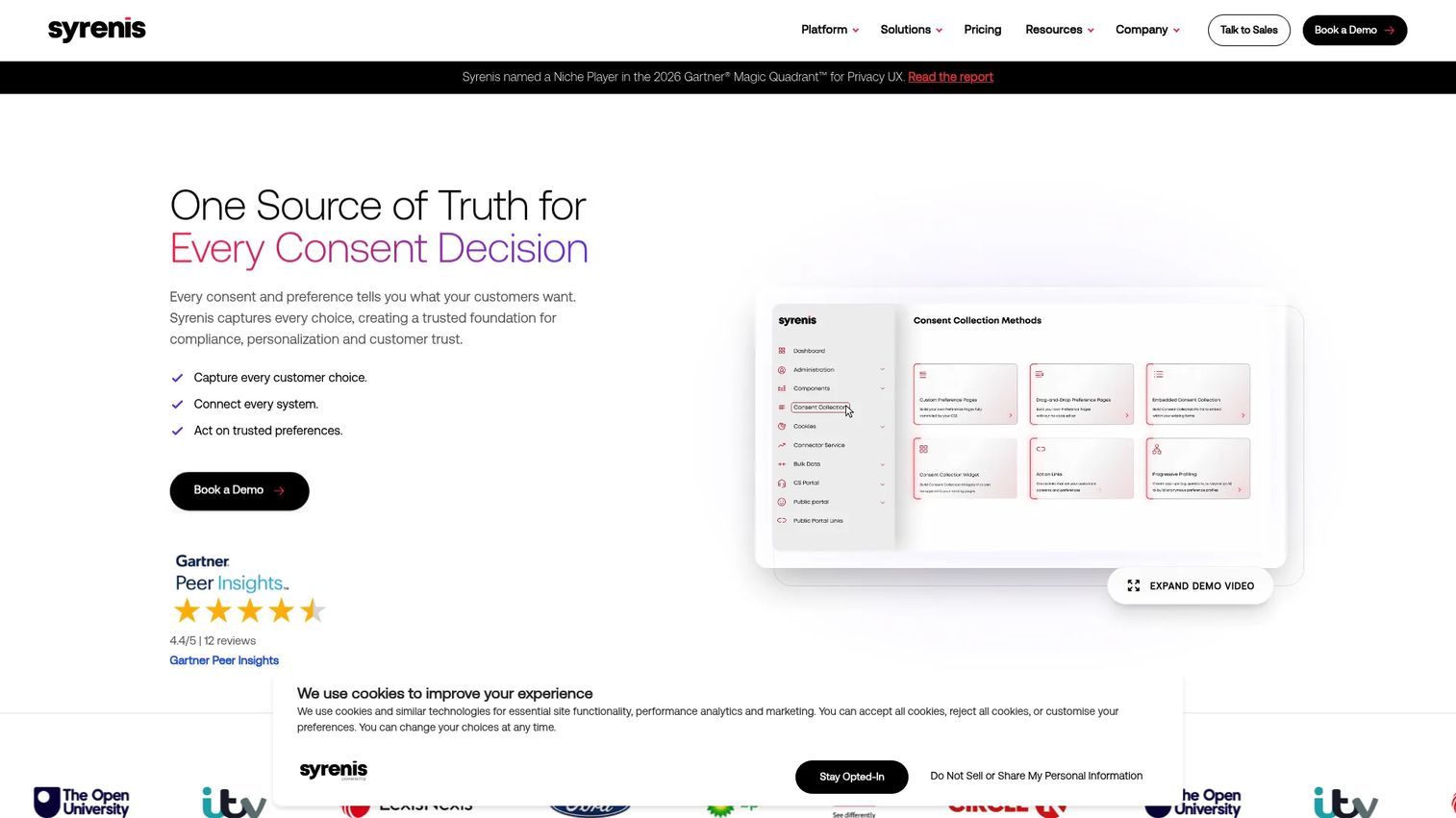
Syrenis provides enterprise consent and preference management for large, regulated organizations managing stakeholder data across complex, global systems. The SMART product identity was consolidated under the unified Syrenis brand in April 2026. The platform specializes in consent management across domains, devices, and identities, preference centers with granular multi-channel controls, and real-time synchronization across 350+ systems. Its fit for general SRM workflows is narrower than purpose-built stakeholder engagement platforms.
Best for: Large, regulated organizations that need governed communication records, consent tracking, and stakeholder data synchronization across enterprise systems.
Key features
- Consent management across domains, devices, and identities
- Granular preference centers and multi-channel controls
- Real-time synchronization across 350+ integrations
- Data governance and communication compliance controls
- Reporting exports for consent audit trails
Why choose Syrenis SMART: Choose it when compliant communication and stakeholder data governance are the primary requirements, particularly in sectors with strict privacy and consent regulations. For broader engagement history and relationship management, evaluate whether the platform covers the full SRM scope your team needs.
Syrenis SMART pricing: Pricing is bespoke. Contact the sales team for a quote based on your organization size and system integration requirements.
9. StakeWare
StakeWare is a cloud-based stakeholder relationship and sustainability data management platform built on Salesforce. It covers stakeholder profiling and relationship intelligence, issue intelligence and stakeholder risk analysis, and sustainability performance management with centralized data collection. The Salesforce foundation means teams already running that CRM environment can align stakeholder data with their broader enterprise stack.
Best for: Organizations that need stakeholder relationship management, issue intelligence, and sustainability performance tracking within an existing Salesforce infrastructure.
Key features
- Stakeholder profiling and relationship intelligence
- Issue intelligence and stakeholder risk analysis
- Sustainability performance management and data collection
- Reporting dashboards and engagement insights
- Mobile app access
Why choose StakeWare: It suits teams whose sustainability reporting and stakeholder engagement operate in the same system. Because it is Salesforce-native, implementation depends on existing Salesforce admin capacity. Teams without that resource should factor setup time into the evaluation.
StakeWare pricing: Pricing is handled by quote. Contact StakeWare directly to scope licensing based on user count and modules.
10. EngagementHQ
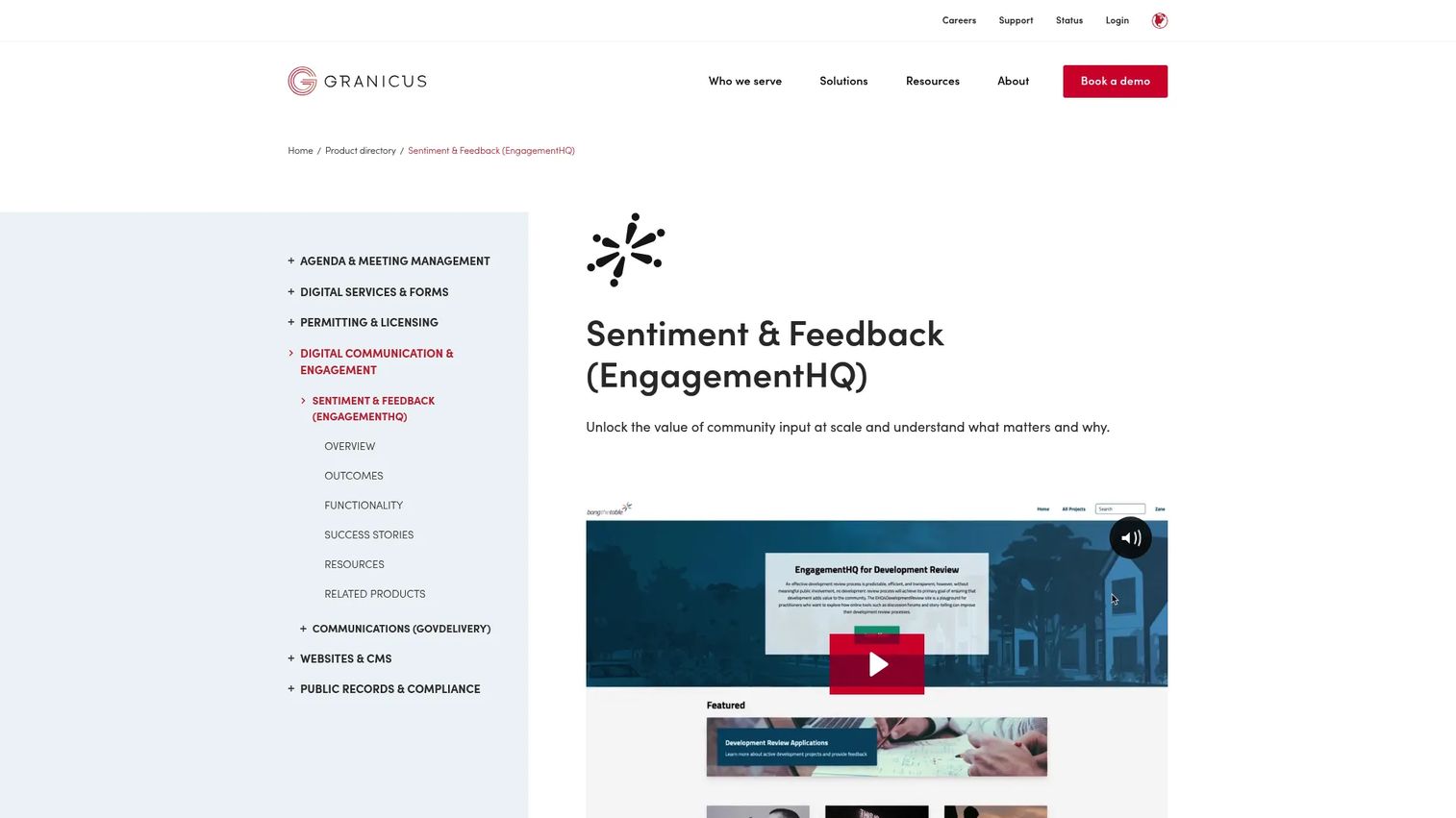
EngagementHQ is a digital community engagement platform for government agencies and public-sector organizations running public consultation programs. It supports surveys, quick polls, discussion forums, ideation, interactive mapping, Q&A, and participant submissions, with an audience segmentation layer, AI-powered text analysis, and sentiment reporting. Its strength is the public-facing engagement experience, not deep relationship history or private SRM records.
Best for: Public sector and civic organizations prioritizing the quality of the online engagement experience alongside participant analytics and consultation reporting.
Key features
- Surveys, quick polls, forums, ideation, and interactive mapping
- Participant relationship management and audience segmentation
- AI-powered text analysis and sentiment reporting
- Consultation dashboards and reporting
- Two-way communication tools
Why choose EngagementHQ: Choose it when the engagement experience itself, what participants see and do, matters as much as internal relationship records. Teams that need deep stakeholder commitment tracking and issue management alongside the public-facing layer should evaluate whether EngagementHQ covers both or requires a separate SRM tool.
EngagementHQ pricing: Pricing is handled by quote. Contact the EngagementHQ team for a proposal based on program scale and feature requirements.
G2 rating: 5.0/5
11. Granicus
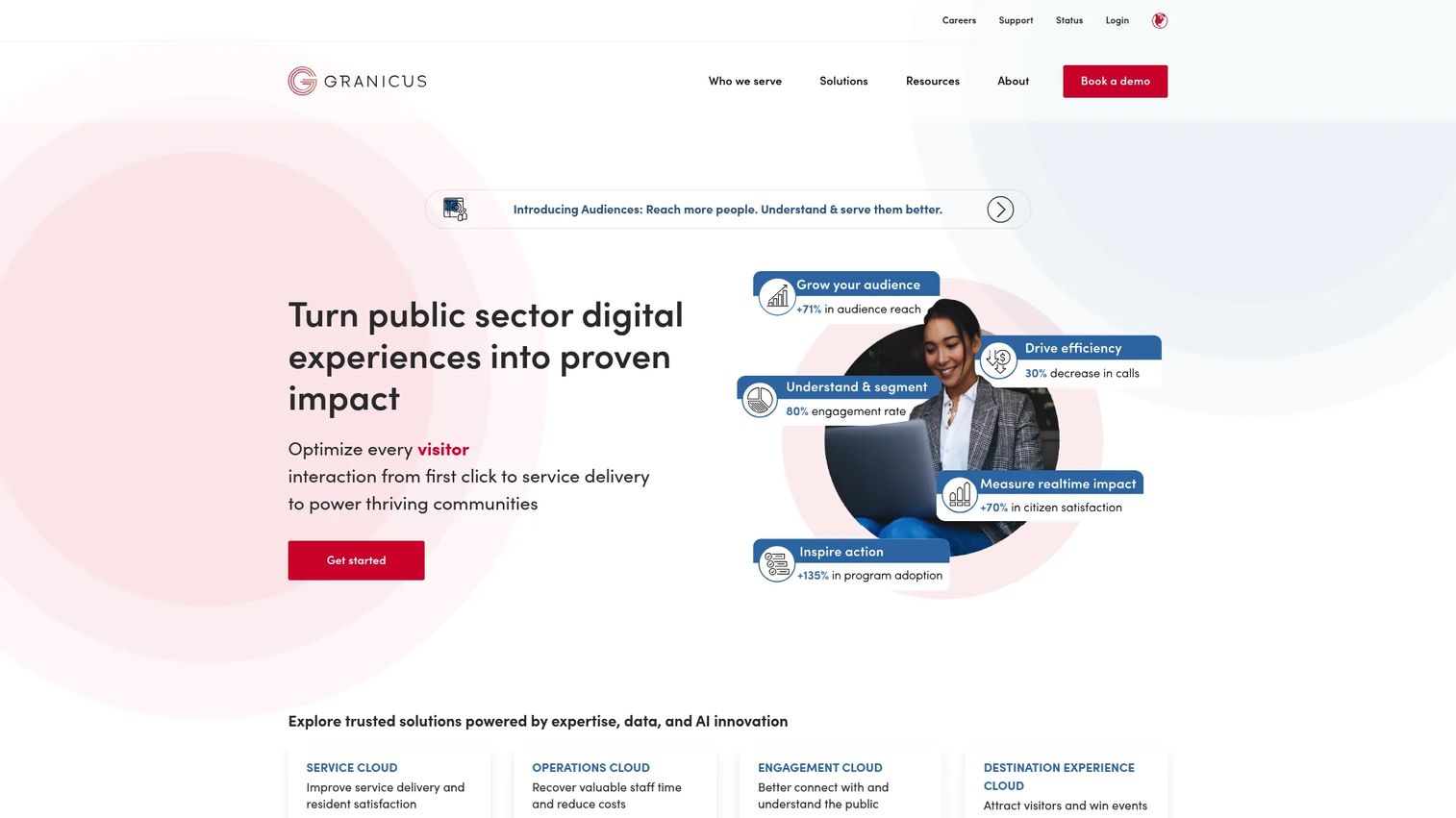
Granicus is a broad civic engagement and government technology platform covering digital service delivery, resident experience, agenda management, video streaming, records requests, and digital communications. It is relevant for stakeholder relationship management where public engagement overlaps with government operations, public meetings, and resident communications at scale. Its breadth makes it the widest-scope option in this list.
Best for: Government teams that need a broader civic platform covering engagement, communication, operational workflows, and digital services, rather than a narrowly focused SRM tool.
Key features
- Government-focused service delivery and resident experience tools
- Agenda management, video streaming, and records requests
- Digital communications, audience engagement, and sentiment analysis
- Feedback collection and reporting dashboards
- Meeting management and civic operations
Why choose Granicus: Its value is platform breadth. For public sector organizations where stakeholder engagement is one part of a larger digital government program, Granicus covers more ground than any single SRM tool. Teams with a narrower SRM need should check whether the full platform scope is necessary or whether a focused tool fits better.
Granicus pricing: Pricing requires a conversation with the sales team. Contact Granicus to discuss scope and volume.
G2 rating: 4.5/5
12. Citizen Space
Citizen Space is public consultation software built for government organizations and public bodies managing statutory consultations, community engagement, and public participation. It handles surveys, information pages, activity templates, response analysis, translation, tagging, response publishing, geospatial mapping, and SSO. Its design is optimized for formal consultation workflows rather than ongoing stakeholder relationship management.
Best for: Public bodies, government departments, and regulated bodies running formal consultations with structured participation, traceable responses, and published outcomes.
Key features
- Online consultations, surveys, and information pages
- Response analysis and tagging tools
- Geospatial mapping and location-based responses
- Translation, accessibility support, and SSO
- API integrations: Power BI and Looker Studio
Why choose Citizen Space: It is the clearest fit for teams whose primary need is running formal, traceable public consultations with published outcomes. Teams that also need ongoing private relationship records and stakeholder commitment tracking should verify whether Citizen Space covers internal SRM depth or whether a companion tool is required.
Citizen Space pricing: Pricing is handled directly or through government procurement frameworks. Contact Delib, the Citizen Space team, for a quote.
13. Commonplace
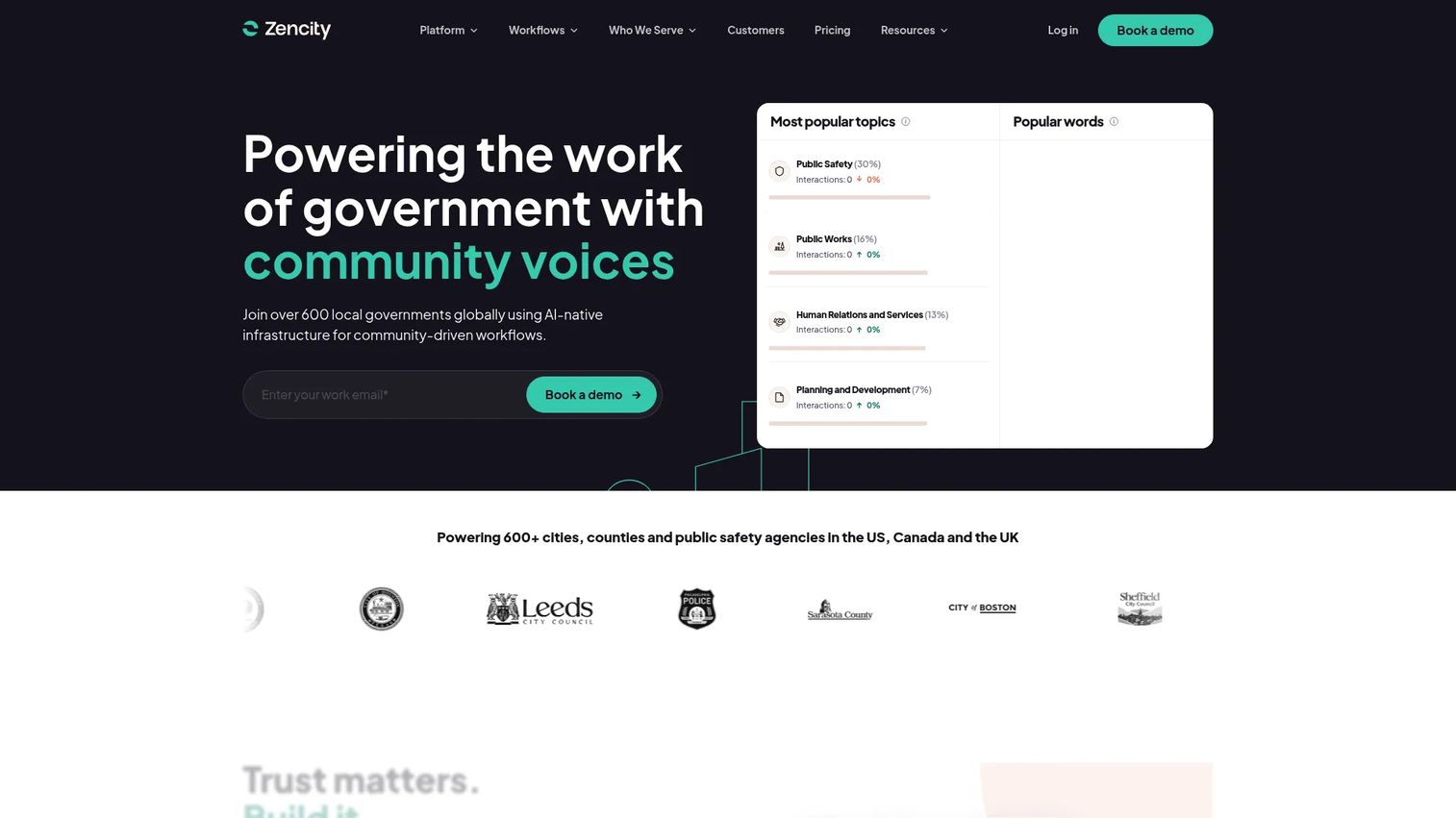
Commonplace is community engagement software for councils, developers, and city managers running place-based participation programs. It supports interactive maps, heatmaps, surveys, voice comments, real-time dashboards, demographic analysis, and AI-assisted topic summarization. The platform is built for public-facing community input rather than private stakeholder relationship management.
Best for: Planning and place-based teams collecting public feedback at scale, particularly for development, infrastructure, and urban planning projects.
Key features
- Community engagement and consultation websites
- Interactive maps and heatmaps with spatial analysis
- Survey and questionnaire tools
- Voice comments and voice-to-text technology
- AI-assisted topic analysis and sentiment dashboards
Why choose Commonplace: It is strong for place-based engagement where location context matters and public input needs to be gathered, analyzed, and communicated back to communities. Teams evaluating best community management software for planning or development programs will find it purpose-built for that workflow. For deeper relationship records and long-term stakeholder management, assess what Commonplace covers beyond the consultation phase.
Commonplace pricing: Pricing is handled by quote. The website currently redirects to Zencity. Contact the team directly to confirm current pricing and product status.
14. Go Vocal
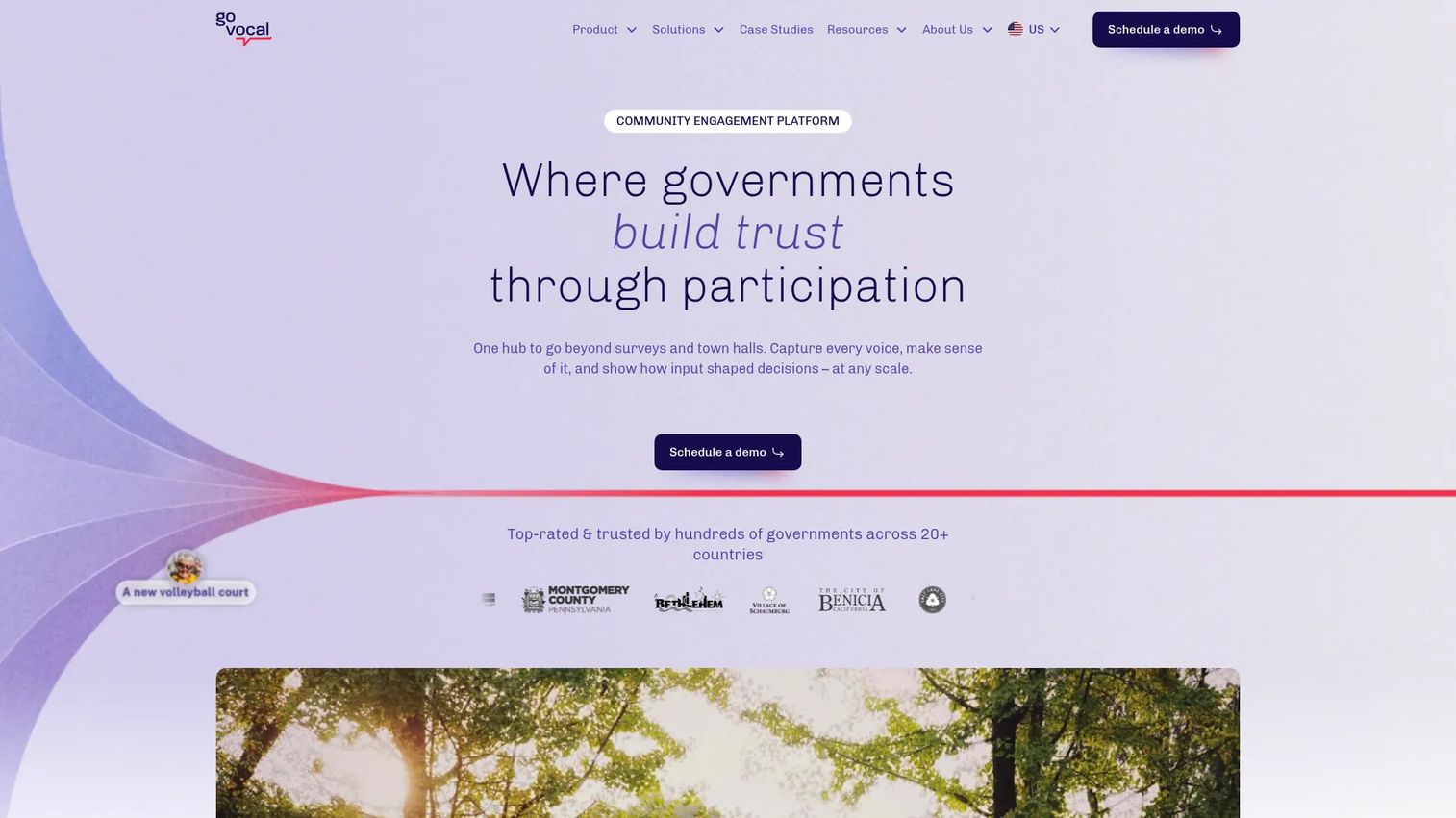
Go Vocal is a community engagement and participation platform for governments, cities, and public organizations that need to involve residents in decisions at scale. It supports surveys, ideation, mapping, voting, voice recording, and paper forms, with AI-supported analysis, theme detection, and reporting tools that show how participant input shaped decisions. Multilingual access makes it practical for diverse communities.
Best for: Government and public-sector teams running participatory engagement programs where demonstrating that input influenced decisions is a formal requirement.
Key features
- Surveys, ideation, mapping, voting, and voice recording
- Paper forms and multilingual access
- AI-supported analysis with theme detection
- Traceable insights showing input-to-decision links
- Reporting and participant communication tools
Why choose Go Vocal: Its participation-first design and traceability tools suit teams under democratic accountability or formal engagement obligations. If your program also needs long-term private stakeholder records and issue tracking across years, check whether Go Vocal's internal relationship management depth meets those requirements.
Go Vocal pricing: Plans include Essential, Standard, Premium, Department, and Enterprise tiers. Contact Go Vocal for a personalized quote on any tier.
15. Salesforce
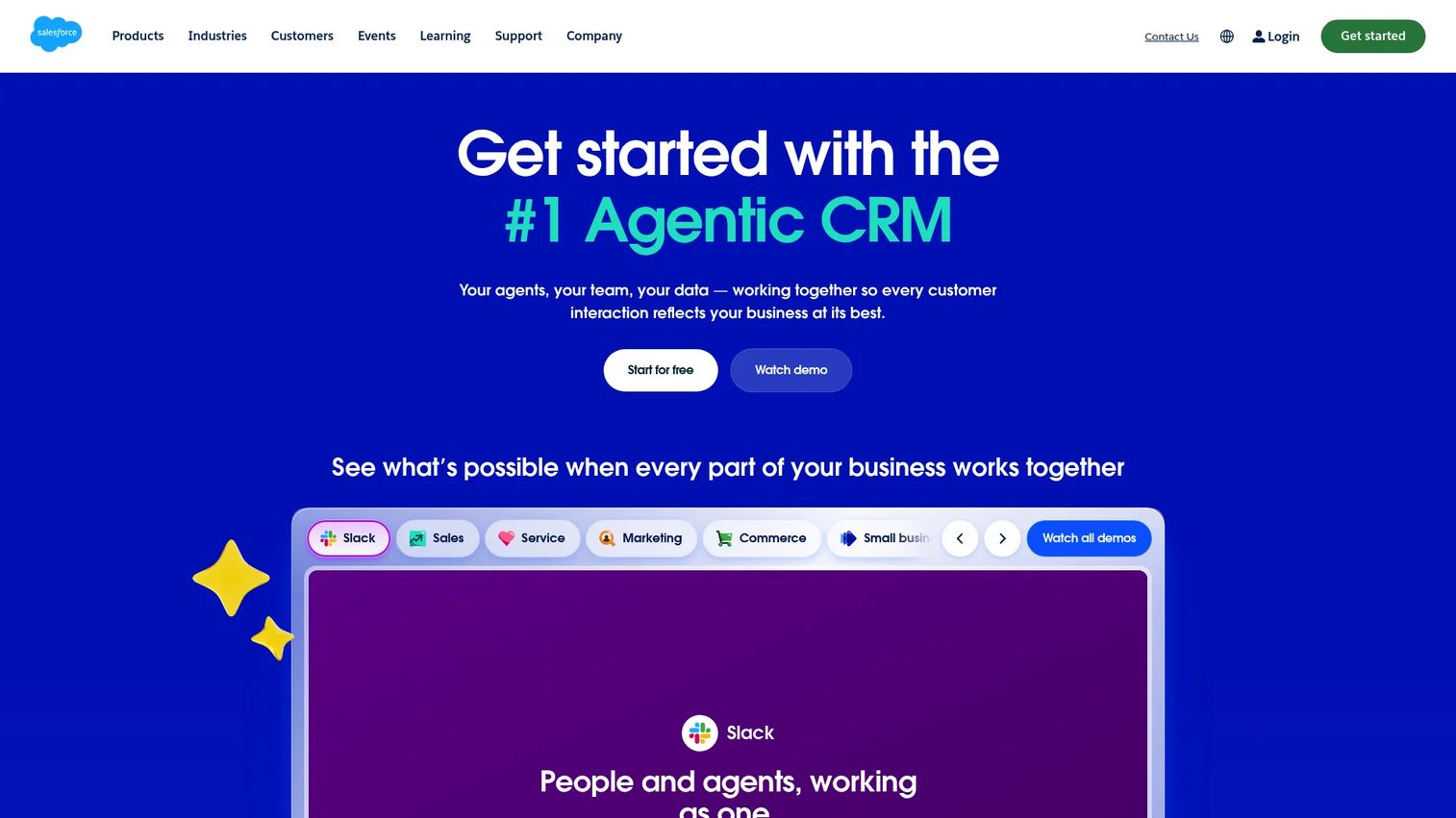
Salesforce is a configurable CRM platform that some organizations use for stakeholder management workflows through custom objects, workflow automation, and AppExchange add-ons. It is not purpose-built SRM software. Teams that already operate Salesforce enterprise-wide and have strong admin resources can build stakeholder tracking into existing infrastructure, but the out-of-the-box design serves sales pipelines, not community relations, landholders, grievances, or consultation evidence.
Best for: Large organizations that already run Salesforce and can invest in custom configuration to extend it into stakeholder management workflows.
Key features
- Lead, account, contact, and opportunity management
- Custom objects, workflow automation, and reporting dashboards
- Agentforce AI and automation tools
- AppExchange integrations for extended capabilities
- Role-based permissions and enterprise security
Why choose Salesforce: Choose it when the organization already has Salesforce infrastructure, strong admin capacity, and needs stakeholder data inside the same system as commercial relationships. The key caveat: Stakeholder mapping, consultation evidence, grievance management, and institutional memory typically require custom design. Teams that are starting from scratch with SRM needs will find purpose-built tools faster to implement. For candidate relationship management software or similar structured tracking needs across a broader enterprise stack, Salesforce covers the most ground.
Salesforce pricing: Starter Suite starts at $25 per user per month (billed monthly or annually). Pro Suite is $100 per user per month, Core is $195, Advanced is $395, and Max is $550, all billed annually. A 30-day free trial is available. No permanent free tier exists.
G2 rating: 4.4/5
Considerations when choosing stakeholder relationship management software
Match the tool to your stakeholder model
A mining team needs landholder records, grievance workflows, and GIS context. A local government team needs formal consultation tracking and published response records. A public affairs team needs influence mapping and issue trend analysis. No single tool optimally covers all three models, so define your primary use case before comparing features.
Check relationship depth, not just contact storage
The difference between a contact database and a stakeholder management platform shows in what gets recorded after the meeting: Sentiment, concerns, commitments, follow-up ownership, and relationship history. Ask vendors to show how a specific interaction gets logged, what fields are available, and how that record appears in a report six months later.
Verify reporting and audit trails early
Stakeholder engagement tracking that cannot produce auditable evidence is a compliance risk. Before shortlisting, ask whether the platform can show who was contacted, what was raised, what was promised, who owns the follow-up, and what changed afterward. These are the questions regulators and boards actually ask.
Review security, hosting, and permissions
For regulated sectors, verify SSO availability, two-factor authentication, role-based permissions, and regional data hosting before committing to a platform. Some tools host data in specific jurisdictions relevant to public-sector procurement or privacy requirements. Avoid making assumptions: Ask the vendor directly about their compliance documentation.
Test integrations against daily workflows
If email logging requires copy-pasting from Outlook, adoption will stall within weeks. Test whether the platform captures emails from your actual mail client, connects to your GIS environment, exports to Power BI or your BI tool, and surfaces engagement signals in your CRM. These daily touchpoints determine whether the platform actually gets used.
Conclusion
Stakeholder relationship management software is not a contact database upgrade. The right platform preserves engagement history, tracks risks and commitments, and produces evidence that survives staff turnover, regulatory scrutiny, and project handovers.
For broad dedicated SRM coverage, Simply Stakeholders is the strongest out-of-the-box fit. For energy, mining, and ESG programs with complex land and grievance workflows, Borealis is purpose-built. Jambo and Tractivity suit infrastructure and public engagement teams that need clean records and regulatory reporting. For formal public consultation programs, Citizen Space and EngagementHQ are the clearest fits. Commonplace and Go Vocal handle place-based and participatory engagement well. Salesforce works when CRM customization is a strategic organizational choice, not a workaround.
Shortlist three to five tools and test each one using a real stakeholder scenario from your program. See how the platform handles logging an interaction, recording a commitment, flagging an unresolved concern, and producing a summary report. That test will tell you more than any feature list.
Evaluating complex software is easier when buyers can see the workflow before the call. If your team sells software to procurement or evaluation committees, interactive demos let stakeholders explore the product on their own terms, without scheduling a live session for every reviewer in the buying committee.
Start your journey with Guideflow today!
FAQs
Stakeholder relationship management software is a platform for identifying stakeholders, mapping relationships, tracking engagement history, recording issues and commitments, and producing auditable evidence of how an organization manages relationships over time. It differs from generic CRM systems because it covers non-commercial stakeholders: Community members, landholders, regulators, government agencies, and public participants, not just sales prospects or customers.
A CRM tracks customers, sales opportunities, and revenue workflows. A stakeholder management platform tracks a much broader relationship population, including communities, regulators, project opponents, NGOs, and internal teams, alongside concern histories, commitments, grievances, and engagement evidence. Only 34% of B2B teams say they fully use their CRM systems (Insightly, 2025), and that gap is even wider for stakeholder engagement work where relationship context matters more than pipeline stage.
Triggers include lost engagement history when staff leave, duplicated outreach to the same stakeholder from different team members, unclear commitment ownership, audit pressure from regulators, and manual reporting that takes days to compile. Spreadsheets break when context matters as much as the record itself. If a new engagement lead cannot reconstruct six months of history without calling the previous manager, the system is already failing.
Borealis, Darzin, StakeWare, and Simply Stakeholders are the most relevant options for mining and resource-heavy work. Borealis covers land agreements, grievance portals, and GIS mapping for complex field programs. Darzin provides AI sentiment analysis and project-linked interaction tracking with a free trial. StakeWare adds sustainability performance management within a Salesforce environment. Simply Stakeholders covers the broadest SRM scope for teams that need engagement history, risk reporting, and mapping without field-specific add-ons.
Stakeholder mapping and segmentation, engagement history with full interaction logs, issue and commitment tracking, sentiment analysis, audit trails, configurable reporting, and security controls matter most for regulated programs. Integration depth, particularly Outlook or Gmail logging, GIS connectivity, and CRM or BI export, determines whether adoption holds after implementation. Teams focused on alumni engagement software or similar structured relationship programs will recognize the same requirements.
Not fully. Public consultation tools are strong for gathering input, running participation programs, and publishing outcomes. They typically do not provide deep relationship history, influence mapping, long-term commitment tracking, or grievance management across years. Teams running regulated infrastructure or energy programs usually need both: A public-facing consultation layer and a private SRM database with full audit capability.
Pricing varies based on user count, modules selected, hosting requirements, implementation, and support tier. Jambo Professional starts at $995 per month for five users. Tractivity starts at £9,495 per year with additional users at £500 each. Most other purpose-built SRM platforms, including Simply Stakeholders, Borealis, Darzin, and Open Point, are quote-based. When requesting proposals, ask for the total cost including onboarding, data migration, training, and integration setup. The license fee is rarely the full cost of ownership.
Technical evaluators supporting a stakeholder management platform procurement should test integrations first, particularly whether email logging works with the organization's existing mail client, how data imports from spreadsheets or legacy systems, and whether reporting outputs can be validated against a real stakeholder scenario. Confirm role-based permissions, regional data hosting, SSO availability, and API documentation for custom integrations. Check whether the vendor's onboarding timeline fits the project's go-live date, and ask for reference customers in the same sector.