Your product team shipped three AI features last quarter. Each one calls a different provider directly. Token spend is unattributed. The security team wants an audit trail. And finance is asking why the AI line item doubled.
This is where most teams are right now. Enterprise generative AI adoption jumped from 6% in 2023 to 30% in 2025, according to the Capgemini Research Institute. The instrumentation has not kept pace. Provider keys live in environment variables, there is no shared view of latency or cost by feature, and every squad is building its own ungoverned LLM proxy.
An AI gateway is the control layer that fixes this. It sits between your application and your AI providers, routing requests, enforcing policies, tracking spend, and protecting credentials. Without one, every new AI feature adds a new failure mode and a new gap in your observability.
This guide compares 12 AI gateway tools so you can find the right fit for your architecture, governance requirements, and release cadence.
What's inside
This guide is for product managers, platform engineers, and infrastructure leads moving AI features from prototype to production.
- Scope: 12 tools covering managed, open-source, cloud-native, and API-management-led AI gateways
- Selection criteria: Routing depth, security controls, observability, deployment model, and cost attribution
- Reader fit: Teams that need centralized control over LLM, MCP, and agent traffic
- Verification: Pricing and G2 ratings checked against vendor pages at time of writing
TL;DR
- Best overall for enterprise AI control: TrueFoundry AI Platform covers LLM, MCP, and agent governance with routing, budget controls, guardrails, and OpenTelemetry-compatible observability
- Best for Cloudflare-native teams: Cloudflare AI Gateway adds caching, analytics, and provider routing with zero additional infrastructure
- Best for API gateway teams: Kong AI Gateway brings AI controls including semantic caching and prompt guards to an established gateway runtime
- Best open-source option: LiteLLM gives engineering teams a self-hosted, OpenAI-compatible proxy with virtual keys and spend tracking
- Best for AWS-native agent workloads: Amazon Bedrock AgentCore manages tool access, identity, and runtime for agents built on Bedrock
- Best for agent and MCP governance: Solo.io agentgateway handles MCP, A2A, and agent-to-tool traffic with tool-level RBAC and audit trails
What is an AI gateway?
An AI gateway is a control layer that sits between applications and AI services, routing requests to models while enforcing security, observability, cost, and governance policies.
Unlike a traditional API gateway, which manages general HTTP and REST traffic, an AI gateway understands the shape of model requests. It tracks tokens, not just bytes. It inspects prompts, not just headers. It routes across providers based on latency, cost, or availability, and it can hold a request if a budget threshold is crossed.
As AI agents and MCP servers become part of product architectures, AI gateways are extending further: Governing tool calls, agent identities, and A2A communication that traditional API management was never designed to handle.
Key capabilities of an AI gateway:
- Model routing: Sends requests to the right provider or model based on cost, latency, or availability
- Fallback and failover: Keeps AI features running when a provider degrades
- Token cost tracking: Attributes spend by model, feature, team, or customer segment
- Rate limiting: Prevents runaway usage across features or tenants
- Prompt protection: Detects injection attempts, jailbreaks, and sensitive data in inputs
- Credential protection: Keeps provider API keys out of application code
- Semantic caching: Reuses responses to similar requests to reduce latency and cost
- Observability: Logs latency, errors, tokens, prompts, and outputs in a queryable format
- Agent governance: Controls tool access, agent identities, and MCP or A2A traffic
AI gateway vs. traditional API gateway:
| Dimension | Traditional API gateway | AI gateway |
|---|---|---|
| Traffic type | HTTP, REST, GraphQL | LLM requests, agent calls, MCP traffic |
| Cost unit | Requests, bandwidth | Tokens, model usage |
| Inspection | Headers, payloads | Prompts, completions, tool inputs |
| Routing logic | Path, host, method | Model, provider, latency, cost |
| Agent support | None | Tool policies, identity, A2A |
For a broader view of the AI governance tools landscape, including policy management and compliance tooling, see our related guide.
When to use AI gateways
Standardize LLM access across product teams
Multiple squads embedding AI into different workflows create a fragmented picture fast. Provider keys scatter across services, logging is inconsistent, and there is no shared view of what is being sent to which model. An AI gateway creates a shared control point without forcing every team to route through a bottleneck. Teams keep their autonomy; the gateway captures the signal.
Control cost, latency, and reliability in production
Token usage grows quickly once AI features reach active users. Product managers need cost per workflow or customer segment to make informed prioritization calls. Engineering needs routing, caching, and fallback rules to protect reliability. A gateway gives both sides the instrumentation they need without requiring a custom-built solution from each squad.
Govern agents, tools, and sensitive workflows
Agentic systems introduce tool calls, agent identity, and data boundaries that go beyond simple LLM proxying. MCP and A2A protocols increase the surface area that needs governance. Security teams need audit trails and access policies. Product teams need enough control to release confidently, knowing a misconfigured tool call cannot escalate privileges or exfiltrate data.
AI gateway comparison
The right AI gateway depends on deployment model, provider strategy, and governance requirements. Teams already on Cloudflare will evaluate differently than teams building AWS-native agent workflows or platform engineers standardizing open-source infrastructure. Use this table as a starting shortlist, then verify pricing and ratings directly with each vendor.
| # | Product | Best for | Key differentiator | Pricing | G2 rating |
|---|---|---|---|---|---|
| 1 | TrueFoundry AI Platform | Enterprise LLM, MCP, and agent governance | Routing, budgets, guardrails, and observability across cloud and on-prem | Free (Developer); $25/user/mo (Pro); Custom (Enterprise) | 4.6/5 |
| 2 | Cloudflare AI Gateway | Teams running infrastructure through Cloudflare | Edge-based control plane with caching, analytics, and provider routing | Free core features | N/A |
| 3 | Kong AI Gateway | API platform teams adding AI controls | AI plugins on an established gateway runtime with semantic caching | From $25/mo plus usage | 4.4/5 |
| 4 | LiteLLM | Engineering teams wanting self-hosted routing | OpenAI-compatible proxy for 100+ providers with virtual keys and budgets | Free (open source); Enterprise by quote | N/A |
| 5 | Amazon Bedrock AgentCore | AWS-native agent workloads | Managed runtime and gateway for agents on Bedrock | Consumption-based; from $0.005/1K invocations | N/A |
| 6 | Gravitee | Enterprise API, event, and agent governance | Full-lifecycle API management extended to agent traffic | From $1,250/mo | 4.6/5 |
| 7 | IBM API Connect | Large enterprises on hybrid cloud | Mature API lifecycle management with multi-environment deployment | Custom pricing | 4.3/5 |
| 8 | Google Apigee API Management | Google Cloud and hybrid API teams | Mature API management with cloud-native policy controls | From $20 per 1M API calls | 4.3/5 |
| 9 | CData Connect AI | AI apps needing governed enterprise data access | Live connectivity to hundreds of enterprise systems for agents | From $99/mo | 4.6/5 |
| 10 | Solo.io agentgateway | MCP, A2A, and agent-to-tool governance | Agent-native gateway with tool-level RBAC and OpenTelemetry observability | Open source (free); Enterprise by quote | 4.5/5 |
| 11 | API7 | APISIX-based gateway with AI traffic support | Apache APISIX foundation with LLM proxying and PII redaction | From $2 per 1M API calls | 5.0/5 |
| 12 | Alibaba Cloud API Gateway | Alibaba Cloud API and AI workloads | Cloud-native gateway for Alibaba Cloud with AI and MCP gateway scenarios | From $0.124/hour | 5.0/5 |
Best 12 AI gateway tools for 2026
1. TrueFoundry AI Platform
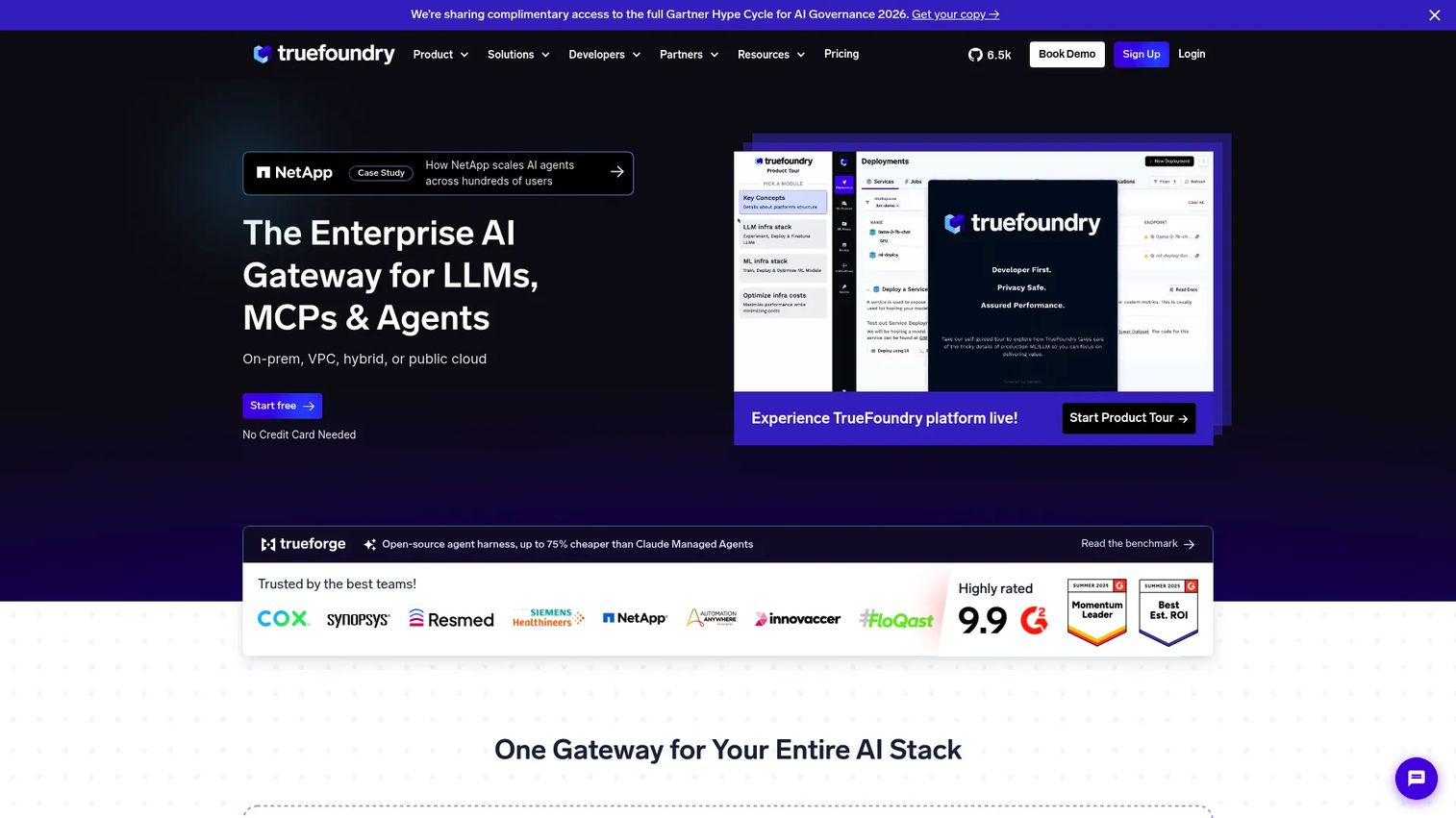
TrueFoundry AI Platform is an enterprise AI platform for deploying, governing, observing, and scaling LLMs, agents, MCP servers, and machine-learning workloads. Its unified gateway covers LLM, MCP, and agent traffic from a single control plane, with deployment options across cloud, VPC, on-premises, and hybrid environments. For product and platform teams moving from scattered AI prototypes to governed production workloads, it removes the need to build routing, budget, and observability infrastructure from scratch.
Best for: Enterprise product and platform teams governing LLM, MCP, and agent traffic across multiple providers and environments.
Key features
- Unified gateway for LLM, MCP, and agent traffic
- Multi-provider routing with fallbacks and rate controls
- Budget limits and spend tracking per team or workflow
- Guardrails, RBAC, SSO, and audit logging
- OpenTelemetry-compatible traces across prompts and tools
Why choose TrueFoundry AI Platform: TrueFoundry fits organizations that need platform-level controls across the entire AI workload stack, not just a lightweight developer proxy. It is a strong first evaluation when the roadmap includes both LLMs and agentic workflows.
TrueFoundry AI Platform pricing: The Developer plan is free for up to 3 users and 10K requests per user per month. Pro is $25 per user per month with 20K requests included and $20 per additional 100K requests. Enterprise uses a custom annual commitment.
G2 rating: 4.6/5
2. Cloudflare AI Gateway
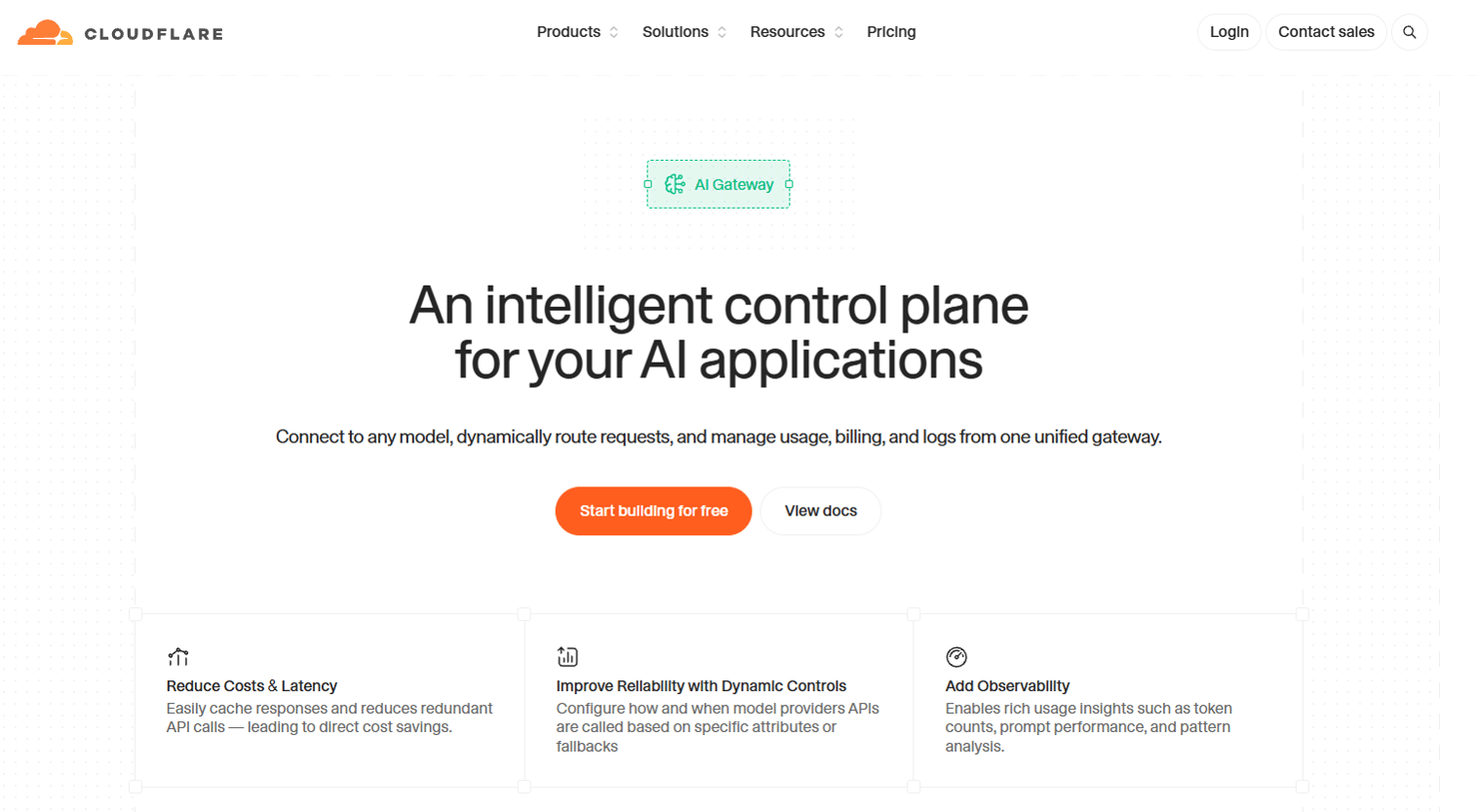
Cloudflare AI Gateway is an AI application control plane built on Cloudflare's global network. It provides visibility, routing, caching, rate limiting, safety controls, and unified billing across AI providers, all without requiring additional infrastructure for teams already running application traffic through Cloudflare. For product teams that want fast setup and AI traffic control close to existing edge infrastructure, it reduces time-to-value significantly.
Best for: Product and platform teams that already run application infrastructure through Cloudflare and want centralized AI observability and cost control.
Key features
- Multi-provider routing and fallback
- Caching of identical requests to reduce provider costs
- Analytics for requests, tokens, costs, and errors
- Rate limiting and safety guardrails
- Unified billing across providers
Why choose Cloudflare AI Gateway: Choose this when AI traffic control should sit close to your existing edge layer. It is especially relevant for teams that want fast setup without spinning up a dedicated gateway service.
Cloudflare AI Gateway pricing: Core features are free on all Cloudflare plans. Additional costs apply for logs, Logpush, Workers AI inference, and provider usage separately. No base subscription required to start.
3. Kong AI Gateway
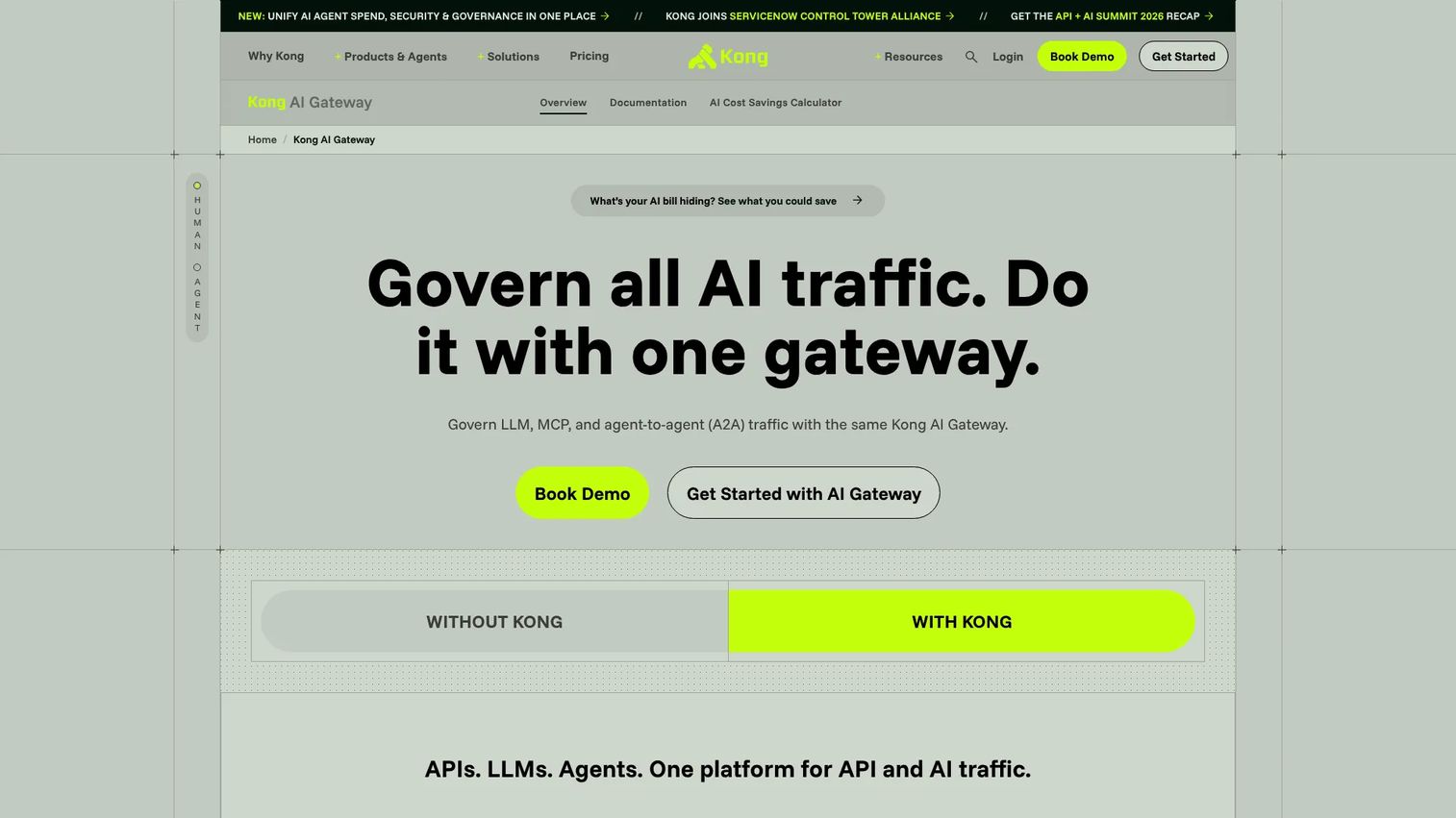
Kong AI Gateway is a connectivity and governance layer for LLM, MCP, and A2A traffic built on Kong's established gateway runtime. It adds AI-specific plugins, including prompt guards, PII sanitization, semantic caching, and token-based rate limiting, on top of a platform that many API teams already operate. Product teams evaluating gateway options alongside broader API management will find Kong familiar if they already work with Kong's ecosystem.
Best for: API platform teams that want to add AI traffic controls, including semantic caching and guardrails, within an existing gateway operating model.
Key features
- LLM provider routing, load balancing, and failover
- Prompt guard plugins and PII sanitization
- Token-based rate limiting and semantic caching
- MCP server generation and governance
- A2A traffic observability and audit trails
Why choose Kong AI Gateway: Kong fits teams that want AI controls inside a broader API management motion. It is a better fit for platform engineers than for product managers seeking a standalone AI cost dashboard.
Kong AI Gateway pricing: A 30-day free trial is available. The Plus plan starts from $25 per month plus usage. Additional charges include $500/month per dedicated cloud gateway control plane and $200/month per additional 1 million requests. Enterprise pricing is custom.
G2 rating: 4.4/5
4. LiteLLM
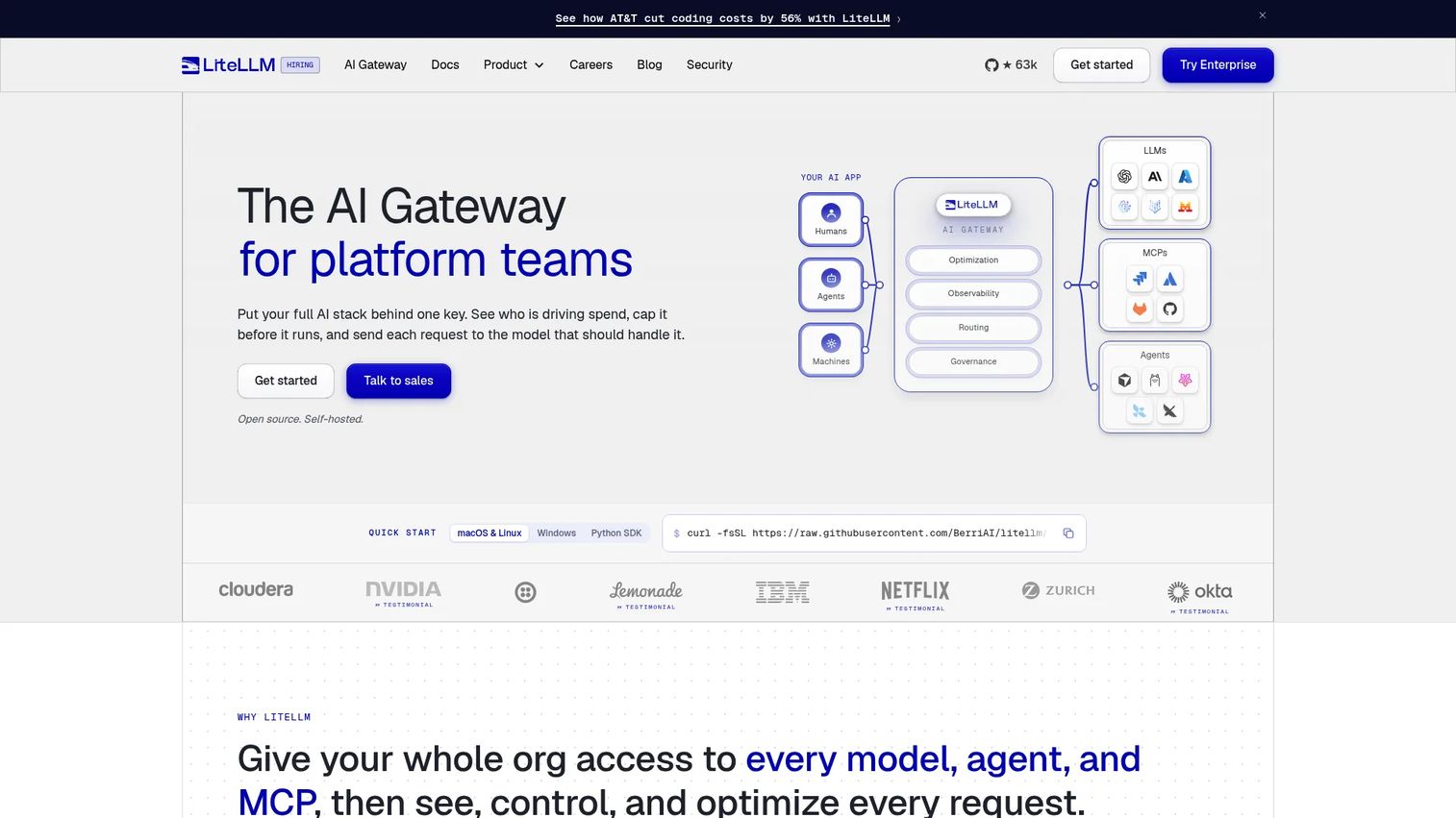
LiteLLM is an open-source, self-hosted AI gateway providing a unified OpenAI-compatible interface to more than 100 model providers. It handles provider abstraction, virtual keys, budget enforcement, spend tracking, and request logging, all from a proxy your team deploys and operates. For engineering-led teams that want complete control over routing and hosting, it removes provider lock-in without requiring a managed service.
Best for: Engineering teams that want a self-hosted LLM gateway with provider abstraction, budget controls, and virtual key management.
Key features
- OpenAI-compatible proxy for 100+ providers
- Virtual keys with per-key budgets and quotas
- Fallbacks, retries, and Prometheus metrics
- Request and response logging
- Self-hosted deployment with open-source licensing
Why choose LiteLLM: LiteLLM works well when engineering wants full ownership over routing and infrastructure. Product teams should confirm who will own uptime, upgrades, and cost reporting before selecting it, since those operational responsibilities stay in-house.
LiteLLM pricing: The open-source gateway is free to self-host. Infrastructure and model-provider costs are separate. Enterprise adds SSO, SCIM, audit logs, and advanced administration; pricing requires contacting sales.
5. Amazon Bedrock AgentCore
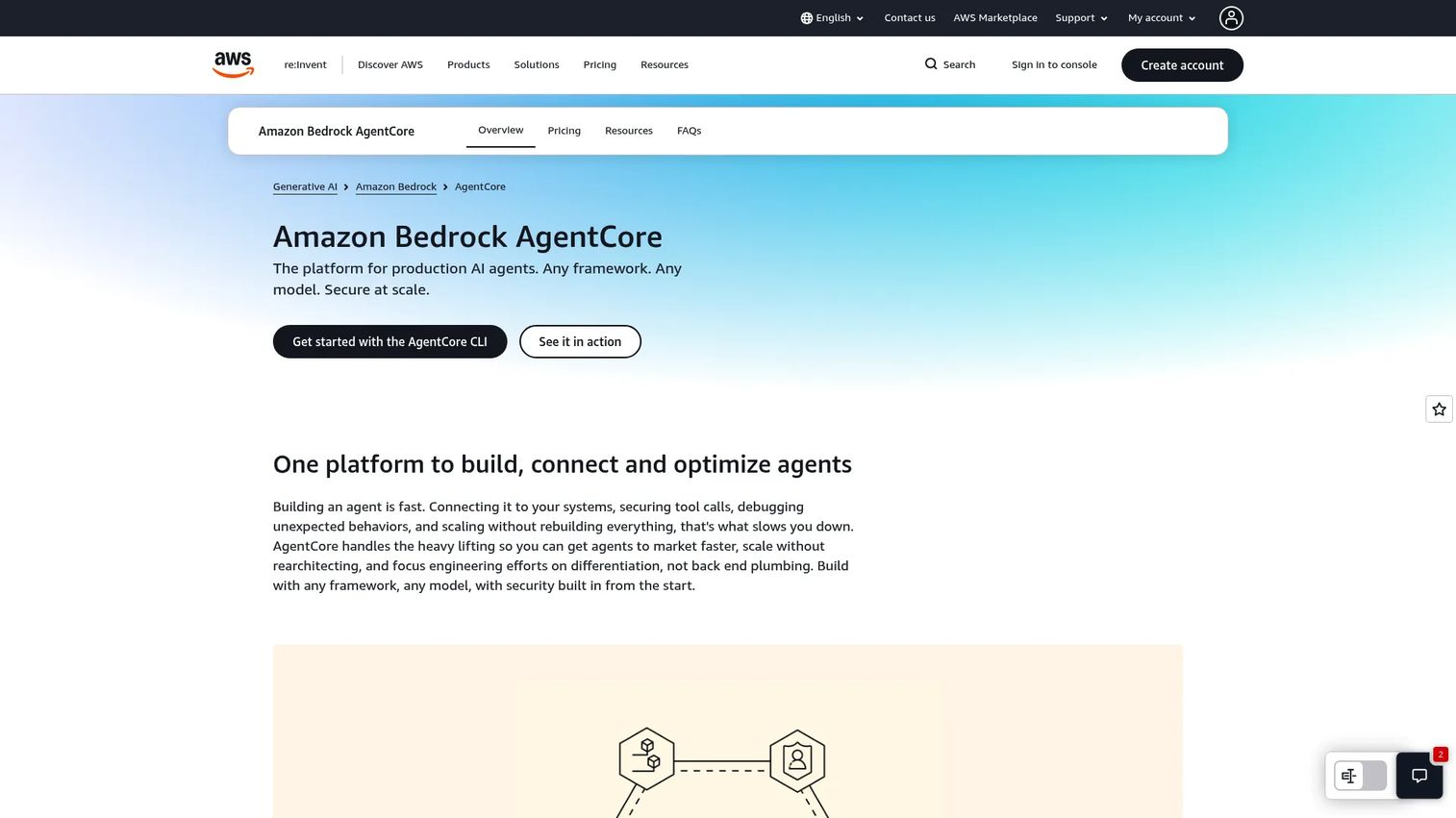
Amazon Bedrock AgentCore is a platform for building, connecting, deploying, and operating production AI agents using any framework and model. Its gateway component connects agents to APIs, Lambda functions, MCP servers, and tools with identity controls and access policies. Memory, browser tools, code interpreter, observability, and tracing round out the managed infrastructure layer, making it a strong fit for AWS-native teams that want to avoid building agent plumbing from scratch.
Best for: AWS-first product and engineering teams building agentic workflows that need managed tool access, identity, and observability on Bedrock.
Key features
- Secure serverless runtime for deploying and scaling agents
- Gateway for connecting agents to APIs, Lambda functions, and MCP servers
- Short-term and long-term agent memory
- Identity, authentication, and access controls
- Observability, tracing, and evaluation
Why choose Amazon Bedrock AgentCore: Choose it when the AI product architecture already centers on AWS and Bedrock. Product managers should evaluate how deeply the team wants to commit agent workflows to AWS services before shortlisting.
Amazon Bedrock AgentCore pricing: Consumption-based with no upfront fees. Example published rates: Runtime microVM CPU at $0.0895 per vCPU-hour, Gateway API invocations at $0.005 per 1,000 invocations, and Web Search at $7.00 per 1,000 queries.
6. Gravitee
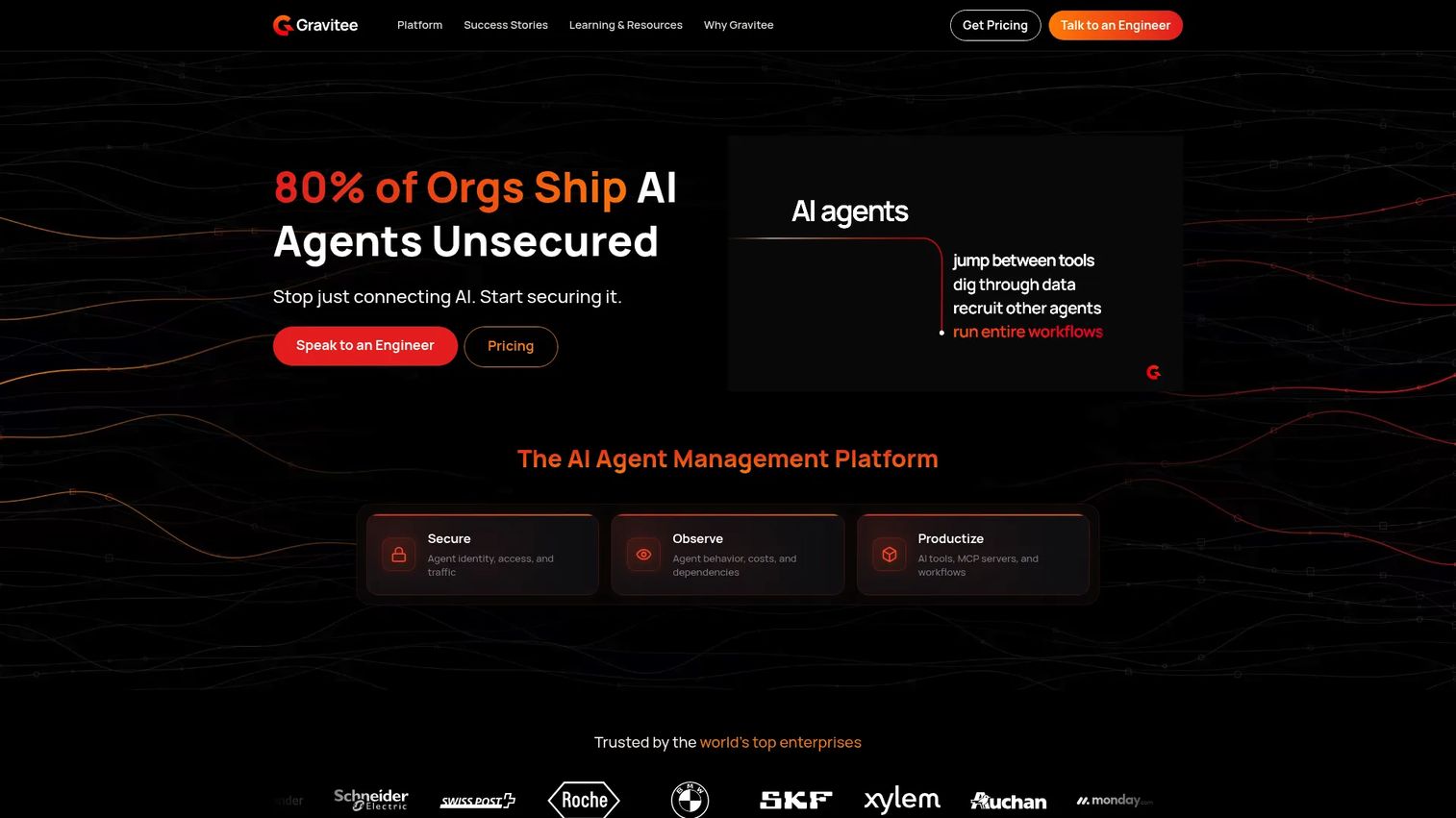
Gravitee is an event-native API management platform for designing, deploying, governing, securing, and monitoring APIs, event streams, and AI-agent traffic. It supports REST, GraphQL, gRPC, SOAP, WebSocket, and SSE, and extends governance policies to agent traffic. Enterprises that treat AI gateway decisions as part of broader API security and event governance will find Gravitee's model familiar.
Best for: Enterprise platform and API teams that need centralized governance across APIs, event streams, and AI-agent traffic under a shared policy model.
Key features
- Full-lifecycle API management across protocols
- Agent governance and event traffic control
- OAuth 2.0, JWT, mTLS, API keys, and OIDC support
- Developer portal with API discovery and analytics
- Observability and access management
Why choose Gravitee: Gravitee fits teams whose AI governance problem overlaps with broader API and event governance. It may be more than a simple LLM routing layer, which is precisely why it works for regulated or complex environments.
Gravitee pricing: Comet plan starts at $1,250 per month. Planet is $2,500 per month. Galaxy, Universe, Meteor, and Asteroid tiers require a quote.
G2 rating: 4.6/5
7. IBM API Connect
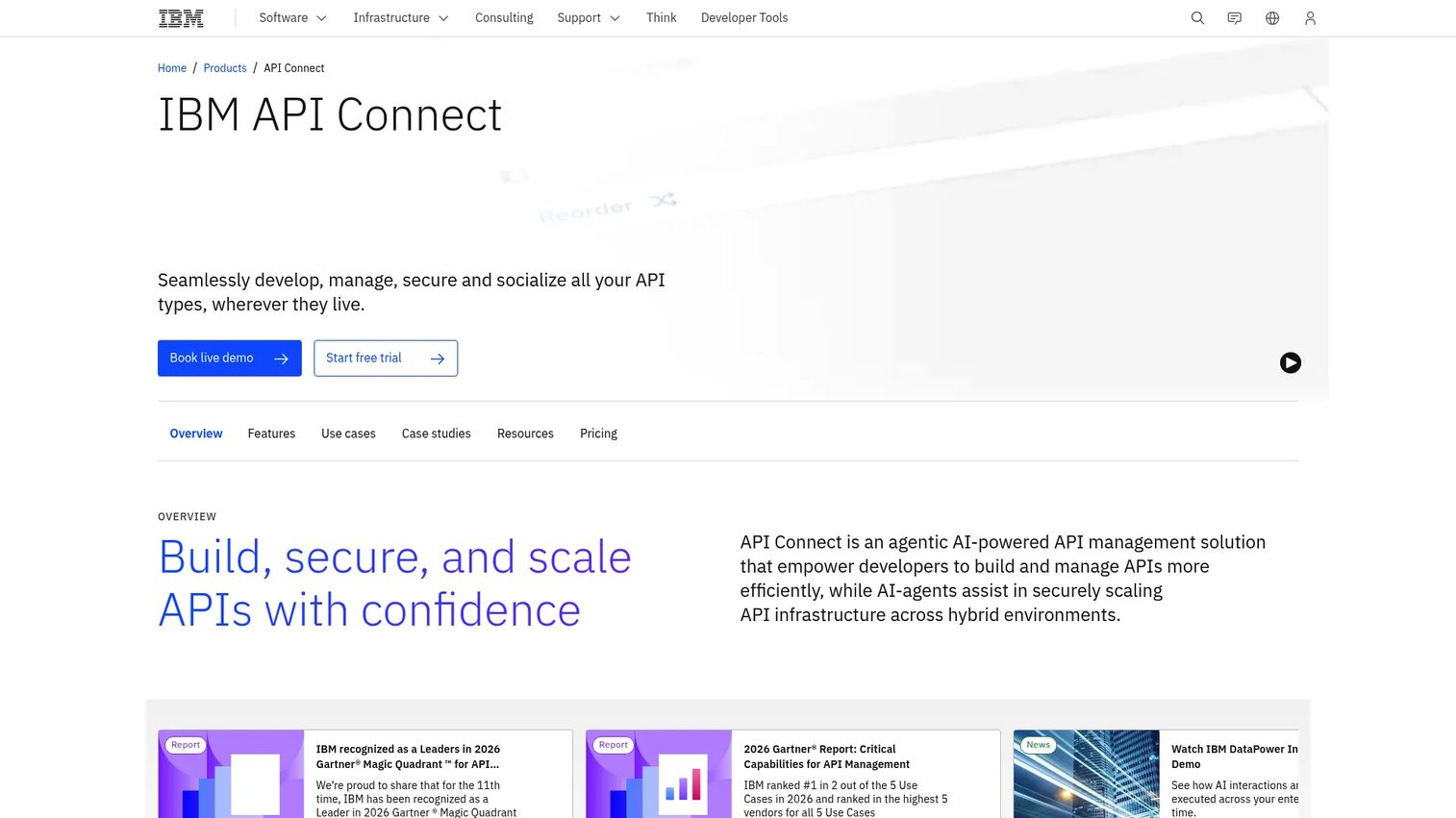
IBM API Connect is an enterprise API management platform for developing, securing, managing, sharing, and analyzing APIs across cloud, hybrid, multicloud, and on-premises environments. It covers the full API lifecycle with security policies, developer portals, analytics, and hybrid deployment. Teams evaluating it as an AI gateway entry point should verify current AI-specific controls against IBM's latest documentation, as the platform's AI governance extension potential depends on configuration.
Best for: Large enterprises standardizing API governance across hybrid-cloud environments where AI services are one part of a broader integration estate.
Key features
- API gateway and security policies
- Full API lifecycle management and versioning
- Developer portal for discovery and subscription
- REST, SOAP, GraphQL, WebSocket, and AsyncAPI support
- Hybrid, multicloud, and on-premises deployment
Why choose IBM API Connect: IBM API Connect fits organizations with existing IBM or hybrid-cloud investments. Evaluate it when AI gateway needs overlap with enterprise API management, not when the primary need is LLM proxying alone.
IBM API Connect pricing: IBM lists Pay-as-you-Go, Standard, Premium, Reserved Instance, and Software (self-managed) tiers. Prices are not displayed on the product page; buyers need to request a quote or use IBM's price estimator.
G2 rating: 4.3/5
8. Google Apigee API Management
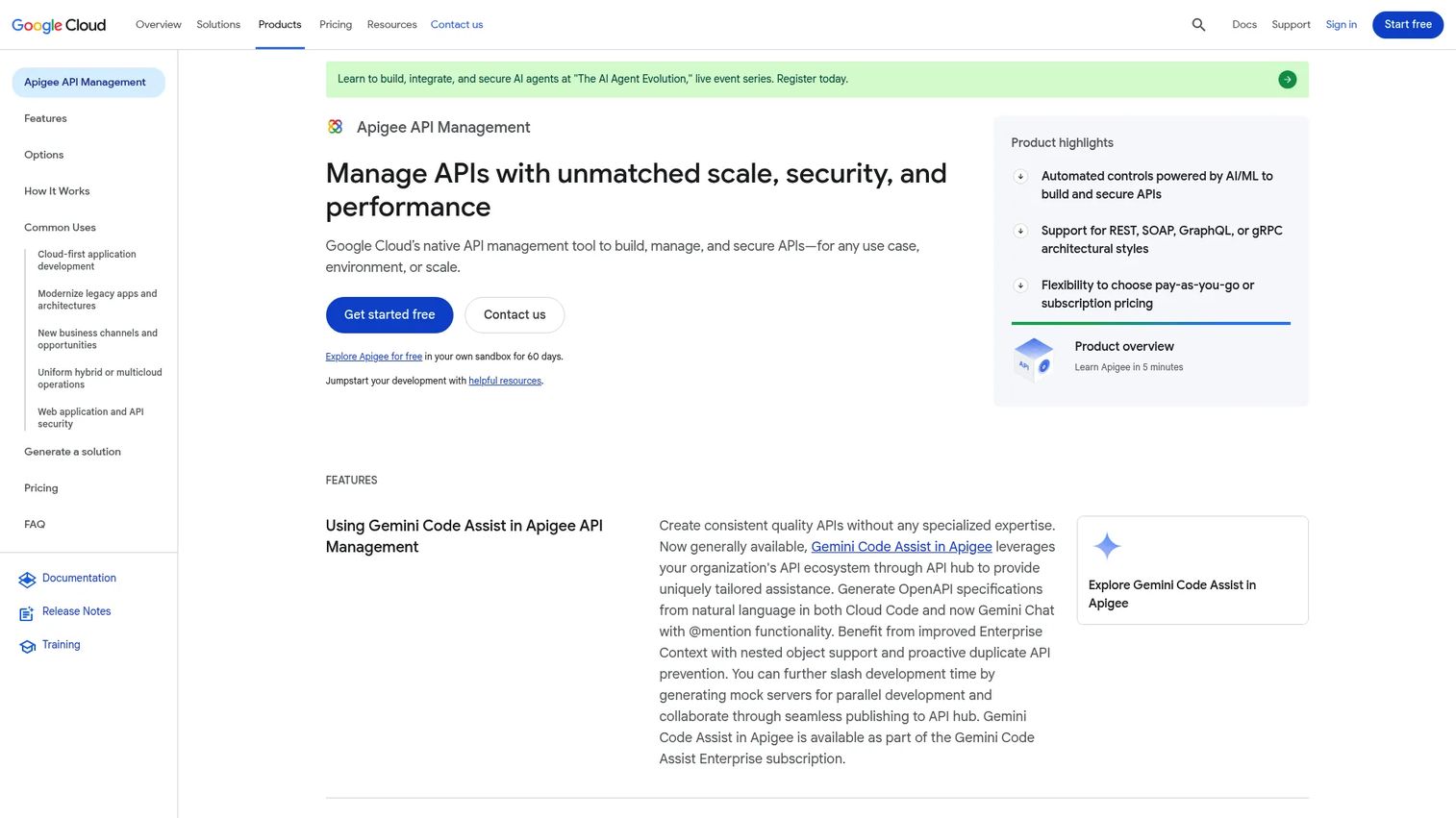
Google Apigee API Management is Google Cloud's native API management platform for building, managing, securing, and scaling APIs. It supports API proxy management for REST, gRPC, SOAP, and GraphQL, with traffic policies, analytics, developer portals, and hybrid deployment. For teams routing AI APIs through existing API governance on Google Cloud, Apigee provides a well-instrumented control layer. Teams should verify AI-specific controls before treating it as a full LLM gateway.
Best for: Google Cloud and hybrid API teams extending mature API governance to AI services and model endpoints.
Key features
- API proxies for REST, gRPC, SOAP, and GraphQL
- Traffic management, rate limiting, and quotas
- Analytics dashboards and monitoring
- Developer portals and API Hub
- Hybrid and multicloud deployment
Why choose Google Apigee API Management: Apigee fits teams with mature API programs and Google Cloud alignment. It is a strong choice when AI endpoint governance should sit inside the same policy model as other APIs.
Google Apigee API Management pricing: A free 60-day evaluation is available. Pay-as-you-go pricing starts at $20 per 1 million API calls. Standard, Enterprise, and Enterprise Plus subscription tiers require contacting sales.
G2 rating: 4.3/5
9. CData Connect AI
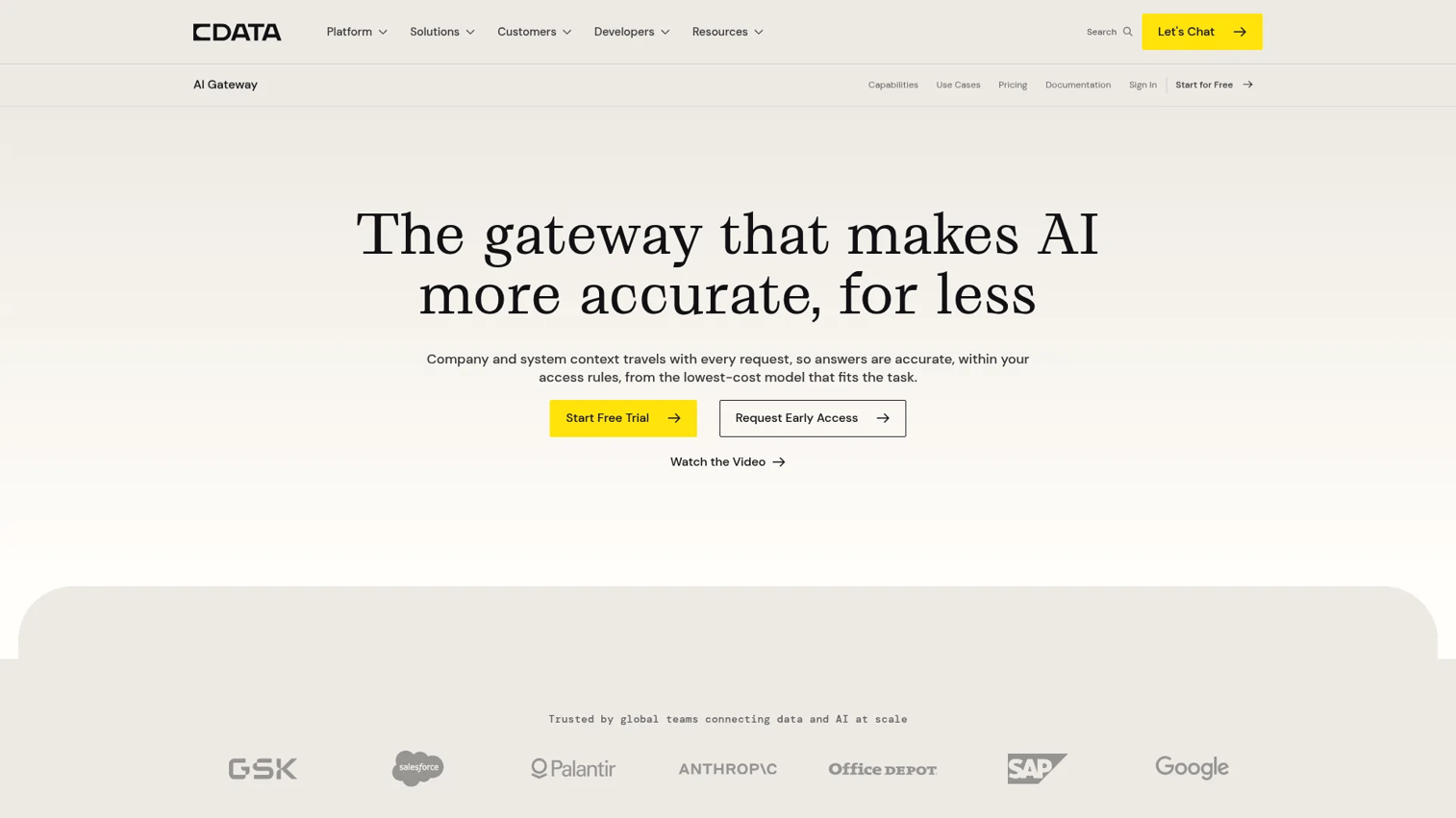
CData Connect AI is an AI gateway and governed data layer providing live, secure access to enterprise systems for agents, copilots, models, and applications. It connects AI workflows to hundreds of enterprise applications and databases via MCP, ODBC/JDBC, REST/OData, and SQL Server connectivity. When the core AI gateway problem is not model routing but safe data access, CData addresses a gap that most LLM-focused gateways leave open. Teams building retrieval-augmented or data-grounded AI features will find it directly relevant. See also our guide to AI model deployment software for the broader infrastructure picture.
Best for: Teams connecting AI agents and applications to governed enterprise data sources including SaaS platforms and databases.
Key features
- Live connectivity to hundreds of enterprise applications
- MCP, ODBC/JDBC, REST/OData, and SQL Server access
- Governance, access controls, and audit logging
- Derived views, federated queries, and semantic context
- Enterprise SSO, SCIM 2.0, passthrough identity, and encryption
Why choose CData Connect AI: CData matters when AI features need trusted access to business data, not just model routing. Evaluate it alongside model gateways when data permissions and source connectivity drive the roadmap.
CData Connect AI pricing: Standard plan is $99 per month (billed annually) and includes 1 user and 1 data source. Growth is $199 per month and adds broader sources and derived views. Business uses an annual contract with custom pricing. A 14-day trial is available.
G2 rating: 4.6/5
10. Solo.io agentgateway
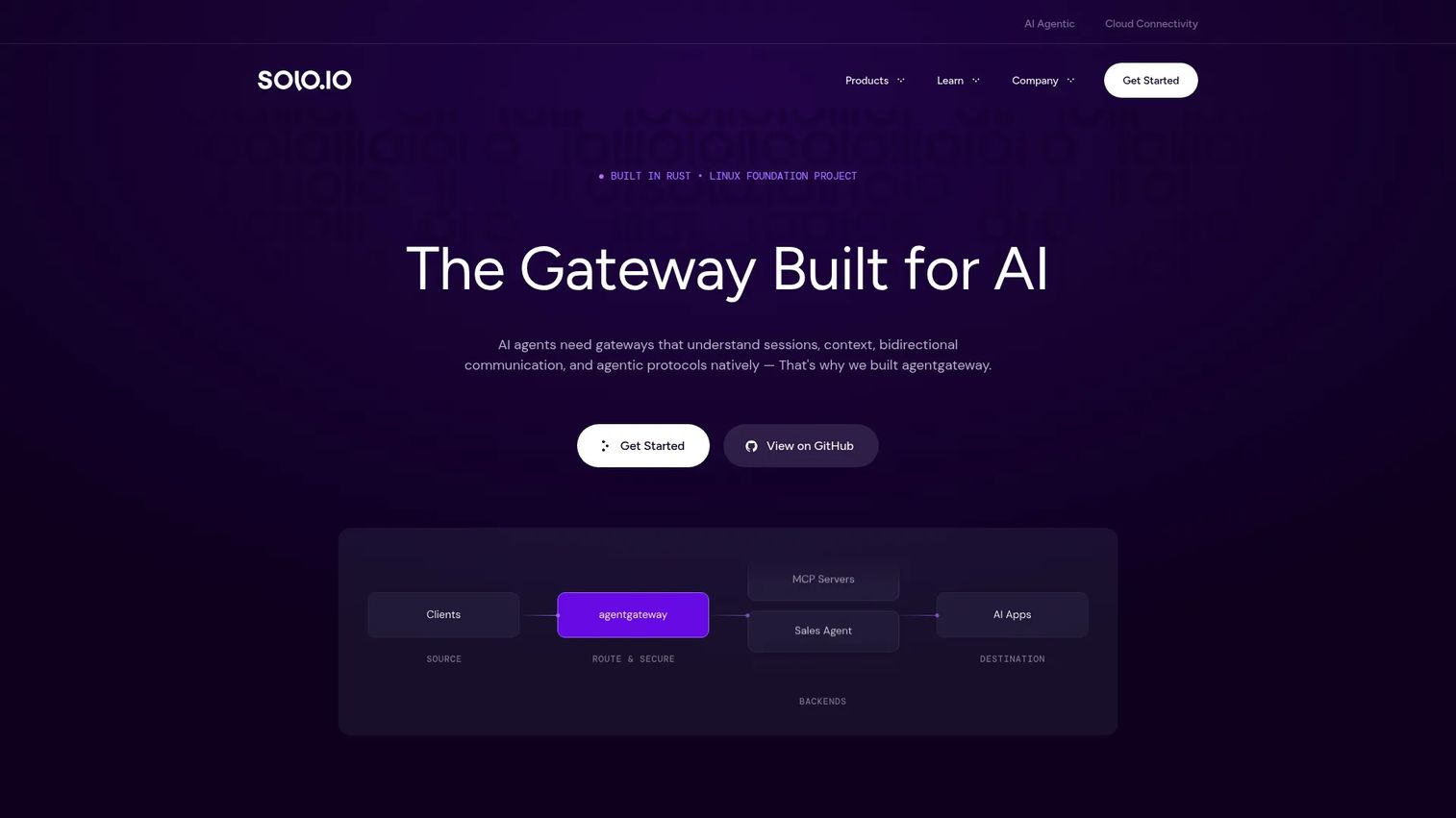
Solo.io agentgateway is an open-source, AI-native gateway for securing, governing, observing, and routing LLM, MCP, A2A, inference, HTTP, and gRPC traffic. Its Rust-based data plane supports tool-level RBAC, OAuth 2.1, OpenAPI-to-MCP exposure, MCP server federation, and context-aware inference routing. For platform teams where MCP tools and agent-to-agent traffic are becoming core product surface, the governance model maps directly to the problem. This is one of the most architecturally specific options in this list for teams building agentic AI platforms.
Best for: Platform teams governing MCP, A2A, and agent-to-tool communication with tool-level policies and service mesh alignment.
Key features
- Unified gateway for LLM, MCP, A2A, HTTP, and gRPC traffic
- Tool-level RBAC, OAuth 2.1, and audit trails
- OpenTelemetry/OpenInference observability with token and cost metrics
- Token- and request-based rate limiting with budget controls
- OpenAPI-to-MCP tool exposure and MCP server federation
Why choose Solo.io agentgateway: Solo.io agentgateway fits teams that see AI gateway architecture through an agent connectivity lens. It is especially relevant when MCP tools and agent-to-agent traffic are on the near-term roadmap.
Solo.io agentgateway pricing: The agentgateway project is open source and free to self-host under Apache 2.0. Solo Enterprise for agentgateway requires a license; pricing requires contacting an account representative.
G2 rating: 4.5/5
11. API7
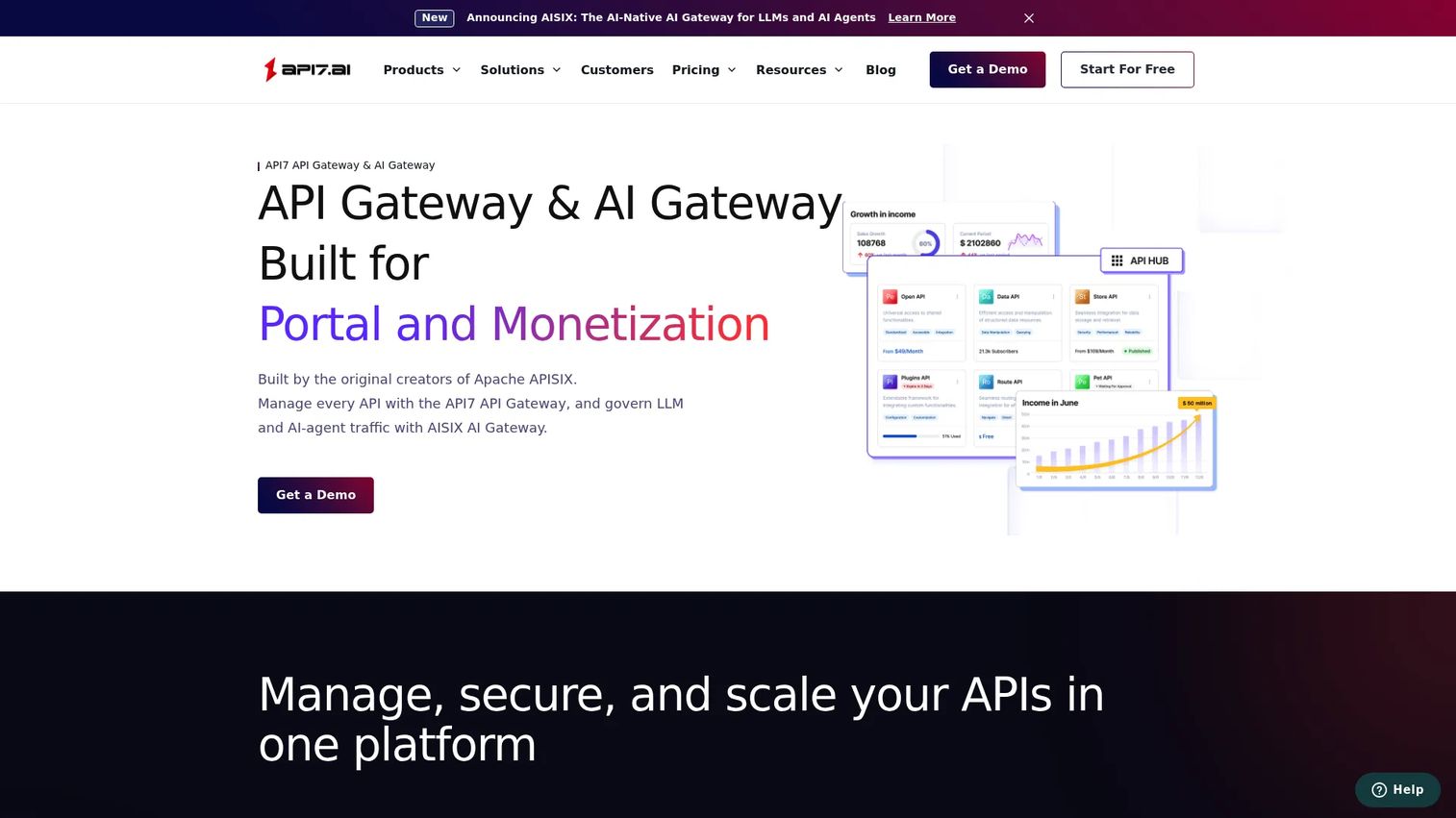
API7 is an enterprise API management platform built on Apache APISIX for centrally managing, securing, and observing API traffic. Its AI traffic management capabilities include LLM proxying, multi-model routing, guardrails, PII redaction, and token rate limiting. Teams that want open-source gateway roots with commercial support and AI-specific extensions will find the APISIX foundation familiar. Product managers should confirm AI-specific capabilities match their token tracking and prompt protection requirements before shortlisting. For a broader view of application security software relevant to AI workloads, see our related guide.
Best for: Organizations needing Apache APISIX-based gateway control extended to AI traffic with LLM proxying, PII redaction, and token rate limiting.
Key features
- Centralized control plane with decoupled data plane
- Authentication, rate limiting, and observability
- RBAC, SSO, audit logging, and high availability
- LLM proxying and multi-model routing
- PII redaction and AI guardrails
Why choose API7: API7 fits when teams want open-source gateway roots with AI extensions and commercial support. Confirm that AI-specific features match your prompt inspection and token attribution needs before committing.
API7 pricing: API7 Cloud Standard starts at $2 per 1 million API calls, plus $250 per gateway group per month and $10 per service per month. Cloud Premium and API7 Enterprise Edition use custom pricing.
G2 rating: 5.0/5
12. Alibaba Cloud API Gateway
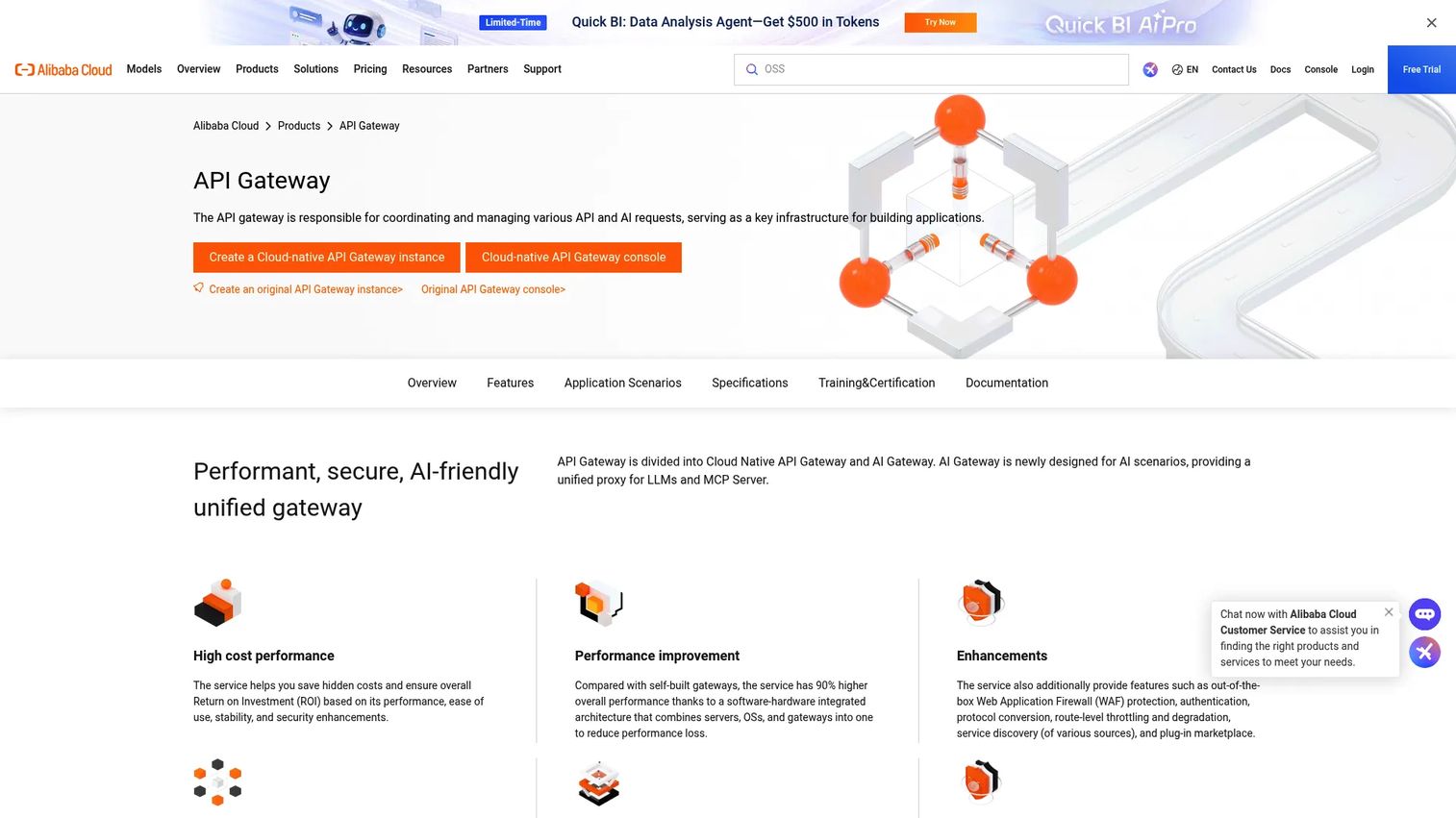
Alibaba Cloud API Gateway is a managed API platform for API lifecycle management, traffic governance, security, service exposure, and AI and MCP gateway scenarios. It covers traffic management including throttling, routing, canary releases, caching, circuit breakers, and degradation policies, alongside security controls including JWT, OIDC, API keys, HMAC, mTLS, and WAF integration. Note that the traditional version is being retired: New purchases stopped August 23, 2026, with full discontinuation scheduled for September 21, 2027. Teams should evaluate the cloud-native version.
Best for: Teams running AI and API workloads inside Alibaba Cloud that need a managed gateway with traffic governance and AI or MCP gateway support.
Key features
- Full API lifecycle management from design through publishing
- Traffic management with throttling, canary releases, and circuit breakers
- JWT, OIDC, API keys, HMAC, mTLS, and WAF integration
- AI and MCP gateway scenarios
- Monitoring tools and Alibaba Cloud integration
Why choose Alibaba Cloud API Gateway: Alibaba Cloud API Gateway fits teams whose infrastructure and market requirements center on Alibaba Cloud. It is less relevant for teams seeking vendor-neutral LLM routing across multiple cloud providers.
Alibaba Cloud API Gateway pricing: Cloud-native API Gateway starts at $0.124 per hour (pay-as-you-go) or $63 per month (subscription) for the entry instance size. Data processing and internet traffic fees apply separately.
G2 rating: 5.0/5
Considerations when choosing an AI gateway
Routing and provider strategy
Decide whether you need single-provider routing, multi-provider switching, or dynamic routing based on latency and cost. For multi-provider AI routing, verify that fallback rules are configurable per feature or customer segment, not just globally. This matters for product teams that need different reliability guarantees for different workflows.
Security and governance controls
Evaluate authentication, API key protection, prompt injection detection, PII handling, and audit log coverage. For product managers, the practical question is: Will security approve the architecture before usage scales? A gateway with RBAC, SSO, and exportable audit trails reduces the security review cycle materially.
Observability and cost attribution
Look for token usage by model and by feature or segment, error rates, latency percentiles, and cost-per-workflow reporting. This is PM language for AI: Instrumentation that ties model spend to product outcomes, not just aggregate billing. Without it, roadmap prioritization around AI features is guesswork.
Deployment and ownership model
Compare managed SaaS, self-hosted, cloud-native, and hybrid deployment options. Self-hosted gateways like LiteLLM and Solo.io agentgateway shift uptime, upgrades, and incident response to your team. That is a real opportunity cost to weigh against control. Managed options reduce that overhead but introduce vendor dependency.
Agent and MCP readiness
For product roadmaps that include agentic workflows, check whether the gateway can govern tools, MCP servers, and A2A communication. This is not future-proofing for most teams building AI products in 2026. It is a near-term architectural decision. See our guide to best prompt management tools for the adjacent layer of LLM workflow control.
Conclusion
The right AI gateway depends on where your team is architecturally and what your production AI workload actually looks like today.
TrueFoundry AI Platform covers the broadest range of enterprise needs: LLM, MCP, and agent governance with routing, budgets, guardrails, and OpenTelemetry-compatible observability across cloud and on-prem. For teams already running on Cloudflare, the AI Gateway adds centralized control with minimal setup. Kong AI Gateway is the natural choice for API platform teams that want AI controls inside a familiar gateway runtime.
LiteLLM gives engineering teams the most control for open-source, self-hosted routing, with the operational overhead that entails. Amazon Bedrock AgentCore is the strongest fit for AWS-native agent workloads. Gravitee and Solo.io agentgateway both address agent governance, with Gravitee leaning toward enterprise API management and Solo.io toward MCP and A2A connectivity specifically.
For teams beginning the selection process: Shortlist two or three tools based on deployment model first, then run a proof of concept against one production-like AI workflow. Measure latency, fallback behavior, token cost attribution, and security controls before committing.
If your team sells complex software and needs buyers to understand AI-powered workflows before a call, Start your journey with Guideflow today!
FAQs
An AI gateway is a control layer that sits between applications and AI services, routing requests to models while enforcing security, observability, cost, and governance policies. It tracks tokens, inspects prompts, protects provider credentials, and can route across multiple providers based on latency or cost. It is the infrastructure that separates ad hoc AI feature calls from governed, instrumented production workloads.
Traditional API gateway software manages HTTP, REST, and GraphQL traffic by inspecting headers, paths, and payloads. An AI gateway adds token awareness, prompt inspection, semantic caching, model routing, provider failover, and agent governance, capabilities that standard API gateways were not designed to provide. Some platforms, including Kong, Gravitee, IBM API Connect, Apigee, and API7, extend existing API gateway runtimes with AI-specific plugins rather than building from scratch.
They can, when configured to use caching, rate limits, quotas, model routing, and usage analytics. Semantic caching alone can materially reduce repeated provider calls for similar inputs. The savings depend on traffic patterns and policy design; a gateway that routes expensive requests to cheaper models when latency tolerance allows will show clearer cost impact than one used only for logging.
LiteLLM is the most established open-source option, providing an OpenAI-compatible proxy for more than 100 providers with virtual keys, budget controls, and self-hosted deployment at no license cost. Solo.io agentgateway is also open source under Apache 2.0 and covers MCP and A2A traffic, which matters for teams building agentic products. Both require your team to own uptime, upgrades, and policy design as part of the opportunity cost calculation.
Amazon Bedrock AgentCore is the strongest fit for AWS-native agent workloads, providing a managed runtime, gateway, memory, and observability layer for agents built on Bedrock. The fit depends on how committed the architecture is to AWS services. Teams that want flexibility across cloud providers will find vendor-neutral options like TrueFoundry or LiteLLM more portable.
Gateways with prompt inspection capabilities scan inputs before forwarding them to the model, flagging or blocking injection patterns, jailbreak attempts, and sensitive data. API key protection keeps provider credentials out of application code entirely, reducing the blast radius of a leaked key. Audit logs capture what was sent and received, which supports both security review and compliance documentation. No gateway guarantees compliance outcomes; that determination depends on your organization's specific regulatory obligations.
Support varies by product. Solo.io agentgateway, Amazon Bedrock AgentCore, TrueFoundry AI Platform, Kong AI Gateway, and Alibaba Cloud API Gateway all document MCP support. A2A governance is currently most developed in Solo.io agentgateway and Kong AI Gateway. Teams building agentic products should evaluate tool-level policy controls, agent identity management, and audit trail coverage alongside standard routing and observability features. See our guide to agentic AI platforms for the broader category context.
Adopt one when AI features move beyond prototypes and into production traffic, multiple teams are calling models from different services, token spend becomes hard to attribute to features or customers, or security asks for centralized controls before the next release. For product managers, the trigger is usually the first time someone asks: "How much does this AI feature actually cost us per user?" and there is no clean answer. A gateway makes that question answerable, which changes how you prioritize and price AI features on the roadmap.