Your production manager walks the floor at 7am with a clipboard. By the time the numbers land in a spreadsheet and get rekeyed into the ERP, it's mid-afternoon and the data describes a shift that already ended. A machine went down for 40 minutes at 9:15. Nobody upstairs knew until the daily report. The reschedule that could have saved the delivery date never happened.
That gap between what's happening on the floor and what leadership can see is the exact problem shop floor control software exists to close. The market reflects the pressure: the global shop floor management software market sat at roughly USD 1.2 to 2.26 billion in 2024 and is forecast to grow at around 8 to 8.5% CAGR through the early 2030s, according to Business Research Insights (2024). Meanwhile, only 43% of SMEs use advanced software to track and manage inventory, per Expert Market Research (2025), so the headroom for adoption is large.
If you're evaluating tools that promise real-time visibility, tighter production scheduling, and cleaner ERP integration without piling on manual work, this guide compares six real options. Each handles work order management, downtime tracking, and shop floor execution differently, and the right pick depends on your manufacturing complexity, existing stack, and how you want to deploy. If your evaluation touches adjacent operational categories, you may also find our roundups on audit management software, contract lifecycle management software, and event management software useful for building the wider stack picture.
What's inside
This guide compares six real shop floor control software products built for teams actively narrowing a vendor shortlist, not just learning the category. We selected tools based on six criteria that matter most for operations leaders: real-time visibility into production status, production scheduling and capacity planning depth, ERP and MES integration, execution workflows on the floor, operator usability, and how well each scales from a single line to a global network. Where public pricing or an independent rating exists, we include it. Where a vendor gates pricing behind a sales conversation, we say so plainly rather than guess.
TL;DR
- Best overall for operations teams: Siemens Opcenter Execution, for order lifecycle control and real-time monitoring across specialized manufacturing industries.
- Best for concrete floor tooling tied to ERP: DELMIAWorks, for operator dashboards, paperless production, and quality workflows in one system.
- Best for high-complexity, compliance-aware manufacturing: Manufacturo, for dynamic scheduling, accountability, and API-first integration.
- Best for modular rollout and machine-level data: STIWA Shopfloor Software, for PLC-level capture and scaling from one machine to many.
- Best for Oracle-centric environments: Oracle Shop Floor Management, for lot and serial traceability and tight transaction control.
- Best as an ERP module: Sage 500 ERP Shop Floor Control, for labor and production reporting inside an existing ERP.
What is shop floor control software?
Shop floor control software is the layer of manufacturing software that manages and tracks production activity as it happens, sitting between high-level planning and the physical work on the floor. It takes released production orders and turns them into executable, trackable work, then feeds real actuals back up so scheduling and reporting reflect reality instead of assumptions.
Planning tools tell you what should happen. Shop floor control tells you what is happening and what already did. That feedback loop is why the category overlaps heavily with the term manufacturing execution system, and why many vendors use "shop floor control" and "MES software" almost interchangeably.
Core functions you should expect from shop floor management software:
- Production order management: Release, sequence, and track work orders from start to settlement.
- Production scheduling and capacity planning: Sequence jobs against machine availability, labor, and material constraints.
- Shop floor data collection: Capture progress, quantities, and status through barcode workflows, terminals, or machine signals instead of paper.
- Labor tracking and material consumption tracking: Record who worked on what and how much material was consumed against each order.
- Real-time visibility and production monitoring: Show live job status and machine state on operator dashboards.
- **Downtime tracking and OEE:** Log stoppages, reasons, and productivity tracking metrics to support OEE / productivity tracking.
- Quality management: Capture inspections, SPC charts, and nonconformance handling in line with execution.
- Reporting and ERP integration: Push actuals back into the ERP so financials, inventory, and scheduling stay accurate.
When to use shop floor control software
Not every plant needs a full MES on day one. These three situations tell you when the investment pays off.
Improve real-time visibility
If your team only sees production status at end of shift, you're always reacting to yesterday. Shop floor control software gives live job and machine status so a supervisor can spot a bottleneck the moment throughput drops, not hours later. Faster bottleneck detection means faster intervention, and faster intervention protects delivery dates. This is the single most common reason operations leaders start looking.
Reduce manual data entry
Paper travelers, whiteboards, and spreadsheets create two problems: errors and delay. Every rekeyed number is a chance to introduce a mistake, and every manual step pushes the data further behind reality. Automated shop floor data collection through barcode workflows, terminals, or machine signals improves accuracy and moves you toward a paperless shop floor where operators log work at the point of activity.
Tighten scheduling and resource allocation
When demand shifts, a machine goes down, or a shift runs short-staffed, static schedules break. Dynamic production scheduling that reacts to actual machine availability and labor constraints keeps work order flow moving. Tie that to capacity planning and you can commit to realistic dates instead of optimistic ones, then adjust when conditions change.
Comparison table
The table below summarizes intent, differentiation, pricing, and independent rating for each tool. Read it as a starting filter, not a verdict: the "intent" column tells you what buyer each product fits best, and "key differentiation" points to the capability that sets it apart. Most vendors in this category gate pricing behind a sales conversation, which is normal for enterprise manufacturing software, so treat pricing as an evaluation step rather than a public number.
| # | Product | Intent | Key differentiation | Pricing | G2 rating |
|---|---|---|---|---|---|
| 1 | Siemens Opcenter Execution | Enterprise MES across specialized industries | Industry-specific MES variants and order lifecycle control | Contact sales | Not listed |
| 2 | DELMIAWorks | Mid-market ERP plus MES in one system | Operator dashboards and paperless floor tied to ERP | Contact sales | 4.1/5 |
| 3 | Manufacturo | High-complexity, compliance-aware manufacturing | API-first MES/MOM with dynamic scheduling | Contact sales | 4.7/5 |
| 4 | STIWA Shopfloor Software | Modular rollout with machine-level data | PLC-level capture and modular scaling | Contact sales | 4.3/5 |
| 5 | Oracle Shop Floor Management | Oracle-centric manufacturing operations | Lot/serial traceability and genealogy | Contact sales | Not listed |
| 6 | Sage 500 ERP Shop Floor Control | Labor and production tracking inside an ERP | Shop floor module within Sage 500 ERP | Contact sales | 3.4/5 |
1. Siemens Opcenter Execution
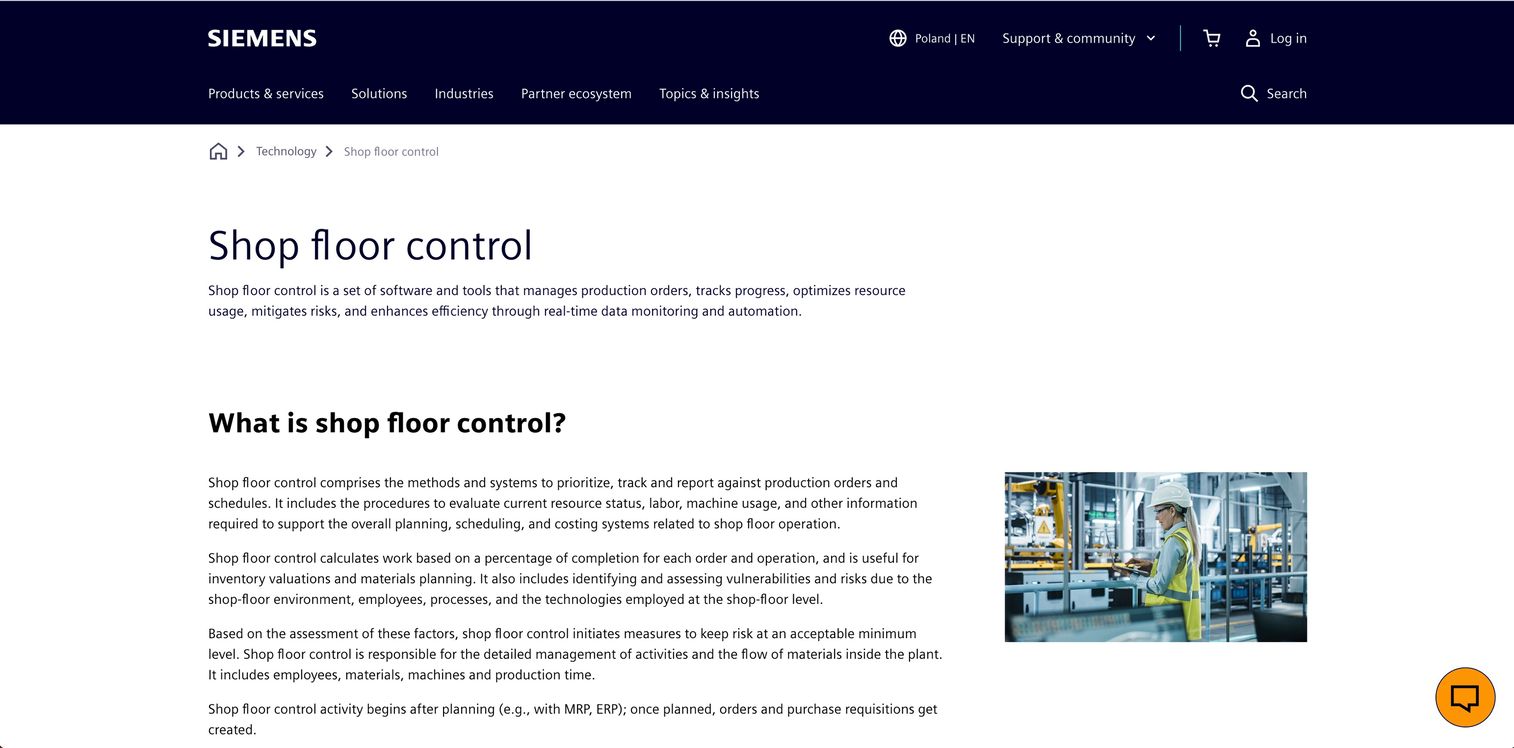
Siemens Opcenter Execution is the category-defining manufacturing execution system for teams that need deep production control across specialized industries. It ships as a portfolio with industry-specific variants for discrete, electronics, semiconductor, process, and pharmaceutical manufacturing, so the execution logic matches the way each type of plant actually runs. It manages the full function set from planning handoff through order execution to settlement.
The strength here is the order lifecycle. Opcenter Execution handles production order prioritization and scheduling, tracks material, labor, and machine usage against each order, and provides real-time monitoring of production progress. Percentage-of-completion logic and closed-loop feedback support the digital thread, which matters when traceability and risk mitigation are non-negotiable, as in pharma or semiconductor work.
Best for: Enterprise manufacturers that need Siemens-grade MES and MOM execution tailored to a specialized industry.
Key strengths
- Industry-specific variants: Execution logic purpose-built for electronics, semiconductor, process, pharma, and discrete manufacturing.
- Order lifecycle control: Prioritization, scheduling, and percentage-of-completion tracking from planning to settlement.
- Real-time monitoring: Live production progress with material, labor, and machine usage tracking.
Why choose Siemens Opcenter Execution: If you operate in a regulated or highly specialized industry and want an MES backed by one of the largest industrial software vendors, this is the reference point every other tool gets measured against. It rewards teams ready for a structured enterprise evaluation and a rollout that touches the digital thread across the plant.
Siemens Opcenter Execution pricing: Siemens does not publish list pricing for Opcenter Execution. The product pages direct buyers to contact sales for pricing information, so expect a scoped enterprise quote based on industry variant, plant count, and modules. Budget for a formal evaluation cycle rather than a self-serve signup.
2. DELMIAWorks
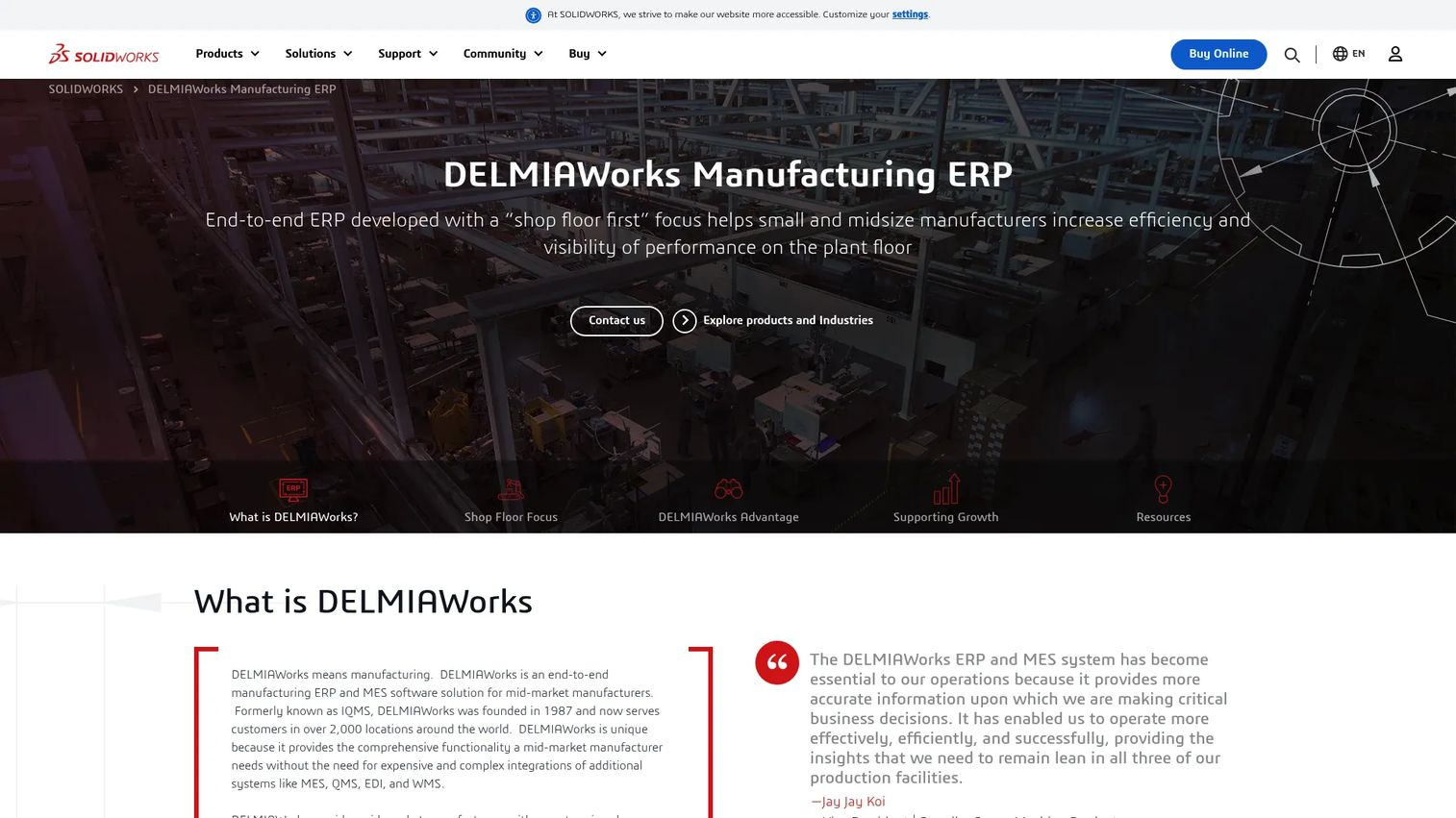
DELMIAWorks is end-to-end manufacturing ERP and MES software built for mid-market discrete and process manufacturers who want their shop floor interface and their ERP in one system. This is the most concrete floor-tooling option on the list. The operator experience is front and center, with configurable dashboards, paperless production, and documentation available right at the workstation.
The capability depth is where it earns its place. DELMIAWorks covers real-time production monitoring, downtime reporting, task clock labor tracking, quality inspection, scheduling, label printing, and detailed work order management, all tied to end-to-end supply chain management and integrated quality management. Because ERP and MES live in the same platform, actuals from the floor flow into inventory and financials without a separate integration layer.
Best for: Mid-market discrete or process manufacturers who want ERP and MES unified rather than stitched together.
Key strengths
- Operator dashboards and paperless floor: Configurable dashboards, documentation access, and label printing at the workstation.
- Production monitoring and downtime reporting: Real-time status plus task clock labor tracking and downtime capture.
- Integrated quality management: Inspection and quality workflows in the same system as scheduling and work orders.
Why choose DELMIAWorks: If you want one vendor for both ERP and shop floor execution, and your priority is a usable operator interface tied directly to quality and inventory, DELMIAWorks removes the integration seam that separate systems create. It holds a 4.1/5 rating on G2, reflecting broad mid-market adoption.
DELMIAWorks pricing: DELMIAWorks does not list public pricing on its site and directs visitors to contact sales for a quote. Pricing typically scales with modules, users, and plant footprint, so plan for a sales-led evaluation to size the system to your operation.
3. Manufacturo
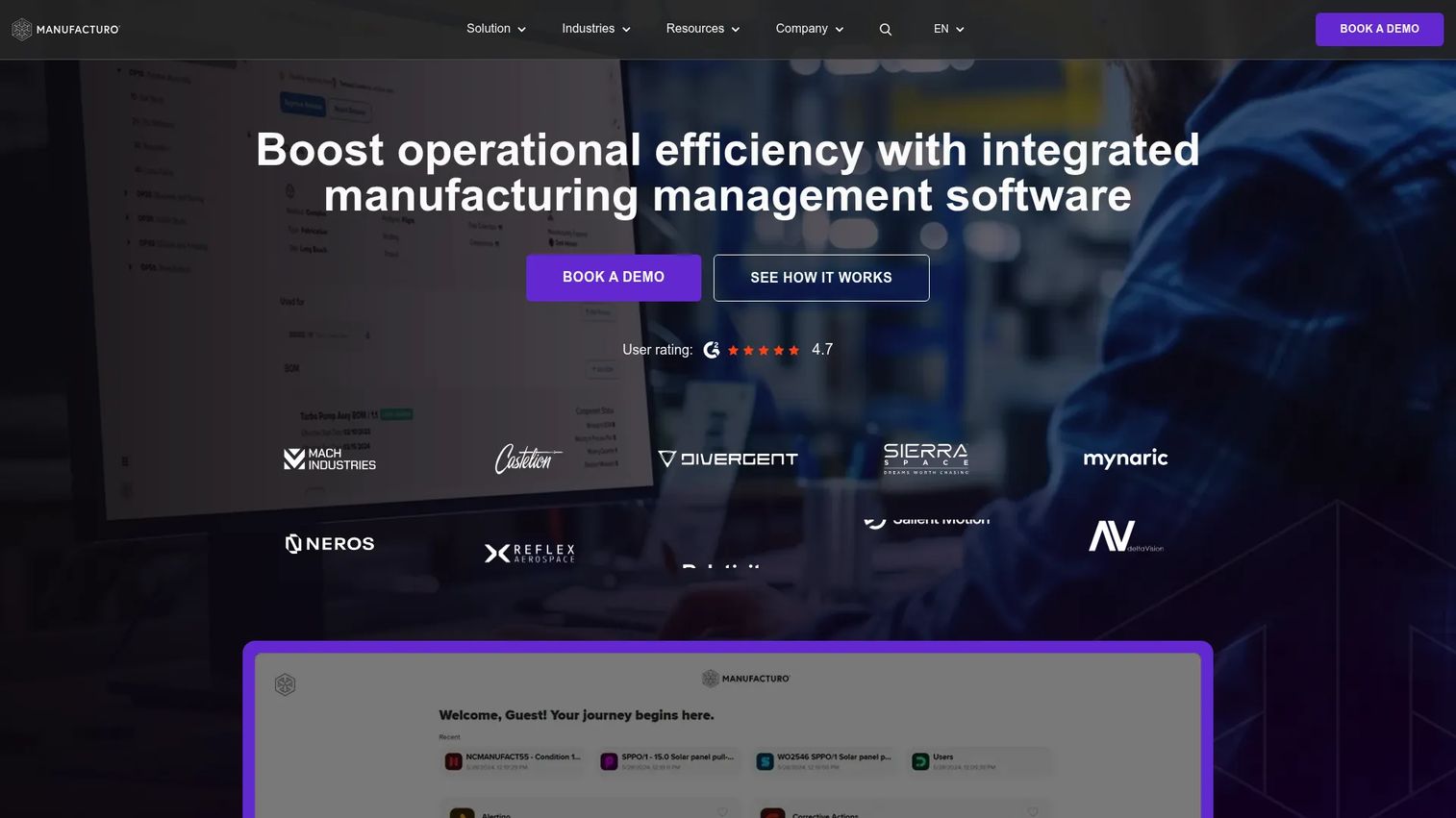
Manufacturo is integrated manufacturing management software built for complex, high-mix operations that care about data-driven control and regulatory rigor. It unifies MES and MOM capabilities on an API-first platform, which makes it a strong fit for manufacturers that need to connect execution to a broader stack rather than run it in isolation.
The feature set leans into control and accountability. Manufacturo covers shopfloor operations, process and procedures, equipment management, material requirements planning, inventory management, and document management, alongside nonconformance and CAPA handling for compliance-aware operations. Dynamic scheduling, task assignment, changeover, downtime, and KPI tracking give supervisors visibility and give leadership defensible data. ERP and WMS integration keep the system connected to planning and warehouse workflows.
Best for: High-complexity manufacturers that need a unified MES/MOM platform with strong compliance and traceability.
Key strengths
- API-first integration: Connects execution to ERP, WMS, and the wider stack without a bolt-on layer.
- Compliance-aware operations: Nonconformance and CAPA handling built into execution, not added later.
- Dynamic scheduling and KPI tracking: Task assignment, changeover, and downtime tracking with accountability baked in.
Why choose Manufacturo: If your manufacturing is complex, regulated, or both, and you want a modern platform that treats integration and data as first-class, Manufacturo is built for that reality. It carries a 4.7/5 rating on G2, the highest among the tools here, and its pricing is quote-based.
Manufacturo pricing: Manufacturo does not publish public pricing. The site prompts visitors to book a demo or request a quote, and pricing is scoped to your operation's complexity and module needs. Expect a consultative sales process rather than a fixed price list.
4. STIWA Shopfloor Software
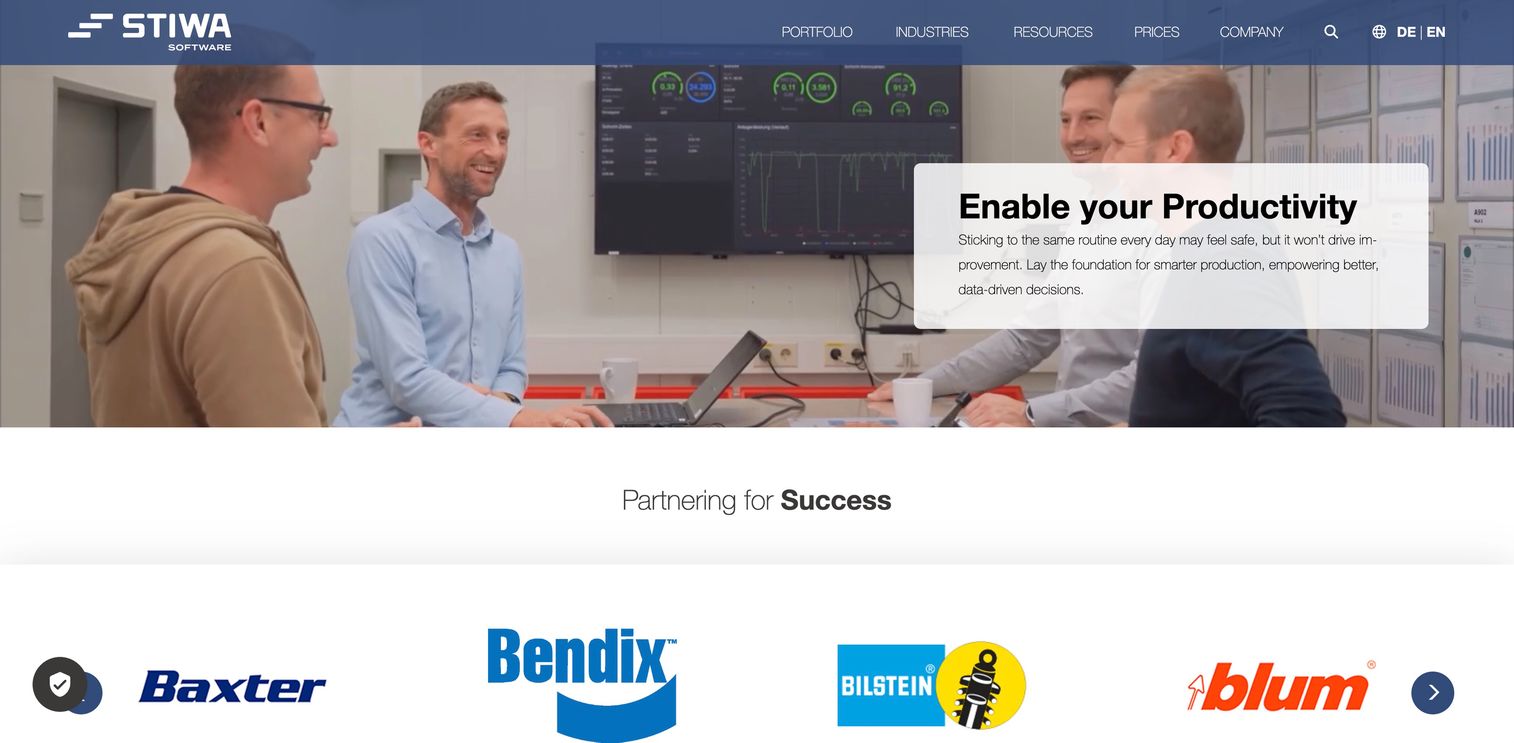
STIWA Shopfloor Software is industrial shopfloor software for planning, control, data collection, and analysis, built by a company with deep manufacturing and automation roots. Its differentiator is a modular architecture that scales from a single machine to a global production network, so you can start narrow and expand without replatforming.
The data story runs deep. STIWA emphasizes comprehensive production control from planning through detailed analysis, real-time data collection and process optimization, and open system interfaces that connect to machines and PLCs directly. That machine-level and PLC-level capture supports KPI standardization and AI-assisted optimization, which appeals to teams that want automation-native transparency rather than manual logging. The modular deployment model means you commit to what you need now and layer on capability as you grow.
Best for: Manufacturers who want an integrated shopfloor platform with deep machine data and the flexibility of modular rollout.
Key strengths
- Modular deployment: Scale from a single machine to a global network without a rip-and-replace.
- Machine and PLC-level capture: Real-time data collection straight from equipment via open interfaces.
- AI-assisted optimization: KPI standardization and process optimization built on granular shop floor data.
Why choose STIWA Shopfloor Software: If you value a manufacturing-native origin and want to prove value on one line before scaling across the plant or network, STIWA's modular model fits how cautious operations teams actually buy. It holds a 4.3/5 rating in third-party listings, though verify the exact product match during evaluation.
STIWA Shopfloor Software pricing: STIWA does not publish public pricing and instead structures offerings around service packages and product groups. Pricing is scoped through direct contact, so plan a conversation to map modules to your rollout phases.
5. Oracle Shop Floor Management
Oracle Shop Floor Management is Oracle's shop floor execution and tracking module within its manufacturing applications and E-Business Suite. It's the natural choice for organizations already standardized on Oracle that want execution, tracking, and genealogy tightly coupled to their ERP rather than integrated through a separate system.
Where Oracle earns its spot is transaction control and traceability. It handles complex lot transactions and genealogy, dispatch lists, move in and move out flows, travelers, and detailed scheduling with enhanced shop floor execution. For manufacturers where lot and serial traceability is a hard requirement, and where the ERP is already Oracle, keeping shop floor control inside that ecosystem reduces the integration surface and keeps a single source of truth.
Best for: Manufacturers running Oracle applications that need shop floor execution with strong traceability and transaction control.
Key strengths
- Lot and serial traceability: Complex lot transactions and full genealogy for regulated or high-accountability production.
- ERP-native execution: Dispatch lists, travelers, and move flows tightly integrated with Oracle manufacturing.
- Detailed scheduling: Enhanced shop floor execution coupled to Oracle's planning and transaction layer.
Why choose Oracle Shop Floor Management: If Oracle is already your system of record, keeping shop floor control in the same ecosystem avoids a separate MES integration and keeps genealogy and transactions consistent end to end. It fits teams that prioritize traceability and tight ERP coupling over a standalone execution layer.
Oracle Shop Floor Management pricing: Oracle does not publish first-party pricing for this module, and licensing typically depends on your broader Oracle agreement and user counts. Pricing is handled through Oracle sales, so scope it alongside your existing Oracle contract.
6. Sage 500 ERP Shop Floor Control
Sage 500 ERP Shop Floor Control is the Shop Floor Control module inside Sage 500 ERP, giving manufacturers real-time labor and production reporting from the floor without adding a standalone MES. This is the ERP-extension option: useful when your team wants a module that fits an existing Sage 500 investment rather than a separate execution platform.
The module focuses on execution basics done well. It provides real-time labor and production reporting, touchscreen and handheld device support, and built-in barcode scanning for work order logon and logoff. Around that core, it supports planned orders, labor reporting, and material control, feeding manufacturing execution data directly into the ERP. For a plant that has outgrown spreadsheets but wants to stay inside Sage, this bridges the gap.
Best for: Manufacturers on Sage 500 ERP who need shop floor labor and production tracking inside their existing system.
Key strengths
- Real-time labor and production reporting: Live actuals captured at the point of work.
- Barcode and device support: Built-in barcode scanning plus touchscreen and handheld logon/logoff.
- ERP-native module: Planned orders, labor reporting, and material control inside Sage 500.
Why choose Sage 500 ERP Shop Floor Control: If you already run Sage 500 and want to add shop floor tracking without a separate MES project, this module extends what you have. It performs best for teams that want a module over a platform, and it carries a 3.4/5 rating in G2 comparison listings.
Sage 500 ERP Shop Floor Control pricing: Sage does not publish standalone pricing for the Shop Floor Control module, and cost generally depends on your Sage 500 licensing and user counts. Pricing is handled through Sage or a Sage partner, so scope it as part of your ERP arrangement.
How to choose the right shop floor control software
The right tool depends less on a feature checklist and more on where you sit today. Use these criteria to narrow the field.
Match the tool to your integration reality
If you're already committed to an ERP, that decision shapes everything. Oracle users get the least friction from Oracle Shop Floor Management, and Sage 500 shops get a natural extension from the Sage module. If you're ERP-agnostic or want to consolidate, DELMIAWorks unifies ERP and MES, while Manufacturo's API-first approach connects execution to whatever stack you run. Weigh the cost of a new integration against the cost of a compromise fit.
Decide between a dedicated MES and an ERP module
A dedicated MES like Siemens Opcenter Execution or Manufacturo gives you depth: closed-loop feedback, industry-specific logic, and richer execution workflows. An ERP module like Sage 500 Shop Floor Control gives you simplicity and a single vendor. Higher manufacturing complexity and regulatory pressure push you toward a dedicated MES; a leaner operation may be well served by a module.
Weigh deployment and rollout fit
Modular deployment matters when you want to prove value on one line before scaling. STIWA is built for exactly that phased approach. If you'd rather standardize the whole plant at once, an enterprise MES rollout may suit better. Consider how much change your operators can absorb at a time.
Prioritize the visibility and data you actually lack
Be honest about your gap. If it's real-time visibility and downtime tracking, prioritize live dashboards and machine capture. If it's traceability, prioritize genealogy and lot control. If it's scheduling under changing demand, prioritize dynamic scheduling and capacity planning. Buy for the problem you have, not the one a demo makes exciting.
Conclusion
The strongest fit depends on your operational maturity, your existing ERP, and whether you want a dedicated MES, an ERP module, or a modular platform. Siemens Opcenter Execution is the reference-grade MES for specialized, regulated industries. DELMIAWorks unifies ERP and shop floor execution for mid-market plants. Manufacturo suits high-complexity, compliance-aware operations that value API-first integration. STIWA fits teams that want machine-level data and a modular rollout. Oracle Shop Floor Management is the natural choice inside an Oracle ecosystem, and Sage 500 Shop Floor Control extends an existing Sage investment.
Your next step: map your biggest gap, whether that's real-time visibility, traceability, or scheduling, against your current ERP, then shortlist two vendors and put them through a scoped evaluation on that specific problem. Choose based on visibility, execution depth, and integration fit, in that order, and the decision gets a lot simpler.
FAQs
Shop floor control software manages and tracks production activity in real time, sitting between planning and the physical work on the floor. It turns released production orders into trackable work, captures labor, material, and progress data, and feeds actuals back into the ERP so scheduling and reporting reflect reality.
The two overlap heavily, and many vendors use the terms interchangeably. A manufacturing execution system is the broader category covering execution, quality, traceability, and analytics, while "shop floor control" often refers to the order sequencing, tracking, and data collection at the heart of that system. In practice, most modern shop floor control software is delivered as part of an MES.
No. It complements ERP rather than replacing it. The ERP owns planning, inventory, and financials, while shop floor control owns execution and real-time data capture, then pushes actuals back to keep the ERP accurate. Some products, like DELMIAWorks, combine both in one platform, but the two functions remain distinct.
The core set is production scheduling, real-time visibility, labor tracking, material consumption tracking, quality management, and reporting with ERP integration. Which matters most depends on your gap: regulated manufacturers prioritize traceability and quality, while plants with variable demand prioritize dynamic scheduling and capacity planning.
Real-time production monitoring and downtime tracking surface stoppages and reasons as they happen, so teams intervene faster and log accurate loss data. Better data supports OEE / productivity tracking and helps identify the bottlenecks that cap throughput, turning guesswork into measurable improvement.
Yes, and integration is one of the most important selection criteria. Some tools are ERP modules (Sage 500, Oracle), some unify ERP and MES in one system (DELMIAWorks), and some use API-first integration to connect to any stack (Manufacturo). Match the integration model to your existing systems to reduce implementation effort.
By capturing machine state and stoppage reasons in real time, the software lets supervisors respond to a bottleneck the moment throughput drops instead of at end of shift. Over time, downtime tracking data reveals recurring causes, which supports predictive maintenance and process changes that prevent stoppages before they happen.
For many teams, yes. Modular deployment lets you prove value on a single line or machine before scaling across the plant or a global network, which lowers rollout risk and helps operators absorb change gradually. STIWA is built around this phased model, though most vendors support some form of staged rollout.