Your shop is booked out two weeks. Parts are somewhere. Customers are texting for updates. The invoice is in one system, the payment is in another, and the owner is still the routing layer for everything. That is not a workflow problem. It is a system problem.
Independent repair shops account for an estimated 70% of U.S. repair capacity, according to AAPEX (2025). Most of them are still running across disconnected tools: Paper tickets, inbox-based customer updates, standalone payment terminals, and spreadsheet inventory. The result is a shop that cannot scale cleanly past the owner's memory.
The right repair shop management software creates a shared system of record for every job, part, invoice, and customer interaction. This guide breaks down 10 options by shop type, workflow depth, pricing, and operating fit.
What's inside
This guide is for repair shop owners, operators, and managers comparing software in 2026 across automotive, computer, phone, heavy-duty, and specialty repair contexts.
- Side-by-side comparison of 10 tools with pricing and G2 ratings
- Selection criteria: Workflow coverage, inventory depth, payment integration, and reporting
- Practical fit guidance by shop type and growth stage
- Pricing verified from vendor pages; G2 ratings pulled from live listings
TL;DR
- Best for automotive repair information and shop management: Mitchell 1 combines OEM repair data with shop operations in one buying decision
- Best for computer and electronics repair: RepairShopr covers tickets, CRM, invoicing, and field jobs for non-automotive shops
- Best for growing auto repair shops: Tekmetric delivers digital inspections, payments, and multi-shop reporting from one platform
- Best for cell phone and multi-store repair: RepairDesk handles serialized inventory, POS, and multi-location workflows
- Best for modern auto shop operations: Shopmonkey and AutoLeap both suit shops that want clean workflows and customer communication built in
- Best for heavy-duty and fleet repair: Fullbay is built specifically for diesel, truck, and commercial repair operations
- Best free entry point: ARI offers a freemium tier for solo mechanics and small auto shops
What is repair shop software?
Repair shop software is a business management platform that helps repair companies manage jobs, customers, estimates, invoices, parts, inventory, scheduling, payments, and reporting from a central system.
The category spans two distinct use cases. Auto repair software focuses on vehicle-specific workflows: VIN decoding, labor guides, OEM repair information, digital vehicle inspections, parts ordering, and repair orders. Broader repair shop management software supports computer, cell phone, electronics, jewelry, watch, drone, bicycle, and mail-in repair workflows, where ticket management, serialized inventory, and multi-channel communication matter more than labor guides.
Key capabilities to look for across both:
- Repair tickets and work orders: Create, assign, track, and close jobs with technician notes and status updates
- Estimates and customer approvals: Build estimates, send for approval, and convert to invoices
- POS, invoicing, and payment processing: Collect deposits, split payments, and process text-to-pay
- Inventory and parts tracking: Manage parts stock, serialized items, low-stock alerts, and purchase orders
- Scheduling and technician workflow: Assign bays and technicians, manage appointments, and track job progress
- Customer communication and CRM: Two-way texting, email updates, service reminders, and customer history
- Reporting and dashboards: Revenue, margins, technician productivity, and location-level performance
- Integrations: Accounting (QuickBooks), marketing, e-commerce, and calendar tools
The clearest dividing line is between repair information platforms (which include OEM data, wiring diagrams, and labor guides) and shop management platforms (which focus on ticket, billing, and inventory workflows). Some tools do both; most specialize in one.
When to use repair shop software
Replace spreadsheet-heavy shop operations
If your shop is still running tickets on paper, tracking inventory in a spreadsheet, and handling customer updates through a personal inbox, you need a shared system of record. Software creates one place for jobs, parts, invoices, and payment status so any team member can answer a customer question without calling the owner.
Scale beyond the owner's memory
When the owner is still the approval layer for every job status, parts order, and customer follow-up, the business cannot add a second location or a new manager without chaos. Shop management software gives a manager the same visibility the owner had, without the owner being present. That is the definition of a repeatable operating system.
Manage multiple repair workflows in one system
Mail-in repairs, mobile jobs, multi-location auto service, device repair, and heavy-duty fleet maintenance all run differently. Category fit matters: A cell phone repair shop needs serialized inventory and ticket-based billing, while a diesel fleet shop needs preventive maintenance tracking and commercial invoicing. Picking a platform built for your repair model saves significant re-configuration time.
Repair shop software comparison
The table below is a shortlist organized by repair type, workflow complexity, and growth stage. "Best for" reflects the shop model each tool fits most naturally, not a universal ranking. Pricing is verified from vendor pages; G2 ratings are pulled from live listings.
| # | Product | Best for | Key differentiator | Pricing | G2 rating |
|---|---|---|---|---|---|
| 1 | Mitchell 1 | Automotive shops needing repair data plus shop management | OEM repair information, diagnostics, and estimating | From $254/mo | 3.8/5 |
| 2 | RepairShopr | Computer, electronics, and general repair shops | CRM, tickets, invoicing, inventory, and field jobs | From $59.99/mo | 4.6/5 |
| 3 | Tekmetric | Growing auto repair shops | Digital inspections, payments, reporting, and marketing | From $179/mo | N/A |
| 4 | RepairDesk | Cell phone, computer, and multi-store repair | POS, repair tickets, serialized inventory, and communications | From $79/store/mo | 4.7/5 |
| 5 | Shopmonkey | Modern auto repair shops | Estimates, workflows, communication, and shop operations | From $215/mo | 4.6/5 |
| 6 | AutoLeap | Auto shops focused on growth | Scheduling, inspections, payments, marketing, and analytics | From $179/mo | 4.8/5 |
| 7 | Shop-Ware | Digital-first auto repair teams | Cloud shop management and customer-facing approvals | From $251/mo | 4.9/5 |
| 8 | Fullbay | Heavy-duty and fleet repair shops | Diesel, fleet, and commercial repair operations | From $188/mo | 4.8/5 |
| 9 | Shop Boss | Independent auto repair shops | Repair orders, inspections, and customer communication | From $179/mo | N/A |
| 10 | ARI | Small auto repair and mobile mechanics | Affordable invoicing, estimates, and repair management | From $33.33/mo | 4.6/5 |
Best 10 repair shop software tools for 2026
1. Mitchell 1
Mitchell 1 is an automotive repair information and shop management platform built for professional repair shops. Its flagship product, ProDemand, provides OEM-level repair data: Wiring diagrams, labor guides, maintenance schedules, fluids data, and diagnostic procedures for light-duty and medium-to-heavy-duty vehicles. Beyond repair information, Mitchell 1 covers shop management workflows including digital vehicle inspections, parts ordering, customer communication, and marketing.
Best for: Automotive repair shops where repair information depth is as important as operational workflow.
Key features
- OEM repair information, diagnostics, and labor guides
- Interactive wiring diagrams and maintenance data
- Digital vehicle inspections and shop management workflows
- Automated marketing, service reminders, and customer retention
- Parts ordering and inventory management
Why choose Mitchell 1: Shops that treat repair information as a daily operational tool, not an occasional lookup, will find Mitchell 1's data depth genuinely useful. If your business competes on accurate diagnosis and faster repair times, the integration of data and shop management in one buying relationship is worth evaluating.
Mitchell 1 pricing: ProDemand+ is listed at $254/month, which includes mechanical repair information plus collision repair resources. Existing ProDemand subscribers can upgrade for $40/month. Pricing for other products (Manager SE, TruckSeries, SocialCRM) goes through a sales conversation, with packages tied to product mix and vehicle coverage.
G2 rating: 3.8/5
2. RepairShopr
RepairShopr is an all-in-one repair shop management platform built primarily for computer repair shop software, electronics, mobile repair, and field service businesses. It covers CRM, ticketing, invoicing, estimates, POS, payments, inventory, scheduling, field jobs, mail-in workflows, and a customer-facing web portal. The platform also includes lead tracking and marketing tools, making it one of the broader non-automotive options on this list.
Best for: Computer, electronics, and general repair shops that need a ticket-driven system covering customers, billing, and inventory without switching tools.
Key features
- Repair tickets and job workflow management
- CRM and customer-facing web portal
- Invoicing, estimates, and POS linked to inventory
- Field jobs and mail-in repair support
- Integrated marketing and lead tracking
Why choose RepairShopr: The best fit for shops that run on tickets rather than vehicle inspections. Computer repair shops, phone repair businesses, and IT service providers will find the CRM and billing depth practical without paying for automotive features they will never use. The Starter plan's 75-ticket monthly cap is worth checking against your actual volume before committing.
RepairShopr pricing: Starter is $69.99/month (or $59.99/month billed annually) and covers up to 75 tickets per month. Repair Shop is $139.99/month (or $129.99/month annually) with unlimited tickets for one location. Big Chain is $149.99/month (or $139.99/month annually) for two or more locations. A free trial is available.
G2 rating: 4.6/5
3. Tekmetric
Tekmetric is a cloud-based auto repair software platform combining shop management, digital vehicle inspections, parts and inventory, integrated payments, two-way texting, real-time reporting, and marketing tools. It supports multi-shop management with consolidated reporting across locations, which makes it relevant to operators running more than one bay. The platform positions itself for shops that want operating visibility alongside daily workflow, not just basic invoicing.
Best for: Growing auto repair shops that need clean reporting across service, payments, and customer communication.
Key features
- Digital vehicle inspections with photo and video capture
- Smart job and estimate building
- Parts and inventory management
- Integrated text-to-pay and payment processing
- Real-time reporting and multi-shop management
Why choose Tekmetric: The reporting depth is the differentiator here. If you are a shop owner who wants weekly visibility into revenue, margins, technician productivity, and declined work without building a dashboard manually, Tekmetric surfaces that data natively. Multi-shop operators will find consolidated location reporting useful for comparing site performance.
Tekmetric pricing: Start is $199/month ($179/month annually). Grow is $349/month ($309/month annually). Scale is $439/month ($409/month annually). Enterprise uses custom pricing. Multi-shop management adds $70/month per additional shop. All plans include unlimited users.
4. RepairDesk
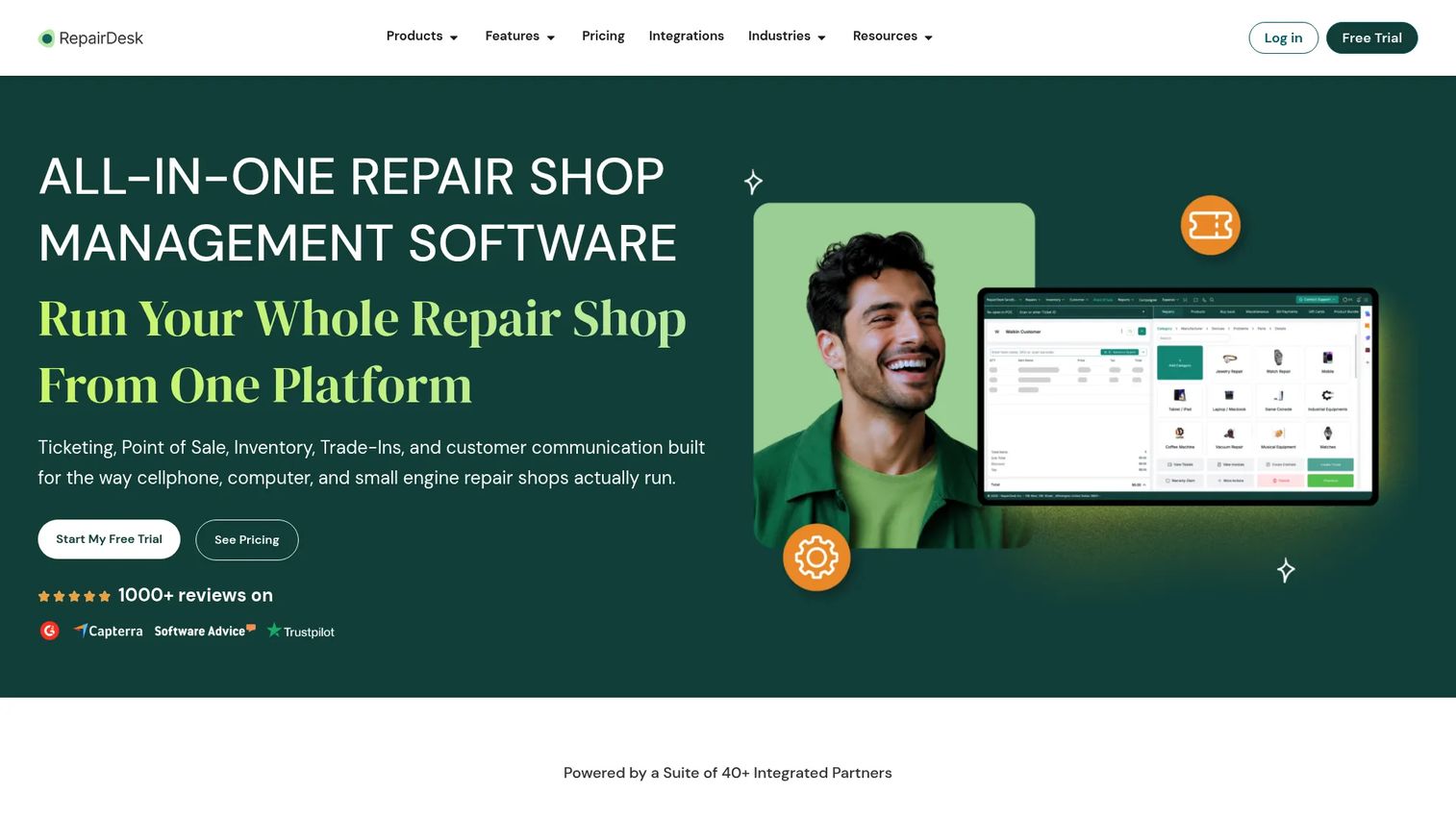
RepairDesk is a cloud-based POS and repair shop management platform built for cell phone, computer, electronics, jewelry, watch, drone, and bicycle repair businesses. Its POS and repair ticketing system handles checkout, quotes, receipts, and customer communication. Serialized inventory tracking makes it a practical choice for device repair shops where individual item tracking matters. RepairDesk also supports appointment booking, employee role management, time tracking, and a multichannel inbox.
Best for: Cell phone, computer, and multi-location repair shops where serialized inventory and POS accuracy are non-negotiable.
Key features
- POS and repair ticket management
- Serialized inventory tracking and purchasing
- Appointment booking and scheduling
- Multichannel inbox (SMS and email)
- Employee roles, permissions, and time tracking
Why choose RepairDesk: Serialized inventory is where RepairDesk stands apart from generic shop management tools. For device repair businesses tracking individual IMEIs, serial numbers, or part batches, that capability matters daily. Multi-store operators benefit from consolidated inventory and location-level reporting, which reduces the spreadsheet patching that multi-location device shops often rely on.
RepairDesk pricing: Essential is $99/store/month ($79/store/month billed annually) for single-store businesses. Growth is $149/store/month ($119/store/month annually) for high-volume and multi-store operations. Advanced uses custom pricing for mail-in repair, refurbishment, and warranty centers.
G2 rating: 4.7/5
5. Shopmonkey
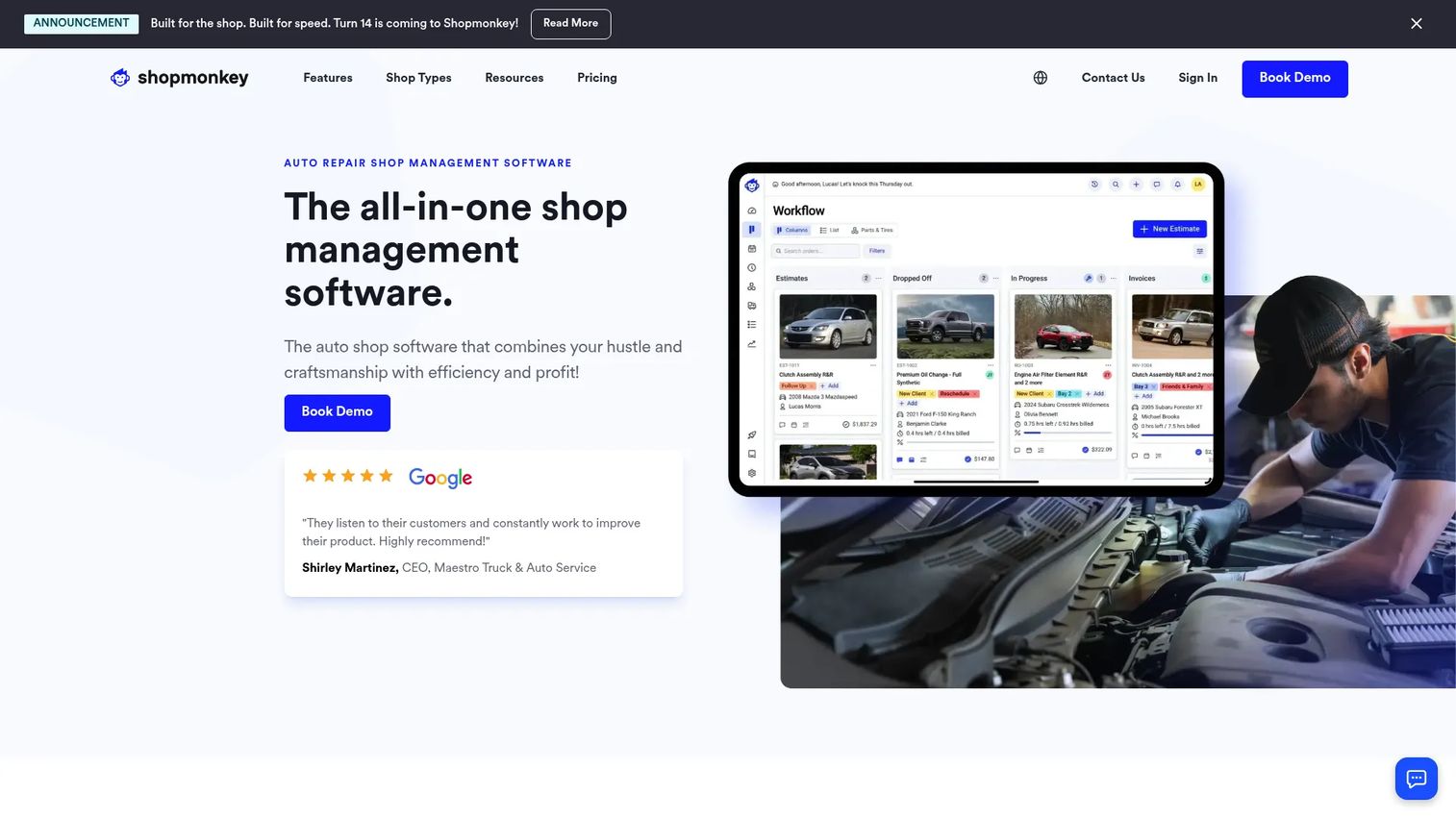
Shopmonkey is a shop management platform for auto repair, tire, quick-lube, and heavy-duty service businesses. Its workflow management layer covers estimates, digital vehicle inspections, two-way customer messaging, integrated payments, inventory, purchase orders, and a mobile app for technicians. CRM, online scheduling, and accounting integrations are available as add-ons. According to Shopmonkey via Ratchet+Wrench (2025), online booking adoption at U.S. auto repair shops has grown from 33% to more than 60%, which tracks with the direction Shopmonkey's scheduling and communication tools are built for.
Best for: Independent and growing auto repair shops that want modern communication workflows and clear job status visibility built into daily operations.
Key features
- Workflow management with job status tracking
- Estimates, invoices, and integrated payments
- Digital vehicle inspections
- Two-way customer messaging
- Inventory and purchase order management
Why choose Shopmonkey: For shops that feel the friction of back-office coordination (waiting on approvals, chasing parts status, following up with customers manually), Shopmonkey consolidates those touchpoints into one operational layer. The CRM Essentials and Bookkeeping add-ons mean you can expand the platform as the shop grows without switching systems.
Shopmonkey pricing: Basic starts at $239/month ($215/month annually). Clever is $399/month ($359/month annually). Genius is $499/month ($449/month annually). Multi-shop uses custom pricing. CRM Essentials, Bookkeeping, and Accounting are paid add-ons.
G2 rating: 4.6/5
6. AutoLeap
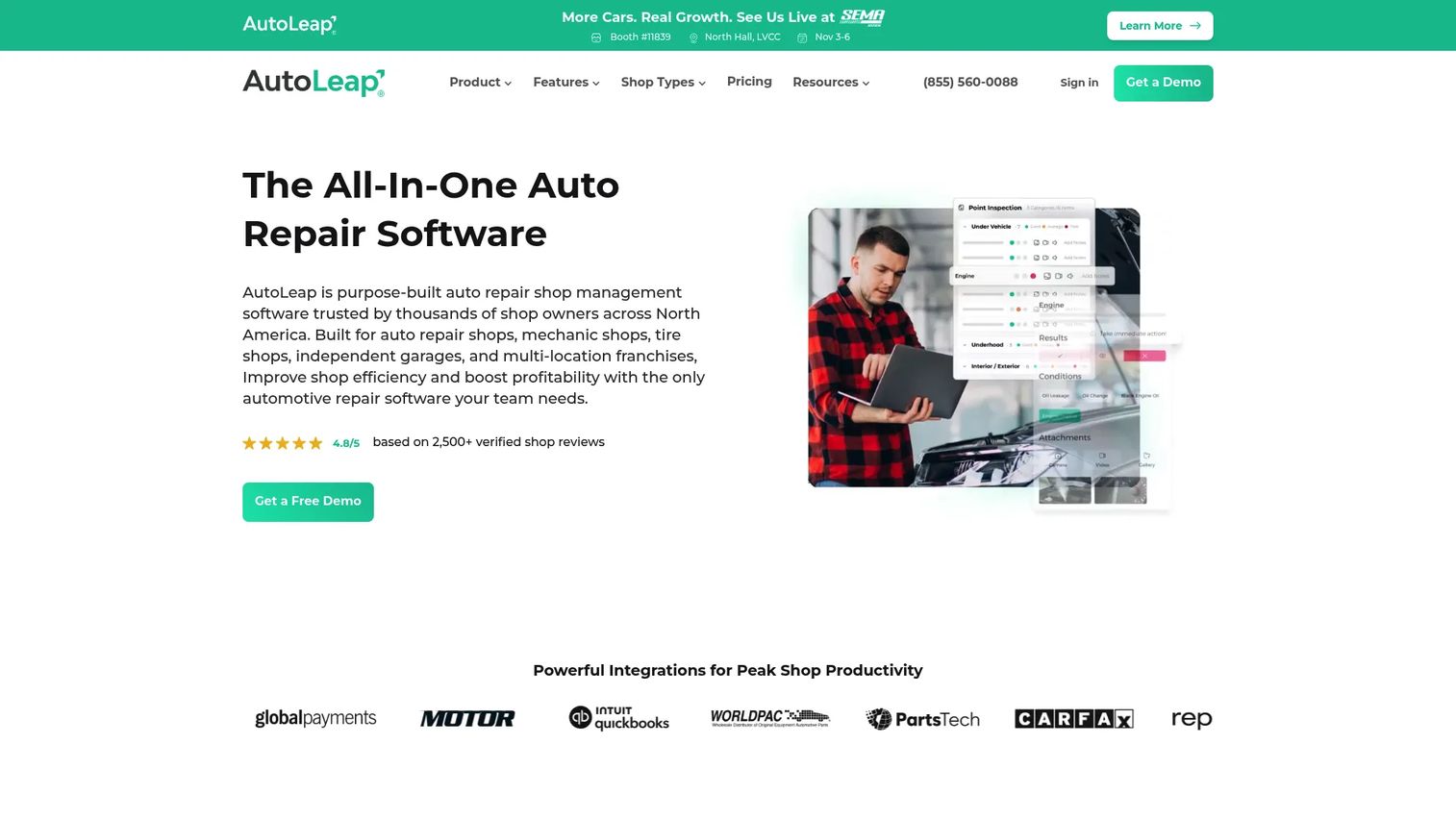
AutoLeap is an all-in-one auto repair shop management platform covering scheduling, digital inspections, estimates, invoices, payments, two-way texting, parts and inventory, QuickBooks integration, reporting dashboards, and an AI receptionist. It serves independent shops, mechanic and tire shops, and multi-location franchises. The platform's growth-focused positioning means marketing and analytics sit alongside daily shop workflows, rather than requiring a separate tool.
Best for: Auto repair shops that want customer acquisition, scheduling, and reporting tools in the same operating system they use for daily jobs.
Key features
- Online scheduling and customizable work board
- Digital vehicle inspections
- Estimates, invoices, and payment processing
- Two-way texting and customer communication
- Profitability dashboards and QuickBooks integration
Why choose AutoLeap: Shops that are actively trying to grow their customer base, not just manage existing volume, will find the marketing and analytics layer practical. The AI receptionist handles after-hours booking and customer inquiries, which reduces the owner dependency that is common in single-location shops where the phone still routes through one person.
AutoLeap pricing: Essentials starts at $179/month (billed annually) or $199/month. Pro is $309/month annually ($349/month). Elite is $409/month annually ($449/month). Enterprise uses custom pricing. AutoLeap AIR (AI receptionist) is listed separately at $99/month.
G2 rating: 4.8/5
7. Shop-Ware
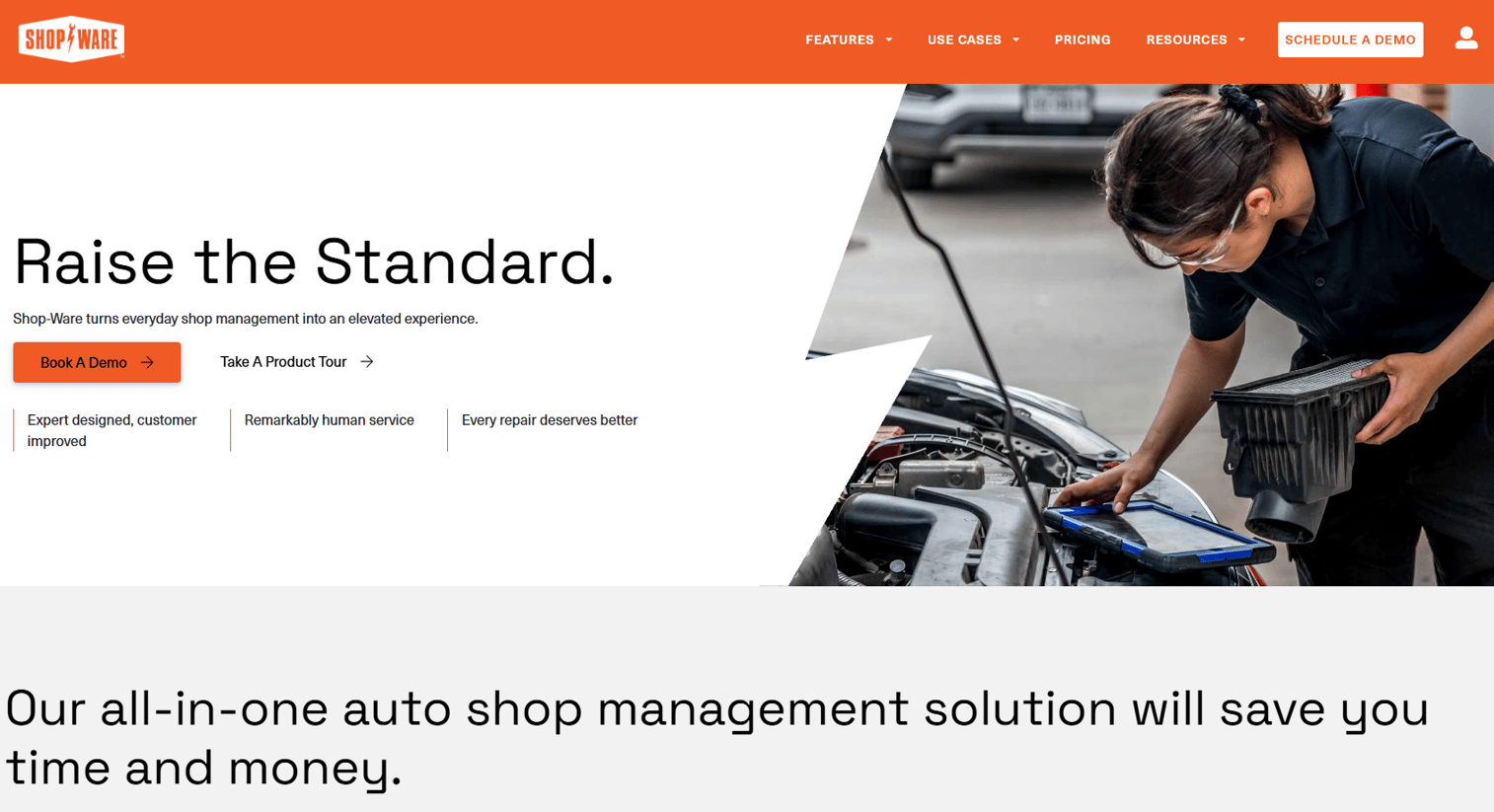
Shop-Ware is a cloud-based auto repair shop management platform built for independent shops and multi-shop operators. Its Digital Vehicle Experience includes digital inspections, live chat, and two-way texting. Shop-Ware also includes an AI Parts Matrix for parts pricing optimization and a native parts catalog with real-time inventory management. The platform's customer-facing approval workflow lets customers review, approve, and pay from their phone, which reduces back-and-forth between the service desk and the technician bay.
Best for: Auto repair teams that want repair order transparency and digital customer approval workflows built into every job.
Key features
- Digital inspections, live chat, and two-way texting
- Customer-facing digital approvals and repair orders
- AI Parts Matrix for parts pricing optimization
- Native parts catalog and real-time inventory
- Shop performance reporting
Why choose Shop-Ware: The customer approval workflow is the clearest differentiator. Shops where customers frequently request changes mid-job, or where service advisors spend significant time on the phone getting verbal approvals, will see the most direct benefit. The unlimited-user pricing model per location also removes the per-seat math that can get expensive as a shop staffs up.
Shop-Ware pricing: Startup is $279/month ($251/month annually). Pro is $389/month ($350/month annually). Master is $499/month ($449/month annually). Ultimate+ is $999/month ($899/month annually). CRM and Online Service Scheduler is a $249/month add-on. All plans are priced per location with unlimited users.
G2 rating: 4.9/5
8. Fullbay
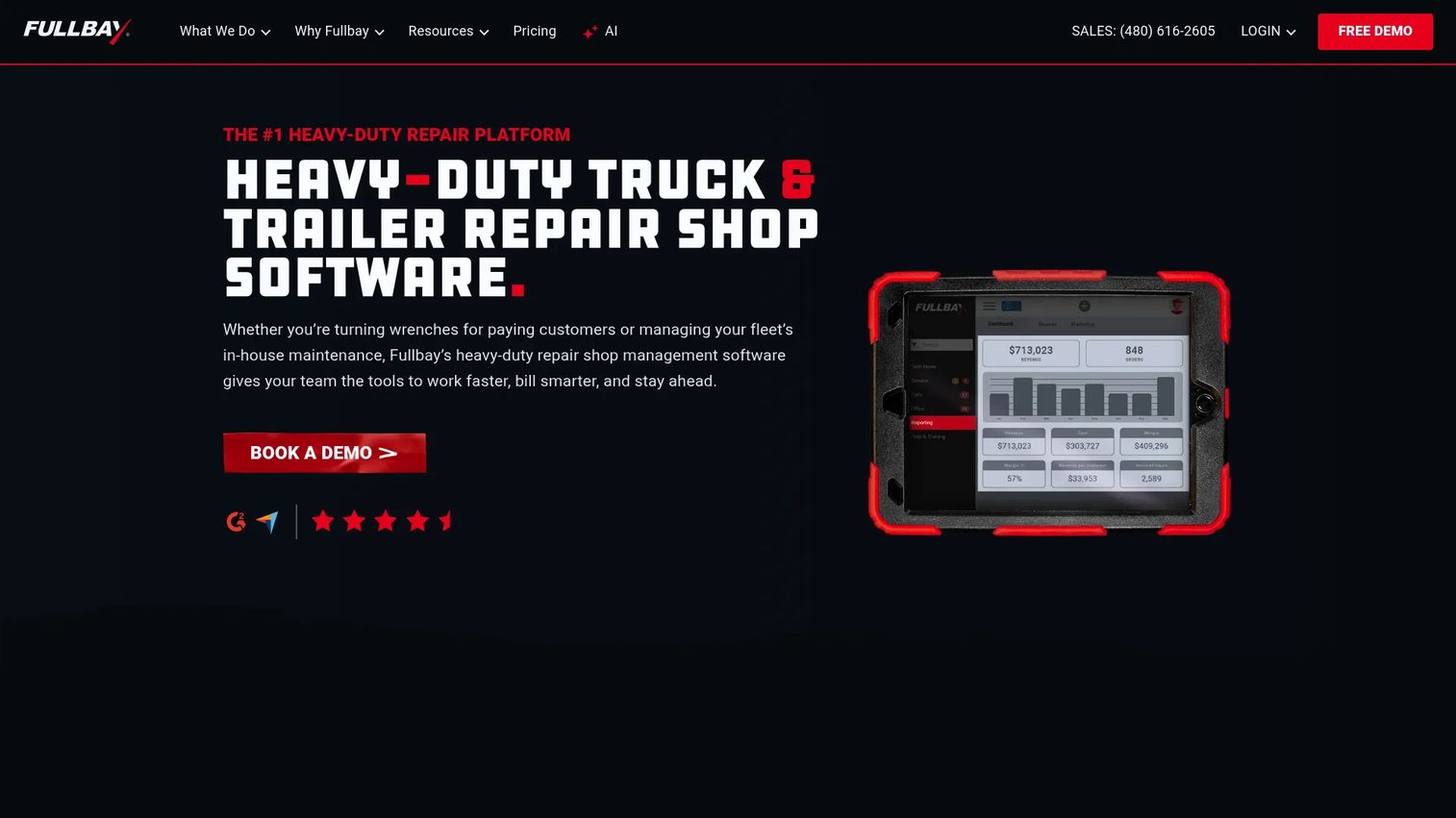
Fullbay is a shop management platform built specifically for heavy-duty truck and trailer repair, diesel shops, and fleet maintenance operations. It covers service order workflow, estimates, invoicing, parts and inventory, preventive maintenance tracking, technician management, customer communication, and fleet reporting. Integrations include QuickBooks, labor guides, telematics, and GPS tools. The platform also includes AI technician notes and voice transcription, which reduces manual data entry during active repair work.
Best for: Independent heavy-duty repair shops and fleet maintenance operations managing truck, trailer, and commercial equipment repairs.
Key features
- Heavy-duty service orders and estimates
- Parts and inventory management
- Preventive maintenance tracking
- Fleet reporting and customer communications
- QuickBooks, telematics, and GPS integrations
Why choose Fullbay: A light-duty auto shop platform will not cover the fleet management, preventive maintenance scheduling, and commercial billing workflows that diesel and truck repair shops run daily. Fullbay is built for that operating model from the ground up, which means the out-of-the-box workflow fits a fleet shop's actual job types rather than requiring significant customization.
Fullbay pricing: Basic starts at $188/month (annual agreement). Pro is $258/month. Elite is $318/month. Enterprise uses custom pricing. Additional users cost $89/month on Basic, $109/month on Pro, and $119/month on Elite. The base plan includes one full-user license.
G2 rating: 4.8/5
9. Shop Boss
Shop Boss is a web-based shop management platform built for independent auto repair shops. Core features include repair orders, digital vehicle inspections, VIN scanning, vehicle history, estimates, customer communication, integrated parts and tire ordering, integrated payments, and a customer and fleet portal. Higher-tier plans add labor guides, analytics dashboards, online scheduling, CRM, and AI-assisted technician notes.
Best for: Independent auto repair shops that want practical repair order and inspection workflow without enterprise-scale complexity.
Key features
- Repair orders and digital vehicle inspections
- VIN scanner and vehicle history
- Integrated parts and tire ordering
- Customer and fleet portal
- Custom reporting and dashboards
Why choose Shop Boss: A good fit for shops that want auto repair workflow structure without paying for features that only matter at multi-location scale. The Gold plan covers core operations; upgrading to Platinum or Premier adds labor guides, digital inspections, and analytics when the shop is ready for them. That tiered approach lets a shop pay for what it uses now and expand without migrating to a new system.
Shop Boss pricing: Gold is $199/month ($179/month annually). Platinum is $349/month ($314/month annually). Premier is $449/month ($404/month annually). Premier Plus is $649/month ($584/month annually). No free tier was confirmed on the official pricing page.
10. ARI
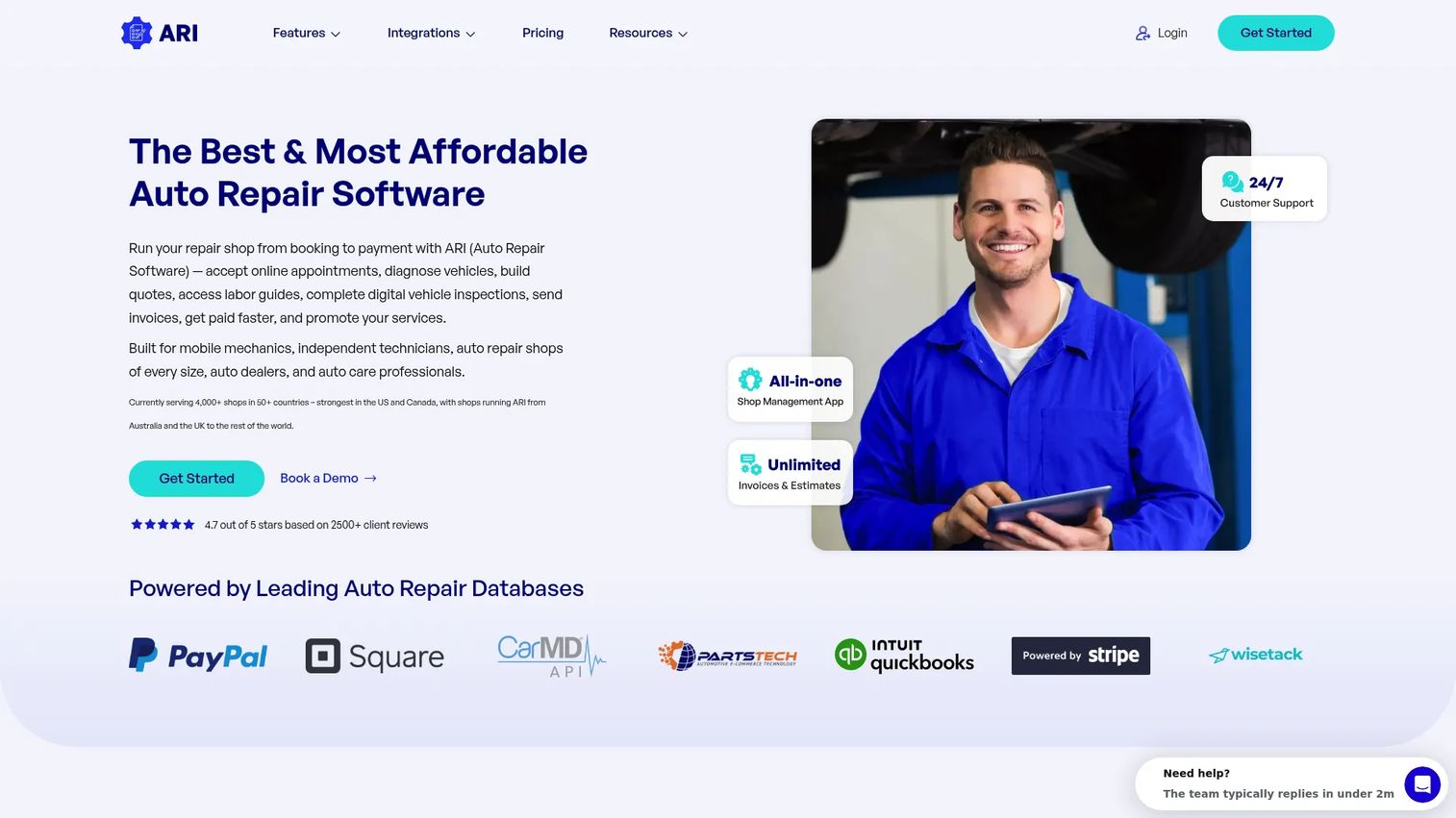
ARI is an auto repair shop management platform for mobile mechanics, independent technicians, and small-to-large repair shops. Features include client and vehicle management, estimates, invoicing, digital vehicle inspections, online booking, inventory, accounting, payment collection, OBD scanning and diagnostics, a client portal, and AI labor guides. ARI offers a freemium entry point with limited usage, making it one of the few tools on this list accessible without an upfront payment commitment.
Best for: Small auto repair shops and mobile mechanics that need affordable invoicing and vehicle management without a lengthy setup process.
Key features
- Estimates and invoices with client and vehicle management
- Digital vehicle inspections and online booking
- OBD scanning and diagnostics
- Inventory and accounting
- AI labor guides and client portal
Why choose ARI: The freemium tier covers up to 5 invoices, estimates, inspections, clients, and vehicles, which is enough to evaluate whether the platform fits before committing to a paid plan. For solo mechanics and very small shops that do not need multi-location inventory or digital inspection workflows at scale, ARI's Pro plans are priced well below most automotive platforms on this list.
ARI pricing: ARI offers a freemium tier with limited usage. ARI Pro is $39.99/month or $33.33/month billed annually (total $399.99/year). ARI Pro Plus is $59.99/month or $49.99/month billed annually (total $599.99/year).
G2 rating: 4.6/5
Considerations when choosing repair shop software
Match the platform to your repair model
Auto repair, phone repair, computer repair, heavy-duty fleet maintenance, and specialty repair do not share the same workflow. A platform built for automotive inspections and labor guides will create friction in a device repair shop that needs serialized inventory and ticket-based billing. Start with your repair type, then evaluate features.
Audit the estimate, approval, and payment path
The money path is where most shops lose time. Test how estimates are created, how customers approve work, how deposits are collected, and how text-to-pay handles partial payments or refunds. Platforms that break this into separate steps add coordination overhead that compounds daily across every job.
Check inventory and parts depth before you buy
Basic inventory and parts-linked inventory are different things. Confirm whether the platform supports serialized item tracking, low-stock alerts, purchase orders to vendors, and parts transfers between locations. A shop with high parts complexity needs those capabilities day one, not as an upgrade.
Verify the reports your manager will actually use weekly
Demo the reporting before signing. The reports that matter are revenue by job type, technician productivity, declined work totals, and payment collection by period. If those require exporting to a spreadsheet, that is a signal the reporting layer is not production-ready for your operating cadence.
Test integrations with your current accounting stack
Most shops already run QuickBooks or a similar accounting tool. Confirm whether the integration is native or sync-based, how often it updates, and whether payment data flows automatically. A broken accounting integration means manual reconciliation, which removes most of the efficiency the platform was supposed to deliver.
Conclusion
Repair shop software is not one market. The right choice comes down to the repair model you run, the inventory complexity you carry, and the operating visibility your manager needs every week.
For shops that need automotive repair information alongside operations, Mitchell 1 is the most direct fit. For computer and electronics repair, RepairShopr covers the broadest non-automotive workflow. For cell phone and multi-store device repair, RepairDesk's serialized inventory and POS depth are hard to replicate. Among auto repair platforms, Tekmetric, Shopmonkey, AutoLeap, Shop-Ware, and Shop Boss cover a range from reporting-focused to communication-first to digital-approval-led workflows. Fullbay is the clear choice for diesel and fleet operations. ARI is the entry point for solo mechanics and small shops that want to test before committing.
The practical next step: Shortlist two or three platforms based on repair type and shop size. Run the same repair workflow through each demo, specifically the estimate-to-payment path, and measure how quickly a manager who was not in the room could follow up with a customer. That test tells you more than any feature comparison grid.
If your team sells software and needs buyers to experience workflows before a demo call, interactive demos make evaluation faster and reduce the number of calls required to qualify a lead.
Start your journey with Guideflow today!
FAQs about repair shop software
The answer depends on repair type. ARI is the strongest entry point for small auto repair shops and mobile mechanics, with a freemium tier and paid plans starting at $33.33/month annually. For small computer or device repair shops, RepairShopr's Starter plan at $59.99/month covers tickets, invoicing, and basic inventory without requiring an enterprise commitment. Prioritize ease of setup, invoicing accuracy, and payment collection when evaluating at this scale.
No single tool wins across all automotive contexts. Mitchell 1 is the strongest choice when OEM repair information is a daily operational requirement. Tekmetric fits shops that want deep reporting and multi-shop visibility. Shopmonkey and AutoLeap suit growing shops that want communication and scheduling built in. Shop-Ware is worth evaluating for shops where customer-facing digital approvals would reduce phone traffic. Shop Boss covers core workflow for independent shops without overcomplicating the stack.
Core features include repair tickets or work orders, customer CRM, estimates, customer approvals, invoices, payment processing, and reporting. Inventory and parts tracking, scheduling, technician assignment, and customer communication round out a complete system. Specialty shops may also need serialized inventory for device repair, preventive maintenance tracking for fleet work, mail-in repair support, or labor guides and OEM data for automotive operations.
Pricing spans a wide range depending on shop size, locations, included modules, and payment features. Entry-level plans for single-location shops typically start between $33 and $200 per month. Platforms with marketing, digital inspections, or multi-shop management tend to price higher. Most automotive platforms require an annual commitment for the lowest rate. Check whether payment processing fees, add-on modules, and per-user costs change the total before committing.
Repair shop software is the broader category. It covers any repair business type, including computer, phone, electronics, jewelry, watch, drone, bicycle, and mail-in repair. Auto repair software is a subset focused specifically on vehicle workflows: VIN decoding, labor guides, OEM repair information, digital vehicle inspections, and repair orders. Platforms like Tekmetric, AutoLeap, and Shop-Ware are built for automotive operations; RepairShopr and RepairDesk serve non-automotive repair workflows. Some platforms, including Shopmonkey and Fullbay, serve specific sub-verticals within automotive (general auto versus heavy-duty).
Combining POS and payments with the repair ticket reduces handoffs between job close, invoice creation, payment collection, and customer record update. When those steps live in separate tools, the shop ends up reconciling payment status manually at end of day. Shops with high ticket volume, deposits on parts orders, or text-to-pay workflows benefit most from a unified payment layer. Some operators prefer a separate payment provider for rate negotiation; confirm that the platform supports third-party payment integration before assuming the built-in processor is the only option.
Multi-location operations need consolidated reporting, location-level performance visibility, inventory transfers between sites, standardized workflows, and role-based permissions. Tekmetric, RepairDesk, AutoLeap, and Shop-Ware each support multi-location management, though the depth of consolidated reporting varies. Test location switching and cross-location inventory visibility during the demo. The difference between a platform that shows aggregate revenue and one that shows per-technician productivity by location is significant when you are trying to identify where a site is underperforming.
Yes, through automated service reminders, follow-up messages after job completion, review request workflows, and CRM segmentation tied to repair history. The platforms that do this most effectively connect retention communications to real job data, so a service reminder references the customer's last visit date and vehicle, not just a generic follow-up. Mitchell 1's SocialCRM, AutoLeap's marketing tools, and Shop-Ware's CRM add-on each approach this differently. Evaluate whether the marketing automation is included in the base plan or priced separately before factoring it into your decision.