
Your BOM lives in a spreadsheet. The latest revision sits in someone's inbox. Manufacturing is building against a part number engineering deprecated three weeks ago. Nobody signed off on the change, and now you are on a call trying to figure out who did what and when.
This is the mess that product lifecycle management software exists to fix. When product data is scattered across drives, email threads, and disconnected tools, every change becomes a guessing game. Change control breaks. Traceability disappears. Compliance audits turn into archaeology projects. And the cost is real, not abstract: rework, scrapped inventory, missed launch dates, and audit findings that stall regulated products.
The market reflects how central this problem has become. The global PLM software market is forecast to reach USD 50.17 billion in 2026 and grow at an 8.06% CAGR through 2031, according to Mordor Intelligence. Cloud deployments made up 43.34% of PLM revenue in 2025 and are growing faster than on-premises. Large enterprises still dominate adoption at 72.54% of implementations, but SMEs are the fastest-growing segment. That shift matters if you are a growing product organization trying to get your product truth into one system before the complexity outruns you.
If you have read enough definition pages and now want a shortlist you can actually act on, this guide covers seven PLM platforms worth evaluating, with honest notes on where each one fits. It sits alongside adjacent buyer guides like best contract lifecycle management software and audit management software if your evaluation stretches into contracts or compliance tooling.
What's inside
This guide is for product managers, operations leaders, and engineering stakeholders comparing PLM systems to centralize product data, control changes, and keep cross-functional teams aligned. It is not a manufacturing-jargon deep dive. It is a decision aid.
Every platform here was assessed against four criteria that matter when you are actually buying:
- Lifecycle coverage: whether it spans ideation through retirement, not just file storage.
- BOM and change management: how it handles bills of materials, change orders, and revision control.
- Integration depth: how well it connects to CAD, ERP, and supply chain systems.
- Compliance and deployment fit: audit trails, regulated-industry support, and cloud versus on-premises options.
TL;DR
- Best for large enterprise engineering: Siemens Teamcenter, for digital-thread depth and cross-domain collaboration at scale.
- Best for flexible BOM and part control: OpenBOM, with a free tier and data-record-based pricing that suits growing teams.
- Best unified PLM plus quality: Propel, built on Salesforce for teams combining PLM, QMS, and PIM.
- Best cloud-native PLM: Arena PLM, for high-tech and regulated product teams that want connected quality and supply chain workflows.
- Best for configurability at scale: Aras Innovator, with a low-code platform and a free Community Edition.
- Best for Oracle ecosystems: Oracle Cloud PLM, when you want PLM aligned tightly with SCM and ERP.
- Best for engineering-heavy manufacturers: PTC Windchill, for complex, design-centric product organizations.
What is product lifecycle management software?
Product lifecycle management software is a system that centralizes product data, workflows, and approvals across every phase of a product's life, from ideation and design through production, service, and retirement.
That definition sounds tidy. The reality it manages is not. A PLM system is the single source of truth for what a product is: its parts, its documents, its revisions, its approvals, and the audit trail that proves how it got there. PLM meaning, in practice, is control over product data and change, so that everyone downstream, from manufacturing to service, works from the same verified information.
The lifecycle a PLM system governs typically runs through five phases: ideation, design, production, maintenance, and retirement. Around those phases, a PLM system enables the digital thread, the connected flow of data that links requirements to design to manufacturing to service, so a change in one place is traceable everywhere else.
Core PLM functions usually include:
- Product data management: a central repository for parts, documents, CAD files, and specifications.
- BOM management: structured, revision-controlled bills of materials shared across engineering and manufacturing.
- Engineering change management: change requests, change orders, and approval workflows that keep revisions controlled.
- Quality management: links between defects, corrective actions, and the product records they affect.
- Compliance and traceability: audit trails, and records such as the Device History File (DHF) and Device Master Record (DMR) in regulated industries.
- Integration: connections to CAD, ERP, and supply chain systems so product data flows without manual re-entry.
A PLM system is often confused with product data management (PDM). PDM is the narrower discipline, focused on managing engineering files and CAD data. PLM spans the full lifecycle and the cross-functional processes around it.
When to use PLM software
Not every team needs a full PLM platform on day one. These are the operational triggers that signal you do.
Manage product data across engineering, manufacturing, and service
When your BOM lives in one tool, your CAD files in another, and your specs in a shared drive, you have no single source of truth. Manufacturing builds against stale data. Service techs reference the wrong revision. A PLM system centralizes product data management so every team pulls from the same verified record, which is where digital thread traceability starts to pay off.
Control changes and maintain traceability
An engineering change that skips formal review is a defect waiting to ship. Engineering change management in a PLM system routes every change order through structured approvals, ties it to the affected parts and documents, and records who approved what and when. When a customer or auditor asks why a part changed, you have the answer in seconds, not days.
Support compliance, quality, and launch readiness
Regulated products in medtech, aerospace, and industrials demand auditable records: DHFs, DMRs, and complete change histories. A PLM system with quality management and built-in audit trails turns compliance from a scramble into a byproduct of how you already work, and it keeps launches on schedule because release readiness is visible, not assumed.
Comparison table
The table below gives you a fast shortlist view. Pricing for enterprise PLM is frequently quote-based, so figures are noted as public, partial, or quote-based where relevant. Ratings reflect current G2 listings.
| # | Product | Intent | Key use case | Pricing | G2 rating |
|---|---|---|---|---|---|
| 1 | Siemens Teamcenter | Enterprise PLM | Digital thread and cross-domain collaboration at scale | From $165.38/user/mo; higher tiers quote-based | 4.3/5 |
| 2 | OpenBOM | BOM and PDM/PLM | Collaborative BOM and part management | Free tier; from $30/seat/mo billed yearly | 4.2/5 |
| 3 | Propel | Unified PLM/QMS/PIM | PLM plus quality on Salesforce | Quote-based (annual, user-based) | 4.3/5 |
| 4 | Arena PLM | Cloud-native PLM | Connected quality and supply chain | Quote-based; 10-day free trial | 4.2/5 |
| 5 | Aras Innovator | Configurable enterprise PLM | Low-code digital thread workflows | Free Community Edition; paid quote-based | 4.4/5 |
| 6 | Oracle Cloud PLM | Cloud PLM in Oracle suite | PLM aligned with SCM and ERP | Quote-based | - |
| 7 | PTC Windchill | Engineering-centric PLM | Design-to-manufacturing coordination | Quote-based | 4.1/5 |
1. Siemens Teamcenter
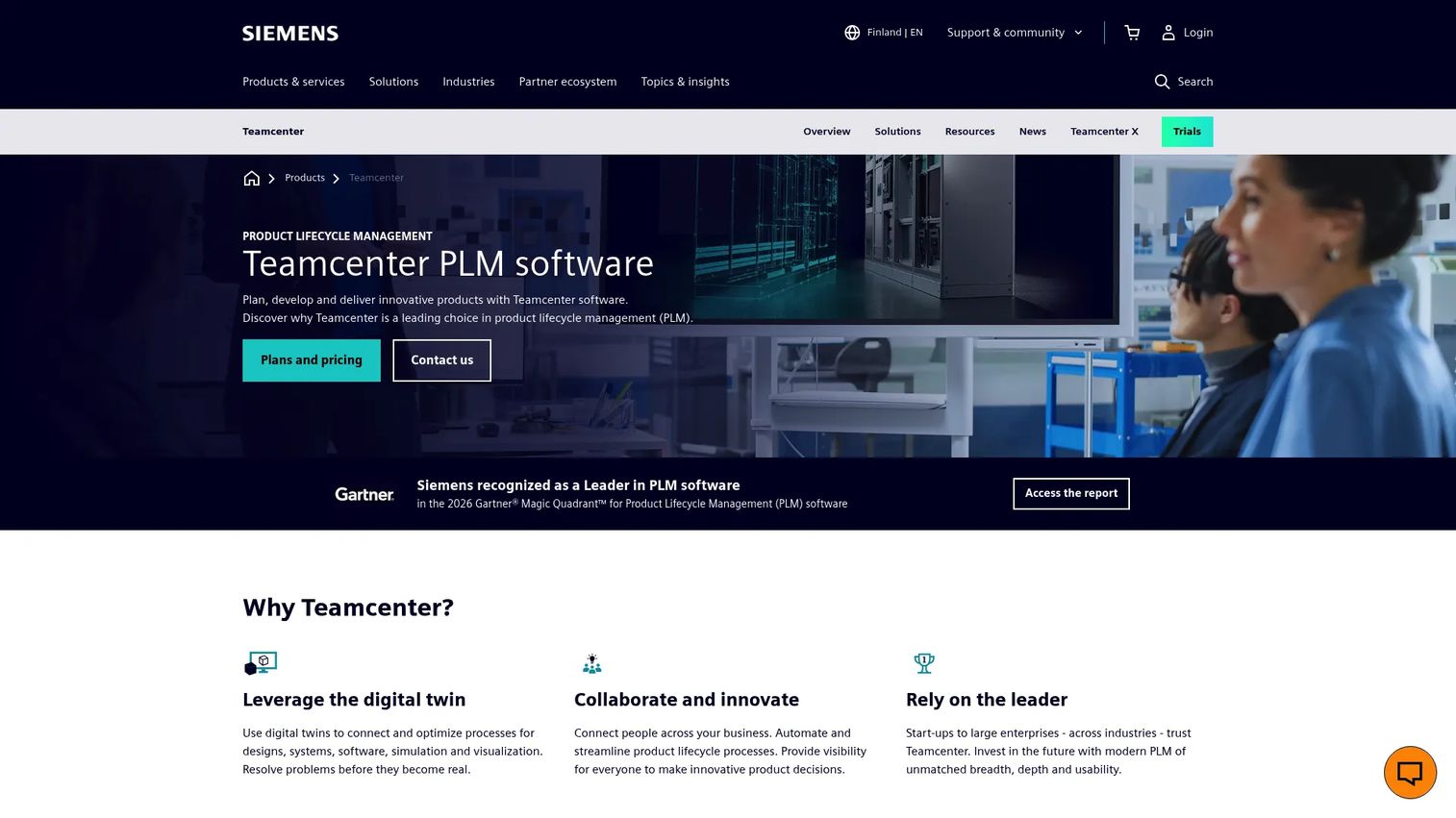
Siemens Teamcenter is enterprise PLM software for planning, developing, and delivering products across the full lifecycle. It is built around a digital-twin model of product data and is designed for organizations that need one governed source of truth spanning mechanical, electrical, software, manufacturing, and service domains. For complex discrete manufacturers, it is one of the most comprehensive platforms on this list.
Best for: Large engineering organizations needing enterprise PLM and cross-domain collaboration.
Key strengths
- Digital-twin PLM: Manages product data as a connected digital twin, supporting the digital thread from requirements through service.
- Cross-domain collaboration: Brings mechanical, electrical, software, manufacturing, and service teams onto shared product records.
- Flexible deployment: Available as cloud, on-premises, and SaaS, so governance and IT constraints can be met without compromise.
Why choose Siemens Teamcenter: If your product organization is large, multi-disciplinary, and building physically complex products, Teamcenter gives you the governance and lifecycle visibility that lighter tools cannot match. It fits teams that treat PLM as core infrastructure, not a side system, and that need one platform to hold engineering, manufacturing, and service data together.
Siemens Teamcenter pricing: Teamcenter X, the SaaS offering, lists an Essentials tier at $165.38 per user per month. Standard, Advanced, and Premium tiers are quote-based, and Siemens offers a 30-day trial. There is no free tier. For higher tiers, you request pricing directly through the Teamcenter X plans page.
2. OpenBOM
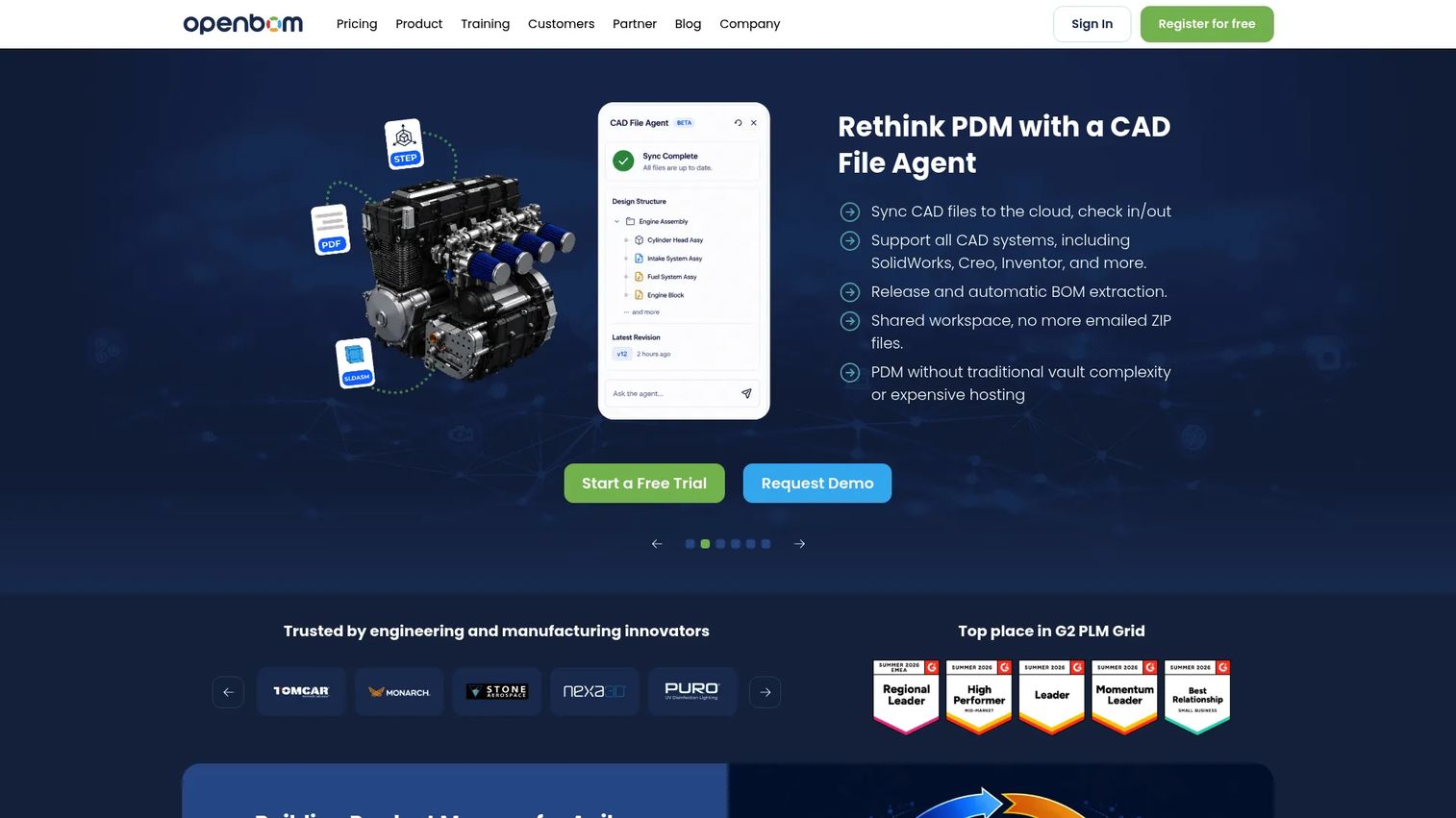
OpenBOM is a cloud-native platform for BOM management, PDM/PLM, procurement, and inventory, built for engineering and manufacturing teams that need flexible part and BOM control. It centers on collaborative bills of materials and connects to the CAD and ERP systems where product data originates and gets consumed. Its record-based model makes it accessible for smaller teams that are outgrowing spreadsheets.
Best for: Manufacturing and engineering teams needing collaborative BOM and product-data management.
Key strengths
- BOM management and collaboration: Real-time, shared bills of materials that engineering and manufacturing can work in together.
- CAD integration and file management: Connects to CAD tools so part data and files stay linked to the BOM.
- Procurement workflows: Inventory, RFQ, and purchase order handling tied directly to your BOM data.
Why choose OpenBOM: It is the practical choice when your immediate pain is BOM chaos and part control rather than full lifecycle governance. Teams that want to start with flexible BOM and data management, then scale into broader PLM, get a low barrier to entry with a free tier and pricing that grows with data records and seats.
OpenBOM pricing: OpenBOM has a genuine free tier, with up to 2,000 data records included. The Professional Team plan runs $55 per seat per month billed monthly, or $30 per seat per month billed yearly. The Company plan is $165 per seat per month monthly, or $90 per seat per month yearly. Enterprise pricing is custom. Pricing also scales by data records across tiers.
3. Propel
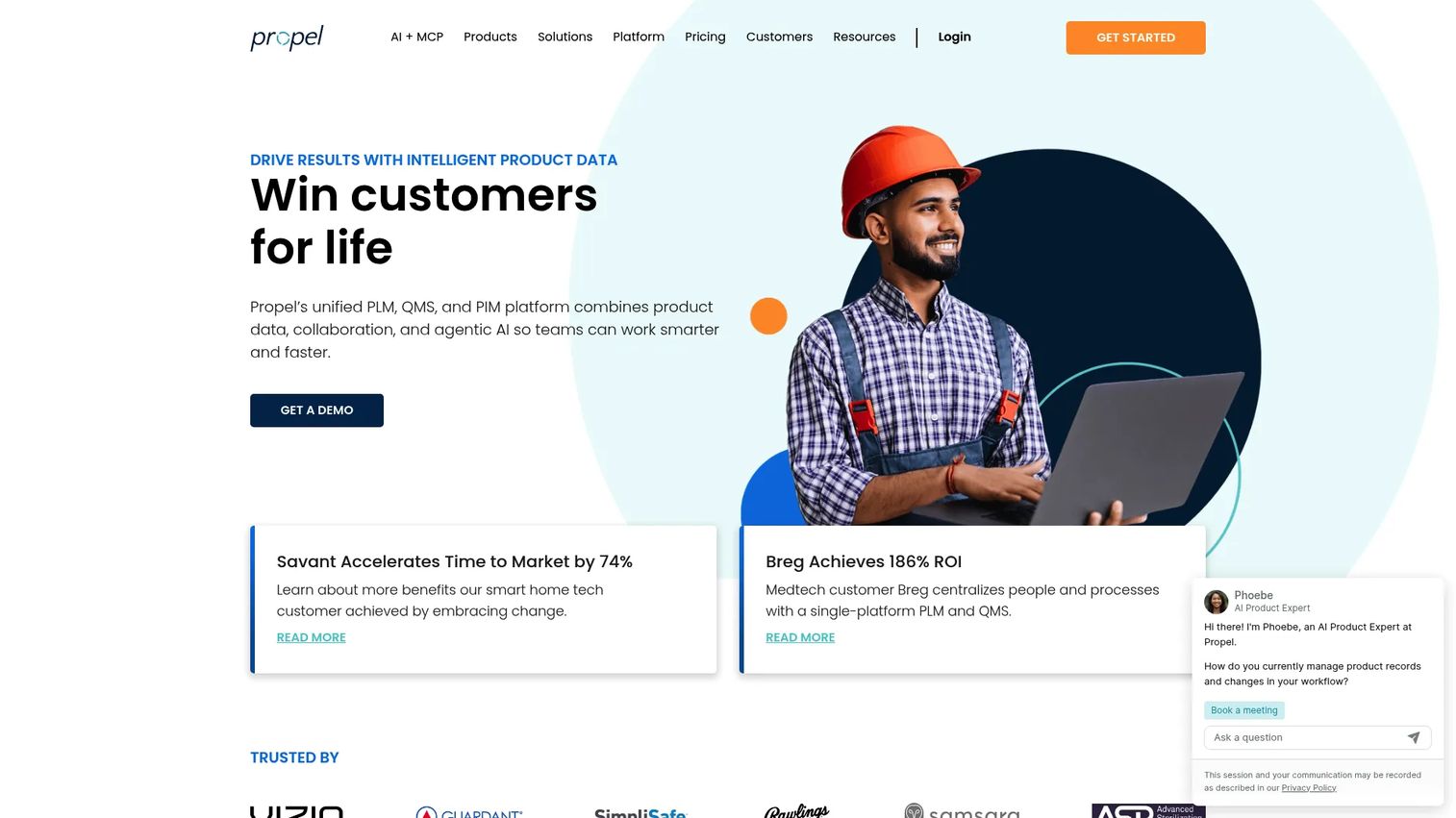
Propel is cloud software that unifies product lifecycle management, quality management, and product information management on the Salesforce platform. That foundation matters: teams already invested in Salesforce get PLM, QMS, and PIM sharing one data model and one interface, which reduces the swivel-chair work between product, quality, and commercial systems.
Best for: Manufacturers that need a unified PLM/QMS/PIM platform on Salesforce.
Key strengths
- Unified PLM, QMS, and PIM: AI-powered product, quality, and information management in one connected platform.
- Salesforce foundation: Built natively on Salesforce, so product data connects to commercial and customer processes.
- Modular licensing: Product Performance, Product Quality, Product Enrichment, Product Collaboration, Partner Collaboration, and Training licenses let you buy what you need.
Why choose Propel: It fits teams replacing manual, disconnected processes with connected PLM and quality workflows, especially those standardizing on Salesforce. Sustainability and audit-trail requirements, combined with the modular license structure, make it a strong fit for organizations that want product and quality data governed together.
Propel pricing: Propel uses annual, user-based licensing, and pricing is quote-based rather than published as a single starting figure. Propel shows sample annual license ranges by plan: Small at roughly $10K to $150K, Medium at $50K to $500K, and Large at $250K to $500K. Actual pricing depends on team structure and the licenses you select.
4. Arena PLM
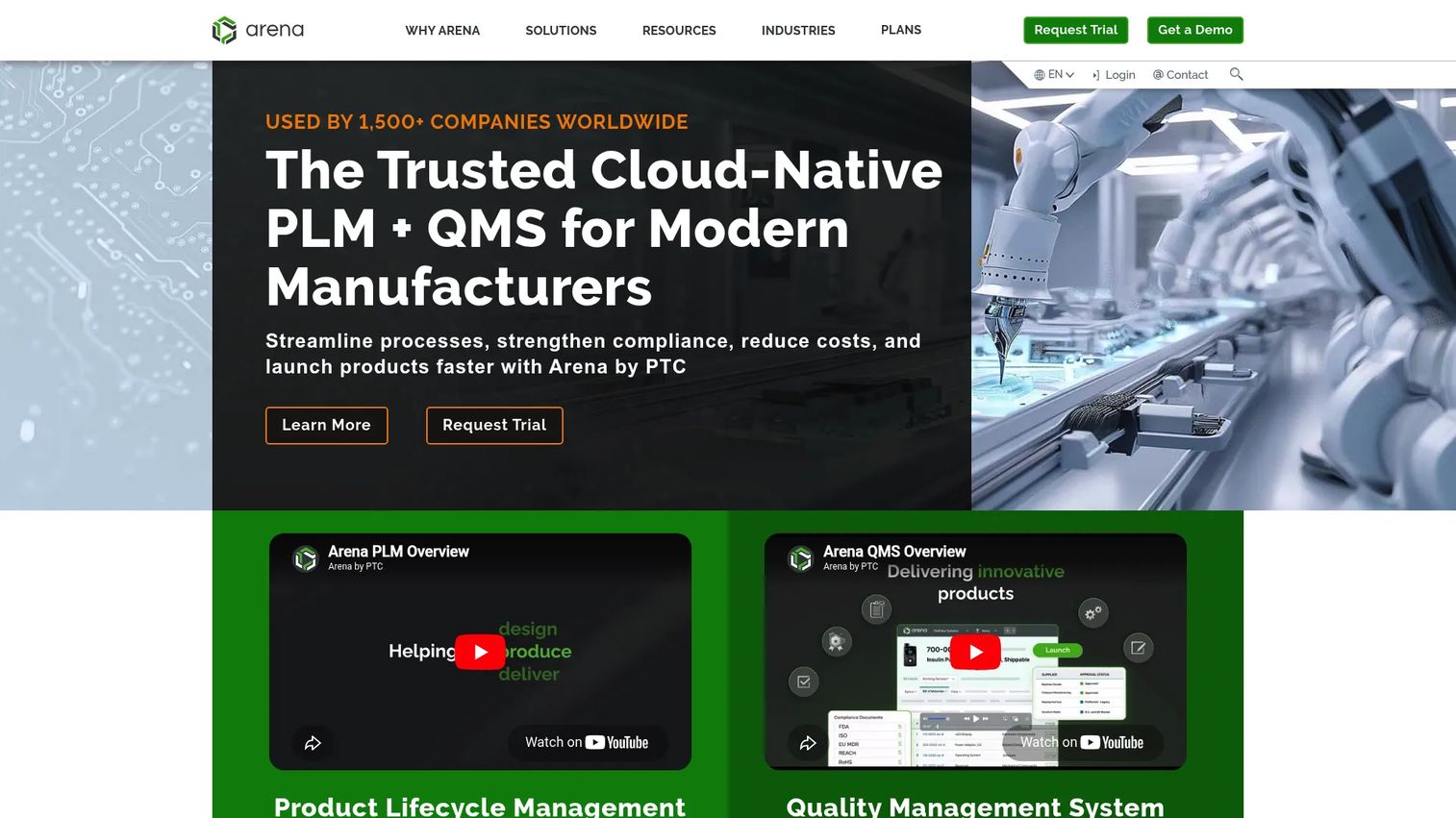
Arena PLM is cloud-native PLM software for managing product records, BOMs, change workflows, and supply chain collaboration. It was built cloud-first, which shows in how it connects design-to-release processes with quality and supply chain intelligence. For high-tech and regulated product teams, that combination of cloud PLM and connected quality is the core draw.
Best for: High-tech and regulated product teams needing cloud PLM with supply-chain collaboration.
Key strengths
- BOM management: Structured, revision-controlled bills of materials at the center of the product record.
- Change management: Change orders and approval workflows that keep revisions controlled and traceable.
- Document management: Controlled product documentation tied to parts, changes, and quality records.
Why choose Arena PLM: Cloud-first matters when you want fast deployment, easier access for distributed teams and suppliers, and connected quality without standing up on-premises infrastructure. It suits product-centric teams focused on launch readiness and compliance workflows that need supply chain participants in the loop.
Arena PLM pricing: Arena offers a free 10-day trial with no credit card required. Its PLM plans, Launch and Enterprise, are quote-based, with pricing determined by team setup and requirements. Arena does not publish a paid dollar figure for its PLM plans, so you request pricing through its plans page.
5. Aras Innovator
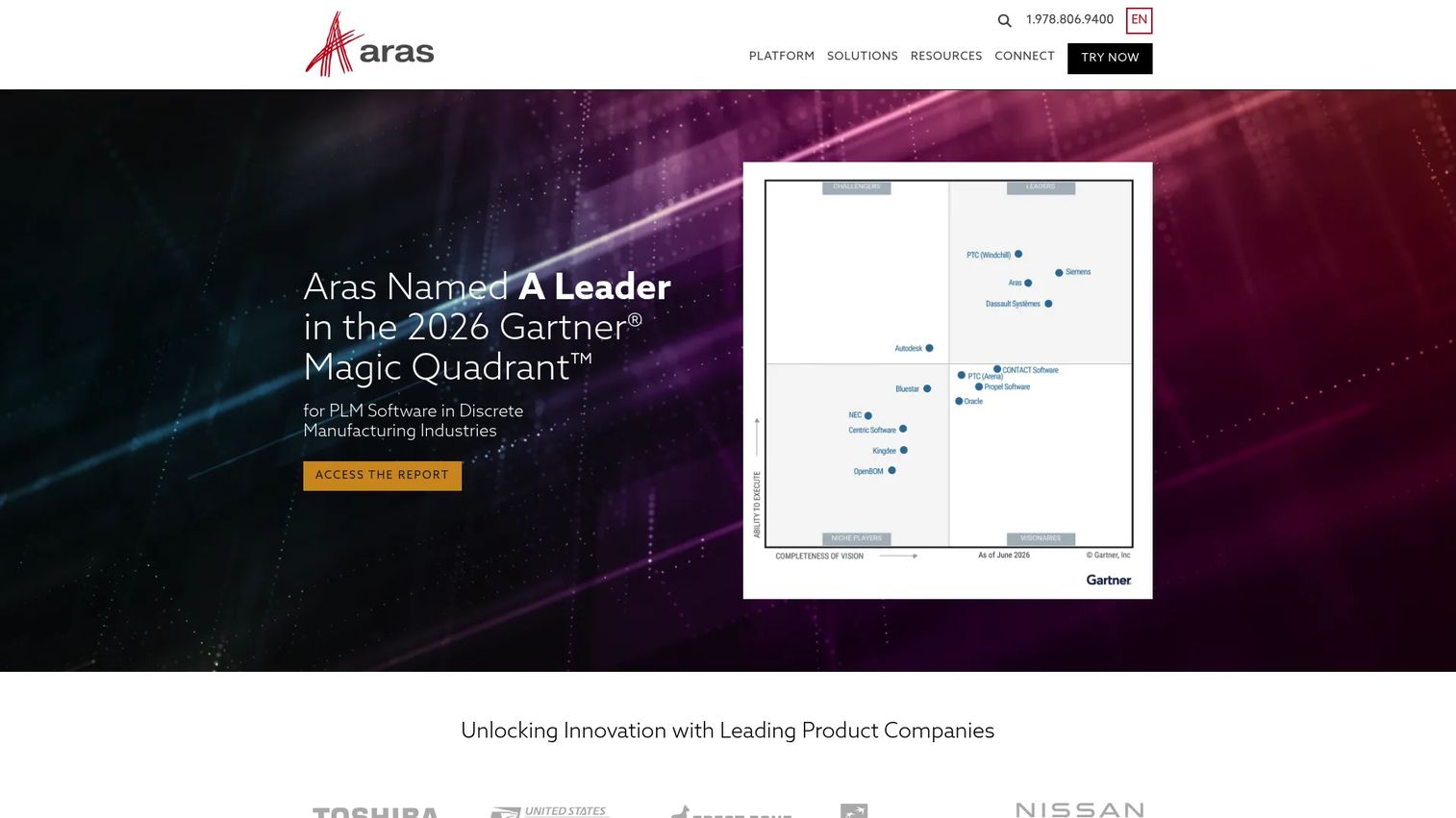
Aras Innovator is an enterprise PLM and digital thread platform built for scale and configurability. Its Product Data Platform and low-code development environment let organizations model complex product structures and adapt workflows without rebuilding the system, which is why it appeals to large manufacturers with non-standard lifecycle requirements.
Best for: Large manufacturers needing configurable PLM and digital thread workflows.
Key strengths
- Product Data Platform: A foundation for managing complex product data and the digital thread across the lifecycle.
- Low-code environment: Configure and extend workflows and applications without deep custom development.
- Composable PLM applications: Assemble the lifecycle capabilities you need rather than accepting a fixed feature set.
Why choose Aras Innovator: Configuration flexibility is the differentiator. If your product structures, change processes, or governance rules do not fit a standard template, the low-code platform lets you adapt PLM to your reality at enterprise scale. The free Community Edition also gives teams a genuine path to evaluate before committing.
Aras Innovator pricing: Aras offers a free Community Edition limited to 50 named users. Its paid Subscription (SaaS and Standard) plan is quote-based, listed as contact sales, and billed per year. Aras does not publish a public starting dollar amount for the paid subscription.
6. Oracle Cloud PLM
Oracle Cloud PLM, part of Oracle Fusion Cloud, is a cloud-based platform for managing product data, development, change, and quality processes. Its strongest argument is suite alignment: for organizations already running Oracle SCM and ERP, PLM data flows into the same fabric with a shared digital thread across design, planning, manufacturing, and service.
Best for: Enterprises needing cloud PLM tightly integrated with Oracle SCM processes.
Key strengths
- Full product record management: Handles items, parts, products, documents, requirements, engineering change orders, and quality workflows.
- AI and digital thread: Built-in AI features and a connected digital thread across design, planning, manufacturing, and service.
- BOM and data harmonization: BOM management, BOM compare, workflow approvals, and product data harmonization across the enterprise.
Why choose Oracle Cloud PLM: If your organization is standardized on Oracle, the value is in not bolting PLM onto a foreign stack. Product data, change orders, and quality records live in the same cloud environment as your ERP and SCM processes, which reduces integration overhead and keeps the digital thread intact end to end.
Oracle Cloud PLM pricing: Oracle does not publish a public price for Cloud PLM on its product pages. Pricing is arranged directly with Oracle and depends on modules and scope. Contact Oracle for a quote tailored to your Fusion Cloud footprint.
7. PTC Windchill
PTC Windchill is enterprise PLM software for managing product data, processes, and collaboration across the lifecycle. It is engineering-centric by design, strong on the digital thread and on coordinating design and manufacturing for complex, engineering-heavy product organizations. That focus is why it earns a place on any serious discrete-manufacturing shortlist.
Best for: Large manufacturers needing enterprise PLM and digital thread collaboration.
Key strengths
- BOM management: Controlled bills of materials at the core of the product structure.
- Engineering change and configuration management: Change orders and configuration control for complex, variant-heavy products.
- Collaborative development: Product and supplier development coordination across engineering and manufacturing.
Why choose PTC Windchill: It belongs on the shortlist when engineering complexity is your defining challenge and design-to-manufacturing coordination is where deals are won or lost. Windchill's data governance and digital thread depth suit organizations where the product itself is intricate and the cost of a lost revision is high.
PTC Windchill pricing: PTC does not publish public pricing for Windchill on its package pages. Pricing is sales-led and depends on packages and deployment. Contact PTC for a quote based on your requirements.
Considerations before you buy
A PLM decision outlives most software purchases. These are the criteria that separate a system you grow into from one you fight against.
Lifecycle coverage, not just PDM
Confirm the platform spans ideation through retirement, not only file and CAD storage. If it stops at product data management, you will bolt on quality, change, and compliance tools later. Buy for the lifecycle you will have in three years, not the one you have today.
Change control and auditability
Every PLM system claims change management. Test how it actually routes change requests and change orders, ties them to affected parts, and records approvals. Ask to see the audit trail. If you cannot reconstruct who changed what and when in seconds, the system will not survive a real audit.
ERP, SCM, and manufacturing integration depth
Product data does not live in isolation. Map the exact integrations you need to CAD, ERP, and supply chain systems, and verify they are supported natively, not through fragile middleware. Integration depth is where PLM projects quietly succeed or fail.
Compliance and regulated-industry support
If you operate in medtech, aerospace, or another regulated space, DHF, DMR, and traceability support are non-negotiable. Confirm the vendor supports your specific standards and can produce audit-ready records without custom work.
Cloud versus on-premises fit
Cloud PLM is now the fastest-growing deployment model, and for good reason: faster rollout, easier access for suppliers, less infrastructure. But governance, data residency, and IT policy may push you toward on-premises or hybrid. Decide your deployment constraints before you shortlist, not after. The same discipline applies across adjacent categories like best digital adoption platforms and best component content management systems, where deployment model shapes total cost.
Data ownership and governance
Understand who owns your product data, how you export it, and what the governance model looks like. A PLM system becomes your source of truth. You need portability and clear ownership before you commit years of product records to it.
Conclusion
The right PLM system depends on your team's complexity, governance needs, and integration reality, not on which vendor ranks highest in the abstract.
For large, multi-disciplinary engineering organizations, Siemens Teamcenter and PTC Windchill offer the deepest enterprise governance and digital thread. Teams standardizing on a broader suite should look at Oracle Cloud PLM for Oracle alignment or Propel for a Salesforce-native PLM, QMS, and PIM combination. Cloud-first product teams focused on launch and compliance workflows will find Arena PLM a strong fit, while Aras Innovator wins on configurability at scale. If BOM and part control is your immediate pain, OpenBOM offers the lowest barrier to entry with a free tier.
The next step is simple: shortlist two or three based on your lifecycle coverage, integration, and compliance needs, then run a real evaluation against your own product data and change workflows. Buy the system that fits how your teams actually work.
If you also need to show your own product's value to prospects and customers without long production cycles, Guideflow helps teams turn any product into self-serve interactive experiences. Its formats span guided interactive demos for controlled storytelling, sandboxes for hands-on validation and technical evaluation, demo centers for organizing every demo in one branded hub, live demos for presenter-led calls, and mobile demos for on-device experiences. Start your journey with Guideflow today!
FAQs
PLM software centralizes product data, workflows, and approvals across the entire lifecycle, from design through production, service, and retirement. It gives every team, from engineering to manufacturing to service, one verified source of truth for parts, documents, revisions, and change history. That control reduces rework, prevents building against stale data, and keeps launches on schedule.
PLM governs product definition and change: what a product is, how it is designed, and how revisions are controlled. ERP governs business execution and transactions: orders, inventory, finance, and fulfillment. They complement each other, and most organizations integrate the two so approved product data flows from PLM into ERP for production.
PDM is a narrower discipline focused on managing product data and engineering files, primarily CAD files and their revisions. PLM spans the full lifecycle, adding change management, quality, compliance, and cross-functional workflows on top of that data foundation. In practice, PDM is often a subset of what a full PLM system delivers.
At minimum, look for BOM management, engineering change orders, revision control and traceability, quality management, compliance and audit-trail support, and integrations with CAD, ERP, and supply chain systems. Regulated industries should also confirm support for records such as DHFs and DMRs. The right feature set depends on your lifecycle coverage and governance needs.
Yes, when the platform provides the right controls. Regulated teams should verify audit trails, access governance, electronic signatures, data residency options, and the vendor's security posture. Cloud PLM is now the fastest-growing deployment model, and many platforms support regulated workflows, but confirm the vendor meets your specific standards before committing.
Discrete manufacturing leads, with automotive and transportation holding the largest share of PLM revenue in 2025 per Mordor Intelligence. High-tech and electronics are among the fastest-growing segments. Aerospace, medtech, and industrials also rely heavily on PLM for the traceability and compliance their products demand.
Match the system to your scope, integrations, implementation effort, and governance maturity. Prioritize lifecycle coverage you will need in a few years, native integrations to your CAD and ERP stack, and a deployment model that fits your IT and compliance constraints. Then run a real evaluation against your own product data before committing, since a PLM system becomes your long-term source of truth.