A campaign manager uploads a recipient list. Orders flow into a storefront. A print vendor produces the kits. A carrier updates delivery status. If those four steps live in separate tools, you cannot see where the campaign broke down - or prove it arrived on time.
The print fulfillment software market reached $483 million in 2025 and is projected to hit $1.068 billion by 2034, according to DataIntelo (2025). That growth reflects a real operational problem: Marketing teams running direct mail, branded merchandise, and distributed collateral programs are stitching together order portals, vendor emails, inventory spreadsheets, and carrier portals by hand.
The right platform collapses that stack. But the category is not one thing. Web-to-print storefronts, print-on-demand networks, shop management systems, and direct mail APIs solve different problems. Choosing by feature count rather than operating model almost always leads to the wrong buy.
Which tool matches your fulfillment workflow without adding another system your team has to maintain?
What's inside
This guide covers eight print fulfillment software tools evaluated for digital marketers running physical campaigns, ecommerce print operations, or distributed collateral programs. Selection criteria:
- Operational fit: Does it match your order origin, production model, and shipping workflow?
- Integration depth: Confirmed connections to ecommerce, CRM, carriers, and accounting tools
- Pricing transparency: Verified against each vendor's live pricing page in October 2026
- Category clarity: Web-to-print, print-on-demand, shop management, and direct mail are distinct models - this guide separates them
TL;DR
- Best for web-to-print storefronts: OnPrintShop for B2B and B2C print ordering, pricing controls, approvals, and production workflow
- Best for apparel and branded merchandise: Printavo for shop management, quoting, online merch stores, labels, and packing slips
- Best for print-on-demand networks: Fulfill Engine for decorated-product workflows, supplier sourcing, and ecommerce integrations
- Best for multi-channel fulfillment operations: PrintXpand for order aggregation across channels, production routing, and pick-pack-ship workflows
- Best for enterprise document distribution: Mimeo for global print production, managed fulfillment, and branded collateral programs
- Best for automated direct mail: Lob for API-driven postcards, letters, address verification, and campaign tracking
The best option is the one that removes the most manual handoffs from your current order-to-delivery path, not the one with the longest feature list.
What is print fulfillment software?
Print fulfillment software manages the flow of printed products from order capture through production, packing, shipping, tracking, and delivery.
The category covers a wide operational range. A single platform might handle online ordering, production routing, carrier labels, and delivery confirmation. Another might focus exclusively on API-driven mail or decorated-product sourcing. Understanding where the boundaries sit helps you evaluate the right tool.
What print fulfillment software does
- Collects orders from ecommerce stores, B2B portals, APIs, CSV uploads, or sales teams
- Tracks inventory, blank goods, print-ready files, and production status
- Routes work to in-house teams, contract printers, or fulfillment partners
- Generates pick lists, packing slips, carrier labels, and customer notifications
- Syncs shipment data back to storefronts, CRM records, or customer-service systems
- Handles exceptions such as reprints, replacements, stockouts, and split shipments
How it differs from related categories
| Category | Primary job | Best fit |
|---|---|---|
| Print fulfillment software | Runs order-to-delivery workflows | Print providers, merch programs, ecommerce operations |
| Web-to-print software | Lets buyers configure and submit print orders online | B2B storefronts, print resellers, corporate print portals |
| Print MIS | Manages estimating, production, scheduling, and finance | Commercial printers with complex shop operations |
| Print-on-demand platform | Sources, decorates, and ships products after purchase | Ecommerce sellers and merchandise programs |
| Direct mail API | Automates physical mail from digital systems | Lifecycle marketing, triggered mail, account-based campaigns |
Many platforms overlap across these categories. The buying question that matters: Where does your current order-to-delivery process lose time, visibility, or accuracy?
When to use print fulfillment software
Launch campaign kits without spreadsheet coordination
Marketing teams managing event kits, direct-mail packages, or regional collateral need inventory visibility and shipment status in one place. A fulfillment platform lets you see which items are in stock, which orders have shipped, and which campaigns are at risk before the deadline passes.
Consolidate orders from stores, portals, and sales teams
Orders arriving from a Shopify store, a B2B portal, an internal request, and a CSV upload all need to land in one production queue. A fulfillment platform routes them to the right printer or warehouse without manual hand-matching between systems.
Route production and shipping without manual handoffs
Routing rules based on product type, stock level, decoration method, facility capacity, geography, and carrier cost replace the daily email thread between campaign managers and print vendors. Fewer manual checks means faster exception handling and fewer missed windows.
Print fulfillment software comparison
The table below reflects pricing and G2 ratings verified in October 2026 from each vendor's pricing page and live G2 listing. Where vendors quote by project or volume rather than posting fixed tiers, the pricing column notes the billing model.
| # | Product | Best for | Key differentiator | Pricing | G2 rating |
|---|---|---|---|---|---|
| 1 | OnPrintShop | Web-to-print storefronts | B2B and B2C ordering with production workflow automation | Fixed monthly subscription, contact for amount | 4.5/5 |
| 2 | Printavo | Apparel and merchandise shops | Shop management, online stores, labels, and packing slips | From $109/month | 4.3/5 |
| 3 | Fulfill Engine | Print-on-demand decorated-product fulfillment | Decorator network, product sourcing, and ecommerce routing | From $0/month | Not listed on G2 |
| 4 | PrintXpand | High-volume multi-channel fulfillment | Order aggregation, routing, and fulfillment dashboards | Custom quote | 5.0/5 |
| 5 | Aleyant Pressero | Corporate storefront programs | Branded B2B storefronts with workflow integrations | From $399/month | 1.5/5 |
| 6 | DesignNBuy | Configurable web-to-print commerce | Product design tools, storefronts, and print-commerce workflows | From $90/month | 4.2/5 |
| 7 | Mimeo | Enterprise document distribution | Global production network and managed fulfillment | Per-order or custom pricing | 4.5/5 |
| 8 | Lob | Automated direct mail campaigns | API-first print and mail automation with Postal IQ routing | From $0/month | 4.4/5 |
Pricing and G2 ratings verified October 2026 from each vendor's pricing page and live G2 listing.
Best print fulfillment software tools for 2026
1. OnPrintShop
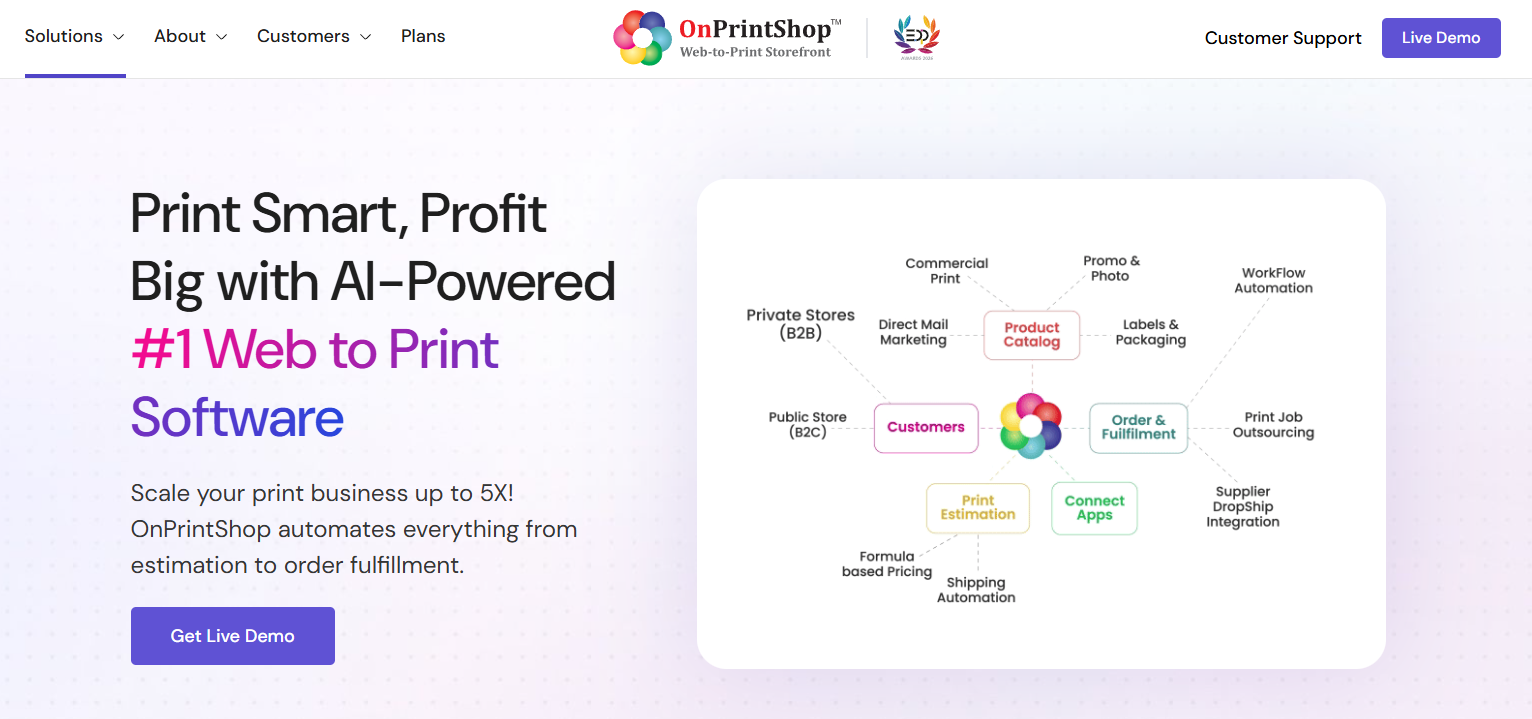
OnPrintShop is a cloud-based web-to-print platform covering online storefronts, product personalization, pricing and quoting, production workflow automation, and order management. It serves print service providers that need customer-facing ordering tied directly to backend fulfillment. The platform claims no transaction or commission fees on its subscription plans, which keeps cost predictable as order volume grows.
Best for: Commercial printers, resellers, and corporate print programs that need storefront and fulfillment operations in the same system.
Key features
- B2B and B2C print storefronts with dynamic pricing calculator
- Browser-based design editor with 3D preview and personalization
- Print-specific quoting engine and order management
- Production workflow automation with preflight checks
- Design proofing and approval workflows
- Integrations with MIS, ERP, shipping, payment, and accounting tools
Why choose OnPrintShop: Choose it when you need more than a shipping tool. It fits organizations that want online ordering, product configuration, and production status inside the same operating model, without paying per-transaction fees on top of subscription costs.
OnPrintShop pricing: Plans are listed as Platinum Basic, Platinum Startup, Platinum Pro, and Enterprise. Monthly subscription amounts are not displayed on the pricing page; contact OnPrintShop for a quote. The vendor confirms fixed monthly pricing with no commission or transaction fees.
G2 rating: 4.5/5 from 17 reviews.
2. Printavo
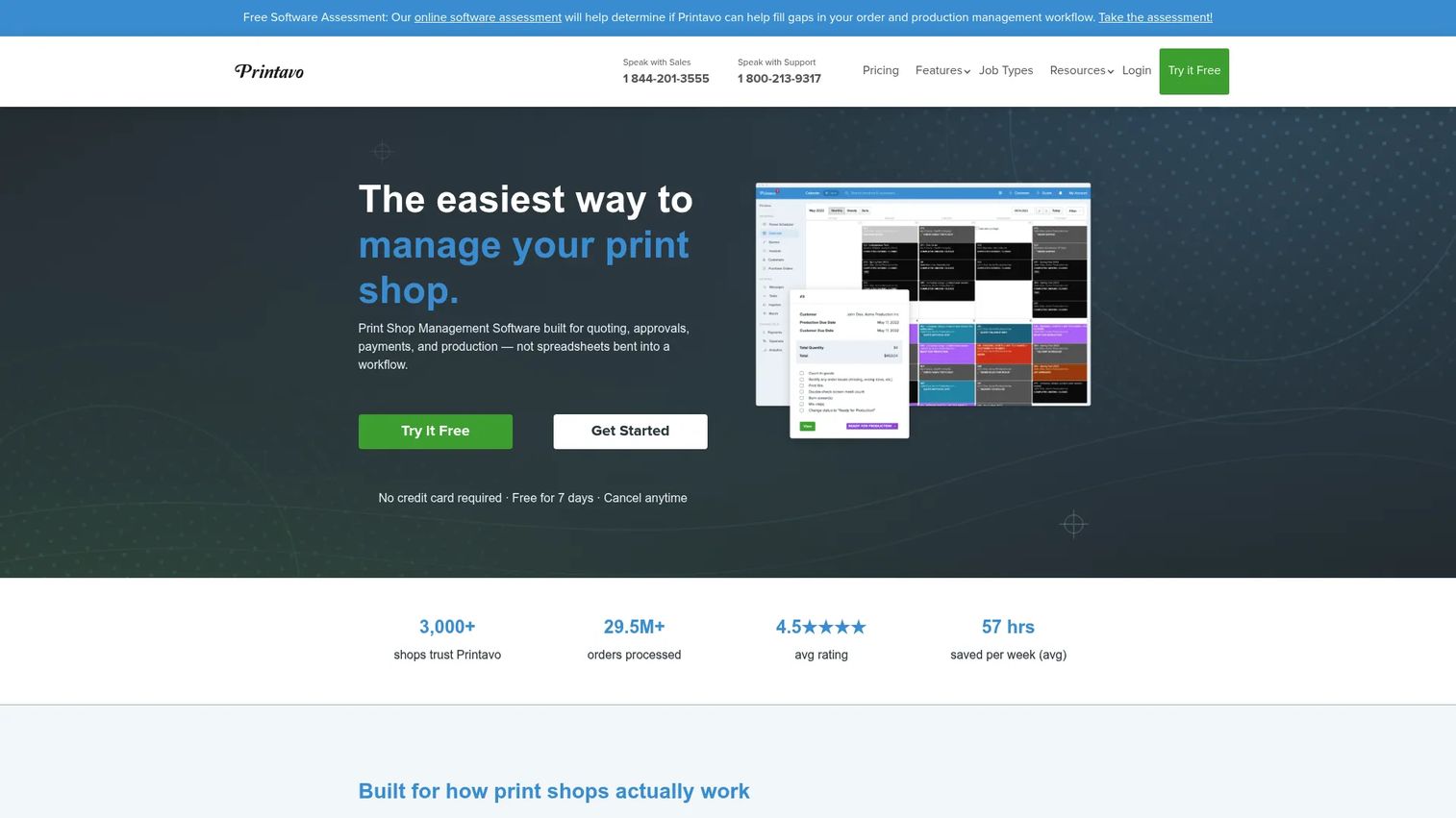
Printavo is print shop management software for apparel decorators, screen printers, embroidery shops, and branded merchandise operations. It covers order intake, quoting, artwork approvals, production scheduling, customer communication, invoicing, shipping labels, packing slips, and online merchandise stores. More than 3,000 shops use the platform, which has processed over 29.5 million orders according to Printavo's own data.
Best for: Apparel decorators and merchandise teams that need straightforward order, production, and fulfillment control without enterprise complexity.
Key features
- Quote and artwork approvals with custom order-status workflows
- Production scheduling and job-status tracking
- Online merch stores with product catalog integrations
- Shipping labels and packing slips
- Mobile shop-management access
- Customer communication and payment automation
Why choose Printavo: Pick it when you run a decorated-goods operation, school store, event merchandise program, or fundraising campaign. It is built around shop execution, not enterprise print distribution, so teams with simpler operations get to value faster.
Printavo pricing: A free trial is available (the pricing page references seven days in the main plan section and fourteen days in the FAQ). Lite runs at $109 per month and Standard at $244 per month. Premium pricing requires contacting sales. Printavo Merch adds $109 per month on Standard and is included on Premium.
G2 rating: 4.3/5 from 12 reviews.
3. Fulfill Engine
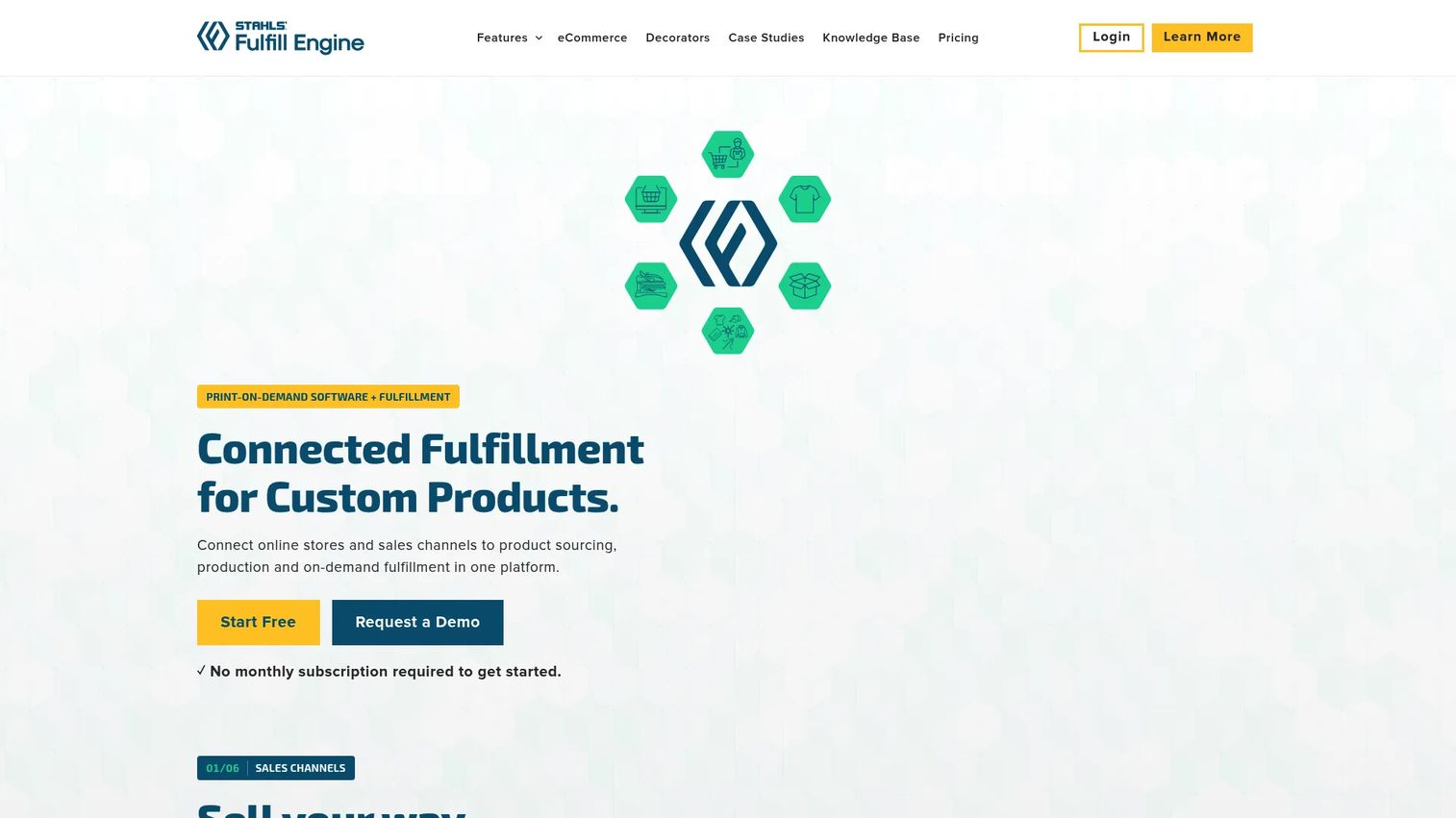
Fulfill Engine is a print-on-demand fulfillment platform connecting online stores and sales channels with product sourcing, decoration, production, and shipping. It supports decorated-product workflows across DTF, DTG, embroidery, sublimation, screen printing, UV printing, and laser engraving. Sellers, distributors, decorators, and ecommerce platforms each have their own plan tier, reflecting different access levels to the network and workflow tools.
Best for: Ecommerce and promotional-product programs that need product sourcing, decoration routing, and shipping automation across multiple suppliers or locations.
Key features
- Unlimited white-label webstores and sales portals
- On-demand product catalog with integrated suppliers and blank-goods sourcing
- Scan-to-print production workflow
- API, Shopify, Order Desk, and CSV integrations
- Inventory management, shipping, invoicing, and disbursements
- Automated fulfillment through the Fulfill Engine decorator network
Why choose Fulfill Engine: It is stronger for print-on-demand operations coordinating product sourcing and decoration across locations than for document-heavy corporate storefront programs. When your constraint is routing decorated orders intelligently across a network, this platform is purpose-built for it.
Fulfill Engine pricing: The Seller Essentials plan starts at $0 per month, covering on-demand selling and network fulfillment. Seller Pro runs $50 per month and adds customer, pricing, and financial controls. Decorator Pro is $500 per month for in-house production and inventory workflows. Enterprise Tier 1 starts at $2,500 per month and Enterprise Tier 2 at $5,000 per month. A 3.5% cart fee applies to webstore and order-portal transactions, or $0.50 per item for integrated orders.
4. PrintXpand
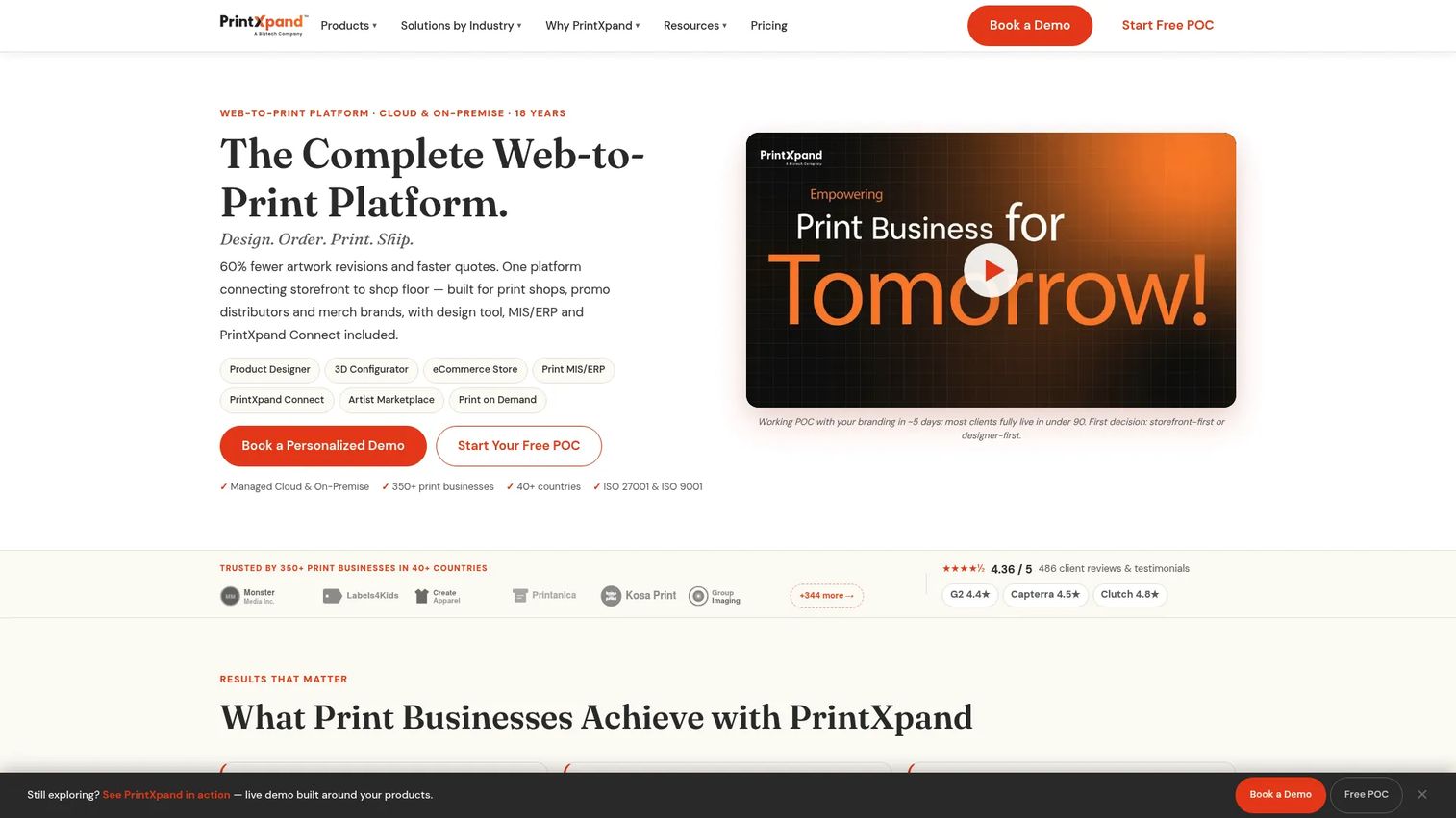
PrintXpand is an enterprise web-to-print and print fulfillment platform for organizations managing high-volume orders across multiple channels, facilities, or vendor networks. It connects ecommerce storefronts, B2B portals, marketplaces, and APIs into one production queue, then routes work to in-house teams or external vendors with carrier rate shopping and label generation. The platform serves print businesses, promotional-product distributors, and packaging companies across 40-plus countries.
Best for: Print businesses and fulfillment operators managing complex order flows across more than one facility, vendor, or production method.
Key features
- Multi-channel order aggregation from ecommerce, marketplaces, and portals
- In-house and vendor routing with barcode-scanning workflows
- Pick lists, packing slips, and shipping-label generation
- Carrier rate shopping and tracking
- Print MIS/ERP with job costing, scheduling, and analytics
- Artwork approval, online proofing, and estimating tools
Why choose PrintXpand: Choose it when campaign orders must route across multiple facilities or vendors and when exception management matters as much as order volume. Handling reprints, replacements, and stockouts reliably is where fulfillment programs typically break, and PrintXpand's routing rules are built around that reality. The vendor offers a proof of concept in approximately five days, with most clients live within 90 days.
PrintXpand pricing: Pricing is custom-quoted across three deployment options: PX Cloud, PX Cloud+, and PX On-Premise. The vendor states no per-order, per-user, or transaction fees. Request a quote at printxpand.com/pricing.
G2 rating: 5.0/5 from 1 review.
5. Aleyant Pressero
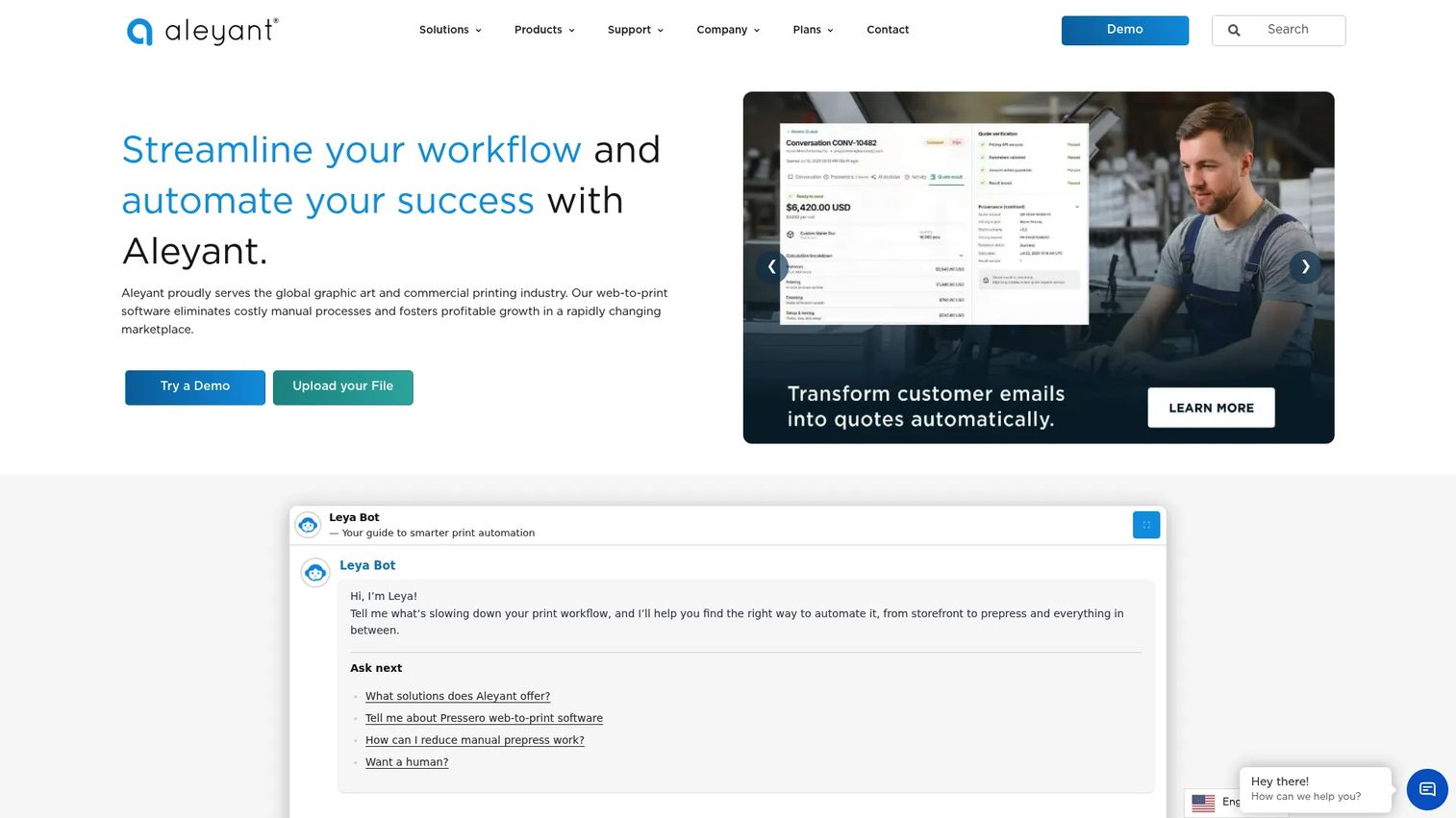
Aleyant Pressero is web-to-print software for commercial printers operating branded B2B storefronts, corporate ordering sites, and customer-specific print catalogs. The platform supports pricing engines, template-based design tools, inventory and budget controls, approval workflows, and integrations with MIS and shipping tools. Aleyant reports 18,000 active Pressero storefronts, indicating meaningful deployment scale among print providers.
Best for: Print providers managing recurring B2B ordering programs, franchise networks, or controlled corporate print portals where self-service reordering matters.
Key features
- Branded B2B and B2C storefronts with customer-specific catalog controls
- Pricing engines and instant online pricing calculators
- Template designer and online design tools
- Inventory, budgets, promotions, and approval workflows
- Purchase orders, tax profiles, vendors, and brokers modules
- Third-party integrations with unlimited users
Why choose Aleyant Pressero: Pick it when corporate ordering and repeatable storefront governance matter more than consumer-style ecommerce. Teams with recurring client catalogs and controlled print procurement get the most from it. The five-plan lineup (Starter, Advanced, Premier, Premier+, Premier DS) lets you start narrower and add capabilities as the program grows.
Aleyant Pressero pricing: Plans start at $399 per month. Individual tier amounts for Advanced through Premier DS are not displayed on the plans page. Contact Aleyant for a full tier breakdown.
G2 rating: 1.5/5 from a small number of reviews on G2.
6. DesignNBuy
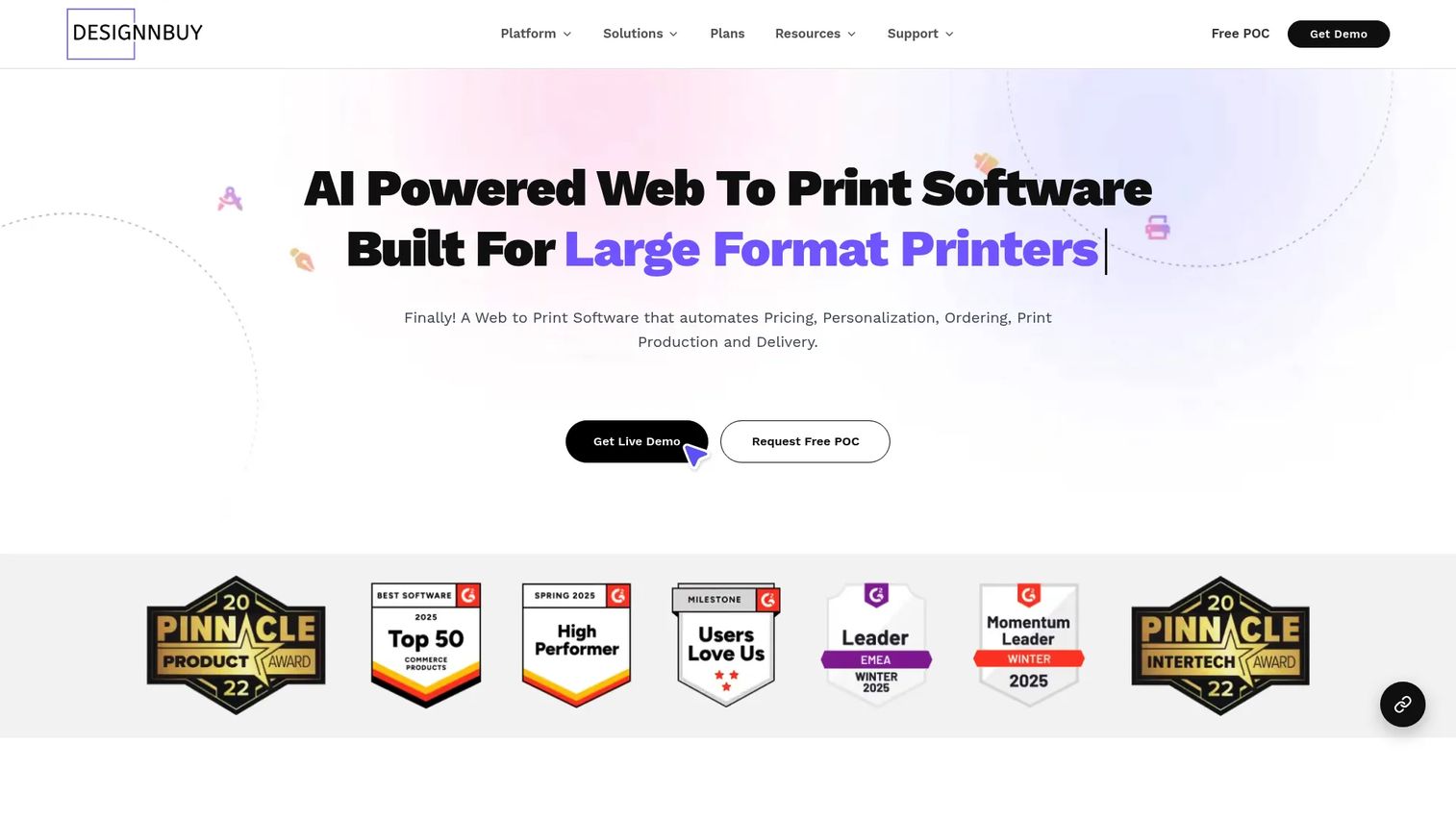
DesignNBuy is AI-powered web-to-print software covering product personalization, online design tools, storefronts, configure-price-quote, production workflow automation, and print-ready output. It supports B2B and B2C ordering with integrations across Shopify, WooCommerce, Magento, and BigCommerce. The company reports serving web-to-print clients across 60-plus countries from more than 2,000 businesses using the platform.
Best for: Print businesses whose buyers need to personalize products before submission, and whose sales model depends on front-end customer configuration.
Key features
- AI-powered product personalization and design tools with 2D and 3D visualization
- Configure, price, and quote capabilities with B2B and B2C storefronts
- Production workflow automation and preflight checks
- Order and job management with print-ready output
- Integrations with major ecommerce platforms
Why choose DesignNBuy: Choose it when the customer experience around product customization is central to your sales model. After customer submission, orders move through approval, production handoff, and shipping. Keep the boundary clear: It is a design-led print commerce platform, not a standalone fulfillment operating system.
DesignNBuy pricing: Starter runs at $90 per month (one B2C storefront, 100 GB storage). Growth is $190 per month (one B2C storefront, B2B add-on available, 200 GB storage). Enterprise pricing is custom. A perpetual-license model is also available; contact DesignNBuy for that pricing.
G2 rating: 4.2/5.
7. Mimeo
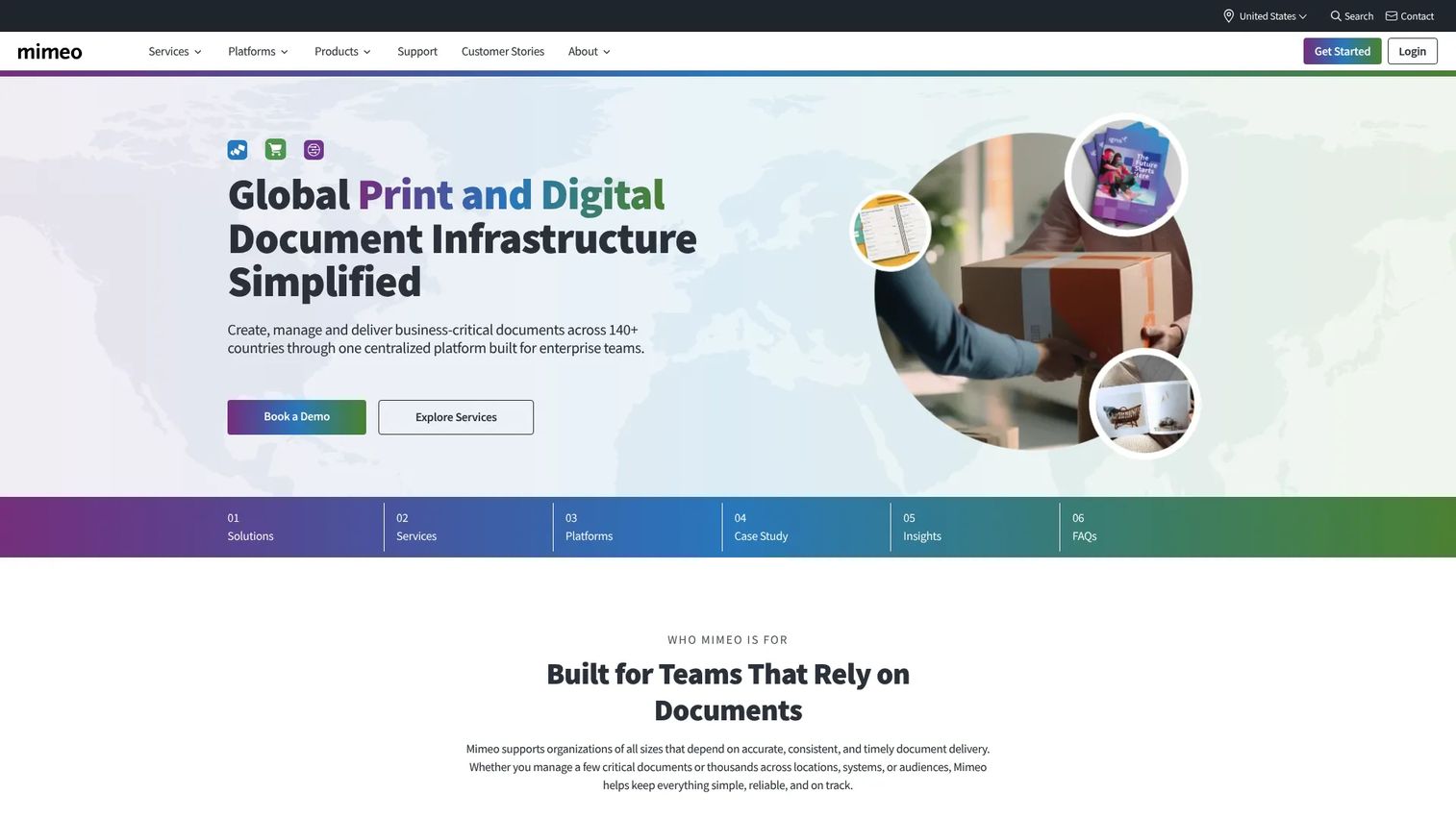
Mimeo provides enterprise print-on-demand, branded storefront, fulfillment, and digital content distribution services for organizations that need globally distributed, controlled print workflows. It serves enterprise teams running field marketing kits, training materials, sales collateral, and distributed campaigns where managed service and global reach matter more than in-house production control.
Best for: Enterprise marketing, enablement, and operations teams with recurring document or collateral distribution needs across multiple geographies or business units.
Key features
- On-demand document printing with real-time pricing and digital proofing
- Branded storefronts with access controls, order tracking, and warehousing
- Variable data printing and secure digital content distribution
- Global production network with managed fulfillment operations
- Audience engagement reporting for digital content
Why choose Mimeo: Choose it for managed service and global reach, not for running an in-house print shop's production queue. Sales kits for distributed field teams, franchise materials, event collateral, and document libraries for regulated environments are all strong fits. The trade-off: Pricing is per-order or custom, so high-volume programs should model costs carefully.
Mimeo pricing: Mimeo calculates pricing per order and provides personalized or custom pricing for larger programs. Contact Mimeo at mimeo.com/platforms for a quote. No standard subscription tiers are published.
G2 rating: 4.5/5.
8. Lob
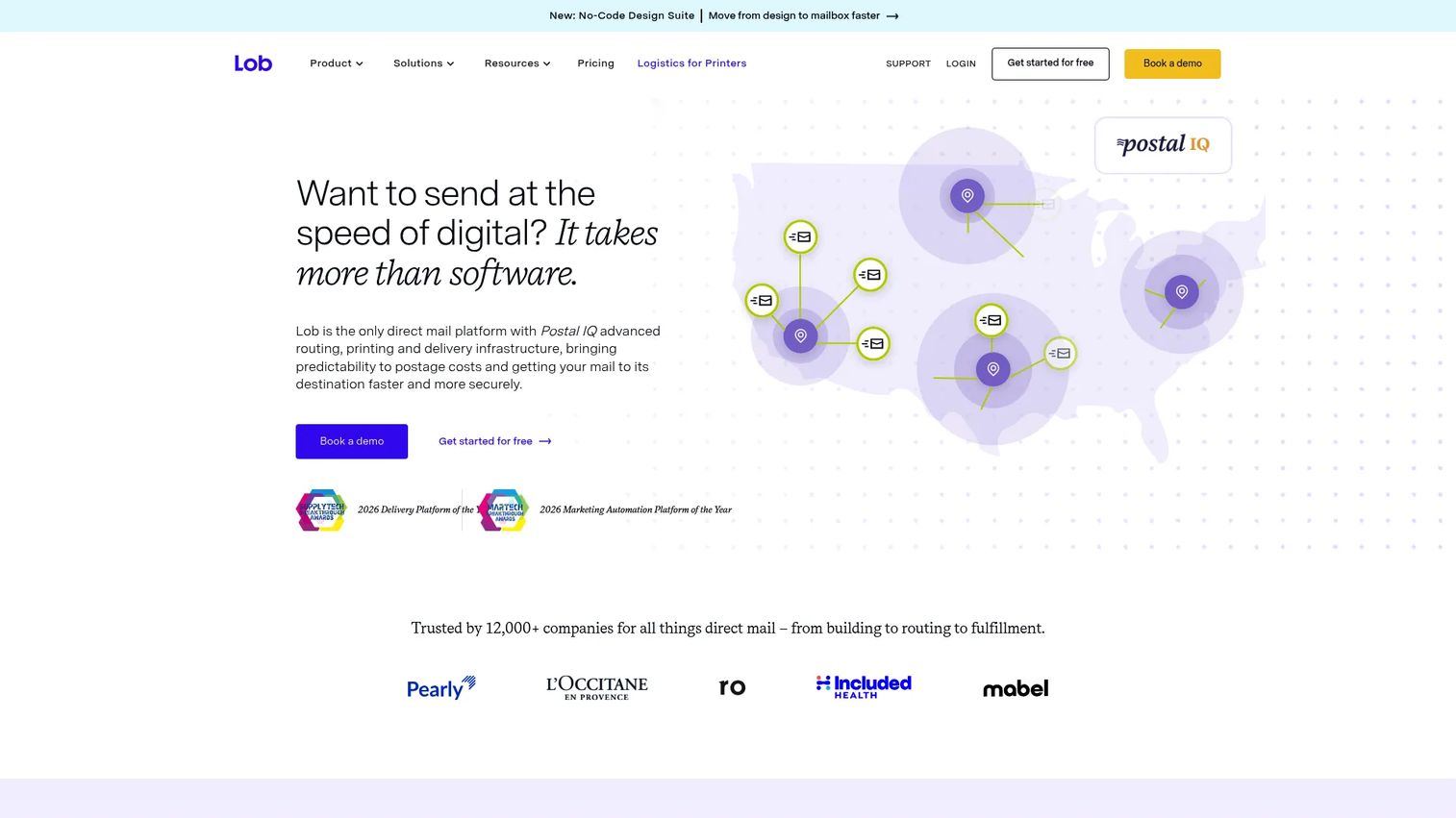
Lob is a direct mail platform combining campaign tools, APIs, Postal IQ routing intelligence, and a nationwide Print Delivery Network. It is built for teams that want to send postcards, letters, and similar mail programmatically through APIs and marketing workflows, rather than managing a print shop operation. Growth and lifecycle marketing teams use it for triggered direct mail, account-based marketing sends, and programmatic mail campaigns tied to CRM events or product behavior.
Best for: Growth and lifecycle marketing teams running triggered direct mail, account-based campaigns, and programmatic mail tied to CRM or product data.
Key features
- Direct mail API with address verification
- Postcards, letters, and personalized mail pieces
- Postal IQ routing intelligence and Print Delivery Network
- In-transit mail tracking and delivery analytics
- API integrations, webhooks, and CRM connections
- Campaign-level reporting tied to send segments
Why choose Lob: Pick it when you need to trigger physical mail from product events, lifecycle stages, or CRM data without managing a print vendor relationship. The attribution story is direct: Sends tie to segments, campaign IDs, response windows, and downstream pipeline. State the boundary clearly for your team: Lob is a direct mail automation platform, not a full print-production or merchandise-fulfillment system.
Lob pricing: The Developer plan starts at $0 per month. Startup runs from $260 per month and Growth from $550 per month, each billed monthly with print and postage charged separately per piece. Enterprise pricing is custom. All plans include address verification; higher plans add analytics depth and volume discounts.
G2 rating: 4.4/5.
Considerations when choosing print fulfillment software
Match the platform to your production model
Decide first whether you produce in-house, route to vendors, use a distributed network, or need a managed service. A web-to-print storefront solves ordering and approvals, but it will not replace a supplier routing engine. A direct mail API handles triggered postcards, but it will not run an apparel production floor.
Verify integration depth before you buy
Ask for confirmed integrations with your ecommerce platform, CRM, accounting tool, and carrier. "Integrates with" is vague. Confirm what data syncs, how frequently, and who owns error resolution when a sync fails mid-campaign.
Price the full operating model
Entry pricing rarely covers the complete setup. Model total cost across additional storefronts, user seats, implementation services, design modules, shipping volume, and required integrations. The gap between entry price and actual deployment cost is where B2B ecommerce platforms and print programs most commonly overspend.
Plan for exceptions, not the happy path
Ask specifically how the platform handles stockouts, reprints, partial shipments, address errors, cancelled orders, and vendor delays. These scenarios are where campaign credibility breaks down, and a feature checklist will not tell you how robust the exception workflow actually is.
Define your reporting requirements first
For digital marketers, the reports that matter are inventory status, campaign order volume, shipment timing, delivery performance, exception rate, and fulfillment cost per program. Tie those requirements to your campaign KPIs before evaluating any platform. If a tool cannot surface those metrics, you will be back in a spreadsheet after implementation. For context on marketing automation and how fulfillment data plugs into broader campaign reporting, the integration question is the same: Confirm what flows where before signing.
Conclusion
The eight platforms in this guide serve meaningfully different operational needs. OnPrintShop handles web-to-print storefronts and print workflow control. Printavo fits apparel, merchandise, and shop execution. Fulfill Engine covers print-on-demand sourcing and decorated-product routing. PrintXpand suits large-scale multi-channel fulfillment. Aleyant Pressero and DesignNBuy both target print-commerce storefronts, with Pressero focused on corporate B2B programs and DesignNBuy on front-end product customization. Mimeo serves enterprise distribution programs. Lob handles automated direct mail tied to marketing workflows.
The practical next step: Map one real order from campaign request to delivery. Identify every manual handoff, every tool switch, and every place where status becomes invisible. The platform that removes the most of those handoffs from that specific path is the better buy, regardless of which feature list looks more complete.
For teams evaluating marketing resource management alongside a fulfillment platform, the integration question is the same: Prove the data flows before you commit.
Start your journey with Guideflow today!
FAQs
Print fulfillment software manages printed products from order capture through production, packing, shipping, tracking, and delivery. Features vary widely: Web-to-print storefronts, print-on-demand routing, shop management systems, and direct mail APIs all fall under the category but solve different operational problems. Buyers should match the platform to where their workflow currently breaks, not to the broadest feature set available.
Web-to-print software focuses on online ordering, product configuration, and customer submission. Print fulfillment covers the downstream operational work: Routing, picking, packing, labeling, and shipping. Many platforms combine both, but buyers should validate the depth of each workflow before purchasing. A platform strong on storefront features may have thin carrier and exception-management tools, and vice versa.
Most platforms connect to ecommerce storefronts via API, native integration, or CSV import. The important verification is not whether an integration exists, but what data it syncs: Order status, inventory updates, shipment tracking, and error handling. Confirm the sync direction and frequency. If your Shopify store needs real-time inventory updates, verify that the platform supports it at your expected order volume. For a broader look at best ecommerce platforms, the integration compatibility question applies there too.
Apparel and merchandise operations need quoting, artwork approvals, production scheduling, supplier catalogs, shipping labels, and packing slips in one system. Evaluate platforms based on the decoration methods they support (DTG, embroidery, screen printing, DTF), whether they include online store functionality, and how they handle reorder and inventory tracking. Printavo and Fulfill Engine are the strongest options covered in this guide for decorated-goods workflows.
Direct mail automation platforms are built for programmatic postcards, letters, and lifecycle-triggered mail. They prioritize APIs, address verification, campaign segmentation, and mail tracking rather than print-shop production management. Lob is the clearest fit in this guide for teams triggering physical mail from CRM data, product events, or marketing automation workflows. For volume direct mail without API requirements, a managed fulfillment service like Mimeo may be a better fit.
Costs range from free entry tiers (Fulfill Engine's Seller Essentials, Lob's Developer plan) to $109 per month for shop management (Printavo Lite), $399 per month for corporate storefronts (Aleyant Pressero), and custom enterprise quotes for platforms like PrintXpand and Mimeo. The price drivers are user count, storefront count, order volume, integrations, implementation services, and deployment model (cloud vs. on-premise). Entry pricing often does not include the modules most teams actually need, so model total cost before committing.
The answer turns on the platform and the operating model. Some tools, particularly PrintXpand, cover substantial MIS functionality including job costing, scheduling, and production analytics. Commercial printers with advanced estimating, finance, and production controls often need both systems connected, with the MIS handling cost and scheduling and the fulfillment platform handling order intake and shipping. Evaluate which workflows each system owns and where the handoff between them occurs.
Track campaign order volume, delivery timing against campaign windows, fulfillment cost per program, inventory accuracy, shipment exception rate, reprint rate, and delivery confirmation. Where attribution is available, connect delivery confirmation to downstream response rate and pipeline. The best marketing analytics software tools can pull those fulfillment signals into a unified campaign view when the print platform exposes them via API or webhook. Establish a baseline for exception rate and delivery timing before claiming improvement after implementation.