Pharmacy inventory sits at the intersection of patient care, cash flow, and regulatory obligation. Too much stock ties up working capital in slow-moving product. Too little creates stockouts that interrupt care and frustrate customers. Expired medication turns purchasing errors into direct write-offs. And when compliance audits arrive, manual spreadsheets rarely hold up.
The global pharmacy inventory management software market reached $6.6 billion in 2024 and is projected to reach $13.0 billion by 2033, according to Grand View Research (2024). That growth reflects a real shift: Pharmacy operators are replacing manual processes with systems that automate replenishment, track expiration dates, support audit workflows, and give finance teams the reporting they need without assembling five spreadsheets first.
The right pharmacy inventory management software reduces stockouts, improves purchasing discipline, and produces the inventory-turn and drug-spend data a board or finance leader can actually use. This guide helps you find that system.
What's inside
This guide compares 12 pharmacy inventory management software options for 2026, covering dedicated inventory tools and broader pharmacy management platforms with strong inventory modules.
- Who it's for: Independent pharmacy owners, health-system pharmacy directors, long-term care operators, and operations leaders evaluating inventory software
- How tools were chosen: Inventory relevance, pharmacy environment fit, purchasing depth, compliance and reporting capability
- What's covered: Stock control, replenishment, lot tracking, DSCSA and 340B support, pricing, and G2 ratings
- Scope: Both inventory-focused systems and all-in-one pharmacy platforms where inventory is a core module
TL;DR
- Best inventory-first pick: SureCost Inventory Manager for pharmacies prioritizing real-time stock visibility, low-stock alerts, transfers, and automated replenishment
- Best for health systems: Tecsys Elite for centralized supply chain visibility, lot tracking, and multi-site governance
- Best for drug spend optimization: McKesson Asset Management for organizations focused on inventory turns and working capital
- Best for long-term care: FrameworkLTC for LTC pharmacy workflows tied to cycle-fill and medication distribution
- Best all-in-one pharmacy systems: BestRx, Rx30, ComputerRx, and EnterpriseRx when inventory must connect directly to dispensing and pharmacy management
- Best evaluation approach: Start with pharmacy environment fit, then compare replenishment depth, audit requirements, and implementation load before shortlisting vendors
What is pharmacy inventory management software?
Pharmacy inventory management software helps pharmacies track medication stock, automate replenishment, manage purchasing, monitor expiration dates, support audit workflows, and reduce waste across one or more pharmacy locations.
According to AMECO Research (2025), inventory management accounted for about 30.4% of pharmacy management system solutions revenue in 2025, making it the largest functional segment of the broader pharmacy software market.
Core capabilities
Most pharmacy inventory management systems cover the following:
- Stock level tracking: Real-time visibility into on-hand quantities across locations
- Automated replenishment: Par levels, reorder points, and purchase order generation
- Purchase order management: Wholesaler ordering, contract compliance, and receiving workflows
- Expiration date tracking: FEFO workflows, alerts for near-expiry stock, and disposal documentation
- Lot and serial traceability: Chain-of-custody records for audit and DSCSA compliance support
- Cycle counts: Scheduled and ad hoc physical inventory verification
- Transfer management: Stock movement between locations with audit trails
- Demand forecasting: Historical movement data applied to future purchasing decisions
- Inventory valuation: On-hand value reporting for finance and board reporting
- Audit reporting: Documentation to support regulatory and internal review
Inventory software versus pharmacy management software
Inventory-focused tools handle stock control, purchasing, waste reduction, transfers, and optimization. Pharmacy management systems add dispensing, patient profiles, claims adjudication, point of sale, and e-prescribing, with inventory as one module among several.
The right choice depends on whether the pharmacy needs a standalone inventory layer or a complete operating system. A health system with a separate dispensing platform may benefit from a dedicated inventory tool. An independent retail pharmacy just getting started often prefers one system that handles everything.
When to use pharmacy inventory management software
Reduce stockouts without overbuying
Stockouts interrupt patient care and create lost sales. Overbuying traps cash in slow-moving product. Pharmacy inventory software sets par levels, triggers replenishment, and applies demand forecasting to historical movement data. The result: Fewer emergency orders and less excess stock sitting on the shelf past its turn date.
Control medication waste and expiration risk
Expired drugs become direct write-offs. Inventory software with expiration tracking flags near-expiry stock before it becomes a disposal problem. FEFO (first-expiry, first-out) workflows and transfer suggestions reduce waste across locations. Lot tracking connects each unit to its purchase record, which matters for returns and audit documentation.
Manage inventory across multiple pharmacy locations
A single-site pharmacy can manage inventory manually, at some cost in technician time. Multi-location pharmacy networks cannot. Before placing another order, a purchasing manager needs to know what each site has on hand. Dedicated inventory software provides centralized visibility, supports inter-location transfers, and generates reporting that covers the whole network rather than one store at a time.
Pharmacy inventory management software comparison
The table below gives a fast shortlist for each pharmacy environment. It is a starting point, not a final buying decision. Pricing and G2 ratings were verified against vendor pricing pages and G2 listings at generation time. Vendors that price by quote are noted accordingly.
| # | Product | Best for | Key differentiator | Pricing | G2 rating |
|---|---|---|---|---|---|
| 1 | SureCost Inventory Manager | Multi-location inventory control | Track, alert, transfer, and replenish workflow | Quote-based | 4.3/5 |
| 2 | McKesson Asset Management | Drug spend and inventory turns | Inventory optimization plus purchasing analytics | Quote-based | N/A |
| 3 | Supplylogix | Data-driven replenishment | Forecasting, redistribution, and diversion monitoring | Quote-based | N/A |
| 4 | Tecsys Elite | Health-system pharmacy supply chain | Centralized visibility, lot tracking, compliance | Quote-based | 4.7/5 |
| 5 | BestRx | Independent retail pharmacies | All-in-one pharmacy management with inventory | Quote-based | 3.0/5 |
| 6 | Kroll | Retail pharmacy operations | Pharmacy workflow plus inventory management | Quote-based | 3.8/5 |
| 7 | Rx30 | Community pharmacy management | Dispensing, POS, and inventory workflows | Quote-based | 3.8/5 |
| 8 | ScriptPro | Pharmacy automation environments | Robotics, 340B, and workflow automation | Quote-based | 3.9/5 |
| 9 | ComputerRx | Community pharmacy operations | Pharmacy management with integrated inventory | Quote-based | 3.5/5 |
| 10 | EnterpriseRx | Multi-site pharmacy organizations | Enterprise management and centralized reporting | Quote-based | N/A |
| 11 | FrameworkLTC | Long-term care pharmacies | LTC workflow and cycle-fill support | Quote-based | 4.4/5 |
| 12 | SuiteRx | Independent and specialty pharmacies | Modular pharmacy management and inventory workflows | SRx+ from $25,000 (one-time) | 4.5/5 |
Pricing and G2 ratings verified November 2026 from vendor pricing pages and G2 listings.
Best pharmacy inventory management software for 2026
1. SureCost Inventory Manager
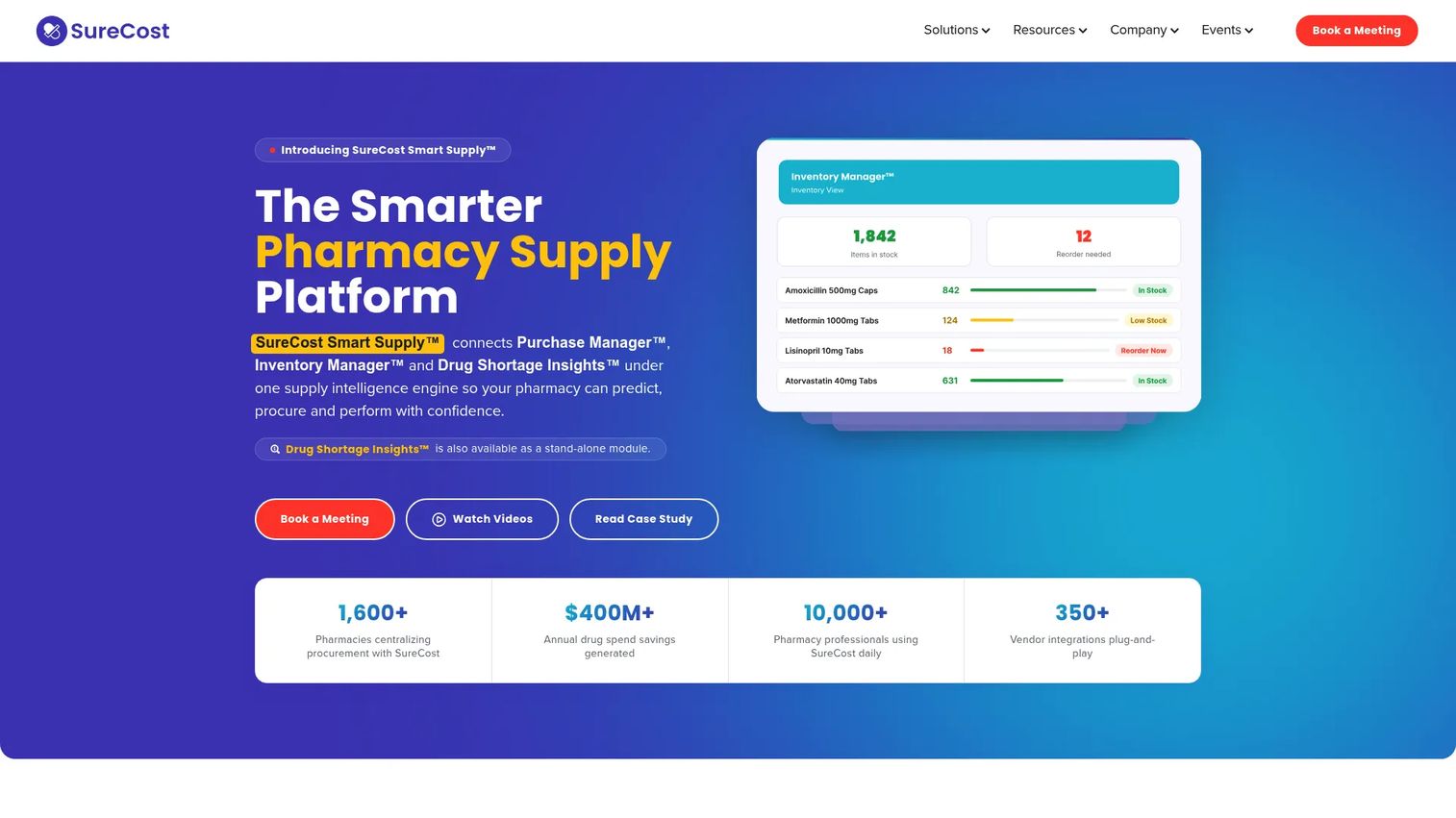
SureCost Inventory Manager is a dedicated pharmacy inventory control platform built for pharmacies that want stronger control over stock movement without switching their entire dispensing system. It covers real-time stock visibility, automated replenishment, inventory transfers with audit trails, and cycle-count workflows. The platform serves retail, long-term care, and health-system pharmacy environments.
Best for: Pharmacies that want a focused inventory layer rather than a broader pharmacy management suite.
Key features
- Real-time inventory visibility across multiple locations
- Automated replenishment using par levels and demand forecasting
- Inventory transfer tracking with full audit trails
- Physical and perpetual inventory management
- Cycle-count and cycle-fill accuracy workflows
Why choose SureCost Inventory Manager: It fits teams where inventory control is the specific bottleneck. If you already have a dispensing system you want to keep, SureCost adds the replenishment, transfer, and cycle-count layer on top.
SureCost Inventory Manager pricing: SureCost prices by quote. Cost reflects pharmacy type, number of locations, purchasing workflow complexity, and implementation scope. Contact SureCost directly to request a tailored estimate.
G2 rating: 4.3/5 (verified November 2026, G2)
2. McKesson Asset Management
McKesson Asset Management is a pharmacy inventory optimization program that combines McKesson Connect, mobile computing tools, analytics, and account-manager guidance. It is designed for inpatient, outpatient, and long-term care pharmacies that want to reduce inventory investment and improve procurement efficiency.
The program focuses on identifying A items, reviewing purchase history, optimizing contract compliance, and improving inventory turns. It is more of an advisory and analytics program than standalone software.
Best for: Hospitals, health systems, and pharmacy organizations focused on drug spend reduction and working capital improvement.
Key features
- Analytics to identify and prioritize high-velocity A items
- Purchase-history-based ordering guidance
- Contract-compliance optimization
- Procurement process assessment
- Implementation planning and performance measurement
Why choose McKesson Asset Management: A fit for pharmacy leaders who want expert help diagnosing excess inventory and tightening purchasing behavior. It pairs well with organizations already inside the McKesson distribution network.
McKesson Asset Management pricing: Pricing is quote-based. Cost reflects program scope, pharmacy setting, distribution relationship, and inventory complexity. Reach out to McKesson directly for program details.
G2 rating: No verified G2 rating available for this specific program.
3. Supplylogix
Supplylogix is pharmacy supply chain and inventory management software for retail pharmacies, independent pharmacies, and health systems. It focuses on data-driven ordering, inventory redistribution, and controlled-substance monitoring rather than broad pharmacy management.
Supplylogix integrates with McKesson Connect, EnterpriseRx, PDX, Rx30, Epic Willow, and custom systems, making it a practical add-on for organizations already running those platforms.
Best for: Pharmacy teams seeking analytics-led inventory optimization, demand forecasting, and controlled-substance diversion monitoring.
Key features
- Intelligent medication ordering and replenishment
- Inventory redistribution across locations
- Controlled-substance theft and diversion monitoring
- Automated inventory cycle counting
- Generics management and conversion tracking
Why choose Supplylogix: It adds a data layer to purchasing decisions that reduces judgment-call ordering. The diversion monitoring module makes it relevant for health systems and retail chains with controlled-substance exposure.
Supplylogix pricing: Supplylogix prices by quote. Cost reflects the number of pharmacy locations, analytics scope, and integration requirements. Request pricing directly through the Supplylogix team.
G2 rating: No verified G2 rating found at generation time.
4. Tecsys Elite
Tecsys Elite is an enterprise supply chain management platform with deep healthcare distribution and pharmacy inventory capabilities. For health-system pharmacy operations, it covers centralized inventory visibility, lot tracking, expiration management, real-time traceability, and warehouse-level controls across complex multi-site environments.
The platform includes AI-driven supply chain intelligence through TecsysIQ and a low-code workflow layer through Itopia, which allows configuration without heavy engineering involvement.
Best for: Health systems, hospital pharmacies, and enterprise pharmacy networks that need supply chain governance at scale.
Key features
- Centralized real-time inventory visibility across all sites
- Lot tracking and full chain-of-custody traceability
- Expiration date management and FEFO workflow support
- Warehouse management covering receiving, replenishment, and cycle counting
- AI-driven supply chain analytics through TecsysIQ
Why choose Tecsys Elite: It is built for complexity. When a health system needs audit-ready traceability, multi-location transfers, and predictive replenishment across dozens of dispensing points, Tecsys Elite covers the supply chain layer that lighter tools do not.
Tecsys Elite pricing: Pricing is quote-based. Cost depends on modules selected, number of sites, user count, transaction volume, and implementation services. Contact Tecsys for a configuration-specific estimate.
G2 rating: 4.7/5 (verified November 2026, G2, based on 3 reviews)
5. BestRx
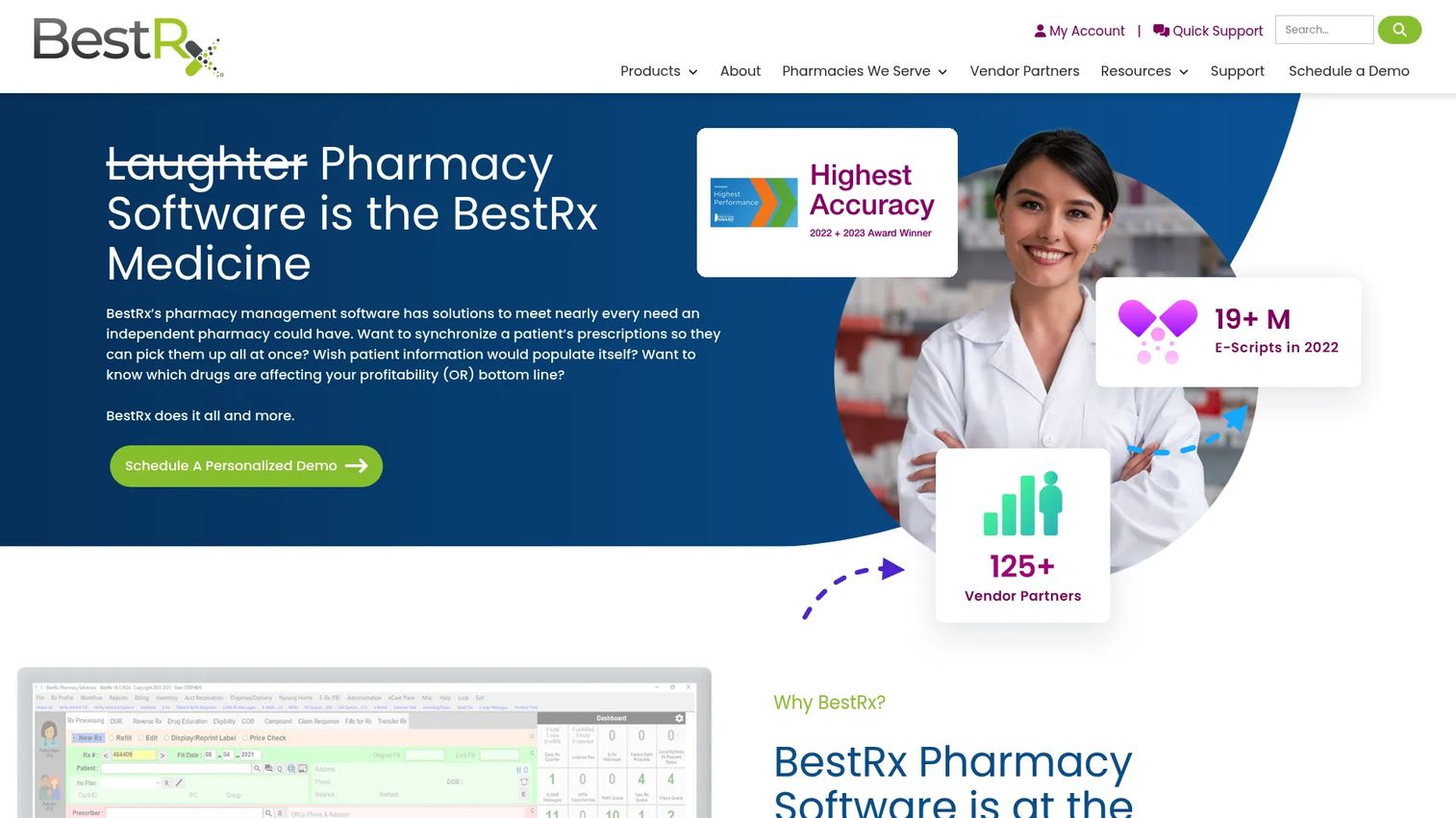
BestRx is pharmacy management software for independent pharmacies, combining prescription workflow, inventory management, electronic prescribing, automated refills, and two-way patient messaging in one platform. Inventory sits inside the core operating system rather than as a separate module.
BestRx offers Basic, Standard, and Premium tiers, though definitive plan pricing is not displayed on the current official site.
Best for: Independent retail pharmacies that want inventory, dispensing, and patient management in a single system.
Key features
- Customizable prescription workflow management
- Inventory management integrated into daily operations
- Electronic prescribing and automated refills
- Two-way patient messaging
- Cloud-based data backups
Why choose BestRx: A practical fit for pharmacies that prefer operational consolidation over best-of-breed tools. It is strongest when inventory needs connect closely to daily retail dispensing workflows.
BestRx pricing: BestRx references Basic, Standard, and Premium tiers. Definitive plan prices are not posted on the current site. Request a quote tied to pharmacy size, modules required, and user count.
G2 rating: 3.0/5 (verified November 2026, G2, based on 4 reviews)
6. Kroll
Kroll is pharmacy management software used in retail pharmacy environments, particularly where prescription workflow, patient profiles, claims processing, and inventory need to connect within a single system.
Best for: Retail pharmacies that want inventory connected to dispensing and patient workflow management.
Key features
- Prescription processing and workflow management
- Inventory tracking
- Patient profile management
- Claims workflow and adjudication
- Pharmacy reporting tools
Why choose Kroll: A fit for retail pharmacies that want a pharmacy management backbone with inventory included. Pharmacies operating in Canadian markets should confirm current product ownership and regional support directly with the vendor.
Kroll pricing: Kroll prices by quote. Cost drivers include pharmacy count, selected modules, integrations, and the support package. Contact Kroll or its regional resellers for current pricing.
G2 rating: 3.8/5 (verified November 2026, G2, based on 3 reviews)
7. Rx30
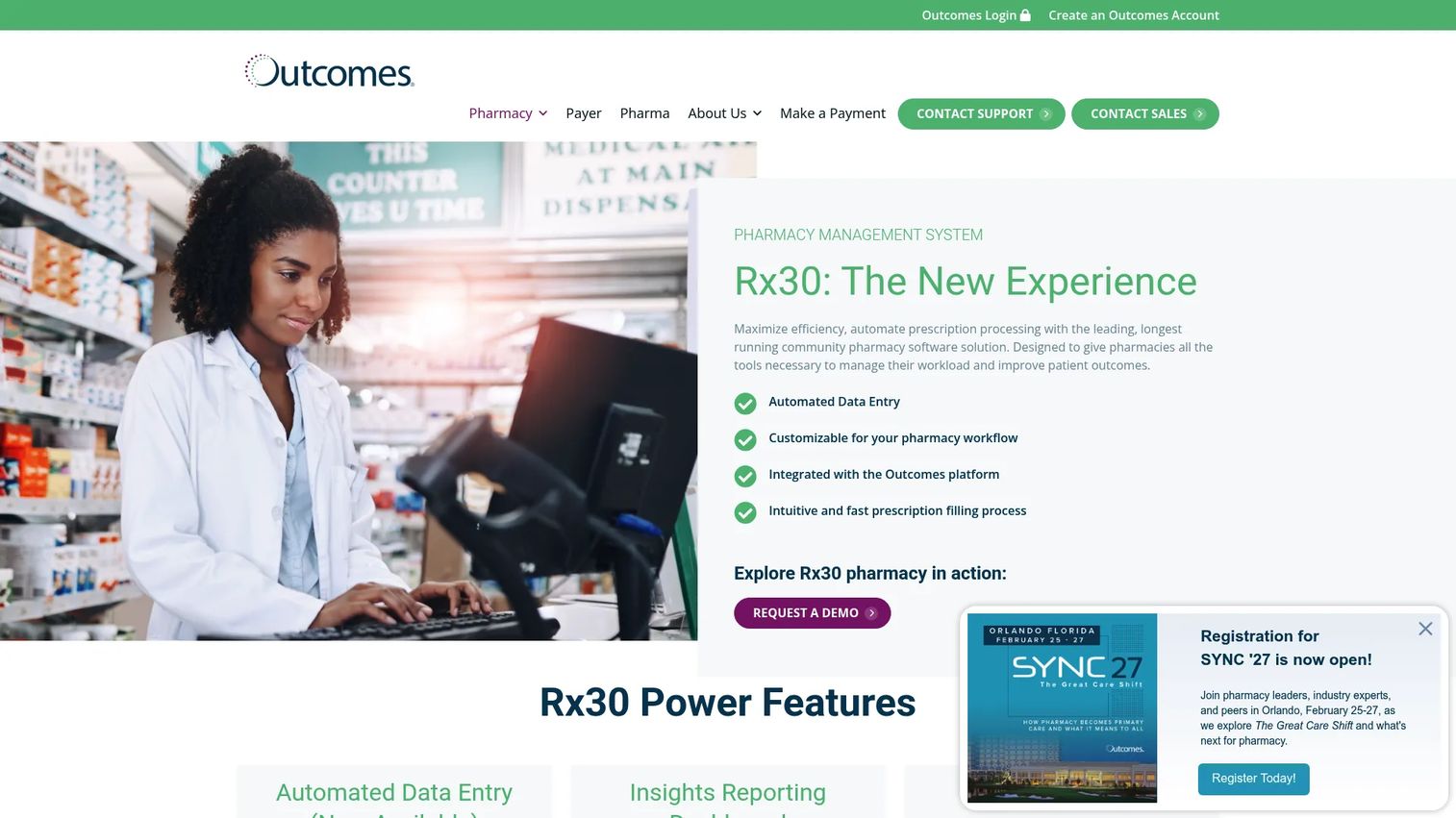
Rx30 is a pharmacy management platform for independent and community pharmacies. It integrates prescription management, clinical opportunity workflows, point-of-sale, and inventory tracking including ordering, receiving, reporting, and shelf-label printing.
The platform has been integrated into the Outcomes network, which provides access to clinical program opportunities alongside core dispensing functions.
Best for: Independent pharmacies that want inventory management close to dispensing, claims, and point-of-sale activity.
Key features
- Integrated clinical opportunity indicator and Outcomes dispensing dashboard
- Inventory tracking, ordering, receiving, and shelf-label printing
- Point-of-sale with electronic signatures and ID scanning
- Accounts receivable and order transmission tools
- Gift-card, loyalty, delivery, and mobile integrations
Why choose Rx30: It reduces the number of disconnected tools a community pharmacy needs to run daily operations. Inventory data sits alongside dispensing and POS activity, which simplifies reconciliation and purchasing reviews.
Rx30 pricing: Rx30 prices by quote. Cost reflects modules selected, pharmacy dispensing volume, number of locations, and implementation scope. The Rx30 website does not display plan prices.
G2 rating: 3.8/5 (verified November 2026, G2)
8. ScriptPro
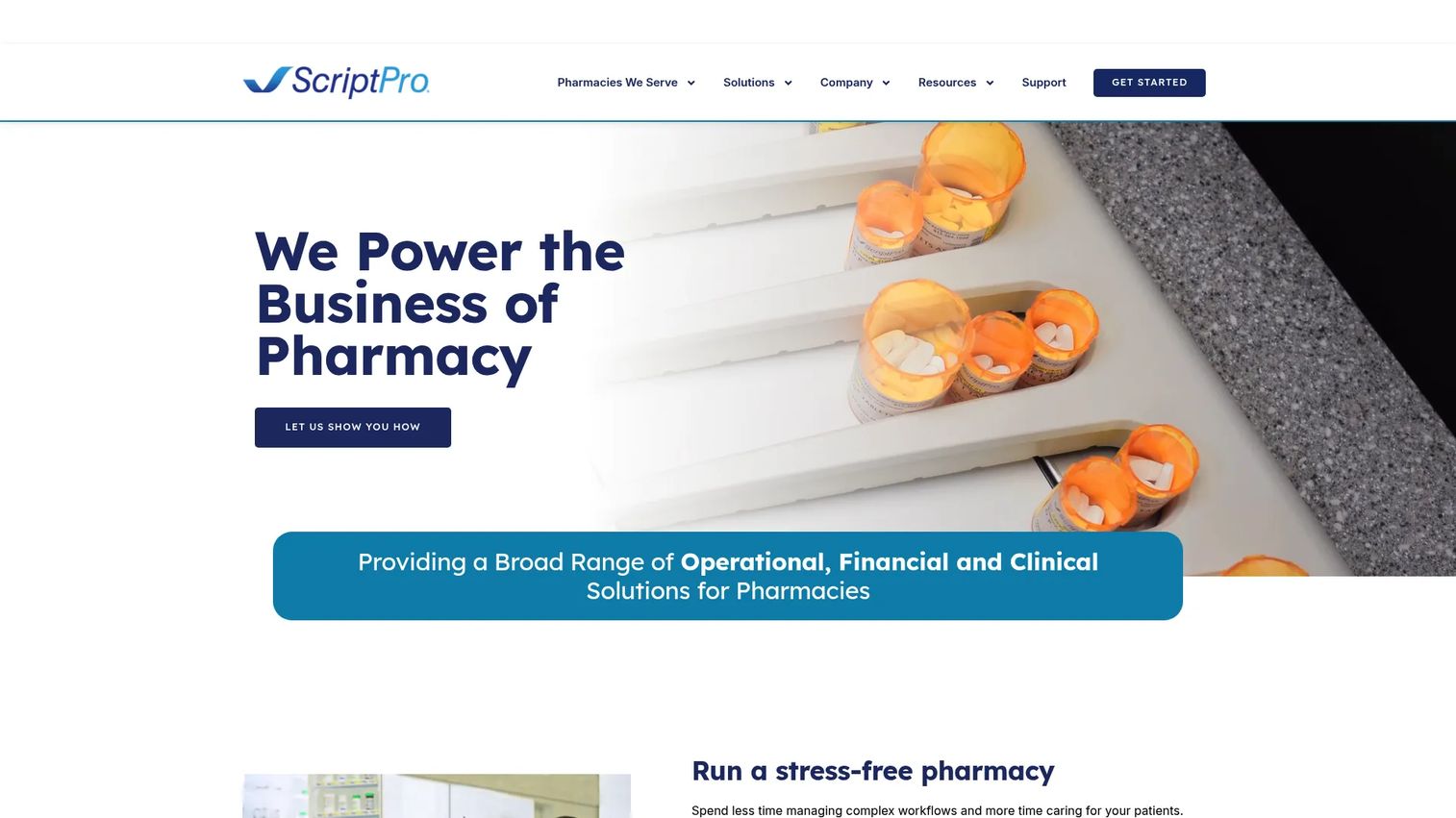
ScriptPro provides pharmacy management, workflow automation, robotic dispensing, and pouch packaging systems. Inventory management and 340B tracking are part of the broader platform alongside robotic prescription dispensing, mobile dispensing tools, and point-of-sale applications.
Best for: Pharmacies investing in automation-heavy workflows where inventory management connects to robotic dispensing and fulfillment.
Key features
- Pharmacy management and workflow automation systems
- Robotic prescription dispensing with barcode controls and vial labeling
- Medication pouch packaging and verification
- Inventory and 340B management
- Mobile dispensing and point-of-sale applications
Why choose ScriptPro: The strongest fit when manual dispensing is the core operational constraint and inventory management needs to connect directly to automation hardware. It is less suited to pharmacies that do not need robotic dispensing.
ScriptPro pricing: ScriptPro prices by quote. Cost reflects automation configuration, software modules, pharmacy dispensing volume, hardware requirements, and implementation. Contact ScriptPro directly for a hardware-inclusive estimate.
G2 rating: 3.9/5 (verified November 2026, G2, for SP Central)
9. ComputerRx
ComputerRx is pharmacy management software for community and independent pharmacies, covering prescription processing, customizable workflows, automated refills, claims adjudication, and label printing through its Xpress Fill module. Inventory management connects to the daily dispensing workflow.
Best for: Community pharmacies that want inventory, dispensing, and pharmacy operations in a consolidated platform.
Key features
- Prescription processing and customizable workflow management
- Automated refills, claims adjudication, and label printing via Xpress Fill
- Inventory tracking integrated into daily operations
- Patient engagement and profile management
- Point-of-sale support
Why choose ComputerRx: A fit for community pharmacies that want fewer systems to manage. Inventory data connects to dispensing history, making it easier to spot slow-moving products and align purchasing with actual movement.
ComputerRx pricing: ComputerRx prices by quote. Cost varies with pharmacy size, product modules selected, user count, integrations, and support package. Request a quote through the Outcomes/ComputerRx team.
G2 rating: 3.5/5 (verified November 2026, G2, based on 11 reviews)
10. EnterpriseRx
EnterpriseRx is a McKesson pharmacy management system for retail, specialty, mail-order, and multi-location pharmacy organizations. It integrates workflow automation, clinical programs, patient engagement, centralized reporting, and HL7 interfaces. Supplylogix connects via single sign-on, providing a data-driven inventory optimization layer on top of the core dispensing platform.
Best for: Larger or multi-site pharmacy organizations that need enterprise pharmacy management with centralized workflow and reporting.
Key features
- Workflow automation and workload balancing across locations
- Clinical programs and patient engagement tools
- Centralized pharmacy data and reporting
- Automated refill, call, and text reminders
- Supplylogix single sign-on integration for inventory analytics
Why choose EnterpriseRx: It fits organizations where local workflow standardization and centralized visibility matter more than deep standalone inventory tooling. The Supplylogix integration adds the forecasting and diversion-monitoring layer for teams that need it.
EnterpriseRx pricing: EnterpriseRx prices by quote. Cost reflects organization size, modules, number of locations, integrations, and enterprise support requirements. Contact McKesson for EnterpriseRx program details.
G2 rating: No verified G2 rating found at generation time.
11. FrameworkLTC
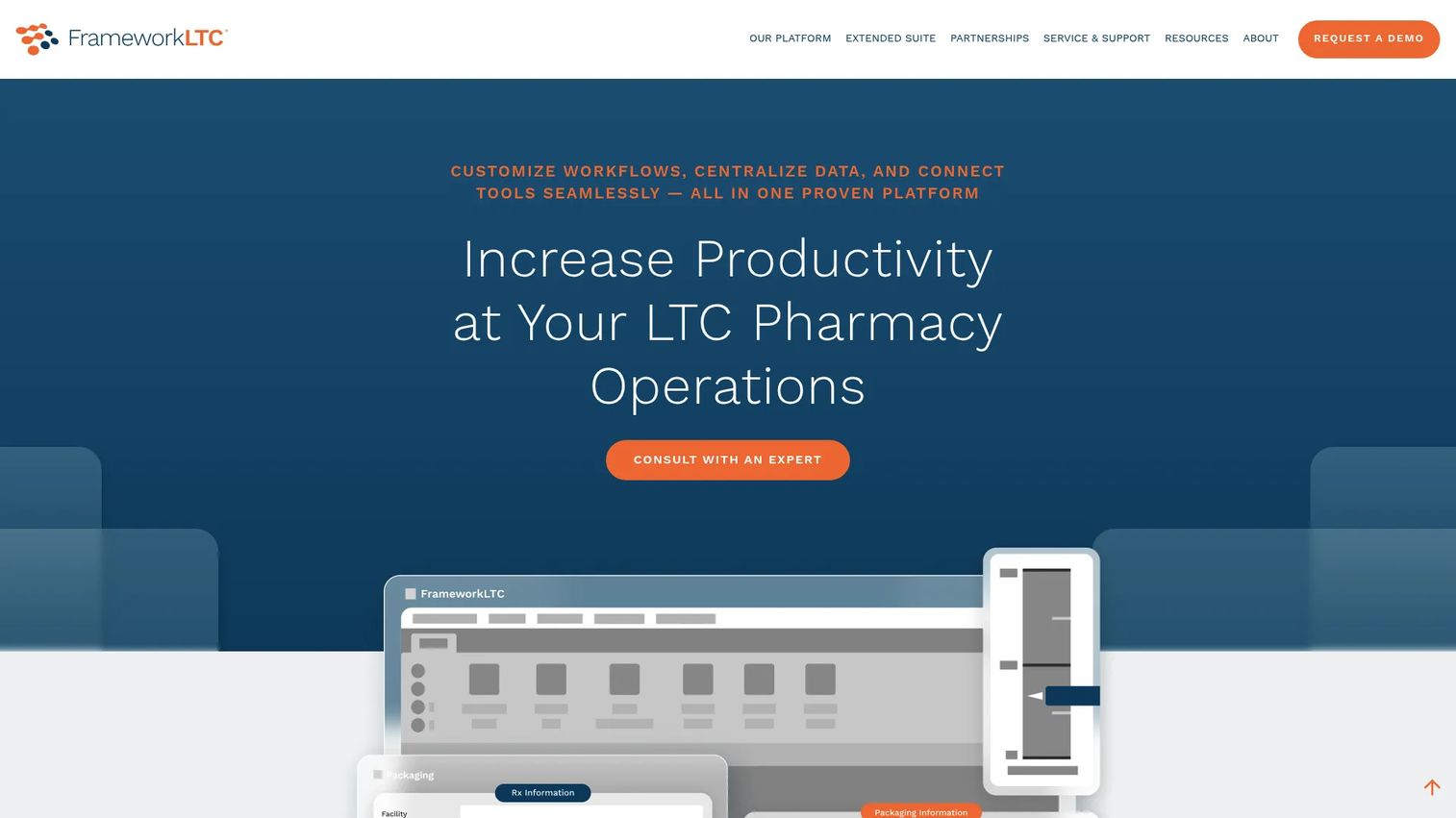
FrameworkLTC is a pharmacy management platform built specifically for long-term care pharmacy operations. It automates prescription dispensing, electronic prescribing, order processing, and refill workflows, with real-time monitoring of prescription tracking, delivery status, production, inventory, and billing.
The platform connects to robotic dispensing machines and eMARs, and uses AI-assisted order entry that reportedly auto-populates more than 80% of new orders.
Best for: Long-term care pharmacies serving facilities with recurring cycle-fill and medication distribution workflows.
Key features
- Automated prescription dispensing, electronic prescribing, and order processing
- AI-assisted order entry for new orders
- Real-time monitoring of production, inventory, and delivery status
- HIPAA-compliant document storage and real-time documentation
- Two-way connectivity with robotic dispensing machines and eMARs
Why choose FrameworkLTC: It is purpose-built for the LTC environment. Retail-first pharmacy tools do not account for cycle-fill scheduling, facility-based delivery, or the pace of recurring medication orders. FrameworkLTC does.
FrameworkLTC pricing: FrameworkLTC prices by quote, scoped after a demo or consultation. Cost depends on facility count, workflow modules, dispensing volume, integrations, and implementation. Schedule a demo through the FrameworkLTC site.
G2 rating: 4.4/5 (verified November 2026, G2)
12. SuiteRx
SuiteRx provides pharmacy management software and related applications for retail, long-term care, combination, specialty, and 340B pharmacies. The core platform covers document management, adherence reporting, inventory management, cycle fill, shipping integration, and custom design workflows.
The SRx+ product, powered by Knostos, is publicly priced as a one-time investment starting at $25,000, plus monthly SaaS fees structured per active patient. The core SRx platform pricing is not posted publicly.
Best for: Independent retail, long-term care, specialty, and 340B pharmacies that want modular pharmacy management with inventory capabilities.
Key features
- Inventory management and cycle fill management
- Document management and adherence reporting
- Shipping integration
- 340B pharmacy workflow support
- Custom design and specialty pharmacy capabilities
Why choose SuiteRx: A practical option for pharmacies that need both specialty and LTC capabilities in one platform. The SRx+ module gives smaller operations a lower starting-cost entry point before committing to the full platform.
SuiteRx pricing: SRx+ starts at a $25,000 one-time investment plus monthly Knostos SaaS fees per active patient. Core SRx pricing is available by quote. Contact SuiteRx for details on module selection and implementation costs.
G2 rating: 4.5/5 (verified November 2026, G2, based on 3 reviews)
Considerations when choosing pharmacy inventory management software
Match the software to your pharmacy model
Retail, hospital, health system, long-term care, and specialty pharmacies manage inventory differently. A retail-first tool rarely handles cycle-fill scheduling. A health-system warehouse platform may be overkill for a two-location independent. Start by mapping the decision to your pharmacy type before comparing features.
Check replenishment depth before you buy
Most vendors claim "inventory tracking." The real question is whether they support par levels, reorder points, purchase orders, preferred wholesaler routing, demand forecasting, and exception alerts. Ask vendors to show a full replenishment cycle during the demo, not just the dashboard.
Validate compliance and audit workflows
Lot tracking, expiration date management, audit logs, DSCSA traceability documentation, and 340B workflow support vary significantly across platforms. Software can support the documentation and traceability workflows your team needs. It does not remove your organization's compliance obligations, so confirm exactly what each platform tracks and what it does not.
Test reporting against finance and board questions
A finance leader or board member will ask about inventory turns, drug spend, expiration write-offs, stockouts, and working capital. Ask each vendor to run those specific reports live. If the answer requires manual spreadsheet assembly, the reporting depth may not be sufficient for the level of operational visibility you need.
Pressure-test implementation and adoption
Ask how long setup takes, which integrations require IT involvement, who owns data cleanup, and how pharmacy technicians will learn the new workflow. The best system in a vendor demo fails if the team keeps ordering outside the system because onboarding was never completed.
Conclusion
Pharmacy inventory software is not one size. The right choice depends on the pharmacy model, the scale of operations, and what the team currently does manually.
For pharmacies where inventory control is the bottleneck, SureCost Inventory Manager or Supplylogix add a dedicated layer without replacing an existing dispensing system. For health systems managing multi-site supply chains, Tecsys Elite or the McKesson Asset Management program addresses working capital, lot tracking, and audit readiness at enterprise scale. For independent retail pharmacies that want one system to handle everything, BestRx, Rx30, ComputerRx, and SuiteRx each combine dispensing and inventory without requiring a separate tool. For long-term care, FrameworkLTC is built for cycle-fill and facility-based distribution in a way that general-purpose platforms are not.
The next step: Shortlist three vendors by pharmacy type, then ask each to demonstrate the same four workflows during the demo, which are receiving a purchase order, identifying near-expiry stock, transferring inventory between locations, and running an inventory-turn report. How clean each answer is will tell you more than any feature comparison sheet.
You can also explore related operational software guides, including our roundups on asset inventory software and asset lifecycle management software, for adjacent infrastructure evaluation frameworks.
Start your journey with Guideflow today!
FAQs
Pharmacy inventory management software helps pharmacies track medication stock levels, automate replenishment, manage purchasing and receiving, monitor expiration dates, support lot traceability, and generate audit and reporting documentation. It can operate as a standalone system or as a module within a broader pharmacy management platform.
Pharmacy inventory software focuses on stock control, purchasing, replenishment, expiration tracking, and audit documentation. Pharmacy management software adds dispensing workflow, patient profiles, claims adjudication, point of sale, and e-prescribing to those inventory capabilities. Some organizations run both; others choose an all-in-one platform where inventory is one component of the full system.
Independent pharmacies most often compare all-in-one systems that handle dispensing and inventory together. BestRx, Rx30, ComputerRx, and SuiteRx each cover that combination. Pharmacies that already have a dispensing platform and need a dedicated inventory layer should evaluate SureCost Inventory Manager or Supplylogix.
Health systems should prioritize centralized inventory visibility, lot tracking, expiration management, DSCSA traceability documentation, 340B workflow support, and multi-location reporting. Tecsys Elite and the McKesson Asset Management program address those requirements. EnterpriseRx combined with the Supplylogix integration is another option for McKesson-aligned health system networks.
The primary mechanisms are expiration date tracking, FEFO workflow enforcement, near-expiry alerts, and transfer suggestions that move slow-moving stock to locations where it will be used before it expires. Demand forecasting reduces overbuying, and purchasing controls prevent reordering stock that is already overstocked.
Pharmacy inventory software can support the documentation, lot tracking, transaction data, and audit workflows that DSCSA compliance requires. It can record chain-of-custody data, generate audit logs, and store transaction documentation. Meeting DSCSA obligations remains the responsibility of the pharmacy organization. Software is a tool that supports those workflows, not a guarantee of compliance.
Most vendors in this category price by quote. Cost depends on pharmacy type, number of locations, modules selected, integrations required, and implementation scope. SuiteRx is the exception, with SRx+ starting at a $25,000 one-time investment. For all others, expect to request a tailored estimate based on your specific pharmacy configuration.
Ask each vendor to show the same four workflows: Receiving a purchase order from a wholesaler, locating near-expiry stock and identifying transfer or disposal options, moving inventory between pharmacy locations, and running an inventory-turn or drug-spend report without spreadsheet cleanup. The quality of each live answer will surface both the depth of the tool and how well it fits your actual operating model. Also ask who owns data migration, how long setup typically takes, and what adoption support looks like for pharmacy technicians after go-live.