A plant has hundreds of connected assets, a remote maintenance vendor, a network built over decades, and no reliable answer to one basic question: What is actually connected to the environment right now?
That question sits at the center of every OT security program. According to the SANS 2025 ICS/OT Cybersecurity report, 40% of reported ICS/OT incidents caused operational disruption, yet only 13% of organizations reported full visibility across the ICS Cyber Kill Chain. You cannot defend what you cannot see.
OT security decisions differ from standard IT security decisions because production uptime, physical safety, and protocol compatibility constrain what teams can deploy. A misconfigured scan can trip a PLC. A rushed agent deployment can disrupt a process that took years to tune. For PMs responsible for industrial products, connected-device platforms, or enterprise integrations, the selection choice is also an operating-model choice: Which tool gives security and operations the same picture, fits existing release cadence, and stays maintainable as the environment grows?
This guide cuts through the noise. It covers 10 OT security tools for 2026, explains the category, and gives you a structured way to evaluate before you commit to a vendor.
What's inside
This guide covers 10 OT security platforms built for industrial, ICS, SCADA, IIoT, and cyber-physical environments.
- Who this is for: Security and product leaders evaluating OT security solutions, including PMs who own security requirements for industrial or connected-device products.
- Selection criteria: Asset visibility depth, passive monitoring approach, threat detection capability, integration with existing security workflows, and deployment fit for industrial environments.
- Scope note: Pricing is quote-based for most platforms on this list. Verify current figures directly with each vendor before committing.
- Ratings: G2 ratings verified October 2026.
TL;DR
- Best for XIoT and cyber-physical visibility: Claroty covers industrial, healthcare, commercial, and public-sector environments with deep asset context and communication mapping.
- Best for OT network monitoring and threat intelligence: Dragos and Nozomi Networks both excel at protocol-aware detection across distributed industrial sites.
- Best for converged IT, OT, and IoT programs: Armis provides a unified exposure management view across all connected asset types, including medical devices.
- Best for segmentation-led programs: Fortinet and Palo Alto Networks are strong picks when network architecture and Zero Trust enforcement anchor the strategy.
- Best for vulnerability prioritization: Tenable OT Security is purpose-built for risk-based remediation planning across industrial assets.
- Pricing reality: Most platforms price by asset count, site, or enterprise scope. Contact each vendor for a current quote. Microsoft Defender for IoT is the one exception with published per-site licensing starting at $70/month (paid yearly) for up to 100 devices.
What are OT security tools?
OT security tools are platforms and controls that help organizations identify, monitor, protect, and respond to cyber risk across operational technology, including industrial control systems, SCADA environments, distributed control systems, and connected industrial devices.
Unlike IT security tools, which focus primarily on protecting data and user applications, OT platforms must also preserve availability, physical safety, and equipment integrity. Most industrial environments run legacy systems that were never designed for external network connectivity. Many cannot accept endpoint agents or tolerate active scanning. A single disruption to a control loop can cascade into a production outage or a safety event.
Core functions of OT security platforms
- Passive asset discovery software and industrial asset inventory
- Continuous network visibility across ICS and SCADA traffic
- Vulnerability and exposure assessment for OT devices
- Behavioral analytics, anomaly detection, and OT threat detection
- Network segmentation and microsegmentation support
- Identity controls and secure remote access for OT
- SIEM, SOAR, CMDB, and ticketing integrations
- Compliance evidence for IEC 62443, NIST, and NERC CIP programs
How OT security differs from IT security
Availability and safety routinely outweigh rapid patch cycles in industrial environments. A firmware update that IT would push overnight may require a planned maintenance window weeks in advance. Legacy systems often cannot run agents, and protocol-aware analysis matters because OT traffic looks nothing like web or email traffic. Security changes require coordination with engineering and plant operations before any change window opens.
OT security tools versus general network security tools
Firewalls, SIEM platforms, EDR products, and IAM tools remain part of the broader stack. OT security platforms add the industrial asset context, protocol visibility, risk prioritization, and operational workflows that general network tools were never built to provide. Think of them as the layer that translates raw industrial traffic into actionable security data.
OT security is a program, not a single product.
When to use OT security tools
Build a reliable industrial asset inventory
Most OT security programs start here, because every downstream capability depends on knowing what exists. If your CMDB is incomplete, your controllers are undocumented, or your network has grown over decades without a consistent audit, asset inventory software designed for industrial environments will surface devices that spreadsheets and manual walks miss. Inventory is the prerequisite for segmentation, vulnerability prioritization, and meaningful risk reporting.
Detect abnormal communications before they disrupt operations
Behavior baselining and industrial protocol analysis let teams identify unusual connections, lateral movement, and changes in controller behavior before they escalate. For PMs managing products with OT integrations, this is where instrumentation pays off: Continuous OT security monitoring gives security and operations a shared picture of what is happening in the environment, not just what happened after an incident.
Secure remote access and IT/OT convergence
Third-party maintenance vendors, remote operations, and IIoT expansion create access paths that traditional perimeter controls were not designed to manage. Secure remote access for OT requires identity integration, session monitoring, and network segmentation mapped to the actual industrial process. As cloud-connected assets multiply, access control software decisions made early in the product lifecycle become much harder to retrofit later.
OT security tools comparison
No platform wins every environment. Selection depends on industrial protocols, network architecture, existing security stack, required deployment model, regulatory context, and internal operational ownership.
The table below is ordered by broad category fit, not a single universal score. Pricing reflects the current commercial model for each vendor. Ratings are from G2, verified October 2026.
| # | Product | Best for | Key differentiator | Pricing | G2 rating |
|---|---|---|---|---|---|
| 1 | Claroty | XIoT visibility across industrial, healthcare, and commercial environments | Deep asset context and communication mapping | Pricing by quote | 4.7/5 |
| 2 | Nozomi Networks | OT network monitoring across distributed industrial sites | Protocol-aware monitoring with AI-powered analysis | Pricing by quote | 5.0/5 |
| 3 | Dragos | Critical infrastructure threat detection and incident readiness | OT-specific threat intelligence and expert response playbooks | Pricing by quote | 3.8/5 |
| 4 | Armis | Converged IT, OT, IoT, and medical device risk management | Agentless exposure management across 200+ integrations | Pricing by quote | 4.4/5 |
| 5 | Forescout | Device intelligence and policy enforcement across IT and OT | Agentless discovery with automated remediation workflows | Pricing by quote | 4.5/5 |
| 6 | Fortinet | Segmentation-led OT programs on existing Fortinet infrastructure | Security Fabric integrations with industrial NGFW | Pricing by quote | 4.4/5 |
| 7 | Tenable OT Security | OT vulnerability management and exposure prioritization | Risk-based vulnerability prioritization score (VPR) | Pricing by quote | 4.1/5 |
| 8 | Microsoft Defender for IoT | Microsoft-centered security operations teams | OT site licenses starting at $70/month (up to 100 devices) | From $70/month (annual) | 4.3/5 |
| 9 | Palo Alto Networks | Zero Trust and NGFW architecture extended into OT | Cloud NGFW with pay-as-you-go licensing from $1.50/hr | From $1.50/hr (Cloud NGFW) | 4.4/5 |
| 10 | Honeywell Cyber Insights | Honeywell-heavy industrial environments | Experion PKS-certified integration and OT-native risk context | Pricing by quote | 5.0/5 |
Best 10 OT security tools for industrial environments
The shortlist below is ordered by broad category fit, not a single universal score.
1. Claroty
Claroty is an XIoT security platform covering industrial, healthcare, commercial, and public-sector environments. The platform focuses on passive discovery, asset inventory, exposure management, industrial protocol visibility, and secure access, giving security teams a detailed map of what is connected and how assets communicate before any segmentation or risk program begins.
Best for: Organizations that need detailed asset and communication visibility across complex industrial networks spanning multiple device types and sectors.
Key features
- Passive XIoT asset discovery across OT, IoT, and IoMT
- Industrial protocol visibility and communication mapping
- Exposure and risk management across cyber-physical systems
- Secure remote access controls integrated with asset context
- Network protection and segmentation support
Why choose Claroty: Claroty is a strong fit for teams that need an OT-focused view of assets, dependencies, and communications before rolling out segmentation or compliance programs. PMs should validate protocol coverage against their specific controllers, PLCs, SCADA stack, and plant network design during a proof of value.
Claroty pricing: Claroty does not display pricing on its website. Contact Claroty directly for a quote; commercial terms typically reflect asset count, site scope, and module selection.
G2 rating: 4.7/5
2. Nozomi Networks
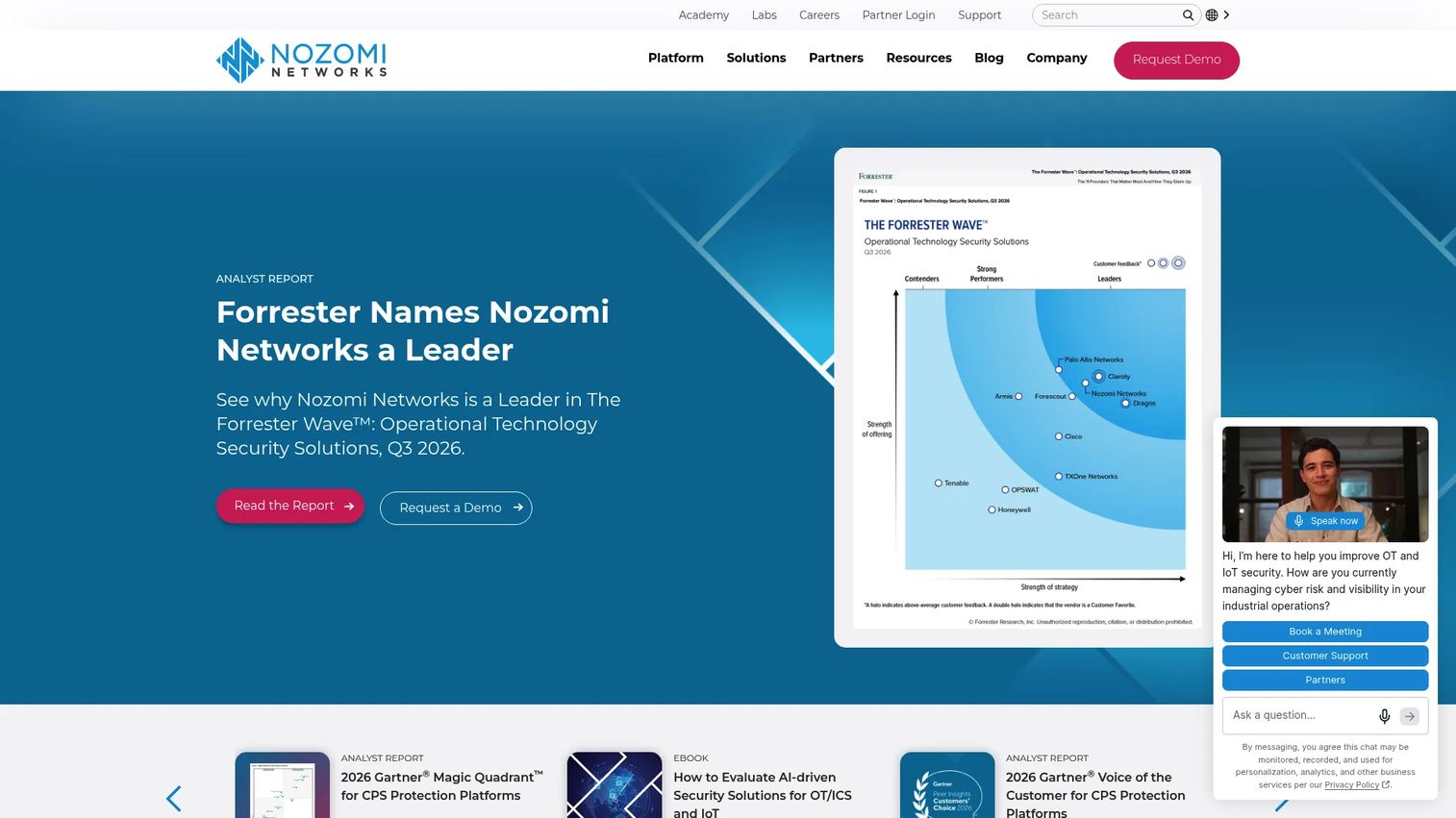
Nozomi Networks provides OT and IoT cybersecurity for critical infrastructure, combining real-time asset visibility, threat detection, and AI-powered analysis. The platform is built for organizations that need continuous OT security monitoring across large or distributed industrial sites where manual tracking would be unmanageable.
Best for: Security and operations teams at large enterprises or critical-infrastructure operators that need protocol-aware OT monitoring at scale.
Key features
- Real-time OT, IoT, and IT asset visibility
- Behavioral anomaly detection and OT threat detection
- AI-powered incident response and analysis
- Vulnerability and exposure management workflows
- Risk scoring, dashboards, and compliance reporting
Why choose Nozomi Networks: Continuous monitoring and asset context are where this platform earns its keep. For PM readers, Nozomi turns a growing device footprint into a prioritized engineering and security backlog rather than an unmanageable inventory spreadsheet. It carries the highest G2 rating in this list, though from a small reviewer base.
Nozomi Networks pricing: Nozomi does not display pricing on its website. Contact the sales team for current quote terms; pricing reflects deployment scale and site architecture.
G2 rating: 5.0/5
3. Dragos
Dragos is an OT cybersecurity platform focused on industrial threat detection, xOT asset visibility, and incident readiness. It is frequently evaluated by critical infrastructure operators that need more than generic security alerts, specifically OT-context threat intelligence tied to known adversary groups and industrial attack patterns.
Best for: Critical infrastructure teams in energy, manufacturing, or utilities that need OT-specific threat intelligence and structured incident response support.
Key features
- xOT asset visibility and industrial inventory
- OT network monitoring and threat detection
- Risk-based vulnerability management
- Threat intelligence and expert response playbooks
- Automated device remediation for credentials, firmware, and configurations
Why choose Dragos: Dragos is the right pick when teams need context alongside alerts. OT threat intelligence distinguishes active adversary behavior from generic IT security feeds, which matters when the response decision affects a live industrial process. Coordinate proof-of-value testing with your engineering and operations stakeholders before committing.
Dragos pricing: Dragos does not display pricing on its website. Reach out to the Dragos sales team for enterprise packaging and platform scope details.
G2 rating: 3.8/5
4. Armis
Armis Centrix is a cloud-based cyber exposure management platform that provides real-time visibility, risk assessment, and automated workflows across IT, OT, IoT, and medical device environments. With over 200 pre-built integrations, it connects asset intelligence into the security and IT tools teams already use.
Best for: Enterprises where IT, OT, IoT, and unmanaged assets need to be prioritized through a common risk model rather than separate siloed programs.
Key features
- Agentless discovery across managed, unmanaged, IT, OT, and medical devices
- Automated risk scoring and vulnerability detection
- Dynamic network segmentation and automated remediation workflows
- AI-driven asset intelligence and behavioral anomaly detection
- 200+ pre-built integrations with security and IT platforms
Why choose Armis: Armis fits organizations with fragmented asset ownership across security, product, infrastructure, and operations teams. A shared risk view across all device types reduces the coordination overhead that slows remediation decisions. PMs building products that span IT and OT boundaries will find the convergence framing maps directly to how enterprise buyers evaluate deployment risk.
Armis pricing: Armis does not post pricing on its site. Request a quote; commercial terms typically reflect asset count and module scope.
G2 rating: 4.4/5
5. Forescout
Forescout provides cyber asset intelligence with agentless real-time device discovery, policy-based access control, network segmentation, and security orchestration across IT, IoT, IoMT, and OT environments. Its strength is connecting visibility to enforcement and integrating with the SIEM, ITSM, and CMDB tools that security operations teams already run.
Best for: Large organizations that need broad device visibility connected to automated enforcement across enterprise, IoT, and OT environments.
Key features
- Agentless real-time asset discovery and classification
- Policy-based access control and compliance enforcement
- Network segmentation with traffic visualization
- Risk and exposure analysis across device categories
- SIEM and ITSM integrations for security operations workflows
Why choose Forescout: Forescout's value is in turning visibility into action. Integrations with security operations and service-management workflows reduce handoff friction between OT teams and central security teams, which is one of the biggest friction points in cross-functional OT programs. Assess integration depth against your current SIEM and ticketing stack during evaluation.
Forescout pricing: Forescout does not display pricing on its website. Contact Forescout for a current quote based on your environment scope and required modules.
G2 rating: 4.5/5
6. Fortinet
Fortinet is a broad cybersecurity vendor delivering OT security through its Security Fabric, including industrial next-generation firewalls, centralized policy management, network segmentation, and secure remote access. It is most compelling for teams already running Fortinet network infrastructure who want to extend enforcement into OT environments without managing a separate vendor stack.
Best for: Organizations that already rely on Fortinet network security and want to extend segmentation and security operations into industrial sites through their existing architecture.
Key features
- Industrial next-generation firewalls with SD-WAN and ZTNA
- OT network segmentation and policy enforcement
- Centralized management through FortiOS and FortiManager
- AI-powered threat protection and detection
- Secure remote access support integrated with Security Fabric
Why choose Fortinet: Fortinet is strongest when network architecture and enforcement anchor the OT security program. Teams should still validate asset visibility and industrial protocol context, either through Fortinet capabilities or validated integrations, because network enforcement without asset inventory leaves gaps in risk prioritization.
Fortinet pricing: Fortinet directs customers to request a customized quote. Total cost for OT deployments typically includes hardware, software licenses, and support. Contact Fortinet sales for current terms.
G2 rating: 4.4/5
7. Tenable OT Security
Tenable OT Security is an OT and industrial control systems security platform providing asset visibility, risk-based vulnerability management, threat detection, and configuration-change monitoring. Its Vulnerability Priority Rating (VPR) helps teams distinguish which findings actually need immediate attention versus which can wait for a planned maintenance window.
Best for: Teams that need to prioritize OT vulnerabilities and exposure without treating every alert as equally urgent.
Key features
- OT, IT, and IoT asset inventory and visibility
- Risk-based vulnerability management with VPR scoring
- Configuration-change monitoring and control
- Threat detection using policy, behavioral, and signature-based methods
- Compliance mapping and reporting for IEC 62443 and NIST frameworks
Why choose Tenable OT Security: This platform fits organizations where vulnerability and exposure management is the immediate program gap. Before deployment, PMs should define remediation ownership explicitly, especially for legacy systems that cannot be patched quickly. A finding without a clear owner and a realistic remediation path becomes a backlog item rather than a closed risk.
Tenable OT Security pricing: Tenable directs prospects to request a demo for pricing details. Contact Tenable sales for current packaging and quote terms.
G2 rating: 4.1/5
8. Microsoft Defender for IoT
Microsoft Defender for IoT is a security product for IoT and OT environments that integrates with Microsoft Sentinel and other Microsoft security operations workflows. It uses agentless network-layer monitoring and sensor-based device discovery, making it a natural extension for teams already standardized on the Microsoft security stack.
Best for: Microsoft-centered security teams that want OT and IoT monitoring connected to their existing security operations infrastructure without adding a separate platform.
Key features
- Agentless network-layer monitoring and device discovery
- Vulnerability assessment with risk prioritization and remediation recommendations
- Threat detection with incident investigation workflows
- Microsoft Sentinel and SOC tool integrations
- Site-based OT licensing by monitored device count
Why choose Microsoft Defender for IoT: Workflow fit is the primary argument here. If your SOC already runs on Microsoft security tools, adding Defender for IoT avoids a separate investigation console. Validate industrial protocol support, sensor placement requirements, and OT-specific detection depth against your environment before standardizing.
Microsoft Defender for IoT pricing: Site-based OT licenses are $70/month (XS, up to 100 devices), $150/month (S, up to 250 devices), $250/month (M, up to 500 devices), $400/month (L, up to 1,000 devices), and $1,500/month (XL, up to 5,000 devices), all billed annually. Sites exceeding 5,000 devices require contacting Microsoft Sales.
G2 rating: 4.3/5
9. Palo Alto Networks
Palo Alto Networks provides enterprise cybersecurity spanning network security, security operations, cloud security, and identity. For OT environments, the platform is relevant through its next-generation firewalls, Zero Trust architecture support, and SOC integrations. Cloud NGFW is available with publicly displayed pay-as-you-go pricing, which makes it one of the more accessible entry points among enterprise security vendors.
Best for: Enterprise network security teams extending an established Zero Trust and NGFW architecture into industrial sites as part of a broader SOC program.
Key features
- AI-powered next-generation firewalls and network segmentation
- Zero Trust architecture and ZTNA support
- Threat prevention policies and network security controls
- Cloud security and secure access service edge (SASE)
- Security operations integrations for detection and response
Why choose Palo Alto Networks: Palo Alto fits when OT security is being built into a larger network and SOC architecture rather than deployed as a standalone industrial program. Validate how industrial asset discovery software and protocol-specific monitoring will be handled, since OT-specific detection depth may require additional integrations or companion tools.
Palo Alto Networks pricing: Cloud NGFW starts at $1.50/hr (Base/Standard) and $3.00/hr (Premium) on a pay-as-you-go basis. Broader Palo Alto Networks products require contacting sales for current terms.
G2 rating: 4.4/5
10. Honeywell Cyber Insights

Honeywell Cyber Insights is an OT cybersecurity platform that provides automated asset discovery, near-real-time threat detection, vulnerability management, and actionable risk insights across industrial OT systems. It carries Experion PKS-certified integration and connects with the Honeywell Cyber Watch service for ongoing monitoring support.
Best for: Industrial organizations running Honeywell environments or teams that need an OT security platform with deep operational process context and native vendor ecosystem alignment.
Key features
- Automated asset discovery and inventory for OT and IoT devices
- Near-real-time threat detection, anomaly identification, and vulnerability alerts
- OT network visibility covering communication patterns and attack vectors
- Vendor-agnostic integration alongside Honeywell Experion PKS certification
- Compliance support and Honeywell Cyber Watch integration
Why choose Honeywell Cyber Insights: The platform is well suited for teams seeking industrial-domain alignment alongside cybersecurity visibility, particularly in Honeywell-heavy environments. Avoid assuming it replaces dedicated OT detection, segmentation, or vulnerability platforms for heterogeneous environments. Contact Honeywell to confirm coverage against your specific controllers and third-party assets.
Honeywell Cyber Insights pricing: Honeywell does not display pricing on its website. The solution includes subscription software, one-time deployment services, and technical support. Contact Honeywell experts for current commercial terms.
G2 rating: 5.0/5
Considerations when choosing OT security tools
Start with asset visibility, not a feature checklist
Before evaluating detection or segmentation capabilities, confirm whether the platform can passively discover your PLCs, HMIs, engineering workstations, remote access paths, and connected devices. The question to ask: Does the platform provide the asset context your operations team would recognize and trust? A list of IP addresses is not an asset inventory. Industrial-aware discovery maps device types, protocols, and communication patterns.
Validate industrial protocol and legacy-system coverage
Generic protocol lists are not sufficient evidence of fit. Run a proof-of-value test against your actual environment, covering the specific controllers, SCADA components, industrial Ethernet protocols, serial gateways, and engineering workflows your team operates. Protocol support that works in a reference architecture may not work against a 15-year-old DCS running proprietary fieldbus communications.
Evaluate deployment impact on uptime and change management
Passive monitoring, sensor placement, data retention, and network architecture choices all affect operational risk during deployment. For PM teams, this maps directly to release schedules and cross-functional signoff requirements. Understand who owns the sensor infrastructure, who approves network changes, and what maintenance windows are required before deployment begins.
Connect alerts to the systems teams already use
An alert without an owner, asset context, and a response workflow becomes backlog noise. Assess how the platform integrates with your SIEM, ITSM, CMDB, and ticketing tools. The goal is that a finding in the OT security platform creates an actionable work item in the system the responsible team already monitors.
Treat compliance mapping as evidence support, not an outcome
OT security platforms can help document assets, controls, risks, and remediation status. They support IEC 62443, NIST Cybersecurity Framework, and NERC CIP programs by making evidence collection more tractable. They do not independently make an organization compliant. Map the tool's outputs to your own control framework and governance process, and involve your compliance and legal teams in that mapping.
Conclusion
OT security is a program built in stages. Most teams start with inventory, because segmentation, detection, and response all depend on knowing what exists and how it communicates.
For deep XIoT and industrial visibility, Claroty and Nozomi Networks are the strongest starting points. Dragos is the right pick when industrial threat intelligence and incident response maturity are the program's primary gap. Armis handles converged environments where IT, OT, IoT, and medical devices need a shared risk model. Forescout connects visibility to enforcement through SIEM and ITSM integrations. Fortinet and Palo Alto Networks are best when network architecture and Zero Trust segmentation lead the strategy. Tenable OT Security is purpose-built for vulnerability and exposure prioritization. Microsoft Defender for IoT fits Microsoft-centered SOC teams, and Honeywell Cyber Insights serves industrial environments with deep Honeywell ecosystem alignment.
Start with a 30-day evaluation plan. Define the industrial assets, protocols, sites, integrations, and response workflows that matter most. Then test whether the platform gives security and operations the same answer about what is happening in the environment.
For teams also evaluating AI cybersecurity solutions or AI security posture management tools to complement an OT program, those guides cover the adjacent IT security categories in the same format.
FAQs
OT security tools are platforms and controls that protect operational technology environments, including industrial control systems, SCADA deployments, distributed control systems, and connected industrial devices. They typically provide asset visibility, continuous network monitoring, anomaly detection, exposure management, and integrations with security operations workflows. The category is distinct from IT security tools because OT environments prioritize availability and physical safety alongside data protection.
IT security focuses primarily on protecting data, user applications, and enterprise networks. OT security must also protect availability, physical processes, equipment safety, and production continuity. Many OT devices run legacy firmware, cannot accept endpoint agents, and cannot be patched on a standard IT cycle. Security changes in OT environments require coordination with engineering and plant operations, and a misconfigured scan can disrupt a live industrial process in ways that a misconfigured IT scan typically cannot.
Core capabilities to evaluate include passive asset discovery, industrial protocol support, continuous network monitoring, behavioral anomaly detection, vulnerability and exposure management, network segmentation support, secure remote access controls, and integrations with SIEM or ITSM tools. Feature priority depends on the environment's largest current gap. A team with no reliable asset inventory should start there before evaluating detection or segmentation capabilities.
Yes, the platforms on this list are designed for ICS and SCADA environments. Verify support for your specific protocols, controllers, vendor equipment, network topology, and remote-access workflows during a proof-of-value test. Protocol coverage that works in a lab or reference architecture may behave differently against your actual environment, particularly with legacy serial or proprietary fieldbus protocols.
They can support asset inventory, monitoring, risk assessment, evidence collection, and control tracking relevant to these frameworks. Several platforms on this list include compliance mapping and reporting features. They do not independently satisfy any regulatory requirement. Teams should map the tool's outputs to their own governance process and involve legal and compliance stakeholders in that work.
Passive monitoring observes network traffic without sending probes or active queries to devices. It is the standard approach in industrial environments because active scanning can disrupt sensitive legacy devices, trigger false alarms in control systems, or interfere with time-critical process communications. Deployment design still matters: Sensor placement, data collection scope, and network tap architecture all affect what the platform can see and how accurately it can build an asset inventory.
They can identify remote connections, apply identity-based access controls, monitor active sessions, integrate with IAM systems, and segment vendor access from core process networks. Effective secure remote access for OT also requires multifactor authentication, role-based access policies, session recording, and approval workflows. Assess whether the platform you evaluate handles all of these or requires a companion access management tool for complete coverage.
Run a structured proof of value with a defined site or asset group. Agree on success criteria for inventory completeness and detection accuracy before the test starts. Test integrations against your actual SIEM, ITSM, and identity tools. Identify who will own alerts, remediation workflows, and sensor maintenance before deployment. Document the deployment impact on network architecture and change management. Avoid judging a platform on dashboard design or a scripted demo; evaluate it against your specific environment, protocols, and operational constraints.