Oil and gas assets don't fail on schedule. A compressor trips, a pipeline inspection slips its window, a spare part is missing from the right warehouse at the wrong moment. The cost isn't just a repair ticket. It hits production continuity, field crew productivity, safety exposure, and the board's confidence in your operational metrics.
The market reflects how seriously operators take this. According to Fortune Business Insights (2025), the global asset integrity management market is valued at $25.28 billion, with oil and gas accounting for more than 25% of that spending. More than 50% of oil and gas companies plan to invest in asset performance management software within 12 to 18 months, per IDC Industry Insights (2025). The pressure to replace fragmented spreadsheets and legacy CMMS setups with platforms that connect maintenance, compliance, and finance is real.
Choosing the wrong platform costs more than the license fee. It costs the implementation time, the data migration, and the six months of adoption your field crews spend working around a tool that doesn't fit their workflow.
What's inside
This guide compares 7 oil and gas asset management software platforms for 2026. It's written for operations leaders, maintenance and reliability managers, CIOs, and executives accountable for asset-heavy software investments who want a credible shortlist, not a vendor pitch.
Tools were selected based on:
- Oil and gas fit: Relevance to upstream, midstream, and downstream operations
- Asset lifecycle coverage: From acquisition and deployment through inspection, repair, and decommissioning
- Maintenance depth: Preventive, predictive, condition-based, and risk-based inspection support
- Integration capability: ERP, SCADA, IoT, field operations, and finance
- Buyer relevance: Deployment model, pricing transparency, and implementation reality
TL;DR
- Best for enterprise oil and gas EAM: IBM Maximo Application Suite, for operators with complex asset hierarchies and the internal capacity to run a large enterprise deployment
- Best for asset-intensive operations planning: IFS Cloud, for organizations needing EAM, service management, and ERP in one environment
- Best for oil and gas back office plus operations: W Energy Stream+, for upstream and midstream companies that need financial workflows connected to field operations
- Best for maintenance teams that need fast CMMS adoption: Limble CMMS, for maintenance crews that need preventive maintenance and work-order management without a full EAM implementation
- Best for predictive asset performance: SAP Asset Performance Management, for reliability teams already running SAP who need failure prediction and risk-based maintenance
- Best for enterprise EAM modernization: Infor EAM or Hexagon HxGN EAM, for asset-intensive organizations replacing older EAM systems
What is oil and gas asset management software?
Oil and gas asset management software helps energy companies track, maintain, optimize, and govern assets across their lifecycle, from acquisition and deployment through inspection, repair, compliance, and decommissioning.
The category covers physical assets (rigs, wells, pipelines, pumps, compressors, fleets, plants, and storage facilities), the digital records that describe them, and the human workflows that keep them running. Strong platforms connect operations, engineering, maintenance, finance, and IT rather than siloing each function.
Core capabilities the category covers:
- Asset registry and hierarchy management
- Preventive maintenance scheduling
- Predictive and condition-based maintenance
- Work-order management and labor scheduling
- Asset performance monitoring and health scoring
- Risk-based inspection planning
- Inventory and spare-parts management
- HSE, emissions, and compliance records
- Mobile field execution with offline support
- ERP, SCADA, IoT, and finance integrations
- Reporting, dashboards, KPIs, and audit trails
The category is broader than maintenance. The best platforms also support asset lifecycle management from capital planning through decommissioning, connect to production accounting and revenue accounting systems, and surface intent signals that help finance and operations teams make faster capital allocation decisions.
AI and analytics features in this space are worth evaluating only when they solve a specific job: Failure prediction on a class of rotating equipment, maintenance task prioritization by criticality, or anomaly detection from sensor data. Generic "AI-powered" positioning without a named use case is a signal to ask more questions before buying.
When to use oil and gas asset management software
Reduce unplanned downtime across critical assets
When pumps, compressors, pipelines, wells, or processing equipment are failing without warning, it's time to move beyond reactive maintenance. Platforms with preventive scheduling and predictive capabilities create maintenance plans tied to operating hours, sensor readings, or condition thresholds. Production continuity depends on knowing which assets are at risk before they trip.
Connect field operations with finance and compliance
Field maintenance records sitting in one system, AFE tracking in a spreadsheet, and production accounting in an ERP creates a reporting lag that costs real money. Oil and gas asset management platforms built for this integration eliminate the manual reconciliation. Companies evaluating W Energy Stream+ often cite this connection as the primary driver.
Standardize inspections, safety, and environmental reporting
Regulatory inspections, safety audits, and emissions reporting require documented, repeatable workflows. When your team is manually compiling inspection records or building compliance evidence from scattered sources, asset tracking software with built-in HSE modules and audit trails removes that risk. Risk-based inspection planning lets you prioritize the highest-consequence assets first.
Oil and gas asset management software comparison
The table below covers all 7 platforms with verified pricing context and current G2 ratings. Enterprise EAM platforms in this category are almost universally quote-based. Pricing varies by deployment model, module selection, user count, and implementation scope.
| # | Product | Best for | Key differentiator | Pricing | G2 rating |
|---|---|---|---|---|---|
| 1 | IBM Maximo Application Suite | Enterprise EAM at scale | AI-driven asset health and lifecycle management | Custom pricing | N/A |
| 2 | IFS Cloud | Asset-intensive enterprise operations | EAM, ERP, and field service in one platform | Custom pricing | 4.0/5 |
| 3 | W Energy Stream+ | Upstream and midstream oil and gas | Integrated back-office and field operations for energy | Custom pricing | N/A |
| 4 | Limble CMMS | Maintenance execution and adoption speed | Preventive maintenance with fast team adoption | Custom pricing | 4.8/5 |
| 5 | SAP Asset Performance Management | Reliability and predictive maintenance | Risk-based, IoT-connected asset health in SAP environments | Custom pricing | 4.4/5 |
| 6 | Infor EAM | Enterprise asset maintenance modernization | Established EAM for asset-intensive industries | Custom pricing | N/A |
| 7 | Hexagon HxGN EAM | Complex industrial asset management | Digital twin and 3D CAD integration with EAM | Custom pricing | N/A |
Best 7 oil and gas asset management software for 2026
1. IBM Maximo Application Suite
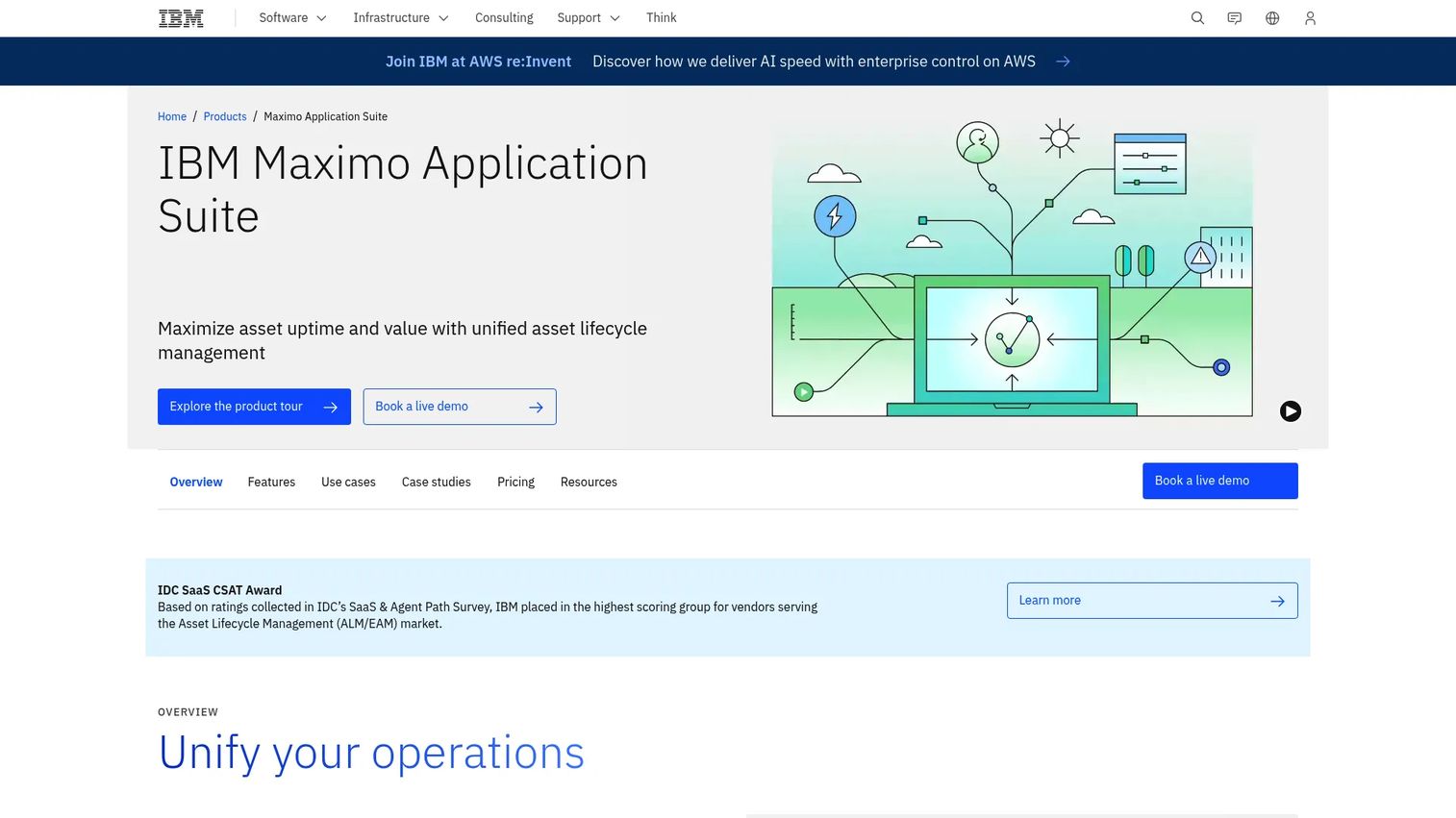
IBM Maximo Application Suite is a unified enterprise asset management platform covering maintenance, inspections, reliability, and asset lifecycle management. It runs as SaaS or client-managed software using AppPoints-based licensing across Essentials, Standard, and Premium editions. Oil and gas operators use it to manage asset hierarchies spanning rigs, pipelines, processing plants, fleets, and storage facilities, connecting those assets to work orders, inventory, and safety workflows.
Best for: Large oil and gas operators needing enterprise asset lifecycle management across complex asset hierarchies.
Key features
- Enterprise asset management and work-order management
- AI-driven asset health monitoring and reliability insights
- Mobile EAM with online and offline field access
- Preventive and predictive maintenance scheduling
- HSE workflow support and audit trail management
Why choose IBM Maximo: Maximo earns its place in large-scale operations where asset hierarchy complexity, reliability requirements, and governance depth exceed what mid-market CMMS tools can handle. The trade-off is implementation weight: Teams without dedicated EAM resources will feel the overhead.
IBM Maximo Application Suite pricing: IBM prices Maximo by quote, with Essentials, Standard, and Premium SaaS tiers. Pricing reflects deployment model, AppPoints allocation, module selection, and implementation support requirements.
G2 rating: No current G2 rating is available for this product at the time of writing.
2. IFS Cloud

IFS Cloud is a composable enterprise platform unifying ERP, enterprise asset management, field service management, and supply chain management with embedded Industrial AI. For oil and gas operations, the platform covers asset lifecycle planning, workforce coordination, maintenance execution, and connected field operations. IFS serves asset-intensive industries including energy, utilities, aerospace, and manufacturing.
Best for: Asset-intensive companies that need EAM, service management, and operational planning in one enterprise environment.
Key features
- Enterprise asset management with lifecycle planning
- Field service management and workforce coordination
- Embedded Industrial AI for predictive maintenance
- ERP and supply chain management integration
- Responsive mobile interfaces for field crews
Why choose IFS Cloud: IFS Cloud fits organizations where asset management, service operations, and financial systems need to run from a single source of truth rather than being integrated post-hoc. Buyers should validate implementation scope, partner support options, and integration requirements against their existing stack before committing.
IFS Cloud pricing: IFS does not display pricing on its website. Reach out to their sales team for a quote. Pricing reflects the module combination, user count, deployment model, and implementation support.
G2 rating: 4.0/5
3. W Energy Stream+
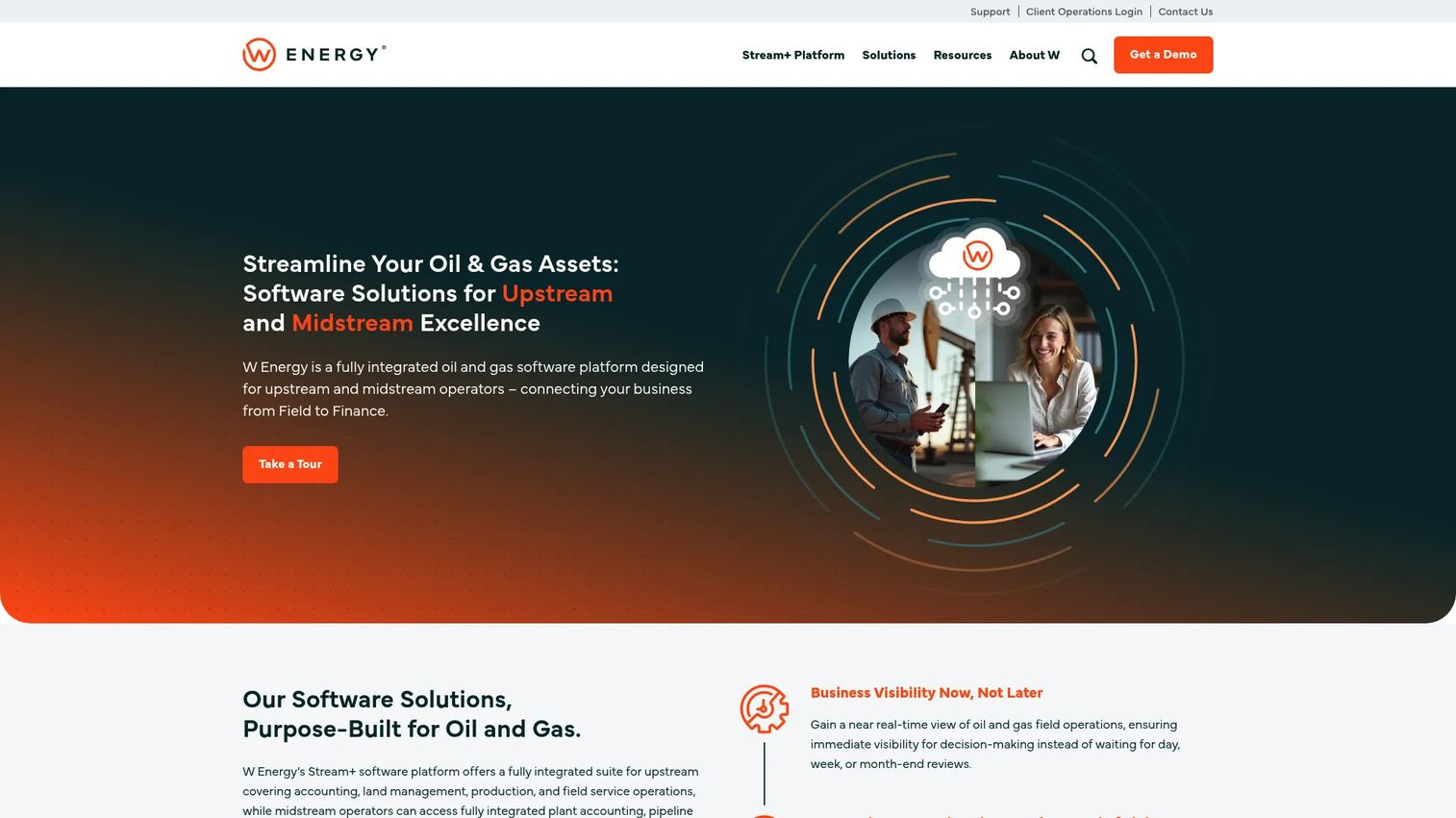
W Energy Stream+ is a cloud-based platform built specifically for upstream and midstream oil and gas operations. It integrates accounting, land management, production reporting, and field service into one system, covering plant accounting and pipeline accounting for midstream operators. The platform includes an embedded DataView business intelligence layer for real-time reporting across operational and financial data.
Best for: Upstream and midstream oil and gas companies that need asset management connected to AFE tracking, production accounting, revenue accounting, and land administration.
Key features
- Integrated accounting and land management for oil and gas
- Production accounting and revenue accounting workflows
- Plant and pipeline accounting for midstream operations
- Field service and operations management
- Embedded DataView analytics for real-time reporting
Why choose W Energy Stream+: W Energy's strength is oil and gas specificity. If your primary bottleneck is getting field data, maintenance records, and financial workflows into one system built for the energy sector, Stream+ addresses that directly. Buyers whose main requirement is deep predictive maintenance or complex enterprise asset hierarchies should verify that asset maintenance depth covers their specific use case.
W Energy Stream+ pricing: W Energy prices by quote and describes pricing as predictable. Contact their team for a figure based on your module requirements and user count.
4. Limble CMMS
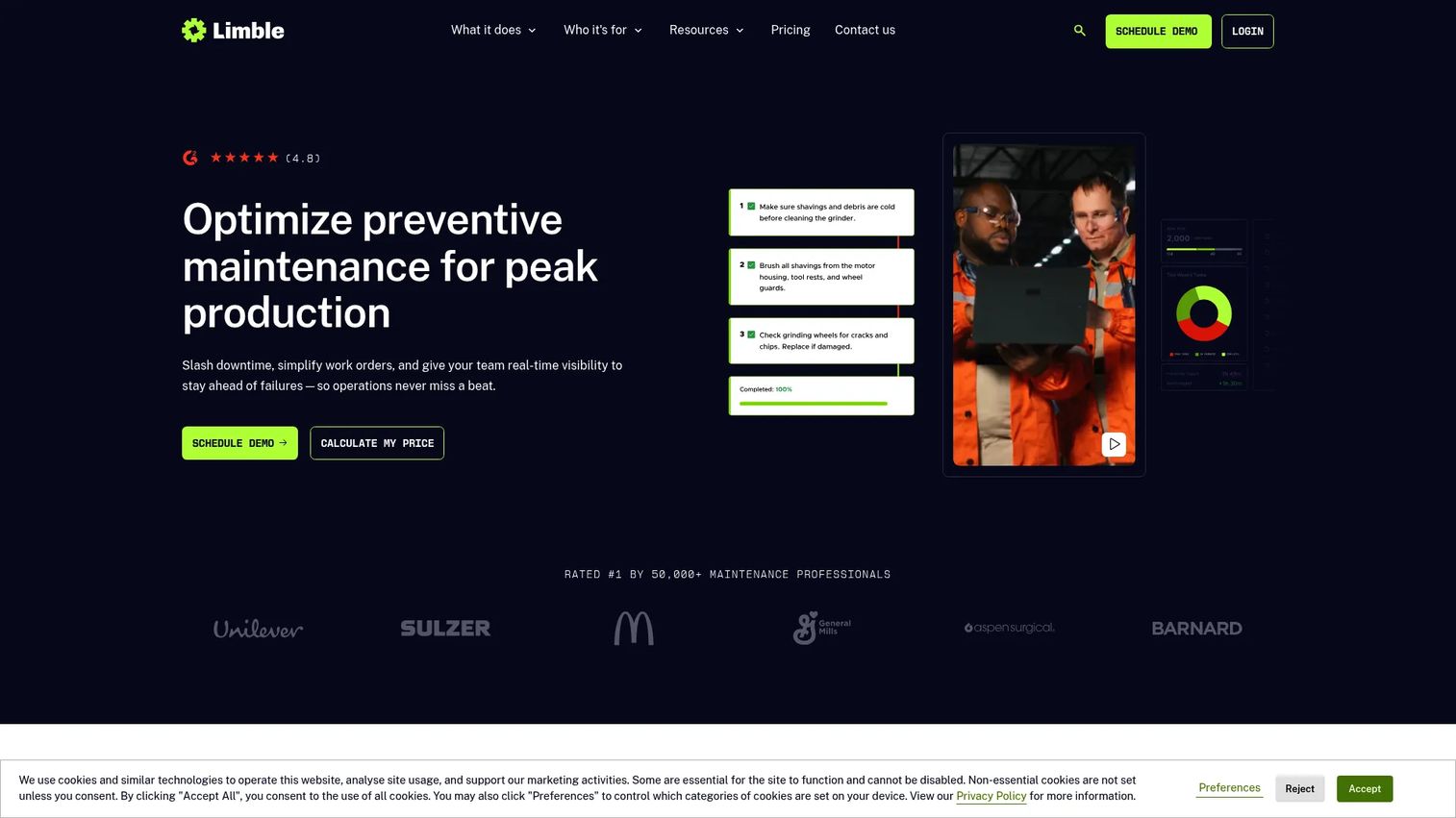
Limble CMMS is a cloud-based computerized maintenance management system designed for maintenance teams that need preventive maintenance automation, work-order management, asset inventory software integration, and maintenance reporting without the overhead of a full enterprise EAM implementation. In oil and gas contexts, Limble covers asset tracking using QR codes and barcodes, mobile work orders for field crews, and maintenance histories by asset.
Best for: Maintenance teams that need preventive maintenance, work-order management, and asset tracking with faster adoption than a large EAM platform requires.
Key features
- Preventive maintenance scheduling by time, usage, or condition
- Work-order management with checklists, photos, and required steps
- Asset management with custom hierarchies and QR-code access
- Mobile maintenance with online and offline capability (Premium+ and above)
- Maintenance reporting and downtime tracking
Why choose Limble CMMS: Limble earns its place when the immediate bottleneck is maintenance visibility and adoption speed. If your field crews are working from spreadsheets or paper work orders, Limble delivers a fast first win. For organizations that need to connect maintenance data to AFE management, production accounting, or enterprise-level asset performance analytics, a larger EAM platform will eventually be necessary.
Limble CMMS pricing: Limble offers Standard, Premium+, and Enterprise plans, all custom-priced. Standard covers mobile access, unlimited assets, work orders, preventive maintenance, and dashboards. Premium+ adds offline mode and spare-parts management. Enterprise adds multi-location tools, approval workflows, SSO, and integrations.
G2 rating: 4.8/5
5. SAP Asset Performance Management

SAP Asset Performance Management is a cloud-based platform for optimizing industrial asset reliability, risk, and maintenance strategy. It covers asset risk and criticality assessment, reliability-centered maintenance (RCM) and failure mode analysis (FMEA), IoT-based asset health monitoring, anomaly detection, and AI-assisted visual inspection. Integration with SAP Enterprise Asset Management and SAP S/4HANA is a core part of its positioning.
Best for: Enterprise reliability teams focused on risk-based, predictive, and prescriptive maintenance integrated with SAP enterprise asset management.
Key features
- Asset risk and criticality assessment
- RCM and FMEA reliability assessments
- IoT-based asset health monitoring and anomaly detection
- Integration with SAP EAM and SAP S/4HANA
- AI-assisted visual inspection
Why choose SAP Asset Performance Management: When reliability strategy, failure prediction, and risk-based inspection planning are the primary goals, and SAP is already part of the operating environment, this platform adds the asset performance layer that generic CMMS tools don't provide. The trade-off is implementation complexity and the need for clean, structured asset data before the predictive features deliver value.
SAP Asset Performance Management pricing: Core platform pricing is quote-based, with an advanced capabilities add-on priced at USD 1.15 per Capacity Unit per month. Contact SAP for base product pricing, which reflects deployment scope, object count, and tenant requirements.
G2 rating: 4.4/5
6. Infor EAM
Infor EAM is an enterprise asset management platform for asset-intensive industries including manufacturing, facilities, life sciences, transportation, and utilities. Core capabilities cover asset and maintenance management, work-order scheduling, preventive maintenance, predictive reliability analysis, inventory and warranty management, and mobile work management.
Best for: Enterprise teams modernizing asset maintenance and lifecycle management, particularly where existing EAM systems need to be replaced rather than extended.
Key features
- Asset and maintenance management
- Work-order scheduling and preventive maintenance
- Predictive reliability and failure analysis
- Inventory and warranty management
- Mobile work management
Why choose Infor EAM: Infor EAM has an established footprint in asset-intensive industries and covers the core EAM functional areas buyers expect. Before committing, verify the current product roadmap, implementation partner availability in your region, and integration depth with your specific ERP and SCADA systems. The product landscape around Infor has shifted with ownership changes, so getting current references from oil and gas deployments is worth the effort.
Infor EAM pricing: Infor does not display pricing on its website. Contact Infor or an implementation partner for a quote. Pricing reflects asset scope, module selection, user count, and implementation requirements.
7. Hexagon HxGN EAM
Hexagon HxGN EAM is a cloud-based enterprise asset management platform for organizations managing complex maintenance operations across fleets, facilities, equipment, or infrastructure. It covers asset lifecycle tracking, work-order management, labor scheduling, inventory and procurement management, mobile asset data access, and embedded AI assistance. A distinguishing feature is its 2D CAD and 3D digital twin capability, which is relevant for complex plant and pipeline asset environments.
Best for: Asset-heavy companies that want EAM depth with 3D digital twin capabilities and a strong industrial operations footprint.
Key features
- Asset lifecycle management and lifecycle tracking
- Work-order management and labor scheduling
- Inventory and procurement management
- 2D CAD and 3D digital twin integration
- Mobile asset-data access and inspection support
Why choose Hexagon HxGN EAM: Hexagon's digital twin and CAD integration is the differentiating capability for operations where spatial asset representation adds value, such as plant engineering or pipeline corridor management. Before choosing, verify that the platform's current state (including any rebranding to Octave Attune EAM) aligns with your upstream, midstream, or downstream workflow requirements.
Hexagon HxGN EAM pricing: Hexagon does not display pricing on its website. Pricing reflects asset scope, module selection, user count, and implementation needs. Contact Hexagon or an authorized partner for a quote.
Considerations when choosing oil and gas asset management software
Match the software to your highest-risk asset class
Rigs, wells, pipelines, fleets, pumps, and storage facilities each create different maintenance and inspection workflows. Map the software to the asset class where downtime or failure carries the highest operational and financial cost. A platform that works well for facility maintenance may not handle pipeline integrity or wellhead inspection in the way your operations team needs.
Verify maintenance depth before procurement
Ask vendors to demonstrate preventive maintenance scheduling, predictive maintenance, condition-based triggers, and risk-based inspection planning against your actual asset scenarios, not generic dashboard screenshots. The gap between marketing claims and live capability on your specific asset types is where most post-implementation regret originates.
Check integration with your systems of record
ERP, SCADA, production accounting, land administration, and finance systems all need to talk to your asset management platform. Disconnected asset software creates another reporting layer rather than a single source of truth. Verify specific integration protocols, data refresh patterns, and who owns data quality when systems disagree. Related categories like carbon emissions management software increasingly need to pull from the same asset and operations data, so plan for that connection during procurement.
Evaluate field adoption and mobile usability
Field crews need fast work orders, asset history, inspection steps, and simple data capture, ideally with offline support where connectivity is unreliable. Poor field adoption weakens asset data quality at the source, which undermines every dashboard, KPI, and compliance record downstream.
Model ROI around downtime and compliance readiness
ROI should account for avoided unplanned downtime, fewer emergency repairs, faster inspection cycles, inventory savings from better spare-parts visibility, and reduced manual compliance reporting hours. Vague "efficiency gains" won't survive a board or due diligence conversation. Build the business case around specific assets, failure scenarios, and documented current costs.
Conclusion
For enterprise oil and gas EAM, IBM Maximo Application Suite and IFS Cloud are the strongest options when complexity, scale, and governance depth matter most. Both require serious implementation planning and internal ownership.
W Energy Stream+ is the clearest choice for upstream and midstream operators that need oil and gas-specific financial and operational workflows connected. Limble CMMS is the right starting point when maintenance visibility and fast adoption are the immediate priorities, and a full EAM implementation would take too long to show value.
SAP Asset Performance Management fits reliability and predictive maintenance use cases where SAP is already embedded in the operating environment. Infor EAM and Hexagon HxGN EAM deserve evaluation for organizations replacing older EAM systems, particularly where Hexagon's digital twin capability or Infor's industrial footprint matches the asset environment.
Shortlist two or three platforms based on your highest-cost asset class, your integration requirements, and how much internal implementation capacity you can commit. Then run a workflow-based evaluation using real asset scenarios before entering procurement.
Start your journey with Guideflow today!
FAQs
Oil and gas asset management software helps energy companies track, maintain, optimize, and govern assets across their full lifecycle, from acquisition and deployment through inspection, repair, compliance, and decommissioning. Assets it covers include wells, rigs, pipelines, pumps, compressors, processing plants, fleets, and storage facilities. Strong platforms connect maintenance, compliance, and financial data rather than keeping each function in a separate system.
A CMMS (computerized maintenance management system) focuses on maintenance workflows: Work orders, preventive maintenance scheduling, maintenance histories, and asset tracking. An EAM (enterprise asset management) platform covers a broader asset lifecycle, including capital planning, asset performance monitoring, risk-based inspection, compliance records, and often financial integration. For most oil and gas operations, a CMMS handles maintenance execution well, while an EAM handles the full asset governance picture.
SAP Asset Performance Management, IBM Maximo Application Suite, IFS Cloud, and Hexagon HxGN EAM are frequently evaluated for predictive and condition-based maintenance. Before selecting, verify that the platform can ingest data from your specific sensors and SCADA systems, run failure models relevant to your asset classes, produce asset health scores your reliability team can act on, and integrate with your existing maintenance workflow.
For oil and gas asset tracking, the most important capabilities are an asset registry with location and status tracking, maintenance history by asset, mobile access for field crews, inspection record management, QR code or barcode support for equipment identification, IoT data integration for condition monitoring, and connection to CMMS or ERP systems. The right tracking technology depends on the asset type: GPS for mobile equipment, RFID for high-value components, barcodes or QR codes for fixed equipment identification.
Pricing varies by vendor, module selection, user count, asset scope, implementation complexity, and integration requirements. CMMS tools like Limble CMMS offer custom-priced tiers that are generally more accessible than full enterprise EAM platforms. Enterprise EAM platforms including IBM Maximo, IFS Cloud, Infor EAM, and Hexagon HxGN EAM are all quote-based. SAP Asset Performance Management's advanced capabilities add-on is priced at USD 1.15 per Capacity Unit per month, with base platform pricing by quote.
Asset management software centralizes inspection records, maintenance logs, safety task completion, environmental reporting, and audit trails in one system, so compliance evidence is available when regulators or auditors ask for it. Compliance outcomes depend on how well your processes, data quality, and internal controls are designed around the software. The platform creates the structure; your team's discipline makes it defensible.
Before committing, verify the deployment model (SaaS versus client-managed), integration depth with your ERP, SCADA, and production accounting systems, data migration requirements from your existing CMMS or spreadsheets, mobile field usability under your connectivity conditions, reporting and dashboard configurability, security and access controls, vendor support response commitments, and implementation partner availability. Run the evaluation against real asset scenarios from your operations, not vendor demo data.
Yes, but integration depth varies significantly by platform. Some platforms support direct SCADA data ingestion; others require middleware or custom connectors. Verify supported communication protocols, data refresh frequency, how alerts are handled when sensor thresholds are crossed, how asset hierarchy mapping works between the SCADA environment and the EAM, and who owns data quality when the systems produce conflicting readings.