Your corporate team publishes a campaign. A franchise location in Phoenix posts something off-brand. The review response for the Denver store goes out three days late. And when leadership asks which markets are actually driving foot traffic, the answer is a spreadsheet that took two hours to build.
This is the operational reality for multi-location brands. According to BrightLocal's Brand Beacon Report (2024), 86% of multi-location brands have a dedicated local marketing strategy, yet 45% still run a hybrid model where corporate and location-level execution overlap without clear coordination. That gap shows up as inaccurate listings, missed reviews, inconsistent campaigns, and reporting that never quite reflects what is happening on the ground.
A multi-location marketing platform closes that gap. The right one centralizes governance while giving local teams enough room to publish content that fits their market. The wrong one adds another dashboard that local operators ignore. Before you add anything to your stack, the question worth asking is: What is actually broken, and which category of tool fixes it?
What's inside
This guide covers eight multi-location marketing platforms evaluated for 2026. Selection criteria included location data accuracy, local execution controls, measurement depth, and integration quality. It is written for digital marketers and growth teams at franchise brands, retail chains, healthcare networks, and distributed service businesses.
- Eight platforms covering local SEO, listings, reputation, distributed campaigns, and reporting
- Verified pricing and G2 ratings from live sources
- Buyer guidance for enterprise brands, franchise networks, and agency teams
- A considerations checklist to help you shortlist around your actual bottleneck
TL;DR
- Best for enterprise local marketing operations: SOCi covers social, reviews, listings, and local search in one platform for large distributed brands
- Best for location data and search visibility: Yext distributes verified business data across 200+ publishers and powers AI-optimized local pages
- Best for reviews and customer experience: Birdeye combines review generation, unified messaging, and feedback analytics for multi-location businesses
- Best for global multi-location presence: Uberall manages listings, reputation, and local search across 150+ directories in multiple countries
- Best for reputation intelligence: Chatmeter adds competitive benchmarking and sentiment analysis to standard reputation management
- Best for franchise and channel marketing execution: BrandMuscle handles co-op funds, compliant campaign creation, and affiliate enablement at scale
- The right platform depends on whether your bottleneck is local discoverability, review response, campaign governance, or field-team execution
What is multi-location marketing?
Multi-location marketing is the practice of managing brand visibility, local search presence, customer feedback, campaigns, and performance measurement across multiple physical locations from a coordinated system.
A multi-location marketing platform is the software layer that makes this coordination possible without requiring corporate teams to manually touch every location. These platforms serve verticals including retail, restaurants, healthcare, automotive, fitness, hospitality, financial services, and franchise networks.
Core capabilities to look for
- Business listing and location data management: Sync accurate business information across search engines, maps, and directories
- Local SEO and location page publishing: Build and maintain search-optimized pages for each location
- Review monitoring and response workflows: Aggregate reviews, alert teams, and respond across platforms
- Local social media and campaign publishing: Distribute content with location-level customization
- Asset libraries, approvals, and brand controls: Keep local teams working from approved materials
- Location-level reporting and benchmarking: Compare markets, track engagement, and identify underperforming locations
- Localized paid media support: Run geo-targeted campaigns tied to individual locations
- Franchisee and field-team enablement: Give local operators tools that fit how they actually work
How this category differs from marketing automation
Standard marketing automation software manages leads and lifecycle communication. Multi-location marketing platforms coordinate physical presence and local execution across many locations. Some tools overlap with CRM, social publishing, and analytics, but their core job is governing distributed local growth, not managing a single brand's funnel.
What to measure
Track listing accuracy and profile completeness, local pack visibility, review volume and average rating, response time, campaign engagement by location, cost per lead by market, and store visits or bookings where attribution is available.
When to use multi-location marketing software
Standardize local brand execution
When corporate marketing has no reliable way to ensure locations publish on-brand content, the problem is governance. A multi-location platform provides templates, approved asset libraries, workflow approvals, and permission controls. Local teams can customize within defined guardrails rather than recreating everything from scratch or going rogue.
Improve local search visibility
Inconsistent business data is one of the most common reasons locations underperform in local search. If your hours, addresses, or service attributes differ across Google, Apple Maps, and Bing, search engines lose confidence in your listings. Platforms in this category push verified data across directories, manage Google Business Profiles, and help build local SEO infrastructure that improves discovery without requiring manual updates at every location.
Measure campaign performance by location
Growth marketers need to prove which markets produce results. Location-level dashboards let you compare review sentiment, campaign engagement, search visibility, and conversion rates across markets. When one region underperforms, you can identify whether the cause is poor listing data, a low rating, slow campaign adoption, or a local execution gap.
Multi-location marketing tools comparison
No platform owns every part of this stack equally. Some are strongest in listings and local search, others in reviews and feedback, others in distributed campaign execution. Use this table as a starting point for shortlisting, then evaluate each finalist against your primary operational bottleneck.
Pricing and G2 ratings verified October 2026 from each tool's official pricing page and G2 listing.
| # | Product | Best for | Key differentiator | Pricing | G2 rating |
|---|---|---|---|---|---|
| 1 | SOCi | Enterprise local marketing operations | Unified local social, reviews, and listings | Custom pricing | 4.5/5 |
| 2 | Yext | Location data and local search visibility | Knowledge Graph with 200+ publisher integrations | Custom pricing | 4.4/5 |
| 3 | Birdeye | Reviews and customer experience management | Review generation, unified messaging, and feedback analytics | Custom pricing | 4.7/5 |
| 4 | Uberall | Global brands managing local presence | Multi-country listings and reputation management | GEO Starter from $109/mo | 4.3/5 |
| 5 | Chatmeter | Reputation intelligence and location benchmarking | Sentiment analysis and competitive local insights | Custom pricing | 4.5/5 |
| 6 | Reputation | Enterprise reputation and feedback programs | Reviews, surveys, and experience analytics with location scorecards | From $80/location/mo | 4.5/5 |
| 7 | Partoo | Distributed brand networks needing listings and messaging | AI-assisted review responses and customer messaging | Custom pricing | 4.7/5 |
| 8 | BrandMuscle | Franchise and channel marketing execution | Co-op fund management and compliant campaign activation | Custom pricing | Not listed |
Best 8 multi-location marketing tools for 2026
1. SOCi
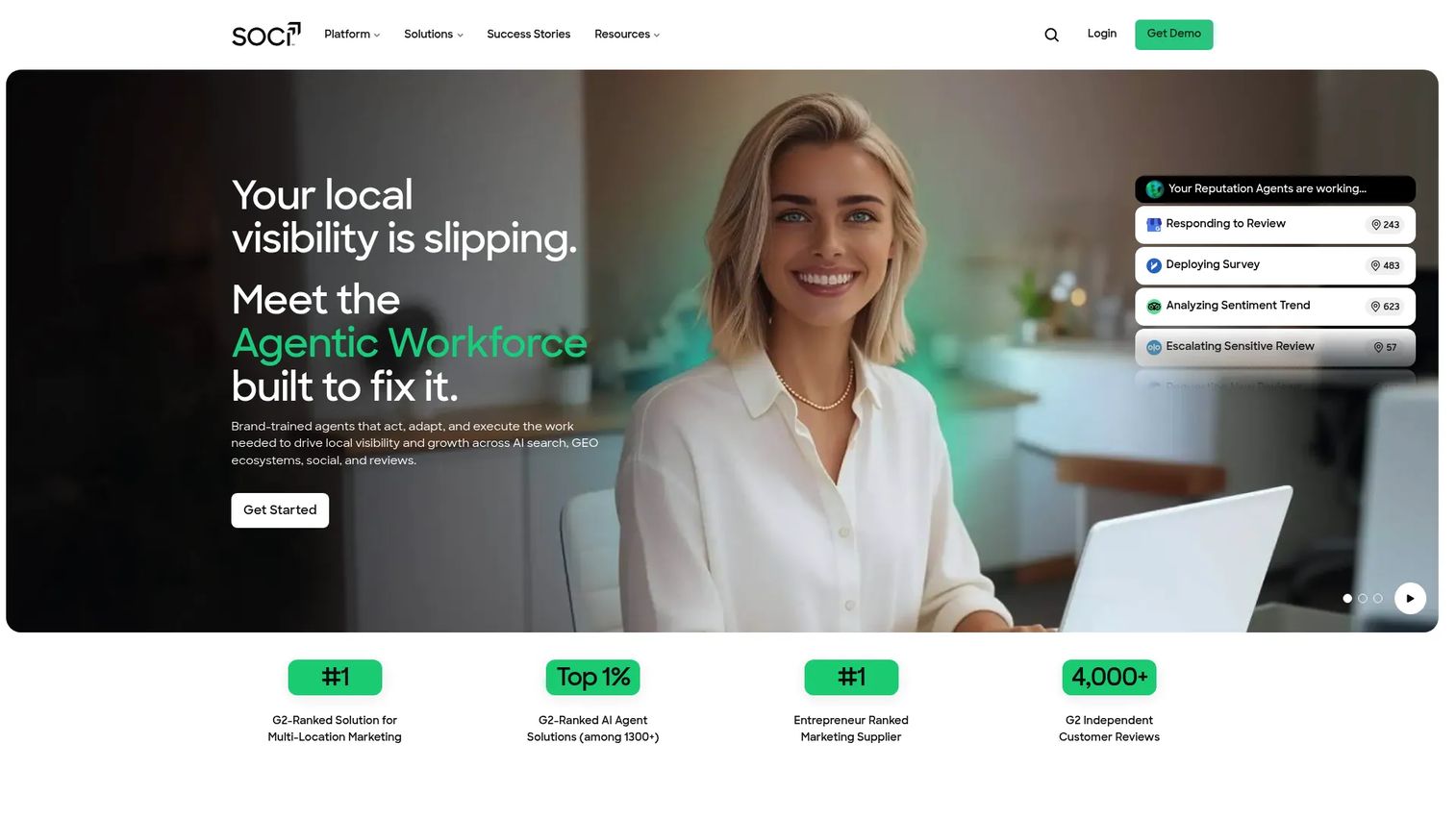
SOCi is an agentic workforce platform built specifically for multi-location brands. It centralizes local social media publishing, review monitoring, listings management, and customer feedback in one system. The platform is designed for enterprise organizations and franchise networks that need cross-location governance without blocking local teams from publishing relevant content.
Best for: Enterprise and franchise organizations managing local marketing across dozens or hundreds of locations.
Key features
- Local listings management across major search networks
- Review monitoring with response workflows and suggested replies
- Localized social media content creation and publishing
- Search-optimized local pages and locator tools
- Multi-location reporting dashboards and benchmarking
Why choose SOCi: SOCi fits teams that are consolidating several disconnected local marketing workflows into one operating layer. It covers more of the local marketing stack than most alternatives, which matters when you are managing brand consistency and local engagement simultaneously across many markets. Validate which modules are included in any contract before signing, since the platform's breadth means not every capability is part of every package.
SOCi pricing: SOCi does not post pricing on its website and requires a demo request to receive a quote. Pricing varies by number of locations, modules selected, and contract terms. Contact SOCi directly for package details.
G2 rating: 4.5/5.
2. Yext
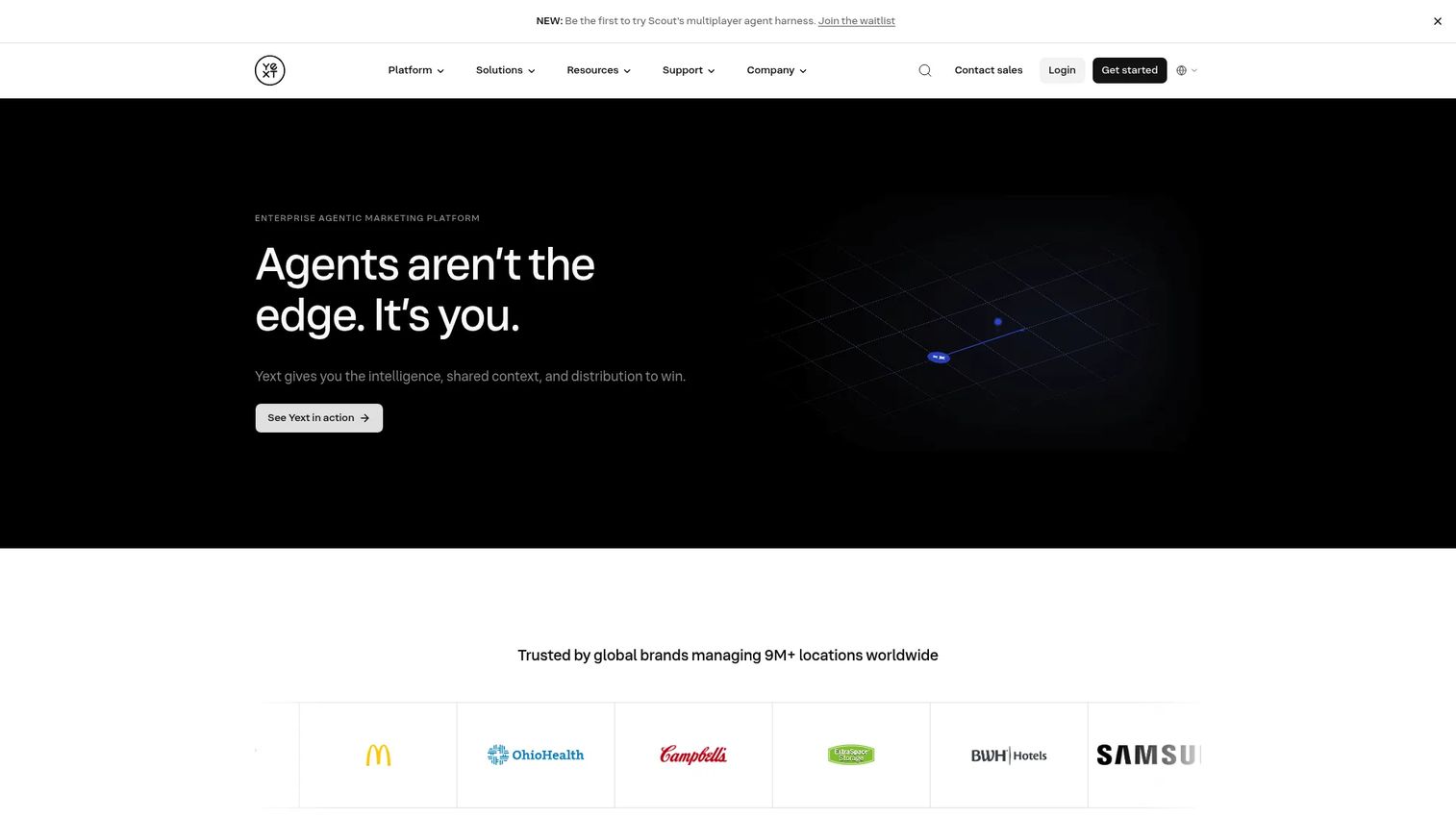
Yext is an enterprise platform for managing verified brand data and local search visibility. Its Knowledge Graph stores structured business information and distributes it across more than 200 publisher integrations, including Google, Apple Maps, Bing, Facebook, and dozens of directories. The platform also covers AI-optimized local pages, review monitoring and solicitation, social publishing, and cross-channel analytics.
Best for: Brands whose biggest local search problem is inconsistent or inaccurate business data across search engines, maps, and directories.
Key features
- Knowledge Graph for verified brand data across 200+ publishers
- AI-optimized store and location pages
- Review monitoring and solicitation across 80+ platforms
- AI-drafted local social publishing
- Cross-channel analytics and search reporting
Why choose Yext: Yext is the right fit when discoverability starts with accuracy. If your hours, addresses, service attributes, and special closures differ across platforms, Yext's publisher network ensures changes propagate quickly and consistently. The platform goes beyond basic listing management into local pages and AI search visibility, which matters as more searches happen through AI overviews and conversational search results. It is a stronger fit for location data governance than for distributed campaign execution.
Yext pricing: Yext does not display numeric pricing on its website. Pricing is enterprise contract-led and varies by number of locations, products selected, and account scope. Request a quote directly through their site.
G2 rating: 4.4/5.
3. Birdeye
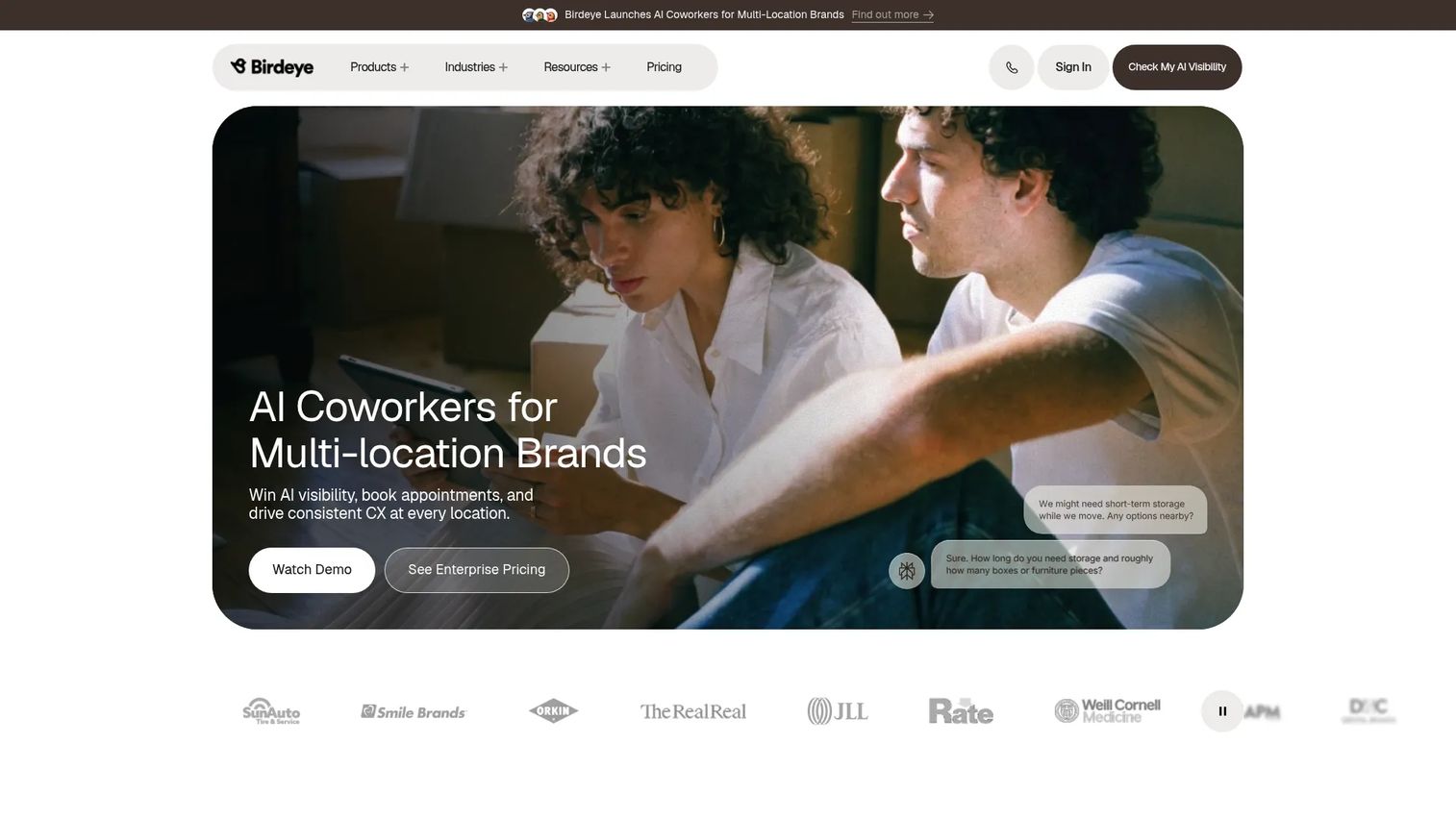
Birdeye is an AI-powered customer experience and reputation platform for multi-location businesses. It covers review generation, omnichannel customer messaging, business listings management, social media publishing, surveys, and AI-assisted engagement. The platform is built for teams that treat reviews and customer feedback as a growth input, not just a support task.
Best for: Multi-location brands that need to improve reputation signals, increase review volume, and consolidate customer communication across channels.
Key features
- Review generation campaigns via email and SMS
- Unified customer messaging across web, social, and review platforms
- Business listings management and data sync
- Customer surveys and feedback analytics
- AI chatbot for conversational customer engagement
Why choose Birdeye: Birdeye makes sense when reviews are a conversion driver for your locations. According to SOCi's Consumer Behavior Index (2025), 73% of consumers use social media for local discovery, and review signals directly influence that behavior. Birdeye can reduce the need for separate review request tools, messaging platforms, and feedback collection software. Check whether listings management is included in your target package or requires an add-on.
Birdeye pricing: Birdeye customizes pricing by number of locations, products, and contract terms. There is no fixed-rate plan displayed. Request a quote through their pricing page for location-specific figures.
G2 rating: 4.7/5.
4. Uberall
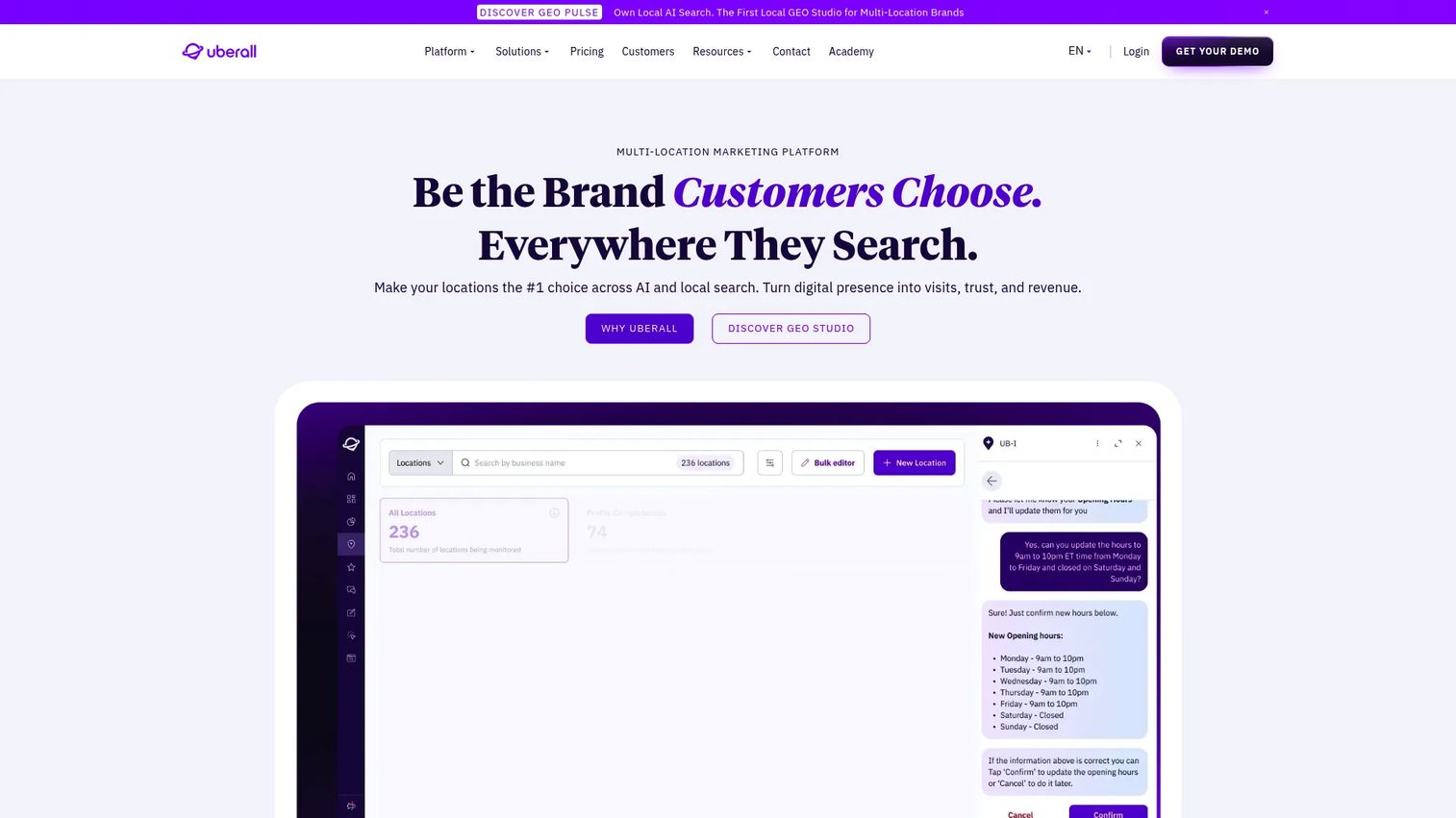
Uberall is a multi-location marketing platform for managing listings, reviews, local social media, location pages, and AI search visibility across many markets. Its GEO Studio product monitors and optimizes visibility in AI-generated search results, a distinction that matters as buyers increasingly interact with AI overviews rather than standard search listings.
Best for: Global multi-location businesses managing local presence across multiple countries, languages, and regional teams.
Key features
- Listings management across 150+ directories, maps, and platforms
- Review management with AI-assisted responses and sentiment analysis
- Local social media publishing and scheduling
- SEO-optimized store locators and location pages
- GEO Studio for AI search visibility monitoring
Why choose Uberall: Uberall is worth evaluating when country-level variation creates governance complexity. Its multi-market controls and localization support handle the differences in directories, languages, and regulatory requirements that come with international locations. GEO Studio is a more differentiated offering than standard listings management for teams tracking visibility in conversational AI search results. Confirm which integrations your tech stack requires before contract negotiations.
Uberall pricing: Uberall's GEO Studio product posts pricing directly: GEO Starter at $109/month and GEO Scale at $449/month. Core platform pricing for full listings and reputation management requires a quote.
G2 rating: 4.3/5.
5. Chatmeter
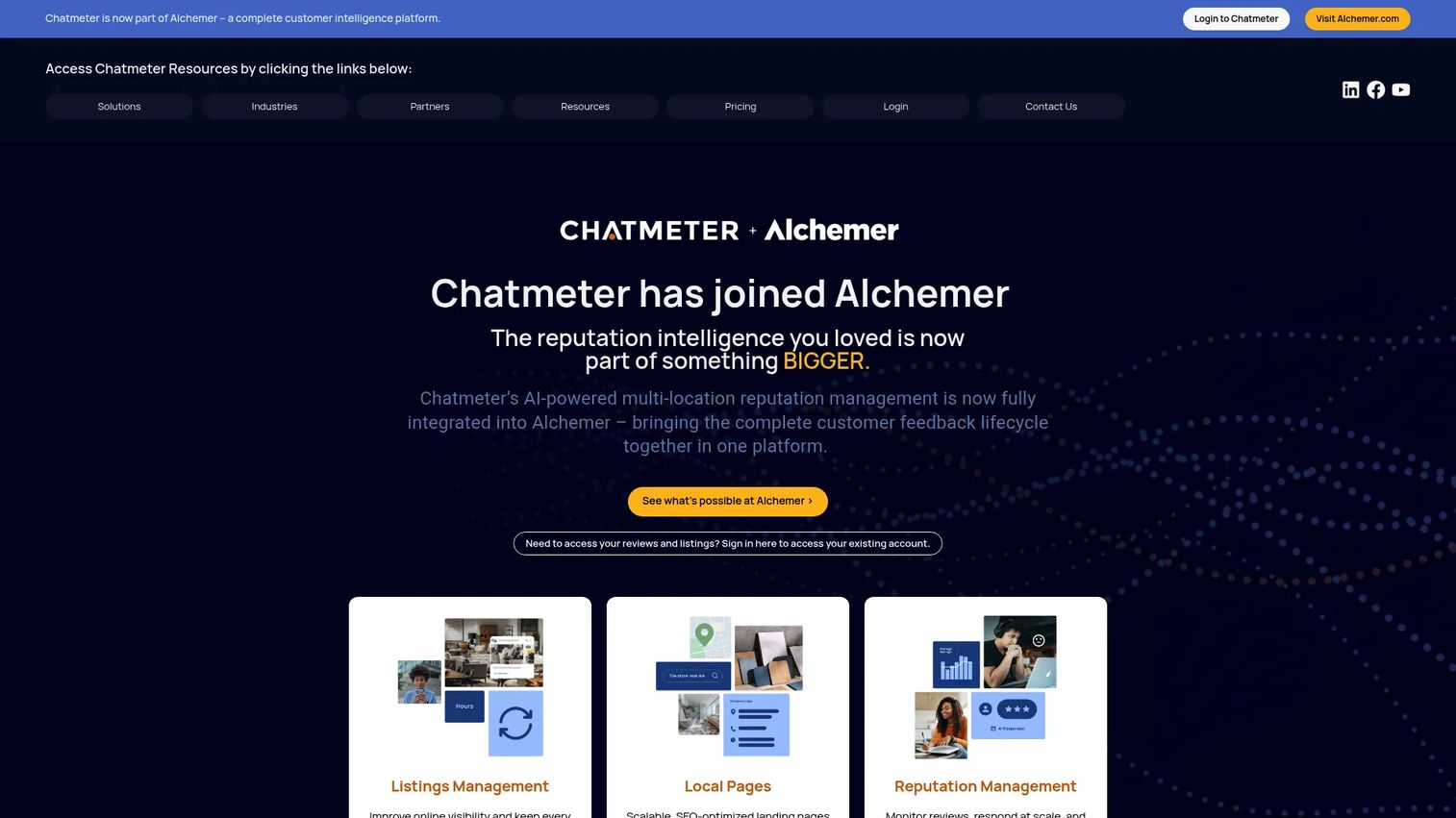
Chatmeter is an AI-powered reputation management platform for multi-location brands. Now listed on G2 as Alchemer Reputation Management following a rebrand, it combines review aggregation, sentiment analysis, listings management across 140+ platforms, social media management, and competitive benchmarking. Its local intelligence layer helps teams identify why one location's performance diverges from another.
Best for: Multi-location brands that want to understand the operational and market factors driving differences in ratings, sentiment, and local search performance across locations.
Key features
- Review monitoring with bulk response tools and customizable templates
- Listings management across 140+ directories and review platforms
- AI-powered sentiment analysis and topic classification
- Location performance benchmarking against competitors
- Workflow automation and approval routing
Why choose Chatmeter: The competitive benchmarking capability separates Chatmeter from tools that only report on your own locations. If your team needs to understand how your ratings compare to a competitor two blocks away, or why one market is losing ground, that intelligence layer is what makes the difference. Pricing is custom per location with unlimited users, which works well for larger teams evaluating per-seat models elsewhere.
Chatmeter pricing: Chatmeter prices per location with unlimited users and requires a custom proposal. No numeric pricing is available without a sales conversation.
G2 rating: 4.5/5.
6. Reputation

Reputation is an AI-powered reputation management platform for multi-location organizations. It connects reviews, surveys, listings, social listening, and customer experience analytics into location scorecards and enterprise reporting. The Rep Score metric gives teams a single number that reflects each location's reputation health, making it easier to prioritize interventions across a large network.
Best for: Large service brands that need reviews, survey data, and customer experience programs to operate from one governance layer.
Key features
- Reviews management with AI-assisted responses
- Business listings and local SEO tools
- Customer surveys and Pulse analytics
- Rep Score and location scorecard reporting
- Competitive insights and social listening
Why choose Reputation: Reputation fits organizations where the feedback program is as important as the review management. Hospitals, hospitality groups, and financial services brands often need structured surveys alongside review workflows. The platform's enterprise controls and location scorecards give corporate teams visibility into which locations need attention without requiring manual audits. Implementation involves multiple stakeholders, so factor that into your timeline.
Reputation pricing: Reputation offers named tiers. Rep Core starts at $80 per location per month. Rep Core plus Pulse adds reputation insights and AI features at $115 per location per month. Rep Core plus Surveys adds advanced survey capabilities at $150 per location per month. Enterprise plans for 125 or more locations require a custom quote.
G2 rating: 4.5/5.
7. Partoo
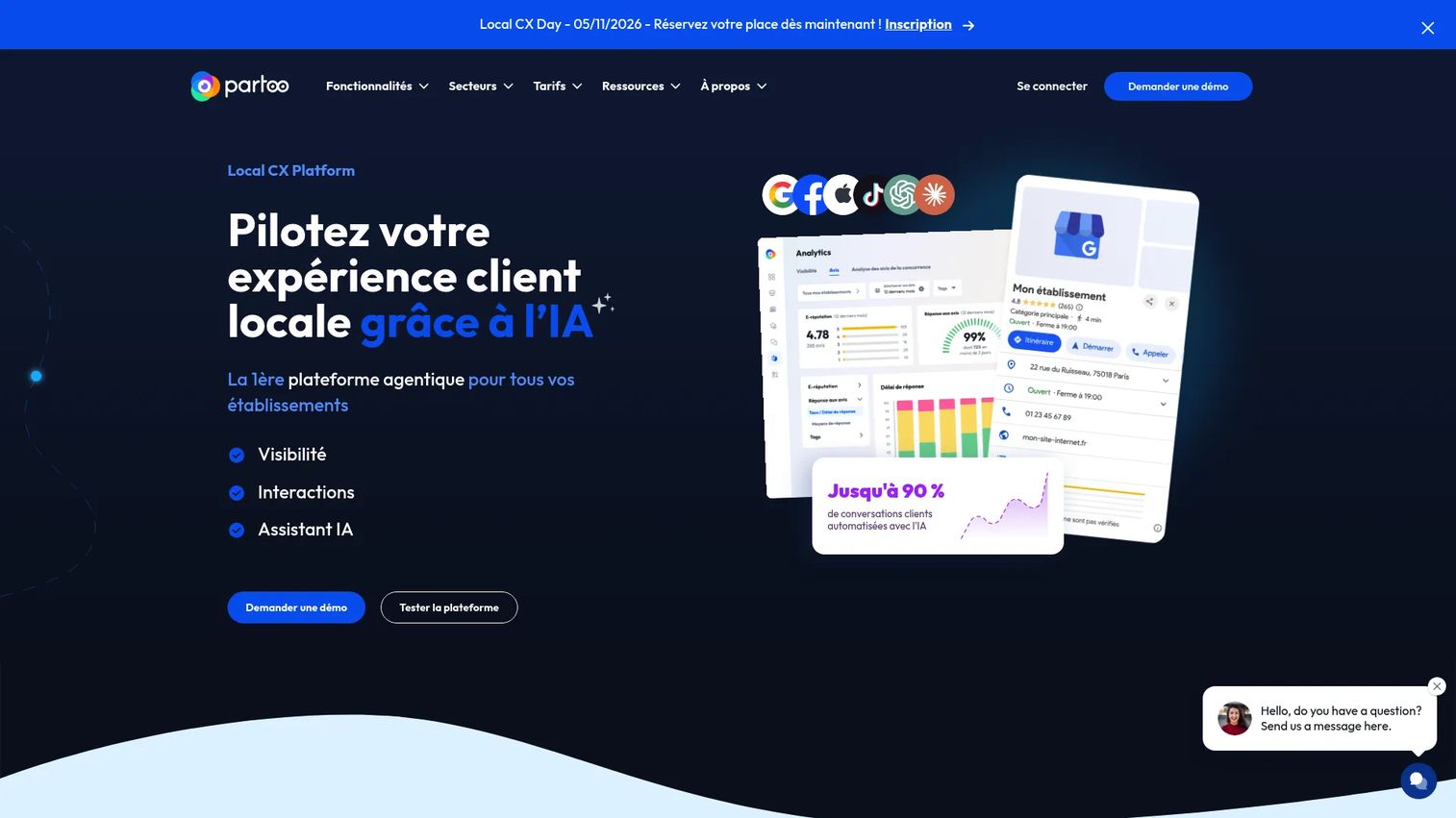
Partoo is an AI-powered local customer experience platform that brings business visibility, review management, and customer messaging into one system. It synchronizes business information across search engines, maps, directories, and AI search platforms while giving local teams tools to respond to reviews and engage customers directly through WhatsApp, Facebook Messenger, Instagram, and on-site chat.
Best for: Regional and international brands that need local visibility management paired with direct customer communication at the location level.
Key features
- Presence management across search engines, maps, and AI platforms
- Review management with AI-assisted and automated responses
- Centralized messaging across WhatsApp, Instagram, and live chat
- Store locator and SEO-optimized local pages
- AI chatbot for customer conversation automation
Why choose Partoo: Partoo is worth evaluating when local teams need to engage customers directly through messaging channels, not just monitor and respond to reviews. The combination of presence management and customer messaging in one platform reduces the need for a separate live chat or messaging tool. Its AI review response automation is useful for networks where response time is a KPI but staffing is limited. Pricing requires a custom quote based on locations and modules.
Partoo pricing: Partoo uses a request-a-quote model and posts no numeric pricing. Fees are structured around locations and the specific products included in the contract.
G2 rating: 4.7/5.
8. BrandMuscle
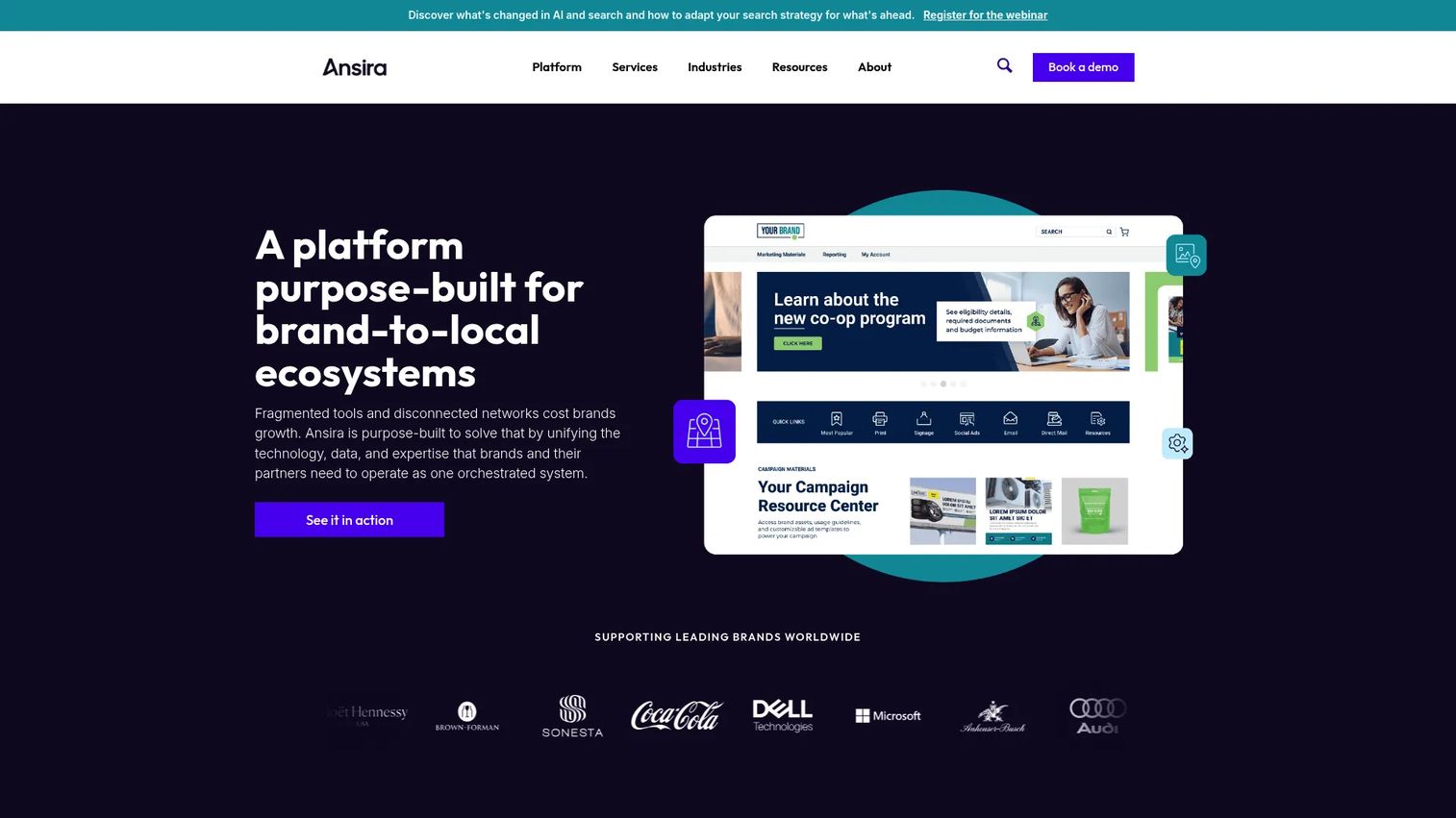
BrandMuscle provides channel-partner and local marketing software for brands managing affiliates, dealers, distributors, agents, or franchisees. It handles co-op and MDF fund management, brand-compliant localized campaign creation, affiliate training, and incentive programs. The company's homepage notes it is becoming Ansira, so evaluate the current product suite directly during any sales conversation.
Best for: Enterprise brands running marketing programs through franchise networks, dealer groups, or channel partners that need compliant campaign execution at scale.
Key features
- Co-op, MDF, and program fund management
- Brand-compliant localized campaign creation and execution
- Affiliate engagement through training and incentive programs
- Approval and workflow routing for local campaign requests
- Distributed marketing analytics and program reporting
Why choose BrandMuscle: BrandMuscle focuses on execution rather than listings or reputation. The platform addresses a different problem: Getting franchisees or channel partners to actually run approved campaigns, spend co-op funds correctly, and stay on brand. For brands where the core bottleneck is local adoption of corporate campaigns rather than listing accuracy or review management, BrandMuscle is a better match than the reputation-focused alternatives. Factor the Ansira transition into your evaluation.
BrandMuscle pricing: BrandMuscle does not post pricing. Contract structure reflects the number of affiliate locations, modules selected, and program requirements. Request a quote through their sales team.
Considerations when choosing multi-location marketing software
Match the platform to the bottleneck
Start with the workflow that is most broken. Inaccurate listings driving missed demand points toward Yext or Uberall. Poor ratings and slow review responses point toward Birdeye, Chatmeter, or Reputation. Franchisees ignoring corporate campaigns points toward BrandMuscle. A platform that solves a problem you do not have will not move your numbers.
Confirm location data ownership
Ask where the source of truth for business information lives before you sign anything. The platform should support clean data syncs with your CRM, store systems, and analytics tools. Without defined ownership rules, inaccurate hours and duplicate listings return as soon as data governance lapses.
Test the corporate-to-local workflow
Do not evaluate only the corporate admin dashboard. Have an actual local operator complete common tasks: Publishing a post, responding to a review, updating holiday hours, or requesting a campaign asset. If local teams cannot complete those tasks without calling corporate, adoption will stall.
Verify reporting depth
Require both roll-up reporting and location-level drill-down in any proof-of-concept. Growth teams need to compare markets and move budget based on evidence, not on spreadsheets assembled after the fact. Check whether marketing analytics exports to your existing BI or attribution tools.
Price the full operating model
Per-location fees, user limits, contract minimums, module add-ons, onboarding services, and integration costs all affect total cost. An entry-tier quote can expand significantly as you add locations or capabilities. Build a three-year model before comparing vendors on sticker price alone.
Conclusion
The right multi-location marketing platform depends on where your current operations break down. SOCi is the broad operational pick for enterprise local marketing teams that need social, listings, and reviews from one system. Yext is the strongest choice when accurate location data and local search visibility are the primary gap. Birdeye, Reputation, and Chatmeter all excel when reviews and customer experience signals drive the decision, with Chatmeter adding competitive intelligence and Reputation adding structured survey programs. Uberall and Partoo are worth evaluating for global or distributed networks with international locations and complex governance requirements. BrandMuscle fits organizations where the bottleneck is getting franchisees or channel partners to execute compliant campaigns, rather than managing listings or reputation.
Shortlist two or three platforms based on your largest operational gap, then run a proof-of-work evaluation with both corporate administrators and local operators. A tool that works for one and not the other will not stick.
Start your journey with Guideflow today!
FAQs
Multi-location marketing is the practice of coordinating brand visibility, local search presence, campaigns, customer feedback, and performance measurement across multiple physical locations from a shared system. It addresses the tension between central brand standards and the need for local relevance across different markets, communities, and operating conditions.
The most common operational challenges include inaccurate or inconsistent location data across directories, fragmented review workflows that result in slow or missed responses, inconsistent campaign execution at the location level, and reporting that cannot be trusted without significant manual cleanup. The underlying issue is usually a coordination gap between corporate marketing and local operators.
A complete platform covers listings management, local SEO and location page publishing, review monitoring and response workflows, local campaign tools with approval controls, integrations with your CRM and analytics stack, and location-level reporting with roll-up views. The priority among those capabilities varies by organization. Brands with hundreds of locations and a franchise model weight campaign governance and co-op management differently than a regional healthcare network focused on review response and patient sentiment.
Franchise brands are among the most common buyers of these platforms. They use them to distribute approved campaign assets, manage local profiles without requiring franchisees to have deep marketing expertise, coordinate review responses across locations, and monitor execution across the network. Brand asset management software and local marketing platforms often complement each other in a franchise stack.
These platforms improve local search performance by keeping business information consistent across directories and maps, managing Google Business Profiles at scale, building and updating SEO-optimized location pages, monitoring reviews that influence local pack rankings, and reporting on local search visibility metrics. Platforms like Yext go further with publisher networks that push verified data to 200 or more directories simultaneously.
Start with listing accuracy and profile completeness rates, then track local search visibility through map pack impressions and non-brand local traffic. Layer in review volume, average star rating, response time, and sentiment trends by location. Campaign-level metrics should include engagement and conversion by market. Where attribution allows it, connect local marketing activity to store visits, calls, bookings, or location-specific revenue.
Some platforms cover listings, reviews, local social, and reporting well enough to consolidate several separate tools. Others specialize and work better alongside dedicated solutions. The answer depends on your current stack and which gaps are actually costing you performance. A business listing management software decision and a reputation management decision are often separate purchases that eventually converge onto one platform as the organization matures.
Local marketing typically refers to campaigns or tactics aimed at a single market or physical location. Location marketing refers to the systems and practices used to manage many locations consistently, including data governance, local SEO infrastructure, review operations, and performance measurement across a distributed network. Most platforms in this category address location marketing at scale rather than serving a single-location business.
Multi-location social management requires features beyond standard scheduling tools, including location-level content publishing with approval workflows, the ability to monitor and respond to comments and reviews across locations, and reporting that shows engagement by market. Tools like SOCi and Birdeye include this natively. If you are evaluating standalone options, see our comparison of social media management tools for additional context.
Clean, structured customer data makes location-level personalization and attribution possible. Platforms that integrate with a customer data platform can segment campaign audiences by location, match review signals to customer journeys, and attribute store visits or conversions to specific marketing activities. Without reliable data connections, location-level reporting stays descriptive rather than predictive.