Your roads, pipes, bridges, and facilities are all tracked somewhere. The problem is "somewhere" usually means a combination of spreadsheets, paper field logs, disconnected GIS layers, and a finance system that has never spoken to any of them.
The infrastructure asset management software market reached $28.12 billion in 2025 and is projected to hit $50.11 billion by 2031, growing at a 10.28% CAGR, according to Mordor Intelligence (2026). Government and municipal authorities accounted for 36% of that market. The volume signals how many public works teams, utilities, and transportation agencies are actively replacing patchwork systems with purpose-built platforms.
This guide is for the teams doing that evaluation: Public works directors, GIS managers, municipal IT buyers, utility operations teams, and presales engineers preparing for RFPs and technical validation conversations in this category. If you need a shortlist built around real buyer questions rather than vendor landing pages, this is it.
What's inside
This guide compares 10 infrastructure asset management software options for 2026 across GIS depth, lifecycle planning, maintenance execution, and public-sector fit.
- Who it's for: Public works teams, municipalities, utilities, transportation agencies, GIS administrators, and presales teams supporting infrastructure software deals
- How tools were selected: Infrastructure fit, GIS capability, maintenance and work order depth, capital planning support, and buyer evidence
- Selection criteria: Asset type coverage, GIS integration model, field crew adoption, and reporting for public accountability
- What to verify: Current pricing directly with vendors, G2 ratings at time of evaluation, integration support, and implementation timelines
TL;DR
- Best for public works infrastructure management: AssetWorks EAM or OpenGov Enterprise Asset Management, depending on portfolio size and procurement structure
- Best for GIS-first teams: Esri ArcGIS or Trimble Unity Maintain, both built around spatial asset management
- Best for enterprise asset-intensive operations: IBM Maximo, for large utilities and multi-site infrastructure portfolios
- Best for municipalities connecting assets and citizen services: Civic Impact Platform, which links infrastructure workflows to resident-facing services
- Best for mobile maintenance execution: MaintainX, with a free tier and strong field crew adoption
- Best for IT and infrastructure operations overlap: Infraon, for teams managing both technology assets and physical infrastructure workflows
Pricing across most platforms in this category is custom. Verify current figures directly with each vendor before shortlisting.
What is infrastructure asset management software?
Infrastructure asset management software is a system for tracking, maintaining, analyzing, and planning the lifecycle of public and private infrastructure assets, including roads, bridges, water systems, utilities, facilities, and transportation networks.
Unlike generic asset management tools, infrastructure-specific platforms handle the spatial complexity of public works. Roads are linear assets measured in segments. Hydrants and valves are point assets tied to precise coordinates. Parks and watersheds are boundary-based assets with service areas. A system built for infrastructure understands those distinctions. One that doesn't will force your team to work around its data model from day one.
GIS is not optional in this category. It connects every asset to location, service area, inspection record, and repair history. For presales teams preparing asset inventory software evaluations, the first question to answer is whether the GIS layer is native, bidirectional, or requires a separate sync.
Core capabilities to look for in any infrastructure asset management system:
- Asset inventory and centralized location records
- GIS mapping and spatial asset management
- Condition assessment and performance scoring
- Work orders and maintenance scheduling
- Preventive and predictive maintenance workflows
- Lifecycle cost analysis and replacement modeling
- Risk scoring and repair prioritization
- Capital planning and long-range budget support
- Reporting, dashboards, and data export for finance and elected-official review
- Citizen service request integration, where relevant
The category also connects directly to ISO 55000, the international standard for asset management. Teams referencing ISO 55000 in RFPs are typically asking about systematic lifecycle management, risk-based decision-making, and documented maintenance strategies, not just a work order queue.
When to use infrastructure asset management software
Build a reliable infrastructure inventory
Most public works teams know what they own in theory. Field reality is different. Signs get replaced without records, valves get abandoned without updates, pavement condition scores sit in a spreadsheet that nobody updates after inspection season ends. Deploy infrastructure asset management software when your GIS layers and maintenance records no longer agree with what's actually in the ground.
Prioritize maintenance before failures reach the public
Work order history, condition scores, and failure patterns tell you which assets are at risk before they fail. Teams use infrastructure asset management solutions to move from reactive patching to scheduled intervention, which protects service continuity and reduces emergency crew costs. The goal is a defensible queue, not just a list of complaints.
Defend capital plans with data
Council presentations, grant applications, and long-range capital improvement planning all require proof. Infrastructure asset management software turns inspection data and lifecycle cost records into budget justifications that elected officials, ratepayers, and auditors can follow. Condition-based replacement modeling shows why a bridge rehab in year three costs less than emergency repair in year seven.
Infrastructure asset management software comparison
The table below is a starting point for buyers comparing operational fit. It doesn't replace a technical demo, security review, or implementation scoping conversation. Use it to build your shortlist, then validate fit with each vendor directly.
| # | Product | Best for | Key differentiator | Pricing | G2 rating |
|---|---|---|---|---|---|
| 1 | AssetWorks EAM | Public works and government agencies | Infrastructure-specific EAM with GIS and lifecycle planning | Custom pricing | 4.0/5 |
| 2 | Esri ArcGIS | GIS-first infrastructure teams | Spatial system of record for maps, assets, and field data | Custom pricing (annual user licenses) | 4.5/5 |
| 3 | Civic Impact Platform | Municipal teams connecting assets and citizen services | Local-government suite with infrastructure, service requests, and reporting | Custom pricing | 4.4/5 |
| 4 | IBM Maximo | Enterprise asset-intensive organizations | EAM depth with AI, IoT, lifecycle, and reliability capabilities | Starting under $40K/year (Essentials) | Not verified |
| 5 | Infraon | IT and infrastructure operations teams | ITSM plus infrastructure asset visibility with monitoring workflows | Custom pricing | 4.6/5 |
| 6 | OpenGov Enterprise Asset Management | Local governments modernizing public works | Public-sector asset, work, budget, and reporting workflows | Custom pricing | 4.4/5 |
| 7 | Trimble Unity Maintain | Esri-centered public works teams | GIS-centric maintenance with Starter, Professional, and Elite tiers | Custom pricing (tiered plans) | Not verified |
| 8 | Brightly Asset Essentials | Facilities, campuses, and municipal maintenance | Work orders, preventive maintenance, and asset tracking | Custom pricing | 4.2/5 |
| 9 | NEXGEN Asset Management | Utilities and public works maintenance | Asset lifecycle planning with risk-based prioritization | Custom pricing | 4.0/5 |
| 10 | MaintainX | Mobile-first maintenance teams | Frontline work orders, inspections, and asset history with a free tier | Free; paid from $20/user/month | 4.8/5 |
Best 10 infrastructure asset management software tools for 2026
1. AssetWorks EAM
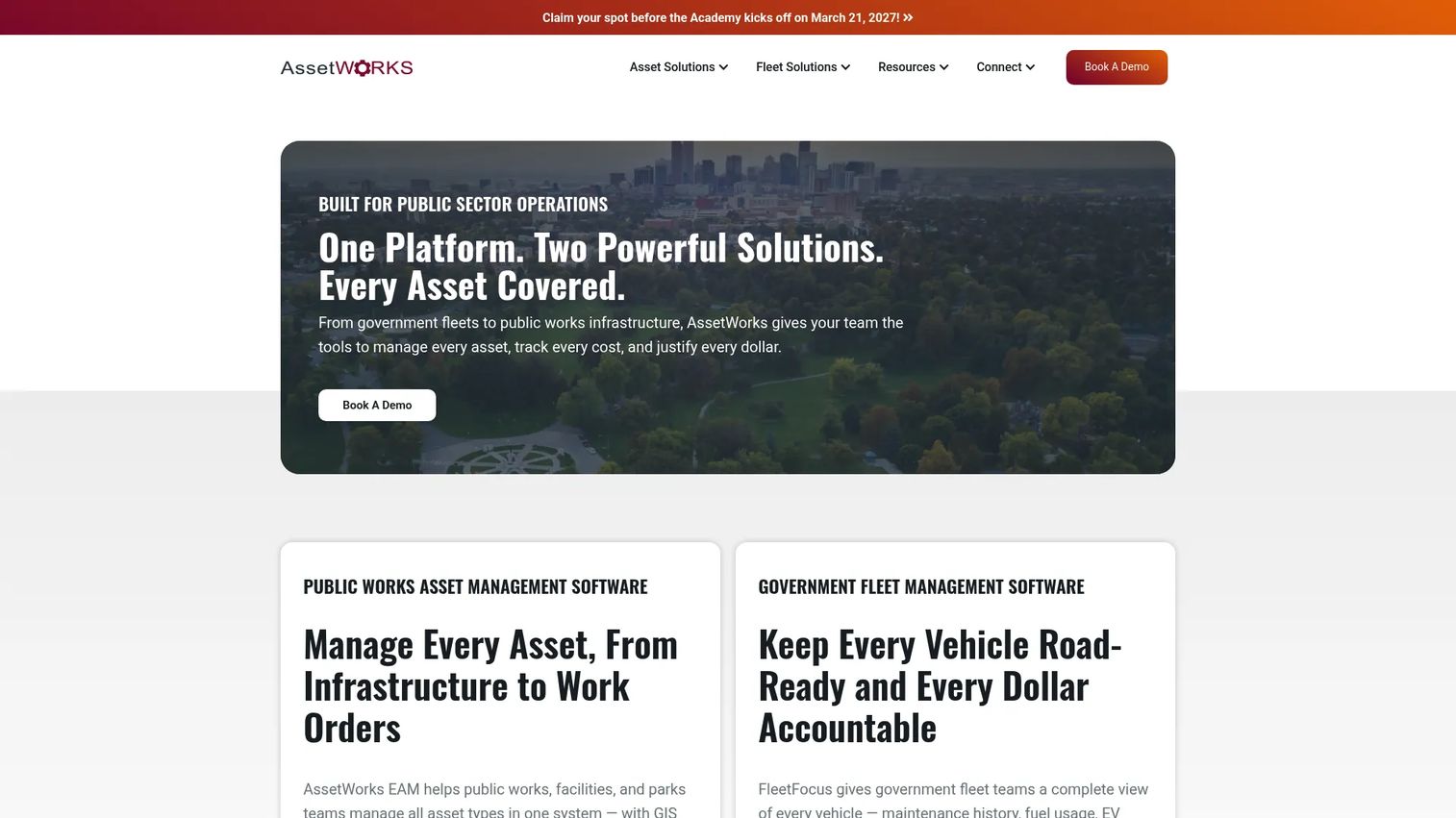
AssetWorks EAM is an enterprise asset management platform built specifically for public-sector organizations managing infrastructure, facilities, equipment, and fleet. The platform handles the full asset lifecycle from inventory and condition assessment through maintenance execution and capital planning. Public works teams, transportation agencies, and government facilities operations use it across linear, point, and boundary-based asset portfolios.
Best for: Public-sector agencies managing complex infrastructure, facilities, and maintenance operations across multiple asset types.
Key features
- Asset lifecycle management and costing
- Preventive maintenance and inspection scheduling
- GIS mapping and spatial asset management
- Work order and service request management
- Mobile field access with online and offline capability
- Capital planning and long-range budget support
- Parts, materials, labor, and warranty tracking
Why choose AssetWorks EAM: The platform's public-sector focus means it understands the reporting structures, procurement models, and asset categories that generic EAM tools often miss. For presales teams preparing demos, the strongest proof points come from pavement segment management, infrastructure inspection workflows, and lifecycle cost modeling tied to capital improvement plans.
AssetWorks EAM pricing: Contact the vendor directly for a quote.
G2 rating: 4.0/5 based on 11 reviews.
2. Esri ArcGIS
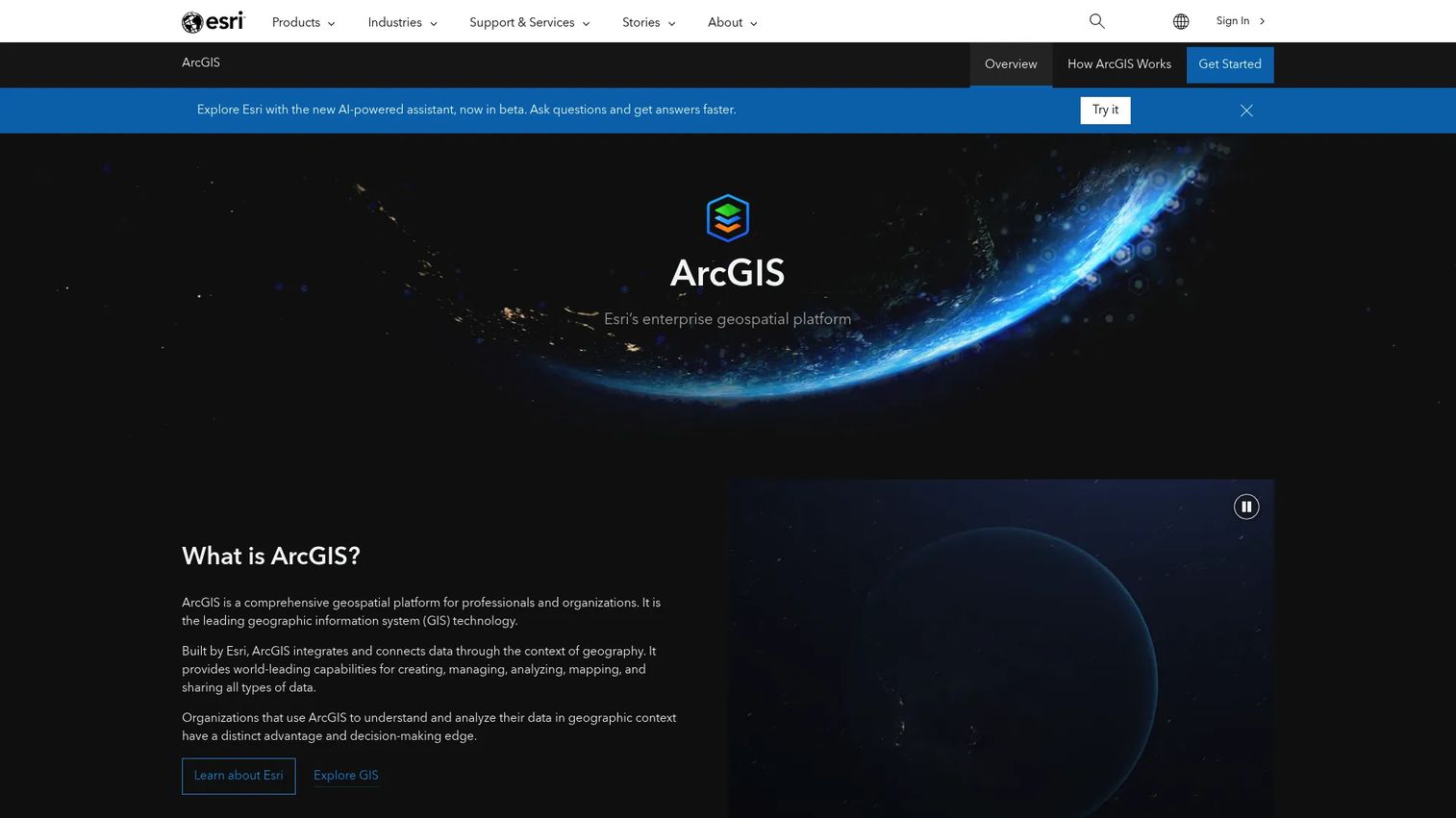
Esri ArcGIS is the GIS standard for infrastructure asset location, field data collection, spatial analysis, and map-based decision-making. It is the spatial foundation that most other infrastructure platforms either integrate with or build on. For teams where GIS is the primary system of record, ArcGIS provides the authoritative location layer for roads, utilities, water networks, and facilities.
Best for: Organizations where location intelligence is the core requirement and the team already works in Esri tools.
Key features
- 2D and 3D mapping and visualization
- GIS asset layers and spatial data management
- Field data collection with mobile applications
- Spatial analysis and scenario modeling
- Esri ecosystem integrations with complementary work management tools
Why choose Esri ArcGIS: ArcGIS excels when location is the primary organizing principle for asset data. One important evaluation note: Depending on the buyer's workflow, ArcGIS may need complementary work order management or EAM tooling to handle maintenance execution and capital planning. For GIS administrators, this is expected. For public works directors evaluating a complete replacement for legacy systems, ask vendors directly which modules handle work orders and capital planning.
Esri ArcGIS pricing: Esri sells ArcGIS Online through annual user-type licenses (Creator, Professional, Mobile Worker, and others). Contact Esri or an authorized reseller for current figures.
G2 rating: 4.5/5 in the GIS software category.
3. Civic Impact Platform
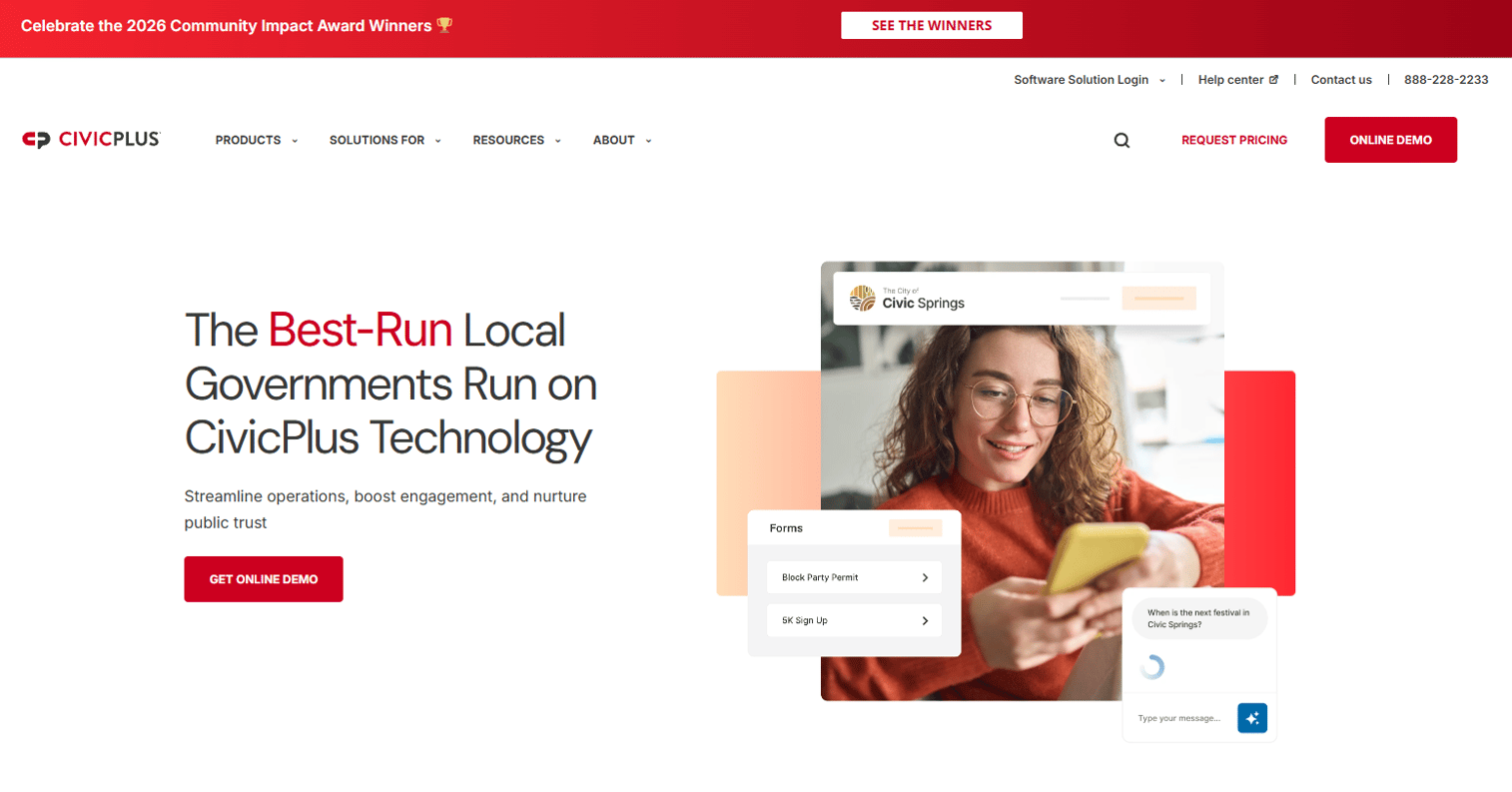
Civic Impact Platform is CivicPlus's unified platform for local government operations, connecting resident-facing services, administrative workflows, and infrastructure management in a single environment. Municipal teams use it to link infrastructure asset records to citizen service requests, community communications, and public reporting. It brings together websites, agenda management, records requests, and operational workflows under a shared authentication layer.
Best for: Local governments that want infrastructure data connected to 311-style service requests, resident portals, and public accountability reporting.
Key features
- Infrastructure asset tracking and inventory
- Citizen request and service workflow integration
- GIS mapping support
- Reporting dashboards for public transparency
- AI-powered content and workflow assistance for staff
Why choose Civic Impact Platform: The platform's strongest differentiation is the connection between what residents report and what crews fix. For municipalities where the 311 request pipeline feeds directly into maintenance prioritization, that connection matters. For teams evaluating this platform in an RFP, ask specifically which modules handle asset condition tracking and whether field inspection data flows back to the asset record.
Civic Impact Platform pricing: CivicPlus operates on custom pricing. Request a quote through the CivicPlus site for current figures.
G2 rating: 4.4/5 based on CivicPlus overall reviews.
4. IBM Maximo
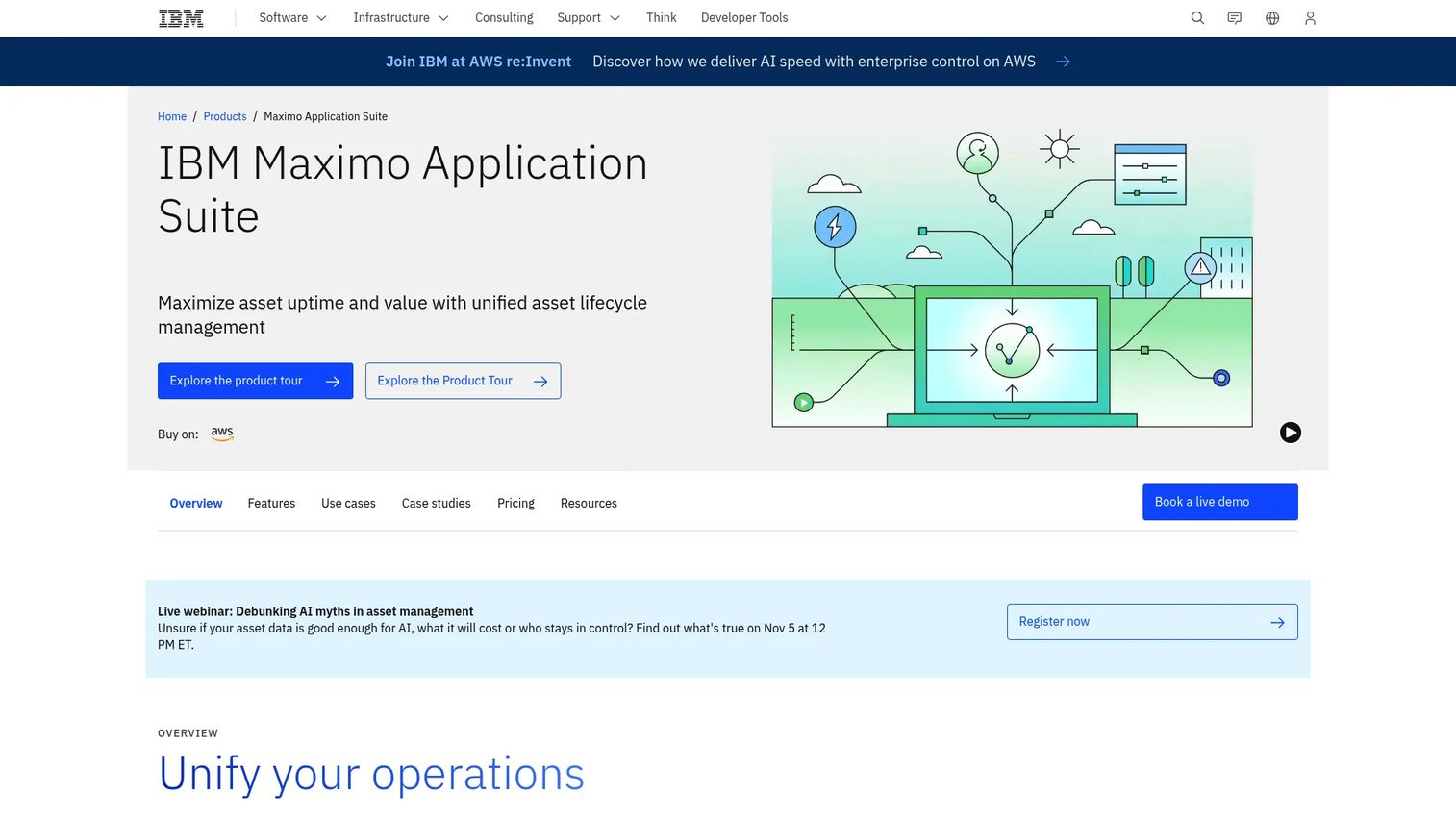
IBM Maximo is a unified asset lifecycle management platform for large, asset-intensive organizations managing maintenance, reliability, facilities, and infrastructure operations. It covers the full spectrum from AI-enabled predictive maintenance through visual inspections and mobile field execution. Large utilities, transportation networks, and multi-site municipal portfolios use Maximo when they need governance, deep integrations, and asset performance management software at scale.
Best for: Large asset-intensive organizations managing complex maintenance, reliability, and infrastructure operations across multiple sites.
Key features
- AI-enabled asset lifecycle management
- Predictive maintenance and asset health monitoring
- IoT data integration for real-time asset performance
- Visual inspections and mobile field execution
- Workforce scheduling and dispatching
- Asset investment planning
Why choose IBM Maximo: Maximo's depth in reliability engineering, compliance documentation, and integration with enterprise systems makes it the right choice for large utilities and transportation agencies. Enterprise buyers should expect a configuration and integration phase. Implementation complexity is proportional to portfolio size and integration scope, which is worth naming honestly in presales conversations rather than minimizing it.
IBM Maximo pricing: Maximo Application Suite Essentials starts under $40,000 per year for modules including Maintenance, Inspection, and Inventory Optimization. Standard, Premium, and client-managed pricing requires a quote from IBM.
5. Infraon
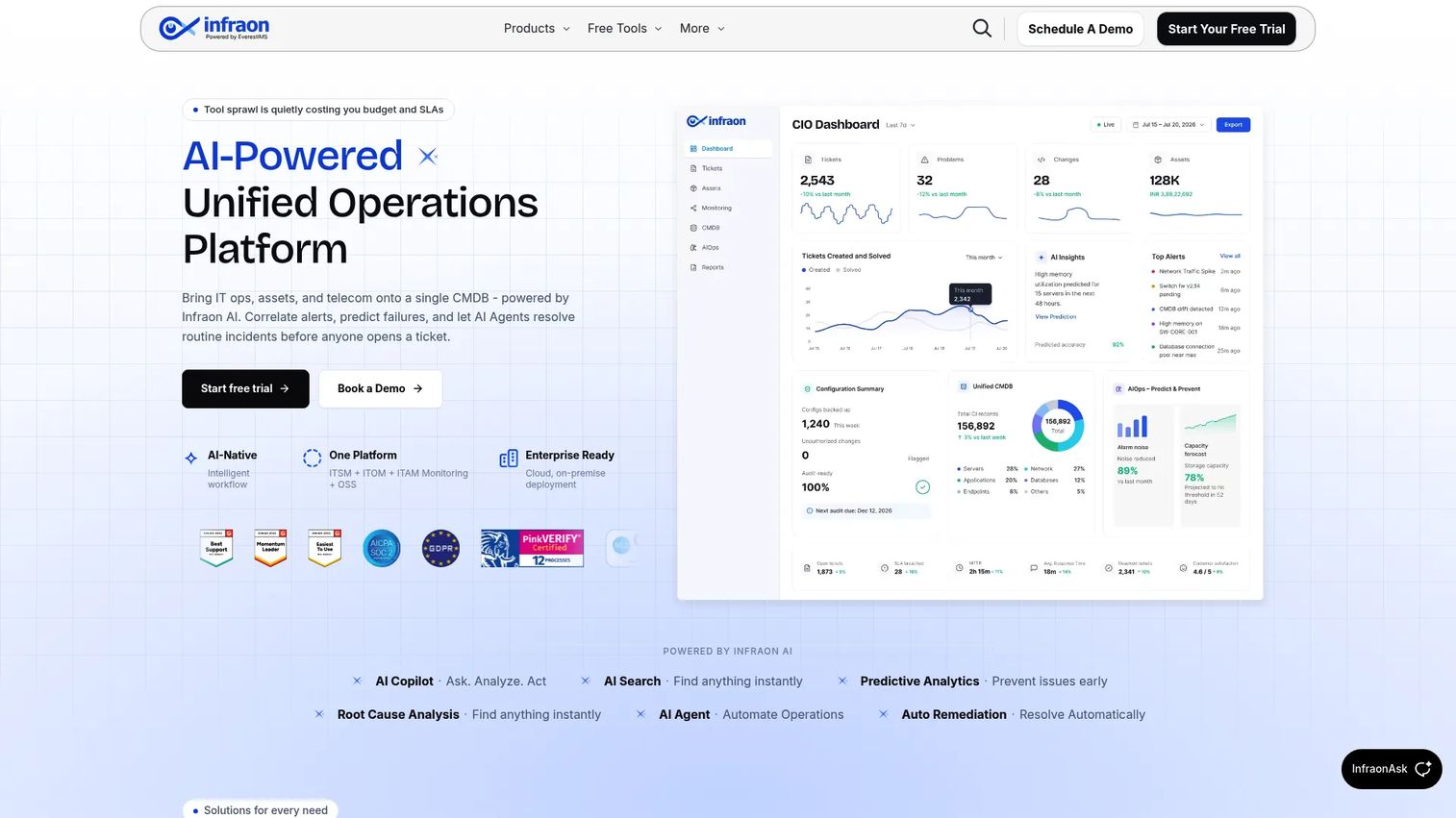
Infraon is an AI-powered platform combining IT service management, IT operations management, and infrastructure asset management. Its centralized CMDB, automated device discovery, incident routing, and SLA tracking make it a strong fit for teams managing technology assets alongside physical infrastructure workflows. It's particularly relevant when the buyer means IT infrastructure rather than public works or GIS-managed civil assets.
Best for: Organizations managing both IT infrastructure assets and physical infrastructure operations, particularly those with ITSM requirements alongside field maintenance.
Key features
- GenAI-powered incident management and ticket routing
- Asset and configuration management with centralized CMDB
- Infrastructure monitoring and automated device discovery
- Change management with CAB workflows
- Real-time SLA tracking and escalation alerts
- Self-service portal with conversational AI search
Why choose Infraon: Infraon covers the overlap between IT operations and infrastructure asset visibility that many organizations struggle to address with separate tools. For presales teams evaluating this platform, the key clarifying question for buyers is whether their infrastructure challenge is primarily IT-side (servers, network, devices) or physical infrastructure (roads, pipes, utilities). The answer determines whether Infraon is the right fit or whether a public works-focused platform is a better match.
Infraon pricing: Infraon offers a 14-day free trial. Contact the vendor for current plan pricing, as figures are not displayed publicly.
G2 rating: 4.6/5 based on 46 reviews.
6. OpenGov Enterprise Asset Management
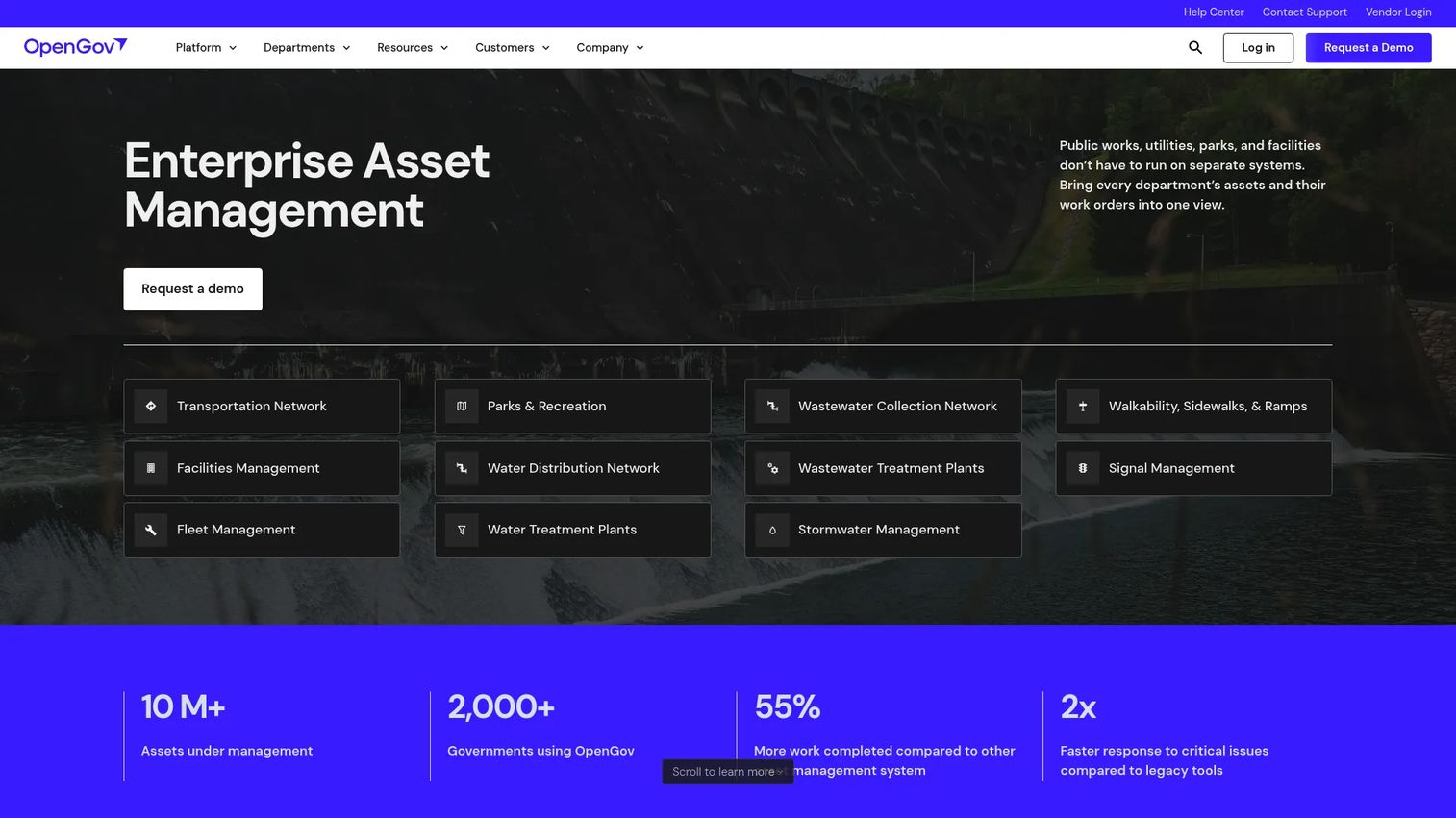
OpenGov Enterprise Asset Management is a public-sector asset management platform for local governments handling infrastructure, public works, utilities, facilities, fleet, and parks. Work orders, inspections, GIS integration with Esri, capital planning through its Scenario Builder, and 311 request connection make it a broad choice for cities and counties modernizing legacy systems. The OG Assist AI feature adds guided asset and task support for staff.
Best for: Cities, counties, and public works departments replacing fragmented legacy systems with an integrated public-sector platform.
Key features
- Asset inventory across public works, utilities, facilities, and transportation
- Work orders, inspections, and mobile field data capture
- GIS integration with Esri
- Scenario Builder for capital planning and risk evaluation
- 311 request integration
- OG Assist AI-powered asset and task assistance
Why choose OpenGov Enterprise Asset Management: OpenGov's public-sector focus means finance teams, councils, and operations departments share a common evidence base. For presales teams, the strongest demo moments involve showing how condition data and maintenance history feed directly into the Scenario Builder for capital improvement plan justification. Buyers evaluating this platform alongside broader OpenGov products should ask whether budgeting and permitting modules share data with the asset management layer.
OpenGov Enterprise Asset Management pricing: OpenGov operates on custom pricing with Essentials, Plus, and Pro tiers. Contact OpenGov directly for current figures.
G2 rating: 4.4/5.
7. Trimble Unity Maintain
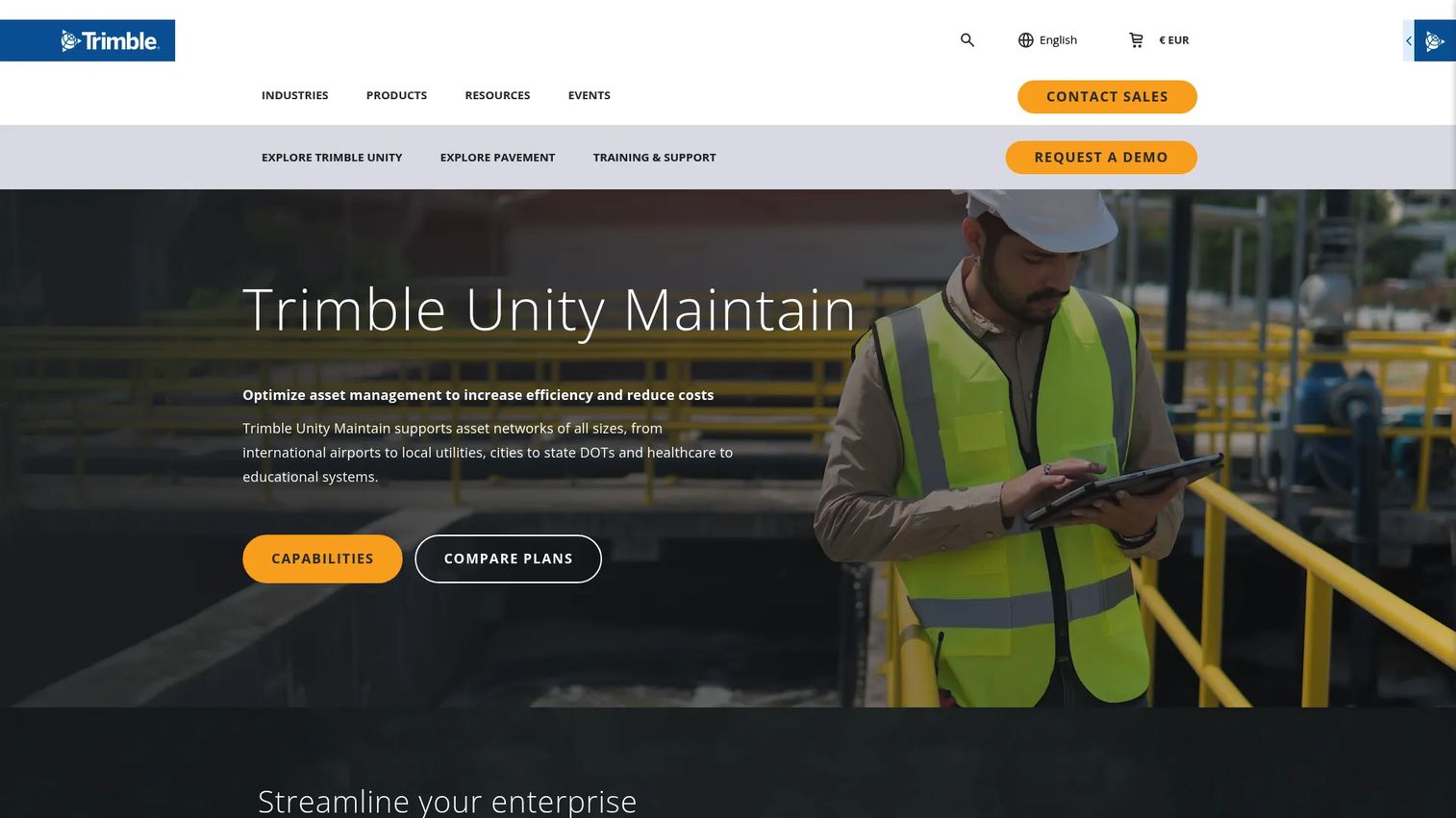
Trimble Unity Maintain is a cloud-first enterprise asset management platform for managing infrastructure assets, maintenance, inspections, and reporting. Its tight integration with Esri ArcGIS and Linear Referencing System (LRS) support makes it a natural fit for Esri-centered public works teams managing road networks, utility corridors, and distributed infrastructure. The platform offers Starter, Professional, and Elite subscription tiers with progressively broader capabilities.
Best for: Esri-centered municipalities and agencies managing map-based work orders and field crew operations across distributed infrastructure.
Key features
- GIS-based geolocation with Esri ArcGIS and LRS support
- Work order management and inspections
- Preventive maintenance scheduling
- Risk assessment and predictive analytics
- Data visualization and community engagement portal
Why choose Trimble Unity Maintain: For teams already running infrastructure workflows around GIS maps and field crews, the Esri integration reduces the friction of switching between systems. In demos and validation conversations, buyers should ask specifically about data migration from legacy GIS layers, field adoption on crew devices, and how inspection data syncs back to the asset record. These three areas carry the most implementation risk for GIS-heavy organizations.
Trimble Unity Maintain pricing: Contact Trimble for current subscription pricing.
8. Brightly Asset Essentials
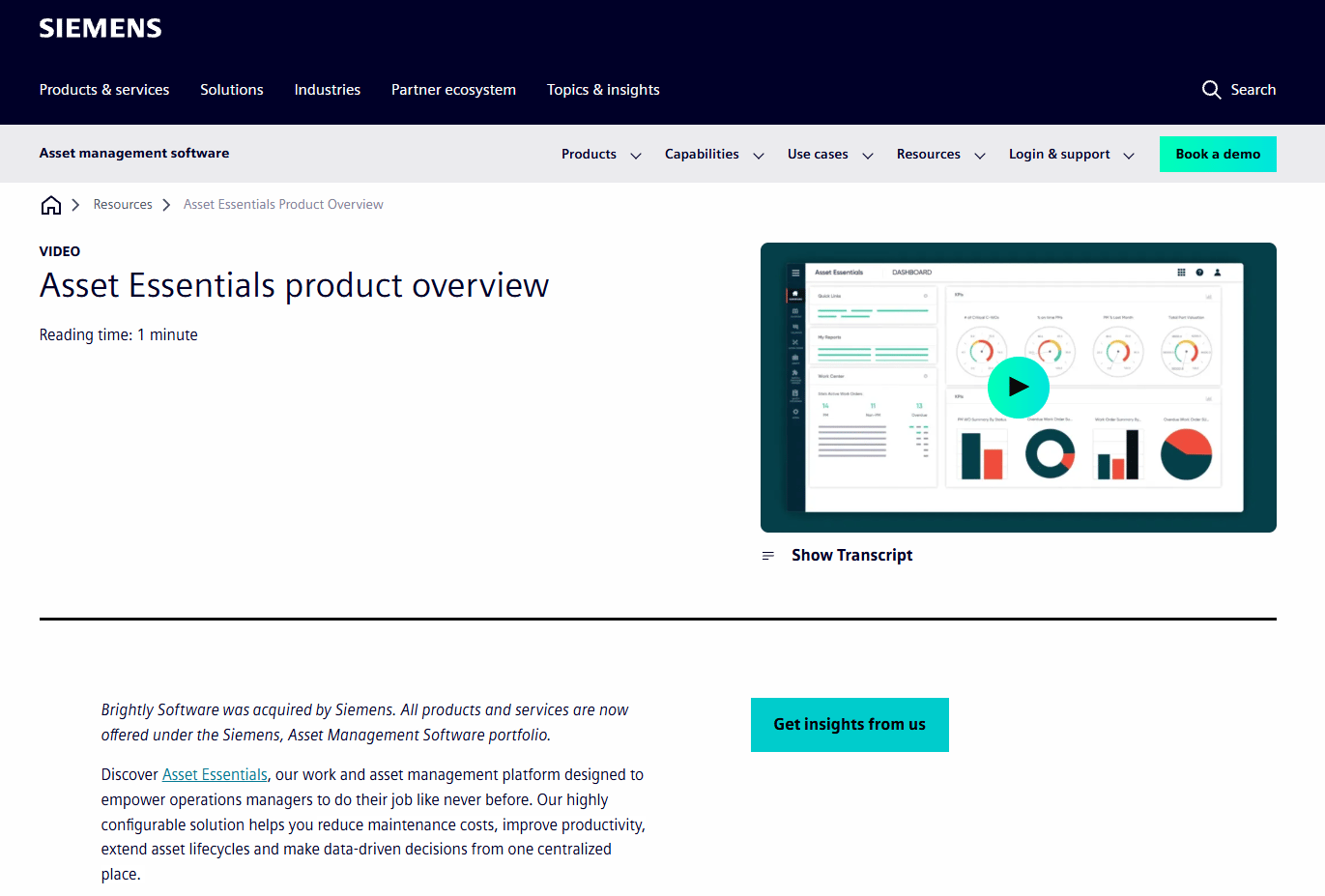
Brightly Asset Essentials is a cloud-based maintenance and asset management platform covering work orders, preventive maintenance, asset tracking, inventory management, and mobile operations. Schools, government agencies, healthcare providers, and infrastructure-adjacent facilities teams use it for day-to-day maintenance execution without enterprise EAM complexity.
Best for: Maintenance teams focused on practical daily execution, especially in facilities, campuses, and municipal maintenance contexts where deep GIS or capital planning is secondary.
Key features
- Work order management and request automation
- Preventive and predictive maintenance scheduling
- Asset and equipment management
- Mobile app with barcode and QR code support and offline work
- Reporting, dashboards, and data analysis
Why choose Brightly Asset Essentials: Brightly covers the maintenance execution layer well for teams that don't need roads and utilities depth. For presales evaluations, the qualifying question is whether the buyer primarily needs facilities and work order management or a full infrastructure asset management system with GIS, linear asset support, and capital planning. If it's the former, Brightly is a practical fit. If it's the latter, a GIS-first or public works-specific platform will serve better.
Brightly Asset Essentials pricing: Contact Siemens/Brightly for current plan details and quote.
G2 rating: 4.2/5.
9. NEXGEN Asset Management
NEXGEN Asset Management combines enterprise asset management and computerized maintenance management into a single platform, with asset lifecycle planning, risk and criticality-based prioritization, and financial planning for utilities, public works, and facilities teams. Its focus on risk-based maintenance prioritization and funding forecasts makes it useful for organizations that need to justify replacement schedules to finance teams and governing bodies.
Best for: Utilities and public works departments managing distributed field assets where maintenance prioritization and financial planning need to share the same data layer.
Key features
- Asset lifecycle planning and condition assessment
- Risk and criticality-based maintenance prioritization
- Work order and preventive maintenance management
- Financial planning and funding forecasts
- Asset inventory management
Why choose NEXGEN Asset Management: NEXGEN's combination of risk scoring and financial forecasting addresses one of the core public-sector challenges: Converting field condition data into defensible budget requests. For presales teams, the strongest demo workflows involve showing how inspection results feed into replacement prioritization and how that prioritization connects to funding scenarios.
NEXGEN Asset Management pricing: Contact the vendor for a quote.
G2 rating: 4.0/5 based on 3 reviews.
10. MaintainX
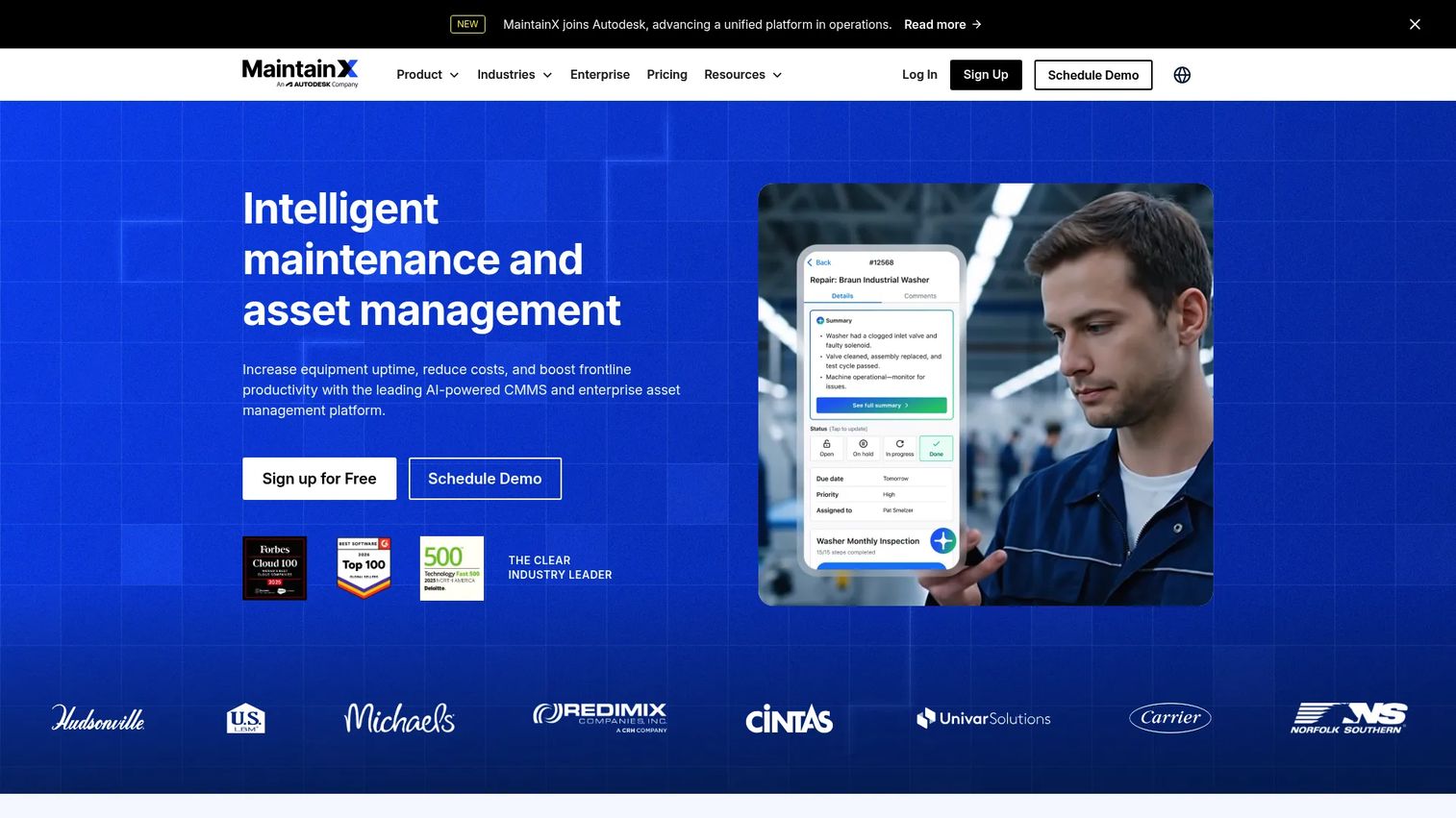
MaintainX is an AI-powered computerized maintenance management platform for frontline maintenance and operations teams. Its mobile-first design, free entry tier, and strong field adoption make it the most accessible option on this list for teams prioritizing work order speed and crew usability over deep GIS or capital planning features.
Best for: Maintenance and operations teams that prioritize mobile adoption and practical work order execution, particularly where field crew usability matters more than municipal capital planning workflows.
Key features
- Mobile work orders and asset history
- Preventive and condition-based maintenance scheduling
- Checklists, procedures, and inspections
- Parts inventory management
- AI-powered maintenance assistance
- Reporting and analytics
Why choose MaintainX: MaintainX is the clearest starting point for maintenance teams that need something running quickly without a lengthy implementation. The free Basic plan lets teams try core work order workflows before committing. For presales teams evaluating infrastructure asset management software, note that MaintainX is not a GIS-first municipal platform. It fits asset maintenance execution and crew operations well, and for buyers who need roads, utilities, or capital planning depth, a complementary GIS or EAM platform will be necessary.
MaintainX pricing: Basic is free forever. Essential costs $20 per user per month billed annually ($25 monthly). Premium costs $65 per user per month billed annually ($75 monthly). Enterprise pricing requires a quote.
G2 rating: 4.8/5.
Considerations when choosing infrastructure asset management software
Match the platform to your asset types
Test each system with real examples from your portfolio: Hydrants, pavement segments, bridge decks, storm inlets, parks boundaries. A platform that handles point assets well may struggle with linear asset segmentation or boundary-based service areas. Ask vendors to demonstrate your specific asset types during evaluation, not generic demos.
Verify GIS depth before the demo ends
Ask directly whether GIS is native, bidirectional, or a one-way sync. Request a live demonstration of editing an asset record on a map and watching that edit flow back into the work order. Ask how long synchronization takes. For teams supporting advanced planning and scheduling software integrations, confirm which GIS platforms the vendor supports and whether the integration is maintained by the vendor or requires third-party configuration.
Test field adoption with crew workflows
A technically capable platform fails if field crews won't use it. During evaluation, run through mobile work order creation, photo capture, offline mode, inspection form completion, and supervisor dashboard review. Ask whether crews can complete their most common tasks in three taps or fewer. Low field adoption is the most common reason infrastructure asset management implementations stall after go-live.
Connect maintenance history to capital planning
Ask vendors to show how repair records, failure events, labor costs, and condition scores feed into replacement modeling and capital improvement planning. The connection between field data and budget justification is where infrastructure asset management software delivers the most value to public-sector buyers, but many platforms handle it differently. Some use scenario modeling tools, others require manual exports to finance systems.
Pressure-test reporting for public accountability
Public-sector buyers need reports that work for finance teams, councils, auditors, grant administrators, and residents. Request example outputs during evaluation: A council-ready capital plan summary, an inspection completion report, and a cost-per-asset analysis. If the platform can't produce those outputs without custom development, factor that into the implementation estimate.
Conclusion
The right infrastructure asset management software depends on which problem you're actually solving. GIS-first teams will get the most from Esri ArcGIS or Trimble Unity Maintain, where location is the organizing layer for everything else. Public works departments replacing legacy systems with a full operational platform should evaluate AssetWorks EAM and OpenGov Enterprise Asset Management side by side. Large utilities and multi-site infrastructure operations with complex reliability and compliance requirements belong on IBM Maximo. Municipalities that want infrastructure data connected to resident services and civic reporting will find Civic Impact Platform the closest match. Infraon addresses the overlap between IT operations and physical infrastructure for hybrid teams. Brightly, NEXGEN, and MaintainX each cover maintenance execution well, with MaintainX offering the lowest barrier to entry through its free tier.
Start by shortlisting three platforms based on your asset type portfolio, GIS maturity, field crew workflows, and capital planning requirements. Then validate each with a structured demo, a data migration conversation, and a reference check from an organization with a similar portfolio.
Start your journey with Guideflow today!
FAQs
Infrastructure asset management software is a system for tracking, maintaining, analyzing, and planning the lifecycle of physical infrastructure assets, including roads, bridges, water systems, utilities, facilities, and transportation networks. It connects asset inventory, condition data, maintenance history, and capital planning into a single platform so teams can make defensible decisions about repair prioritization and replacement schedules.
Infrastructure asset management focuses on public and physical infrastructure assets, typically with GIS and spatial data as a core component. It handles linear assets like roads and pipelines, point assets like hydrants, and boundary-based assets like parks and service areas. Enterprise asset management is a broader category covering plants, equipment, fleets, facilities, and any asset-intensive operation, and it may or may not include native GIS capability.
The most important capabilities are asset inventory with location records, GIS mapping and spatial asset management, condition assessment, work order management, preventive maintenance scheduling, lifecycle cost analysis, capital planning and replacement modeling, and reporting for public accountability. For public-sector teams, the connection between field condition data and capital improvement plan justification is often the highest-value capability to evaluate.
The best choice depends on GIS maturity, asset portfolio composition, citizen service workflow requirements, and procurement structure. Teams managing roads, utilities, and parks with strong GIS foundations typically evaluate Esri ArcGIS or Trimble Unity Maintain for spatial management alongside OpenGov or AssetWorks EAM for operational workflows. Municipalities that need infrastructure data connected to 311 requests and resident portals should evaluate Civic Impact Platform specifically for that connection.
GIS connects each asset to its location, service area, inspection history, repair record, and risk profile. For linear assets like road segments, pipes, and sidewalks, GIS is the only practical way to manage spatial extent and condition data together. Field crews use GIS to navigate to assets and capture inspection data on-site. Managers use it to visualize asset condition across a network and prioritize repairs by location, risk, and service impact.
Look beyond the annual license cost. Implementation, data migration from legacy systems, GIS integration setup, training, mobile user licensing, support tiers, and reporting customization all affect total cost. For cloud-based platforms, ask whether GIS data storage and sync are included or metered separately. For teams running procurement through formal RFP processes, require vendors to itemize implementation and first-year support costs alongside subscription fees.
Yes. Condition scores, lifecycle cost calculations, failure history, and risk-based replacement schedules all feed into capital improvement planning. The strongest platforms let teams model multiple scenarios, such as maintaining current service levels versus accelerating replacement of highest-risk assets, and produce council-ready budget justifications from that data. Buyers should ask vendors to demonstrate the connection between inspection data and a capital plan output during evaluation.
Most platforms include maintenance schedules, recurring inspection tasks, work orders, and asset history as core capabilities. Predictive maintenance, which uses condition trends and IoT sensor data to anticipate failures before they occur, varies significantly by platform. IBM Maximo and MaintainX both include predictive maintenance features. For other platforms, ask vendors specifically whether predictive capabilities are native, available through an add-on, or require external integration.