Your team ships cloud resources faster than anyone can govern them. A new environment goes up for a demo. Someone tweaks a security group by hand to unblock a deal. A staging tenant drifts from production, and nobody notices until an audit or an outage forces the question. Manual provisioning and one-off scripts feel fast at first, then quietly become the reason releases stall and technical validation drags.
That pressure is not going away. The infrastructure as code market was valued at USD 1.06 billion in 2024 and is forecast to reach USD 9.40 billion by 2034, a 24.39% CAGR, according to Precedence Research (2024). More than 70% of organizations now wire IaC into their CI/CD pipelines, per an IaC Tool Market Outlook (2023). Codifying infrastructure has moved from a nice-to-have to the baseline expectation for any team running cloud or hybrid at scale.
For presales and sales engineers, this matters in a specific way. When a prospect asks how your product provisions, scales, or stays compliant, the answer usually runs through your IaC layer. Getting that layer right shortens security reviews, cleans up proof-of-concept work, and keeps technical validation moving. The same discipline shows up in adjacent categories like AI code generation tools and AI security posture management, which increasingly sit next to IaC in a modern platform stack.
This guide is not a popularity contest. It is a practical map of which class of tool solves which problem, so you can build a stack that fits your motion.
What's inside
This guide compares 17 infrastructure as code tools grouped by function and buying intent, not by hype. You will find provisioning engines, configuration management tools, Kubernetes control planes, orchestration and governance layers, and policy scanning.
Selection is based on six criteria that matter when you actually deploy: provisioning capability, configuration management depth, governance and policy support, multi-cloud coverage, ecosystem maturity, and drift control. Each tool section covers what it does best, who it fits, key strengths, and pricing where a public figure exists. The goal is to help you choose the right class of IaC tool first, then the right brand within it.
TL;DR
Short on time? Here are the decision shortcuts:
- Best general-purpose provisioning: Terraform, still the default engine for multi-cloud infrastructure teams.
- Best open-governance alternative: OpenTofu, for teams wanting Terraform-style workflows under a community license.
- Best for typed language support: Pulumi, for developer-heavy orgs defining infrastructure in real code.
- Best cloud-native control planes: CloudFormation for AWS, ARM and Bicep for Azure, Infrastructure Manager for Google Cloud.
- Best for configuration management: Ansible, with Chef, Puppet, and SaltStack for larger fleets.
- Best for governance orchestration: Spacelift for policy as code and drift detection, plus Checkov for scanning.
What is infrastructure as code?
Infrastructure as code is the practice of defining and managing infrastructure through version-controlled, machine-readable configuration files instead of manual console clicks or ad hoc scripts.
Instead of provisioning a server or network by hand, you describe the desired state in a file, commit it to source control, and let a tool reconcile reality with that definition. That makes infrastructure auditable, repeatable, and reviewable, exactly like application code.
A few distinctions clarify the landscape:
- Declarative vs imperative. Declarative infrastructure describes the end state you want and lets the tool figure out how to get there. Imperative approaches spell out the exact steps. Most modern IaC leans declarative because it is easier to reason about and diff.
- Provisioning vs configuration management. Provisioning tools create and manage infrastructure resources, such as virtual machines, networks, and managed services. Configuration management tools install packages, manage files, and enforce state on machines that already exist.
- Orchestration and scanning. Orchestration layers coordinate multiple IaC runs, dependencies, approvals, and policy. Scanning tools inspect your definitions for misconfigurations and policy violations before anything ships.
- State and drift. Most provisioning tools track state, a record of what they manage. Drift detection compares live infrastructure against that state so you catch out-of-band changes.
Get these categories straight and the tool choice gets much simpler.
What to look for in infrastructure as code tools
Provisioning model and language
Decide whether you want a declarative domain-specific language, an imperative flow, or a code-first approach in a general-purpose language. Declarative tools like Terraform keep configuration readable and diffable. Code-first tools like Pulumi suit engineering teams that want loops, functions, and testing from a real language. Match the model to your team's skill set and to what you can maintain two years from now.
Cloud scope and portability
Single-cloud native tools integrate deeply with one provider and its governance features. Cloud-agnostic tools give you consistent patterns across more than one cloud or on-prem footprint. If you live entirely in AWS, a native tool may be enough. If you run multi-cloud infrastructure or expect to, portability and a shared workflow start to pay off quickly.
Governance and policy
Enterprise buying turns on governance. Look for policy as code, role-based access control, audit logs, secrets handling, and state protection. These are the same controls a security reviewer will probe during technical validation, so evaluating them early saves painful back-and-forth later. Adjacent disciplines like audit management and contract lifecycle management often sit alongside IaC governance in a compliance-heavy environment.
Drift detection and operational control
Provisioning is day one. The harder work is day two. Evaluate how a tool handles drift detection, remediation, approval workflows, and CI/CD integration. A tool that surfaces drift and requires a review before applying changes reduces production surprises. Tie this to your infrastructure automation goals: the fewer manual touches after initial provisioning, the fewer things break.
When to use infrastructure as code tools
Standardize repeatable infrastructure
Reach for IaC when your team is tired of rebuilding the same environment by hand. Codifying the environment means every deploy is consistent and reproducible. Spin up a fresh staging environment that matches production exactly, tear it down, and recreate it on demand without a runbook full of manual steps.
Support multi-cloud or hybrid environments
Use IaC when you need consistent patterns across more than one cloud or an on-prem footprint. A shared provisioning workflow gives you portability and one governance model instead of a different process per provider. This is where cloud-agnostic provisioning tools and Kubernetes control planes earn their place.
Tighten compliance and change control
Reach for IaC when security, auditability, and approval workflows matter. Version-controlled definitions plus policy as code mean every change is reviewed, logged, and enforceable. For regulated teams, this turns audits from a scramble into a query against your git history.
Reduce configuration drift over time
Use IaC when environments keep drifting from their desired state. Provisioning gets you to a known-good starting point. Orchestration and reconciliation keep you there, continuously comparing live state against your definitions and flagging or fixing the difference.
Comparison table
The table below groups tools by primary fit, not by popularity. Use the Intent column to find the class of tool you need first, then read the section for the brand within it.
| # | Product | Intent | Key use case | Pricing | G2 rating |
|---|---|---|---|---|---|
| 1 | Terraform | Provisioning | Multi-cloud provisioning and governance | From $0.10/resource/mo; free tier | 4.7/5 |
| 2 | OpenTofu | Provisioning | Open-source Terraform-style engine | Open source | N/A |
| 3 | Pulumi | Provisioning | IaC in general-purpose languages | Free; Team from $40/mo | 4.8/5 |
| 4 | AWS CloudFormation | Native provisioning | AWS-native templates and drift detection | Usage-based; free tier | 4.4/5 |
| 5 | Azure Resource Manager | Native provisioning | Azure-native deployment and governance | Included with Azure | 4.2/5 |
| 6 | Bicep | Native authoring | Cleaner Azure authoring over ARM | Free, open source | N/A |
| 7 | Google Cloud Infrastructure Manager | Native provisioning | Managed Terraform on Google Cloud | Usage-based | 4.2/5 |
| 8 | AWS CDK | Code-first provisioning | AWS IaC in programming languages | Open source | 4.4/5 |
| 9 | CDK for Terraform | Code-first provisioning | Terraform providers via code | Open source | N/A |
| 10 | Crossplane | Control plane | Kubernetes-based infrastructure APIs | Open source | N/A |
| 11 | Ansible | Configuration management | Agentless automation and day 2 ops | Custom quote | 4.6/5 |
| 12 | Chef | Configuration management | Cookbook-driven automation and compliance | From $59/node/yr | 4.2/5 |
| 13 | SaltStack | Configuration management | Large-scale remote execution | Custom quote | 4.6/5 |
| 14 | Puppet | Configuration management | Desired-state fleet management | Free tier; custom | 4.2/5 |
| 15 | Spacelift | Orchestration and governance | Policy as code and drift detection | Free; Starter + $20,000/yr | 4.9/5 |
| 16 | Terragrunt | Orchestration | DRY Terraform and OpenTofu at scale | Free; Team from $500/mo | N/A |
| 17 | Checkov | Scanning | IaC misconfiguration scanning | Open source | N/A |
1. Terraform
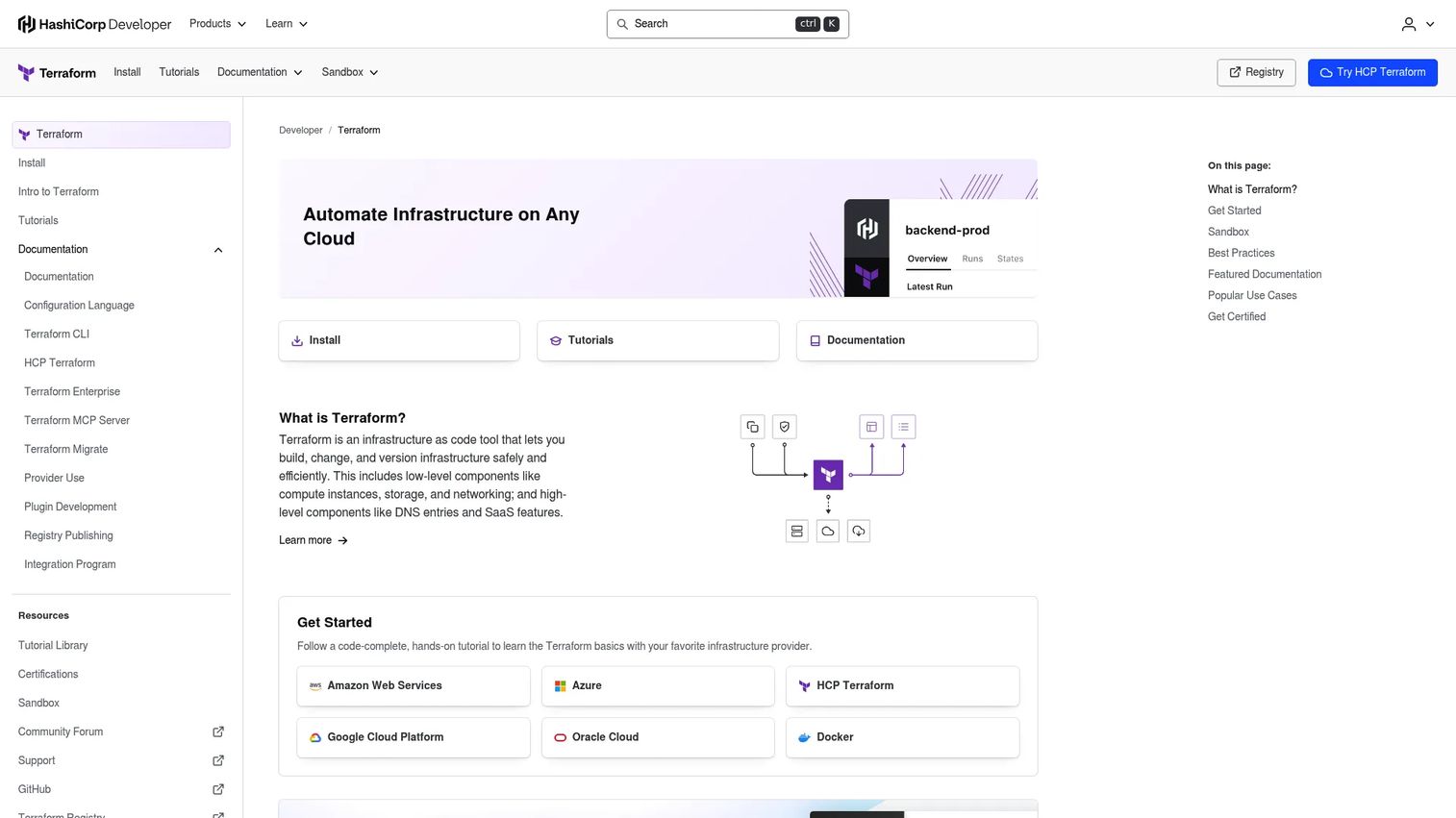
Terraform is the default general-purpose provisioning engine for most infrastructure teams. It uses HCL, a declarative configuration language, and a plan-and-apply workflow that shows you exactly what will change before it happens. A vast provider ecosystem covers the major clouds plus hundreds of SaaS and platform services, which is why Terraform still anchors so many IaC programs.
Best for: Teams standardizing multi-cloud provisioning and governance with a mature, widely adopted engine.
Key strengths
- Provider ecosystem: Manage almost any cloud or SaaS resource from one consistent workflow.
- Plan and apply: Preview every change before it lands, reducing surprises in production.
- Remote state and policy: Centralized state storage plus policy and security controls for team governance.
Why choose Terraform: If you want the safest default with the deepest hiring pool and the widest integration surface, Terraform is hard to beat. It fits presales conversations well because most prospects already recognize it, which shortens technical validation. The trade-off is that large estates eventually need an orchestration layer on top.
Terraform pricing: HCP Terraform lists Essentials starting at $0.10 per month per resource, Standard at $0.47, and Premium at $0.99 per month per resource. Enterprise is custom priced, and a free tier is available through the product page.
2. OpenTofu
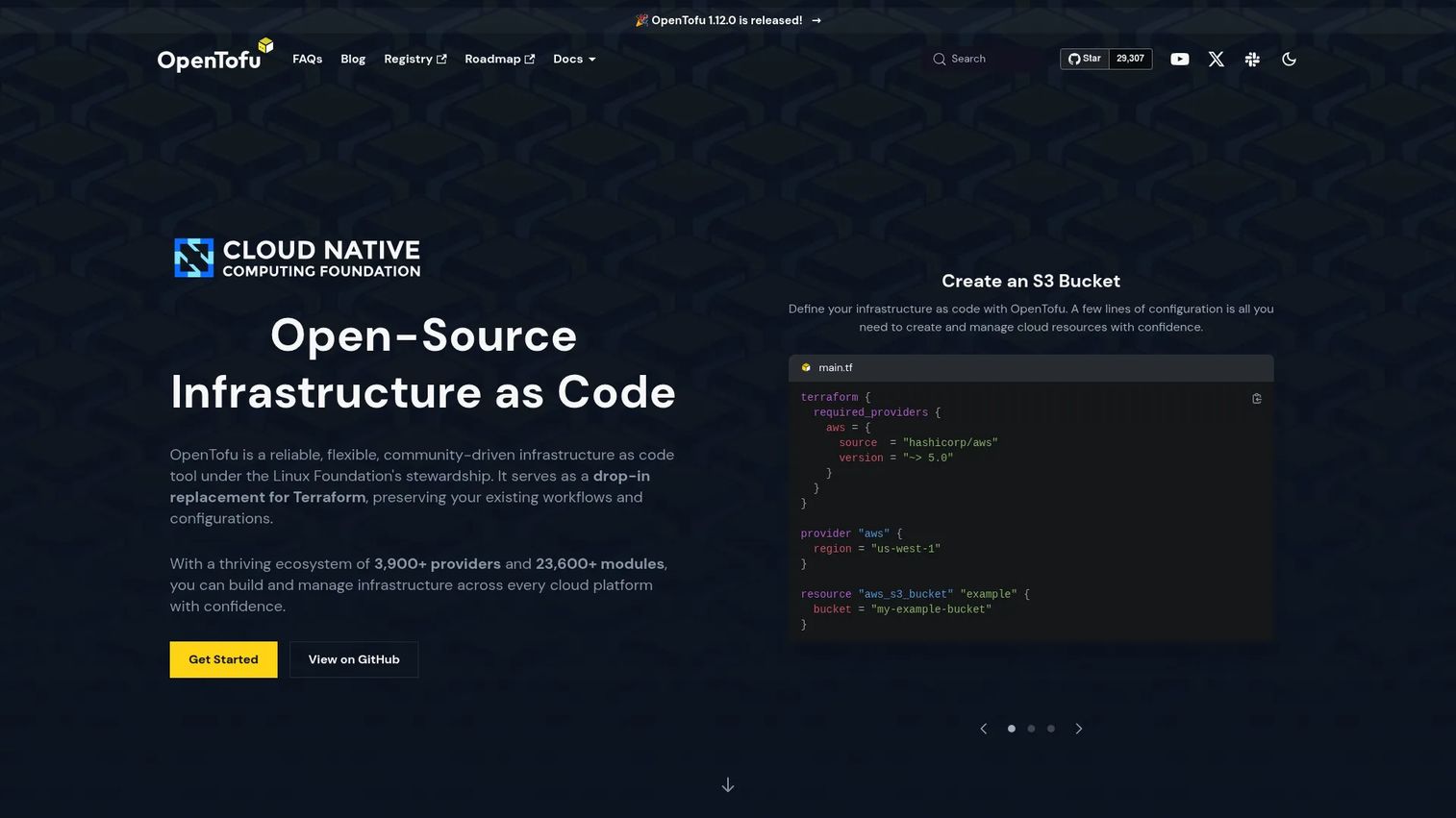
OpenTofu is the community-driven, open-source infrastructure as code engine for teams that want Terraform-style workflows under open governance. It ships a tofu CLI with the familiar init, validate, plan, apply, and destroy commands, so the day-to-day feels immediately familiar to anyone who has run Terraform.
Best for: Teams needing an open-source IaC engine compatible with existing Terraform-style workflows.
Key strengths
- Familiar CLI workflow: init, validate, plan, apply, and destroy mirror the workflow your team already knows.
- Built-in state management: State and plan encryption are handled natively.
- Open governance: A community-led license and roadmap reduce vendor lock-in concerns.
Why choose OpenTofu: For organizations that value an open license and a community roadmap, OpenTofu offers a low-friction path from Terraform-style configuration. Frame migration around compatibility and ecosystem parity when you evaluate it. Because it is an open-source project, there is no public pricing to weigh.
OpenTofu pricing: OpenTofu is an open-source project distributed through documentation and downloads. No public paid tiers were found.
3. Pulumi
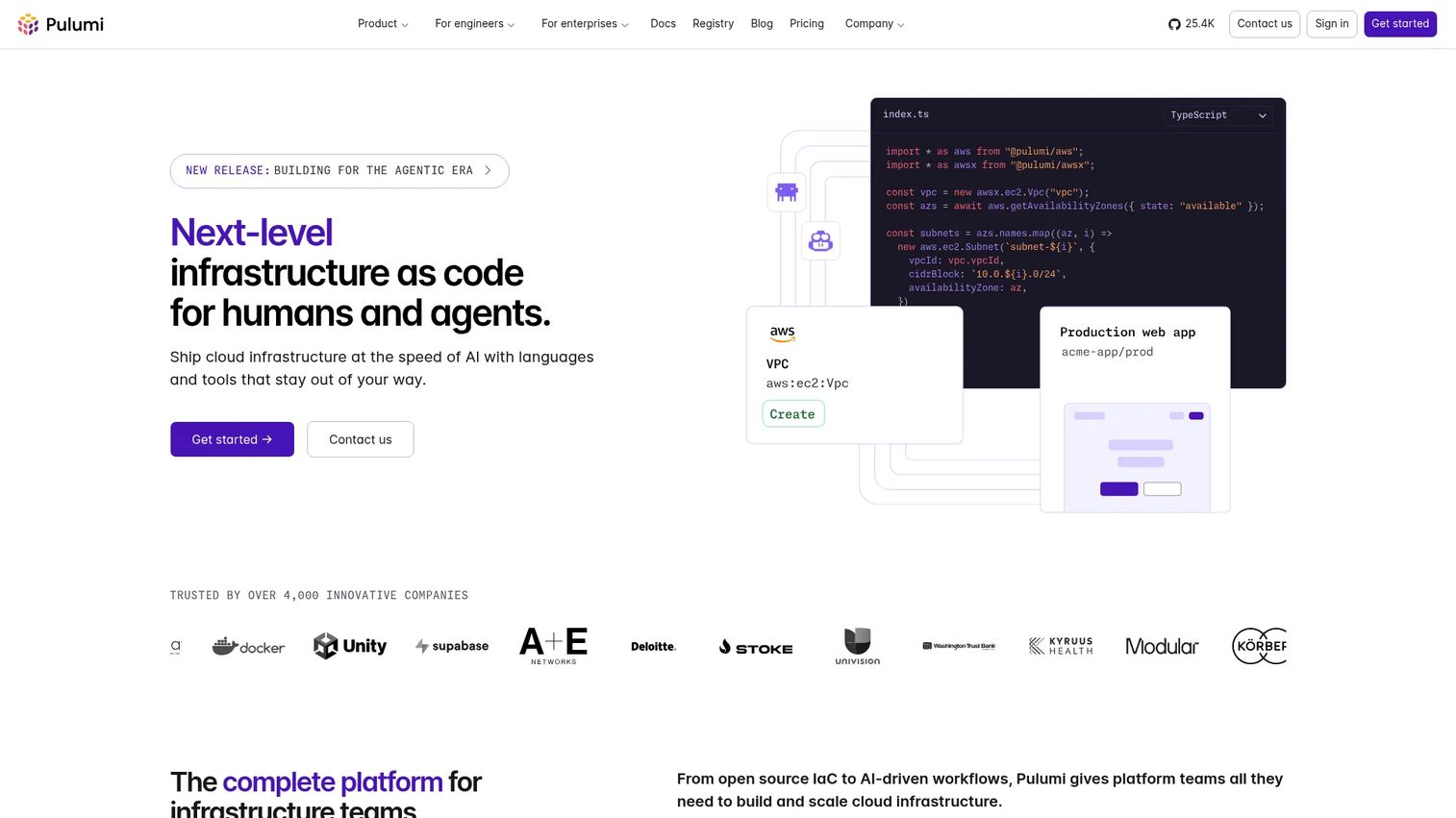
Pulumi lets teams define infrastructure in real programming languages like TypeScript, Python, Go, and C#. For developer-heavy organizations, that means loops, functions, unit tests, and shared libraries applied directly to infrastructure. Pulumi Cloud handles state, secrets, and deployments, with policy and governance controls layered on top.
Best for: Teams that want infrastructure as code in general-purpose programming languages with cloud governance.
Key strengths
- Multi-language authoring: Write infrastructure in the language your engineers already use.
- Pulumi Cloud: Managed state, secrets, and deployment orchestration in one place.
- Governance controls: Policy, compliance, and governance features for enterprise teams.
Why choose Pulumi: If your engineering team lives in code and finds a domain-specific language limiting, Pulumi removes the context switch. It suits multi-language teams that want to reuse existing testing and abstraction patterns. The consideration is that reviewers less familiar with code-based IaC may need onboarding.
Pulumi pricing: The Individual plan is free forever. Team starts at $40 per month, Enterprise at $400 per month, and Business Critical is custom priced.
4. AWS CloudFormation
AWS CloudFormation is the native infrastructure as code service for AWS. You model resources in JSON or YAML templates and let CloudFormation provision and manage them, along with supported third-party resources. Its tight coupling with AWS means new service features often land here first.
Best for: Teams standardizing AWS infrastructure provisioning and governance with templates and automation.
Key strengths
- Native AWS integration: Deep coverage of AWS services with first-party support.
- Change Sets and rollback: Preview changes and roll back safely on failure.
- Drift detection: Built-in drift detection flags out-of-band changes to your stacks.
Why choose CloudFormation: For AWS-only shops that want native service integration and AWS-specific governance, CloudFormation is the natural fit. It integrates with AWS CDK and SAM for higher-level authoring. The consideration is portability, since templates are AWS-specific by design.
CloudFormation pricing: There are no minimum fees. The free tier covers hook and third-party resource operations, with usage-based charges of $0.0009 per handler operation and $0.00008 per second above 30 seconds for extensions and custom hooks.
5. Azure Resource Manager (ARM)
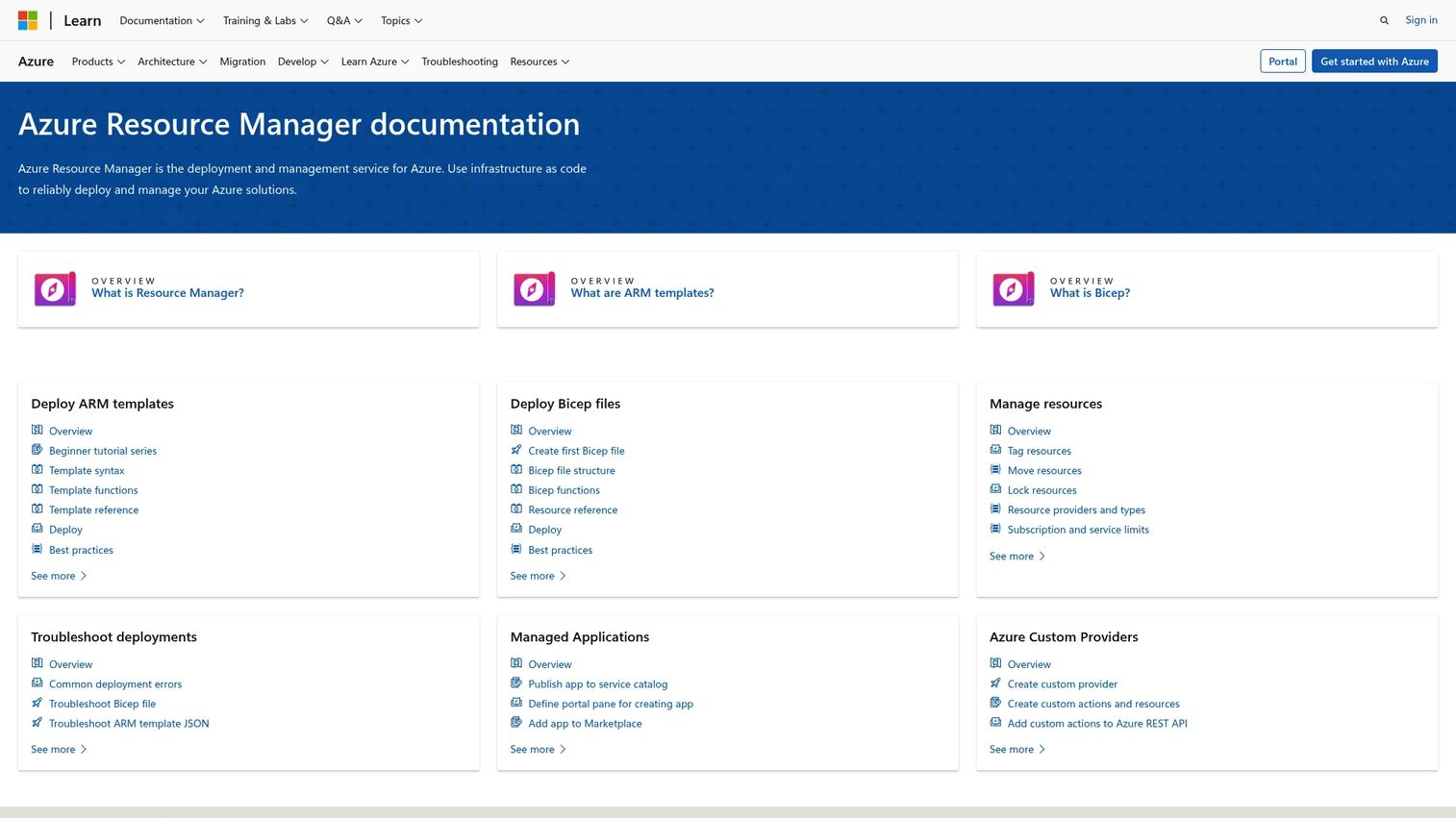
Azure Resource Manager is Microsoft Azure's native deployment and management service. It provides declarative templates, resource grouping, scoped management, and centralized governance for everything you run in Azure. If Azure is your primary cloud, ARM is the foundation the rest of your tooling builds on.
Best for: Teams managing Azure infrastructure with infrastructure as code and centralized governance.
Key strengths
- Declarative templates: Define Azure infrastructure as code with repeatable deployments.
- Resource grouping: Organize and manage resources by scope for cleaner governance.
- Access control and locks: Apply RBAC, resource locks, and tags for compliance.
Why choose ARM: For Azure-native teams, ARM delivers deep integration and the governance primitives security reviewers expect. It pairs naturally with Bicep for a cleaner authoring experience. The consideration is that raw ARM template syntax can be verbose, which is exactly what Bicep addresses.
ARM pricing: ARM is an Azure management service and is included with Azure. Microsoft does not list a standalone public price for it.
6. Bicep
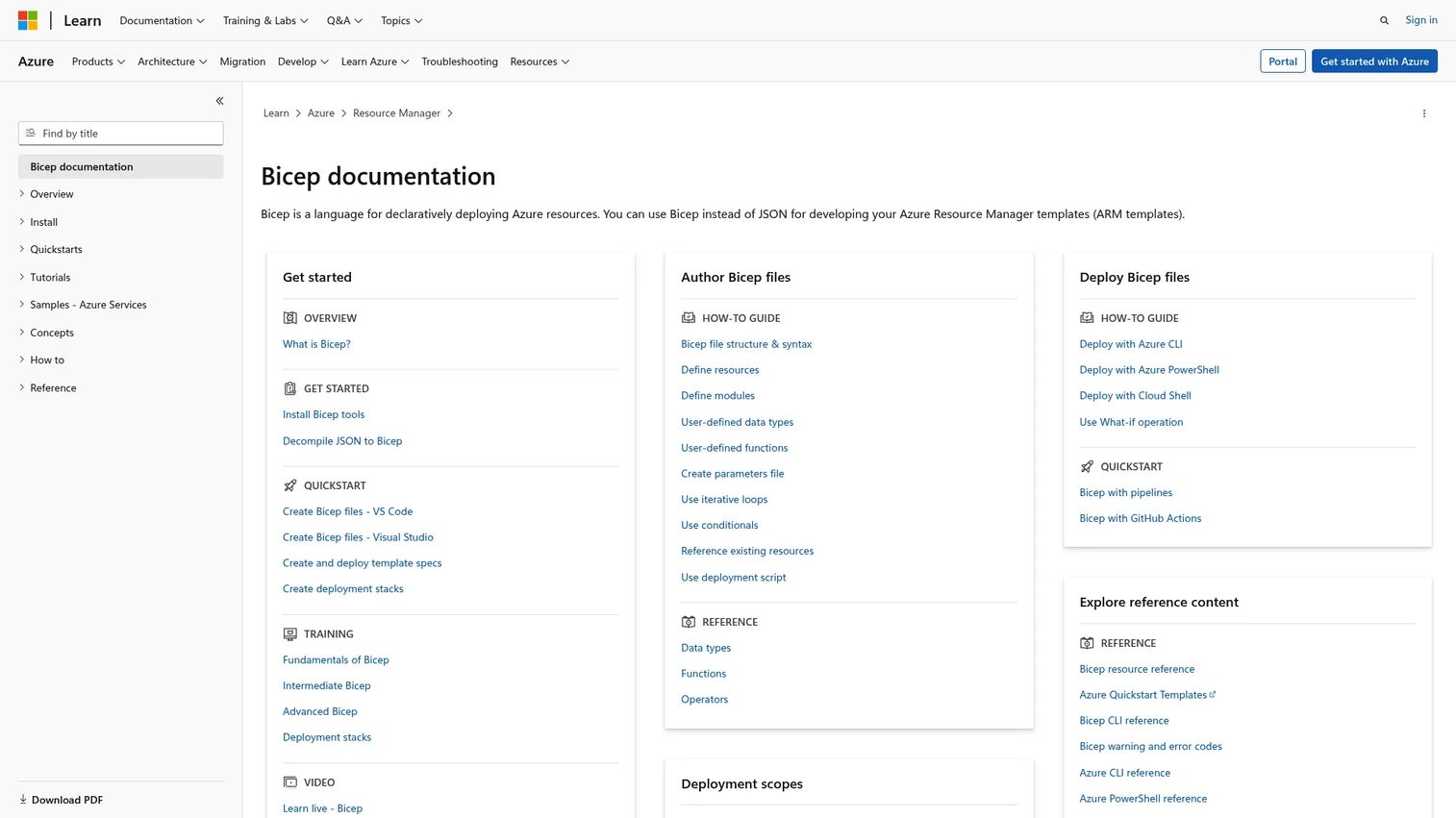
Bicep is a declarative language that compiles down to ARM templates, giving Azure teams a much cleaner authoring experience than raw JSON. It adds concise syntax, type safety, IntelliSense, modules, and what-if previews, while still producing standard ARM deployments under the hood.
Best for: Teams authoring Azure infrastructure as code deployments who want readable syntax.
Key strengths
- Concise syntax: Author Azure deployments with far less boilerplate than ARM JSON.
- Type safety and IntelliSense: Catch errors early with editor support.
- What-if previews: See exactly what a deployment will change before applying it.
Why choose Bicep: If you are committed to Azure and want maintainable IaC, Bicep is the natural authoring layer over ARM. Automatic dependency management and modules make large deployments easier to reason about. Because it is Azure-specific, it is not a multi-cloud tool.
Bicep pricing: Bicep is free and open source. There are no paid tiers.
7. Google Cloud Infrastructure Manager
Google Cloud Infrastructure Manager is Google Cloud's managed service for deploying and managing infrastructure with Terraform. It handles the deployment lifecycle and revision management, and it supports preview deployments so you can see planned changes before they apply.
Best for: Teams using Terraform on Google Cloud who want managed provisioning and lifecycle control.
Key strengths
- Terraform-based deployment: Use familiar Terraform configuration on a managed service.
- Lifecycle and revisions: Manage deployment revisions and history natively.
- Preview deployments: Inspect changes before applying them to live infrastructure.
Why choose Infrastructure Manager: For Google Cloud teams already using Terraform, this removes the burden of self-hosting state and execution. It fits GCP-centric organizations that want native lifecycle control in 2026. The consideration is that it is scoped to Google Cloud workflows.
Infrastructure Manager pricing: Google Cloud charges for the underlying Cloud Build execution and Cloud Storage used, rather than a standalone product price. Check the pricing page for current usage rates.
8. AWS Cloud Development Kit (CDK)
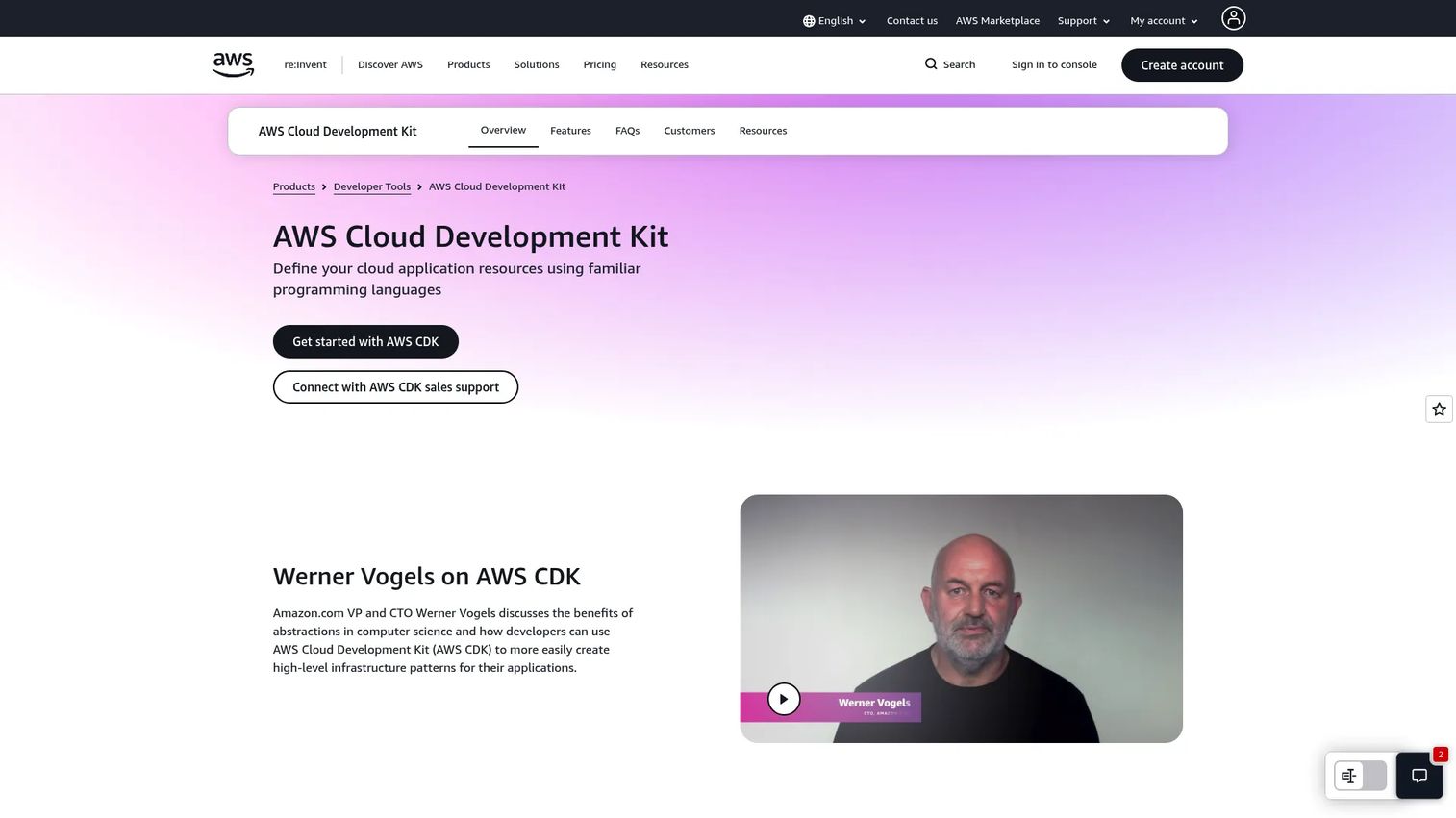
AWS Cloud Development Kit is an open-source framework for defining AWS infrastructure in familiar programming languages, then deploying through CloudFormation. Its construct library provides reusable, higher-level components so you write less boilerplate and compose infrastructure like software.
Best for: Teams building AWS infrastructure as code with a programming-language-first workflow.
Key strengths
- Construct library: Reusable components abstract common AWS infrastructure patterns.
- Multi-language support: Write in TypeScript, Python, Java, C#, or Go.
- CloudFormation deployment: Deploys through CloudFormation for reliable provisioning.
Why choose AWS CDK: When your team prefers general-purpose language support and reusable constructs over raw templates, CDK is the code-first path on AWS. It suits engineering teams that want abstraction and type checking. Like CloudFormation, its output is AWS-specific.
AWS CDK pricing: AWS CDK is open source. There is no separate charge for the framework; you pay for the AWS resources you deploy.
9. CDK for Terraform (CDKTF)
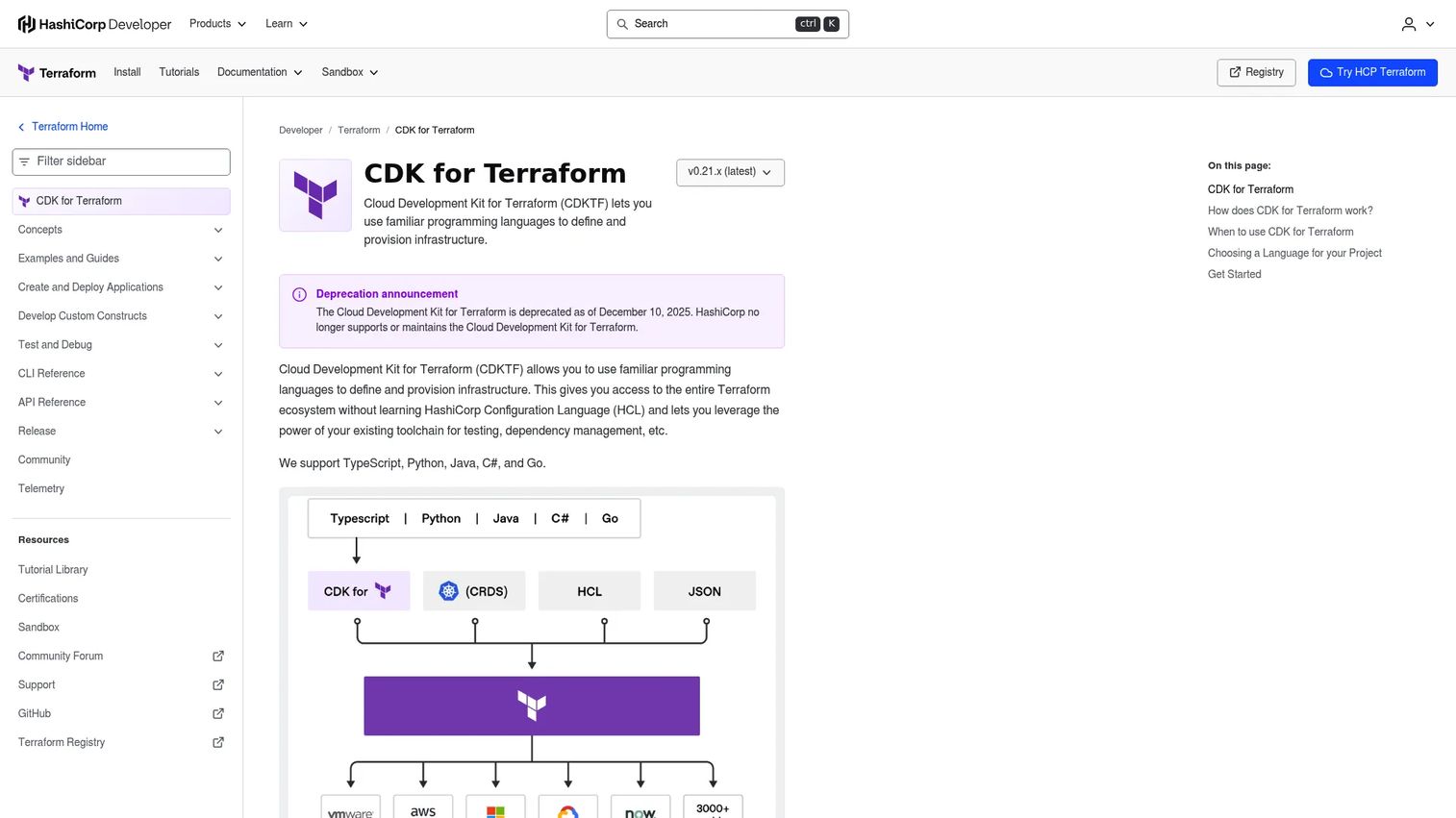
CDK for Terraform bridges familiar programming languages and Terraform providers, letting you author infrastructure in TypeScript, Python, Java, C#, or Go while tapping the full Terraform provider ecosystem. It generates Terraform configuration from your code and works with Terraform modules, HCP Terraform, and Sentinel.
Best for: Teams that want Terraform's ecosystem with code-first authoring.
Key strengths
- Terraform provider access: Reach the full provider ecosystem from general-purpose code.
- Multi-language authoring: Write in the language your team already knows.
- Ecosystem compatibility: Works with Terraform modules, HCP Terraform, and Sentinel policy.
Why choose CDKTF: For teams that love code-first authoring but want Terraform's provider breadth, CDKTF is the connective tissue. Note that HashiCorp has marked CDKTF as deprecated as of December 2025, so evaluate it with that roadmap status in mind and confirm long-term support before adopting it for new work.
CDKTF pricing: No standalone CDKTF pricing is published. It works within the Terraform ecosystem and any associated HCP Terraform plan.
10. Crossplane
Crossplane is an open-source control plane framework for platform engineering. It lets you build custom control planes and APIs, then manage cloud infrastructure and cloud-native software directly from Kubernetes using its reconciliation model. Composition and managed resources let platform teams offer opinionated, self-serve infrastructure abstractions.
Best for: Teams building internal platform APIs and control planes on Kubernetes.
Key strengths
- Custom control planes: Build platform APIs tailored to your organization.
- Kubernetes-native reconciliation: Continuously reconcile infrastructure to desired state.
- Composition and packages: Compose reusable abstractions with a package manager.
Why choose Crossplane: If you already run Kubernetes and want a control plane that continuously reconciles infrastructure like it reconciles workloads, Crossplane fits the platform engineering pattern. It suits teams building an internal developer platform. The consideration is that it assumes Kubernetes familiarity.
Crossplane pricing: Crossplane is an open-source, community-driven project. No public pricing is listed on the project site.
11. Ansible
Ansible is an agentless configuration management and automation technology, offered at scale as Red Hat's Ansible Automation Platform. It uses YAML playbooks to configure systems, deploy applications, and handle day 2 operations, often working alongside a provisioning engine rather than replacing it.
Best for: Teams that need enterprise-grade infrastructure, network, and application automation at scale.
Key strengths
- Agentless automation: Manage systems over SSH without installing agents.
- YAML playbooks: Describe configuration in readable, version-controlled files.
- Platform tooling: Controller, automation hub, analytics, and Event-Driven Ansible for enterprise scale.
Why choose Ansible: When your challenge is configuring machines, deploying apps, and automating day 2 tasks rather than provisioning cloud resources, Ansible shines. It pairs naturally with Terraform: provision with one, configure with the other. Pricing is quote-based, which suits enterprise procurement but requires a sales conversation.
Ansible pricing: Red Hat lists Standard and Premium subscription tiers. Pricing varies by sizing, so the pricing page directs you to contact Red Hat or a partner for a customized quote.
12. Chef
Chef is a configuration management and DevOps automation platform with a long history in policy-driven infrastructure. It handles infrastructure management automation, orchestration, auditing, and compliance, making it a fit for teams that want cookbook-driven automation with strong governance workflows.
Best for: Organizations needing automated infrastructure management with compliance controls.
Key strengths
- Infrastructure automation: Codify and enforce system configuration at scale.
- Orchestration and auditing: Coordinate changes with built-in auditing.
- Compliance support: Security and compliance features built into the platform.
Why choose Chef: For teams that want mature configuration management with compliance baked in, Chef's cookbook model provides repeatable, auditable automation. It suits regulated environments with long-lived infrastructure. The consideration is that the cookbook approach has a learning curve for newer teams.
Chef pricing: The Business plan is $59 per node per year and Enterprise is $189 per node per year. Enterprise Plus requires a customized quote, with Cloud and Self-Managed views available.
13. SaltStack
SaltStack is an open-source automation, configuration management, and remote execution platform built for speed at scale. Its remote execution model lets you run commands and enforce state across large fleets quickly, which is why it fits big systems management and operational automation.
Best for: Teams needing scalable infrastructure automation and configuration management.
Key strengths
- Remote execution: Run commands across large fleets fast.
- Salt States: Enforce desired configuration declaratively.
- Automation and orchestration: Coordinate complex operational workflows at scale.
Why choose SaltStack: When operational automation, speed, and large-scale remote execution matter most, SaltStack is built for that pattern. It suits teams managing thousands of nodes that need fast, event-driven control. Salt is now integrated into Tanzu Salt, so factor that in when planning long-term support.
SaltStack pricing: No first-party public pricing was verified during this research. Salt is available as an open-source project, with commercial options through Tanzu Salt.
14. Puppet
Puppet is a mature infrastructure automation platform built around desired-state configuration management. It enforces configuration, compliance, and operational state across servers, cloud, network, and edge, making it a strong fit for enterprise governance and long-lived fleet management.
Best for: Teams needing enterprise-grade infrastructure automation and compliance control.
Key strengths
- Desired-state model: Continuously enforce the configuration you declare.
- Compliance enforcement: Security and compliance controls built in.
- Broad reach: Automate across servers, cloud, network, and edge.
Why choose Puppet: For large, long-lived fleets where enterprise governance and compliance are paramount, Puppet's desired-state model keeps configuration consistent over years. It suits organizations with mature operations. Most paid plans are custom priced, so budgeting requires a sales conversation.
Puppet pricing: Puppet lists Core, Enterprise, and Advanced plans. The Core Developer plan is free, while Core Commercial, Enterprise, and Advanced are custom priced through sales.
15. Spacelift
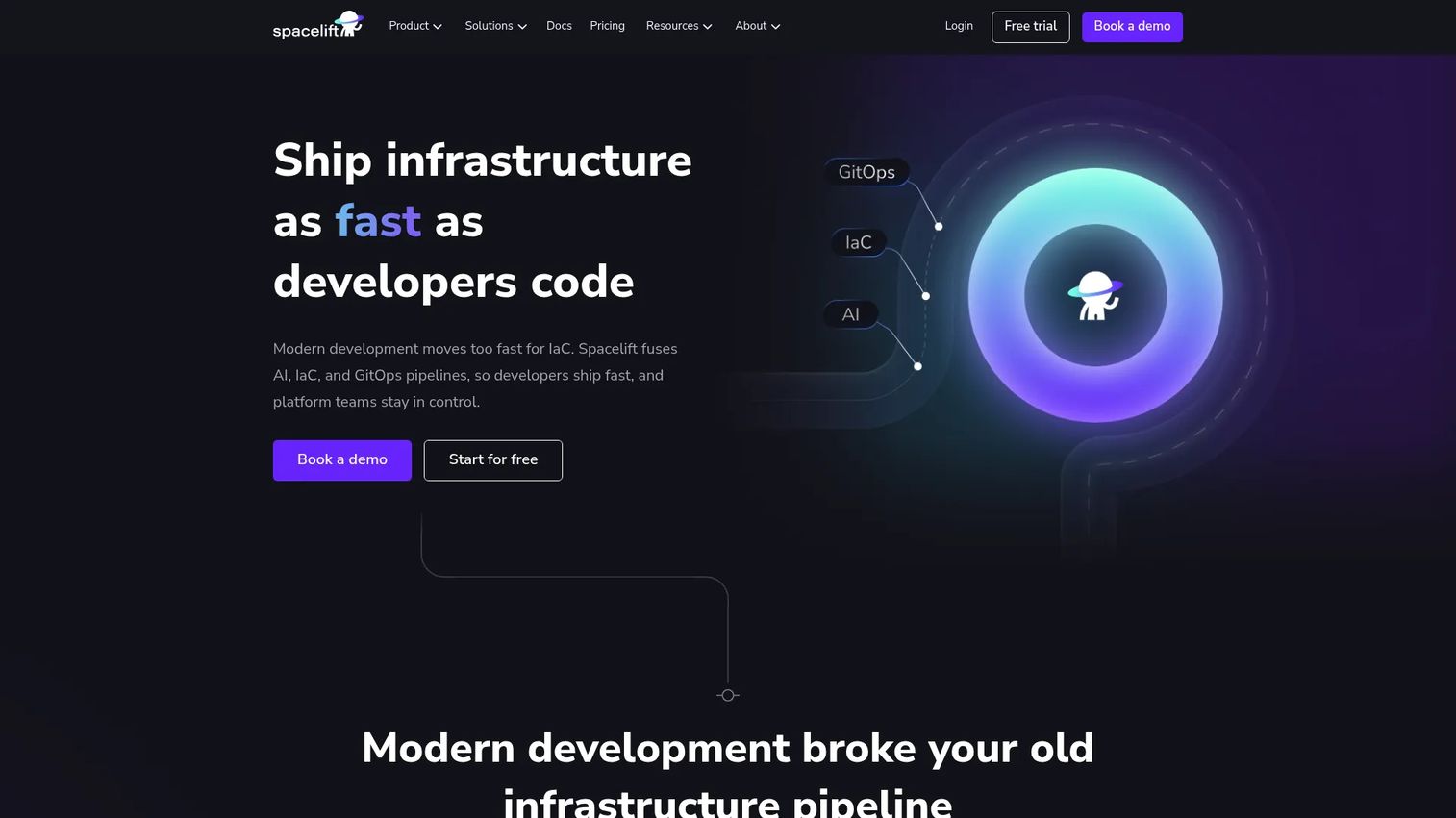
Spacelift is an infrastructure as code orchestration and governance platform that sits on top of multiple IaC engines, including Terraform and OpenTofu. It adds policy as code, stack dependencies, drift detection, approvals, and cost estimation, turning a collection of IaC runs into a governed, collaborative workflow.
Best for: Teams managing Terraform, OpenTofu, and other IaC workflows with governance and collaboration needs.
Key strengths
- IaC orchestration: Coordinate state and runs across multiple engines.
- Policy as code: Enforce governance rules automatically before changes apply.
- Drift detection and cost: Catch drift and estimate cost impact before approval.
Why choose Spacelift: When your Terraform or OpenTofu estate grows past what raw CLI workflows can safely handle, Spacelift adds the governance layer. It fits teams that need approvals, policy enforcement, and drift detection across many stacks. Its entry paid tier targets teams ready to invest in orchestration.
Spacelift pricing: A free plan is available for small teams. Starter + is $20,000 per year with unlimited users and public workers. Business, Enterprise, and Enterprise + are quote-based and add private workers, governance, and self-hosted options.
16. Terragrunt
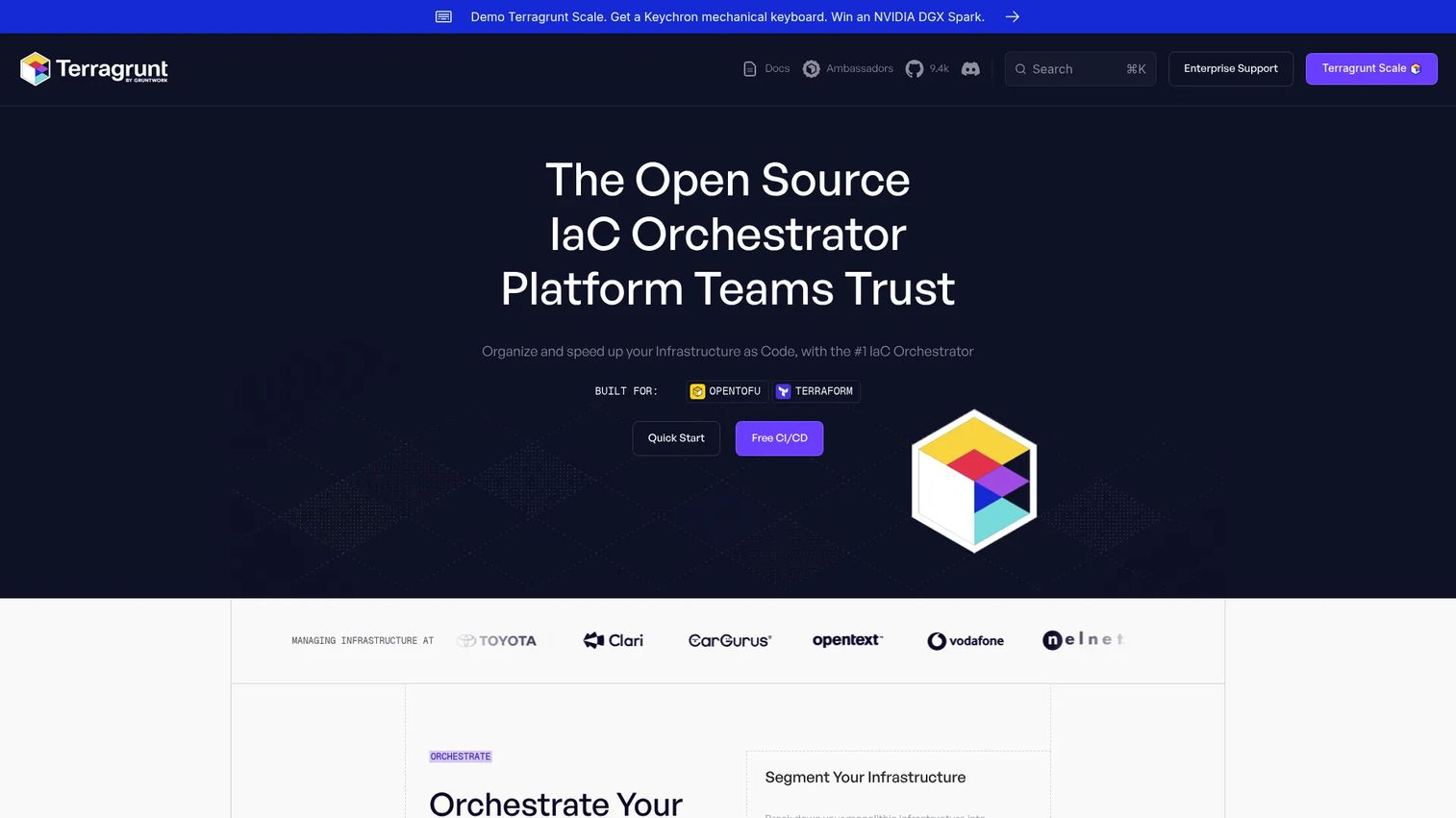
Terragrunt is an open-source orchestrator for Terraform and OpenTofu that helps large estates stay DRY and manageable. It segments infrastructure into independently updatable units, controls run order with a run queue, and adds hooks, error handling, feature flags, includes, and stacks.
Best for: Platform teams managing multi-environment Terraform and OpenTofu infrastructure at scale.
Key strengths
- Infrastructure units: Segment infrastructure into independently updatable pieces.
- Run queue control: Manage what updates and in what order.
- DRY configuration: Reduce duplication across environments with includes and stacks.
Why choose Terragrunt: When a growing Terraform estate becomes hard to keep DRY and coordinate, Terragrunt adds the structure to manage dependencies and environments cleanly. It suits platform teams running many modules across many environments. Adopting it means committing to its conventions.
Terragrunt pricing: Free Forever includes up to 25 infrastructure units. The Team plan starts at $500 per month for 200 units, and Enterprise is custom priced.
17. Checkov
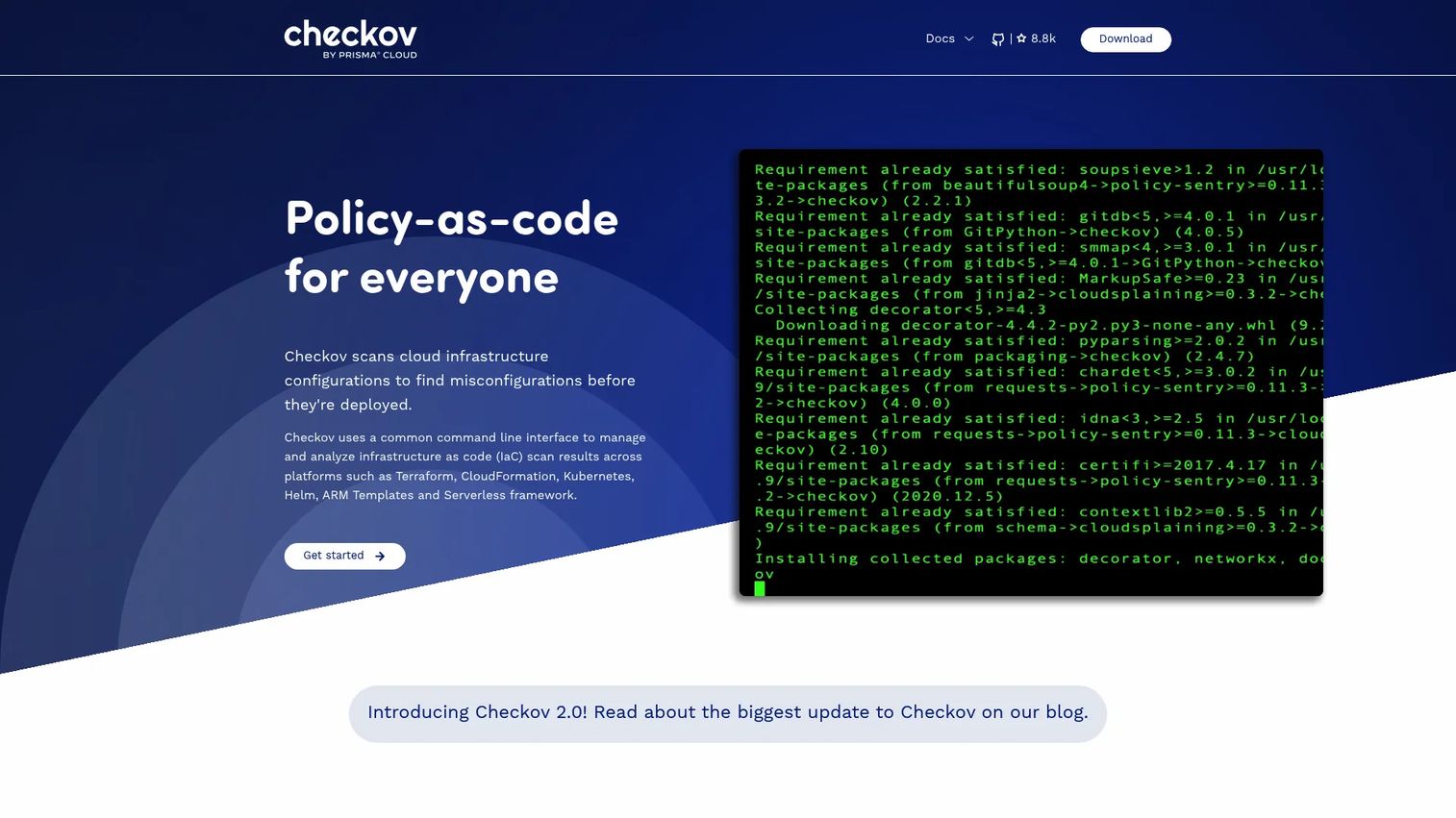
Checkov is an open-source policy-as-code and IaC security scanning tool that catches misconfigurations before they ship. It scans Terraform, CloudFormation, Kubernetes, Helm, ARM templates, Serverless, AWS CDK, and Docker, and it plugs into CI/CD so problems surface at pull-request time rather than in production.
Best for: Teams needing IaC misconfiguration scanning in CI/CD pipelines.
Key strengths
- Broad framework coverage: Scan Terraform, CloudFormation, Kubernetes, ARM, CDK, and more.
- Custom policies: Write attribute-based and graph-based custom policy checks.
- CI/CD integration: Catch misconfigurations, secrets, and vulnerabilities in the pipeline.
Why choose Checkov: When you want to shift security left and catch policy violations before deployment, Checkov slots directly into your existing pipeline. It suits any team that treats security as a gate rather than an afterthought. It complements, rather than replaces, your provisioning and orchestration tools.
Checkov pricing: Checkov is open source. No public pricing figure was found on the project site.
Considerations
Before you commit, run any shortlist through this checklist.
Provisioning model fit
Match the language model to your team. HCL and declarative tools favor readability and diffs. Code-first tools favor engineering teams that want testing and abstraction. Pick the model your team can maintain for years, not the one that looks best in a demo.
Cloud scope and lock-in
Decide how much portability you actually need. Native tools give you the deepest integration with one cloud. Cloud-agnostic engines give you one workflow across many. Be honest about whether multi-cloud is a real requirement or an aspiration.
Governance and security
Verify policy as code, RBAC, audit logs, secrets handling, and state protection. These are exactly what a security reviewer probes, so evaluating them early smooths procurement. This connects to broader disciplines like contract management and audit management in regulated environments.
Drift and operational control
Confirm how the tool detects drift, remediates it, and gates changes with approvals. Day 2 operations decide whether your infrastructure automation actually reduces surprises or just moves them around.
Conclusion
The right IaC tool depends on the job, not the leaderboard. For general-purpose provisioning, Terraform and OpenTofu anchor most stacks, with Pulumi for teams that prefer real programming languages. For a single cloud, reach for the native option: CloudFormation and CDK on AWS, ARM and Bicep on Azure, Infrastructure Manager on Google Cloud. For configuration management, Ansible, Chef, Puppet, and SaltStack handle day 2 automation and compliance. For governance and control, Spacelift and Terragrunt orchestrate at scale, Crossplane brings a Kubernetes control plane, and Checkov scans for misconfigurations before they ship.
The practical next step is simple: pilot one provisioning engine plus one governance or scanning layer. Prove the workflow on a single environment, measure how much drift and manual work it removes, then expand. That pairing, provisioning plus governance, is what turns IaC from a script pile into a system your team and your prospects can trust.
FAQs
Provisioning creates and manages infrastructure resources like virtual machines, networks, and managed services. Configuration management installs software, manages files, and enforces state on machines that already exist. Many teams use both: a provisioning engine like Terraform stands up the resources, then a configuration management tool like Ansible configures what runs on them.
Terraform is the most common choice for multi-cloud infrastructure because of its broad provider ecosystem and consistent workflow. OpenTofu offers the same style under open governance. Pulumi suits teams that prefer general-purpose languages across clouds, and Crossplane fits organizations that want a Kubernetes control plane spanning multiple providers.
For AWS-only teams, CloudFormation is the native default with the deepest service integration. AWS CDK adds a code-first layer over CloudFormation for engineering teams. Terraform remains popular for AWS even in single-cloud setups thanks to its ecosystem, and CDK for Terraform bridges code-first authoring with Terraform providers.
Policy as code lets you encode governance rules that run automatically before changes apply, blocking non-compliant infrastructure at review time. Drift detection compares live infrastructure against your declared state to catch out-of-band changes. Together with approval workflows, they turn IaC into an enforceable change-control system rather than just an automation script.
Choose native tools like CloudFormation, ARM, or Infrastructure Manager when you live in one cloud and want the deepest integration and earliest access to new service features. Choose cloud-agnostic tools like Terraform, OpenTofu, or Pulumi when you run multiple clouds or want one workflow and governance model across them. Be honest about whether multi-cloud is a current requirement.
Ansible is primarily a configuration management and automation tool, though it can provision some resources too. It excels at configuring systems, deploying applications, and handling day 2 operations. Most teams pair it with a dedicated provisioning engine like Terraform, using each for what it does best rather than forcing one tool to cover both jobs.
Check for role-based access control, state security and encryption, audit logs, secrets handling, and policy enforcement. Confirm the tool integrates with your CI/CD pipeline and supports approval workflows for changes. A scanner like Checkov adds a compliance gate that catches misconfigurations before deployment, which is often what security reviewers want to see.
Focus on technical validation questions that surface real fit: how the tool handles state and drift, what governance and policy controls exist, which clouds and services it covers, and how it integrates with the existing stack. Ask stakeholders about compliance and audit requirements early, and define proof-of-value criteria such as reduced drift, faster provisioning, and cleaner change control before running a pilot.