Health plans are not buying payer software because they want another platform. They are buying it because claims queues, prior authorization, member service, provider data, and quality reporting keep pulling teams into manual work that compounds over time.
The scale of that drag is real. According to the CAQH Index (2025), automating remaining manual administrative transactions could unlock more than $20 billion in annual savings across U.S. healthcare. Electronic prior authorization adoption among U.S. medical plans sat at only 40% in 2025, while electronic claims-payment adoption reached 78%. The gap between what payers can automate and what they have automated is still wide.
The right healthcare payer software is not a single thing. Core administration, claims adjudication, care management, analytics, and member engagement are different jobs. Picking the wrong platform for the wrong layer is an expensive mistake. This guide maps the market so you can find where your operating bottleneck actually sits before booking a single demo.
What's inside
This guide compares 14 healthcare payer software platforms for 2026 across claims, payer administration, care management, analytics, and member experience.
- Vendors were selected based on SERP coverage, payer category relevance, claims and administration fit, and healthcare-specific workflow depth
- The comparison prioritizes operating fit, interoperability, automation support, implementation risk, and buyer use case
- Pricing and G2 ratings are drawn from vendor pricing pages and live G2 listings; most payer platforms use enterprise contracts, so pricing rows reflect what is verifiable
- This guide suits payer operations leaders, health plan IT buyers, and founders or operators mapping the healthcare payer software market as part of a build-partner-buy evaluation
TL;DR
- Best for CRM-led payer administration: Salesforce Health Cloud suits organizations that want member engagement, provider workflows, and CRM data in one operating layer
- Best for core claims and administration: Cognizant TriZetto (Facets, QNXT) and HealthEdge HealthRules cover claims adjudication at health-plan scale
- Best for payer analytics and value-based care: Arcadia unifies clinical, claims, and operational data for population health and risk adjustment
- Best for care management workflows: ZeOmega Jiva and Medecision Aerial cover utilization management, care coordination, and member risk
- Best for government program administration: Gainwell Technologies and Conduent HSP MediTrac are built for Medicaid and public-sector payer environments
- Best for provider-sponsored plans: Epic Tapestry is the natural fit when the payer operation sits inside an Epic-centered health system
What is healthcare payer software?
Healthcare payer software is technology that health plans, TPAs, government programs, and risk-bearing healthcare organizations use to administer benefits, process claims, manage members and providers, coordinate care, automate approvals, and measure financial and clinical performance.
The category spans several distinct layers, and understanding which layer you need is the first decision a buyer has to make.
Core payer workflows
Healthcare payer software supports the operating engine behind health insurance. At the core sits claims intake, adjudication, payment, and appeals. Layered on top are member enrollment and eligibility, benefits configuration, prior authorization, provider network contracting and credentialing, care management, utilization review, and quality reporting.
Each workflow touches a different team. Claims operations teams own adjudication accuracy and payment speed. Care management teams run utilization review and population health programs. Provider relations teams manage network directories and rosters. Analytics teams handle risk adjustment, Star Ratings, and CMS reporting. Few platforms cover all of these equally well.
Key capabilities to look for
- Claims adjudication and auto-adjudication rates
- Benefit configuration and rules management
- Member enrollment and eligibility
- Provider data management and directory accuracy
- Prior authorization workflows and automation
- Care management and utilization management
- Quality reporting and risk adjustment analytics
- FHIR and HL7 interoperability
- AI-assisted workflow automation for administrative tasks
Where payer software fits in the stack
Healthcare payer software can mean a core administration system, a claims processing engine, a care management tool, an analytics platform, a provider network application, or a CRM-style member engagement layer. Vendors frequently market across multiple layers, but their actual depth varies. Treat vendor descriptions of "full-suite" coverage as a due diligence prompt, not a purchasing signal.
When to use healthcare payer software
Modernize claims and administration
Core admin systems matter when claims backlogs, manual benefit configuration, payment accuracy issues, or adjudication speed create operating drag. Healthcare claims processing software that supports real-time adjudication and configurable benefit rules can reduce manual workarounds significantly. If your team is rebuilding claim edits by hand or waiting days for payment runs, that is where to start.
Connect member, provider, and care data
A connected payer platform becomes critical when data lives across member service, provider network, care management, utilization management, and analytics tools without a shared record. Interoperability through FHIR APIs and HL7 interfaces reduces the cost of moving data between systems. Buyers who cannot answer "where does a member's care plan live relative to their claims history" need this layer addressed before adding more workflow tools.
Reduce manual work in regulated payer workflows
Prior authorization, appeals and grievances, utilization review, CMS reporting, audit trails, and quality measure tracking all carry regulatory deadlines. Healthcare claims management software that automates these workflows reduces compliance risk and frees clinical staff for higher-value work. Frame this as operational control, not technology modernization, when building the internal business case.
Healthcare payer software comparison
Healthcare payer software is not one uniform category. Some platforms are core administration systems; others specialize in analytics, care management, member engagement, or government program operations. The table below treats each vendor's primary strength honestly. Pricing reflects enterprise contract models for most vendors, so contact sales figures are common. G2 ratings are drawn from live listings where available.
| # | Product | Best for | Key use case | Pricing | G2 rating |
|---|---|---|---|---|---|
| 1 | Salesforce Health Cloud | CRM-led payer administration | Member engagement, provider workflows, prior auth | From $350/user/month (annual) | 4.0/5 |
| 2 | Cognizant TriZetto | Core claims and administration | Facets/QNXT claims adjudication, enrollment | Custom pricing | N/A |
| 3 | HealthEdge HealthRules | Configurable core admin | Claims processing, benefit rules configuration | Custom pricing | 4.3/5 |
| 4 | Arcadia | Payer analytics and value-based care | Population health, risk adjustment, quality | Custom pricing | N/A |
| 5 | ZeOmega Jiva | Care management workflows | Utilization management, prior auth, case management | Custom pricing | 4.0/5 |
| 6 | Medecision Aerial | Population health management | Care coordination, utilization, member risk | Custom pricing | N/A |
| 7 | Gainwell Technologies | Government program administration | Medicaid claims, enrollment, program management | Custom pricing | N/A |
| 8 | EXL CareRadius | Care management with analytics | Utilization management, population health | Custom pricing | N/A |
| 9 | Elligint Health HELIOS | Medical management operations | Care and utilization workflows, prior auth | Custom pricing | N/A |
| 10 | Chordline ACUITYnxt | Managed care organizations | Utilization review, care management, appeals | Custom pricing | N/A |
| 11 | SS&C CareSpace | Enterprise payer workflows | Care management, population health | Custom pricing | N/A |
| 12 | athenahealth athenaIDX Financial Risk Manager | Financial risk management | Risk-based arrangements, revenue cycle | Custom pricing | N/A |
| 13 | Conduent HSP MediTrac | Claims and health plan administration | Claims processing, member and provider portals | Custom pricing | 3.5/5 |
| 14 | Epic Tapestry | Provider-sponsored health plans | Managed care administration, Epic integration | Custom pricing | N/A |
Best healthcare payer software for 2026
1. Salesforce Health Cloud
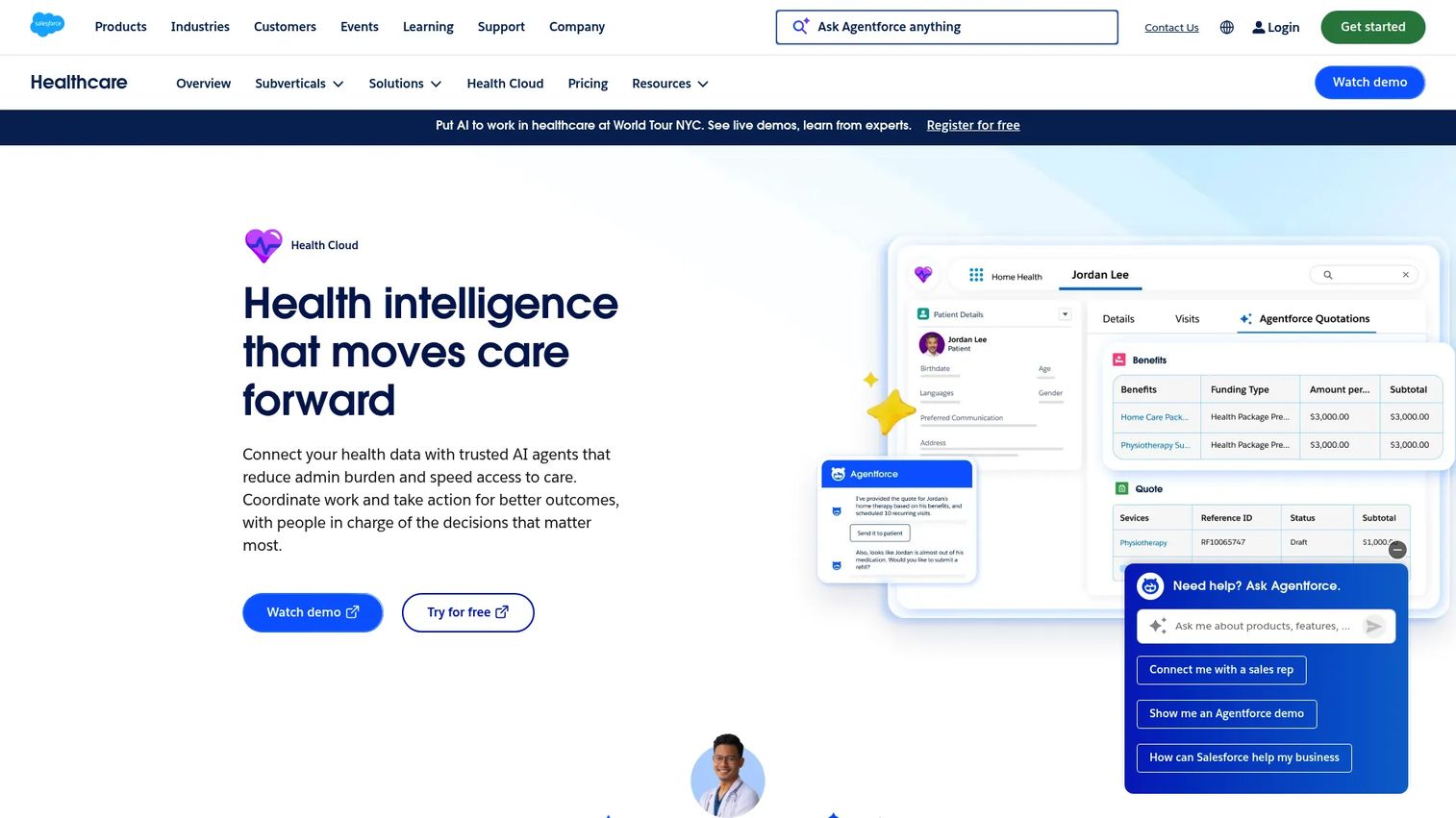
Salesforce Health Cloud is a healthcare CRM platform that connects member data, care workflows, provider networks, and engagement across a single operating layer. It supports payer organizations that want to manage member service, prior authorization, provider relationships, and analytics inside the Salesforce environment. The platform includes Agentforce for healthcare, which adds AI-driven workflow automation for administrative tasks including service routing and care gap identification.
Best for: Health plans that need member engagement, provider network management, and CRM-led payer administration in one system, particularly those already running Salesforce elsewhere in the business.
Key features
- Member 360 profiles with clinical and insurance data
- Provider network management and credentialing workflows
- Prior authorization and utilization management support
- FHIR API connectivity for interoperability
- Agentforce AI agents for healthcare service automation
Why choose Salesforce Health Cloud: Choose it when payer workflows depend on member, provider, and broker data across service and sales teams. It is a stronger fit as an engagement and administration layer than as a pure claims adjudication engine, so evaluate it alongside a dedicated claims system if adjudication accuracy is the primary bottleneck.
Salesforce Health Cloud pricing: Plans run from $350 per user per month for Health Cloud Sales and Service Core, up to $725 per user per month for the combined Sales and Service Max edition, all billed annually. A 30-day trial is available on the pricing page.
G2 rating: 4.0/5
2. Cognizant TriZetto
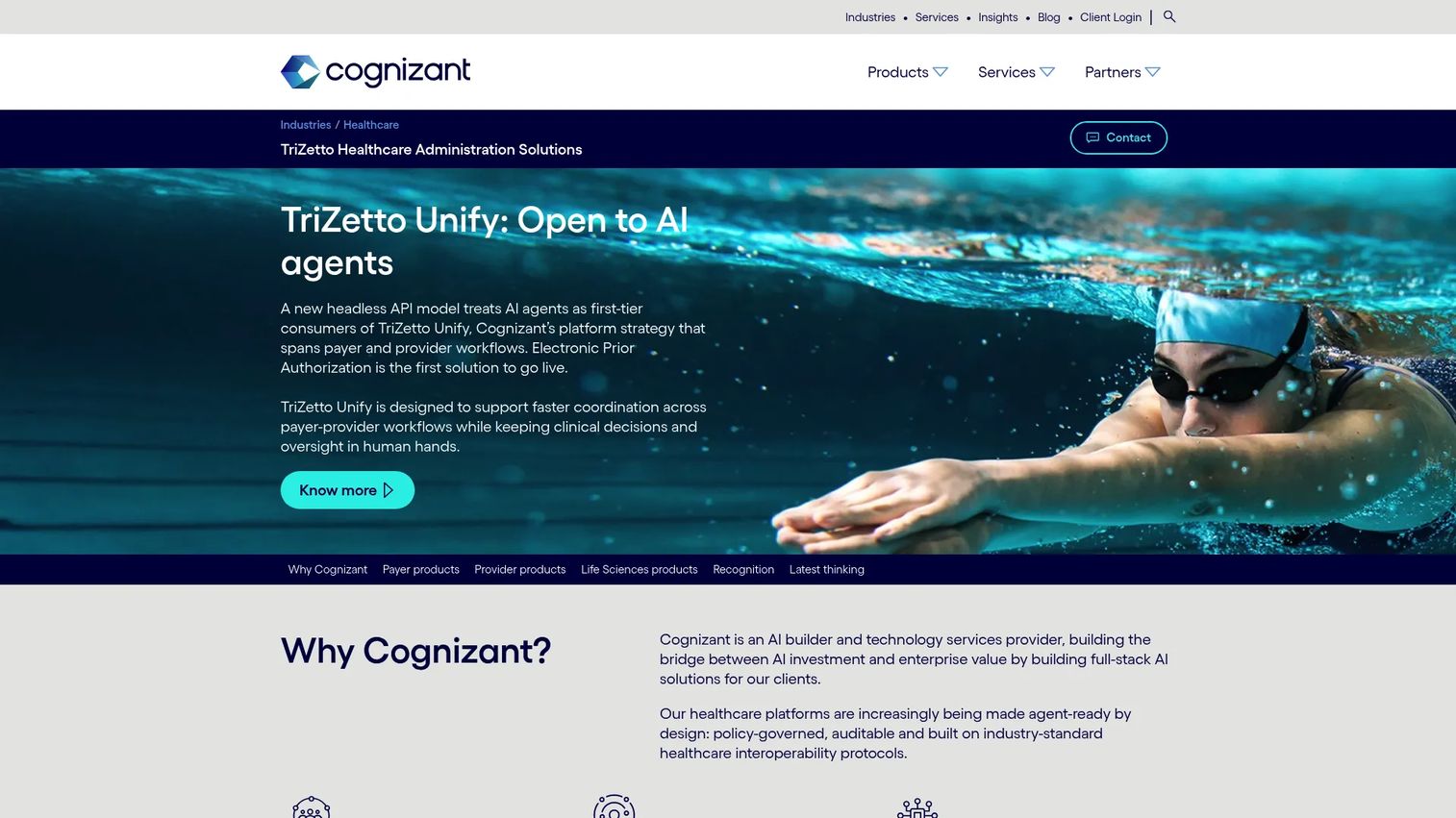
Cognizant TriZetto provides a broad portfolio of payer technology products including Facets and QNXT for core administration, TriZetto Unify for interoperability, and EngageMember and EngageProvider for member and provider portals. The platform covers claims adjudication, enrollment administration, benefit configuration, provider reimbursement, and care management. It is one of the most widely deployed healthcare payer administration software stacks among established commercial health plans.
Best for: Large health plans and established payer organizations modernizing core claims and administration infrastructure where scale and depth of adjudication logic matter.
Key features
- Core administration through Facets and QNXT
- Interoperability through TriZetto Unify
- Member and provider portals (EngageMember, EngageProvider)
- Provider reimbursement tools including NetworX Modeler and NetworX Pricer
- Medicare and Medicaid enrollment, encounter, and risk-score administration
Why choose Cognizant TriZetto: Best fit when claims and administration sit at the center of a modernization program. Evaluate implementation depth carefully because a Facets or QNXT replacement touches every team in the payer organization, and migration timelines for core admin systems run long.
Cognizant TriZetto pricing: Pricing is handled through enterprise contracts. Contact Cognizant directly for scope and commercial terms.
3. HealthEdge HealthRules
HealthEdge offers HealthRules Edge (formerly HealthRules Payer), a cloud-native core administrative processing and claims engine for health plans. The platform uses an English-like rules language for benefit configuration, which reduces reliance on specialized development resources when setting up new plan designs. HealthRules Edge targets health plans replacing legacy core admin systems with a modern, API-first architecture that supports real-time adjudication and embedded AI agents.
Best for: Health plans that need configurable, automated core claims and administrative processing and are ready to move off a legacy core admin system.
Key features
- Claims administration with 90 to 97% first-pass auto-adjudication
- Benefit and rules configuration using HealthRules Language
- Real-time business intelligence and analytics
- API-first cloud-native integration architecture
- Embedded AI agents and straight-through processing
Why choose HealthEdge HealthRules: The configurable rules language reduces the IT overhead of managing benefit changes, which matters for plans that frequently update plan designs across multiple lines of business. Confirm the current product name (HealthRules Edge) with the vendor before drafting any internal business case documents.
HealthEdge HealthRules pricing: Pricing is handled through enterprise contracts. Reach out to HealthEdge directly for terms.
G2 rating: 4.3/5
4. Arcadia
Arcadia is a healthcare data and analytics platform that unifies clinical, claims, operational, and other data sources for analytics, AI, and healthcare workflows. It is used by payers, providers, ACOs, and government organizations that need governed data infrastructure, population health analytics, risk adjustment, and quality performance tracking. Arcadia's Ascent Connect module handles standards-based interoperability, and its AI capabilities are applied to predictive analytics and workflow support rather than core adjudication.
Best for: Payers and risk-bearing organizations where the operating bottleneck is fragmented data rather than claims engine replacement, particularly those managing value-based care contracts.
Key features
- Unified healthcare data foundation across claims and clinical sources
- Standards-based interoperability through Ascent Connect
- Healthcare analytics dashboards and reporting
- Quality, risk, financial, and predictive analytics
- AI-powered workflows and insights
Why choose Arcadia: Arcadia excels when analytics and performance visibility are the primary need. Compare it as a data and analytics layer alongside, not instead of, a core admin system. Organizations with multiple data sources and no unified data model will get immediate utility from Arcadia's data integration capabilities.
Arcadia pricing: Arcadia directs prospective customers to contact its team for pricing.
5. ZeOmega Jiva
ZeOmega offers Jiva, an enterprise management platform for care management, population health, utilization management, and health-plan workflows. Jiva includes automated care plans, AI-powered analytics, next-best-action workflows, and a member portal for care plan access, medication tracking, survey completion, and secure communication with care teams. The platform integrates data from across the payer organization to surface member-level insights for clinical staff.
Best for: Health plans and risk-bearing organizations where medical management and care coordination are more urgent than claims core replacement.
Key features
- Care, disease, and utilization management workflows
- Automated care plans and population analytics
- AI-powered next-best-action recommendations
- Member portal with care plan and messaging access
- Enterprise data integration across payer systems
Why choose ZeOmega Jiva: Strong fit when the clinical operations team needs structured workflows for case management, prior authorization, and population health programs. Confirm that Jiva supports your specific lines of business before committing to implementation.
ZeOmega Jiva pricing: ZeOmega directs buyers to contact sales for pricing.
G2 rating: 4.0/5
6. Medecision Aerial
Medecision offers a healthcare data and AI platform for health plans and providers, including care management, utilization management with AI-powered policy management, quality management with HEDIS measures, and risk management with HCC models. The platform supports provider portals, EMR messaging, SMART on FHIR APIs, and member engagement campaigns including scheduling and secure chat.
Best for: Payers focused on coordinated care, member risk programs, and population health operations across multiple lines of business.
Key features
- Care management with personalized care plans and care-gap closure
- Utilization management with automated decision rules and appeals
- Quality management including HEDIS measures and quality-gap tracking
- Risk management with HCC models and chart-review workflows
- Member engagement through campaigns, scheduling, and secure messaging
Why choose Medecision Aerial: Use Medecision when improving care team workflows and population-level clinical visibility is the priority. Evaluate against analytics and care management requirements rather than core claims processing needs. G2 currently shows 0 reviews for this product, so weight references and KLAS context more heavily during due diligence.
Medecision Aerial pricing: Pricing requires a direct engagement with the Medecision team.
G2 rating: 0.0/5
7. Gainwell Technologies
Gainwell Technologies provides technology and services for Medicaid, public health, and human services programs. Its portfolio covers Medicaid enterprise solutions for claims and encounters, data and analytics through Gainwell Genius, provider management through Gainwell Provider+, interoperability through Gainwell Connect, and pharmacy through Gainwell Rx. Gainwell's customer base is primarily state agencies and government-sponsored health programs managing large-scale public health infrastructure.
Best for: State agencies, Medicaid programs, and government-sponsored health organizations managing complex payer administration with public procurement requirements.
Key features
- Medicaid enterprise solutions for claims, encounters, and financials
- Data and analytics through Gainwell Genius
- Provider services management through Gainwell Provider+
- Systems integration and interoperability through Gainwell Connect
- Pharmacy solutions through Gainwell Rx
Why choose Gainwell Technologies: The right fit for public-sector payer environments where procurement processes, program reporting, and Medicaid-specific workflows dominate. Ask for public sector references from similar program types and population sizes before entering contract negotiations.
Gainwell Technologies pricing: Government contract pricing. Contact Gainwell directly or evaluate through applicable procurement vehicles.
8. EXL CareRadius
EXL offers CareRadius, an integrated care management platform for health plans covering utilization management, case and disease management, population health, analytics, and member engagement. CareRadius includes a Member 360 profile that integrates clinical, claims, pharmacy, lab, EMR, behavioral, and social determinants data. Embedded analytics support risk stratification, and the platform connects to provider and member portals with automated outreach capabilities.
Best for: Healthcare payers seeking care management technology that pairs software capabilities with EXL's operational services and analytics support.
Key features
- Utilization management workflows
- Case, disease, and population health management
- Member 360 profile integrating clinical and social determinants data
- Embedded analytics and risk stratification
- Automated member outreach and reporting dashboards
Why choose EXL CareRadius: Fits payer teams that want software combined with process and analytics support from EXL's services organization. Clarify during procurement what is software and what is managed service, as the two are closely bundled in EXL's commercial model.
EXL CareRadius pricing: EXL directs buyers to contact a representative for a demo and pricing discussion.
9. Elligint Health HELIOS
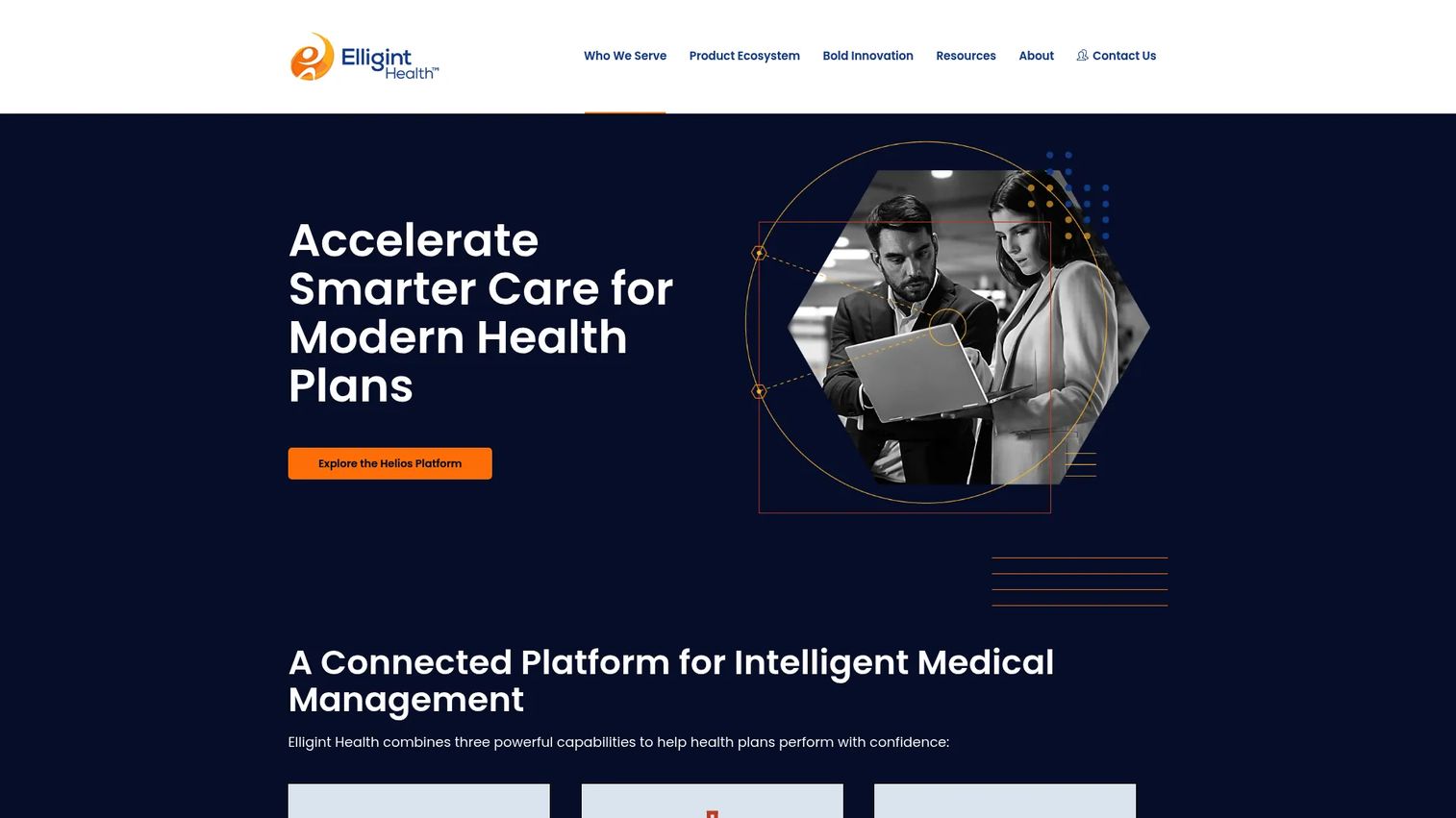
Elligint Health offers HELIOS, a configurable medical management platform for care management, utilization management, analytics, and value-based healthcare operations. HELIOS provides 360-degree member views across clinical, claims, and social determinants data, configurable care plans, predictive risk scoring, prior authorization, appeals and grievances workflows, and FHIR-native interoperability. The platform also includes Helios Text for secure messaging and Helios Visit for telehealth.
Best for: Health plans, payers, providers, and risk-bearing organizations managing care and utilization operations who need a configurable workflow platform with strong interoperability.
Key features
- Care and utilization management with configurable workflows
- 360-degree member views across clinical, claims, and social data
- Predictive risk scoring and population health capabilities
- Prior authorization, appeals, grievances, and regulatory workflow support
- FHIR-native interoperability
Why choose Elligint Health HELIOS: Choose HELIOS when configurable workflows and FHIR-native architecture matter alongside care management depth. Verify current product naming and package details with the vendor, as smaller healthcare software brands sometimes update their product portfolio between cycles.
Elligint Health HELIOS pricing: Pricing requires direct engagement with the Elligint Health team.
10. Chordline ACUITYnxt
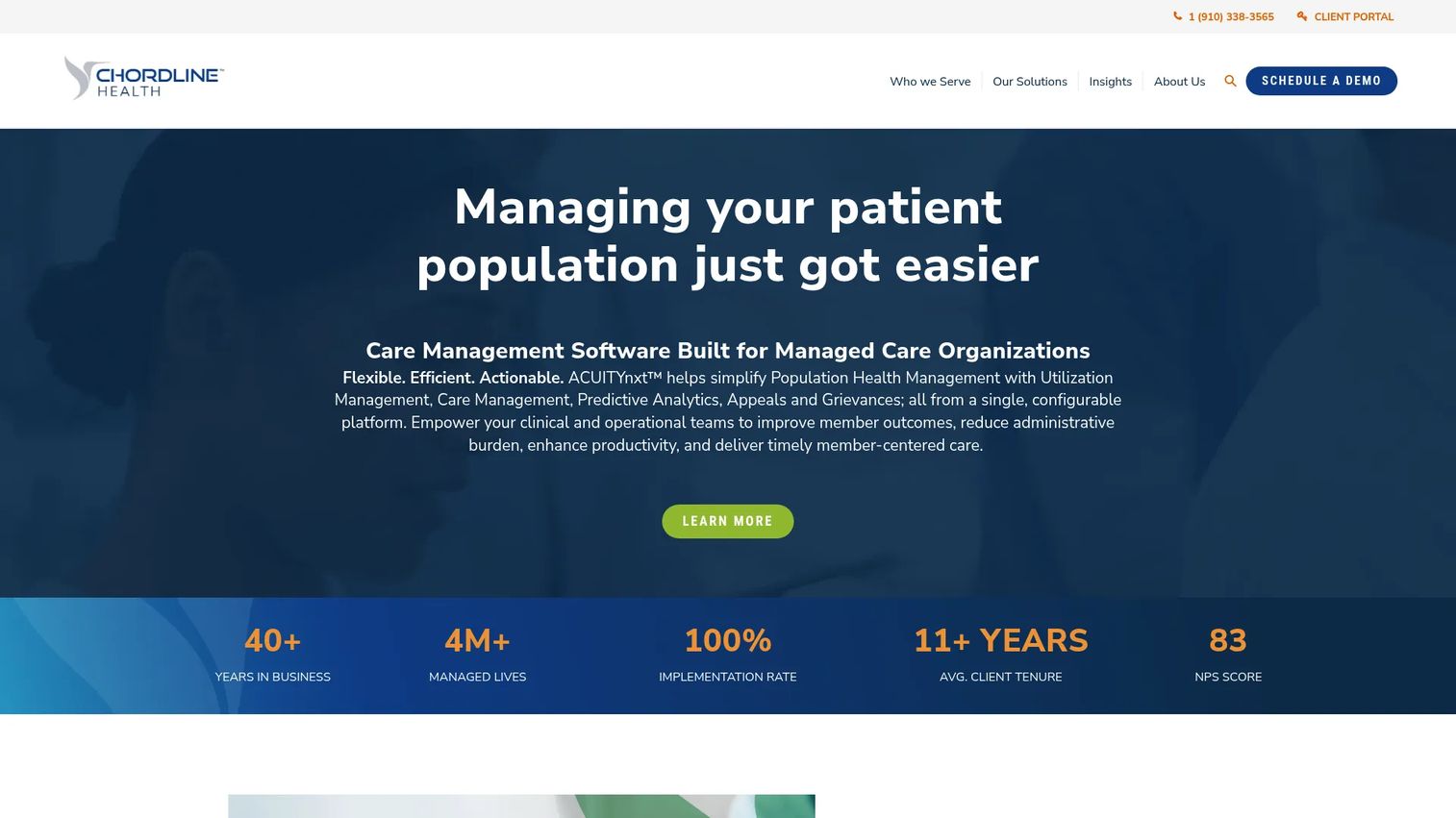
Chordline offers ACUITYnxt, a cloud-based managed care and population health management platform for health plans, TPAs, ACOs, and other risk-bearing organizations. The platform uses Johns Hopkins ACG Predictive Analytics for population health, and supports utilization management, case and care management, appeals and grievances, clinical program management, quality and risk management, and workflow automation with configurable business rules.
Best for: Managed care organizations that need an integrated platform for care management, utilization review, and population health with strong analytics foundations.
Key features
- Population health analytics using Johns Hopkins ACG
- Utilization management and prior authorization workflows
- Case and care management with assessments, care plans, and task management
- Appeals and grievances management
- Quality, risk, and clinical program support
Why choose Chordline ACUITYnxt: Strong fit for clinical operations teams that need structured workflows with meaningful predictive analytics underneath. Clarify ACUITYnxt's scope against claims and core administration tools, as it is a care management and population health platform rather than a claims adjudication system.
Chordline ACUITYnxt pricing: Chordline directs buyers to schedule a demo for pricing.
11. SS&C CareSpace
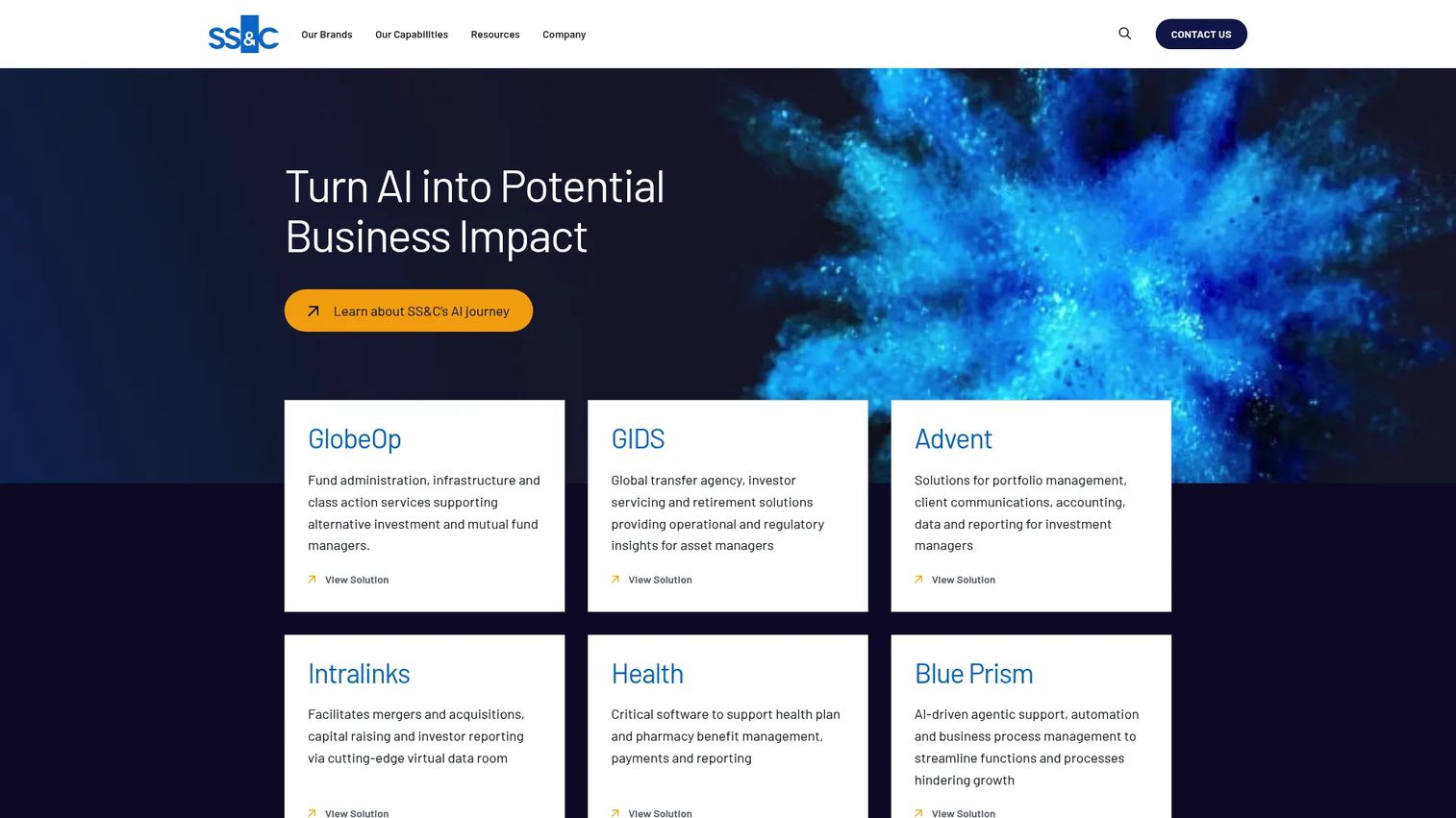
SS&C Technologies is a broad enterprise technology and services company. CareSpace is associated with payer care management and population health workflows. Buyers evaluating SS&C for payer operations should verify current product scope and naming directly with SS&C, as the company's healthcare offering has evolved through acquisitions and product development.
Best for: Organizations evaluating payer workflow tools from a large enterprise technology vendor with broad financial and healthcare service capabilities.
Key features
- Care management workflows
- Member engagement tools
- Population health insights
- Workflow tracking and reporting dashboards
Why choose SS&C CareSpace: Suits buyers who value enterprise vendor stability and want payer workflow capabilities within a broader financial and technology services relationship. Verify current product scope with SS&C before committing, and do not overstate claims processing capabilities without confirmation from the vendor.
SS&C CareSpace pricing: Pricing requires direct contact with SS&C.
12. athenahealth athenaIDX Financial Risk Manager
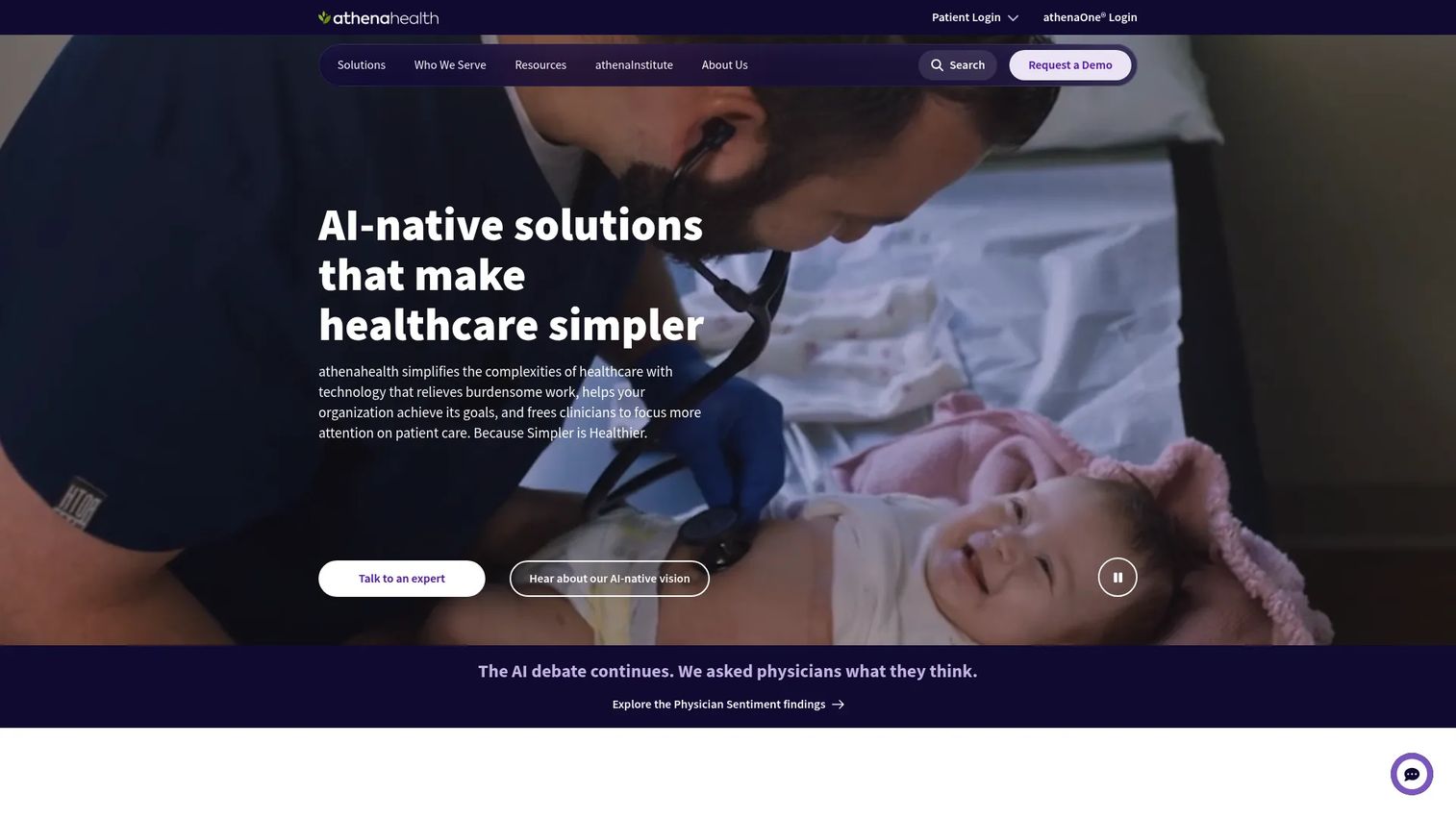
athenahealth offers athenaIDX, an enterprise revenue cycle management system for large healthcare organizations, with the Financial Risk Manager module targeting organizations managing complex risk-based reimbursement arrangements. The platform covers pre-claim readiness, automated charge capture, claims processing, contract analysis, dispute management, real-time dashboards, and predictive risk models. Over 380 APIs support integration across athenaIDX and Financial Risk Manager.
Best for: Large healthcare organizations, health systems, specialty networks, and payviders managing complex revenue cycles and risk-based payer-provider contract economics.
Key features
- Pre-claim readiness including eligibility verification and payment estimation
- Automated charge capture, coding, claims, and payment processing
- Financial Risk Manager for complex risk-based arrangements and payvider management
- Real-time dashboards and predictive risk models
- 380+ integration APIs
Why choose athenahealth athenaIDX Financial Risk Manager: Use this when the buyer's priority is financial risk management, contract modeling, and revenue cycle operations rather than broad payer core administration. Clarify where athenaIDX sits relative to core claims systems, as it is primarily a revenue cycle and financial risk tool for provider-side payer operations.
athenahealth athenaIDX Financial Risk Manager pricing: Pricing requires direct engagement with athenahealth.
13. Conduent HSP MediTrac
Conduent provides healthcare payer administration software supporting claims processing and core administrative operations through its HSP Payer Suite, with MediTrac serving claims and health plan administration functions for payers and TPAs. The platform covers claims intake, automated processing, premium and claims billing, and member and provider web portals. Conduent's healthcare practice focuses on administrative processing environments including Medicaid and public payer operations.
Best for: Public payer and TPA environments that need claims administration and program operations support, particularly in Medicaid or government-adjacent contexts.
Key features
- Claims intake and automated processing
- Premium and claims billing
- Member and provider web portals
- Eligibility and program operations
Why choose Conduent HSP MediTrac: A practical fit for public-sector and administrative processing environments where claims accuracy and portal access are the primary requirements. Verify current product naming with Conduent during procurement, as product nomenclature in legacy claims platforms can shift with platform updates.
Conduent HSP MediTrac pricing: Pricing is handled through enterprise and government contracts. Contact Conduent directly for commercial terms.
G2 rating: 3.5/5
14. Epic Tapestry
Epic Tapestry is managed-care software for organizations that operate health plans alongside a broader Epic deployment. It covers claims processing and repricing, eligibility, enrollment, benefits administration, utilization management, authorization workflows, and referral management. Tapestry is designed for provider-sponsored health plans and integrated delivery networks where the payer operation and the clinical operation share the same Epic environment.
Best for: Provider-sponsored health plans, managed care organizations, and integrated delivery networks already committed to the Epic platform.
Key features
- Managed care administration and enrollment workflows
- Claims processing, repricing, and referral management
- Eligibility and benefits administration
- Utilization management and authorization workflows
- Native integration with the broader Epic environment
Why choose Epic Tapestry: The clearest fit when the payer operation sits inside an Epic-centered provider system and integration with clinical workflows matters as much as claims administration. For standalone commercial payers without an existing Epic deployment, evaluate the full implementation cost and ecosystem commitment before choosing Tapestry over a purpose-built payer administration platform.
Epic Tapestry pricing: Epic pricing is handled through direct enterprise engagement. Contact Epic for scope and commercial terms.
Considerations when choosing healthcare payer software
Match the platform to the operating layer
Core administration, claims adjudication, care management, analytics, and member engagement are different jobs. A vendor can be excellent in one layer and incomplete in another. Evaluate candidates against the specific workflow bottleneck you are trying to fix first. A care management platform will not solve a claims adjudication backlog, and a claims engine will not give you population health visibility.
Verify claims and adjudication depth
Test real benefit designs during vendor evaluation, including exception workflows, retroactive eligibility, coordination of benefits, payment rules, appeals, and claim adjustments. Auto-adjudication rates are a useful benchmark: HealthEdge reports 90 to 97% first-pass rates, which gives you a reference point for evaluating competing claims. Ask for references from plans with similar lines of business and member volumes.
Pressure-test interoperability
FHIR API support appears on most vendor marketing pages. The harder question is whether a specific use case, like prior authorization, member access to records, or provider directory synchronization, is fully supported through FHIR today or is on a roadmap. Validate integration references with your EHR, data warehouse, care management platform, and analytics tools before signing.
Evaluate implementation risk
Core administration and claims system implementations can take many months. Care management and analytics tools often deploy faster, but data migration, configuration, and staff training still require internal ownership. Identify who inside your organization will own each workstream before vendor selection, and ask vendors for implementation timelines from comparable customers. Connect implementation cost to time-to-value when presenting the business case internally.
Check reporting and regulatory workflows
Verify that the platform handles CMS reporting, prior authorization tracking, appeals and grievances audit trails, quality measures, Star Ratings, Medicaid program reporting, and risk adjustment as configured workflows rather than custom development. Regulatory deadlines are fixed, and gaps discovered post-implementation are expensive to close.
Conclusion
The right choice depends entirely on where the operating bottleneck sits. These platforms are not interchangeable.
For CRM-led member and provider workflows, Salesforce Health Cloud fits organizations already in the Salesforce ecosystem. For core claims and administration at scale, Cognizant TriZetto and HealthEdge HealthRules are the most established options. Arcadia is the strongest pick when fragmented data and analytics gaps are the primary problem. ZeOmega Jiva and Medecision Aerial serve care management and population health workflows. For public-sector and Medicaid environments, Gainwell Technologies and Conduent HSP MediTrac are purpose-built for government program complexity. Epic Tapestry is the natural fit for provider-sponsored plans running inside an Epic ecosystem.
Before booking vendor demos, build a short scorecard. Map each platform to your primary operating layer, your top three workflow requirements, your integration constraints, and your implementation risk tolerance. That scorecard will cut your vendor shortlist in half and make the demo conversations far more productive.
If you sell software into this market or work alongside payer organizations in your GTM motion, understanding how buyers evaluate healthcare payer solutions can sharpen your own positioning and sales approach. The ai medical diagnostic platforms space is evolving alongside payer software, and the intersection of both is worth monitoring as a founder mapping adjacent categories.
FAQs
Healthcare payer software is technology used by health plans, TPAs, government programs, and risk-bearing organizations to administer benefits, process claims, manage members and providers, coordinate care, automate prior authorization, and measure financial and clinical performance. It spans core administration systems, claims platforms, care management tools, analytics applications, and member engagement layers. Most enterprise payer platforms serve one or two of these layers well rather than all of them equally.
Payer software supports insurance administration: Claims processing, benefits configuration, member enrollment, prior authorization, provider network management, and health plan financial operations. Provider software supports clinical care delivery: EHR workflows, clinical documentation, scheduling, billing, and patient operations. The boundary has blurred for organizations running both, such as integrated delivery networks with provider-sponsored health plans, which is why platforms like Epic Tapestry and athenaIDX Financial Risk Manager serve both sides.
No single vendor is universally best for claims processing. Cognizant TriZetto (Facets, QNXT) and HealthEdge HealthRules serve health plans needing deep claims adjudication at scale. Conduent HSP MediTrac suits TPA and public-sector claims environments. Epic Tapestry handles claims within provider-sponsored plan contexts. The right choice depends on adjudication depth required, benefit complexity, volume, and integration requirements. Evaluate auto-adjudication rates, benefit configuration flexibility, and implementation references from comparable payers.
Core capabilities include claims intake and adjudication, enrollment and eligibility management, benefit configuration, provider network data management, prior authorization workflows, care management and utilization review, interoperability through FHIR and HL7, quality reporting and risk adjustment analytics, and audit controls for regulatory compliance. The relative importance of each feature changes by operating model: A Medicaid plan weights enrollment and program reporting differently than a commercial plan focused on value-based care contracts.
Payer software is priced through enterprise contracts for most vendors in this category. Cost drivers include covered lives, lines of business, modules selected, implementation scope, data migration complexity, hosting model, and ongoing support terms. Salesforce Health Cloud is the exception, with posted pricing starting at $350 per user per month billed annually. For all other vendors in this list, request a detailed commercial proposal and ask for implementation and support costs to be quoted separately from the license fee.
Core administration and claims system implementations typically run six months to two or more years depending on data migration complexity, benefit configuration scope, and integration requirements. Care management and analytics platforms often deploy faster, sometimes within three to six months for a core configuration. Ask vendors for implementation timelines from customers with similar payer size, lines of business, and existing system complexity. Treat vendor-quoted timelines as a starting point, not a commitment.
Healthcare claims adjudication software is the system that applies eligibility rules, benefits configuration, provider contracts, claim edits, payment logic, and policy rules to determine whether a healthcare claim is paid, denied, or adjusted. It sits at the core of payer operations and directly affects payment accuracy, audit exposure, and provider satisfaction. Adjudication platforms vary significantly in auto-adjudication rates, benefit configurability, and exception workflow depth, all of which affect total cost of ownership beyond the license fee.
FHIR APIs enable payer systems to exchange data more consistently with providers, members, and other systems across prior authorization, member access to records, provider directory synchronization, and broader interoperability mandates. CMS interoperability rules require payers to support FHIR-based member data access and prior authorization APIs. Buyers should validate specific use-case support rather than accepting FHIR compatibility as a broad marketing claim, since implementation depth varies significantly across vendors.