Your enterprise prospect asks whether your product connects to their CRM. Sales says yes, assuming Engineering will figure it out. Engineering scopes it at a sprint, minimum, and that's before accounting for token refresh, multi-tenant credential isolation, and the API version change that will break everything six months after you ship.
That's not a feature request. It's an infrastructure decision disguised as one.
According to the State of SaaS Integrations Report (2025), 98% of surveyed companies say customers who use integrations are less likely to churn, and 84% call integrations a key requirement during procurement. The demand is clear. The maintenance burden is the part most roadmaps underestimate.
Embedded integration platforms (also called embedded iPaaS) exist to change that equation. They give your customers a way to connect their own tools from inside your product, while your team retains control over authentication, reliability, and operational visibility.
This guide compares eight platforms to help you choose the right infrastructure before you're locked into a maintenance commitment that outlasts your original sprint estimate.
What's inside
This guide covers eight shortlisted embedded integration platforms for 2026, evaluated for product-manager-specific priorities.
- Who it's for: PMs and platform leads at B2B SaaS companies evaluating customer-facing integration infrastructure
- Selection criteria:
- Customer-facing UX and self-service connection flows
- Development model: Embedded iPaaS, unified API, or code-first infrastructure
- Operational reliability: Logs, retries, tenant isolation, alerting
- Pricing mechanics and total cost as adoption grows
TL;DR
- Best for configurable B2B SaaS integrations: Prismatic, for teams that need both code-first development and low-code customer configuration
- Best for branded in-product integration UX: Paragon, for teams where the connection flow is part of onboarding
- Best for transparent usage pricing: Nango, for developer-led teams who want to model costs from connections, compute, and data transfer
- Best for tenant-based cost predictability: Pandium, for teams that want pricing tied to active customer tenants
- Best for published embedded iPaaS plans: Cyclr, for teams that need visible plan pricing before procurement conversations
- Best for unified API breadth: Merge and Apideck, for teams adding coverage across software categories rather than building every connector
- Best for deep two-way sync: Ampersand, for teams where custom objects and customer-configurable mappings are non-negotiable
What are embedded integration platforms?
Embedded integration platforms are product infrastructure tools that let SaaS companies build, deploy, and manage customer-facing integrations inside their own application.
Unlike internal iPaaS tools that connect a company's own back-office systems, embedded platforms are multi-tenant by design. Each customer gets their own credential storage, configuration, and execution context.
How embedded integration platforms work
Most platforms share a common set of building blocks:
- Prebuilt connectors and API abstractions: Reduce the time to add common endpoints
- OAuth and API-key authentication: Managed token storage, refresh cycles, and connection health checks
- Embedded connection UI or white-label marketplace: Lets customers authorize accounts from inside your product
- Sync, actions, webhooks, and workflow orchestration: Covers the data movement patterns customers need
- Tenant-specific credentials and configuration: Keeps one customer's workload isolated from another's
- Logs, retries, alerts, and integration monitoring: Gives Engineering and Support a path from "the sync failed" to a useful answer
Embedded iPaaS vs traditional iPaaS vs unified APIs
| Approach | Primary user | Main job | Customer-facing | Best fit |
|---|---|---|---|---|
| Embedded iPaaS | SaaS product team and customers | Build configurable in-product integrations | Usually embedded or white-labeled | Multi-tenant SaaS products |
| Traditional iPaaS | Internal ops teams | Connect the company's own systems | Internal only | RevOps, finance, IT |
| Unified API | Product engineering | Normalize data access across a category | Connection UI usually available | HRIS, ATS, CRM, accounting coverage |
| In-house integrations | Engineering | Build each connector directly | Fully custom | Narrow strategic integrations with stable requirements |
What product managers should evaluate
- Customer setup experience: Can customers connect accounts without a support ticket?
- Custom logic and field mapping: How much tenant-level configuration is possible?
- Reliability under tenant growth: Does one tenant's workload affect another's?
- Error visibility: What does a failed sync look like for Support and Engineering?
- Cost meter: What unit drives the bill as adoption grows?
- Versioning and migration controls: What happens when you need to change an integration?
When to use an embedded integration platform
Productize recurring customer integration requests
When multiple customers need the same workflow, maintaining custom code per account creates compounding debt. A recurring request for CRM sync or data export belongs on the roadmap as infrastructure, not as a professional services engagement. Repeatable delivery architecture is cheaper than one-off maintenance once you're past three or four tenants running the same logic.
Reduce engineering interruptions from connector work
Each manually built connector creates an ongoing obligation: API version changes, token expiration handling, error retries, and customer-specific edge cases. An embedded platform shifts that overhead from custom code to managed infrastructure. Engineering capacity moves toward differentiated product work rather than connector upkeep.
Support enterprise evaluations without fragile environments
Integration coverage is a common blocker in mid-market and enterprise procurement. Customers want to verify that your product fits their stack before they sign. A customer-facing connection flow with observable sync status removes that blocker earlier in the sales cycle. It also gives Customer Success a cleaner path through onboarding once the deal closes.
Use an embedded platform when:
- More than three customers have requested the same integration
- Engineering estimates exceed two sprints per new connector
- Enterprise deals stall on "do you integrate with X?"
- A manual connector has broken once and required emergency patching
Embedded integration platforms comparison
Starting price is only part of the decision. The more important question is what unit the vendor bills for as your customer base grows: Active tenants, linked accounts, connectors, compute hours, API calls, data transfer, or annual contract capacity. Run a 12-month scenario against your expected adoption curve before committing.
Pricing and G2 ratings verified October 2026 from each vendor's pricing page and G2 listing.
| # | Product | Best for | Key differentiator | Pricing | G2 rating |
|---|---|---|---|---|---|
| 1 | Prismatic | B2B SaaS teams needing code-first and low-code integration building | Multi-tenant embedded workflows, marketplace, and managed authentication | Quote-based (Scale, Enterprise, Custom) | 4.8/5 |
| 2 | Paragon | Teams prioritizing branded in-product integration UX | White-labeled Connect Portal with tenant OAuth, workflows, and MCP support | Quote-based (Pro, Enterprise) | 4.6/5 |
| 3 | Nango | Developer-led teams wanting transparent usage meters | Code-first auth for 1,000+ APIs, syncs, webhooks, and MCP | Free; $50/month plus usage | 4.5/5 |
| 4 | Pandium | SaaS teams seeking tenant-based cost predictability | Code-first integration development kit with active-tenant pricing | Lite $499/month; Pro from $2,000/month | 4.8/5 |
| 5 | Cyclr | Teams needing low-code embedded iPaaS with published plans | 600+ connectors, embedded marketplace, and customer-facing workflows | From $1,595/month | 4.7/5 |
| 6 | Merge | Teams needing normalized APIs across major software categories | Unified data models with embedded account linking | Free tier; $650/month for up to 10 linked accounts | 4.7/5 |
| 7 | Apideck | Teams adding unified API coverage across multiple categories | Standardized API access with passthrough options | Launch $599/month; Scale $1,299/month | 4.9/5 |
| 8 | Ampersand | Teams building deep two-way sync with customer-configurable integrations | Declarative bi-directional sync with custom-object support | Free tier; Catalyst from $999/month | Not yet rated on G2 |
Best 8 embedded integration platforms for 2026
1. Prismatic
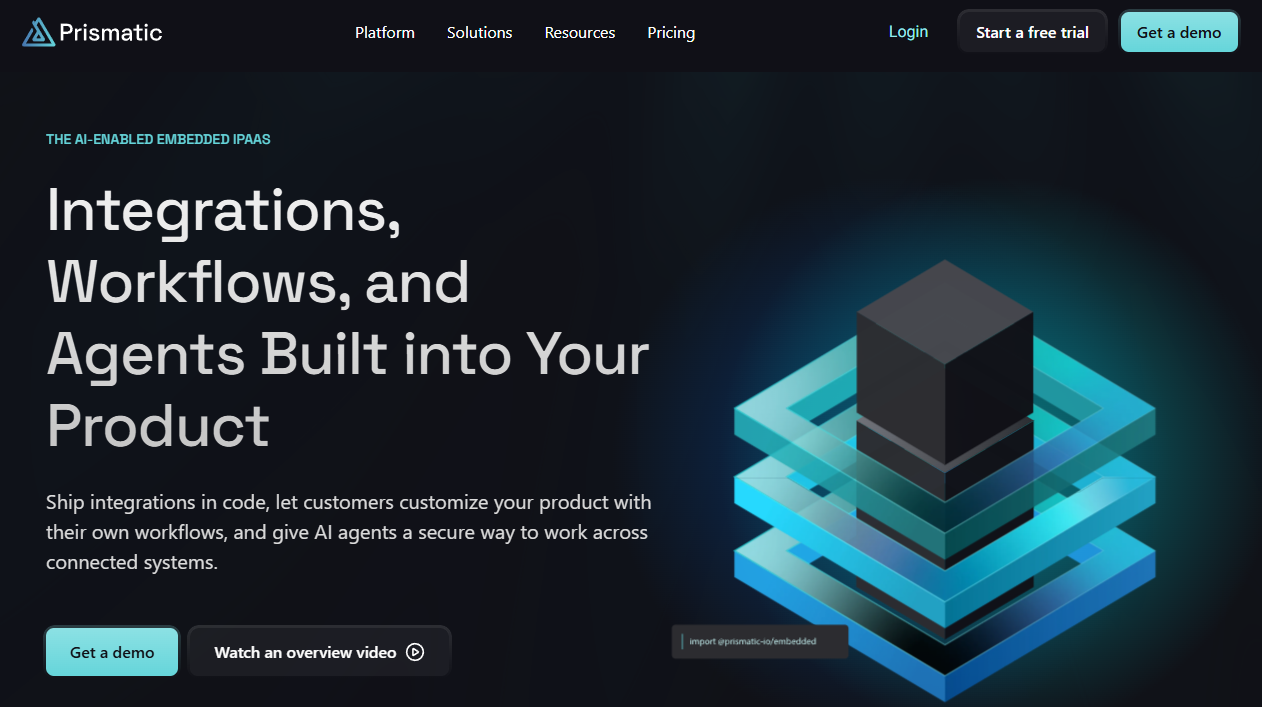
Prismatic is an AI-enabled embedded iPaaS built specifically for B2B SaaS companies. It supports both code-first TypeScript development and low-code workflow configuration, letting engineering teams build reusable integration logic that customers can then configure from a branded marketplace without writing code.
Best for: Product teams that need to give customers self-service integration configuration while retaining engineering control over complex business logic.
Key features
- Code-first TypeScript and low-code integration building
- Embedded integration marketplace and workflow builder
- Per-customer authentication, configuration, and deployment
- Open-source connectors and custom connector SDK
- MCP server support for AI-agent-ready workflows
Why choose Prismatic: The combination of code-first development and low-code customer configuration fits teams whose integration backlog spans both standard connectors and custom, account-specific logic. It suits PMs who need reusable deployments across many tenants without rebuilding per customer.
Prismatic pricing: Scale, Enterprise, and Custom plans use volume-based per-instance pricing; Prismatic does not display numeric prices on its pricing page. Evaluate the cost against expected active customer instances, execution volume, and hosting requirements by requesting a quote directly.
G2 rating: 4.8/5 (verified October 2026)
2. Paragon
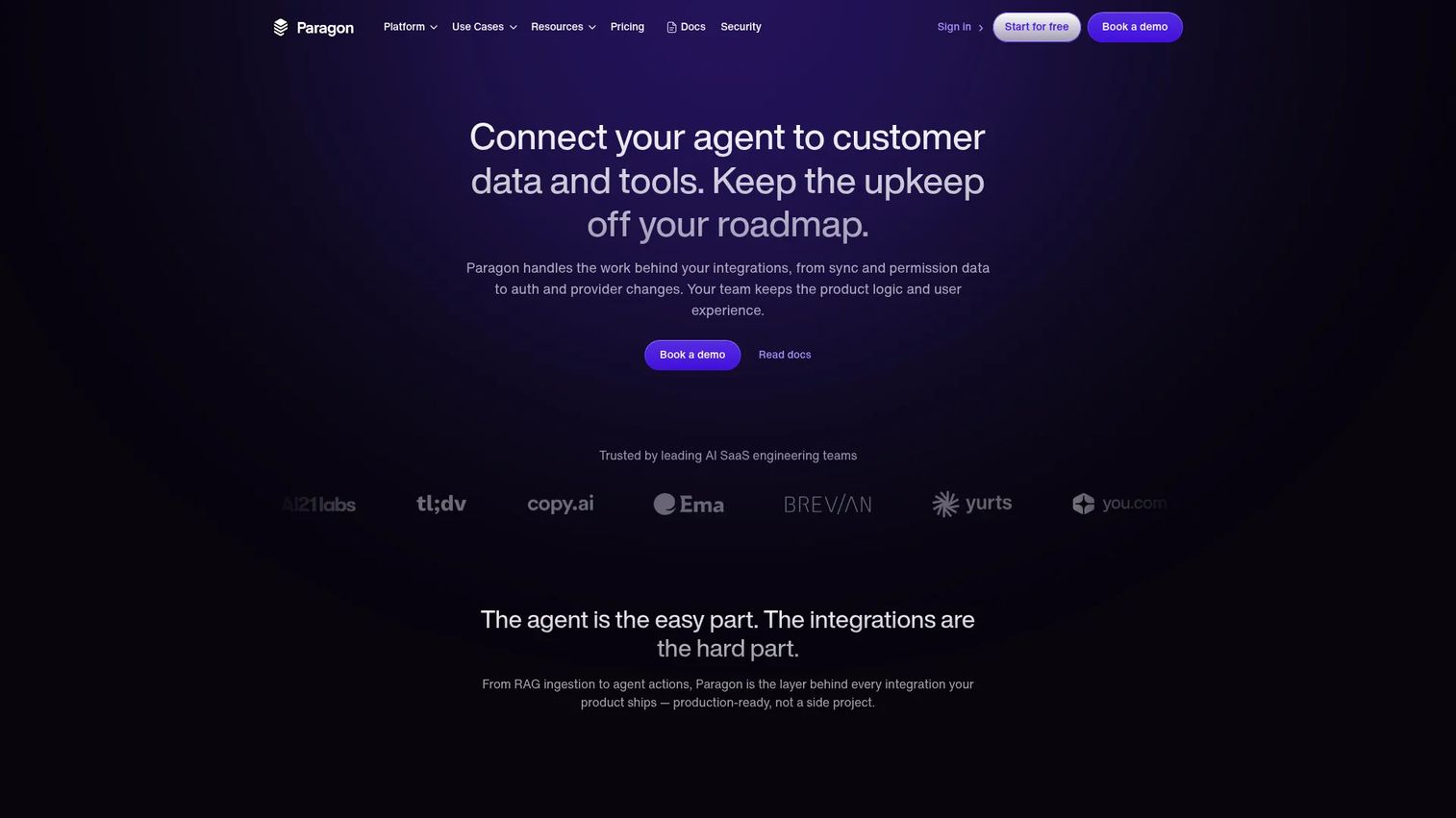
Paragon is integration infrastructure for SaaS products that puts the customer-facing connection experience at the center of the design. Its white-labeled Connect Portal embeds directly inside your product, handles OAuth 2.0 token management per tenant, and supports real-time actions, managed syncs, and workflow orchestration.
Best for: PMs where the integration setup flow is part of onboarding and the branded experience matters as much as the underlying data movement.
Key features
- White-labeled Connect Portal and headless SDK
- Managed OAuth 2.0 with token refresh and connection health checks
- 130+ prebuilt connectors and custom connector support
- ActionKit and Workflows for real-time triggers and orchestration
- MCP support for AI-agent connectivity
Why choose Paragon: The Connect Portal reduces the friction that usually causes customers to abandon integration setup mid-flow. For PMs whose enterprise deals include a "show me how customers connect their systems" moment during procurement, a polished embedded portal adds credibility at that stage.
Paragon pricing: Pro and Enterprise plans are quote-based, priced against connected-user volume and the specific product capabilities required. Enterprise adds self-hosting, dynamic field mapping, SAML SSO, and priority SLAs. Contact Paragon for current figures.
G2 rating: 4.6/5 (verified October 2026)
3. Nango
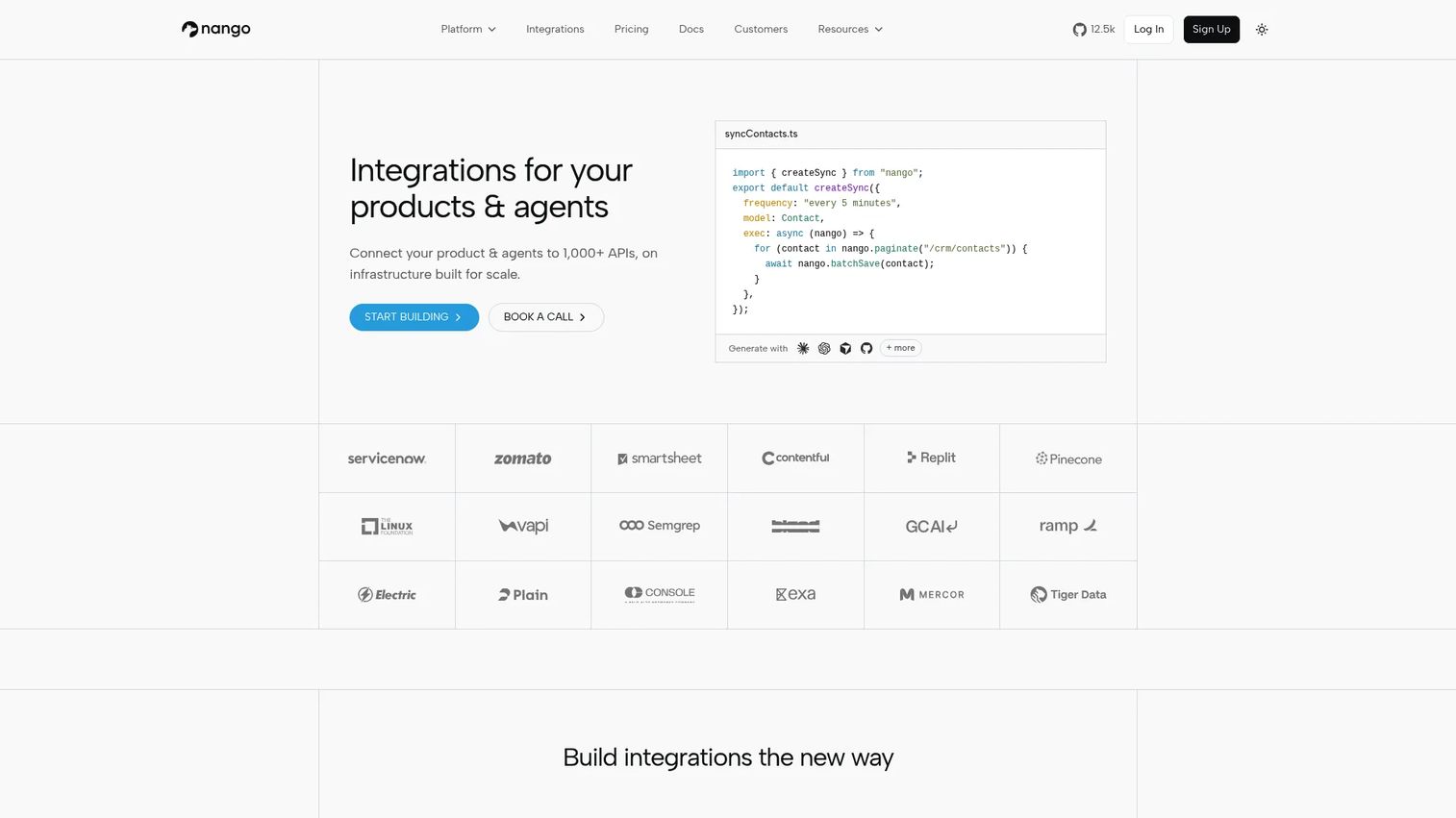
Nango is a code-first integration platform that provides managed authentication for over 1,000 APIs, along with syncs, webhooks, custom functions, and observability. It's designed for product and engineering teams who want deep control over integration logic without building auth infrastructure from scratch.
Best for: Developer-led SaaS teams that want to own custom integration code and model pricing from connections, compute time, and data transfer.
Key features
- Auth and credential management for 1,000+ APIs and MCPs
- MCP tools, triggers, webhooks, and managed data syncs
- Custom integrations with embedded UI components
- Logs, metrics, and alerting with OpenTelemetry export
Why choose Nango: Transparent consumption units let PMs build a real cost model before procurement. Teams comfortable writing integration logic in code get managed infrastructure for the parts that are expensive to own: Auth, execution runtime, retries, and logs.
Nango pricing: Free plan available with hard-capped limits. Pay-as-you-go starts at $50 per month including monthly credits, then bills by connection ($0.29 each), compute ($0.72 per hour), and data transfer ($0.50 per GB). Enterprise uses custom pricing with self-hosting and SLA options.
G2 rating: 4.5/5 (verified October 2026)
4. Pandium
Pandium is a code-first embedded integration platform that handles the infrastructure layer around integration code: Managed authentication, hosting, versioning, scheduling, and logging. Your engineering team writes and owns the business logic; Pandium manages everything else.
Best for: Product teams that want pricing tied to active customer tenants rather than task or API-call volume, and who need Engineering to own integration code rather than configure a low-code workflow builder.
Key features
- Integration Development Kit with project scaffolding, CLI, and API clients
- Managed authentication, hosting, versioning, and real-time logging
- Scheduled execution and custom per-tenant configuration
- Embeddable in-app marketplace and integration analytics
Why choose Pandium: Tenant-based pricing gives PMs a predictable cost model as integration adoption grows. When integrations become a core product capability used by many customers, flat-per-tenant pricing is easier to forecast than usage meters with variable data volumes.
Pandium pricing: Pandium Lite is $499 per month and includes 25 tenants plus 50,000 daily executions. Pandium Pro starts at $2,000 per month with custom tenant packages, unlimited daily executions, advanced reporting, and optional marketplace support.
G2 rating: 4.8/5 (verified October 2026)
5. Cyclr
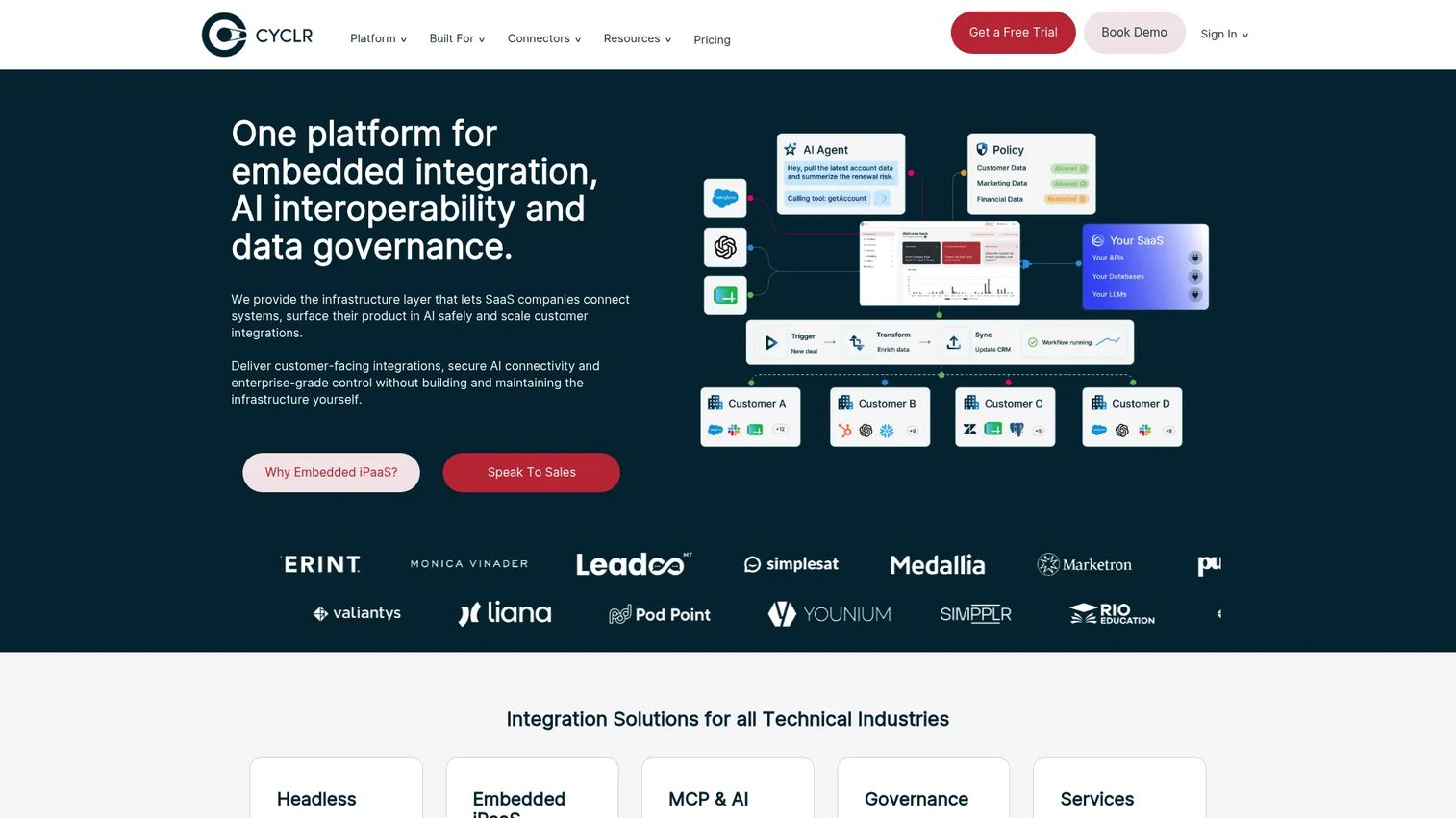
Cyclr is a low-code embedded iPaaS with over 600 managed connectors, customer-facing workflow configuration, and an embedded marketplace. It publishes its plan pricing, which reduces the uncertainty that typically delays procurement conversations for this category.
Best for: SaaS teams that need visible plan economics, a broad connector catalog, and a low-code approach to building and managing customer-facing integrations.
Key features
- 600+ managed SaaS, API, database, and enterprise connectors
- Low-code visual workflow builder with data transformation and routing
- Embedded marketplace and customer-facing workflow configuration
- Multi-tenant management with authentication, permissions, and monitoring
- Custom connector toolkit and on-premises support
Why choose Cyclr: Published pricing means PMs can build a business case before entering a sales process. The connector catalog depth suits teams whose customers request many different integrations across different software categories.
Cyclr pricing: Native Embedded iPaaS PAYG plan starts at $1,595 per month, Growth at $2,595 per month, and Scale at $7,195 per month. A shared-infrastructure Service plan starts at $1,495 per month. Connector allowances, API-call volume, and onboarding services affect total cost at each tier.
G2 rating: 4.7/5 (verified October 2026)
6. Merge
Merge is a unified API platform rather than a full embedded iPaaS. It standardizes access to integrations across software categories including HRIS, ATS, CRM, accounting, ticketing, and file storage, through a single normalized data model. Customers connect their accounts through Merge Link, an embeddable connection UI.
Best for: Product teams that need broad coverage within specific software categories and can work within a normalized schema rather than building provider-specific implementations.
Key features
- Unified API with normalized common data models across categories
- Embedded account-linking via Merge Link
- Standardized authentication, pagination, rate-limit, and webhook handling
- Remote fields, remote data, and authenticated passthrough requests
- Built-in integration logs and observability
Why choose Merge: A unified API can compress months of category coverage into a single integration. For PMs with a roadmap that includes HRIS or CRM connections across many providers, the normalized model removes repetitive per-provider work while still allowing passthrough access to provider-specific data.
Merge pricing: The first three production linked accounts are free. Launch costs $650 per month for up to 10 total production linked accounts, with additional accounts at $65 each per month. Professional and Enterprise use contract-based pricing.
G2 rating: 4.7/5 (verified October 2026)
7. Apideck
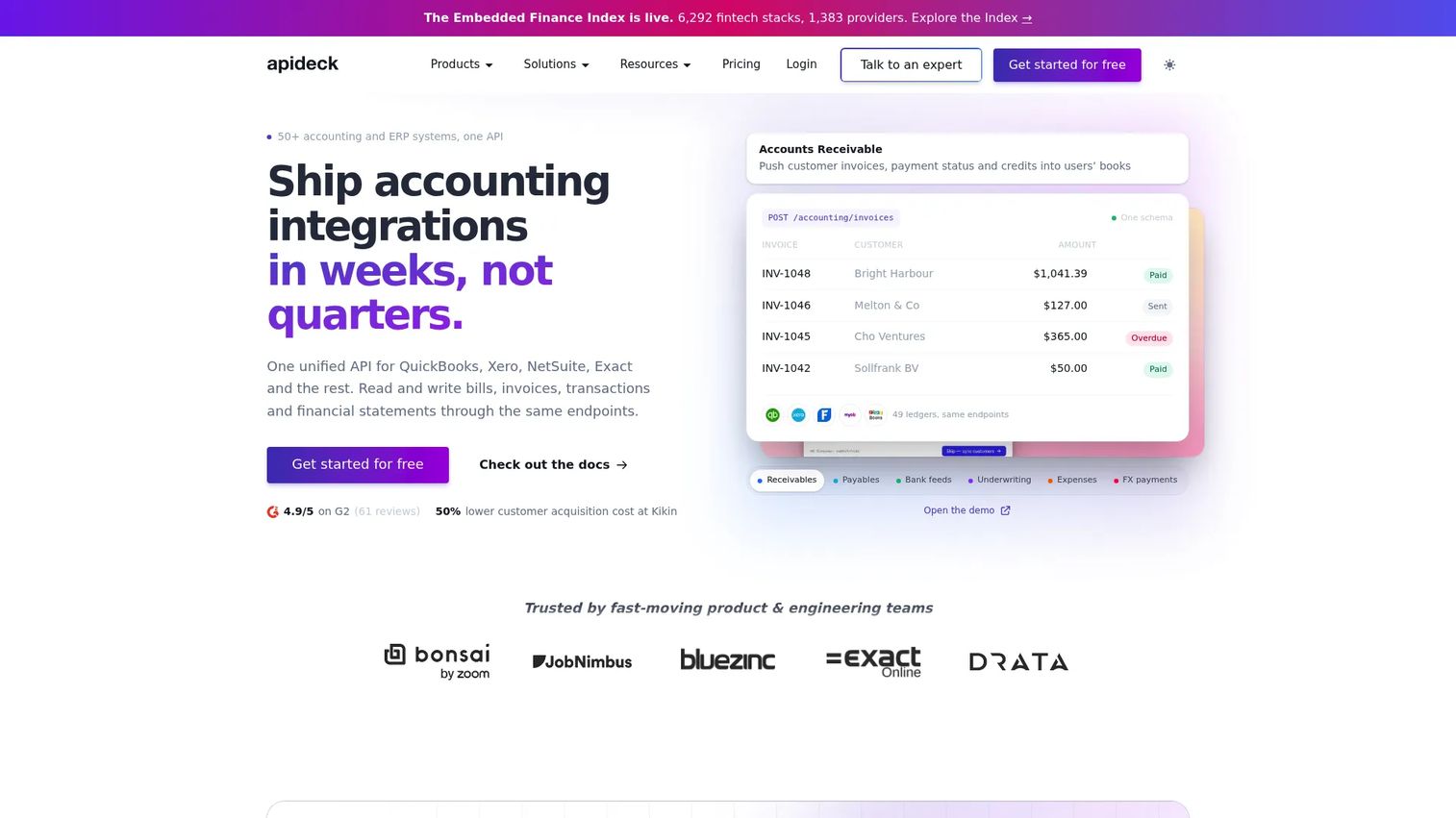
Apideck provides unified APIs that let SaaS products connect to multiple third-party platforms through a single integration layer. It covers accounting, CRM, HRIS, ATS, file storage, ERP, e-commerce, and issue tracking, and preserves room for provider-specific behavior through passthrough access.
Best for: SaaS product teams that need to add integration breadth across several software categories without building each authentication flow and connector independently.
Key features
- Unified API endpoints across eight+ software categories
- OAuth, token handling, and connection management through Vault
- API proxy and passthrough access for provider-specific behavior
- Real-time API processing with zero data retention
- Custom field mapping, data scopes, and centralized logging
Why choose Apideck: Normalized access covers the common case for each category; passthrough handles the provider-specific edge cases that arrive later. This combination suits teams whose roadmap spans multiple categories rather than one deep vertical.
Apideck pricing: Launch starts at $599 per month and covers 1 API category. Scale starts at $1,299 per month and covers 3 categories with custom field mapping and data scopes. Enterprise includes unlimited categories, sandboxes, SSO, white-label Vault, and premium support. A 30-day free trial is available.
G2 rating: 4.9/5 (verified October 2026 for Apideck Unify)
8. Ampersand
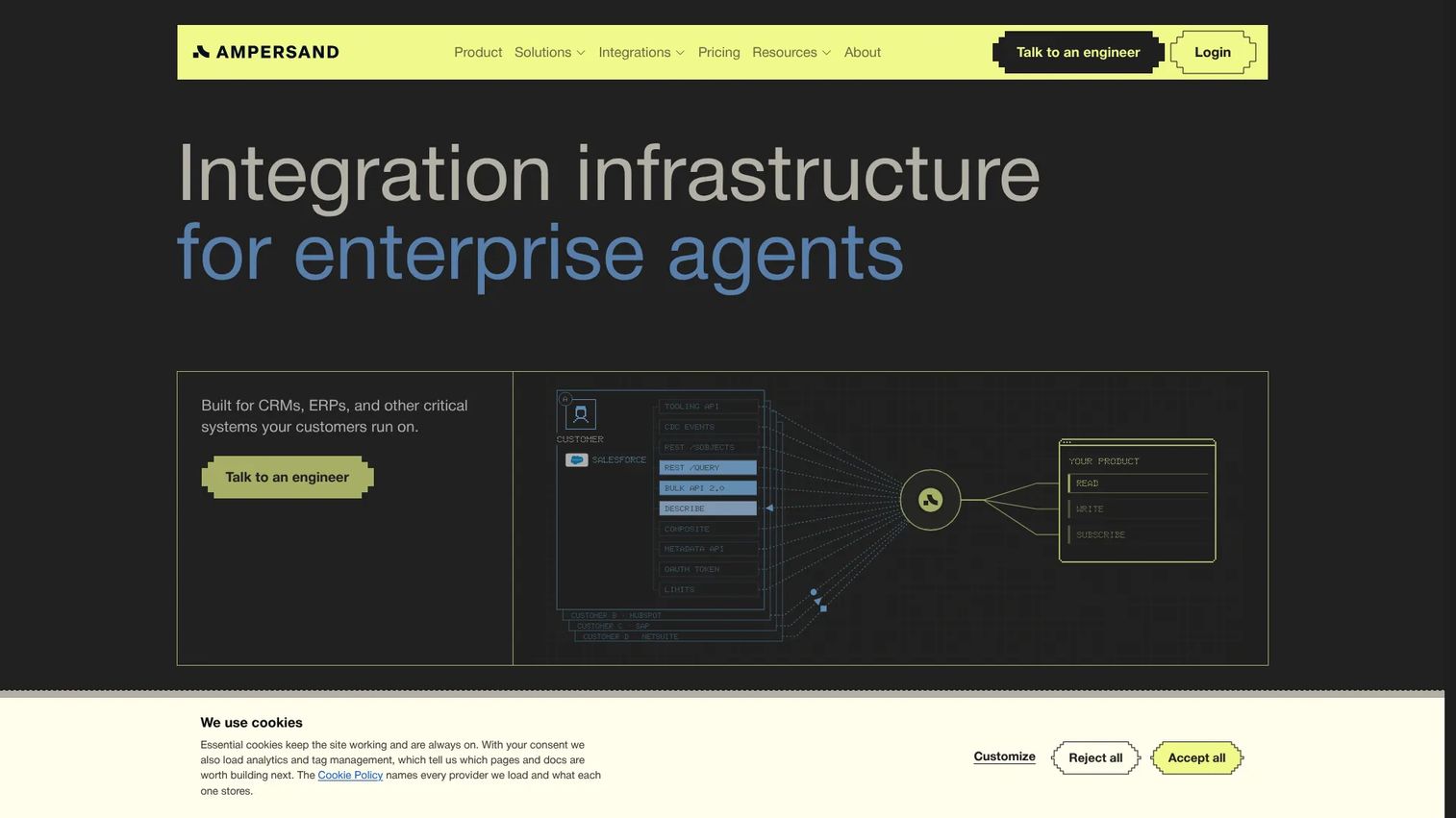
Ampersand is a declarative integration platform for SaaS products that need customer-configurable, bi-directional data movement with support for standard and custom objects. It's designed for cases where normalized reads are insufficient and tenants need control over what gets synced, how fields map, and what gets written back.
Best for: Product teams building integrations where tenant-specific data models, custom objects, and write-back behavior are requirements rather than edge cases.
Key features
- Bi-directional integrations with read, write, and subscription actions
- Standard and custom object support with customer-configurable field mappings
- OAuth and auth-token management with automatic refresh
- Retries, error handling, cost controls, detailed logs, and alerting
- Tenant-specific API budgets
Why choose Ampersand: When your customers' data models vary significantly across accounts, a normalized schema forces compromises that create support tickets. Ampersand's declarative model gives each tenant the configuration depth they need without requiring custom code per customer.
Ampersand pricing: Free tier includes 2 GB of data and up to 5 production customers. Catalyst starts at $999 per month and includes 2 GB of monthly data delivery for up to 25 production customers. Custom plans are available for higher data volumes and customer counts.
Considerations when choosing an embedded integration platform
Start with the customer job, not the connector count
A catalog of 600 connectors only matters if those connectors cover the exact workflows your customers need. Evaluate depth alongside breadth: Read access, write actions, custom fields, webhook behavior, and two-way sync support for each target application. Ask vendors to demonstrate the specific API objects your highest-priority integration requires.
Model the pricing meter before you negotiate
Pricing units vary across platforms: Active tenants, linked accounts, compute hours, API calls, and data transfer each scale differently as your customer base grows. Build a 12-month adoption scenario using your expected customer count, sync frequency, and data volume. A platform that looks affordable at 10 tenants may have a different cost profile at 200.
Decide who owns integration logic after launch
Some platforms let customers configure workflows themselves. Others require Engineering to write and maintain the integration code. Clarify ownership before you choose: It determines release management, support load, documentation requirements, and the engineering cost of handling tenant-specific edge cases.
Treat observability as a customer experience requirement
Customers expect answers when their sync fails, not a support ticket with a 48-hour SLA. Prioritize platforms with searchable logs, automatic retries, configurable alerts, and tenant-level isolation. Poor observability creates engineering interruptions and CS escalations that erode the efficiency gain the platform was supposed to provide.
Plan for migration before you need it
Ask vendors about credential export, code portability, integration definition ownership, and data retention policies. A platform change mid-roadmap is expensive. Confirming the exit path upfront is not pessimism; it's responsible product management.
Conclusion
The right embedded integration platform depends on the integration model your roadmap requires and the cost mechanics you can sustain as customer adoption grows.
Prismatic suits teams that need both code-first development and low-code customer configuration inside a marketplace. Paragon fits product-led teams where the integration setup flow is part of onboarding. Nango is the strongest choice for developer-led teams who want transparent, usage-based pricing and full code ownership. Pandium works well for teams that want cost tied to active tenants rather than variable consumption. Cyclr offers published plan pricing for low-code teams with broad connector requirements.
Merge and Apideck fit unified API strategies, where the goal is category coverage rather than custom connector logic. Ampersand is the right tool when bi-directional sync with customer-configurable mappings and custom objects is a hard requirement.
The most useful evaluation step: Shortlist two platforms, then run the same high-demand integration through both. Build the customer connection flow, define a field mapping, trigger an error scenario, trace the retry path, and model a 12-month cost projection. The platform that performs well across all five tests is more likely to survive the roadmap than the one with the longest connector list.
Start your journey with Guideflow today!
FAQs
An embedded integration platform is product infrastructure that lets SaaS vendors offer customer-facing integrations from inside their own application. It handles connection flows, OAuth and API-key authentication, data sync, workflow orchestration, and monitoring, covering multiple tenants with isolated credentials and configuration. The vendor's customers connect their own tools without leaving the product, while the vendor retains control over reliability and observability.
Traditional iPaaS connects a company's internal systems, such as finance, operations, or marketing tools, and is operated by that company's own teams. Embedded iPaaS is built for multi-tenant SaaS products: It gives each of the vendor's customers a separate integration context and lets them configure connections from inside the product. The two categories serve different jobs and are rarely interchangeable.
In-house development makes sense for a narrow set of strategic integrations with stable API requirements, unusual deployment or compliance constraints, or cases where the integration is a core differentiator that warrants full engineering ownership. Every in-house connector creates a long-term obligation: Token management, API version changes, error handling, retries, and customer-specific configuration. Teams should evaluate whether that maintenance cost is preferable to a platform's pricing before choosing to build from scratch.
Pricing units vary significantly: Active tenants, linked accounts, connectors, tasks, API calls, compute hours, data transfer, or annual contract capacity. Some platforms publish tiered prices; others require a quote. Before committing, model the cost against your expected adoption curve at 12 months. An entry tier that looks affordable at low volume can grow quickly if the billing unit scales with workload rather than customer count.
Many can, but "two-way sync" covers a wide range of implementations. Confirm how each platform handles write-back actions, conflict resolution, incremental updates, webhook delivery, custom objects, and rate limiting for each target application. A platform that supports reads and writes at the API level may still require significant custom work to handle the edge cases your customers encounter in production.
A short checklist for the demo session:
- Can customers connect their accounts independently, without a Support ticket?
- Does the platform support custom fields and tenant-specific configuration?
- How are integration changes tested and versioned before deployment?
- What does a failed sync look like in the logs, and how does Support find the cause?
- Which pricing unit grows with adoption, and what does the cost look like at 3x current volume?
- Can we export credentials, integration definitions, or code if we change platforms?
They're related but distinct. A unified API normalizes data access across a software category through a single endpoint, trading provider-specific depth for category breadth. A full embedded iPaaS typically provides broader capabilities: Workflow orchestration, an embedded marketplace, customer-configurable logic, and runtime infrastructure that works across any API category. Some SaaS products use both approaches in parallel: A unified API for category coverage, and a more flexible platform for integrations that need custom logic. You can explore how API monitoring tools and API documentation tools complement this infrastructure layer.
Several platforms now provide MCP-related capabilities, hosted tool endpoints, or connection-scoped actions that support AI-agent workflows. Before exposing customer data to an AI workflow, evaluate the platform on authorization boundaries, tool-level permissions, audit logging, tenant isolation, and observability. Scoped access controls matter more than the presence of an MCP feature in the marketing copy. Confirming what the agent can and cannot read or write per tenant is the critical question. For context on how API gateway software and API testing tools fit into this evaluation, those resources cover complementary infrastructure decisions.
Integration observability refers to the logs, alerts, retry mechanisms, and status dashboards that let Engineering and Support understand what happened inside a customer's integration workflow. Without it, a failed sync produces a support ticket with no actionable detail. Good observability means a Support agent can search by tenant, find the specific failed step, see the error response, confirm the retry outcome, and resolve the issue without involving Engineering. For PMs, observability is a support-cost lever: Better tooling here reduces the engineering interruptions that erode platform ROI.