You run a random selection, print the roster, email the collection sites, chase down results, log everything in a spreadsheet, then do it again next quarter. One missed selection or a chain-of-custody gap, and an audit turns into a bad week. That is the operational reality most employers, third-party administrators, and DOT-regulated operators live in when they manage testing by hand.
The category is growing fast, which means more programs and more scrutiny. The global drug testing market hit USD 7.09B in 2025 and is projected to reach USD 11.55B by 2033, according to Grand View Research (2026). The employer and workplace slice alone was USD 6.40B in 2025, per Future Market Insights (2026). North America drove 40.88% of global drug screening revenue in 2025, according to Mordor Intelligence (2026).
The question is not whether you need software. It is which platform matches your program. If you are the kind of operator who also evaluates audit management software or contract lifecycle management software for the rest of the business, you already know the criteria: repeatability, workflow fit, integrations, and time to value. Drug testing software is no different. Programs that lean on compliance-heavy processes should treat vendor selection the same way they treat any audit management decision, with a clear checklist and honest fit assessment.
What's inside
This guide is for employers, TPAs, compliance leads, background screening firms, and DOT-focused operators choosing a drug testing platform. We selected tools based on four criteria: how well they handle random selections and consortium management, depth of compliance and reporting features, integration with labs and MRO services, and how much of the workflow they automate versus leave manual. Each entry includes what the tool does, who it fits, key strengths, and verified pricing where a vendor publishes it. We skipped tools with no verifiable product footprint.
TL;DR
- Best for nationwide testing plus MRO services: National Drug Screening, with a 4.8/5 G2 rating.
- Best for configurable administration with published pricing: TestChecks, starting at $199 per month.
- Best for DOT-heavy oversight: eScreen, built around MyeScreen and eCCF workflows.
- Best for automatic lab result importing: TestVault, rated 4.2/5 on G2.
- Best for branded client portals and billing: DrugPak, rated 4.0/5 on G2.
- Best for fast roster import and random selection: DTSMS, with a 30-day full-functionality trial.
What drug testing software does
Drug testing software is a platform that manages the full workplace drug and alcohol testing workflow, from scheduling and random selection through chain of custody, results tracking, and compliance reporting. It replaces the spreadsheets, email threads, and paper forms that programs otherwise use to coordinate donors, collection sites, labs, and Medical Review Officers.
Most platforms in this category are cloud-based or browser-based, which means no local install and access from any authorized device. That matters for compliance teams who need audit-ready records available on demand.
Core features to expect across drug testing program management software:
- Random testing management: automated random selection by percentage or headcount, with consortium and pool handling for DOT and non-DOT programs.
- Test scheduling software: ordering, appointment coordination, and a collection site locator so donors get sent to the right place.
- Electronic CCF software: paperless chain of custody through electronic CCF workflows that reduce transcription errors.
- Drug test results tracking: real-time status updates, result reporting, and history storage for every donor and event.
- Lab integration and MRO services: direct handoffs to testing labs and Medical Review Officers, with results routed back into the system.
- Drug testing compliance software features: audit-ready reporting, DOT MIS reports, role-based access, and secure records retention.
The strongest platforms also add branding and portal customization, API integration, and reseller or TPA support, so an administrator can run many client programs from one system.
When to use it
Manage random testing without a spreadsheet
If you run random pools or consortiums, manual selection is the highest-risk part of the job. Software for random drug testing automates the draw, documents the methodology, and produces the certificate an auditor wants to see. This is the first workflow most programs move off spreadsheets, because a defensible random process is the backbone of compliance.
Stay audit-ready for DOT programs
DOT drug testing software matters when you answer to FMCSA, FTA, or other modal rules. You need clean chain of custody, DOT MIS reporting, and a record trail that survives an audit. Platforms built for DOT oversight handle alternate donor scenarios, consortium certificates, and the specific reporting formats regulators expect.
Run multiple client programs as a TPA
If you administer testing for many employers, you need drug testing administration software that separates clients, brands portals per account, invoices accurately, and reports at both the client and program level. Reseller-friendly platforms with white-labeling and API access let a small team manage a large book of business without adding headcount.
Comparison table
Here is how the seven platforms compare across intent, key use case, published pricing, and G2 rating. Pricing reflects what each vendor publishes; where a vendor gates pricing behind sales, that is noted.
| # | Product | Intent | Key use case | Pricing | G2 rating |
|---|---|---|---|---|---|
| 1 | National Drug Screening | Testing services plus software | Nationwide testing with MRO services | From $10.00 per item | 4.8/5 |
| 2 | STATWARE by Micro Distributing | Program management suite | Cloud-based compliance workflows | Contact vendor | Not listed |
| 3 | TestChecks | Administration platform | Configurable admin with random selections | From $199/month | Not listed |
| 4 | eScreen | DOT program management | eCCF and MyeScreen workflows | Contact vendor | 4.0/5 |
| 5 | TestVault | Workflow and billing software | Automatic lab result importing | Contact vendor | 4.2/5 |
| 6 | DrugPak | Testing management suite | Branded client portals and billing | Contact vendor | 4.0/5 |
| 7 | DTSMS | Random program management | Fast roster import and random draws | 30-day trial | Not listed |
1. National Drug Screening
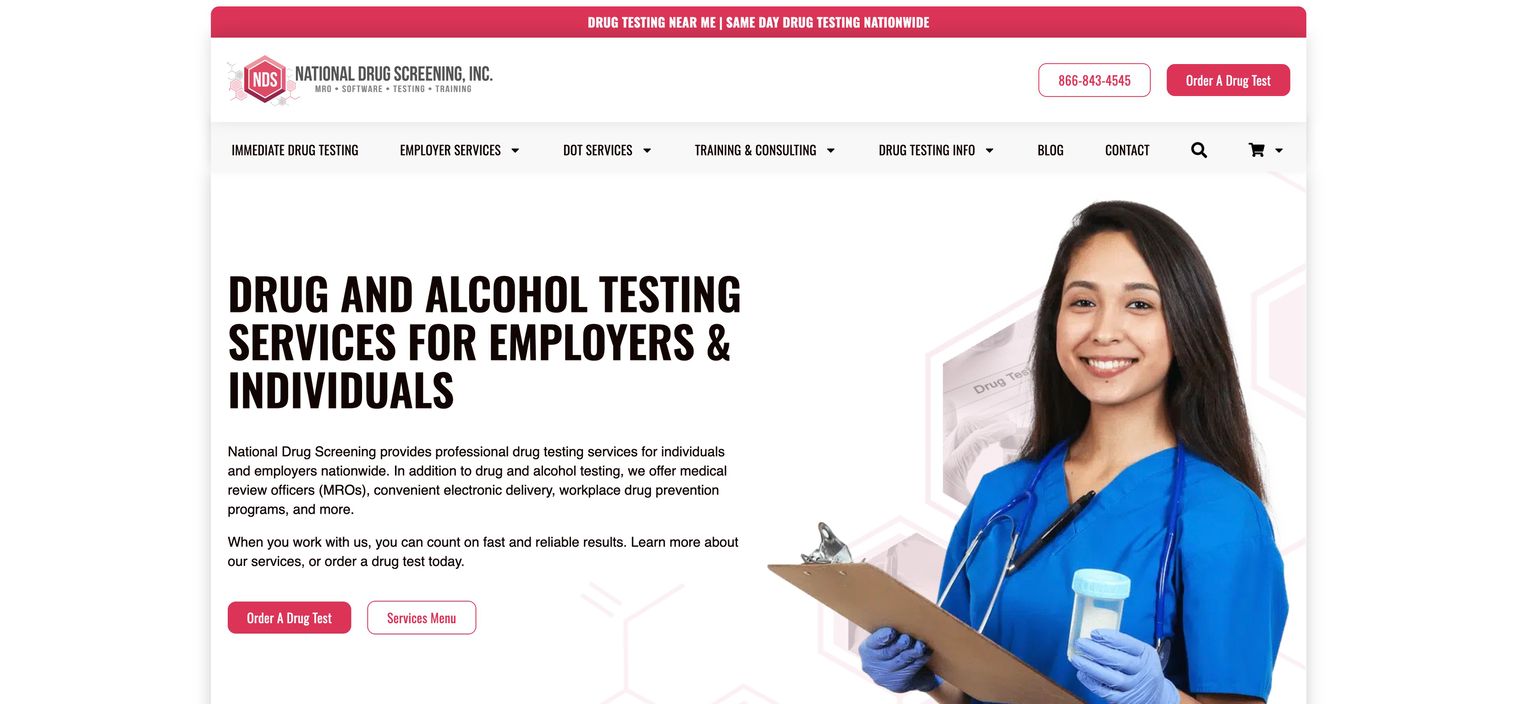
National Drug Screening is a U.S.-based drug and alcohol testing services provider that pairs a web-based ordering and management platform with a nationwide testing network. It serves employers and organizations that want testing services and program administration from one source, including Medical Review Officer services and electronic delivery of workplace drug prevention programs.
The platform covers the parts of the workflow that usually leak time: scheduling, ordering, completion tracking, and reporting. Because it bundles MRO services, results get reviewed and released without a separate handoff to an outside reviewer. That single-source model suits employers who would rather buy an outcome than assemble a stack.
Best for: Employers and organizations that need nationwide drug and alcohol testing services with integrated MRO review.
Key strengths
- Nationwide testing network: Send donors to collection sites across the country without managing site relationships yourself.
- Integrated MRO services: Results are reviewed by a Medical Review Officer inside the same service, closing the loop faster.
- Compliance program support: Electronic delivery and workplace drug prevention program tools help employers stand up policy-backed testing.
Why choose National Drug Screening: This is the pick for operators who want testing and administration handled together rather than stitched from separate vendors. If your priority is coverage and a done-for-you MRO layer, the bundled model removes coordination work. Teams that prefer to run their own lab and MRO relationships may want a pure software platform instead.
National Drug Screening pricing: Pricing is published per test and per item in the site shop rather than as a monthly subscription. Examples include an FMCSA Clearinghouse pre-employment query at $10.00 each, a 5-panel drug test at $69.00 each, a 10-panel urine drug test at $69.00 each, and a DOT urine drug test at $75.00 each. There is no free tier. The platform holds a 4.8/5 rating on G2.
2. STATWARE by Micro Distributing
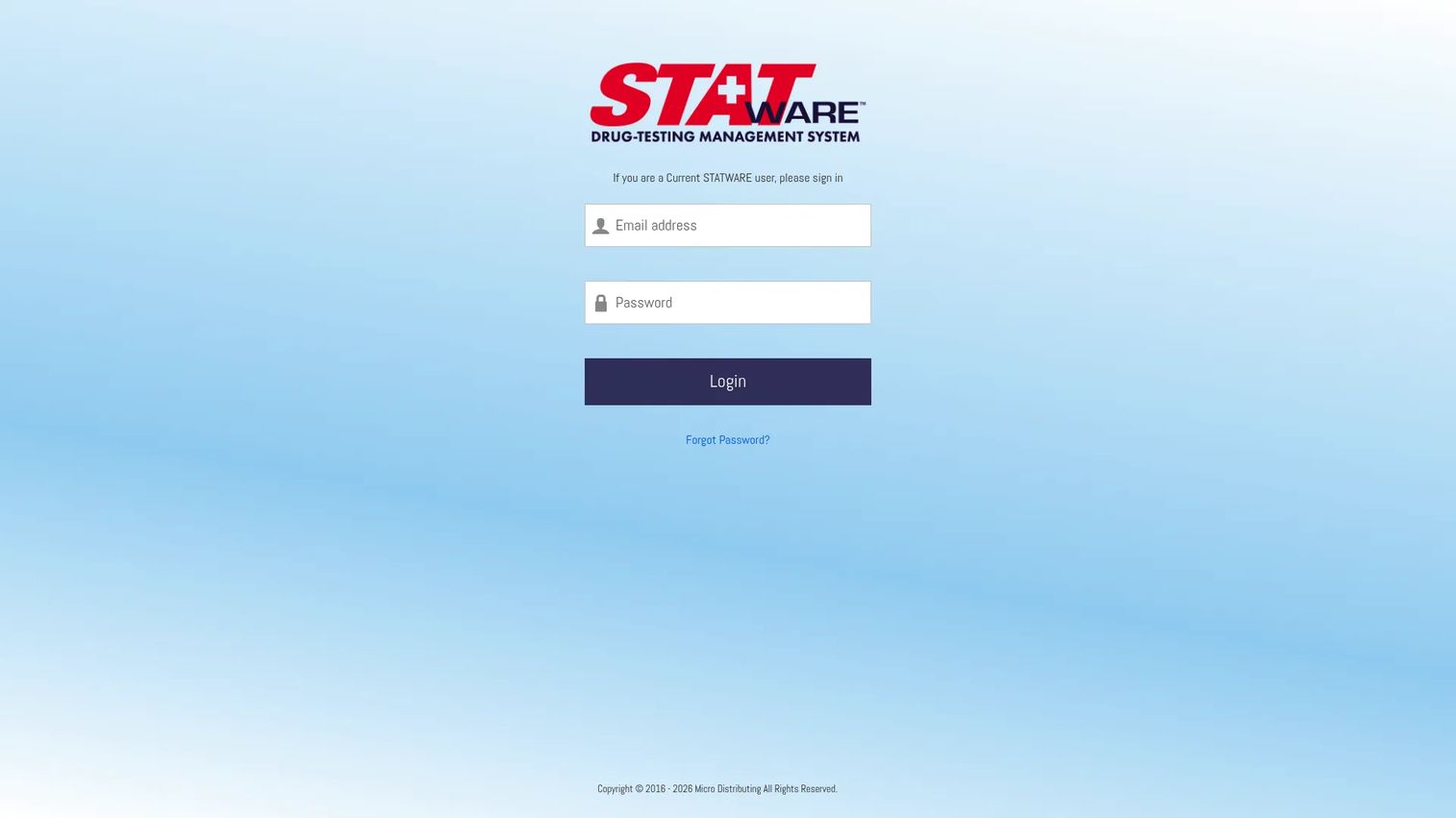
STATWARE by Micro Distributing is a cloud-based drug testing program management suite aimed at operators who want broad workflow coverage in a single system. The public site is a sign-in destination for existing customers, so detailed feature and pricing pages are not openly published. Buyers should expect to speak with the vendor to see the current product in depth.
Positioned as a compliance-focused suite, STATWARE is typically evaluated by TPAs and screening providers who want result reporting, random selection, and program administration under one roof. For teams consolidating a fragmented process, a single management suite is the appeal: fewer tools, one record trail, one place to look.
Best for: Current STATWARE customers and prospects who want a demo-led evaluation of a cloud-based compliance suite.
Key strengths
- Cloud-based access: Manage programs from any authorized browser, no local install to maintain.
- Compliance-focused workflow: Built around the reporting and record-keeping a compliance team needs.
- Single-suite consolidation: Coordinate testing administration from one platform rather than several disconnected tools.
Why choose STATWARE: If you prefer a guided vendor evaluation over self-serve sign-up, STATWARE fits the buyer who wants to see the product walked through before committing. Because pricing and feature detail are not publicly posted, budget-driven shoppers who want numbers up front will need to book a conversation first.
STATWARE pricing: No public pricing is listed on the brand site, and the homepage exposes a login rather than a rate card. Pricing and packaging are handled directly with the vendor. No public G2 rating was verifiable for this exact product.
3. TestChecks
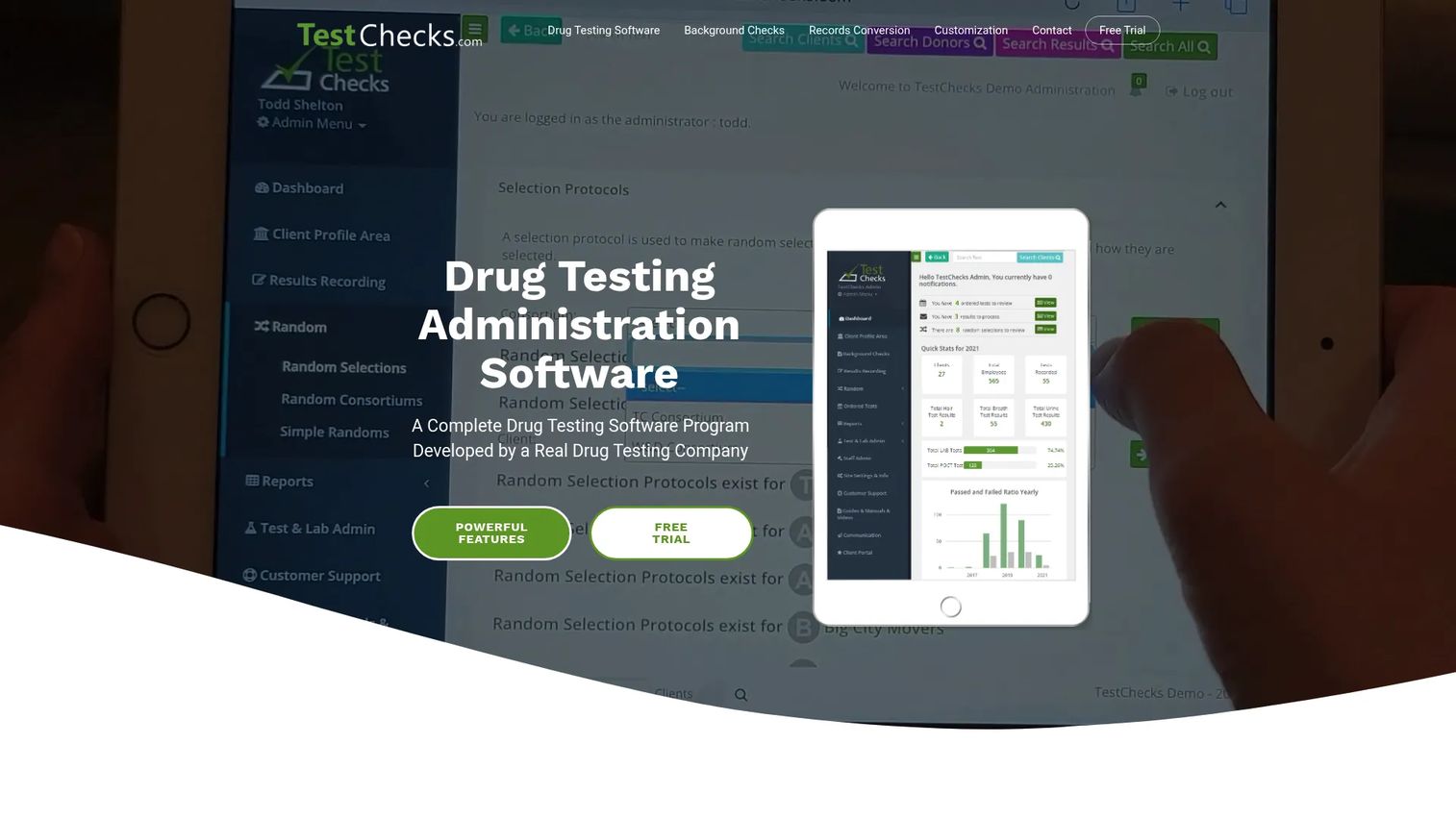
TestChecks is browser-based drug testing administration software built for testing businesses that manage client programs, rosters, and reporting. It combines client test ordering, employee roster management, random DOT selections, random consortiums, invoicing, reporting, and white-labeling in a platform you can evaluate without a sales call. Integrated background checks round out the offering.
What sets TestChecks apart in this list is transparency. It publishes tiered plans and pricing openly, which is rare in this category. For an operator who wants to compare cost against features before talking to anyone, that clarity shortens the evaluation.
Best for: Drug testing businesses and TPAs that want a configurable administration platform with published pricing and white-labeling.
Key strengths
- Random DOT selections and consortiums: Automate compliant random draws and manage consortium pools from one place.
- Client invoicing and white-labeling: Brand the portal per client and bill accurately without external tools.
- Roster and order management: Handle client test ordering and employee rosters in a single administration layer.
Why choose TestChecks: This is the shortlist pick for TPAs and screening firms that want self-serve evaluation, predictable monthly pricing, and white-labeling to run client programs under their own brand. The published tiers make it easy to match plan to book size. Operators who need a fully bundled testing-plus-MRO service will pair it with outside lab and review relationships.
TestChecks pricing: TestChecks publishes three monthly plans. TestChecks Pro is $199 per month, TestChecks Pro Max is $249 per month, and TestChecks Pro Custom is $299 per month. Each plan includes two months free, and additional storage is offered at $20 per extra 5 GB monthly. There is no free tier, but the transparent pricing makes cost modeling straightforward.
4. eScreen
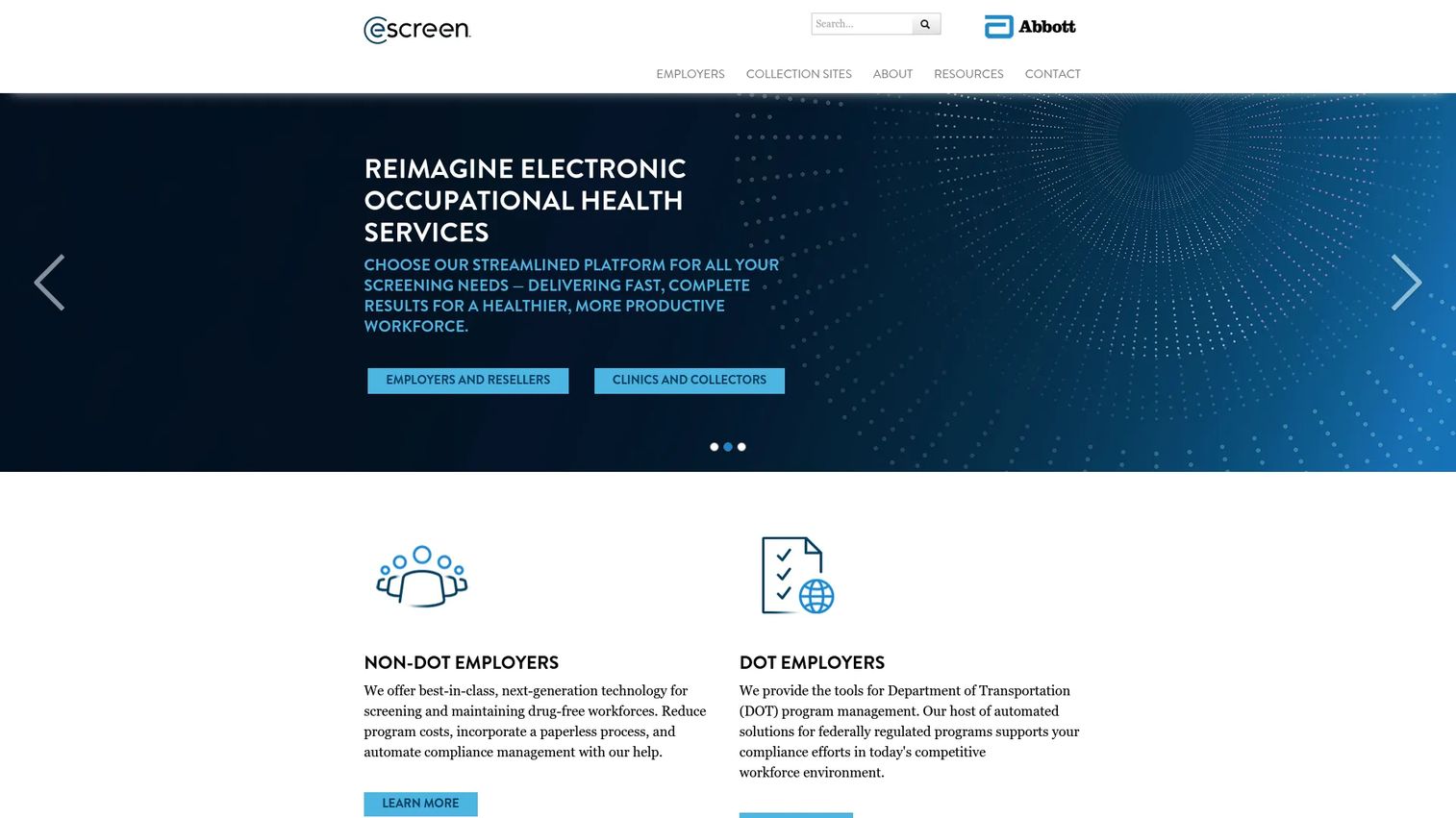
eScreen is a technology-enabled employee screening and drug-testing program management platform built around the MyeScreen web portal and the eScreen123 workflow. It leans into paperless chain of custody through an eCCF process and connects to a nationwide occupational health and collection network. It is the DOT-heavy option in this list, with oversight features employers under regulatory pressure tend to need.
The platform centers on program management rather than a la carte testing. MyeScreen gives compliance teams a web-based hub for ordering, status tracking, and reporting, while the collection network handles the physical side. For regulated employers, the combination of eCCF and network coverage is the draw.
Best for: Employers and clinics managing compliant drug-testing and occupational health workflows, especially DOT-regulated programs.
Key strengths
- MyeScreen web portal: Manage ordering, status tracking, and reporting from a single web-based program hub.
- eCCF paperless workflow: Electronic chain of custody through eScreen123 reduces paper handling and transcription errors.
- Nationwide collection network: Access occupational health and collection sites across the country.
Why choose eScreen: If your program answers to DOT rules and you want paperless chain of custody backed by a large collection network, eScreen is built for that oversight. The eCCF-first workflow suits compliance teams that want to move off paper CCFs. Buyers who want published pricing before a conversation will need to contact sales, since the site directs to a sales team rather than a rate card.
eScreen pricing: No public pricing number is posted on the official site; the platform directs prospective buyers to contact sales for a quote. eScreen holds a 4.0/5 rating on G2, though product naming across G2 pages is inconsistent.
5. TestVault
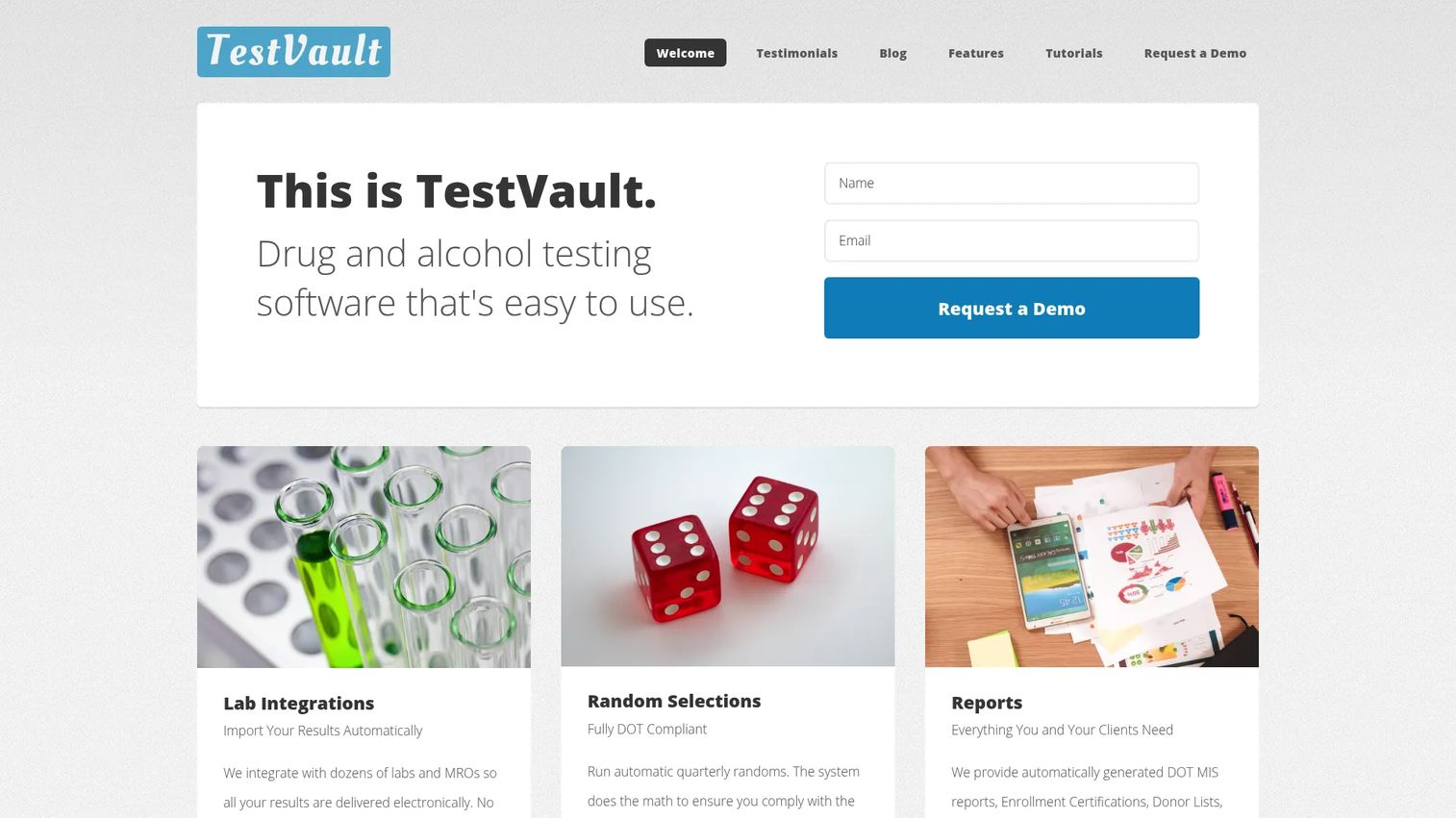
TestVault is web-based drug testing software built for TPAs, MROs, collection sites, and employers who want workflow, ordering, and billing in one platform. Its standout capability is automatic lab result importing, which pulls results in without manual entry, alongside electronic drug test ordering and random selections with consortium management.
TestVault is the pick when result handling is your bottleneck. Automatic importing removes the copy-paste step that introduces errors and slows reporting, which matters most for high-volume programs. Configurable client-specific price rules and price schedules give billing flexibility across a varied client base.
Best for: Drug testing organizations that need integrated workflow, electronic ordering, and automatic lab result handling.
Key strengths
- Automatic lab result importing: Results flow in without manual entry, cutting transcription errors and speeding reporting.
- Electronic drug test ordering: Place and track orders electronically across clients and collection sites.
- Random selections and consortium management: Run compliant random draws and manage pools in the same system.
Why choose TestVault: For teams whose biggest time sink is getting lab results into the system cleanly, automatic importing is the reason to shortlist it. G2 reviewers rate it well overall, and the configurable billing rules suit administrators juggling many client price schedules. Some users note the depth of configuration takes time to learn, so plan for a setup period to tailor rules to your clients.
TestVault pricing: Public pricing is not posted on the brand site. Instead of a rate card, TestVault describes configurable client-specific price rules and price schedules, so pricing is set per engagement. The platform holds a 4.2/5 rating on G2.
6. DrugPak
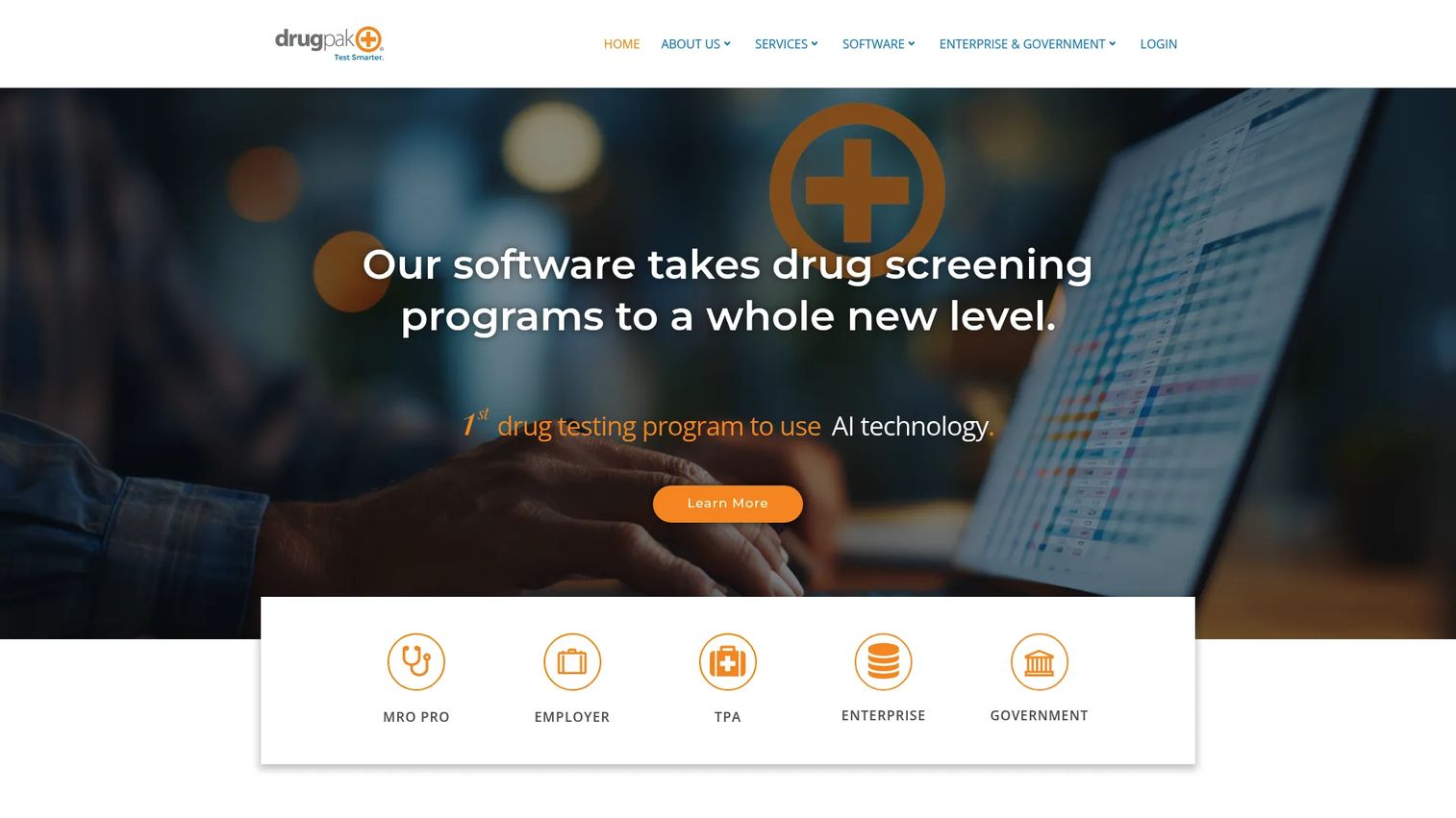
DrugPak is a drug and alcohol testing management software suite for employers and screening providers. It handles random drug and alcohol testing management, offers a client portal with a branded dashboard and secure access, and includes a billing module with invoicing, price schedules, and QuickBooks export. The QuickBooks tie-in is a practical touch for operators who already run accounting there.
DrugPak is built around administration and billing as a paired workflow. The branded client portal gives each employer secure access to their own program, while the billing module keeps invoicing and price schedules organized. For screening providers managing recurring client relationships, that combination reduces month-end friction.
Best for: Employers and screening providers managing drug and alcohol testing workflows who value branded client portals and integrated billing.
Key strengths
- Branded client portal: Give each client a secure, branded dashboard to access their own program.
- Billing with QuickBooks export: Invoicing and price schedules export to QuickBooks, reducing double entry.
- Random testing management: Handle random drug and alcohol selections inside the administration workflow.
Why choose DrugPak: If you run recurring client programs and want branded portals plus billing that plays nicely with QuickBooks, DrugPak covers that pairing directly. G2 shows a 4.0/5 rating from reviewers. Pricing is handled through a subscription calculator on a secure page rather than a public rate card, so budget-conscious buyers will get numbers after reaching out.
DrugPak pricing: DrugPak says a basic subscription covers most clients, with add-on modules available, but no public price is visible on the brand site. Pricing runs through a subscription calculator on a secure page. The platform holds a 4.0/5 rating on G2 from a small set of reviews.
7. DTSMS
DTSMS, the Drug Testing Software Management Suite, is built for organizations managing random drug and alcohol testing programs. It includes an Excel and CSV import wizard, DOT and non-DOT compliant reports, and unlimited individuals import, so getting a large roster into the system is fast rather than painful.
DTSMS focuses on the practical mechanics of random program management: import the roster, run the selection by percentage or headcount, notify the right people, and produce compliant reports. For operators who spend too long just getting data into other systems, the unlimited import wizard is the standout.
Best for: Organizations running DOT and random drug testing programs that want fast roster import and straightforward random selection.
Key strengths
- Excel and CSV import wizard: Load large rosters quickly, with unlimited individuals import.
- DOT and non-DOT compliant reports: Produce the reporting formats regulators and clients expect.
- Random program management: Run random draws by percentage or headcount with roster handling built in.
Why choose DTSMS: If onboarding a big roster into other platforms has been your friction point, the import wizard and unlimited individuals import make DTSMS worth a look. The 30-day full-functionality trial lets you test the workflow with real data before committing. Buyers who want published pricing up front will find the site mentions a trial and price matching rather than posting numbers.
DTSMS pricing: The site states a 30-day trial with full functionality, but no public numeric pricing is posted on the homepage or an accessible pricing page. DTSMS also mentions price matching, so budget conversations happen directly with the vendor.
Considerations before you buy
Once you have a shortlist, run each candidate through the same checklist so you are comparing programs, not marketing pages.
Random selection and consortium fit
Confirm the platform automates random selection by both percentage and headcount, and documents the methodology for audits. If you run consortiums, verify it produces consortium certificates and handles DOT and non-DOT pools separately. This is the highest-risk workflow, so weight it heavily.
Compliance and reporting depth
Check for DOT MIS reports, audit-ready reporting, and secure records retention. A platform that produces the exact report formats your regulators expect saves hours during an audit. Ask how long records are retained and how quickly you can pull a donor history.
Lab and MRO integration
Decide whether you want bundled MRO services or you run your own reviewer relationships. If results handling is your bottleneck, prioritize automatic lab result importing and clean lab integration. The fewer manual handoffs between lab, MRO, and your system, the fewer errors.
Administration and access controls
For TPAs and screening firms, look at white-labeling, per-client branding, invoicing accuracy, and role-based access. If you manage many clients, API integration and portal branding decide whether a small team can scale the book without adding headcount.
Conclusion
The right pick comes down to your program type. If you want testing and MRO review handled together across a national network, National Drug Screening is the single-source option, with a 4.8/5 G2 rating. If you want configurable administration with published pricing you can model today, TestChecks starts at $199 per month and offers white-labeling for client work.
For DOT-heavy oversight with paperless chain of custody, eScreen is built around MyeScreen and eCCF. If result handling is your bottleneck, TestVault's automatic lab result importing removes the copy-paste step. DrugPak fits screening providers who want branded client portals and QuickBooks-friendly billing, and DTSMS is the fastest way to import a large roster and run random selections, with a 30-day trial to test it first.
Next step: shortlist two platforms that match your program, then run a real random selection and a sample audit report through each before you commit. The tool that survives your actual workflow wins.
FAQs
Drug testing software manages the full workplace testing workflow: scheduling, random selection, chain of custody, results tracking, and compliance reporting. It replaces spreadsheets and paper forms with a single system that coordinates donors, collection sites, labs, and Medical Review Officers. The point is a defensible, audit-ready record trail without the manual overhead.
Prioritize automated random selection by percentage and headcount, documented selection methodology, and consortium certificate generation. You also want DOT and non-DOT pool handling kept separate, plus status tracking and reporting that survive an audit. If random selection is manual anywhere in the process, that is the first thing to fix.
Cloud-based drug testing software gives authorized users access from any browser, with records available on demand rather than trapped on one machine. That matters when an auditor asks for a donor history or a random selection certificate on short notice. Paperless workflows and electronic CCF support also cut transcription errors that create compliance gaps.
Drug testing software manages the testing lifecycle: random selections, chain of custody, lab and MRO handoffs, and compliance reporting. Background check software verifies identity, criminal history, employment, and education records. They serve different parts of pre-employment and ongoing screening, though some platforms, like TestChecks, integrate background checks alongside testing administration.
If you want to reduce paper handling and transcription errors, electronic CCF software is worth prioritizing. eCCF workflows move chain of custody into a paperless process, which speeds reporting and lowers the risk of a documentation gap. For DOT-regulated programs especially, a clean electronic trail simplifies audits.
They are central if results handling is your bottleneck. Direct lab integration and automatic result importing remove the manual copy-paste step that introduces errors and delays reporting. Bundled MRO services close the review loop inside one system, while running your own reviewer relationships gives more control. Decide which model fits your volume and staffing.
TPAs should weight white-labeling, per-client branding, accurate invoicing, and role-based access most heavily. API integration and reseller support decide whether a small team can manage a large client book without adding headcount. Confirm the platform separates clients cleanly and reports at both the client and program level before you commit.