Most dealership software problems do not start as software problems. They show up as duplicate entry, delayed accounting closes, missed parts margin, service bottlenecks, and department heads arguing over whose report is correct.
A dealer management system (DMS) is the operational backbone of a dealership. It connects sales, F&I (finance and insurance), service, parts, inventory, accounting, and reporting into one system. Replacing it is high-risk because it touches every department simultaneously. The wrong choice creates years of workflow drag. The right one improves cross-team visibility, tightens cash controls, and gives leadership a single version of the truth.
The global automotive DMS market was valued at $5.2 billion in 2024 and is projected to reach $8.8 billion by 2030, according to Global Industry Analysts (2025). Cloud-based deployment already represents 46% of global DMS market revenue, per KBV Research (2024). The category is expanding fast, and the vendor landscape reflects that.
This guide compares 13 dealer management systems for 2026, covering franchise auto, independent, Canadian, international, and specialty dealerships. Use it to shortlist vendors before you book a single demo.
What's inside
This guide is for dealership operators, controllers, and executives evaluating DMS platforms for 2026. It covers all 13 tools with verified pricing, G2 ratings, and operational fit guidance.
Platforms were selected from recognized DMS vendor lists and dealership automotive software category pages.
- Selection criteria: Department coverage, cloud readiness, integration depth, reporting quality, and implementation fit
- Fit guidance: Franchise auto, independent, Canadian, international, RV/marine/powersports, and multi-location dealers
- Pricing: Requested from vendor pages at generation time; quote-based where no rates are published
- Ratings: Verified from live G2 listings
TL;DR
- Best overall for large franchise auto groups: Dealertrack covers accounting, sales, F&I, service, parts, reporting, and integrations at enterprise dealership scale
- Best cloud-native option: Tekion Automotive Retail Cloud suits dealerships prioritizing modern architecture and real-time connected retail workflows
- Best for established enterprise dealerships: CDK Dealership Xperience Platform fits stores that want a broad DMS footprint and established automotive retail infrastructure
- Best for independent and regional dealers: Auto/Mate and DealerBuilt ceDMS both fit operationally focused stores; choose based on accounting depth and implementation style
- Best for Canadian dealers: PBS DMS and Quorum DMS both align well with regional market requirements
- Best for specialty dealers: Dealer-Mate (BiT DMS) is built for RV, marine, powersports, golf cart, and outdoor power equipment businesses rather than franchise automotive
What is a dealer management system?
A dealer management system is dealership operations software that centralizes sales, F&I, service, parts, inventory, accounting, reporting, and customer data in one connected system. Think of it as the ERP for a dealership.
A DMS is broader than a CRM, an accounting software tool, or a standalone inventory system. It connects the operational work those tools only partially cover, creating a single data layer across every profit center.
Key features of dealer management systems
- Vehicle inventory management: Stock tracking, VIN decoding, pricing, and marketplace uploads
- Parts inventory and ordering: Bin management, special orders, core tracking, and electronic catalogs
- Service scheduling and repair orders: Dispatch, technician assignment, labor tracking, and work order history
- Sales desking and deal jacket workflows: Multi-quote comparisons, trade valuations, and document management
- F&I, contracting, and lender connections: Aftermarket product pricing, digital signing, and credit submission
- Accounting, payroll, and reporting: General ledger, intercompany accounting, month-end close, and dashboards
- CRM and customer communication: Lead management, follow-up tracking, and texting integrations
- OEM and manufacturer integrations: Parts pricing, warranty claims, and factory communications
- Multi-location controls: Shared inventory, intercompany transfers, and permission management
- Security, permissions, and audit trails: Role-based access, compliance workflows, and data protection
A DMS earns its place when disconnected tools create duplicate entry, delayed reconciliation, and unclear departmental ownership. It is not a point tool. It is the operating system for dealership margin, cash visibility, and customer handoffs.
When to use dealer management systems
Run sales, service, parts, and accounting from one system
A DMS becomes necessary when department heads work from different data sources. Sales sees one inventory number, service sees another, and the controller closes the books days late because reconciliation is manual. One connected system gives leadership a consistent operational picture and removes the handoff failures between departments.
Manage multi-location dealership operations
Multi-rooftop groups need consistent reporting across stores, intercompany accounting, shared inventory visibility, and standardized workflows. A DMS built for multi-location operations lets you set permissions by store, department, and role, then pull consolidated reporting without assembling spreadsheets from each location separately.
Replace legacy workflows before they cap growth
Aging on-premise systems slow execution. Updates are slow, integrations break, and leadership makes decisions based on delayed data. The trigger to switch is not always a crisis. Often it is the moment the current system becomes the ceiling on how fast the team can operate.
Dealer management systems comparison
The table below gives a quick read across all 13 platforms. Use it as a first filter, not a final answer. Each tool is covered in depth in the sections that follow.
| # | Product | Best for | Key differentiator | Pricing | G2 rating |
|---|---|---|---|---|---|
| 1 | Dealertrack | Large franchise dealerships and dealer groups | Broad DMS with connected F&I, credit, compliance, and contracting | Quote-based | 4.4/5 |
| 2 | Tekion Automotive Retail Cloud | Cloud-native automotive retail teams | AI-native, cloud-native platform with unified retail, service, and analytics | Quote-based | 4.4/5 |
| 3 | CDK Dealership Xperience Platform | Enterprise dealerships and established auto groups | Integrated platform spanning DMS, variable ops, fixed ops, and analytics | Quote-based | 4.1/5 |
| 4 | Reynolds Retail Management System | Franchise dealerships needing mature retail workflows | Unified identifier across every customer, vehicle, and transaction | Quote-based | N/A |
| 5 | Auto/Mate | Independent and regional auto dealerships | Broad integrated DMS with practical workflow coverage | Quote-based | 4.3/5 |
| 6 | DealerBuilt ceDMS | Dealers needing configurable, enterprise-grade DMS workflows | Open integration platform with centralized multi-store accounting | Quote-based | 3.8/5 |
| 7 | PBS DMS | Canadian and North American dealers | All-in-one DMS covering accounting, CRM, service, and parts | Quote-based | N/A |
| 8 | Keyloop DMS | International dealer groups | Open APIs and OEM connectivity for multi-market automotive retail | Quote-based | N/A |
| 9 | Quorum DMS | Canadian dealerships and regional groups | Integrated accounting, analytics, and AI voice agent | Quote-based | N/A |
| 10 | VUE DMS | Dealers evaluating modern cloud DMS options | Azure cloud-native architecture with unlimited users and data retention | Quote-based | N/A |
| 11 | Autologica Sky DMS | International dealers and emerging markets | Native AI assistants across sales, service, parts, and analytics | Quote-based | N/A |
| 12 | incadea DMS | Global dealer networks and OEM-aligned operations | Multi-language, multi-currency, cloud or on-premises deployment | Quote-based | N/A |
| 13 | Dealer-Mate (BiT DMS) | RV, marine, powersports, and specialty dealers | Vertical-specific DMS with BHPH, CRM, and lender integrations | From $79/mo | 4.5/5 |
Best 13 dealer management systems for 2026
1. Dealertrack
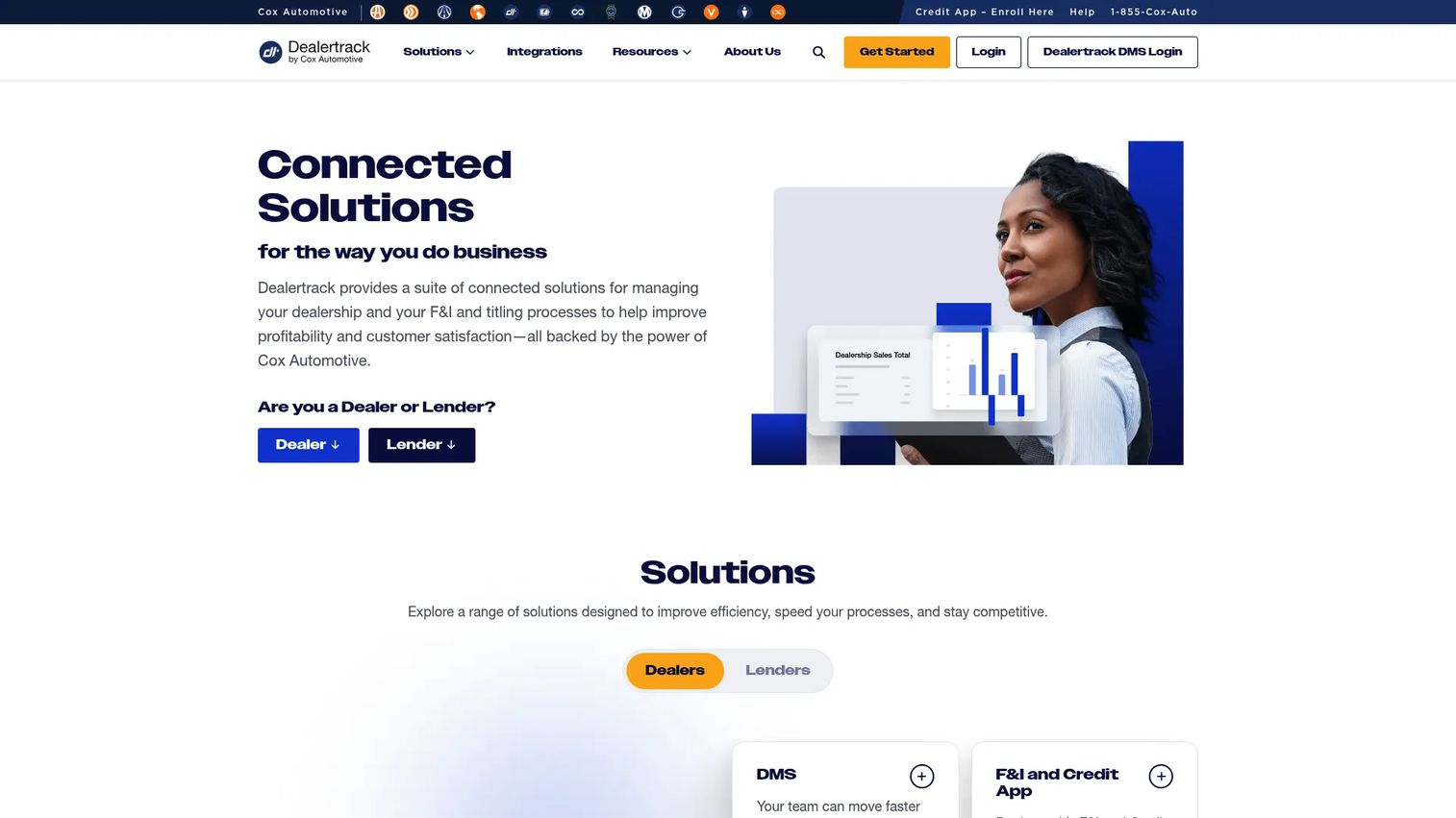
Dealertrack is automotive dealership software connecting credit, contracting, compliance, F&I, and dealer-management workflows for franchise and multi-rooftop auto groups. Part of Cox Automotive, it brings together the DMS, lender network, digital contracting, and F&I product integrations that large-scale dealers depend on. It is one of the most widely deployed DMS platforms in the United States, with particular strength in compliance-heavy workflows like Red Flag, OFAC, and disclosure management.
Best for: Large franchise dealerships and multi-rooftop groups that need broad operational coverage and deep lender connectivity.
Key features
- DMS covering accounting, sales, F&I, service, and parts
- Compliance tools: Red Flag, OFAC, identity, and disclosure workflows
- Digital contracting and remote signing
- F&I aftermarket product integration with real-time pricing
- Loan acquisition, retention, and originations
Why choose Dealertrack: Choose Dealertrack when compliance and F&I workflow depth matter as much as operational coverage. Its lender and OEM integration network is a practical advantage for high-volume franchise stores.
Dealertrack pricing: Pricing is quote-based. Ask sales for a breakdown by rooftop count, modules, implementation, and integration requirements.
G2 rating: 4.4/5 (43 reviews)
2. Tekion Automotive Retail Cloud
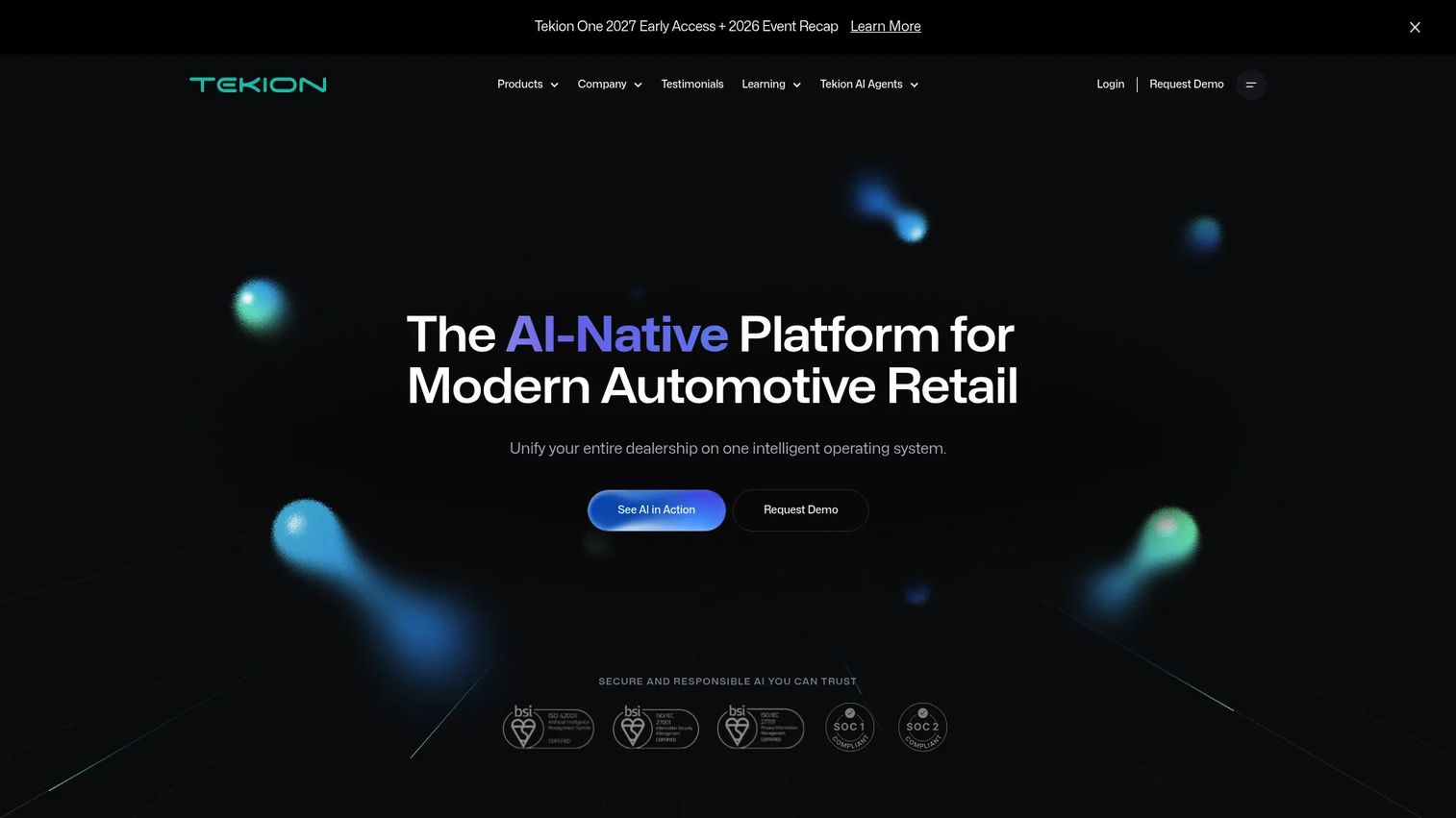
Tekion Automotive Retail Cloud is an AI-native, cloud-native automotive retail platform that unifies DMS, CRM, service, payments, payroll, analytics, and digital retail in one architecture. Its T1 conversational AI interface lets dealers query operational data and trigger workflows without navigating menus. Tekion targets dealers replacing legacy systems who want real-time data across every department rather than a retrofitted on-premise platform.
Best for: Automotive dealerships and multi-rooftop groups prioritizing modern cloud architecture and real-time connected retail workflows.
Key features
- Unified DMS covering sales, service, parts, F&I, and accounting
- AI-driven CRM with lead routing, prioritization, and automation
- Digital service experience with online scheduling and digital check-in
- Embedded payments, payroll, and advanced analytics
- T1 conversational AI for dealership insights and workflow actions
Why choose Tekion Automotive Retail Cloud: The AI-native architecture gives operators real-time visibility that traditional DMS platforms require manual reporting to approximate. Worth evaluating when your current system delays weekly decisions.
Tekion Automotive Retail Cloud pricing: Pricing is quote-based and varies by store count, modules, onboarding, and enterprise requirements. Contact Tekion to request a demo and pricing form.
G2 rating: 4.4/5 (13 reviews)
3. CDK Dealership Xperience Platform
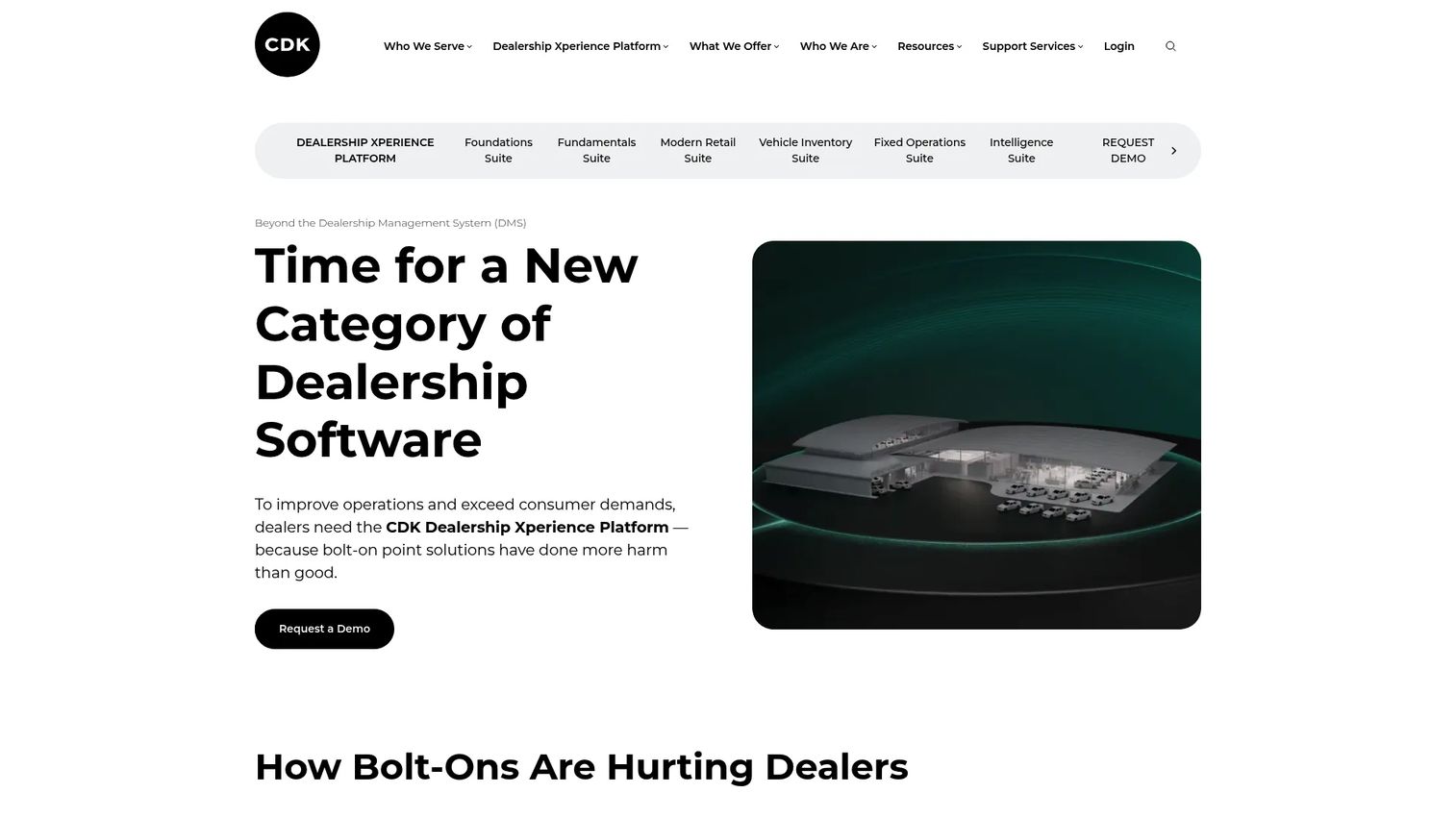
CDK Dealership Xperience Platform is a broad dealership technology platform for enterprise and franchise automotive retail. It covers variable operations, fixed operations, inventory, digital retail, CRM, F&I, business office, DMS, payments, parts, and service under a connected suite. CDK is one of the largest automotive software providers in North America, with a footprint in established franchise groups that need proven infrastructure rather than a greenfield build.
Best for: Enterprise dealerships and established auto groups that want a broad automotive retail technology footprint with deep operational coverage.
Key features
- Foundations, Fundamentals, Modern Retail, and Intelligence suites
- Variable operations: Inventory, digital retail, CRM, and F&I
- Fixed operations: Service, parts, and business office
- DMS and payments integration
- Advanced analytics, AI, and machine learning capabilities
Why choose CDK Dealership Xperience Platform: CDK fits complex dealership groups that want a proven, broad platform and have the IT and operations resources for an enterprise implementation. If your store is already on CDK, the Xperience Platform is the upgrade path rather than a migration.
CDK Dealership Xperience Platform pricing: Pricing is quote-based. Ask CDK to clarify modules, data access, implementation scope, and support terms before signing.
G2 rating: 4.1/5
4. Reynolds Retail Management System
Reynolds Retail Management System is a unified automotive dealership retail management system connecting sales, finance, service, parts, accounting, and customer data. Reynolds and Reynolds is a longstanding DMS provider for franchise dealerships in North America. Its ERA-IGNITE platform uses a single unique identifier across every customer, vehicle, and transaction, which simplifies data consistency across departments and reduces duplicate records.
Best for: Franchise dealerships that want a mature retail management system with deep dealership process coverage and established vendor presence.
Key features
- ERA-IGNITE DMS with sales, F&I, service, parts, and accounting
- Single unique identifier across customers, vehicles, and transactions
- Unified data sharing across all dealership departments
- Retail management workflows and deal processing
- Reporting dashboards with drill-down detail
Why choose Reynolds Retail Management System: Reynolds is a strong fit for dealerships that value process maturity and an established DMS partner. Scrutinize contract terms, data portability, and support model carefully during evaluation, as these are common points of feedback in operator reviews.
Reynolds Retail Management System pricing: Pricing requires a direct quote from Reynolds. Map costs to users, rooftops, modules, training, and data conversion before comparing against other vendors.
5. Auto/Mate
Auto/Mate provides an integrated dealership management system covering accounting, sales, F&I, parts, service, and reporting for auto dealerships. It targets regional and independent dealers that want broad workflow coverage without an enterprise-heavy buying process. Auto/Mate includes service dispatch, repair-order tracking, automatic customer texting, and recommended-service upsells alongside accounting and F&I capabilities. It also includes an auto shop management workflow layer within the fixed ops module.
Best for: Independent and regional auto dealers that want a dealer-focused DMS with practical operational coverage across variable and fixed operations.
Key features
- Integrated accounting, sales, F&I, parts, and service modules
- Service dispatch, repair-order tracking, and customer texting
- Multi-quote comparisons, credit-provider integrations, and digital signatures
- Parts inventory, electronic catalogs, and special-order handling
- Customizable reports with scheduling and KPI drill-down
Why choose Auto/Mate: Auto/Mate suits dealerships that want operational depth without a large enterprise footprint. Verify current product availability and vendor packaging before committing, as ownership structures in the DMS market shift periodically.
Auto/Mate pricing: Pricing is quote-based. Ask for module, conversion, training, and ongoing support costs separately.
G2 rating: 4.3/5
6. DealerBuilt ceDMS
DealerBuilt ceDMS is an enterprise dealership management platform marketed under the Lightyear brand. It combines accounting, sales, F&I, parts, service, payroll, business intelligence, document management, and integrations in a configurable architecture. Its open integration platform with real-time APIs makes it a strong fit for dealer groups that want to connect existing tools rather than replace everything at once. Multi-store centralized accounting is a distinguishing capability for groups managing multiple rooftops. You can also explore related accounting practice management software comparisons for context on dealership-level financial controls.
Best for: Multi-location automotive dealer groups needing configurable DMS workflows with centralized accounting and open integrations.
Key features
- Enterprise and centralized accounting across multiple stores
- Sales, F&I, digital signing, and eContracting workflows
- Parts and service with mobile write-up and intelligent dispatch
- Payroll with multi-EIN support and web-based time tracking
- Open integration platform with real-time APIs and scheduled data exports
- Built-in business intelligence dashboards
Why choose DealerBuilt ceDMS: Choose DealerBuilt when you need a DMS that fits existing processes rather than forcing a workflow redesign. The open API layer is practical for groups that have already invested in specialized tools they want to keep.
DealerBuilt ceDMS pricing: Pricing is quote-based. Ask DealerBuilt to clarify implementation, integrations, data conversion, and support costs as separate line items.
G2 rating: 3.8/5 (4 reviews)
7. PBS DMS
PBS DMS, sold as PBS v10 APEX, is an all-in-one automotive dealership management system covering accounting, sales, service, parts, CRM, and digital service operations. PBS Systems has strong market presence in Canada and North America, making it a recognized option for dealers who want regional market alignment alongside integrated dealership operations. It includes a built-in CRM with lead management and follow-up tracking rather than requiring a third-party add-on.
Best for: Canadian and North American dealers that want integrated dealership operations from a regional DMS provider with built-in CRM.
Key features
- Accounting automation and financial reporting
- Real-time inventory tracking and sales workflow automation
- Service scheduling, dispatch, work orders, and service-history management
- Parts management and availability tracking
- Built-in CRM with lead management and follow-up tracking
- Digital service tools including online appointments and digital check-in
Why choose PBS DMS: PBS is a solid choice when regional support and OEM integration fit for Canadian markets matter more than a large-brand DMS name. Validate OEM and lender integration compatibility for your specific market before signing.
PBS DMS pricing: Pricing is quote-based. Request a comparison by rooftop, module set, training, and support requirements.
8. Keyloop DMS
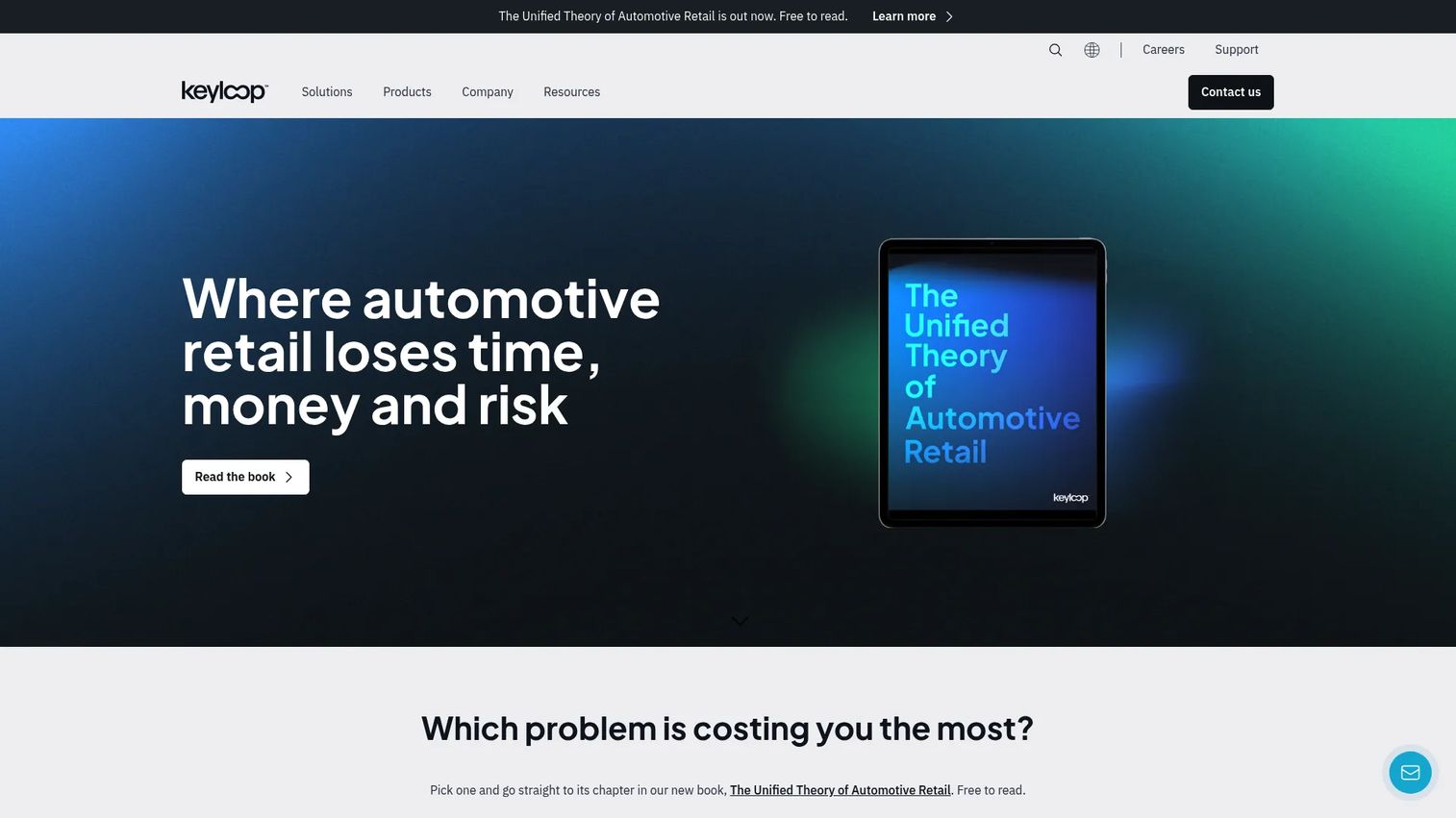
Keyloop DMS is a dealer management system for automotive retailers that connects sales, service, parts, accounting, manufacturers, and partner applications. It operates primarily in international markets and positions itself around open APIs and OEM connectivity for dealer groups managing operations across multiple countries or regions. Capabilities include single-ledger accounting, FIFO parts management, test-drive scheduling, trade-in valuation integrations, and complaint and campaign management.
Best for: International dealer groups and automotive retailers operating across multiple regions who need OEM connectivity and open integration architecture.
Key features
- Real-time data sharing across dealership systems
- Open APIs and partner integrations
- Stock segmentation and FIFO parts management
- Single-ledger accounting with customized invoicing
- Test-drive scheduling and trade-in valuation integrations
- Accountability and compliance workflows
Why choose Keyloop DMS: Keyloop fits dealer groups that need governance, reporting consistency, and manufacturer alignment across multiple countries. If your operation is a single-market North American store, the global architecture is more than you need.
Keyloop DMS pricing: Pricing is quote-based. Ask Keyloop to clarify country coverage, modules, integrations, implementation, and support as separate cost items.
9. Quorum DMS
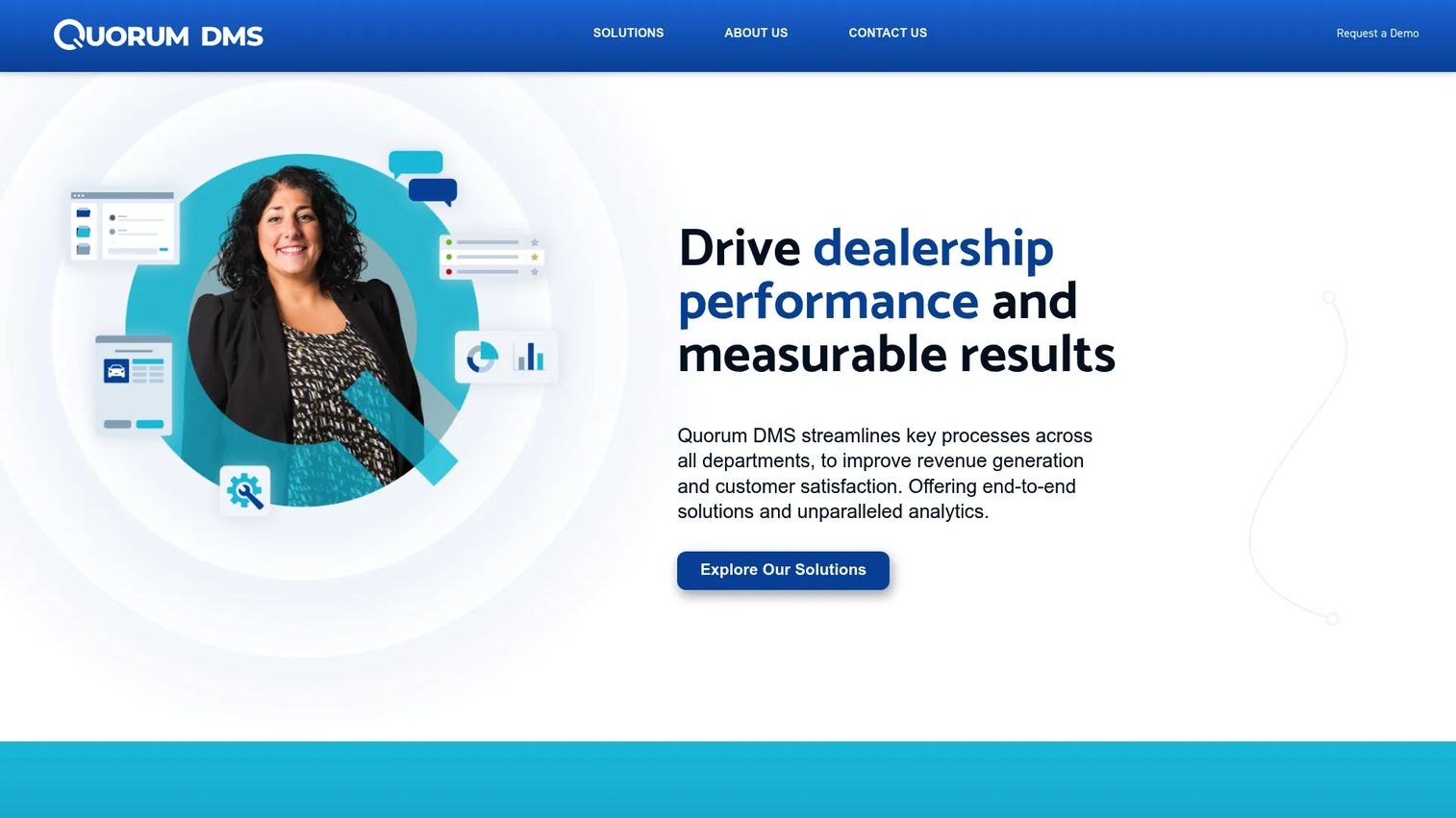
Quorum DMS is a dealer management system providing integrated capabilities for automotive dealerships across fixed operations, variable operations, accounting, analytics, communications, and AI. Its MORI AI voice agent answers inbound calls and books service appointments automatically, which is a differentiator for high-volume service departments. QAnalytics provides real-time reporting across dealerships. Quorum is a strong fit for Canadian dealerships and regional groups that want operational integration alongside modern communication tools.
Best for: Canadian dealerships and regional auto groups that want integrated DMS operations with built-in AI voice and real-time analytics.
Key features
- Fixed ops: Service, parts, warranty, declined services, and tire management
- Variable ops: Desking, F&I, digital retailing, and lead management
- Integrated accounting and payroll
- QAnalytics real-time reporting across dealerships
- MORI AI voice agent for inbound calls and service booking
Why choose Quorum DMS: Quorum is worth evaluating when service department throughput and inbound call handling are operational priorities alongside standard DMS functions. Verify current product naming and packaging before committing.
Quorum DMS pricing: Pricing is quote-based. Request a quote tied to store count, modules, migration, and support scope.
10. VUE DMS
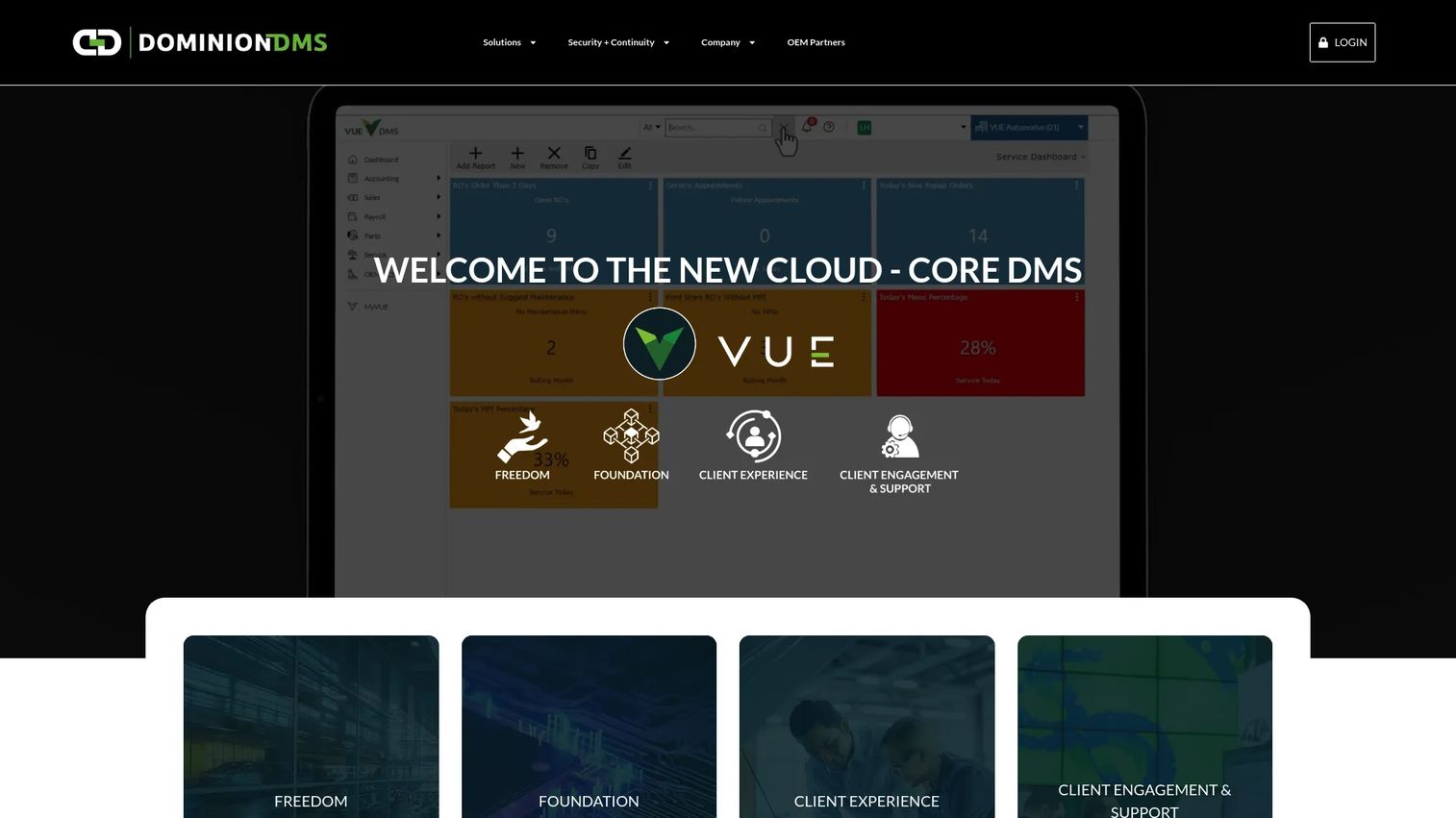
VUE DMS, currently marketed by Dominion DMS, is a cloud-core dealer management system built on Microsoft Azure. It covers accounting, sales, F&I, parts, and service with unlimited user access and unlimited data retention baked into the platform rather than metered as an add-on. Vehicle inspections run from a tablet, repair orders are collaborative and real-time, and vendor-partner app integrations are customizable. It targets dealers that want a modern cloud architecture without selecting one of the dominant enterprise DMS vendors.
Best for: Automotive dealerships evaluating modern cloud DMS options who want Azure-based architecture with no user limits and practical fixed-ops tools.
Key features
- Microsoft Azure cloud-native architecture
- Accounting, sales, F&I, parts, and service modules
- Unlimited user access and unlimited data retention
- Vehicle inspections from a tablet
- Collaborative real-time repair orders
- Customizable vendor-partner app integrations
Why choose VUE DMS: VUE fits dealers who want to modernize without locking into one of the two or three largest DMS vendors. The unlimited-user model removes a common per-seat cost concern for growing teams.
VUE DMS pricing: Pricing is quote-based. Ask about modules, rooftops, implementation, and data conversion as part of the initial conversation.
11. Autologica Sky DMS
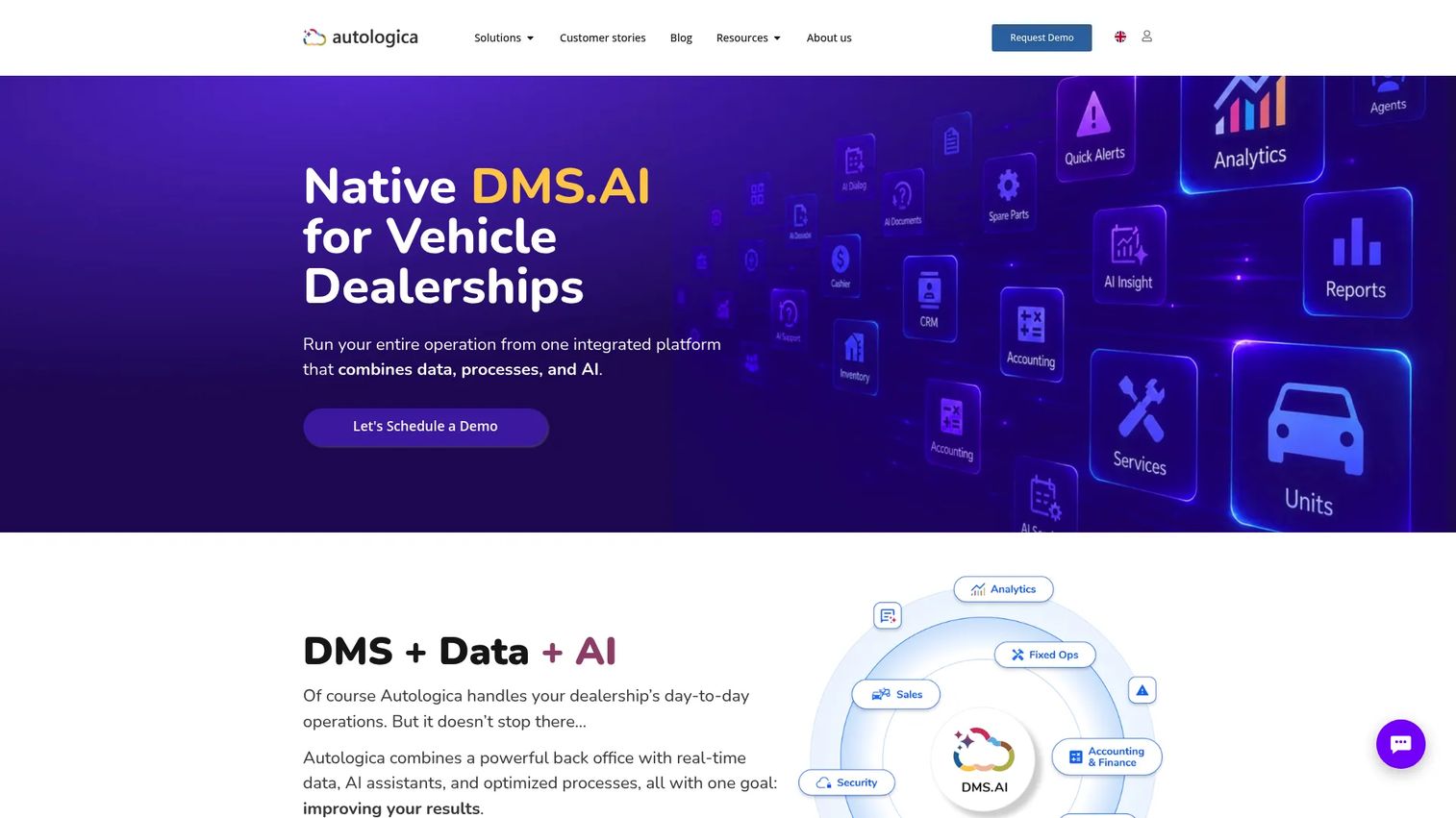
Autologica Sky DMS is a cloud-based dealership management system combining sales, service, parts, administration, accounting, inventory, and workflow management with native AI assistants. It supports vehicle, agricultural, truck, motorcycle, and equipment dealerships, making it a viable option beyond franchise automotive. The native AI assistants handle document processing, data dialogue, service appointments, KPI insights, and sales opportunity identification rather than requiring third-party add-ons. Autologica has strong market presence in Latin America and other international markets.
Best for: International dealerships and emerging-market dealer groups that need a cloud DMS with native AI and multi-country support.
Key features
- Native AI assistants across document processing, service, KPIs, and sales
- Sales, service, parts, administration, accounting, and inventory management
- Integrated analytics with departmental KPIs and customizable dashboards
- Branch comparisons and budget tracking
- Multi-country support
Why choose Autologica Sky DMS: Choose Autologica when you are outside the dominant North American franchise DMS ecosystem and need international deployment support with AI capabilities built in rather than bolted on.
Autologica Sky DMS pricing: Pricing is quote-based. Request a breakdown by market, deployment scope, modules, and support requirements.
12. incadea DMS
incadea DMS is automotive dealership management software for dealers, importers, and workshops, covering vehicle sales, CRM, service, parts, accounting, and OEM integrations. It supports multi-language, multi-currency, and multi-brand operations and can be deployed cloud-based or on-premises. incadea is built for OEM-aligned dealer networks that need standardization across regions rather than flexibility for independent store customization.
Best for: Global dealer networks and OEM-aligned dealerships that need standardized workflows across multiple regions and manufacturer connectivity.
Key features
- Vehicle sales and CRM management
- Service, workshop scheduling, and resource management
- Parts management and built-in accounting
- Multi-language, multi-currency, and multi-brand support
- Real-time KPI reporting and AI-powered insights
- Cloud or on-premises deployment options
Why choose incadea DMS: incadea suits dealer networks where the OEM or importer sets the operational standard and rollout consistency across countries matters more than store-level customization. It is less suited to independent dealers who need flexibility.
incadea DMS pricing: Pricing is quote-based. Ask incadea to clarify regional rollout scope, integrations, implementation, and support costs.
13. Dealer-Mate (BiT DMS)
Dealer-Mate is a browser-based dealer management system for independent automotive, motorcycle, RV, marine, trailer, and specialty dealers. Where most DMS platforms are built around franchise auto workflows, Dealer-Mate is designed from the ground up for specialty dealerships, including those managing Buy Here Pay Here and Lease Here Pay Here portfolios. It includes inventory management with VIN decoding and marketplace uploads, deal structuring, lender integrations, CRM with phone and text follow-up, and dealer websites. For dealers managing boats, trailers, or powersports units, the inventory and 3D parts catalog software workflows are purpose-built rather than adapted from an automotive template.
Best for: Independent specialty dealers (RV, marine, powersports, golf cart, outdoor power equipment) that need vertical-specific DMS workflows without franchise automotive overhead.
Key features
- Inventory management with VIN decoding, photos, pricing, and marketplace uploads
- Desking, deal structuring, F&I, lender integrations, and forms
- Buy Here Pay Here and Lease Here Pay Here portfolio management
- CRM with phone, text, and email follow-up
- Dealer websites, parts and service, QuickBooks integration, and data conversion
Why choose Dealer-Mate: Dealer-Mate is the clearest fit when your inventory includes RVs, boats, trailers, motorcycles, or outdoor power equipment and standard franchise automotive DMS workflows create more friction than they solve.
Dealer-Mate pricing: Cloud DMS v1.0 starts at $79/month on annual billing ($119/month billed monthly). A special introductory package runs $79/month for the first three months, then $119/month. D-M DMS v2.0 and add-on modules are priced by quote. A 30-day free trial is available.
G2 rating: 4.5/5 (2 reviews)
Considerations when choosing dealer management systems
Department coverage
A DMS must match how the dealership actually earns margin. A store with heavy service revenue should scrutinize service dispatch, repair order management, technician workflow, labor analysis, and parts integration depth. Weak fixed-ops tools in a service-heavy store create technician idle time and parts margin leakage that show up in monthly reports, not in vendor demos.
Integration depth
Ask whether data moves cleanly in both directions, not just whether the integration exists. OEM, lender, payment, CRM, website, inventory, and reporting connections all carry the same risk: A one-way sync that creates duplicate entry and inconsistent records. Verify integration architecture before signing, not after go-live.
Cloud access and architecture
Cloud-native, cloud-hosted, and legacy on-premise systems have meaningfully different implications for uptime, remote access, update cycles, security posture, and long-term implementation cost. Cloud-based deployment represents 46% of global DMS revenue (KBV Research, 2024), but legacy systems still fit some dealers with stable workflows. Tie the cloud conversation to your reporting cadence and remote management needs rather than treating it as a default preference.
Accounting and reporting quality
This is where leadership gets operational leverage. Evaluate chart of accounts fit, intercompany accounting for multi-rooftop groups, month-end close speed, departmental profitability visibility, and dashboard accuracy. A DMS with weak accounting forces the controller into manual reconciliation, which delays the weekly numbers your leadership team depends on.
Implementation and change management
A DMS replacement touches every department simultaneously. Migration, training, data conversion, workflow redesign, and parallel runs all carry risk and cost. Ask vendors for a phased implementation plan and references from dealerships of similar size and complexity. The go-live plan matters as much as the feature set.
Conclusion
The right DMS is not the most feature-rich one on the list. It is the one that fits how your dealership makes money and can be implemented without a year of disruption.
For large franchise and enterprise auto groups, Dealertrack, Tekion Automotive Retail Cloud, CDK Dealership Xperience Platform, and Reynolds Retail Management System all address the scale, compliance, and integration complexity those operations require. For regional and independent dealers, Auto/Mate, DealerBuilt ceDMS, PBS DMS, Quorum DMS, and VUE DMS offer strong operational coverage without an enterprise buying process. International and OEM-connected networks should evaluate Keyloop DMS, Autologica Sky DMS, and incadea DMS based on regional fit and manufacturer alignment. Specialty dealers running RV, marine, powersports, golf cart, or outdoor power equipment businesses should start with Dealer-Mate (BiT DMS), which is built around those workflows rather than adapted from franchise auto.
Before booking vendor demos, map your current workflows across sales, F&I, service, parts, accounting, and reporting. Then score each shortlisted vendor against the specific workflows that create margin or slow the team down. That exercise will make every demo conversation more productive and every proposal easier to compare.
FAQs
A dealer management system (DMS) is dealership operations software that centralizes sales, F&I, service, parts, inventory, accounting, reporting, and customer data in one connected system. It functions like an ERP for a dealership, connecting every profit center rather than managing just one department. A DMS is broader than a CRM or standalone inventory tool because it ties together the operational work those tools only partially cover.
A CRM manages customer relationships, leads, communications, and follow-up activity. A DMS manages broader dealership operations, including vehicle inventory, deal processing, repair orders, accounting, parts, and financial reporting. Most DMS platforms include a CRM module or integrate with a dedicated CRM, but the DMS is the operational system of record while the CRM focuses on customer-facing activity.
Evaluate department coverage, accounting and reporting depth, fixed-operations workflows, OEM and lender integrations, cloud access model, security and permissions, support quality, and implementation planning. A DMS that covers accounting well but lacks a strong service module will not serve a fixed-ops-heavy dealership. Match the platform to where your dealership earns its margin.
Cloud systems can improve remote access, update cycles, centralized visibility, and long-term maintenance burden. Legacy on-premise systems may still fit dealers with stable workflows, existing infrastructure investments, and limited need for remote access. The right answer depends on your reporting cadence, remote management requirements, and appetite for a managed transition. Avoid selecting a cloud DMS purely on architecture when the operational fit is weak.
DMS pricing typically depends on rooftop count, users, modules selected, integrations, implementation scope, training, and ongoing support. Most enterprise DMS vendors do not publish rates and require a direct quote. Dealer-Mate is the exception in this list, with Cloud DMS v1.0 starting at $79/month on annual billing. For all other platforms covered here, request a full cost breakdown covering implementation, data conversion, and annual support, not just the subscription rate.
Timelines vary significantly by dealership size, data migration complexity, integration requirements, accounting setup, and training scope. A single-store independent dealer may complete implementation in weeks. A multi-rooftop franchise group with complex accounting and OEM integrations should plan for months, including parallel runs. Ask every vendor for a phased implementation plan and references from dealerships with a similar operational profile.
Multi-location dealers should prioritize intercompany accounting, shared inventory visibility, consolidated reporting, permission controls by store and role, and standardized workflows. Dealertrack, Tekion, CDK, DealerBuilt ceDMS, and Quorum DMS all address multi-location operations in different ways. No single platform is universally best. Use the comparison table to shortlist candidates, then evaluate each against your specific store count, accounting structure, and integration requirements.
RV, marine, powersports, golf cart, and outdoor power equipment dealers often need different inventory management, storage tracking, service workflows, warranty processing, and manufacturer price-file update capabilities. A franchise automotive DMS adapted for those verticals often requires workarounds that create friction. Dealer-Mate is purpose-built for specialty dealerships and handles BHPH portfolios, marine and RV inventory, and lender integrations that standard automotive DMS platforms do not natively support.