You can fill out a security questionnaire in an afternoon. Proving where sensitive data actually lives across 40 SaaS apps, three clouds, and production databases is a different problem entirely.
That gap between paper compliance and real data visibility is widening. In the IBM Cost of a Data Breach Report 2025, among organizations planning to increase security investment after a breach, 37% named data security and protection tools as a priority area, behind only threat detection and response at 43%. The same report puts the global average cost of a breach at USD 4.44 million, with the United States average at a record USD 10.22 million. Meanwhile the Thales 2025 Cloud Security Study found that only 8% of organizations encrypt 80% or more of their cloud data. The tools exist. The coverage often does not.
Note on that last source: the Thales study is published by Thales, which also owns the CipherTrust platform listed at number four below. Treat the figure as vendor-published research rather than independent analysis.
For presales teams, this creates a specific kind of friction: buyers ask detailed questions about data handling, access controls, encryption standards, and audit trails. Answering those questions well requires understanding the real capabilities of data security software, not just the marketing language around it. This guide cuts through that noise.
What's inside
This guide covers 12 data security software products evaluated for security engineers, solutions consultants, and presales managers supporting enterprise buying decisions in 2026.
Selection criteria:
- Coverage across data discovery, classification, DLP (data loss prevention), DSPM (data security posture management), monitoring, and access control
- Fit for cloud, hybrid-cloud, SaaS, endpoint, and database environments
- Compliance reporting depth and audit-readiness
- Security stack integrations and operational workflow fit
- Published pricing where the vendor lists it, and the current G2 rating for the specific product named
TL;DR
- Best for DSPM and sensitive data discovery: Cyera provides AI-native discovery and risk prioritization across cloud data estates
- Best for Microsoft-heavy enterprises: Microsoft Purview ties governance, DLP, and compliance into the Microsoft security stack
- Best for database monitoring and compliance: IBM Guardium covers database activity monitoring and vulnerability assessment in regulated environments
- Best for encryption and key management: CipherTrust Data Security Platform centralizes cryptographic controls across hybrid deployments
- Best for insider risk and file exposure: Varonis detects abnormal access across file shares and SaaS repositories
- Best for cloud access and data protection convergence: Netskope and Zscaler both enforce data controls inline with cloud and web traffic
- Consolidation note: DSPM has been bought up faster than almost any security category. Six of the 12 platforms below got their DSPM or classification capability through an acquisition, and Satori is now owned by Commvault. Each entry flags its own situation.
What is data security software?
Data security software helps organizations discover, classify, monitor, control, and protect sensitive data across databases, SaaS apps, cloud storage, endpoints, and AI workflows.
The category is broad by design. Enterprise environments generate sensitive data across dozens of systems, and no single control type protects all of it. A data security platform typically combines several capability layers rather than delivering one.
Core capabilities of data security software
- Data discovery and classification: Finding where sensitive data lives and labeling it by type and risk level
- Data loss prevention (DLP): Enforcing policies that stop risky data movement or sharing across channels
- Data security posture management (DSPM): Continuously assessing exposure, misconfigurations, and over-permissioned access in cloud environments
- Access controls and authorization: Applying least-privilege policies to govern who can read, write, or move sensitive data
- Encryption, tokenization, and masking: Protecting data values at rest, in transit, and during processing
- Database activity monitoring: Logging queries, capturing anomalies, and flagging policy violations at the database layer
- Insider risk detection: Behavioral analytics that surface unusual access patterns before data leaves the environment
- Compliance reporting: Generating audit evidence, activity logs, and policy documentation for frameworks like GDPR, HIPAA, PCI DSS, and SOX
- AI data governance: Controlling what data feeds AI models, agents, and workflows, and tracking exposure through those channels
- Security stack integrations: Connecting to SIEM, SOAR, IAM, CASB, EDR, GRC, and ticketing tools for operational continuity
Data security software versus data privacy software
Data security focuses on protecting data from unauthorized access, misuse, exfiltration, and exposure. Data privacy focuses on lawful data collection, consent management, retention schedules, subject rights, and policy governance. The distinction matters for procurement. A tool that generates privacy impact assessments does not replace encryption or access controls, and a DLP platform does not handle consent workflows. Enterprise buyers often need both categories, but treating them as interchangeable leads to coverage gaps that surface during security reviews.
When to use data security software
Map sensitive data before a security review
Buyers, auditors, and procurement teams routinely ask vendors to document where sensitive data lives and who can access it. For presales teams supporting regulated accounts, this question appears in RFPs, security questionnaires, and due diligence calls. Data discovery and classification tools give security teams a defensible, current map of their data estate rather than a best-guess response assembled the night before a review.
Control access across cloud and SaaS environments
Multi-cloud and SaaS environments create sprawl. Data sits in storage buckets, analytics platforms, collaboration tools, and third-party APIs, often with permissions granted during fast-moving projects and never revisited. Data security platforms that combine DSPM with access governance help teams identify over-permissioned users, exposed buckets, and risky sharing configurations before they become incidents. During technical evaluation, SEs should verify enforcement depth beyond discovery alone.
Prove compliance without rebuilding reports manually
Compliance frameworks require evidence: activity logs, access histories, policy change records, and data residency documentation. Teams that build those reports manually from scattered system logs burn significant time and introduce inconsistency. Data security software with built-in compliance reporting generates that evidence continuously, so audits draw from a live record rather than a reconstruction effort. This matters most in regulated industries where audit cycles are frequent and evidence standards are high.
Data security software comparison
The table below covers 12 tools evaluated for enterprise data security in 2026. Pricing reflects the state of each vendor's official pricing page. Several vendors price by quote only; those cells note the quote-based model. Each G2 rating names the specific product listing it comes from, because several of these vendors hold multiple G2 profiles with different scores.
Ownership and acquisition disclosure, once, for the whole table. Satori is owned by Commvault, which announced the deal in July 2025 and expected it to close that August; satoricyber.com now redirects to Commvault. Six platforms acquired their DSPM or data classification capability rather than building it: Proofpoint bought Normalyze in October 2024, Netskope bought Dasera in October 2024, Forcepoint bought Getvisibility in April 2025, IBM bought Polar Security in 2023, Cyera bought Trail Security in October 2024, and Palo Alto Networks bought Dig Security in December 2023. CipherTrust is a Thales product, and Thales also owns Imperva following its 2023 acquisition. Trellix is owned by Symphony Technology Group, built from the former McAfee Enterprise and FireEye businesses. No two entries below share a parent company, but none of the DSPM capability here is independent.
| # | Product | Best for | Key differentiator | Pricing | G2 rating |
|---|---|---|---|---|---|
| 1 | Cyera | DSPM and sensitive data discovery | AI-native classification across cloud, SaaS, and endpoint | Quote-based | 4.5/5 (Cyera, 31 reviews) |
| 2 | Microsoft Purview | Microsoft 365 and Azure environments | Governance, DLP, and compliance inside the Microsoft stack | From $12.00/user/month | 4.4/5 (Microsoft Purview Information Protection, 32 reviews) |
| 3 | IBM Guardium | Database security and monitoring | Deep database activity monitoring and compliance controls | Quote-based | 4.3/5 (IBM Guardium Data Protection, 119 reviews) |
| 4 | CipherTrust Data Security Platform | Encryption and key management | Centralized encryption, tokenization, and key management | Quote-based | 4.5/5 (Thales CipherTrust Data Security Platform, 32 reviews) |
| 5 | Forcepoint Data Security Cloud | Unified DLP and posture management | DLP, DSPM, and risk-adaptive controls in one portfolio | Quote-based | 4.2/5 (Forcepoint Data Security Cloud, 103 reviews) |
| 6 | Varonis | Insider risk and file activity | Behavioral analytics and permissions analysis across data stores | Quote-based | 4.6/5 (Varonis Data Security Platform, 88 reviews) |
| 7 | Netskope | Cloud and SaaS data protection | CASB, SWG, ZTNA, and DLP in a unified SSE platform | From $135.06/user/year at 1,000+ users | 4.4/5 (Netskope One Platform, 95 reviews) |
| 8 | Palo Alto Networks Prisma Access | SASE with data controls | Cloud-delivered security with DLP across distributed workforces | Quote-based | 4.3/5 (Prisma Access, 73 reviews) |
| 9 | Proofpoint | Email, collaboration, and insider risk | Human-centric data protection across email and messaging channels | Essentials from $1.65/user/month for existing customers | 4.3/5 (Proofpoint Enterprise Data Loss Prevention, 56 reviews) |
| 10 | Zscaler | Zero trust data protection | Cloud security service edge with inline DLP enforcement | Quote-based | 4.4/5 (Zscaler Internet Access, 324 reviews) |
| 11 | Trellix Data Security | Endpoint and enterprise DLP | Data protection across endpoints, databases, and removable media | Quote-based | 4.3/5 (Trellix Data Loss Prevention, 109 reviews) |
| 12 | Satori Data Security Platform | Data access governance | Access controls and dynamic masking for cloud data platforms | Quote-based | 4.7/5 (Satori Data Security Platform, 87 reviews) |
Each tool in detail
1. Cyera
Cyera is an AI-native data and AI security platform built for security teams that need to know exactly where sensitive data lives, who can access it, and where it is exposed. The platform provides agentless discovery and classification across SaaS, IaaS, DBaaS, on-premises environments, email, network traffic, endpoints, AI models, and agents. For presales teams supporting enterprise security diligence, Cyera's ability to generate context-rich risk prioritization and compliance evidence accelerates the conversation from "where is your data?" to "here is the specific exposure and what we are doing about it."
Best for: Enterprise security teams that need DSPM and sensitive data discovery across modern, multi-environment cloud data estates.
Key features
- Agentless discovery and classification across cloud, SaaS, on-prem, and AI environments
- DSPM with risk prioritization, identity context, and automated remediation
- Omni DLP with AI-driven alert analysis and real-time policy enforcement
- AI and agent security, including Agent Guardian and AI asset discovery
- Compliance evidence generation and workflow orchestration
Acquisition note: Cyera remains independent, and is one of the few DSPM vendors on this list that has not been bought. It is itself an acquirer: it bought DLP company Trail Security in October 2024 in a deal reported at USD 162 million, which is where the Omni DLP line originates. Ask how far that integration has progressed if DLP enforcement is a scored requirement.
Why choose Cyera: Cyera suits security teams whose data estate spans cloud, SaaS, and AI workflows and who need posture management alongside policy enforcement. Buyers should verify exact environment coverage and integration depth during evaluation.
Cyera pricing: Pricing is quote-based. Ask Cyera's sales team about covered data stores, the DSPM and DLP plan modules, and any add-ons for data subject request automation.
G2 rating: 4.5/5 on the Cyera listing, from 31 reviews.
2. Microsoft Purview
Microsoft Purview is a portfolio of data governance, data security, and compliance tools designed to protect and manage organizational data across Microsoft 365, Azure, and external sources. It brings together data loss prevention, information protection labels, insider risk management, audit, eDiscovery, and a unified data catalog under one administrative surface. For organizations already standardized on the Microsoft security stack, Purview reduces integration overhead by connecting directly to Microsoft 365 signals, Entra identity data, and Defender telemetry.
Best for: Enterprises standardized on Microsoft security, compliance, and productivity tools that want tight integration between data governance and their existing Microsoft environment.
Key features
- Microsoft 365 DLP and information protection labels
- Unified data catalog and data map for governance
- Insider risk management and communication compliance
- eDiscovery, audit, and compliance management workflows
- Pay-as-you-go and subscription licensing options
Why choose Microsoft Purview: The fit is strongest when the buyer's data risk centers on Microsoft 365 collaboration, SharePoint, Teams, and Azure storage. Presales teams should verify licensing complexity carefully, since capabilities are distributed across the Purview Suite, Microsoft 365 E5, and standalone add-ons. Purview is also split across multiple G2 listings rather than one product profile, so confirm which listing a quoted rating refers to.
Microsoft Purview pricing: The Microsoft Purview Suite is listed at USD 12.00 per user per month on an annual subscription, which Microsoft notes was formerly packaged as E5 Compliance. Microsoft 365 E5, which bundles Purview capabilities, is listed at USD 60.00 per user per month on an annual commitment. Both figures exclude tax and vary by region.
G2 rating: 4.4/5 on the Microsoft Purview Information Protection listing, from 32 reviews.
3. IBM Guardium
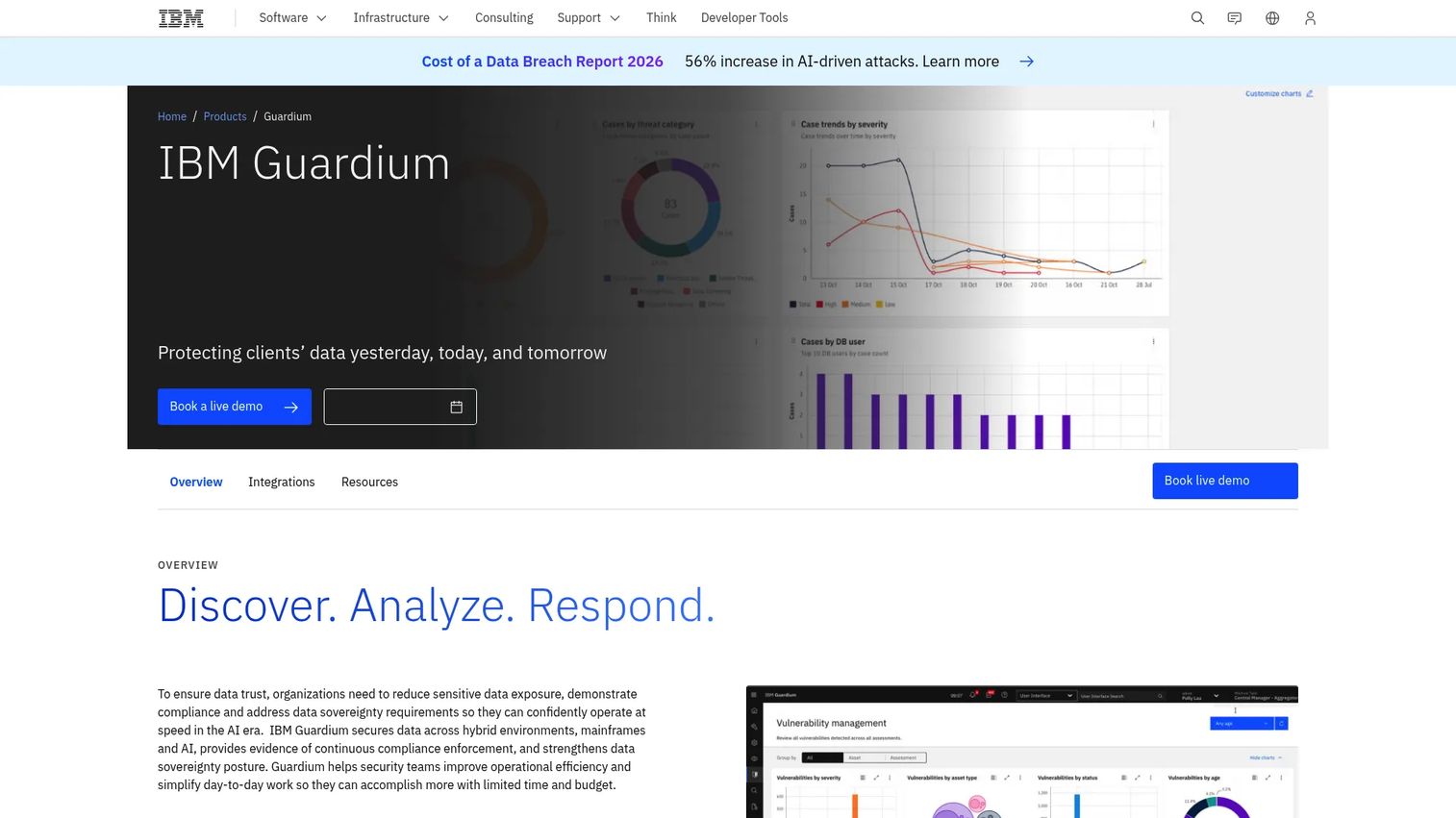
IBM Guardium is a data security portfolio focused on database protection, activity monitoring, vulnerability assessment, and compliance in hybrid and multicloud environments. The platform provides real-time visibility into database queries and access patterns, flags policy violations, and generates the audit trails that regulated industries require. IBM Guardium also covers mainframe environments, which matters for organizations running core banking, insurance, or government workloads on legacy infrastructure. It is a common requirement in financial services and healthcare RFPs that specifically ask for database-layer security controls.
Best for: Enterprises in regulated industries that need database activity monitoring, vulnerability assessment, and compliance evidence across on-premises and cloud databases.
Key features
- Real-time database activity monitoring and anomaly detection
- Vulnerability assessment and remediation tracking
- Sensitive data discovery and classification at the database layer
- Data encryption, tokenization, and masking
- Compliance reporting with centralized policy enforcement
Acquisition note: IBM acquired DSPM company Polar Security in 2023, and that technology underpins the Guardium DSPM capability. If your requirement is cloud DSPM rather than database activity monitoring, confirm which Guardium module covers it and how it is licensed, because Guardium spans several separately sold products.
Why choose IBM Guardium: IBM Guardium suits organizations where the primary risk is unauthorized access to databases holding regulated data, such as PII, financial records, or health information. Implementation planning is important for large environments with mixed database vendors.
IBM Guardium pricing: Pricing is quote-based and varies by deployment model and selected Guardium modules. Contact IBM directly for a scope-specific quote that covers monitored databases and support requirements.
G2 rating: 4.3/5 on the IBM Guardium Data Protection listing, from 119 reviews. Other Guardium modules carry separate listings and separate scores.
4. CipherTrust Data Security Platform
CipherTrust Data Security Platform by Thales is a centralized data protection platform for organizations that need to manage encryption, tokenization, key management, secrets management, and access controls across hybrid and multicloud environments. The platform handles transparent encryption for files, databases, big data workloads, and containers, as well as application-layer protection and dynamic data masking. For buyers with data sovereignty, key ownership, or HSM requirements, CipherTrust provides a platform that consolidates cryptographic controls rather than leaving them scattered across cloud-native services.
Best for: Security teams prioritizing centralized encryption, enterprise key management, and tokenization across hybrid and multicloud data environments.
Key features
- Enterprise and multicloud key management
- Transparent encryption for files, databases, and containers
- Tokenization and dynamic data masking
- Application-layer data protection
- Secrets management and granular access policy controls
Ownership note: CipherTrust is a Thales product, and Thales completed its USD 3.6 billion acquisition of Imperva in December 2023, so Thales now sells both CipherTrust and the Imperva data security line. Thales also publishes the Cloud Security Study cited at the top of this guide. If a competitive evaluation puts CipherTrust against an Imperva product, those are two offerings from the same company.
Why choose CipherTrust Data Security Platform: CipherTrust is the right choice when the primary requirement is protecting sensitive data values at rest and in use, with full control over encryption keys. Buyers should verify supported databases, cloud services, HSM integration options, and deployment model during evaluation.
CipherTrust Data Security Platform pricing: Pricing is quote-based. Ask about the specific modules required, the number of protected systems, key management scope, and whether hardware security module support is needed.
G2 rating: 4.5/5 on the Thales CipherTrust Data Security Platform listing, from 32 reviews.
5. Forcepoint Data Security Cloud

Forcepoint Data Security Cloud combines enterprise DLP, DSPM, data detection and response, cloud app security, and AI risk controls into a unified data security portfolio. The platform applies risk-adaptive policy enforcement, adjusting controls based on user behavior, data sensitivity, and context rather than relying solely on static rule sets. An ARIA natural-language assistant lets security analysts query insights and deploy policies without writing complex rule logic. For organizations with data moving across endpoint, web, email, cloud, and AI workflows, Forcepoint positions itself as a single portfolio covering those channels.
Best for: Enterprise and government organizations looking for unified DLP, DSPM, and AI data risk controls across multiple enforcement channels.
Key features
- DSPM with continuous discovery and AI-powered classification
- Enterprise DLP across cloud, web, email, and endpoints
- Risk-adaptive policy enforcement based on user behavior and context
- Cloud app security with SaaS and generative AI visibility
- ARIA natural-language assistant for policy deployment
Acquisition note: Forcepoint completed its acquisition of Getvisibility in April 2025, and the AI-powered discovery and classification layer described above comes from that deal rather than from long-standing Forcepoint engineering. Ask how deeply Getvisibility is integrated with the DLP enforcement engine, because the two were separate products until recently.
Why choose Forcepoint Data Security Cloud: Forcepoint fits when the buyer wants a portfolio that connects DLP with posture management and behavioral risk signals rather than managing those layers separately. Presales teams should verify which enforcement channels are included in the evaluated tier and how AI governance claims hold up under technical scrutiny.
Forcepoint Data Security Cloud pricing: Pricing is quote-based. Ask about covered channels, user count, endpoint coverage scope, and cloud data controls.
G2 rating: 4.2/5 on the Forcepoint Data Security Cloud listing, from 103 reviews. Forcepoint Data Loss Prevention is a separate listing at 4.4/5 from 42 reviews.
6. Varonis
Varonis is a data security platform built around sensitive data discovery, permissions analysis, behavioral analytics, and threat detection across file shares, collaboration tools, SaaS repositories, and cloud data stores. Its core strength is finding overexposed data and abnormal access patterns, then automating remediation of excessive permissions without requiring manual ticket-by-ticket cleanup. For security teams that manage large Microsoft 365, SharePoint, or cloud storage environments, Varonis surfaces the exposure hiding in folder structures and permission grants that no one has reviewed in years.
Best for: Security teams focused on insider risk, abnormal data access, and overexposed file systems in SaaS and on-premises environments.
Key features
- Sensitive data discovery and classification across cloud and on-premises stores
- Permissions analysis and automated remediation of excessive access
- Real-time data activity monitoring and forensic audit trails
- Behavioral analytics and data-centric threat detection
- Compliance management and data access governance
Why choose Varonis: Varonis performs best when data exposure hides in permissions, shared drives, and collaboration platforms rather than at the network perimeter. Buyers should verify coverage for their specific repository types and identity stack before committing.
Varonis pricing: Pricing is quote-based, with costs driven by the number of monitored identities and data stores. Rather than a self-serve trial, Varonis offers a free Data Risk Assessment: a scoped engagement with full platform access and an assigned analyst that Varonis says produces key findings within 24 hours of install. Ask about deployment services and response options alongside the licence quote.
G2 rating: 4.6/5 on the Varonis Data Security Platform listing, from 88 reviews.
7. Netskope
Netskope is a security service edge (SSE) platform that combines cloud access security broker (CASB) capabilities, secure web gateway (SWG), zero trust network access (ZTNA), DLP, DSPM, and AI visibility controls in a cloud-delivered architecture. For organizations protecting data moving through cloud apps, web traffic, and remote users, Netskope enforces data policies inline without requiring on-premises hardware. The platform also covers enterprise browser and AI security, making it relevant for teams evaluating data exposure risk across generative AI tool usage. This is a good fit for presales supporting evaluations where data protection is inseparable from access control and cloud traffic management.
Best for: Security teams that need cloud access security and data protection enforced together across SaaS, web traffic, and remote workforces.
Key features
- Cloud access security broker (CASB) for SaaS visibility and control
- Secure web gateway with threat protection
- Cloud DLP and data security posture management
- Zero trust private access
- AI visibility, security, and enterprise browser controls
Acquisition note: Netskope acquired Dasera in October 2024 and launched its DSPM capability on that technology, so Netskope One DSPM is the former Dasera product rather than an organic Netskope build. If DSPM is a scored line item, ask which Netskope One release the capability shipped in and how it shares policy with the inline DLP engine.
Why choose Netskope: Netskope fits when DLP enforcement is tied to cloud access rather than existing as a standalone control. SEs should verify whether the buyer needs data discovery depth, traffic-level enforcement, or both before scoping the deployment.
Netskope pricing: Netskope's published price list dated August 2024 lists the SSE Professional Package at USD 135.06 per user per year and the SSE Enterprise Package at USD 172.47 per user per year, both at the 1,000-plus user tier. Below 1,000 users the same list prices Professional at USD 213.16 and Enterprise at USD 257.00 per user per year, so seat count moves the unit price substantially. That list is more than a year old; confirm current figures directly with Netskope.
G2 rating: 4.4/5 on the Netskope One Platform listing, from 95 reviews.
8. Palo Alto Networks Prisma Access
Palo Alto Networks Prisma Access is a cloud-delivered SASE platform that secures users, devices, and applications across distributed work environments. Data protection in Prisma Access is delivered through DLP policy enforcement within the broader secure access layer, alongside zero trust network access (ZTNA), cloud access security broker (CASB), firewall-as-a-service (FWaaS), and remote browser isolation. For organizations already running Palo Alto Networks architecture, Prisma Access extends consistent data policy enforcement to remote users and branch locations without separate data security tooling.
Best for: Enterprises using Palo Alto Networks security architecture that want data controls embedded inside a SASE and zero trust enforcement model.
Key features
- Zero trust network access (ZTNA) for private application security
- Secure web gateway (SWG) with threat prevention
- Cloud access security broker (CASB) for SaaS visibility
- Firewall-as-a-service (FWaaS) with data loss prevention
- Remote browser isolation (RBI)
Acquisition and scoping note: Palo Alto Networks acquired DSPM company Dig Security in December 2023, in a deal widely reported at around USD 400 million, and folded that technology into Prisma Cloud rather than Prisma Access. Those are two different products on two different licences. If your requirement is data discovery and posture management, Prisma Access alone will not cover it, and the conversation needs to include Prisma Cloud, now being transitioned to the Cortex Cloud name.
Why choose Palo Alto Networks Prisma Access: Prisma Access makes sense when the buyer wants data security tied to network access and cloud traffic enforcement rather than as a standalone control plane. Buyers who primarily need data discovery depth or database monitoring will want to evaluate additional tools alongside it.
Palo Alto Networks Prisma Access pricing: Pricing is quote-based. Ask Palo Alto Networks about users, bandwidth requirements, geographic regions, and the security service modules required.
G2 rating: 4.3/5 on the Prisma Access listing, from 73 reviews.
9. Proofpoint
Proofpoint provides human-centric cybersecurity with capabilities across email security, information protection, DLP, insider threat management, and collaboration risk. Its data security approach starts with the human layer: where do people make risky data decisions, and how do behavioral signals identify those risks before data exits the organization? Proofpoint's Essentials Email Security product has published tiered pricing, while enterprise data security and insider threat products are quote-based. The platform is common in organizations where data loss incidents originate from email, file sharing, or deliberate exfiltration by departing employees.
Best for: Organizations where sensitive data loss most often starts with human behavior, including email, cloud sharing, or insider activity.
Key features
- AI-powered email threat detection and data protection
- Insider threat management with behavioral risk signals
- Cloud DLP and data security posture management
- Compliance archiving and eDiscovery
- Collaboration and messaging security controls
Acquisition note: Proofpoint acquired DSPM company Normalyze in October 2024, and the Proofpoint DSPM product is that technology. It is a young listing with very little buyer feedback behind it on G2, so treat DSPM as the least proven part of this portfolio and ask for references in environments like yours.
Why choose Proofpoint: Proofpoint is the right fit when the buyer's primary data risk runs through email and people rather than through cloud storage misconfigurations or database vulnerabilities. Presales teams should verify which Proofpoint products address the target use case, since the portfolio spans several distinct modules.
Proofpoint pricing: Proofpoint's published Essentials price list puts the Beginner tier at USD 1.65 per active user per month in its Region 1 pricing, rising to USD 1.93 in Region 2, and the list states that this tier is available only to existing Proofpoint Essentials customers. Business, Advanced, and Professional tiers run from USD 3.03 to USD 5.86 per active user per month in Region 1. Enterprise data security and insider threat products are quote-based; ask about bundles, user count, and retention requirements.
G2 rating: 4.3/5 on the Proofpoint Enterprise Data Loss Prevention listing, from 56 reviews. Proofpoint Insider Threat Management sits at 4.3/5 from 48 reviews. Proofpoint's company-wide G2 average of 4.5/5 spans more than 1,300 reviews across its email security products and does not describe its data security tools.
10. Zscaler
Zscaler is a cloud security platform built on the Zero Trust Exchange architecture, providing secure internet access, secure private application access, inline threat prevention, and data security with DLP across web, email, endpoint, SaaS, and generative AI traffic. Zscaler's DLP enforcement is inline, meaning it inspects and controls data as it moves rather than relying on out-of-band scanning. For organizations adopting zero trust as their security model, Zscaler provides data protection as part of that architecture rather than a separate overlay. The platform also includes AI security capabilities, including AI asset management, guardrails, and AI red teaming.
Best for: Organizations adopting zero trust cloud security that want data loss prevention built into their access and traffic enforcement model.
Key features
- Cloud DLP with inline enforcement across web, SaaS, and email
- Zero trust access for internet and private applications
- Secure web gateway with TLS inspection and cloud sandboxing
- SaaS security controls and CASB capabilities
- AI security, including AI asset management and guardrails
Why choose Zscaler: Zscaler fits best when the buyer wants to reduce data loss through cloud-delivered inline enforcement tied to their broader zero trust architecture. Teams should determine whether their use case needs discovery depth, traffic control, or both, since Zscaler's primary strength is the latter.
Zscaler pricing: Zscaler offers Essentials Platform and Zscaler Platform bundles, but pricing is quote-based. Contact Zscaler about users, service bundle selection, cloud workload scope, and DLP capabilities.
G2 rating: 4.4/5 on the Zscaler Internet Access listing, from 324 reviews. Zscaler holds several other product listings with their own scores, so check which one a quoted figure refers to.
11. Trellix Data Security
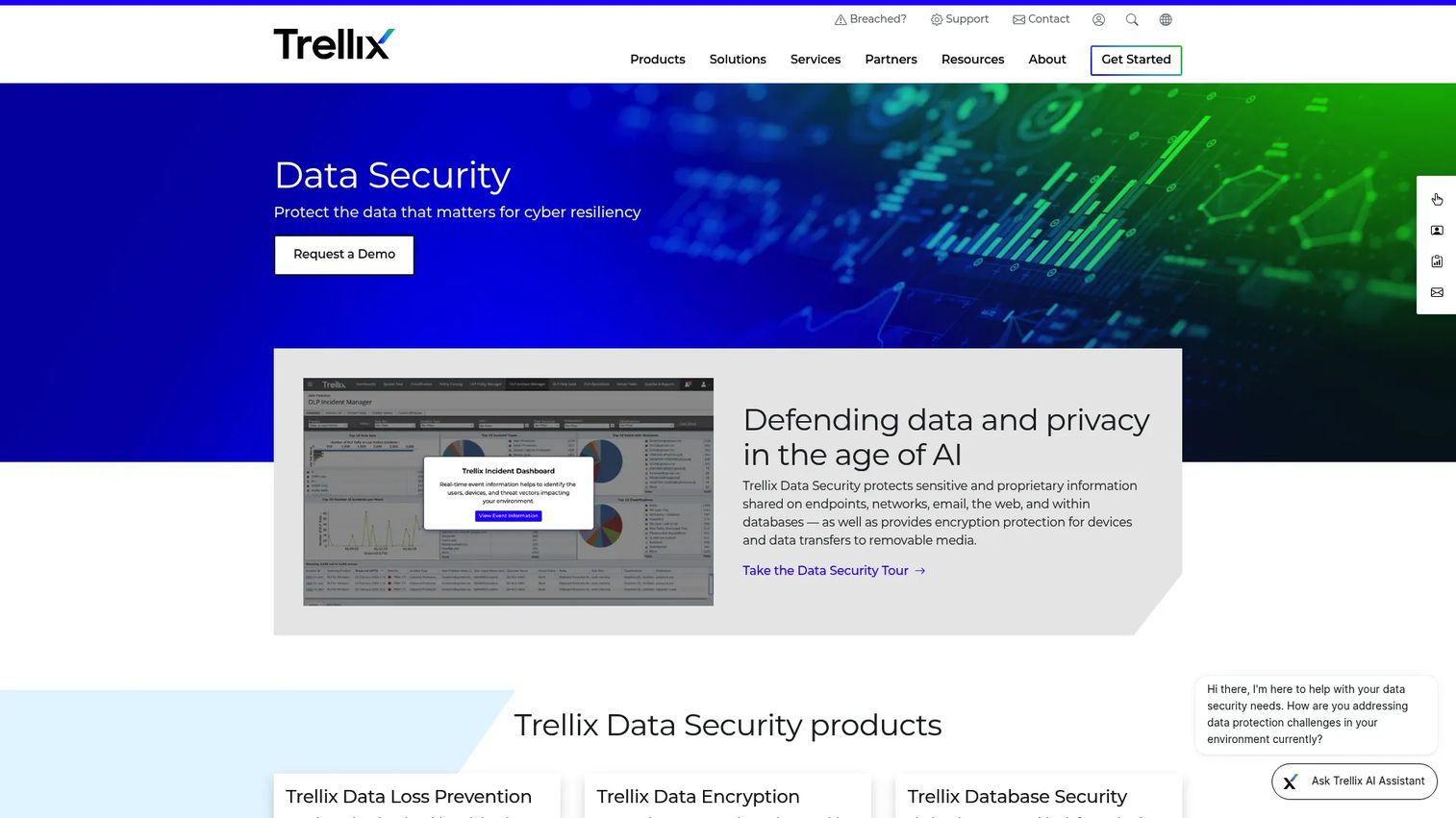
Trellix Data Security is an enterprise data security portfolio covering DLP across endpoints, networks, email, and web, as well as database discovery and protection, device encryption for removable media, and centralized management with compliance reporting. Trellix datasheets state that the DLP product classifies more than 300 content types, and the platform supports user coaching workflows, where employees receive in-context guidance when they are about to take a risky data action rather than simply being blocked. For enterprises with established endpoint-heavy security operations, Trellix fits naturally into an environment where security operations workflows already exist.
Best for: Enterprises with established endpoint security operations that need DLP, data classification, and database security integrated into existing security workflows.
Key features
- Enterprise DLP across endpoint, email, web, and network
- Encryption for enterprise devices and removable storage media
- Database discovery, protection, and activity monitoring
- Data classification covering more than 300 content types
- Centralized management, user coaching, and compliance reporting
Ownership note: Trellix is privately held by Symphony Technology Group, which assembled it from the former McAfee Enterprise business and FireEye in 2021 and also owns the sister company Skyhigh Security. Product naming and packaging have changed repeatedly through that transition, so confirm the current SKU names and support lifecycle before scoping a deployment.
Why choose Trellix Data Security: Trellix is worth evaluating when the buyer's existing security operations infrastructure is endpoint-centric and the goal is extending data protection consistently across those controls. Buyers should verify roadmap status, current product packaging, and deployment model during evaluation.
Trellix Data Security pricing: Pricing is quote-based. Ask Trellix about DLP modules, endpoint count, database security scope, support level, and deployment services.
G2 rating: The Trellix Data Security portfolio has no single G2 listing. Its components are rated separately: Trellix Data Loss Prevention at 4.3/5 from 109 reviews, and Trellix Database Security at 4.3/5 from 33 reviews. Trellix as a seller averages 4.2/5 across 752 reviews spanning its whole product range.
12. Satori Data Security Platform
Satori Data Security Platform is a cloud-native platform focused on data access governance, access controls, and real-time enforcement across cloud data warehouses, data lakes, databases, and AI applications. It applies role-based and attribute-based access controls (RBAC and ABAC), dynamic data masking, row-level security, and audit logging to give data and security teams governed, audited access to production data without provisioning separate environments. For presales teams fielding questions about how analysts and developers access sensitive datasets during POCs, Satori provides a direct answer: centralized policy enforcement with a full audit trail.
Best for: Data and security teams governing access to cloud data platforms, analytics environments, and AI applications where least-privilege access controls are the primary requirement.
Key features
- Centralized data access control with RBAC and ABAC
- Data discovery and classification across cloud data stores
- Data activity monitoring and full audit logging
- Real-time enforcement, dynamic masking, and row-level security
- Data access governance across cloud warehouses and lakes
Ownership note: Satori is no longer an independent company. Commvault announced its intent to acquire Satori Cyber on 29 July 2025 and expected the deal to close that August, and the Satori blog now redirects to Commvault properties. This matters for a shortlist in two ways. First, roadmap and packaging decisions now sit with Commvault, a data protection and backup vendor, so ask directly how Satori will be sold and supported going forward and whether it remains available standalone. Second, if your evaluation already includes Commvault for backup or data resilience, Satori is not a separate vendor relationship.
Why choose Satori Data Security Platform: Satori is the right fit when the buyer's biggest concern is safe, governed access to data platforms used by analysts, data scientists, and applications, rather than endpoint DLP or network-layer enforcement. Verify supported warehouses, BI tools, and identity providers during evaluation, and confirm the post-acquisition support model.
Satori Data Security Platform pricing: Pricing is quote-based. Ask Satori about protected data platforms, user volume, and access policy requirements, and whether pricing is now set through Commvault.
G2 rating: 4.7/5 on the Satori Data Security Platform listing, from 87 reviews. Note that this score reflects the product as it was sold before the Commvault acquisition.
Considerations when choosing data security software
Start with data coverage
Map your actual data stores first: SaaS apps, cloud storage buckets, databases, endpoints, data warehouses, collaboration tools, and any AI workflows that process sensitive inputs. A platform that misses a major store produces a false sense of coverage. Your shortlist should be driven by where your data actually lives, not by which vendor has the strongest marketing materials.
Check who owns the product and who built it
DSPM has consolidated faster than almost any security category, and most of the DSPM capability sold today arrived through an acquisition. That has two practical consequences. Integration depth varies widely, because a recently acquired classification engine may not yet share policy with the enforcement engine it is sold alongside. And apparent competitors may share a parent, which quietly removes the leverage you thought a competitive bake-off gave you. Before a shortlist is final, confirm current ownership, which module came from which acquisition, and how long it has shipped as one product.
Separate discovery from enforcement
Discovery tells you where sensitive data is. Enforcement controls what happens to it. Some platforms lead on discovery with lighter enforcement; others enforce strongly but require you to know what to protect before deployment. The right choice depends on whether your biggest gap is visibility into exposure, prevention of data movement, incident response, or all of them combined.
Verify compliance evidence output
Ask vendors to show you sample audit reports, activity logs, policy history exports, and evidence packages during the POC. Review them the same way your buyer's security team or auditor would. Generic dashboards are easy to demo; exportable, audit-ready evidence is what regulated buyers actually need to show.
Read review scores at the product level
Several vendors here hold many G2 listings with different scores, and a company-wide average can be a point higher than the listing for the specific data security product you are buying. When a rating appears in a vendor deck or an analyst summary, check which listing produced it and how many reviews sit behind it before treating it as evidence.
Test integrations before the POC ends
Compliance reporting and alert triage both depend on how data security software connects to SIEM, SOAR, ticketing, IAM, cloud platforms, and GRC tools. Map integration claims to the specific tools in your environment and test the actual data flow, not just a screenshot of a connector list. Ask about access control software patterns and how those integrate with your identity stack.
Model operational ownership
Identify who will manage policies, tune alerts, review incidents, and maintain data classifications after deployment. A platform that works well in a POC can stall post-deployment if the operating model is unclear. Ask vendors about typical staffing requirements and whether managed services are available. Also consider how access review software workflows will feed into ongoing data governance cycles.
Conclusion
Data security software has become a category of overlapping controls rather than one neat product type. DSPM, DLP, database monitoring, encryption, access governance, and cloud security all address different slices of the same problem, and most enterprise environments need more than one layer.
For presales teams supporting data security evaluations, the practical shortlist breaks down by the buyer's primary risk profile: Cyera for cloud-first DSPM and discovery, Microsoft Purview for Microsoft-standardized enterprises, IBM Guardium for regulated database environments, CipherTrust for encryption and key management, Varonis for insider risk and file exposure, and Netskope or Zscaler for organizations enforcing data controls through cloud access architecture.
The 30-day evaluation plan that consistently works: inventory your data stores in week one, define your top two or three data risk scenarios in week two, test enforcement and reporting against those scenarios in week three, then compare operational burden and stack integration in week four. No single tool wins every dimension. The right choice is the one that covers your highest-risk scenarios, integrates with your stack, and can be operated by the team you have.
For broader security category research, the guides on best AI cybersecurity solutions and best AI security posture management tools cover adjacent categories worth reviewing alongside this shortlist.
Security buyers do not take data handling claims on trust. They want to see the classification result, the access policy, and the audit export, and they want to see it in the product rather than in a slide. An interactive demo lets a presales team walk a security reviewer through those exact screens at the reviewer's own pace, and share the same sequence with the people on the diligence call who could not attend.
Start your journey with Guideflow today!
FAQs
There is no single best choice that fits every organization. The right tool depends on where your sensitive data lives and what type of risk you are trying to address. Cyera suits cloud-first DSPM needs, Microsoft Purview fits Microsoft-standardized environments, IBM Guardium is the default for database monitoring in regulated industries, and Varonis covers insider risk and file exposure. Match the tool to your primary risk scenario rather than selecting by brand name alone.
Data security software focuses on preventing unauthorized access, misuse, exposure, and exfiltration of sensitive data. Data protection software can also include backup, disaster recovery, resiliency, and data privacy workflows. Enterprise buyers often evaluate both categories together, but they serve different functions. A DLP platform does not replace a backup solution, and a backup system does not prevent insider exfiltration. That line is blurring at the vendor level, though: Commvault, a backup and data resilience vendor, acquired the access governance platform Satori in 2025.
Core capabilities include data discovery and classification, access controls, DLP, encryption and masking, database activity monitoring, compliance reporting, and security stack integrations. AI data governance is increasingly important in 2026, as organizations face exposure risk through AI model training, generative AI tools, and agent-to-application data flows. You can also review the AI governance tools category for adjacent capabilities.
DSPM (data security posture management) continuously discovers and assesses where sensitive data is exposed across cloud environments, flagging misconfigurations, excessive permissions, and risky data locations. DLP (data loss prevention) enforces policies that stop sensitive data from moving to unauthorized destinations. Most enterprise security programs benefit from both: DSPM tells you what is exposed, DLP prevents it from leaving. Some platforms combine the two; others specialize in one. Where a platform sells both, check whether the DSPM side arrived through an acquisition, since that often predicts how well the two layers share policy.
Very few. Of the platforms in this guide, Palo Alto Networks bought Dig Security in 2023, IBM bought Polar Security in 2023, Proofpoint bought Normalyze and Netskope bought Dasera in 2024, Forcepoint bought Getvisibility in 2025, and Commvault bought Satori in 2025. Cyera remains independent and has itself acquired Trail Security. If vendor independence matters to your procurement process, confirm ownership at the time you evaluate rather than relying on a roundup, because this category is still moving.
Software alone does not satisfy a regulatory requirement. What it does is generate the controls, activity logs, audit trails, and evidence that compliance frameworks require organizations to maintain. GDPR, HIPAA, PCI DSS, and SOX each impose specific data protection obligations; data security software helps meet those obligations by enforcing controls and producing documentation. Treat compliance outputs as one factor in tool selection, not the only one.
Focus technical validation on the scenarios your buyer's security team will actually test. Ask vendors to demonstrate supported data stores with your environment's specific databases and cloud platforms, show sample audit reports that match your buyer's compliance framework, and walk through an actual incident workflow from detection to remediation. A polished demo of a generic environment tells you little. Test with realistic use cases that reflect your buyer's data estate and risk profile.
Most enterprise data security products price by quote. Cost drivers include the number of protected data stores, monitored user identities, selected modules, traffic volume, endpoint count, cloud environments covered, and support tier. Microsoft Purview is an exception, with the Purview Suite published at USD 12.00 per user per month on an annual subscription. Netskope's August 2024 price list puts SSE Professional at USD 135.06 per user per year at 1,000-plus users, rising to USD 213.16 per user per year below that threshold. Proofpoint publishes Essentials email security tiers from USD 1.65 per active user per month, though the entry tier is restricted to existing customers and its enterprise data security products are quoted. For the other vendors on this list, ask for a full scope-based quote rather than a platform-only fee.
Several platforms now address AI-related data risks, including shadow AI discovery, exposure of sensitive data through generative AI prompts, training data governance, and agent-to-application traffic inspection. Cyera, Forcepoint, Netskope, and Zscaler all include some form of AI security or visibility capability. Buyers should ask vendors to demonstrate exactly which AI risk scenarios their platform covers and how enforcement works in practice, since AI security claims vary significantly in depth. The guide on best AI cybersecurity solutions covers this adjacent category in more detail.