A commodity business can look profitable on paper until one broken handoff reveals the truth. A trade sits in a spreadsheet, a logistics update arrives late, the market moves, and finance finds the margin problem after the decision window closes.
This is the operating reality that CTRM software, short for commodity trade and risk management software, exists to fix. According to Molecule Software's 2025 survey, 85% of organizations now use an ETRM or CTRM system, up from 34% in 2024. That jump reflects a category crossing from specialist tool to operational necessity.
For founders and operators whose businesses trade, move, hedge, or settle physical and financial commodities, the question is no longer whether to adopt a CTRM system. The question is which platform matches your commodity mix, your integration stack, and the scale of the operating model you're trying to build.
This guide gives you a structured shortlist to answer that question.
What's inside
This guide is written for founders, COOs, and trading-operations leaders evaluating commodity trading and risk management software for the first time or replacing a fragmented legacy setup.
Tools were selected and evaluated based on:
- Commodity and market coverage: Does the platform support your specific commodities, from energy to agriculture to metals?
- Trade lifecycle depth: How completely does it handle deal capture through settlement and invoicing?
- Integration readiness: Can it connect to your ERP, accounting software, market-data feeds, and reporting stack?
- Deployment fit: Cloud, on-premise, or hybrid, and what the implementation load looks like
TL;DR
- Best for large, multi-commodity trading programs: Allegro covers physical and financial positions across energy, renewables, and related markets with deep logistics and risk workflows
- Best for commodity management across trading and supply-chain workflows: Eka CTRM connects trading, procurement, and physical supply-chain operations in one platform
- Best for broad enterprise trade lifecycle coverage: TriplePoint (the commodity trading platform, not the software-services firm) offers end-to-end workflow management
- Best for energy trading, risk, and logistics: FIS Energy Trading, Risk and Logistics Platform suits high-volume energy-market participants who need real-time position and cloud-native deployment
- Best for smaller or specialist commodity businesses: Agiblocks provides a more accessible path from spreadsheet operations to structured CTRM workflows
Each recommendation is a starting point. Commodity coverage, integration requirements, and implementation capacity all shape the final fit.
What is CTRM software?
CTRM software, short for commodity trade and risk management software, manages the full lifecycle of physical and financial commodity transactions from deal capture through risk, logistics, settlement, and reporting.
It is the operating system that determines whether a commodity business can see, control, and settle risk as it scales, replacing the disconnected spreadsheets, email threads, and manual reconciliation processes that create key-person risk and weaken auditability.
What CTRM software manages
- Trade and contract capture: Record deals, terms, counterparties, and pricing formulas
- Position management: Maintain a real-time view of physical and financial exposures
- Market and credit risk: Monitor value-at-risk, limit breaches, and counterparty credit exposure
- Portfolio valuation and P&L reporting: Produce mark-to-market valuations and realized/unrealized profit views
- Commodity logistics and scheduling: Coordinate inventory, transport, delivery, and operational deadlines
- Settlement and invoicing: Generate invoices, process payments, and hand off to accounting
- Market-data and enterprise-system integrations: Connect pricing curves, ERP, and reporting tools
CTRM versus ETRM software
ETRM, or energy trading and risk management software, is a specialized branch of the broader CTRM category. ETRM platforms typically emphasize power, gas, oil, renewables, and energy-market operations. CTRM extends further to agriculture, metals, freight, and soft commodities. Many platforms cover both categories, but buyers should verify specific commodity and market support before shortlisting.
CTRM versus ERP
ERP handles broad finance and operational administration across a business. CTRM handles the market-specific trading lifecycle, including exposure, valuation, contracts, logistics, and settlement logic that a general ERP does not model deeply. The two systems are complementary, not substitutes. Most CTRM implementations require integration with an existing ERP rather than a replacement.
| Dimension | CTRM | ETRM | ERP | Spreadsheets |
|---|---|---|---|---|
| Trade capture | Deep | Deep (energy) | Basic | Manual |
| Commodity risk | Native | Native | Limited | None |
| Logistics/scheduling | Covered | Covered | Partial | Manual |
| Settlement and invoicing | Native | Native | Partial | Manual |
| Market-data integration | Native | Native | Limited | Manual |
When to use CTRM software
Replace spreadsheet-driven trade operations
When trades, contracts, pricing, exposure, and settlement live in disconnected spreadsheets, manual consolidation creates key-person risk and weakens auditability. A single trader leaving can take institutional knowledge with them. CTRM creates a structured, auditable record that a new COO or CRO can inherit on day one.
Control physical and financial commodity risk
When your business needs an integrated view of inventory, delivery exposure, price exposure, counterparty credit, and hedge positions, a CTRM system gives risk managers and executives a single source of truth. Fragmented data across multiple tools makes that picture impossible to assemble in real time.
Scale commodity operations without multiplying manual work
New commodities, geographies, counterparties, or trading volume eventually outgrow manual processes. CTRM platforms absorb that growth by standardizing workflows rather than adding headcount. For a Series B founder building an operating model that can survive due diligence, this is the lever that converts trading volume into predictable margin visibility.
You likely need CTRM if you can say yes to any of these:
- Trades are captured in more than two systems
- Position reconciliation requires manual exports
- Settlement errors surface after the fact
- Risk reporting is produced the day after a trade, not in real time
- A key person's absence would break the trading workflow
CTRM software comparison
The table below gives a fast shortlist view before the detailed entries. Pricing reflects verified information from vendor pages and review platforms as of October 2026. G2 ratings are drawn from live listings where available.
| # | Product | Best for | Key differentiator | Pricing | G2 rating |
|---|---|---|---|---|---|
| 1 | Allegro | Utilities and energy firms with complex physical and financial trading | Front-to-back energy trading with real-time position visibility and automated scheduling | Quote-based | Not listed on G2 |
| 2 | Eka CTRM | Multi-commodity enterprises needing trading and supply-chain integration | Connected commodity trading, procurement, and physical supply-chain in one platform | Quote-based | 4.2/5 |
| 3 | TriplePoint | Enterprises needing broad trade lifecycle and enterprise workflow coverage | End-to-end trade lifecycle with enterprise integrations | Quote-based | Not listed on G2 |
| 4 | FIS Energy Trading, Risk and Logistics Platform | Energy-market participants with high-volume physical and financial trading | Cloud-native, real-time market-to-market positions with regulatory compliance | Quote-based | Not listed on G2 |
| 5 | Brady ETRM | Multinational energy firms managing European multi-commodity operations | European ETRM with EMIR/REMIT reporting and real-time risk | Quote-based | Not listed on G2 |
| 6 | CoreTRM | Commodity and energy trading organizations needing an integrated cloud platform | Cloud CTRM/ETRM with configurable pricing and real-time risk analytics | Quote-based | Not listed on G2 |
| 7 | Agiblocks | Commodity producers and traders moving beyond spreadsheets | Web-based CTRM with derivatives, logistics, and mark-to-market valuation | Quote-based | Not listed on G2 |
| 8 | AEGIS E/CTRM | Companies managing commodity price exposure and hedge-book analytics | Cloud CTRM with audit-ready reporting and scenario modeling | Quote-based | Not listed on G2 |
| 9 | MX.3 Platform | Large capital-markets firms with cross-asset risk and treasury needs | Cross-asset front-to-back platform covering trading, risk, collateral, and post-trade | Quote-based | 4.3/5 |
| 10 | IGNITE CTRM | Commodity trading firms needing integrated front-to-back office support | Multi-commodity CTRM with logistics, settlement, and integrated accounting | Quote-based | 4.0/5 |
| 11 | Lancelot ETRM | Energy traders managing electricity and gas trading lifecycles | ETRM with portfolio management, real-time position monitoring, and credit risk | Quote-based | Not listed on G2 |
| 12 | ENTRADE | Energy and commodity trading companies needing deal-to-settlement workflows | Front-to-back ETRM/CTRM with VaR, stress testing, and portfolio sensitivity analysis | Quote-based | Not listed on G2 |
| 13 | EOT | Organizations evaluating a dedicated energy-market operations platform | Energy-market-focused trade and operations management | Quote-based | Not listed on G2 |
| 14 | Igloo ETRM | High-volume financial or physical commodities trading and risk management | SaaS ETRM with algorithmic trading, automated clearing, and European TSO scheduling | Quote-based | Not listed on G2 |
| 15 | OATI webTrader | Power-market participants in North American RTO markets | Web-based energy trading with shadow settlement and multi-RTO connectivity | Quote-based | Not listed on G2 |
| 16 | Trader Suite | Tax and investment organization for small businesses and self-employed | Capital gains and tax tracking with free-to-start pay-as-you-go model | Free to start | Not listed on G2 |
| 17 | Alchemy CTRM | Concentrates and refined metal trading firms | Specialist CTRM for complex concentrates formula, treatment charges, and blending | Quote-based | Not listed on G2 |
| 18 | ClearOpx OTRM Platform | Commodity and energy firms seeking AI-powered operational trade risk management | Agentic-AI OTRM with natural-language CoPilot and automated reconciliation | Quote-based | Not listed on G2 |
| 19 | Comcore | Organizations needing specialized optical-fiber components and sensing equipment | Optical-fiber current sensors and polarization-maintaining fiber products | Quote-based | Not listed on G2 |
Pricing and ratings verified October 2026 from each vendor's official pricing page and G2 listing.
Best 19 CTRM software tools for 2026
The list below is ordered by relevance to commodity trading and risk workflows, then differentiated by market focus, operational depth, deployment fit, and implementation expectations. A shortlist is only the first step. Validating fit requires running representative transactions through each system, testing reporting against your actual positions, and scoping integration requirements before committing.
1. Allegro
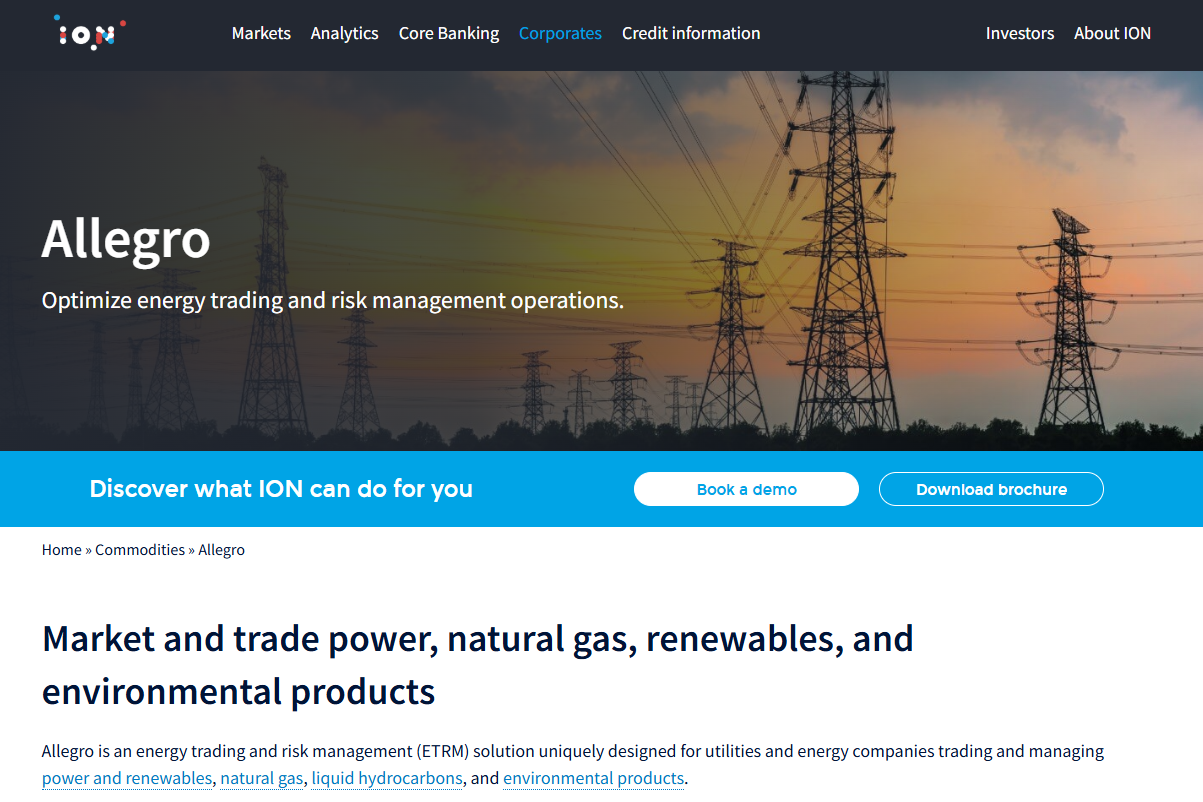
Allegro, now part of ION Group, is a front-to-back energy trading and risk management platform built for utilities and energy companies managing power, renewables, natural gas, liquid hydrocarbons, and environmental products. The platform covers deal capture through scheduling, logistics, risk analytics, and accounting handoff in a single environment. Its extensible framework supports custom workflows and integrations with enterprise systems.
Best for: Utilities and energy companies with complex physical and financial trading operations requiring deep risk, logistics, and compliance capabilities.
Key features
- Real-time position visibility across physical and financial books
- Risk management with advanced analytics and limit monitoring
- Automated logistics and scheduling workflows
- Flexible deal capture across multiple commodity types
- Regulatory compliance tools built into the trade workflow
Why choose Allegro: Allegro suits large organizations where the trading operation spans multiple commodities, physical assets, and settlement workflows, and where a configurable enterprise-grade platform justifies the implementation investment.
Allegro pricing: Allegro sells through enterprise contracts. Contact ION Group directly for pricing details, as the cost structure reflects commodity modules, user count, and deployment requirements.
2. Eka CTRM
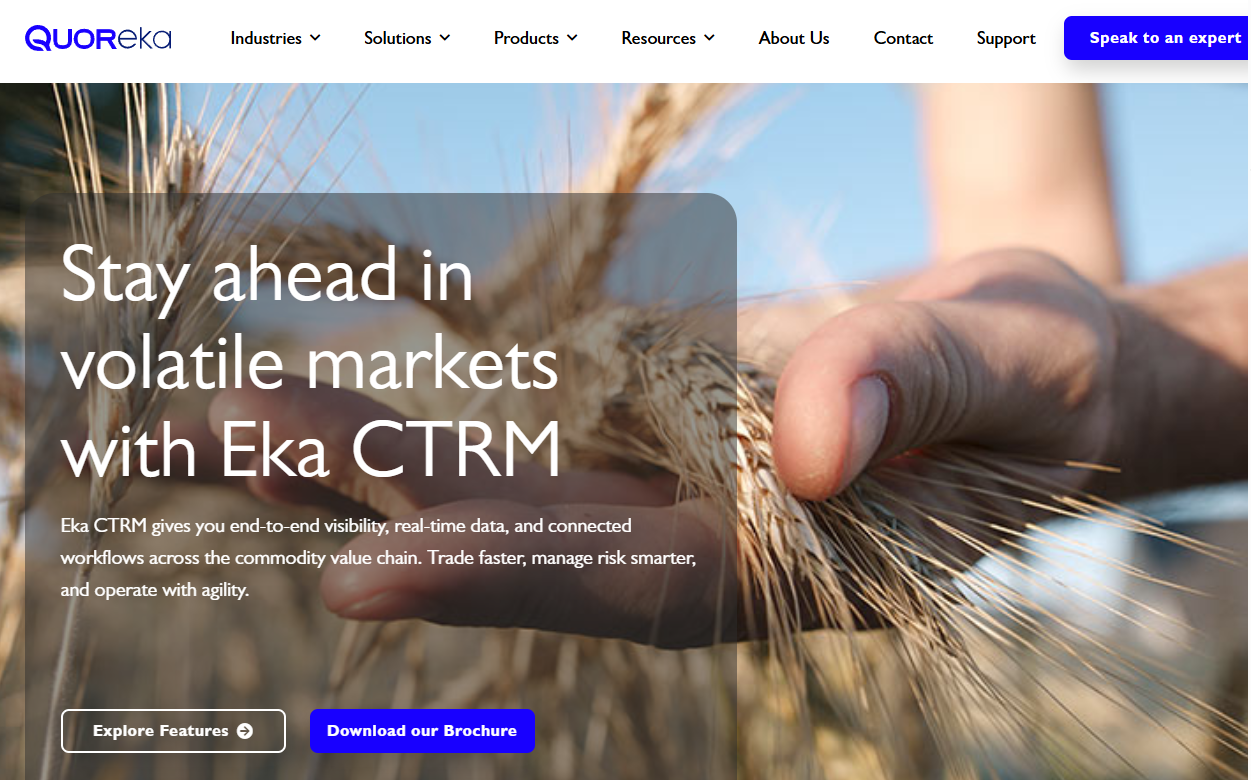
Eka is a cloud-based commodity trading and risk management platform covering the full trade lifecycle across agriculture, energy, metals, and mining. It connects physical trade management, derivative trading, procurement, and supply-chain workflows in one environment, with real-time position, exposure, and P&L visibility. Eka's scenario simulation and VaR calculations give risk teams the analytical depth to model exposure before it becomes a board-level surprise.
Best for: Enterprise commodity businesses that need integrated multi-commodity trading, risk, supply-chain, and analytics in one platform.
Key features
- Physical trade and contract management with pricing and scheduling
- Derivative trading, hedging, mark-to-market, and exchange/OTC support
- Scenario simulation, VaR calculations, and risk-limit breach alerts
- Exposure and P&L views updated in real time
- Settlement and financial integration workflows
Why choose Eka CTRM: Eka fits organizations that need trading and supply-chain operations connected rather than managed through separate tools. Its breadth across agriculture, energy, and metals makes it a practical choice for multi-commodity businesses.
Eka CTRM pricing: Eka directs prospects to contact sales for pricing. The cost structure varies by commodity modules, user count, and integration scope.
G2 rating: 4.2/5 (verified October 2026).
3. TriplePoint
TriplePoint in the commodity trading context refers to TriplePoint Technology, a CTRM platform built for enterprises managing complex physical and financial commodity trade lifecycles. The platform covers trade capture, exposure, portfolio reporting, physical logistics, settlement, and enterprise integrations across multi-region or multi-business-unit trading environments. Founders evaluating this platform should confirm they are reviewing TriplePoint Technology's CTRM product, as another company with the same name operates in software development services.
Best for: Enterprises that need broad coverage across commodity trading, risk, logistics, finance, and compliance workflows.
Key features
- Trade and contract capture with pricing and workflow automation
- Exposure and portfolio reporting across physical and financial books
- Physical logistics and operational scheduling
- Settlement, invoicing, and accounting handoff
- Enterprise integrations with ERP and market-data systems
Why choose TriplePoint: TriplePoint suits multi-region or multi-business-unit organizations where consistent trade lifecycle management across divisions is the primary operational need.
TriplePoint pricing: Contact TriplePoint Technology directly for pricing. Enterprise contracts vary by deployment model, commodity modules, and integration requirements.
4. FIS Energy Trading, Risk and Logistics Platform
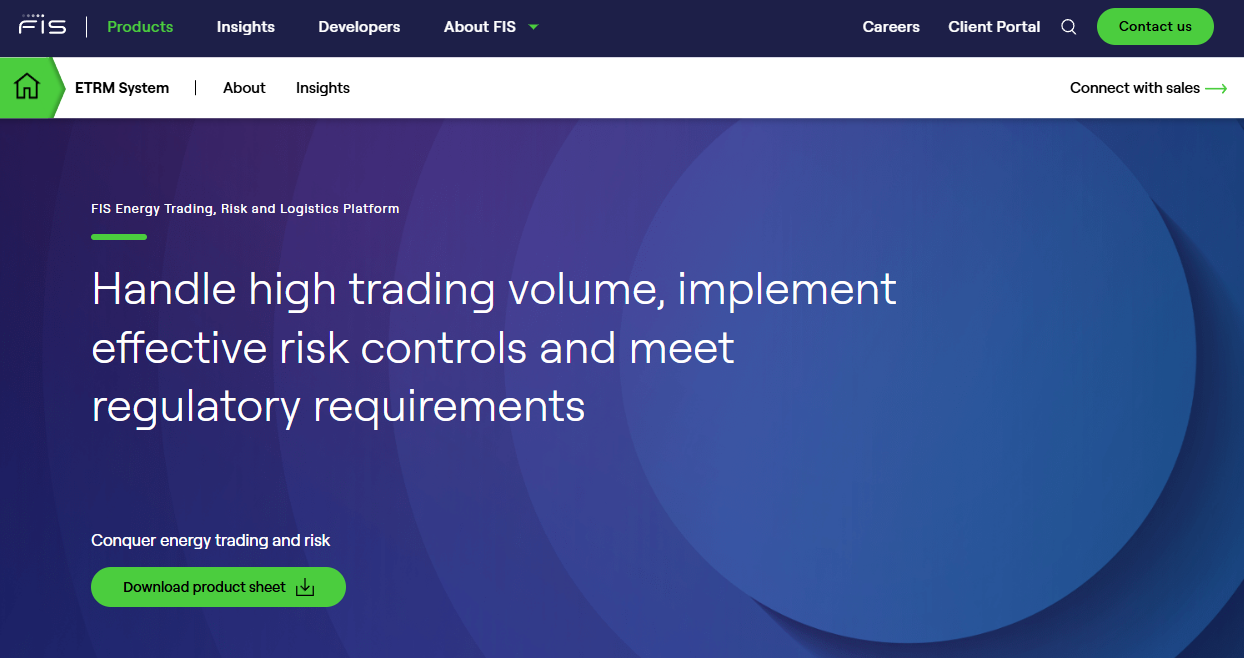
FIS offers a cloud-native energy trading and risk platform built for high-volume physical and financial commodity trading across energy markets. The platform provides real-time market-to-market position calculation, historical and interval market-data analysis, and a customizable HTML5 interface. Its cloud architecture supports trading, risk management, and operations without the maintenance burden of on-premise infrastructure.
Best for: Energy-market participants managing high-volume physical and financial commodity trading who need real-time position visibility and regulatory compliance.
Key features
- Real-time market-to-market position calculation
- Physical and financial instrument capture across multiple commodities
- Historical and interval market-data analysis
- Cloud-based trading, risk management, and operations
- Regulatory compliance support built into trade workflows
Why choose FIS Energy Trading, Risk and Logistics Platform: The platform fits organizations where cloud deployment is a requirement and where energy-market complexity, from scheduling to regulatory reporting, needs a specialized operational environment.
FIS Energy Trading, Risk and Logistics Platform pricing: FIS sells through enterprise contracts. Contact FIS directly to scope pricing by commodity coverage, users, and integration requirements.
5. Brady ETRM
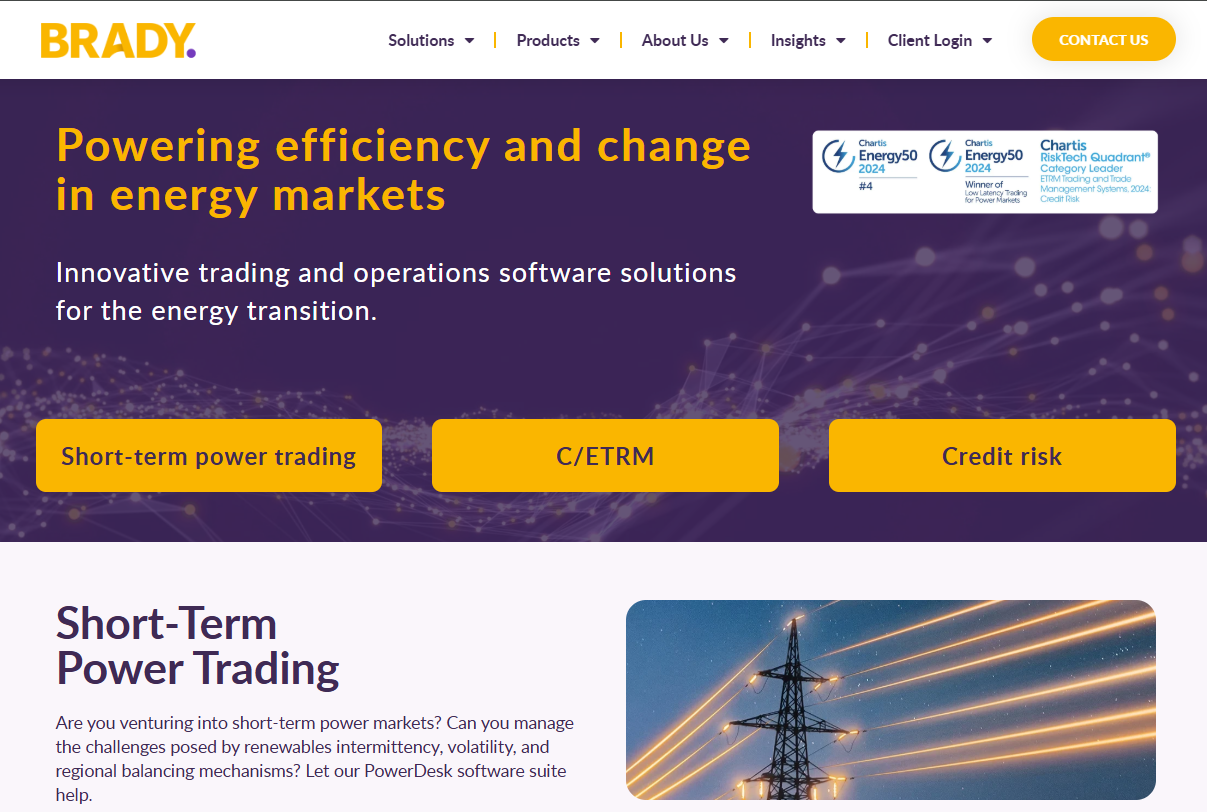
Brady Technologies provides enterprise-wide European energy trading and risk management software for multinational organizations managing complex physical assets and financial contracts. The platform covers deal capture, mark-to-market valuations, Value-at-Risk, cash-flow-at-risk, stress testing, and market connectivity including EMIR and REMIT regulatory reporting. Brady's business-intelligence integration supports real-time energy reporting across front, middle, and back offices.
Best for: Multinational energy companies managing European multi-commodity trading, risk management, and regulatory reporting.
Key features
- Trade management with deal capture and contract management
- Mark-to-market, VaR, cash-flow-at-risk, and stress-test analysis
- Market connectivity with EMIR and REMIT regulatory reporting
- Exchange deal capture and reconciliation workflows
- Business-intelligence integration for real-time reporting
Why choose Brady ETRM: Brady fits European energy organizations where regulatory compliance, real-time risk analytics, and front-to-back connectivity are non-negotiable requirements.
Brady ETRM pricing: Brady sells through enterprise contracts. Contact Brady Technologies for pricing details based on commodity modules, deployment model, and regulatory reporting requirements.
6. CoreTRM
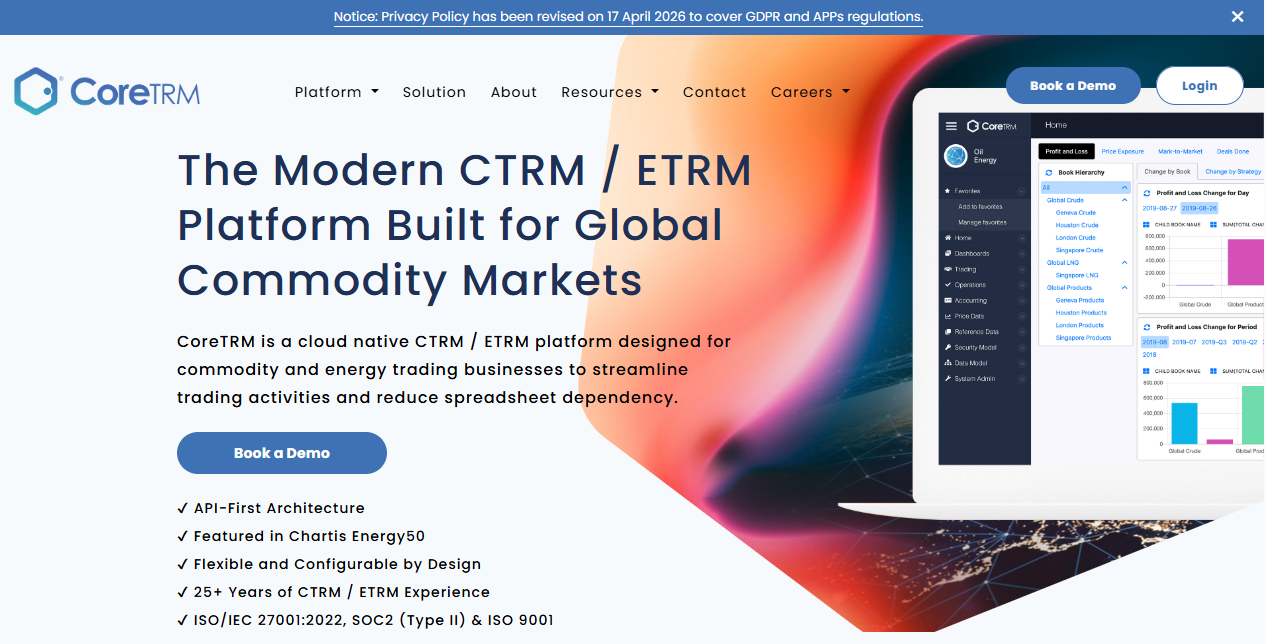
CoreTRM is a cloud-based CTRM/ETRM platform that integrates commodity trading, operations, risk management, reporting, and settlement into one configurable environment. The platform handles physical and derivative trade capture with complex pricing disaggregation, logistics management including operational deadline alerts and blending, and real-time risk analysis with VaR, position simulation, and forward curve building. A discretionary free trial is available per CoreTRM's terms, though a public free tier does not exist.
Best for: Commodity and energy trading organizations needing an integrated, configurable platform across the full trade lifecycle without building custom infrastructure.
Key features
- Physical and derivative trade capture with complex pricing
- Logistics management with operational deadline alerts
- Real-time risk analysis, limits tracking, and VaR calculations
- Forward curve building and valuation modeling
- Position simulation and scenario analysis
Why choose CoreTRM: CoreTRM suits trading teams that need configurability across physical and derivative workflows without the implementation weight of a large enterprise platform.
CoreTRM pricing: Contact CoreTRM for enterprise pricing. Pricing varies by commodity modules, user count, and integration requirements.
7. Agiblocks
Agiblocks, developed by Agiboo, is a web-based commodity trade and risk management platform for commodity traders, producers, and purchasers. The platform covers trade management, risk and hedging, derivatives management, physical contract and logistics workflows, mark-to-market valuation, financing, invoicing, and cost accruals. Its web, cloud, and mobile-browser accessibility makes it more accessible for teams without large internal IT functions.
Best for: Commodity producers, purchasers, and trading teams moving from spreadsheet operations to a structured CTRM workflow.
Key features
- Commodity trade management and derivatives handling
- Physical contract, logistics, inventory, and sampling management
- Mark-to-market valuation and realized/unrealized P&L
- Financing, collateral, invoicing, and cost accruals
- Flexible reporting and trading dashboards via web and mobile browser
Why choose Agiblocks: Agiblocks suits smaller or specialist commodity businesses where the priority is replacing fragmented spreadsheet operations with structured workflows, without overbuying a large enterprise suite.
Agiblocks pricing: Contact Agiboo for pricing. Package structure and pricing vary by modules and user count. No self-serve pricing page is available.
8. AEGIS E/CTRM
AEGIS E/CTRM, offered by AEGIS Hedging Solutions, is a cloud-based commodity trading and risk management platform for capturing, valuing, managing, and reporting physical and financial commodity positions. The platform covers physical and financial trade capture, mark-to-market valuation, hedge-book analytics, position management, scenario modeling, and audit-ready reporting, with APIs and third-party integrations for ERP and accounting connectivity.
Best for: Companies managing commodity price exposure and physical or financial commodity positions who need hedge-book analytics and audit-ready reporting.
Key features
- Physical and financial trade capture
- Mark-to-market valuation and hedge-book analytics
- Position management and scenario modeling
- Audit trails and audit-ready reporting
- Cloud deployment with APIs and third-party integrations
Why choose AEGIS E/CTRM: AEGIS E/CTRM suits organizations where compliance, auditability, and hedge-book clarity are the primary drivers, particularly those managing commodity price risk for treasury or risk-management purposes.
AEGIS E/CTRM pricing: Contact AEGIS Hedging Solutions for pricing. Enterprise contracts vary by commodity scope and integration requirements.
9. MX.3 Platform
MX.3 is Murex's integrated cross-asset capital-markets platform covering trading, risk management, investment management, treasury, operations, finance, and collateral. The platform provides extensive financial-instrument coverage including derivatives, fixed income, FX, equities, commodities, digital assets, and private investments, with regulatory, market, counterparty-credit, liquidity-risk, clearing, and trade-reporting capabilities. Deployment options include on-premises, cloud, and SaaS.
Best for: Large banks, asset managers, and capital-markets institutions with sophisticated cross-asset risk, treasury, and post-trade requirements that include commodity exposure.
Key features
- Cross-asset trading, risk management, and post-trade processing
- Front-to-back coverage across treasury, investment management, operations, and collateral
- Derivatives, fixed income, FX, equities, commodities, and digital-asset coverage
- Regulatory and counterparty-credit risk, clearing, and trade-reporting tools
- REST APIs and customizable workflows with cloud, on-premises, and SaaS deployment
Why choose MX.3 Platform: MX.3 fits large financial institutions that need commodity exposure managed alongside a broader cross-asset book. Buyers whose primary need is physical commodity trading and logistics should confirm commodity workflow depth before selecting it.
MX.3 Platform pricing: Murex sells through enterprise contracts. Contact Murex for pricing based on instrument coverage, deployment model, and organization scale.
G2 rating: 4.3/5 (verified October 2026).
10. IGNITE CTRM
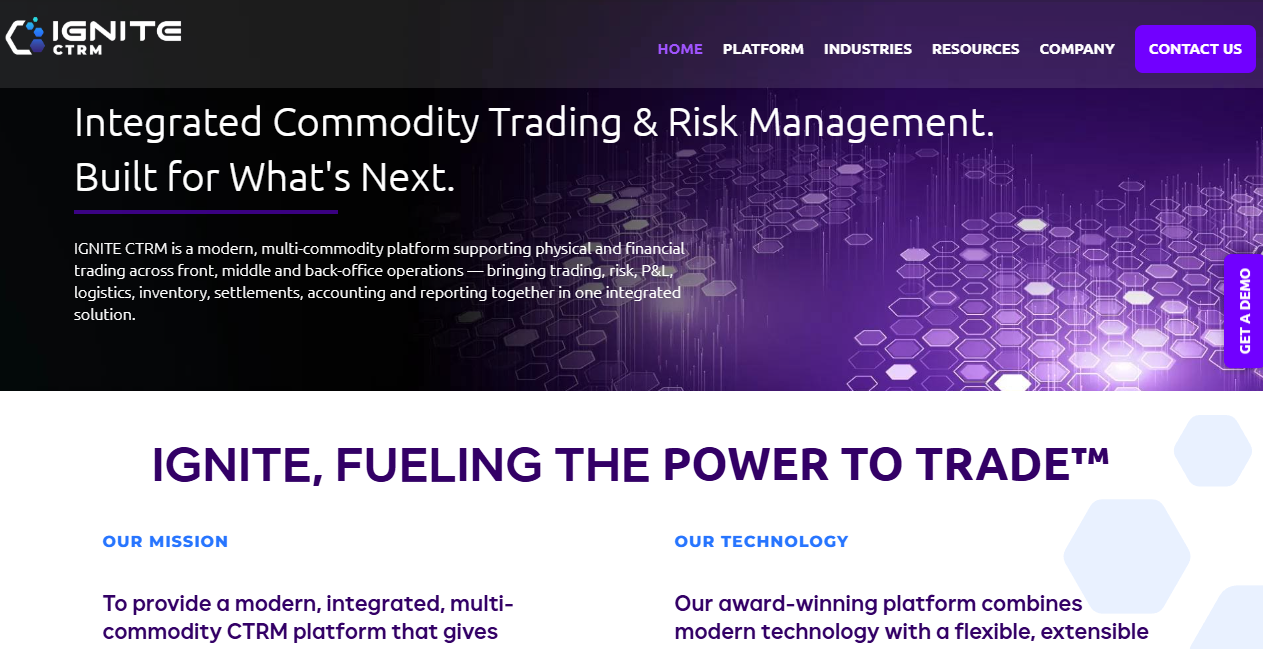
IGNITE CTRM, available at ignite-etrm.com, is a cloud-based multi-commodity platform supporting physical and financial trading across front-, middle-, and back-office operations. The platform covers trade capture, logistics and operations management, position and P&L reporting, risk management, integrations, and reporting and analytics. IGNITE's pricing factsheet identifies plan tiers including P&L Starter, P&L Plus, Pro, and Enterprise, with fixed fees at the entry tiers and volume discounts at higher tiers, though exact figures are not publicly displayed.
Best for: Commodity trading firms that need integrated front-to-back office support across physical and financial trading, logistics, settlement, and accounting.
Key features
- Front-to-back office support for physical and financial commodity trading
- Logistics and operations management with scheduling
- Position, P&L, and risk management in real time
- Integrations and connectivity to enterprise systems
- Reporting and analytics with configurable outputs
Why choose IGNITE CTRM: IGNITE suits commodity trading organizations that need a cloud-based system covering the full trade lifecycle without building or maintaining on-premise infrastructure.
IGNITE CTRM pricing: IGNITE offers tiered plans (P&L Starter, P&L Plus, Pro, Enterprise). Contact IGNITE directly for specific pricing per tier, as numeric figures are not publicly posted.
G2 rating: 4.0/5 (verified October 2026).
11. Lancelot ETRM
Lancelot ETRM, available at lancelotenergy.com, is energy trading and risk management software for electricity, gas, and other energy commodities. The platform covers trade management and confirmations, portfolio management with real-time position monitoring, and risk management including Value-at-Risk, credit risk, and mark-to-market metrics. It suits energy traders, suppliers, and distributors that need dedicated ETRM workflows.
Best for: Energy traders, suppliers, and distributors managing electricity and gas trading lifecycles with real-time position and credit risk visibility.
Key features
- Trade management and trade confirmations
- Portfolio management with real-time position monitoring
- Value-at-Risk, credit risk, and mark-to-market metrics
- Exposure monitoring and risk limit tracking
- Settlement and post-trade workflows
Why choose Lancelot ETRM: Lancelot fits organizations focused on European or specialist energy markets where a dedicated ETRM with strong portfolio management and credit risk tools is the primary requirement.
Lancelot ETRM pricing: Contact Lancelot Energy for pricing. Enterprise terms vary by commodity coverage and user count.
12. ENTRADE
ENTRADE, the ETRM/CTRM platform by Enuit, supports energy and commodity trading across the deal lifecycle from front office through back office. The platform covers deal capture, contract management, scheduling, settlement, and invoicing, alongside commodity risk management including credit risk, mark-to-market, VaR, stress testing, and portfolio sensitivity analysis. Enuit's official product documentation is available at enuit.com.
Best for: Energy and commodity trading companies needing a full-lifecycle ETRM/CTRM platform with strong risk analytics including VaR and stress testing.
Key features
- Front-, middle-, and back-office commodity trading workflows
- Deal capture, contract management, scheduling, settlement, and invoicing
- Credit risk, mark-to-market, VaR, and stress testing
- Portfolio sensitivity analysis
- Physical and financial commodity trade management
Why choose ENTRADE: ENTRADE suits organizations where risk analytics depth, including VaR and stress testing, is as important as operational workflow coverage from deal capture to settlement.
ENTRADE pricing: Contact Enuit for pricing. Terms vary by commodity scope, user count, and integration requirements.
13. EOT
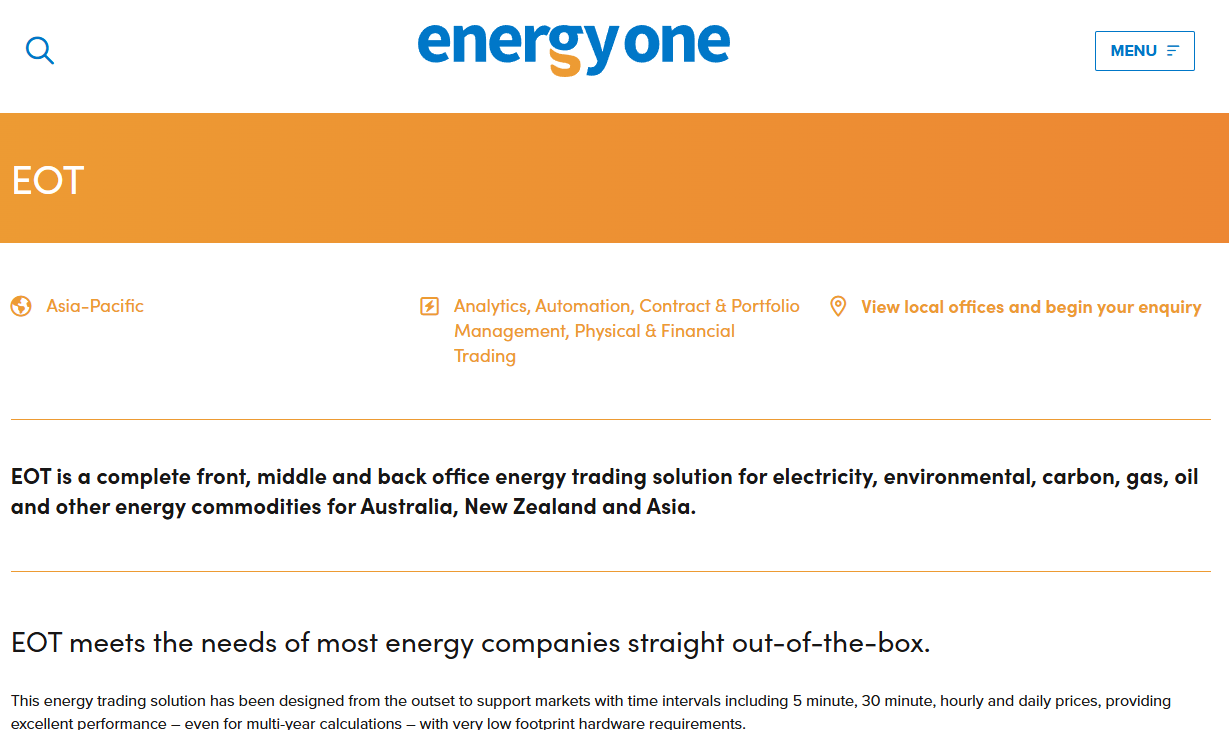
EOT is listed here as a platform evaluated for energy-market operations and commodity trade management. The vendor's website was not readable during research for this guide, and verifiable first-party feature documentation was not available. Buyers considering EOT should request a full product demonstration and reference customers before any evaluation commitment.
Best for: Organizations evaluating a dedicated energy-market operations platform for trade lifecycle management and risk visibility.
Key features
- Energy trade management and deal capture
- Position tracking and exposure monitoring
- Risk reporting and operational workflows
- Financial settlement support
- Operational dashboards and controls
Why choose EOT: EOT may suit energy-market teams looking for a focused operations and trade management platform. Direct vendor engagement is required to validate commodity coverage and integration scope.
EOT pricing: Contact EOT for pricing details. Enterprise terms vary by deployment and commodity requirements.
14. Igloo ETRM
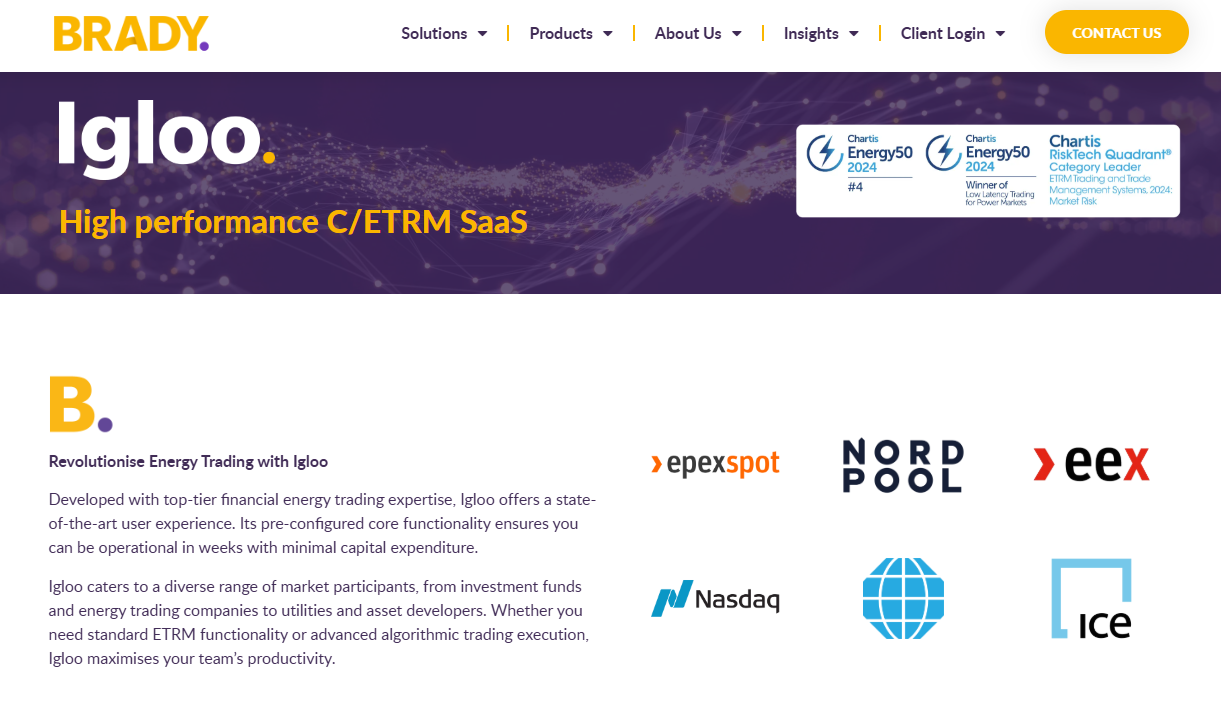
Igloo ETRM, offered by Brady Technologies, is a high-performance SaaS energy and commodities trading and risk management platform. The platform provides real-time position, P&L, and risk views, automated clearing reconciliations, connectivity to major exchanges and providers, financial trading for European energy and oil derivatives, physical power trading with automated European TSO scheduling, and algorithmic trading support for high-volume trade processing.
Best for: Energy traders, investment managers, utilities, and asset developers requiring high-volume financial or physical commodities trading and risk management with algorithmic trading capability.
Key features
- Real-time position, P&L, and risk views
- Automated clearing reconciliations
- Connectivity to major exchanges, platforms, and providers
- Financial trading for European energy and oil derivatives
- Physical power trading with automated European TSO scheduling
Why choose Igloo ETRM: Igloo fits organizations where high-volume processing, algorithmic trading, and automated European TSO scheduling are operational requirements that a standard CTRM platform cannot handle.
Igloo ETRM pricing: Contact Brady Technologies for pricing. Enterprise SaaS contracts vary by trading volume, commodity scope, and integration requirements.
15. OATI webTrader
OATI webTrader is a web-based energy trading and shadow settlement system for RTO market participants, supporting physical and financial trading across North American RTO markets. The platform covers front-to-back physical and financial energy trading, shadow settlement and market settlement reconciliation, integration with e-Tagging and congestion management, and connectivity to MISO, PJM, ISO-NE, NYISO, IESO, SPP, CAISO, and ERCOT.
Best for: Power marketers, merchant utility groups, generation operators, and organizations managing North American RTO trading and settlements.
Key features
- Front-to-back physical and financial energy trading
- Shadow settlement and market settlement reconciliation
- Integration with e-Tagging, scheduling, and congestion management
- Connectivity to MISO, PJM, ISO-NE, NYISO, IESO, SPP, CAISO, and ERCOT
- Operational reporting and position visibility
Why choose OATI webTrader: OATI webTrader fits organizations operating specifically in North American power markets where multi-RTO connectivity, shadow settlement, and e-Tagging integration are core operational requirements.
OATI webTrader pricing: Contact OATI for enterprise pricing. Terms vary by RTO connectivity requirements, user count, and deployment.
16. Trader Suite
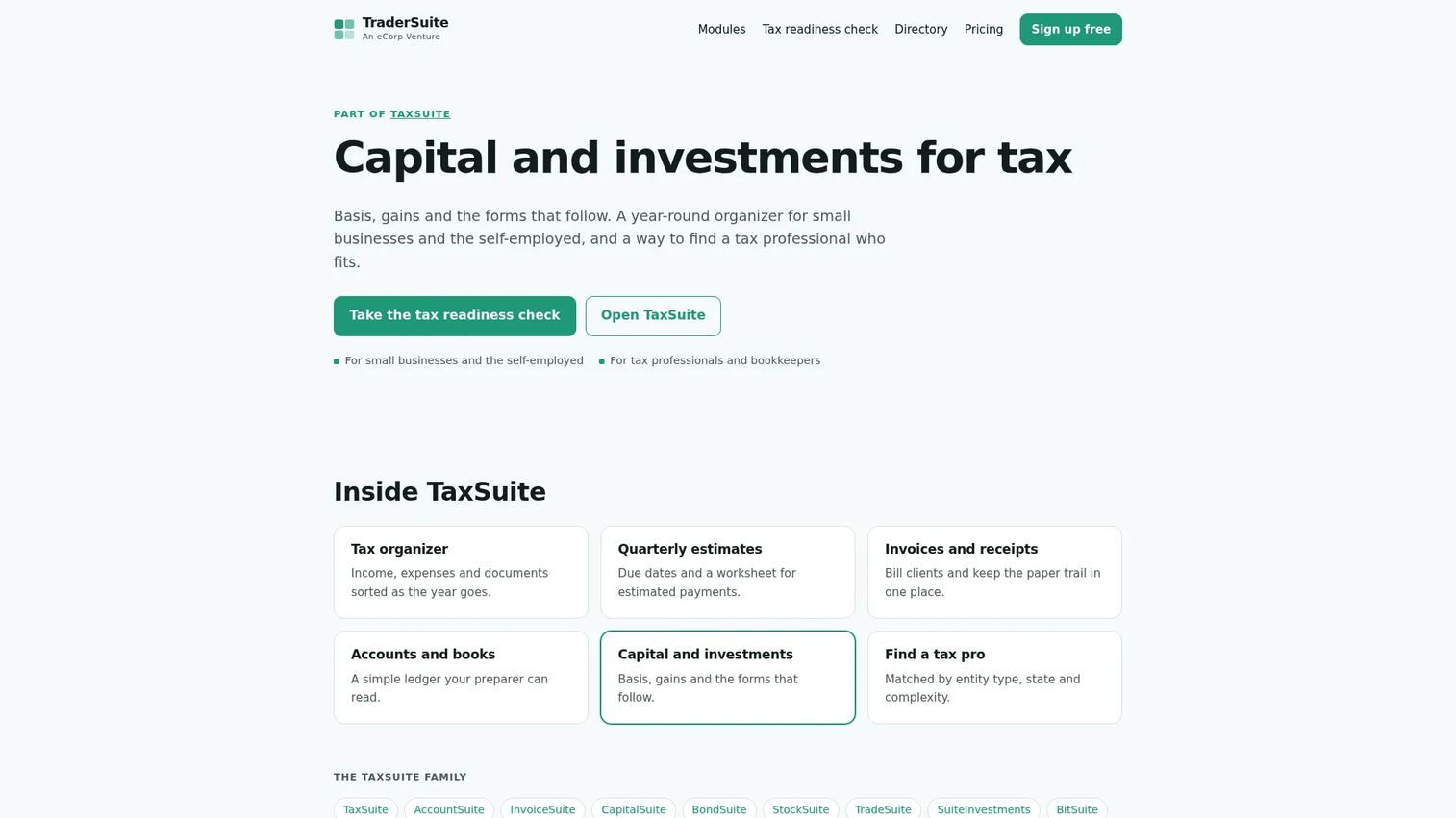
Trader Suite is a tax and investment organization tool for small businesses, self-employed individuals, tax professionals, and bookkeepers managing capital gains and investment-related tax information. It is part of TaxSuite and covers capital and investment basis and gains tracking, a tax organizer for income and expenses, quarterly estimated-tax due dates, invoices and receipts management, and a simple ledger for preparers. It is not a commodity trading and risk management platform.
Best for: Small businesses and self-employed individuals organizing investment-related tax information, not commodity trading operations.
Key features
- Capital and investment basis and gains tracking
- Tax organizer for income, expenses, and documents
- Quarterly estimated-tax worksheets and due dates
- Invoices and receipts management
- Simple ledger and tax-professional matching
Why choose Trader Suite: Trader Suite is a practical option for small businesses or individual investors who need investment tax organization. Buyers searching for a commodity trading and risk management system should evaluate other platforms on this list.
Trader Suite pricing: Free to sign up. Every module is available with free starting limits. Pay-as-you-go usage billing opens after signup. Partner access requires application.
17. Alchemy CTRM
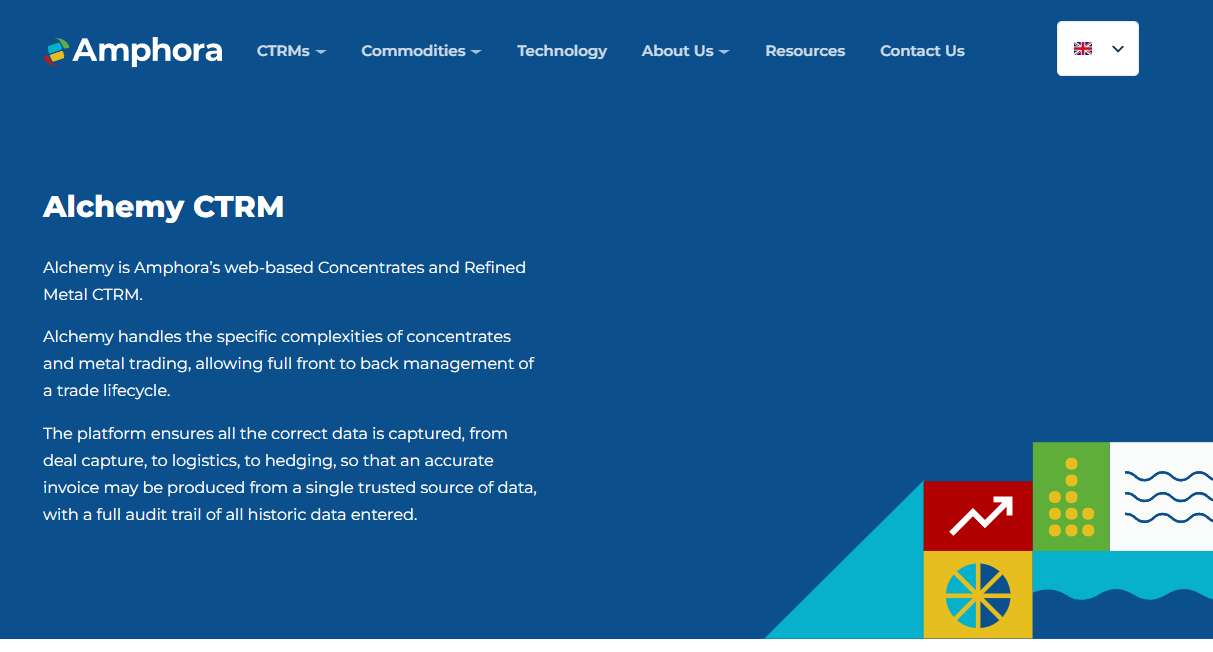
Alchemy CTRM, developed by Amphora, is a web-based CTRM platform for concentrates and refined metal trading. The platform handles complex concentrates formula management, treatment charges and penalties, scheduling and blending, splitting executions, invoicing, hedging, and a flexible report builder. Its specialization in concentrates and refined metals makes it distinct from broader energy or agricultural CTRM platforms.
Best for: Companies trading concentrates and refined metals that need front-to-back trade lifecycle management with concentrates-specific formula and penalty handling.
Key features
- Complex concentrates formula management
- Treatment charges and penalties
- Scheduling and blending workflows
- Invoicing and hedging support
- Flexible report builder for custom outputs
Why choose Alchemy CTRM: Alchemy CTRM suits metals traders, particularly those handling concentrates, where commodity-specific formula complexity and treatment-charge management are requirements that generic CTRM platforms handle poorly.
Alchemy CTRM pricing: Contact Amphora for pricing. Enterprise terms vary by commodity scope and configuration requirements.
18. ClearOpx OTRM Platform
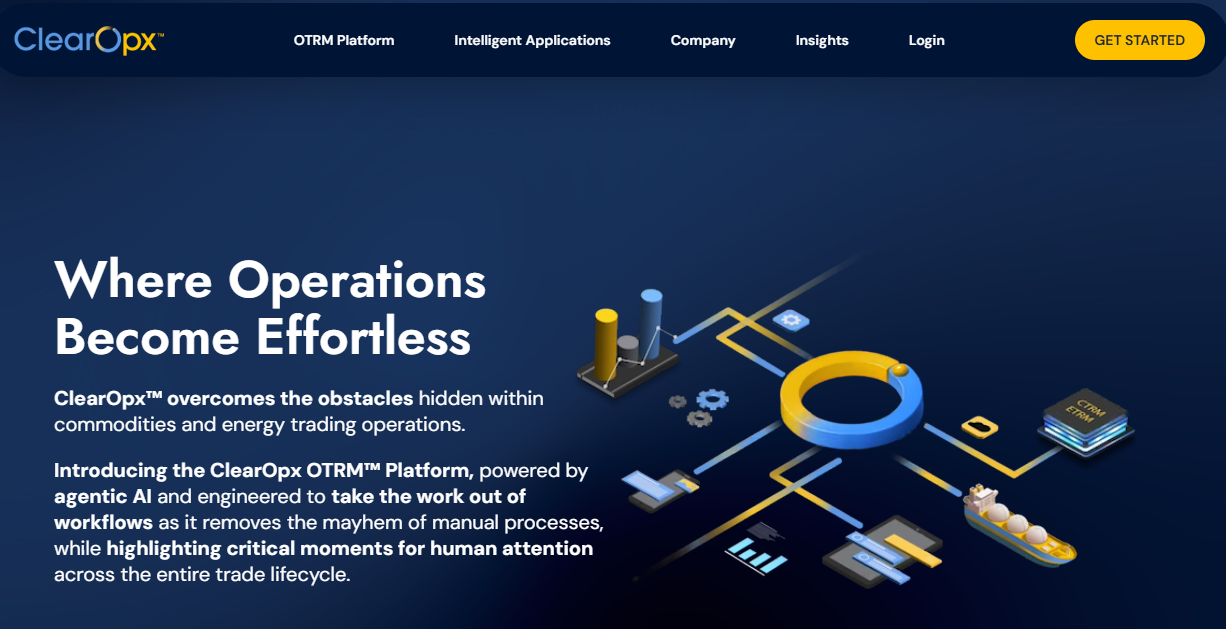
ClearOpx is an agentic-AI-powered Operations Trade Risk Management platform for automating commodity and energy trading operations across the trade lifecycle. The platform covers trade capture, trade confirmation, operations intelligence, payment processing, finance optimization, compliance insights, and data reconciliation, with a natural-language ClearOpx CoPilot for workflow automation and integration.
Best for: Commodity and energy trading organizations seeking automated operational workflows, reconciliation, and risk visibility through an AI-native operational layer.
Key features
- Trade capture and trade confirmation workflows
- Operations intelligence and compliance insights
- Payment processing and finance optimization
- Agentic AI with natural-language ClearOpx CoPilot
- Data reconciliation and enterprise integration
Why choose ClearOpx OTRM Platform: ClearOpx suits organizations where operational automation and AI-assisted reconciliation address a specific bottleneck in the post-trade workflow, complementing or sitting alongside a broader CTRM system.
ClearOpx OTRM Platform pricing: Contact ClearOpx for pricing. Enterprise terms are not publicly displayed.
19. Comcore
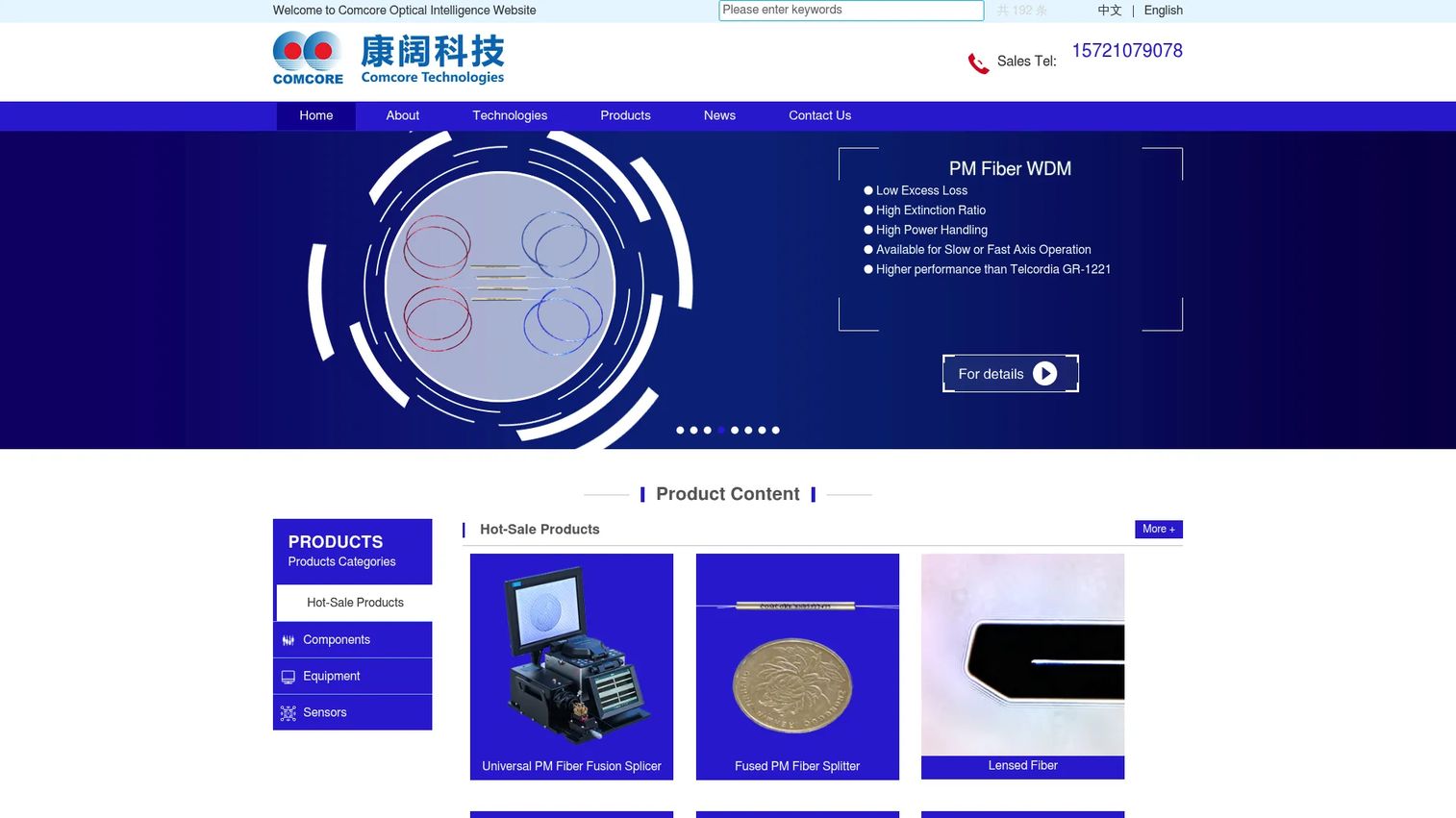
Comcore is an optical-fiber components and sensing company manufacturing fiber-optic current sensors, polarization-maintaining fiber fusion splicers, lensed fibers, and related optical products. Comcore Optical Intelligence Technologies is not a commodity trading and risk management software vendor. A separate Comcore CTRM product has been referenced on some review platforms, but that product could not be verified as connected to this vendor.
Best for: Organizations needing specialized optical-fiber components, fiber-optic current sensing, or polarization-maintaining fiber-splicing equipment.
Key features
- Fiber-optic current sensors and sensing coils
- Polarization-maintaining fiber fusion splicers
- Ultra-high-reliability fused fiber components
- Lensed fibers and optical product manufacturing
- Specialized optical-intelligence technologies
Why choose Comcore: Comcore serves a specialized optical-hardware market. Buyers searching for commodity trading and risk management software should evaluate other platforms on this list and contact vendors directly to confirm product scope before shortlisting.
Comcore pricing: Contact Comcore directly for pricing on optical-fiber and sensing products.
Considerations when choosing CTRM software
Match the platform to your commodity and trade model
A power-market workflow differs materially from an agricultural supply-chain workflow. Start with the commodities, contract types, geographies, and physical assets the platform must support on day one, not at a theoretical future scale. Verify specific commodity coverage during a live demonstration rather than accepting a general capability claim.
Audit the trade lifecycle, not the feature list
Trace one representative transaction from deal capture through scheduling, exposure calculation, valuation, invoicing, payment, and accounting handoff. If the workflow breaks into manual exports at any point, the platform may preserve the same operational risk you are trying to remove. This test reveals integration gaps and workflow assumptions before they become implementation problems.
Define the source of truth for risk and valuation
Before selecting a platform, agree internally on which system owns pricing curves, market data, positions, risk limits, P&L, and hedge reporting. A CTRM system that duplicates data without clear ownership creates reconciliation problems. Require clear answers from the vendor before implementation begins. This is where many implementations introduce new complexity rather than removing it.
Treat integrations as part of the product decision
The CTRM platform must connect to ERP, accounting software, market-data providers, and reporting systems. The integration design decides whether the team gets a functional operating system or an isolated database. Ask vendors for integration documentation, reference customers on similar stacks, and scope integration effort as part of the initial business case, not as a post-selection activity. For guidance on contract lifecycle management software that may complement your CTRM stack, that resource covers related evaluation criteria.
Price the implementation alongside the subscription
Low platform pricing does not mean low ownership cost. CTRM implementations carry significant costs in consulting, data migration, configuration, training, and internal project time. Request a phased implementation plan with a defined first operational milestone, then build the full cost including internal staffing into the business case before board approval.
Conclusion
CTRM software is not a reporting tool. It is the operating system that determines whether a commodity business can see, control, and settle risk as it scales, and whether a new COO, CRO, or trading leader can inherit a functioning system on day one.
For large, multi-commodity operations, Allegro and Eka CTRM offer the depth and breadth that complex organizations need. TriplePoint and FIS Energy Trading, Risk and Logistics Platform suit enterprise teams with energy-specific or broad lifecycle requirements. Agiblocks and IGNITE CTRM provide a more accessible path for smaller or specialist teams replacing spreadsheet-driven operations. Organizations managing concentrates and refined metals should look closely at Alchemy CTRM. For capital-markets institutions with cross-asset commodity exposure, MX.3 Platform covers that broader scope.
No single platform is the universal answer. The right choice depends on your commodity mix, existing integration stack, and implementation capacity. Shortlist three platforms, run the same representative transaction through each demonstration, and score operational fit against your actual trading workflows before committing to implementation. For context on how application portfolio management software decisions compare in rigor to a CTRM selection, that guide covers a similar evaluation framework.
When evaluating complex enterprise software, giving internal teams and stakeholders an interactive product experience before committing to a full evaluation saves time and surfaces fit questions early.
Start your journey with Guideflow today!
FAQs about CTRM software
CTRM software, short for commodity trade and risk management software, manages the full lifecycle of physical and financial commodity transactions from deal capture through risk, logistics, settlement, and reporting. It replaces fragmented spreadsheets, disconnected trade logs, and manual reconciliation workflows with a structured operating environment that gives trading, risk, operations, and finance teams a shared view of exposure and position in real time.
ETRM, or energy trading and risk management software, is typically a specialized branch of the broader CTRM category, focused on power, gas, renewables, oil, and energy-market operations. CTRM extends to agriculture, metals, freight, and soft commodities. Many platforms cover both categories, so the more useful question for buyers is which specific commodities, contract types, and market structures the platform supports rather than which label it carries.
CTRM software replaces fragmented spreadsheets, disconnected trade logs, manual valuation processes, email-based scheduling, and reconciliation-heavy settlement workflows. It does not replace ERP or accounting systems. Most implementations require integration with existing ERP and accounting infrastructure rather than a full system replacement. The goal is to own the trading lifecycle between market execution and the accounting handoff.
The trigger is operational complexity, not company size. A smaller team needs CTRM when pricing, inventory, contracts, risk, and settlement can no longer be managed reliably in spreadsheets, or when key-person dependency in trading operations creates unacceptable business risk. Several platforms on this list, including Agiblocks and IGNITE CTRM, are positioned for organizations that are not large enterprises but have outgrown manual processes. For related guidance on contract management software tools, that resource covers evaluation criteria that apply at similar scale.
Most CTRM vendors sell through annual enterprise contracts rather than self-serve pricing tiers. The contract cost varies by commodity modules, user count, deployment model, integration scope, and implementation support. Data migration, configuration, consulting, and internal project staffing add materially to the total cost of ownership. Trader Suite is the one platform on this list with a publicly available free-to-start model, though it is a tax-organization tool rather than a commodity trading and risk management system.
Implementation timelines vary significantly by data quality, workflow complexity, integration count, commodity modules, reporting requirements, and internal project ownership. Simple implementations with clean data and limited integration requirements may reach first operational use in a few months. Complex multi-commodity, multi-region deployments with deep ERP integration can take considerably longer. Request a phased implementation plan from any vendor you shortlist, with a defined milestone for the first operational go-live rather than a full deployment as the first deliverable.
Yes. CTRM platforms commonly connect to ERP, accounting, market-data providers, data warehouses, and reporting systems. The quality of the integration design matters more than a generic integration claim. Before selecting a platform, confirm which specific ERP and accounting systems are supported, whether integration is native or requires middleware, and what the data-flow design looks like between the CTRM and the accounting handoff. For broader context on best contract analytics software that often sits alongside CTRM in enterprise stacks, that guide covers related evaluation factors.
Five questions that cut through vendor claims quickly:
- Which commodity workflows run without custom development, and what does the standard configuration cover?
- How will historical trades, contracts, and counterparty data migrate into the new system, and who owns that process?
- Which system becomes the source of truth for positions, valuation, and risk reporting after go-live?
- Which integrations must be live before the first operational rollout, and what does each integration require?
- What measurable operating outcome should the implementation deliver in the first two quarters, and how will that be tracked?
The answers reveal whether a vendor has implemented for organizations like yours or is proposing a framework it will figure out during your project.