Accepting crypto payments sounds like a growth lever. Running crypto payments without creating finance chaos is the harder part.
Nearly 9 in 10 U.S. merchants have already received customer requests to pay with crypto, according to a 2026 survey by the National Cryptocurrency Association and PayPal. The demand is real. The operational complexity is also real: Settlement models, FX exposure, AML requirements, reconciliation, and regional licensing can turn a simple checkout addition into a finance team headache.
The question for a Series B founder is not whether customers want to pay in crypto. The question is whether your team can run crypto payments without creating a new bottleneck in finance or engineering. That means choosing the right settlement model, understanding the compliance posture, and picking infrastructure that your new VP of Finance will actually trust.
This guide cuts through the noise. It compares 14 cryptocurrency payment gateways on settlement options, compliance posture, integration effort, and pricing so you can shortlist the right tools for your stack.
What's inside
This guide is for founders, finance leads, and RevOps teams evaluating crypto payment infrastructure in 2026. Tools were selected based on four criteria:
- Settlement options: Fiat, stablecoin, and crypto settlement availability
- Compliance posture: AML, KYC, licensing, and supported jurisdictions
- Integration effort: Hosted checkout, plugins, payment links, and API depth
- Operational fit: Reconciliation, reporting, payouts, and finance workflow
Pricing and ratings were verified against each vendor's live pricing page and G2 listing. See the best payment processing software guide for broader payment infrastructure context.
TL;DR
- Best for regulated merchant payment acceptance: CoinGate (1% per transaction, no monthly fees) or Triple-A (custom pricing) depending on your region and volume
- Best for established crypto checkout: BitPay, with tiered transaction fees starting at 2% + 25¢
- Best for broad coin support: CoinPayments, processing fees at 3%
- Best for stablecoin treasury workflows: BVNK or Circle, depending on whether you need a full stablecoin rail or USDC-native infrastructure
- Best for crypto-native customer bases: Coinbase Business, Binance, or Crypto.com, each with different regional availability
- Best pick for SaaS founders: Choose based on settlement model and compliance posture, not brand recognition
What is cryptocurrency payment gateway software?
Cryptocurrency payment gateway software lets businesses accept crypto or stablecoin payments, verify blockchain transactions, convert funds when needed, and settle proceeds into crypto, stablecoins, or fiat currency.
At checkout, the gateway generates a payment address or invoice, monitors the blockchain for the incoming transaction, confirms it meets required thresholds, and then triggers the merchant's settlement process. What happens next varies by provider: Some convert instantly to fiat, some hold in stablecoin, and some pass through raw crypto.
For a SaaS founder, the settlement and reporting story matters more than the coin count. A gateway that settles to your bank account daily and exports clean transaction data for your accountant is worth more than one that supports 500 coins but requires manual reconciliation.
Key capabilities to evaluate:
- Hosted checkout, payment links, or API-driven flows
- Crypto-to-fiat conversion and automatic settlement
- Stablecoin settlement (USDC, USDT, EURC)
- Outbound payouts to contractors, partners, or vendors
- AML monitoring, KYC workflows, and sanctions screening
- Transaction reporting and accounting integrations
- Refund handling and dispute controls
Gateway vs. processor terminology:
| Term | Practical meaning for a merchant |
|---|---|
| Gateway | Customer-facing payment acceptance layer |
| Processor | Transaction handling, conversion, and settlement layer |
| Wallet | Storage and control of crypto assets |
| Treasury platform | Holding, moving, and managing digital assets |
Vendors use these terms interchangeably, so focus less on the label and more on whether the tool covers your settlement, compliance, and integration needs.
When to use cryptocurrency payment gateways
Accept global payments without adding card friction
Crypto gateways help businesses sell to customers in regions where card rails, banking access, or FX are painful. For a SaaS company expanding into Southeast Asia, Latin America, or parts of Africa, crypto payments can collect revenue that traditional card processors struggle to route. The key is pairing a gateway with fiat settlement so international ARR still lands in your operating account cleanly.
Settle in stablecoins or fiat
Holding crypto on the balance sheet creates treasury exposure your board will ask about. Most founders are better served by providers that convert at payment time and settle in local currency or USDC. Choose your settlement model before you choose your provider. Some tools give you both options; others are opinionated one way or the other.
Support crypto-native buyers and partners
Developer communities, gaming platforms, infrastructure businesses, and international contractors often prefer crypto for speed, cost, or ideology. Accepting crypto payments for these segments removes friction from both sides of the transaction. The accounting and reconciliation still need to work, though, so confirm your finance team can close the books on crypto invoices before you go live.
Cryptocurrency payment gateway comparison
The table below summarizes 14 providers by best use case, key differentiator, pricing, and G2 rating. Availability varies by jurisdiction, so confirm regional support before committing. Pricing reflects verified figures from each vendor's pricing page. Use this for blockchain analysis tools context alongside the comparison below.
| # | Product | Best for | Key differentiator | Pricing | G2 rating |
|---|---|---|---|---|---|
| 1 | CoinGate | Licensed merchant crypto acceptance | Fiat and crypto settlement with e-commerce plugins | 1% per transaction | 4.0/5 |
| 2 | BitPay | Established merchant checkout | Tiered volume-based fees, strong merchant history | 2% + 25¢ (under $500K/mo) | 4.0/5 |
| 3 | CoinPayments | Broad crypto coverage | 800+ assets, hosted checkout, wallets | 3% per payment | 3.9/5 |
| 4 | Triple-A | Regulated global enterprise payments | Licensed stablecoin payments, 70+ payout countries | Custom pricing | 4.0/5 |
| 5 | BVNK | Stablecoin infrastructure and treasury | Fiat plus stablecoin wallets, card issuance | Custom pricing | 4.7/5 |
| 6 | Coinbase Business | Coinbase ecosystem familiarity | USDC rewards, accounting integrations | Custom pricing | 3.9/5 |
| 7 | Binance | Crypto-native audiences in supported markets | Broad asset ecosystem, VIP fee tiers | 0.1% trading fee base | 4.0/5 |
| 8 | Crypto.com | Consumer crypto payment acceptance | Consumer wallet reach, 400+ assets | Varies by product | 4.1/5 |
| 9 | CoinsPaid | High-volume crypto processing | Enterprise custody, AML, and settlement infrastructure | Custom pricing | 4.5/5 |
| 10 | Fipto | B2B stablecoin and fiat money movement | Named IBANs, stablecoin wallets, Payment Links | Custom pricing | 4.5/5 |
| 11 | Circle | USDC-native payments and treasury | USDC/EURC issuer, cross-chain infrastructure | Custom pricing | 4.2/5 |
| 12 | Stripe | Existing Stripe users adding crypto support | Developer-grade payments stack, stablecoin support | 2.9% + 30¢ (standard) | 4.4/5 |
| 13 | Transak | Crypto onramp for app users | Fiat-to-crypto, 3.99% + $1 card on-ramp | 3.99% + $1 (card) | N/A |
| 14 | Simplex | Fiat-to-crypto checkout and onramp | 125+ cryptos, card/Apple Pay/Google Pay support | From 3.5% of transaction | N/A |
Best cryptocurrency payment gateways for 2026
1. CoinGate
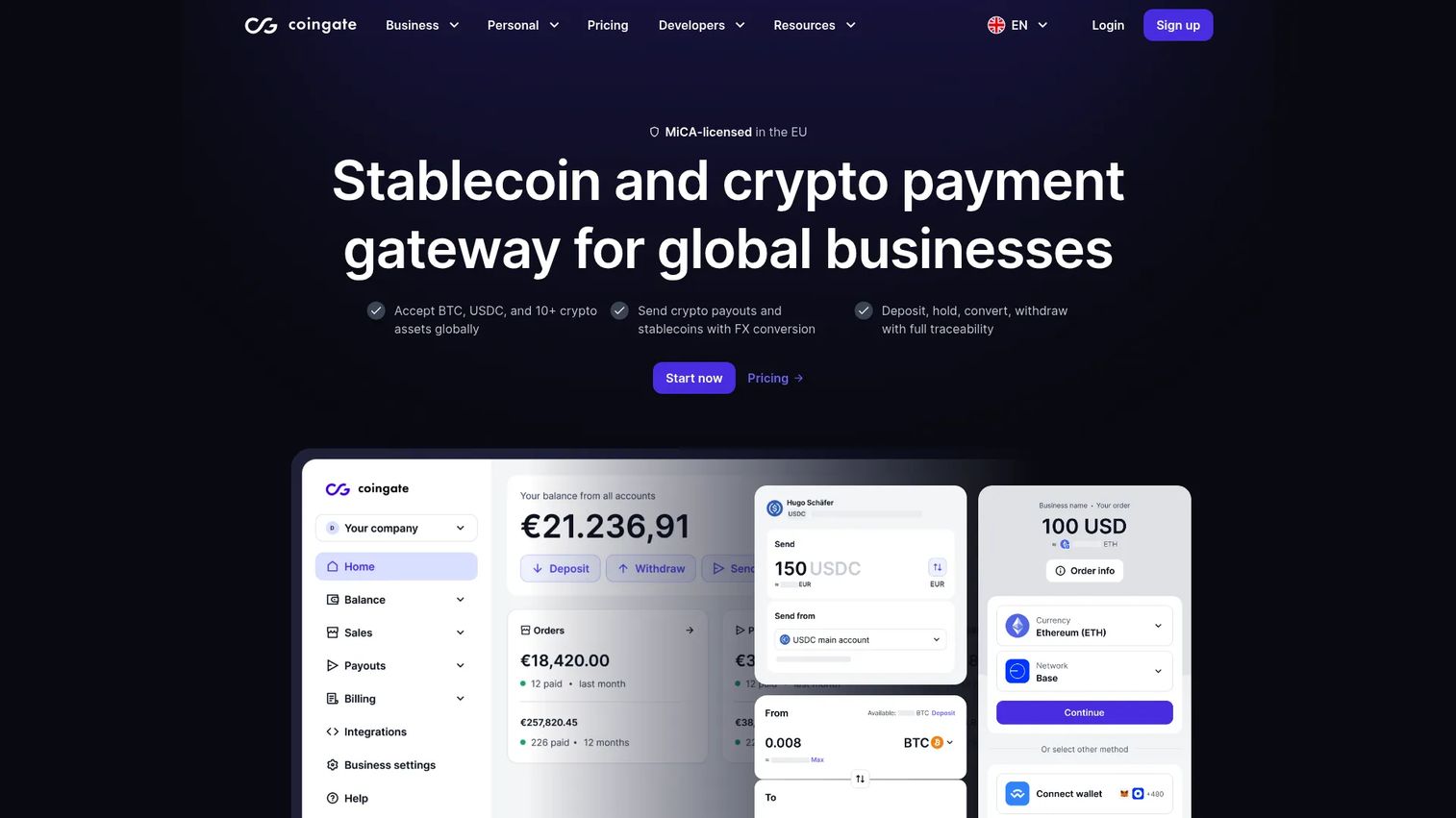
CoinGate is a cryptocurrency payment gateway that lets businesses accept, manage, convert, refund, and send crypto payments across 180+ countries. It covers the full payment cycle from checkout to fiat settlement, with a merchant dashboard for reporting, roles, and transaction tracking. E-commerce plugins for WooCommerce, Magento 2, PrestaShop, OpenCart, and WHMCS are available for merchants who need a no-code integration path.
Best for: SaaS and e-commerce companies that want crypto payment acceptance with fiat settlement and minimal manual finance work.
Key features
- Crypto and stablecoin checkout across 180+ countries
- Instant fiat or crypto settlement
- E-commerce plugins: WooCommerce, Magento 2, PrestaShop, OpenCart, WHMCS
- Crypto payouts and refunds
- Real-time reporting and transaction tracking
Why choose CoinGate: CoinGate fits a company that wants crypto payment acceptance without asking finance to manage every transaction manually. The combination of fiat settlement and plugin support keeps implementation simple for both engineers and accountants.
CoinGate pricing: Standard plan charges 1% per transaction with no monthly fees. Enterprise accounts get custom volume-based rates, also with no monthly fees. Additional fees apply to payouts, conversions, withdrawals, and refunds.
G2 rating: 4.0/5
2. BitPay
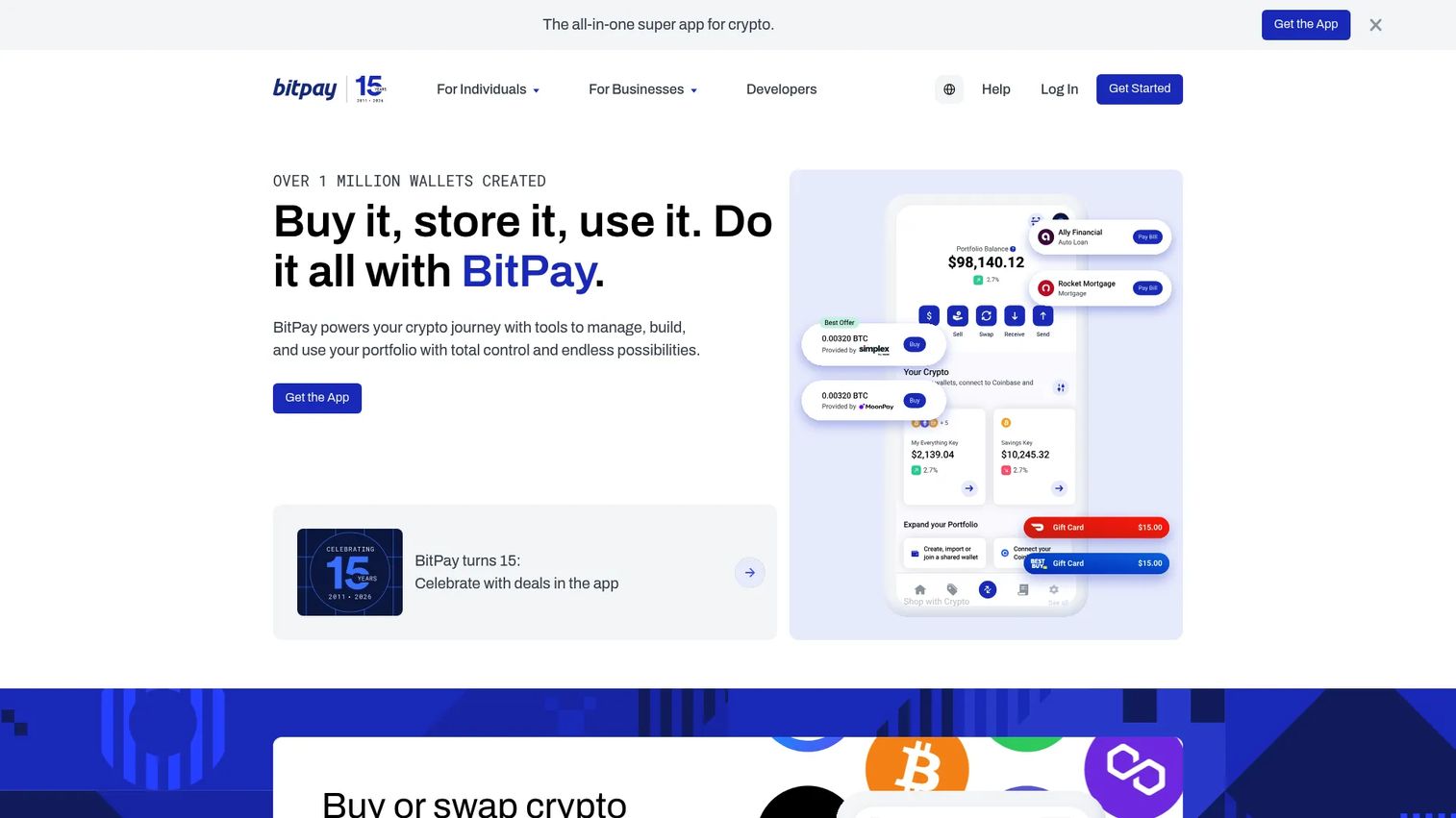
BitPay is one of the most established cryptocurrency payment processors for businesses, covering crypto checkout, email billing, and settlement in fiat or crypto. Its merchant tools include hosted invoices, donation flows, retail payment options, and automatic payment exception handling. QuickBooks IIF downloads make reconciliation more manageable for finance teams.
Best for: Merchants who need proven crypto checkout infrastructure and care about credibility and adoption history.
Key features
- Crypto checkout and email billing
- Daily settlement in fiat, crypto, or a combination
- Automatic payment exception handling
- QuickBooks IIF export for accounting
- Self-custody wallet for storing and spending crypto
Why choose BitPay: BitPay is the practical pick when your finance team wants crypto payments but also wants a provider with a long track record. The tiered fee model rewards volume, so it gets more cost-effective as your crypto payment revenue grows.
BitPay pricing: Transaction fees are tiered by monthly volume: 2% + 25¢ per transaction below $500,000 per month, dropping to 1.5% + 25¢ at $500,000 to $999,999, and 1% + 25¢ at $1,000,000 and above. High-risk industries may pay higher rates.
G2 rating: 4.0/5
3. CoinPayments

CoinPayments provides enterprise-grade cryptocurrency payment processing and wallet infrastructure for merchants. It supports an extensive list of crypto assets with hosted checkout, invoices, API integrations, and pre-built e-commerce plugins. Auto-sweep and secured vaulting help merchants manage received funds without leaving everything exposed on-chain.
Best for: Businesses that need broad asset coverage, multiple checkout routes, and wallet management in one platform.
Key features
- Hosted invoices and checkout with multi-currency support
- API integrations, webhooks, and wallet addresses
- Pre-built e-commerce plugins and payment buttons
- Auto-sweep, conversions, and secured vaulting
- Personal wallet deposits free for first $15,000 per month
Why choose CoinPayments: CoinPayments fits businesses that accept payments in many different coins, whether because of customer preference or multi-market demand. Verify current regional availability and compliance posture before committing, since coverage varies.
CoinPayments pricing: Payment processing fees are 3% per payment for standard balance mode. ASAP and Nightly settlement modes add a network fee on top. Personal wallet withdrawals cost the network fee. The first $15,000 per month in personal wallet deposits is free, with 3% applied after that.
G2 rating: 3.9/5
4. Triple-A
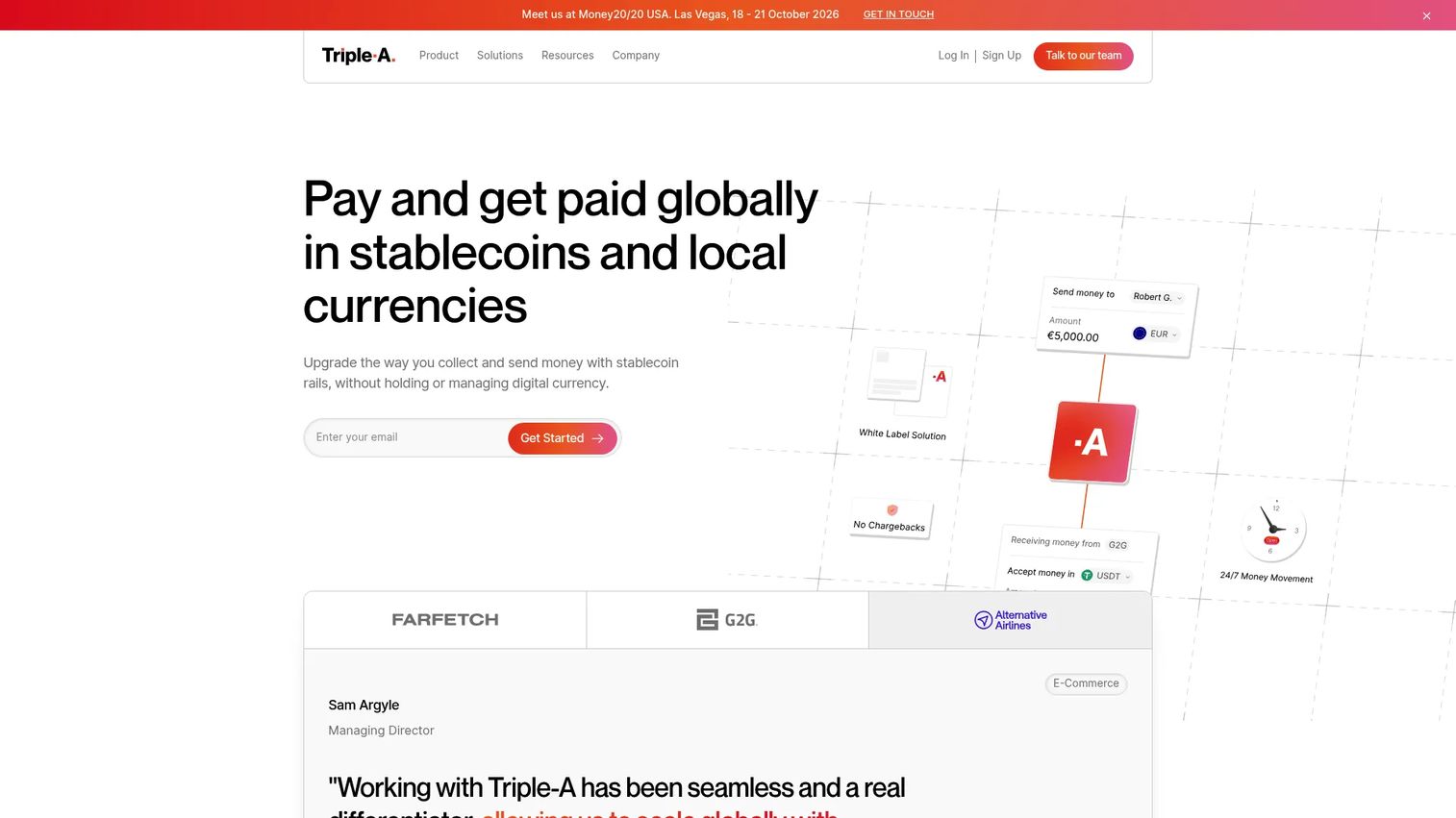
Triple-A is enterprise stablecoin payment infrastructure for businesses that need to accept, send, and settle payments in stablecoins and local currencies without managing digital-asset custody. It supports stablecoin checkout, local-currency settlement, and payouts across 70+ countries in 30+ currencies. Payment links, API integrations, and customizable forms cover both no-code and developer-led implementations.
Best for: Larger businesses and enterprises that need regulated crypto payments and their finance team requires a licensed operating model.
Key features
- Stablecoin checkout and invoice payments
- Local-currency settlement
- Payouts to 70+ countries in 30+ currencies
- API integrations and customizable payment forms
- Transaction tracking and reconciliation
Why choose Triple-A: Triple-A belongs on the shortlist when leadership needs a compliant framework for crypto payment acceptance, not just a tool. The stablecoin focus reduces treasury volatility compared to raw crypto settlement.
Triple-A pricing: Custom pricing. Fees vary by transaction, volume, settlement currencies, and payment corridors. Contact Triple-A's sales team during onboarding to negotiate terms.
G2 rating: 4.0/5
5. BVNK
BVNK is stablecoin infrastructure for enterprises that need to send, receive, store, convert, and spend across fiat currencies and digital assets. It positions itself at the intersection of traditional banking and crypto rails, which makes it relevant for fintechs, marketplaces, payroll providers, and gaming platforms with complex international money movement. Card issuance linked to stablecoin balances extends the use case beyond payments into broader treasury management.
Best for: Fintechs, SaaS companies, and enterprise finance teams that need stablecoin payment rails and fiat integration in a single infrastructure layer.
Key features
- Send and receive stablecoin and fiat payments
- Store funds in fiat and stablecoin wallets
- Convert between fiat currencies and stablecoins
- Issue cards linked to stablecoin balances
- Earn rewards on eligible stablecoin balances
Why choose BVNK: BVNK is more relevant when crypto payments connect to treasury, payouts, and global settlement than when you just need a checkout button. It is worth evaluating when your finance operations require both fiat and stablecoin rails under one roof.
BVNK pricing: Custom pricing. Contact BVNK's sales team for a quote. Main cost drivers include payment volume, currencies used, and product modules activated.
G2 rating: 4.7/5
6. Coinbase Business
Coinbase Business is an all-in-one crypto financial platform for companies that want to trade crypto, send and receive payments, and earn rewards on eligible USDC balances. It covers global payments through payment links, invoices, payouts, and checkouts, alongside accounting integrations and role-based access controls. The Coinbase brand carries customer recognition in the U.S. and select international markets.
Best for: Businesses whose customers already use Coinbase and whose teams want to operate within a familiar crypto brand.
Key features
- Crypto checkout, payment links, and invoices
- Global payouts and inbound payments
- 3.60% APY rewards on eligible USDC balances
- Accounting integrations, tax reporting, and role-based access
- APIs for payments, trading, transfers, and invoicing
Why choose Coinbase Business: Coinbase Business may be a practical fit if your customers skew crypto-native and your finance team wants a brand they recognize. Verify current product availability and fee structure in your operating region, as the product has evolved from its earlier Coinbase Commerce iteration.
Coinbase Business pricing: Coinbase states there is no application fee. Payment and conversion fees are disclosed within your account after signup.
G2 rating: 3.9/5 (listed as Coinbase Commerce on G2)
7. Binance
Binance is a cryptocurrency and blockchain infrastructure platform offering trading, conversion, earning, wallets, and merchant payment tools. Its merchant payment features (Binance Pay) let businesses accept crypto from Binance's large user base through QR codes and payment links. Fees vary by product, VIP tier, and jurisdiction, and U.S. availability is restricted.
Best for: Businesses targeting crypto-native audiences who already hold assets on Binance, primarily in markets where Binance operates without restrictions.
Key features
- Binance Pay for merchant crypto acceptance
- QR payment and payment link flows
- Spot and margin trading alongside payments
- Broad asset coverage across hundreds of cryptocurrencies
- VIP fee tiers based on trading volume
Why choose Binance: Binance is strongest where the buyer base already uses Binance and the business operates in supported jurisdictions. Do not assume U.S. availability; verify regional access before building a payment flow on Binance infrastructure.
Binance pricing: Regular spot trading starts at 0.1% per successful trade. Merchant payment fees depend on product and region.
G2 rating: 4.0/5
8. Crypto.com
Crypto.com is a digital finance platform covering crypto trading, payments, earning, and financial services for individuals and businesses. Its merchant payment products let businesses accept crypto from Crypto.com's consumer wallet user base. The platform covers 400+ cryptocurrencies and product availability varies by jurisdiction.
Best for: Consumer-facing brands that care about crypto wallet adoption and want to accept payments from Crypto.com's user base.
Key features
- Crypto checkout and invoice support
- Consumer wallet reach across 400+ cryptocurrencies
- Crypto.com Visa Card and payment tools
- Price alerts, recurring buys, and trading bots
- Settlement options vary by product and region
Why choose Crypto.com: Crypto.com fits businesses where consumer wallet recognition matters as much as backend rails. Verify current merchant product availability and fees from Crypto.com's official documentation before integrating.
Crypto.com pricing: Transaction and trading fees vary by product, volume, and balance. No subscription pricing tiers were publicly displayed.
G2 rating: 4.1/5
9. CoinsPaid

CoinsPaid provides blockchain payment infrastructure for fintech companies, payment providers, financial institutions, and businesses with high-volume crypto processing needs. Its architecture covers payments and payouts via API, enterprise custody with secure key management and wallet clustering, and compliance tooling including KYT, AML monitoring, risk scoring, approval workflows, and audit trails. The G2 listing is under CryptoProcessing by CoinsPaid.
Best for: High-volume businesses where crypto payments are core to the operating model and compliance infrastructure matters as much as transaction throughput.
Key features
- API and webhook-driven payments and payouts
- Enterprise custody with wallet clustering and key management
- KYT, AML monitoring, risk scoring, and audit trails
- Approval workflows for compliance-sensitive transactions
- Settlement in crypto with conversion options
Why choose CoinsPaid: CoinsPaid is worth evaluating when crypto payments are not an add-on but a primary payment rail. The compliance depth, including AML monitoring and audit trails, is relevant for fintechs and financial services businesses operating under regulatory scrutiny. See the AML software guide for broader compliance context.
CoinsPaid pricing: Custom pricing. Contact CoinsPaid's sales team. Verify minimum volume requirements and enterprise fee structures during initial conversations.
G2 rating: 4.5/5
10. Fipto
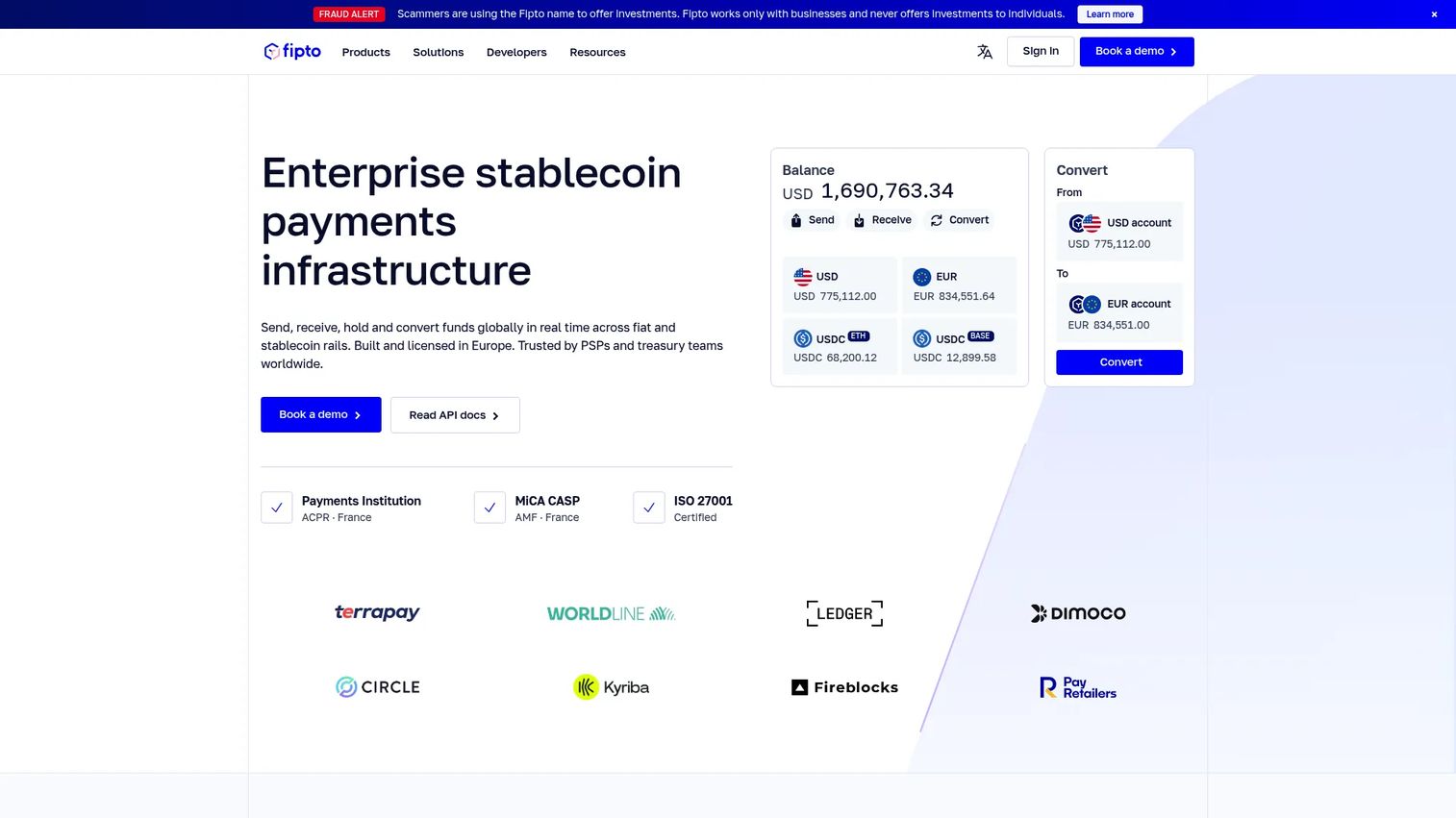
Fipto is regulated enterprise infrastructure for businesses that need to send, receive, hold, and convert fiat currencies and stablecoins globally. It provides EUR and USD business accounts with named and virtual IBANs, stablecoin and crypto-asset wallets across multiple blockchain networks, and real-time fiat-stablecoin conversion. Payment Links let businesses accept stablecoin payments without a full API integration.
Best for: Payment service providers, crypto brokers, and finance teams that need regulated cross-border fiat and stablecoin payment infrastructure.
Key features
- EUR and USD accounts with named and virtual IBANs
- Stablecoin and crypto-asset wallets across multiple blockchains
- Global fiat and stablecoin payouts
- Real-time fiat and stablecoin conversion
- Compliance tooling: AML/CFT monitoring, MFA, multi-signature approvals
Why choose Fipto: Fipto is more compelling for B2B operational payments, contractor payouts, and cross-border money movement than for simple storefront checkout. The named IBAN structure makes it easier to receive and reconcile fiat payments alongside stablecoin flows. Note that G2 ratings are currently based on a small review sample.
Fipto pricing: Custom packages. Book a demo with Fipto to discuss pricing based on volume, currencies, and product modules.
G2 rating: 4.5/5
11. Circle
Circle is the issuer of USDC and EURC and provides stablecoin, payments, and blockchain infrastructure for businesses building regulated financial products. Its offering includes the Circle Payments Network, programmable wallet services, cross-chain infrastructure (including CCTP), and the Arc Layer-1 blockchain. Circle is more of a developer-oriented infrastructure layer than a plug-and-play merchant checkout tool.
Best for: Businesses and developers building regulated stablecoin-based financial products, payment flows, or onchain applications centered on USDC.
Key features
- USDC and EURC digital assets
- Circle Payments Network for cross-border settlement
- Programmable wallets and smart-contract developer services
- Cross-chain infrastructure including CCTP and Gateway
- Arc Layer-1 blockchain for onchain applications
Why choose Circle: Circle is the right choice when your strategy centers on stablecoins, treasury, and programmable money rather than a standard "pay with crypto" button. If your product requires USDC as a first-class currency, building on Circle's infrastructure gives you the cleanest path. Consult the best e-signature software guide for adjacent workflow tools your finance team may need alongside a stablecoin treasury setup.
Circle pricing: No public pricing page was found. Contact Circle's team for API, account, and transaction fees.
G2 rating: 4.2/5
12. Stripe
Stripe is programmable financial infrastructure for accepting payments, managing revenue, preventing fraud, and operating globally. Its core stack covers online and in-person payments, recurring billing, fraud prevention with Radar, and platform payments. Stripe has expanded into stablecoin and crypto-related features, making it worth evaluating for SaaS teams already running Stripe billing who want to add crypto support without a separate provider.
Best for: SaaS and e-commerce teams already using Stripe that want to add crypto or stablecoin payment support within their existing payment stack.
Key features
- Online and in-person payments with Payment Links and Checkout
- Recurring billing and subscription management
- Fraud prevention with Stripe Radar
- Stablecoin and crypto payment support (verify current product availability)
- Payouts and detailed financial reporting
Why choose Stripe: Stripe removes the need for a separate crypto provider if your team already trusts Stripe as the payments layer. Verify which crypto and stablecoin features are live in your region before building on them, since the product roadmap in this area evolves quickly. Reference the API gateway software guide for broader API infrastructure context.
Stripe pricing: Standard pricing is 2.9% + 30¢ per successful domestic card transaction, with custom pricing available for high-volume businesses. Crypto and stablecoin product fees are separate.
G2 rating: 4.4/5
13. Transak
Transak is payments infrastructure that enables financial applications to offer fiat-to-crypto and crypto-to-fiat transactions, stablecoin payments, and KYC workflows. It provides white-label APIs and plug-and-play widgets for wallets, exchanges, fintechs, and remittance platforms. Transak is not a traditional merchant gateway; it powers the in-app experience where users purchase or sell crypto.
Best for: Apps and platforms that need users to acquire or convert crypto inside a product flow, rather than businesses accepting customer invoices.
Key features
- Fiat-to-crypto and crypto-to-fiat on-ramps and off-ramps
- KYC, AML, and compliance workflows
- White-label APIs and plug-and-play widgets
- Virtual account payments and headless card support
- Apple Pay and Google Pay support for on-ramp transactions
Why choose Transak: Transak is useful when your product needs users to buy crypto inside the app experience, not when you need to accept payment from a customer for a SaaS subscription. The distinction matters before you invest engineering time. Note that no G2 listing was available at time of writing.
Transak pricing: On-ramp fees start at 3.99% + $1 for debit or credit card and Apple Pay transactions. Google Pay on-ramp charges 3.99%. Wire transfer on-ramp runs 0.75% + $9. Bank transfer on-ramp is 2% + $1. Off-ramp via debit or credit card is 0.99%. Exact fees display at checkout and vary by payment method, region, and crypto asset.
14. Simplex

Simplex is a global crypto payment processing service that enables businesses and platforms to offer fiat-to-crypto purchasing through cards, bank transfers, and alternative payment methods. It supports 125+ cryptocurrencies and 115+ fiat currencies, with credit and debit card, Apple Pay, Google Pay, PIX, SEPA, and ACH payment support depending on location and partner arrangements. Fraud and risk screening are built into the checkout flow.
Best for: Crypto platforms and wallets that need a fiat-to-crypto checkout experience and fraud screening, rather than businesses accepting crypto as payment for goods or services.
Key features
- Fiat-to-crypto on-ramp for 125+ cryptocurrencies
- Card, Apple Pay, Google Pay, PIX, SEPA, and ACH support
- Built-in fraud and risk screening
- White-label partner integrations
- Co-branded Visa debit card option for eligible partners
Why choose Simplex: Like Transak, Simplex fits platforms that need a crypto purchase experience more than a full merchant settlement gateway. If your product is a wallet or exchange, Simplex provides a proven on-ramp. If you are a SaaS business accepting customer payments, a gateway with merchant settlement is a better fit.
Simplex pricing: Partner-platform card payment fees generally range from 3.5% to 5%, with a $10 minimum. Purchases made directly on simplex.com carry a transaction fee of no less than 13%.
Considerations when choosing a cryptocurrency payment gateway
Settlement model
Decide on your settlement preference before evaluating any tool. Fiat settlement reduces treasury risk and simplifies accounting. Stablecoin settlement (USDC, USDT) offers speed and programmability. Crypto settlement requires your finance team to manage conversion timing and FX exposure. For most Series B SaaS companies, fiat or stablecoin settlement is the right starting point.
Compliance and geographic coverage
AML and KYC requirements, sanctions screening, and licensing vary by jurisdiction. Confirm that the provider covers your primary markets and can meet the regulatory obligations your business faces. This is operational guidance only; consult your legal and compliance team for jurisdiction-specific advice. The AML software guide covers monitoring tools that may need to sit alongside your payment gateway.
Integration effort
Some providers offer hosted checkout and payment links requiring minimal engineering. Others are API-first and need a full integration build. Clarify who owns implementation and maintenance before you commit. A hosted checkout option reduces go-live time. An API-first provider gives you more control but requires ongoing engineering support. Review the best ecommerce platform for small business guide if you also need e-commerce infrastructure alongside your payment gateway.
Reconciliation and reporting
Accepting crypto only adds value if finance can close the books. Evaluate whether the provider exports clean transaction-level data with invoice references, settlement timing, fees broken out, and refund records. Confirm accounting integrations before committing, especially if your finance team uses QuickBooks, Xero, or a similar tool.
Total cost
Transaction fees are the visible cost, but the total cost includes FX and conversion spreads, withdrawal and settlement fees, monthly minimums (if any), and engineering time for setup and maintenance. For best payment processing software comparisons beyond crypto, that guide covers the broader payment infrastructure market.
Conclusion
The right cryptocurrency payment gateway is not the one with the most coins. It is the one that fits your settlement model, compliance posture, and finance workflow.
For regulated merchant payment acceptance with fiat settlement, CoinGate and Triple-A are the strongest starting points. BitPay is the pick for established merchant checkout with volume-based pricing. BVNK and Circle are for companies building stablecoin treasury operations, not just adding a checkout option. Coinbase Business, Binance, and Crypto.com each make sense when your customer base is already on their platform. CoinsPaid fits high-volume businesses that need enterprise compliance infrastructure. Fipto and Simplex serve more specialized B2B and onramp use cases.
For a Series B founder, the next step is straightforward: Shortlist three tools based on settlement model, ask your finance lead to define the reconciliation requirements, ask engineering to estimate integration effort, then run a small pilot before committing. Do not choose based on brand recognition alone.
Start your journey with Guideflow today!
FAQs
A cryptocurrency payment gateway is software that lets businesses accept crypto or stablecoin payments from customers, verify the transaction on the blockchain, optionally convert the funds, and settle the proceeds into crypto, stablecoins, or fiat currency. It handles the checkout experience, transaction monitoring, and downstream settlement, similar in function to a card payment processor but operating on blockchain rails.
When a customer selects crypto at checkout, the gateway generates a payment address or invoice with a specific amount and time window. The gateway monitors the blockchain for the incoming transaction, confirms it meets the required confirmation threshold, and then triggers the merchant's settlement process. Depending on the provider, settlement happens instantly via conversion to fiat, daily in stablecoin, or in the original crypto received.
The terms are often used interchangeably. In practice, the gateway refers to the customer-facing acceptance layer: The checkout page, payment link, or invoice. The processor refers to the backend layer that handles conversion, risk checks, and settlement. Many providers cover both functions in one product. Focus on whether the provider meets your settlement, compliance, and reconciliation needs rather than on how they label themselves.
Yes. Most gateways support automatic conversion to fiat at the point of payment, so the merchant receives local currency without ever holding a crypto balance. Stablecoin settlement (USDC or USDT) is another option that avoids volatility while keeping value in digital form. CoinGate, BitPay, and Triple-A all offer fiat settlement paths.
Safety depends on the provider's AML and KYC procedures, custody model, sanctions screening, and settlement controls. Established providers maintain compliance programs and maintain regulatory licenses in their operating jurisdictions. That said, no gateway eliminates counterparty or custody risk entirely. Run standard vendor due diligence, confirm the provider's licensing in your markets, and do not treat a provider's compliance program as a substitute for your own.
Fees vary by provider and typically include a transaction fee (percentage of the payment amount), a conversion or FX spread if the provider converts crypto to fiat, a withdrawal or settlement fee for moving funds, and sometimes a minimum transaction fee. CoinGate charges 1% per transaction. BitPay starts at 2% + 25¢, falling as volume grows. CoinPayments charges 3% per payment. Transak starts at 3.99% + $1 for card on-ramps. Always verify fees by region and volume before committing.
Coin count matters less than customer demand, settlement preference, volatility exposure, and accounting workflow. Bitcoin and Ethereum cover most customer demand. USDC is the default choice if stablecoin settlement is the goal. Accepting dozens of altcoins adds operational complexity without proportional revenue gain for most SaaS businesses. Start with the assets your customers actually request.
Some do. CoinGate, for example, offers verified plugins for WooCommerce, Magento 2, PrestaShop, OpenCart, and WHMCS. CoinPayments also supports pre-built e-commerce plugins and payment buttons. Shopify's own platform controls which payment gateways can connect directly; confirm that your chosen provider has a current, maintained Shopify integration before building. Plugin availability changes, so verify against the provider's current documentation rather than a list from a year ago.