Public cloud promises elasticity until your workload stops behaving like a typical web app. Noisy neighbors, unpredictable I/O, GPU scarcity, and compliance review cycles then become roadmap blockers rather than infrastructure footnotes. The bare metal cloud market was valued at $14.32 billion in 2025 and is projected to reach $36.71 billion by 2030, a 20.7% compound annual growth rate, according to MarketsandMarkets (2025). That growth reflects a real shift: More engineering and product teams are evaluating dedicated physical infrastructure as a deliberate architectural choice, not just a last resort.
Bare metal as a service (BMaaS) covers a wide range of platforms. Some automate hardware you own. Others rent dedicated servers. A few provide distributed bare metal cloud adjacent to major networks. Choosing without mapping the category first means buying the wrong abstraction for your workload.
This guide cuts through the category to give you a decision map, not a vendor pitch.
What's inside
This guide compares 9 BMaaS and bare metal cloud platforms for 2026, evaluated for provisioning model, workload fit, automation depth, security controls, support, and pricing clarity.
- Who this is for: Product leaders, platform engineers, and technical buyers who need to understand the category before pushing a decision into engineering, security, or finance review
- Selection criteria: Provisioning model (ticket-driven vs. API-driven), workload fit across performance and regulated use cases, automation and infrastructure-as-code support, support quality and SLA coverage
- What it covers: When BMaaS makes sense over public cloud VMs, and when it does not
TL;DR
- Best for data center automation: MAAS, for teams managing their own physical hardware
- Best for managed bare metal hosting: Liquid Web, for production workloads needing operational support
- Best for enterprise hybrid cloud: IBM Cloud Bare Metal Servers, for teams inside the IBM Cloud portfolio
- Best for storage-led cloud repatriation: Pure Storage Evergreen//One, where data performance drives the decision
- Best for distributed bare metal cloud: Equinix Metal, for latency-sensitive and network-adjacent workloads
- Best budget and regional options: OVHcloud Bare Metal starts at $163.20/month; phoenixNAP starts at $0.08/hour; Hivelocity starts at $75/month; Leaseweb starts at $45.09/month
What is bare metal as a service?
Bare metal as a service is a cloud delivery model that gives teams on-demand access to dedicated physical servers, usually with automated provisioning, usage-based or contract billing, and provider-managed infrastructure operations.
Unlike virtual machines, bare metal servers do not share a hypervisor layer with other tenants. Each customer gets exclusive access to the underlying hardware, which removes the shared-compute variability that affects latency-sensitive or I/O-heavy workloads on public cloud.
BMaaS can be delivered two ways. A hosted provider rents you physical servers provisioned through an API or control panel, managed from their data centers. Alternatively, internal data center automation software like MAAS lets a team treat its own physical hardware with cloud-like lifecycle management. Both approaches aim to give the operational agility of cloud with the control of dedicated hardware.
The category is broader than a server specification. What separates BMaaS from traditional dedicated hosting is the combination of API-driven provisioning, automated OS deployment, lifecycle management, and integration with infrastructure-as-code workflows such as Terraform and Ansible. A bare metal server you provision by filing a support ticket is not BMaaS in the meaningful sense.
Key capabilities to look for:
- Dedicated single-tenant hardware
- API-driven provisioning and deprovisioning
- Operating system image deployment
- Networking and IP address management
- Hardware inventory and diagnostics
- Role-based access controls
- Usage-based, monthly, or contract billing
- Hybrid and multicloud workflow support
One thing BMaaS does not automatically provide: Compliance. Physical isolation is one layer of a security posture. Patching, monitoring, encryption, audit logging, and contractual review are still your responsibility, whether the server sits in a colocation cage or a cloud provider's data center.
When to use bare metal as a service
Run performance-sensitive workloads
HPC, GPU training, real-time analytics, database clusters, media streaming, and latency-sensitive services all hit a ceiling on shared cloud instances. Variable I/O from neighboring tenants creates performance noise that engineering teams compensate for with over-provisioning, which raises cost without fixing the root problem. Bare metal removes that variability. For product teams, this matters when infrastructure performance directly affects user experience or service-level commitments your roadmap depends on.
Reduce cloud cost surprises
Elastic public cloud is priced for variable workloads. Steady-state workloads that run at high utilization around the clock become expensive under variable billing models. BMaaS with monthly or reserved pricing can lower the cost per compute hour for workloads with predictable consumption. Cloud repatriation decisions typically start here: The finance team notices the cloud bill no longer tracks usage assumptions.
Control regulated or isolated environments
Some workloads require stronger isolation controls than shared cloud can provide. Single-tenant servers, data locality guarantees, and audit trails over physical hardware access can support regulated environments in finance, healthcare, and government. The compliance outcome still depends on how you configure access controls, what contracts your provider signs, and how your operations team handles incident response. BMaaS creates the conditions; it does not deliver a compliance certification by itself.
Bare metal as a service comparison
The table below maps each platform's intended use, primary differentiator, and pricing starting point. It compares platform intent rather than every hardware configuration. Pricing changes frequently; verify against each vendor's current pricing page before making a commitment. G2 ratings are marked N/A where no category-relevant listing was available.
| # | Product | Best for | Key differentiator | Pricing | G2 rating |
|---|---|---|---|---|---|
| 1 | MAAS | Data center automation | Open-source bare metal lifecycle management | From $30/machine/year (support) | N/A |
| 2 | Liquid Web | Managed bare metal hosting | 24/7 expert support with dedicated servers | From $116.75/month | 4.2/5 |
| 3 | IBM Cloud Bare Metal Servers | Enterprise hybrid cloud | IBM Cloud integration with global regions | From $0.253/hour | 4.0/5 |
| 4 | Pure Storage Evergreen//One | Storage-led cloud repatriation | Managed full-stack storage as a service | Custom pricing | 4.7/5 |
| 5 | Equinix Metal | Distributed bare metal cloud | API-driven bare metal near major network hubs | Custom pricing | N/A |
| 6 | OVHcloud Bare Metal | Cost-conscious regional hosting | Broad server catalog with anti-DDoS included | From $163.20/month | 3.1/5 |
| 7 | Hivelocity | Flexible dedicated hosting | Configurable servers with fast deployment | From $75/month | 4.6/5 |
| 8 | phoenixNAP Bare Metal Cloud | API-driven DevOps workloads | Hourly billing with Terraform and Kubernetes support | From $0.08/hour | 5.0/5 |
| 9 | Leaseweb Dedicated Servers | Bandwidth-heavy and gaming workloads | High-bandwidth server catalog with global presence | From $45.09/month | 3.4/5 |
Best 9 bare metal as a service platforms for 2026
1. MAAS
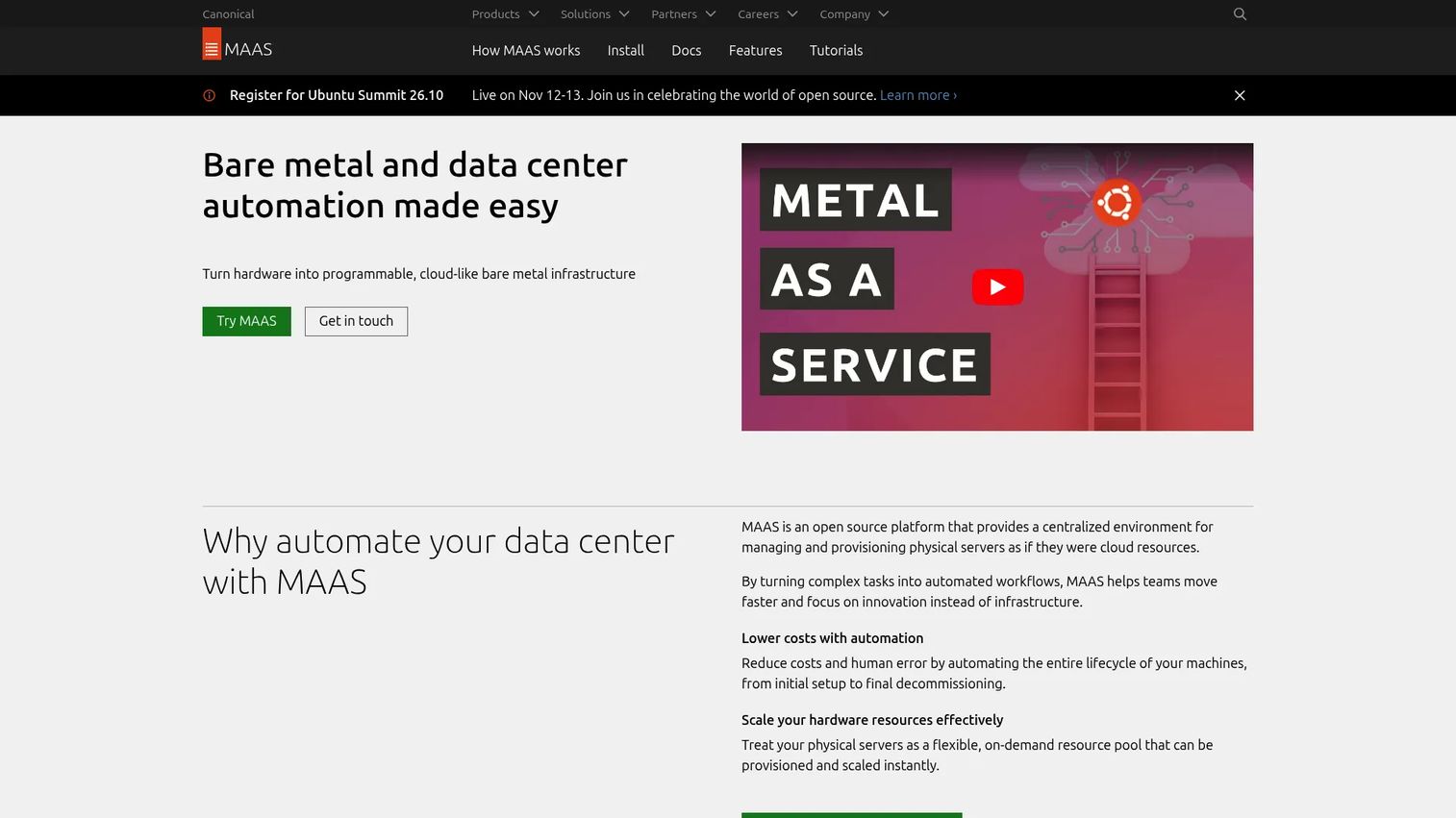
MAAS (Metal as a Service) is an open-source bare metal provisioning and data center automation platform from Canonical. It treats physical servers the way cloud orchestration tools treat virtual machines: Hardware is discovered automatically, commissioned, deployed with an OS image, and returned to the pool when a workload ends. MAAS handles IPAM, DHCP, DNS, storage configuration, and hardware lifecycle across heterogeneous environments. It is not a hosted BMaaS provider; it is the automation layer you run on hardware you own or colocate.
Best for: Platform teams building private cloud, automating OpenStack or Kubernetes deployments, or managing repeatable server lifecycle operations.
Key features
- Automated hardware discovery and commissioning
- OS image deployment across heterogeneous server fleets
- IPAM, DHCP, and DNS management
- Terraform and Ansible workflow integrations
- LDAP, Active Directory, and SAML identity integration
Why choose MAAS: MAAS fits teams that own physical infrastructure and need cloud-like repeatability over provisioning without depending on a third-party managed provider. It is the right tool when infrastructure automation is the job, not server rental.
MAAS pricing: MAAS is free to use as open-source software. Canonical offers paid support tiers for managed machines: Essential at $30/machine/year, Standard at $50/machine/year, and Advanced at $100/machine/year. The open-source tier is fully functional for teams comfortable with self-support.
2. Liquid Web
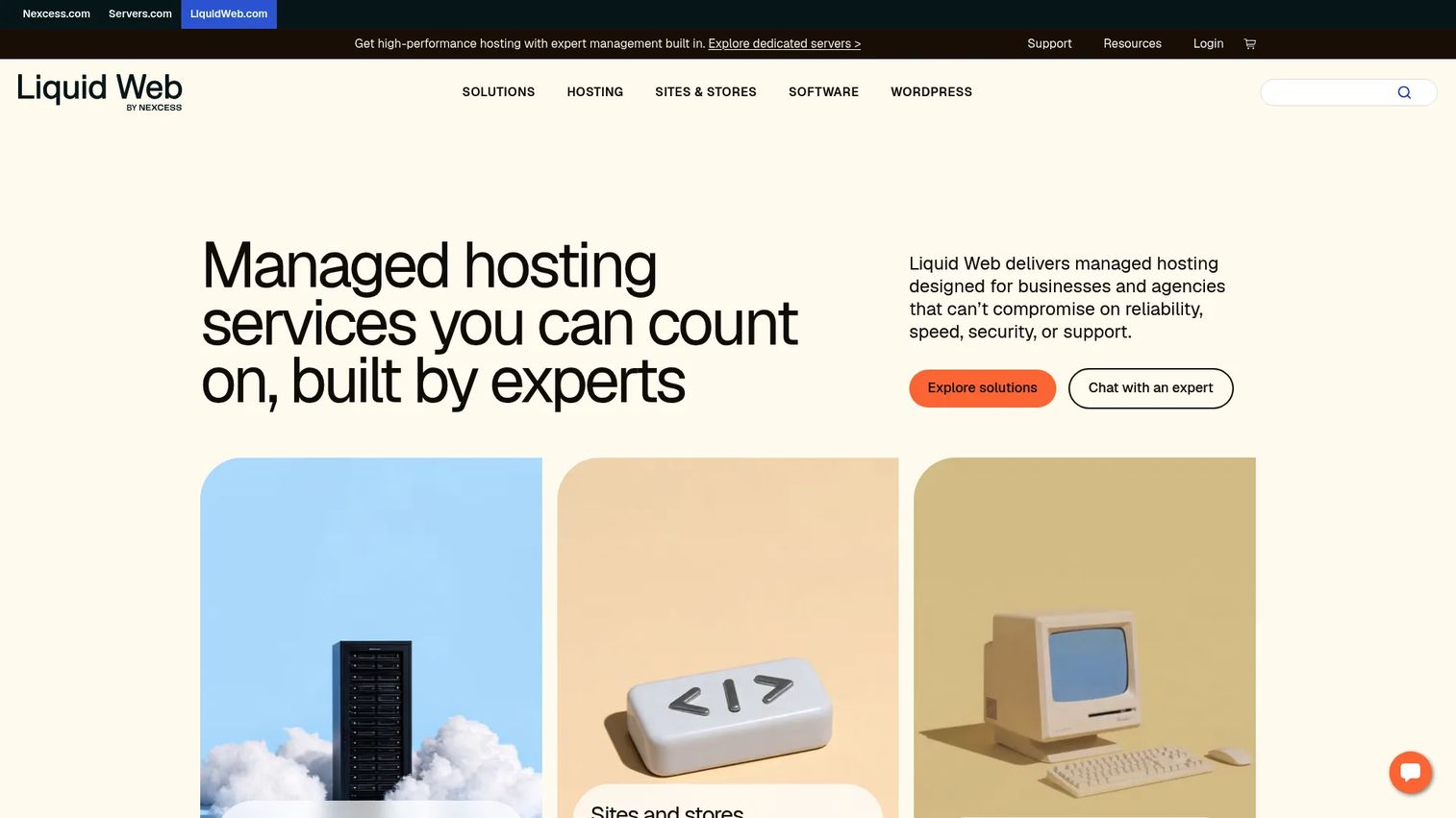
Liquid Web packages dedicated servers and cloud infrastructure with managed operations and expert support, making it a practical choice for teams that want physical isolation without building a data center automation stack. It serves high-traffic websites, ecommerce platforms, and mission-critical workloads that need a provider to handle hosting operations rather than raw server access. The company positions itself around 24/7/365 support and managed service wrappers around VPS, dedicated, and cloud dedicated hardware.
Best for: Teams running production web apps, ecommerce, or regulated workloads who need hosting expertise alongside dedicated hardware.
Key features
- Cloud dedicated and VPS hosting options
- 24/7/365 expert support
- DDoS protection, firewalls, and backup services
- Root access with cPanel, Plesk, or InterWorx
- Managed WordPress, WooCommerce, and Magento hosting
Why choose Liquid Web: Choose Liquid Web when managed operations and support quality matter more than DIY automation. It suits product teams whose engineering capacity should stay on the product, not on hosting operations.
Liquid Web pricing: Cloud dedicated servers start at $116.75/month for an Intel Xeon E-2134 configuration. Higher configurations reach $457/month for an Intel Xeon 6226R. VPS plans start at $18/month. No free tier is available.
G2 rating: 4.2/5
3. IBM Cloud Bare Metal Servers
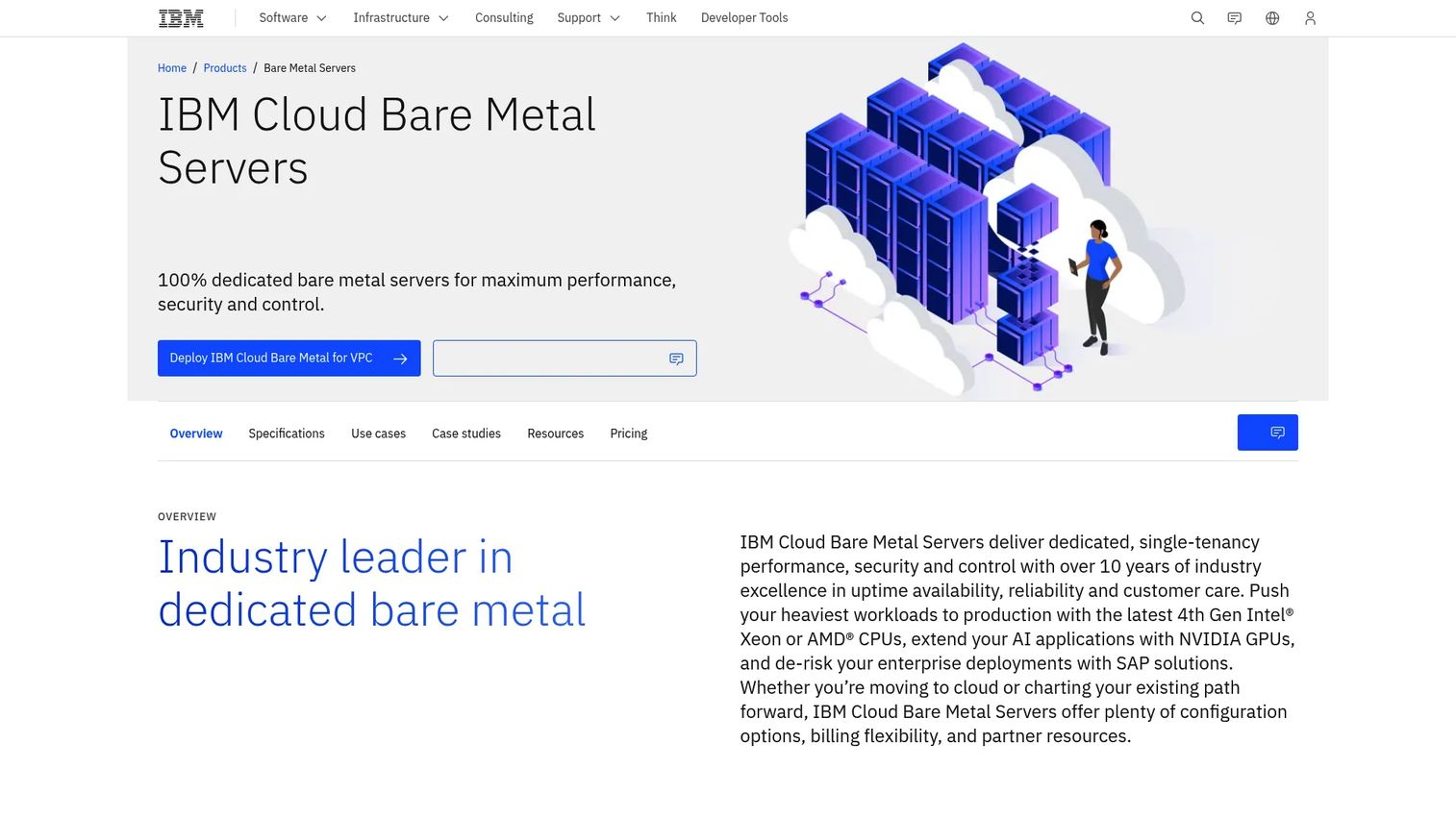
IBM Cloud Bare Metal Servers offer enterprise-grade dedicated physical servers within IBM's broader cloud portfolio. The product supports both VPC and classic infrastructure deployments, with options for Intel Xeon, AMD EPYC, and NVIDIA GPU configurations. Enterprises already standardizing on IBM Cloud find the tight integration with IBM's network, security, and compliance services most valuable. It is a strong fit when the infrastructure decision needs to pass procurement, security, and legal review inside a large organization.
Best for: Enterprise teams running performance-sensitive or security-sensitive workloads inside an IBM Cloud or hybrid architecture.
Key features
- Dedicated single-tenant physical servers
- VPC and classic infrastructure deployment options
- Support for Intel Xeon, AMD EPYC, and NVIDIA GPUs
- Hourly, monthly, and reserved billing
- Global cloud region availability
Why choose IBM Cloud Bare Metal Servers: IBM Cloud suits product teams whose workload decisions must survive enterprise procurement cycles. The hybrid cloud architecture support, global region footprint, and IBM's compliance documentation make it defensible inside large organizations where bare metal sits alongside cloud-native services.
IBM Cloud Bare Metal Servers pricing: Pricing starts at approximately $0.253/hour for on-demand instances. Final cost varies by region, server profile, OS choice, and optional services. Hourly, monthly, and 1-year or 3-year reserved billing are available. Verify current configurations through IBM's pricing configurator.
G2 rating: 4.0/5
4. Pure Storage Evergreen//One
Pure Storage Evergreen//One is not a bare metal compute provider in the conventional sense. It is a storage-as-a-service subscription that delivers managed, full-stack storage infrastructure with contracted capacity, performance SLAs, and non-disruptive hardware modernization. Teams evaluating it in a BMaaS context are usually looking at cloud repatriation, hybrid architecture, or storage-heavy workloads where managed operations and predictable performance SLAs matter more than raw compute choice.
Best for: Teams migrating storage-heavy workloads from public cloud, building hybrid infrastructure, or needing managed storage operations with SLA guarantees.
Key features
- Usage-based billing on effective used capacity
- Performance, uptime, and Zero Data Loss SLAs
- Non-disruptive hardware modernization
- On-premises, colocation, and public cloud deployment
- Portworx integration for container-based storage
Why choose Pure Storage Evergreen//One: Choose Evergreen//One when storage architecture is the primary decision driver. It belongs on the BMaaS shortlist for teams where compute, storage, and operations need to move as a managed full-stack service, particularly during cloud repatriation projects.
Pure Storage Evergreen//One pricing: Evergreen//One is quote-based across all subscription tiers (Block and File Performance, Premium, Ultra, Capacity, Cloud Block Store, and UFFO Standard). The price depends on committed capacity, performance tier, and contract length. Contact Pure Storage for a quote.
G2 rating: 4.7/5
5. Equinix Metal
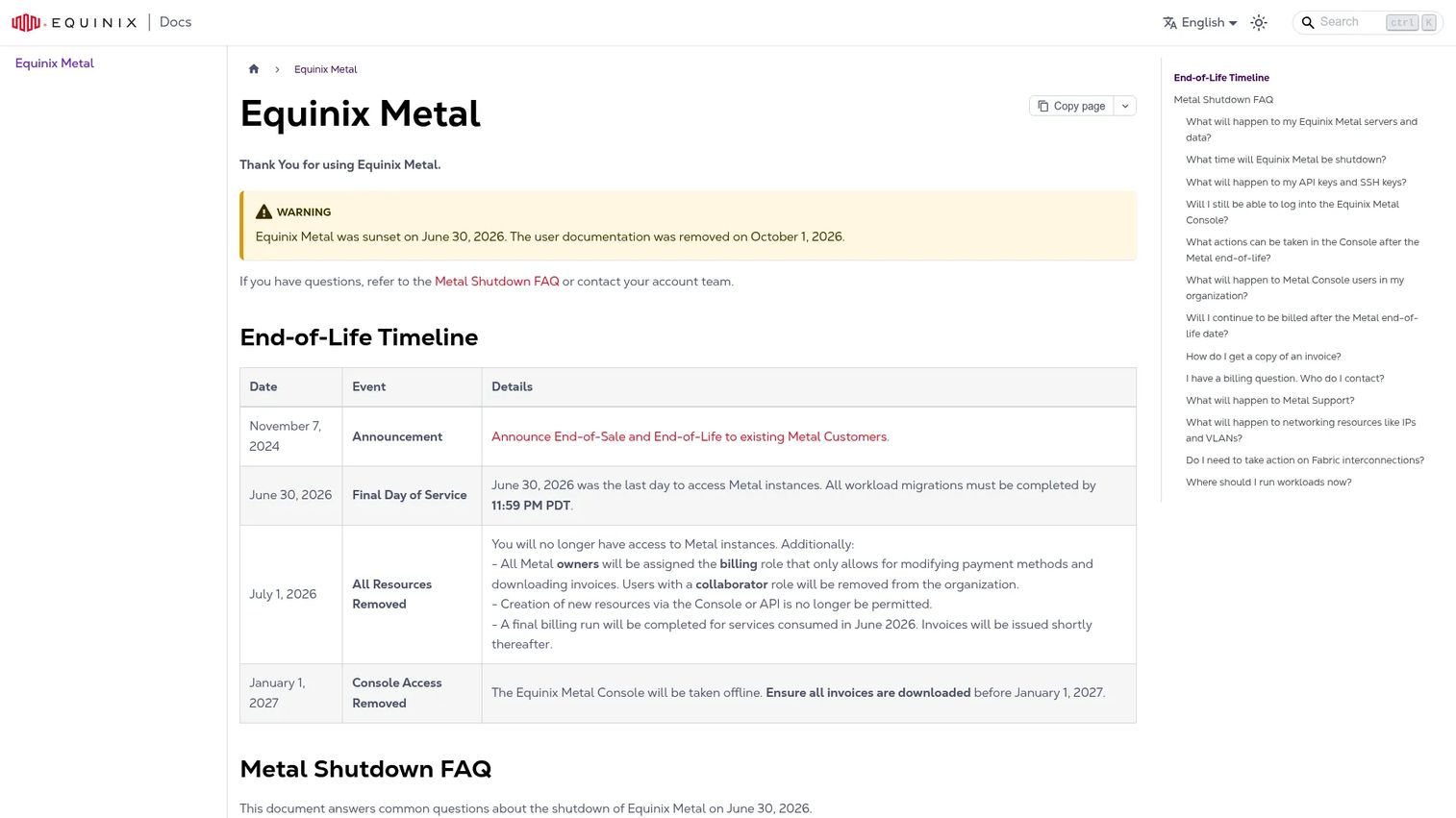
Equinix Metal provides API-driven bare metal infrastructure deployed across Equinix's global colocation network. The product is designed for workloads that need physical hardware close to major internet exchanges, cloud on-ramps, and network peering points. Teams running distributed applications, edge infrastructure, or latency-sensitive services use Equinix Metal because physical proximity to network hubs affects application performance in ways that CPU speed alone cannot solve. API-driven provisioning and Terraform support make it accessible to platform engineering teams used to cloud workflows.
Best for: Engineering teams whose application latency or network architecture requires physical infrastructure at specific global metro locations.
Key features
- API-driven bare metal provisioning
- Global metro deployment locations
- Private networking between servers and facilities
- Cloud-adjacent connectivity through Equinix Fabric
- Terraform provider support
Why choose Equinix Metal: Location and interconnection drive most Equinix Metal decisions. If your workload's performance depends on being close to a specific cloud region, peering point, or network hub, the colocation footprint is a differentiator that compute-only bare metal providers cannot match.
Equinix Metal pricing: Equinix Metal offers on-demand, monthly reserved, and commitment-based pricing. Contact Equinix Metal for a current quote.
6. OVHcloud Bare Metal
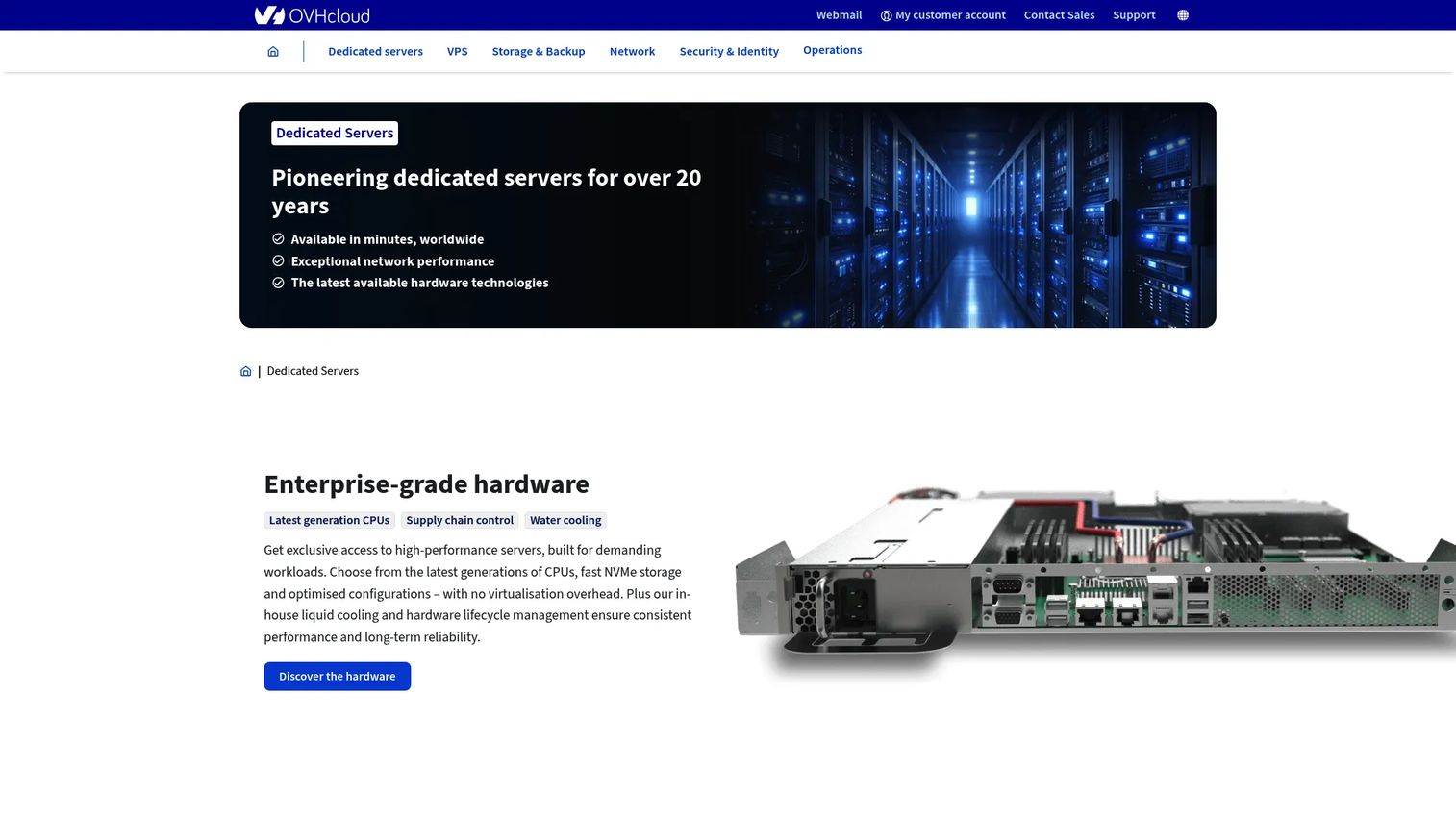
OVHcloud Bare Metal offers one of the broader dedicated server catalogs in the market, organized into Advance, Game, Scale, and High Grade ranges. Servers deploy in under 120 seconds, include 500 GB backup storage, and come with built-in anti-DDoS protection across all plans. OVHcloud operates data centers across Europe, North America, and Asia-Pacific, giving regional teams predictable pricing without the premium of large enterprise cloud providers. It is a practical choice for cost-conscious teams that know their workload profile and want a large bare metal catalog to match it.
Best for: Cost-conscious teams that need dedicated server capacity across multiple regions, including gaming, storage, and business applications.
Key features
- Advance, Game, Scale, and High Grade server ranges
- Deployment in under 120 seconds
- Built-in anti-DDoS protection on all plans
- 500 GB included backup storage
- Integration with OVHcloud Private Cloud and Public Cloud
Why choose OVHcloud Bare Metal: OVHcloud earns its place when price and server variety matter more than managed operations or enterprise procurement support. If you have a clear workload profile and want to pick the hardware configuration that matches it at a predictable monthly cost, the catalog depth is a genuine advantage.
OVHcloud Bare Metal pricing: Advance range starts at $163.20/month including VAT. Game servers start at $397.20/month, Scale at $765.60/month, and High Grade at $1,777.20/month.
G2 rating: 3.1/5
7. Hivelocity
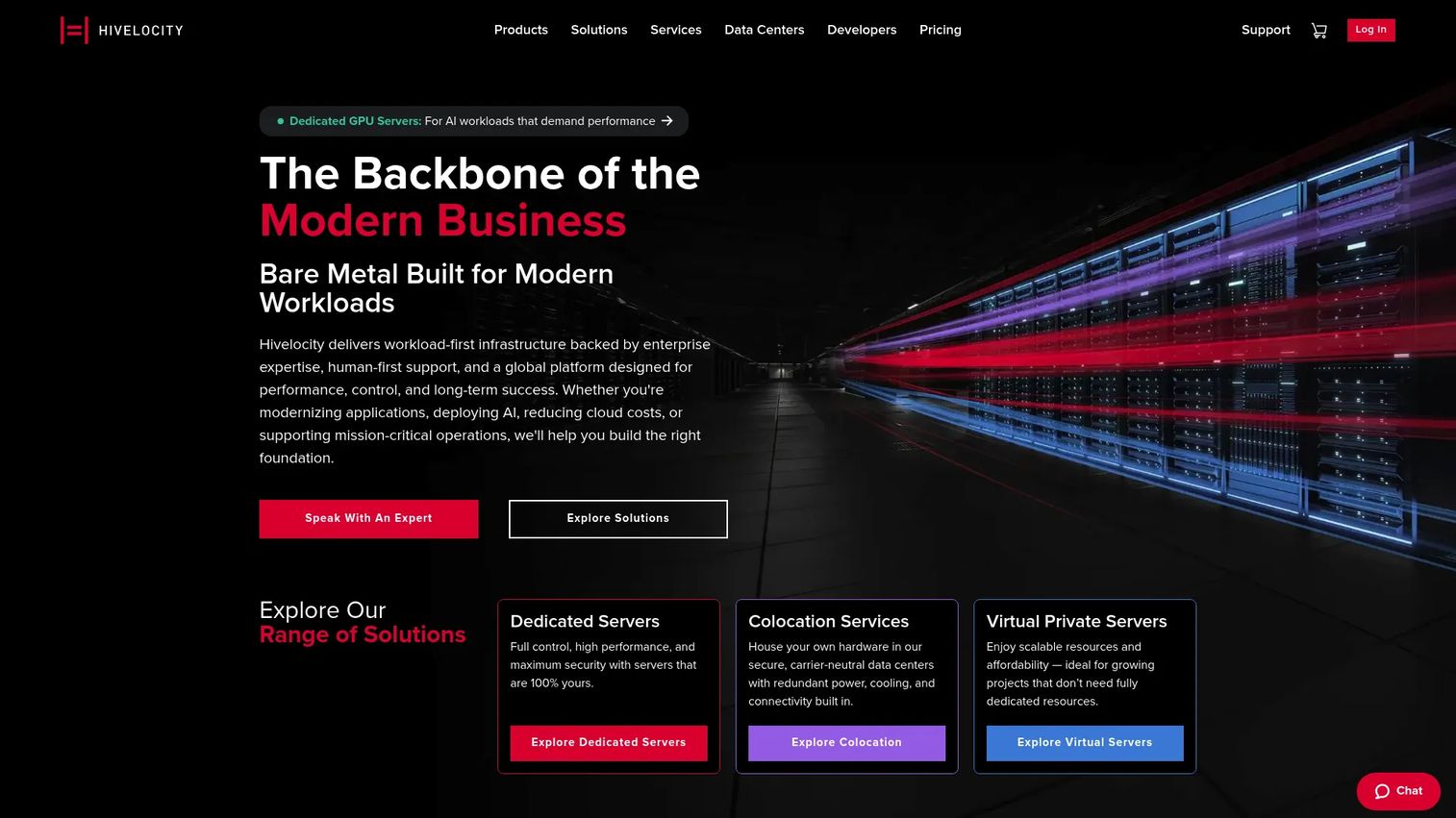
Hivelocity provides dedicated bare metal servers, VPS, and colocation across multiple US data centers, with a focus on configurable hardware and hands-on provider support. Teams use it for SaaS workloads, web platforms, and infrastructure migrations that need dedicated hosting flexibility without entering a large enterprise procurement cycle. The platform offers API and Terraform automation alongside optional managed services, so teams can start with provider-assisted operations and move toward more automation as they grow.
Best for: Teams that need configurable dedicated servers with provider support, particularly for SaaS infrastructure and web platform hosting.
Key features
- Customizable dedicated bare metal configurations
- Private networks and built-in DDoS protection
- API and Terraform infrastructure automation
- Managed services add-ons
- Multiple US data center locations
Why choose Hivelocity: Hivelocity works well when the team needs dedicated hosting with real support but does not need the complexity of an enterprise cloud platform. Its server customization options and human-first support model suit teams migrating workloads or running infrastructure that needs occasional operational help.
Hivelocity pricing: Dedicated servers start at $75/month for an E-2336 2.9GHz configuration. Mid-range configurations run around $97 to $250/month. Higher-end AMD Ryzen builds reach $553/month. All prices are monthly.
G2 rating: 4.6/5
8. phoenixNAP Bare Metal Cloud
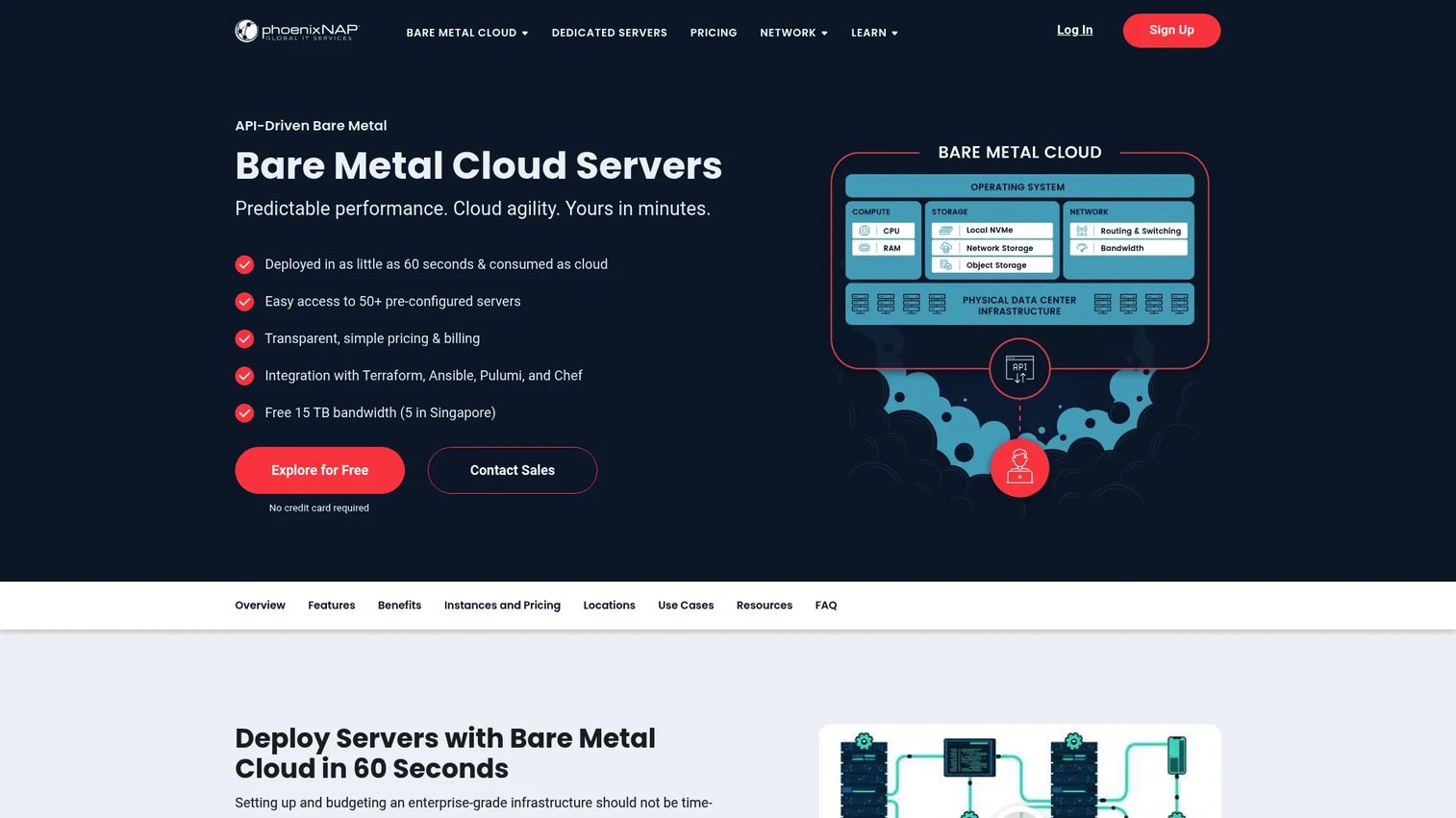
phoenixNAP Bare Metal Cloud positions itself as the programmable bare metal choice for DevOps and platform teams. Servers provision in as little as 60 seconds through API, CLI, SDK, or web UI, with integrations for Terraform, Ansible, Pulumi, and Chef. Hourly billing starts at $0.08/hour, making it accessible for workloads that need dedicated hardware without committing to a monthly contract. GPU and AI/ML instance types extend the catalog beyond general-purpose compute. For product teams evaluating bare metal for Kubernetes clusters or database workloads, the cloud-native provisioning model reduces the operational gap between bare metal and cloud.
Best for: DevOps and platform engineering teams running Kubernetes, CI/CD pipelines, databases, or AI/ML workloads on dedicated hardware with cloud-style provisioning.
Key features
- Provisioning in as little as 60 seconds
- API, CLI, SDK, and web UI management
- Terraform, Ansible, Pulumi, and Chef integrations
- Hourly, monthly, and yearly reservation pricing
- 50-plus pre-configured instance options including GPU and AI/ML
Why choose phoenixNAP Bare Metal Cloud: Choose phoenixNAP when the team wants cloud-like provisioning habits applied to dedicated physical hardware. The hourly billing and fast provisioning make it viable for platform experiments that might scale into production, without locking in a monthly commitment before workload sizing is confirmed.
phoenixNAP Bare Metal Cloud pricing: General Purpose instances start at $0.08/hour. Compute instances start at $0.61/hour. Memory instances start at $1.10/hour. Database instances run at $3.10/hour. AI/ML instances start at $1,646.72/month on a monthly plan.
G2 rating: 5.0/5
9. Leaseweb Dedicated Servers
Leaseweb Dedicated Servers provides customizable bare metal infrastructure organized by use case: Gaming, AMD, high bandwidth, high performance, GPU, and storage server categories. The company operates data centers across North America, Europe, and Asia-Pacific, with high-bandwidth options suited to media platforms, gaming infrastructure, and large-scale content delivery. Monthly contracts and a customer portal with API access make it straightforward for teams that want predictable dedicated hosting without cloud-platform complexity.
Best for: Teams running bandwidth-heavy applications, gaming infrastructure, media platforms, or regional hosting footprints that need predictable monthly costs.
Key features
- Server categories covering gaming, high bandwidth, AMD, GPU, and storage
- Global data centers across North America, Europe, and Asia-Pacific
- Customer Portal and API management
- Private networking and NVMe SSD upgrade options
- DDoS protection and high-availability options
Why choose Leaseweb Dedicated Servers: Leaseweb earns its place for workloads where network capacity and regional presence matter more than a cloud-native automation layer. Media platforms, gaming operators, and mature SaaS workloads with predictable steady-state traffic get the best value from its bandwidth catalog and geographic spread.
Leaseweb Dedicated Servers pricing: Gaming servers start at $45.09/month. AMD servers start at $116.39/month. High Bandwidth configurations start at $143.12/month. High Performance servers start at $224.06/month. All prices are monthly.
G2 rating: 3.4/5
Considerations when choosing bare metal as a service
Match the platform to the workload type
HPC, GPU workloads, databases, gaming, Kubernetes clusters, and regulated applications each make different demands on hardware, networking, and operations. The wrong BMaaS provider is usually a workload mismatch rather than a bad platform. Before evaluating vendors, write down what the workload actually needs: Raw compute throughput, low-latency storage I/O, network adjacency to a specific cloud, or strong isolation controls.
Check the provisioning model carefully
There is a meaningful difference between ticket-driven deployment, API-driven self-service, and infrastructure-as-code workflows. Product teams should ask how long it takes to provision, rebuild, reprovision, and decommission servers in each scenario. A platform that takes hours to provision on paper but days in practice changes the operational calculus for release cadence and incident response.
Evaluate network and location constraints
Latency, bandwidth costs, cloud adjacency, data residency requirements, and regional availability can matter more than raw CPU specifications. A server in the wrong region or on the wrong network path creates problems that hardware upgrades cannot fix. Peering relationships, private networking between servers, and direct cloud on-ramps all affect application performance for distributed systems.
Understand security and compliance responsibilities
Physical isolation is one layer of a security posture, not a complete one. Buyers still need to plan for access control policies, OS patching cadence, monitoring and alerting, encryption at rest and in transit, backup strategy, audit log retention, and contractual review of the provider's data processing terms. BMaaS providers vary significantly in what they handle versus what they hand back to you.
Model total cost beyond the server price
Bandwidth overage, additional storage, managed support tiers, security add-ons, software licenses, setup fees, and backup services can add meaningfully to what looks like a simple monthly server price. PMs pushing an infrastructure decision into finance review need to model these variables, because a low headline server price can become a larger line item once network and operations costs are included.
Conclusion
BMaaS is not "better cloud." It is dedicated physical infrastructure delivered with cloud-like operations, and the right platform depends on what your workload actually needs.
MAAS is the choice for teams automating hardware they own. Liquid Web and Hivelocity fit teams that want managed bare metal hosting with provider support. IBM Cloud Bare Metal Servers belongs in enterprise hybrid architectures where procurement and compliance review govern infrastructure decisions. Equinix Metal is the right answer when physical location relative to network hubs determines application performance.
Pure Storage Evergreen//One serves a different decision point: Teams where storage performance, managed operations, and cloud repatriation drive the conversation rather than raw compute choice. OVHcloud, phoenixNAP, and Leaseweb cover cost, programmability, and regional hosting needs at competitive entry prices.
Start by mapping your workload to a provisioning model. That single question (do you need to own hardware, rent dedicated servers, or access distributed bare metal cloud?) filters the list to two or three real candidates. Then compare network, support, and total cost against those finalists.
FAQs
Bare metal as a service (BMaaS) is a cloud delivery model that provides on-demand access to dedicated physical servers with automated provisioning and provider-managed infrastructure operations. Unlike shared cloud instances, BMaaS gives each customer exclusive use of the underlying hardware, removing the hypervisor layer and the shared-tenant risk that comes with virtual machines. Billing is typically usage-based, monthly, or contract-based depending on the provider.
Not exactly. Traditional dedicated hosting gives you a physical server provisioned through a support request, often with limited automation. BMaaS adds cloud-like provisioning through APIs, lifecycle automation, infrastructure-as-code integration, and self-service management. The operational model is meaningfully different, even when the underlying hardware is similar.
Public cloud typically runs workloads on virtualized shared infrastructure, where multiple customers share the same physical host through a hypervisor. BMaaS provides dedicated physical hardware with no co-tenancy at the compute layer. Public cloud still wins for instant elasticity and the breadth of managed services. BMaaS wins when consistent performance, physical isolation, or cost predictability for steady-state workloads are the primary concerns.
The clearest triggers are performance variability affecting user experience, cloud bills that no longer track usage assumptions, regulatory isolation requirements, GPU or HPC workloads that need predictable hardware access, database I/O bottlenecks on shared cloud, and cloud repatriation decisions driven by cost or control. For product teams, the question is whether infrastructure variability is showing up in user experience metrics or engineering capacity spent on infrastructure management.
BMaaS can support stronger isolation because the physical server is not shared with other customers. That eliminates one class of risk. Security still depends on how you configure access controls, how consistently you patch the OS, what monitoring and alerting you run, whether encryption is applied at rest and in transit, and what your provider's physical security and audit controls look like. Physical isolation is a meaningful starting point, not a complete security model.
Yes, and several providers on this list support it directly. MAAS, Equinix Metal, and phoenixNAP Bare Metal Cloud all have documented Kubernetes deployment paths with Terraform and API integrations. The practical considerations include cluster lifecycle management, storage provisioning, load balancer integration, and observability. Teams should evaluate whether the provider's networking model supports the pod networking and service mesh requirements their Kubernetes setup needs.
Workloads that fit well include HPC, AI and GPU training, analytics pipelines, relational and distributed databases, gaming servers, media streaming, high-traffic web applications, regulated systems in finance and healthcare, and steady-state SaaS infrastructure where utilization is predictable. The common thread is consistent resource demand where shared-cloud variability creates operational or cost problems.
Compare server price, billing unit (hourly vs. monthly vs. reserved), bandwidth included and overage rates, storage costs, support tier pricing, security add-ons, and setup or provisioning fees. The cheapest server in the catalog can become the most expensive option once bandwidth and managed operations costs are added. Build a 12-month model based on expected utilization before treating headline server prices as the comparison point.