Roadmaps stop working when they become status updates. Product has one version, Sales has a different story, and Marketing plans campaigns against timing that shifted two sprints ago. The gap is not just frustrating - it's a launch risk.
According to The Future of Strategy (2025), 79% of strategy-planning respondents still rely on Excel as their primary planning tool. That matters for PMMs because roadmap clarity shapes positioning, campaign timing, sales enablement, and customer communication. When the source of truth is a shared spreadsheet, message drift is almost guaranteed.
The problem is not a shortage of tools. It's knowing which layer you actually need: Product roadmapping, strategy execution, innovation portfolio management, or visual collaboration. The global strategic planning software market reached $2.23 billion in 2025 (The Insight Partners, 2026), and innovation management software hit $3.06 billion in the same year (Mordor Intelligence, 2026). The category has matured. Choosing the wrong fit still costs quarters.
What's inside
This guide compares 20 strategy and innovation roadmapping tools for PMMs, product leaders, and strategy teams evaluating their options in 2026. Tools were drawn from best product management tools research, live vendor pages, and G2 listings. Selection criteria:
- Roadmap visualization and stakeholder sharing
- Prioritization frameworks and decision support
- Feedback, market signal, or innovation pipeline management
- Execution tracking and integration depth
TL;DR
- Best overall for enterprise strategy and product planning: Aha! for teams that need connected strategy, discovery, prioritization, and portfolio visibility in one workflow
- Best for prioritization-driven roadmaps: airfocus for product teams that need scoring models and modular views before roadmap commitments reach GTM teams
- Best for roadmap communication: ProductPlan for sharing clear, audience-specific roadmaps across executives, sales, and marketing
- Best for customer-feedback-driven planning: Productboard, Craft.io, and Canny for teams that want customer evidence behind every roadmap decision
- Best for innovation portfolio management: ITONICS, HYPE Innovation Management, Qmarkets, and Wellspring for enterprise innovation and R&D programs
- Best flexible planning layer: Miro and Airtable for teams that need visual collaboration or a configurable database before committing to a dedicated roadmapping system
What is strategy and innovation roadmapping software?
Strategy and innovation roadmapping software helps teams visualize, prioritize, communicate, and track strategic initiatives, product plans, innovation pipelines, and execution dependencies over time.
This category is broader than basic project management or product delivery. Project management tracks tasks. Product roadmapping tracks product direction and feature release timing. Strategy and innovation roadmapping connects long-term business goals, market shifts, investment decisions, and innovation bets to actual execution workflows.
For PMMs, that distinction matters. Roadmap clarity directly shapes what you can defend in a launch brief, how you sequence campaigns, and whether Sales is telling the same story as the product site.
Key capabilities to look for:
- Roadmap visualization: Timeline, swimlane, portfolio, and scenario views for different audiences
- Prioritization frameworks: RICE, WSJF, value-vs-effort scoring, and custom weighted models
- Feedback and signal capture: Customer requests, sales input, market research, and innovation ideas
- Innovation pipeline management: Idea campaigns, technology scouting, trend radars, and portfolio tracking
- Stakeholder collaboration: Permissions, audience-specific views, and presentation-ready sharing
- Execution integration: Connections to Jira, Azure DevOps, and delivery tools so roadmaps stay current
- OKR and strategy alignment: Linking roadmap items to company-level goals and measurable outcomes
- Governance and versioning: Ownership, review cadence, and access controls that prevent drift
PMMs should care because roadmap clarity feeds launch plans, positioning frameworks, sales battlecards, and customer communication. A roadmap that lives in a shared doc cannot do that reliably.
When to use strategy and innovation roadmapping tools
Align roadmap decisions with company strategy
Roadmap choices stopped being purely a product-team call the moment your company had multiple products, competing priorities, or executive stakeholders with different views. A dedicated roadmapping tool surfaces conflicts, dependencies, and tradeoffs before they reach GTM planning. For PMMs, this means fewer late-stage surprises when launch dates shift.
Turn customer and market signal into priorities
Customer feedback, competitive intel, win/loss data, and sales input all shape what should ship and when. Tools in this category give product and PMM teams a structured way to link evidence to roadmap decisions. That connection makes it far easier to defend positioning and proof points when you're building launch messaging.
Communicate change before GTM teams get surprised
A roadmap update that reaches Sales two weeks before a campaign launches is not a roadmap. It's a crisis. The right tool makes it straightforward to share audience-specific views, control what different stakeholders see, and push updates when priorities change. That cadence is what keeps positioning consistent across every touchpoint.
Strategy and innovation roadmapping tools comparison
The table below covers all 20 tools in order, with pricing and G2 ratings verified against live vendor pages and G2 listings. Where a vendor does not display a numeric price, "Custom pricing" reflects that the price requires a sales conversation. G2 ratings use "N/A" where insufficient reviews prevent a published aggregate score.
| # | Product | Best for | Key differentiator | Pricing | G2 rating |
|---|---|---|---|---|---|
| 1 | Aha! | Enterprise product and strategy roadmaps | Integrated strategy, discovery, and portfolio planning | From $9/user/month | 4.4/5 |
| 2 | airfocus | Prioritization-heavy product teams | Modular scoring and flexible roadmap views | Custom pricing | 4.4/5 |
| 3 | ProductPlan | Roadmap communication | Executive-ready visual roadmap sharing | Custom pricing | 4.3/5 |
| 4 | Productboard | Customer-feedback-driven roadmaps | Feedback-to-prioritization workflow | Free; paid from $19/maker/month | 4.2/5 |
| 5 | Craft.io | End-to-end product management | Strategy, planning, feedback, and delivery in one platform | From $19/editor/month | 4.5/5 |
| 6 | Canny | Feedback-led roadmap planning | Feedback portal, voting, and changelog workflow | Free; Pro from $79/month | 4.5/5 |
| 7 | Roadmunk | Visual roadmap planning | Timeline, swimlane, and presentation-ready views | From $19/editor/month | 4.0/5 |
| 8 | ITONICS | Innovation portfolio management | Trend radars and innovation ecosystem mapping | From $3,000/year for 10 seats | 4.4/5 |
| 9 | HYPE Innovation Management | Enterprise innovation programs | Campaign, idea, and innovation portfolio workflows | Custom pricing | 4.8/5 |
| 10 | Qmarkets | Innovation management at scale | Idea management and open innovation programs | Custom pricing | 4.5/5 |
| 11 | Wellspring | Enterprise innovation and R&D | Technology scouting and innovation portfolio management | Custom pricing | 4.5/5 |
| 12 | Cascade | Strategy execution teams | Strategic planning tied to measurable execution | Custom pricing | 4.8/5 |
| 13 | WorkBoard | OKR-led strategy execution | Outcomes, alignment, and operating rhythm management | Custom pricing | 3.3/5 |
| 14 | Jira Product Discovery | Atlassian product teams | Ideas and prioritization connected to Jira delivery | Free; Standard from $10.50/creator/month | 4.3/5 |
| 15 | ProdPad | Product discovery and roadmap planning | Lean roadmap and product backlog workflow | Custom pricing | 4.3/5 |
| 16 | Miro | Visual strategy workshops | Flexible collaborative whiteboarding and planning | Free; Business from $20/member/month | 4.6/5 |
| 17 | Airtable | Custom roadmap databases | Spreadsheet-database flexibility for roadmap workflows | Free; Team from $20/user/month | 4.6/5 |
| 18 | IBM Targetprocess | Agile portfolio management | Enterprise agile planning and portfolio visibility | Custom pricing | 4.3/5 |
| 19 | Perdoo | OKR and strategy alignment | Goal management tied to roadmap priorities | Free; Premium from €6.40/user/month | 4.4/5 |
| 20 | SharpCloud | Strategic portfolio visualization | Data-rich visual roadmaps and stakeholder views | Custom pricing | N/A |
Best 20 strategy and innovation roadmapping tools for 2026
1. Aha!
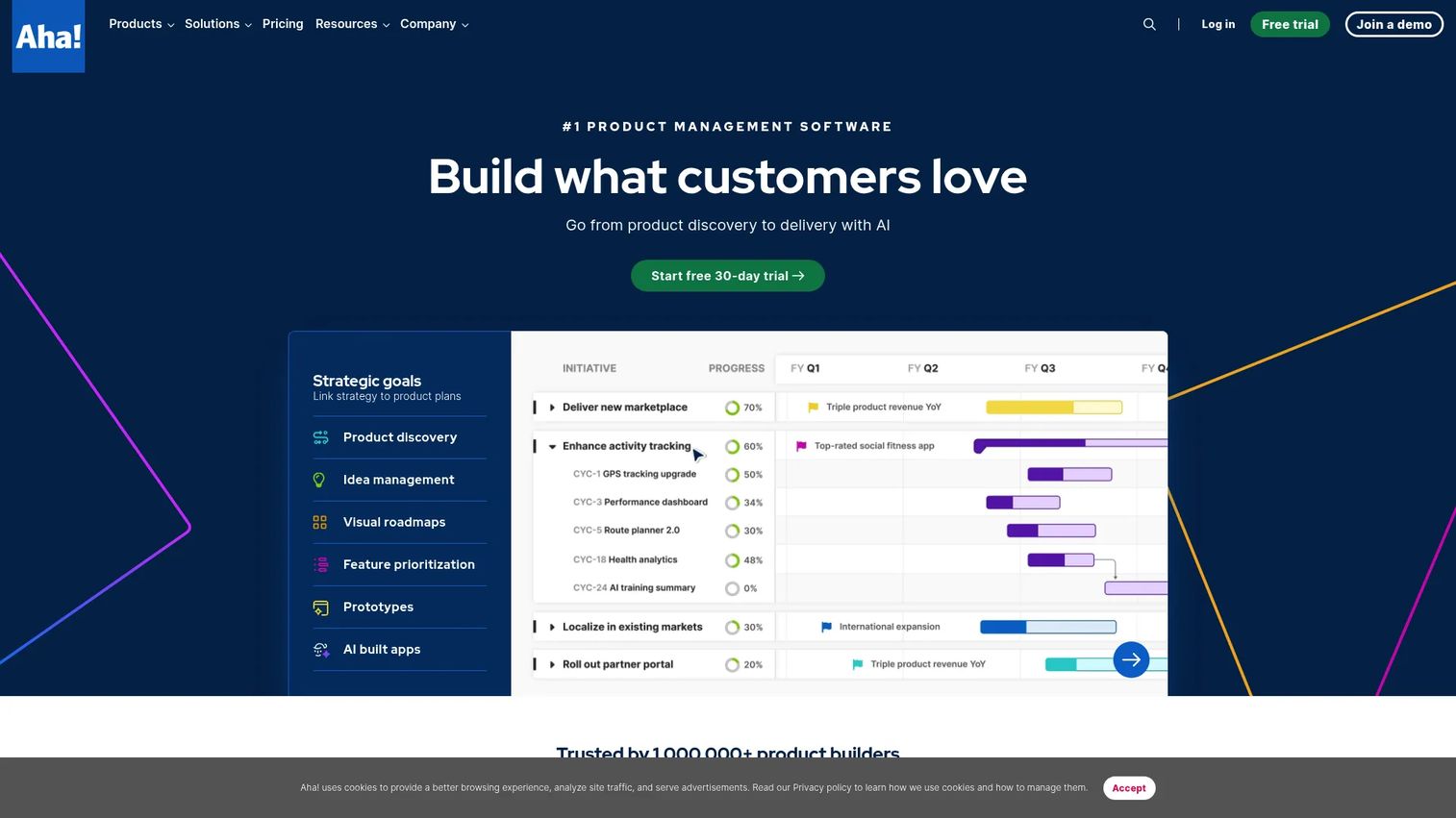
Aha! is an integrated product development suite covering strategy, discovery, idea management, roadmapping, prototyping, agile development, and knowledge management. It is designed for product organizations that need every layer, from market insight to release planning, connected in one workflow. The platform includes an AI assistant across multiple product workflows and supports both monthly and annual billing.
Best for: Enterprise product and strategy teams managing multiple products, goals, releases, and stakeholder groups.
Key features
- Product strategy templates and competitive analysis workspaces
- Idea management with customer research and voting
- Portfolio roadmaps with dependency tracking
- Release planning and milestone management
- AI assistant across product workflows
Why choose Aha!: Aha! fits mature product organizations where roadmap decisions require executive visibility and cross-product coordination. For PMMs, the cleaner the connection between strategy documents and roadmap views, the easier it is to build launch briefs from verified product direction rather than Slack messages.
Aha! pricing: Aha! offers a free trial. The Teamwork product starts at $9/user/month, with Whiteboards Essentials at $18/user/month. Roadmaps plan pricing is available on the official Aha! pricing page and varies by product and tier.
G2 rating: 4.4/5
2. airfocus
airfocus is a product management and product intelligence platform that connects feedback, strategy, OKRs, roadmaps, prioritization, and delivery in modular workspaces. It includes custom scoring models, priority boards, customer and stakeholder portals, and an AI agent with an MCP server. Integrations cover Jira, Azure DevOps, Trello, Asana, Shortcut, and Zapier, among others.
Best for: Product teams that need structured prioritization before roadmap commitments reach GTM teams.
Key features
- Custom scoring and weighted prioritization frameworks
- Priority boards and modular roadmap views
- Customer and stakeholder feedback portals
- OKR and objective tracking
- Jira, Azure DevOps, and Zapier integrations
Why choose airfocus: The modular workspace model lets teams configure exactly the prioritization and roadmap views they need without forcing a single structure. For PMMs, clear scoring helps prevent roadmap debates from turning into opinion battles, which means launch timelines are grounded in something defensible.
airfocus pricing: Both the Professional and Enterprise plans require requesting pricing through airfocus. No free plan or trial was confirmed on the official pricing page. Contact airfocus directly for a quote.
G2 rating: 4.4/5
3. ProductPlan
ProductPlan is a product intelligence and planning platform that combines customer research, prioritization frameworks, roadmapping, and portfolio management. It positions itself as one plan that includes all features, unlimited viewers, and customized annual pricing. It has added OKR alignment, launch management, AI-moderated research surveys, and Jira and Azure DevOps integrations.
Best for: Teams that need polished, audience-specific roadmap communication for executives, sales, and marketing.
Key features
- Timeline and swimlane roadmap views
- Portfolio views and OKR alignment
- Risk and dependency tracking
- Launch management workflows
- AI-moderated research surveys and synthesis
Why choose ProductPlan: The emphasis on viewer access and presentation-ready exports makes ProductPlan well suited for teams that communicate roadmaps to many stakeholders outside the product org. PMMs benefit when Sales and leadership can always find a current roadmap view without requesting a meeting.
ProductPlan pricing: Pricing is customized and billed annually. There is no standard tier with a published numeric price. Contact ProductPlan for a tailored quote based on your use case.
G2 rating: 4.3/5
4. Productboard
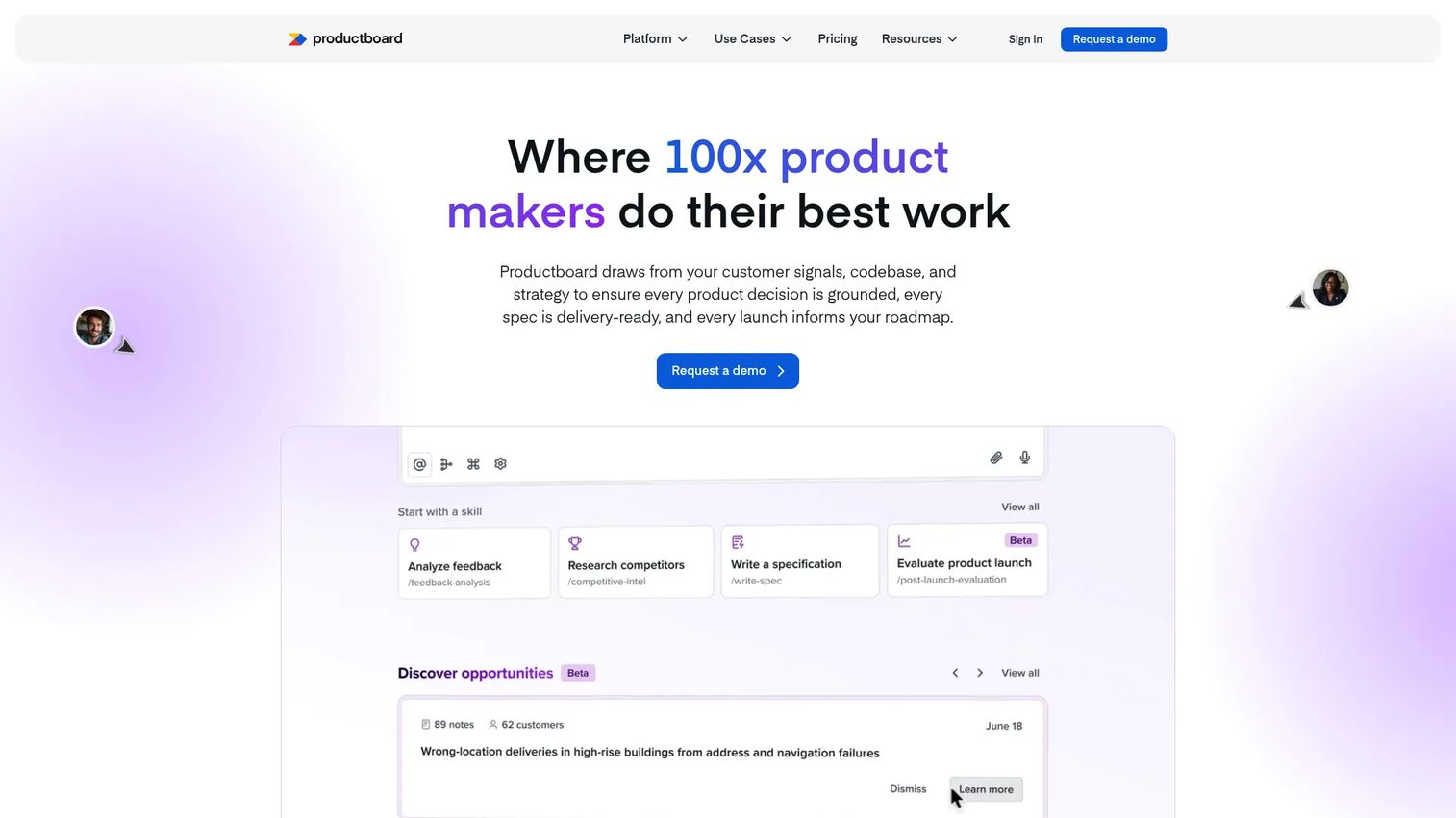
Productboard is an AI-powered product management platform for turning customer signals into priorities, specifications, roadmaps, and delivery plans. It centralizes feedback from multiple sources, connects insights to features, and shares roadmaps with internal and external stakeholders. It now includes AI-assisted product specification and customer feedback portals.
Best for: Product organizations that want customer evidence behind every roadmap decision.
Key features
- Customer feedback inbox with multi-source ingestion
- AI-assisted feature specification
- Insight-to-feature linking and prioritization
- Customizable roadmap sharing with portals
- Release planning with stakeholder updates
Why choose Productboard: The feedback-to-prioritization connection gives PMMs a cleaner path from customer language to roadmap justification. When you're building launch messaging, having documented customer evidence tied to the features you're launching is a significant credibility advantage.
Productboard pricing: A free plan is available. The Plus plan is $19/maker/month billed annually ($25/month billed monthly), Business is $59/maker/month billed annually (2 maker minimum), and Enterprise is custom with a 5 maker minimum.
G2 rating: 4.2/5
5. Craft.io
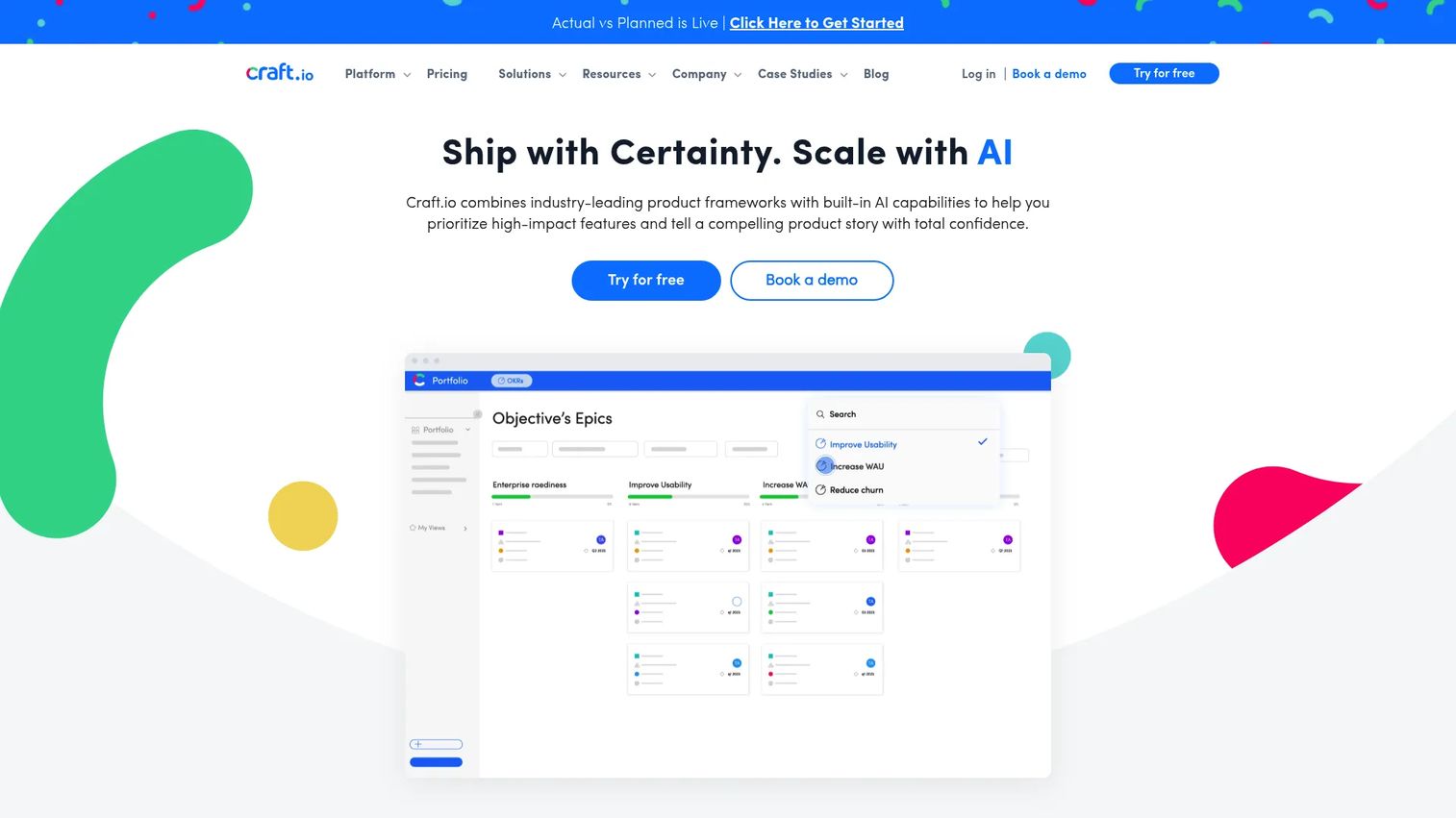
Craft.io is an AI-powered product management platform covering strategy, OKRs, feedback, idea management, backlog prioritization, capacity planning, roadmapping, and portfolio management. It connects product strategy to delivery through integrations with development tools and includes Guru AI for in-platform assistance. A 14-day free trial is available.
Best for: Product teams that want strategy, feedback, prioritization, and delivery planning connected in one platform.
Key features
- Product strategy workspace with OKR alignment
- Feedback and idea management with prioritization frameworks
- Capacity planning across teams and releases
- Portfolio management and roadmap views
- Development-tool integrations and Guru AI
Why choose Craft.io: Craft.io suits teams that want roadmaps tied to product operations rather than presentation-only views. For PMMs, fewer handoff gaps between roadmap planning and launch readiness mean fewer late-breaking surprises when campaigns are already in flight.
Craft.io pricing: The Starter plan is $19/editor/month billed monthly ($24/editor/month billed annually). Pro is $79/editor/month billed monthly ($99/editor/month billed annually, with add-ons available at $15 per add-on). Enterprise pricing is custom and billed annually.
G2 rating: 4.5/5
6. Canny
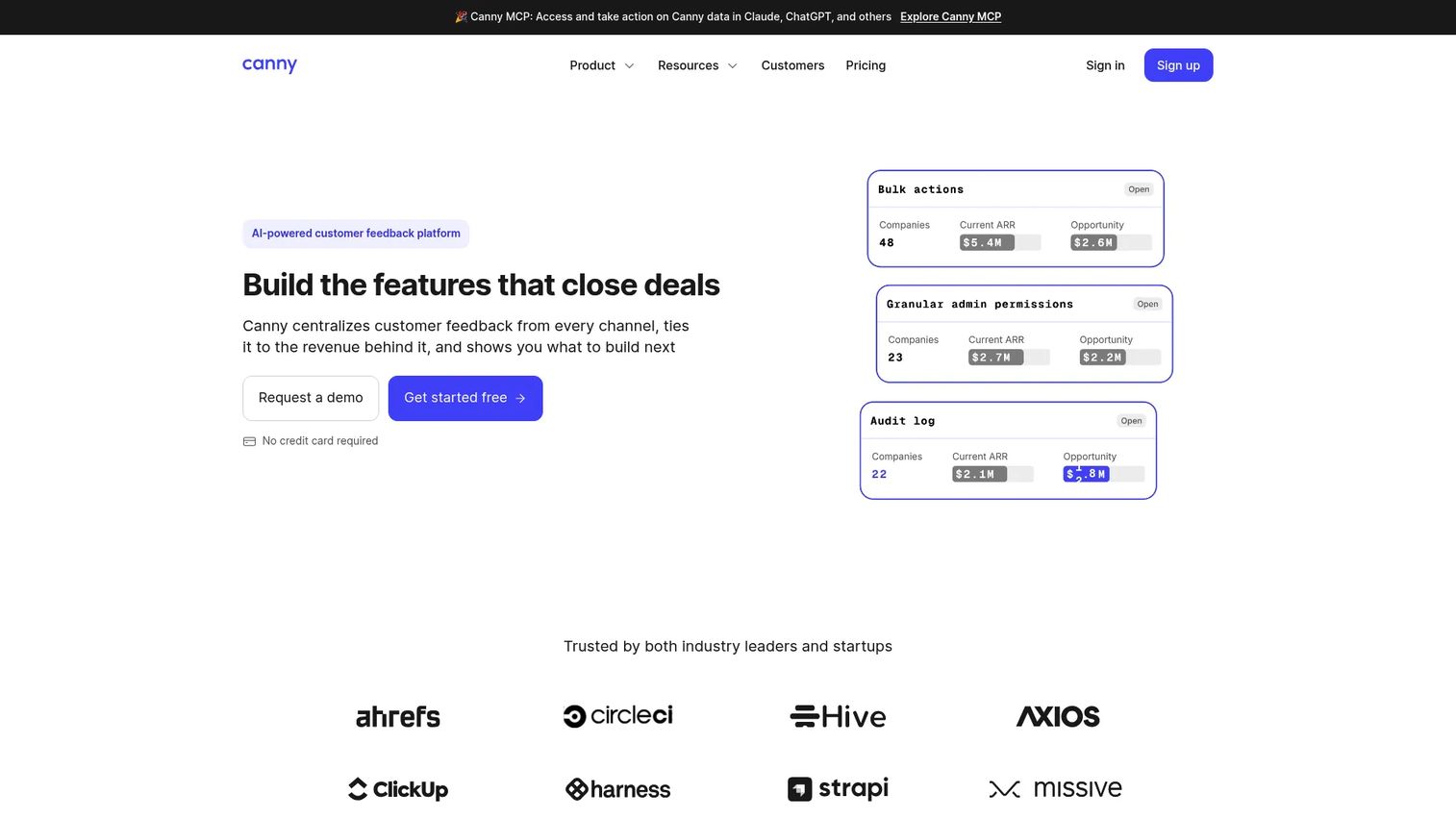
Canny is an AI-powered customer feedback management platform for collecting, analyzing, prioritizing, and communicating product feedback. It includes feedback boards, feature voting, AI-powered deduplication, public and private roadmaps, changelog publishing, and integrations with Intercom, Zendesk, Slack, Jira, Salesforce, and HubSpot.
Best for: Teams that want roadmap decisions visibly shaped by customer requests, with a public changelog to close the feedback loop.
Key features
- AI-powered feedback capture and deduplication
- Feedback analysis with segmentation and revenue-impact scoring
- Public and private roadmaps with status updates
- Changelog publishing and scheduling
- Integrations with Jira, Salesforce, and HubSpot
Why choose Canny: Canny works well when customer-facing transparency matters, particularly for PLG or SaaS teams where users expect to see their requests acknowledged. For PMMs, the customer language captured in Canny's feedback portals is often the rawest signal for sharpening positioning.
Canny pricing: A free plan covers 25 tracked users. The Pro plan is $79/month billed yearly (starting at $99/month billed monthly for 100 tracked users). Business pricing is custom and billed annually, covering SSO and CRM integrations.
G2 rating: 4.5/5
7. Roadmunk
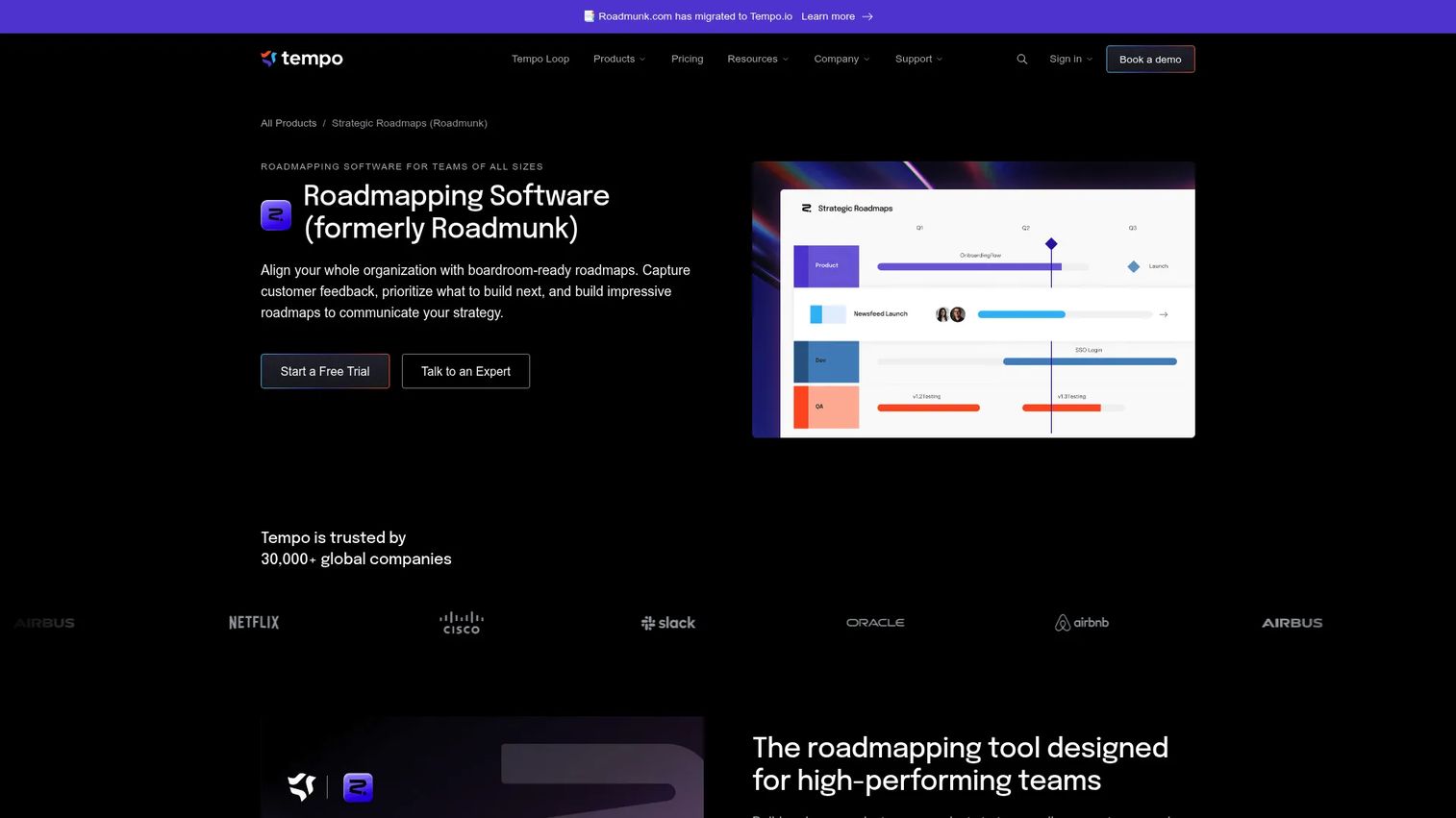
Roadmunk, now branded as Strategic Roadmaps under Tempo, is product roadmapping software for capturing feedback, prioritizing ideas, and communicating strategy. It covers timeline and swimlane views, customer feedback collection, idea prioritization, portfolio roadmaps, dependency tracking, and integrations with Jira, Azure DevOps, Asana, Monday.com, and several other delivery tools. A 14-day free trial is available.
Best for: Teams that need presentation-ready roadmaps with different views for executives, Sales, CS, and customers.
Key features
- Timeline and swimlane roadmap views
- Customer feedback collection and idea prioritization
- Portfolio roadmaps and dependency tracking
- Stakeholder-specific sharing and permissions
- Jira, Azure DevOps, and Asana integrations
Why choose Roadmunk: The audience-specific view model makes it practical to maintain one roadmap while showing different cuts to different stakeholders. PMMs find this useful when the product roadmap feeds sales enablement, customer communication, and exec reporting simultaneously.
Roadmunk pricing: The Starter plan is $19/editor/month billed annually. Business is $49/editor/month, Professional is $99/editor/month, and Enterprise is custom. No permanent free tier was verified.
G2 rating: 4.0/5
8. ITONICS
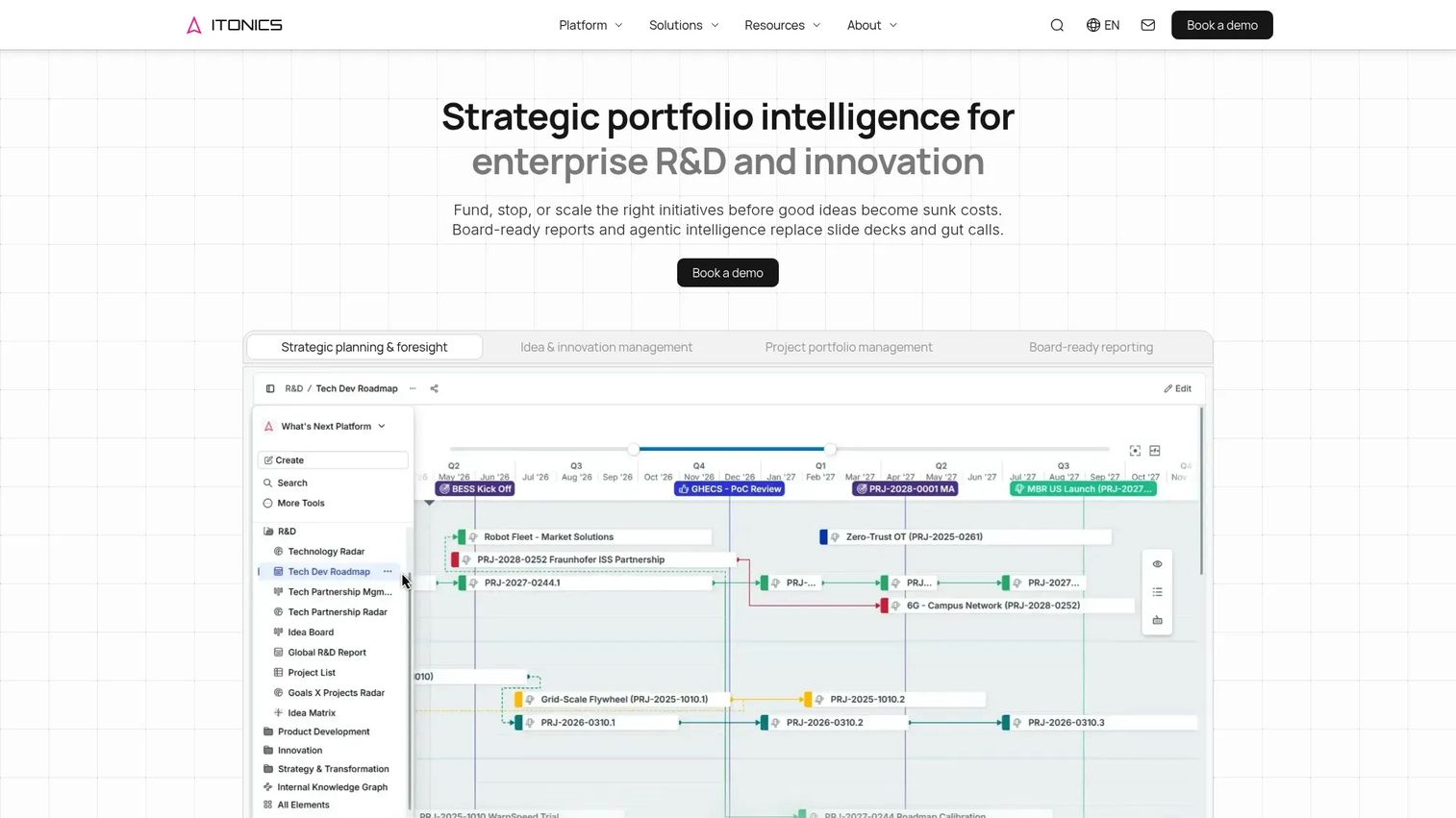
ITONICS is an innovation operating system connecting foresight, ideation, portfolio management, and strategy execution. It uses AI-powered monitoring of trends, technologies, competitors, and startups, and includes innovation portfolio visualization, roadmaps, dashboards, and impact tracking. Three tiers serve teams from small innovation groups to global enterprises.
Best for: Enterprise R&D, strategy, and innovation teams managing end-to-end innovation activities before they reach product roadmap commitments.
Key features
- AI-powered trend and technology monitoring
- Innovation portfolio visualization with roadmaps
- Idea campaigns, collaborative ideation, and workflow management
- Ecosystem mapping and competitive signal tracking
- Dashboards and impact tracking
Why choose ITONICS: ITONICS operates upstream of the product roadmap, helping teams identify and evaluate opportunities before committing resources. For PMMs, it provides a documented view of market trends and innovation bets that can anchor category narratives and competitive positioning.
ITONICS pricing: A free tier is available. Paid pricing starts at approximately $3,000/year for 10 full-user seats, based on ITONICS' own published figures. Pro and Enterprise tiers require contacting ITONICS for pricing.
G2 rating: 4.4/5
9. HYPE Innovation Management
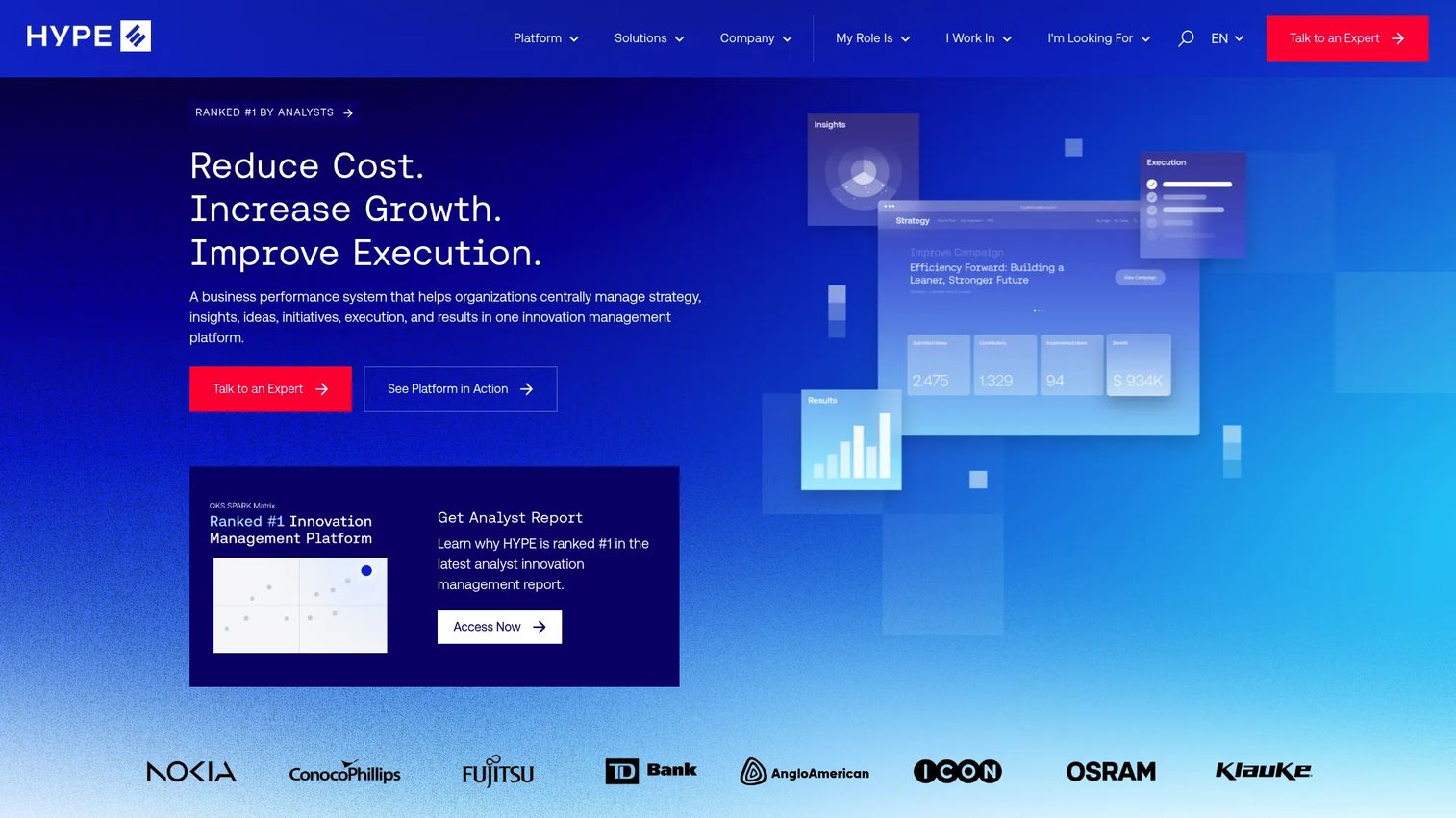
HYPE Innovation Management is an enterprise innovation management platform for capturing opportunities, prioritizing initiatives, managing execution, and measuring business impact. It covers strategic idea sourcing, configurable phase-gate workflows, trends and technology management, partnering ecosystem management, and AI-supported evaluation and portfolio analysis.
Best for: Large organizations running formal, structured innovation programs across multiple business units.
Key features
- Strategic idea sourcing and innovation campaigns
- Configurable phase-gate workflow management
- Innovation portfolio dashboards and impact tracking
- Trends and technology management
- AI-supported evaluation, scouting, and reporting
Why choose HYPE Innovation Management: HYPE fits enterprises where innovation is a managed program rather than an ad hoc process. For PMMs working in organizations where category strategy depends on R&D or corporate innovation inputs, HYPE provides the structured pipeline that translates innovation activity into documented strategic bets.
HYPE Innovation Management pricing: Custom pricing. No numeric prices are displayed on HYPE's website. Contact HYPE directly to discuss program scope, module requirements, and user volume.
G2 rating: 4.8/5
10. Qmarkets
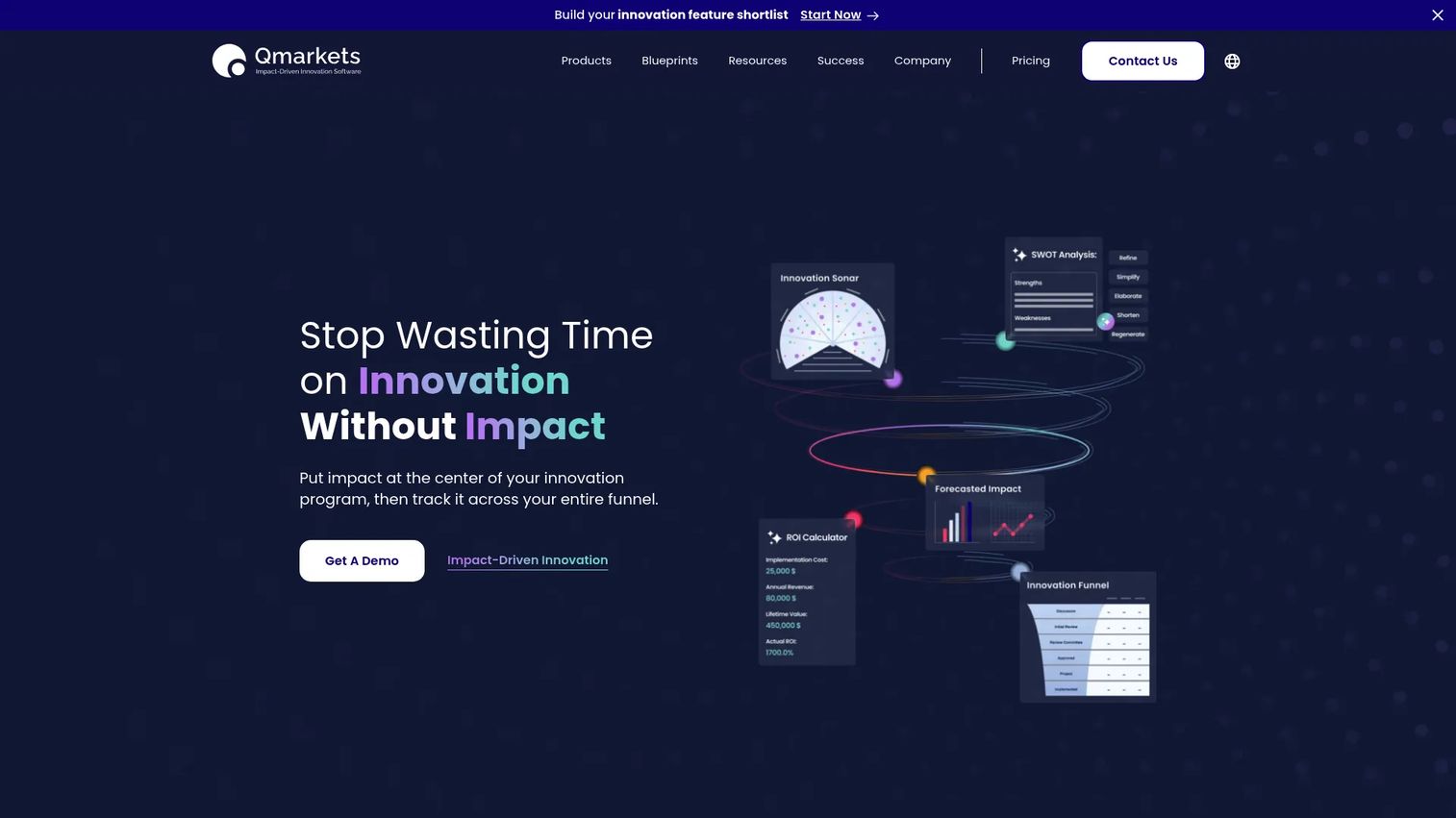
Qmarkets provides an enterprise innovation management platform spanning trends and foresight, technology scouting, idea management, continuous improvement, portfolio management, and AI-powered analysis. It supports idea challenges, always-open submissions, technology scouting and startup discovery, continuous-improvement workflows, and AI clustering and expert matching.
Best for: Organizations running large-scale innovation and continuous improvement programs that need structured idea intake, evaluation, and portfolio visibility.
Key features
- Idea challenges and always-open submission workflows
- Technology scouting and startup discovery
- Continuous-improvement workflows with impact tracking
- Innovation portfolio management with budget and risk tracking
- AI-powered clustering, enrichment, and expert matching
Why choose Qmarkets: Qmarkets handles the scale problem that most ideation tools avoid. When thousands of employees or external partners are contributing ideas, the AI clustering and evaluation workflows keep the portfolio manageable. For PMMs, the connection is upstream market and customer insight surfacing before roadmap decisions solidify.
Qmarkets pricing: Both the Core and Enterprise plans require requesting a quote. No numeric prices are shown on the Qmarkets pricing page.
G2 rating: 4.5/5
11. Wellspring
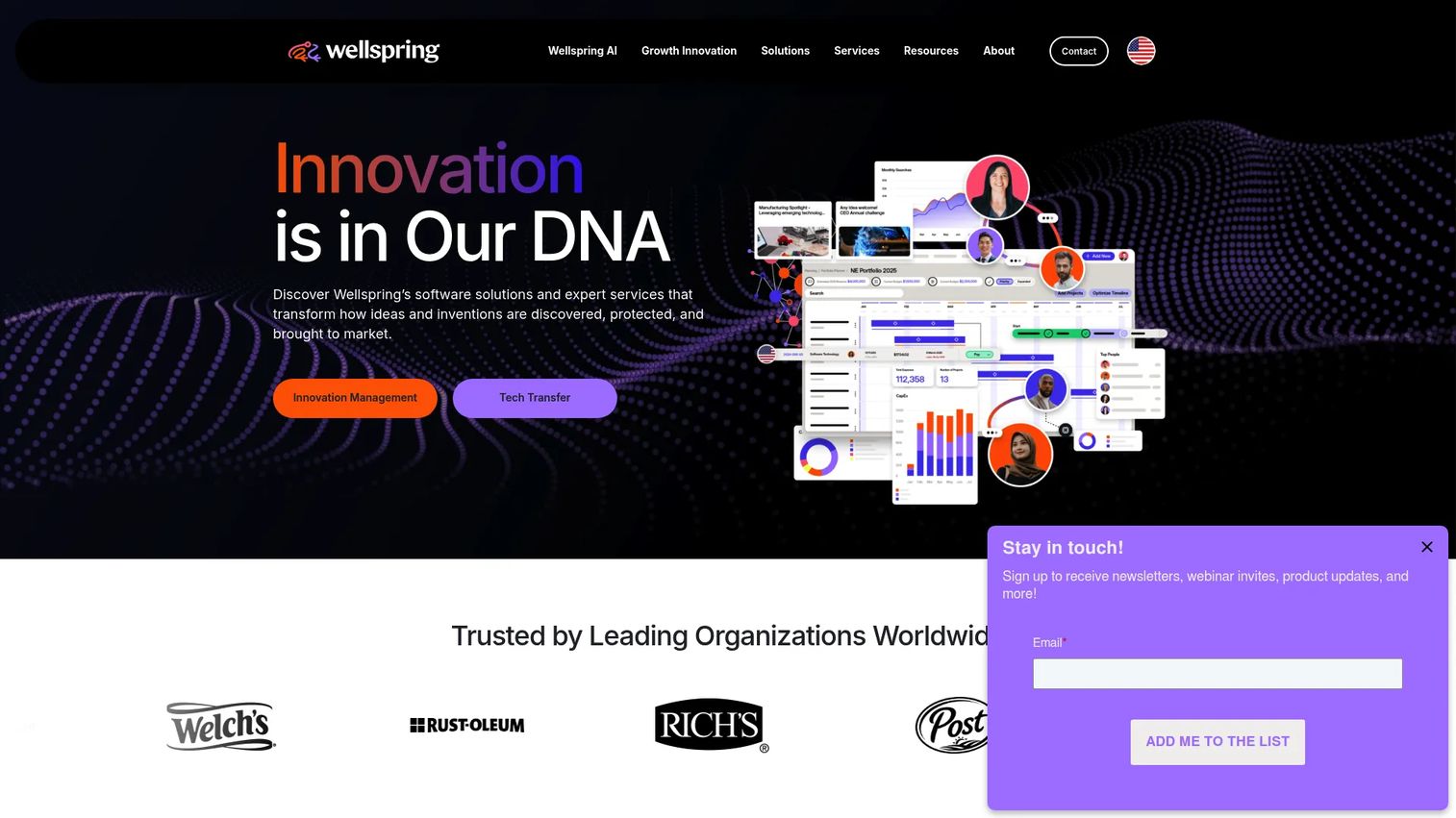
Wellspring provides innovation management, technology scouting, technology transfer, and intellectual property management software and services for enterprise teams. Its AI-powered search covers 400M+ innovation records. Capabilities include technology scouting, ecosystem discovery, competitive intelligence, innovation portfolio management, project workflows, and evaluation management.
Best for: R&D, corporate innovation, and technology scouting teams managing complex innovation portfolios and external partnerships.
Key features
- AI-powered search across 400M+ innovation records
- Technology scouting and ecosystem discovery
- Innovation portfolio, project, and workflow management
- Technology transfer and IP management
- Competitive intelligence and evaluation tools
Why choose Wellspring: Wellspring fits teams where innovation involves external partnerships, licensing, or technology commercialization, not only internal idea pipelines. For PMMs at companies where R&D and innovation investments need to translate into category positioning, Wellspring provides the documented evidence of what is being explored and why.
Wellspring pricing: Custom pricing. Wellspring directs prospects to schedule a demo. Contact the Wellspring team to discuss modules, seats, services, and integrations.
G2 rating: 4.5/5
12. Cascade
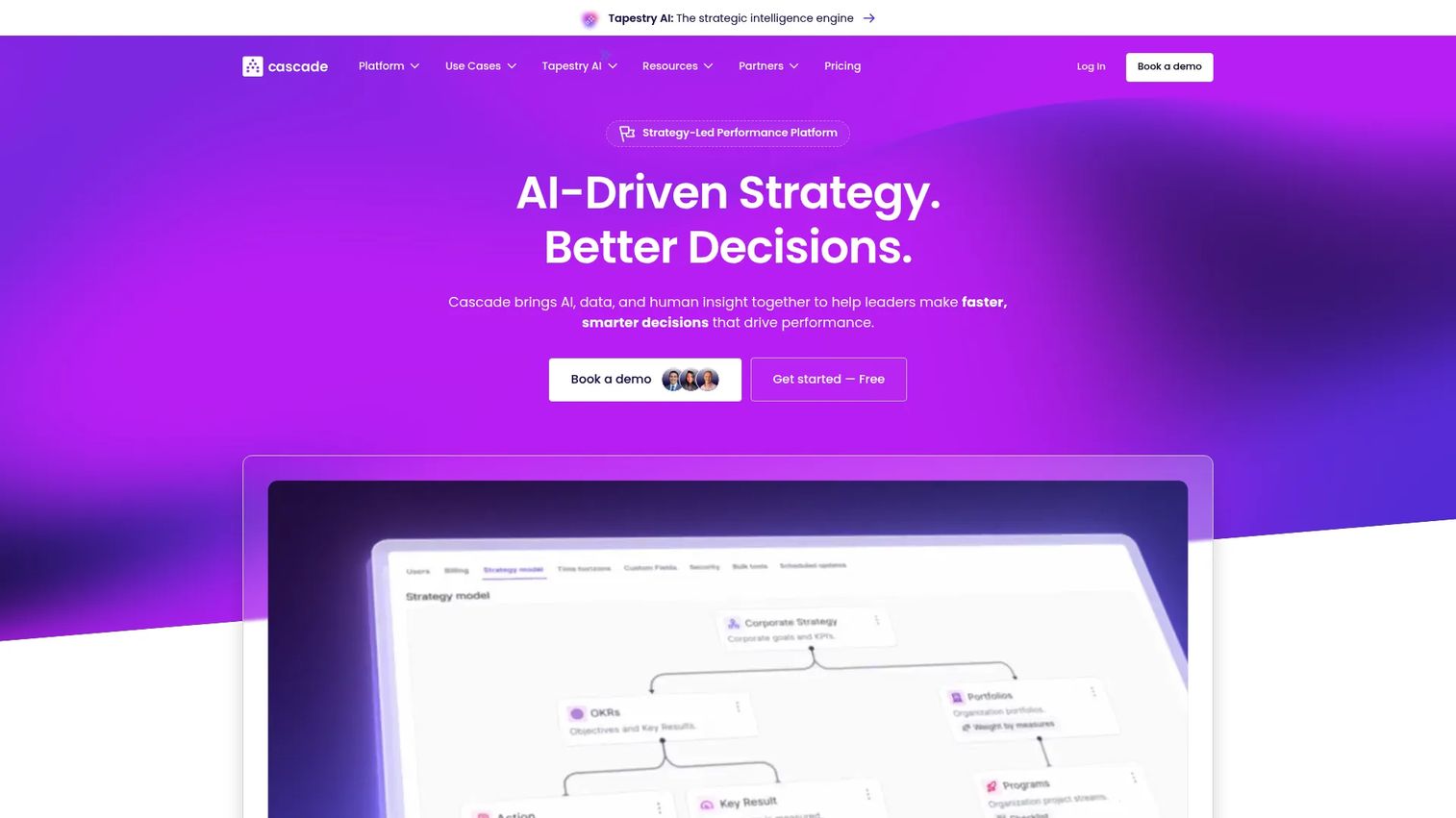
Cascade is a strategy execution platform for planning, executing, tracking, and adapting organizational strategy. It includes strategic planning with customizable frameworks, goal and KPI tracking with alignment and accountability views, dashboards with AI-powered strategy insights (Tapestry AI on Enterprise), and health scores. Three plan tiers cover individual teams through enterprise deployments.
Best for: Leadership and strategy teams that need to connect strategic plans to execution progress and make that connection visible across the organization.
Key features
- Strategic planning with customizable frameworks and strategy models
- Goal, KPI, project, and action tracking
- Execution dashboards and health scores
- OKR alignment and progress reporting
- AI-powered strategy insights on Enterprise tier
Why choose Cascade: Cascade is a strategy execution tool rather than a product roadmapping tool. For PMMs, its value is in making GTM programs and launch initiatives visible against company-level outcomes, which strengthens the case for resource allocation and cross-functional alignment.
Cascade pricing: A free Plan tier is available for up to 2 users. The Essentials and Enterprise tiers require contacting Cascade for pricing. No numeric prices are displayed for paid plans.
G2 rating: 4.8/5
13. WorkBoard
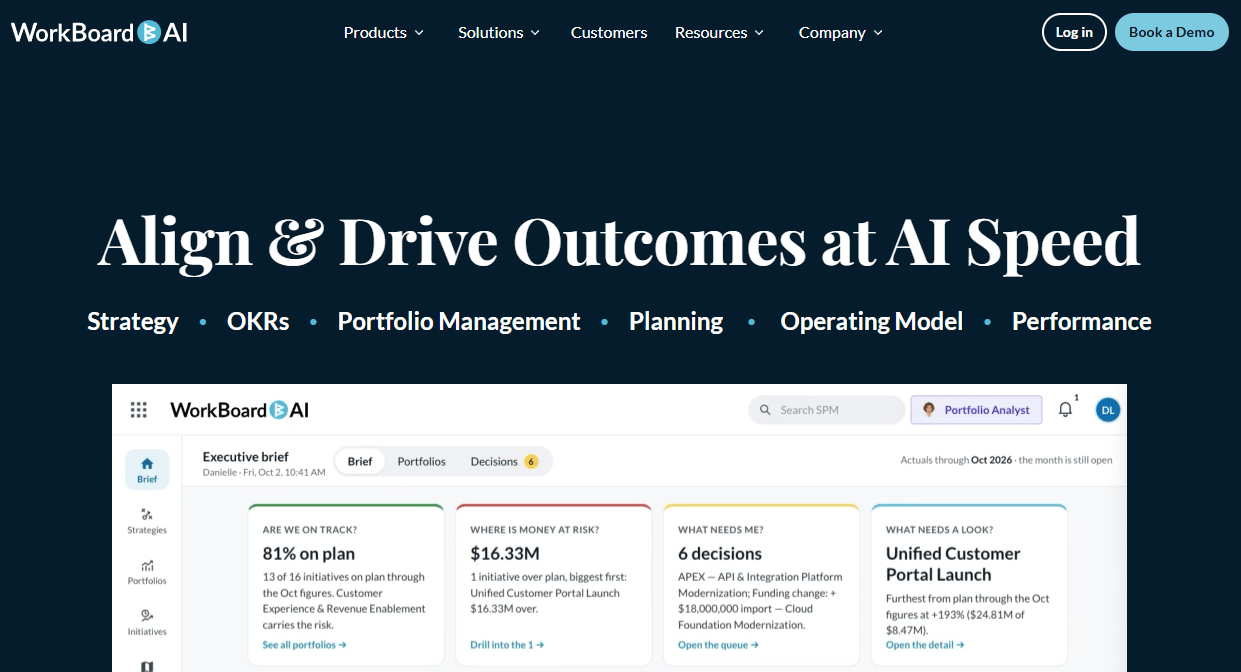
WorkBoard is an enterprise strategy execution platform connecting strategy, OKRs, portfolios, initiatives, financials, and daily execution with AI agents. WorkBoardAI features OKR creation and alignment, an AI Chief of Staff for workplans and reporting, strategic portfolio management with scenario planning, scorecards, business reviews, and integrations with Jira, Azure DevOps, Teams, Slack, and Workday.
Best for: Large and complex organizations that need enterprise-wide OKR management, strategy execution, and operating-cadence automation.
Key features
- OKR creation, alignment, and management
- AI Chief of Staff for automated reporting and dashboards
- Strategic portfolio management with scenario planning
- Scorecards and business review workflows
- Jira, Teams, Slack, and Workday integrations
Why choose WorkBoard: WorkBoard operates at the operating-cadence layer, making it useful when OKR reviews, business reviews, and strategy check-ins are themselves a managed program. PMMs benefit when product launches and GTM programs connect to company-level outcome tracking rather than sitting in isolation.
WorkBoard pricing: Usage-based custom pricing. Contact WorkBoard to discuss seat count, implementation, and coaching scope.
G2 rating: 3.3/5
14. Jira Product Discovery
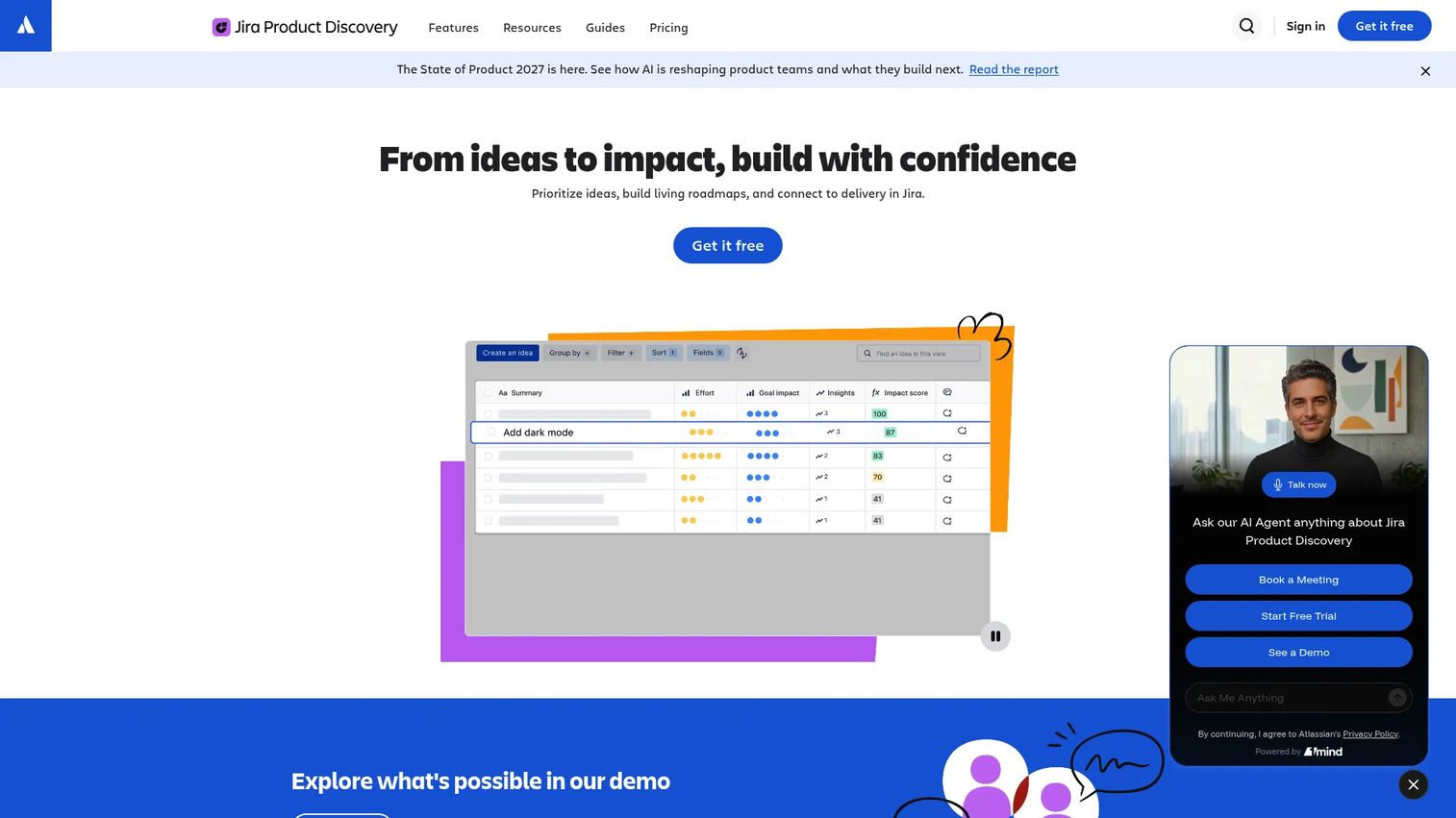
Jira Product Discovery is a prioritization and roadmapping tool for product teams to gather ideas and insights, align stakeholders, and connect discovery work to delivery in Jira. It covers idea boards, custom prioritization fields, insight capture, flexible views including list, matrix, board, and timeline, and a Jira Software connection for linking ideas to delivery tickets.
Best for: Product teams already working in Atlassian that want discovery and prioritization adjacent to their delivery workflows.
Key features
- Idea boards with custom prioritization fields and formulas
- Insight capture and stakeholder collaboration
- Flexible list, matrix, board, and timeline views
- Customizable roadmaps with stakeholder sharing
- Direct Jira Software connection for idea-to-delivery tracking
Why choose Jira Product Discovery: The proximity to Jira delivery data is the primary advantage. When engineering is already planning in Jira, Jira Product Discovery keeps the roadmap connected to actual delivery status. For PMMs, the risk is that the tool optimizes for the product and engineering view rather than the GTM communication view, so stakeholder roadmap sharing still often requires a separate surface.
Jira Product Discovery pricing: A free plan covers 3 creators. The Standard plan is $10.50/creator/month billed monthly, Premium is $26.25/creator/month billed monthly, and Enterprise pricing requires contacting Atlassian. Annual billing is available for Standard and Premium.
G2 rating: 4.3/5
15. ProdPad
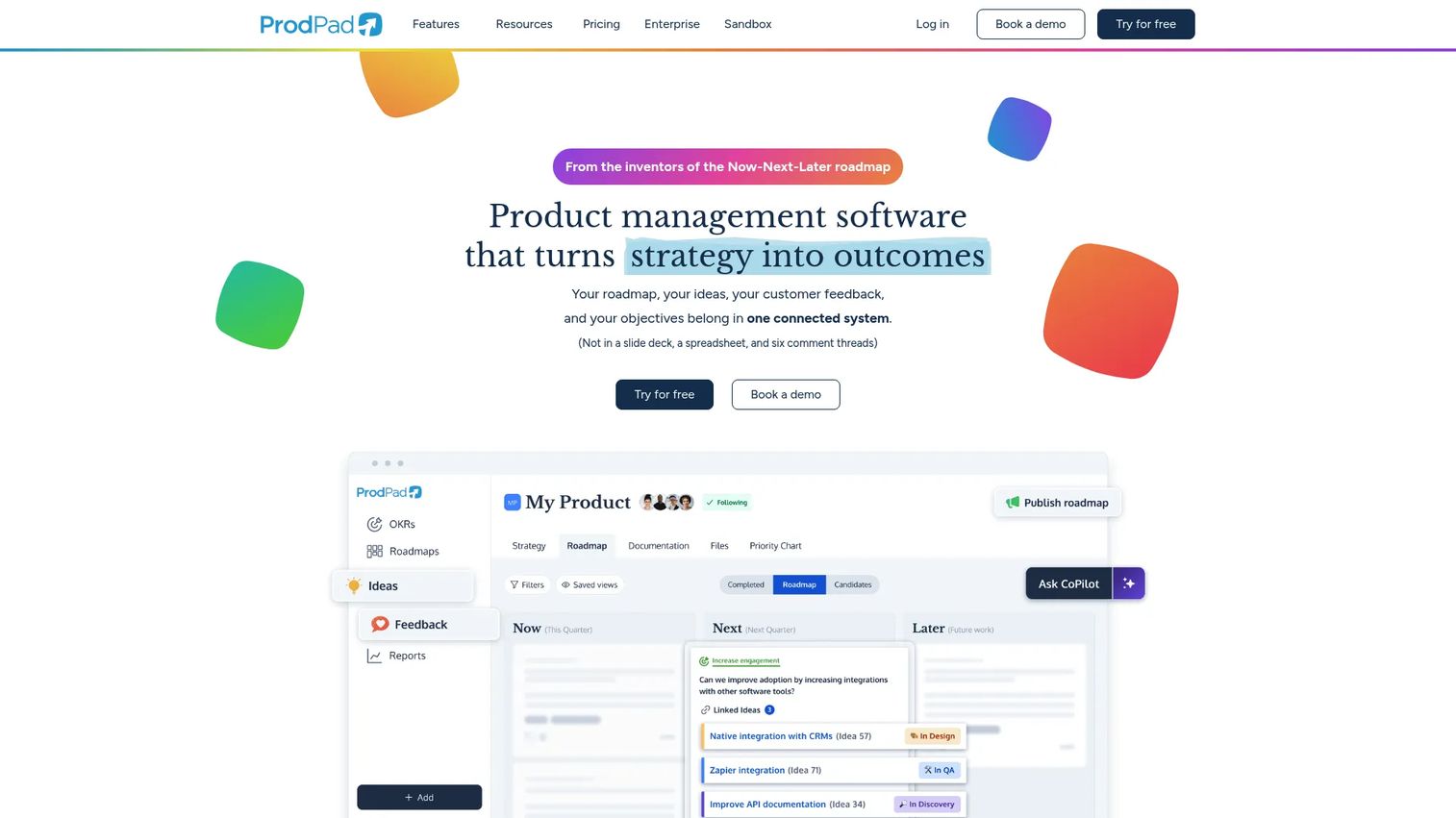
ProdPad is a product management platform connecting customer feedback, ideas, roadmaps, objectives, and delivery workflows. It includes a branded customer feedback portal, idea and backlog management with Idea Canvas and impact/effort scoring, outcome-focused roadmaps linked to objectives, AI theme analysis, and development-tool integrations. Reviewers can be invited for free, and annual subscriptions receive a 20% discount.
Best for: Product teams that want flexible product discovery and roadmap planning without overcommitting to fixed release dates.
Key features
- Branded customer feedback portals with AI theme analysis
- Idea backlog with impact/effort scoring and Idea Canvas
- Outcome-focused roadmaps linked to objectives and feedback
- OKR alignment and delivery-tool integrations
- Duplicate detection and workflow management
Why choose ProdPad: ProdPad's lean roadmap model suits teams that prefer outcome-based planning over fixed-date commitments. For PMMs, this reduces the risk of building campaigns around ship dates that shift, because roadmap items are framed around problems and outcomes rather than specific feature releases.
ProdPad pricing: Modular pricing; no numeric plan prices are displayed on the official pricing page. Reviewers can be added for free. Annual billing provides a 20% discount. Contact ProdPad for plan pricing.
G2 rating: 4.3/5
16. Miro
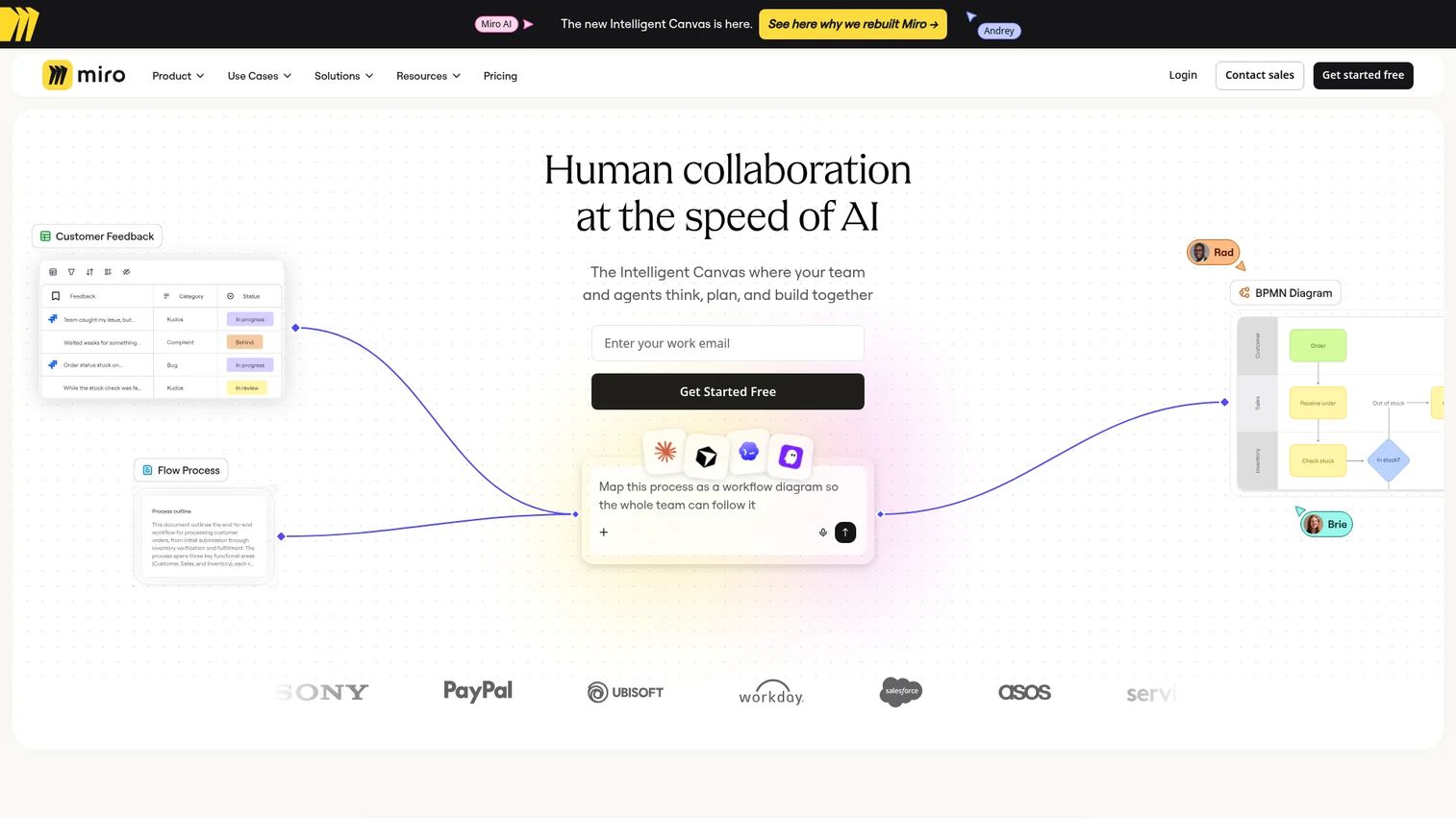
Miro is a collaborative visual workspace for brainstorming, diagramming, planning, workshops, and product development. It includes an infinite canvas, sticky notes, mind maps, diagramming tools, templates, voting, timers, and presentations. AI-assisted idea generation, clustering, and summarization are included. Integrations cover Jira, Asana, Figma, Slack, and Microsoft Teams.
Best for: Distributed and cross-functional teams that need visual collaboration for strategy workshops, planning sessions, and roadmap alignment before formalizing decisions in a dedicated tool.
Key features
- Infinite collaborative canvas with real-time and async editing
- AI-assisted idea generation, clustering, and summarization
- Workshop templates, voting, timers, and presentations
- Diagramming, mind mapping, and sticky note tools
- Jira, Asana, Figma, and Teams integrations
Why choose Miro: Miro excels at early-stage alignment, particularly for launch planning workshops, persona mapping, and roadmap narrative sessions where a structured tool would be premature. PMMs often reach for Miro to facilitate cross-functional alignment before work moves into a formal roadmapping or project system.
Miro pricing: A free plan covers unlimited team members and up to 3 editable boards. Starter pricing was not displayed in the retrieved pricing page. Business is $20/member/month billed yearly. Enterprise pricing requires contacting Miro.
G2 rating: 4.6/5
17. Airtable

Airtable is an AI app-building platform for creating custom business applications, workflows, databases, automations, and AI agents. For roadmapping purposes, it supports custom relational databases, grid, kanban, timeline, Gantt, calendar, gallery, and form views, plus automations, integrations, custom interfaces, and reporting. Airtable AI and Omni AI app-building extend its flexibility further.
Best for: Teams that want a configurable roadmap database with flexible views and automations, and are willing to invest time in setup.
Key features
- Custom relational databases and multiple view types
- Grid, kanban, timeline, Gantt, and calendar views
- Automations and external integrations
- Custom interfaces and reporting dashboards
- Airtable AI and Omni AI app-building capabilities
Why choose Airtable: Airtable requires more configuration than a dedicated roadmapping platform, but it offers far more flexibility. PMMs often use it when roadmap tracking, launch calendar management, content workflows, and campaign planning all need to connect in a system that the team already controls.
Airtable pricing: A free plan is available. The Team plan is $20/user/month billed annually. Business is $45/user/month billed annually. Enterprise Scale pricing is custom.
G2 rating: 4.6/5
18. IBM Targetprocess
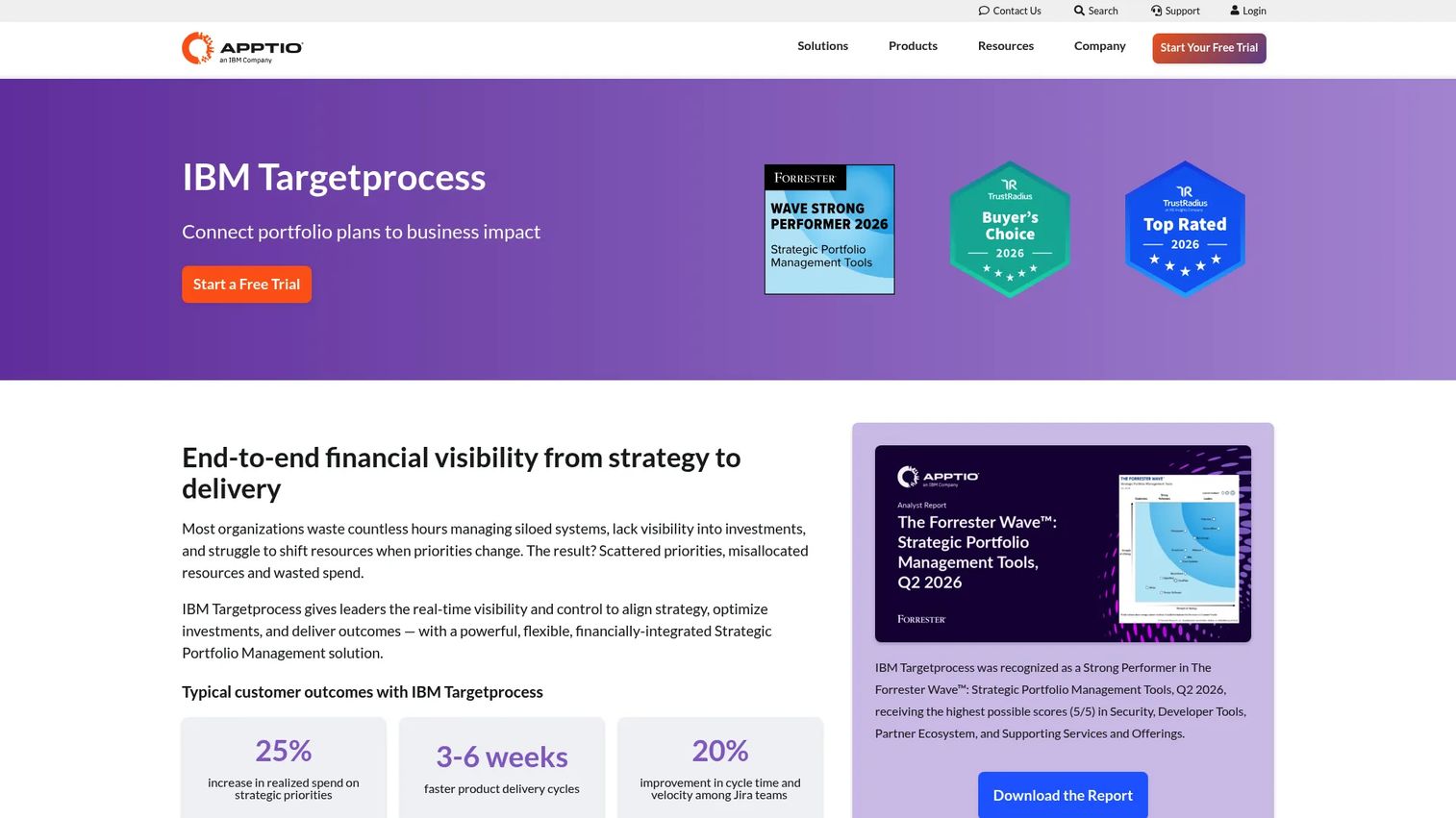
IBM Targetprocess is a strategic portfolio management platform that connects strategy, investments, resources, and work to business outcomes. Now part of IBM's Apptio portfolio, it covers strategic and portfolio planning, investment and workforce capacity optimization, agile and hybrid delivery, roadmaps and scenario planning, and financial visibility and reporting.
Best for: Large enterprises managing complex agile portfolios, product lines, dependencies, and delivery teams across multiple business units.
Key features
- Strategic and portfolio planning with investment tracking
- Workforce capacity optimization and resource planning
- Agile, hybrid, and traditional work delivery views
- Roadmaps and scenario planning
- Financial visibility and portfolio reporting
Why choose IBM Targetprocess: IBM Targetprocess fits enterprises where roadmap and strategy decisions must connect to delivery capacity, workforce planning, and financial reporting simultaneously. For PMMs at large organizations, it is less a launch planning tool and more an enterprise system that produces the strategic context you build positioning and GTM plans against.
IBM Targetprocess pricing: Custom pricing. Contact IBM or your IBM Apptio representative to discuss implementation scope and licensing.
G2 rating: 4.3/5
19. Perdoo
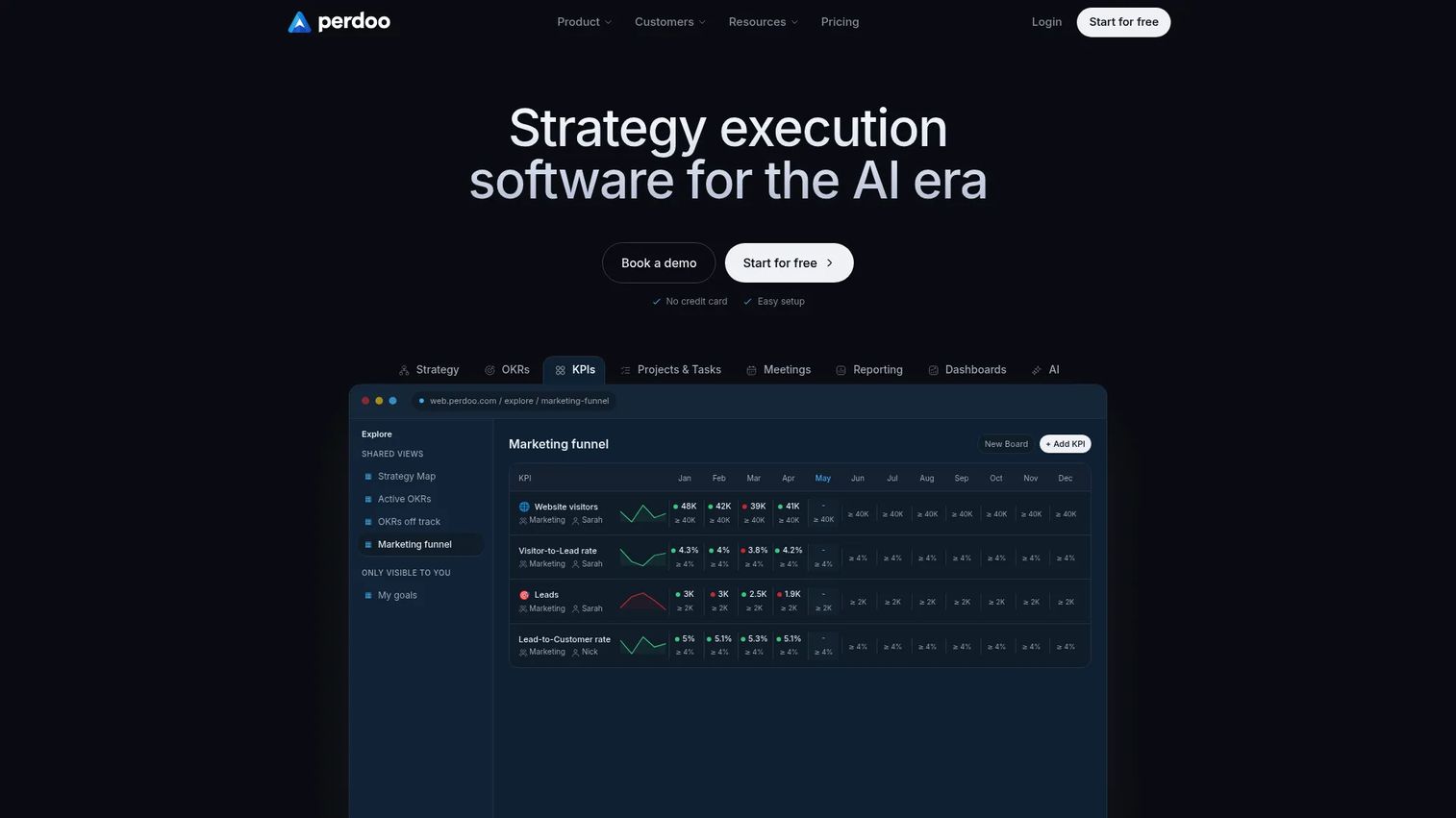
Perdoo is strategy execution software combining strategy maps, OKRs, KPIs, projects, meetings, reporting, dashboards, and AI. It includes Strategy Maps, cascade views for OKR and KPI tracking, customizable check-ins, meeting and 1:1 support, an AI Assistant and AI Coach, and an MCP server. Slack and Microsoft Teams integrations are included.
Best for: Organizations that need one platform to connect strategy, OKRs, KPIs, execution tracking, and performance conversations with measurable outcomes.
Key features
- Strategy Maps and Strategic Pillars
- OKR and KPI tracking with cascade and alignment views
- Dashboards, customizable check-ins, and progress reporting
- AI Assistant, AI Coach, and MCP server
- Slack and Microsoft Teams integrations
Why choose Perdoo: Perdoo suits teams where launches and roadmap items need to connect to measurable strategic outcomes rather than just ship dates. For PMMs, this framing matters when you're defending campaign investment or launch scope to leadership: The roadmap item ties to a stated KPI rather than only to a delivery milestone.
Perdoo pricing: A free plan is available for up to 5 users. The Premium plan is €6.40/user/month billed annually. Supreme is €8.00/user/month billed annually. A USD selector is available on the pricing page.
G2 rating: 4.4/5
20. SharpCloud
SharpCloud is a strategic portfolio management platform from Lumivero that connects project, portfolio, and risk data in an interactive visualization and decision environment. It supports data integration and unification, interactive visualizations including timelines, grids, layers, radars, and kanban views, relationship and dependency mapping, what-if scenario modeling, roadmapping, enterprise portfolio management, and enterprise risk management.
Best for: Strategy, innovation, and portfolio teams that need to show complex, interconnected plans as a connected interactive story rather than a static spreadsheet.
Key features
- Data integration and unification across enterprise systems
- Interactive visualizations: Timelines, radars, grids, layers, kanban
- Relationship and dependency mapping
- What-if scenario modeling and trade-off comparison
- Role-based access controls, SSO, and enterprise system integrations
Why choose SharpCloud: SharpCloud is built for situations where the strategy itself is the communication challenge. When executive or board-level audiences need to understand how portfolio decisions, dependencies, and risks connect, SharpCloud's visual storytelling model is more effective than a roadmap spreadsheet. For PMMs at enterprise organizations, this kind of visual strategic roadmap can anchor category positioning and competitive narrative.
SharpCloud pricing: Custom pricing. Flexible licensing covers Creator, Collaborator, and Read-Only roles, all billed annually with minimum purchase requirements. Contact Lumivero for pricing.
Considerations when choosing strategy and innovation roadmapping tools
Match the tool to the roadmap layer you actually need
Product roadmaps, innovation portfolios, strategic execution plans, and OKR tracking are related but distinct workflows. A PMM choosing for launch visibility and stakeholder communication needs different depth than an enterprise innovation manager running a global idea program. Start by naming which layer is broken before evaluating tools.
Check how prioritization decisions get made and documented
Scoring models, weighted frameworks, and customer-feedback linkage matter because roadmap decisions without documented rationale are impossible to defend. For PMMs, a tool that captures why something was prioritized, not only what was prioritized, gives you something to build positioning and launch messaging against.
Verify stakeholder communication workflows
Roadmap sharing permissions, audience-specific views, export options, and update workflows determine whether your roadmap actually reduces stakeholder surprises. Tools vary widely: Some offer public links with view controls, others require a seat to see anything. For PMMs managing multiple internal audiences, this is often the deciding factor.
Confirm the integrations that matter for your stack
Jira integration varies significantly in depth across tools, from one-directional pushes to full bidirectional sync with field mapping. Beyond Jira, check whether the tool connects to your CRM, marketing automation, or analytics stack. A roadmap that doesn't connect to your existing data surfaces will quickly drift out of sync.
Evaluate governance and update maintenance
Ownership, review cadence, version history, and access controls determine whether a roadmap stays current or becomes a snapshot from six months ago. For PMMs, a roadmap that Sales trusts as the source of truth requires a team that actually maintains it. Simpler tools with clearer ownership often outperform complex platforms with no one responsible for updates.
Conclusion
The right strategy and innovation roadmapping tool depends on which layer of the problem you're solving. For product management and PMM teams, the most common need is clearer roadmap communication, documented prioritization, and a connection between customer signal and launch direction.
Aha! covers the broadest scope for mature product organizations that need strategy through delivery in one place. ProductPlan and Roadmunk work well for teams that prioritize stakeholder communication and presentation-ready roadmap views. Productboard, Canny, Craft.io, and ProdPad each approach the customer-feedback-to-roadmap connection differently, so the fit depends on how your team collects and acts on feedback.
For innovation portfolio and R&D teams, ITONICS, HYPE Innovation Management, Qmarkets, and Wellspring are the category leaders. Cascade, WorkBoard, and Perdoo address the strategy execution and OKR alignment layer. Miro and Airtable fit teams that need flexible visual planning before committing to a dedicated system. SharpCloud and IBM Targetprocess serve enterprise portfolio management use cases where complexity and stakeholder breadth demand a more specialized approach.
Pick the tool that matches your actual layer, your team's governance reality, and the integrations your stack already depends on.
Once your roadmap turns into a launch, your buyers and internal teams need to experience what changed. Guideflow helps you turn shipped product experiences into interactive demos for sales enablement, onboarding, and customer education, so your GTM teams can show the product story, not just describe it.
Start your journey with Guideflow today!
FAQs
Strategy and innovation roadmapping tools are software platforms that help teams visualize, prioritize, communicate, and track strategic initiatives, product plans, innovation pipelines, and execution dependencies over time. They sit between basic project management, which tracks tasks, and portfolio management, which tracks investment allocation, connecting market signal, strategic goals, and execution into a single visible workflow.
Product roadmap tools focus primarily on product direction, feature sequencing, release timing, and customer feedback. Strategy roadmapping tools extend that scope to include company-level goal alignment, scenario planning, innovation portfolio management, cross-portfolio dependencies, and execution tracking. Many teams use both layers, with product roadmap tools feeding into a broader strategy execution platform.
There is no single answer because the fit depends on what the PMM team is actually missing. Teams that need cleaner roadmap communication for sales and executives often evaluate ProductPlan, Aha!, and Roadmunk first. Teams that need customer evidence behind roadmap decisions typically look at Productboard and Canny. Teams that need to connect launches to company-level OKRs should evaluate Cascade and Perdoo. Evaluating based on your specific integration requirements and stakeholder workflow will narrow the list faster than comparing feature lists.
ITONICS, HYPE Innovation Management, Qmarkets, and Wellspring are the primary tools in this segment. ITONICS is strong on trend and technology monitoring with a radar visualization model. HYPE covers structured enterprise innovation programs with phase-gate workflows. Qmarkets handles large-scale ideation and open innovation. Wellspring is the deepest option for technology scouting, IP management, and external partnership workflows. SharpCloud can also serve innovation portfolio visualization where the complexity and interdependency of the portfolio is the primary communication challenge.
Jira Product Discovery is the native Atlassian option and the tightest integration. Roadmunk (Strategic Roadmaps), airfocus, Productboard, Aha!, and Craft.io all offer Jira integrations, but depth varies significantly. Before committing, verify whether the integration is bidirectional, how field mapping works, and whether updates flow automatically or require a manual trigger. A shallow integration can create a false sense of connection while the roadmap and delivery backlog quietly drift apart.
PMMs should evaluate five things specifically: Audience-specific roadmap views and permissions, the quality of the update workflow when priorities change, whether the tool connects customer feedback to roadmap decisions, integrations with product and GTM systems already in use, and how easy it is to extract a launch-timing view that sales and campaigns can plan against. A tool that the product team loves but that GTM teams can't read or access reliably solves only half the problem.
Miro and similar visual workspaces are strong for early-stage alignment, workshops, and roadmap sketching. They become insufficient as soon as teams need governance, structured prioritization, access controls, stakeholder-specific views, and ongoing update workflows. Most teams start with a whiteboard and outgrow it as launch frequency and cross-functional complexity increase. Moving to a dedicated roadmapping tool at that point prevents the accumulated debt of maintaining a visual board that no one trusts as the source of truth.
Roadmaps should be reviewed in cadence with quarterly planning cycles, major priority shifts, significant market changes, and any launch or product update that affects campaign timing or messaging. For PMMs, the triggering event is often a product change that affects positioning or enablement. The practical rule: If Sales or a campaign team could be making decisions based on a stale version, the roadmap needs updating. Setting a standing review cadence, even quarterly, is more reliable than relying on ad hoc communication to trigger updates.