Your activation dashboard says the onboarding change worked. Support tickets say the opposite. Sales says new customers are still confused. The problem is not the chart - it is the data path feeding it.
Product managers deal with this constantly. Product analytics events live in one system. CRM lifecycle data lives somewhere else. Billing, support, and marketing data are split across four more. Experiment results cannot be trusted because identifiers and sync cadence disagree across sources. Cloud data integration software is what connects those systems so the numbers finally agree.
The global cloud integration software market was valued at $7.68 billion in 2025 and is forecast to reach $16.35 billion by 2031, according to Mordor Intelligence (2026). Cloud deployment already accounts for 58.74% of data integration market revenue. The tools in this guide are the ones most relevant to that shift. No tool wins every architecture, but the right choice makes product decisions trustworthy without turning every dashboard request into an engineering project.
What's inside
This guide compares 12 cloud data integration tools selected for 2026. It is written for product managers, senior PMs, and product leaders who need cleaner data for activation analysis, retention cohorts, segmentation, experimentation, and roadmap decisions.
- Who it is for: PMs who collaborate with data engineering and need to ask better questions of the pipeline
- Selection criteria: Connector coverage, pipeline reliability, CDC support, transformation capability, governance controls, and pricing clarity
- How tools were chosen: Recurring SERP presence, cloud fit, feature depth, and suitability for product and data teams
- A note on verification: Pricing and G2 ratings are sourced from each vendor's live page; involve data engineering before tools that touch production pipelines
TL;DR
- Best for AWS-native teams: AWS Glue fits teams where product data already lives in the AWS ecosystem
- Best for managed ELT with broad connector coverage: Fivetran handles SaaS and database replication without ongoing connector maintenance
- Best for Microsoft-first stacks: Azure Data Factory is the natural fit for teams running on Azure Synapse, Microsoft Fabric, or Power BI
- Best for enterprise governance: Informatica covers data quality, lineage, metadata, and compliance at scale
- Best open-source option: Airbyte gives data teams flexible ingestion with self-managed or cloud deployment
- Best for no-code sync on smaller teams: Skyvia offers accessible integration with a free plan starting at $0/month
What is cloud data integration software?
Cloud data integration software moves, transforms, synchronizes, and governs data across cloud applications, databases, warehouses, lakes, and business systems.
The two dominant patterns are ETL and ELT. ETL (extract, transform, load) transforms data before loading it into the destination, which suits governed or compliance-heavy environments. ELT (extract, load, transform) loads raw data first and transforms it inside the cloud data warehouse or lakehouse, which is now the more common pattern for modern analytics stacks.
Beyond ETL and ELT, most platforms also cover:
- Change data capture (CDC): Captures row-level changes from source systems without full reloads, enabling near-real-time replication
- Batch and streaming ingestion: Scheduled batch jobs run on a cadence; streaming pipelines move data continuously for lower-latency use cases
- Data orchestration: Coordinates when and how pipeline jobs run, including dependencies, retries, and alerting
- Reverse ETL: Moves transformed data from the warehouse back into operational tools like CRM or marketing automation
Key capabilities to look for
- Connector coverage for your SaaS apps, databases, cloud storage, and APIs
- ETL and ELT support, depending on your destination architecture
- CDC for near-real-time replication without full dataset reloads
- Transformation logic, whether visual, SQL-based, or code-first
- Scheduling, orchestration, and dependency management
- Data quality checks, schema drift handling, and backfill support
- Governance controls including lineage, audit logs, and access management
- Cost monitoring with controls over connector usage and compute
- Pipeline monitoring and alerting
- Security controls: Encryption, RBAC, SSO, and data residency options
For PMs specifically, what matters is not the pipeline mechanics but the output: Activation metrics that reflect real behavior, retention cohorts built on consistent customer data, and experiment segments that hold up under scrutiny.
When to use cloud data integration tools
Unify product and customer data across systems
PMs frequently need product usage, CRM stage, billing tier, and support history inside the same analytical model. Without a managed pipeline, that means CSV exports and manual joins. A cloud data integration platform automates those connections, keeps schemas current, and makes activation and retention measurement reliable rather than approximate.
Move from ad hoc SQL jobs to governed pipelines
Spreadsheet exports and one-off SQL scripts cannot scale. As soon as multiple teams depend on the same data, ownership, lineage, and reliability matter. Governed cloud data pipelines with alerting and retry logic reduce stakeholder debates over which number is correct.
Support AI-ready analytics and experimentation
Product analytics teams running personalization, recommendation systems, or A/B experiments need clean, structured, and current data before any model output can be trusted. Data integration platforms establish the instrumentation layer that makes experimentation repeatable and defensible.
Cloud data integration tools comparison
No single tool wins across every architecture. The right choice depends on your cloud ecosystem, team skill, latency requirements, governance obligations, and cost model. Use the table below as a starting point, then validate pricing against each vendor's live page and involve data engineering before finalizing any evaluation.
Tools were selected based on connector coverage, cloud fit, CDC capability, transformation depth, governance features, and suitability for product and data teams. Pricing and G2 ratings were verified from each vendor's official pricing page and G2 listing.
| # | Product | Best for | Key differentiator | Pricing | G2 rating |
|---|---|---|---|---|---|
| 1 | AWS Glue | AWS-native serverless ETL | Serverless data integration inside AWS | From $0.44/DPU-hour | 4.3/5 |
| 2 | Fivetran | Managed ELT with SaaS connectors | Automated connector maintenance and replication | Free tier; paid usage-based | 4.4/5 |
| 3 | Azure Data Factory | Microsoft cloud stacks | Visual pipelines across Azure services | Usage-based | 4.6/5 |
| 4 | Informatica | Enterprise governed integration | AI-powered enterprise data management platform | Custom pricing | 4.2/5 |
| 5 | Airbyte | Open-source flexible ingestion | Connector extensibility with open-source roots | From $20/month | 4.4/5 |
| 6 | Matillion | Cloud warehouse ELT transformation | Low-code ELT for modern cloud warehouses | Credit-based; free trial | 4.5/5 |
| 7 | Qlik Talend Cloud | Data quality plus integration | Integration with built-in governance and quality | Capacity-based subscription | 4.6/5 |
| 8 | SnapLogic | Enterprise app and data integration | Low-code integration across apps, data, and APIs | Custom pricing | 4.4/5 |
| 9 | Skyvia | Smaller teams and no-code sync | No-code cloud integration with accessible pricing | From $0/month | 4.8/5 |
| 10 | Nexla | Data product delivery | Governed data products and enterprise connectors | Usage-based; free plan | 4.6/5 |
| 11 | Hevo | Fast managed ELT setup | Managed pipelines with near-real-time movement | From $299/month | 4.4/5 |
| 12 | Integrate.io | ETL, ELT, and reverse ETL workflows | Fixed-fee pipeline builder with CDC support | From $1,999/month | 4.4/5 |
Best 12 cloud data integration tools for 2026
1. AWS Glue
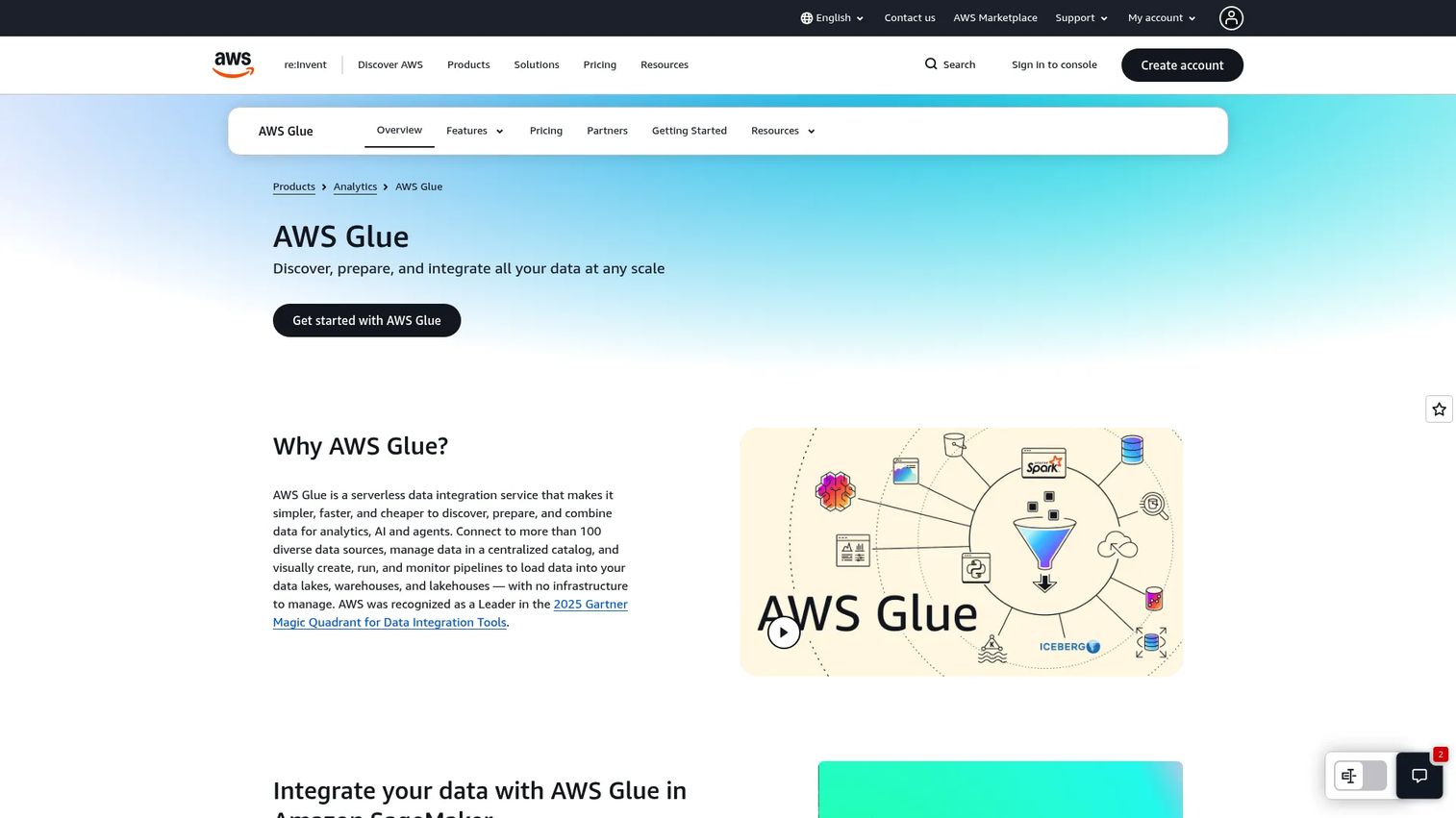
AWS Glue is a serverless data integration service for discovering, preparing, moving, and integrating data from multiple sources. It runs inside the AWS ecosystem, with native connections to S3, Redshift, Athena, and a wide range of AWS-managed databases. Teams use it for serverless ETL, automated schema discovery, and lakehouse patterns where data engineering already owns the platform choices. Generative-AI-assisted ETL authoring is available through AWS Glue Studio for teams building pipelines faster.
Best for: AWS-native teams that want serverless ETL and data catalog integration without managing infrastructure.
Key features
- Serverless ETL jobs using Apache Spark or Ray
- AWS Glue Data Catalog with automated schema discovery via crawlers
- Visual job authoring in AWS Glue Studio
- Streaming ETL support alongside batch
- Event-based triggers, scheduling, and built-in job monitoring
Why choose AWS Glue: If your product data already lives in AWS and your data engineering team owns the platform, Glue removes infrastructure management entirely. Teams outside the AWS ecosystem will face extra configuration to connect non-native sources.
AWS Glue pricing: AWS Glue uses pay-as-you-go pricing. ETL jobs and crawlers run at $0.44 per DPU-hour, billed per second. The first one million Data Catalog metadata objects are free; storage above that costs $1.00 per 100,000 objects monthly. DataBrew interactive sessions are $1.00 per 30-minute session.
G2 rating: 4.3/5
2. Fivetran
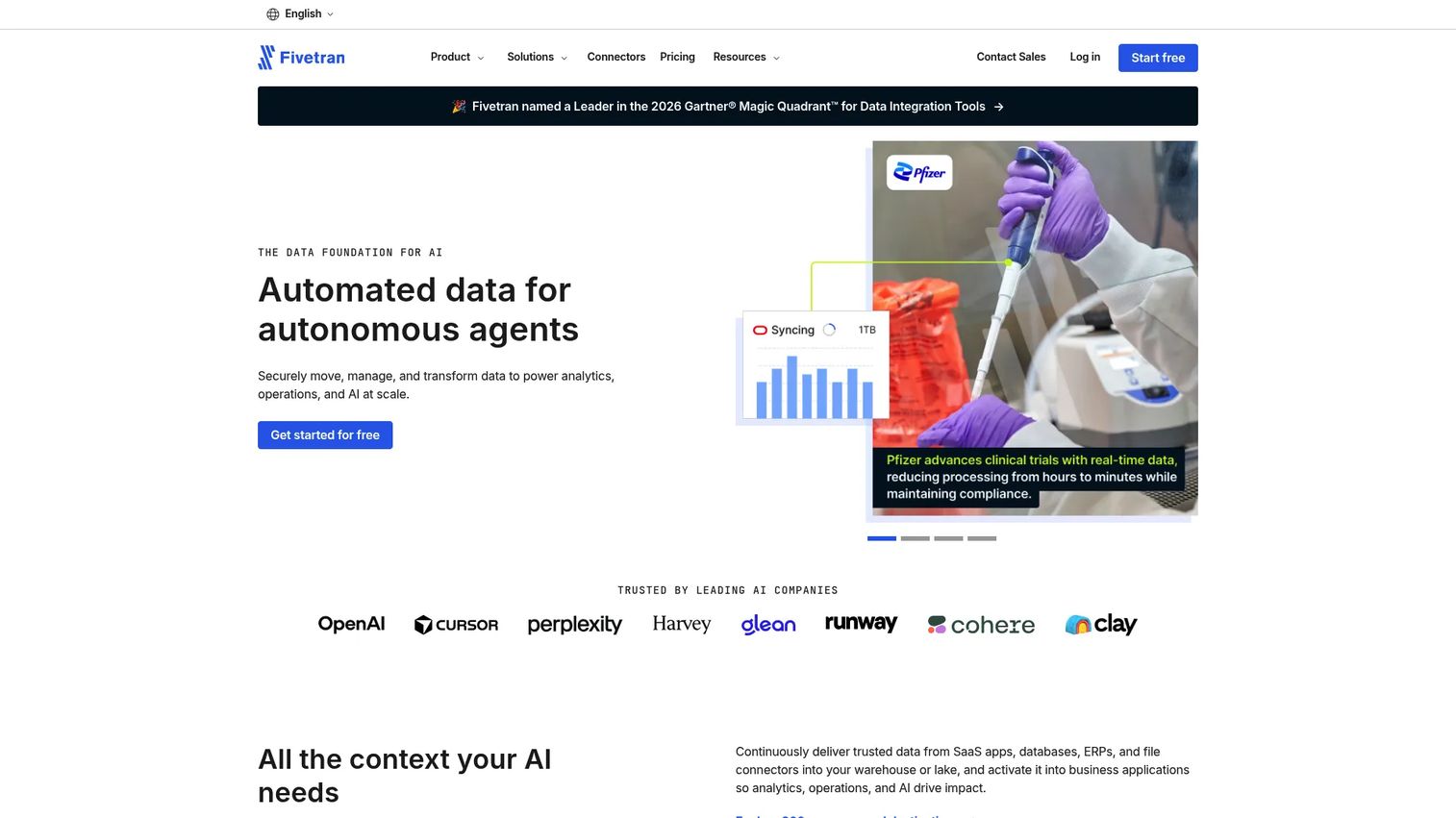
Fivetran is a managed data movement platform built to replicate data from SaaS applications, databases, and event sources into warehouses, lakes, and activation destinations. Its differentiation is connector maintenance: Fivetran handles schema changes, API updates, and sync scheduling so data engineering does not have to. With 700+ managed connectors and 15-minute sync intervals on Standard, it is widely used for product, CRM, and billing data consolidation. Database replication supports CDC for sources like Postgres, MySQL, and SQL Server.
Best for: Teams that need broad SaaS and database connector coverage without maintaining connectors themselves.
Key features
- 700+ fully managed SaaS and database connectors
- Database replication with CDC support
- Automated schema change handling
- 15-minute sync intervals on Standard
- dbt-compatible data models for downstream transformation
Why choose Fivetran: When PMs need consistent product, CRM, and billing data in the warehouse without filing an engineering request for every new source, Fivetran removes that overhead. High-volume or high-frequency workloads should model usage costs carefully before committing, as the usage-based model scales with data volume.
Fivetran pricing: A Free plan covers up to 500,000 connection monthly active rows, 3,500 activation monthly active rows, and 5,000 monthly model runs. Standard and Enterprise plans use usage-based pricing with annual contract discounts.
G2 rating: 4.4/5
3. Azure Data Factory
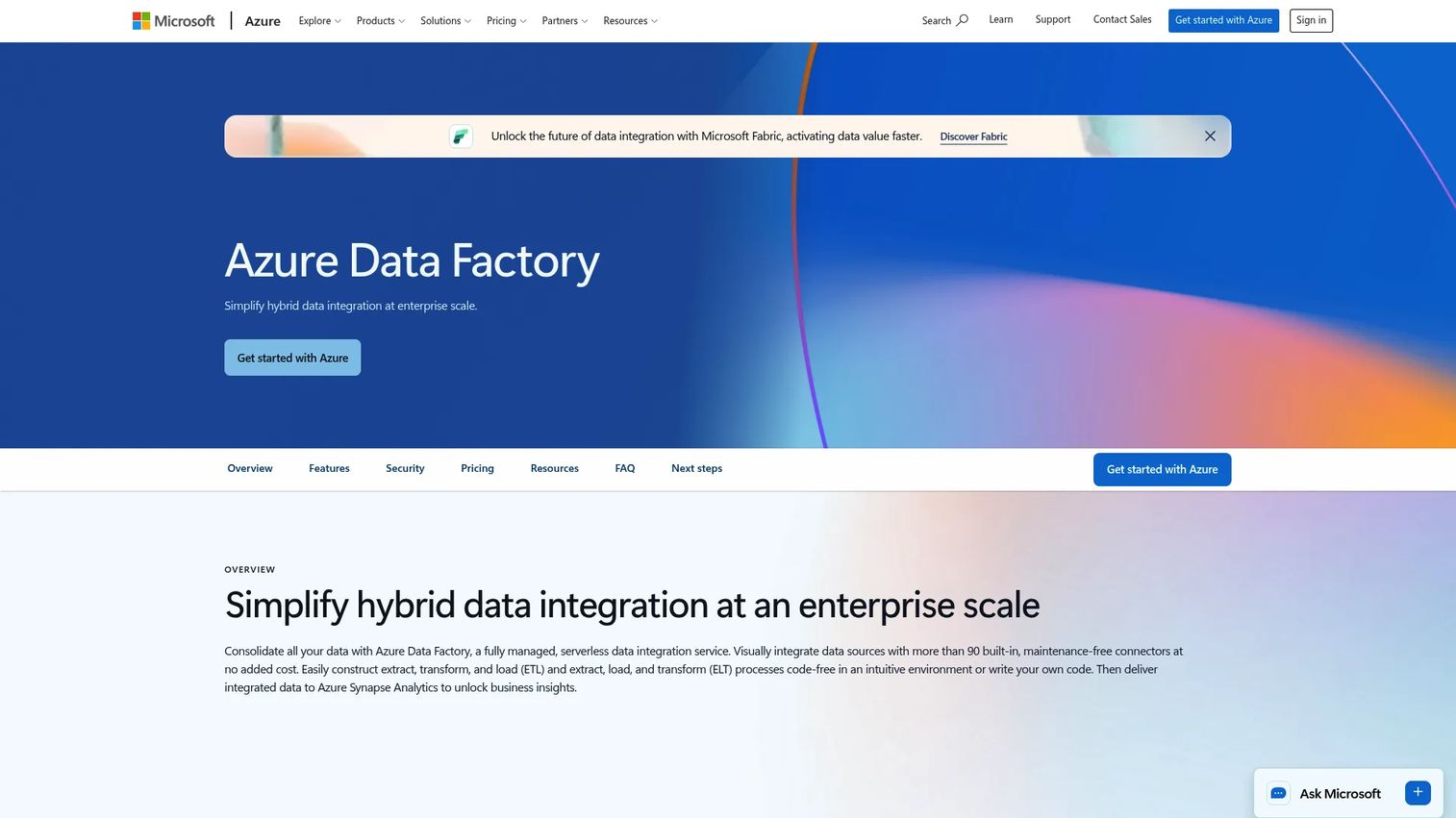
Azure Data Factory is Microsoft's fully managed cloud data integration and orchestration service for building hybrid ETL and ELT pipelines. It connects more than 90 built-in sources spanning on-premises databases, SaaS applications, and cloud storage. Visual pipeline authoring, mapping data flows, and pipeline triggers make it accessible without requiring custom code. For teams already running on Azure Synapse, Microsoft Fabric, or Power BI, the native integration avoids the complexity of connecting external tools to the Microsoft stack.
Best for: Microsoft-first organizations building data pipelines across Azure services and business intelligence platforms.
Key features
- Code-free pipeline authoring with built-in Git and CI/CD support
- Mapping data flows for visual data transformation
- More than 90 built-in connectors for on-premises, SaaS, and cloud sources
- Pipeline triggers and visual monitoring with alerting
- Support for rehosting SSIS workloads in the cloud
Why choose Azure Data Factory: For product teams whose analytics and BI already depend on the Microsoft stack, Azure Data Factory is the lowest-friction path to governed pipelines. Teams running multi-cloud or non-Azure-primary stacks should evaluate the operational complexity of connecting outside the ecosystem.
Azure Data Factory pricing: Pricing is usage-based, determined by pipeline orchestration runs, data movement units, mapping data flow execution, and debugging. Rates vary by Azure region and configuration; the official pricing calculator on Microsoft's site provides workload-specific estimates.
G2 rating: 4.6/5
4. Informatica
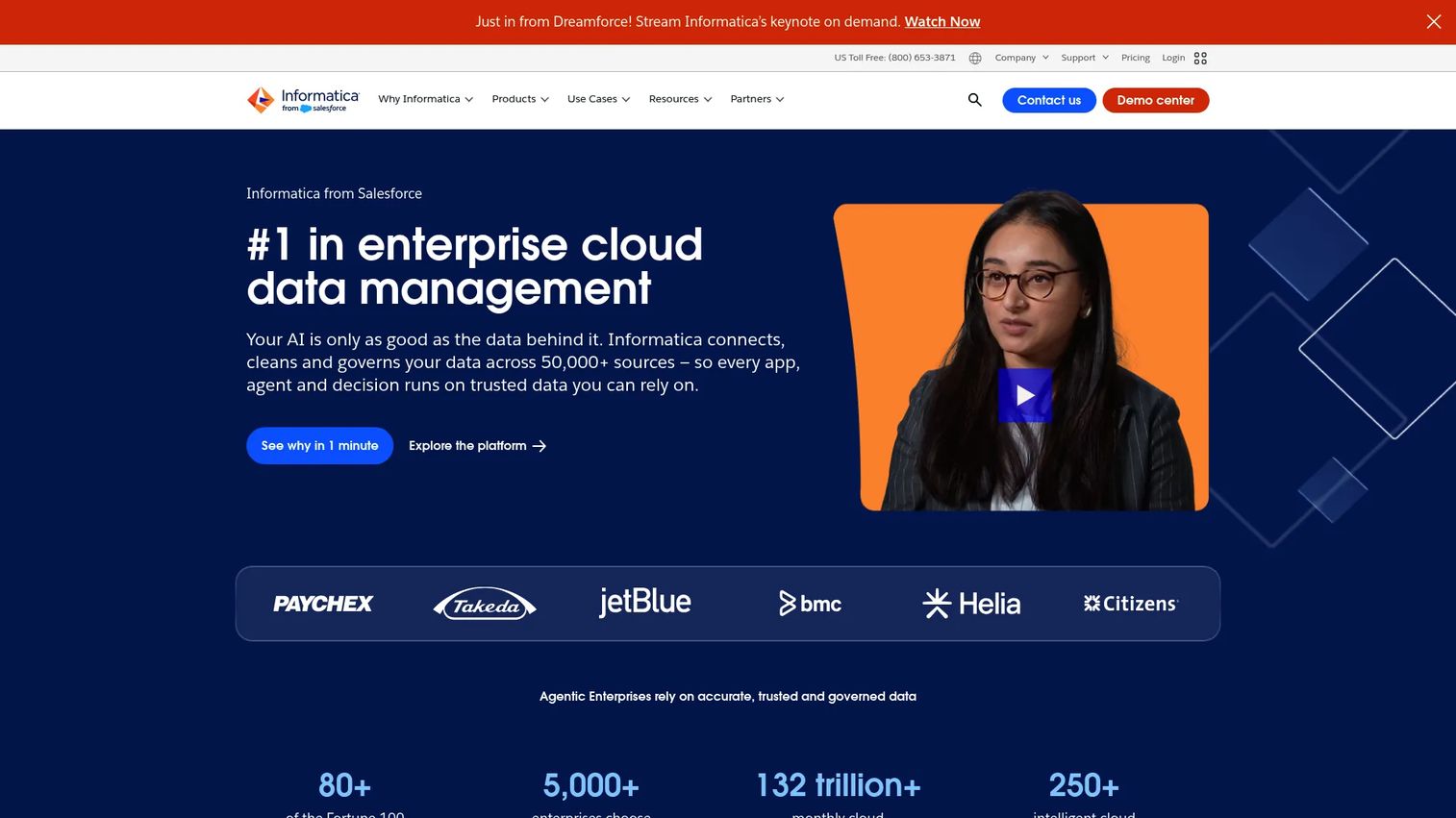
Informatica provides an AI-powered enterprise cloud data management platform covering data integration, governance, quality, lineage, metadata management, and master data management. Its CLAIRE AI engine assists with automated development, data discovery, and pipeline recommendations. For large enterprises that need product data decisions to satisfy security, privacy, and cross-functional governance requirements, Informatica covers the full data management lifecycle. It supports ETL, ELT, CDC, and streaming alongside its data catalog and governance capabilities.
Best for: Large enterprises that need governed data integration across multiple domains, with compliance and audit requirements.
Key features
- Enterprise data integration: ETL, ELT, CDC, and streaming
- Data cataloging with metadata management and lineage
- Data quality, profiling, and observability
- AI-powered automation via the CLAIRE engine
- Master data management and 360-degree applications
Why choose Informatica: When product decisions must satisfy security review, privacy compliance, and cross-functional governance, Informatica's breadth covers what narrower ELT tools leave unaddressed. Implementation planning and stakeholder alignment take real time given the platform's scope, so budget accordingly.
Informatica pricing: Informatica uses consumption-based, volume-based pricing customized by data volume, selected modules, deployment model, and support requirements. Contact sales for a quote.
G2 rating: 4.2/5
5. Airbyte
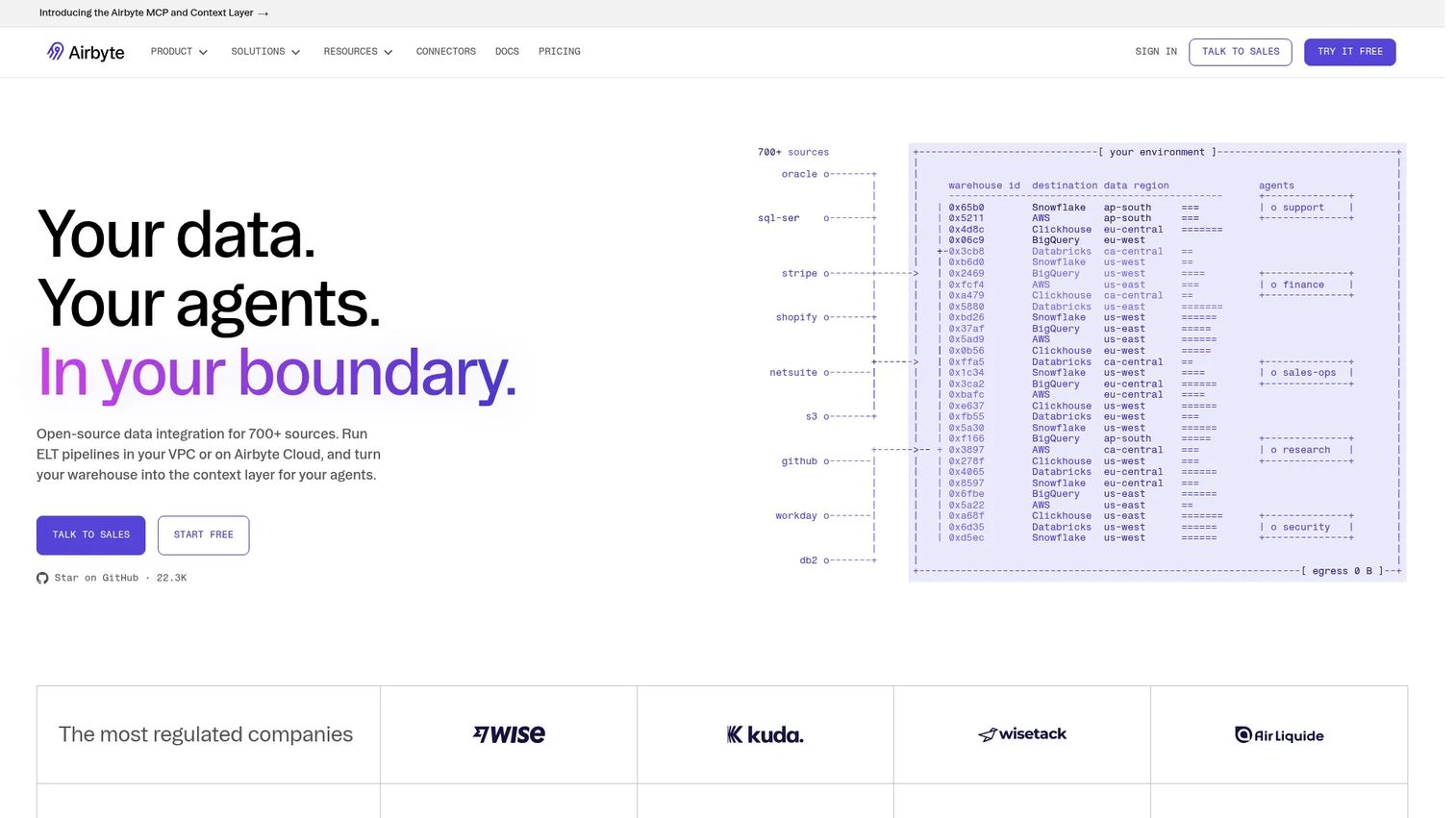
Airbyte is an open-source data integration and replication platform with 700+ connectors, cloud-managed and self-hosted deployment options, and a custom connector builder for sources without a prebuilt connector. It supports CDC, schema propagation, database replication, and API sources. A growing MCP and AI-agent context layer makes it relevant for teams building AI orchestration on top of their data pipelines. Teams with the engineering bandwidth to manage or customize the platform get significant flexibility.
Best for: Data teams that need flexible ingestion with open-source extensibility and control over deployment.
Key features
- 700+ connectors across SaaS, databases, APIs, and files
- Change data capture with schema propagation
- Custom Connector Builder for non-standard sources
- Cloud, self-hosted, hybrid, and on-premises deployment
- MCP layer for AI-agent data connectivity
Why choose Airbyte: Airbyte's open-source foundation means connector logic is inspectable and extensible. Teams that self-manage should plan for ownership of infrastructure, upgrades, and incident response; the Cloud offering removes that burden.
Airbyte pricing: Cloud starts at $20/month on the Standard plan (volume-based). The Plus plan is $189/month on a credit package. Pro and Enterprise Flex use custom capacity or deployment pricing. Airbyte Core is free to self-host.
G2 rating: 4.4/5
6. Matillion
Matillion is a cloud data integration and ELT platform focused on building, managing, and orchestrating data pipelines for analytics and AI workloads on modern cloud warehouses. Its visual transformation canvas lets data teams design ELT jobs without writing raw SQL, though SQL and Python components are available for teams that need them. Pipeline scheduling, Git integration, data lineage, and AI-assisted pipeline capabilities round out the platform. For product teams whose dashboards depend on repeatable, visible transformations in Snowflake, BigQuery, or Redshift, Matillion is worth evaluating.
Best for: Data teams building low-code ELT and transformation pipelines on cloud warehouses.
Key features
- Visual ELT pipeline design with 500+ prebuilt components
- Batch loading and change data capture
- SQL and Python transformations alongside low-code options
- Pipeline scheduling, orchestration, and job monitoring
- Git integration and data lineage
Why choose Matillion: Warehouse-native transformation keeps compute inside the warehouse, which matters for cost visibility and governance. Teams should model warehouse compute cost alongside Matillion's subscription to understand total cost at their data volume.
Matillion pricing: Matillion offers Developer, Teams, and Scale editions with consumption-based credit pricing. A free trial is available.
G2 rating: 4.5/5
7. Qlik Talend Cloud
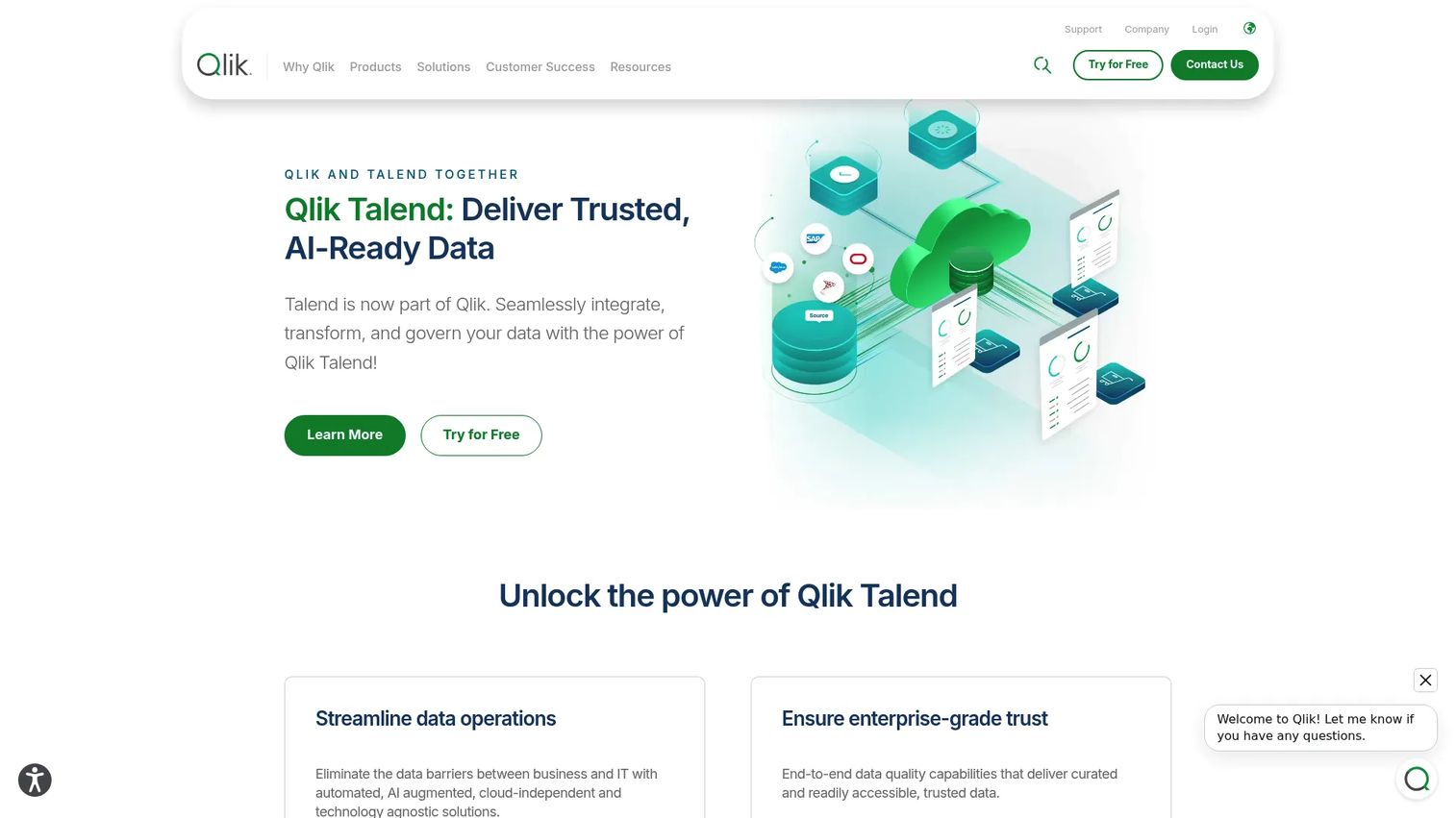
Qlik Talend Cloud is a unified cloud platform for data integration, transformation, quality, governance, and delivery of trusted, AI-ready data. It combines batch and real-time data integration with log-based change data capture, visual and low-code transformation tools, and built-in data quality and profiling. For product teams whose decisions depend on trusted customer attributes and lifecycle segments, the integration of data quality into the pipeline rather than as a downstream afterthought is a meaningful difference. A 14-day free trial is available.
Best for: Teams that need data integration and quality management together, particularly where data trust affects product and customer decisions.
Key features
- Batch and real-time integration with log-based CDC
- Visual, low-code, and full-code transformation tools
- Built-in data quality, profiling, and governance
- Data lineage and data products support
- Four subscription tiers: Starter, Standard, Premium, Enterprise
Why choose Qlik Talend Cloud: When product and analytics decisions depend on consistent customer segments and usage data, treating data quality as a first-class pipeline capability reduces downstream errors. Teams should verify which capabilities fall under which edition before comparing pricing.
Qlik Talend Cloud pricing: Four capacity-based subscription tiers are available (Starter, Standard, Premium, Enterprise), priced on data moved, job executions, and job duration.
G2 rating: 4.6/5
8. SnapLogic
SnapLogic is an enterprise integration platform for connecting and orchestrating data, applications, APIs, workflows, and AI agents. With 1,000+ pre-built connectors and a visual no-code or low-code builder, it covers both application integration (CRM, ERP, support, finance) and data integration (ETL, ELT, reverse ETL) in a single platform. For product teams that need data flowing between operational systems and the warehouse, SnapLogic's broad connector set reduces the need to stitch together separate tools for application and data pipelines.
Best for: Enterprises that need a single platform connecting application workflows and data pipelines across diverse business systems.
Key features
- 1,000+ pre-built connectors and integration templates
- Visual no-code and low-code pipeline builder
- ETL, ELT, and reverse ETL support
- API management and AI-assisted pipeline creation
- No-code AI agent creation for workflow automation
Why choose SnapLogic: When product data flows need to connect operational systems like CRM, support, marketing automation, and finance alongside warehouse ingestion, SnapLogic reduces tool sprawl. Teams with deep data engineering requirements should confirm connector depth for specific source systems before committing.
SnapLogic pricing: Three package tiers are available: Essential, Professional, and Enterprise One. All use custom pricing. SnapLogic offers unlimited pipelines and data movement within packages.
G2 rating: 4.4/5
9. Skyvia
Skyvia is a no-code cloud data integration platform for integrating, syncing, automating, backing up, querying, and connecting data across cloud applications, databases, warehouses, and file stores. With 200+ pre-built connectors and a visual setup that does not require a data engineer, it is accessible to smaller product ops and GTM reporting workflows. Features cover ETL, ELT, reverse ETL, bidirectional sync, workflow automation, cloud backup, and SQL querying. For lean teams that need CRM, database, and app data connected without heavy engineering involvement, Skyvia's pricing and setup make it one of the most accessible customer data platform alternatives in this category.
Best for: Smaller teams and product ops workflows that need no-code data sync without engineering overhead.
Key features
- 200+ pre-built cloud app and database connectors
- ETL, ELT, reverse ETL, and bidirectional synchronization
- Workflow automation with scheduling and triggers
- Cloud data backup with restore capabilities
- Visual query builder and SQL querying tools
Why choose Skyvia: Skyvia's free plan and accessible paid tiers make it the most approachable option for teams without a dedicated data engineering function. Larger platforms with complex orchestration or governance requirements will find the platform less suited to those needs.
Skyvia pricing: A free plan is available. Data Integration paid plans start at $99/month ($79/month billed annually) for Basic, $199/month ($159/month annually) for Standard, and $499/month ($399/month annually) for Professional. Enterprise plans use custom annual pricing.
G2 rating: 4.8/5
10. Nexla
Nexla is a data connectivity and integration platform that organizes data as governed, reusable products called Nexsets, each carrying schema, lineage, quality rules, and access controls. With 1,000+ bidirectional enterprise connectors and support for ETL, ELT, reverse ETL, CDC, streaming, and document integration, it covers a wide integration surface. For organizations where multiple product, analytics, and business teams need the same underlying data delivered in consistent, governed formats, Nexla's data product model reduces duplication and drift. AI-agent connectivity is also built in.
Best for: Enterprise organizations treating data as reusable, governed products shared across multiple teams and systems.
Key features
- 1,000+ bidirectional enterprise connectors
- ETL, ELT, reverse ETL, CDC, and streaming support
- Governed data products (Nexsets) with schema, lineage, and quality controls
- Pipeline monitoring and observability
- AI-agent data connectivity
Why choose Nexla: When several product and analytics functions draw from the same sources and data drift between teams creates credibility problems, Nexla's data product model addresses the structural root. Teams evaluating Nexla should map their operating model to the product concept before comparing it to a simpler ELT tool.
Nexla pricing: Pro, Team, and Enterprise tiers use usage-based pricing. A free plan is available with no credit card required. Contact sales for a quote.
G2 rating: 4.6/5
11. Hevo
Hevo is a managed data integration platform combining extraction, loading, and dbt-based modeling with operational visibility across data sources. It offers 170+ pre-built connectors, near-real-time streaming pipelines, automated schema mapping, and pipeline monitoring with alerting. dbt integration, SQL transformation, and role-based access control are included on paid plans. For product teams that need faster reporting without waiting on custom ingestion work, Hevo's managed setup removes much of the operational burden. Single sign-on is available on higher tiers.
Best for: Data teams that want fast managed ELT setup and near-real-time pipeline monitoring for warehouse analytics.
Key features
- 170+ pre-built connectors for SaaS, databases, and files
- Near-real-time streaming and batch pipelines
- dbt, SQL, and Hevo Transformer modeling
- Pipeline observability and automated alerting
- Role-based access control and SSO on paid tiers
Why choose Hevo: Speed to first pipeline is Hevo's strongest argument. Teams that need a managed, low-maintenance data pipeline quickly will find the setup time shorter than most. High-volume teams should model credit consumption at their expected event rate before committing, as costs scale with data volume.
Hevo pricing: A Free plan covers up to 1 million events per month with limited connectors. Starter plans begin at $299/month; Professional plans start at $549/month. Business Critical uses custom pricing. All paid tiers include additional connectors, dbt, streaming, security, and governance features.
G2 rating: 4.4/5
12. Integrate.io
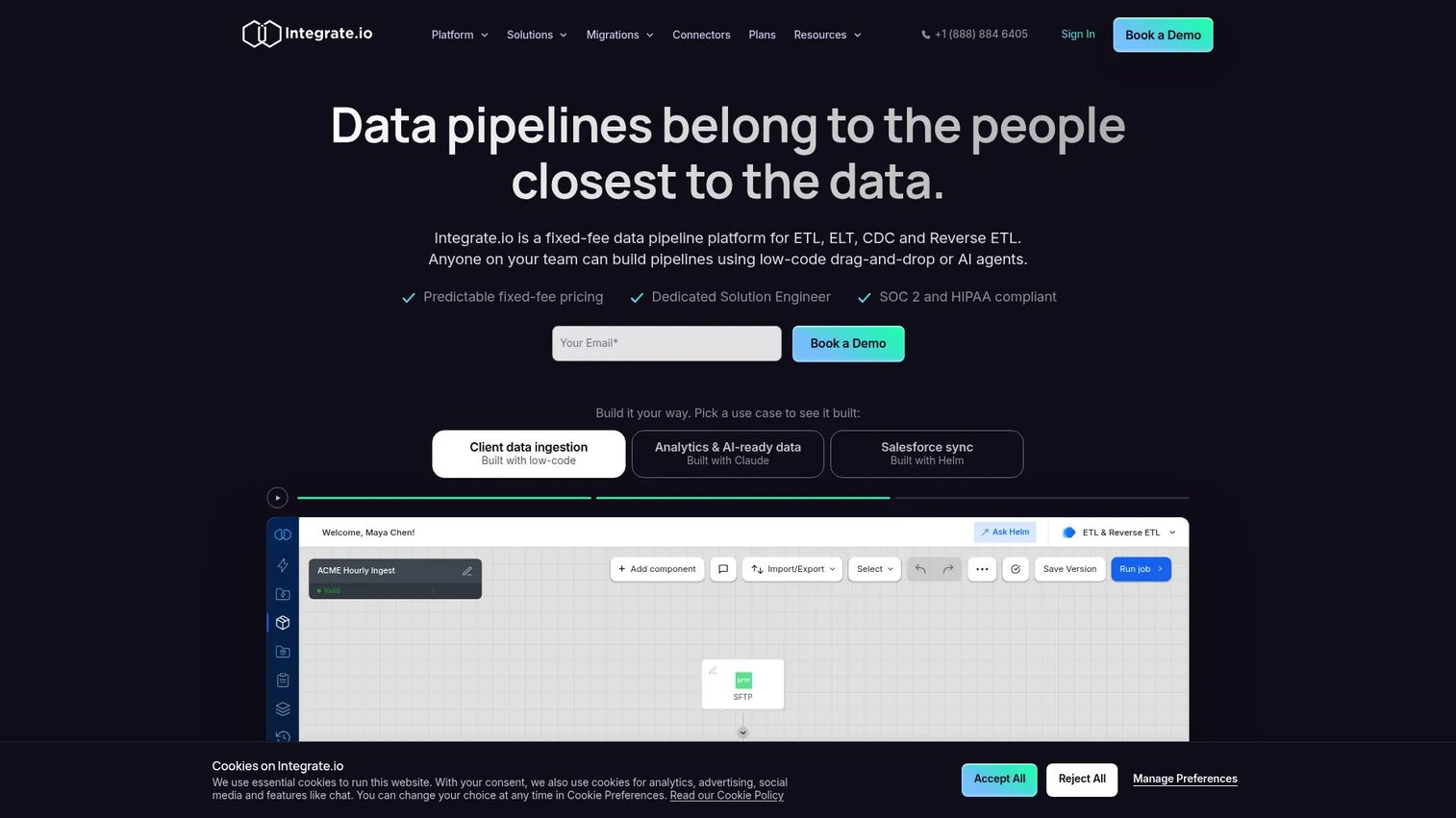
Integrate.io is a low-code data pipeline platform for ETL, ELT, CDC, reverse ETL, orchestration, and monitoring across apps, databases, files, APIs, and warehouses. Its visual pipeline builder includes 220+ low-code transformation functions and native scheduling with 60-second pipeline frequency on the Core plan. Full platform access with unlimited data volumes and pipelines is included in a fixed monthly fee rather than usage-based billing. For product and GTM teams that need operational data moved between cloud systems on a predictable budget, the fixed-fee model simplifies cost planning.
Best for: Teams that want ETL, ELT, and reverse ETL in a low-code pipeline builder with predictable fixed-fee pricing.
Key features
- ETL, ELT, CDC, and reverse ETL pipelines
- 220+ low-code transformation functions
- Visual pipeline builder with native scheduling
- 60-second pipeline frequency on Core plan
- API data workflows with monitoring and alerting
Why choose Integrate.io: Fixed-fee pricing with unlimited data volumes removes the anxiety of usage-based cost spikes at higher volumes. Teams should confirm connector depth for their exact source systems, as the catalog is smaller than Fivetran or Airbyte.
Integrate.io pricing: The Core plan starts at $1,999/month, covering unlimited data volumes, pipelines, and connectors alongside full platform access and 30-day onboarding support. Custom plans add advanced security, HIPAA readiness, and tailored support. A 14-day free trial is available.
G2 rating: 4.4/5
Considerations when choosing cloud data integration tools
Start with the workload, not the name
The difference between SaaS ELT, database replication, streaming CDC, warehouse transformation, and reverse ETL is not marketing language. Each pattern needs different capabilities. A tool built for managed SaaS connectors may handle CDC poorly; a tool strong on transformation may not support API sources. Map your workloads before shortlisting.
Check connector depth beyond the count
A connector count on a marketing page tells you little. The questions that matter are whether the connector supports incremental sync, how it handles schema drift, what happens during API rate limits, and whether historical backfill is available. Ask the vendor for documentation on your specific source before trialing.
Model total cost before the trial
The subscription price is rarely the full picture. Add connector usage fees, warehouse compute for transformation, cloud egress costs, implementation time, and ongoing pipeline monitoring overhead. A usage-based tool that looks affordable at low volume can become expensive at scale; a fixed-fee tool like Integrate.io may cost more upfront but simplify budgeting.
Decide your data freshness requirement
Not every product decision needs real-time data. Scheduled batch suits daily retention cohorts; micro-batch suits hourly reporting; CDC suits operational dashboards that require sub-minute latency. Ask what latency your actual product decisions require before defaulting to the highest-frequency option, which often costs more and requires more infrastructure.
Verify governance and security early
RBAC, secrets management, encryption at rest and in transit, audit logs, lineage tracking, PII handling controls, SSO, and data residency requirements should be evaluated before the trial, not after procurement. For enterprise teams, vendor security review workflows can add weeks to the timeline.
Conclusion
The right cloud data integration tool depends on where your data lives, how fresh it needs to be, and who maintains it. AWS Glue fits teams already inside the AWS ecosystem; Fivetran handles SaaS connector maintenance at scale; Azure Data Factory is the natural pick for Microsoft-first stacks. For enterprise governance, Informatica covers data management, quality, and lineage across domains. Airbyte gives teams with engineering bandwidth a flexible, open-source foundation. Skyvia is the most accessible option for smaller teams that need no-code sync without an engineering hire.
Matillion and Qlik Talend Cloud both serve warehouse-native transformation, with Qlik adding integrated data quality. SnapLogic spans application and data integration in one platform. Nexla models data as governed products for teams sharing data across functions. Hevo gets pipelines running fast with managed operations. Integrate.io offers fixed-fee pricing with reverse ETL included.
Start with the data decision you need to trust, then choose the pipeline that can support it.
FAQs
Cloud data integration tools move, transform, synchronize, and govern data across cloud applications, databases, warehouses, lakes, and business systems. They cover patterns including ETL, ELT, CDC, data replication, reverse ETL, and orchestration, connecting source systems to analytical destinations so teams can run reporting, segmentation, and experimentation on consistent data.
ETL (extract, transform, load) transforms data before it reaches the destination, which suits governed environments where transformation rules must be enforced upstream. ELT (extract, load, transform) loads raw or lightly prepared data into the cloud data warehouse first, then transforms it using the warehouse's compute power. ELT is now the more common pattern for modern cloud warehouses, as warehouse compute has become both fast and cost-effective.
Fivetran, Airbyte, Hevo, Skyvia, and Integrate.io are frequently used for SaaS data integration. The right fit depends on connector support for your specific SaaS sources, sync frequency requirements, schema drift handling, and the cost model at your expected data volume. Teams with engineering bandwidth get more flexibility from Airbyte; teams that want managed maintenance lean toward Fivetran or Hevo.
AWS Glue is the most direct AWS-native option, with serverless ETL, the Glue Data Catalog, and deep integration across S3, Redshift, Athena, and other AWS services. Teams that need broader SaaS connectors or cross-cloud workflows should also evaluate Fivetran, Airbyte, or Matillion, which all support AWS destinations alongside other clouds.
PMs do not need to design every pipeline, but understanding latency, data quality, identifier consistency, and lineage is important. Those choices directly affect activation metrics, retention cohorts, experiment results, and roadmap confidence. A PM who can ask specific questions about sync frequency, schema drift handling, and backfill behavior will have fewer data credibility debates with the analytics team.
Change data capture (CDC) reads row-level changes from a source database's transaction log and moves only the changed records to the destination, without reloading the full dataset each sync. It is useful for near-real-time replication, operational reporting, and keeping warehouse data current without the compute cost of full refreshes. Tools like Fivetran, Airbyte, Qlik Talend Cloud, Matillion, and Integrate.io all support CDC for common database sources.
Compare more than the subscription line item. Add connector usage fees, the data volume that triggers tier upgrades, warehouse compute for downstream transformation, cloud egress charges, implementation time, and the ongoing cost of pipeline monitoring and maintenance. Usage-based models like Fivetran and Airbyte scale predictably at low volume but can grow quickly. Fixed-fee models like Integrate.io simplify budgeting but carry a higher floor. Tools like Skyvia offer accessible entry points for smaller teams.
Data integration moves and transforms data between source and destination systems. Data orchestration coordinates when and how those pipeline jobs run, including dependencies between jobs, retry logic on failure, alerting when a job stalls, and triggering downstream tasks once upstream data is ready. Many cloud data integration platforms include orchestration features; dedicated orchestration tools like Apache Airflow or Dagster are also commonly used alongside integration platforms.