Your new commercial lines product launched on schedule. Premium volume is climbing. And your finance team is still reconciling payments in a spreadsheet, chasing exception queues manually, and producing receivables reports that are already stale before the Monday meeting starts.
The platform holding this together is insurance billing software - but the keyword pulls up two very different markets. This guide covers carrier billing software for property and casualty insurers, MGAs, and program administrators. If you need tools for provider claims submission, EHR workflows, or patient billing, search for medical billing or revenue cycle management software instead.
According to Dataintelo (2025), the global insurance billing platforms market reached $8.2 billion in 2025, with cloud-based platforms accounting for 71.8% of that share. The adoption pressure is real. Which platform fits the billing architecture your operations team will need two years from now?
What's inside
This guide is built for P&C insurance carriers, MGAs, and insurtech founders evaluating billing infrastructure. Eight platforms were selected based on:
- Billing model depth: Direct, agency, group, installment, and commission support
- Payments and collections: Automation, delinquency workflows, and receivables visibility
- Core integration fit: Connectivity to policy administration, claims, and finance systems
- Implementation reality: Enterprise readiness, configuration approach, and migration risk
Pricing for every platform on this list is quote-based. Verify commercial terms directly with each vendor before shortlisting.
TL;DR
- Best for large P&C carriers: Guidewire BillingCenter, for configurable billing inside a mature insurance core environment
- Best for modular cloud adoption: Duck Creek Billing, for carriers modernizing billing alongside adjacent core functions
- Best for broader core coverage: Majesco P&C Billing or Sapiens Insurance Platform, for insurers that need billing connected to a wider suite
- Best for specialized P&C programs: Insurity or OneShield, for regional carriers, MGAs, and specialty programs
- Best for cloud-native flexibility: EIS or Socotra, for insurers prioritizing API-first architecture and product configurability
- Category note: Medical billing is a separate category. This guide covers premium collection and policyholder billing only.
What is insurance billing software?
Insurance billing software is a carrier-facing system that manages premium invoicing, payment schedules, receivables, collections, commissions, reconciliation, and financial reporting across insurance policies.
This is not an invoicing add-on. Carrier billing is an operating system for premium cash flow.
What carrier billing software manages
The core workflows span the full premium lifecycle:
- Premium invoice generation tied to policy issuance and mid-term changes
- Installment plans, billing schedules, and payment method management
- Direct, agency, and group billing across distribution channels
- Receivables aging, delinquency identification, and collections workflows
- Commission calculation, settlement, and producer compensation
- Payment allocation, cash application, and reconciliation to the general ledger
- Data exchange with policy administration, claims, customer service, and finance systems
Carrier billing versus medical billing
The distinction matters for search intent and buying decisions:
- Carrier billing: Premium collection and policyholder billing for P&C insurers
- Medical billing: Provider claims, payer reimbursement, denial management, EHR connectivity, and patient statements
These are different products serving different buyers. If you landed here looking for healthcare revenue cycle tools, this guide will not serve your need.
Key capabilities to look for
- Flexible billing models (direct, agency, group, installment, user-defined)
- Payment options and self-service portals for policyholders
- Collections automation with configurable dunning and delinquency rules
- Commission management for agents, brokers, and tiered structures
- Reconciliation controls with exception handling and audit trails
- Policy and claims integration on a shared data model
- Reporting across receivables aging, payment failures, and write-offs
- Configurable workflows for new products and jurisdictions
When to use insurance billing software
Replace manual billing and reconciliation workflows
Finance teams rebuilding receivables reports from exception queues and spreadsheets are carrying technical debt that compounds as volume grows. A dedicated billing system reduces repeated manual work, but the buyer should confirm that exceptions surface clearly rather than disappearing into automated processes that only fail at month-end.
Support more complex policyholder payment models
When the business expands into new product lines, states, or distribution channels, billing requirements shift fast. Standard monthly premium schedules give way to installment plans, agency statements, wholesale arrangements, and group billing. The platform must handle these without custom workarounds that create maintenance risk.
Connect billing to policy, claims, and finance systems
A policy change that does not flow reliably into the invoice creates reconciliation problems downstream. A claims adjustment that cannot be reflected in billing affects cash application. Integrated core platforms fit organizations that need a shared data model across functions. Modular platforms fit teams modernizing in phases.
Insurance billing software comparison
The table below routes buyers by organization type and architecture fit. All eight platforms are quote-based. Verify live ratings and commercial terms before finalizing a shortlist. Cross-reference claims management software and best payment processing software guides for adjacent evaluation context.
| # | Product | Best for | Key differentiator | Pricing | G2 rating |
|---|---|---|---|---|---|
| 1 | Guidewire BillingCenter | Large P&C carriers with complex billing operations | Deep billing configuration inside Guidewire InsuranceSuite | Custom pricing | Not listed |
| 2 | Duck Creek Billing | Carriers modernizing through modular cloud adoption | Configurable P&C billing on a connected cloud core | Custom pricing | 4.3/5 |
| 3 | Majesco P&C Billing | P&C insurers needing billing with broader core capabilities | Multi-plan billing, reconciliation, and analytics in a cloud platform | Custom pricing | 3.0/5 |
| 4 | Sapiens Insurance Platform | Multi-line insurers needing broad suite coverage | AI-enabled core platform across policy, billing, claims, and reinsurance | Custom pricing | 4.4/5 |
| 5 | Insurity | Regional P&C insurers and specialty programs | Cloud insurance suite for commercial and specialty P&C operations | Custom pricing | 3.7/5 |
| 6 | EIS | Carriers pursuing cloud-native core modernization | Unified digital insurance platform with configurable billing workflows | Custom pricing | 4.6/5 |
| 7 | OneShield | Insurers and MGAs seeking configurable core operations | Policy, billing, claims, and rating with AI-powered workflow support | Custom pricing | Not listed |
| 8 | Socotra | Insurtechs and carriers wanting API-oriented core flexibility | Cloud-native insurance core with open APIs and developer extensibility | Custom pricing | Not listed |
Best 8 insurance billing software tools for 2026
1. Guidewire BillingCenter
Guidewire BillingCenter is designed for property and casualty insurers managing billing at scale across direct, agency, and group channels. It operates as one component of Guidewire InsuranceSuite, alongside PolicyCenter and ClaimCenter, giving carriers a connected core where billing data shares context with underwriting and claims. The platform covers the full billing lifecycle from invoice generation to payment allocation, delinquency management, and producer compensation.
Best for: Large P&C carriers with complex billing operations that require deep configuration, multi-channel distribution, and integration with a mature insurance core.
Key features
- Direct, agency, and group billing across distribution channels
- Installment plans and configurable payment rules
- Commission calculation and producer compensation management
- Collections and delinquency workflows with configurable follow-up
- Billing analytics and benchmarking capabilities
- Cloud APIs for integration with partner and third-party systems
Why choose Guidewire BillingCenter: The platform's depth comes from its shared InsuranceSuite architecture. Carriers that already operate PolicyCenter or ClaimCenter benefit from a common data model rather than point-to-point integrations. It suits organizations with the capacity to govern a structured implementation program.
Guidewire BillingCenter pricing: Pricing is negotiated through Guidewire's enterprise sales process. Commercial terms depend on deployment model, modules selected, implementation scope, and service requirements. Contact Guidewire directly for a quote.
2. Duck Creek Billing
Duck Creek Billing is a configurable P&C billing platform for carriers that want payment automation, collections, reconciliation, and financial visibility within a connected cloud core. The platform handles embedded payments, automated invoicing, dunning, reinstatement, and rescission workflows. Real-time visibility into receivables, delinquencies, and cash flow makes it a practical fit for finance and operations teams that need reliable data without rebuilding reports manually.
Best for: Mid-market and enterprise P&C insurers that want to modernize billing within a broader P&C architecture, without treating the project as an isolated finance initiative.
Key features
- Embedded payments and automated reconciliation
- Automated invoicing, collections, dunning, and reinstatement
- Configurable billing plans, installment schedules, and commission rules
- Real-time receivables and cash-flow visibility
- Low-code configuration and integration with policy, claims, and payment systems
Why choose Duck Creek Billing: The appeal for a growing insurer is the ability to modernize billing alongside adjacent core functions rather than in a vacuum. Carriers that want a credible modernization path without a single big-bang program will find the modular sequencing approach practical.
Duck Creek Billing pricing: Commercial terms are quote-based and are discussed through Duck Creek's enterprise sales team. Ask specifically about billing module scope, implementation assumptions, and any integration requirements that affect cost.
G2 rating: Duck Creek Billing holds a 4.3/5 rating on G2.
3. Majesco P&C Billing
Majesco P&C Billing supports premium billing, payment processing, reconciliation, and financial operations as part of a broader cloud-based P&C insurance platform. The platform handles a wide range of billing plan types, from direct bill and agency statement to wholesale, list billing, and user-defined arrangements. Payment journeys cover ACH, credit card, guest checkout, one-time, and recurring options. Automated reconciliation, refund processing, write-offs, holds, and exception handling reduce the manual work that typically falls on finance teams.
Best for: P&C carriers that need billing connected to policy, claims, and digital workflows, particularly those evaluating consolidation onto a single cloud platform.
Key features
- Configurable payment plans, fees, notices, and billing workflows
- ACH, credit card, guest, one-time, and recurring payment options
- Automated reconciliation, refunds, write-offs, and exception handling
- Multi-currency billing and reporting
- Account analytics covering balances, payment activity, and delinquency
Why choose Majesco P&C Billing: Majesco suits insurers that want to consolidate carrier operations rather than maintain separate billing and policy systems. Confirm that the implementation model fits your product roadmap and internal capacity before committing.
Majesco P&C Billing pricing: Pricing is obtained through a direct vendor quote. Commercial structure typically reflects platform scope, lines of business, and implementation services. Contact Majesco to discuss your specific configuration.
G2 rating: Majesco shows a 3.0/5 rating on G2, based on a limited review sample.
4. Sapiens Insurance Platform

Sapiens Insurance Platform is an AI-enabled, modular insurance platform that covers policy administration, billing, claims, and related operations across P&C, life, pensions, and reinsurance contexts. For carriers operating across multiple lines or geographies, the platform's breadth reduces the number of separate systems required. Deployment is cloud-based with low-code configuration, and the platform includes persona-based portals for digital and data capabilities.
Best for: Mid-size and enterprise insurers that need wide functional coverage and operate across lines, geographies, or complex product portfolios where a single vendor roadmap simplifies governance.
Key features
- Core policy administration with billing and claims connectivity
- AI-powered automation and decision-making across insurance workflows
- Cloud and SaaS deployment with low-code configuration
- Digital portals for policyholder and agent self-service
- Pre-integrated solutions for faster implementation
Why choose Sapiens Insurance Platform: Sapiens fits buyers evaluating billing as part of a larger core-platform decision rather than a point-system replacement. The breadth of coverage across lines of business is a genuine differentiator for insurers that have outgrown fragmented systems.
Sapiens Insurance Platform pricing: Pricing is not displayed on the Sapiens website. Sapiens directs prospects to request a demo for scoped commercial discussions. Evaluate total program scope, including product lines, implementation partners, and integration needs, when comparing quotes.
G2 rating: Sapiens holds a 4.4/5 rating on G2.
5. Insurity
Insurity offers cloud-based software, analytics, and AI-enabled workflows for P&C insurers, specialty carriers, brokers, MGAs, and third-party administrators. Billing operates within an integrated suite alongside policy administration, claims, and accounting. The platform includes AI-enabled underwriting, geospatial intelligence for exposure management, and premium audit automation, making it relevant for operations teams that want more than basic billing functionality.
Best for: Regional carriers, specialty insurers, MGAs, and program administrators that need P&C-specific operating depth rather than a generic finance billing system.
Key features
- Integrated policy administration, billing, and claims management
- AI-enabled underwriting, risk analysis, and pricing support
- Geospatial intelligence for exposure and portfolio management
- Premium audit automation and loss-control workflows
- Cloud deployment with configurable operational workflows
Why choose Insurity: A platform aligned with specialty or regional insurance operations creates more value than a generic enterprise finance system that requires heavy adaptation. Insurity's vertical focus means fewer workarounds for commercial and specialty lines workflows.
Insurity pricing: Insurity does not display pricing on its website and directs prospects to book a demo. Verify which product family in the Insurity portfolio supports your billing requirements before requesting a scoped proposal.
G2 rating: Insurity holds a 3.7/5 rating on G2 based on its seller profile.
6. EIS
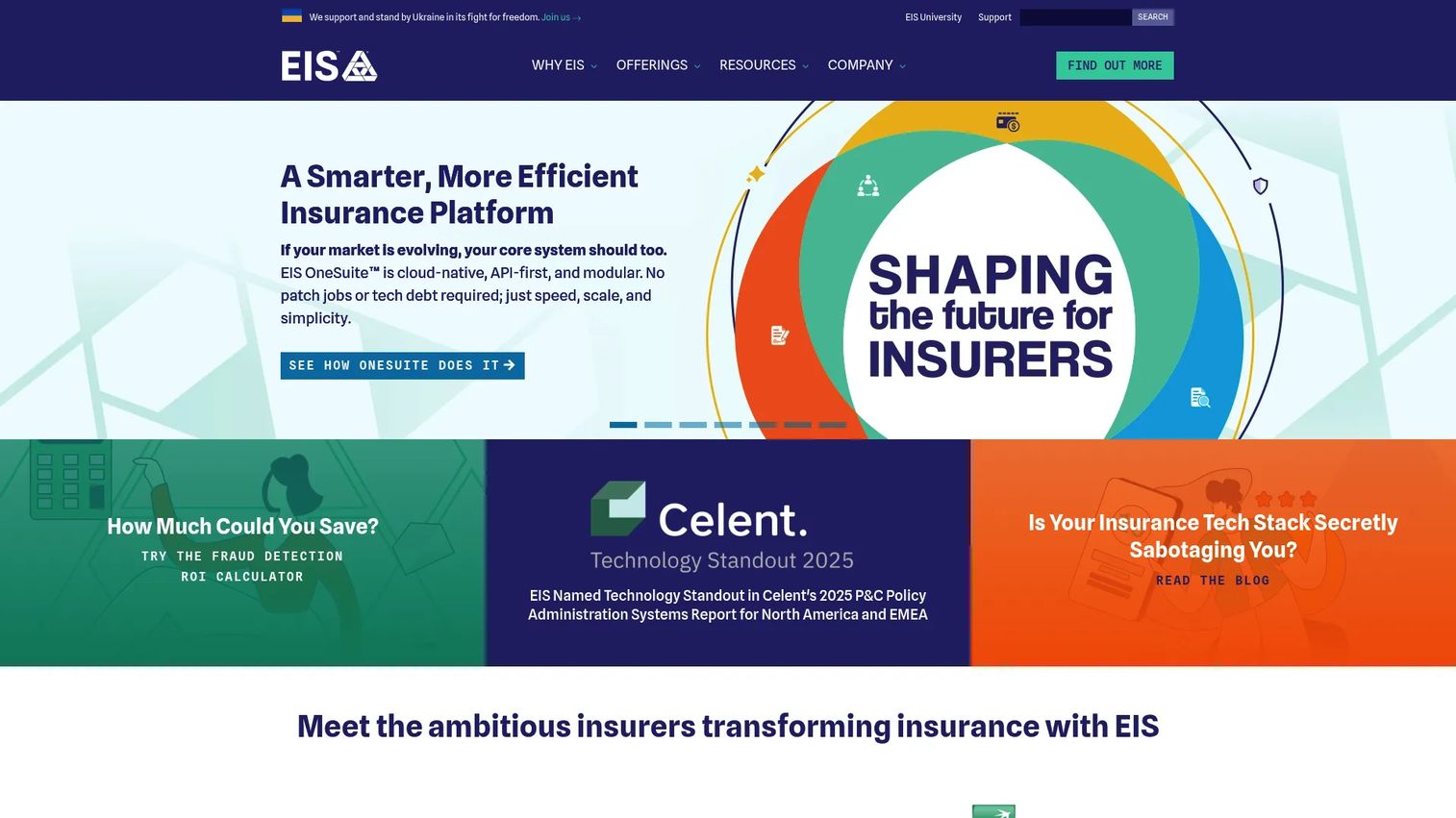
EIS provides a cloud-native, API-first insurance platform covering policy, billing, claims, customer operations, and digital experiences. Billing capabilities include automation, invoicing, payment processing, reconciliation, delinquency management, and producer compensation, all within a modular, event-driven architecture. For carriers that want billing as part of a wider digital-core replacement rather than a standalone project, EIS provides the integration surface to connect adjacent functions without building point-to-point dependencies.
Best for: Insurance carriers seeking a modern core platform that handles policy, billing, claims, and customer operations in a unified architecture with open APIs.
Key features
- Billing automation, invoicing, payment processing, and reconciliation
- Delinquency management and producer compensation
- Cloud-native, event-driven architecture with open API integration
- Policy administration with product configuration and lifecycle management
- Claims management with configurable workflows and adjudication
Why choose EIS: EIS suits the buyer that sees billing as one component of a larger digital operating model. The platform's architecture supports new product launches without adding separate systems for each workflow. The key question to ask in evaluation: Does the platform support your operating model two years from now, not only today?
EIS pricing: Pricing is discussed through EIS's enterprise sales team. Ask whether pricing is driven by policy volume, premium volume, modules, implementation scope, or a combination, since the model varies by engagement type.
G2 rating: EIS holds a 4.6/5 rating on G2, the highest verified rating among the platforms in this guide.
7. OneShield
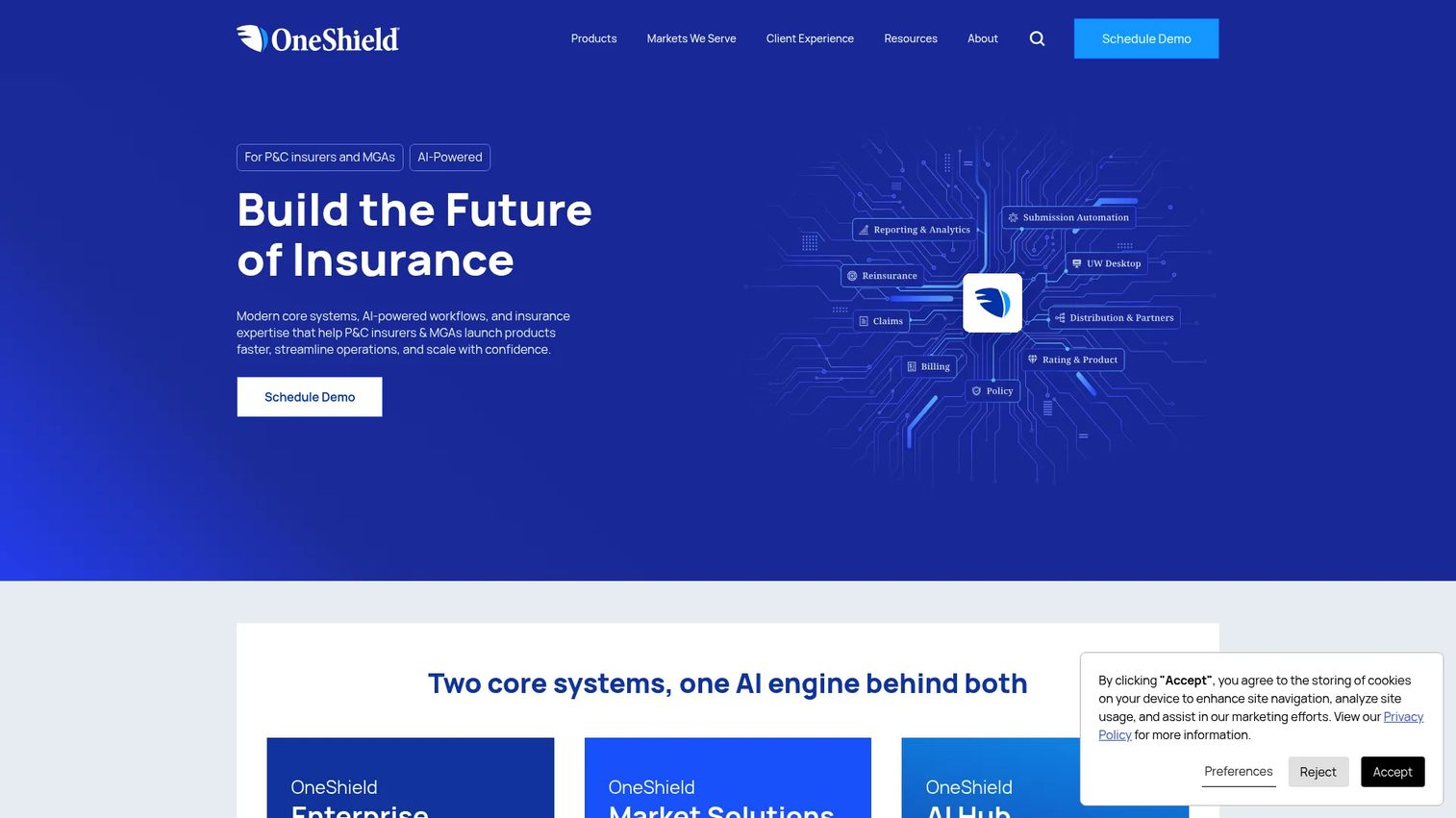
OneShield provides AI-powered core insurance platforms for P&C insurers, MGAs, and specialty carriers. Its product line includes OneShield Enterprise for large carriers and OneShield Market Solutions for MGAs and insurance startups. Both cover policy, billing, claims, rating, and reinsurance management with configurable products, workflows, rules, and forms. OneShield Market Solutions uses an all-inclusive annual subscription that bundles software, hosting, support, implementation, and defined managed-service hours, which simplifies budgeting for smaller organizations.
Best for: Carriers and program administrators that want configurable core operations connecting billing to underwriting and policy workflows, particularly MGAs and specialty programs evaluating a fully managed option.
Key features
- Policy, billing, claims, rating, and reinsurance management
- Configurable products, workflows, rules, and forms
- AI Hub with insurance-specific agents and multi-agent workflows
- OneShield Market Solutions: All-inclusive annual subscription model
- Hosted, managed deployment reducing internal infrastructure requirements
Why choose OneShield: OneShield fits organizations where product configuration and workflow fit matter more than a narrowly defined billing replacement. Assign a named executive owner for platform selection, migration, and post-launch adoption. This is a core-system decision, not a procurement task.
OneShield pricing: OneShield does not publish numeric pricing. OneShield Market Solutions uses an all-inclusive annual subscription. Contact OneShield directly to scope commercial terms against your product and operational requirements.
8. Socotra
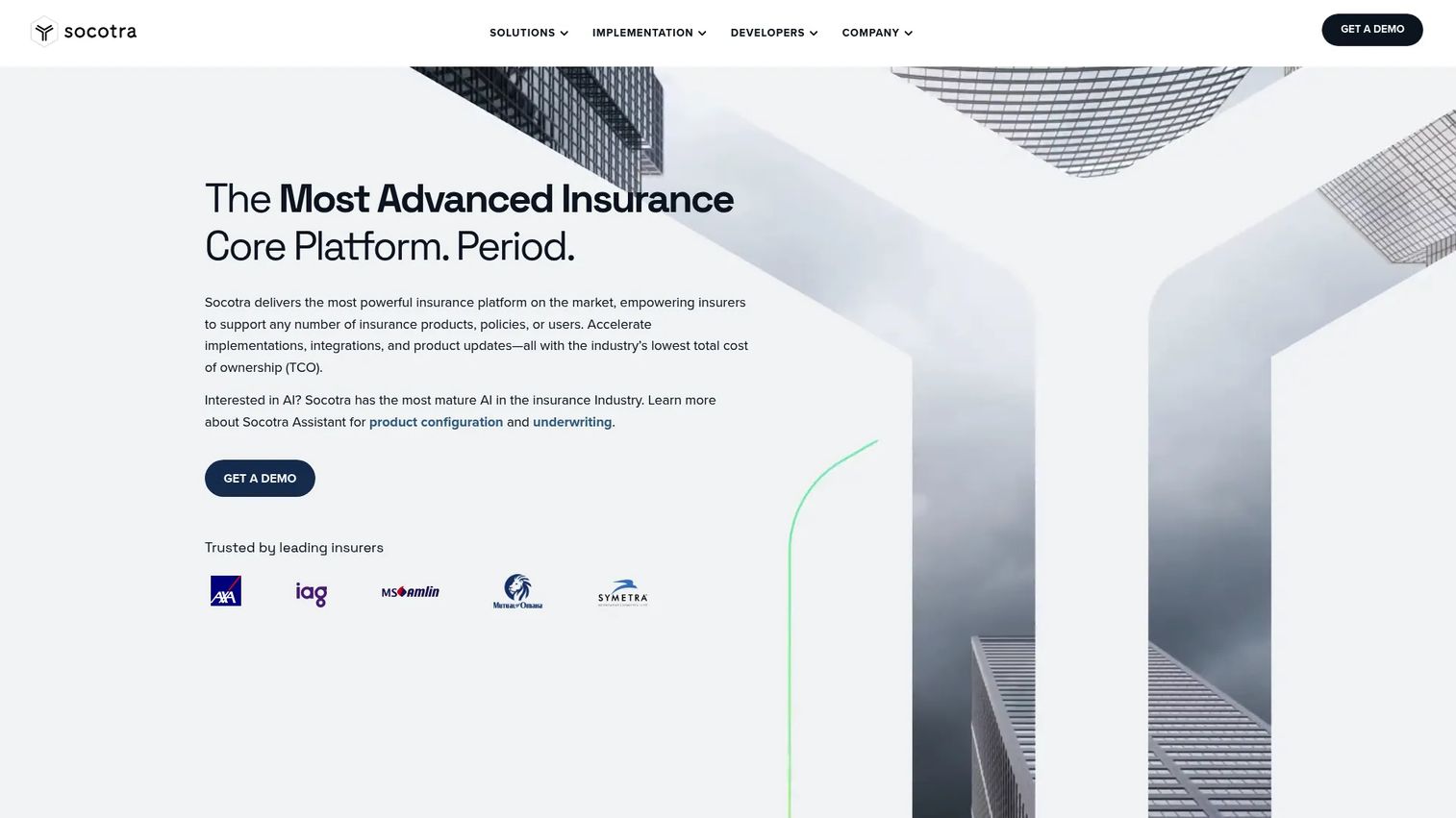
Socotra is a cloud-native insurance core platform built for insurance carriers and insurtechs that need API-oriented flexibility. The platform covers policy administration, billing, claims, reporting, and product configuration with open APIs designed for extensibility. For a technology-led carrier or insurtech that wants to shape its own operating model, Socotra provides the architecture to do it, provided the organization has the engineering ownership to govern integrations and configuration at pace.
Best for: Insurtechs, digital carriers, and MGAs where software differentiation is part of the business model and engineering-led product development is an existing capability.
Key features
- Policy administration across the full policy lifecycle
- Insurance billing with complex workflow support
- Open APIs and configurable insurance product definitions
- Automated underwriting and rating
- Reporting and data access for operational and analytical needs
Why choose Socotra: The platform is a fit for founders who want to ship new insurance products without waiting on a vendor's release cycle. The honest trade-off: Test whether internal engineering ownership will accelerate launches or create a new operational dependency before committing to an API-first architecture.
Socotra pricing: Socotra does not display pricing on its website. Contact the Socotra sales team to discuss commercial assumptions, implementation expectations, and applicable product scope.
Considerations when choosing insurance billing software
Start with your billing model
Map your actual billing requirements before comparing feature lists. Direct, agency, group, installment, and commission billing each carry distinct configuration demands. A platform that handles standard monthly premiums cleanly may break down when your distribution model changes or a new product line requires a different billing arrangement.
Decide between a billing replacement and a core transformation
Replacing billing alone reduces immediate operational pain and carries lower migration risk. A full policy, claims, and billing replacement improves data consistency but requires stronger executive ownership and longer runway. The decision depends on how much the current fragmentation is actually costing you, measured in reconciliation hours, payment exceptions, and finance reporting delays.
Test payments, collections, and reconciliation together
Ask each vendor to demonstrate a complete scenario: Policy change, invoice adjustment, partial payment, delinquency event, commission calculation, payment allocation, and finance reporting. Disconnected feature demonstrations hide integration gaps that surface during implementation.
Confirm integration ownership
Clarify which system owns policy data, payment status, commissions, customer records, and general ledger entries. A demo that shows what happens when data changes across systems is more informative than a tour of individual screens. This question surfaces architectural assumptions that affect your operating model for years.
Price the operating model, not just the license
Include implementation services, internal backfill costs, data migration, integration work, testing, training, and ongoing platform administration in your cost model. For a founder handing this off to a VP of Operations, the relevant number is the total effort required to reach stable operations, not the license fee alone.
Conclusion
Carrier billing software is a distinct category from medical billing. The eight platforms in this guide serve P&C insurers, MGAs, and insurance operators managing premium collection, policyholder payments, commissions, and billing-to-finance reconciliation.
Guidewire BillingCenter is the credible choice for large carriers that need deep billing configuration within an established insurance core. Duck Creek Billing suits carriers that want to modernize billing in phases rather than all at once. Majesco and Sapiens fit insurers evaluating billing as part of a broader core consolidation. Insurity and OneShield serve regional, specialty, and MGA markets with P&C-specific depth. EIS and Socotra suit carriers prioritizing cloud-native architecture and API flexibility.
The next step is a focused proof of concept using a real billing scenario, not a slide presentation. Pick a scenario that reflects your actual distribution model and a mid-term policy change, and ask each shortlisted vendor to run it end to end. Assign one executive owner before the vendor conversations start. That person owns the decision, the implementation, and the adoption.
For further context on adjacent software categories that connect to billing infrastructure, see the guides to claims management software and best payment processing software.
FAQs
Insurance billing software is carrier-facing software that manages premium invoicing, payment schedules, receivables, collections, commissions, reconciliation, and financial reporting across insurance policies. It differs from medical billing software, which handles provider claims submission, payer reimbursement, EHR connectivity, and patient balances. The two categories serve different buyers with different workflows.
Policy administration software manages the policy lifecycle, including quoting, issuance, endorsements, renewals, and cancellations. Billing software manages the financial side: Premium collection, payment schedules, receivables, and related financial controls. Modern insurance core platforms often connect both on a shared data model, which reduces the reconciliation work that occurs when the two systems are separate.
Core features include flexible billing plan types (direct, agency, group, installment), payment method management, commission calculation, collections automation with configurable dunning, payment allocation and reconciliation, audit-ready reporting, and integration with policy and claims systems. Receivables aging and exception reporting are also essential for finance teams that need accurate cash-flow visibility.
Yes. Installment billing is a standard requirement for P&C carriers, and the platforms in this guide support configurable installment plans with payment dates, schedule changes, and exception handling. The critical evaluation point is mid-term policy changes: A policyholder endorsement should automatically trigger invoice adjustments and update the installment schedule without manual intervention.
Collections support typically includes receivables aging dashboards, configurable delinquency alerts, automated follow-up sequences (dunning), payment reminders, payment-plan modification options, and exception reporting for accounts requiring manual handling. The strongest platforms surface payment risk before it affects cash flow rather than reporting it after month-end close.
Yes, these are separate categories. Carrier billing software supports insurer premium collection, policyholder billing, agency commissions, and policy-related financial operations. Medical billing software supports healthcare provider claims submission, payer reimbursement, denial management, EHR integration, and patient statements. The buyers, workflows, and integrations are entirely different.
Carrier-grade billing platforms are sold through enterprise quotes rather than published price lists. Total cost depends on modules selected, lines of business covered, deployment model, implementation services, data migration scope, integrations, and ongoing administration. Budget modeling should include all of these components, not only the software license, to produce a number that reflects the full change cost.
Start with the billing model you actually need to operate today, then map it to a platform that can extend without custom workarounds as volume and product complexity grow. Run a complete billing scenario, including a mid-term change and a delinquency event, before selecting a vendor. Prioritize integration fit with your policy administration and general ledger systems over UI preference or feature breadth that you will not use in the first year.