Your procurement team is running the same RFQ process it ran two years ago. Manual intake, spreadsheet comparisons, supplier follow-up over email. The sourcing work gets done, but it takes three times longer than it should, and the coverage gap on tail spend keeps growing.
According to EY's 2025 CPO survey, 80% of procurement leaders plan to deploy generative AI within three years, yet only 36% have it meaningfully running today. The gap between intention and execution is where procurement hours get consumed.
Autonomous sourcing software changes the equation not by removing procurement judgment, but by automating the repeatable parts: Intake, supplier engagement, bid collection, award recommendations. Policy stays in the workflow. Approvals stay with people. The manual chasing stops.
This guide compares four platforms across different sourcing approaches so your finance or operations lead can own the decision without routing every question back to you.
What's inside
This guide covers four autonomous sourcing platforms selected for workflow coverage, AI autonomy depth, governance controls, integration breadth, and verified sourcing use cases.
- Who it's for: Founders and operators evaluating procurement automation for mid-market or enterprise teams
- Selection criteria:
- Verified sourcing workflow from intake through award or negotiation
- AI autonomy with documented governance and human oversight controls
- Integrations with ERP, P2P, or source-to-pay systems
- Pricing and G2 ratings checked live before publication
TL;DR
- Best source-to-pay suite option: Coupa, for teams that want autonomous sourcing inside a broader procurement platform
- Best sourcing optimization option: Keelvar, for complex tenders, logistics rate events, and constrained award decisions
- Best tail spend option: Fairmarkit, for enterprise teams bringing more spend under managed sourcing
- Best autonomous negotiation option: Pactum, for indirect procurement teams automating supplier negotiations through digital workers
- Choose by bottleneck: Match the tool to whether your team is stuck on intake, event execution, bid optimization, or supplier negotiation
What is autonomous sourcing software?
Autonomous sourcing software uses AI, workflow automation, and procurement rules to run repeatable sourcing tasks from intake through supplier engagement, bid analysis, negotiation, and award recommendations.
The category sits between basic sourcing automation and broader autonomous procurement. Sourcing automation handles predefined task sequences. Autonomous sourcing can coordinate multi-step workflows with AI-generated recommendations, supplier outreach, bid modeling, and human review gates built in. Autonomous procurement is wider still, covering intake, purchasing, contract workflows, invoice handling, and supplier management end to end.
A chatbot that answers procurement questions is not autonomous sourcing software. The defining capability is execution or coordination inside governed sourcing workflows.
Core capabilities this category covers:
- Intake from email, purchase requisitions, or guided forms
- Supplier discovery and AI-generated supplier recommendations
- Automated RFQs, RFPs, and reverse auctions
- Bid comparison and scenario-based award recommendations
- Negotiation automation through AI agents or digital workers
- Policy controls, approval routing, and exception handling
- Audit trails and decision logs for every sourcing event
- Integrations with ERP, P2P, and source-to-pay platforms
- Reporting on savings, cycle time, and sourcing coverage
The key distinction from conventional eSourcing platforms: Autonomous sourcing platforms can initiate and progress sourcing work without a buyer manually driving each step. Human oversight stays in the loop through approval thresholds and review gates rather than through hands-on task management.
When to use autonomous sourcing software
Automate repeatable tactical sourcing
Routine RFQs, spot buys, and low-complexity indirect procurement requests consume procurement time that should go to strategic work. Autonomous sourcing fits when the rules are clear, the supplier pool is known, and the process runs frequently. Teams using agentic AI platforms in procurement contexts are finding that well-defined sourcing events are prime candidates for agent-led execution.
Expand sourcing coverage for tail spend
Tail spend escapes competitive sourcing because the team lacks bandwidth, not because it lacks value. Autonomous sourcing software can run sourcing events on spend categories that previously went directly to a preferred supplier or through a P-card. More spend under competition typically means better pricing and more supplier data.
Standardize sourcing without slowing the business
Policy-based workflows, pre-built templates, and audit trails let teams move faster without bypassing controls. For a founder handing off operations to a finance or procurement leader, this matters. The goal is a system the new leader can run without calling you for exceptions. Check our guide to AI governance tools for context on how governance frameworks typically sit alongside autonomous AI systems.
Autonomous sourcing software comparison
Here are the four tools mapped by use case, differentiation, pricing model, and G2 rating. All pricing and ratings were verified against live vendor pages and G2 listings.
| # | Product | Best for | Key differentiator | Pricing | G2 rating |
|---|---|---|---|---|---|
| 1 | Coupa | Source-to-pay teams | Autonomous sourcing inside an integrated spend management suite | Contact sales | 4.2/5 |
| 2 | Keelvar | Complex sourcing optimization | AI agents with constrained bid modeling and logistics rate sourcing | Contact sales | 4.7/5 |
| 3 | Fairmarkit | Tail spend automation | Agentic intake-to-award sourcing with supplier discovery | Contact sales | 4.6/5 |
| 4 | Pactum | Autonomous negotiation | Digital workers for single-source and indirect procurement negotiation | Contact sales | N/A |
Best 4 autonomous sourcing software tools
1. Coupa
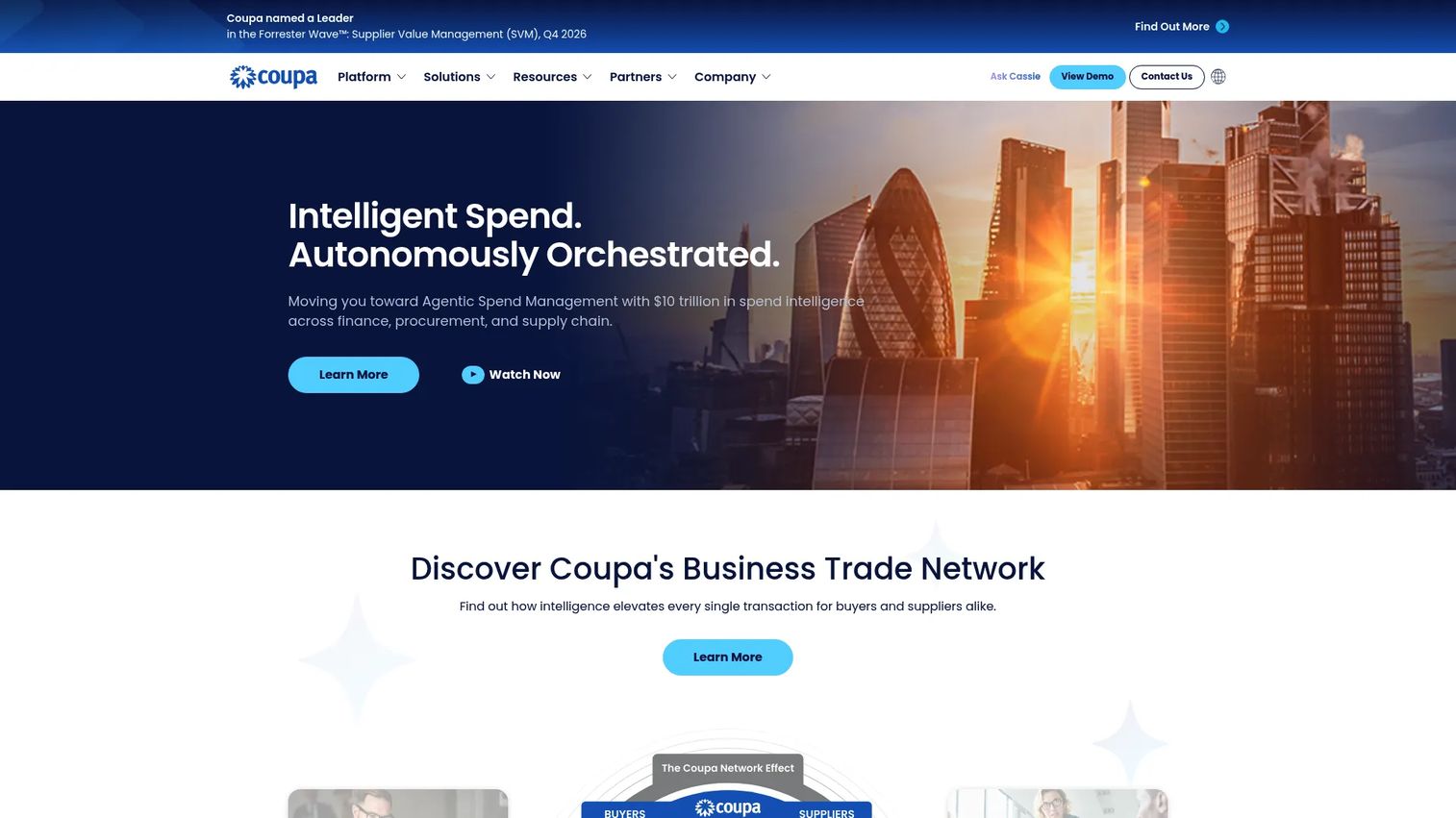
Coupa is a business spend management platform covering procurement, sourcing, invoicing, expense management, supplier management, and payments under one operating layer. Its autonomous sourcing capabilities sit inside the broader Coupa suite, connecting sourcing events to upstream intake and downstream purchase order creation without switching tools. Teams using Coupa for procurement and invoicing can extend the same platform into sourcing event execution and supplier recommendations.
Best for: Enterprise procurement teams that want autonomous sourcing embedded inside an existing source-to-pay operating system.
Key features
- Procurement and purchasing workflow management
- Sourcing events with supplier recommendations
- Invoicing and accounts payable automation
- Expense management and payments
- Spend analytics and compliance reporting
Why choose Coupa: Choose Coupa when the procurement team already operates across multiple spend categories and wants one platform for sourcing, purchasing, and invoicing rather than a point solution. The suite breadth is the trade-off, not the differentiator: More modules means more implementation work, so validate the specific autonomous sourcing module fit during evaluation.
Coupa pricing: Coupa prices by quote. Contact sales for module-level pricing, implementation fees, and contract minimums. The Coupa Supplier Portal is free for suppliers.
G2 rating: 4.2/5
2. Keelvar
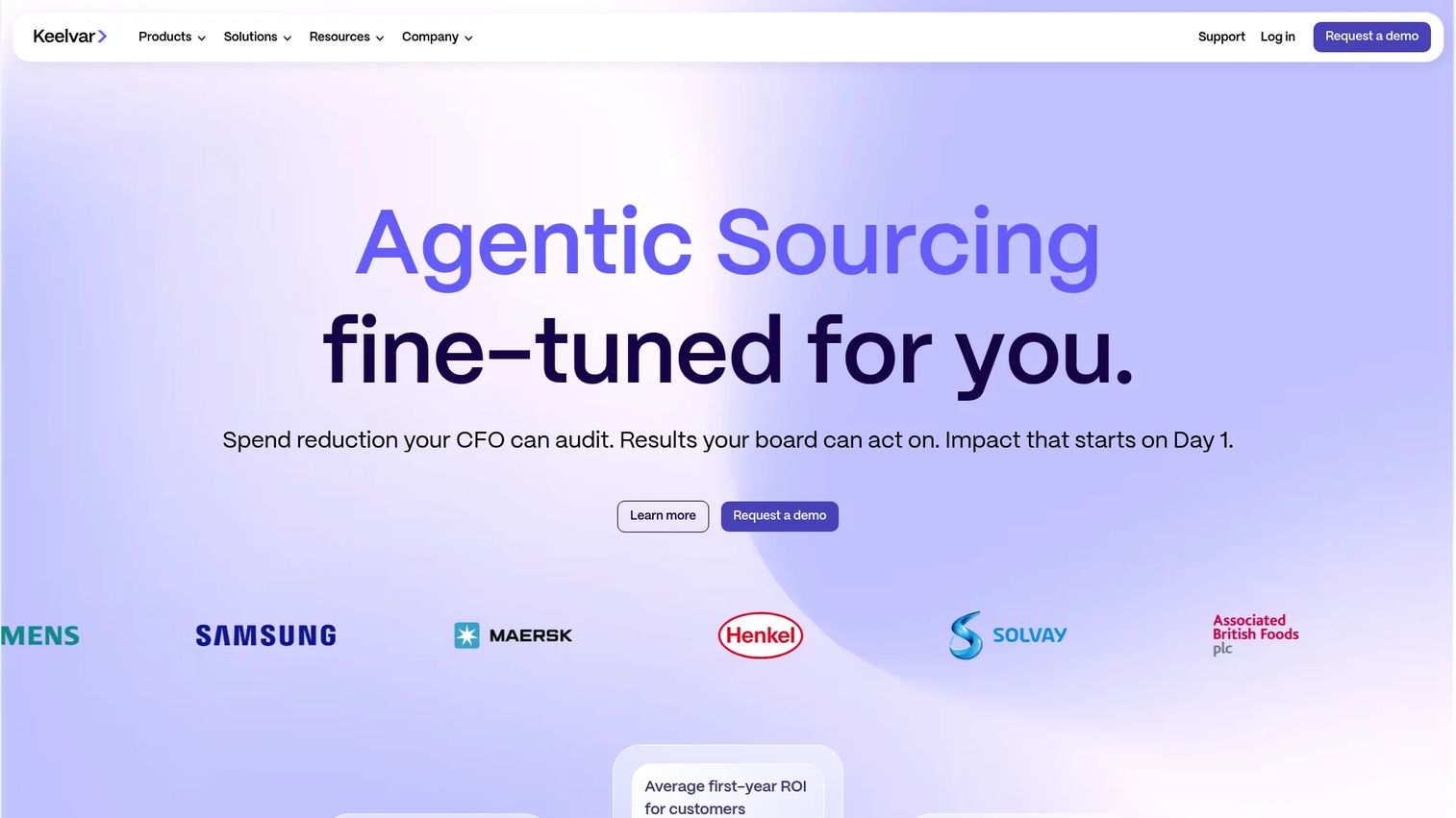
Keelvar is an AI-native agentic sourcing platform built for enterprise procurement teams managing complex, high-volume sourcing events. Its autonomous sourcing agents can build sourcing events, engage suppliers, run negotiations, analyze bids, and recommend awards. The sourcing optimization layer handles constrained award decisions, scenario modeling, and conditional bidding that go beyond lowest-price comparison. Keelvar is particularly well-suited for logistics rate sourcing, MRO, spot buys, mini tenders, and categories where the award decision involves trade-offs across multiple variables.
Best for: Procurement teams running complex sourcing events where optimization and scenario modeling drive award decisions.
Key features
- Autonomous sourcing agents for event build, supplier engagement, and award recommendations
- Sourcing optimization with machine-learning bid analysis and scenario modeling
- RFx and reverse auctions with conditional bidding
- Logistics rate sourcing and rate management
- Workflow automation and API integrations
Why choose Keelvar: Choose Keelvar when your procurement team runs high-volume or analytically complex events and needs more than basic RFQ automation. It earns its place when the award decision requires constraint modeling, multi-variable trade-offs, or logistics-specific rate structures. For a founder, this matters because it reduces the need to scale procurement headcount for analytically heavy sourcing work, letting a smaller team cover more spend categories with better decisions.
Keelvar pricing: Keelvar prices by quote. Confirm event volume, optimization requirements, and implementation support during evaluation.
G2 rating: 4.7/5
3. Fairmarkit

Fairmarkit is an agentic sourcing platform that uses AI agents to automate procurement workflows from intake through supplier discovery, RFx execution, evaluation, award, and performance tracking. Its core use case is bringing tail spend and tactical procurement under managed sourcing by running the full cycle with minimal buyer involvement. Fairmarkit's supplier discovery and AI-generated recommendations help procurement teams compete spend categories that previously went uncontested. It integrates with SAP Ariba, Coupa, and ServiceNow, so it can sit alongside existing procurement systems rather than replacing them.
Best for: Enterprise procurement teams that need to increase competitive sourcing coverage across tail spend and tactical categories.
Key features
- AI-powered intake and requester copilot
- AI supplier discovery and supplier recommendations
- RFx event execution, auctions, and bid optimization
- Side-by-side bid analysis and scenario-based award modeling
- Audit-ready sourcing records and compliance insights
Why choose Fairmarkit: Choose Fairmarkit when high volumes of lower-value sourcing events are consuming procurement bandwidth that should go elsewhere. The operating leverage angle for founders is direct: More spend under competition without adding proportional headcount. The platform's integrations with major procurement suites also make it a viable add-on rather than a full platform replacement, which matters if the team already runs SAP Ariba or Coupa for strategic sourcing.
Fairmarkit pricing: Fairmarkit prices by quote. Ask sales about sourcing volume, supplier network usage, and implementation costs.
G2 rating: 4.6/5
4. Pactum
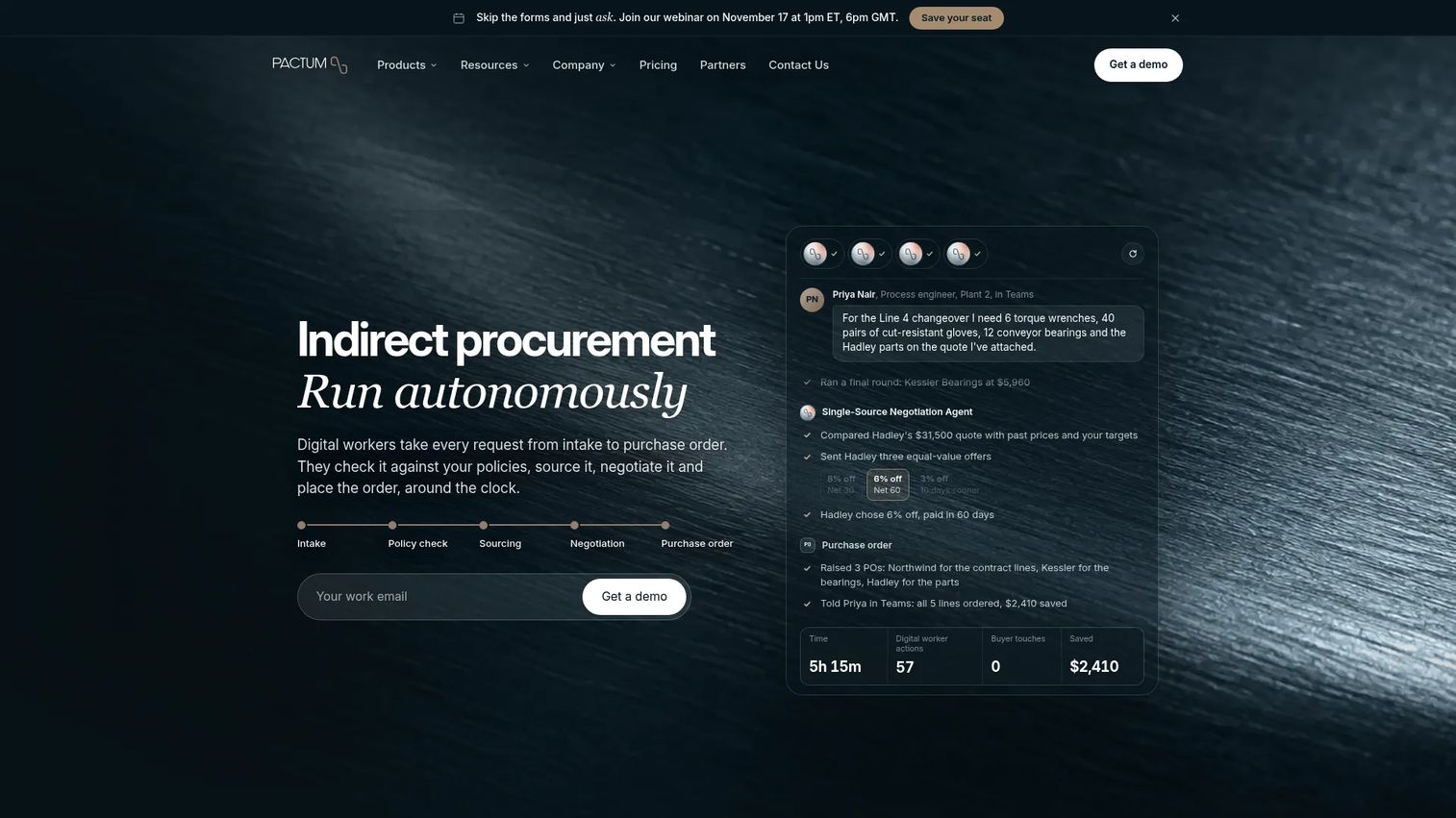
Pactum provides autonomous AI agents for enterprise procurement intake, compliance alignment, sourcing, and supplier negotiation. Its model centers on digital workers: AI agents assigned to specific procurement tasks including intake alignment, single-source negotiation, tactical sourcing, advanced sourcing events, and post-sourcing negotiation. Where other platforms focus on sourcing event execution, Pactum specializes in automating the commercial back-and-forth between buyers and suppliers, particularly for indirect spend, payment terms, discounts, and rebates. Pactum integrates with SAP Ariba, SAP S/4HANA, Coupa, and Microsoft Teams.
Best for: Procurement teams that want autonomous negotiation for indirect spend and high-volume supplier engagement campaigns.
Key features
- Intake Agent: Converts plain-language requests into coded, policy-compliant requisitions
- Alignment Agent: Checks requisitions against procurement policies before sourcing begins
- AI agents for single-source negotiation, tactical sourcing, and post-sourcing negotiation
- Supplier engagement campaigns for payment terms, discounts, and rebates
- Integrations with SAP Ariba, SAP S/4HANA, Coupa, and Microsoft Teams
Why choose Pactum: Choose Pactum when procurement savings depend on repeated supplier negotiations that buyers are currently handling manually or outsourcing. It makes economic sense when the cost of manual buyer time or outsourced procurement operations exceeds what an annual subscription would run. For founders, the angle is simpler: Encode commercial strategy in procurement rules once, then let agents run the conversations at scale. Every customer starts with a pilot before a full deployment.
Pactum pricing: Pactum prices by annual subscription tied to revenue band and selected digital workers. Each customer starts with a pilot. Contact sales for a written proposal.
Considerations when choosing autonomous sourcing software
Start with the sourcing bottleneck
Before evaluating platforms, map where sourcing work actually stalls. If the problem is intake quality and routing, the fix is upstream. If the problem is too many events running manually, focus on event execution and automation depth. If the problem is tail spend coverage, prioritize supplier discovery and RFQ automation. Buying a broad platform for a narrow bottleneck adds cost without adding coverage.
Validate governance before autonomy
Autonomy without controls creates audit risk. During evaluation, ask specifically about approval thresholds, role-based permissions, exception handling, decision logs, and human review gates. A well-governed autonomous sourcing workflow should be fully auditable: Every AI recommendation should trace back to the data and rules that produced it.
Check integration depth
The platform needs to read from your existing procurement systems and write outcomes back cleanly. Ask whether it reads purchase requisitions from your ERP, syncs supplier records, and pushes award outcomes to downstream purchasing or contract workflows. Surface-level integrations that require manual export and import create more work, not less. See our roundup of accounts payable automation software for context on how upstream and downstream procurement integrations typically connect.
Measure savings and cycle time before rollout
Define baseline metrics before the platform goes live. Track sourcing cycle time, sourcing coverage as a percentage of addressable spend, realized savings against baseline pricing, and supplier response rates. Without a baseline, it is impossible to tell whether the platform is working. Most procurement transformation projects that fail do so because the team never agreed on what success looked like before they started.
Match implementation effort to team maturity
A large spend management suite can standardize procurement across the organization, but it requires more implementation resources and change management. A specialist tool focused on tail spend or negotiation automation can deliver faster wins if the bottleneck is narrow and well-defined. Ask sales for the typical time-to-first-event for a team of your size and ERP configuration.
Conclusion
Each of the four platforms in this guide addresses a different procurement constraint. Coupa fits teams that want sourcing embedded inside a broader spend management suite. Keelvar fits complex, optimization-heavy sourcing events where the award decision involves multiple variables. Fairmarkit fits enterprise teams trying to bring more tail spend under competitive sourcing. Pactum fits organizations where procurement savings depend on repeated supplier negotiations that currently run manually.
The practical next step: Map 20 recent sourcing requests across intake type, spend category, supplier count, approval path, and cycle time. The pattern will tell you which software category addresses your actual constraint.
For teams evaluating operational software, understanding how complex workflows look in practice before you sign a contract saves time. Start your journey with Guideflow today!
FAQs
Autonomous sourcing software uses AI agents, workflow automation, and procurement rules to execute repeatable sourcing tasks from intake through supplier engagement, bid analysis, negotiation, and award recommendations. It differs from basic sourcing tools in that it can coordinate multi-step workflows with AI-generated recommendations and human review gates rather than requiring a buyer to manage each step manually.
Sourcing automation handles predefined, rule-based tasks such as sending a standard RFQ template to a supplier list. Autonomous sourcing can coordinate multi-step workflows, generate supplier recommendations, analyze bids, and recommend awards based on procurement rules, with human review built in at defined approval thresholds. The distinction is between executing a fixed script and adapting within a governed workflow.
Autonomous sourcing focuses on the sourcing workflow specifically: Intake, supplier discovery, RFx events, bid analysis, negotiation, and award recommendations. Autonomous procurement is a broader category covering the full source-to-pay process, including purchasing, contract workflows, invoice handling, and supplier lifecycle management. Most of the platforms in this guide focus on the sourcing layer, with integration into broader procurement systems rather than replacing them entirely.
Depending on the platform, autonomous sourcing software can handle intake from email or requisitions, supplier discovery and recommendations, automated RFQs and RFPs, reverse auctions, supplier communications and follow-up, bid comparison and award recommendations, negotiation on payment terms or pricing, and reporting on savings and cycle time. Governance tasks including approval routing, policy checks, and audit trail creation typically run alongside these workflows rather than separately.
It can be, but governance design determines the answer. Procurement teams should evaluate approval thresholds, audit logs, exception handling paths, role-based permissions, and human review gates before deployment. AI recommendations should always be traceable to the data and rules that produced them. Teams in regulated industries or with complex supplier contracts should validate how the platform handles exceptions and what happens when an AI recommendation falls outside normal parameters.
Fairmarkit is positioned for tail spend and tactical procurement, with agentic intake-to-award workflows and AI supplier discovery built specifically for lower-value, high-volume sourcing events. When evaluating for tail spend, validate supplier network coverage in your spend categories, RFQ workflow depth, audit trail quality, and ERP integration. See our guide to AI procurement software for context on how AI-driven tools are changing procurement workflows more broadly.
At minimum, the platform should connect to your ERP for requisition data and your P2P or source-to-pay platform for downstream purchasing and invoicing. Supplier management systems, contract lifecycle management tools, finance reporting systems, and communication platforms like Microsoft Teams or Slack are common additional integration points. The quality of the integration matters as much as its existence: Ask whether data flows automatically or requires manual export steps. For context on how software evaluation processes typically work, see our guide to agentic AI tools for sales, which covers agentic workflow evaluation criteria applicable across categories.
Track sourcing cycle time reduction against your baseline, sourcing coverage as a percentage of addressable spend, realized savings compared to historic pricing, supplier response rates, and manual hours reduced per sourcing event. Compliance rate and stakeholder satisfaction are worth tracking alongside financial metrics. Establish baselines before go-live: 55% of finance and procurement decision-makers already use AI-powered procurement tools according to SAP Taulia and Opinium (2025), which means benchmarking against industry norms is increasingly possible as adoption data accumulates.