Your sales team hears the same objection every quarter. Support logs the same ticket category for months. Product gets the same feature request from five different customers. Yet none of those signals make it into a prioritized decision. They sit in call recordings, Slack threads, and meeting notes, owned by no one.
That is the actual problem. Not a shortage of ideas. A shortage of infrastructure to turn ideas into decisions.
Only 28% of U.S. employees strongly agree their opinions count at work, according to Gallup (2025). The gap is not disengagement. It is a missing operating layer: No submission channel, no evaluation criteria, no owner, no feedback loop. Employees stop contributing when nothing visibly happens.
Workplace innovation platforms fix that operating layer. They give organizations a repeatable way to collect, evaluate, prioritize, and track ideas until they become implemented initiatives.
What's inside
This guide is for founders, innovation leads, and operations owners who need to turn frontline insight into measurable outcomes. Eight platforms were selected based on:
- End-to-end idea workflow coverage (submission through implementation)
- Governance and evaluation controls
- Integrations with common workplace systems
- Fit for structured programs rather than one-off suggestion campaigns
You'll find a comparison table, eight tool breakdowns, a buyer checklist, and scenario-based selection guidance. The focus stays on purpose-built innovation management platforms, not general chat, whiteboarding, or project tools.
TL;DR
- Best for structured innovation programs: InnovationCast, for teams that need guided challenges and participation mechanics
- Best for enterprise governance: Qmarkets, for repeatable campaigns with configurable workflows
- Best for broad innovation portfolios: Brightidea, for organizations managing multiple programs across departments
- Best for open innovation and market signals: Wazoku, for teams combining internal ideas with external expertise
- Best for configurable processes: HYPE Innovation, for flexible workflows across ideation, scouting, and portfolio management
- Best for adoption inside existing tools: Sideways 6, for organizations where participation is the primary constraint
What are workplace innovation platforms?
Workplace innovation platforms are software systems that help organizations gather, develop, evaluate, prioritize, implement, and measure employee-led ideas. They replace scattered suggestion channels with a governed operating layer that gives every idea a visible route from submission to decision.
What these platforms do
The core lifecycle runs in six stages:
- Collect: Always-on submission channels or time-bound challenges capture ideas from employees, customers, or partners
- Route: Ideas reach relevant reviewers and subject-matter experts
- Develop: Contributors and reviewers collaborate, comment, and refine ideas
- Score: Evaluation criteria score ideas on strategic fit, feasibility, and estimated impact
- Execute: Approved ideas move into experiments, pilots, or implementation work
- Measure: The platform tracks progress and reports business outcomes
Core capabilities to look for
- Configurable idea-submission forms and challenge campaigns
- Commenting, voting, and expert-review workflows
- Stage-gate processes and scoring models
- Portfolio views and initiative tracking
- Participation analytics and recognition mechanics
- Integrations with identity providers, project tools, and reporting environments
- Reporting on implementation rate and business value
What workplace innovation platforms are not
General collaboration, whiteboarding, and intranet tools can support innovation activities. They do not replace a purpose-built platform when the company needs structured evaluation, named reviewers, decision rights, and outcome measurement. A chat thread can capture an idea. It cannot run a stage-gate, close the feedback loop, or produce a board-ready record of what was implemented and what it delivered.
When to use a workplace innovation platform
Capture frontline insight before it disappears
Customer-facing teams see recurring problems that never reach product or operations. Support logs the same issue, sales hears the same objection, and implementation repeats the same workaround. An employee engagement layer helps, but without a structured submission channel and an assigned owner, the signal stays invisible. A workplace innovation platform gives those teams a route from observation to reviewed idea, with a feedback loop that confirms what happened.
Run innovation challenges around a strategic priority
A founder preparing for a board conversation on retention, infrastructure cost, or new-market entry can frame that question as a time-bound challenge. Contributors submit targeted ideas. Reviewers evaluate against stated criteria. The result is a shortlist of vetted proposals, not a backlog of unrelated suggestions. This approach fits organizations that need focused participation around a specific business outcome rather than an always-open inbox.
Move from idea volume to measurable execution
The platform earns its place when leadership needs to report what happened to the ideas they collected. Participation rate and submission volume are leading indicators. Implementation rate, realized cost savings, and revenue impact are the metrics a board cares about. A workplace innovation platform creates the record that connects submission to outcome, which is what most spreadsheets and form tools cannot produce.
Workplace innovation platform comparison
Pricing models and governance depth vary significantly across this category. Evaluate platforms based on the operating model you need, not the longest feature list.
| # | Product | Best for | Key differentiator | Pricing | G2 rating |
|---|---|---|---|---|---|
| 1 | InnovationCast | Structured employee innovation programs | Guided challenges, participation mechanics, and implementation support | From $2,999/mo | N/A on G2 |
| 2 | Qmarkets | Enterprise idea management and campaigns | Configurable challenges, evaluation, governance, and portfolio reporting | Contact sales | 4.5/5 |
| 3 | Brightidea | Large innovation portfolios | Idea programs plus portfolio-level innovation management | From $99/team site/mo | 4.3/5 |
| 4 | Wazoku | Open innovation and market intelligence | Internal ideation combined with external expertise and scouting | From $15,000/year | 4.4/5 |
| 5 | HYPE Innovation | Configurable innovation management | Flexible processes for ideas, scouting, and portfolio decisions | Contact sales | 4.8/5 |
| 6 | Planbox | Product and operational innovation | Idea management tied to initiative execution | Contact sales | N/A on G2 |
| 7 | Sideways 6 | Employee ideas inside collaboration tools | Captures ideas where employees already communicate | Free up to 10 users; from $3/user/mo | 4.4/5 |
| 8 | IdeaScale | Crowdsourced ideas and participatory challenges | Broad community participation, voting, and challenge programs | Contact sales | 4.5/5 |
Best workplace innovation platforms for 2026
1. InnovationCast
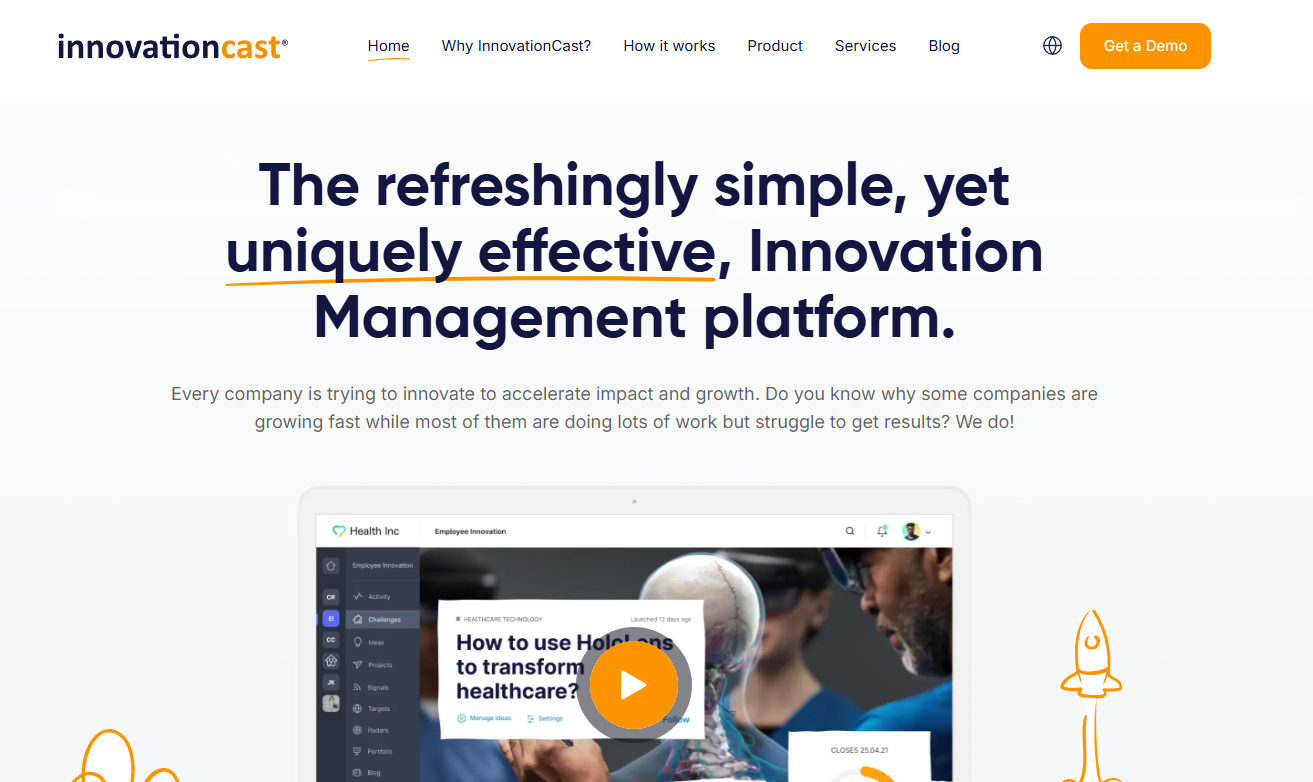
InnovationCast is collaborative innovation management software for discovering, developing, assessing, and implementing ideas across an organization. The platform centers on structured challenges and always-on idea collection, with workflows for co-creation, expert review, and recognition built into the process. It also includes innovation education content, which makes it useful for organizations building participation habits from scratch.
Best for: Mid-market and enterprise teams that need program design support alongside software, not just a place to collect submissions.
Key features
- Innovation challenges and always-on idea submission
- Custom idea assessment and stage-gate workflows
- Idea incubation and experimentation tracking
- Innovation scouting and foresight capabilities
- Analytics, portfolio management, and recognition mechanics
Why choose InnovationCast: Choose it when the company needs to build a repeatable innovation program and wants structured support for challenge design, reviewer workflows, and participation cadence. It fits founders who need a system their operations or people team can own without constant hand-holding.
InnovationCast pricing: Plans start at $2,999/month for Standard (1 community, 2 admins, 10 active challenges). Plus runs $4,199/month and adds branding, SSO, and a second community. Enterprise is $7,199/month and includes Microsoft Teams, Power BI, dedicated success management, and 24/7 support.
2. Qmarkets
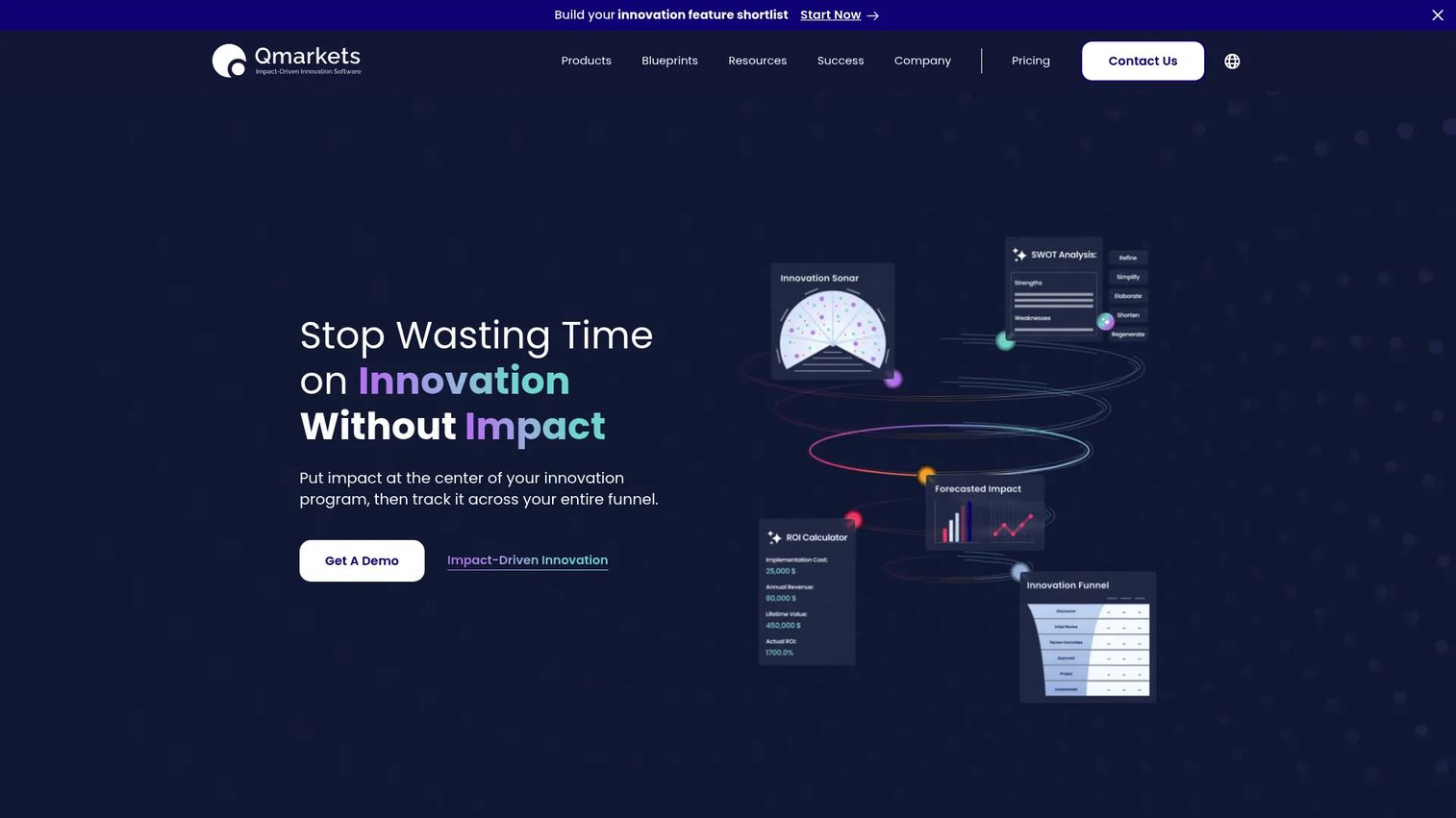
Qmarkets provides enterprise innovation management software covering idea management, continuous improvement, technology scouting, and innovation portfolio management. Its configurable challenge structure lets teams run multiple programs simultaneously, with evaluation workflows, AI-powered clustering, and ROI tracking built in. The platform supports both strategic foresight and operational improvement work.
Best for: Organizations managing repeatable innovation campaigns across business units or regions, where governance and stakeholder review are non-negotiable.
Key features
- Idea challenges with always-open submission channels
- Technology scouting and startup discovery
- Continuous improvement workflows
- Innovation portfolio management and ROI tracking
- AI-powered evaluation, clustering, and strategic analysis
Why choose Qmarkets: It suits companies that need strong program structure, a formal governance layer, and reporting that can surface in board conversations. Evaluate implementation ownership before you sign: The platform rewards teams with a dedicated operator who can configure workflows and run evaluation cadences.
Qmarkets pricing: Qmarkets uses a recurring annual license with a setup fee. Plans are Core and Enterprise, both priced by quote. The price depends on product family, user count, integrations, and add-ons. Contact sales for figures.
G2 rating: 4.5/5
3. Brightidea

Brightidea is an established enterprise innovation management option for capturing, evaluating, and tracking ideas across departments. It covers idea campaigns, hackathon management, expert evaluation workflows, and portfolio visibility. The platform is built for organizations running multiple innovation programs simultaneously and needing a central view of what is at what stage.
Best for: Larger organizations building an innovation portfolio across products, operations, or transformation work, where centralized visibility matters as much as intake.
Key features
- Idea campaigns, submission portals, and hackathon management
- Customizable stage-gate workflows and expert evaluation
- Innovation labs and experimentation support
- Portfolio visibility and initiative tracking
- ROI, analytics, and business-impact reporting
Why choose Brightidea: Choose it when leadership needs standardized evaluation across multiple programs and a record of which initiatives delivered measurable results. It is better matched to companies with an existing innovation function than to teams starting from zero.
Brightidea pricing: Brightidea Memo starts at $99/team site/month and includes a free trial. The broader Innovation Cloud is quote-based. Contact sales for enterprise terms.
G2 rating: 4.3/5
4. Wazoku
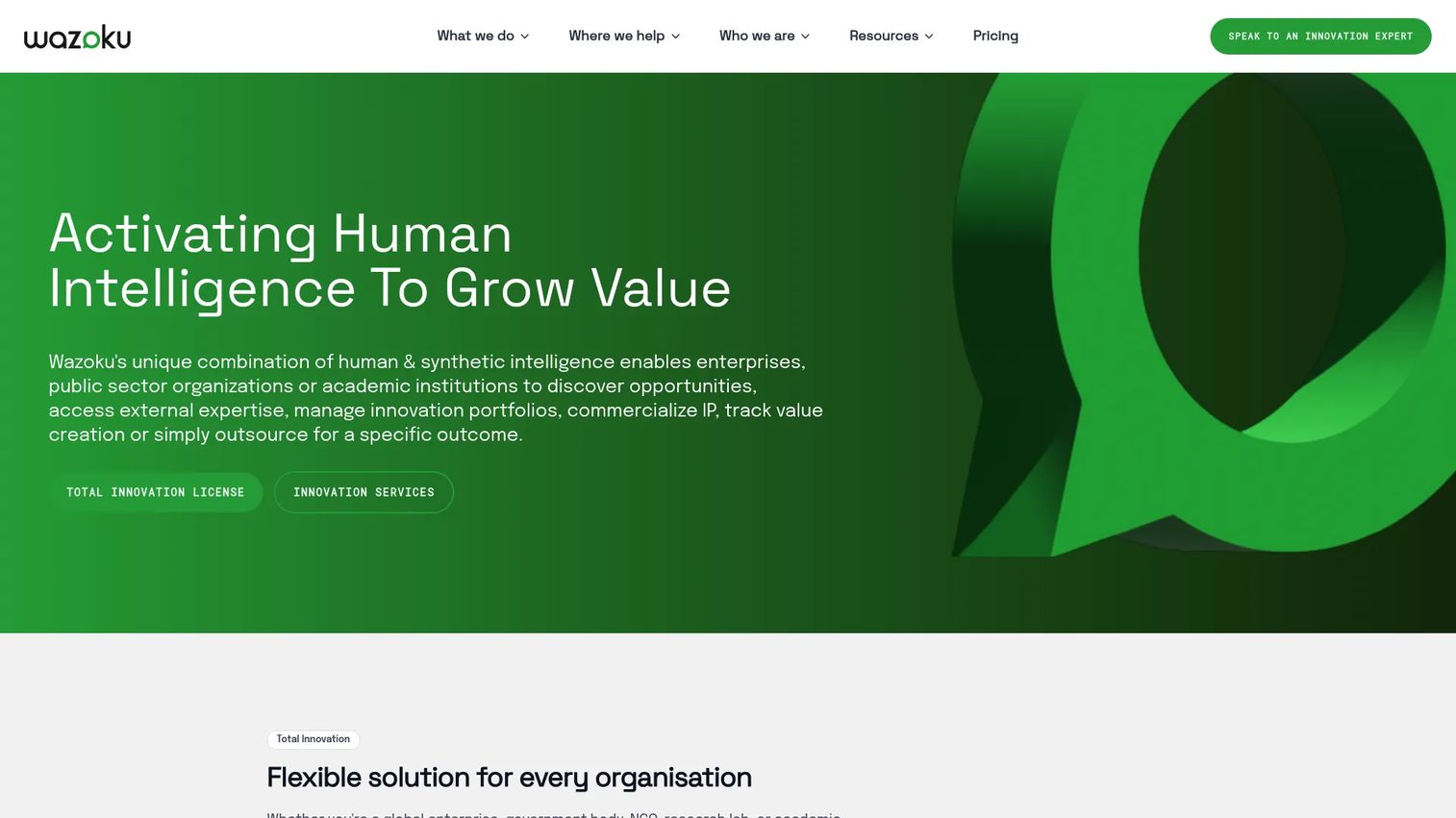
Wazoku provides an intelligent innovation platform for managing ideas, challenges, ecosystems, and portfolio governance. It combines internal ideation with external problem-solving networks and technology scouting, which sets it apart from platforms focused only on employee submissions. The Wazoku.ai product adds AI-assisted content curation and strategic analysis.
Best for: Organizations that need employee ideas alongside external expertise, market signals, and open-innovation methods, particularly for strategic bets that internal teams cannot validate alone.
Key features
- Challenge workflows and idea management
- External expert communities and ecosystem collaboration
- AI Copilot with intelligent automation
- Content curation, technology scouting, and insights
- Portfolio management and analytics
Why choose Wazoku: It fits companies whose innovation work extends beyond internal process improvement into market research, strategic partnership exploration, or technology evaluation. A basic workplace idea portal does not cover this ground.
Wazoku pricing: Wazoku.ai starts at $15,000 per year per Admin; participation for non-admin contributors is free. The optional Deep Research add-on costs $2,950/year. The broader Wazoku Platform uses customized packages priced by quote.
G2 rating: 4.4/5
5. HYPE Innovation
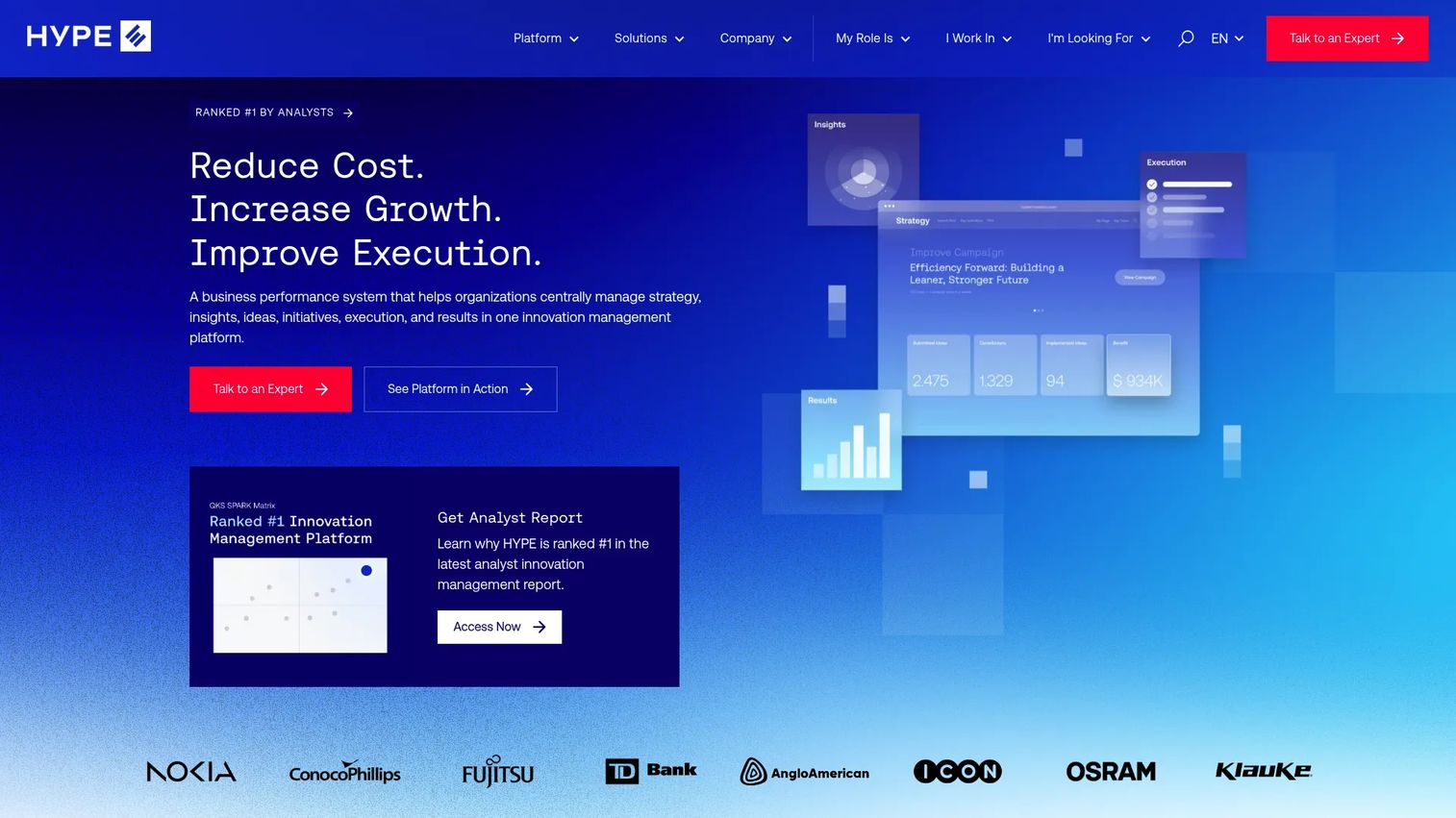
HYPE Innovation is an AI-first enterprise innovation management platform for capturing opportunities, prioritizing initiatives, and measuring business impact. Its configurable stage gates and process workflows let teams build different evaluation paths for ideas, technology scouting, experiments, and strategic initiatives. The Innovation Graph and AI Coach capabilities add analytical depth beyond standard voting or scoring.
Best for: Companies with complex innovation processes that need separate workflows for ideation, technology scouting, and portfolio-level decisions.
Key features
- Configurable process workflows and stage-gate automation
- Technology scouting and partnering ecosystem tools
- Innovation radar views and strategic idea sourcing
- Innovation portfolio management and initiative tracking
- AI capabilities: Innovation Graph, AI Coach, AI Idea Generation, and AI-powered evaluation
Why choose HYPE Innovation: Choose it for a flexible operating model rather than a fixed suggestion-box workflow. Configuration should follow a defined internal decision process; teams that buy before designing their governance model tend to underuse the platform's depth.
HYPE Innovation pricing: HYPE does not display pricing. Contact the sales team directly for packaging details and implementation support options.
G2 rating: 4.8/5
6. Planbox
Planbox now redirects to HYPE, a business performance system that connects idea management, innovation management, and initiative execution. The combined platform gives product and operations teams a tighter link between employee submissions and the prioritization and delivery workflows where approved work actually gets done.
Best for: Product and operations teams that want ideas to feed directly into prioritization and roadmap decisions, not sit in a separate queue.
Key features
- Idea management and innovation campaigns
- Prioritization frameworks and portfolio views
- Initiative execution and workflow tracking
- Innovation reporting
Why choose Planbox (via HYPE): It suits organizations where the biggest gap is not idea collection but the handoff from reviewed idea to owned initiative. Teams that need tighter integration between innovation input and execution planning will find this model useful.
Planbox pricing: Planbox's site redirects to HYPE. Contact HYPE Innovation directly for current commercial details.
7. Sideways 6
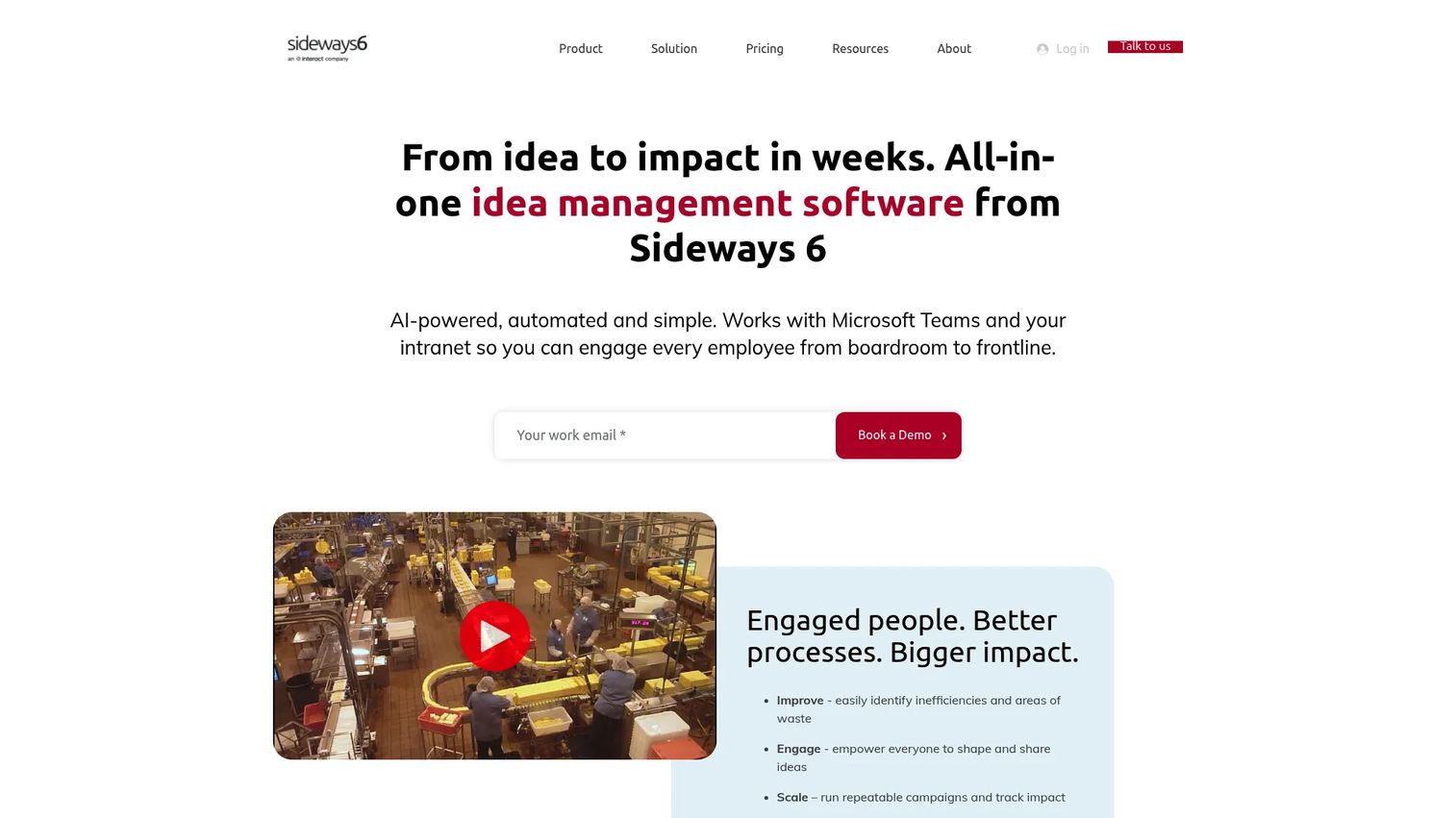
Sideways 6 captures, manages, and implements ideas directly inside Microsoft Teams, Viva Engage, Workplace by Meta, and online forms. Rather than sending employees to a separate portal, it meets them in the tools they already use. AI capabilities include idea improvement suggestions, duplicate detection, and auto-population. ISO 27001 certification and Azure AD SSO cover enterprise security requirements.
Best for: Organizations where participation is the primary constraint, especially those already running Microsoft Teams as the core collaboration environment.
Key features
- Idea capture inside Microsoft Teams, Viva Engage, and Workplace by Meta
- Idea workflows with stages, ownership, automation, and shortlisting
- AI: Idea improvement, similar-idea detection, AI search, and auto-population
- Analytics, data export, and Power BI integration
- Enterprise security: ISO 27001, SAML, and Azure AD SSO
Why choose Sideways 6: If employees are not submitting ideas because another portal means another login, this removes the friction. The tradeoff is depth: Confirm during evaluation that the platform's review and reporting workflows are sufficient for the governance model you need.
Sideways 6 pricing: A free Lite plan covers up to 10 users. Paid Lite plans start at $3/user/month. Enterprise pricing is contact-only and sized to the organization's requirements.
G2 rating: 4.4/5
8. IdeaScale
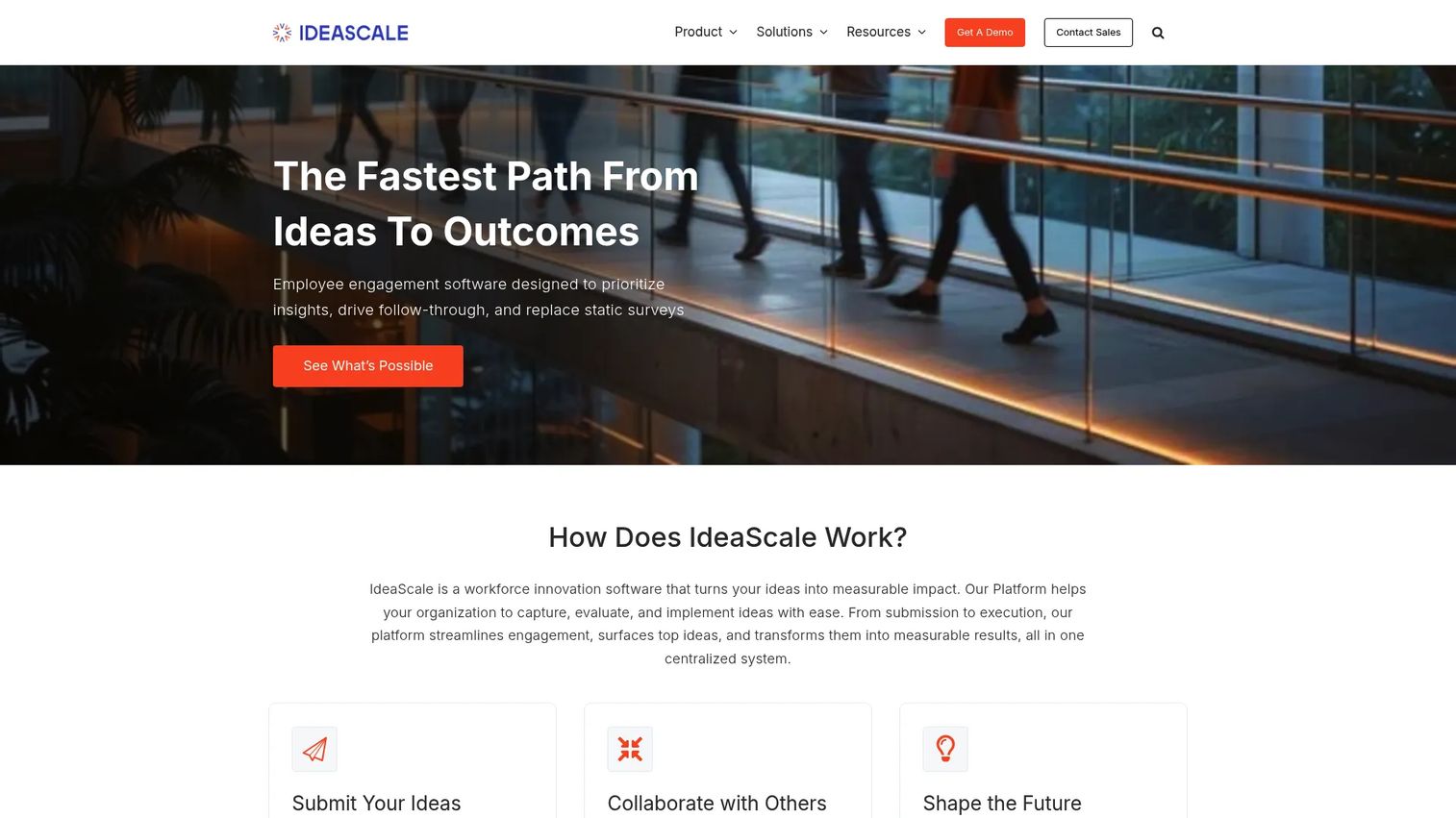
IdeaScale is an innovation management platform for capturing, evaluating, and implementing ideas across organizations and communities. It supports structured challenges, community participation, voting, discussion, and configurable evaluation workflows. AI capabilities include idea clustering, sentiment analysis, and theme detection. A digital whiteboarding feature with Kanban task management supports collaborative development.
Best for: Enterprises, government agencies, and organizations managing structured innovation programs that need broad participation from employees, customers, or partners.
Key features
- Idea collection from employees, customers, and partners
- Configurable workflows for scoring, evaluating, and selecting ideas
- Idea portfolio and progress tracking from submission to implementation
- AI-powered clustering, categorization, trend, and sentiment analysis
- Digital whiteboarding with real-time collaboration and Kanban task management
Why choose IdeaScale: It fits teams that need participation at scale across multiple contributor groups. Before finalizing, validate moderation controls, governance depth, and how implementation tracking maps to your reporting requirements.
IdeaScale pricing: IdeaScale uses custom subscriptions priced by scope, features, and organizational needs. Contact sales for details.
G2 rating: 4.5/5
Considerations when choosing a workplace innovation platform
Map the route from idea to decision first
Before evaluating software, define what happens after someone submits an idea. Name the reviewers, state the scoring criteria, set a response-time standard, and describe the path for approved ideas. Software cannot repair unclear decision rights. The approval workflow has to exist before a platform can support it.
Measure implementation, not participation
Submission volume and voting activity are useful leading indicators. The number your board cares about is implementation rate: How many reviewed ideas became owned initiatives, and what did they deliver? Ask each vendor how the platform reports cost savings, revenue impact, and time from submission to decision. Platforms that only surface participation dashboards will leave you building that reporting layer elsewhere.
Match governance depth to company stage
A 50-person SaaS company does not need the same approval layers as a global enterprise. Governance that is too light produces an unowned backlog. Governance that is too heavy suppresses participation before it starts. Choose a platform with enough control to enforce evaluation cadence, without creating process overhead that discourages submission.
Verify integration and data portability
Check that the platform fits your identity provider, connects to your project and reporting tools, and allows data export for board reporting. Application portfolio management workflows often depend on data flowing cleanly between systems. Confirm ownership of submitted ideas and whether data can be pulled into your existing analytics environment.
Assign an owner before you buy
Every platform in this list requires someone accountable for running challenges, convening reviewers, publishing outcomes, and closing the feedback loop with contributors. The strongest candidates are operations, product-operations, transformation, or people leaders with the authority to run a cadence. A platform without an owner becomes a neglected inbox within two quarters.
How to choose the right workplace innovation platform for your team
If you need a formal employee innovation program: Start with InnovationCast or Qmarkets. InnovationCast fits teams that want program design support alongside the software. Qmarkets suits organizations with an existing innovation function that needs a governed structure for repeatable campaigns and stakeholder review.
If you need portfolio visibility across major initiatives: Prioritize Brightidea or HYPE Innovation. Brightidea works well when leadership needs a central view of many programs. HYPE suits organizations with complex processes that require different workflows for ideation, scouting, and portfolio-level decisions.
If you need external insight as well as employee ideas: Evaluate Wazoku. It fits organizations exploring new markets, technology partnerships, or strategic problems that internal teams cannot solve alone. Internal-only platforms will not cover this ground.
If adoption is the biggest barrier: Evaluate Sideways 6 or IdeaScale. Sideways 6 is the stronger choice for Microsoft Teams environments. IdeaScale fits teams that need broad participation across employees, customers, and partners, with structured challenge and evaluation workflows.
Conclusion
A workplace innovation platform only earns its place if it turns employee insight into evaluated, owned, and measurable action. The platform is infrastructure for a decision-making process, not a replacement for one.
The right choice depends on where your biggest constraint sits. InnovationCast for guided programs with participation mechanics. Qmarkets for enterprise governance across repeatable campaigns. Brightidea for portfolio visibility across multiple programs. Wazoku for open innovation that extends beyond internal teams. HYPE Innovation for configurable workflows across ideation and scouting. Sideways 6 for participation inside existing communication tools. IdeaScale for broad crowdsourced challenges. Planbox (via HYPE) for connecting ideas to execution and delivery.
The practical first step: Identify one recurring business problem that frontline teams see but cannot escalate. Define the owner, the contributor group, the evaluation criteria, and the response standard. Run a time-bound pilot before expanding. A platform that proves its value on one challenge in 60 days is far more defensible to a board than a license purchased on a feature comparison.
For related reading on software that helps employee engagement and portfolio decisions, see our guides on adjacent categories.
Start your journey with Guideflow today!
FAQs
A workplace innovation platform is software that manages the full lifecycle of employee-led ideas, from submission and collaboration through evaluation, prioritization, implementation, and outcome measurement. It differs from a suggestion box or form tool by providing structured evaluation workflows, named ownership, feedback loops, and reporting on business impact. The goal is a repeatable operating layer, not a one-time collection campaign.
Idea management software typically covers submission, collaboration, and review. Workplace innovation platforms extend that with challenge campaigns, governance controls, portfolio views, initiative tracking, and participation analytics. The distinction matters when the company needs to track what happened to ideas after they were reviewed and connect that record to business outcomes.
Engagement improves when contributors can submit ideas, receive visible feedback, collaborate on refinement, and see tangible outcomes. The participation drop-off that most organizations experience is not a motivation problem. It is a feedback-loop problem. When employees see that submitted ideas reach a decision, they submit more. Platforms that close the loop with automated notifications and published results maintain participation without requiring manual communication from program owners.
Useful metrics span the full lifecycle: Participation rate, qualified-idea rate, time from submission to decision, pilot conversion rate, implementation rate, realized cost savings, revenue contribution, and employee feedback-loop speed. Voting counts and submission volume are leading indicators but insufficient on their own. The metrics that belong in a board conversation are implementation rate and business impact, since those connect the program's cost to the value it produced.
Yes, if the company starts with a narrow use case and a defined operating cadence. The risk at that stage is turning the platform into an unowned suggestion backlog. Start with one challenge focused on a specific business problem, assign a named reviewer, set a response standard, and publish the outcome. That cycle builds participation credibility before expanding the program. Sideways 6's pricing structure, with a free tier up to 10 users, makes it practical to pilot before committing a larger budget.
Setup time depends on the number of workflows, contributor groups, integrations, reviewers, and reporting requirements. A single always-on intake channel with a small reviewer group can be live in days. A multi-business-unit program with SSO, CRM integration, and custom evaluation criteria takes weeks to configure and test. Most vendors recommend starting with one challenge or one intake program before expanding, which reduces the time-to-first-value and limits the change management scope.
No. These platforms serve an upstream and cross-functional role. They help surface, score, and prioritize opportunities across the organization, including inputs from employees outside the product team. Approved initiatives then move into the roadmap or project management tools where delivery work is tracked. The innovation platform is the front end of the decision pipeline, not the delivery environment.
Define the first business problem, the owner, the contributor group, the evaluation criteria, the response standard, and the success metric. Software should support an operating model that already has decision rights. A common failure pattern is buying a platform before defining those elements, then watching it become an unmanaged inbox. Run a manual version of the process first, even with a simple form and a weekly review meeting, to confirm the operating model works before adding software infrastructure.