Your pricing changed three times this year. Finance is reconciling billing exports in spreadsheets every month-end. Sales promised custom terms. Product wants usage-based pricing. The board still wants one clean MRR number.
That tension is not a people problem. It is a systems problem. And it compounds fast once you cross $3M ARR and the billing exceptions outnumber the standard cases.
The global subscription revenue management software market was valued at $954 million in 2025 and is projected to reach $2.16 billion by 2034, according to The Insight Partners (2026). The growth reflects how many SaaS companies are discovering that basic billing infrastructure cannot carry pricing complexity, revenue recognition, or board-ready reporting at scale.
The goal here is not prettier invoices. The goal is one source of revenue truth across finance, RevOps, sales, product, and the board deck. This guide helps you find the right tool to build that system, covering 21 subscription revenue management platforms for 2026.
What's inside
This guide compares 21 subscription management tools across billing, payments, revenue recognition, dunning, analytics, and subscription lifecycle management.
- Tools chosen by recurring-revenue category fit, SaaS relevance, finance and RevOps use cases, and market presence
- Selection criteria: Monetization flexibility, finance depth, integration quality, and stage fit
- Comparison table with verified pricing, G2 ratings, best fit, and key differentiator
- Per-tool notes on where each platform earns its place in your stack
Written for SaaS founders, finance leaders, RevOps teams, and GTM operators who need cleaner recurring revenue operations.
TL;DR
- Best overall for SaaS subscription lifecycle management: Chargebee covers billing, usage pricing, dunning, revenue recognition, and retention in one platform
- Best for Salesforce-native quote-to-cash: Salesforce Revenue Cloud, starting at $150/user/month, runs the full revenue lifecycle inside your CRM
- Best for B2B SaaS finance and subscription metrics: Maxio starts at $599/month and pairs billing with board-ready SaaS reporting
- Best for developer-led billing infrastructure: Stripe Billing runs at 0.7% of billing volume and gives engineering teams flexible subscription APIs
- Best for retention and payment recovery: Recurly's Starter plan begins at $249/month plus 0.9% of billing volume, with dunning and win-back workflows built in
- Best for usage-based and hybrid pricing experiments: Zenskar handles metering, custom billing logic, and pricing changes without engineering sprints
- Best for mobile app subscriptions: RevenueCat is free up to $2,500 in monthly tracked revenue, then 1% of what you track
What is subscription revenue management software?
Subscription revenue management software helps companies manage recurring revenue across pricing, billing, invoicing, payments, revenue recognition, renewals, reporting, and retention. It is the operational layer between how you charge customers and what appears in your board deck.
It differs from adjacent categories in a few specific ways:
- Subscription billing software: Narrower scope, focused on recurring invoices and payment collection. Revenue management software typically adds revenue recognition, analytics, lifecycle workflows, and dunning.
- CRM: Manages relationships and pipeline, not billing rules or revenue recognition.
- Accounting software: Records financial transactions, but rarely manages subscription lifecycle complexity like proration, upgrades, or dunning.
- Payment processors: Collect money, but do not manage pricing, entitlements, renewals, or revenue reporting rules.
Key capabilities the category covers:
- Recurring, usage-based, tiered, hybrid, and promotional pricing models
- Subscription creation, upgrades, downgrades, renewals, cancellations, and proration
- Billing, invoicing, tax calculation, payment collection, and payment recovery
- Dunning workflows and involuntary churn reduction
- Revenue recognition, deferred revenue, and finance close support
- MRR, ARR, churn, NRR, LTV, and cohort reporting
- CRM, ERP, accounting, payment gateway, data warehouse, and product usage integrations
For a Series B SaaS founder, the question is not which tool invoices customers. The question is which tool produces numbers the board trusts, without the founder reconciling them manually every month.
Subscription revenue management software is also closely related to contract lifecycle management and quote management for sales-led businesses.
When to use subscription revenue management software
Replace spreadsheet-backed billing operations
Finance exporting data from billing, CRM, and accounting tools to produce MRR or deferred revenue reports is a board risk. Manual reconciliation creates errors, slows month-end close, and makes it impossible to trust the numbers before a fundraise. If your finance team runs any revenue metric through a spreadsheet step, you have already outgrown basic billing infrastructure.
Support usage-based or hybrid pricing
Product and GTM teams regularly want usage-based pricing, overages, prepaid credits, seat-based plans, or packaging experiments. Each change needs billing logic, entitlement tracking, and reporting discipline. Without a platform built for it, every pricing iteration becomes an engineering sprint and finance cleanup project.
Reduce churn from failed payments and renewal friction
Involuntary churn from failed card payments and renewal misses is the quietest leak in a subscription business. It sits inside gross retention numbers and looks like customer dissatisfaction. A proper dunning system recovers a meaningful portion of that revenue automatically, which improves NRR without requiring product or sales changes.
Subscription revenue management software comparison
The table below summarizes all 21 tools with verified pricing and G2 ratings. Use it to narrow your shortlist before reading the full per-tool notes.
| # | Product | Best for | Key differentiator | Pricing | G2 rating |
|---|---|---|---|---|---|
| 1 | Chargebee | SaaS subscription lifecycle management | Billing, revenue recognition, retention, and monetization in one platform | Free tier available; paid plans by quote | 4.4/5 |
| 2 | Salesforce Revenue Cloud | Salesforce-native quote-to-cash | CRM-connected revenue lifecycle workflows | From $150/user/month | 4.2/5 |
| 3 | Maxio | B2B SaaS finance and metrics | Subscription billing plus SaaS financial reporting | From $599/month | 4.3/5 |
| 4 | Stripe Billing | Developer-led billing infrastructure | Flexible APIs and payment-native billing | 0.7% of billing volume | N/A |
| 5 | Recurly | Retention and payment recovery | Subscription billing with strong churn reduction workflows | From $249/month + 0.9% of billing volume | 4.1/5 |
| 6 | Sage Intacct | Finance-first subscription accounting | Accounting depth and revenue recognition | Custom pricing | 4.3/5 |
| 7 | Zenskar | Usage-based and hybrid pricing | Monetization logic for complex pricing models | Custom pricing | 4.8/5 |
| 8 | Paddle | Merchant-of-record SaaS selling | Global payments, tax, billing, and checkout | 5% + 50¢ per transaction | 4.6/5 |
| 9 | RevenueCat | Mobile app subscriptions | App store subscription infrastructure | Free up to $2,500/month tracked revenue, then 1% | 4.8/5 |
| 10 | DealHub AI | Quote-to-revenue teams | CPQ, contracts, billing, and deal execution | Custom pricing | 4.7/5 |
| 11 | Zuora | Enterprise subscription monetization | Revenue lifecycle depth for complex enterprises | Custom pricing | 3.9/5 |
| 12 | Ordway | Finance-led billing automation | Billing, revenue recognition, and collections | Custom pricing | 4.6/5 |
| 13 | ChargeOver | SMB recurring billing | Practical subscription invoicing and dunning | From $229/month | N/A |
| 14 | Stax Bill | Mid-market subscription billing | Recurring billing, payments, and customer management | From $499/month | 4.2/5 |
| 15 | OneBill | Telecom and usage-heavy billing | Subscription, usage, and channel billing | Custom pricing | N/A |
| 16 | Younium | B2B SaaS subscription management | European SaaS finance and billing workflows | Custom pricing | 4.2/5 |
| 17 | Revaly | Revenue automation teams | Subscription revenue workflows and analytics | Custom pricing | 5.0/5 |
| 18 | PayPro Global | Software and digital goods sellers | Merchant-of-record subscription commerce | Custom pricing | 4.9/5 |
| 19 | FastSpring | Global software commerce | Payments, tax, checkout, and subscription commerce | Custom revenue-share pricing | 4.5/5 |
| 20 | GoCardless | Bank payment collection | Direct debit and account-to-account recurring payments | From 1% + 20p per transaction (GBP) | 4.6/5 |
| 21 | Zoho Billing | Zoho ecosystem subscribers | Affordable subscription billing inside Zoho | From $39/org/month (annual) | 4.4/5 |
Best 21 subscription revenue management software for 2026
1. Chargebee
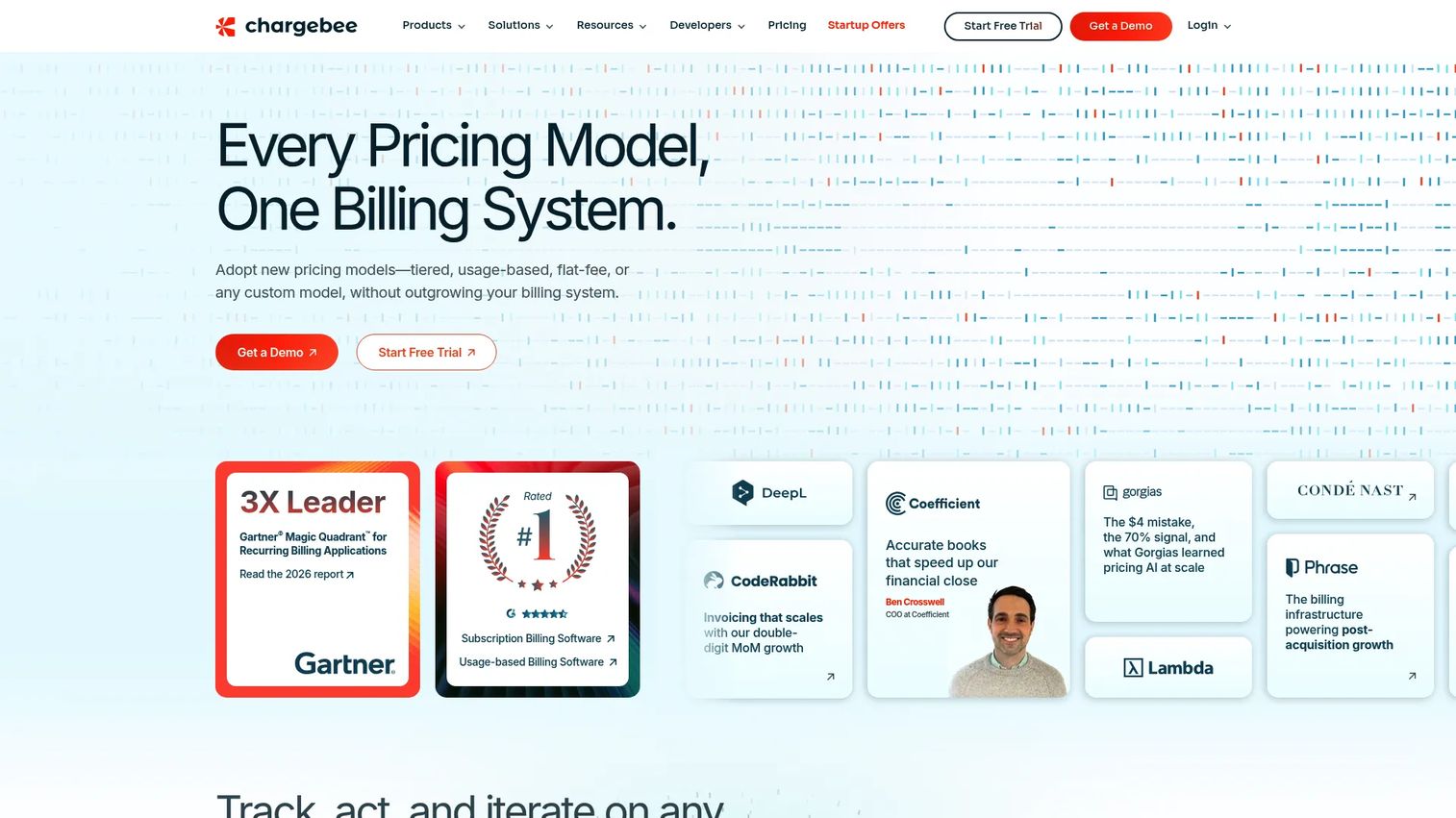
Chargebee is a billing and monetization platform for subscription, usage-based, and AI businesses. It covers the full recurring revenue operating system: Plan creation, usage metering, billing, dunning, revenue recognition, and retention analytics. Chargebee is used across the subscription lifecycle from first invoice to revenue close.
Best for: SaaS companies at Series A and beyond that need billing, finance operations, and retention running from one platform.
Key features
- Subscription lifecycle management with plan changes, proration, and renewals
- Usage-based and hybrid billing with metering
- Dunning workflows and revenue recovery automation
- Revenue recognition supporting finance close
- Subscription analytics for MRR, ARR, churn, and cohort reporting
Why choose Chargebee: It is the strongest fit when pricing, billing, retention, and revenue reporting need shared operating discipline. Series B founders hiring a VP Finance or Head of RevOps will find Chargebee gives new leaders a system that works from day one.
Chargebee pricing: A Growth Starter tier is available at no cost for Chargebee Billing customers. Growth Enterprise uses scalable custom pricing based on active subscribers. Billing Flow and Billing Enterprise plans require a quote. CPQ includes 50 free quotes before moving to a contact-sales model. RevRec Performance and Enterprise are also quote-based.
G2 rating: 4.4/5
2. Salesforce Revenue Cloud
Salesforce Revenue Cloud is a Salesforce-native revenue lifecycle management platform covering product catalog management, CPQ, quoting, contracts, ordering, invoicing, billing, and revenue analytics. It connects directly to your CRM data so sales, RevOps, and finance operate from one revenue workflow.
Best for: SaaS companies already standardized on Salesforce and running complex, sales-led subscription motions with multiple deal types.
Key features
- Salesforce CRM-native product catalog and price management
- CPQ, guided configuration, and quote generation
- Contract management and subscription amendments
- Usage modeling, consumption tracking, and invoicing
- Revenue analytics and AI capabilities
Why choose Salesforce Revenue Cloud: Choose this when the revenue problem starts in Salesforce, runs through Sales, and needs finance to close in the same system. The integration advantage is real for teams already running pipeline in Salesforce.
Salesforce Revenue Cloud pricing: Revenue Cloud Growth starts at $150 per user per month, billed annually. Revenue Cloud Advanced is $200 per user per month, billed annually. No free trial is available. Billing-specific pricing requires a separate quote.
G2 rating: 4.2/5
3. Maxio
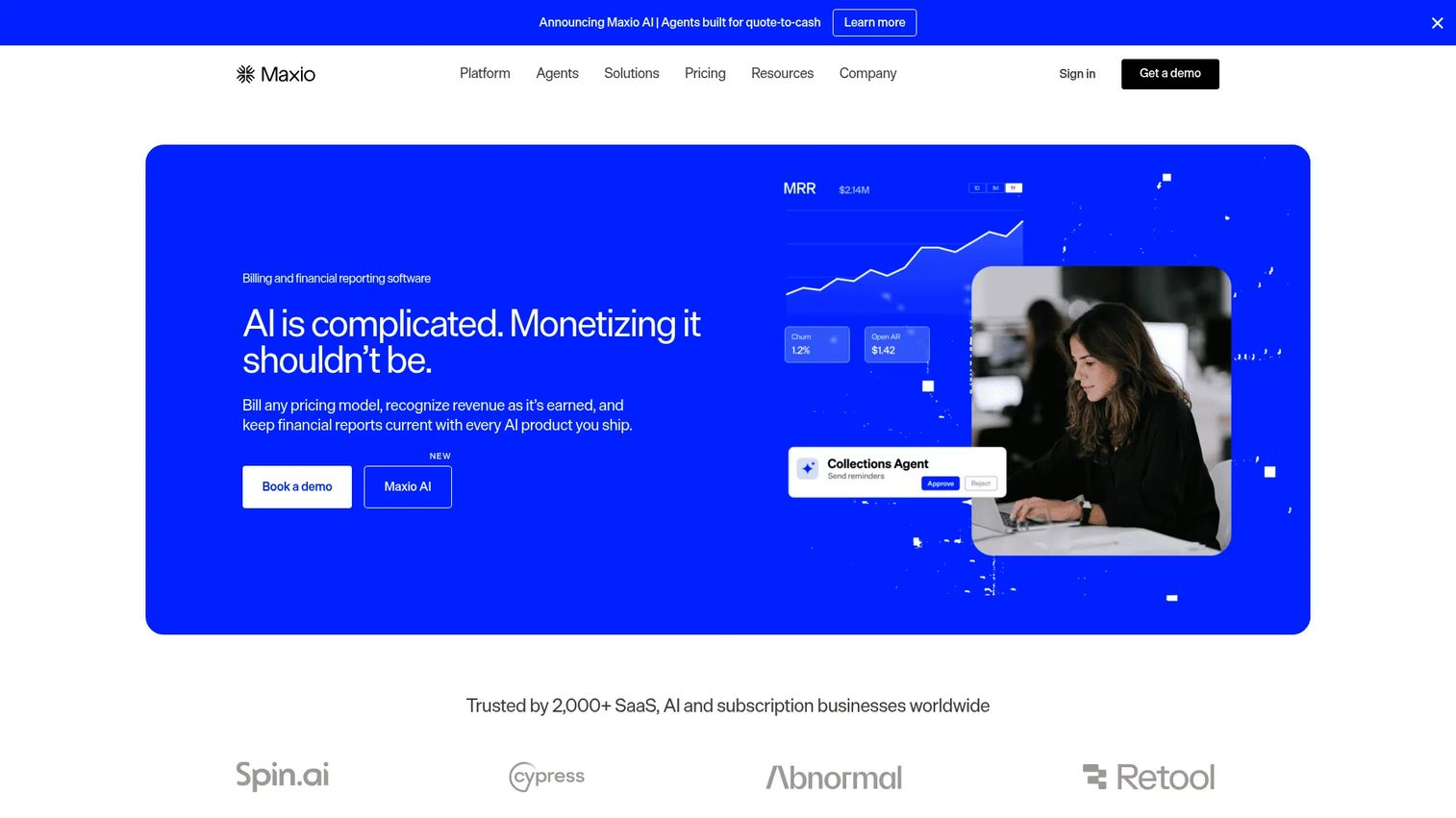
Maxio is a billing, revenue, and monetization platform for B2B SaaS and AI companies. It combines subscription management, usage-based billing, collections and dunning, revenue recognition supporting ASC 606 and IFRS 15, and SaaS metrics reporting. The platform sits between billing infrastructure and finance operations.
Best for: B2B SaaS teams where the real problem is not invoicing but confidence in the numbers shown to the board.
Key features
- Usage-based and recurring billing across pricing models
- Subscription management with collections and dunning
- Revenue recognition supporting ASC 606 and IFRS 15
- SaaS metrics dashboards including MRR, ARR, churn, and cohort data
- 20+ payment gateway integrations
Why choose Maxio: Strong fit when the finance team needs billing and board-grade SaaS metrics in one operating layer, without stitching together a billing tool and a separate analytics platform.
Maxio pricing: The Grow plan starts at $599 per month for up to $100,000 in monthly billings. The Scale plan is priced by quote for businesses above that volume.
G2 rating: 4.3/5
4. Stripe Billing
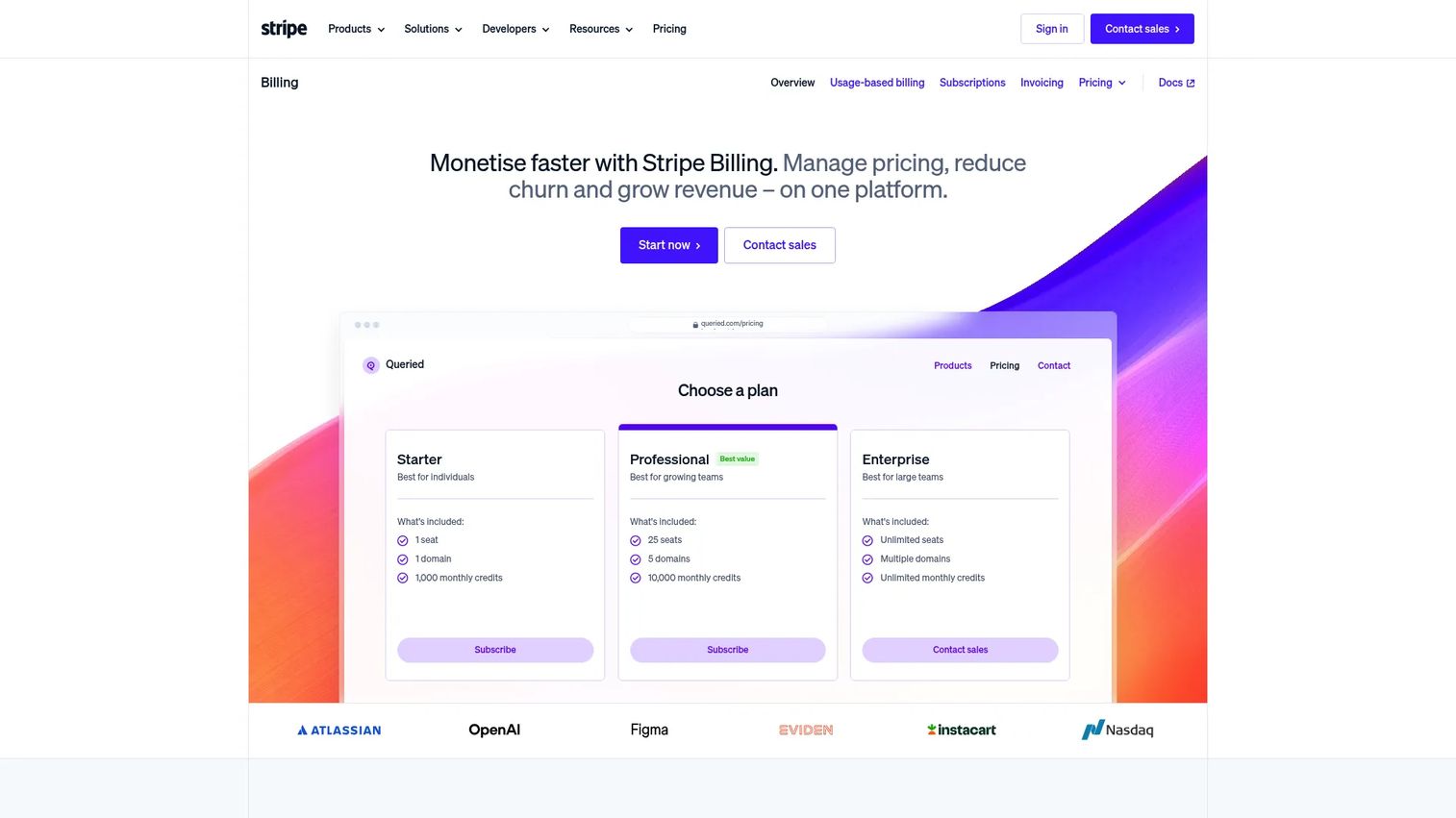
Stripe Billing is a billing platform for pricing, metering, recurring subscriptions, invoicing, payment collection, and revenue recovery. It is part of the broader Stripe payments infrastructure, which makes it a natural fit for teams already collecting payments through Stripe. Engineers can configure subscription logic, usage-based pricing, and billing schedules directly through the API.
Best for: Product-led SaaS teams with engineering resources and a Stripe-first payments stack who want billing to stay close to their existing infrastructure.
Key features
- Recurring billing and subscription management via API
- Usage-based, tiered, and metered pricing models
- Customer portal for self-service billing management
- Automated Smart Retries and payment reminders for revenue recovery
- Subscription schedules, entitlements, and invoice auto-reconciliation
Why choose Stripe Billing: Works best when developer flexibility and payment infrastructure control matter more than a prebuilt finance operations suite. Teams that want to configure complex billing logic without an implementation partner often start here.
Stripe Billing pricing: Pay-as-you-go pricing is 0.7% of billing volume with no recurring fees. Monthly plans start at $620 per month under a one-year contract, with higher volume tiers at $1,500, $2,950, and $5,750 per month. Custom pricing is available for large volumes.
G2 rating: No G2 rating confirmed at time of publication.
5. Recurly
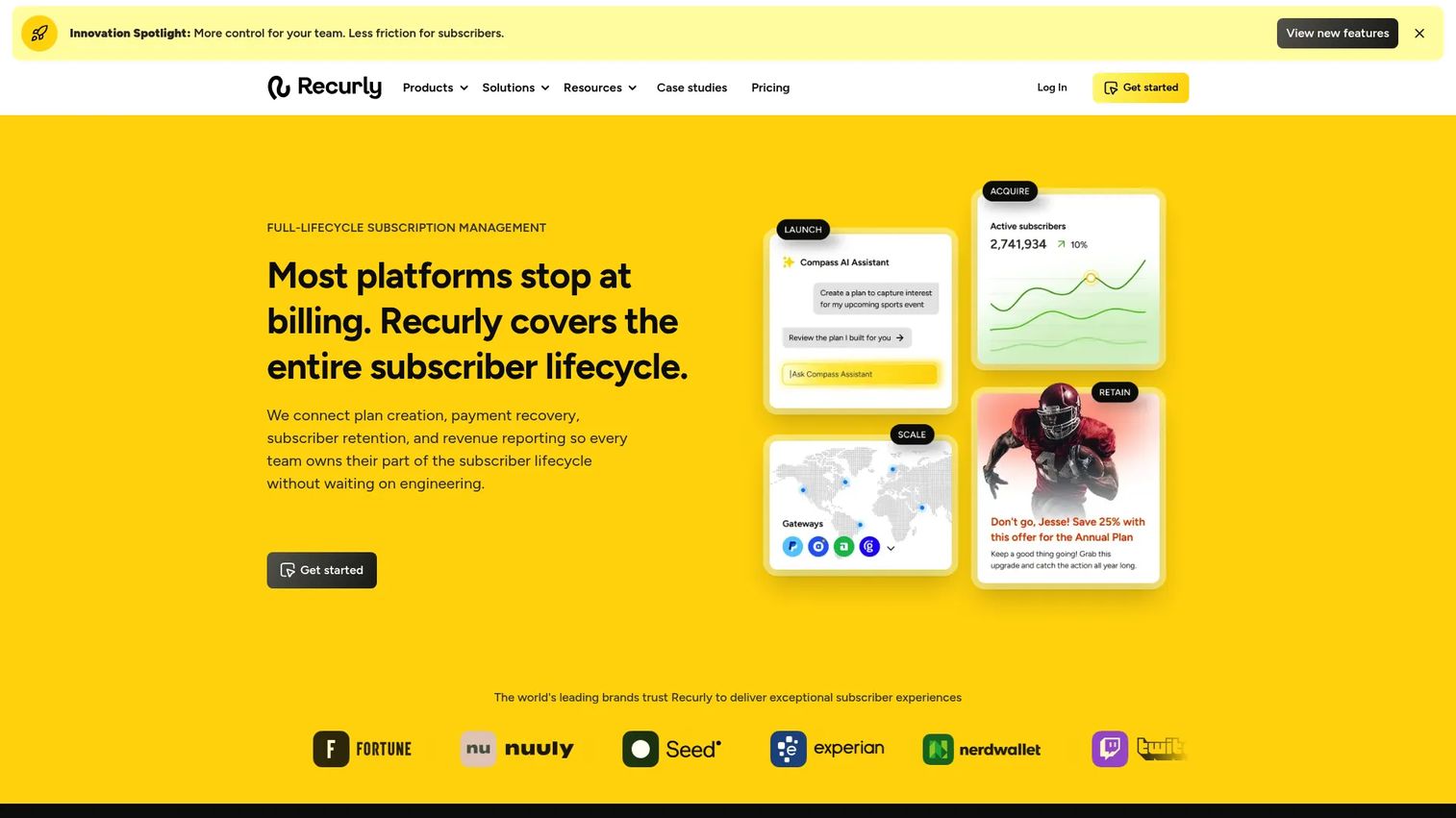
Recurly is a subscription revenue management platform built around billing, payment orchestration, churn prevention, and recurring revenue analytics. Its retention and dunning capabilities are a core strength, particularly for businesses where involuntary churn is a persistent leak. Recurly also covers Shopify subscription commerce as a dedicated product tier.
Best for: Subscription businesses where failed payments and renewal friction are quietly inflating churn numbers in board metrics.
Key features
- Automated subscription billing with flexible plans, pricing, and add-ons
- Payment orchestration across multiple gateways
- Dunning management, failed-payment recovery, and retention offers
- Subscriber lifecycle analytics, reporting, and forecasting
- Automated revenue recognition with multi-GAAP compliance
Why choose Recurly: Choose Recurly when involuntary churn is the primary operational problem. The dunning and payment recovery workflows go deeper than most billing-first platforms.
Recurly pricing: The Starter plan is $249 per month plus 0.9% of billing volume, with the first $40,000 in monthly billings included at no charge. All-Access plans are priced by quote with a $1 million minimum billing volume. Engage (retention tools) starts as low as $1,600 per month. RevRec starts as low as $850 per month. Both are billed annually.
G2 rating: 4.1/5
6. Sage Intacct
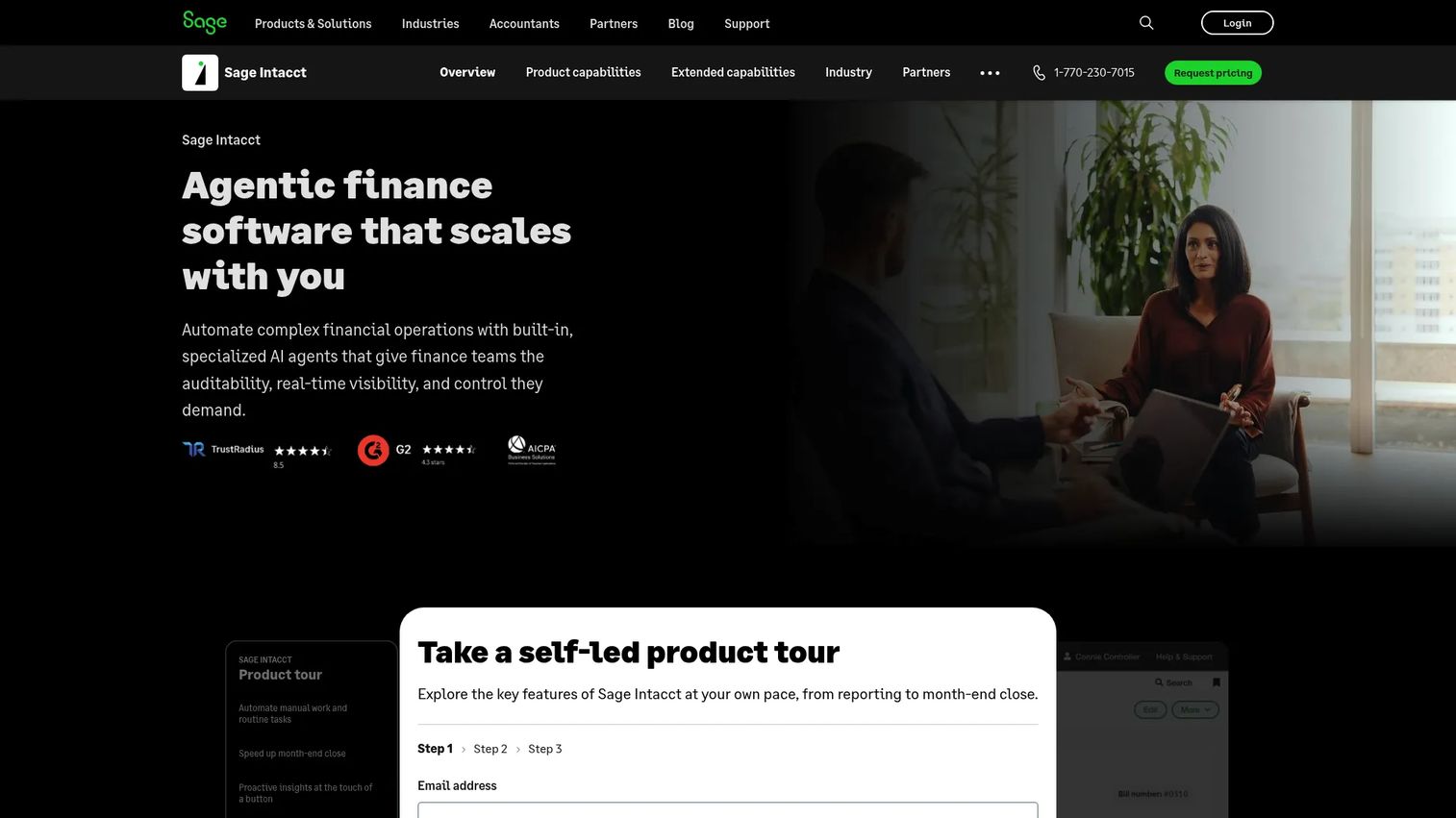
Sage Intacct is an AI-powered, cloud-based financial management system for growing and midsize organizations. It covers core accounting, accounts payable and receivable automation, multi-entity consolidations, revenue recognition, and real-time financial reporting. It is an accounting system of record first, with subscription billing handled through integrations.
Best for: SaaS companies whose subscription challenge has become a finance close, audit readiness, or accounting governance problem.
Key features
- Core financials with automated accounts payable and accounts receivable
- Deferred revenue and revenue recognition workflows
- Multi-entity support and global consolidations
- Multidimensional reporting and real-time financial dashboards
- AI agents for close management, AP automation, and financial assurance
Why choose Sage Intacct: Use it when the finance team needs accounting depth and clean revenue recognition more than front-office billing experimentation. The right fit when a VP Finance or CFO is driving the tool decision, not RevOps.
Sage Intacct pricing: Pricing is customized based on industry, organization size, modules required, and implementation scope. Cost drivers include number of entities, users, and functional modules selected. Contact Sage directly for a quote.
G2 rating: 4.3/5
7. Zenskar
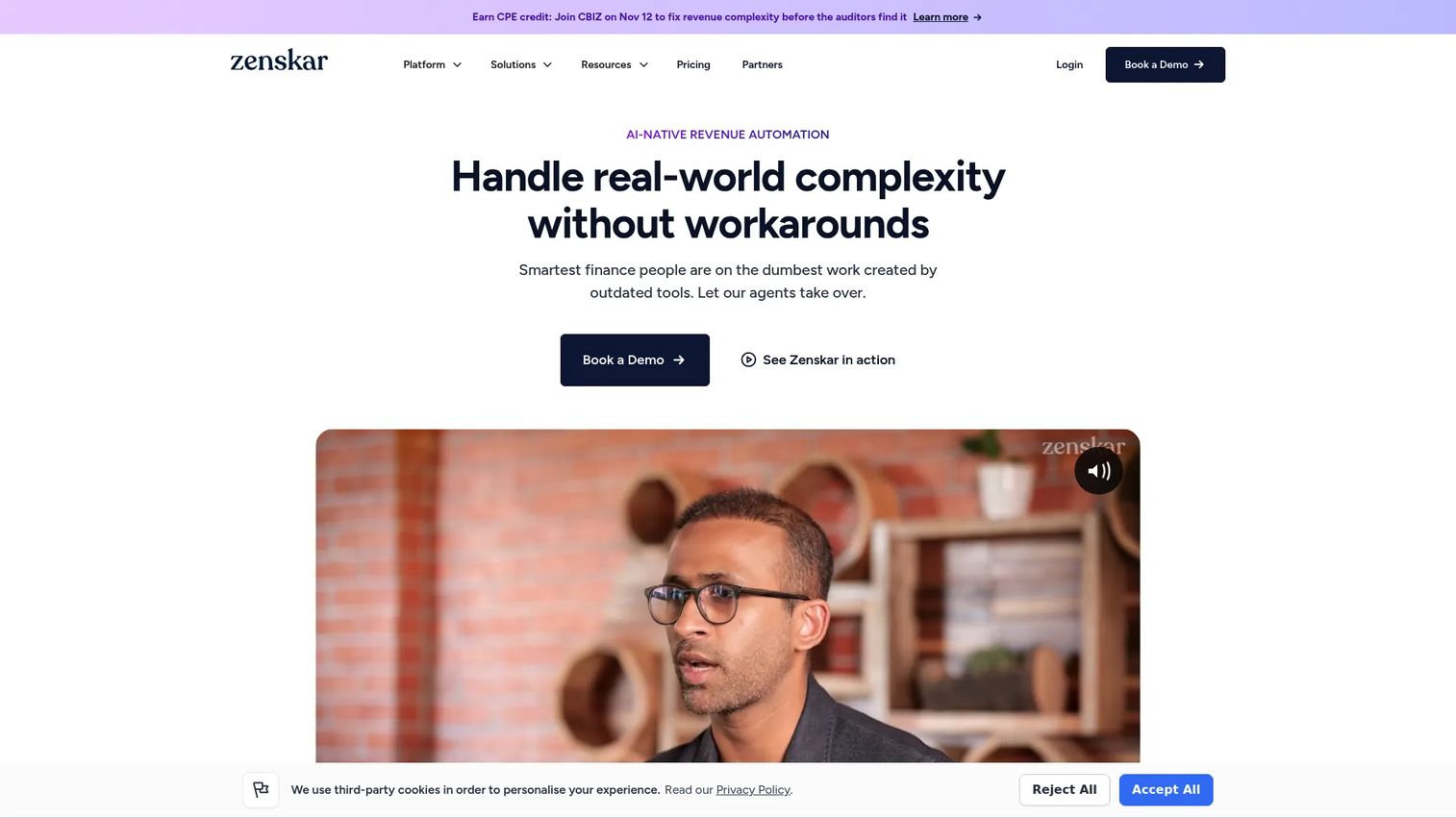
Zenskar is an AI-native revenue automation platform for billing, usage metering, revenue recognition, collections, analytics, and integrations. It is designed specifically for companies with complex subscription, usage-based, hybrid, or custom-contract pricing. AI contract ingestion automates billing setup from signed agreements.
Best for: SaaS companies testing usage-based, seat-based, overage, prepaid credit, or enterprise pricing who cannot afford another engineering sprint every time pricing changes.
Key features
- AI contract ingestion with automated billing setup
- Usage metering via API, CSV, and data warehouse ingestion
- Revenue recognition supporting ASC 606 and IFRS 15
- Automated collections, payment reminders, and reconciliation
- 100+ integrations including CRMs, CPQs, ERPs, payment gateways, and tax systems
Why choose Zenskar: Built for founders who know pricing will keep changing. The monetization logic layer absorbs packaging experiments without requiring engineering involvement each time.
Zenskar pricing: All plans use custom pricing. Starter covers basic support and integrations. Standard adds premium support, all integrations, and hands-on implementation with a 99.9% SLA. Enterprise adds 24x7 dedicated support and white-glove implementation. Contact Zenskar for a quote.
G2 rating: 4.8/5
8. Paddle
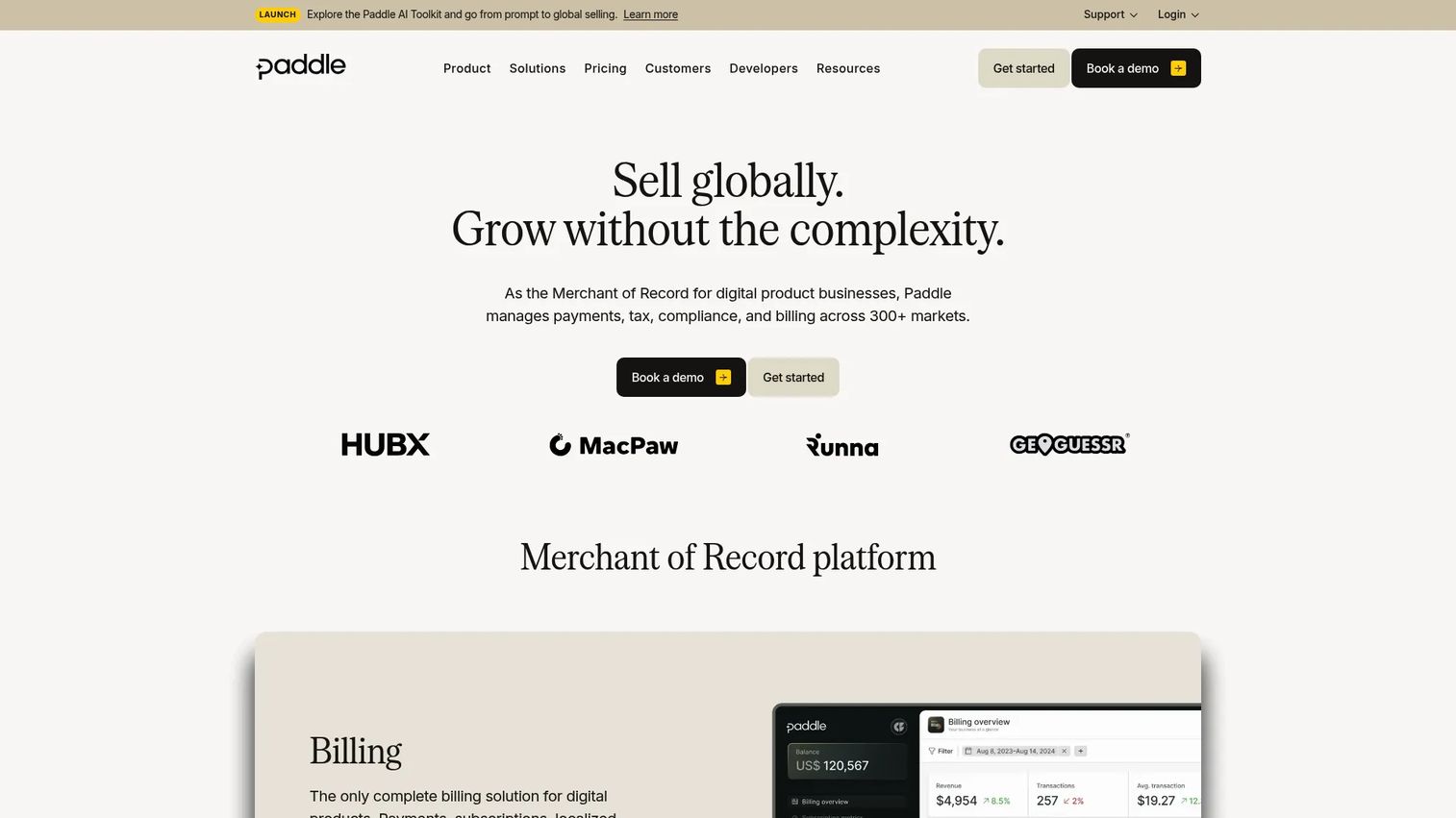
Paddle is a merchant-of-record platform for software businesses. It combines global payments, subscription billing, tax and regulatory compliance, fraud protection, and invoicing in one layer. Because Paddle acts as the merchant of record, it handles sales tax and VAT obligations across countries on the seller's behalf.
Best for: SaaS companies selling globally that want payments, tax, and subscription operations handled without building internal compliance infrastructure.
Key features
- Merchant of record covering tax and regulatory compliance across 200+ countries
- Global payments with localized payment methods
- Subscription billing, checkout, and customer management
- Fraud and chargeback protection
- Invoicing and reporting
Why choose Paddle: Useful when the founder wants to remove the internal burden of tax operations and global payment compliance while still running a subscription business. The tradeoff is less billing customization than pure billing platforms offer.
Paddle pricing: Pay-as-you-go pricing is 5% plus 50 cents per checkout transaction with no monthly fees. Custom pricing is available for high-volume or complex businesses.
G2 rating: 4.6/5
9. RevenueCat
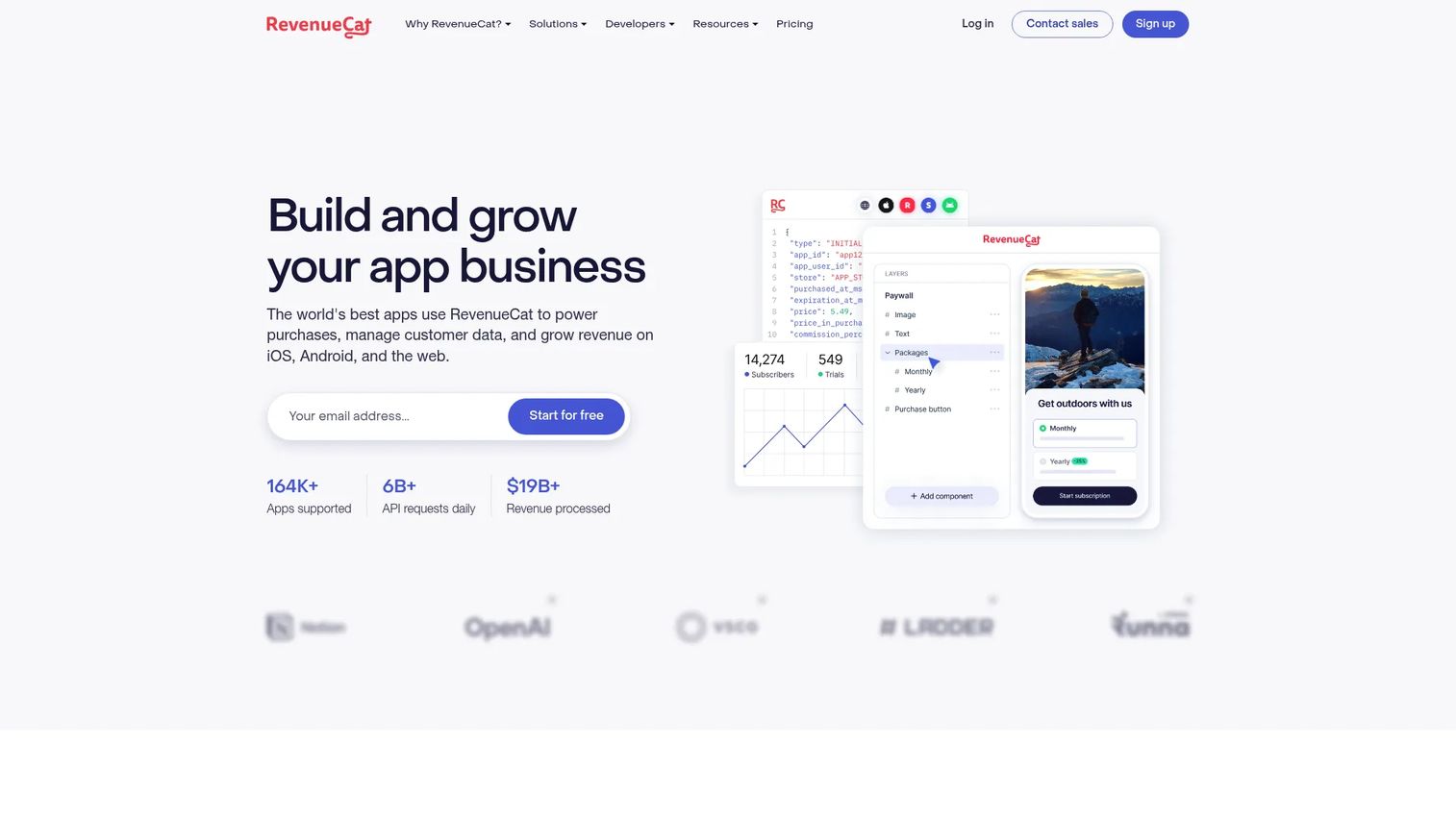
RevenueCat is a platform for implementing, managing, analyzing, and growing in-app subscriptions and purchases. It handles the complexity of cross-platform app store subscriptions: Entitlement management, paywall configuration, subscription events, A/B testing, and mobile monetization analytics. RevenueCat is not a B2B SaaS billing tool.
Best for: App developers and mobile-first subscription businesses managing subscriptions across iOS, Android, and other app stores.
Key features
- Cross-platform entitlement and subscription status management
- Remotely configurable paywalls without app store submissions
- Subscription events and integrations with analytics and marketing tools
- Charts, cohort metrics, and data exports
- A/B testing for monetization through Experiments
Why choose RevenueCat: The right tool when app store subscription complexity is the operational problem. If you are building a mobile-first subscription product, RevenueCat handles infrastructure that would otherwise require significant in-house engineering.
RevenueCat pricing: The Pro plan is free up to $2,500 in monthly tracked revenue, then 1% of what you track. Enterprise uses custom pricing for high-volume or specialized requirements.
G2 rating: 4.8/5
10. DealHub AI
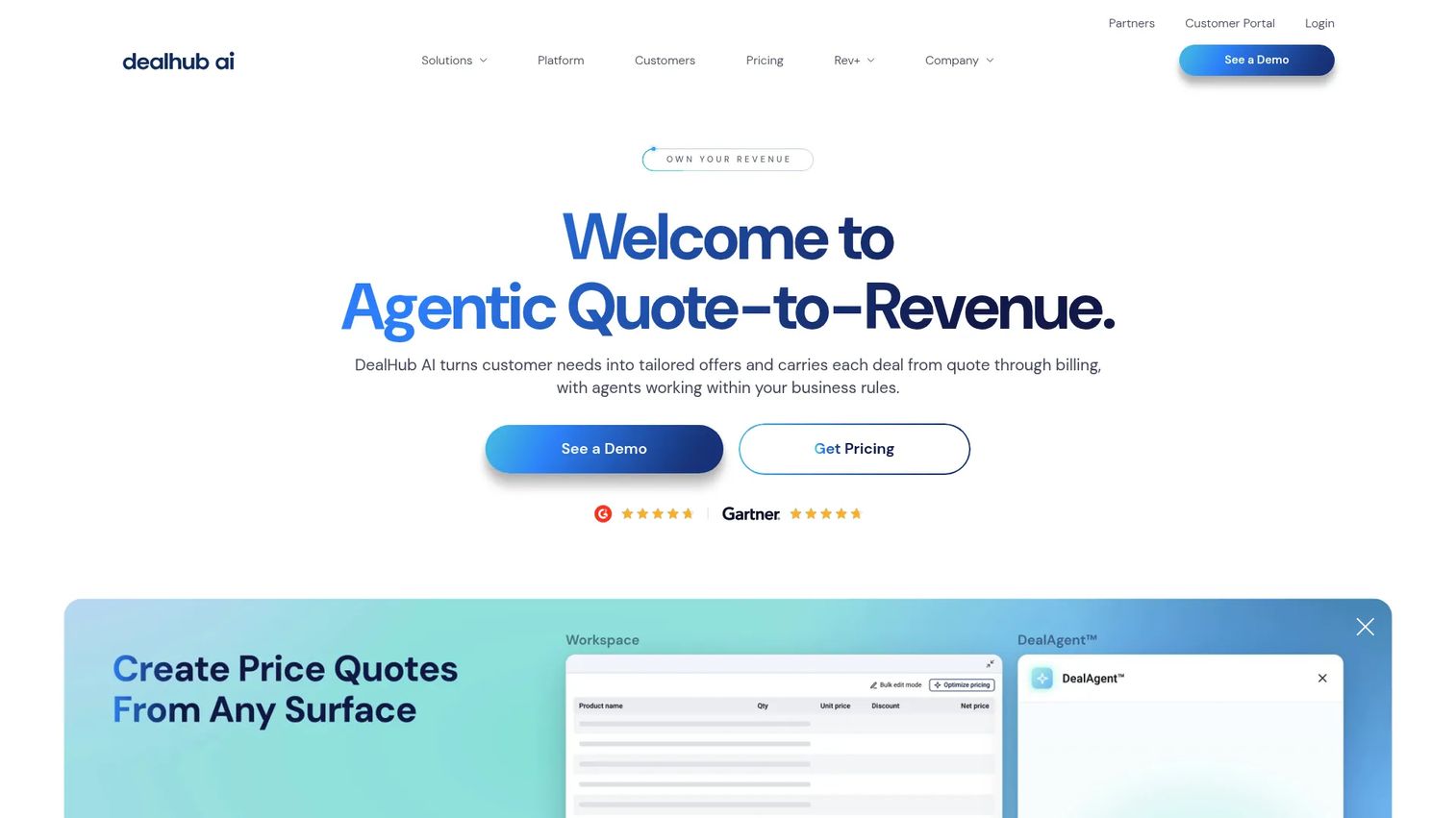
DealHub AI is an agentic quote-to-revenue platform connecting CPQ, contracts, deal rooms, subscription management, billing, and revenue intelligence. The platform is built for sales-led teams where quoting, deal approvals, contract terms, and revenue workflow automation need to run as one connected system.
Best for: Sales-led SaaS companies where the subscription revenue problem starts before billing, in quoting, approval chains, and contract execution.
Key features
- AI conversational quoting with adaptive pricing and guided selling
- CPQ with bundles, discounts, and approval workflows
- Contract management and document generation
- DealRoom buyer collaboration workspace
- Subscription management and billing
Why choose DealHub AI: Choose DealHub when quoting errors, contract misalignment, and approval delays are slowing revenue execution. It bridges the gap between sales and finance in one workflow.
DealHub AI pricing: Growth and Scale plans are both custom-priced. Headless API-Quoting and some integrations are available as add-ons. Cost drivers include user count, modules, and workflow complexity. Contact DealHub for a quote.
G2 rating: 4.7/5
11. Zuora
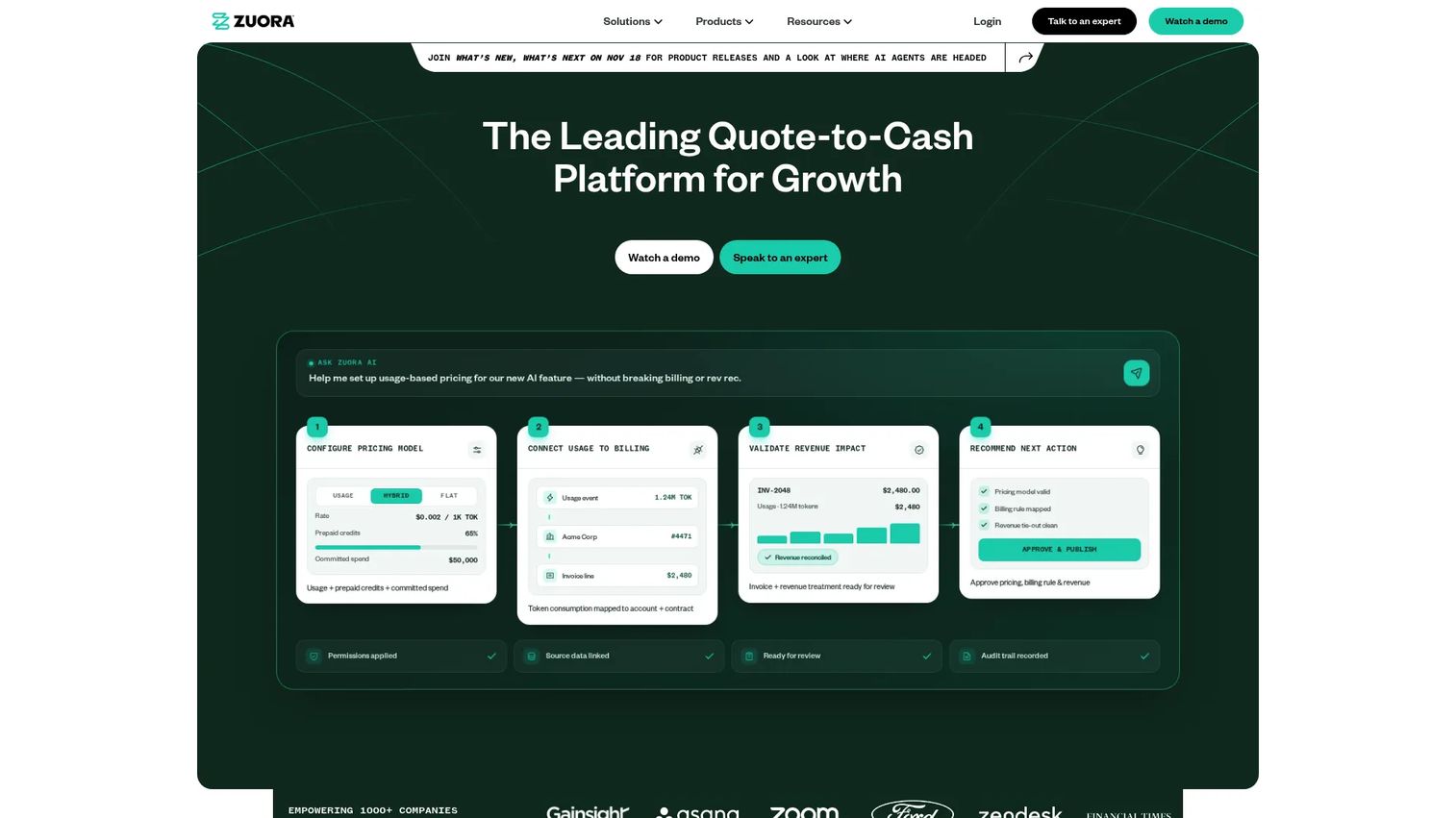
Zuora is a quote-to-cash and monetization platform for subscription, usage-based, hybrid, and recurring-revenue businesses. It offers subscription billing, flexible pricing and packaging, payment collection, revenue recognition, and accounts receivable automation. Zuora is the enterprise-grade option when subscription complexity has outgrown lighter billing tools.
Best for: Larger SaaS or subscription businesses with complex product catalogs, multi-entity structures, and monetization models that require enterprise-scale revenue lifecycle management.
Key features
- Subscription, usage-based, hybrid, and one-time billing
- Flexible pricing and packaging with product catalogs, bundles, and multiple currencies
- Payments, collections, and accounts receivable automation
- Revenue recognition and financial reporting
- Enterprise governance and integration capabilities
Why choose Zuora: The strongest enterprise-grade option for complex subscription monetization. Be clear-eyed about implementation weight: Zuora projects typically involve significant setup time, RevOps ownership, and ongoing administration.
Zuora pricing: Pricing is customized based on products, transaction volume, business model, regions, and implementation needs. Zuora directs buyers to contact sales. Growth, Enterprise, and Nine editions are available. Contact Zuora for a quote.
G2 rating: 3.9/5
12. Ordway
Ordway is an AI-powered billing and revenue management platform for SaaS, AI, cloud, fintech, and other recurring-revenue businesses. It covers subscription and usage-based billing, invoice generation, payment collection, accounts receivable automation, dunning, ASC 606 and IFRS 15 revenue recognition, and SaaS metrics reporting. AI-powered contract abstraction automates billing setup from agreements.
Best for: Mid-market and high-growth SaaS or fintech finance teams replacing spreadsheet-backed billing and recognition workflows with an automated system.
Key features
- Subscription and usage-based billing automation
- Invoice generation and payment collection
- Accounts receivable automation and dunning
- ASC 606 and IFRS 15 revenue recognition
- AI-powered contract abstraction and financial reporting
Why choose Ordway: Useful when finance wants more control over billing, recognition, and collections. Strong choice for a VP Finance or Controller leading the subscription revenue operations project.
Ordway pricing: Custom pricing based on product scope, transaction volume, implementation requirements, and other commercial factors. Contact Ordway for a proposal.
G2 rating: 4.6/5
13. ChargeOver
ChargeOver is subscription, recurring billing, invoicing, and payment-management software. It handles automated billing, payment collection, dunning emails, a customer self-service portal, and accounting integrations with QuickBooks and Xero. The focus is practical recurring billing without enterprise revenue operations overhead.
Best for: Smaller subscription businesses that need automated recurring billing, invoicing, and dunning without the complexity or cost of enterprise platforms.
Key features
- Flexible fixed, metered, quantity-based, and add-on billing
- Subscription lifecycle emails and automated payment reminders
- Self-service billing portal for customers
- Credit card, PayPal, and ACH payment methods
- QuickBooks and Xero integrations with 40+ reports
Why choose ChargeOver: Straightforward, focused recurring billing for teams that need the core workflows without enterprise complexity. A free sandbox is available for testing before going live.
ChargeOver pricing: Flat-rate monthly pricing starting at $229/month based on number of paying customers. No annual contracts, transaction fees, or percentage-of-revenue fees. A free sandbox is available for testing.
G2 rating: ChargeOver does not have a confirmed G2 rating at time of publication. Capterra reports a 4.7/5 rating based on 86 reviews.
14. Stax Bill
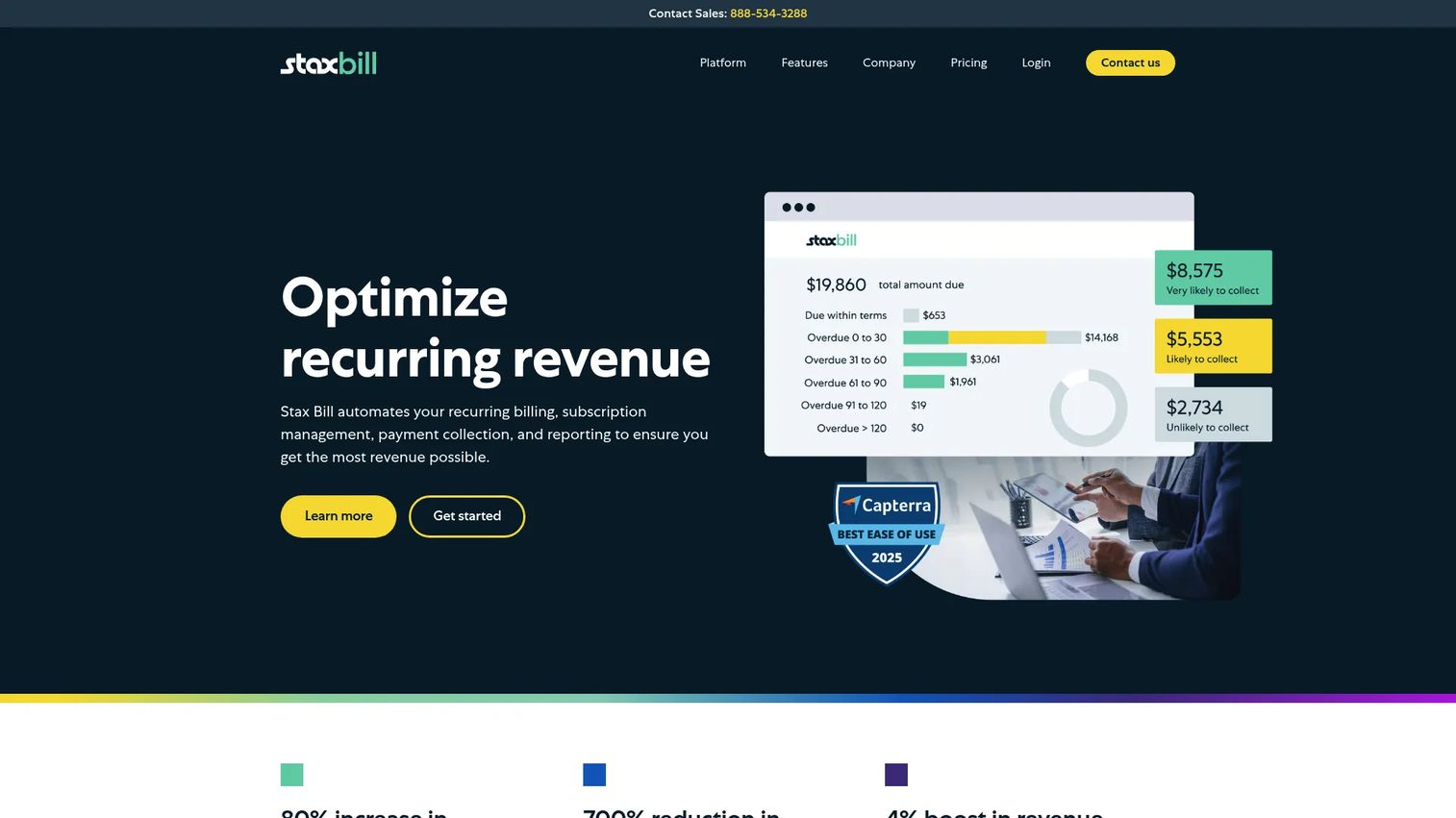
Stax Bill is a subscription billing and revenue management platform for automating recurring billing, payment collection, and revenue recognition. It supports dynamic product catalogs, custom invoices, proration, dunning automation, payment retries, and ASC 606-compliant revenue recognition and reporting.
Best for: Mid-market subscription businesses that want a dedicated billing engine with dunning and revenue recognition before they need enterprise monetization depth.
Key features
- Subscription management with dynamic product catalogs and registration
- Recurring billing with custom invoices and automated proration
- Dunning automation, payment retries, and credit-card updating
- ASC 606-compliant revenue recognition and reporting
- Tax calculation, integrations, and multiple payment methods
Why choose Stax Bill: Works for teams that need a solid subscription billing engine with revenue recognition at a mid-market price point, before the complexity of enterprise-scale systems becomes necessary.
Stax Bill pricing: Growth starts at $499/month, billed annually, supporting up to $85,000 in monthly billings with all features included. Enterprise pricing is a custom quote.
G2 rating: 4.2/5
15. OneBill
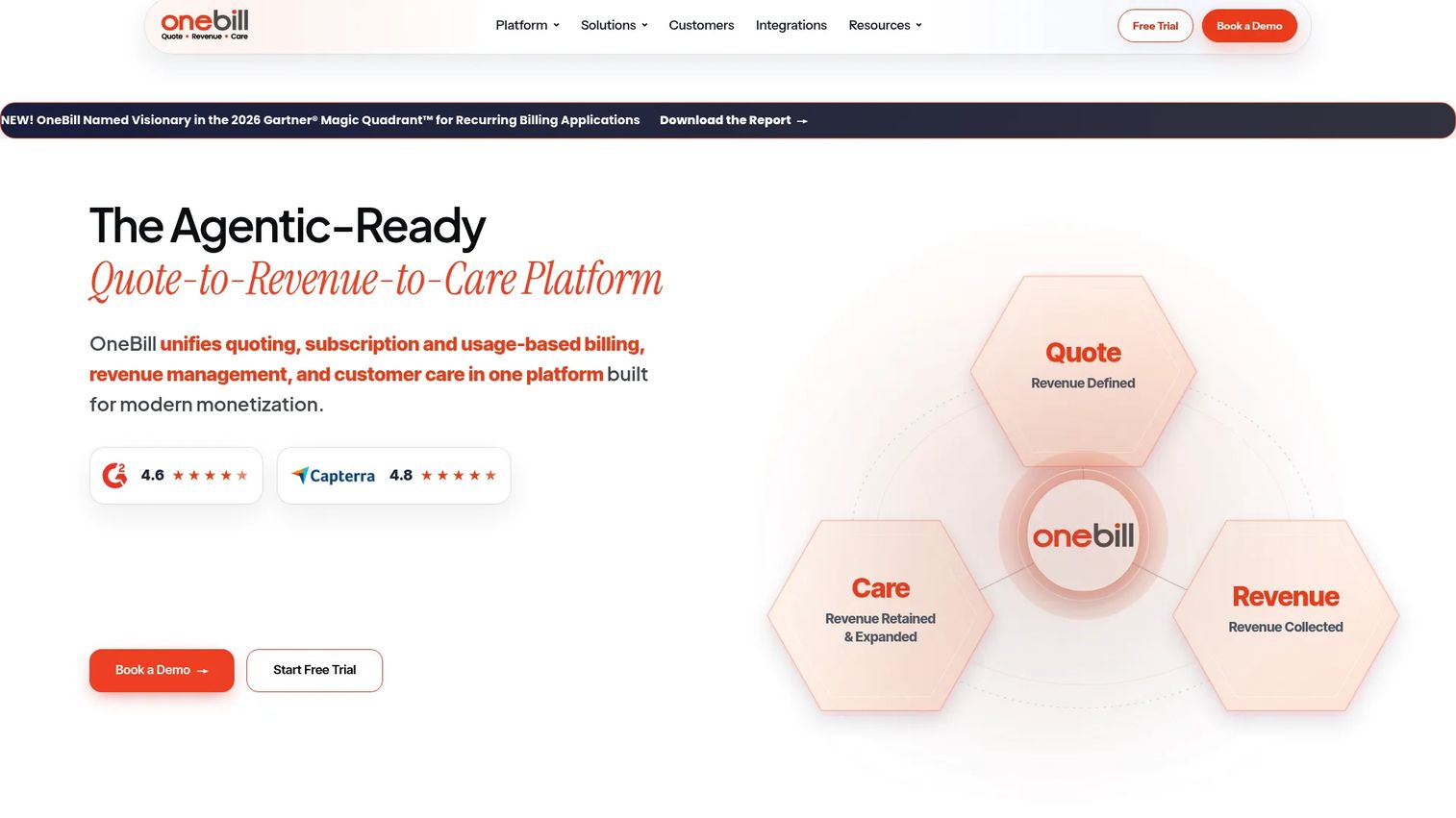
OneBill is a unified quote-to-revenue-to-care platform for subscription, usage-based, hybrid, dynamic, and channel billing. It is built for businesses with complex billing structures including telecom, SaaS, utilities, media, logistics, and IoT companies. Features cover usage mediation, channel partner commissions, CPQ, invoicing, revenue recognition, and customer self-service.
Best for: Companies with usage-heavy, partner-led, telecom, or reseller billing models that go beyond standard SaaS seat plans.
Key features
- Subscription, recurring, usage-based, and hybrid billing
- Real-time usage mediation and rating
- Channel partner commissions and settlements
- Invoicing, collections, accounts receivable, and tax compliance
- CPQ360 for product configuration and quoting
Why choose OneBill: Choose it when billing complexity spans channel partners, usage mediation, and regulatory compliance simultaneously. It handles structures that most SaaS billing platforms do not support.
OneBill pricing: Contract-based pricing. No pricing was publicly listed at time of publication. Contact OneBill for a quote.
G2 rating: No confirmed G2 rating at time of publication. Capterra reports a 4.8/5 rating based on 23 reviews.
16. Younium
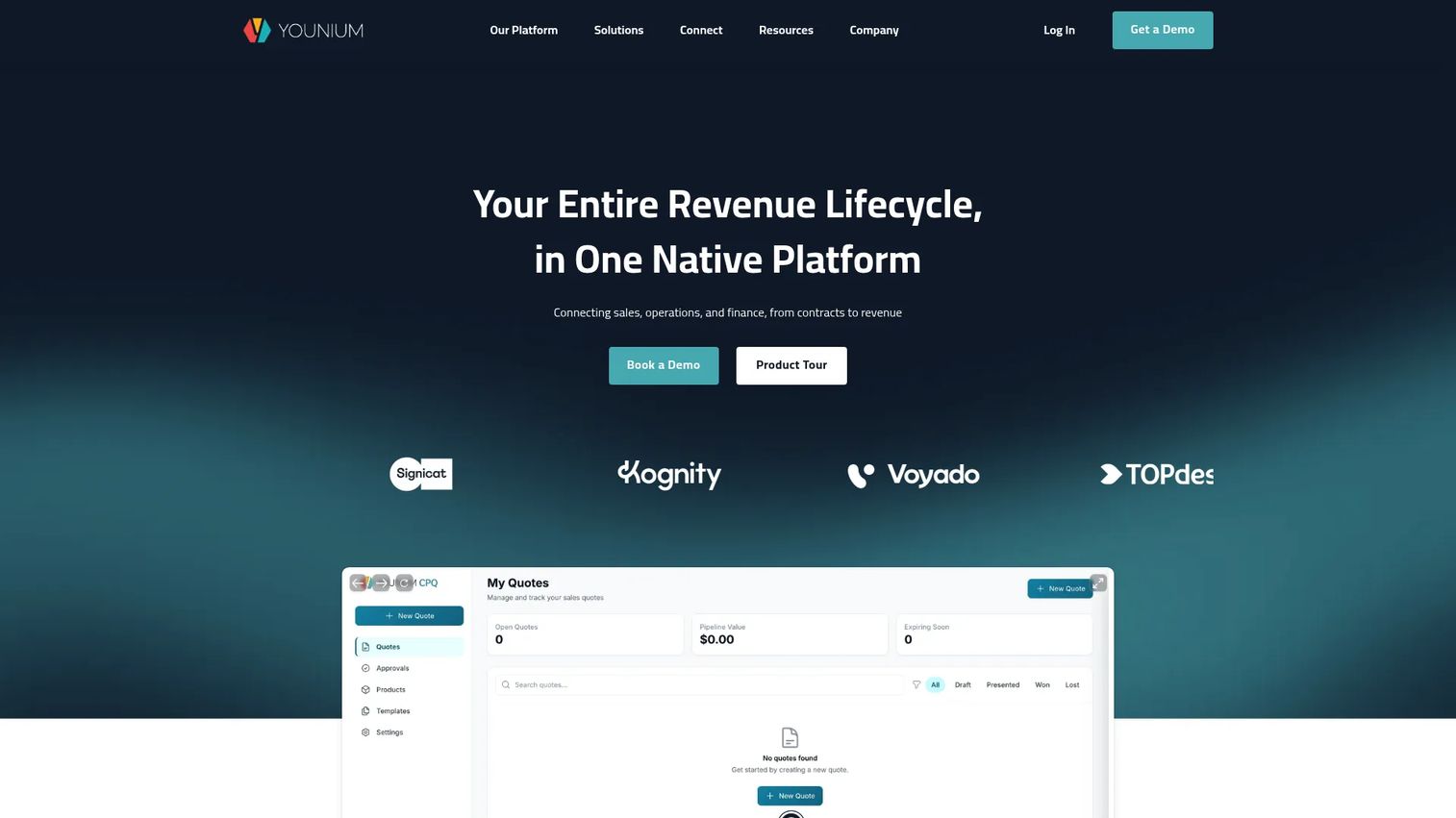
Younium is a B2B SaaS platform for managing the revenue lifecycle from quoting and subscriptions through billing, revenue recognition, and reporting. It supports CPQ, subscription amendments, usage-based pricing, automated invoicing, ASC 606 and IFRS 15 revenue recognition, and subscription analytics with AI and MCP capabilities. Younium serves European SaaS companies and others with similar finance and reporting requirements.
Best for: B2B SaaS companies with complex subscription, usage-based, or hybrid revenue models that want finance-friendly subscription management.
Key features
- CPQ and quote-to-subscription automation
- Subscription management with upgrades, renewals, and cancellations
- Recurring, usage-based, tiered, volume, and hybrid billing
- Revenue recognition aligned with ASC 606 and IFRS 15
- MRR and subscription analytics with AI capabilities
Why choose Younium: Particularly well-suited for SaaS teams where the finance and accounting team needs close alignment between subscription operations and revenue reporting, especially in European operating contexts.
Younium pricing: Flexible pricing based on business size, needs, and functionality. All plans are priced by customized quote. Contact Younium directly.
G2 rating: 4.2/5
17. Revaly

Revaly is listed on G2 as a payment-performance platform with a 5.0/5 G2 rating. Its website was not publicly accessible at time of research, which limits the detail available on current product capabilities and pricing. G2 describes Revaly in the context of subscription revenue workflows and analytics.
Best for: Revenue automation teams exploring newer options in the subscription revenue workflow category.
Key features
- Revenue analytics
- Subscription workflow support
- Payment performance tracking
Why choose Revaly: Treat Revaly as an emerging option to evaluate directly. Given limited verifiable product detail, it is worth requesting a demo before committing.
Revaly pricing: No pricing was publicly available at time of publication. Contact Revaly for a quote.
G2 rating: 5.0/5 (based on 1 review at time of publication)
18. PayPro Global
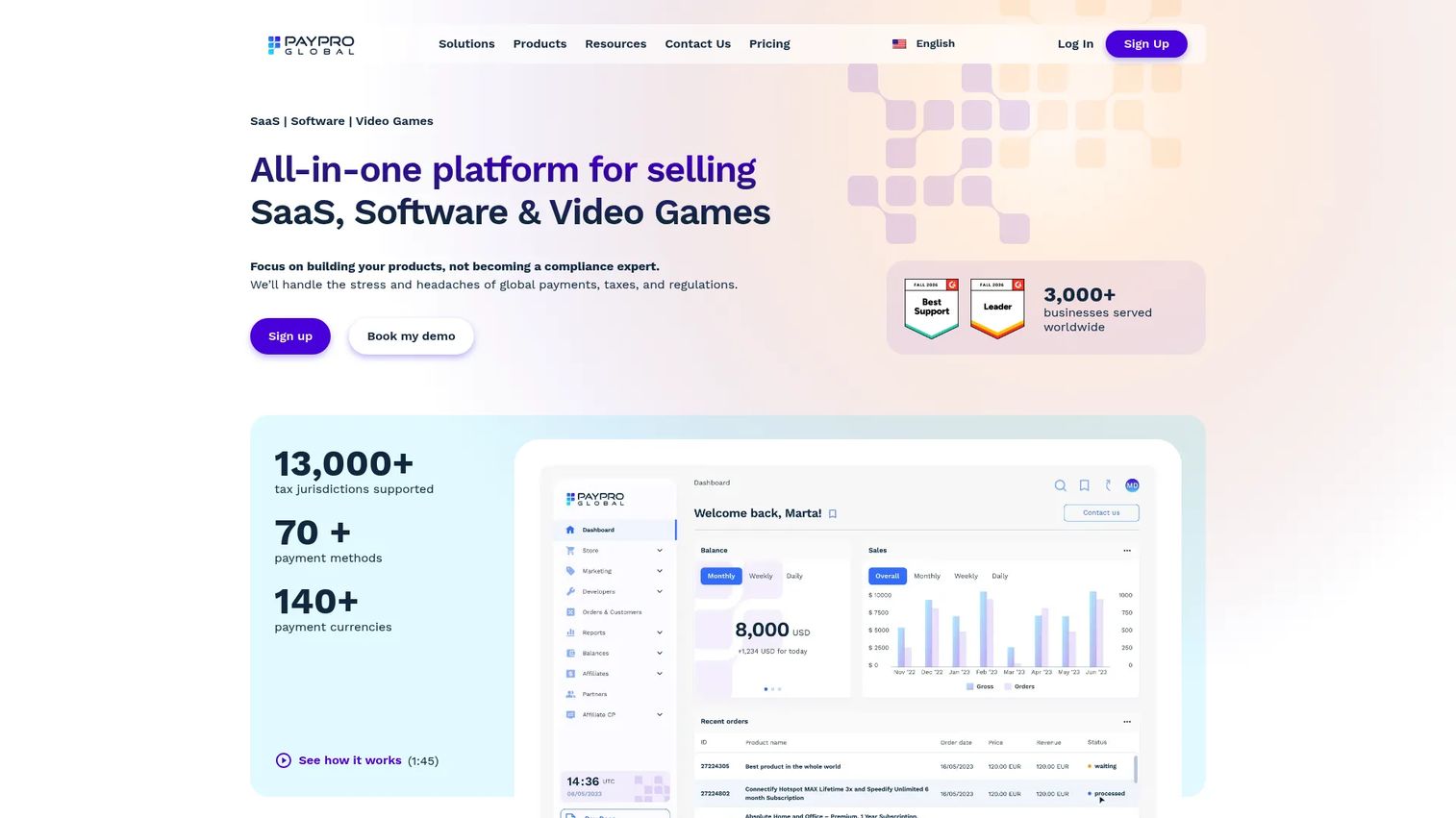
PayPro Global is a merchant-of-record platform for SaaS, software, video game, and digital businesses. It handles global payments across 70+ payment methods and 140+ currencies, tax and compliance management across 200+ regions, subscription management with recurring billing and dunning, fraud prevention, and localized checkout. Customer support runs 24/7 in 28+ languages.
Best for: Software companies selling digital products globally and wanting a full-service merchant-of-record commerce layer.
Key features
- Global payments with 70+ payment methods and 140+ currencies
- Merchant-of-record tax and compliance across 200+ regions
- Subscription management with recurring billing, renewals, and dunning
- Fraud prevention and chargeback management
- Localized and customizable checkout
Why choose PayPro Global: Strongest when global selling, tax operations, and payment compliance are part of the revenue problem, not just billing. PayPro Global removes the need to assemble tax, payment, and subscription tools separately for international markets.
PayPro Global pricing: Custom pricing based on business needs. Contact PayPro Global for a quote.
G2 rating: 4.9/5
19. FastSpring
FastSpring is a merchant-of-record platform for selling software, SaaS, games, and other digital products globally. It covers global payment processing, subscription management, checkout, sales tax and VAT collection and remittance, fraud prevention, chargeback management, and B2B invoicing. FastSpring IQ offers additional interactive quoting capabilities.
Best for: Software and digital goods companies that want a merchant-of-record platform for global selling with no minimum transaction volume requirement.
Key features
- Global checkout with localized payment methods
- Merchant of record for tax and compliance
- Subscription billing and renewals
- Sales tax and VAT collection and remittance
- Fraud prevention and chargeback management
Why choose FastSpring: Useful for software companies that want to offload global commerce operations rather than assembling payments, tax, and checkout tools separately. The revenue-share pricing model means no upfront platform fee.
FastSpring pricing: Custom revenue-share pricing based on transaction type and sales volume, with no minimum transaction volume and no subscription fee. Contact FastSpring's sales team for pricing details.
G2 rating: 4.5/5
20. GoCardless
GoCardless is a payment platform for collecting one-off and recurring bank payments, including Direct Debit and Pay by Bank. It covers subscription and membership payments, international collections from 30+ countries, payment failure recovery through its Success+ tool, fraud protection, and 350+ integrations. GoCardless is a payment collection tool, not a full subscription revenue management suite.
Best for: Subscription businesses wanting to collect recurring payments via bank debit rather than cards, particularly where card failure rates are high.
Key features
- Direct debit and account-to-account recurring payment collection
- International payments from 30+ countries
- Payment failure recovery with Success+
- Fraud protection with Protect+
- 350+ integrations and API access
Why choose GoCardless: Choose it when payment collection via bank debit is the operational bottleneck. It pairs well with a billing platform that handles subscription logic, pricing, and revenue recognition.
GoCardless pricing: Standard plan is 1% plus 20p per transaction. Advanced is 1.25% plus 20p. Pro is 1.4% plus 20p. Custom plans are available for volume-based discounts. Pricing displayed in GBP from the UK pricing page; regional pricing varies.
G2 rating: 4.6/5
21. Zoho Billing
Zoho Billing is end-to-end billing software for invoicing, recurring billing, subscription management, payments, and revenue insights. It integrates with Zoho CRM, Zoho Books, and other Zoho products, making it a natural fit for companies already in the Zoho ecosystem. Standard supports one-time billing; Premium adds subscription billing and advanced capabilities.
Best for: Smaller SaaS and subscription companies already using Zoho products that want affordable subscription billing tightly integrated with the rest of their Zoho stack.
Key features
- Subscription lifecycle management with plan changes and renewals
- Usage-based and flexible pricing models
- Hosted payment pages and customer self-service portal
- Dunning workflows and automated payment retries
- Zoho ecosystem integrations
Why choose Zoho Billing: Ecosystem fit and price are the primary decision drivers. If your team runs Zoho CRM and Zoho Books, adding Zoho Billing keeps data in one stack and avoids integration work. It is not the right choice for enterprise-scale subscription monetization.
Zoho Billing pricing: Standard is $50 per organization per month ($39 when billed annually). Premium is $100 per month ($79 annually). Enterprise is priced by quote. A 14-day free trial is available.
G2 rating: 4.4/5
Considerations when choosing subscription revenue management software
Pricing model fit
The tool needs to match how you actually monetize today, and what you plan to test next. Seat-based, usage-based, tiered, prepaid credit, enterprise contract, and promotional pricing each require different billing logic. Pressure-test the next pricing model before you commit to infrastructure built only for the current one.
Revenue recognition depth
Annual contracts, deferred revenue, multi-element contracts, and audit readiness create different requirements than monthly subscriptions. Involve your finance lead or CFO in this evaluation. The right revenue recognition capability depends on your close process, audit exposure, and accounting standards applied. This is a finance decision as much as a software decision.
CRM, accounting, and payment integrations
The accounts receivable software and billing system must connect to the systems already creating revenue data. Verify which CRMs, ERPs, accounting platforms, payment gateways, and data warehouses each tool supports natively, and how deep those integrations go. A thin integration that pushes data once a day may not support real-time RevOps workflows.
Reporting that survives board scrutiny
MRR, ARR, churn, NRR, LTV, cohort, expansion, and payment recovery reporting all need to be trustworthy from a single source. Before choosing a tool, test whether its reporting definitions match your board deck, and whether finance and RevOps can trust the numbers without a manual reconciliation step.
Implementation cost and ownership
Migration, data cleanup, pricing rule configuration, and product catalog setup take time and expertise. The cheapest tool can become expensive if it requires months of cleanup before the first reliable report. Map who owns the implementation internally (finance, RevOps, or engineering) and whether outside implementation support is needed.
Conclusion
The right choice depends on where the subscription revenue problem actually lives in your business.
Choose Chargebee for broad SaaS subscription lifecycle management. Choose Salesforce Revenue Cloud if Salesforce is already the center of your revenue operations. Choose Maxio if the board-level pain is SaaS finance metrics and subscription reporting. Choose Stripe Billing if your engineering team wants API-first billing inside an existing Stripe payments stack. Choose Recurly if failed payments and retention gaps are the most urgent problem.
For finance-first accounting depth, Sage Intacct leads the project. For global selling with tax and payment operations included, Paddle, PayPro Global, or FastSpring cover the merchant-of-record path. For mobile app subscriptions, RevenueCat is purpose-built. For complex quote-to-revenue workflows, DealHub AI or Zuora fit different scales of that problem.
Before signing anything, map one complete customer lifecycle: Quote to invoice to payment to revenue recognition to renewal. The right tool makes that journey cleaner rather than moving the mess into a new system.
If your team also needs to explain complex pricing models, packaging changes, or billing workflows to prospects and customers, interactive product experiences can make that story far easier to follow. Start your journey with Guideflow today!
FAQs
Subscription revenue management software is a platform that manages recurring revenue across pricing, billing, invoicing, payments, revenue recognition, renewals, reporting, and retention. It sits between how you charge customers and what appears in your financial reports. Unlike basic billing tools, it typically includes revenue recognition, subscription analytics, dunning, and lifecycle management.
Subscription billing software focuses on recurring invoices, payment collection, and dunning. Revenue management software adds revenue recognition, analytics covering MRR, ARR, churn, and NRR, lifecycle workflows for upgrades and renewals, forecasting, and finance close support. Many teams start with billing-only tools and upgrade when they need board-ready reporting or audit readiness.
The answer depends on stage, pricing model, and where the operational pain sits. Chargebee is a strong overall fit for subscription lifecycle management. Maxio works well when SaaS finance metrics are the primary need. Stripe Billing fits developer-led teams with Stripe-first stacks. Recurly leads for payment recovery and retention. Salesforce Revenue Cloud fits companies running sales-led motions in Salesforce. No single tool is the universal choice.
Pricing flexibility matters most when packaging experiments are frequent. CRM integration keeps sales and finance aligned on revenue data. Revenue recognition depth becomes critical with annual contracts and deferred revenue. Dunning and payment recovery protect NRR. MRR and ARR reporting must be trustworthy enough for board decks. Evaluate implementation effort and RevOps ownership requirements before choosing.
It depends on your contract structure and finance requirements. Annual contracts with upfront payments create deferred revenue that needs to be recognized correctly over time. Multi-element contracts, complex billing schedules, and audit readiness all increase the need for built-in revenue recognition. If your finance team is manually tracking deferred revenue in spreadsheets, that is the clearest signal you need it. Involve your finance lead before making this call.
Stripe Billing, Zenskar, Maxio, Chargebee, Zuora, and OneBill all support usage-based billing at different levels of technical depth and enterprise complexity. Stripe Billing and Zenskar are strongest for teams where pricing models change frequently. Maxio and Chargebee cover usage billing alongside subscription metrics and finance reporting. Zuora and OneBill handle enterprise scale and complex usage mediation. The right choice depends on how complex the usage logic is and how much engineering ownership the team wants to maintain.
Pricing across the category varies significantly. Entry-level tools like ChargeOver start at $229/month flat. Mid-market platforms like Maxio start at $599/month and Stax Bill at $499/month. Stripe Billing charges 0.7% of billing volume. Recurly starts at $249/month plus 0.9% of billing volume. Enterprise platforms including Zuora, Sage Intacct, Zenskar, and Salesforce Revenue Cloud (at $150/user/month for the entry tier) are priced by quote or based on transaction volume, entities, modules, and implementation scope.
Replace it when finance runs any revenue metric through a manual spreadsheet step, when billing exceptions outnumber standard cases, when usage-based pricing is on the roadmap, when failed payments are showing up in churn numbers, when month-end close is slower than it should be, or when the board asks questions about MRR or revenue recognition that the current system cannot answer directly. Any of those signals individually is worth taking seriously.