You do not buy specialty practice management software because the front desk needs another screen. You buy it because scheduling, eligibility, claims, denials, collections, and reporting are starting to decide the economics of the practice.
The administrative burden in U.S. healthcare is measurable. The global medical practice management software market reached $8.38 billion in 2025, according to Verified Market Research (2026), reflecting how much operational complexity practices are trying to systematize. At the same time, 58% of U.S. physician practices used digital intake, eligibility, or payment-estimation tools daily in 2025, up from 34% in 2023, per Black Book Research. The gap between practices running clean revenue cycles and those chasing aging claims is widening, and the software layer is a primary driver of that gap.
This guide helps practice operators, founders, and revenue cycle leaders cut through the vendor noise and pick the system that fits their specialty, billing model, and implementation capacity.
What's inside
This guide compares 15 specialty practice management software vendors for 2026, covering medical practice management software options across ambulatory, multi-specialty, behavioral health, and enterprise healthcare settings.
Tools were selected based on:
- Specialty workflow fit across scheduling, authorizations, referrals, and treatment cycles
- Billing, RCM, claims, and denials depth
- Interoperability with EHR systems, payers, and clearinghouses
- Verified pricing and current G2 ratings where available
The guide targets practice administrators, healthcare founders, and revenue cycle leaders evaluating accounting practice management software or clinical systems for specialty or multi-specialty operations.
TL;DR
- Best overall for specialty and multi-specialty practices: NextGen Healthcare, for ambulatory groups that need operational depth across scheduling, RCM, and reporting
- Best for cloud-based network operations: athenahealth, for practices prioritizing cloud delivery and broad connectivity
- Best for integrated EHR, billing, and patient engagement: CureMD, for specialty clinics that want fewer disconnected systems
- Best for affordable, modular cloud practice management: RXNT, with published starting prices and a-la-carte buying options
- Best for behavioral health and wellness: SimplePractice, with published plans starting at $49/month and a 30-day free trial
What is specialty practice management software?
Specialty practice management software is healthcare operations software that manages the administrative, financial, scheduling, and patient-facing workflows of medical practices with specialty-specific needs.
Unlike general-purpose scheduling tools, purpose-built practice management systems handle the full administrative lifecycle from appointment request to paid claim. The category sits adjacent to EHR software but serves a different function. Here is the core distinction:
- EHR software manages clinical documentation, orders, care plans, medication history, and provider charting
- Practice management software manages operations, billing, scheduling, claims, collections, and front-office workflows
Many vendors bundle both layers, but buyers should evaluate each separately before signing.
Core capabilities to expect from medical practice management software:
- Scheduling for providers, locations, rooms, infusion chairs, equipment, and recurring treatment visits
- Registration, eligibility verification, referrals, prior authorizations, and patient intake
- Charge capture, coding support, claims submission, claim scrubbing, and remittance processing
- Denials management, AR worklists, payment posting, and collections tracking
- Patient portals, secure messaging, online payments, and appointment reminders
- Reporting dashboards for productivity, payer performance, AR aging, no-shows, and practice economics
- EHR integration and data exchange through HL7, FHIR, payer networks, and clearinghouses
Multi-specialty practice management software adds another layer: Separate scheduling templates, payer rules, billing codes, and reporting structures for each specialty within a single platform. That configuration complexity is where many generic systems break down and where specialty-focused vendors earn their positioning.
When to use specialty practice management software
Run specialty scheduling without spreadsheet workarounds
Oncology, infusion, GI, cardiology, and behavioral health clinics operate on fundamentally different scheduling logic. Infusion suites need chair availability alongside provider availability. Imaging practices need equipment slots. Recurring authorization-dependent visits need automated status checks before the patient arrives. One scheduling error in an oncology clinic affects clinical flow, revenue capture, and patient safety simultaneously. When your team is managing any of that complexity in spreadsheets or generic calendar tools, you need a dedicated appointment reminder software layer backed by specialty scheduling logic.
Connect billing, claims, and collections to daily operations
Revenue cycle management cannot live as an afterthought bolted onto a scheduling system. When eligibility checks, authorization status, charge capture, and denial workflows operate inside the same system as the schedule, the front desk and billing team work from the same source of truth. Cash flow becomes predictable. Month-end surprises shrink. Finance gets a dashboard instead of a spreadsheet export.
Give leadership usable practice data
Founders and operators building specialty clinic networks need weekly visibility into no-shows by provider, payer lag by insurance, denial rates by payer, and referral volume by source. Vanity dashboards do not move decisions. The right practice management system turns those operational signals into a weekly review that actually changes staffing, contracting, and scheduling decisions before the problem compounds.
Specialty practice management software comparison
The table below is a starting point for shortlisting, not a substitute for workflow validation. Pricing and G2 ratings reflect verified data from vendor pricing pages and current review listings. Where no pricing figure was available, the entry reflects the actual pricing model the vendor uses.
| # | Product | Best for | Key differentiator | Pricing | G2 rating |
|---|---|---|---|---|---|
| 1 | NextGen Healthcare | Multi-specialty ambulatory groups | Broad EHR, PM, and RCM suite for ambulatory care | Quote-based | N/A |
| 2 | athenahealth | Cloud-based network operations | Percentage-of-collections model with network-wide integration | Quote-based (% of collections) | 3.6/5 |
| 3 | CureMD | Integrated EHR, PM, and billing | All-in-one suite with AI scribe and billing services from 3% of collections | From 3% of collections (billing) | 3.1/5 |
| 4 | eClinicalWorks | Large ambulatory practices | Published per-provider pricing with EHR, PM, and RCM tiers | From $499/mo per provider | 3.7/5 |
| 5 | PracticeSuite | Billing-centered practice management | Cloud PM with AI-powered billing automation and RPA | Quote-based | N/A |
| 6 | MicroMD | Small to mid-sized specialty practices | Published subscription pricing starting at $425/provider/mo | From $425/provider/mo | N/A |
| 7 | SimplePractice | Behavioral health and wellness | Published plans from $49/mo with a 30-day free trial | From $49/month | 4.1/5 |
| 8 | Oracle Health | Health systems and enterprise organizations | Enterprise-grade interoperability and clinical operations infrastructure | Quote-based | N/A |
| 9 | CareCloud | PM plus RCM services | Published PRIME plan at $249/provider/mo with optional RCM services | From $249/provider/mo | 3.0/5 |
| 10 | Tebra | Independent medical practices | All-in-one EHR, billing, and practice growth for independents | Custom quote | 4.1/5 |
| 11 | PracticeQ | Client intake and appointment workflows | Published plans from $59.90/mo with a two-week free trial | From $59.90/month | N/A |
| 12 | Claimocity | Charge capture and inpatient billing | Mobile-first charge capture and RCM for hospitalist practices | Quote-based | N/A |
| 13 | Veradigm | Specialty workflow configuration and RCM | Configurable EHR, claims, denials, and payer analytics across specialties | From $49/mo (Connect) | 3.4/5 |
| 14 | RXNT | Modular cloud practice management | A-la-carte and bundled subscriptions with published Ambient IQ pricing | From $75/mo | 4.2/5 |
| 15 | AdvancedMD | Configurable ambulatory practice operations | Published specialty-specific pricing from $130/provider/mo | From $130/provider/mo | 3.6/5 |
Best 15 specialty practice management software tools for 2026
1. NextGen Healthcare
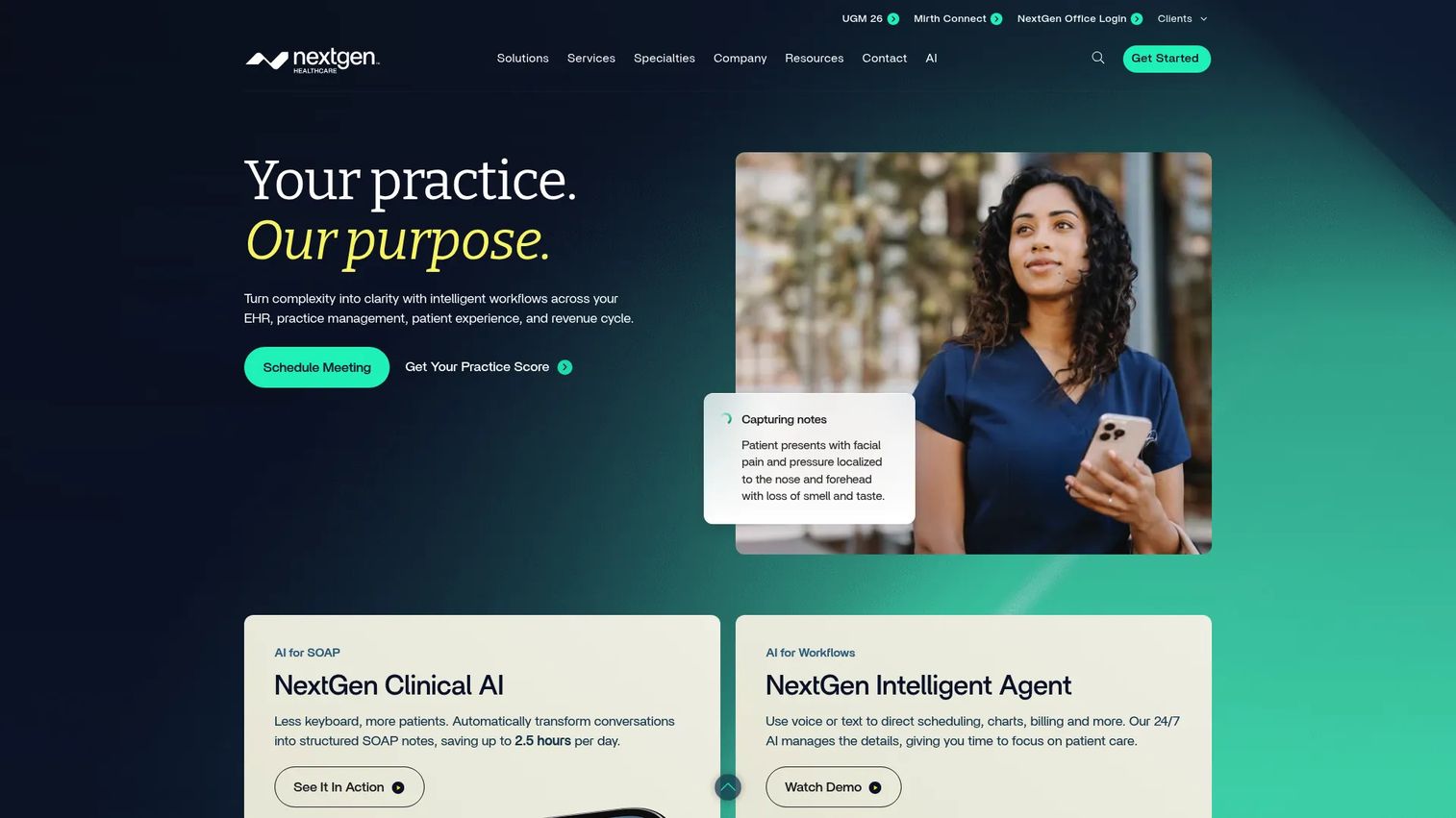
NextGen Healthcare is a cloud-based, AI-powered healthcare technology platform built for ambulatory practices. It covers EHR, practice management, patient experience, interoperability, analytics, and revenue cycle management. The platform is designed for multi-specialty and ambulatory groups that have outgrown generic scheduling and billing tools.
Best for: Multi-specialty ambulatory groups and large practice networks that need operational depth across scheduling, RCM, patient workflows, and reporting.
Key features
- Specialty scheduling with provider, location, and resource management
- Claims and billing workflows with RCM support
- Patient access, intake, engagement, payments, and portal
- AI-assisted clinical documentation and SOAP-note generation
- Practice analytics and interoperability tools
Why choose NextGen Healthcare: NextGen suits organizations that need a mature ambulatory workflow suite with broad specialty coverage. Larger groups should validate implementation timeline, data migration scope, and support model before committing.
NextGen Healthcare pricing: Pricing is quote-based. The price changes with the number of providers, locations, modules selected, and the services package. Contact sales for a detailed breakdown.
2. athenahealth
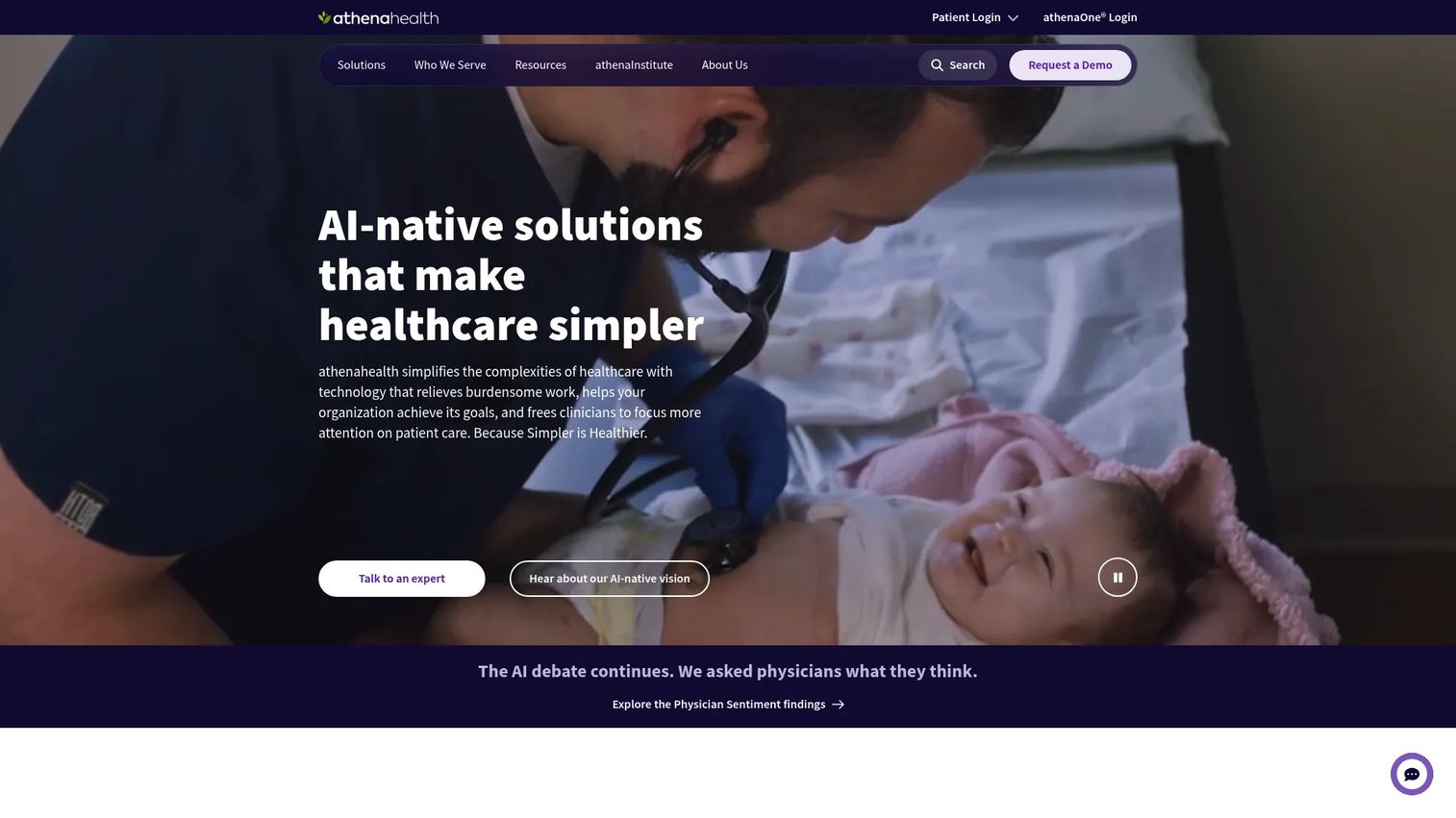
athenahealth provides AI-powered ambulatory healthcare software spanning EHR, practice management, medical billing, revenue cycle management, and patient engagement. The platform operates on a cloud-based model with network-enabled workflows that connect practices to payers, labs, and other providers. It is a strong fit for practices that want consolidated cloud delivery across multiple locations.
Best for: Growing practices and medical groups that want cloud-based operations, billing support, and broad healthcare network connectivity.
Key features
- Cloud-based practice management with specialty-specific workflows
- Patient scheduling and calendar management
- Claims, billing, and automated RCM workflows
- Patient communication tools including telehealth and automated outreach
- Reporting dashboards for productivity and payer performance
Why choose athenahealth: athenahealth's percentage-of-collections pricing aligns vendor incentives with practice revenue, which appeals to practices that want RCM accountability built into the contract. Buyers should validate contract structure, implementation support, and what the billing service actually covers before signing.
athenahealth pricing: Pricing is customized based on a percentage of collections. The final rate changes with practice size, specialty mix, and the services included.
G2 rating: 3.6/5
3. CureMD

CureMD is an AI-powered healthcare platform combining EHR, practice management, medical billing, patient engagement, and population health capabilities. The platform positions itself as a suite consolidation play for practices that prefer integrated administrative and clinical workflows. An AI medical scribe, e-prescribing, eligibility verification, and denial management are all included within the platform.
Best for: Specialty practices and small to mid-sized clinics that want EHR, practice management, billing, and patient engagement in a single system.
Key features
- AI medical scribe and clinical documentation
- EHR with e-prescribing, templates, orders, and results
- Practice management with scheduling, eligibility, claims, and denial management
- Patient portal and engagement tools
- Reporting and analytics dashboards
Why choose CureMD: CureMD reduces the number of disconnected systems a practice has to maintain. The bundled billing service model, priced as a percentage of collections, suits practices that want to outsource the revenue cycle rather than staff it internally.
CureMD pricing: Billing services start at 3% of collections. Practice management, EHR, and all-in-one plans use personalized pricing, so request a quote with your provider count, specialty, and billing model for an accurate number.
G2 rating: 3.1/5
4. eClinicalWorks
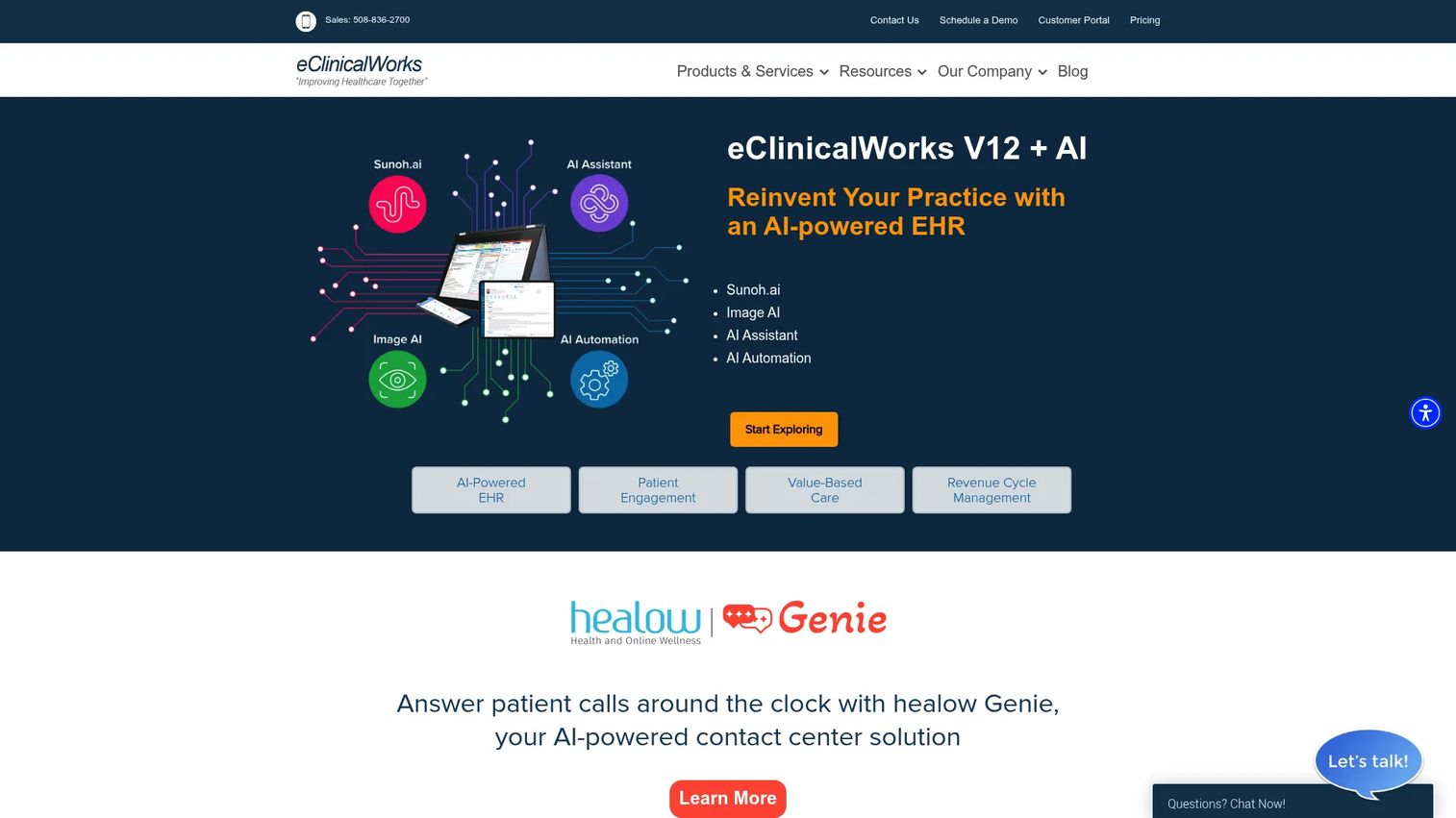
eClinicalWorks is an established ambulatory healthcare platform covering EHR, practice management, patient engagement, telehealth, and revenue cycle management. It is one of the few vendors in this category that publishes transparent per-provider pricing across multiple tiers. The platform includes AI-powered clinical tools, a patient portal, and value-based care functionality.
Best for: Large ambulatory practices and multi-location groups that want broad operational and clinical software coverage with published, predictable pricing.
Key features
- EHR with AI-powered documentation (Sunoh.ai, Eva)
- Practice management with scheduling, billing, and claims
- Patient engagement including telehealth, check-in, and portal
- Value-based care tools including care planning and HEDIS
- RCM with dashboards, KPI monitoring, and billing workflows
Why choose eClinicalWorks: Published pricing makes budget planning straightforward. The EHR-only tier at $499/month per provider lets practices start with clinical workflows and add practice management at $599/month per provider when ready. Buyers should validate implementation support, training needs, and workflow configuration before signing.
eClinicalWorks pricing: EHR Only starts at $499/month per provider. The EHR with Practice Management tier is $599/month per provider. RCM as a Service is priced at 2.9% of practice collections.
G2 rating: 3.7/5
5. PracticeSuite
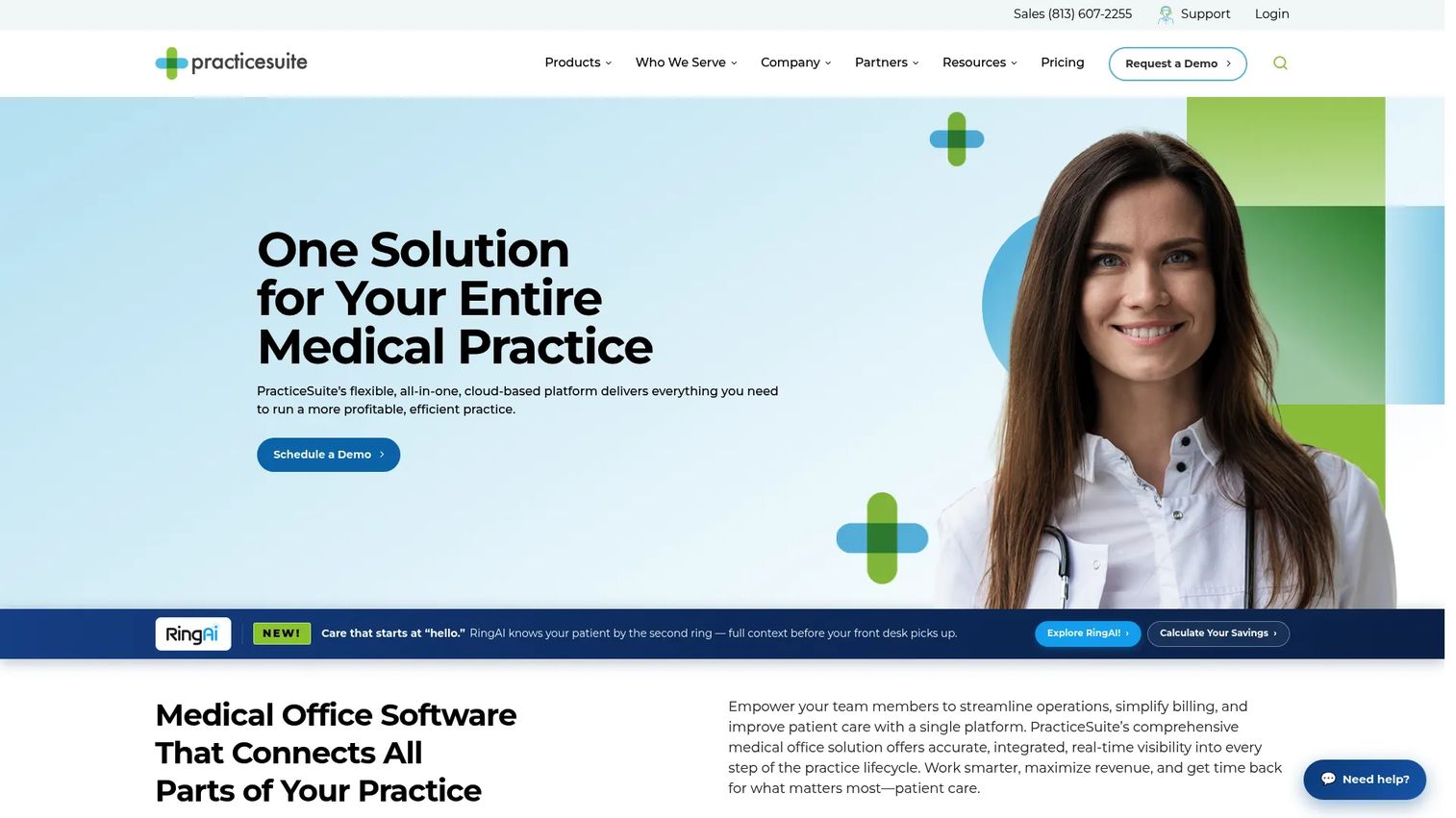
PracticeSuite is a cloud-based medical practice management platform that covers scheduling, EHR, billing, patient engagement, and telehealth. The platform emphasizes AI-powered billing automation, claim validation, denial management, and robotic process automation for administrative workflows. It is positioned for practices that need administrative depth without immediately jumping to enterprise health-system software.
Best for: Practices that want billing-centered practice management with cloud access, AI billing automation, and operational reporting.
Key features
- Practice management with scheduling, eligibility, and reporting
- ONC-certified EHR with customizable templates and dashboards
- Patient portal with online scheduling and digital check-in
- AI-powered billing automation, claim validation, and denial management
- Telehealth with HIPAA-compliant video and phone options
Why choose PracticeSuite: The combination of AI billing automation and a built-in EHR makes PracticeSuite a solid mid-market option. Teams that have outgrown entry-level software but are not ready for enterprise contracts will find the feature depth useful without the enterprise overhead.
PracticeSuite pricing: Pricing is quote-based. The final number changes with practice size, specialty mix, the modules selected, and the billing model. Per-provider and per-transaction pricing options are available, so ask sales to separate each component.
6. MicroMD

MicroMD provides customizable practice management, electronic medical records, e-prescribing, telehealth, patient intake, and patient engagement software for healthcare practices. The platform is designed for small to mid-sized specialty practices that want practice management connected to clinical workflows. MicroMD publicly lists subscription pricing for its expressChart EMR, which is uncommon in a category where most vendors require a sales call before disclosing numbers.
Best for: Small and mid-sized specialty practices that want practice management connected to clinical workflows, with published starting prices.
Key features
- Practice management with scheduling, eligibility, billing, claims, and collections
- Customizable EMR with clinical documentation, patient dashboards, and e-prescribing
- Lab and device connectivity for clinical data integration
- Patient engagement with online scheduling, two-way texting, and digital intake
- Telehealth with HIPAA-compliant tools
Why choose MicroMD: The published pricing and the focus on approachable, configurable workflows make MicroMD a practical fit for practices that are replacing legacy systems without a large IT team. Prospective buyers should ask about support, training, and the implementation timeline for their specialty.
MicroMD pricing: expressChart EMR starts at $425 per provider/month. The combined expressChart EMR and MicroMD PM Suite starts at $588 per provider/month. Other products and configurations use quote-based pricing.
7. SimplePractice
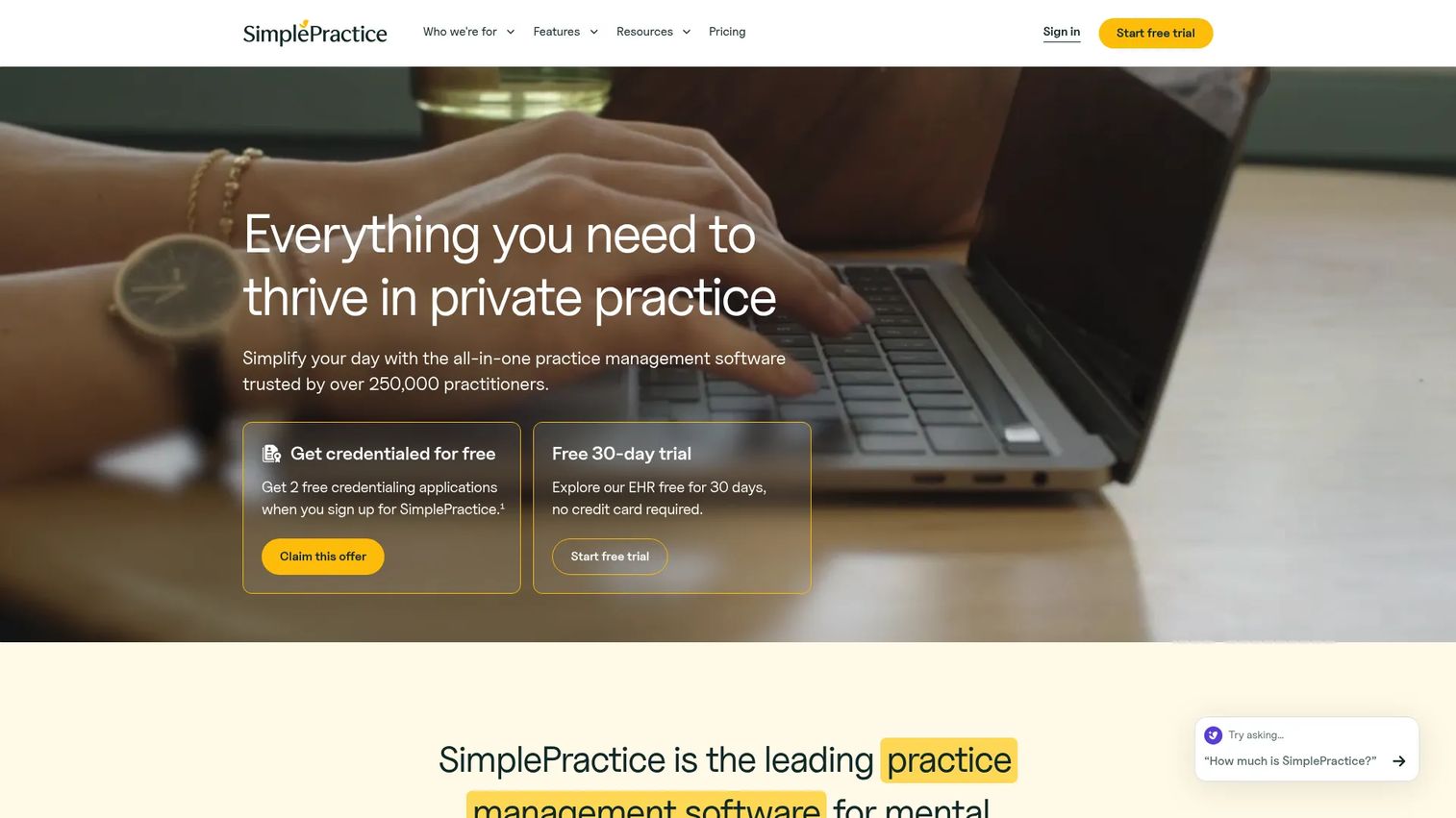
SimplePractice is a practice management and EHR platform built for health and wellness professionals, with particular strength in behavioral health, therapy, counseling, and private practice settings. It covers scheduling, documentation, billing, insurance claims, client portal, telehealth, and ePrescribe in a single system. A 30-day free trial is available across all plans.
Best for: Behavioral health and wellness practices that need scheduling, billing, telehealth, and client communication in a single, straightforward system.
Key features
- Online booking and calendar management
- Billing, payments, and insurance claims processing
- Telehealth tools built into the platform
- Client portal and secure messaging
- Customizable notes, treatment plans, and measurement-based care
Why choose SimplePractice: The published pricing and free trial make it easy to evaluate before committing. For solo practitioners and small group practices in behavioral health, the client-facing workflows are well-designed and require minimal configuration. Larger multi-specialty clinics should verify specialty workflow depth and reporting before choosing this over a heavier-weight system.
SimplePractice pricing: Starter plan starts at $49/month. Essential is $79/month and Plus is $99/month, all billed monthly. A 30-day free trial is available. Optional add-ons include ePrescribe and insurance services.
G2 rating: 4.1/5
8. Oracle Health
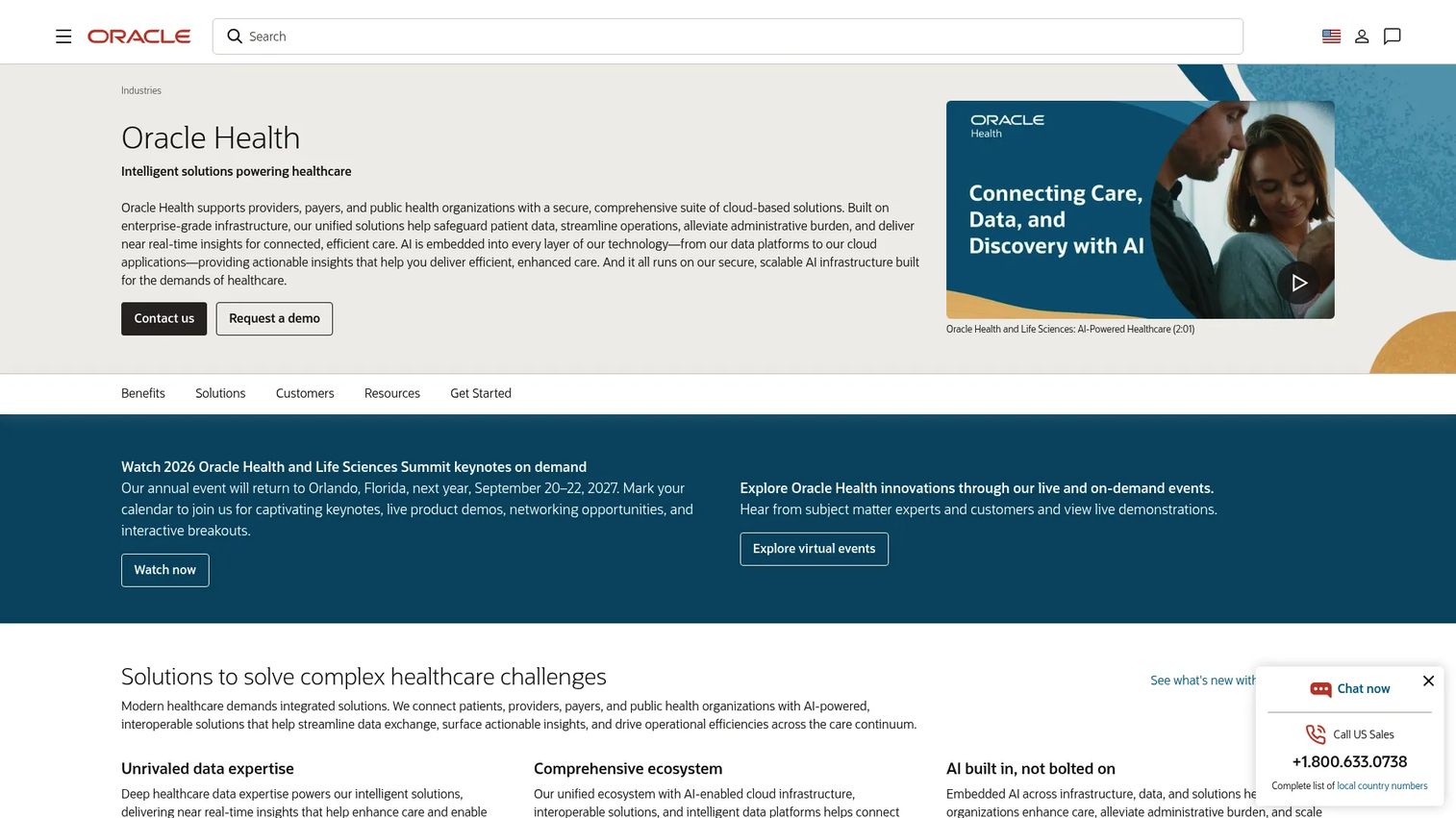
Oracle Health provides cloud-based healthcare technology for large provider organizations, payers, public health organizations, and life sciences companies. The platform covers AI-powered clinical applications, healthcare interoperability, data exchange, and enterprise-scale financial and operational analytics. It is designed for organizations operating at a complexity level that smaller practice management systems cannot support.
Best for: Health systems and large specialty networks that need enterprise-grade healthcare operations infrastructure with deep interoperability requirements.
Key features
- Enterprise health records and AI-powered clinical workflow support
- Healthcare interoperability and HL7/FHIR data exchange
- Clinical, financial, and operational analytics at enterprise scale
- Practice operations and revenue cycle workflows
- System-wide reporting and governance tools
Why choose Oracle Health: Oracle Health suits organizations that have already outgrown mid-market practice management systems and need an integrated clinical and operational platform that can scale across dozens of locations. Smaller practices should evaluate whether the implementation scope and total cost align with their operating reality before engaging.
Oracle Health pricing: Broader Oracle Health solutions require a quote from Oracle. Payment processing services are separately listed at 2.8% per card-present transaction plus $0.15 per transaction, and 3.15% for card-not-present payments.
9. CareCloud
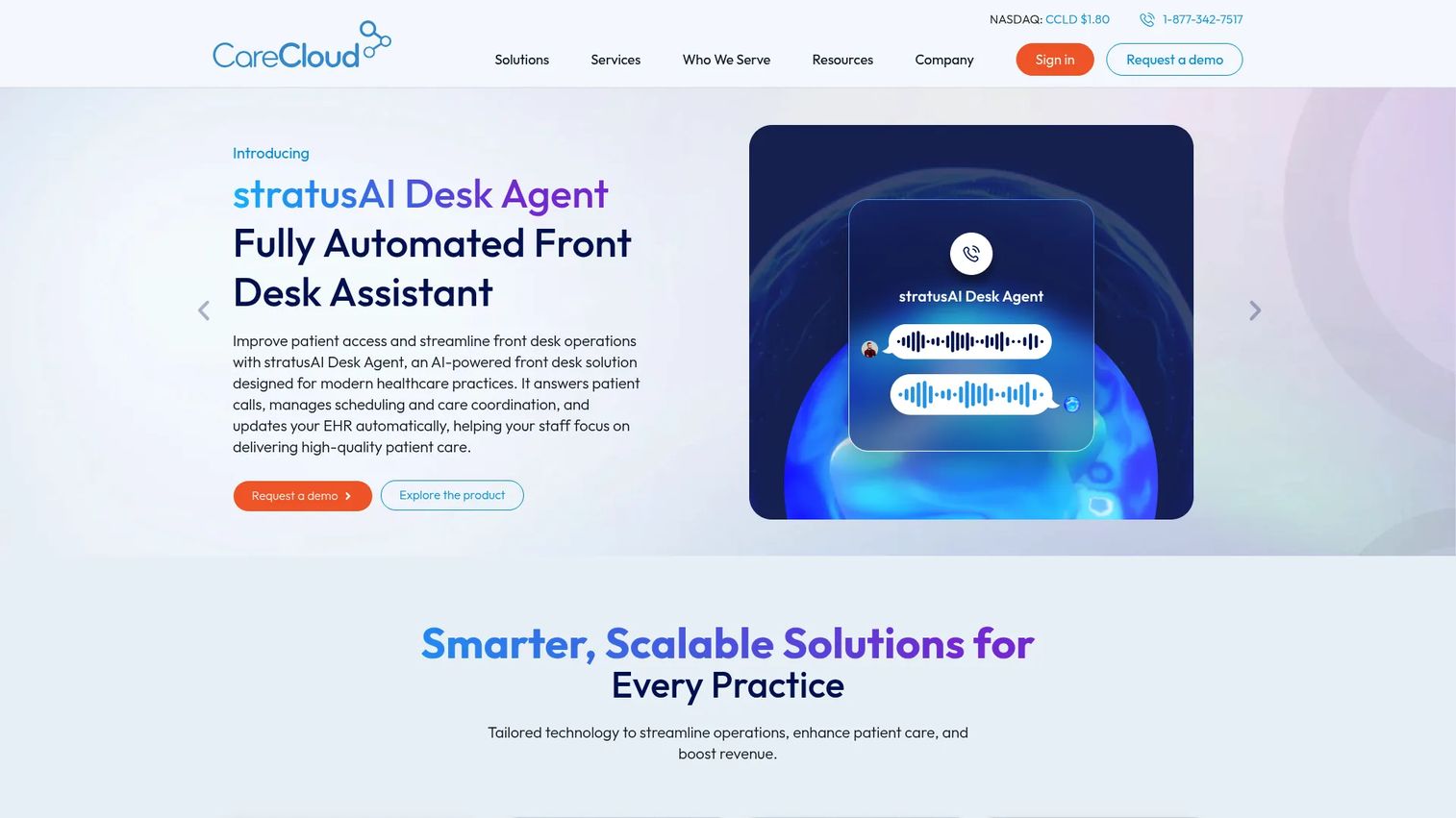
CareCloud is a cloud-based, AI-powered healthcare platform covering practice management, EHR, revenue cycle management, patient engagement, digital health, and analytics. The platform offers both software and optional RCM services, making it a practical option for practices with limited internal billing bandwidth. The PRIME plan pricing is published directly on the CareCloud website.
Best for: Practices that want cloud practice management with optional RCM services and patient-experience tools.
Key features
- EHR and clinical documentation
- Practice management, scheduling, and patient intake
- Revenue cycle management, claims, billing, and denial management
- Patient engagement, telehealth, and automated reminders
- AI-powered documentation and clinical support tools
Why choose CareCloud: The combination of software and optional managed RCM services lets practices start with self-managed billing and add external support as the practice grows. Teams with limited billing staff will find the services model useful for reducing administrative risk.
CareCloud pricing: The PRIME plan starts at $249 per provider per month. The Central, Charts, and Complete plans are listed at $349, $379, and $629 per provider per month respectively. Pricing may be customized based on practice size, specialty, and feature requirements.
G2 rating: 3.0/5
10. Tebra
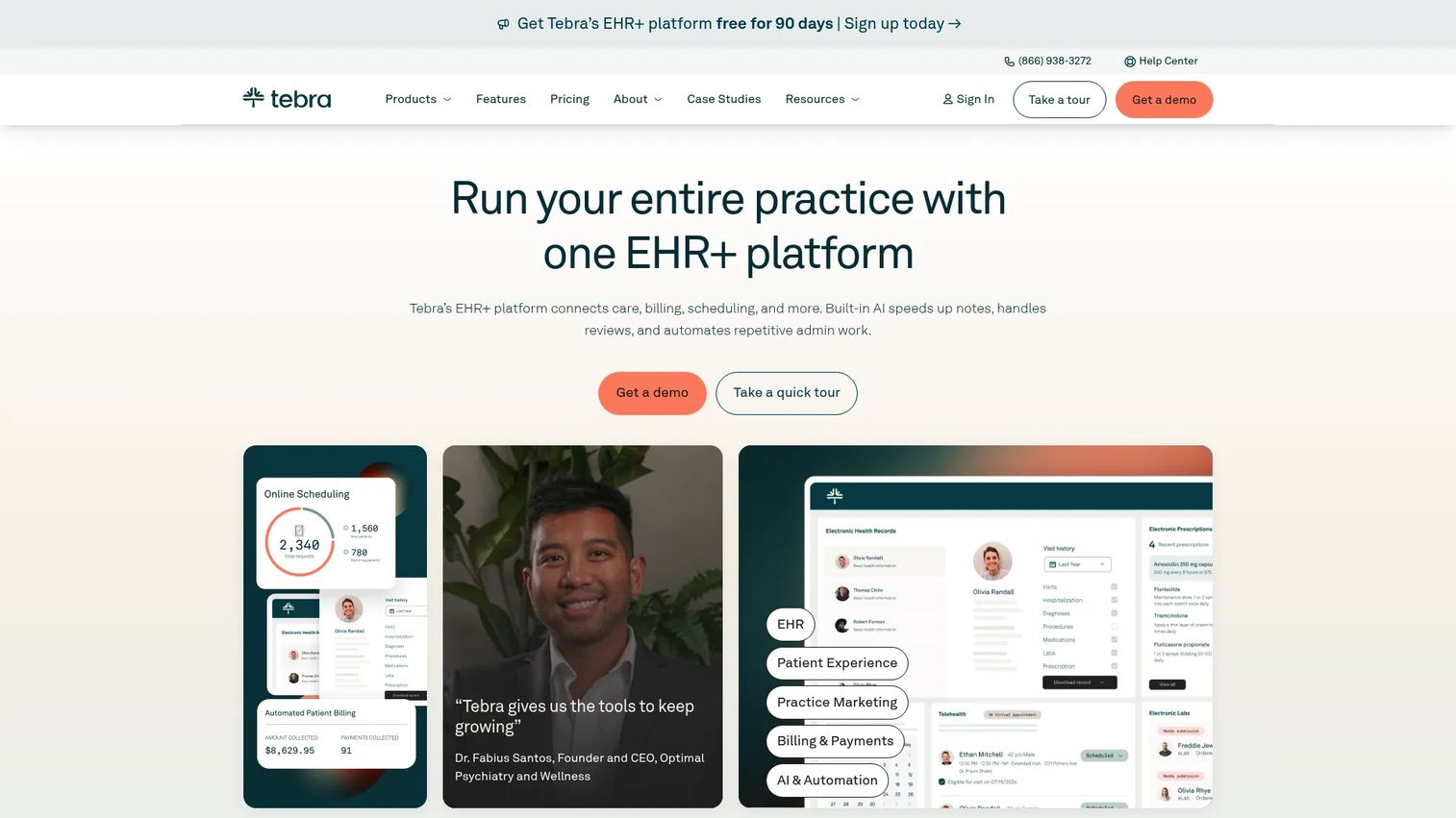
Tebra is an all-in-one operating platform for independent healthcare practices. It combines EHR, medical billing, online scheduling, telehealth, patient engagement, payment processing, and practice marketing tools in a single system. Tebra was formed through the combination of Kareo and PatientPop and positions itself specifically for independent practices that want to run operations, clinical workflows, and patient growth from one vendor relationship.
Best for: Independent medical practices that want practice management, billing, and patient communication in a single vendor relationship without enterprise complexity.
Key features
- EHR with AI-powered charting
- Medical billing and revenue cycle management
- Online scheduling and appointment reminders
- Patient portal and digital intake
- Practice marketing and reputation management tools
Why choose Tebra: Tebra covers the full independent practice lifecycle from patient acquisition to billing, which reduces the number of vendor relationships to manage. Specialty practices with complex RCM requirements should validate the depth of specialty-specific workflows, denials management, and interoperability before committing.
Tebra pricing: Tebra uses custom pricing based on provider count, features, specialty, and claim volume. Five plan configurations are available, including an all-in-one option, an EHR-focused tier, and billing-only configurations. Contact Tebra sales for a quote.
G2 rating: 4.1/5
11. PracticeQ
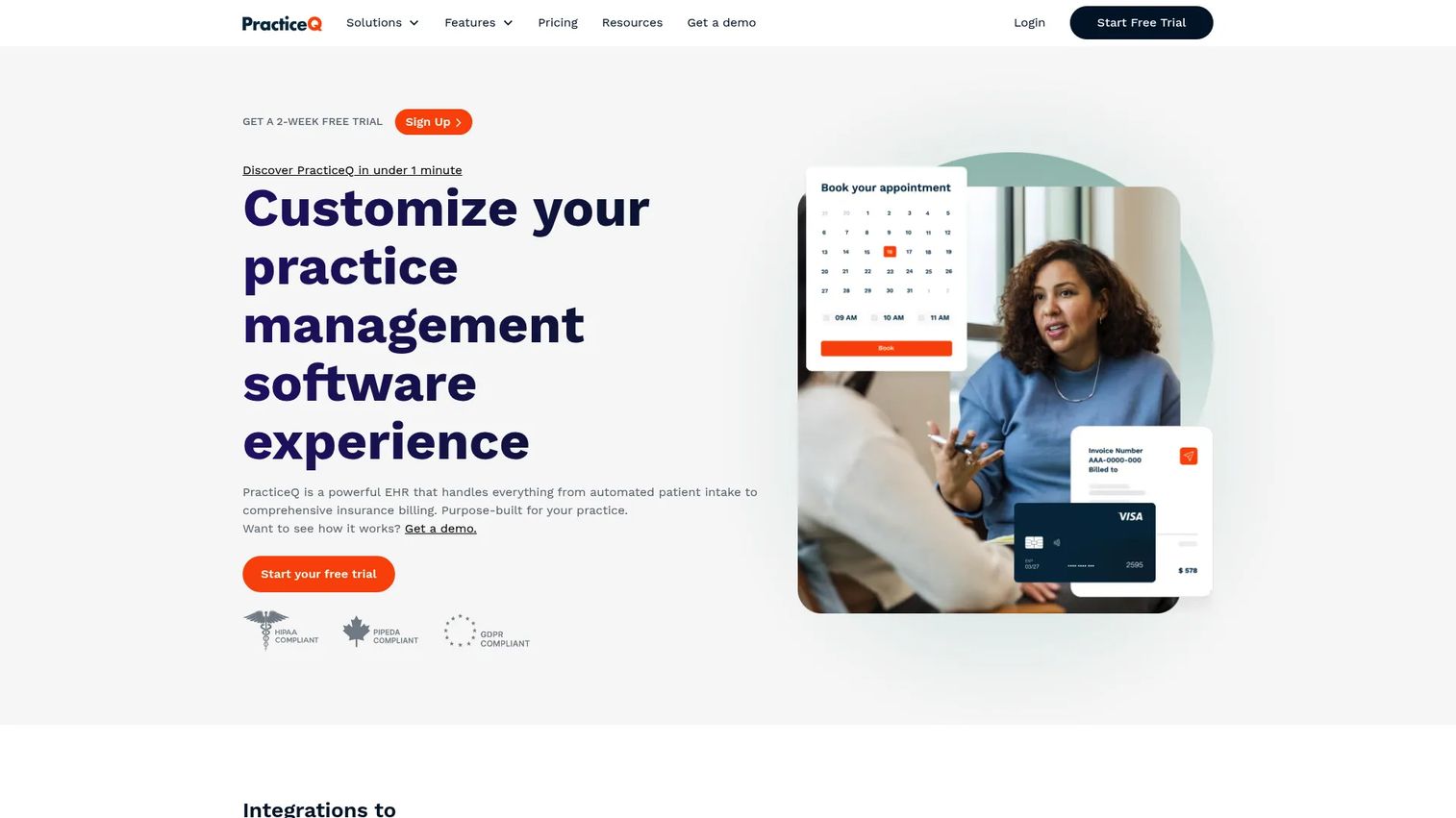
PracticeQ is an EHR and practice management platform for healthcare practices covering patient intake, scheduling, billing, clinical documentation, and insurance workflows. The platform offers a two-week free trial with no credit card required, and published monthly pricing across its two main tiers. It is particularly well-suited to smaller practices and solo providers that prioritize front-office and intake workflows.
Best for: Solo providers and small practices that prioritize intake, online scheduling, documentation, and client communication.
Key features
- Automated patient intake and onboarding forms
- Online booking and appointment reminders
- Billing, invoicing, claims, and superbills
- Secure patient portal and telehealth
- Built-in charting with SOAP and EHR templates
Why choose PracticeQ: The transparent pricing and free trial make it straightforward to evaluate. The front-office and intake workflows are well-developed for smaller practices. Medical practices with complex RCM needs, multi-payer billing, or multi-specialty requirements should verify that the claims and EHR depth meets those requirements before moving away from a larger platform.
PracticeQ pricing: The Starter plan is $59.90/month. The Pro plan is $84.90/month. Both are billed monthly. A two-week free trial is available with no credit card required. E-prescribing is an add-on at $65/month.
12. Claimocity
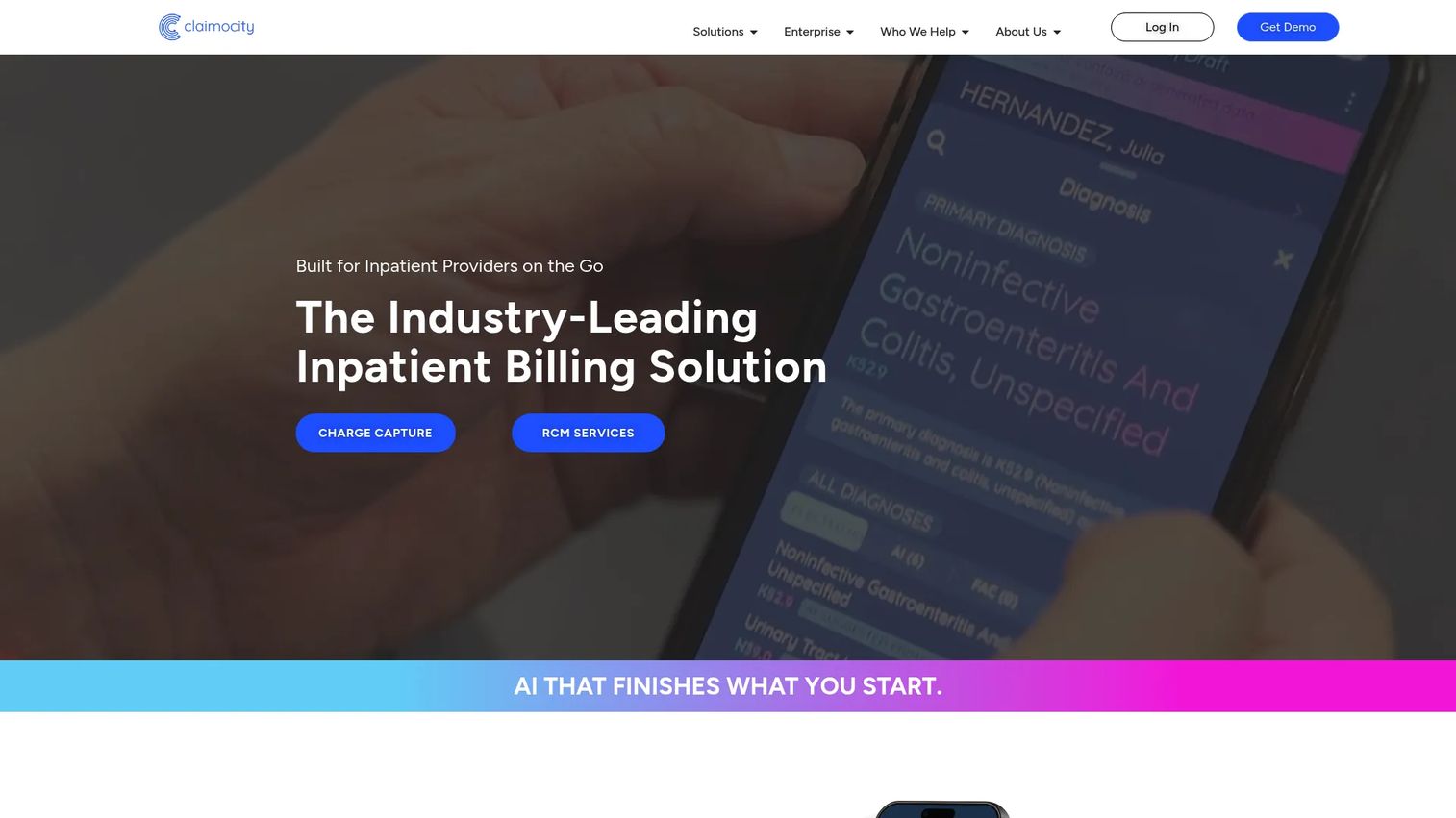
Claimocity is a mobile practice management, billing, and revenue cycle management platform designed specifically for inpatient healthcare providers, including hospitalists and inpatient specialty groups. The platform focuses on AI-powered charge capture, clinical notes, compliance, coding assistance, and facility integrations. It addresses the specific challenge of capturing charges accurately at the bedside before they fall through the cracks.
Best for: Hospitalist groups and inpatient specialty practices that need mobile charge capture, clinical documentation, and RCM support connected to facility workflows.
Key features
- AI-powered charge capture at the point of care
- Revenue cycle management and billing workflows
- Clinical notes and documentation
- Compliance and coding assistance
- Facility integrations and reporting analytics
Why choose Claimocity: Claimocity solves a problem that general practice management systems do not address well: Inpatient charge capture on mobile devices. For hospitalist groups where providers are moving between floors and facilities, the mobile-first design reduces missed charges and documentation lag. Buyers should verify whether Claimocity replaces or complements their broader practice management system before purchasing.
Claimocity pricing: Pricing requires a demo request. The rate changes with provider count, claims volume, and the modules selected. Contact Claimocity directly for a quote.
13. Veradigm
Veradigm is a healthcare technology and analytics company providing solutions for providers, health plans, payers, and life science organizations. For specialty practices, the platform covers EHR, practice management, revenue cycle management, ePrescribing, patient engagement through FollowMyHealth, payer analytics, and real-world evidence data. The Veradigm Connect subscription program has published monthly tiers, which is notable in a category where most vendors gate all pricing behind sales conversations.
Best for: Specialty practices and multi-specialty groups that need configurable workflows across scheduling, RCM, denials, and EHR interoperability with deep payer analytics.
Key features
- EHR and practice management with configurable workflows
- RCM including coding, billing, collections, and denial management
- ePrescribing with electronic prior authorization and PDMP integration
- Patient engagement through the FollowMyHealth portal
- Payer analytics, risk adjustment, and quality management tools
Why choose Veradigm: Veradigm's depth in payer analytics and specialty RCM makes it a strong fit for practices managing complex denial workflows, prior authorization queues, and multi-payer reporting. The published Connect subscription pricing provides a starting point for budget conversations, though the broader EHR and PM product set uses quote-based pricing.
Veradigm pricing: Veradigm Connect subscriptions start at $49/month (Bronze) and go to $99, $499, $1,499, and $2,499/month (Platinum Plus). Broader Veradigm EHR and PM products use quote-based pricing tied to users, specialties, modules, and implementation scope.
G2 rating: 3.4/5 (for Veradigm EHR)
14. RXNT
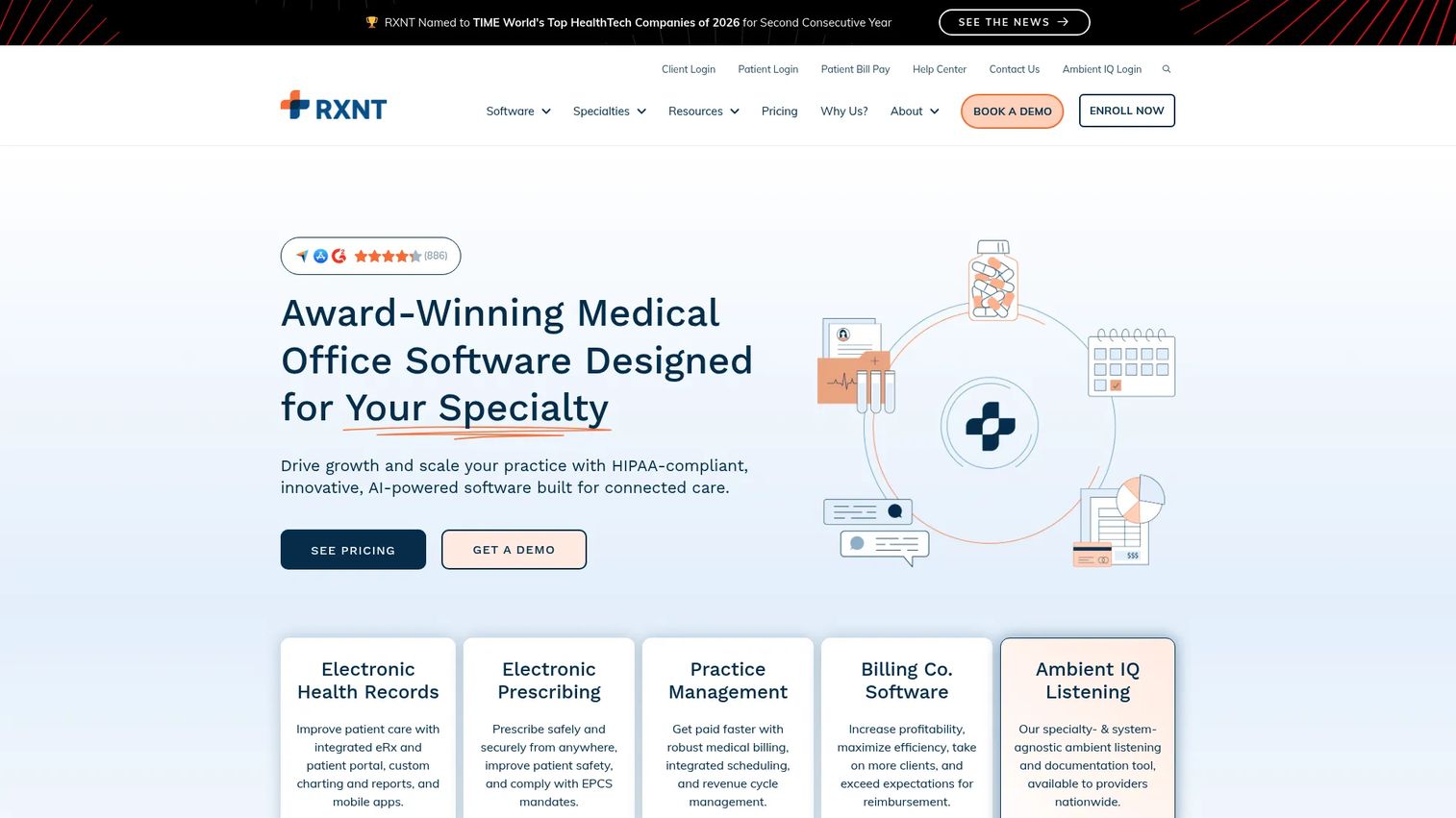
RXNT provides integrated, cloud-based healthcare software covering EHR, electronic prescribing, practice management, medical billing, scheduling, patient engagement, and AI-powered ambient documentation. The platform offers a-la-carte buying or bundled subscriptions, with an annual billing option that provides a 10% discount on eligible plans. Practices can start with one module and add others without switching platforms.
Best for: Practices that want modular, cloud-based practice management with published pricing and the option to add EHR, billing, and e-prescribing as needed.
Key features
- EHR with integrated e-prescribing, patient portal, and mobile apps
- Practice management with claim scrubbing, denial management, and eligibility checks
- Ambient IQ AI-powered clinical documentation
- Revenue cycle management with scheduling and online bill pay
- A-la-carte or bundled subscription options
Why choose RXNT: The modular structure lets smaller and mid-sized practices pay for what they actually use. The published Ambient IQ pricing at $75/month after a 90-day free trial gives a concrete entry point for evaluating the platform. Multi-specialty groups should verify specialty configuration, reporting depth, and interoperability before purchasing.
RXNT pricing: Ambient IQ starts at $75/month after a 90-day free trial. EHR Bundle, Practice Management Bundle, and Full Suite plans are available on monthly or annual billing. Annual billing provides a 10% discount on eligible plans. EPCS identity proofing is $85/year per applicable user.
G2 rating: 4.2/5
15. AdvancedMD
AdvancedMD is a cloud-based healthcare platform combining EHR, practice management, medical billing, revenue cycle management, patient engagement, telemedicine, and AI clinical documentation. The platform publishes specialty-specific pricing across its modules, which is unusual for a full-suite ambulatory vendor. Pricing varies by specialty, so a mental health practice and a medical specialty practice will see different numbers.
Best for: Ambulatory and specialty practices that want configurable practice management with billing and patient engagement, and published pricing by specialty.
Key features
- EHR with configurable templates and clinical documentation
- Practice management with scheduling, billing, claims management, and AR controls
- Patient engagement with portal, online scheduling, intake forms, and payments
- Telemedicine tools integrated into the clinical workflow
- Reporting dashboards for productivity, payer performance, and practice economics
Why choose AdvancedMD: The published specialty-specific pricing makes it easier to build a business case before engaging sales. The RCM-as-a-service model at 4 to 8% of collections suits practices that want to offload the billing function rather than staff it. Buyers should validate the implementation effort, support experience, and module packaging for their specific specialty before signing.
AdvancedMD pricing: Plans start at $130 per provider/month for AdvancedMD Now on a month-to-month basis. Practice Management runs $399 per provider/month and EHR is $220 per provider/month. Medical specialties are priced at $429 to $1,070 depending on configuration. RCM as a service is priced at 4 to 8% of collections. Bundles may reduce total cost.
G2 rating: 3.6/5
Considerations when choosing specialty practice management software
Specialty workflow fit
A dermatology practice, an infusion center, and a behavioral health clinic do not schedule, bill, or document the same way. Generic appointment slots will not cover chair availability, equipment utilization, recurring authorization-dependent visits, or treatment cycles. Ask vendors to demo your exact workflow, not a generic appointment screen. Specifically ask about authorizations, referrals, recurring visits, and payer-specific billing rules before making a shortlist.
Billing and revenue cycle ownership
Define who owns each RCM step after go-live before signing anything. Charge capture, claim scrubbing, claim submission, remittance, denial management, collections, and payment posting can sit inside the software, in a managed service, or split between both. Unclear ownership at the contract stage creates month-two frustration when the billing team realizes the software does not handle the step they assumed it would.
EHR and interoperability requirements
Ask vendors for live examples of HL7 and FHIR integrations with practices similar to yours. Payer connectivity, clearinghouse relationships, lab ordering, imaging, and patient portal data exchange all need to work reliably, not just appear on a feature list. Do not accept slideware as evidence. This article does not constitute compliance or regulatory advice, and buyers should consult their own technical and legal teams on specific interoperability requirements.
Implementation timeline and migration risk
Small practices with straightforward workflows can often go live faster. Multi-location or multi-specialty practices need more time for data migration, payer setup, billing rule configuration, staff training, and billing validation before trusting the output. Ask every vendor for a milestone-based implementation plan and reference contacts from practices your size in your specialty.
Total cost of ownership
The subscription line is rarely the full number. Add implementation fees, clearinghouse fees, payment processing, RCM service percentages, training, add-on modules, support tiers, and integration work to the subscription before comparing vendors. The price changes with provider count, locations, claims volume, and services included, so ask sales to itemize each component rather than presenting a single monthly figure.
Conclusion
The best specialty practice management software for your organization depends on workflow complexity, billing model, specialty mix, and how much implementation disruption the team can absorb.
For broad specialty and ambulatory depth, NextGen Healthcare remains a mature option for multi-specialty groups. For cloud-based operations with network connectivity, athenahealth's percentage-of-collections model aligns incentives well for revenue-cycle-focused practices. SimplePractice is the clearest choice for behavioral health and wellness practices that want published pricing and a free trial. Veradigm earns its place for specialty groups managing complex RCM and payer analytics. For modular, transparent cloud practice management, RXNT offers one of the few published entry points in this category.
The practical next step is to build a shortlist of three vendors and ask each one to demo the same complete workflow: From appointment request through eligibility check, authorization, visit, charge capture, claim submission, denial, payment, and reporting dashboard. That exercise will tell you more than any feature comparison table.
Do not choose the tool with the longest feature list. Choose the one that can run your real workflow from appointment request to paid claim without turning your team into the integration layer. For teams evaluating adjacent software categories, a review of ai medical diagnostic platforms may also be useful context for the broader technology stack.
FAQs
Specialty practice management software is administrative and financial operations software for medical practices with specialty-specific scheduling, billing, and workflow requirements. It covers appointment scheduling, eligibility verification, charge capture, claim submission, denial management, collections, and reporting. It may be sold standalone or bundled with an EHR system, and buyers should evaluate each layer independently.
Practice management software handles operational and financial workflows: Scheduling, billing, claims, collections, and front-office processes. An EHR manages clinical documentation, patient records, orders, and care plans. Many vendors bundle both, but the buying criteria are different. A practice can have a strong EHR with a weak billing engine, or vice versa, so evaluate each component against the workflows it will own.
Pricing models vary significantly across vendors. eClinicalWorks publishes per-provider pricing starting at $499/month. SimplePractice starts at $49/month for behavioral health. AdvancedMD ranges from $130 to over $1,000 per provider/month depending on specialty. CureMD and athenahealth use percentage-of-collections models. Total cost also includes implementation fees, clearinghouse fees, payment processing, and any managed RCM services layered on top.
Most systems include billing workflows, but depth varies considerably. The key distinction is between charge capture, claim scrubbing, claim submission, remittance processing, denial management, and outsourced billing services. Some vendors offer all of those as software features; others provide managed billing services on top of the software. Ask vendors to describe what happens after a claim is submitted, specifically who handles denials and what the AR follow-up workflow looks like.
Yes, but multi-specialty support varies by vendor. Platforms like NextGen Healthcare, eClinicalWorks, and Veradigm are specifically designed for multi-specialty operations. The practical test is whether the system supports separate scheduling templates, payer rules, billing codes, and reporting structures for each specialty within a single instance. Test that configuration with real specialty scenarios before committing.
Small practices with straightforward workflows can often complete an implementation in four to eight weeks. Multi-location or multi-specialty practices typically need three to six months for full data migration, payer setup, billing rule configuration, staff training, and validation. The right vendor will provide a milestone-based plan with clear owners for each phase. Fast setup is useful only if the billing team trusts the outputs at the end of month one.
EHR integration is the first priority, particularly HL7 and FHIR data exchange for clinical and billing data. Clearinghouse connectivity drives claim submission and remittance. Patient portal, payment processing, telehealth, lab ordering, and imaging integrations round out the core stack. Accounting and analytics integrations matter for finance and reporting. Ask vendors for live examples of each integration type with practices comparable to yours in size and specialty, not a diagram in a slide deck.
Ask the vendor to walk through a complete workflow from scheduling to eligibility check, authorization, visit documentation, charge capture, claim submission, denial handling, payment posting, and reporting dashboard. Ask specifically who configures the billing rules, what the first 90 days look like, and what the typical go-live timeline is for a practice your size. Run the demo with a real specialty scenario, such as an infusion chair scheduling sequence or a behavioral health intake and billing flow, rather than a generic appointment.