You passed the technical demo. Then the buyer asks how your team reviews code for security issues, what runs in CI, who triages findings, and how you keep false positives from drowning developers. That is where vague AppSec answers slow deals down.
Security flaws discovered in production cost dramatically more to fix than flaws caught during development. Veracode's State of Software Security 2025, drawn from 1.8 million scans across 457,000 applications, found that 80% of applications tested had at least one security flaw. That number lands differently when a buyer's security team is asking you to prove your SDLC controls before signing.
Secure code review software is the category that closes this gap. It covers everything from pull request checks and application security testing to AI-assisted review and formal peer review workflows. The right tool depends on where your team ships code, how many languages you support, and what evidence buyers need to see.
This guide compares 15 options across repository platforms, dedicated SAST tools, open source risk scanners, AI-assisted reviewers, and self-hosted governance platforms.
What's inside
This guide is for AppSec engineers, DevSecOps teams, engineering managers, and presales professionals supporting security diligence conversations. Tools were selected based on:
- Security coverage: Vulnerability detection, secrets, dependency risk, and SAST depth
- Developer workflow fit: Pull request comments, CI/CD integration, IDE support
- False-positive control: Suppression, severity tuning, and noise reduction
- Evidence quality: Reporting, audit trails, and governance for security review processes
Pricing and G2 ratings come from vendor pricing pages and live G2 listings, checked in October 2026. Several vendors in this category changed list prices during 2026, so confirm current figures before building a business case.
TL;DR
- Best all-around developer platform: GitHub, for teams that want code review, security scanning, and repository workflows in one place
- Best DevSecOps platform: GitLab, for teams wanting secure code review inside a full software delivery lifecycle
- Best dedicated code quality and security analysis: SonarQube, for teams needing maintainability and vulnerability signals across many languages
- Best enterprise SAST depth: Coverity, for organizations with large codebases and formal AppSec programs
- Best AppSec consolidation: Aikido Security, for teams wanting code security, dependency risk, and cloud findings in a single queue
- Best AI-assisted pull request review: CodeRabbit and Qodo, for teams adding AI review support without removing human judgment
What is secure code review software?
Secure code review software helps teams inspect source code for vulnerabilities, insecure patterns, dependency risk, secrets, configuration issues, and security regressions before code reaches production.
The category spans several distinct approaches:
Static application security testing (SAST): Automated analysis of source code for known vulnerability patterns. SAST runs without executing the code and scales across large codebases. Tools like SonarQube and Coverity fall here.
Repository-native security: Platforms like GitHub and GitLab embed security checks directly into pull requests and CI/CD pipelines. Code scanning alerts, secret detection, and dependency review happen where developers already work.
Software composition analysis (SCA): Focuses on open source and third-party dependency risk. Black Duck specializes here.
AI-assisted review: Tools like CodeRabbit, CodeAnt AI Reviews, and Qodo add AI-generated comments and PR summaries on top of standard review workflows.
Manual review support: Tools like Crucible structure formal peer review processes with audit trails, inline comments, and Jira integration.
Key capabilities to look for:
- Pull request and merge request analysis
- Inline findings with developer remediation guidance
- CI/CD pipeline gates and branch protection
- Dependency and open source risk checks
- Secret detection across commits and history
- Policy enforcement and compliance reporting
- Manual review workflows for business logic and authorization issues
OWASP secure coding practices provide a useful evaluation reference for which vulnerability classes a tool should cover. Automated tools scale pattern detection across large codebases, but human reviewers still catch context-sensitive flaws in business logic, authorization, and data-flow assumptions. Strong secure code review programs combine both.
When to use secure code review software
Catch risky code before it reaches production
Security tools that run during pull requests or CI catch injection flaws, weak cryptography, unsafe deserialization, secrets, and authorization issues before they merge. This is far cheaper than remediation after deployment. Presales teams supporting security diligence conversations can point to CI gate policies as evidence of proactive SDLC controls.
Support technical security diligence
Buyers running procurement or vendor security assessments ask about SAST coverage, code review practices, finding triage workflows, and remediation SLAs. A documented, repeatable code security process gives your team concrete evidence to present rather than vague assertions. The same buyers often ask who can reach production systems and how that is governed, so pair your review evidence with a documented access review process.
Scale AppSec without blocking developers
AppSec teams cannot manually inspect every commit. The right tools prioritize risk, suppress noise, integrate into existing CI/CD pipelines, and keep developers inside their normal workflow. This is how you run a program that engineers adopt rather than route around.
Secure code review software comparison
The table below covers all 15 tools in the order they appear in this guide. Two entries are related: Coverity is a Black Duck product, so numbers four and five come from the same vendor. Use this as a starting point for shortlisting, then verify pricing and ratings against vendor pages before procurement decisions.
| # | Product | Best for | Key differentiator | Pricing | G2 rating |
|---|---|---|---|---|---|
| 1 | GitHub | Repository-native security | Integrated code scanning, secret scanning, and Dependabot in one platform | Free; Team $4/user/mo; Enterprise $21/user/mo, security products priced separately | 4.7/5 |
| 2 | GitLab | DevSecOps workflows | Built-in SAST, dependency scanning, and security dashboards across the SDLC | Free; Premium $29/user/mo; Ultimate custom | 4.5/5 |
| 3 | SonarQube | Code quality and security analysis | Quality gates and multi-language vulnerability scanning | Free (up to 50k LOC, 5 users); Cloud Team from $32/mo | 4.4/5 |
| 4 | Coverity (Black Duck) | Enterprise SAST depth | Deep static analysis across 20+ languages for regulated environments | Custom pricing | 4.2/5 |
| 5 | Black Duck | Open source and dependency risk | SCA, SBOM generation, and license compliance enforcement | Custom pricing | 4.2/5 |
| 6 | Aikido Security | Consolidated AppSec | Combines SAST, SCA, secrets, cloud, and container scanning in one queue | Free Developer plan; three flat monthly tiers that bundle users | 4.6/5 |
| 7 | CodeRabbit | AI-assisted PR review | Agentic AI reviews with one-click fixes and security monitoring | Free (public repos); Essentials $24/dev/mo | 4.4/5 |
| 8 | CodeAnt AI Reviews | AI code review with security checks | AI PR feedback with SAST, SCA, secrets, and cloud scanning | 14-day free trial; contact for pricing | 4.7/5 |
| 9 | CodeScene | Risk-based review prioritization | Behavioral code analysis that surfaces hotspots and change risk | Free (OSS); Standard from €18/author/mo | 4.6/5 |
| 10 | Qodo | AI-assisted review governance | Self-learning rules and cross-repository governance analytics | Pro Team $30/mo; Enterprise custom | 4.5/5 |
| 11 | Azure DevOps | Microsoft-centered teams | Azure Repos pull requests and branch policies inside Microsoft infrastructure | Free (5 users); Basic $6/user/mo | 4.4/5 |
| 12 | Bitbucket | Atlassian ecosystem teams | Pull requests, pipelines, and Jira integration in one Atlassian workflow | Free (up to 5 users); Standard $3.65/user/mo | 4.4/5 |
| 13 | Crucible | Formal peer review records | Structured review workflows with Jira integration and audit trails | New sales ended May 2025; legacy only | 3.9/5 |
| 14 | Gitea | Lightweight self-hosted Git | Free, self-hosted Git with pull requests and CI/CD | Free (OSS); Enterprise $9.50/user/mo | 4.7/5 |
| 15 | RhodeCode | Enterprise SCM governance | Multi-VCS repository management with fine-grained permissions and audit logs | Free (Community); Enterprise $75/user/yr | Not listed on G2 |
The 15 tools, reviewed
1. GitHub
GitHub is the most widely used developer platform for planning, building, reviewing, and securing software. Its secure code review capabilities include pull request workflows, code scanning powered by CodeQL, secret scanning, Dependabot alerts for dependency vulnerabilities, and branch protection rules that enforce review before merge. For teams already using GitHub as their repository, these security features land where developers already work, which drives adoption far better than standalone tools.
Best for: Engineering teams that want security checks embedded directly in their pull request and CI/CD workflow.
Key features
- Pull request reviews with inline comments and approval workflows
- Code scanning alerts powered by CodeQL
- Secret scanning across commits and repository history
- Dependabot alerts and automated dependency updates
- Branch protection rules and required status checks
Why choose GitHub: If your team already lives in GitHub, adding security coverage keeps the entire review process in one place and avoids tool switching for developers.
GitHub pricing: Free tier for public repositories. Team plan starts at $4 per user per month. Enterprise plan is $21 per user per month. The advanced security capabilities are licensed separately from the platform seat: GitHub Secret Protection is $19 per active committer per month and GitHub Code Security is $30 per active committer per month. Budget for both lines, because the platform seat price alone does not include deep code and secret scanning on private repositories.
G2 rating: 4.7/5
2. GitLab
GitLab is a DevSecOps platform that integrates source code management, merge requests, CI/CD, and application security testing into a single workflow. Built-in SAST, dependency scanning, secret detection, container scanning, and security dashboards are available without requiring separate tooling. The Ultimate tier includes the most comprehensive security and compliance capabilities, including vulnerability management and advanced supply chain controls.
Best for: Organizations standardizing software delivery and security governance together, particularly those moving away from fragmented tool stacks.
Key features
- Merge request approvals with configurable review requirements
- Built-in SAST and dependency scanning
- Container scanning and secret detection
- Security dashboards and vulnerability management
- CI/CD policy gates for pipeline enforcement
Why choose GitLab: GitLab suits teams that want secure code review, pipeline controls, and security reporting from a single platform rather than stitching tools together.
GitLab pricing: Free tier available with SAST included. Premium is $29 per user per month, billed annually. Ultimate is custom pricing with the full security suite. Note that the most valuable security capabilities, including vulnerability management and security dashboards, sit in Ultimate rather than Premium.
G2 rating: 4.5/5
3. SonarQube
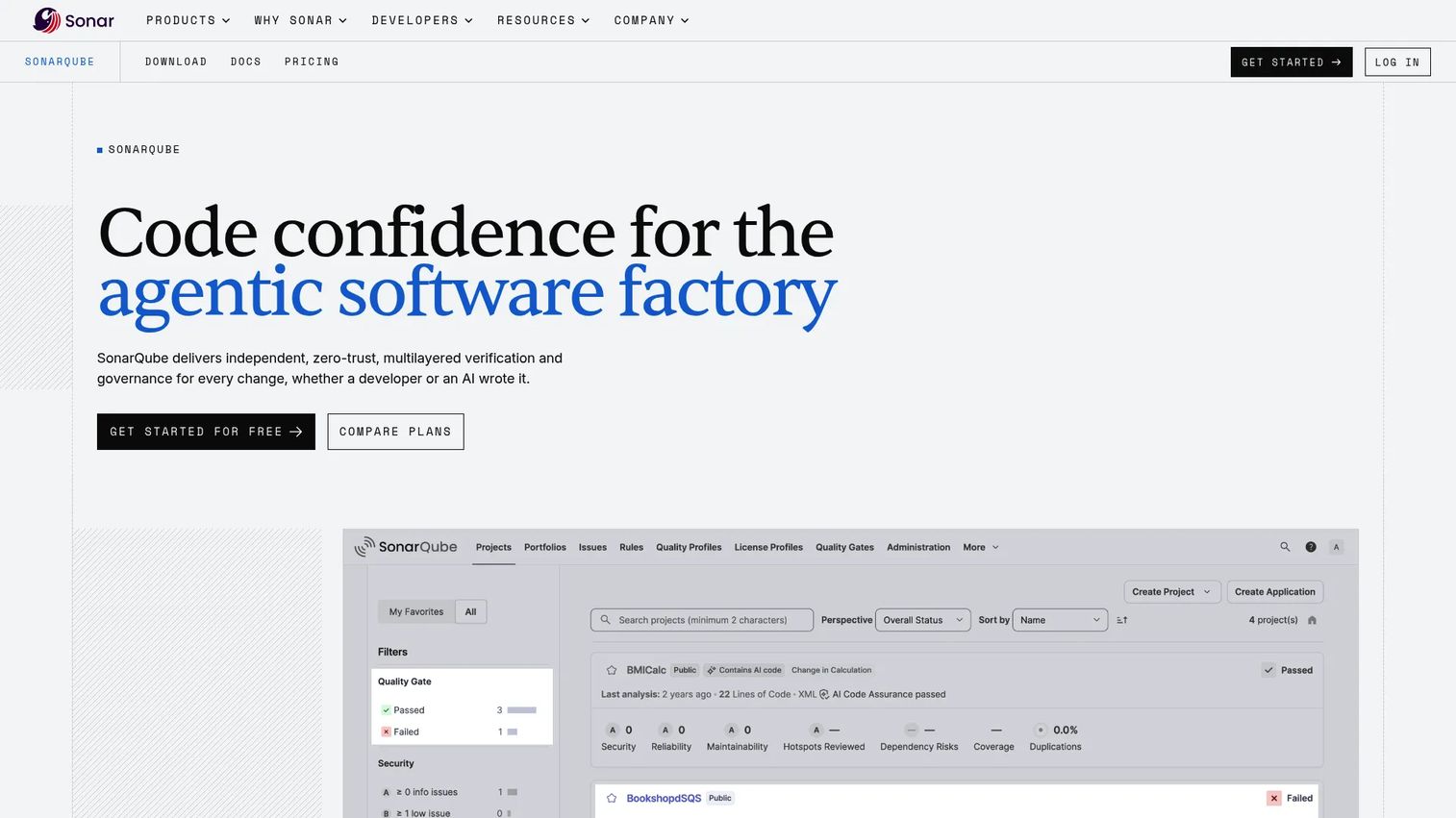
SonarQube is a code verification platform that combines automated code review with static analysis for vulnerabilities, bugs, code duplication, and maintainability issues. Its quality gates stop failing code from merging, and its security hotspot detection flags areas that require developer attention during pull request review. SonarQube supports dozens of programming languages and integrates with IDEs, pull requests, and CI/CD tools.
Best for: Development and security teams that need consistent vulnerability signals and maintainability checks across multiple codebases or languages.
Key features
- Security hotspots and vulnerability detection
- Quality gates that block failing pull requests
- Pull request analysis with branch comparisons
- Multi-language scanning including Java, JavaScript, Python, Go, and C#
- Issue remediation guidance with CWE and OWASP mapping
Why choose SonarQube: Its rule-based approach gives engineering teams repeatable, measurable code health standards across all repositories, which is useful evidence during security review conversations.
SonarQube pricing: SonarQube Cloud is free for private projects up to 50,000 lines of code and a maximum of five users. The Team plan starts at $32 per month for up to 100,000 lines of code and scales in LOC increments from there. Enterprise and Data Center editions use custom pricing based on lines of code.
G2 rating: 4.4/5
4. Coverity
Coverity is an enterprise SAST platform from Black Duck that performs deep static analysis for software quality defects, security vulnerabilities, and coding-standard violations. It supports more than 20 programming languages and 200 frameworks, including C, C++, Java, JavaScript, Python, Go, and C#. Incremental scanning focuses analysis on new or changed code, which keeps analysis times practical even on large codebases. Coverity Connect provides issue management and triage workflows for AppSec and engineering teams.
Worth noting when you shortlist: Coverity and Black Duck, the next entry on this list, are the same vendor. If you are evaluating both, you are evaluating two products from one company rather than two independent options, which matters for negotiation leverage and for concentration risk in your AppSec stack.
Best for: Enterprise AppSec teams in regulated industries or with large, complex codebases that require mature static analysis depth and governance controls.
Key features
- Deep static analysis for security vulnerabilities and quality defects
- Support for 20+ languages and 200+ frameworks
- Incremental scans targeting changed code
- IDE, pull request, and CI/CD pipeline integration
- Coverity Connect for issue management, triage, and compliance reporting
Why choose Coverity: It fits formal AppSec programs where analysis depth, compliance reporting, and governance matter more than lightweight setup. Particularly relevant for embedded systems, regulated software, and enterprise environments.
Coverity pricing: Custom enterprise pricing. Contact Black Duck sales for a quote based on language coverage, user count, and deployment model (on-premises or private cloud).
G2 rating: 4.2/5
5. Black Duck
Black Duck is an application security platform focused on open source risk management, software composition analysis (SCA), and supply chain security. It scans dependencies for known vulnerabilities, maps licenses for compliance, generates SBOMs, and enforces organizational security policies across development workflows. Black Duck also covers infrastructure-as-code scanning, secrets detection, and API scanning as part of its broader application security testing platform. Coverity, listed above, is its static analysis product.
Best for: Organizations that need to prove dependency governance, license compliance, and supply chain security to buyers or auditors during security review.
Key features
- Open source dependency scanning with vulnerability mapping
- License identification and policy enforcement
- SBOM generation for supply chain visibility
- Infrastructure-as-code analysis and secrets detection
- AI-assisted security insights and remediation guidance
Why choose Black Duck: When buyers ask how you manage third-party and open source risk, Black Duck gives you an audit-ready dependency inventory and remediation tracking to point to. Pair it with a SAST tool for first-party code coverage.
Black Duck pricing: Custom pricing based on a Standard package or à-la-carte options. Contact sales for a quote.
G2 rating: 4.2/5
6. Aikido Security
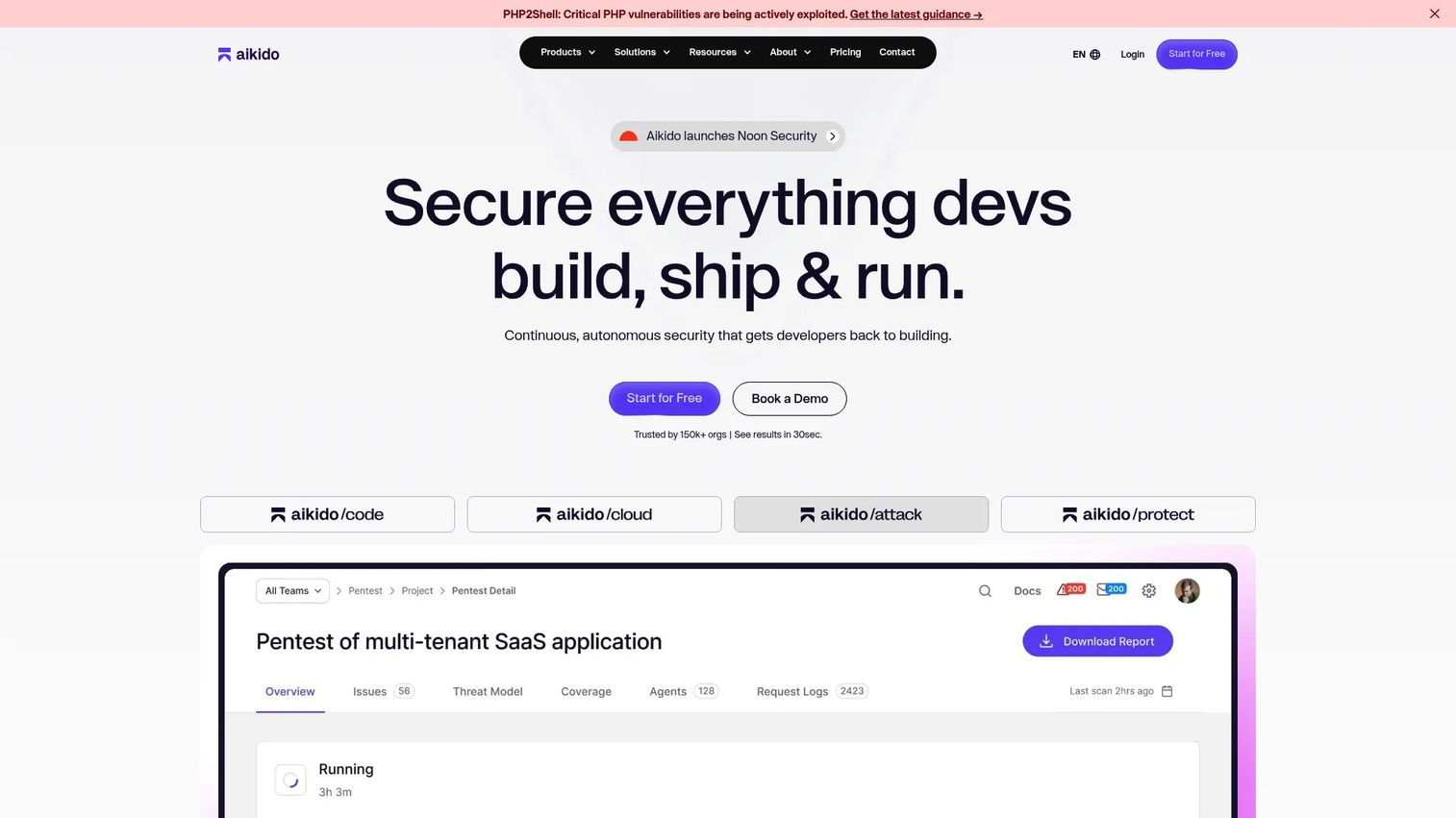
Aikido Security is a developer-first AppSec platform that consolidates code, dependency, secret, container, cloud, and infrastructure findings into a single interface. Instead of managing separate queues from multiple tools, teams see a unified view of security issues across their stack. Aikido includes SAST with AI-powered autofix, SCA with reachability analysis, CSPM, Kubernetes scanning, and DAST, making it a practical option for smaller engineering teams that want broad coverage without an enterprise procurement cycle.
Best for: Development teams wanting broad AppSec coverage with a developer-friendly remediation workflow and fewer separate security tools to manage.
Key features
- SAST with AI-powered autofix and custom rules
- SCA with dependency, license, malware, and reachability scanning
- Cloud security including CSPM, IaC, and container scanning
- Secrets detection across IDE, CI, Git, and pre-commit workflows
- Issue prioritization across code, cloud, and runtime
Why choose Aikido Security: For teams drowning in disconnected security queues, Aikido reduces triage overhead by centralizing findings and adding context around what is actually reachable and exploitable.
Aikido Security pricing: The Developer plan is free forever for a small number of users and repositories. Above that sit three paid tiers, Basic, Pro, and Advanced, plus custom Enterprise pricing. Aikido prices these as flat monthly platform fees that bundle a set number of users and repositories rather than charging per seat, which tends to favour small teams and penalise very small ones. List prices moved more than once during 2026 and are shown in local currency, so check the current figures on Aikido's pricing page rather than quoting a number from a comparison article.
G2 rating: 4.6/5
7. CodeRabbit
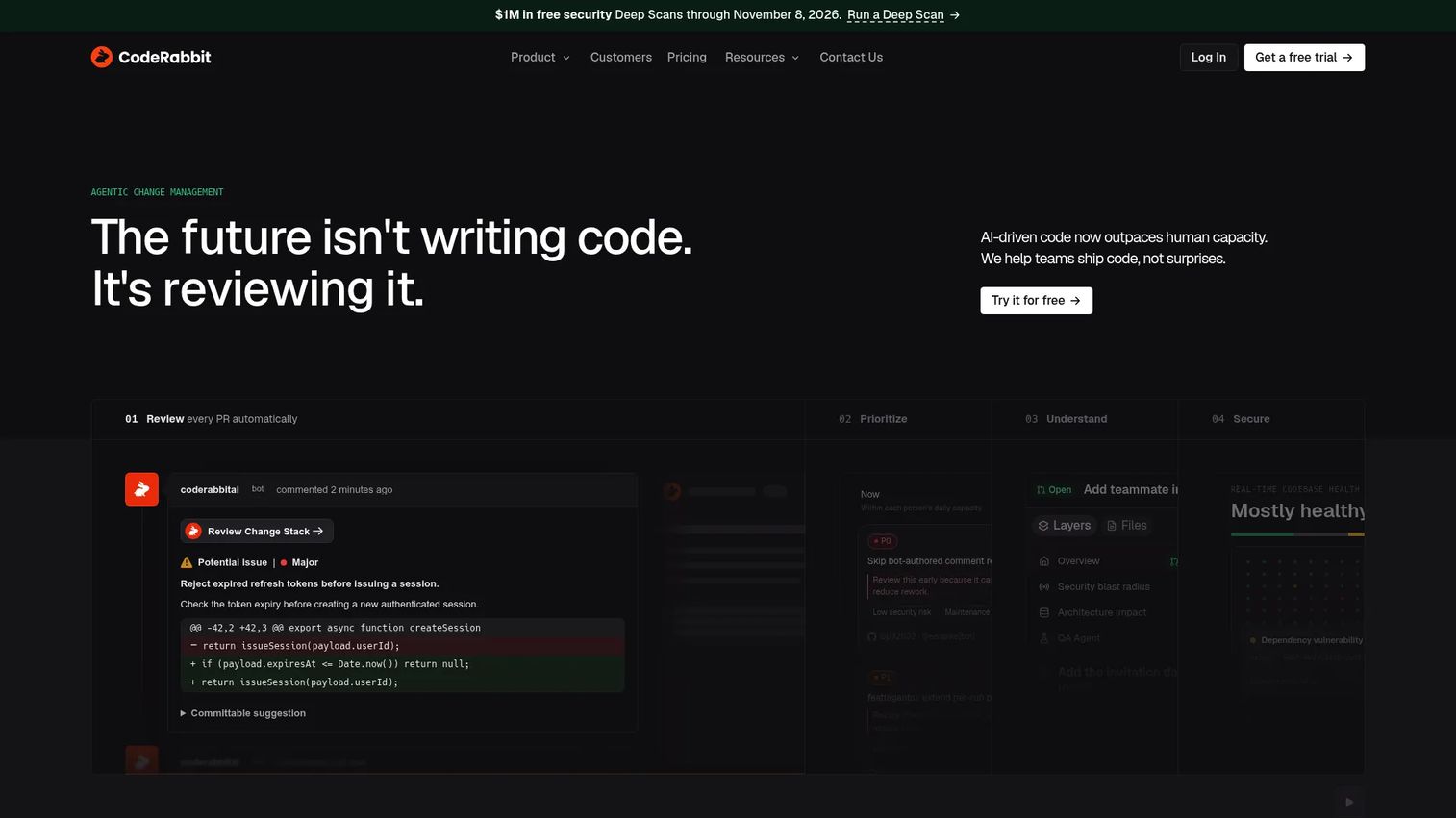
CodeRabbit is an AI-powered code review platform that adds agentic reviews to pull requests. It summarizes changes, leaves inline comments on code quality and potential bugs, supports linters and SAST tool integrations, and can propose one-click fixes. CodeRabbit runs continuous security monitoring and architectural impact analysis across repositories.
Developer trust in AI-generated code remains the open question across this whole sub-category. In a 2025 ACM study surveying 105 developers, only about a quarter expressed confidence in the security of AI-generated code, and experienced developers reported that their own secure-coding proficiency felt weaker when using these tools. It is a small sample, but it is the reason tools like CodeRabbit position AI as review support rather than a replacement for human judgment.
Best for: Engineering teams that want faster PR feedback and broader review coverage, while keeping AppSec validation with human reviewers for critical findings.
Key features
- Agentic AI pull request reviews with inline comments
- PR summaries and change walkthrough generation
- One-click fixes and agentic chat for code changes
- Linter and SAST tool integration
- Continuous security monitoring and architectural analysis
Why choose CodeRabbit: It adds a review layer that catches issues before human reviewers get to a PR, which reduces back-and-forth and speeds up the review cycle on large teams.
CodeRabbit pricing: Free for public repositories. Essentials plan starts at $24 per developer per month, billed annually. Team plan is $48 per developer per month. Enterprise pricing is custom. A 14-day free trial is available on paid plans.
G2 rating: 4.4/5
8. CodeAnt AI Reviews
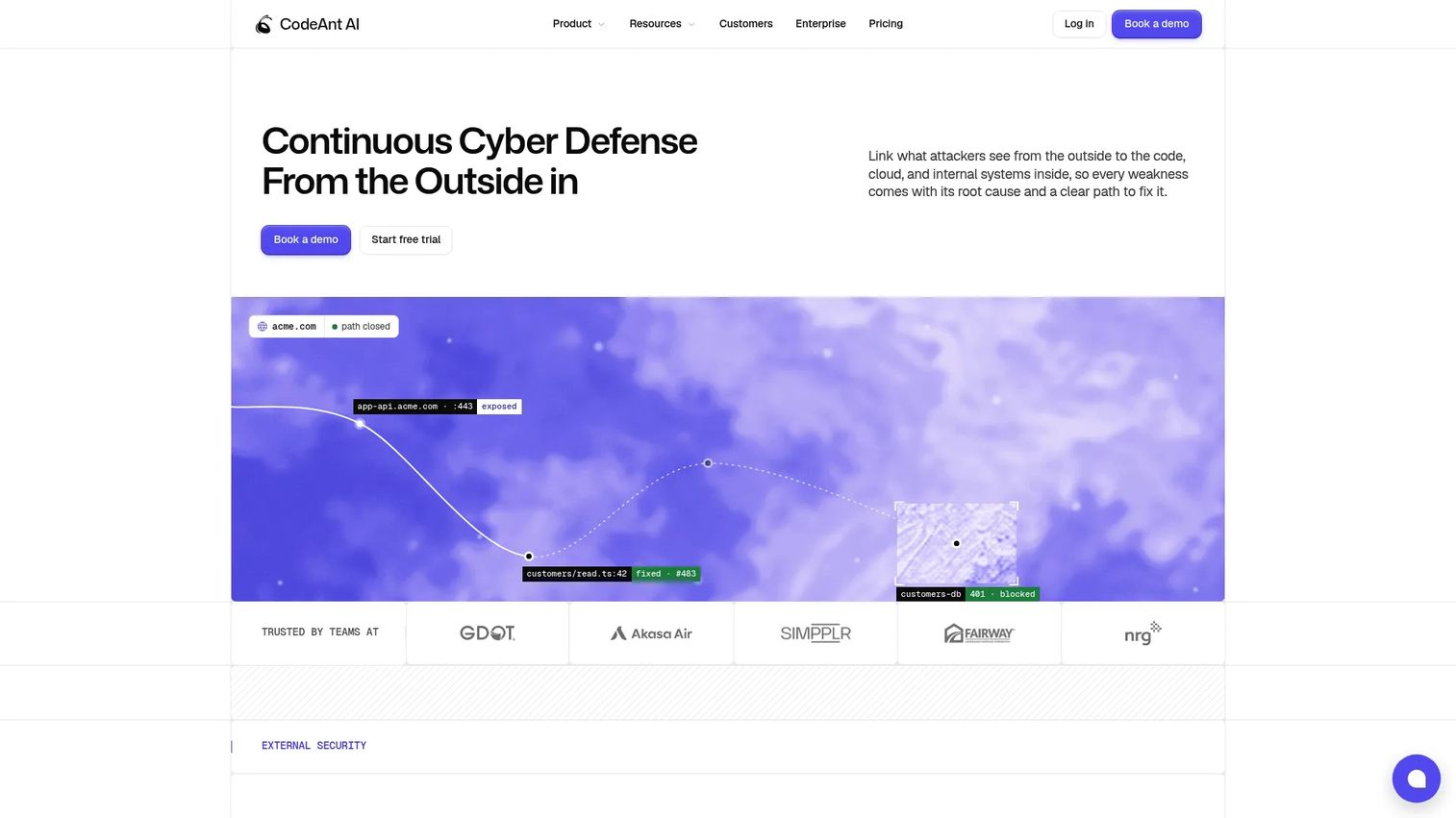
CodeAnt AI Reviews is an AI-powered platform combining code review, SAST, SCA, secrets detection, SBOM generation, malware scanning, and cloud security into a single product. It adds AI review comments to pull requests while running application and cloud security checks in the background, covering CSPM, IaC, Kubernetes, container, and VM scanning. For teams that want AI-assisted review alongside a broader security posture, CodeAnt connects both jobs.
Best for: Engineering and security teams wanting AI pull request feedback integrated with application and cloud security scanning in one platform.
Key features
- AI code reviews with pull request comments
- SAST and SCA with secrets detection and SBOM
- Cloud security scanning including IaC and Kubernetes
- Bug detection and code quality analysis
- Repository integrations across major Git platforms
Why choose CodeAnt AI Reviews: It suits teams that want AI review comments alongside real security scanning, rather than separate AI and security tools that do not share context.
CodeAnt AI Reviews pricing: CodeAnt does not publish plan prices. A 14-day free trial is available with no credit card required, and you contact the vendor for a quote. Treat the absence of public pricing as a signal that cost will depend on repository count and team size, and ask for the full breakdown early if you are comparing against tools with published rates.
G2 rating: 4.7/5
9. CodeScene
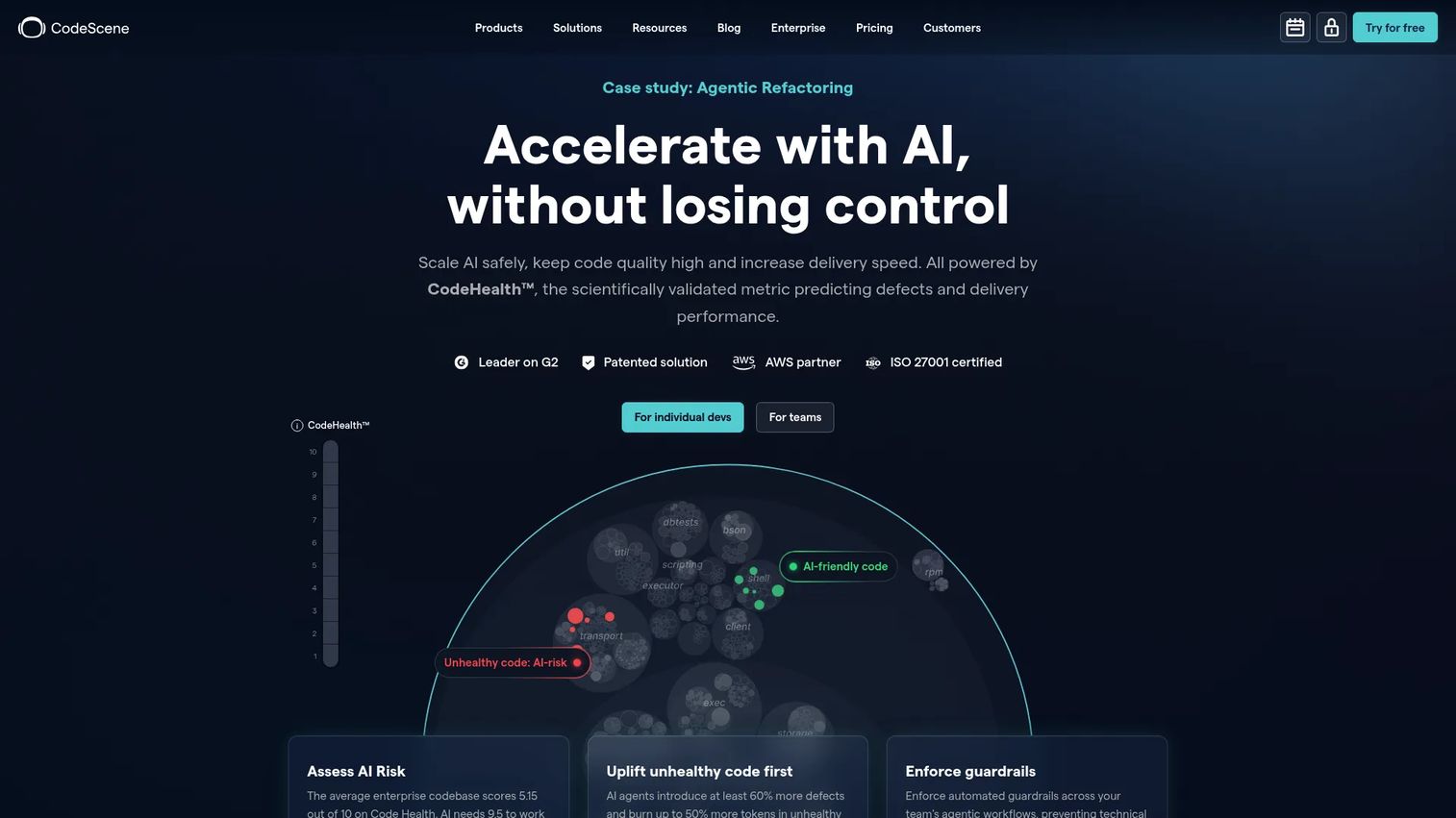
CodeScene is a behavioral code analysis platform that uses development history, team activity, and code health metrics to surface high-risk areas of a codebase. Rather than scanning for specific vulnerability patterns, it identifies hotspots, change risk, technical debt accumulation, and knowledge distribution gaps, helping AppSec teams decide where to focus manual review effort. It also supports automated pull request code reviews and quality gates.
Best for: Engineering leaders and AppSec teams that want to prioritize review effort on the most volatile, complex, or business-critical parts of their codebase.
Key features
- CodeHealth analysis and quality scoring
- Hotspot and change risk detection
- Automated pull request reviews and quality gates
- Knowledge distribution and team risk insights
- Technical debt tracking and delivery performance analytics
Why choose CodeScene: It answers a different question than traditional SAST. Instead of "what vulnerabilities exist," it tells you "where your codebase is most likely to produce them," which makes review effort more efficient on large projects. Note that it is a prioritization layer, not a vulnerability scanner, so it supplements SAST rather than replacing it.
CodeScene pricing: Community Edition is free for open source projects. Standard plan starts at €18 per active author per month, billed yearly. Pro is €27 per active author per month. Enterprise is custom pricing.
G2 rating: 4.6/5
10. Qodo
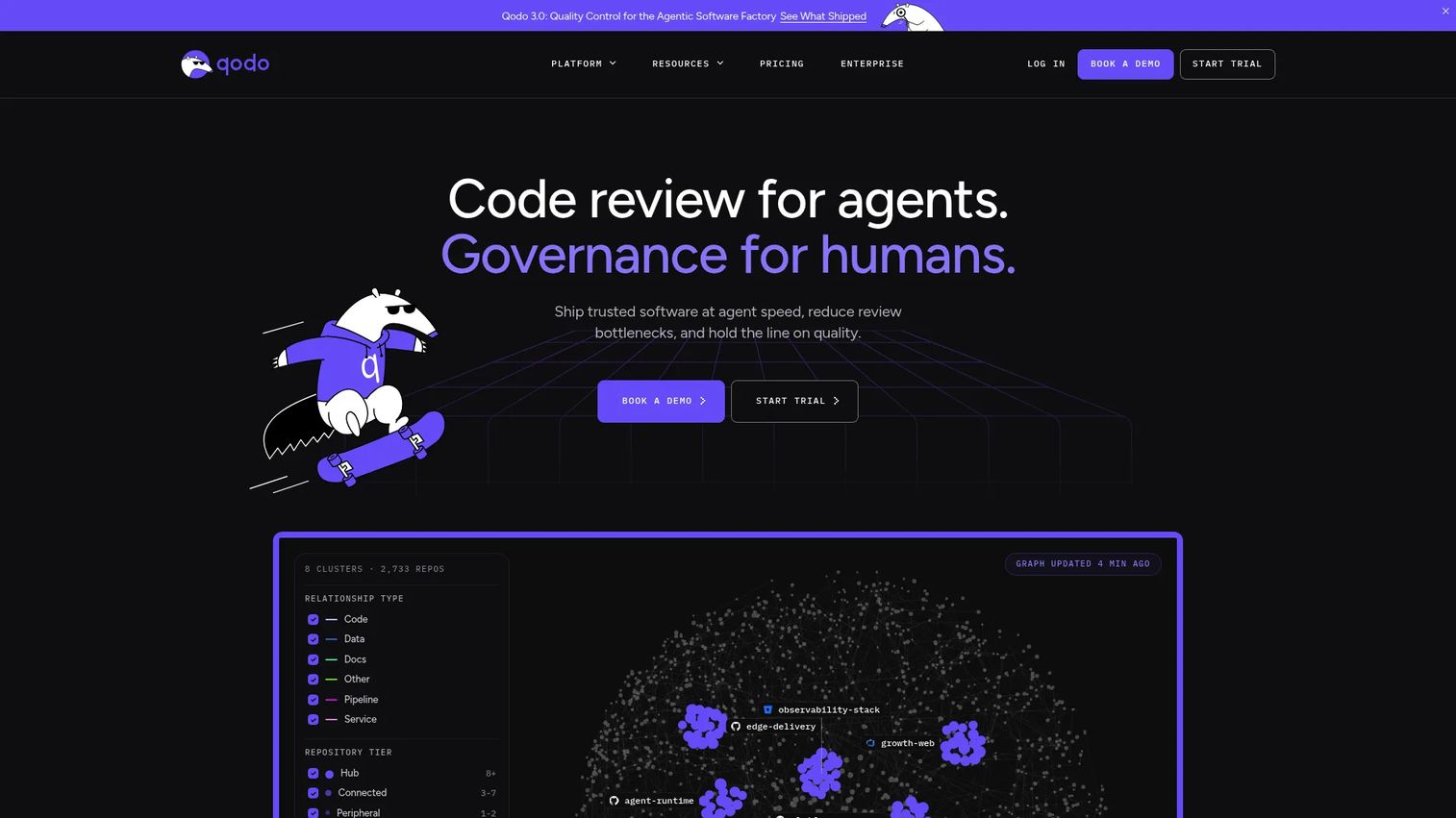
Qodo is an AI code review and governance platform with a self-learning rules system that adapts to your codebase's patterns and standards. It provides context-aware pull request reviews, cross-repository analysis, governance analytics, and audit trails for engineering leaders who need visibility into review quality across teams. IDE support and pre-PR review skills let developers check code before it enters the review queue.
Best for: Engineering teams seeking AI-assisted code review with governance analytics and coding-standard enforcement across repositories.
Key features
- Context-aware AI pull request reviews
- Self-learning rules system for coding standards
- Cross-repository review and software mapping
- Governance analytics and audit trails
- IDE integration and pre-PR review skills
Why choose Qodo: Its governance layer makes it useful for organizations that need to demonstrate consistent review practices during security diligence, not just faster reviews.
Qodo pricing: Pro Team plan is $30 per month, which includes unlimited reviews and a 14-day free trial. Enterprise pricing is custom and adds SSO, SAML, audit logs, and on-premises deployment.
G2 rating: 4.5/5
11. Azure DevOps
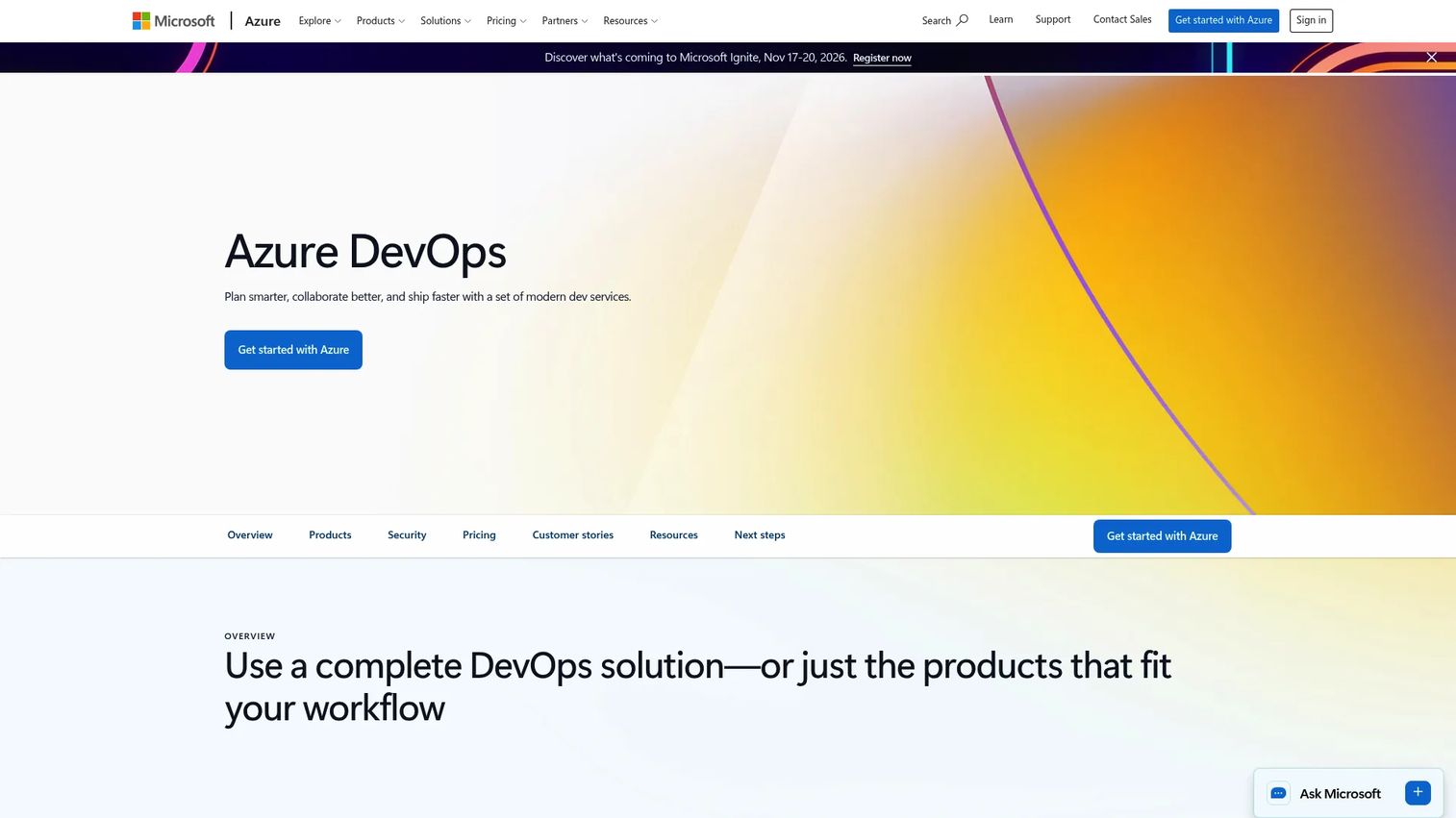
Azure DevOps is Microsoft's suite of development services covering planning, source control, CI/CD, testing, and package management. Azure Repos provides pull request workflows with branch policies, required reviewers, and build validation checks. For security scanning depth, teams typically pair Azure DevOps with GitHub Advanced Security for Azure DevOps, which adds code scanning, secret detection, and dependency review into the Azure Repos experience as a separately licensed product.
Best for: Microsoft-centered engineering teams that want secure pull request review and pipeline controls inside their existing Azure infrastructure.
Key features
- Azure Repos pull requests with branch policies
- Build validation and pipeline checks
- Required reviewer policies and merge requirements
- Agile planning with Azure Boards
- Extension marketplace for third-party security tool integrations
Why choose Azure DevOps: For teams already running Microsoft development infrastructure, Azure DevOps keeps repository, pipeline, and planning workflows in one place, with security scanning available as an integrated add-on.
Azure DevOps pricing: Stakeholder access is free. Basic plan gives the first five users free, then $6 per user per month. Basic plus Test Plans is $52 per user per month. Security scanning is licensed separately on top of these seats.
G2 rating: 4.4/5
12. Bitbucket
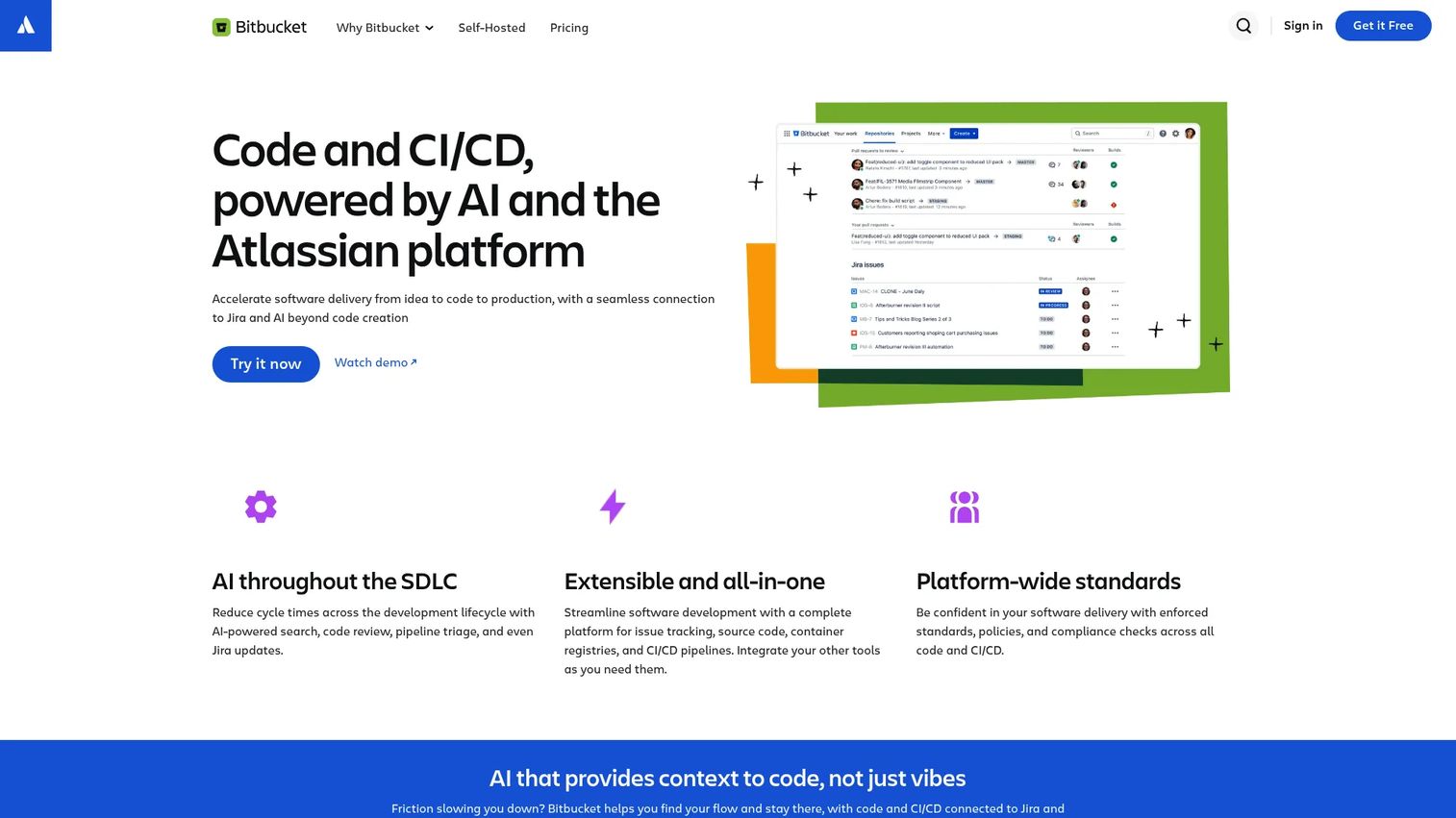
Bitbucket is Atlassian's Git repository and code review platform. Pull requests support inline comments, required approvals, branch permissions, and merge checks. Bitbucket Pipelines provides integrated CI/CD, and code insights let security scanner results surface directly in the pull request view. For teams using Jira for issue tracking, Bitbucket connects branch activity, commits, and PR status to Jira tickets automatically.
Best for: Atlassian-ecosystem teams that want Git hosting, code review, and CI/CD tightly integrated with Jira project management.
Key features
- Pull request reviews with required approvals and merge checks
- Branch permissions and repository access controls
- Bitbucket Pipelines for integrated CI/CD
- Code insights for surfacing scanner results in PRs
- Native Jira and Trello integration
Why choose Bitbucket: If your team runs Jira and wants code review context tied to sprint work, Bitbucket removes the friction of switching between repository and project management tools. Note that Bitbucket provides the review surface rather than the scanning itself, so you bring your own SAST and SCA tooling and surface results through code insights.
Bitbucket pricing: Free for up to five users. Standard plan is $3.65 per user per month. Premium plan is $7.25 per user per month, adding advanced access controls and enforced merge checks.
G2 rating: 4.4/5
13. Crucible
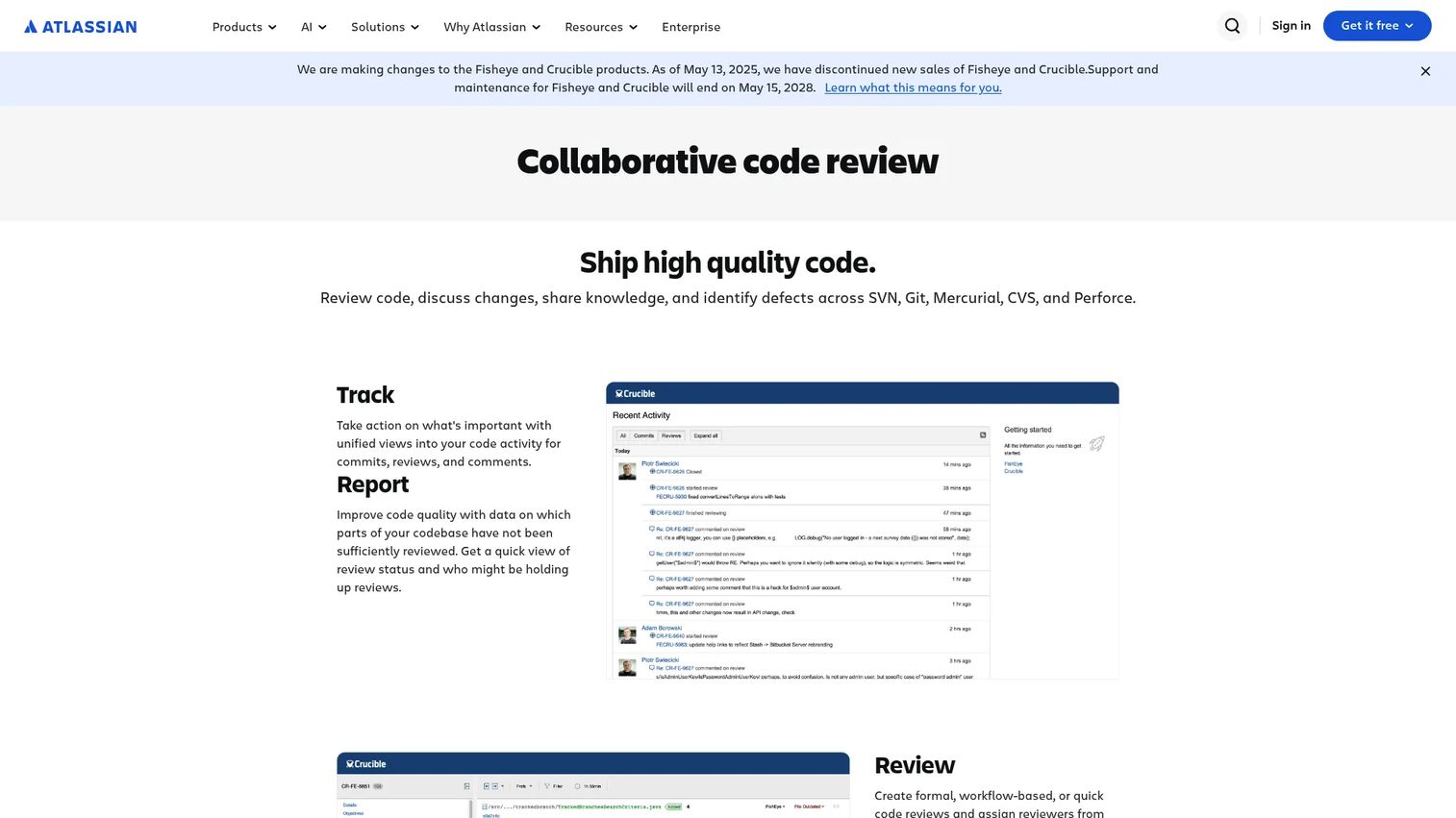
Crucible is Atlassian's formal peer code review tool. It supports structured review workflows, inline discussions, pre-commit reviews, and Jira integration, and generates charts, reports, and audit trails that document review activity. Crucible is not a security scanner. Its value is in structured human review, where a team needs records of who reviewed what, when, and what was found. This matters for regulated environments where documented review processes are part of compliance evidence.
Best for: Teams that already run Crucible and need formal, traceable code review records. New buyers should read the end-of-life note below before shortlisting it.
Key features
- Formal review workflows with activity tracking
- Inline comments and threaded discussions
- Pre-commit and post-commit review support
- Jira integration for issue linking
- Audit trails, reports, and compliance documentation
Why choose Crucible: For teams that need documented evidence of human review, not just automated scan results, Crucible provides the structure. The caveat is significant: Atlassian discontinued new sales on May 13, 2025, and support and maintenance end on May 15, 2028. The product has been in maintenance mode since 2020 with no further feature development planned. Existing customers can renew up to the end-of-support date, but anyone evaluating it fresh should treat it as a migration source rather than a destination.
Crucible pricing: New sales ended May 13, 2025. Existing customers with active licenses can renew and receive support through May 15, 2028. Contact Atlassian to confirm current status.
G2 rating: 3.9/5
14. Gitea
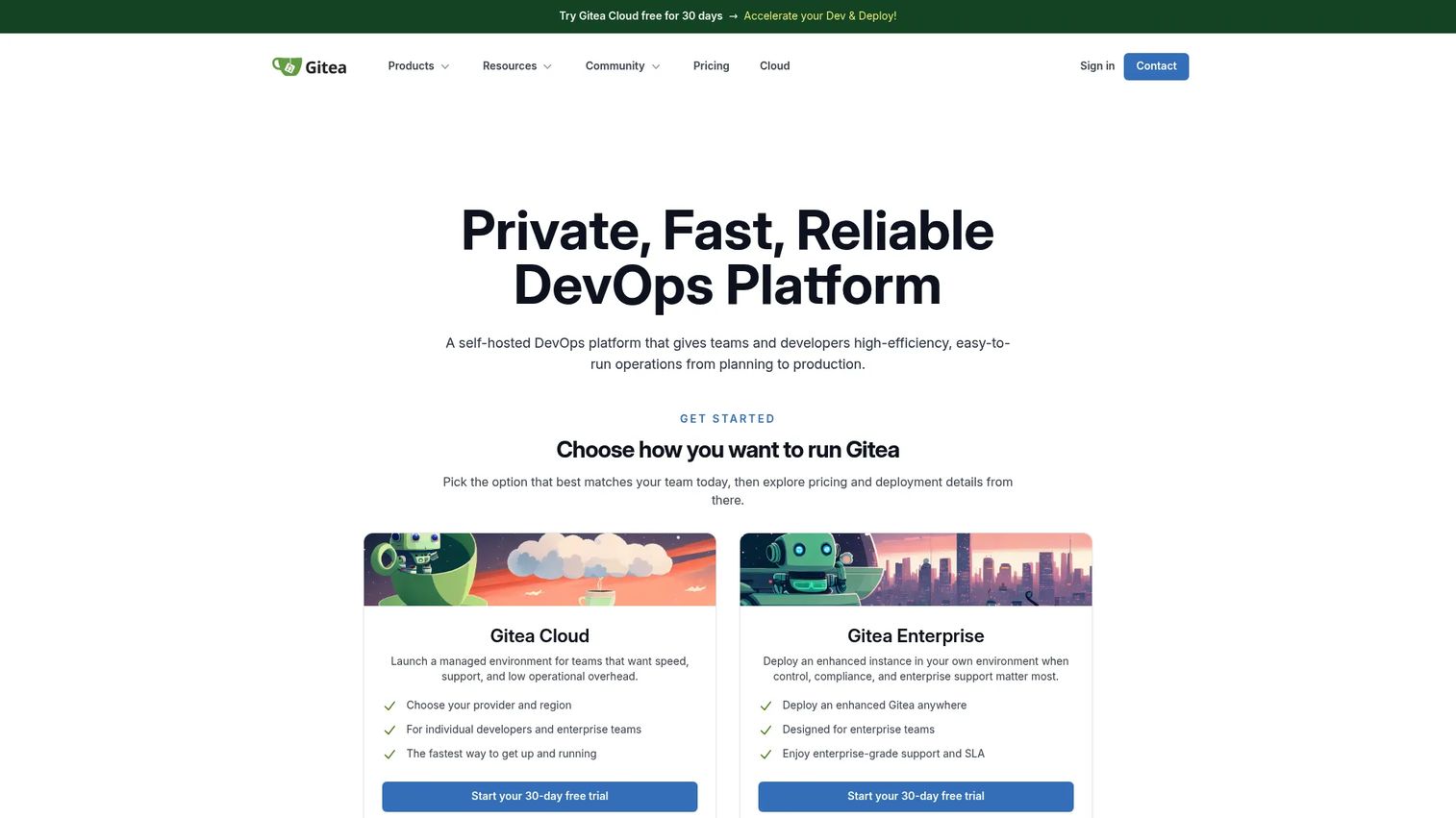
Gitea is a lightweight, self-hosted Git service with repository management, pull requests, branch protection, issue tracking, and CI/CD via Gitea Actions, which is compatible with GitHub Actions syntax. For teams that want control over where their source code lives without cloud vendor dependency, Gitea provides a practical self-hosted option. Security scanning depth requires integrating external CI/CD tools and scanners, as Gitea itself focuses on repository hosting and collaboration.
Best for: Engineering teams that want lightweight, self-hosted Git hosting with pull request workflows and CI/CD, without cloud vendor lock-in.
Key features
- Self-hosted Git repository hosting
- Pull requests with code review and branch protection
- Gitea Actions CI/CD compatible with GitHub Actions
- Issue tracking and project management with kanban boards
- Package registry supporting 20+ package types
Why choose Gitea: It delivers the core pull request and branch protection workflow at no software cost, with the flexibility to run on Linux, Windows, macOS, or Kubernetes. Pair it with dedicated SAST tooling for security coverage, since Gitea ships none of its own.
Gitea pricing: Open source and free to self-host. Enterprise plan starts at $9.50 per user per month with a one-year commitment, adding SAML SSO, audit logs, Kubernetes autoscaling runners, and SLA-backed support.
G2 rating: 4.7/5
15. RhodeCode
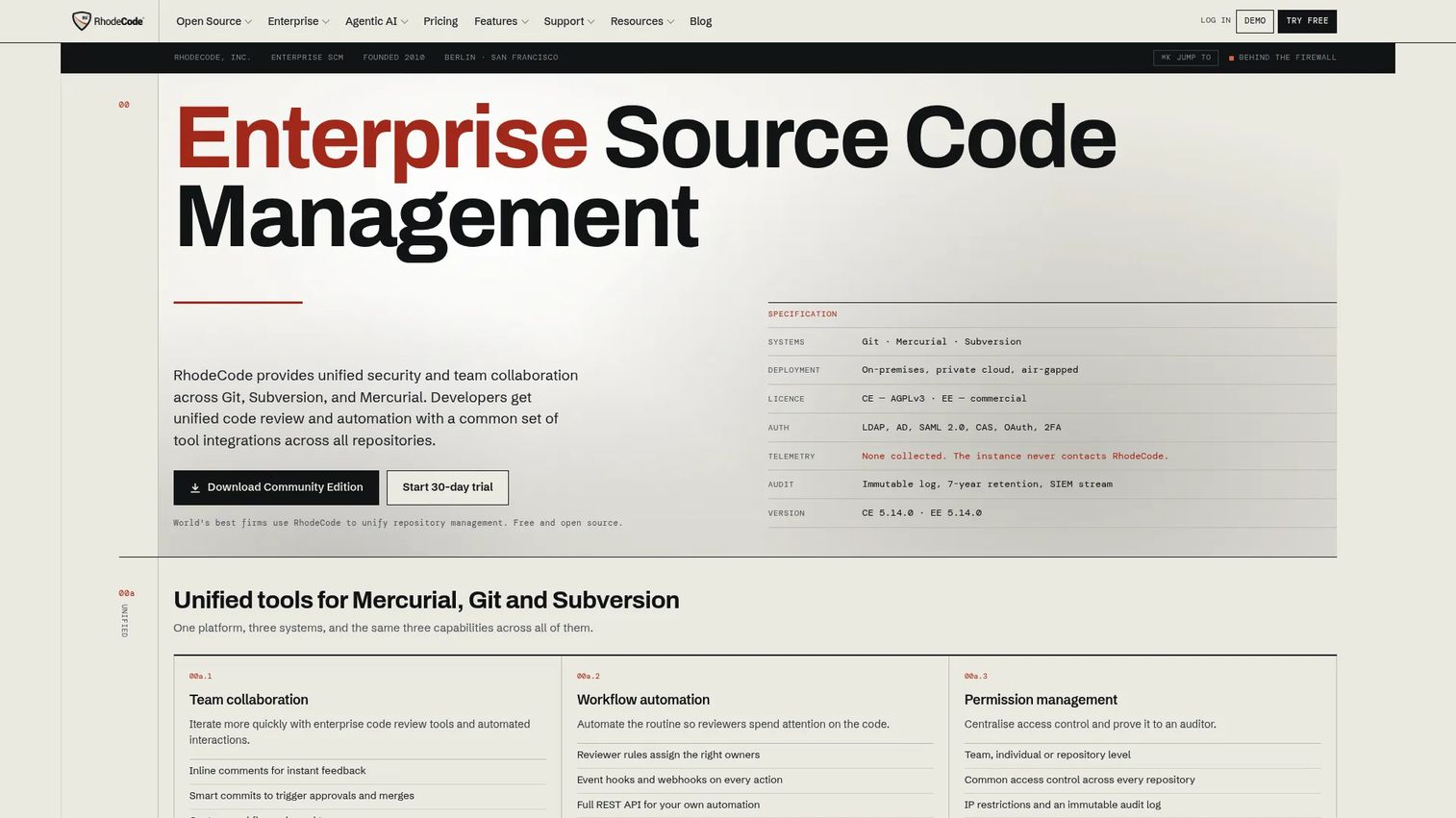
RhodeCode is an enterprise source code management platform that supports Git, Mercurial, and Subversion from a single installation. It provides code review, pull requests, fine-grained repository permissions, audit logs, full-text code search, and LDAP, SAML, OAuth, and two-factor authentication. For organizations with mixed version control environments or strict data residency requirements, RhodeCode's self-hosted model gives security and IT teams direct control over the code review infrastructure.
Best for: Enterprise teams that need governed source code management across multiple VCS types, with strict access controls and self-hosted deployment.
Key features
- Unified repository management for Git, Mercurial, and Subversion
- Pull requests and structured code review workflows
- Fine-grained permissions at repository, team, and user levels
- Full-text code search and source code indexing
- LDAP, SAML, OAuth, and 2FA authentication with audit logging
Why choose RhodeCode: For organizations running legacy Mercurial or Subversion alongside Git, or for teams in regulated sectors that cannot use cloud-hosted repositories, RhodeCode handles governance and access control that cloud platforms do not support by default.
RhodeCode pricing: Community Edition is free and open source. Enterprise Edition starts at $75 per user per year with a ten-seat minimum. Enterprise Cloud plans start at $80 per month for ten seats.
G2 rating: Not listed on G2.
Considerations when choosing secure code review software
Match the tool to the review job
Repository platforms, SAST scanners, SCA tools, AI-assisted reviewers, and manual review systems address different problems. A SAST tool catches vulnerability patterns; a formal review tool creates audit records. Picking the wrong category creates blind spots, so clarify which job matters most before shortlisting.
Separate the platform price from the security price
Several tools in this category charge for the repository or platform seat and then license the security scanning separately. GitHub, Azure DevOps, and GitLab all work this way to some degree, and the gap between the headline seat price and the real cost of code scanning can be several times over. Build your business case on the combined figure.
Check false-positive handling before rollout
Test candidate tools against your own active repository before committing. Look for suppression workflows, rule tuning controls, severity thresholds, and deduplication. A tool that floods developers with low-signal findings will stop being used, regardless of its detection coverage on paper.
Fit the developer workflow
Evaluate pull request comments, IDE integrations, CI/CD pipeline gates, and branch protection support. A tool that AppSec teams love but developers route around does not improve security. Adoption is part of the evaluation.
Verify language and framework coverage
Confirm support for the languages your team ships: Java, JavaScript, Python, Go, C#, C, C++, mobile, infrastructure-as-code, and cloud configuration files each have different coverage levels across tools. Ask vendors for coverage matrices for your specific stack.
Ask how findings become evidence
Presales teams supporting security diligence need more than detection counts. Buyers ask for reports, remediation status, audit trails, and policy documentation. Confirm that the tool you choose can produce the evidence format your buyers or auditors expect.
Conclusion
Secure code review software works best when it fits how your team already ships code. Bolt-on tools that developers ignore do not improve your security posture or your answers in a diligence conversation.
For repository-native workflows, GitHub, GitLab, Azure DevOps, and Bitbucket embed security checks where developers already review code. For dedicated static analysis with governance depth, SonarQube and Coverity are the strongest options across the category. Black Duck covers open source and dependency risk specifically, though remember it and Coverity come from the same vendor. CodeRabbit, CodeAnt AI Reviews, and Qodo add AI-assisted review support on top of existing workflows. CodeScene gives teams a risk-based lens for prioritizing where to look. Gitea and RhodeCode serve teams with self-hosting requirements or multi-VCS environments. Crucible covers formal peer review record-keeping, though its end-of-sale status rules it out for new buyers.
The most practical next step: run a proof of concept on one active repository. Measure signal quality, triage time, and developer adoption over two or three sprints before committing to a platform. That data is also exactly what your buyers will want to see when they ask how you manage code security.
That last part is where a lot of technical deals stall. Buyers want to see the process, not read a description of it. Guideflow lets presales and product marketing teams build interactive demos of their own product, so when a security reviewer asks how something actually works, you can show them instead of scheduling another call.
Start your journey with Guideflow today!
FAQs
Secure code review software helps teams inspect source code for vulnerabilities, insecure coding patterns, dependency risk, secrets, and security regressions before code ships to production. It covers automated static analysis (SAST), pull request security checks, dependency scanning, and manual review support for business logic and authorization issues.
SAST is automated static analysis that scans source code for known vulnerability patterns without executing the code. Secure code review is broader: it includes SAST, but also covers manual inspection for business logic flaws, authorization gaps, threat-model assumptions, and design-level risks that automated tools miss. Strong programs use both.
GitHub, GitLab, SonarQube, Azure DevOps, and Bitbucket each have strong CI/CD integration, embedding security gate checks directly into pipeline runs. Coverity and Aikido Security also support CI/CD pipeline integration. The best choice depends on where your team already runs pipelines and which VCS your repositories live in.
No. AI tools like CodeRabbit, CodeAnt AI Reviews, and Qodo accelerate feedback on pull requests and surface risky patterns, but they do not replace AppSec expertise. Human reviewers and security engineers still need to validate business logic, authorization design, and high-severity findings. AI review is a force multiplier, not a replacement.
Vulnerability coverage, low false positives, CI/CD integration, pull request comment workflows, language and framework support, triage and suppression controls, and reporting for security review evidence all matter. For presales teams, the reporting and audit trail capabilities are especially important when buyers ask for proof of SDLC controls.
Good tools apply data-flow analysis and contextual prioritization rather than simple pattern matching. Features like rule tuning, severity thresholds, suppression workflows, and deduplication all help. Testing a tool against your own codebase before purchase is the most reliable way to assess false-positive rates for your specific stack.
No. Developers, engineering managers, DevSecOps engineers, security architects, and presales teams all interact with code security workflows. Security teams own policy and triage, but developers need actionable findings in their normal workflow. Presales engineers need evidence and reporting to support technical diligence conversations with buyers.
Focus on process evidence rather than general claims. Be prepared to describe what triggers a review, which tools run in CI, how findings are triaged, what remediation SLAs look like, and where audit records live. If you have CI gate policies and documented review workflows, those answer most buyer security questionnaire items more effectively than any general statement about reviewing code.