Your ARR is growing, but the next equity round feels expensive. The board wants efficient scale. Your Head of Finance wants capital that does not turn every slow quarter into a covenant conversation.
Revenue based financing has moved from niche to mainstream fast. The global market reached $17.2 billion in 2025 and is projected to hit $56.7 billion by 2031, a 21.9% compound annual growth rate, according to Mordor Intelligence (2026). For SaaS founders evaluating non-dilutive growth capital, the category now spans genuine alternatives worth modeling seriously, not just merchant cash advance products rebranded with cleaner language.
The hard part is not finding revenue financing options. It is knowing which platforms fit recurring-revenue businesses, what data each provider actually uses to underwrite, how repayment mechanics behave in a slow quarter, and which tools are capital providers versus lender infrastructure. This guide cuts through that.
What's inside
This guide is for SaaS founders, CFOs, and capital teams evaluating revenue based financing options in 2026.
- Who it covers: 7 financing providers and lender platforms
- Selection criteria:
- Fit for revenue-based financing workflows (SaaS, ecommerce, or lender-side)
- Underwriting approach and revenue data requirements
- Repayment structure and monitoring capabilities
- Transparency around pricing or funding terms
TL;DR
- Best for SaaS and recurring-revenue funding: Novel Capital
- Best for founder-friendly, non-dilutive capital: Lighter Capital
- Best for capital-efficient SaaS and tech companies: Flow Capital
- Best for ecommerce and consumer brands: Wayflyer
- Best for lender-side RBF operations: Ned
- Best for flexible capital with advisor access: Sage Growth Capital
- Best for app and digital media receivables: Pollen VC (note: No longer accepting new funding applications as of late 2026)
What is revenue based financing software?
Revenue based financing software helps lenders, capital providers, and borrowers underwrite, fund, monitor, and repay financing where repayments are tied to a percentage of business revenue.
Here is how the structure works in practice. A company receives growth capital upfront. It then repays a percentage of monthly revenue until it reaches an agreed total repayment cap. The key distinction from a fixed bank loan: Monthly obligations rise when revenue rises and fall when revenue falls. That flexibility is the product's main appeal for founders managing variable growth.
The software layer supporting this structure handles several jobs:
- Revenue data ingestion: Pulling bank statements, accounting records, payment processor feeds, subscription metrics, or app store revenue
- Underwriting workflows: Scoring borrowers based on revenue quality, growth rate, and gross margin
- Repayment tracking: Calculating monthly obligations, reconciling payments, and managing cap-based payoffs
- Portfolio monitoring: Giving lenders or capital providers a live view of borrower performance
- Borrower reporting: Connecting repayment data back to the company's finance stack
- Compliance and audit trails: Supporting responsible lending and regulatory requirements
One important distinction: Not every entry in this list is software in the SaaS sense. Some are financing providers with proprietary platforms you access as a borrower. Others, like Ned, are infrastructure tools built for the lenders and CDFIs that offer revenue-based products. Knowing which category you are buying into determines who belongs on your shortlist.
Separating merchant cash advances from genuine revenue-based financing matters too. MCA products often carry factor rates and daily ACH pulls regardless of monthly revenue. True revenue-based financing ties payment amounts to actual revenue performance with a defined repayment cap.
When to use revenue based financing software
Finance growth without immediate equity dilution
You have a funded business with predictable MRR and a clear use of funds, GTM hiring, paid acquisition, product investment, or inventory. Another priced equity round is expensive and may not be the right move. Revenue-based financing lets you deploy capital and repay from the revenue it generates, without giving up board seats or additional ownership. This fits Series B SaaS companies best when gross margins are strong and ARR growth is consistent.
Match repayment burden to revenue performance
Fixed bank debt creates fixed monthly obligations regardless of your growth curve. Revenue-linked repayments can flex with your business, which protects runway during slower months. This flexibility is real, but it is not free capital. Model your base case, your upside, and a scenario where growth is half of plan before accepting an offer. Total repayment caps and effective annualized cost can still be higher than traditional debt.
Underwrite or manage revenue-linked portfolios
For lenders, CDFIs, and fintechs building or running revenue-based lending programs, the same infrastructure question applies: How do you ingest borrower revenue data, automate repayment collection, monitor portfolio risk, and produce clean reporting? Lender-side platforms address this operational layer rather than the borrower-facing capital question.
Revenue based financing software comparison
The table below maps each provider to its primary use case, key differentiator, and funding or pricing terms. Because most providers in this category structure terms individually, the pricing column reflects how each one approaches pricing rather than a fixed monthly subscription rate. G2 ratings reflect verified listings at time of publication.
| # | Product | Best for | Key differentiator | Pricing | G2 rating |
|---|---|---|---|---|---|
| 1 | Novel Capital | SaaS and recurring-revenue funding | Capital-planning tools plus non-dilutive capital up to $5M | Subscription fee; deal terms vary | 4.0/5 |
| 2 | Sage Growth Capital | Flexible growth capital | Revenue rates 3 to 8%, return multiples 1.5x to 2.5x, no collateral | Customized per deal | Not listed |
| 3 | Pollen VC | App and digital media receivables | Receivables-based advances for mobile and gaming | Not accepting new applications | Not listed |
| 4 | Flow Capital | B2B SaaS and technology companies | Interest-only, light covenants, $1M to $15M+ capital | Custom; deal terms vary | Not listed |
| 5 | Wayflyer | Ecommerce and consumer brands | Underwriting via connected business data; fixed fee agreed upfront | Fixed fee per offer; range typically 5% to 10% of advance | Not listed |
| 6 | Ned | Lender-side RBF operations | Cloud-based loan management with automated ACH repayments | Monthly SaaS fee plus implementation | Not listed |
| 7 | Lighter Capital | Founder-friendly SaaS financing | Non-dilutive capital with no equity, board seats, or personal guarantees | Custom per deal; apply to receive terms | Not listed |
Best 7 revenue based financing software for 2026
1. Novel Capital
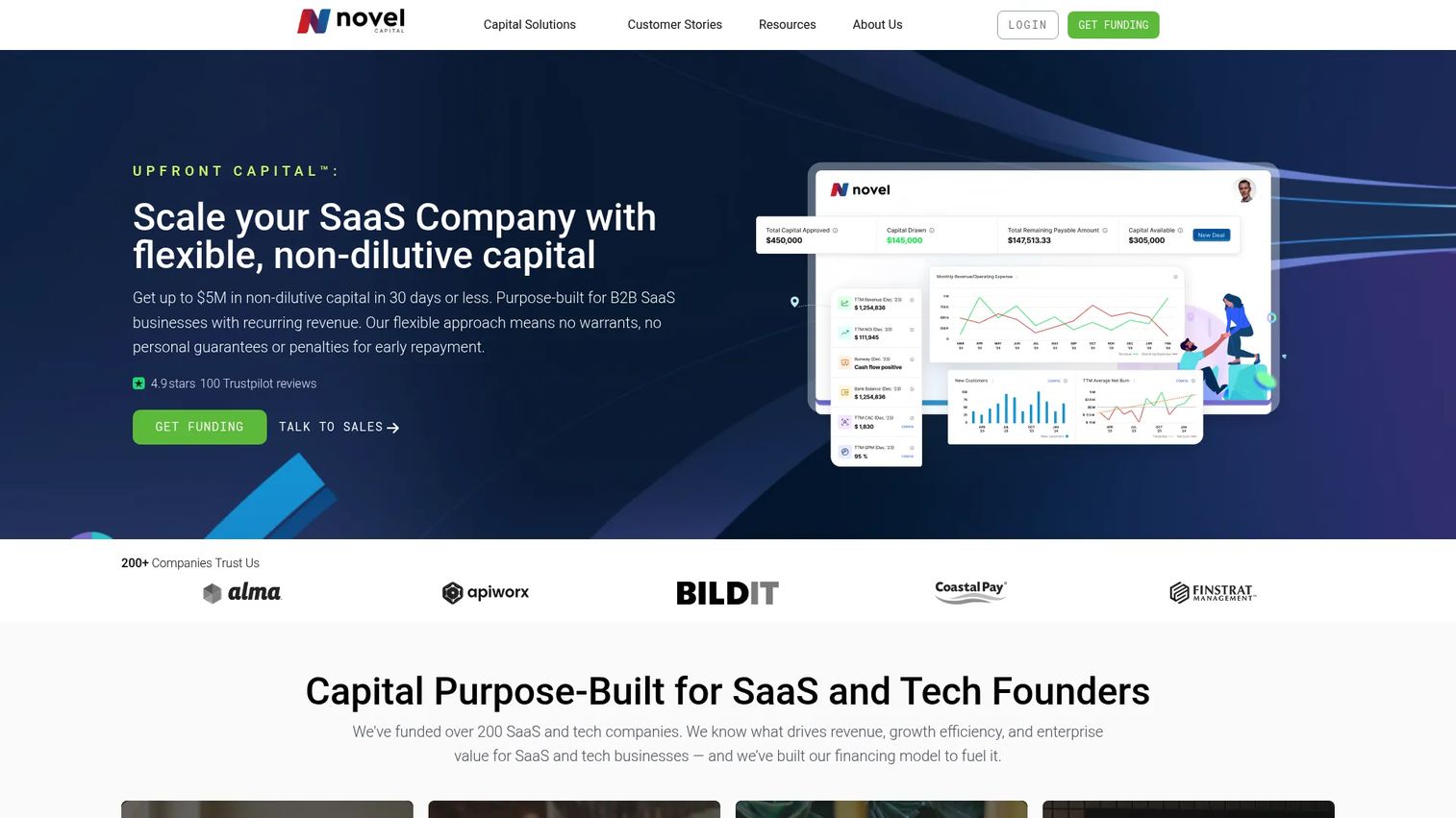
Novel Capital provides non-dilutive growth capital and capital-planning tools for B2B SaaS and technology companies. Its platform combines up to $5M in upfront funding with a CEO dashboard for tracking real-time metrics, a startup valuation tool, and VentureMatch, a data-driven investor introduction service. The model is designed for companies that want capital access alongside planning infrastructure, not just a wire transfer.
Best for: U.S.-based B2B SaaS founders with recurring revenue who want growth capital plus visibility into their financial position.
Key features
- Non-dilutive capital of up to $5M with fixed repayment terms
- CEO dashboard with real-time company metrics
- Startup valuation tool built into the platform
- VentureMatch for data-driven VC introductions
- Flexible drawdown access
Why choose Novel Capital: Novel Capital is worth evaluating when you want capital that pairs with operational tools, not just debt. The dashboard and valuation features give your finance lead a cleaner picture alongside the capital itself, which can reduce the reporting burden during board prep.
Novel Capital pricing: Novel Capital structures access through a subscription fee and deal-specific funding terms. Ask for the offer directly, then compare total repayment obligation against your alternative financing costs.
G2 rating: 4.0/5
2. Sage Growth Capital
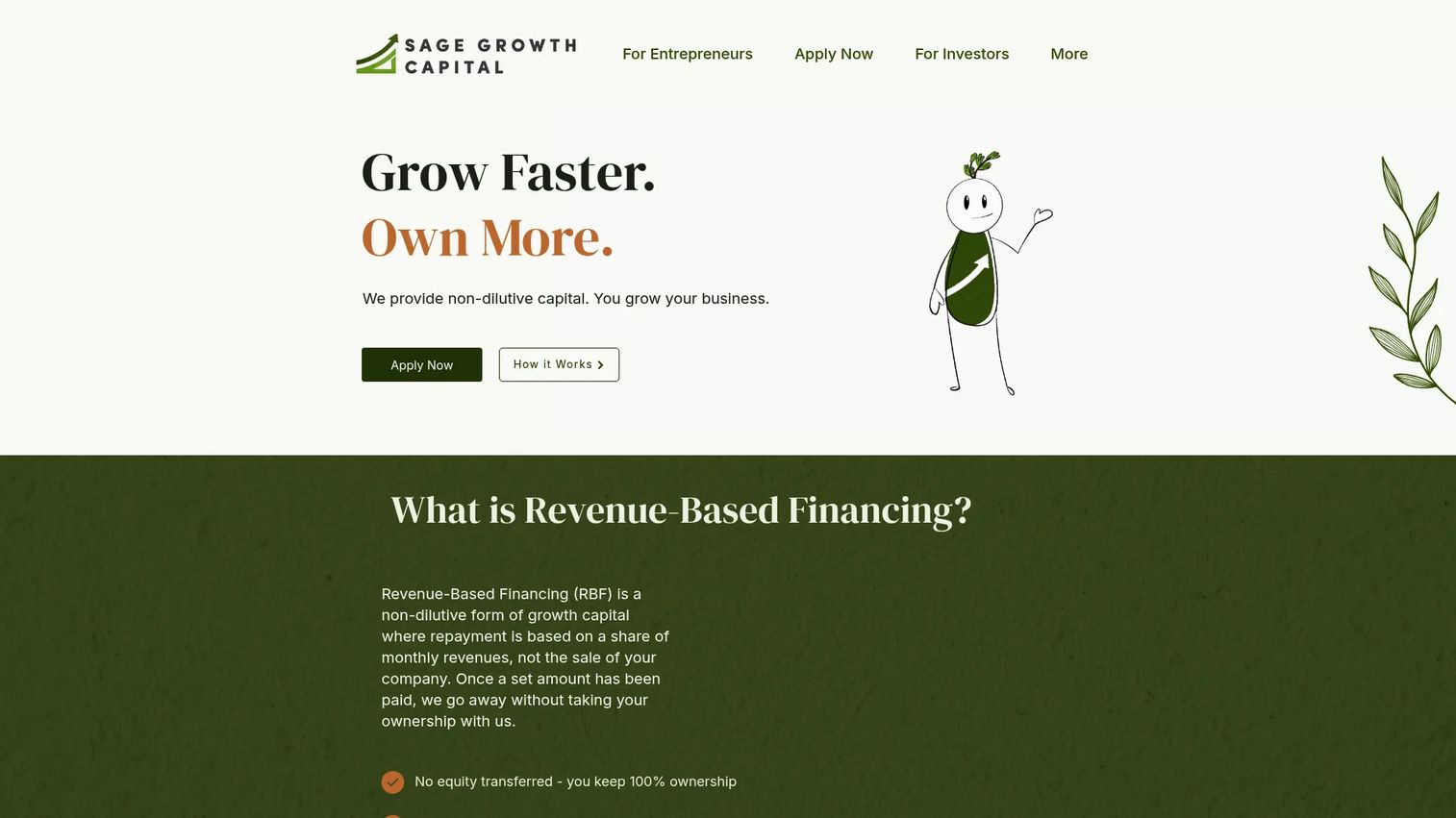
Sage Growth Capital provides non-dilutive revenue-based financing for growing businesses that want capital without the standard equity path. Repayments are tied to cash receipts rather than fixed monthly amounts, and the firm publicly lists its investment parameters: $100K to $1M, revenue rates of 3% to 8%, return multiples of 1.5x to 2.5x, and repayment periods of 3 to 5 years. Notably, the structure requires no equity transfer, no personal guarantees, no collateral, and no UCC liens.
Best for: Revenue-generating businesses that need growth capital and want a financing partner whose terms are structured around cash flow durability, not asset collateral.
Key features
- Revenue-based financing with payments tied to cash receipts
- Investment amounts from $100K to $1M
- Revenue rates from 3% to 8%; return multiples from 1.5x to 2.5x
- No equity, no personal guarantees, no UCC liens
- Access to Sage Advisors and curated professional services
Why choose Sage Growth Capital: The public term ranges make initial modeling possible before you pick up the phone. If your company generates revenue but does not yet have the ARR profile some SaaS-specific lenders require, Sage's structure can still work. The 3 to 5 year repayment period is longer than many alternatives, which reduces monthly cash pressure.
Sage Growth Capital pricing: Pricing is fully customized after application and due diligence. Use the published ranges ($100K to $1M, 3% to 8% revenue rate, 1.5x to 2.5x return multiple) as your pre-call model. Build a 12-month repayment projection under base and downside scenarios before comparing this against venture debt.
3. Pollen VC

Pollen VC built its platform around capital-efficient financing for mobile apps and gaming studios, using platform receivables as the basis for advances. Its model focused on user acquisition financing, with repayment tied to app store and platform revenue. As of late 2026, however, the official homepage states that Pollen VC is no longer accepting new funding applications.
Best for: App and gaming publishers researching the receivables-based financing model or seeking educational content and tools, rather than active capital applicants.
Key features
- Receivables-based financing model for mobile and gaming revenue
- Financing for user acquisition and mergers and acquisitions
- Financial content, resources, and calculators for app companies
- Platform revenue analysis framework
Why choose Pollen VC: Include Pollen VC on your research list to understand how receivables-based financing works for app and digital media businesses. If your SaaS business has app-based or media-style revenue streams, the model is worth understanding even though active funding is currently unavailable. For active capital, evaluate the other providers in this list.
Pollen VC pricing: Pollen VC is not currently accepting new funding applications.
4. Flow Capital

Flow Capital is a growth capital provider for SaaS and technology companies in the United States, Canada, and the United Kingdom. It offers $1M to $15M or more in financing, structured as interest-only debt with light covenants, no board seats, and no personal guarantees. The firm accepts both VC-backed and bootstrapped companies with $3M or more in annual revenue. Warrant coverage is part of the structure in some deals, so founders should model that component alongside the core repayment terms.
Best for: B2B SaaS and technology founders with $3M or more in ARR who want $1M to $15M in growth capital without board obligations or personal liability.
Key features
- Growth capital from $1M to $15M or more
- Interest-only financing with 2 to 4 year terms
- No board seats, no personal guarantees
- Light covenants; non-amortizing structures
- Modest warrant coverage in some deals
Why choose Flow Capital: Flow Capital is relevant when you need scale capital but are not ready to price another equity round. The interest-only structure keeps monthly obligations lower than amortizing debt during the growth period. Build a model that includes any warrant coverage so you have a clear picture of total dilution alongside the repayment cost.
Flow Capital pricing: Flow Capital prices each deal by company size, revenue quality, and growth plan. Request an offer, then compare total repayment, any warrant economics, and monthly cash burden against the dilution cost of your alternative financing route.
5. Wayflyer
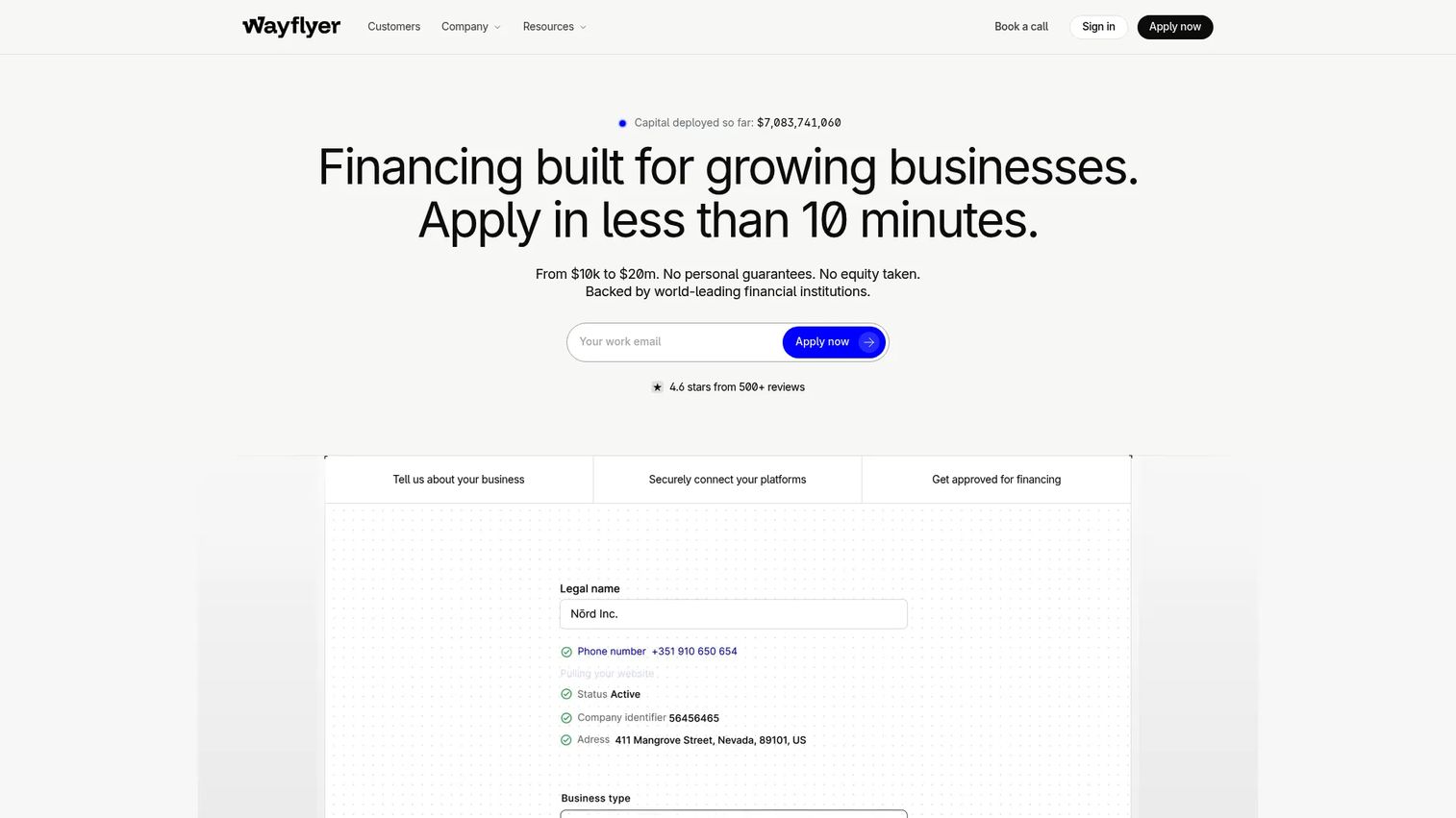
Wayflyer provides fast, data-driven business financing for ecommerce and consumer brands. Its underwriting engine connects to business data sources directly, using revenue, advertising performance, and operational metrics to structure offers. Repayment options include fixed installments or a percentage of sales, depending on the offer structure. The platform also includes Wayflyer Intelligence, a plain-language business analytics tool that surfaces insights from connected data. Funding ranges from $10K to $20M.
Best for: Consumer brands and ecommerce operators financing inventory, marketing, or working capital against sales revenue, not SaaS subscription ARR.
Key features
- Data-driven underwriting using connected business accounts
- Funding from $10,000 to $20 million
- Fixed installment or revenue-percentage repayment options
- Wayflyer Intelligence for plain-language business analysis
- Covers inventory, marketing, hiring, and equipment use cases
Why choose Wayflyer: Wayflyer is a stronger fit for ecommerce than classic B2B SaaS. SaaS founders with marketplace revenue, commerce components, or usage-based billing may find the underwriting model instructive for understanding how non-subscription revenue gets evaluated. For pure SaaS businesses, the other providers in this list are closer fits.
Wayflyer pricing: Wayflyer charges one fixed fee agreed upfront per financing offer. Its help documentation indicates fees typically range from 5% to 10% of the advance, but the exact figure depends on business factors and is set at the offer stage. Compare the fixed fee against gross margin and expected payback timing before accepting.
6. Ned
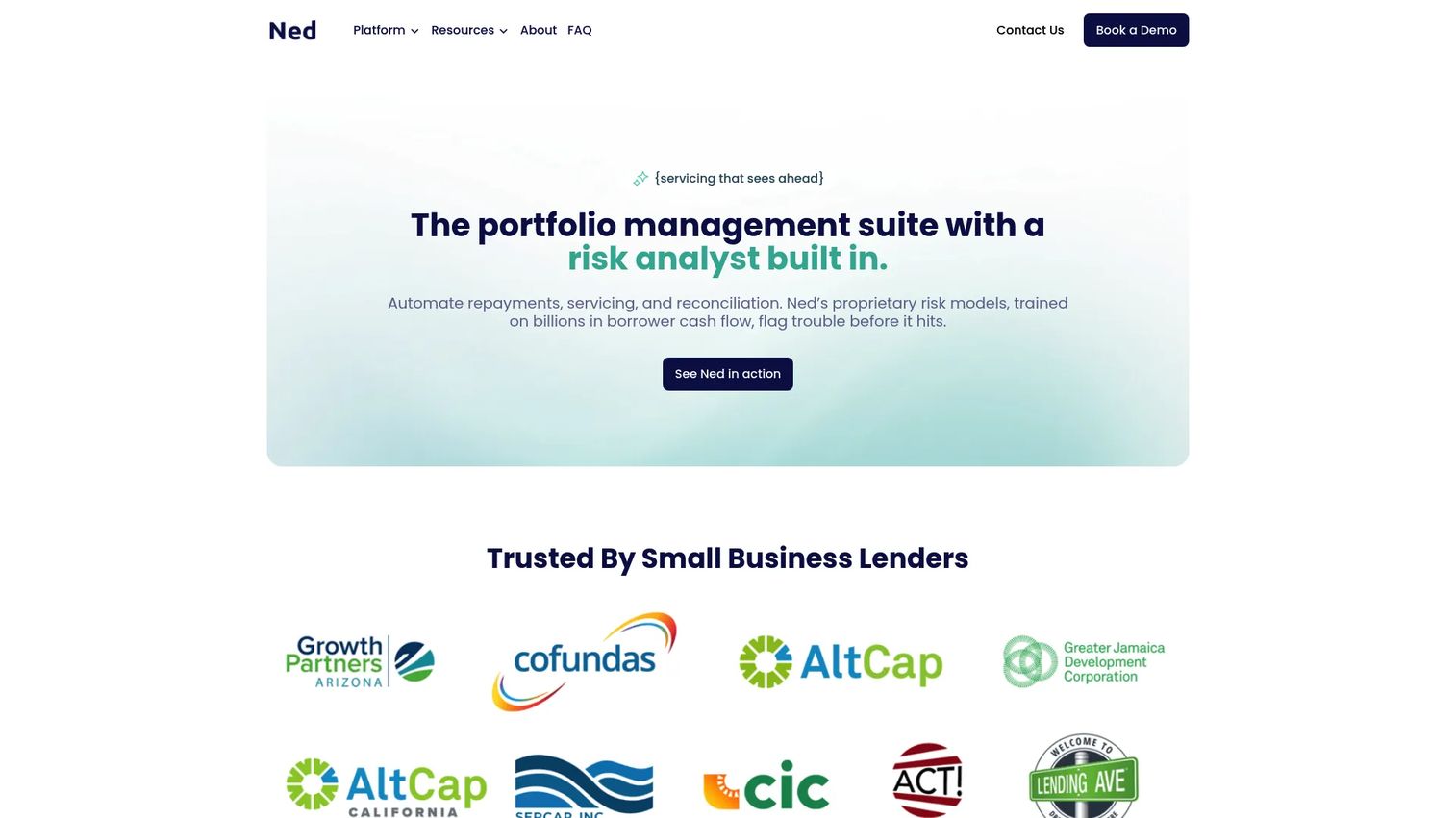
Ned is the most infrastructure-oriented entry in this list. It is a cloud-based loan management and portfolio intelligence platform built for banks, credit unions, CDFIs, fintechs, and non-bank lenders managing cash-flow-driven small-business lending programs. If you are a SaaS founder looking for capital, Ned is not your tool. If you are building or running a revenue-based lending product and need the operational layer, Ned addresses borrower monitoring, automated ACH repayments, portfolio risk signaling, and lender reporting.
Best for: Banks, credit unions, CDFIs, and specialty lenders that need a software platform to manage revenue-based or cash-flow lending portfolios.
Key features
- Portfolio-wide risk oversight with real-time balances and configurable risk signals
- Automated ACH repayments with real-time balance checks and cash-sensitive scheduling
- Live cash-flow analytics and borrower screening
- Predictive risk signals and exposure views
- Flexible repayment structures for diverse loan products
Why choose Ned: Ned is the right choice when you are on the lending side, not the borrowing side. CDFIs and community lenders that want to offer revenue-linked lending products without building proprietary infrastructure from scratch will find the most value here. The automated repayment and monitoring capabilities reduce manual portfolio management time significantly.
Ned pricing: Ned charges monthly SaaS fees plus a one-time implementation and setup fee. Pricing scales with user seats and is provided on request. Contact Ned to scope costs against your borrower volume, required integrations, and repayment workflow complexity.
7. Lighter Capital
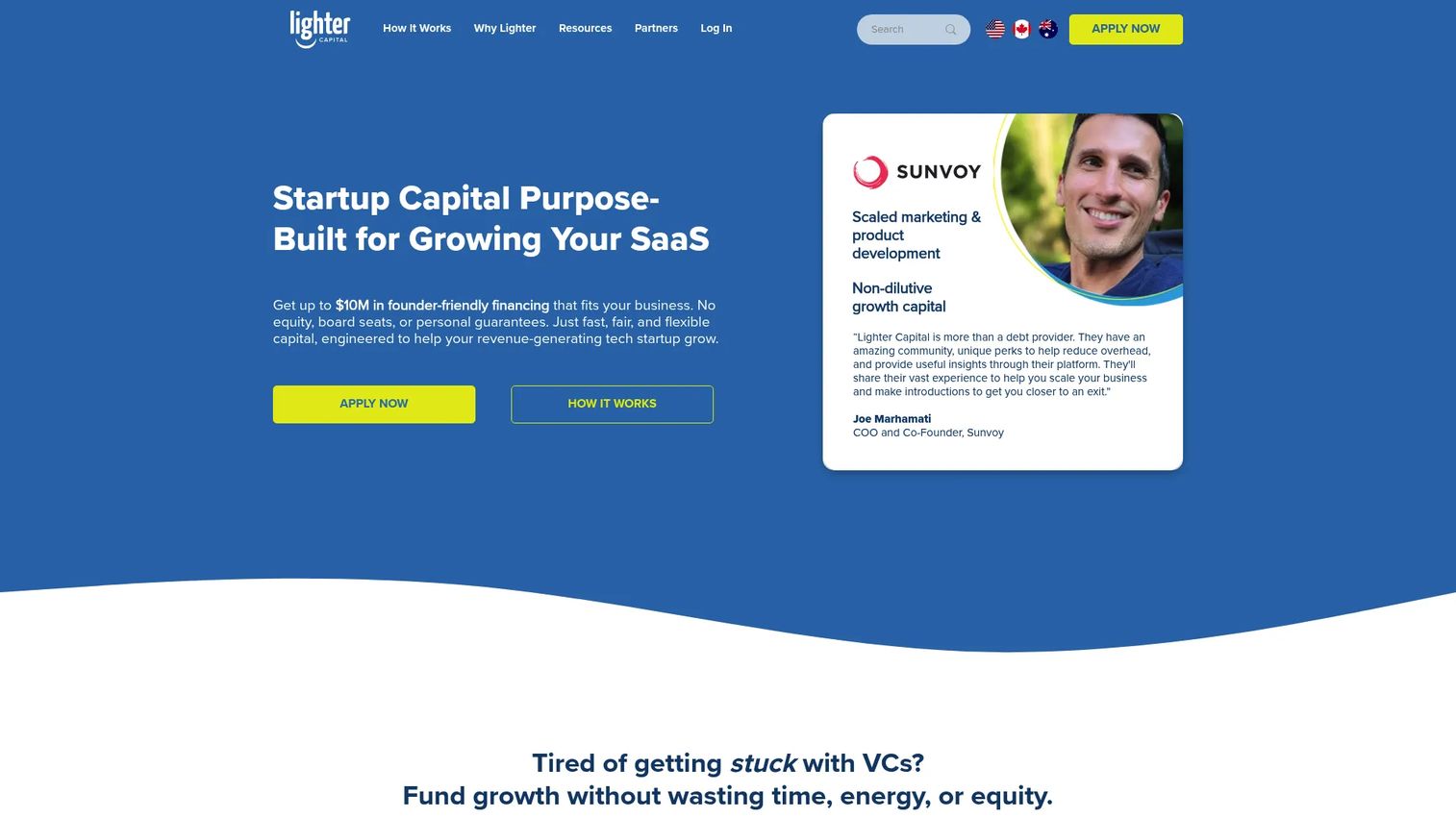
Lighter Capital is one of the better-known non-dilutive financing providers for technology and SaaS startups with recurring revenue. Its model is built specifically for founders who want growth capital without pitching a deck, bringing in a board member, or signing a personal guarantee. The platform offers term-based, revenue-based, and contract-based financing options, plus founder community access, investor introductions, and product discounts.
Best for: SaaS and technology founders with recurring revenue who want non-dilutive capital and a financing partner familiar with subscription metrics.
Key features
- Non-dilutive financing: No equity, no board seats, no pitch deck required
- Term-based, revenue-based, and contract-based financing options
- No personal guarantees required
- Founder community and investor introduction access
- Product and service discounts for portfolio companies
Why choose Lighter Capital: Lighter Capital earns a spot on the shortlist when preserving ownership and avoiding governance overhead matters most. The range of financing structures gives your finance team options to match capital against your specific revenue profile. Compare offer size, repayment cap, and monthly percentage against burn multiple and runway goals before deciding.
Lighter Capital pricing: Terms are structured per deal based on ARR, growth rate, capital amount, and repayment design. Submit an application to receive an offer, then model total repayment against the equity dilution you would otherwise accept.
Considerations when choosing revenue based financing software
Match the tool to your side of the transaction
Some providers in this list give you capital. Others, specifically Ned, help you manage the machinery for offering capital to others. A SaaS founder looking for growth funding has a different shortlist than a CDFI building a revenue-based lending program. Confirm which side of the transaction you are on before comparing features.
Model total cost, not just the headline terms
Revenue-based financing prices itself through repayment caps, revenue share percentages, fixed fees, or return multiples. None of those numbers map cleanly to an APR. Build a 12-month model under base, upside, and downside ARR scenarios. Then compare total repayment obligation against the equity dilution or debt cost of your alternative. For revenue operations software or revenue intelligence platforms teams supporting this analysis, having clean ARR data before the conversation speeds up underwriting significantly.
Check the revenue data requirements
Strong underwriting starts with clean data. Different providers pull from different sources: Bank statements, accounting software exports, payment processor records, MRR and ARR dashboards, app store revenue, or advertising performance data. Know what data you can connect before initiating an application. Gaps in data quality reduce offer quality or slow the process.
Understand repayment behavior in slow months
Flexible repayment is real, but it does not mean zero obligation in a rough quarter. Ask each provider how minimum payments, term extensions, cap adjustments, and reconciliation work when revenue drops sharply. Model the worst-case monthly cash impact before signing. A covenant-light structure still has constraints; find them in the term sheet, not six months post-close.
Separate financing fit from software fit
A provider can offer attractive capital terms and minimal operational visibility into the loan. A lender platform can have excellent portfolio tooling but offer no borrower capital at all. This list mixes both categories intentionally. Use the "Best for" column in the comparison table to stay oriented on which job each entry solves.
Conclusion
Revenue based financing covers a wider range of structures than most founders expect when they first search the category. Some providers focus narrowly on SaaS ARR. Others underwrite ecommerce, app receivables, or general business cash flow. One entry in this list is infrastructure for the lenders themselves.
For SaaS founders, start with Novel Capital, Flow Capital, and Lighter Capital. All three understand recurring-revenue metrics and offer non-dilutive structures without board seat requirements. If your business has an ecommerce or commerce component, model Wayflyer alongside them. If you manage app-based or platform revenue streams, the Pollen VC model is worth understanding even with its current pause on new applications. For lender-side operations, Ned is the purpose-built option. For a capital partner with published term ranges and an advisor network, Sage Growth Capital rounds out the shortlist.
Before taking calls with any provider, build a one-page comparison covering funding amount, repayment percentage, cap, expected payback period, covenants, any warrant coverage, reporting requirements, and worst-case monthly cash impact. That document will sharpen every conversation.
If your team sells or explains complex financial software products, an interactive product demo can help prospects understand underwriting workflows, borrower dashboards, and repayment reporting before a live call. Guideflow is not a financing platform. It helps software teams show complicated products clearly.
Start your journey with Guideflow today!
FAQs
Revenue based financing software supports underwriting, revenue monitoring, repayment tracking, and portfolio reporting for financing structures where payments are tied to business revenue. Some tools are capital providers with proprietary borrower platforms. Others, like Ned, are infrastructure built for the lenders managing those programs.
A company receives a lump sum of capital and repays a percentage of monthly revenue until it reaches an agreed repayment cap. Monthly obligations rise when revenue rises and fall when revenue falls. The financing obligation ends when the total repayment amount is reached, not on a fixed calendar date.
It can be a strong fit for SaaS companies with predictable MRR, strong gross margins, and a defined use of funds. It is a poor fit when revenue is volatile, margins are thin, or the company cannot absorb any repayment obligation during a growth slowdown. Model repayment under a scenario where ARR growth is flat for two quarters before committing.
Venture capital exchanges funding for equity ownership. Revenue-based financing is typically repaid from revenue and may avoid or significantly reduce dilution. Venture capital can be better when you need large-scale, long-horizon capital and the ownership trade-off is acceptable given expected returns. Some RBF structures do include warrant coverage, so read term sheets carefully.
Bank loans usually carry fixed monthly payments, stricter qualification criteria, collateral requirements, and sometimes personal guarantees. Revenue-based financing offers more flexible repayment amounts tied to revenue performance, but typically costs more in total repayment than traditional bank debt. The right choice depends on qualification, available collateral, and your preference for payment flexibility.
Platforms vary significantly. Common data sources include bank statements, accounting software exports, MRR and ARR dashboards, payment processor records, app store revenue, ecommerce sales data, advertising performance, and web analytics. Data quality directly affects offer size and terms. Have 12 months of clean revenue data ready before initiating an application.
Compare funding amount, repayment percentage, repayment cap, expected payback period under base and downside scenarios, minimum payment terms, any fees, warrant coverage, reporting obligations, and total cost relative to the equity dilution you would otherwise accept. A one-page comparison across two or three providers makes the decision much cleaner than evaluating each offer in isolation.
Yes. Lender-side platforms like Ned are purpose-built for this. They handle borrower intake, revenue monitoring, automated repayment collection, portfolio performance reporting, and responsible product design. Borrower-facing capital providers and lender infrastructure platforms serve different buyers in the same category, and distinguishing between them is the first decision a lender or CDFI needs to make. For further reading on business activity monitoring tools and application portfolio management software, those guides cover adjacent operational tooling relevant to lender workflows.