SMS still works. Plain text still delivers. But plain text is also crowded, unbranded, and invisible in a sea of look-alike messages that share no identity with the companies sending them. Email has similar fatigue problems. Push notifications only reach opted-in app users. That leaves a real gap: how do you reach customers on mobile with something that carries your brand, drives action, and tells you what happened afterward?
RCS business messaging fills that gap. Infobip reported a fivefold increase in RCS traffic across its own platform in 2024, based on an analysis of more than 530 billion interactions, with a 14x surge in North America, according to the Infobip Messaging Trends Report (2025). That is one vendor's network rather than a market-wide census, but the direction of travel is clear. The format brings verified sender profiles, rich media, buttons, and read receipts into the native messaging inbox, without requiring a separate app download.
The challenge is the software layer. Choosing the wrong RCS messaging platform means months of integration work, carrier coverage gaps, and analytics that never connect to your CRM. This guide cuts through the vendor marketing to show you which platform fits your team's actual workflow.
What's inside
This guide compares 10 RCS business messaging software options for 2026, written for growth, lifecycle, and CRM marketers evaluating whether RCS belongs in the stack.
- Who it fits: Growth teams, lifecycle marketers, marketing ops leads, and CRM managers
- How tools were chosen: RCS support, carrier and regional coverage, fallback options, analytics depth, and CRM integrations
- Pricing and ratings: Checked against vendor pricing pages and G2 listings in October 2026
- Focus: Practical fit for marketers, not just developer documentation depth
TL;DR
- Best for official RCS ecosystem entry: Google RCS for Business, for verified sender profiles and Google-backed developer resources
- Best for API-first teams already on a messaging platform: Twilio, for an upgrade path through existing infrastructure
- Best for global enterprise omnichannel reach: Infobip, with carrier connectivity across regions and a multi-channel fallback stack
- Best for telecom-scale CPaaS depth: Sinch, for teams needing carrier-grade messaging infrastructure
- Best for developer control with published per-message rates: Telnyx, with network-level programmable messaging and a $0 monthly minimum entry plan
- Best for campaign-first teams wanting messaging plus engagement tools: CM.com, with Conversational Channels plans from $58/month plus per-message traffic
What is RCS business messaging software?
RCS business messaging software helps companies send branded, verified, rich mobile messages through the native messaging inbox, with support for media, buttons, suggested replies, analytics, and fallback to other channels when RCS is unavailable.
RCS stands for Rich Communication Services. The business application of RCS, now branded by Google as RCS for Business and still widely called RCS Business Messaging or RBM, replaces plain text alerts with interactive experiences that carry a verified company identity, logo, and structured content.
The software layer that makes this possible can include APIs, campaign builders, routing logic, analytics dashboards, compliance workflows, and carrier connectivity, depending on the vendor. Marketers typically use it to send promotions, transactional alerts, appointment reminders, and re-engagement campaigns, with the added benefit of read receipts and click data that SMS cannot provide.
Availability depends on country, carrier, device operating system, and messaging app support. Plan your fallback channel before launch, because RCS still does not reach every device.
Key capabilities to look for
- Verified sender identity and branded business profile
- Rich cards, carousels, and suggested replies
- Images, video, and file attachments
- Action buttons and web views
- Read receipts and delivery reports
- Click, reply, and conversion tracking
- SMS or MMS fallback
- API access and campaign builder options
- CRM and marketing automation integrations
- Compliance and opt-in management
RCS vs SMS and MMS
| Format | Best for | Main limitation | Marketing measurement |
|---|---|---|---|
| SMS | Universal reach, fallback | Plain text only, no branding | Delivery reports, no read receipts |
| MMS | Image-heavy messages | Variable carrier support, higher cost | Limited click data |
| RCS business messaging | Branded, interactive campaigns | Coverage gaps, device and carrier dependencies | Read receipts, button clicks, replies |
When to use RCS business messaging software
Send branded promotions people can act on
When paid acquisition gets more expensive and email engagement plateaus, the case for owned mobile channels gets stronger. RCS moves the action into the message itself, so customers can redeem an offer, restart a cart, or accept a renewal without leaving their inbox. Product launches, seasonal campaigns, loyalty offers, and win-back sequences are the strongest early use cases.
Improve transactional messages without losing trust
Order updates, delivery tracking, appointment reminders, and booking confirmations perform better when recipients can see a verified sender name and logo. Verified sender identity reduces the friction that comes from messages that look like they could be phishing. Clear CTAs inside the message also reduce the support load that follows plain-text notifications.
Add measurement to mobile messaging experiments
Growth marketers need evidence that a channel changes behavior, not just that messages were delivered. RCS provides read receipts, button click data, and reply tracking that connect to downstream conversion reporting. Run RCS against SMS control groups before moving budget, so you have defensible attribution to show leadership.
RCS business messaging software comparison
The table below covers 10 RCS messaging platforms. Pricing reflects vendor-published rates or sales-led models as published in October 2026, and CPaaS rates are almost always per message, per segment, or per conversation, with rates that change by destination country and carrier. G2 ratings were taken from each product's G2 listing in October 2026.
| # | Product | Best for | Key differentiator | Pricing | G2 rating |
|---|---|---|---|---|---|
| 1 | Google RCS for Business | Official RCS ecosystem access | Verified business profiles backed by Google | Partner-led, contact an approved aggregator | Not listed on G2 |
| 2 | Twilio | API-first messaging teams | RCS upgrade path through existing infrastructure | Pay as you go; US SMS and RCS rich text $0.0083/segment, RCS rich media $0.022/message | 4.1/5 (541 reviews) |
| 3 | Infobip | Global enterprise omnichannel | Carrier reach with omnichannel fallback routing | Pay as you go, per message by destination; contact sales | 4.2/5 (60 reviews) |
| 4 | Sinch | Telecom-scale CPaaS | Global carrier relationships and messaging APIs | Sinch Engage from $99/mo on annual commitment | 3.8/5 (35 reviews) |
| 5 | MessageBird (Bird) | Omnichannel customer engagement | Email, SMS, WhatsApp, RCS, and Push in one platform | Per-product plans; Email from $15/mo, SMS pay as you go | 3.9/5 (73 reviews) |
| 6 | Vonage (Ericsson) | Enterprise communications APIs | CPaaS messaging inside a broader comms stack | Communications APIs priced per message; UCaaS seats from $19.99/line/mo list | 4.2/5 (404 reviews) |
| 7 | Telnyx | Developer-led programmable messaging | Network-level control with a $0 monthly minimum entry plan | Pay as you go from $0/mo, committed tiers above | 4.7/5 (528 reviews) |
| 8 | CM.com | Campaign-first customer engagement | Conversational Channels with Go, Basic, Advanced, Pro tiers | From $58/mo plus per-message traffic | 4.8/5 (12 reviews) |
| 9 | Route Mobile (Proximus Group) | Enterprise messaging in high-growth markets | CPaaS with carrier-level connectivity | Contact sales | 4.0/5 (3 reviews) |
| 10 | Kaleyra (Tata Communications) | Regulated enterprise communications | Messaging APIs for financial and enterprise verticals | Contact sales | 4.5/5 (14 reviews) |
Ownership and relationships to know before you shortlist. Kaleyra is owned by Tata Communications, which completed its acquisition in 2023. Route Mobile is majority-owned by Proximus Group, which completed its acquisition in May 2024 and now runs it under Proximus Global. Vonage is an Ericsson company. Bird and CM.com are separate companies, but they are not unrelated: Bird made an unsolicited all-cash offer of 5.16 euros per share for CM.com in November 2025, valuing it at about 165.8 million euros. CM.com's boards rejected the offer, Bird withdrew it and ruled out a hostile bid, and Bird remained a sizeable minority shareholder in CM.com, holding about 5.04% as of 12 November 2025. If both appear on your shortlist, treat them as two vendors with a live commercial history rather than two unconnected options.
RCS business messaging platforms reviewed
1. Google RCS for Business
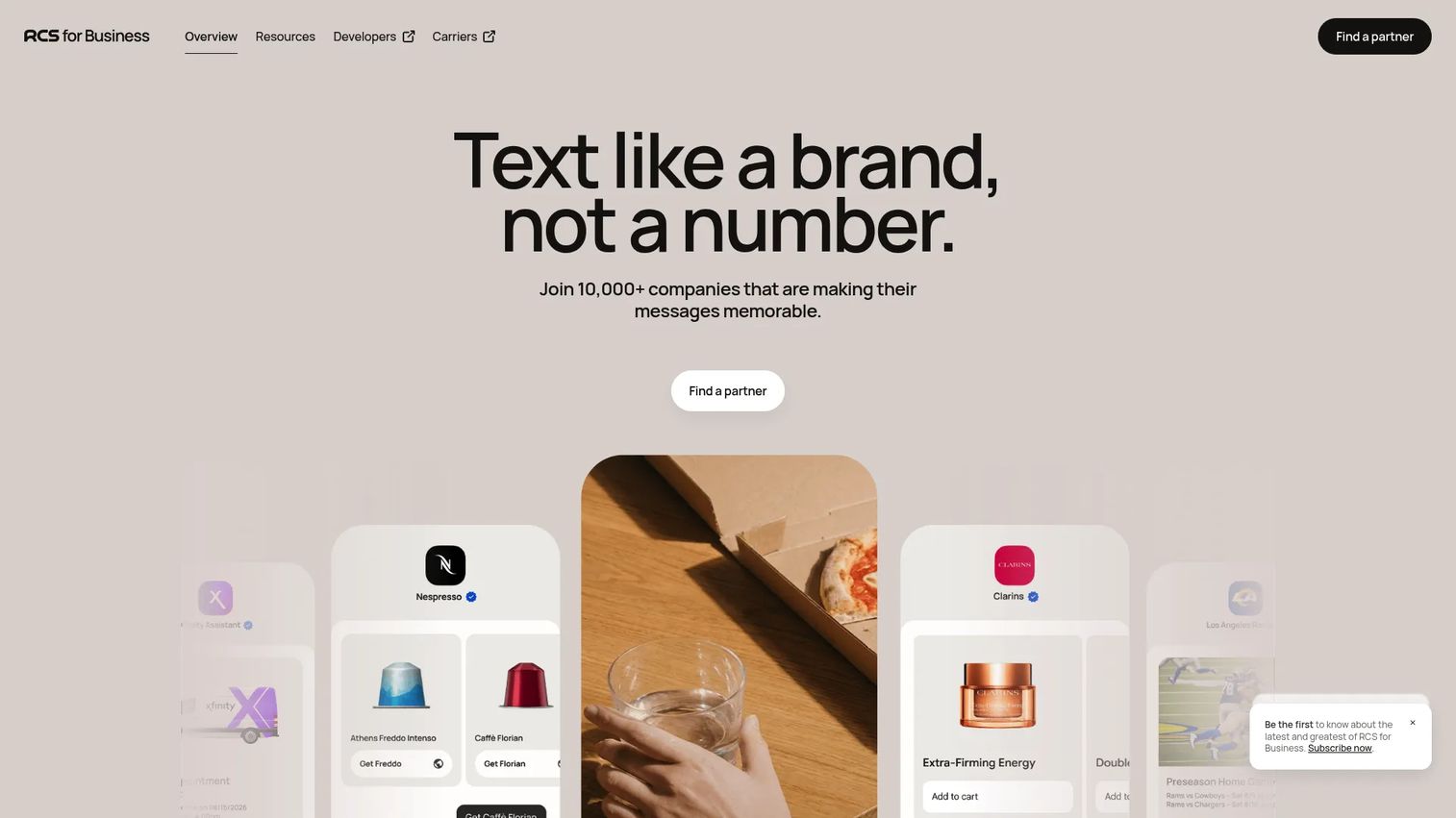
Google RCS for Business is the official framework for delivering branded, interactive business messages through Google Messages and supported native messaging apps on Android and iOS devices where RCS is enabled. It provides verified business profiles, rich messaging templates, and developer resources including a Carrier Console, Developer Console, and design guidelines for building compliant, high-quality messaging experiences.
Best for: Brands that want to understand the official RCS for Business ecosystem, access Google's developer documentation, and work through approved messaging aggregators and partners.
Key features
- Verified sender identity and branded business profile
- Rich cards, carousels, and suggested replies
- Suggested actions and web view integrations
- User-initiated conversations from Google Search and Google Maps
- SMS and MMS fallback support
Why choose Google RCS for Business: Google's program is the right starting point for teams that need official documentation, brand verification guidance, and compliant implementation resources. It does not operate as a standalone campaign suite, so most teams pair it with a messaging aggregator or CPaaS vendor to handle routing, analytics, and CRM connectivity.
Google RCS for Business pricing: Google does not set message rates directly. Costs flow through approved messaging aggregators and carriers, and the final rate depends on the aggregator you choose, your target markets, message volume, and message type. Contact an approved partner to get a quote that reflects your specific carrier mix.
G2 rating: Not listed on G2. Google RCS for Business is a program rather than a purchasable product, so comparisons rely on the aggregator you buy through.
2. Twilio
Twilio is a communications platform that covers programmable messaging, voice, email, and customer engagement APIs. For teams already using Twilio for SMS or notification workflows, RCS Business Messaging fits into the existing Programmable Messaging infrastructure without requiring a separate vendor relationship. Twilio also includes Messaging Insights for delivery analytics and troubleshooting.
Best for: Technical marketing and lifecycle teams that already treat messaging as programmable infrastructure and want RCS as an upgrade layer on top of current SMS workflows.
Key features
- Programmable Messaging API with RCS support
- SMS fallback routing built into messaging logic
- Rich cards, carousels, and suggested replies
- Messaging Insights dashboard for delivery and engagement data
- Omnichannel support across SMS, WhatsApp, and RCS
Why choose Twilio: Twilio suits teams where marketing, product, and engineering collaborate on lifecycle messaging. It is the strongest fit when you already have Twilio infrastructure and want to add RCS without switching vendors. Teams looking for a no-code campaign builder will find it less suited to self-serve campaign launches.
Twilio pricing: Twilio publishes pay-as-you-go US rates. Outbound SMS is $0.0083 per message segment, where a segment is 160 characters. RCS rich text is also billed per segment at $0.0083 outbound, while RCS rich media is billed per message at $0.022 outbound and $0.0165 inbound. Carrier fees are added per message and vary by the recipient's carrier, a $0.001 processing fee applies to failed messages, and one-time carrier onboarding fees can apply to RCS senders. Rates differ by country, so check the pricing page for each destination you plan to send to. Free trial credits are available on account creation.
G2 rating: 4.1/5, based on 541 reviews
3. Infobip
Infobip is a global cloud communications platform covering SMS, WhatsApp, RCS, email, voice, and AI-driven customer engagement. It offers carrier connectivity across a large number of markets, making it a realistic option for enterprises running campaigns across multiple regions simultaneously. Messaging itself is priced per message by destination, while its Start, Grow, and Scale plans cover the AgentOS engagement products rather than the message rate card.
Best for: Global enterprise marketing teams that need RCS as part of a broader omnichannel strategy, with fallback channels, CRM integrations, and implementation support across several markets.
Key features
- Global carrier connectivity for RCS and omnichannel messaging
- Omnichannel fallback through SMS and other chat channels
- AI agents and journey automation for customer engagement
- CRM and marketing platform integrations
- Delivery reports, read receipts, and engagement analytics
Why choose Infobip: Infobip works best when RCS is one channel in a multi-channel customer communication program rather than a standalone initiative. Its carrier reach and omnichannel routing reduce the operational complexity of managing fallback across markets. Teams that need a single vendor to cover RCS, SMS, WhatsApp, and email will find it well suited to that requirement.
Infobip pricing: Infobip prices messaging on a pay-as-you-go basis, charged per message and organized by destination country, with rates that vary by network, volume, and currency, quoted in euros or US dollars. Its Start, Grow, and Scale plans apply to the AgentOS products such as Inbox, Automation Studio, AI Agents, and analytics, so they sit alongside your message spend rather than including it. Contact sales for RCS rates covering your specific market mix. A free trial is available.
G2 rating: 4.2/5, based on 60 reviews
4. Sinch
Sinch is a cloud communications platform offering messaging, voice, email, verification, and conversational AI. Its network of carrier relationships spans a large number of markets, and the platform covers SMS, MMS, RCS, WhatsApp, and in-app messaging. Sinch Engage is its campaign-focused product with publicly listed monthly plans; its broader API and network services use usage-based or sales-assisted pricing.
Best for: Enterprises and high-volume teams that treat messaging as mission-critical infrastructure and need carrier-grade deliverability across global markets.
Key features
- SMS, MMS, RCS, WhatsApp, and multichannel messaging APIs
- Carrier-grade routing and global network connectivity
- Voice APIs, SIP trunking, and in-app voice and video
- Verification API and number lookup
- Conversational AI and omnichannel contact center capabilities
Why choose Sinch: Sinch fits teams that care more about high-volume deliverability and operational support than about self-serve campaign design. For business instant messaging software use cases that require carrier-level reliability, its infrastructure depth is a genuine differentiator. Teams looking for a campaign builder interface may find Sinch Engage more accessible, while API-first needs are served through the broader Sinch developer platform.
Sinch pricing: Sinch Engage runs five published tiers: Basics at $99/month with 3,000 SMS, Conversations at $249/month with 10,000, Pro at $799/month with 40,000, Pro Plus at $1,799/month with 100,000, and Advanced at $2,399/month with 150,000. The published figures assume an annual commitment and exclude tax, and carrier fees may apply on top. Custom pricing applies above 150,000 messages, and broader Sinch API and network pricing is sales-assisted.
G2 rating: 3.8/5, based on 35 reviews
5. MessageBird (Bird)
Bird (formerly MessageBird) is an omnichannel communications platform covering email, SMS, WhatsApp, RCS, Push, Apple Messages, and programmable voice. Its agent inbox product (Mailbox) and developer APIs sit alongside marketing campaign capabilities. The platform targets businesses that want to manage multiple messaging channels without maintaining separate vendor relationships for each.
Best for: Growth teams that want RCS alongside other messaging channels in one platform and need email, SMS, and WhatsApp active simultaneously.
Key features
- Email, SMS, WhatsApp, RCS, Push, and Apple Messages
- Programmable voice and unified agent inbox (Mailbox)
- Verify, Lookup, Realtime, and eSIM APIs
- Developer tools and webhooks for custom workflows
- Channel fallback across supported messaging surfaces
Why choose Bird: Bird fits teams actively testing messaging across multiple channels who want a single vendor relationship rather than separate APIs for SMS, WhatsApp, and email. The channel breadth makes it easier to run RCS alongside existing channels without adding a new integration project. Confirm current RCS availability and regional coverage with the vendor before building a rollout plan.
Vendor relationship to note: Bird bid for CM.com, also on this list, in November 2025. CM.com's boards rejected the offer and Bird withdrew it, but Bird remained a minority shareholder in CM.com of roughly 5% as of November 2025. Weigh that if you are comparing the two against each other.
Bird pricing: Bird prices each product separately rather than through one platform plan, so the billing model differs by channel. Email has a free sending plan and paid plans funded from $15/month into a shared Bird balance, Apple Messages starts from $100/month, and SMS and the other channels run on pay-as-you-go per-message rates that vary by destination and carrier. Published US outbound SMS is $0.0035 per segment before carrier fees. RCS rates are not published per market, so ask Bird to quote your target markets.
G2 rating: 3.9/5, based on 73 reviews
6. Vonage
Vonage provides unified communications, contact center, and programmable communications APIs. Its Messages API supports multi-channel messaging, and Vonage is an Ericsson company, acquired in 2022 and run inside Ericsson's broader communications portfolio. For enterprise teams already using Vonage for voice, video, or contact center workflows, adding RCS-capable messaging through the same vendor reduces procurement and integration complexity.
Best for: Enterprises already using Vonage for voice or unified communications that want to extend to programmable messaging without adding a separate CPaaS vendor.
Key features
- Messages API for multi-channel business messaging
- Cloud-based business phone system with unlimited calls and SMS
- Video conferencing and team messaging
- AI virtual assistant and call recording with transcription
- Webhook-based workflow integrations
Why choose Vonage: Vonage makes sense when messaging, voice, and customer engagement need to sit under one vendor relationship and procurement cycle. It is worth evaluating alongside best marketing automation software tools when you are consolidating the broader marketing and communications stack. Teams that only need messaging APIs without the broader unified communications suite may find more focused alternatives.
Vonage pricing: The per-line pricing Vonage advertises belongs to Vonage Business Communications, its cloud phone system, not to the Communications APIs you would use for RCS. The Mobile plan lists at $19.99 per line per month, shown at $13.99 under a 30% promotional discount that applies to new online accounts on a minimum one-year contract, excluding taxes and fees. Programmable messaging through the Communications APIs is priced per message by destination, so request a quote for RCS in your target markets rather than reading across from the seat price.
G2 rating: 4.2/5, based on 404 reviews for Vonage Communications APIs
7. Telnyx
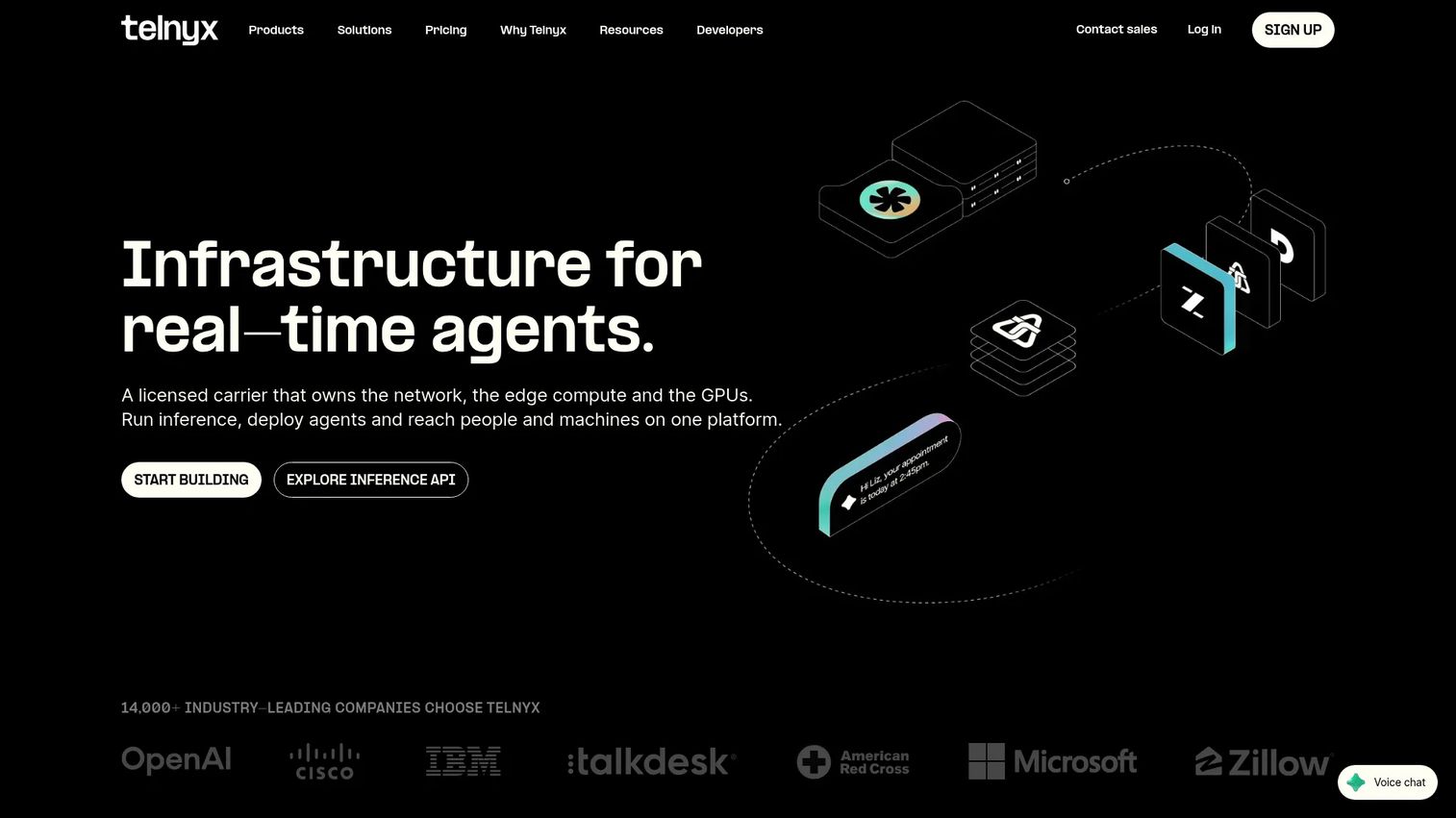
Telnyx operates its own carrier network and provides real-time communications infrastructure for messaging, voice, AI, networking, and edge compute. Its SMS, MMS, RCS, WhatsApp, and Email APIs sit alongside voice AI agents, SIP trunking, and global number management. Telnyx publishes usage-based pricing with no monthly minimum on its entry plan, which makes it accessible for smaller teams or early RCS pilots before committing to higher spend tiers.
Best for: Engineering-led teams that want network-level control over message routing, delivery behavior, and API integration, with published per-message rates.
Key features
- SMS, MMS, RCS, WhatsApp, and Email APIs on one platform
- Voice API with recording, conferencing, streaming, and call control
- Voice AI agents with speech-to-text and text-to-speech
- Global number management, verification, and branded calling
- SIP trunking, WebRTC, and edge compute infrastructure
Why choose Telnyx: Telnyx suits teams that want to own the messaging infrastructure layer rather than accept a managed campaign-builder abstraction. Its $0 monthly minimum entry plan makes it practical for testing RCS campaigns before scaling. Teams that want a no-code campaign UI will need to build that experience on top of the API themselves.
Telnyx pricing: Telnyx charges usage-based rates per message and per minute, with a $0 monthly minimum on its Pay as you go plan. Above that it offers a committed tier that trades a monthly minimum spend for automatic volume discounts, and an enterprise tier with a $5,000 monthly minimum and custom contracted rates. Telnyx changed the committed tier during 2026 and published sources disagree on its current monthly minimum and discount percentage, with figures ranging from $500 to $2,000 per month, so confirm the current rate card on the Telnyx pricing page before you model costs.
G2 rating: 4.7/5, based on 528 reviews
8. CM.com
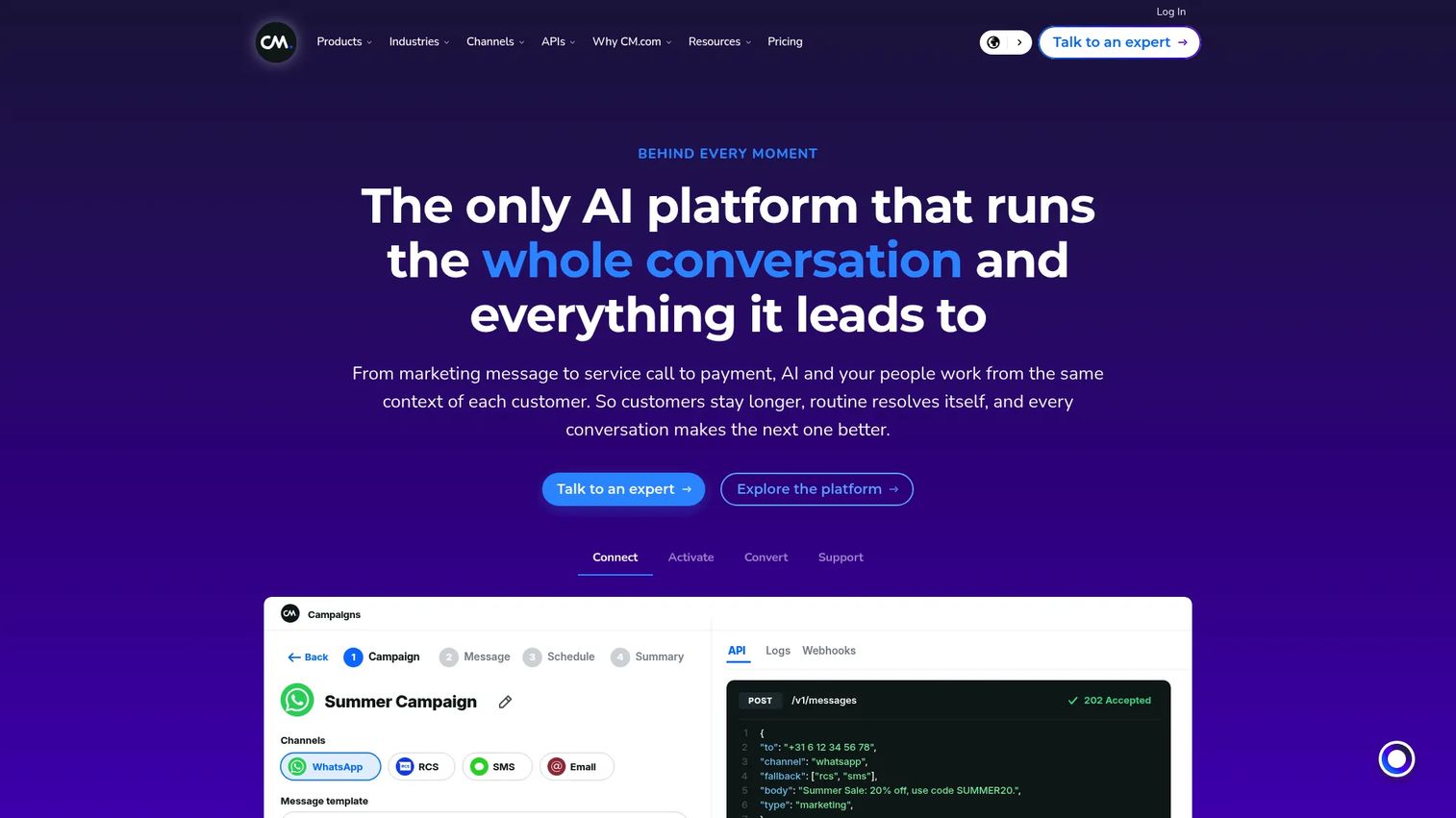
CM.com is an AI-powered customer engagement platform covering conversational commerce, omnichannel messaging, marketing automation, customer service, payments, and ticketing. Its Conversational Channels product supports WhatsApp, RCS, SMS, Voice, and Email with published monthly plan pricing. HALO AI agents and a unified conversation history across channels give marketing and support teams visibility into the full customer interaction history.
Best for: Marketing teams that want RCS inside a customer engagement workflow with campaign management and payment capabilities rather than a pure developer API.
Key features
- Omnichannel messaging across WhatsApp, RCS, SMS, Voice, and Email
- HALO AI agents and conversational automation
- Marketing campaigns and audience segmentation
- Unified customer service inbox with conversation history
- Online and in-person payment processing
Why choose CM.com: CM.com fits marketers who want to run RCS campaigns without filing engineering tickets for every test. Its published plan pricing and campaign management tools make it easier to model ROI upfront than with purely sales-led vendors. Confirm RCS availability in your target markets, and check whether the plan tier you are evaluating includes the channel integrations your CRM requires.
Vendor relationship to note: Bird, also on this list, bid for CM.com in November 2025. CM.com's boards rejected the offer as undervaluing the company and Bird withdrew it, but Bird remained a minority shareholder of roughly 5% as of November 2025. Weigh that if you are comparing the two against each other.
CM.com pricing: Conversational Channels plans are Go at $58/month with one profile, Basic at $180/month with five profiles, Advanced at $590/month with 15 profiles, and Pro on custom pricing. The subscription covers platform access, not traffic: message volume is charged separately per message by channel and destination, so model both lines together. Other CM.com products use separate usage-based or transaction-fee pricing.
G2 rating: 4.8/5, based on 12 reviews, so treat the score as directional given the small sample
9. Route Mobile
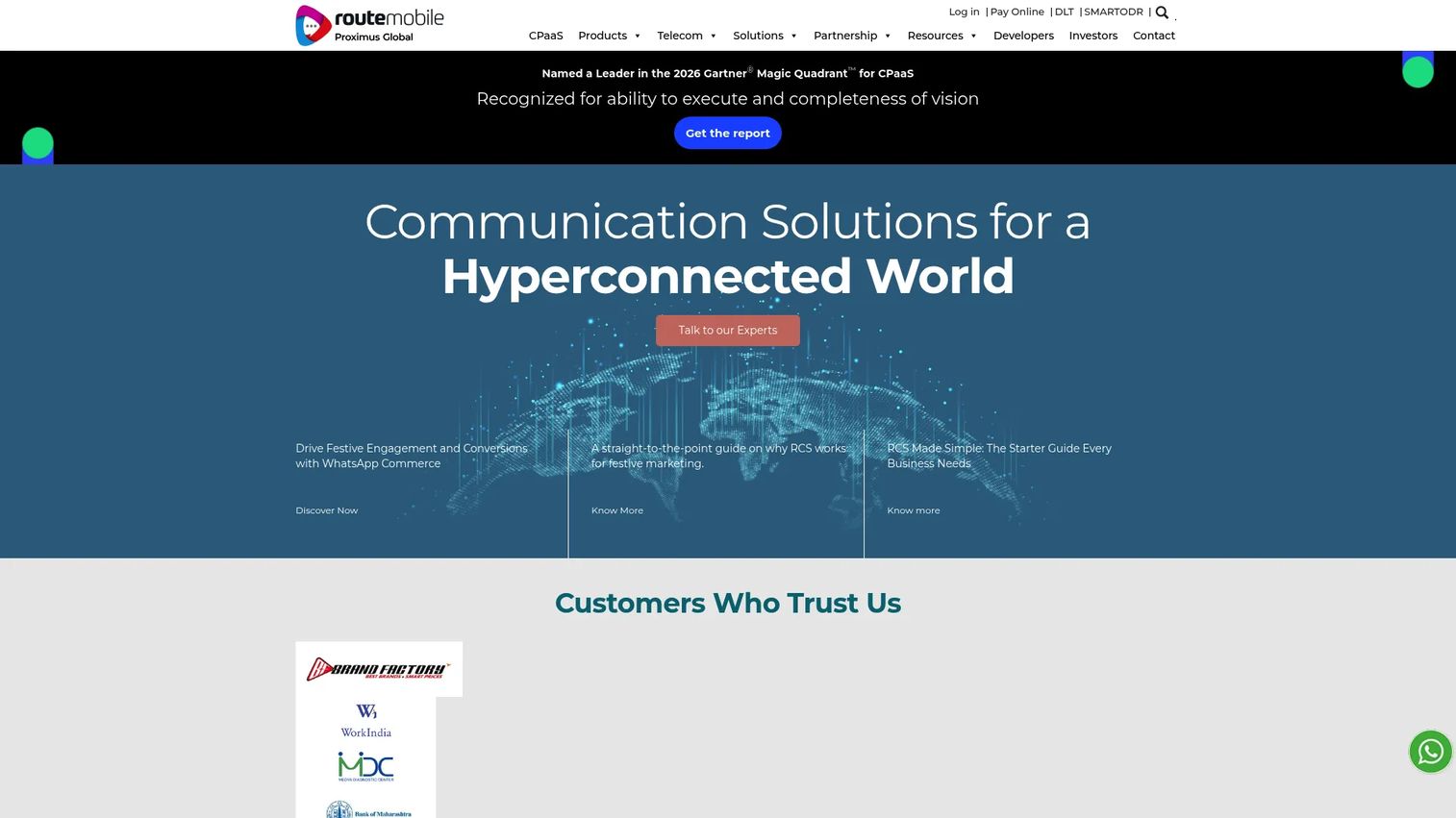
Route Mobile is a CPaaS provider offering enterprise messaging, voice, email, identity verification, and SMS firewall capabilities. It has been majority-owned by Belgian telecom group Proximus since May 2024 and now sits inside the Proximus Global business. Its carrier relationships and A2P messaging infrastructure give it particular strength in high-growth markets across Asia, the Middle East, and Africa. The platform covers WhatsApp, RCS, Viber, and other enhanced business messaging channels alongside standard SMS and voice APIs.
Best for: Enterprises with high-volume messaging needs in emerging markets where carrier relationships and delivery operations matter as much as campaign design tools.
Key features
- A2P and two-way messaging with enterprise routing
- WhatsApp, RCS, Viber, and enhanced business messaging channels
- Voice and cloud telephony APIs
- Email delivery and campaign capabilities
- SMS firewall, analytics, and monetization tools
Why choose Route Mobile: Route Mobile is worth evaluating when your primary concern is delivery rates and carrier-level reach in markets where other CPaaS vendors have thinner coverage. Its omnichannel messaging scope covers the channels that matter in high-growth regions. Teams focused on self-serve campaign design will find the sales-led engagement model a longer path to first send.
Route Mobile pricing: Route Mobile routes all pricing through a sales conversation. The final rate depends on message volume, carrier agreements, target markets, and message types. Contact the sales team to get a quote that covers your specific carrier mix and region.
G2 rating: 4.0/5, based on only 3 reviews for Route Mobile Communication APIs, which is too thin a sample to compare against the larger listings here
10. Kaleyra
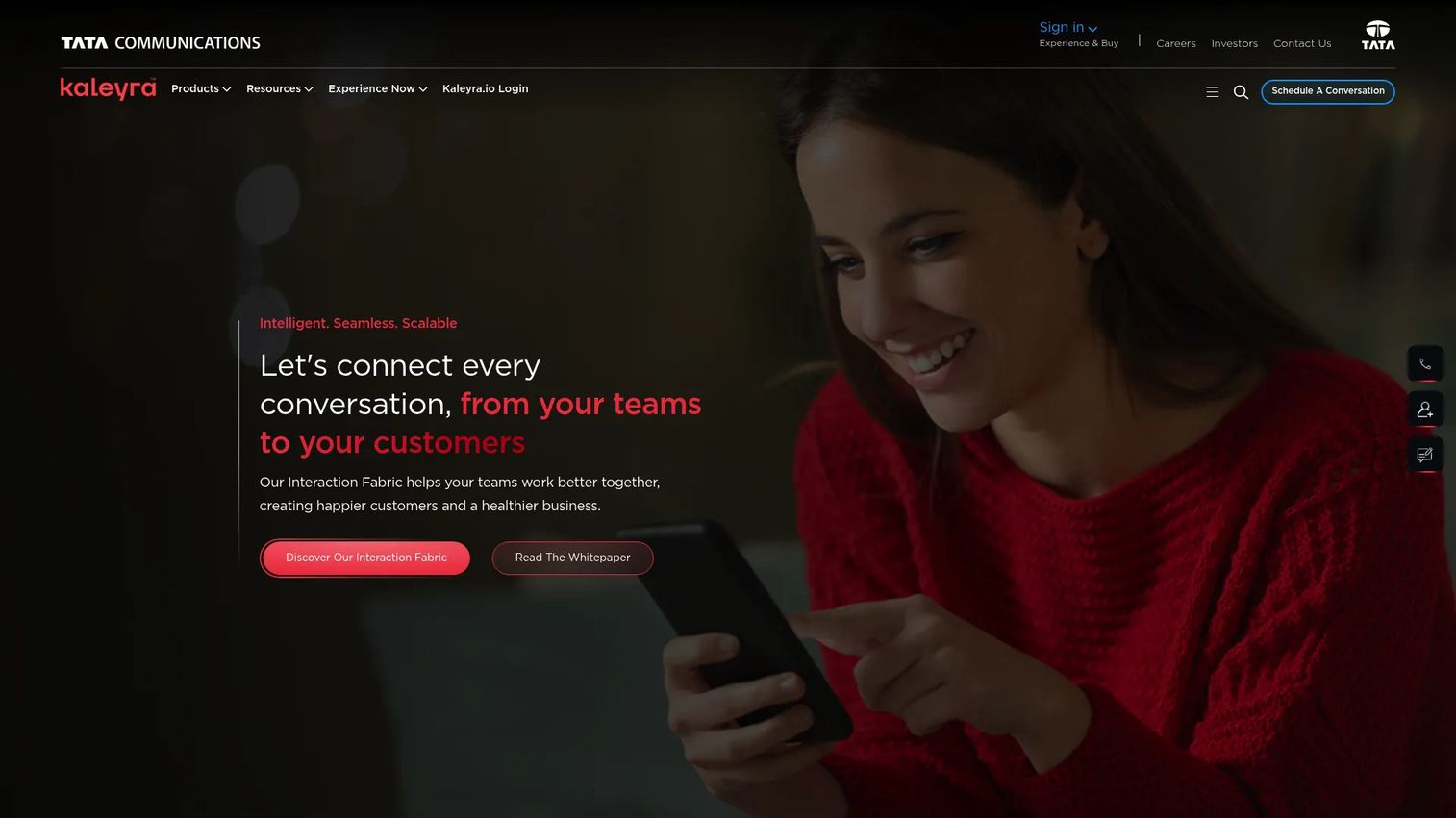
Kaleyra is a cloud communications platform providing messaging APIs for SMS, voice, WhatsApp, email, and push notifications. It has been owned by Tata Communications since 2023, when Tata completed an all-cash acquisition valued at about $100 million, and its capabilities now sit inside Tata's customer interaction portfolio. It has a strong customer base in financial services and enterprise verticals where reliable transactional messaging, two-way communication, and omnichannel customer updates are core operational requirements. Its chatbot and conversational tools support both automated and agent-assisted customer interactions.
Best for: Enterprises in regulated industries that need dependable messaging APIs for transactional notifications, authentication-adjacent alerts, and customer engagement campaigns.
Key features
- SMS and global messaging APIs for high-volume delivery
- Voice APIs, click-to-call, IVR, and call management
- WhatsApp Business API
- Email, push notifications, and chatbot capabilities
- Omnichannel customer communication tools
Why choose Kaleyra: Kaleyra suits enterprises that prioritize reliability and compliance readiness over self-serve campaign builder features. Its footprint in financial services and regulated verticals means the platform has seen the security and audit requirements that slow down enterprise procurement. Because the product now sits under Tata Communications, confirm which entity you would contract with and how the roadmap is packaged before you finalize a shortlist.
Kaleyra pricing: Kaleyra does not display a public pricing page with plan rates. You will need a sales conversation to get a quote for your messaging volume, target markets, and channel mix.
G2 rating: 4.5/5, based on 14 reviews on the Kaleyra listing. The newer Tata Communications Kaleyra CPaaS listing on G2 has no reviews yet, so the score reflects the pre-acquisition product.
Considerations when choosing RCS business messaging software
Verify carrier and regional coverage first
RCS availability changes by country, carrier, and operating system version. Ask every vendor you shortlist for a current coverage map of your top markets before building a campaign schedule or modeling expected reach.
Plan fallback before launch, not after
Define what users receive when RCS is unavailable: SMS, MMS, or another channel. Fallback logic is not a technical detail to hand off to engineering after launch. It determines whether your RCS experiment actually measures RCS performance or measures a mix of channel experiences that make attribution impossible.
Check brand verification timelines
Sender verification affects when you can send. Ask who handles the registration process, what documents are required, and how long approval takes in each of your target markets. Some markets require carrier-by-carrier registration rather than a single submission.
Read the pricing model, not the headline rate
CPaaS vendors bill per message, per segment, or per conversation, and a rich card or carousel is often priced differently from a plain RCS text. Rates also change by destination country and recipient carrier, and some vendors add carrier surcharges, failed-message fees, or one-time onboarding fees for RCS senders. Ask every vendor to show the billing unit alongside the rate so you can compare like for like.
Map engagement data to your attribution setup
Read receipts and button clicks produce useful signals only if they flow into your CRM or analytics platform. Before signing a contract, confirm which events the vendor exports, which integrations are supported, and how the data model maps to the campaign attribution structure you already use. For deeper context on connecting messaging data to pipeline reporting, our guide on how analytics platforms drive ROI covers the measurement stack questions worth asking.
Compare workflow fit, not only channel support
API-first vendors require engineering involvement for most campaign changes. Campaign-builder-first vendors let marketers self-serve but may limit what is configurable. Pick the operating model your team can maintain week to week without filing a ticket for every A/B test.
Conclusion
RCS business messaging is no longer a future-state channel. Infobip's Messaging Trends Report 2025 recorded a fivefold increase in RCS traffic on its own platform during 2024, and the software layer is now mature enough to evaluate seriously alongside SMS and email.
The right platform depends on four things: which markets and carriers you need to reach, whether your team operates API-first or campaign-builder-first, how you plan to handle fallback, and how engagement data connects to your attribution stack.
For official ecosystem resources and verified sender documentation, Google RCS for Business is the starting point. Twilio fits teams already running messaging infrastructure through their APIs, and publishes its US RCS rates. Infobip handles global enterprise scope with multi-channel fallback. Sinch and Route Mobile serve high-volume delivery and carrier-reach requirements. Telnyx offers a low-commitment entry point for developer-led teams. CM.com gives campaign-first marketers published plan pricing and self-serve tooling. Vonage and Kaleyra fit enterprises consolidating under existing communications vendor relationships, both inside larger parent groups.
Shortlist two to three vendors based on your top market coverage, your team's operating model, and how the platform exports engagement data to your existing stack. Run a pilot against an SMS control group before moving significant budget.
For more on the broader messaging and communications stack, see the best SMS marketing software and best mobile marketing software guides.
Evaluating platforms like these usually means sitting through scheduled vendor calls before you can see how a campaign builder or an analytics dashboard actually behaves. If your own team sells software and runs into that problem from the other side, Guideflow lets you publish an interactive demo of your product that buyers can click through on their own, ahead of a call.
Start your journey with Guideflow today!
FAQs
RCS business messaging software lets companies send branded, verified, rich mobile messages through the native messaging inbox, with support for media, buttons, suggested replies, read receipts, and fallback to SMS when RCS is unavailable. The software layer handles carrier connectivity, sender verification, campaign routing, analytics, and CRM integration. It differs from SMS in that messages carry a verified company identity, logo, and interactive content rather than plain text.
RCS adds verified sender identity, images, video, carousels, action buttons, and read receipts to mobile messaging that SMS cannot support. Marketers gain click and reply data they can connect to conversion tracking, which makes campaign measurement more defensible than SMS delivery reports alone. SMS remains important because it provides fallback coverage on devices and carriers where RCS is not yet available.
Yes, in supported markets. iOS 18 brought person-to-person RCS to iPhone in September 2024, rolling out carrier by carrier. Business messaging followed from iOS 18.1 in October 2024, with RCS for Business available on iPhone through select carriers, and Apple publishes regional carrier lists for Europe, North America, and APAC. Coverage is still expanding, so confirm the specific markets and carriers with any vendor you evaluate. Note that the end-to-end encryption Apple began rolling out for personal RCS chats in 2026 does not extend to business messages.
RCS pricing depends on the vendor, target country, carrier fees, message type, and monthly volume. Most CPaaS vendors bill per message, per segment, or per conversation, and the unit matters: a plain RCS text is often billed per segment while a rich card or carousel is billed per message at a higher rate. Twilio, for example, publishes US RCS rich text at $0.0083 per segment and RCS rich media at $0.022 per message, with carrier fees added on top. Some vendors publish plan tiers with SMS allowances; others require a sales quote. Ask each vendor to break out the billing unit, the per-message rate, carrier surcharges, and any platform or setup fees separately so you can compare fully loaded campaign cost, not just headline rates.
RCS delivers through the native messaging app on Android and iOS without requiring a separate application install. WhatsApp operates within its own app with its own opt-in and contact management rules. RCS tends to have broader default reach on Android in markets where carriers have enabled it, while WhatsApp has deep user engagement in specific regions, particularly Europe, Latin America, and parts of Asia. Neither is universally better; the right choice depends on where your customers are and what channel they already use.
RCS improves SMS campaigns where carrier and device support exists, but SMS remains necessary for fallback coverage. Marketers should run RCS and SMS in parallel, with fallback logic that routes to SMS when RCS is unavailable, rather than treating RCS as a complete replacement. Test RCS against SMS control groups before reallocating campaign budget, so the performance comparison is based on your own audience data.
Prioritize verified sender registration support, carrier coverage in your target markets, rich media and button capabilities, SMS fallback logic, CRM and marketing automation integrations, read receipt and click data export, and compliance controls for opt-in management. For teams already comparing best marketing analytics software, confirming how RCS engagement events flow into the attribution stack is as important as the messaging features themselves.
Verified sender identity reduces impersonation risk by confirming that the business sending the message has been authenticated by the platform and carrier. This makes it harder for bad actors to spoof a brand identity in the native inbox. Platform-level security controls, data handling practices, and compliance with regional regulations vary by vendor. Review each vendor's security documentation and confirm their data processing agreements match your requirements before purchase.