You can buy property data from almost anywhere. The hard part is deciding whether it's accurate enough, current enough, and usable enough to drive a product decision, an underwriting rule, or a board-level forecast.
The problem isn't access. It's reconciliation. A new data vendor solves one team's immediate research need, then creates a mismatch every time another system pulls a different address match or valuation figure. According to The State of Commercial Property Management Technology (2025), 90% of commercial real estate professionals say improved data analytics and reporting would most benefit their maintenance and asset management workflows. That signal applies upstream too: The data layer has to be right before any analytics on top of it means anything.
This guide is for founders evaluating property data as infrastructure, not as a one-off research tool. The question isn't which vendor has the most data. It's which tool gives your team a repeatable workflow without becoming another reconciliation problem.
What's inside
This guide covers 10 property intelligence software tools for 2026. Every entry was selected against four criteria:
- Data coverage and freshness: Geographic scope, parcel match rates, and refresh cadence
- Workflow fit: Browser-based research platform versus API-first data delivery
- Integration model: How the tool connects to an existing product, CRM, or analytics stack
- Pricing clarity: What actually drives the cost at scale
The list spans broad property intelligence platforms, aerial imagery analytics, API-first data sources, commercial research tools, and specialist software for zoning and computer vision. Pricing figures were verified against each vendor's live page at generation time. G2 ratings match current listings.
TL;DR
- Best for broad property and risk intelligence: Cotality covers national property, market, climate, and risk data in a single vendor relationship
- Best for aerial imagery and property condition: Nearmap gives insurance, construction, and public-sector teams visual property intelligence at scale
- Best for product teams building with property data: Estated's API starts at $449/month and delivers structured property records for embedding in your own product
- Best for enterprise real estate data integration: Cherre unifies fragmented data across portfolios and operational systems
- Best for commercial real estate research: Crexi combines listings, market intelligence, and deal workflow in one platform
- Best for parcel research and prospecting: PropertyRadar starts at $119/month and pairs ownership data with multichannel outreach workflows
- Founder decision shortcut: Choose a full platform when your team needs analysis in the browser. Choose an API when property data must become part of your product.
What is property intelligence software?
Property intelligence software combines property records, market data, geospatial context, risk signals, and analytics to help teams research assets and make decisions about valuation, underwriting, investment, development, insurance, or customer targeting.
Core data categories
Most platforms draw from some combination of the following inputs:
- Parcel and address records
- Ownership, deed, tax, and transaction history
- Market values and comparable sales
- Property characteristics and building attributes
- Aerial imagery and visual condition signals
- Hazard, climate, and insurance risk
- Zoning, land use, and development constraints
Common software models
| Software model | Best for | Typical buyer | What to validate |
|---|---|---|---|
| Full property intelligence platform | Market, risk, valuation, and portfolio decisions | Lenders, insurers, enterprise real estate teams | Geographic coverage, data refresh, licensing |
| Aerial imagery platform | Property condition, claims, construction, inspections | Insurers, contractors, public-sector teams | Image recency, attribution accuracy, coverage |
| Property data API | Embedding records into software products | Proptech and fintech product teams | API limits, match rates, data rights |
| Research database | Ownership, transaction, parcel, and lead research | Investors, brokers, operations teams | Record completeness, export limits |
| Development and zoning intelligence | Site selection, feasibility, entitlement workflows | Developers, planners, AEC firms | Jurisdiction coverage, zoning freshness |
What founders should care about
Before signing an annual agreement, answer four questions: Is this a data provider, a workflow product, or both? Can the team start with one job and expand without renegotiating? Does the system connect to the existing product and analytics stack? How will data quality affect customer trust and unit economics if a record is wrong at the moment of a decision?
The category is not one interchangeable set of tools. It's a stack decision across property records, risk, imagery, market intelligence, APIs, and specialist workflow software.
When to use property intelligence software
Validate a property before a high-stakes decision
Lenders verifying collateral, insurers assessing roof condition before binding coverage, and acquirers stress-testing a portfolio all need property data that holds up under scrutiny. A research platform or broad intelligence provider gives analysts the ownership history, market comparables, and risk signals to build a defensible case before capital moves.
Build property data into your product
A proptech, mortgage, or home-services product that surfaces property information to end users needs an API, not a browser portal. The right choice here turns on address match rates, response latency, data rights for customer-facing display, and what happens when API usage scales past the initial estimate.
Replace fragmented research workflows
Teams currently jumping between county records, spreadsheets, imagery viewers, and broker documents create rekeying errors and inconsistent decisions. A purpose-built platform consolidates those inputs and gives a repeatable research workflow. Before buying for breadth, confirm the platform actually covers the specific markets and property types the team works in most.
Property intelligence software comparison
Not every tool in this list does the same job. Some are browser-based research platforms built for analysts. Others are APIs built for engineers. The table below maps each tool to its core job so you can skip straight to the category that fits your operating model.
| # | Product | Best for | Key differentiator | Pricing | G2 rating |
|---|---|---|---|---|---|
| 1 | Cotality | Broad property, market, and risk intelligence | National data with AI-powered forecasting and risk models | Custom pricing | 4.0/5 |
| 2 | Nearmap | Aerial imagery and property condition | High-resolution imagery with AI-derived attributes | Custom pricing | 4.6/5 |
| 3 | Estated | Property data APIs for SaaS products | Structured property records and enrichment APIs | From $449/month | 4.6/5 |
| 4 | Cherre | Enterprise real estate data integration | Universal data model connecting fragmented RE data | Custom pricing | N/A |
| 5 | PropertyShark | Ownership and property research | Parcel, ownership, transaction, and comp research | From $59.95/month | 4.7/5 |
| 6 | PropertyRadar | Property research and prospecting | Map-based search with multichannel outreach | From $119/month | 4.5/5 |
| 7 | DataTree Online | Title, property, and document research | Property records and recorded document access | Custom pricing | 2.3/5 |
| 8 | Crexi | Commercial real estate market research | Listings, market intelligence, and deal workflow | Free tier; paid plans by quote | 4.6/5 |
| 9 | Restb.ai | Property image intelligence | Computer vision for condition detection and listing enrichment | Custom pricing | N/A |
| 10 | Gridics | Zoning and development intelligence | Parcel-level zoning analysis with developer API | From $0/month | N/A |
10 best property intelligence software tools for 2026
1. Cotality

Cotality provides property data, analytics, software, and AI-enabled solutions for real estate, mortgage, insurance, restoration, government, and related industries. Its platform combines property records, market data, climate and hazard risk models, customer intelligence, and geospatial data across the U.S. Cotality also covers MLS connectivity, listing management, client collaboration, and real estate productivity tooling for agents and brokers.
Best for: Founders and operators who need broad U.S. property intelligence across valuation, market conditions, risk, and research workflows without stitching together multiple vendors.
Key features
- Nationwide parcel, property, and ownership data
- AI-powered predictive valuation and market forecasting
- Climate, hazard, and insurance risk models
- Geospatial intelligence and mapping layers
- MLS connectivity and listing management tools
Why choose Cotality: Choose Cotality when the company needs a broad property intelligence foundation rather than a narrow workflow tool, and when multiple teams (underwriting, product, research) need consistent property and market data from a single source.
Cotality pricing: Cotality prices by data module, coverage, and enterprise agreement. Contact their sales team for a quote; no public tier pricing is displayed on the vendor site.
Cotality holds a 4.0/5 rating on G2 based on 24 reviews.
2. Nearmap
Nearmap provides high-resolution aerial imagery, property intelligence, AI analytics, and workflow applications for insurers, governments, and architecture, engineering, and construction organizations. Its MapBrowser platform lets teams view, measure, annotate, and export property data from frequently refreshed aerial captures. AI-derived attributes include roof condition, roof age, estimated peril risks, and exterior measurements.
Best for: Insurance, construction, public-sector, and property operations teams that make decisions based on what is physically visible at the property rather than what a record says.
Key features
- High-resolution vertical, oblique, 3D, and near-infrared imagery
- AI-derived roof condition, age, and risk attributes
- Historical imagery archive for change analysis
- Property measurement and annotation tools in MapBrowser
- Claims and risk workflow integrations
Why choose Nearmap: Choose Nearmap when field inspections, claims assessment, or site verification create cost or time pressure, and the decision depends on current visual evidence rather than a property record. Validate image recency and model accuracy against your specific use case before committing.
Nearmap pricing: Nearmap does not display subscription prices; pricing varies by geography, imagery products, and industry application. Reach out to their sales team for a quote.
Nearmap holds a 4.6/5 rating on G2.
3. Estated
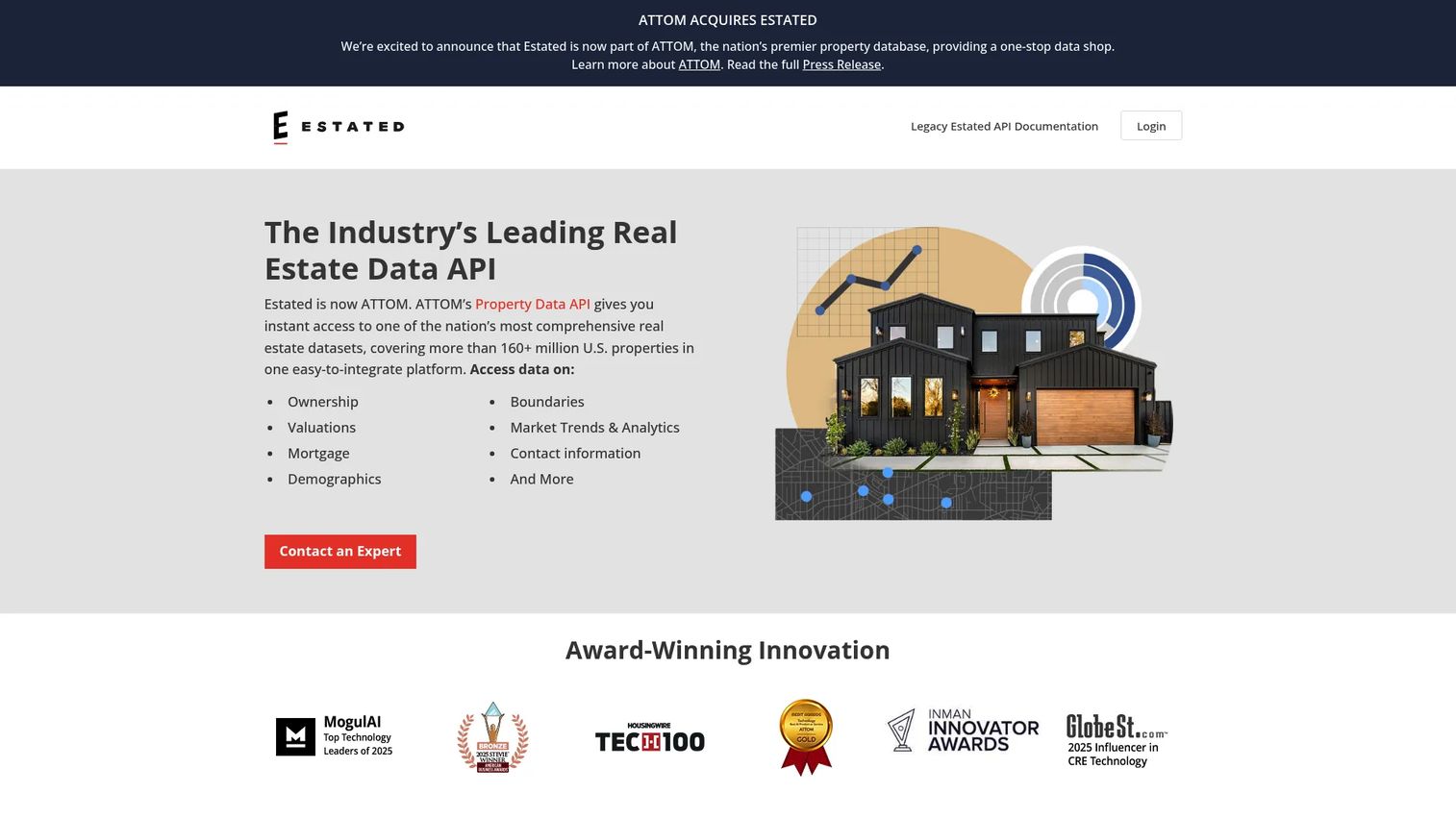
Estated is a real estate data API delivering nationwide U.S. property records, ownership data, valuation, mortgage, tax, assessment, deed information, parcel boundaries, and location analytics. Note that Estated is now part of ATTOM Data. The API returns structured, developer-friendly responses suited for embedding property records directly into proptech, mortgage, insurance, and analytics products.
Best for: Product and engineering teams adding property data to a SaaS product that needs reliable address enrichment without building a data pipeline from scratch.
Key features
- Property records and building characteristics via API
- Ownership, deed, assessment, and valuation data
- Parcel boundaries and location analytics
- Structured API responses with consistent schemas
- First 100 API calls free for evaluation
Why choose Estated: Choose Estated when property intelligence must appear inside your application or underwriting model rather than inside a separate research portal. Run a sample-match test against your own address set to validate coverage before scaling.
Estated pricing: Plans start at $449/month for the Essential tier (5,000 API calls per month) and $549/month for Enhanced. Higher call volumes are available at listed rates. The first 100 API calls are free.
Estated holds a 4.6/5 rating on G2.
4. Cherre
Cherre is a real estate data management and intelligence platform that unifies disparate data sources into a governed, trusted foundation. It ingests data through connectors, flexible uploads, submission portals, and secure SFTP, then applies validation, observability, and profiling against a Universal Data Model. Teams can access unified data via dashboards, APIs, and egress to Snowflake, AWS, Azure, or BigQuery. Cherre also offers an Agent STUDIO for creating and deploying AI agents against connected real estate data.
Best for: Enterprise real estate and investment teams dealing with fragmented data across portfolios, operational systems, and external datasets who need a governed, portfolio-wide data layer.
Key features
- Data ingestion via connectors, uploads, portals, and SFTP
- Universal Data Model with entity resolution and Knowledge Graph
- Data validation, observability, and custom business rules
- API access, dashboards, and egress to major cloud warehouses
- AI agent creation via Agent STUDIO
Why choose Cherre: Choose Cherre when the core problem is fragmented enterprise data rather than finding a single property record. It fits organizations with multiple systems of record and a need for clean, portfolio-wide reporting. This is infrastructure for teams building on top of data, not a consumer-style property lookup.
Cherre pricing: Core platform pricing requires contacting Cherre for a demo and quote. The Agent Marketplace lists most steady agents and workflows at $1 to $99 per run.
5. PropertyShark
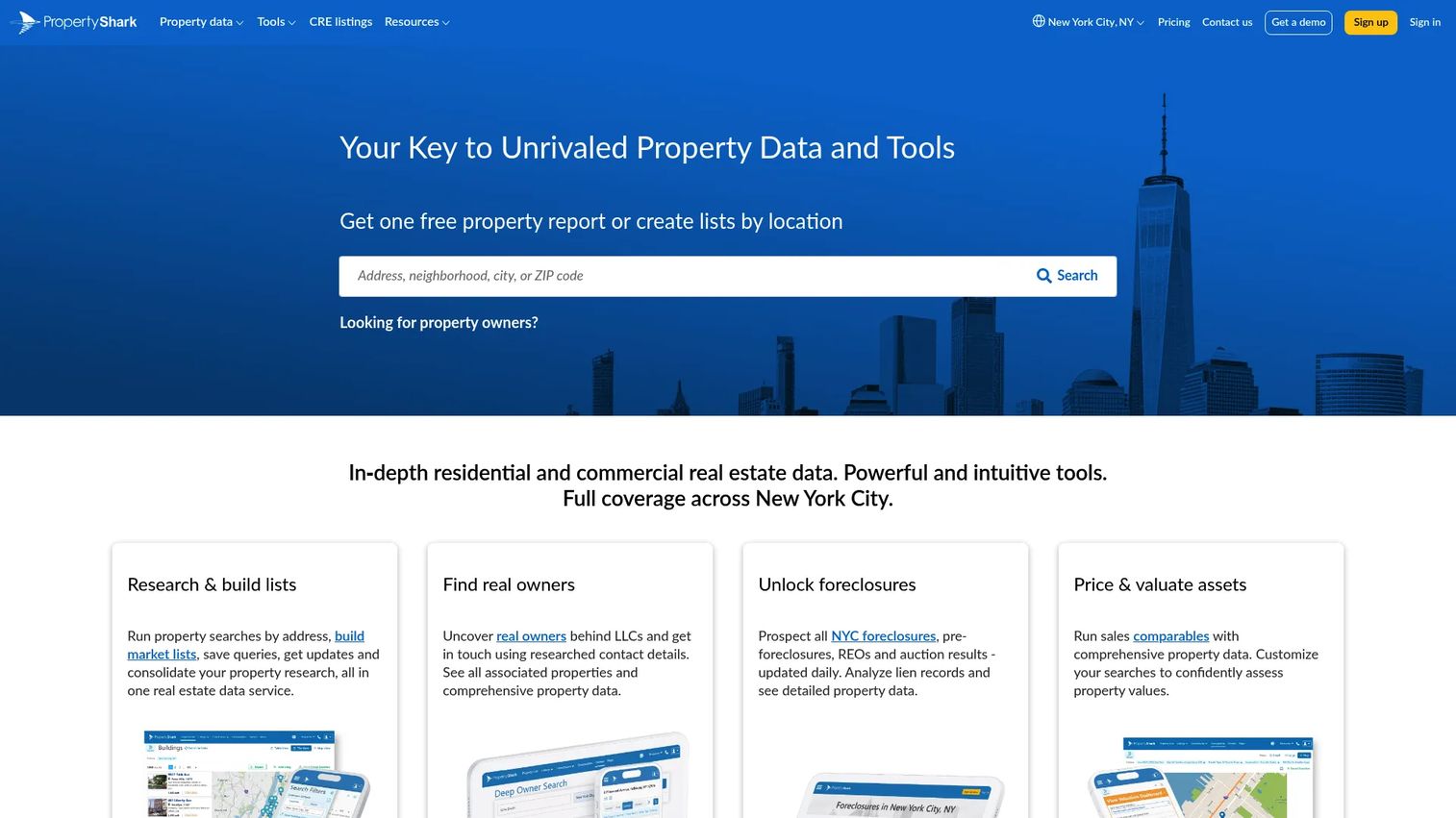
PropertyShark is a U.S. real estate data platform covering residential and commercial property research, ownership records, comparables, and foreclosure data. Reports pull ownership history, building details, tax records, zoning, permits, liens, mortgages, and valuations into a single research view. The platform also surfaces real owners behind LLCs, which matters for investors and lenders trying to reach the actual decision-maker.
Best for: Real estate professionals, investors, brokers, appraisers, and researchers who need fast, user-led ownership and property research in a browser.
Key features
- Property reports covering ownership, sales history, taxes, liens, and valuations
- Comparable sales research with customizable filters and exports
- Foreclosure, pre-foreclosure, and REO data
- Owner contact information, including LLC ownership disclosure
- Interactive maps, list-building, and property alerts
Why choose PropertyShark: Choose PropertyShark when the team needs research depth across ownership, history, and parcel records without the overhead of an enterprise data platform. It works well for founders validating a market before committing product resources. Geographic coverage varies by tier, so confirm the target markets are included before buying.
PropertyShark pricing: The Pro plan is $59.95/month (175 property reports included). Elite is $79.95/month (200 reports). Platinum is $169.95/month (250 reports). Annual billing saves roughly 17%. A free account with one complimentary property report is available.
PropertyShark holds a 4.7/5 rating on G2.
6. PropertyRadar
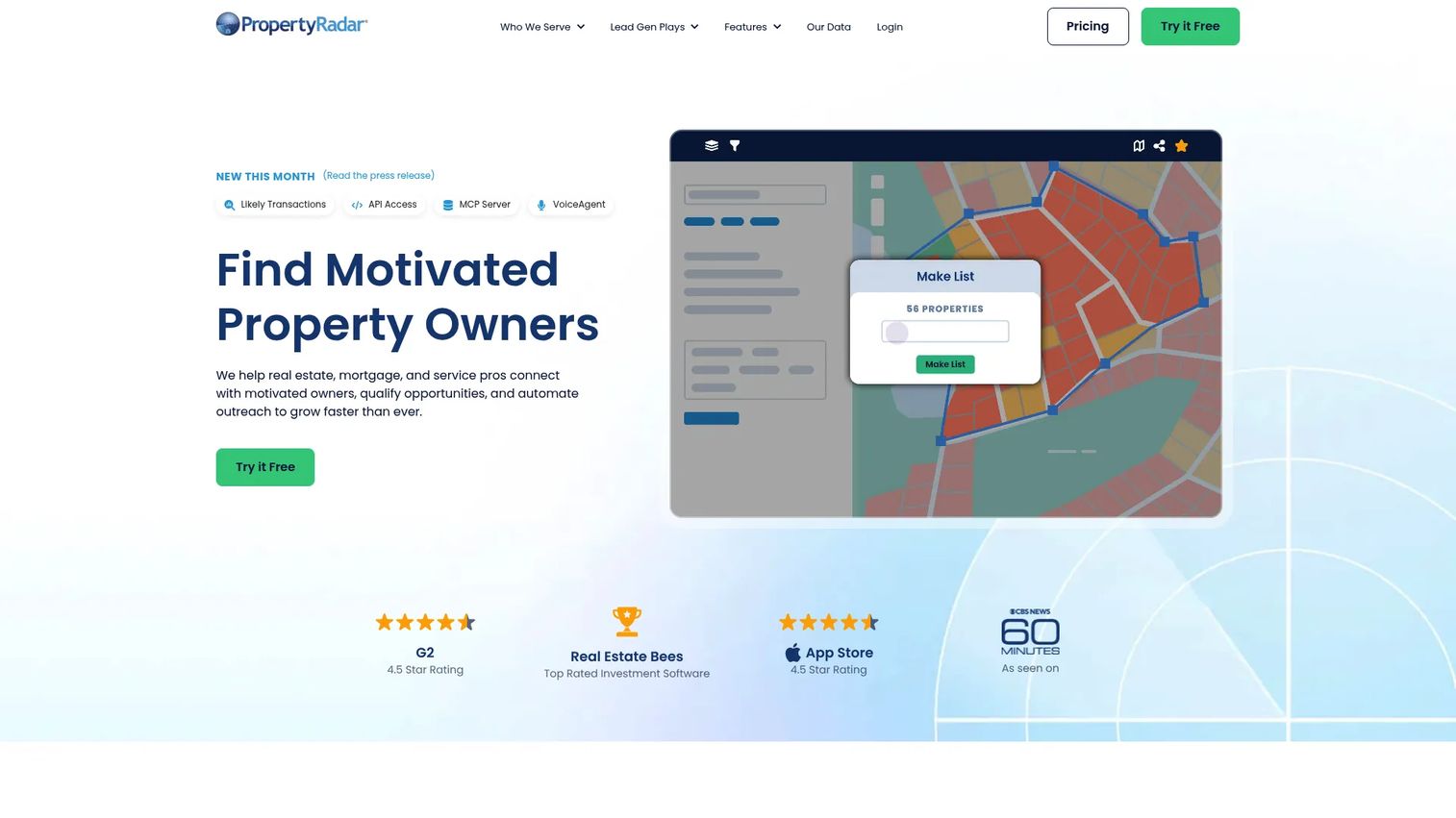
PropertyRadar helps real estate, mortgage, and service professionals find motivated property owners, qualify opportunities, and automate outreach. Its map-first interface combines 300+ property and owner search criteria with matched phone numbers, email addresses, transaction history, and distress signals. Teams can build targeted lists and push them into email, direct mail, phone, text, and online ad campaigns from one workflow.
Best for: Teams that need location-based property research and owner targeting for sales, acquisitions, local market analysis, or outreach, without managing separate list-building and marketing tools.
Key features
- AI-powered property and owner search across 300+ criteria
- Matched phone numbers, email addresses, and distress signals
- Map-based filtering with freehand and radius selection
- Multichannel marketing automation: Email, direct mail, phone, text, ads
- Workflow integrations and data exports
Why choose PropertyRadar: Choose PropertyRadar when the job is finding and segmenting property owners and then acting on that intelligence through a sales or outreach process. It's strongest for research and actionable targeting, not for actuarial risk modeling or API-based product enrichment.
PropertyRadar pricing: The Solo plan is $119/month (or $99/month billed annually). Team is $249/month ($199/month annually). Business is $599/month ($549/month annually). A 5-day free trial is available on all plans. Add-ons are priced separately.
PropertyRadar holds a 4.5/5 rating on G2.
7. DataTree Online
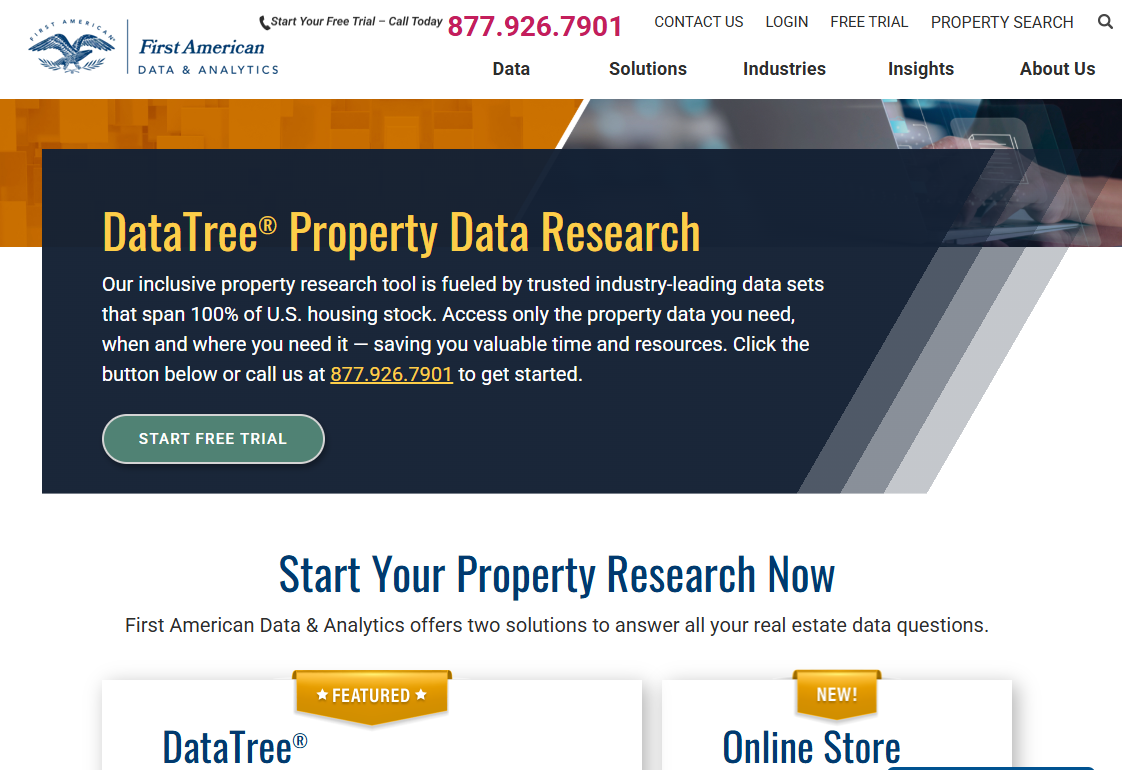
DataTree Online is a web-based real estate property research platform providing property data, recorded document images, advanced searches, and interactive mapping. Teams can search by address, APN, owner name, or interactive map, and access more than 125 advanced search fields. Polygon, radius, and freehand map selection tools let researchers define custom search areas for document retrieval and ownership research.
Best for: Property researchers, title-related teams, lenders, investors, and operations groups who need document-level property investigation and recorded document access.
Key features
- Property searches by address, APN, owner name, or map
- More than 125 advanced search fields
- Recorded document image retrieval and downloads
- Interactive map overlays with freehand, polygon, and radius selection
- Pay-as-you-go or prepaid monthly subscription options
Why choose DataTree Online: Choose DataTree Online when a decision depends on source documents and recorded property history rather than a high-level property profile. It's a research tool for teams with repeatable investigation needs who want access to the underlying documents, not just aggregated attributes.
DataTree Online pricing: The site offers a free trial. Pricing follows a pay-as-you-go download model or prepaid monthly subscription, but no numeric prices are displayed on the vendor's site. Contact DataTree to confirm current plan rates.
DataTree Online holds a 2.3/5 rating on G2.
8. Crexi
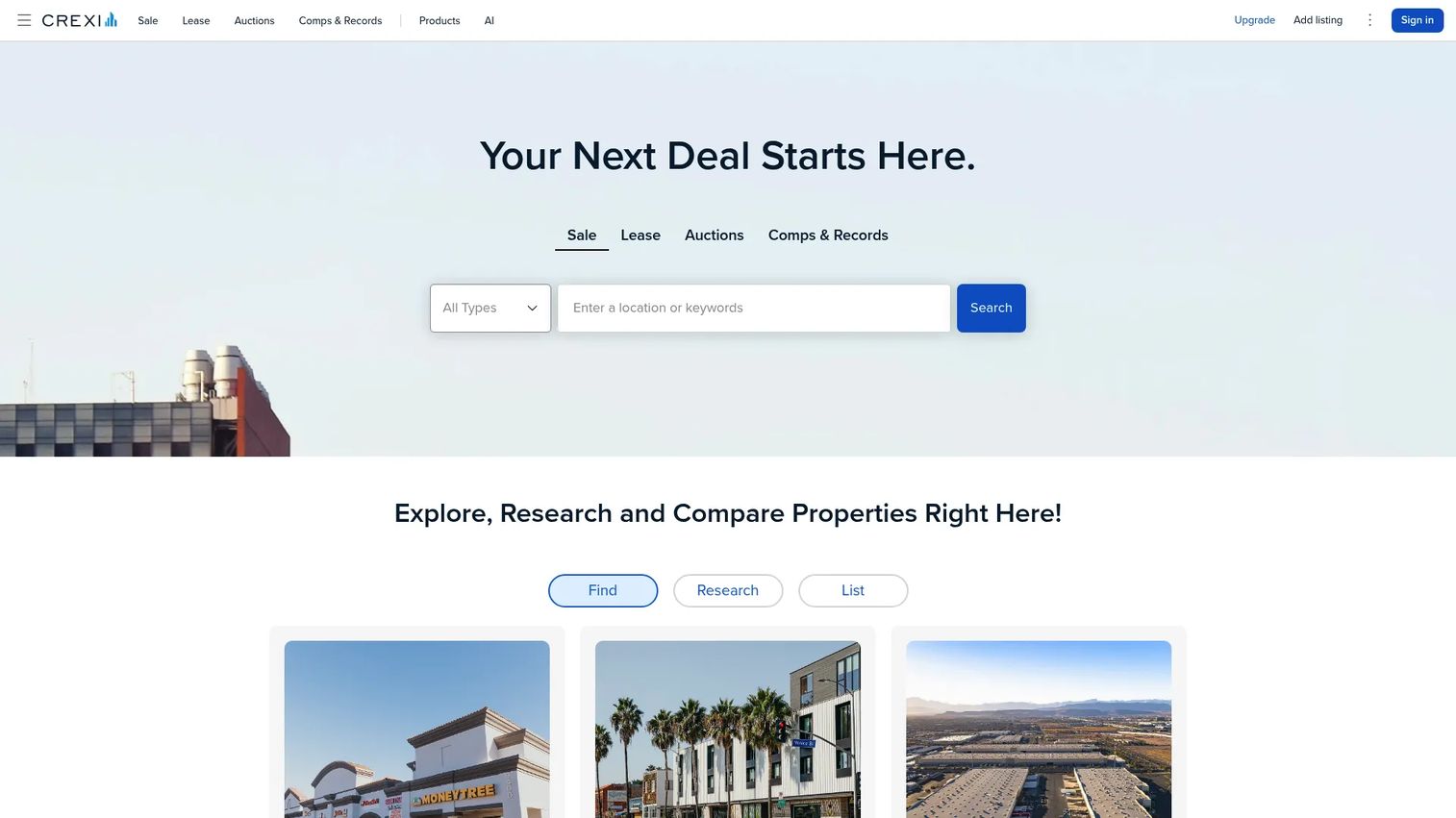
Crexi is a commercial real estate platform for marketing, researching, analyzing, and transacting commercial properties. Its Intelligence product includes property records, sales comparables, market trends, demographics, and ownership contacts. Crexi PRO adds listing marketing, lead tracking, prospecting, and campaign analytics. The platform also includes Crexi AI for deal document creation, listing enrichment, and zoning intelligence, and a Crexi Auction product for time-certain commercial transactions.
Best for: Commercial real estate brokers, investors, lenders, and appraisers who need property discovery, market intelligence, and deal workflow in a single platform.
Key features
- Commercial property sale and lease marketplace
- Sales comparables, market trends, and ownership contacts via Intelligence
- AI tools for deal documents, listing creation, and zoning research
- Listing marketing, lead tracking, and campaign analytics via PRO
- Crexi Auction for non-contingent commercial transactions
Why choose Crexi: Choose Crexi when the business cares primarily about commercial property opportunities and market visibility. It's stronger for commercial deal workflow context than for residential data enrichment or property data APIs. The free listing and marketplace search tier is a good way to evaluate before committing to Intelligence or PRO.
Crexi pricing: Basic marketplace access is free. Intelligence and PRO subscriptions are available but carry no public numeric prices; contact Crexi for current rates.
Crexi holds a 4.6/5 rating on G2, based on 142 reviews.
9. Restb.ai
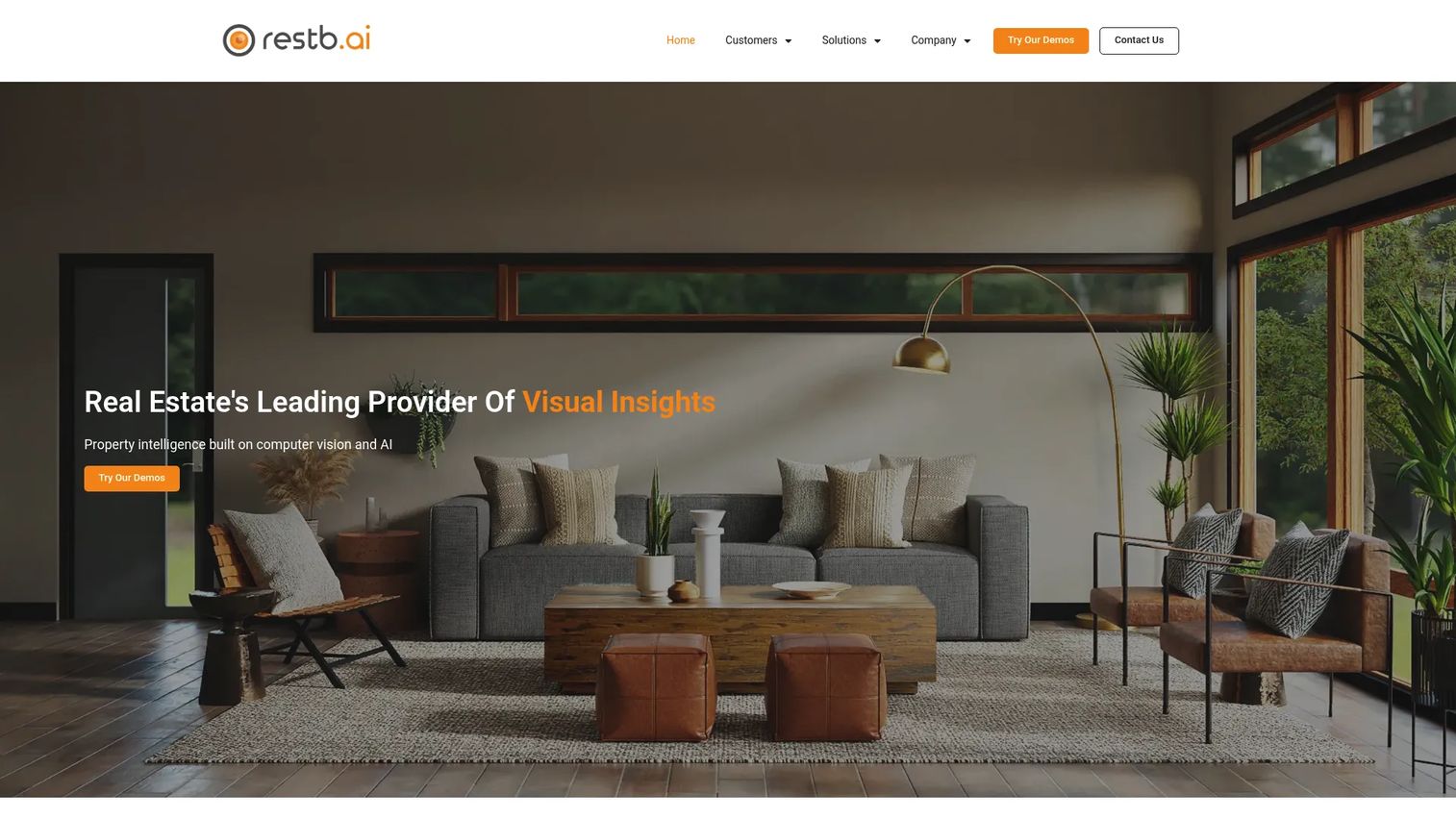
Restb.ai provides AI-powered computer vision and visual insights for real estate imagery. Its API classifies room types, home features, architectural styles, and damage, then extracts structured property attributes from listing photos and field images. Additional capabilities include visual similarity search, image caption and alt-text generation, photo compliance checking, watermark detection, and duplicate photo detection.
Best for: Proptech, insurance, and real estate product teams whose product value depends on structured data extracted from property images, not a full property research platform.
Key features
- Image tagging for rooms, features, architectural style, and damage
- Property condition and quality analysis from photos
- Visual similarity search across image libraries
- Auto-generated image captions and alt-text
- Photo compliance, watermark, and duplicate detection
Why choose Restb.ai: Choose Restb.ai when the product differentiates on what an image reveals about a property. It fits teams building a visual data workflow into listing enrichment, inspection support, or automated property classification. State model outputs precisely in your evaluation; do not assume inspection-grade accuracy without validating against your specific image set.
Restb.ai pricing: Pricing is customized by properties analyzed, products required, API request volume, and throughput requirements. The model uses fixed monthly fees with included API calls, overage fees, and batch pricing for larger datasets. Contact Restb.ai for a quote.
10. Gridics
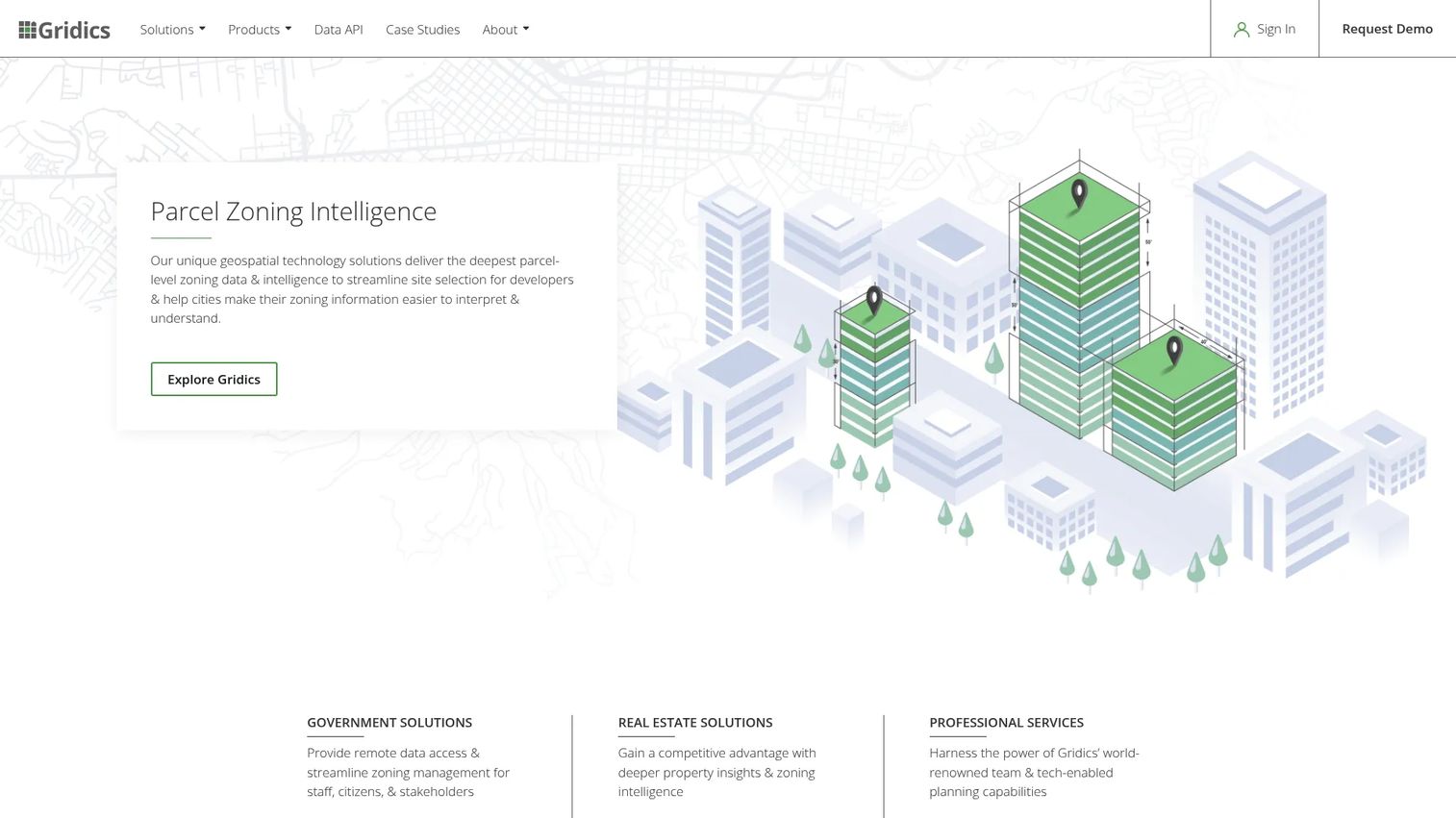
Gridics provides parcel-level zoning data, mapping, code management, and development feasibility software for municipalities and real estate professionals. Its API delivers parcel search, zoning rules, allowed uses, setbacks, lot attributes, and calculated development capacity. The platform also supports real-time 3D zoning maps, interactive zoning-code publishing for municipalities, and citizen self-service portals.
Best for: Developers, urban planners, AEC firms, and proptech companies building products around site selection, development feasibility, or zoning code interpretation.
Key features
- Parcel-level zoning intelligence: Zones, uses, setbacks, lot attributes
- Calculated development capacity and feasibility scenarios
- Real-time 3D zoning maps and scenario analysis
- Interactive zoning-code publishing and citizen portals
- Zoning data API with county-level coverage tiers
Why choose Gridics: Choose Gridics when zoning and land-use rules determine whether a property opportunity exists at all. It's a specialist option for location decisions that cannot rely only on ownership, valuation, or market data. Confirm coverage in the specific jurisdictions where you operate before buying, since zoning data requires jurisdiction-specific validation.
Gridics pricing: The Developer plan includes 1 county and 100 standard API calls per month at no base fee. Standard is $50/month (3 counties, 1,000 calls). Growth is $500/month (10 counties, 5,000 calls). Enterprise uses custom commercial terms.
Considerations when choosing property intelligence software
Match the tool to the operating model
A browser-based research platform helps analysts make decisions manually. An API helps engineers build decisions into a product automatically. Do not buy an API when the immediate need is analyst workflow, and do not buy a research portal when the product needs automated enrichment at scale.
Test the data against your actual address set
Require a proof stage before signing an annual agreement. Upload or test a representative sample of addresses, parcel types, and markets. Compare match rates, missing fields, duplicates, and record recency. A high-level coverage claim does not tell you what happens with the specific zip codes or property types your team works with most.
Validate data rights and pricing mechanics
Ask each vendor about API volume and overage charges, geographic coverage limits, seat restrictions, record or document credits, historical data access, export rights, and whether customer-facing redistribution is permitted. The cheapest entry plan can become expensive when API usage scales past the initial estimate.
Separate imagery, records, and risk intelligence
These data layers are related but not interchangeable. Imagery shows condition signals. Record databases show ownership and transaction history. Risk platforms model exposure. Buy the missing layer, not the most impressive demo. Buying all three from one vendor is efficient only when that vendor is genuinely strong across all three.
Plan for maintenance and ownership
Assign an internal owner for data quality, vendor management, schema changes, and integration monitoring. A Series B company that installs a property data platform in Q1 will find it embedded across two or three teams by Q3. Set up governance before that happens, not after.
Conclusion
Property intelligence software is a stack decision, not a single-tool purchase. The right pick depends on whether your team needs analysis in a browser or data embedded in a product.
Cotality covers the broadest ground for property, market, and risk intelligence. Nearmap is the clearest choice when visual property evidence drives the decision. Estated works for product teams who need property records via API, with plans starting at $449/month. Cherre fits organizations with fragmented enterprise data that need a governed, portfolio-wide foundation. PropertyShark, PropertyRadar, and DataTree Online serve research-driven workflows at different price points and research depths. Crexi addresses commercial real estate deal context. Restb.ai is the specialist for image-derived property intelligence. Gridics handles zoning and development analysis with a developer-friendly API that starts free.
Start by naming the one decision that needs better property signal. Then choose the tool that gives the owning team a repeatable workflow, without creating a new data reconciliation problem for everyone else.
Start your journey with Guideflow today!
FAQs
Property intelligence software combines property records, geospatial data, risk signals, market data, and analytics to help teams make decisions about valuation, underwriting, investment, development, insurance, or customer targeting. It pulls from parcel records, ownership history, aerial imagery, hazard models, and transaction data to give teams a single source of property signal rather than requiring manual research across multiple sources.
Property intelligence software typically provides a user-facing research or analytics workflow where analysts query, view, and export data in a browser. A real estate data API delivers property records and attributes that a company embeds directly into its own software, underwriting model, or internal workflow. The operating question is whether a human needs to interpret the data or whether a system needs to consume it automatically.
Investors should prioritize tools with strong ownership research, transaction history, comparables, and market trend data. PropertyShark covers these at a browser-based research level, starting at $59.95/month. PropertyRadar adds prospecting and outreach capabilities for investors targeting motivated sellers. For commercial assets, Crexi provides market and deal context. The right pick depends on the asset type, target market, and whether the team needs research depth or outreach automation.
Insurance teams typically need property characteristics, condition signals, imagery, hazard exposure, and risk scoring. Nearmap addresses imagery and AI-derived condition attributes. Cotality covers hazard and climate risk models alongside broader property data. Before selecting either, validate image recency for the coverage area and confirm how the platform's risk outputs connect to your policy administration or claims system.
Pricing varies significantly by the data coverage, user count, geography, API call volume, document pulls, and enterprise data rights involved. Estated publishes plans starting at $449/month for 5,000 API calls. PropertyShark plans start at $59.95/month. PropertyRadar starts at $119/month. Cotality, Nearmap, Cherre, and Restb.ai all require a sales conversation for pricing. Compare total usage costs at your expected volume, not just the entry price.
Most platforms support exports, APIs, connectors, or custom integrations. The right question is whether the vendor supports the specific data model, refresh cadence, and governance requirements the team needs. Cherre, for example, explicitly supports egress to Snowflake, AWS, Azure, and BigQuery. Estated delivers structured API responses that are straightforward to ingest into most data pipelines. Confirm integration documentation before finalizing a vendor, not after.
Run a representative data test against your actual address set before committing to an annual contract. Review the API documentation for rate limits, schema stability, and match confidence scoring. Confirm the data rights cover your intended use, including whether customer-facing display and redistribution are permitted. Model the unit economics at three times your current usage volume, since property data costs often scale faster than expected. Assign an internal owner for the integration before the tool goes live, so data quality issues surface quickly rather than quietly compounding.
Yes. Estated and Cherre are both positioned for companies embedding property data into their own product rather than using it for internal research. Estated provides structured property record APIs with a free evaluation tier and published plan pricing. Cherre addresses the data integration and governance layer for organizations managing complex, multi-source real estate data. For computer vision use cases within a proptech product, Restb.ai provides image classification APIs that return structured property attributes from photos.