Your launch just shipped. Sales has three urgent feature asks from enterprise accounts. Customer Success flagged two churn-risk accounts with conflicting requests. Product wants quantified evidence before the next roadmap review. And the feedback you have lives across Slack threads, NPS comments, support tickets, and a spreadsheet someone stopped updating in March.
The problem is not that you lack feedback. The problem is that none of it is decision-ready.
According to AskNicely (2025), 96% of business leaders say they act on customer feedback, but only 36% act within 24 hours. The gap between intention and speed usually comes down to structure. When feedback is scattered, it becomes political rather than analytical. Product wants volume data. PMM wants customer language. Sales wants objection handlers. Each team cherry-picks what confirms what they already believe.
Product feedback software exists to close that gap: Collect signals from the right sources, organize them into patterns, and connect those patterns to decisions your team can defend.
What's inside
This guide compares 12 product feedback tools for 2026, covering everything from feature request boards to AI-powered voice-of-customer analysis.
- Who it's for: PMMs, product managers, CS leaders, research teams, and growth practitioners evaluating their feedback stack
- Selection criteria: Feedback collection depth, analysis and prioritization capability, integrations with product and GTM systems, and pricing transparency
- What you'll find: Verified pricing, live G2 ratings, PMM-specific use cases, and honest fit guidance for each tool
Pricing and G2 ratings were verified against live sources at time of publication.
TL;DR
- Best for feature request boards: Canny collects, votes, and closes the loop with changelogs
- Best for roadmap prioritization: Productboard links customer signals to product strategy
- Best for AI feedback analysis: Enterpret unifies high-volume feedback into themes automatically
- Best for voice-of-customer analytics: Chattermill analyzes sentiment across customer touchpoints
- Best for in-app surveys: Qualaroo or Pendo, depending on whether you need standalone nudges or behavior-linked feedback
- Best for usability research: UserTesting surfaces qualitative insight from real participants
What are product feedback tools?
Product feedback tools are software platforms that help teams collect, organize, analyze, prioritize, and act on customer or user feedback about a product.
Feedback does not arrive as one data type. It comes from surveys, feature requests, user interviews, support tickets, app store reviews, product usage patterns, bug reports, and sales calls. The challenge is not volume: It is interpretation. A single complaint from a $500K account carries different weight than 50 upvotes from free-tier users. Good tools help you tell the difference.
For PMMs specifically, product feedback tools serve a distinct set of jobs. You use them to validate positioning before a launch, find customer language that belongs in website copy or battlecards, identify proof points that Sales can actually use, and spot the adoption blockers that need an enablement response.
Key capabilities to look for:
- Feedback capture via surveys, widgets, portals, and interview notes
- Feature request voting and roadmap prioritization
- AI theme detection and sentiment analysis
- NPS, CSAT, and CES survey workflows
- In-app targeting and behavioral segmentation
- Integrations with CRM, help desk, project management, and analytics tools
- Changelog and customer communication workflows
- Reporting by segment, ARR tier, account, or lifecycle stage
Feedback source and what it tells you:
| Source | What it surfaces |
|---|---|
| Support tickets | Friction and confusion in workflows |
| Sales calls | Objections and deal blockers |
| Feature requests | Demand patterns by segment |
| In-app surveys | Contextual sentiment at a specific moment |
| Product analytics | Behavior behind the words |
| User testing | Usability gaps before they become churn |
The category spans several subcategories: Feature request boards, roadmap prioritization platforms, AI feedback analysis tools, voice-of-customer analytics, survey and in-app feedback platforms, usability research tools, and visual bug reporting. That is why Typeform and Productboard can appear on the same list while solving very different jobs.
When to use product feedback tools
Centralize feedback before roadmap planning
Use product feedback tools when input lives across CS, Sales, Product, and Marketing with no shared source of truth. PMMs can mine that centralized source for recurring objections, launch risks, and customer proof points. Prioritization works better when request volume connects to customer segment and business value, not just whoever spoke loudest in the last planning meeting.
Validate messaging with customer language
Reach for a feedback tool when positioning starts drifting from how customers describe value. Pull language directly from survey responses, interview transcripts, and churn reasons. The phrases customers use to explain why they bought, or why they left, belong in your website copy, launch narratives, and sales talk tracks, not paraphrased versions of them.
Close the loop after product changes
Closed-loop workflows matter most when the same requests surface repeatedly across your customer base. When a feature ships, the tool should let you notify requesters automatically. PMMs can turn those moments into launch campaigns, adoption content, and customer education that also supports user research across the organization.
Product feedback tools comparison
The table below covers all 12 tools, ordered by category relevance. Pricing reflects verified figures from each vendor's pricing page. G2 ratings were confirmed from live G2 listings.
| # | Product | Best for | Key differentiator | Pricing | G2 rating |
|---|---|---|---|---|---|
| 1 | Canny | Feature requests and roadmap | Public or private boards with changelog workflows | Free; Pro from $79/mo | 4.5/5 |
| 2 | Productboard | Roadmap prioritization | Connects feedback to feature hierarchy and strategy | Contact sales | 4.2/5 |
| 3 | Enterpret | AI feedback analysis | Adaptive taxonomy across high-volume feedback sources | Custom pricing | 4.5/5 |
| 4 | Chattermill | VoC analytics | Sentiment and theme analysis across customer channels | Custom pricing | 4.4/5 |
| 5 | Qualaroo | Contextual in-app surveys | Behavior-triggered nudges with IBM Watson sentiment | Free; paid from $19.99/mo | 4.3/5 |
| 6 | UserTesting | Usability research | Video-based tests with participant recruitment panels | Custom pricing | 4.4/5 |
| 7 | Pendo | Product analytics and feedback | Usage data combined with in-app surveys and NPS | Free tier; paid custom | 4.4/5 |
| 8 | Survicate | Multi-channel surveys | Surveys across product, email, website, and mobile | Paid from $114/mo | 4.6/5 |
| 9 | UserVoice | Enterprise feedback management | CRM-enriched portals with AI theme detection | From $1,000/mo | 4.5/5 |
| 10 | Zonka Feedback | NPS, CSAT, and CES programs | Multichannel satisfaction surveys with AI analysis | Custom pricing | 4.7/5 |
| 11 | Usersnap | Visual feedback and bug reporting | Screenshot and video feedback tied to roadmap workflows | From €49/mo | 4.5/5 |
| 12 | Typeform | Lightweight feedback forms | Conversational forms with conditional logic | Free; paid from $29/mo | 4.5/5 |
Best 12 product feedback tools for 2026
1. Canny
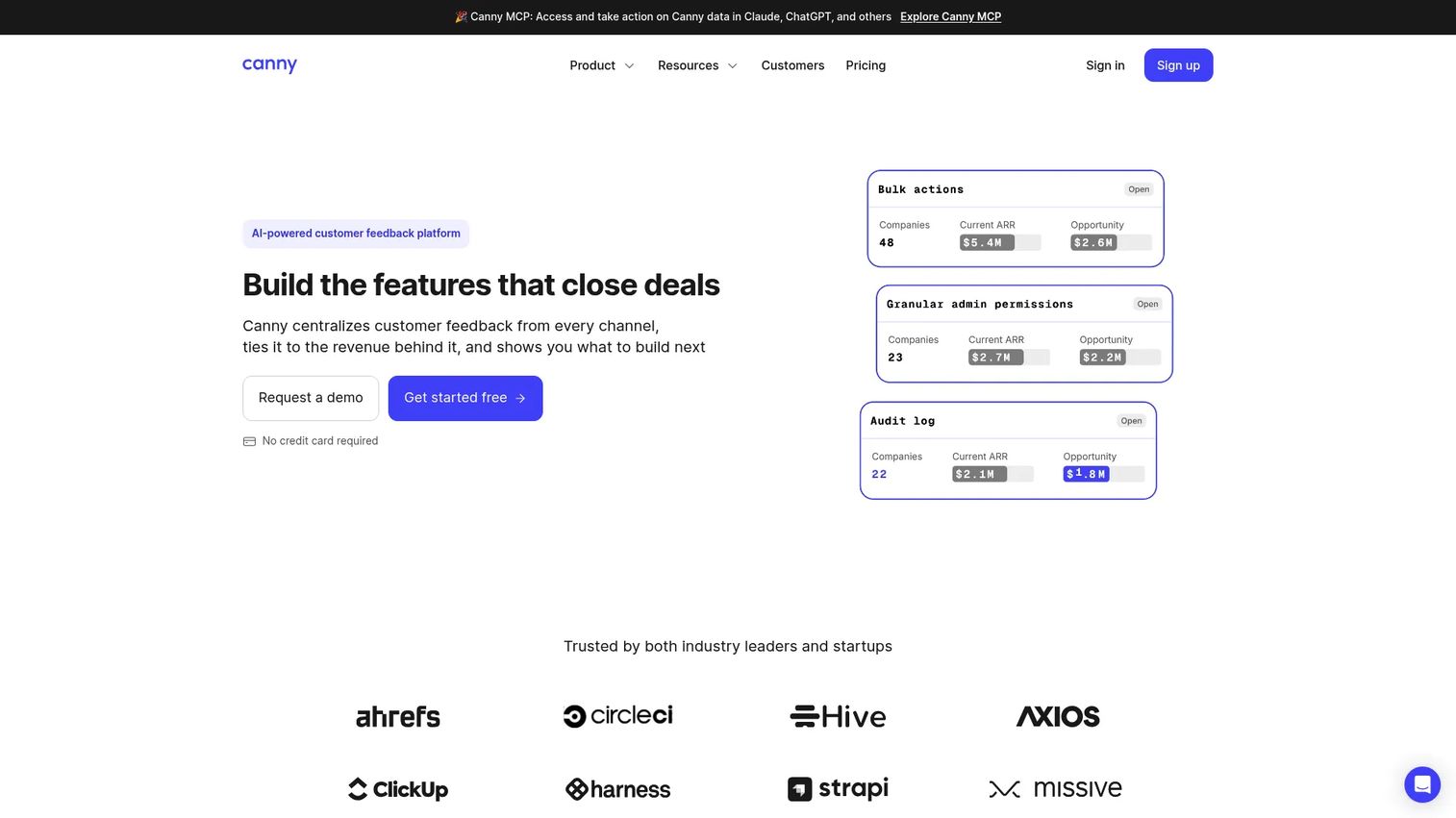
Canny is an AI-powered customer feedback platform for capturing, analyzing, and prioritizing feature requests, then communicating product decisions back to customers through changelogs. It runs on public or private feedback boards where users can submit and vote on ideas, and where PMMs can segment requests by account type, revenue tier, or custom tag. For a PMM, Canny answers a practical question before launch: Which feature asks are coming from enterprise accounts versus free-tier users, and how many people actually want this?
Best for: B2B SaaS teams that need a structured intake process for feature requests combined with roadmap communication.
Key features
- AI Autopilot for feedback capture and deduplication
- Feature voting boards (public or private)
- Roadmap views with status tracking
- Changelog for customer communication
- Customer segmentation and revenue-weighted prioritization
Why choose Canny: Choose Canny when feature request intake and customer communication are the core workflow. It is a less natural fit if your primary need is deep usability testing or broad VoC sentiment analysis.
Canny pricing: A free plan is available and includes 25 tracked users with unlimited feedback. The Pro plan starts at $79/month billed yearly (covering 100+ tracked users). Business pricing is custom, billed yearly.
G2 rating: 4.5/5
2. Productboard
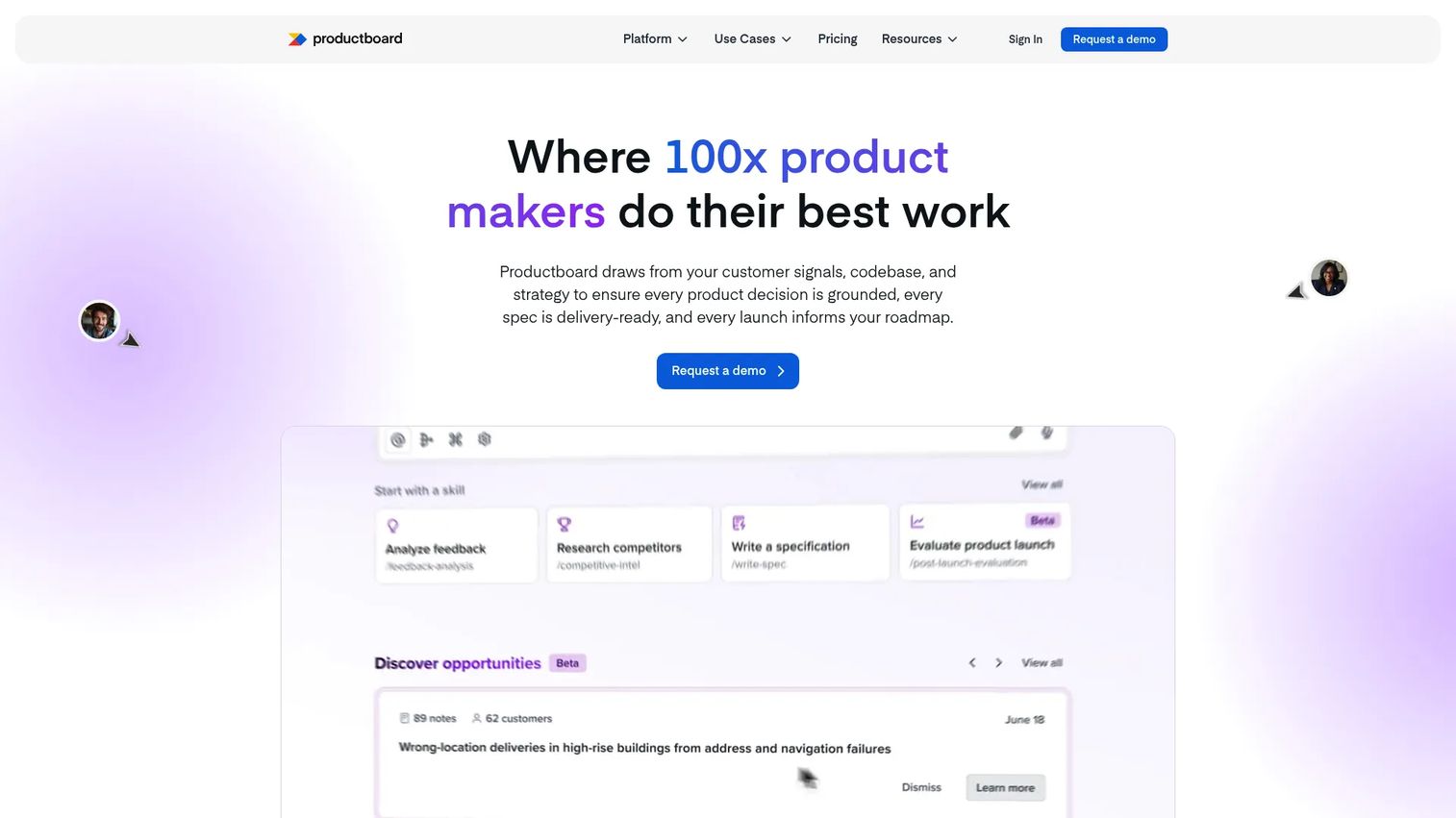
Productboard is an AI-powered product management platform that centralizes customer feedback, connects it to a structured feature hierarchy, and surfaces priorities for roadmap planning. It includes a feedback inbox, prioritization scoring, agile and timeline roadmaps, and a portal for sharing roadmap progress with stakeholders. For PMMs, Productboard is most useful during launch planning: You can see which customer insights support a launch narrative and which features still have open feedback that could affect positioning.
Best for: Product organizations that want feedback tied directly to roadmap decisions and cross-functional alignment.
Key features
- Feedback inbox with centralized customer signals
- Feature hierarchy and prioritization scoring
- Agile and timeline roadmap sharing
- AI-powered Spark for feedback analysis and report generation
- Integrations with Jira, Slack, Salesforce, and product analytics tools
Why choose Productboard: Choose Productboard when feedback needs to influence structured roadmap planning rather than just being collected. It suits mature product organizations more than teams only needing a quick survey solution.
Productboard pricing: Business and Enterprise plans are available; pricing requires contacting sales. The number of "makers" (editors) drives the Business plan cost. Enterprise adds unlimited contributors, Salesforce integration, and advanced governance.
G2 rating: 4.2/5
3. Enterpret
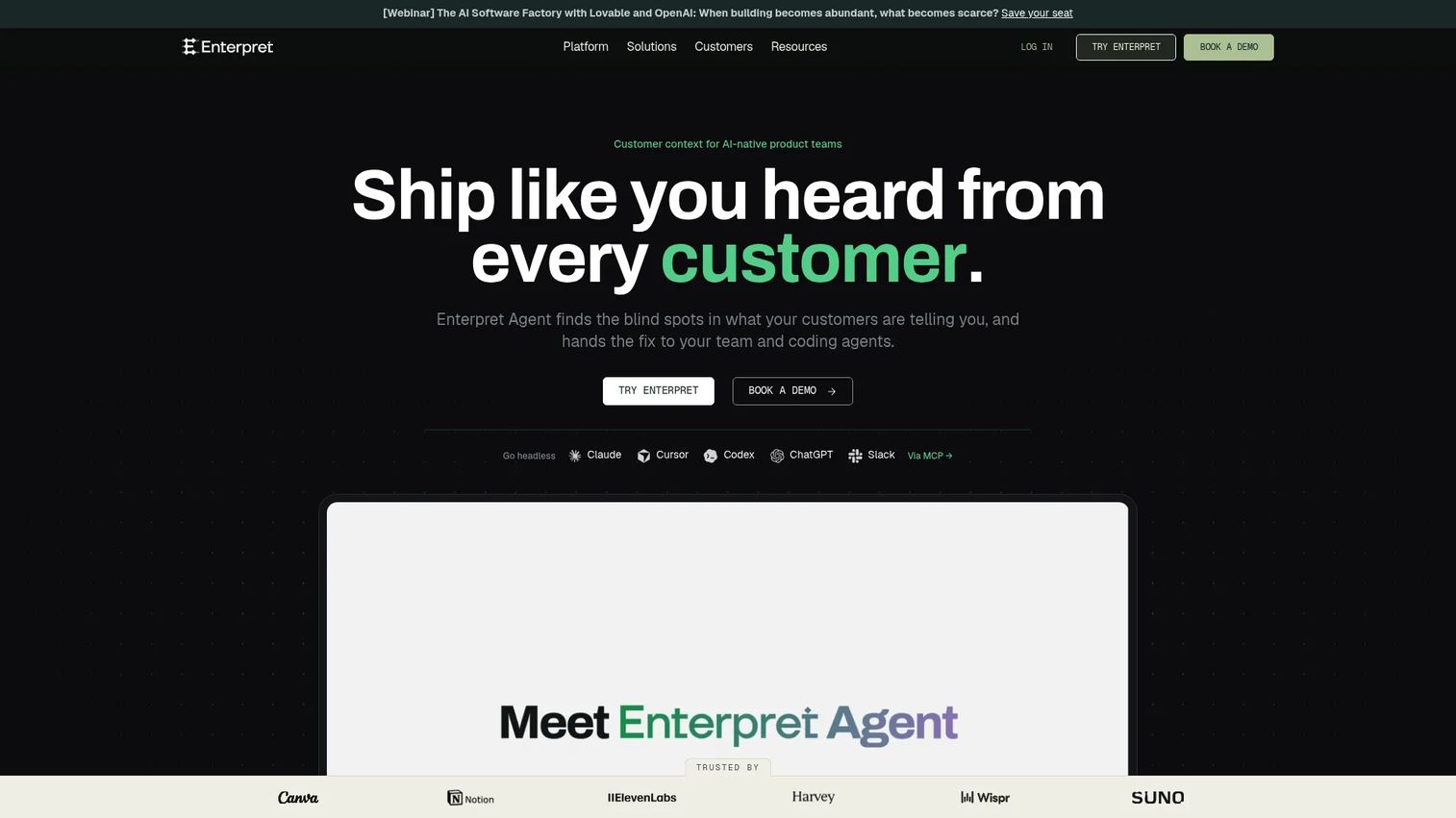
Enterpret is a customer intelligence platform that unifies feedback from support tickets, sales calls, reviews, NPS comments, and community channels into a shared taxonomy. Its adaptive AI automatically builds and maintains topic categories as feedback volume grows, so the taxonomy reflects current customer reality rather than a tag structure someone built 18 months ago. PMMs with high feedback volume who need to find repeated language across channels before a launch or messaging refresh will find Enterpret particularly useful.
Best for: Teams with feedback flowing from many sources who need automated theme detection without manual tagging overhead.
Key features
- Adaptive AI taxonomy with automatic topic classification
- Customer context graph linking feedback to account data
- Enterpret Agent for investigations, reports, and workflow automation
- Integrations with Slack, Jira, Linear, and 50+ feedback sources
- Trend analysis, anomaly detection, and sentiment dashboards
Why choose Enterpret: Reach for Enterpret when manual tagging has become a full-time job or when feedback volume spans multiple channels that no single team owns. It is not the first pick for teams that mainly need a simple feature request board.
Enterpret pricing: Pricing is usage-based and requires a sales conversation. Contact Enterpret for a quote based on feedback volume and source integrations.
G2 rating: 4.5/5
4. Chattermill
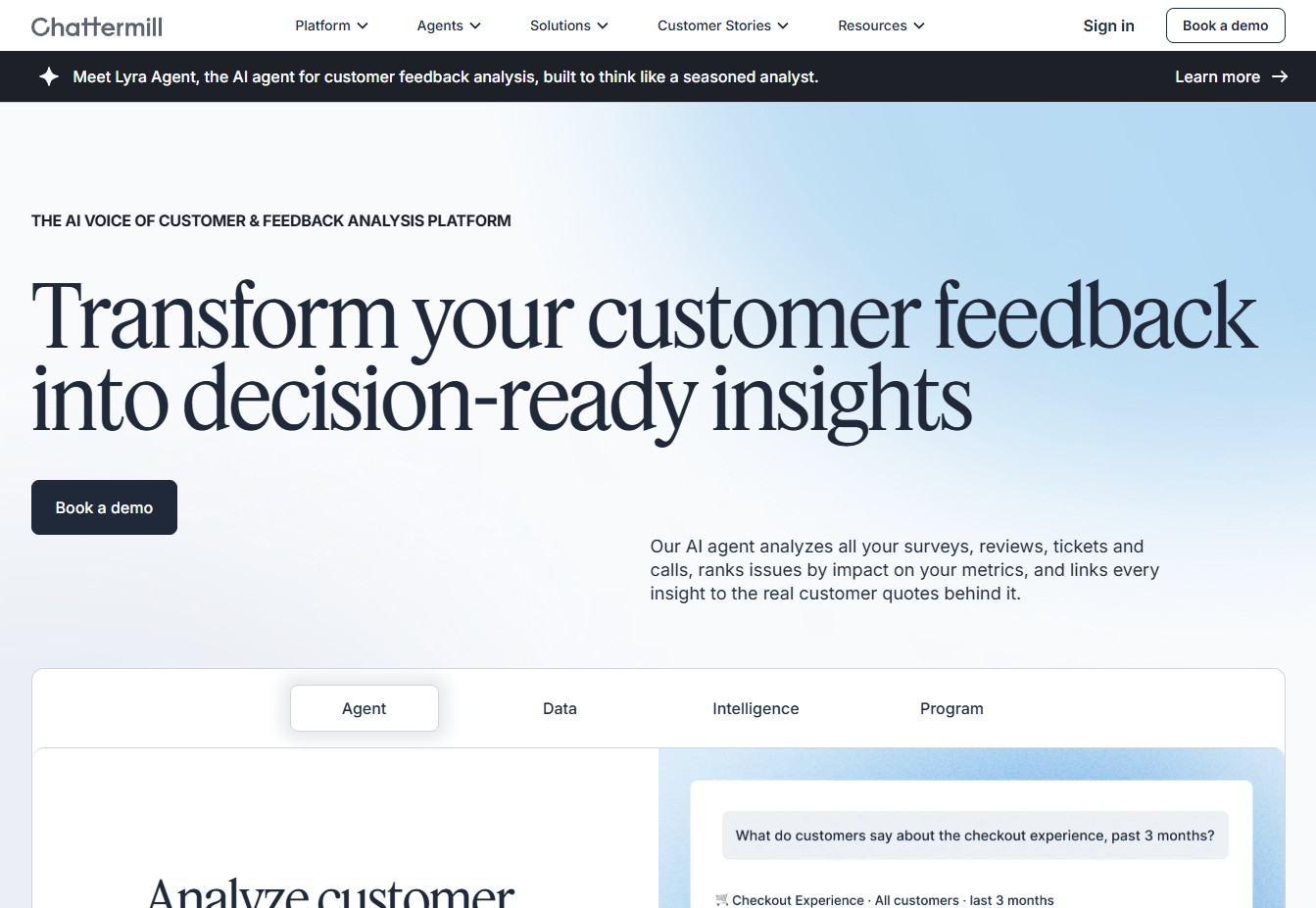
Chattermill is an AI-native voice-of-customer platform that ingests surveys, support tickets, reviews, social media, and voice calls, then applies aspect-based sentiment analysis and theme clustering across all of them. Its Lyra Agent capability generates analyst-grade answers from feedback data on demand. For PMMs, Chattermill answers the kind of question that usually requires a research project: "What do customers say about our onboarding experience across every channel we have?"
Best for: Enterprise CX, VoC, and product insights teams analyzing qualitative feedback at scale across multiple customer touchpoints.
Key features
- Multichannel feedback ingestion (surveys, tickets, reviews, voice)
- Aspect-based sentiment analysis and AI theme clustering
- Lyra Agent for proactive insight generation
- Impact analysis, dashboards, and anomaly detection
- MCP integrations with AI agents
Why choose Chattermill: Choose Chattermill when broad VoC analysis across customer touchpoints is the core need. It is less suited to lightweight survey creation or feature voting as a primary workflow.
Chattermill pricing: Contact Chattermill for a quote.
G2 rating: 4.4/5
5. Qualaroo
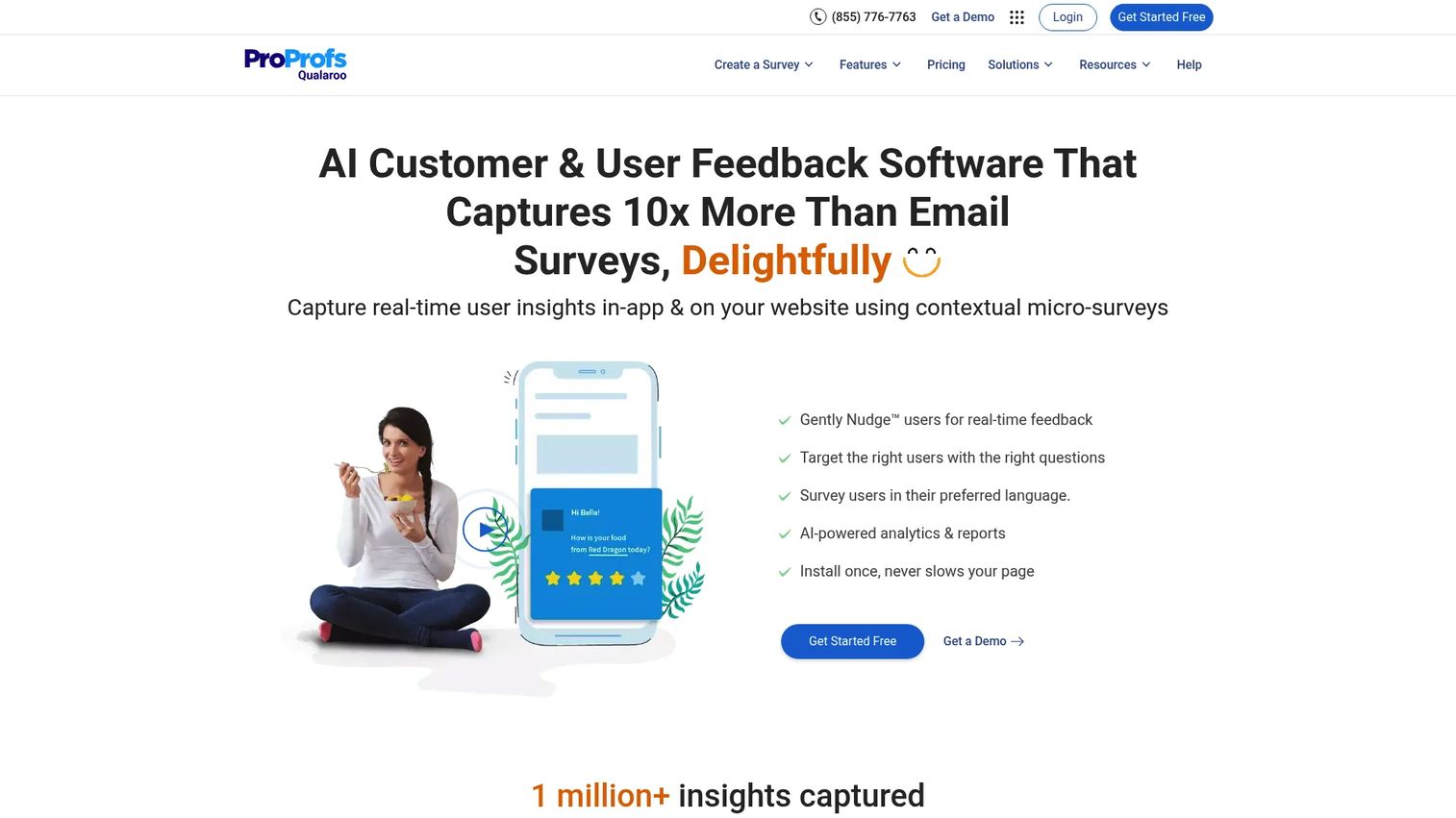
Qualaroo is a contextual survey tool for collecting targeted feedback directly inside websites, products, and mobile apps. Its nudge format appears at the moment that matters: After a user completes a workflow, hits an error, or reaches a pricing page. PMMs can use Qualaroo for message testing on landing pages, post-onboarding feedback, and feature-level satisfaction checks without building a full research program. IBM Watson-powered sentiment analysis processes responses automatically.
Best for: Teams that want targeted survey feedback at specific moments in the user journey without a heavy implementation lift.
Key features
- Behavior-triggered survey nudges with advanced targeting rules
- NPS, CSAT, and CES survey templates
- Branching and skip logic
- IBM Watson sentiment analysis and reporting
- Heatmaps and session recordings on paid plans
Why choose Qualaroo: Qualaroo fits teams that need contextual feedback inside the product experience. It is not a deep roadmap management system, so pair it with a prioritization workflow if feature tracking matters.
Qualaroo pricing: A free plan is available (up to 50 responses). The Essentials plan runs $19.99/month billed annually. Business is $49.99/month billed annually. Enterprise starts at $149.99/month on annual plans.
G2 rating: 4.3/5
6. UserTesting
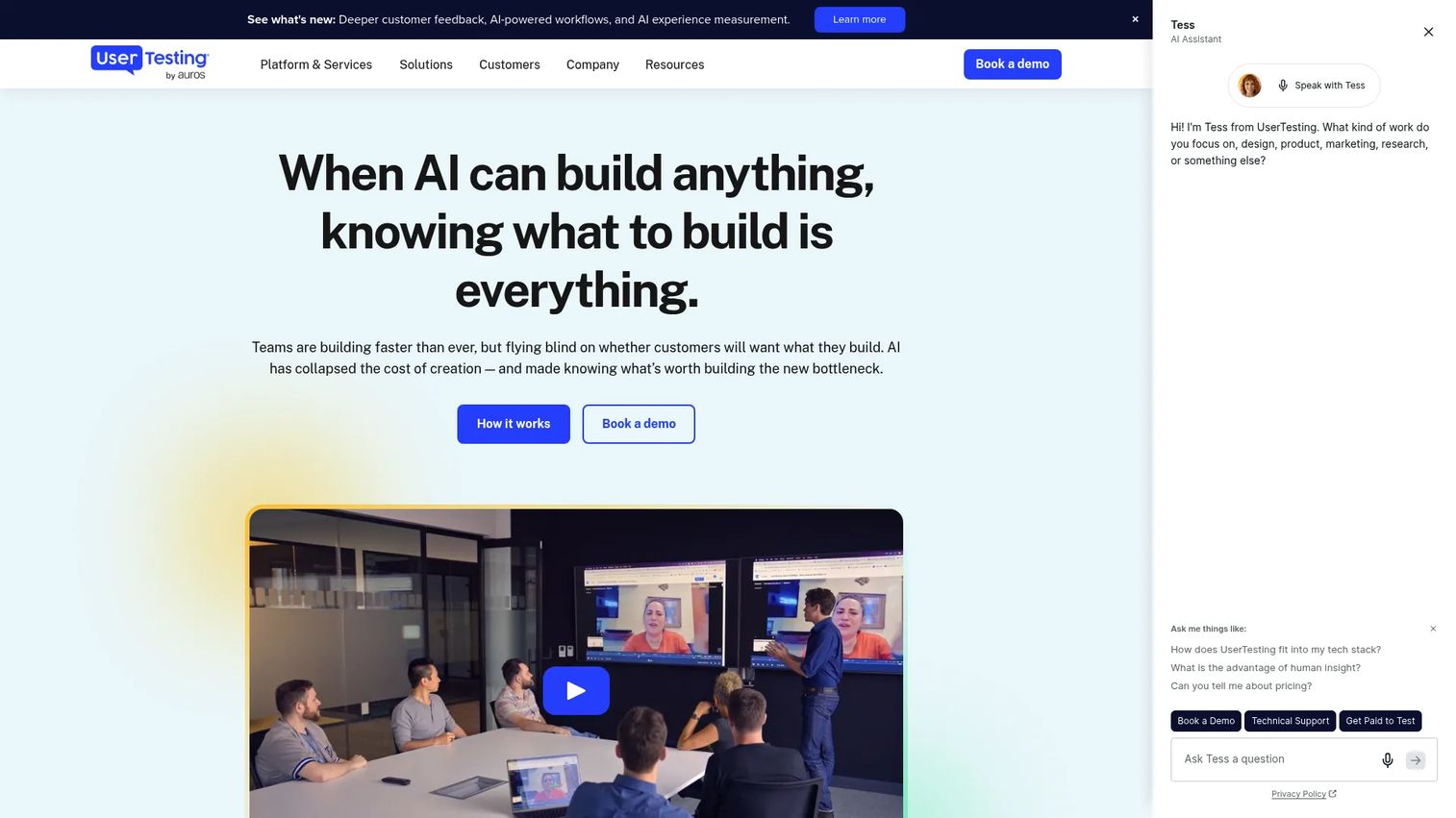
UserTesting is a human insight platform for collecting video-based feedback from real participants through unmoderated tests, surveys, and prototype evaluations. Its participant network lets teams recruit by role, industry, device type, or behavioral criteria and get reactions back quickly. For PMMs, UserTesting is the tool that answers the question surveys cannot: "How do real users describe this feature in their own words?" Those clips become message-testing evidence and Sales enablement material.
Best for: UX, product, and marketing teams that need qualitative feedback with behavioral context from targeted participants.
Key features
- Unmoderated think-out-loud usability testing
- Participant recruitment from the UserTesting Network
- Figma prototype testing
- AI-powered insight summaries and highlight reels
- Surveys and interaction tests
Why choose UserTesting: Choose UserTesting when you need depth and context, not just survey scale. It is research-oriented by design, which suits pre-launch validation and usability work more than ongoing feedback aggregation.
UserTesting pricing: Advanced and Ultimate plans are available; both use custom pricing based on users, test types, and feature requirements. Contact UserTesting for a quote. A free trial is available by request.
G2 rating: 4.4/5
7. Pendo
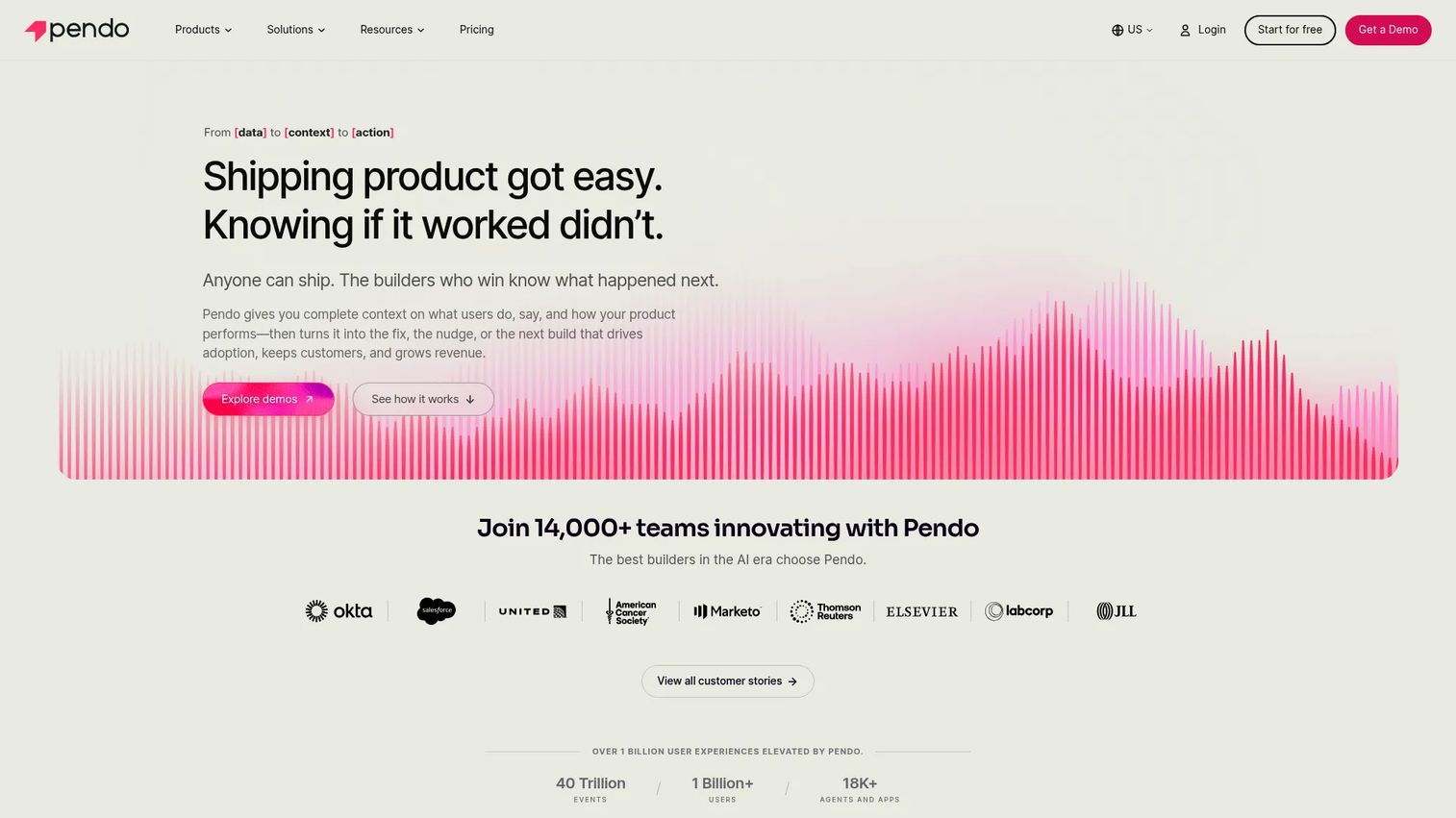
Pendo is a product experience platform that combines usage analytics, in-app guidance, NPS and CSAT surveys, session replay, and a feedback module called Listen. Its core advantage is that feedback connects directly to behavior: You can see which features a user explored before they submitted a complaint, or which onboarding paths correlate with higher satisfaction scores. PMMs use Pendo after a release to identify adoption blockers by looking at what users do, not just what they say.
Best for: SaaS teams that want feedback tied to product behavior and feature adoption data in a single platform.
Key features
- Product analytics: Journeys, funnels, feature adoption, and product health
- In-app guides and Resource Center for targeted user guidance
- NPS, CSAT, and product-market fit surveys
- Session Replay
- Feedback and idea management via Listen
Why choose Pendo: Choose Pendo when behavior data matters as much as stated feedback. Teams that only need survey collection may find the broader platform more than they need initially.
Pendo pricing: A free plan is available for up to 500 monthly active users. Base, Core, and Ultimate plans use custom pricing based on monthly active user volume. Novus is free during open beta.
G2 rating: 4.4/5
8. Survicate
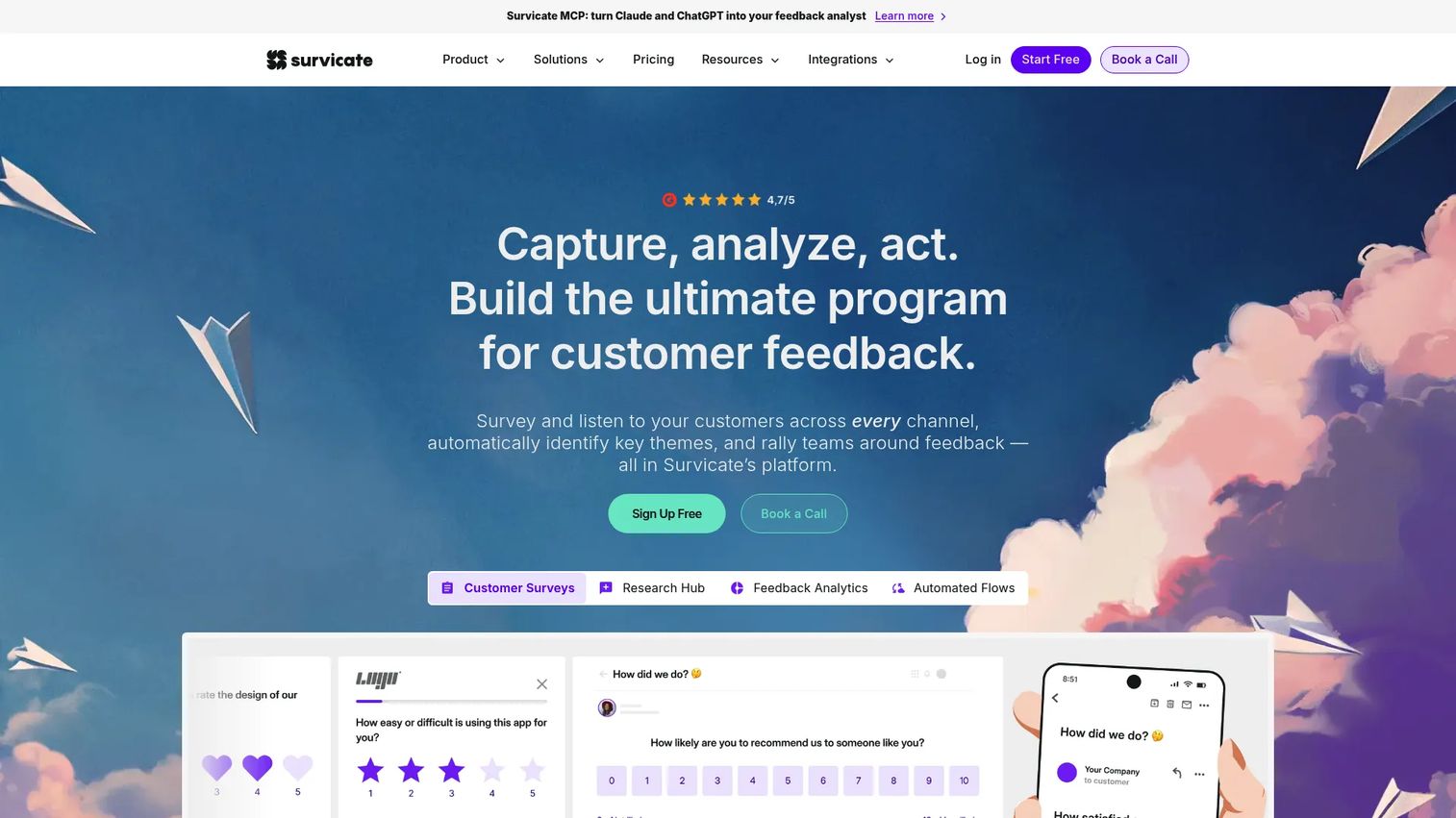
Survicate is a multi-channel customer feedback platform for running surveys across your product, website, email, and mobile app from one builder. Its Research Hub aggregates responses with AI-powered categorization, so teams can move from individual survey answers to recurring themes without manual coding. PMMs use Survicate for fast campaign feedback, launch page testing, churn reason surveys, and tracking NPS over time across customer segments.
Best for: Teams that want to deploy feedback surveys quickly across multiple channels and analyze responses without manual work.
Key features
- Multichannel surveys: In-product, email, website, and mobile
- Research Hub for aggregating and analyzing feedback sources
- AI-powered categorization, insights, and research chat
- NPS tracking and trend reporting
- Integrations with HubSpot, Salesforce, and product analytics tools
Why choose Survicate: Survicate fits teams that need fast, flexible survey deployment without committing to a full product feedback management platform. It is less focused on feature request tracking and roadmap workflows.
Survicate pricing: A free tier is available. The Growth plan starts at $114/month billed annually. Pro is $349/month. Enterprise is $569/month.
G2 rating: 4.6/5
9. UserVoice
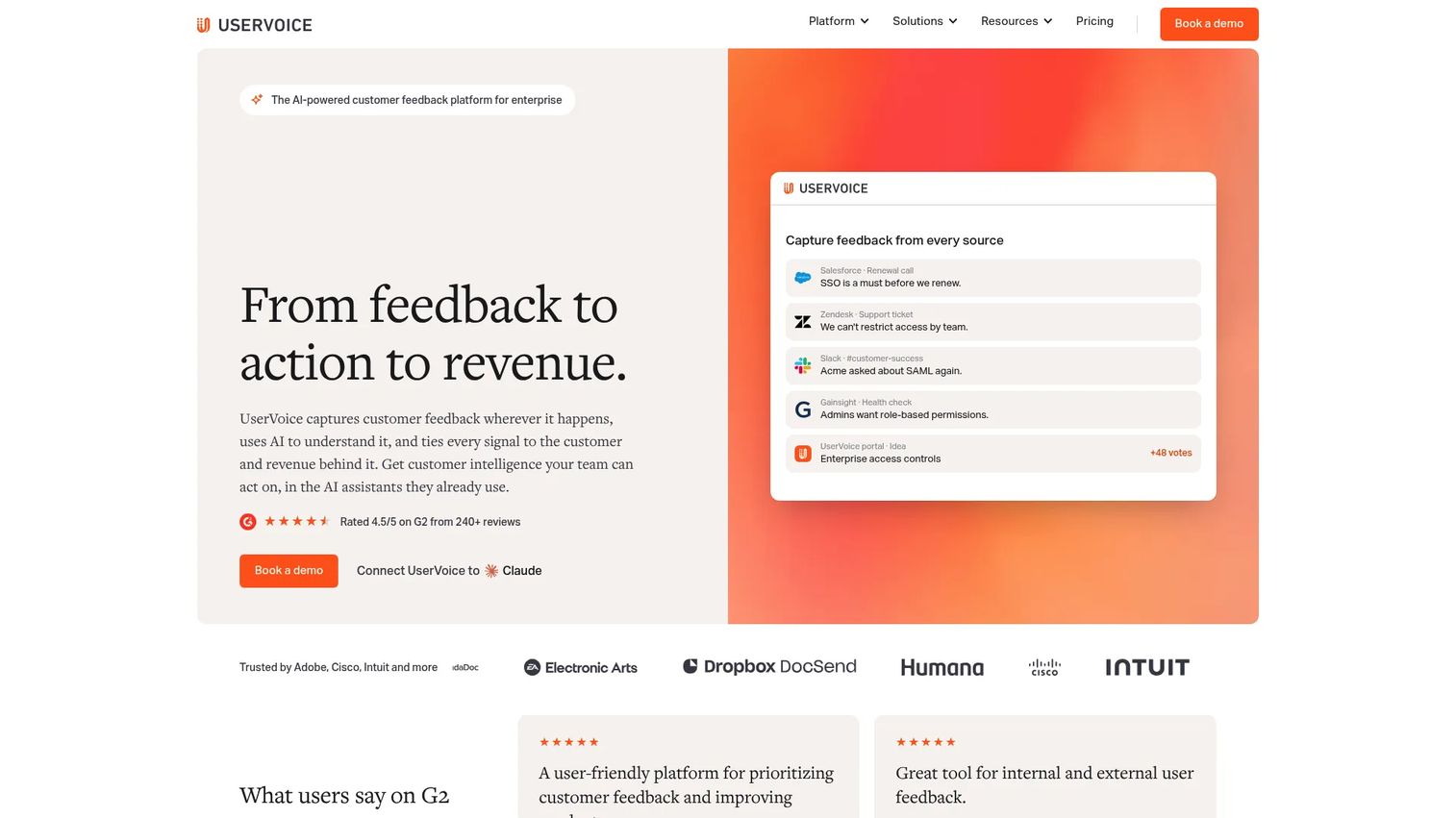
UserVoice is an enterprise customer intelligence platform built for structured feedback intake, AI-assisted analysis, and CRM-enriched prioritization. It combines branded feedback portals with account segmentation, so teams can filter request patterns by company size, revenue, or lifecycle stage. Its AI layer detects themes, generates summaries, and surfaces impact reports. For PMMs at B2B SaaS companies with large customer bases, UserVoice helps connect Sales and CS feedback to product management decisions in a way that individual Slack threads cannot.
Best for: B2B SaaS teams with mature feedback intake needs and a requirement to connect customer requests to revenue context.
Key features
- Branded feedback portals with idea voting and status subscriptions
- AI-powered theme detection, summaries, and sentiment analysis
- CRM enrichment with Salesforce and HubSpot integrations
- Integrations with Jira, Azure DevOps, Slack, and Microsoft Teams
- Roadmap inputs and customer status update workflows
Why choose UserVoice: UserVoice suits teams that need enterprise-grade structure for feedback volume, customer communication, and revenue-informed prioritization. It is likely more infrastructure than a small team needs for lightweight research.
UserVoice pricing: The Launch plan starts at $1,000/month ($12,000 billed yearly). Business starts at $1,833/month ($22,000 billed yearly). Enterprise uses custom pricing. No free tier is available.
G2 rating: 4.5/5
10. Zonka Feedback
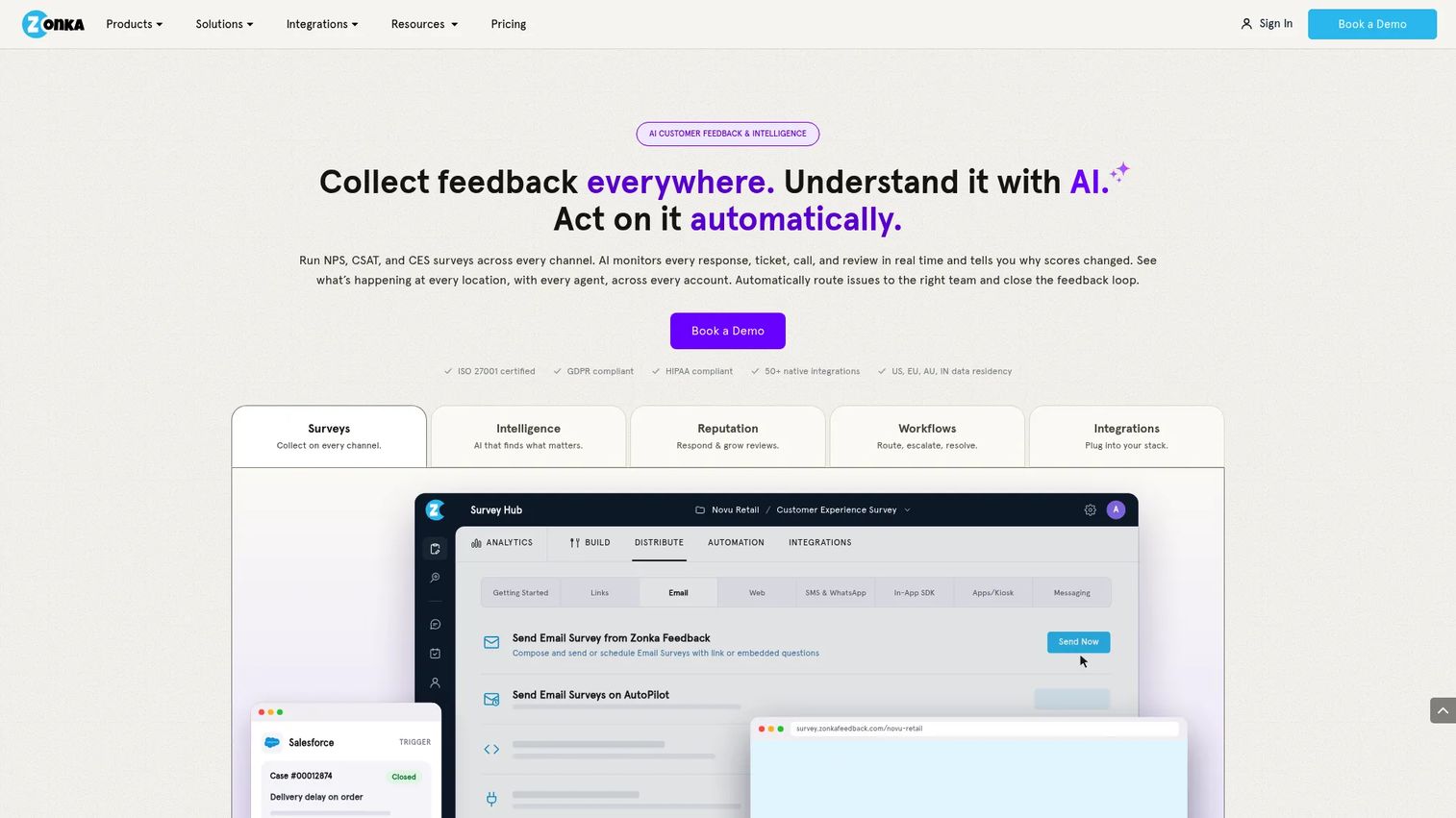
Zonka Feedback is an AI-powered customer feedback and CX platform for running NPS, CSAT, and CES programs across email, SMS, WhatsApp, web, in-app, kiosk, and offline channels from one hub. Its AI layer handles thematic analysis, sentiment scoring, impact analysis, and trend detection. A centralized inbox and workflow automation handle case management and closed-loop follow-up. PMMs who need satisfaction metrics tied to product changes will find Zonka Feedback useful for quantifying customer response before and after a launch.
Best for: Organizations running structured customer satisfaction programs that need multichannel reach and AI-assisted analysis.
Key features
- NPS, CSAT, and CES survey templates
- Multichannel feedback collection (email, SMS, WhatsApp, web, in-app, kiosk)
- AI thematic, sentiment, impact, and trend analysis
- Centralized inbox with case management and automation
- Integrations with CRM and help desk tools
Why choose Zonka Feedback: Choose Zonka Feedback when satisfaction metrics are central to feedback reporting and you need broad channel coverage. It is less product-roadmap-specific than tools built primarily for feature request workflows.
Zonka Feedback pricing: Pricing is custom and depends on feedback volume, response counts, and selected plan type (Feedback Management or AI Feedback Intelligence). Contact Zonka Feedback for a quote.
G2 rating: 4.7/5
11. Usersnap
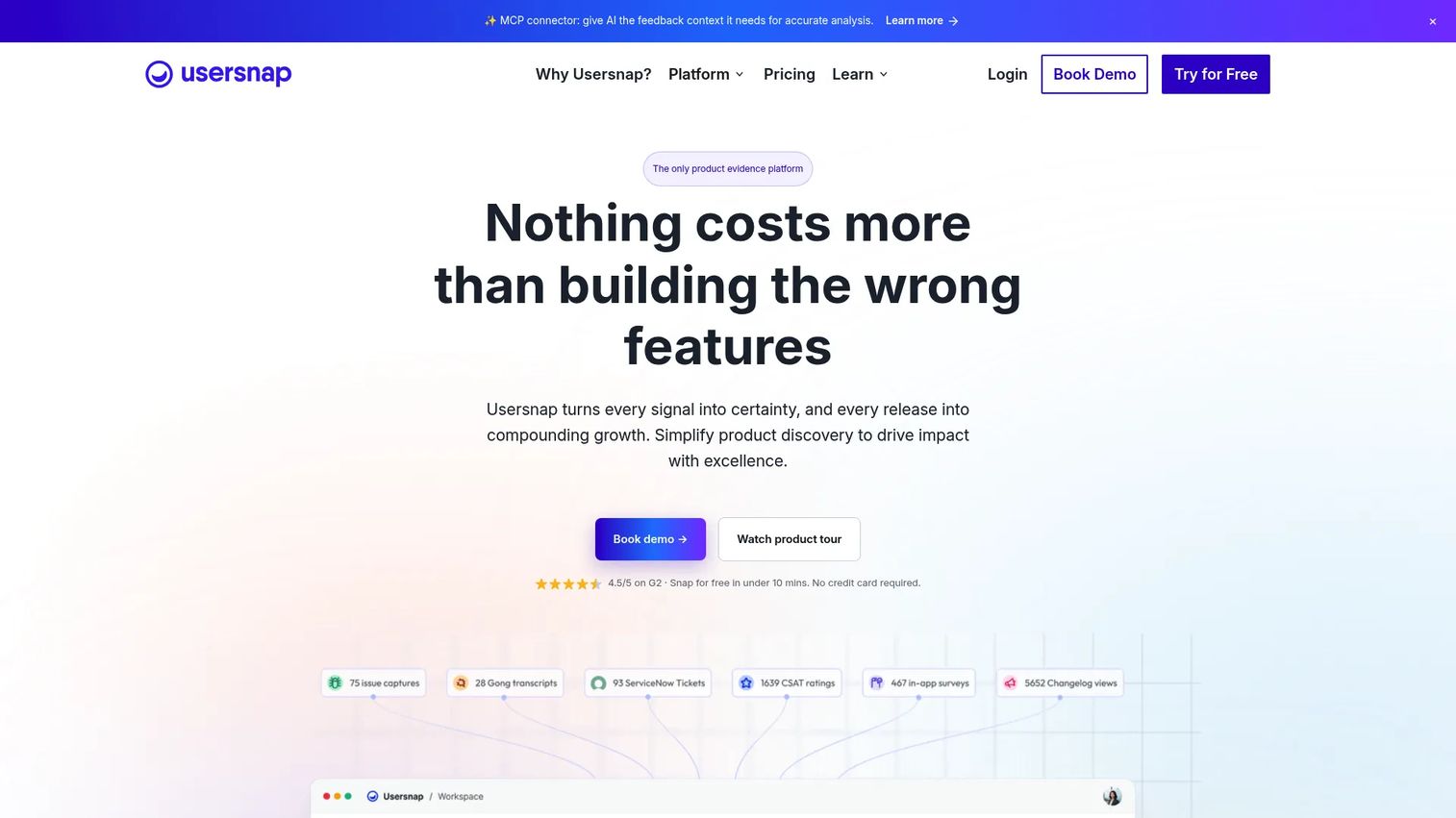
Usersnap is a product evidence platform that collects visual feedback through widgets, screenshots, screen recordings, and browser-based annotations, then connects that evidence to roadmap and prioritization workflows. Its AI layer classifies feedback topics, analyzes sentiment, and surfaces patterns. Opportunity boards and public roadmaps give product teams a way to show customers what happens after they report an issue. For PMMs running beta programs or preparing a launch, Usersnap captures the specific screen-level context that text surveys miss.
Best for: Product and QA teams that need visual feedback with technical context, tied to roadmap decisions and customer communication.
Key features
- Feedback via widgets, screenshots, video, and browser extension
- AI topic classification, sentiment analysis, and pattern detection
- Opportunity boards, roadmaps, and priority scoring
- Integrations with Slack, Jira, Zendesk, Salesforce, and 50+ tools
- Enterprise security: SSO/SAML, GDPR compliance, EU hosting
Why choose Usersnap: Choose Usersnap when context matters more than survey scale. Screen-level feedback with browser metadata is particularly useful during beta testing and pre-launch QA cycles.
Usersnap pricing: Starter is €49/month. Growth is €129/month. Professional is €219/month. Premium is €459/month. Enterprise uses custom pricing. A free trial is available, with one free month of Premium after completing trial conditions.
G2 rating: 4.5/5
12. Typeform

Typeform is an AI-powered form and survey builder for creating engaging, conversational feedback forms with conditional logic, webhooks, and custom branding. It is not a dedicated product feedback management platform, but it fills a real gap: Fast, polished forms for message testing, customer interviews, launch retrospectives, and research intake. PMMs who need to run a quick message test without a full research program, or build a customer proof point survey in an afternoon, reach for Typeform.
Best for: Teams that need polished, flexible feedback forms for research, message testing, or customer interviews without a full platform.
Key features
- AI-powered form creation with conversational single-question flow
- Conditional logic and branching
- Unlimited typeforms and questions on paid plans
- Custom branding and subdomains
- Conversion tracking and response drop-off analytics
Why choose Typeform: Choose Typeform when form experience and speed matter more than roadmap workflows. It will need supporting tools for prioritization, closed-loop communication, and trend analysis.
Typeform pricing: A free plan is available. Basic is $29/month. Plus is $59/month. Business is $99/month. Growth Flow is $349/month. Enterprise uses custom pricing. Annual billing is available at discounted rates.
G2 rating: 4.5/5
Considerations when choosing product feedback tools
Start with the feedback workflow, not the dashboard
Choose based on the job you need to do, not the interface that looks most polished. Feature request intake, in-app survey collection, usability research, and AI-powered VoC analysis each require a different category of tool. Map your decision to the specific output you need: Launch messaging evidence, adoption blockers, proof points, or roadmap signal.
Check source coverage
A strong tool should capture or ingest feedback from the channels where your most useful signal lives. If your best customer language comes from sales call notes and your tool only handles in-app surveys, you will get partial data. Confirm whether the tool connects to support tickets, CRM notes, interview repositories, and community sources, or only manages what it collects directly.
Evaluate analysis depth before buying
Look for AI theme detection, sentiment scoring, deduplication, segmentation, and trend reporting. For PMMs, the critical question is whether the tool can distinguish one loud enterprise account from a broad pattern across the customer base. The best tools reduce manual review work rather than creating another queue of raw responses.
Verify integrations before signing
Confirm two-way integrations with your CRM, help desk, project management tool, and analytics stack. Ask what syncs automatically, what requires a Zapier connection, and what stays manual. A logo wall on the integrations page is not the same as a confirmed workflow. This matters especially when feedback needs to reach product analytics and Sales simultaneously.
Plan the closed-loop process
Decide who owns triage, status updates, and customer responses before the tool goes live. A feedback platform without a named owner for the follow-up workflow becomes another silent inbox within 60 days. PMMs should know how the tool supports changelogs, release communications, and Sales enablement updates so the signal actually influences the work downstream.
Conclusion
The right product feedback tool is not the one that collects the most comments. It is the one that helps your team make better product and GTM decisions from the feedback you already have.
For feature request boards, Canny handles intake, voting, and changelog communication at an accessible price. Productboard suits teams that need feedback connected to structured roadmap planning. Enterpret and Chattermill serve organizations with high feedback volume who need AI analysis across sources rather than manual tagging. Qualaroo, Survicate, and Typeform cover survey-driven collection at different levels of sophistication. UserTesting goes deeper on qualitative research when you need customers talking, not just clicking. Pendo uniquely ties feedback to product usage data. UserVoice brings enterprise-grade structure to CRM-enriched feedback programs. Usersnap handles visual and beta feedback. Zonka Feedback covers satisfaction metrics at scale.
Choose based on your feedback source, the decision type you need to support, and the follow-up process your team will sustain. For PMMs, the right tool helps turn customer language into positioning you can defend, launches your team can coordinate, and enablement that Sales actually uses.
Once your feedback has shaped a clearer product story, use interactive product experiences to show customers what changed. Start your journey with Guideflow today!
FAQs
Product feedback tools are software platforms for collecting, organizing, analyzing, prioritizing, and acting on customer or user feedback about a product. They handle input from surveys, feature requests, user interviews, support tickets, reviews, and product usage data. The goal is to convert scattered signals into patterns that inform roadmap decisions, messaging, adoption programs, and customer communication.
Product feedback tools focus specifically on improving the product: Feature requests, usability issues, adoption friction, and roadmap input. Customer feedback tools often cover a broader scope including satisfaction metrics like NPS, CSAT, support quality, and brand experience. Many platforms overlap both categories, particularly tools like Zonka Feedback and Survicate that handle satisfaction surveys and product feedback in the same interface.
Canny, Productboard, and UserVoice each handle feature requests with different strengths. Canny excels at public or private voting boards with changelog communication and starts with a free plan. Productboard is better when requests need to connect to a structured feature hierarchy and roadmap scoring. UserVoice suits enterprise teams that need CRM-enriched segmentation and AI-assisted analysis across high volumes of incoming requests.
Qualaroo, Pendo, and Survicate all support in-app surveys, with different strengths. Qualaroo uses behavior-triggered nudges that appear at specific moments in the user journey. Pendo combines in-app surveys with product analytics so you can connect what users say to what they do. Survicate spans in-product, email, and website channels from one platform. In-app surveys work best when timing and targeting matter more than survey scale.
PMMs use product feedback tools to validate messaging against customer language, find proof points that support launch narratives, identify adoption blockers after a release, and mine sales objections from feature request patterns. A well-structured feedback system helps keep positioning grounded in customer reality rather than internal assumptions. Forrester (2025) found that more than half of organizations are actively investing in feedback management software, reflecting how central this workflow has become to GTM planning.
Start with the feedback source and the decision type. Ask where your feedback currently lives, who owns triage, and how signals reach Product, PMM, CS, and Sales today. Then verify whether a candidate tool connects to your CRM, help desk, and project management stack with integrations that go beyond basic notifications. Pricing and scalability are the final checks, not the first ones.
Many tools on this list integrate with Jira, Salesforce, and Slack, but integration depth varies significantly. Some sync bidirectionally, others push one-way notifications. Canny, Productboard, UserVoice, Usersnap, and Enterpret all document Jira integrations. Salesforce connections appear in Productboard, UserVoice, Pendo, and Survicate. Before buying, confirm which data fields sync, whether status updates flow back automatically, and which integrations require a third-party connector.
Closing the loop means telling customers what happened after they shared feedback, whether a request became a feature, was declined with a reason, or moved to the roadmap for a future cycle. Practically, it involves status updates in the feedback portal, changelog announcements, targeted emails, and CS outreach for high-value accounts. Someone must own this process. Without a named owner, most feedback platforms become collection tools only, which frustrates customers who submitted input and never heard back.