Your product pages look polished. Ads are running. Orders are coming in. But marketplace revenue still feels impossible to explain in Monday's standup.
The problem is rarely one thing. Listing content, keyword visibility, retail media spend, pricing, and reporting run in disconnected systems, and when one layer breaks, it drags the others down with it. Growing marketplace revenue is not the same as growing profitable marketplace revenue, and that distinction gets expensive fast.
The stakes are real: According to ECDB's 2026 analysis, 83.4% of global ecommerce GMV flowed through marketplaces in 2025. If your team is optimizing in silos, you are competing against brands that are not. Meanwhile, 57% of shoppers use Amazon and similar marketplaces as their primary destination to discover new products and brands, per Salsify's 2025 consumer research.
The right software helps you connect discoverability, ad efficiency, pricing, and margin into a coherent picture. This guide helps you find it.
What's inside
This guide is for digital marketers, ecommerce managers, and retail media leads who are evaluating online marketplace optimization software to improve performance across Amazon, Walmart, eBay, and other channels. Tools were selected based on:
- Marketplace coverage and optimization depth for the stated use case
- Measurement and profitability visibility
- Integration and operational fit
- Pricing model and team scalability
- Verified G2 ratings and live pricing confirmed at time of writing
The list includes both seller-oriented platforms and enterprise retail intelligence tools, because "online marketplace optimization" covers both.
TL;DR
- Best for Amazon listing research: Helium 10 covers keywords, listing optimization, PPC, and inventory in one seller-facing workspace
- Best for product research and market intelligence: Jungle Scout is the go-to for validating demand and analyzing Amazon category opportunities
- Best for retail media optimization: Teikametrics uses AI-assisted bidding to improve ad efficiency across Amazon and Walmart
- Best for enterprise digital shelf visibility: Profitero gives large brands a cross-retailer view of content, availability, and competitor movement
- Best for profitable repricing and revenue optimization: Feedvisor combines algorithmic pricing with advertising intelligence
- Best for multichannel feed automation: Channable handles product data mapping and marketplace exports across 2,500+ channel templates
What is online marketplace optimization?
Online marketplace optimization is the process of improving product visibility, conversion, advertising efficiency, pricing, and operational performance across digital marketplaces such as Amazon, Walmart, eBay, and regional platforms.
It is not a single workflow. Effective optimization spans several connected layers:
- Listing optimization: Product titles, bullets, descriptions, images, and backend keywords that improve search relevance and conversion
- Marketplace SEO: Search term research, rank tracking, category mapping, and share of search monitoring
- Retail media optimization: Sponsored product campaigns, bid strategy, budget pacing, and incrementality measurement
- Digital shelf analytics: In-stock status, content completeness, ratings, reviews, pricing competitiveness, and competitor visibility across retailers
- Pricing and profitability: Buy Box position, marketplace fees, margin tracking, promotions, and automated repricing
- Multichannel operations: Feed syndication, catalog updates, marketplace policy compliance, and product-data consistency
Software in this category falls into distinct types. One platform may improve listings and keywords; another focuses on retail media or price optimization. Buying the wrong category wastes both budget and time.
| Tool type | Typical user | Primary job | Buying trigger |
|---|---|---|---|
| Seller growth platform | Amazon or marketplace operator | Product research, listing SEO, keyword tracking | Launching or improving products |
| Retail media platform | Ecommerce marketer or retail media team | Campaign efficiency and profitable ad spend | Rising ad costs or weak ROAS |
| Digital shelf platform | Enterprise ecommerce or brand team | Monitor content, availability, pricing, competitors | Visibility gaps across retailers |
| Feed management platform | Marketplace and ecommerce operations | Publish accurate product data to multiple channels | Expansion to more marketplaces |
| Revenue optimization platform | Large seller or brand | Balance price, demand, advertising, and margin | Profitable growth pressure |
When to use online marketplace optimization tools
Improve product discoverability before spending more on ads
Weak organic visibility is often the actual bottleneck, not insufficient ad spend. If your titles lack relevant search terms, your category placement is wrong, or your image quality is below category standards, adding budget accelerates an already-broken funnel. Listing optimization tools help you fix the content layer first, so paid spend amplifies a page that actually converts.
Control retail media spend when ROAS hides margin loss
A campaign can show acceptable ROAS while fees, promotions, or stock constraints quietly erode contribution margin. Retail media platforms that connect ad performance to product-level profitability help you see the real number. If your reporting stops at ROAS, you may be scaling spend that is net-negative at the order level.
Expand into more marketplaces without creating catalog chaos
Adding a second or third marketplace without feed automation means manual exports, attribute mismatches, and out-of-date listings. Feed management platforms handle the mapping, transformation, and synchronization so your catalog stays consistent across destinations without a spreadsheet for every channel.
Online marketplace optimization software comparison
The table below organizes tools by the business problem each one solves. No single platform covers all jobs equally well.
| # | Product | Best for | Key differentiator | Pricing | G2 rating |
|---|---|---|---|---|---|
| 1 | Helium 10 | Amazon sellers needing broad research and listing tools | Integrated keyword, listing, PPC, and operations suite | From $99/mo (billed annually) | 4.2/5 |
| 2 | Jungle Scout | Product research and Amazon market intelligence | Product database and opportunity analysis | From $29/mo | 4.6/5 |
| 3 | Teikametrics | Retail media teams optimizing ad profitability | AI-assisted bidding across Amazon and Walmart | From $149/mo (annual) | 4.5/5 |
| 4 | Profitero | Enterprise brands managing digital shelf performance | Cross-retailer visibility and competitor intelligence | Custom pricing | 4.3/5 |
| 5 | CommerceIQ | Enterprise teams coordinating retail execution | Unified sales, media, and digital shelf data | Custom pricing | 4.2/5 |
| 6 | Perpetua | Ecommerce advertisers managing marketplace campaigns | Cross-channel retail media automation | From $695/mo | 4.4/5 |
| 7 | Feedvisor | Brands focused on pricing and profit optimization | Algorithmic repricing with advertising intelligence | From $100/mo (Essentials Repricer) | 4.5/5 |
| 8 | Channable | Multichannel catalog and feed operations | 2,500+ pre-built feed templates across channels | From $35/mo per merchant | 4.5/5 |
| 9 | Intentwise Ad Optimizer | Amazon advertising teams needing granular controls | AI- and rules-based retail media optimization | Custom pricing | 4.7/5 |
| 10 | SellerApp | Amazon sellers combining keyword, PPC, and listing work | Seller-oriented research and optimization workflows | From $29.99/mo (billed annually) | 4.7/5 |
10 best online marketplace optimization tools for 2026
1. Helium 10
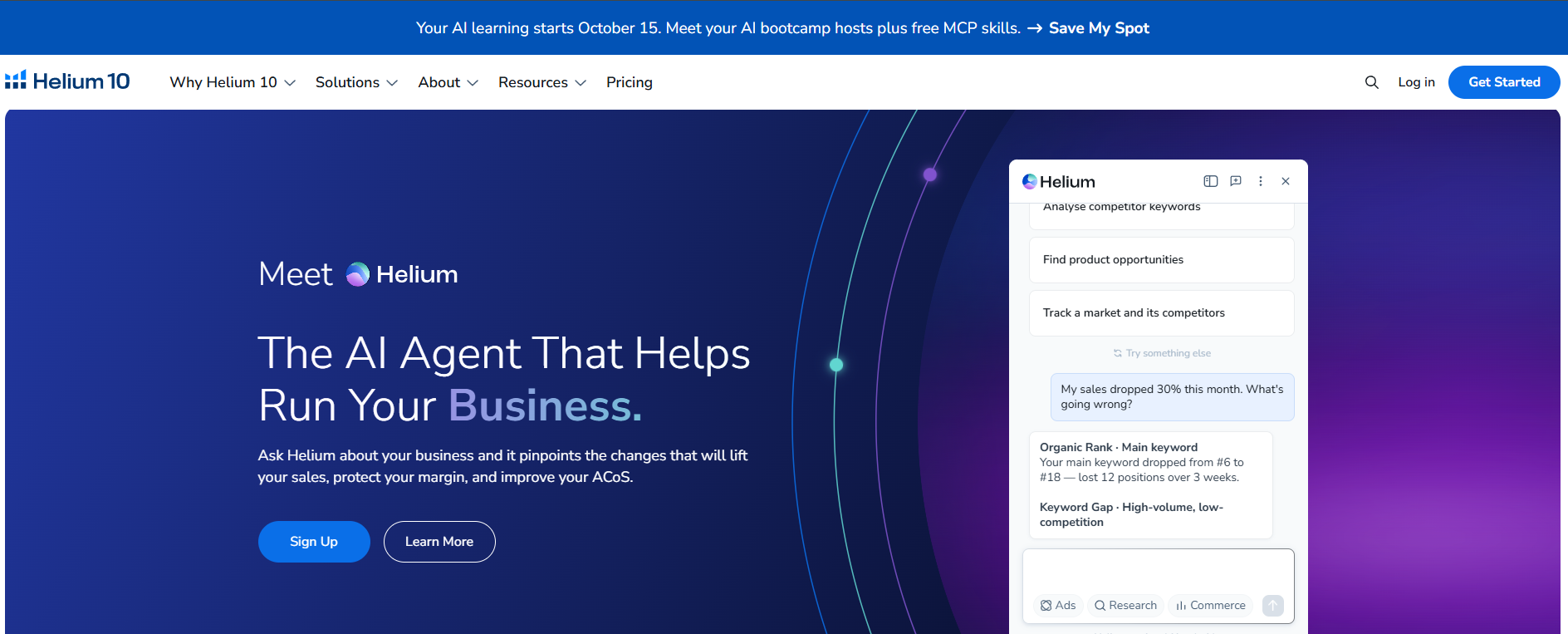
Helium 10 is a broad Amazon seller platform covering product research, keyword research, listing optimization, PPC management, and operational workflows in one suite. It also supports Walmart and TikTok Shop. Teams that want to handle early-stage marketplace research and listing execution without stitching together separate tools will find the range useful. An AI-powered assistant called Helium Agent is included across plans.
Best for: Amazon and multichannel sellers who need keyword research, listing optimization, and advertising support under one subscription.
Key features
- Keyword research and rank tracking for Amazon and Walmart
- Listing creation and optimization with A/B testing support
- Amazon PPC management and campaign automation
- Product and market research database
- Inventory, profit, and refund management tools
Why choose Helium 10: Choose it when the team needs to improve product discovery and listing execution before investing in dedicated enterprise retail media platforms. The breadth suits sellers who want one workspace rather than category-specific point solutions.
Helium 10 pricing: Plans start at $99/month billed annually (Platinum) or $129/month billed monthly. The Diamond plan is $279/month (annual) or $359/month (monthly). Enterprise plans start at $1,499/month billed annually. A free tier is available with limited access.
Helium 10 G2 rating: 4.2/5
2. Jungle Scout
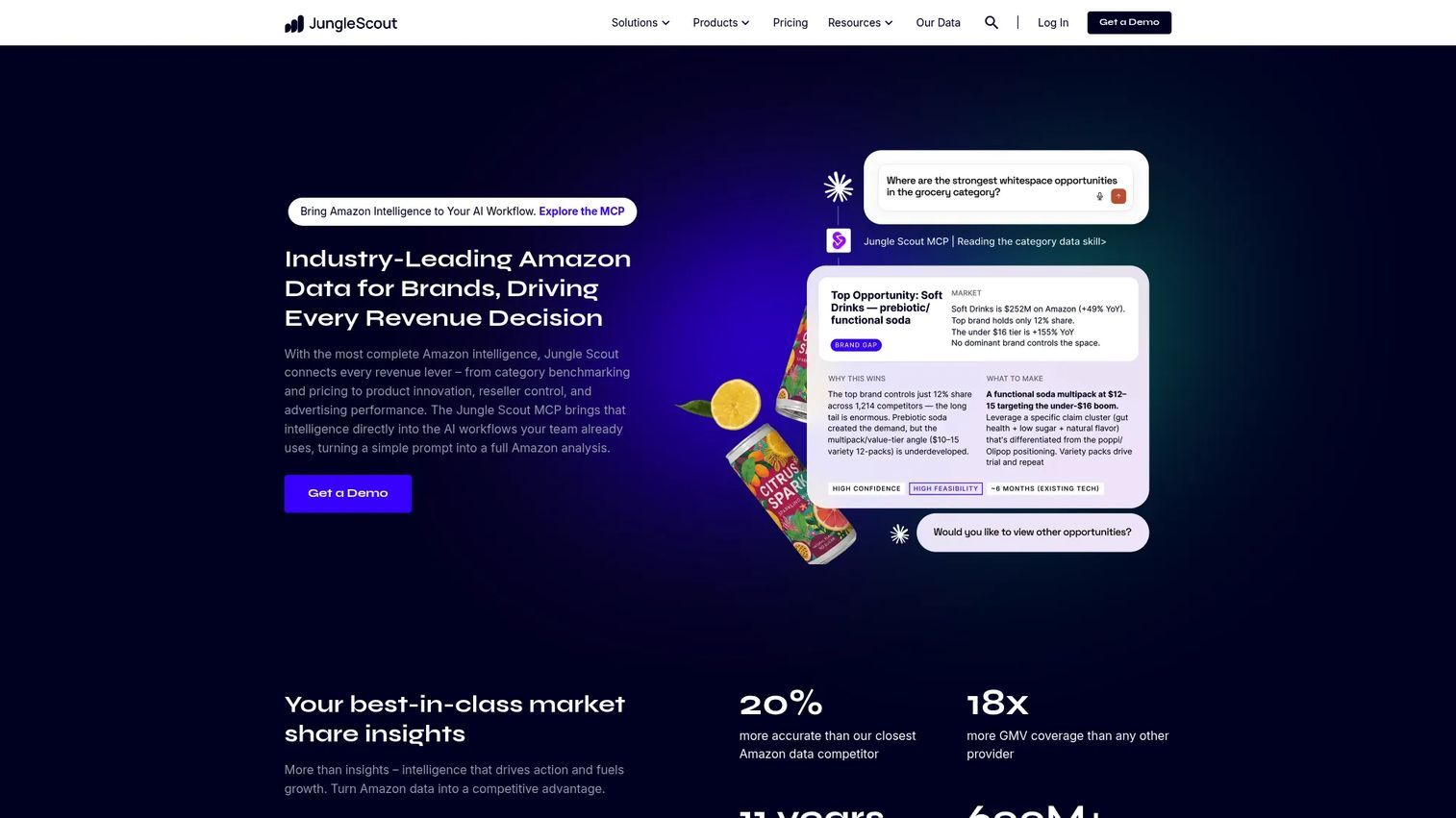
Jungle Scout focuses on Amazon market intelligence and product research. It helps sellers validate demand, analyze competitor performance, track category trends, and identify listing opportunities before committing budget to a product or campaign. The platform also includes supplier discovery and review automation. For teams at the product selection or category expansion stage, it offers one of the cleaner research workflows available.
Best for: Digital marketers and marketplace operators validating product opportunities, monitoring Amazon category demand, or planning listing strategy.
Key features
- Product opportunity database with demand and competition filters
- Keyword research and search volume tracking
- Sales estimate tracking across categories
- Competitor product and pricing analysis
- Supplier discovery and sourcing insights
Why choose Jungle Scout: Choose it when the immediate problem is product selection, niche validation, or category opportunity analysis. It gives marketers a structured way to connect demand data to listing decisions. Teams with broad retail media or cross-retailer reporting requirements will likely need an additional platform alongside it.
Jungle Scout pricing: Three plans are available: Starter at $29/month, Growth Accelerator at $49/month, and Brand Owner at $129/month, all billed monthly. No free trial is offered, but a 7-day money-back guarantee applies to standard plans.
Jungle Scout G2 rating: 4.6/5
3. Teikametrics
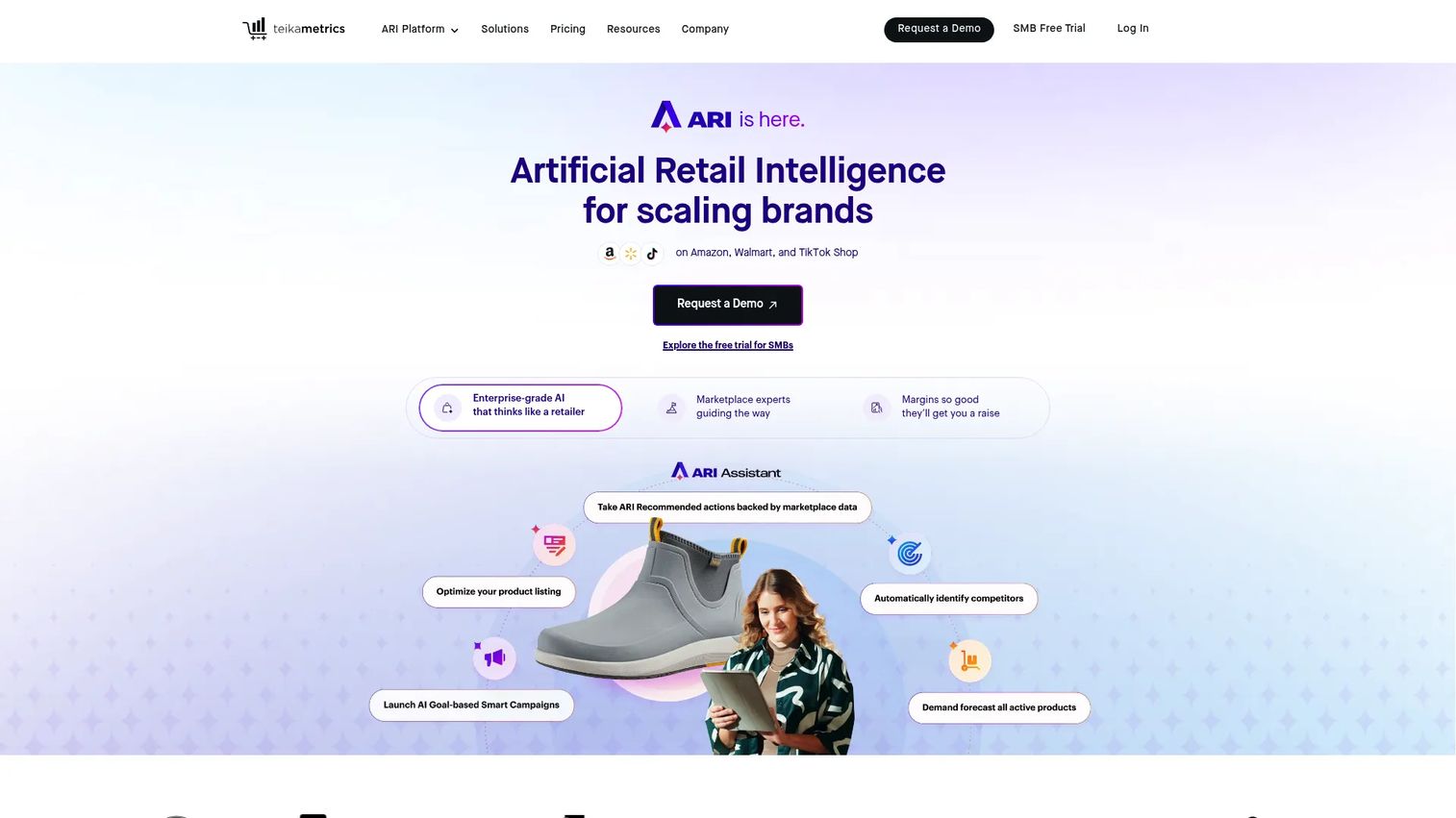
Teikametrics is a retail media optimization platform for brands that need stronger controls over marketplace advertising and profitability across Amazon, Walmart, and TikTok Shop. Its AI-powered Smart Campaigns automate bid decisions based on product-level profitability signals. Listing management and inventory forecasting are also included, making it more than a pure ad platform. Agencies and brands that have outgrown manual PPC management use it to scale campaign decisions without proportionally growing headcount.
Best for: Retail media teams with meaningful ad spend who need automated bidding, profitability-connected reporting, and multi-marketplace ad management.
Key features
- AI-powered advertising optimization with Smart Campaigns
- AI-optimized product listing and catalog management
- Inventory forecasting and optimization
- Profitability dashboards and marketplace analytics
- Multi-marketplace support across Amazon, Walmart, and TikTok Shop
Why choose Teikametrics: It fits marketers who have moved past spreadsheet-based PPC management and need campaign decisions that account for margin, not just ROAS. The connection between ad spend and product-level profit is the core differentiator. It is not a listing-content tool or a feed-management platform.
Teikametrics pricing: The Essentials plan starts at $149/month (annual) or $179/month (monthly) for up to $10K/month in ad spend. Advanced and Enterprise plans use custom pricing with an additional 3% of ad spend over $10K/month. A free trial is available on Essentials.
Teikametrics G2 rating: 4.5/5
4. Profitero
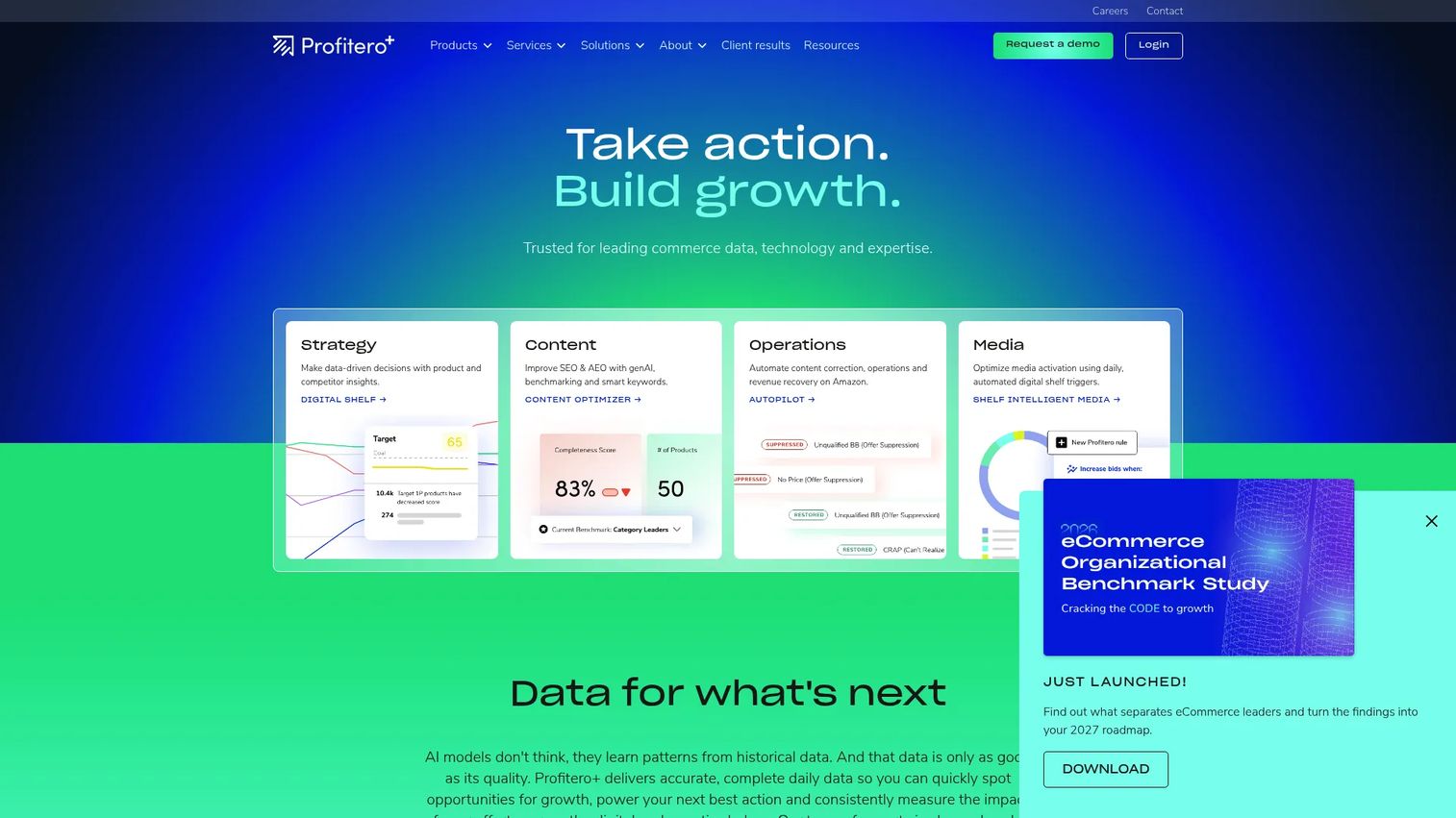
Profitero is an enterprise digital commerce platform combining digital shelf analytics, content optimization, media activation, and Amazon operations automation. It is designed for large consumer brands that need a cross-retailer view of how their products appear on-shelf: Content quality, availability, pricing, search ranking, ratings, reviews, and competitor positioning. A Content Optimizer module surfaces retailer-specific keyword insights and uses AI-assisted copy generation. An Autopilot feature handles Amazon content corrections and catalog management automatically.
Best for: Enterprise brands tracking digital shelf performance across multiple retailers and needing competitor intelligence connected to content and availability data.
Key features
- Digital shelf analytics across content, pricing, search rank, and competitor data
- Content Optimizer with retailer-specific keyword insights and AI copy generation
- Autopilot for Amazon content correction and revenue recovery
- Product ratings and review tracking
- Retailer performance reporting across channels
Why choose Profitero: It suits brand teams that need to diagnose why a product is losing discoverability or conversion across retailers, not just on Amazon. The cross-retailer view is the primary strength. It is built for brand and retail intelligence work, not a low-cost seller toolkit for early-stage Amazon operators.
Profitero pricing: Profitero does not publish numeric pricing. Contact the sales team for a quote based on catalog size and retailer coverage.
Profitero G2 rating: 4.3/5
5. CommerceIQ

CommerceIQ is an AI-powered commerce management platform for enterprise teams coordinating retail media, digital shelf performance, and retailer data across large catalogs. It unifies sales, media, and shelf intelligence into one platform and uses role-specific AI agents to automate workflows for sales, media, and operations teams. Purchase-order reconciliation and out-of-stock prediction are also included, making it a fit for teams where commerce operations and marketing overlap significantly.
Best for: Enterprise ecommerce teams that need central visibility across retail media execution, product content, inventory availability, and sales performance.
Key features
- Unified sales, retail media, and digital shelf data
- Role-specific AI agents for sales, media, and shelf workflows
- Automated bid and budget management for retail media
- Digital shelf monitoring and content compliance checks
- Out-of-stock prediction and purchase-order reconciliation
Why choose CommerceIQ: Choose it when fragmented retailer reporting prevents the team from connecting execution decisions to sales outcomes. The enterprise fit is explicit: It handles scale across large catalogs and multiple retail partners. Smaller marketplace sellers may find the platform's scope broader than their current operational needs.
CommerceIQ pricing: CommerceIQ prices platform components individually using a value-based model. Contact the sales team for a quote.
CommerceIQ G2 rating: 4.2/5
6. Perpetua
Perpetua is a retail media advertising and optimization platform for ecommerce brands and agencies. Its core value is campaign execution across marketplaces: AI-powered bid optimization, automated keyword harvesting, hourly intraday optimization, and Share-of-Voice tracking. The Growth plan adds competitor intelligence and organic rank insights. Custom reporting and data integrations are available on higher tiers. Perpetua is used by brands and agencies that run always-on sponsored advertising and need more automation than native marketplace interfaces provide.
Best for: Ecommerce marketers and agencies managing ongoing retail media campaigns who need automated bidding and performance reporting across Amazon and other channels.
Key features
- AI-powered bid optimization and keyword harvesting
- Hourly intraday optimization and budget pacing
- Share-of-Voice and Organic Rank tracking
- Performance and profitability reporting
- Custom reporting with data integrations
Why choose Perpetua: It suits the marketer who needs better ad execution without manually adjusting campaigns daily. The hourly optimization and Share-of-Voice data help teams connect campaign decisions to category-level visibility. Product content, listing SEO, and feed syndication require separate tools.
Perpetua pricing: The Essentials plan starts at $695/month for up to $10K in monthly ad spend. Growth adds hourly optimization and competitor data at $695/month plus a percentage of ad spend above $10K. Premium plans for $500K+ in monthly spend use custom pricing. No free tier is available.
Perpetua G2 rating: 4.4/5
7. Feedvisor
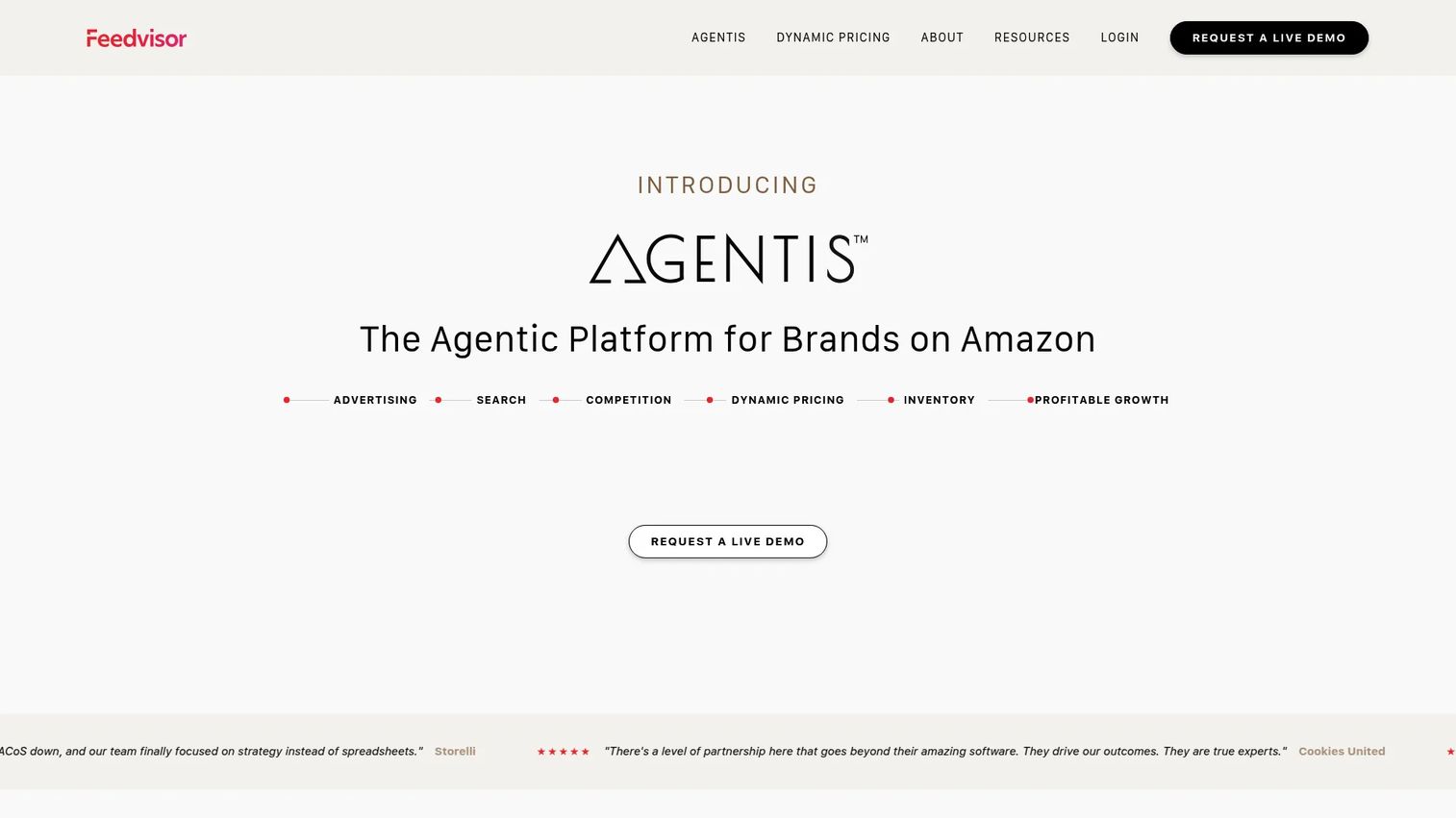
Feedvisor provides an AI-powered agentic commerce platform combining dynamic pricing, advertising optimization, competitive intelligence, inventory insights, and profitability analytics. Its algorithmic repricing engine uses competitor signals, Buy Box data, demand patterns, and margin floors to move price dynamically. Advertising capabilities include bid optimization, keyword discovery, and budget reallocation. Feedvisor360 and its Agentis platform serve larger brands needing integrated revenue intelligence across Amazon and Walmart.
Best for: Marketplace teams that need to protect margin while balancing price, demand, and advertising spend in real time.
Key features
- Algorithmic repricing using competitive, margin, inventory, and demand signals
- AI-powered advertising with bid optimization and budget reallocation
- Buy Box and competitive intelligence dashboards
- Profitability analytics with marketplace fee modeling
- Inventory replenishment insights and MAP monitoring
Why choose Feedvisor: It fits growth marketers under pressure to prove incremental revenue without sacrificing contribution margin. Pricing and media decisions informed by the same data set is the core argument. This is not the starting point for basic Amazon listing optimization or early-stage product research.
Feedvisor pricing: The Essentials Repricer plan starts at $100/month with a free 14-day trial. Feedvisor360 and Agentis pricing require a demo conversation with the sales team.
Feedvisor G2 rating: 4.5/5
8. Channable
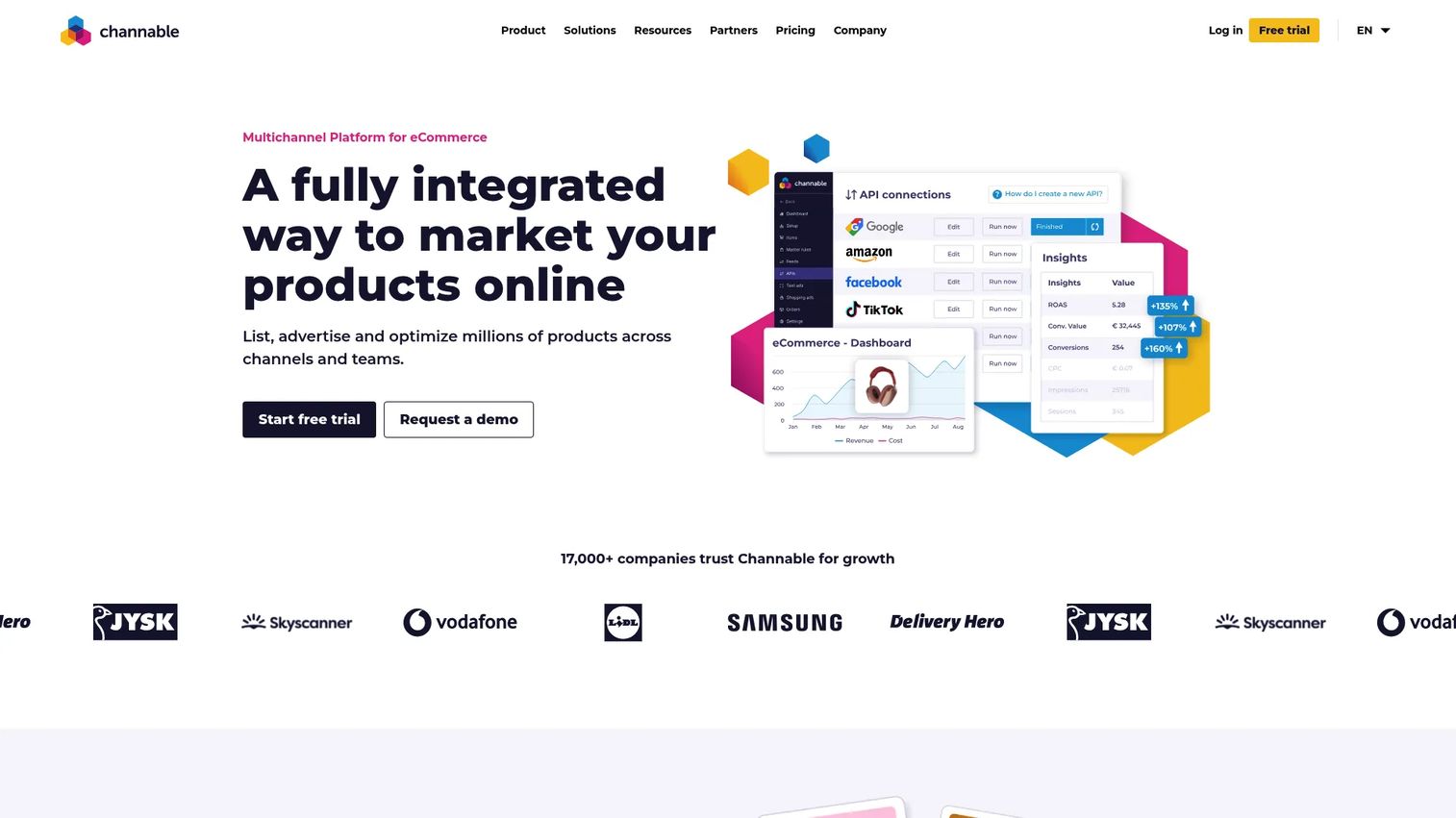
Channable is a multichannel feed management and ecommerce automation platform. It provides over 2,500 pre-built feed templates for marketplaces and advertising channels, rule-based data transformations, AI categorization, and real-time stock and order synchronization. PPC campaign generation and optimization are available as add-on modules. Teams that publish product data to multiple destinations and struggle with inconsistent attributes, manual exports, or channel-specific requirements will find the platform practical.
Best for: Ecommerce brands, retailers, and agencies managing product feeds, marketplace listings, and advertising campaigns across multiple channels.
Key features
- 2,500+ pre-built feed templates for marketplaces and ad channels
- Rule-based product data transformations and quality checks
- Marketplace order connections with real-time stock updates
- PPC campaign generation and optimization (add-on module)
- AI categorization and performance analytics
Why choose Channable: Choose it when the bottleneck is publishing complete, accurate, channel-ready listings across multiple destinations. The modular pricing model lets teams add only the channels and features they need. Channable handles distribution and data quality; it does not replace a dedicated retail media platform or repricing engine.
Channable pricing: Core plans start at $35/month per merchant (CSS Standard), $69/month (Core Standard), $89/month (Core Plus), or $104/month (Core Pro). Add-on modules include Marketplaces Standard at $36/month, PPC Standard at $58/month, and Order Connection at $59/month. A free trial is available.
Channable G2 rating: 4.5/5
9. Intentwise Ad Optimizer
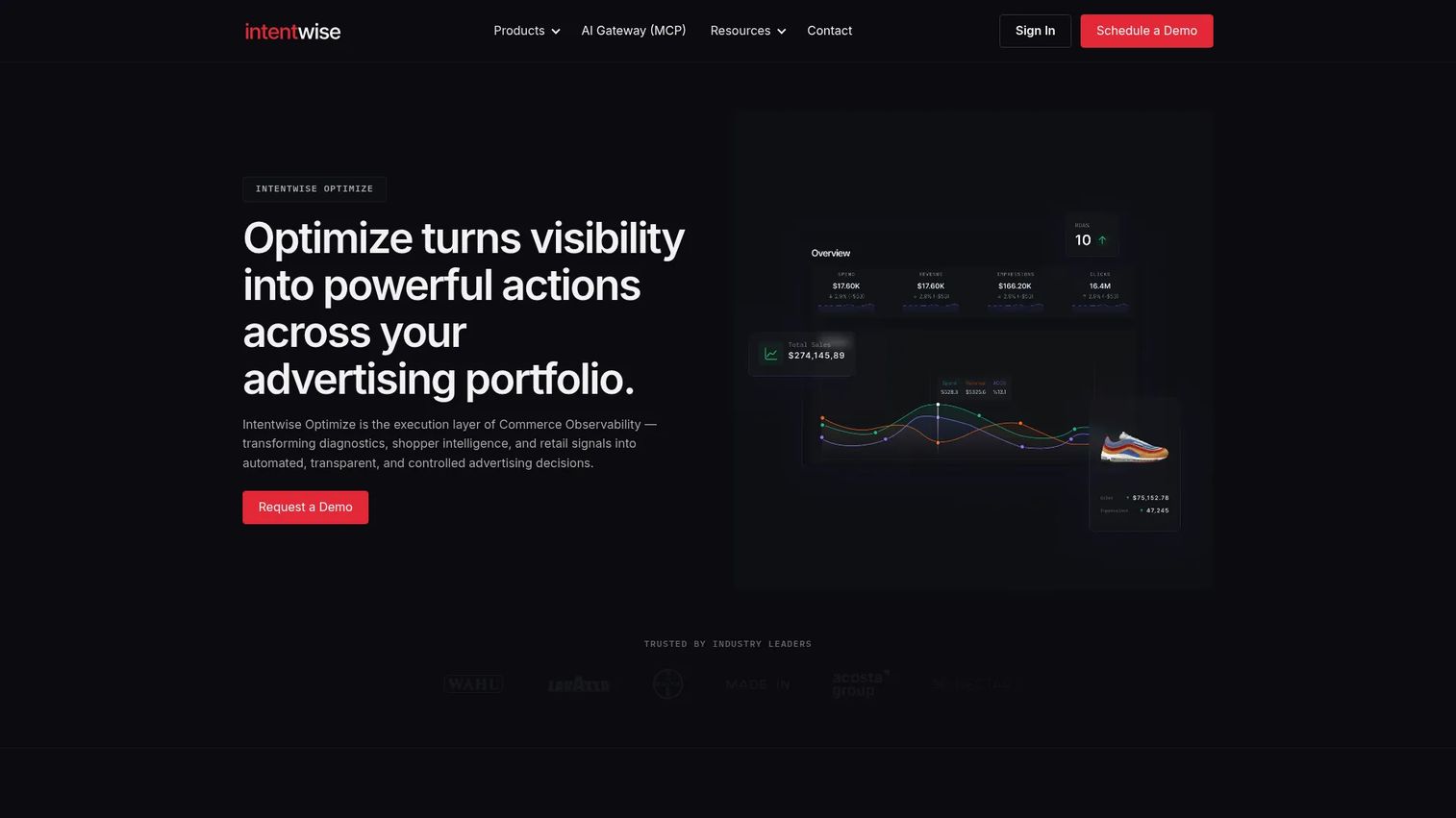
Intentwise Ad Optimizer is a retail media advertising execution and optimization platform built for brands and agencies managing large, multi-marketplace ad programs. It combines AI- and rules-based bidding with automated performance diagnostics, a recommendation engine, and a Search Query Performance dashboard that maps shopper search behavior to campaign structure. Retail-aware optimization uses live inventory, Buy Box status, and competitive pricing signals to inform bid decisions. DSP display and video activation are also supported.
Best for: Amazon advertising teams with meaningful spend who need granular controls, automated audits, and retail-aware campaign optimization beyond what native interfaces offer.
Key features
- AI- and rules-based bidding and campaign optimization
- Automated performance diagnostics and audit recommendations
- Search Query Performance dashboard for shopper behavior analysis
- Retail-aware optimization using inventory and Buy Box signals
- DSP display and video campaign activation
Why choose Intentwise Ad Optimizer: It moves teams from platform-level ROAS reporting to product-level and campaign-level decisions informed by retail context. The diagnostic and recommendation layer saves time that would otherwise go into manual campaign audits. It is advertising-specific and does not replace listing, catalog, or feed management tools.
Intentwise Ad Optimizer pricing: Pricing requires a sales conversation. G2 reviewer data suggests plans starting around $1,000/month for enterprise-level ad programs.
Intentwise Ad Optimizer G2 rating: 4.7/5
10. SellerApp
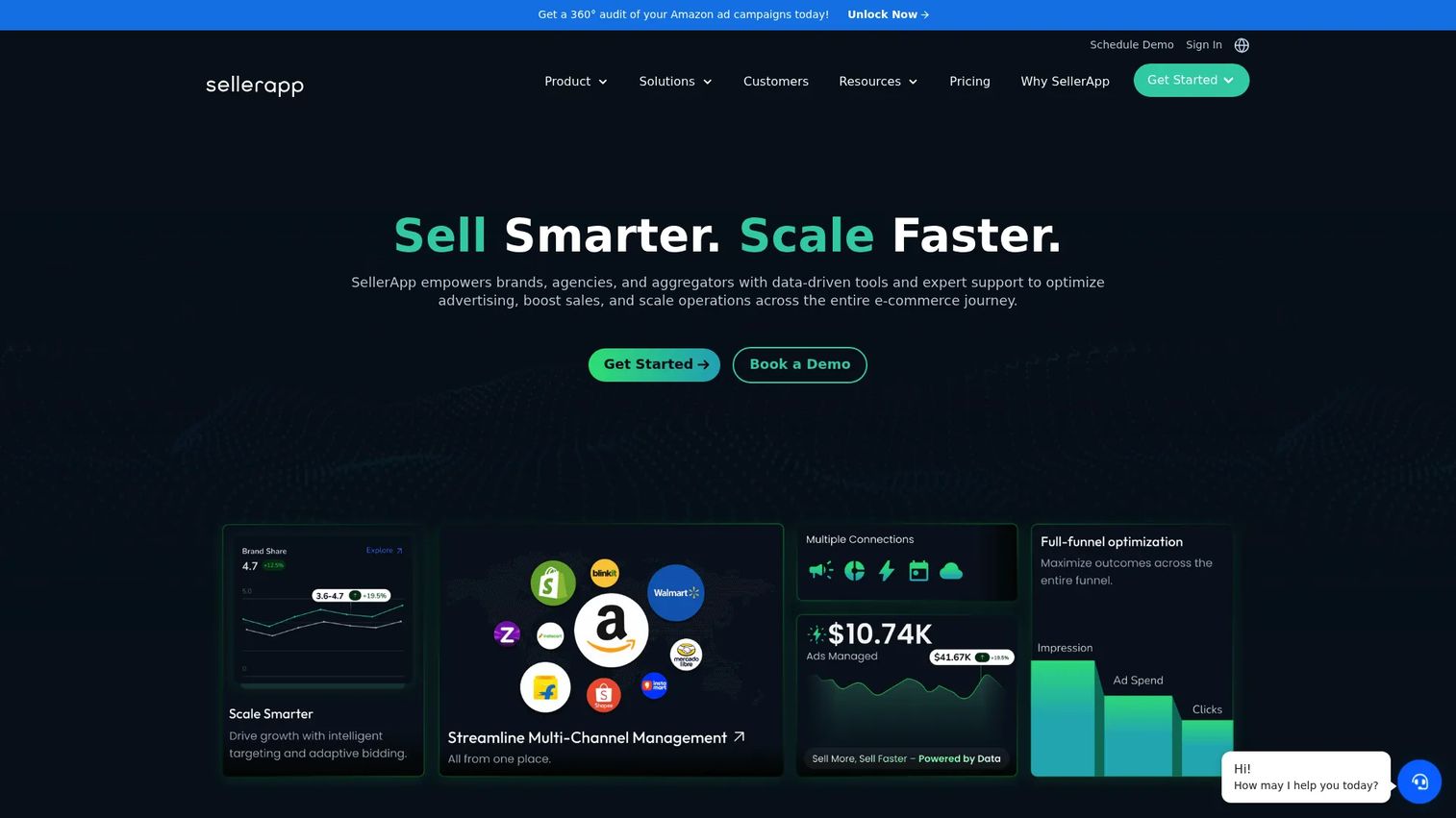
SellerApp is an Amazon intelligence platform combining product research, keyword research, PPC automation, listing quality analysis, and profitability dashboards. It covers the core seller workflow: Find the right products, optimize the listing, manage advertising, and track results. AI-powered ad automation and business alerts round out the feature set. For small to mid-sized sellers, it provides structured Amazon optimization without the overhead of enterprise retail intelligence platforms.
Best for: Amazon sellers and brands needing product intelligence, PPC management, and listing optimization in one seller-oriented environment.
Key features
- Amazon keyword research and rank tracking
- Product intelligence and competitor monitoring
- AI-powered PPC management and ad automation
- Listing quality analysis and optimization
- Profitability and sales analytics dashboards
Why choose SellerApp: It suits teams that need structured Amazon optimization workflows at a price point that makes sense for smaller catalogs. The combination of keyword, advertising, and listing tools in one interface reduces tool-switching. Larger brands needing cross-retailer digital shelf intelligence, advanced governance, or global operations will need an enterprise-focused platform.
SellerApp pricing: Plans start at $29.99/month (Starter), $49.99/month (Essential), and $79.99/month (Pro), all billed annually. A Business plan uses custom pricing for larger teams. A free tier is available for up to 20 products.
SellerApp G2 rating: 4.7/5
Considerations when choosing online marketplace optimization software
Find the bottleneck before picking the platform
Do not buy a broad suite because the feature list looks long. Identify whether revenue is constrained by discoverability, retail media efficiency, margin erosion, data quality, or cross-channel operations. A tool that solves the wrong layer adds cost without improving results. For more on how product analytics software tools can help you identify those gaps upstream, see our related guide.
Verify marketplace coverage and retailer depth
Ask which marketplaces the platform supports at depth. A tool that works well for Amazon keyword research may not provide the same capability for Walmart, eBay, or regional platforms. Coverage gaps become expensive when you expand channels and discover the reporting does not follow.
Connect ad reporting to actual profitability
Evaluate whether the platform shows product-level contribution after marketplace fees, promotions, returns, and ad spend. ROAS alone can create false confidence: A campaign that looks profitable at the gross revenue level may be net-negative once fees and discounts are accounted for.
Confirm data ownership and integration fit
Check which ecommerce platforms, PIM systems, inventory tools, and business intelligence tools the platform integrates with. Also confirm data refresh frequency and export options. Integrations that require engineering time to maintain are a hidden cost. For teams evaluating ecommerce platform fit alongside optimization software, having clear integration requirements before signing a contract saves significant time.
Match pricing model to your operating model
Seller subscriptions work well for focused Amazon execution at predictable cost. Enterprise platforms often use annual contracts priced per catalog size, retailer count, or ad spend percentage. Compare the total cost against the hours, margin leakage, and reporting work the platform can remove.
Conclusion
Marketplace optimization is a stack decision. No single platform does everything, and trying to force one into every role usually means it does none of them well.
For seller-led research and listing workflows, Helium 10 and Jungle Scout offer the most complete starting points. Teikametrics, Perpetua, and Intentwise Ad Optimizer each address retail media performance from different angles: Teikametrics for AI-driven profitability across Amazon and Walmart, Perpetua for always-on campaign automation, and Intentwise for granular Amazon advertising control. Profitero and CommerceIQ belong in evaluations where cross-retailer digital shelf intelligence is the priority. Feedvisor is the strongest option when pricing and margin are the primary levers. Channable earns its place when the team's bottleneck is multichannel feed distribution and data accuracy.
The practical next step: Audit your current marketplace performance, identify the metric that is most broken, then shortlist only the tools that directly address that specific gap. Adding capability without identifying the constraint first is how teams end up with five platforms and the same revenue problem.
For related reading on building out your ecommerce analytics stack, see our guides to best product management tools and analytics platforms that drive ROI.
Start your journey with Guideflow today!
FAQs
Online marketplace optimization is the process of improving product visibility, listing quality, advertising efficiency, pricing, profitability, and operational performance across online marketplaces. It spans multiple connected layers, from product titles and keyword targeting to bid strategy, repricing, and feed syndication. The right tool category depends on which layer is limiting performance.
Amazon-focused sellers generally start with keyword research, product research, listing optimization, and PPC tools. Helium 10, Jungle Scout, and SellerApp each cover this seller workflow at different price points. Enterprise brands that also sell through other retailers often add retail media or digital shelf platforms for a broader view.
Marketplace SEO improves organic discoverability through keywords, content completeness, images, attributes, category relevance, and search rank tracking. Advertising optimization manages bids, budgets, search terms, campaign structure, and spend allocation to drive paid visibility. Both affect discoverability, but they require different tools and operate on different timelines: SEO improvements compound over weeks; ad adjustments affect performance within hours.
Tools can support profitability when they connect advertising spend, pricing, marketplace fees, inventory, and product-level margin in one view. Platforms that show only top-line sales or ROAS can obscure margin erosion. Look for tools that include fee modeling, promotion depth tracking, and contribution margin reporting alongside revenue data.
Coverage varies by tool. Teikametrics supports Amazon, Walmart, and TikTok Shop for advertising optimization. Helium 10 also includes Walmart. Profitero and CommerceIQ cover multiple retailers at the digital shelf level. Before selecting a platform, verify which retailers it supports for each capability: Advertising, catalog data, digital shelf reporting, and pricing are often supported at different depths per channel.
Scale determines the answer. Smaller sellers often manage with one broader platform that covers listings, keyword research, and basic advertising. Larger organizations typically separate these concerns: A digital shelf platform for content and visibility, a dedicated retail media platform for advertising, and a repricing engine for pricing decisions. Combining specialized tools gives more control but requires integration work and clear ownership across the team.
Seller tools prioritize execution for individual sellers or small teams: Product research, listing creation, keyword tracking, and campaign management. Enterprise digital shelf platforms prioritize cross-retailer visibility, data governance, competitor intelligence, and large catalog management. The decision turns on catalog size, the number of retailers you operate across, and whether you need retailer-level reporting beyond Amazon.
High-velocity listings should be reviewed at least monthly. Keyword trends shift, category competition changes, and ad performance affects organic rank over time. Listings that support active advertising campaigns or seasonal promotions need more frequent attention. Any significant product change, price adjustment, or inventory event is also a trigger to revisit the listing for accuracy and relevance.