A lead comes in after hours. The loan officer follows up the next day. The referral partner never gets an update. Three weeks later, nobody can say where the application stalled.
The problem is rarely a shortage of contacts. It is a broken operating system: Borrower follow-up runs on memory, pipeline ownership is unclear, partner coordination happens over text, and leadership has no clean view of what is moving and what is stuck. According to KPMG (2025), 60% of mortgage executives say modernizing the technology stack is a competitive differentiator. That gap is real, and most teams still close it with spreadsheets.
A mortgage CRM should make revenue operations repeatable without creating another system your VP has to manually interpret every Monday. The right platform converts a chaotic lead flow into a predictable process that survives your next hire, your next product launch, and your next board meeting.
This guide cuts through the feature inventories and helps you match a platform to your operating model.
What's inside
This guide covers 12 mortgage CRM tools across mortgage-native and general-purpose categories, ranked by workflow fit rather than brand recognition.
- Who it's for: Lenders, brokers, loan officers, and operators scaling a mortgage business
- Selection criteria: Mortgage workflow coverage, sales automation depth, LOS and POS fit, reporting quality, partner lifecycle support, and pricing transparency
- How to read the list: Mortgage-native platforms appear first, followed by flexible CRMs for teams with stronger operations capacity
- Verification note: Every pricing figure and G2 rating was checked against live vendor sources before publication
TL;DR
- Best for mortgage-native operations: Jungo, for Salesforce-based workflows built around loan officers, borrowers, and referral partners
- Best for customer lifecycle marketing: Total Expert, for lenders that need post-close nurture and database engagement at scale
- Best for lender marketing automation: Surefire CRM, for teams standardizing borrower communications across branches
- Best for high-velocity lead management: Shape, for mortgage teams that need structured routing, calling, and conversion workflows
- Best for AI-assisted loan officer workflows: LoanOfficer.ai, for independent loan officers and small mortgage teams
- Best for flexible CRM customization: Salesforce or HubSpot, for larger organizations with resources to build a tailored lending model
- Best for lean teams: Pipedrive or monday CRM, when a clear pipeline and usability matter more than mortgage-native functionality
What is mortgage CRM software?
Mortgage CRM software is a customer relationship management system built or configured to help lenders, brokers, and loan officers manage borrower leads, loan pipelines, referral partners, communications, and post-close relationships.
How mortgage CRM software differs from a general CRM
A general CRM tracks contacts and deals. Mortgage CRM software layers on the lending-specific infrastructure a standard platform does not provide out of the box:
- Borrower and co-borrower relationship records
- Loan milestones and status-driven task sequences
- Referral partner tracking and attribution
- Mortgage-safe nurture campaigns with consent controls
- LOS and POS integration requirements
- Post-close retention and refinance outreach
Without these layers, teams spend implementation months building what mortgage-native platforms already ship.
Core features to look for
When evaluating a mortgage CRM system, confirm it covers:
- Lead capture and routing rules
- Loan-stage pipeline management
- Email, SMS, and call workflows
- Referral-source attribution
- LOS and POS integrations
- Consent and compliance controls
- Reporting by source, loan officer, branch, and loan status
- Post-close nurture and recapture campaigns
The four mortgage CRM categories
Understanding which category fits your operating model saves more time than any feature comparison:
- Mortgage-native CRM: Purpose-built for loan officer and lender workflows, shorter path to adoption
- Customer engagement platform: Lifecycle marketing from lead intake through post-close retention
- Enterprise CRM platform: Deep customization for financial services, requires admin investment
- Lightweight general CRM: Clean pipeline and basic automation for small teams with limited complexity
The category fit matters more than the longest feature checklist.
When to use mortgage CRM software
Capture and respond to borrower leads before they cool
Speed-to-lead is the first conversion variable a CRM controls. When lead routing, ownership rules, and first-response tasks run automatically, loan officers spend their time on conversations instead of triage. ICE Mortgage Technology (2025) found that 66% of surveyed borrowers explored offers from two or more lenders before choosing one, so the team that responds first and follows up consistently wins a disproportionate share.
Give referral partners visibility without manual updates
Referral relationships erode when partners have to call to get a status update. A mortgage CRM with partner relationship tracking and automated milestone alerts removes that friction. Partners stay informed, referral volume stays consistent, and loan officers stop burning time on status calls that could be automated.
Keep borrowers engaged after funding
A funded loan is the start of the borrower relationship, not the end. Post-close mortgage marketing, including refinance alerts, anniversary campaigns, and homeowner education, converts past customers into referral sources and repeat buyers. A mortgage CRM with mortgage marketing automation handles this without requiring manual campaign management on every closed file.
Mortgage CRM software comparison
Entry pricing is only part of the decision. A lower subscription can become expensive if it requires separate dialing tools, marketing platforms, reporting add-ons, or dedicated integration work. Factor in seats, SMS usage, onboarding fees, and implementation time before comparing line-item prices.
| # | Product | Best for | Key differentiator | Pricing | G2 rating |
|---|---|---|---|---|---|
| 1 | Jungo | Salesforce-based mortgage operations | Mortgage workflows on Salesforce foundation | From $96/user/mo (annual) | 4.5/5 |
| 2 | Total Expert | Enterprise lender lifecycle marketing | Mortgage and financial-services engagement platform | Free tier; Premium $100/user/mo | 4.5/5 |
| 3 | Surefire CRM | Lender marketing and branch communications | Mortgage marketing automation and campaigns | Contact vendor for pricing | 4.0/5 |
| 4 | Shape | High-velocity mortgage lead management | Lead routing, AI scoring, and communication workflows | Contact vendor for pricing | 4.5/5 |
| 5 | Aidium | Mortgage teams focused on database activation | No-code automation with 80+ mortgage playbooks | Contact vendor for pricing | 3.9/5 |
| 6 | BNTouch | Loan officers and small brokerages | 400+ pre-built mortgage campaigns | From $95/user/mo | 4.5/5 |
| 7 | Bonzo | Borrower follow-up and engagement | Multichannel mortgage communication workflows | From $150/seat/mo | 4.0/5 |
| 8 | LoanOfficer.ai | AI-assisted loan officer workflows | AI CRM with rate monitoring and LOS integrations | From $197/mo (2 seats) | 4.9/5 |
| 9 | Salesforce | Complex, customized mortgage operations | Deep customization and broad integration ecosystem | From $25/user/mo | 4.4/5 |
| 10 | HubSpot | Mortgage marketing and sales alignment | Marketing automation plus CRM in one platform | Free tier; Starter from $20/seat/mo | 4.4/5 |
| 11 | Pipedrive | Lean teams needing pipeline discipline | Visual deal management with low admin overhead | From $14/seat/mo (annual) | 4.3/5 |
| 12 | monday CRM | Configurable mortgage workflow management | Custom boards, automations, and cross-team visibility | From £10/seat/mo (annual) | 4.5/5 |
The best mortgage CRM software tools for 2026
1. Jungo
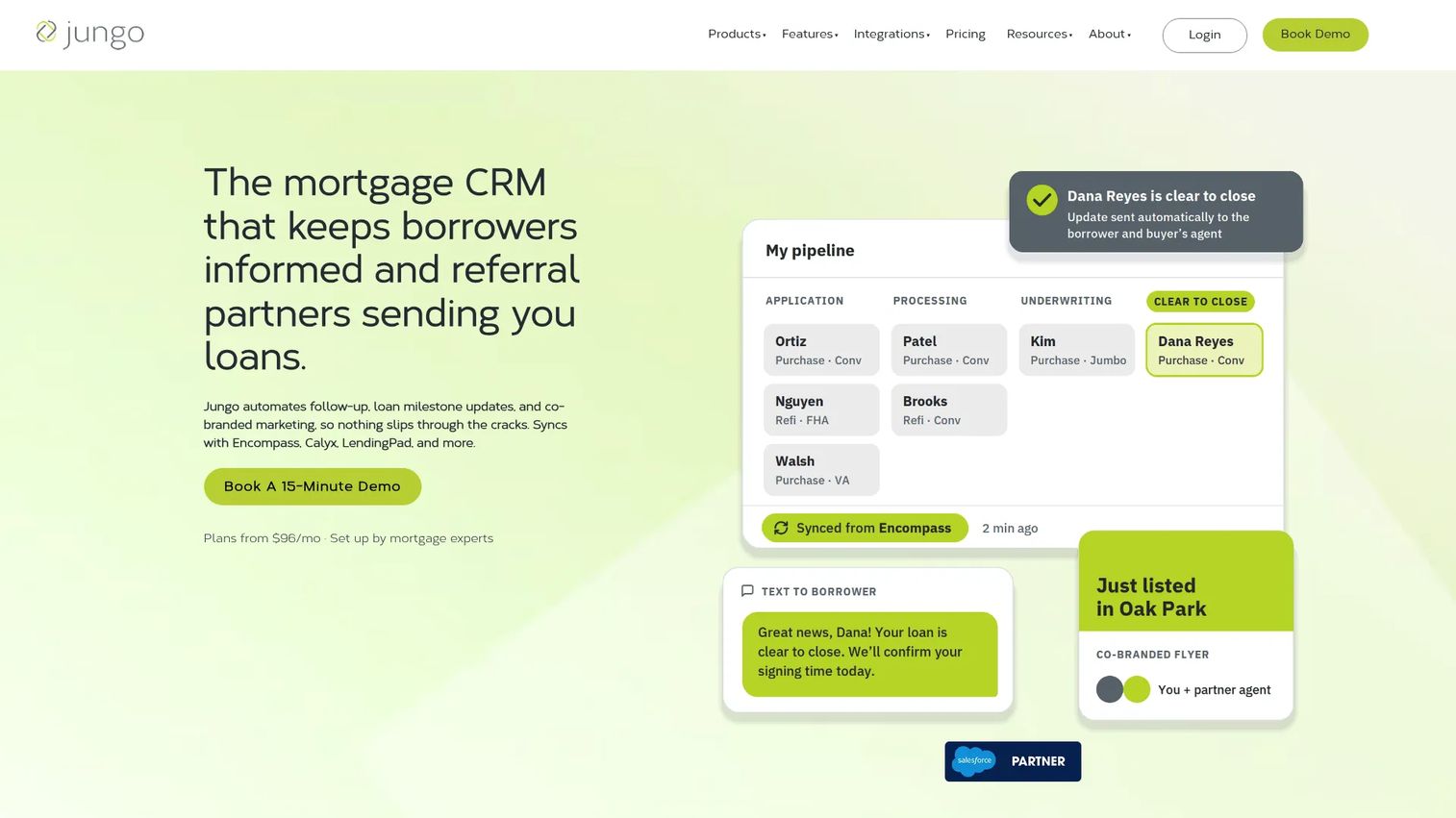
Jungo is a Salesforce-powered mortgage CRM built specifically for loan officers and mortgage organizations. It layers mortgage-specific workflows, referral partner management, and LOS connectivity directly onto the Salesforce platform, which means teams get mortgage-native functionality without building every object and workflow from scratch. The result is a CRM that supports borrower leads, pipeline milestones, partner relationships, and post-close outreach inside an architecture that scales as the business grows.
Best for: Mortgage businesses that want mortgage-specific workflows while using Salesforce as the operational foundation.
Key features
- Salesforce-based mortgage CRM with loan officer workflows
- Lead management, distribution, and pipeline tracking
- Automated email and SMS campaigns plus drip sequences
- Referral partner tracking and agent portal
- LOS and POS integration support
Why choose Jungo: It gives Salesforce shops a way to go live with mortgage-specific workflows in less time than a custom build requires. Teams that already invest in Salesforce governance and admin capacity will get the most from Jungo's depth.
Jungo pricing: Jungo Lite starts at $96 per user per month billed annually, or Jungo Bundle at $125 per user per month on an annual contract. A $249 or $299 setup fee applies depending on the plan. All contracts require a minimum one-year term.
G2 rating: 4.5/5
2. Total Expert
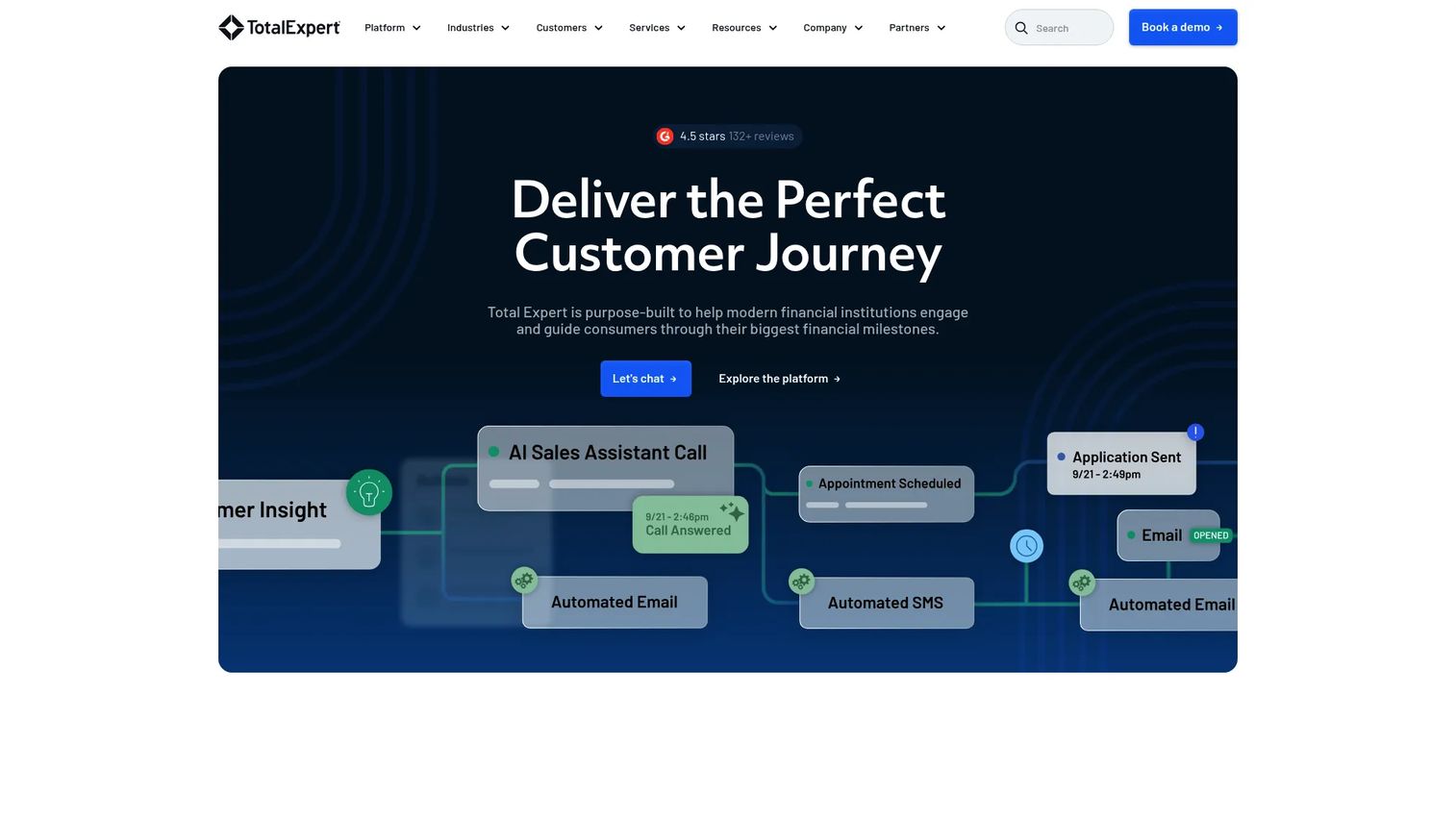
Total Expert positions itself as a Customer Operating System for financial services, combining CRM, marketing automation, and customer intelligence in one platform. Banks, mortgage lenders, and credit unions use it to run lifecycle campaigns from initial lead capture through post-close retention. The platform includes AI-powered lead qualification, dynamic Journey automation, co-marketing tools, and compliant campaign libraries built for regulated financial services.
Best for: Enterprise lenders that need structured borrower engagement, partner communications, and database marketing with compliance controls.
Key features
- Mortgage and financial-services lifecycle journeys
- AI Sales Assistant for lead nurturing and qualification
- Co-marketing tools and compliant campaign content
- Audience segmentation and intent signals via Customer IQ
- Enterprise reporting and governance controls
Why choose Total Expert: The platform is designed for institutions where borrower retention and systematic database marketing are strategic priorities. It is a heavier procurement and implementation decision than a lightweight loan officer CRM, but it solves the post-close engagement problem at scale.
Total Expert pricing: A Complimentary plan is available at $0 per month. Premium is $100 per user per month on a monthly basis. Enterprise financial-services pricing is not publicly displayed.
G2 rating: 4.5/5
3. Surefire CRM

Surefire CRM is a mortgage-focused CRM and marketing automation platform for lenders and loan officers. It handles borrower nurture, referral partner engagement, and post-close outreach through automated campaigns and communication workflows built specifically for the mortgage industry. Lenders with multiple branches use it to standardize borrower communications without requiring each loan officer to manage campaigns manually.
Best for: Lenders that want mortgage-specific relationship marketing across borrowers, real estate partners, and past customers.
Key features
- Mortgage marketing automation and campaign management
- Borrower lifecycle email and communication workflows
- Partner relationship engagement tools
- Loan alerts and milestone-based outreach
- Centralized campaign management across branches
Why choose Surefire CRM: It is a strong fit where consistent, compliant marketing across branches matters more than deep CRM customization. Validate LOS integration compatibility and reporting capabilities against your current stack before committing.
Surefire CRM pricing: Pricing is not publicly displayed on the vendor's site. Contact Surefire CRM directly for current plan and contract details.
G2 rating: 4.0/5
4. Shape
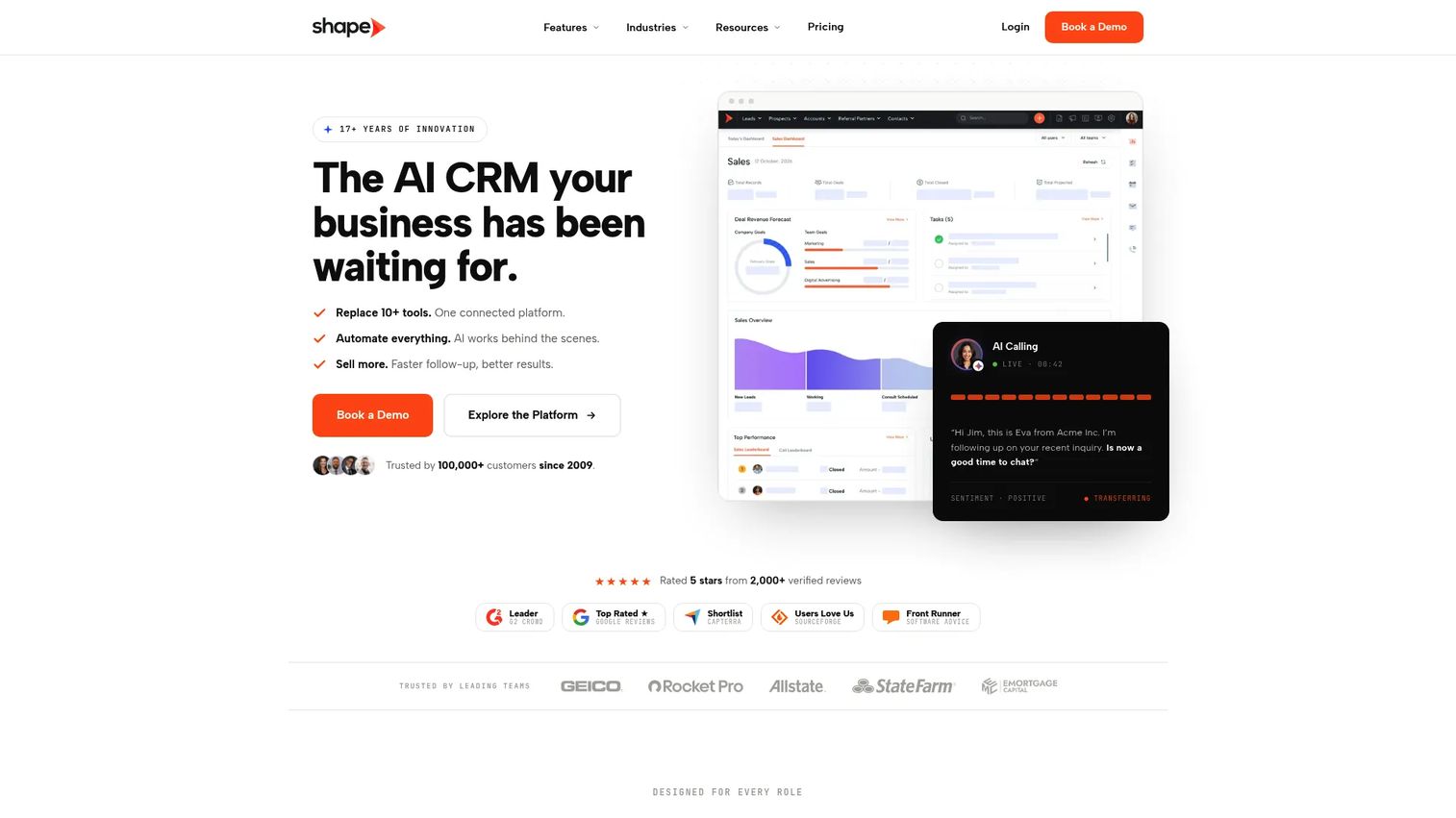
Shape is an AI-powered CRM built for sales and marketing teams that need high-volume lead management, integrated communications, and workflow automation. For mortgage teams, it handles lead capture, routing rules, task creation, phone and SMS outreach, and conversion reporting in one platform. AI lead scoring, AI calling, and no-code workflow automation make it particularly relevant for organizations with significant inbound volume and clear conversion accountability.
Best for: Mortgage teams that need to control lead routing, follow-up discipline, and conversion activity across multiple loan officers.
Key features
- Lead routing and assignment rules with AI scoring
- Mortgage sales pipeline workflows and contact timelines
- Integrated phone, SMS, MMS, and email communications
- No-code workflow automation
- Conversion reporting and activity dashboards
Why choose Shape: Choose Shape when pipeline control and speed-to-lead are the immediate constraints. It is a lead-conversion system first; if comprehensive borrower lifecycle management or deep LOS data sync matter most, validate those capabilities before signing.
Shape pricing: Core and Complete plan prices are not publicly displayed; annual billing saves up to 20%. Enterprise is custom. Contact Shape for current pricing.
G2 rating: 4.5/5
5. Aidium
Aidium is a mortgage CRM built for mortgage executives, loan officers, and producers who need configurable pipelines, database activation, and enterprise reporting. The platform ships with more than 80 pre-built mortgage automation playbooks, two-way SMS and email, in-app calling, and AI propensity modeling. A modern API and 100-plus integrations make it relevant for teams that want to plug CRM data into a broader GTM stack.
Best for: Mortgage teams looking to activate existing contact databases and make borrower follow-up consistent without relying on manual task lists.
Key features
- Customizable mortgage CRM pipelines
- 80-plus no-code automation playbooks for mortgage workflows
- Two-way SMS and email plus in-app calling
- AI propensity modeling for lead prioritization
- Enterprise reporting and data warehousing
Why choose Aidium: It is a strong option for teams that have a large contact database but lack a repeatable activation engine. Before launching automation, plan for data cleanup and source attribution; inaccurate data produces inaccurate reporting regardless of automation depth.
Aidium pricing: Pricing is not publicly displayed. Contact Aidium for current plans and contract terms.
G2 rating: 3.9/5
6. BNTouch
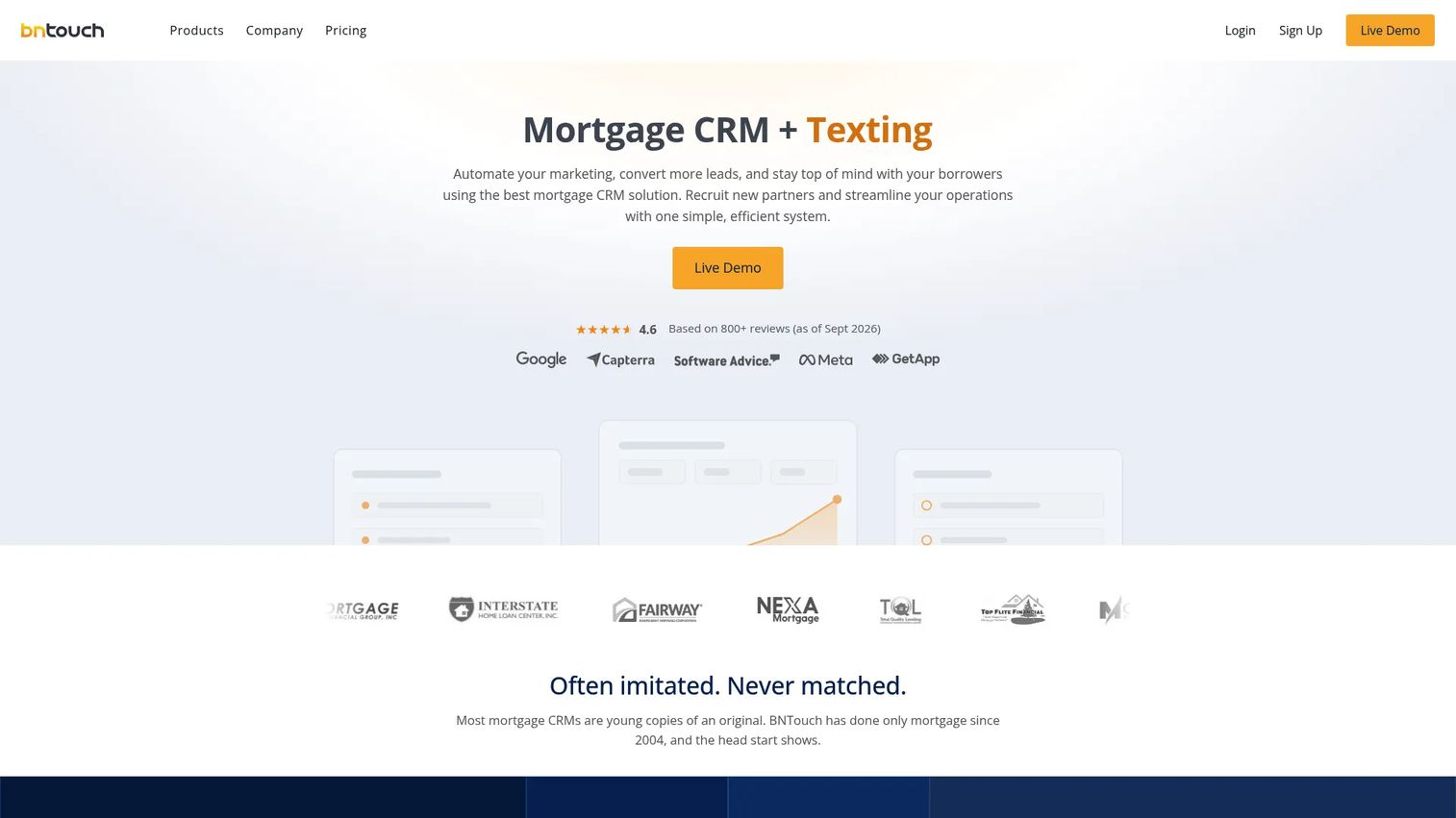
BNTouch is a mortgage CRM and point-of-sale platform built for loan originators, brokers, and mortgage teams. It ships with over 400 pre-built mortgage campaigns, an AI-assisted online loan application, borrower portals, and smart lead distribution with round-robin routing. The platform is designed to reduce adoption friction for loan officers who want mortgage-native workflows without starting from a generic sales CRM.
Best for: Loan officers and brokerages that want a mortgage-first CRM with a short path to adoption.
Key features
- 400-plus pre-built mortgage marketing campaigns
- Smart lead distribution with round-robin routing
- AI-assisted online 1003 and borrower portals
- Email, SMS, social, and voice marketing automation
- Pipeline views, tasks, calendars, and reminders
Why choose BNTouch: The pre-built campaign library and borrower portal capabilities make it accessible for teams that need to go live quickly. Validate integration depth and reporting before choosing it for complex multi-branch operations.
BNTouch pricing: $95 per user per month for teams of 2 to 10, billed monthly. Single-user plans run $165 per month. Enterprise pricing is custom for 10 or more users. BNTouch does not offer a free trial.
G2 rating: 4.5/5
7. Bonzo
Bonzo is a mortgage-focused engagement platform built around multichannel borrower and prospect communication. It handles SMS, MMS, video messages, email, voicemail drops, and calling from one interface. The platform includes unlimited prospect uploads, automated drip sequences, and MMI data integration for historical transaction targeting. Teams whose primary bottleneck is consistent follow-up and response rates find it addresses that gap directly.
Best for: Mortgage professionals who want better borrower follow-up consistency and conversation-driven engagement.
Key features
- Multichannel outreach: SMS, MMS, video, email, voicemail drops, and calling
- Unlimited prospect uploads with automated follow-up sequences
- Drip campaigns and mortgage-specific email and text templates
- MMI data integration for historical borrower targeting
- Contact activity tracking and campaign performance visibility
Why choose Bonzo: It fits teams whose immediate constraint is response consistency rather than full CRM capability. Confirm whether it can replace your current system of record or works better alongside it before treating it as a standalone CRM.
Bonzo pricing: Solo plans start at $150 per seat per month. Small team pricing requires contacting the vendor. Enterprise is custom.
G2 rating: 4.0/5
8. LoanOfficer.ai
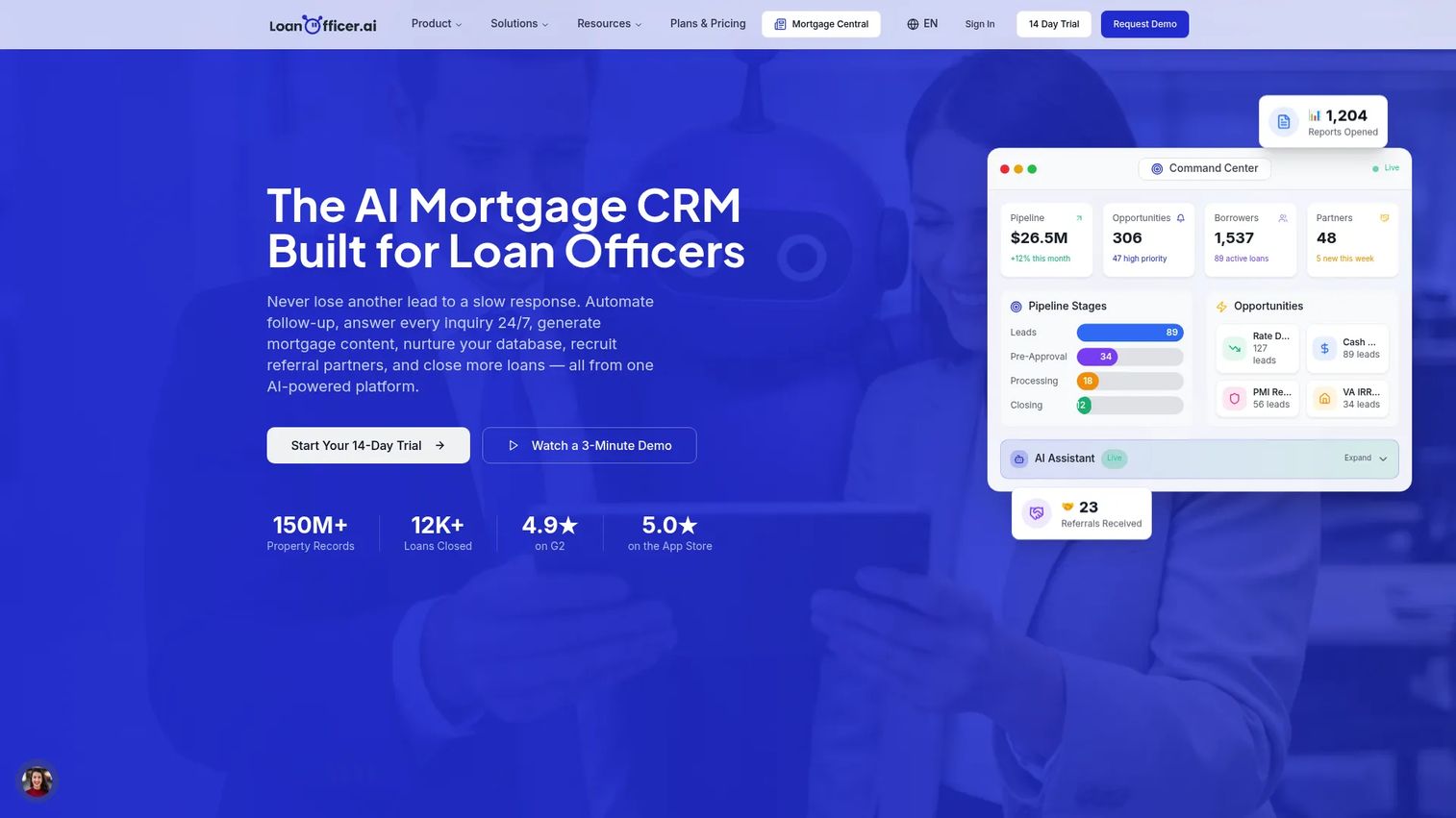
LoanOfficer.ai is an AI-powered mortgage CRM for loan officers, broker teams, and mortgage companies. It combines pipeline management, marketing automation, a smart dialer, rate monitoring, and LOS integrations with an AI assistant that handles lead follow-up, database nurturing, and opportunity alerts. The platform is built to reduce manual work for individual loan officers and small teams without requiring a complex CRM implementation.
Best for: Loan officers and small mortgage teams that want AI-assisted lead response and database engagement without building a full CRM stack.
Key features
- AI-powered CRM with pipeline management and lead scoring
- Marketing automation, email campaigns, and smart dialer with SMS
- Rate monitoring, Property Pulse reports, and opportunity alerts
- LOS integrations with Arive, LendingPad, Byte, Encompass, and Zapier
- All plans include AI assistant and 5,000 tokens per seat per month
Why choose LoanOfficer.ai: It is designed for the loan officer who needs immediate operational help with lead response and database engagement. The flat-seat pricing model and included LOS integrations make total cost predictable for small teams, which is harder to achieve with per-user enterprise platforms.
LoanOfficer.ai pricing: Starter is $197 per month for two seats. Team is $397 per month for five seats. Brokerage is $697 per month for ten seats. A $299 one-time setup fee applies to all plans. A 14-day trial is available for $1.
G2 rating: 4.9/5
9. Salesforce
Salesforce is a configurable enterprise CRM platform that lenders use to build custom mortgage data models, complex permission structures, and broad integration ecosystems. Financial Services Cloud adds purpose-built data structures for lending scenarios. Teams that choose Salesforce for mortgage operations are buying flexibility and depth, not a pre-built mortgage workflow. That trade-off is only favorable when the organization has dedicated admin capacity, implementation discipline, and a clear ownership plan.
Best for: Larger lenders that need deep customization, complex permissions, broad integrations, and centralized reporting across a large organization.
Key features
- Custom mortgage data models and workflow automation
- Financial Services Cloud for lending-specific data structures
- Enterprise reporting with Tableau
- Extensive integration ecosystem and modern API
- Permission controls, governance, and audit capabilities
Why choose Salesforce: Salesforce can support a sophisticated mortgage operating model when the organization has budget and implementation ownership. It is not the default choice for teams seeking an out-of-the-box mortgage workflow. Plan for configuration time, integration work, and ongoing admin investment.
Salesforce pricing: Starter Suite begins at $25 per user per month. Sales Cloud Pro Suite is $100 per user per month, billed annually. Core is $195 and Advanced is $395 per user per month, both billed annually. Financial Services Cloud pricing requires contacting Salesforce.
G2 rating: 4.4/5
10. HubSpot

HubSpot connects CRM, marketing automation, and sales pipeline management in one platform. For mortgage companies, it is most relevant where inbound lead generation, borrower nurture, and sales-marketing handoff are the main bottlenecks. The platform requires custom configuration to model loan-stage pipelines and mortgage-specific objects, but its native marketing toolset, attribution reporting, and CRM usability make it competitive for growth-focused brokerages. This is one of the best marketing automation software tools available for teams that want CRM and marketing in a single platform.
Best for: Mortgage companies that need marketing and sales alignment more than a fully mortgage-native operating model.
Key features
- Free CRM with contact and deal management
- Marketing automation, landing pages, and forms
- Lead nurturing workflows and lifecycle email sequences
- Sales pipeline visibility and activity tracking
- Reporting, attribution, and data sync tools
Why choose HubSpot: Position it for teams where inbound marketing and sales handoff drive the business. Mortgage data structures and loan-stage workflows require configuration investment, and LOS connectivity depends on third-party integrations. Validate compliance communication requirements before relying on HubSpot for regulated borrower outreach.
HubSpot pricing: The Free tier is $0 per month. Starter plans begin at $20 per seat per month. Professional plans start at $1,300 per month for core seats, billed monthly.
G2 rating: 4.4/5
11. Pipedrive
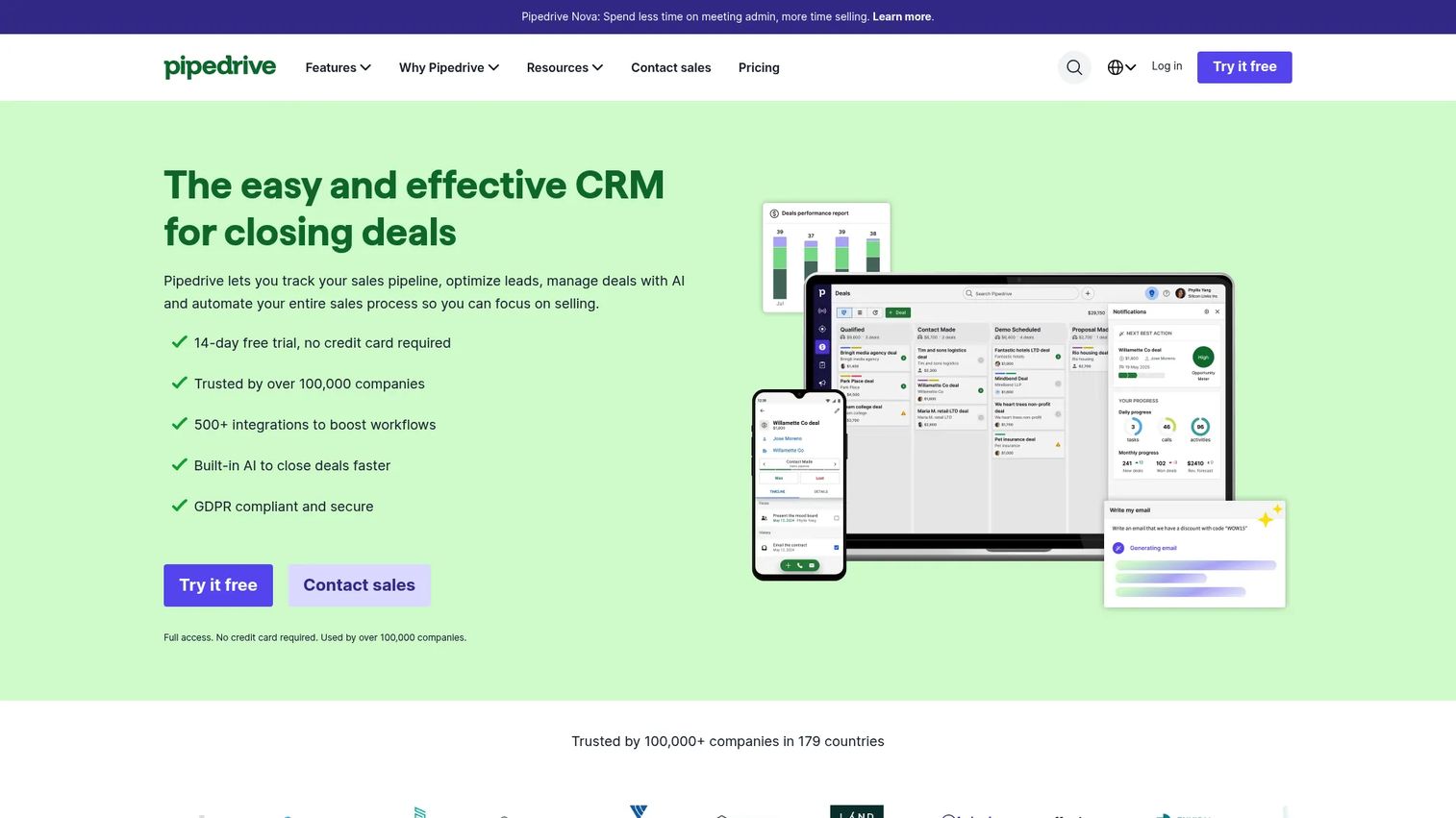
Pipedrive is a visual sales CRM focused on pipeline management, activity tracking, and workflow automation. Small brokerages and lean loan officer teams use it when the primary need is clean deal hygiene and task discipline rather than mortgage-native milestone management. It covers contact management, email sync, automation rules, and reporting. Its adoption curve is low, which makes it useful as a foundation before a team is ready for a more complex platform.
Best for: Small brokerages and lean loan officer teams that need a straightforward pipeline CRM with low administrative overhead.
Key features
- Visual sales pipeline and deal management
- Activity reminders and task tracking
- Contact management with email synchronization
- Workflow automation rules
- Sales reporting and revenue dashboards
Why choose Pipedrive: It is a practical choice when pipeline discipline and adoption are the immediate priority. It becomes less compelling as the business grows to need mortgage-native milestone management, specialized LOS integrations, or large-scale borrower marketing.
Pipedrive pricing: Lite starts at $14 per seat per month billed annually. Growth is $39 per seat per month. Premium is $59 per seat per month. A free 14-day trial is available.
G2 rating: 4.3/5
12. monday CRM
monday CRM is a configurable CRM platform built on monday.com's work management foundation. It uses custom boards, automations, and dashboards to model sales and operational processes without forcing teams into a rigid data structure. Mortgage teams that have a clear, documented process and need flexible execution and cross-functional visibility across sales, operations, and marketing can use it effectively. Mortgage-specific compliance controls and deep LOS connectivity require validation before treating it as a primary lending system.
Best for: Mortgage teams that want configurable sales and operational workflows without committing to a large enterprise CRM implementation.
Key features
- Custom CRM boards and lead tracking views
- Workflow automations and cross-functional visibility
- Email synchronization and activity management
- Shared team dashboards and sales forecasting
- Lead capture, enrichment, and scoring
Why choose monday CRM: It fits teams with a well-defined process that need flexible execution and shared visibility across functions. Teams that need mortgage milestone management or compliance-specific communication controls should validate those capabilities directly with the vendor before purchasing.
monday CRM pricing: Basic starts at £10 per seat per month billed annually. Standard is £14 per seat per month. Pro is £24 per seat per month. Ultimate requires a custom quote. Pricing varies by billing country and team size.
G2 rating: 4.5/5
Considerations when choosing mortgage CRM software
Choose mortgage-native depth before buying flexibility
A mortgage-specific platform shortens workflow design because loan milestones, partner tracking, and compliant campaign templates are built in. A general CRM can match that depth when the team has operations ownership and implementation capacity. The right question: Can your team configure and maintain a general CRM without pulling engineering or RevOps off higher-value work?
Validate your LOS and POS connections first
Build a one-page integration map before booking demos. Include your loan origination system, point of sale, pricing engine, dialer, SMS provider, marketing automation platform, and reporting tools. Confirm the exact data that syncs, sync direction, update frequency, and who owns the integration when it breaks. This single step eliminates more regret than any feature comparison.
Price the operating model, not only the subscription
A platform that costs $95 per user per month may require separate dialing tools, SMS overage charges, data migration fees, and professional services. Total cost covers onboarding, admin time, integration work, and any external tools the CRM does not replace. Run a full first-year cost estimate, not just the monthly subscription.
Test reporting against your weekly operating cadence
In the first week of a trial, run this test: Can a manager answer lead source, first-response time, stage aging, loan officer activity, referral performance, and post-close engagement from native dashboards without exporting spreadsheets? If the answer is no, assume it will always require manual reporting.
Treat compliance workflows as a product requirement
Validate consent management, communication controls, permission structures, auditability, and retention practices before signing a contract. This article does not constitute compliance advice. Route specific regulatory questions to your own legal and compliance team.
Conclusion
The right mortgage CRM depends on what is actually broken in your current operating model.
Jungo fits Salesforce-based mortgage operations that want mortgage-specific depth without a full custom build. Total Expert and Surefire CRM solve the lender lifecycle engagement problem at scale. Shape, Aidium, BNTouch, Bonzo, and LoanOfficer.ai each address specific mortgage-focused lead and relationship workflows, with LoanOfficer.ai standing out for smaller teams that want AI-assisted operations at a predictable price.
Salesforce and HubSpot give larger organizations configurable foundations, but both require meaningful implementation investment to serve mortgage workflows well. Pipedrive and monday CRM work for lean teams that need pipeline discipline before they are ready for mortgage-native complexity.
Pick three platforms from this list. Map each against your current lead flow, LOS connections, referral process, and post-close motion. Then run the same five workflows in each product before you sign a contract.
Start your journey with Guideflow today!
FAQs about mortgage CRM software
The best fit for a loan officer depends on whether the primary need is lead response automation, referral partner management, post-close nurture, or a simple personal pipeline. Mortgage-native platforms like BNTouch, LoanOfficer.ai, and Bonzo address specific loan officer workflows with shorter adoption curves. The right tool is the one that matches the loan officer's actual bottleneck, not the most full-featured option on the market.
A mortgage CRM should cover lead capture and routing, borrower and partner records, loan-stage pipeline tracking, email and SMS automation, LOS or POS connections, consent and compliance controls, and post-close nurture capabilities. Requirements shift based on team size, loan volume, and whether the business runs a sales-led or marketing-led growth motion. Smaller brokerages may not need enterprise reporting; multi-branch lenders almost certainly do.
Mortgage-native platforms reduce workflow configuration because compliant campaigns, loan milestone tasks, and referral tracking are built in. General CRMs provide more flexibility when a team has unique processes, technical resources, and broader GTM needs. The cost of customization versus the value of flexibility is what drives that decision. Organizations without dedicated CRM admin capacity typically get faster time-to-value from a mortgage-specific platform.
Many platforms offer direct integrations, partner integrations, or API-based connections to common LOS platforms. Validate the exact data that syncs, the direction of that sync, update frequency, and error handling before treating an integration as production-ready. LOS integrations that look complete on a demo often require additional configuration or maintenance once they go live.
Mortgage CRM pricing ranges from individual-user subscriptions under $100 per month to enterprise contracts that require a quote. The full cost includes implementation, data migration, seats, SMS and calling usage, integration work, training, and any external marketing or dialer tools the platform does not replace. Plan for first-year total cost, not just the monthly subscription rate.
Yes, when data quality, consent management, and campaign discipline are in place. Post-close workflows can include refinance opportunity alerts, anniversary outreach, homeowner education content, and referral request campaigns. The results depend more on the quality of the underlying contact data and the consistency of execution than on the platform itself.
Small brokerages should prioritize adoption speed, clean pipeline visibility, lead follow-up discipline, and pricing transparency. BNTouch, Pipedrive, and LoanOfficer.ai each offer accessible entry points. Avoid enterprise-complexity platforms before the team has standardized its core process. A tool that nobody uses consistently creates more operational damage than the gap it was supposed to fill.
Ask the vendor to demonstrate these specific workflows using a real operating sequence: Lead capture and ownership assignment, pipeline status changes triggered by LOS events, automated borrower communication triggered by a milestone, referral partner attribution, management reporting without manual exports, permission controls for different roles, and a post-close campaign triggered by a funded loan. If the demo stays on generic features and avoids these walkthroughs, the platform may not support them in practice.