

You picked a platform to launch fast. It worked. Boxes shipped, subscribers renewed, revenue came in.
Then the cracks showed. Failed payments piling up with no recovery logic. A checkout you cannot change without a developer. Reporting scattered across three tools. Every workaround you stacked at launch is now a tax on every deal.
The global subscription box market is projected to reach roughly $45.3 billion in 2026, per Statista's Global E-Commerce Outlook cited by Amra & Elma. Growth like that punishes the wrong platform choice. The bigger you get, the more expensive a migration becomes.
That is the real decision here. Not which tool looks best at launch, but which one keeps working when you have 5,000 subscribers, a churn problem, and a board asking why net revenue retention slipped. Pick for the stage you are heading toward, not the one you are leaving.
What's inside
This guide is for founders and operators choosing a subscription box platform to launch or to migrate onto. We compared seven tools built for recurring commerce, from subscription-first storefronts to full recurring billing systems.
We chose items on four criteria that matter when you scale:
- Subscription fit and checkout control
- Automation, AI insights, and retention tooling
- Integration depth and API access
- Pricing and migration effort
Each entry lists what it does well, who it fits, verified pricing, and its G2 rating where available.
TL;DR
- Best for subscription-first commerce: Subbly. An all-in-one storefront and checkout built for subscription businesses from day one.
- Best for complex recurring billing and retention ops: Recurly. Deep dunning, payment recovery, and revenue recognition for scaling revenue operations.
- Best for teams already committed to Shopify: Shopify. A broad commerce base you extend with a Shopify subscription app.
- Best for custom builds and storefront control: WooCommerce. Open-source flexibility on WordPress for teams with technical resources.
- Best for marketplace-style exposure: Cratejoy. Hosted commerce plus a subscription box marketplace for discovery.
- Best for lightweight subscriptions on existing stores: Bold Commerce. Add subscriptions without rebuilding your storefront.
- Best for simple recurring payment flows: PayWhirl. Embeddable checkout and customer self-service for smaller operations.
What is subscription box software?
Subscription box software is a category of tools that help businesses sell, manage, and retain recurring subscription products. It combines the storefront, the recurring billing engine, and the retention logic that keeps subscribers paying month after month.
Unlike generic commerce software, a subscription commerce platform is built around the subscriber lifecycle: sign-up, renewal, pause, skip, upgrade, and cancel. That lifecycle is where recurring revenue lives or dies.
Core capabilities of subscription management software include:
- Recurring billing and plan management: automated renewals, tiers, add-ons, and one-time purchases handled from one system.
- Checkout customization: branded, no-code checkout flows built for subscription sign-up rather than single transactions.
- Subscriber lifecycle automation: pause, skip, swap, and upgrade flows that reduce cancellations.
- Churn reduction and dunning: retry logic and payment recovery for failed cards, plus win-back sequences.
- Integrations and APIs: connections to payment gateways, fulfillment, analytics, and your existing stack, with API and webhook support for custom workflows.
Think of it as category-level infrastructure for subscription commerce, not just a storefront skin. Recurring billing software and subscription billing software sit inside this category, sometimes as the whole platform, sometimes as one layer of it.
When to use subscription box software
Launch a subscription box business without stitching together plugins
Specialized subscription software collapses the setup. Instead of wiring a generic cart to a billing plugin to a fulfillment tool, you get storefront, checkout, and recurring billing in one place. That reduces the number of things that break and the number of tools you pay for. For a founder who wants a repeatable system rather than a fragile stack, a subscription-native platform removes most of the launch risk.
Migrate from a brittle starter stack
Founders outgrow ad hoc setups fast. Manual billing, spreadsheet reconciliation, and a checkout duct-taped from three apps work until they do not. The signal is usually operational: failed payments you cannot recover, reporting you cannot trust, and a checkout you cannot change without engineering. When workarounds start eating a real share of your team's time, migration to a purpose-built platform pays for itself.
Improve retention and reduce billing churn
Involuntary churn is quiet and expensive. A card expires, a payment fails, and a subscriber you already won silently drops. The right platform runs retry logic, sends dunning emails, and offers pause or skip instead of cancel. Those mechanics protect customer retention without a single new acquisition dollar. For any subscription business past early traction, retention tooling is the highest-leverage line item in the stack.
Comparison table
We scored each platform on subscription fit, checkout control, retention tooling, pricing, and G2 rating. Pricing reflects each vendor's public pricing page as of August 2026. Ratings come from each tool's current G2 listing. Use this to shortlist, then read the full sections for stack fit.
| # | Product | Best for | Key differentiator | Pricing | G2 rating |
|---|---|---|---|---|---|
| 1 | Subbly | Subscription-first commerce | All-in-one subscription storefront and checkout | From $14/mo | 4.8/5 |
| 2 | Recurly | Complex recurring billing and retention | Dunning, payment recovery, revenue recognition | From $249/mo + 0.9% | 4.0/5 |
| 3 | Shopify | Teams committed to Shopify | Broad commerce base plus subscription apps | From $29/mo | 4.4/5 |
| 4 | WooCommerce | Custom, self-hosted storefronts | Open-source flexibility on WordPress | Free core | 4.4/5 |
| 5 | Cratejoy | Marketplace-style exposure | Subscription box marketplace plus hosted commerce | From $59/mo + fees | Not listed |
| 6 | Bold Commerce | Lightweight subscriptions on Shopify | Checkout and subscription apps for existing stores | From $19.99/mo | 3.5/5 |
| 7 | PayWhirl | Simple recurring payment flows | Embeddable checkout and self-service | Free plan available | 4.2/5 |
Best subscription box software for 2026
1. Subbly
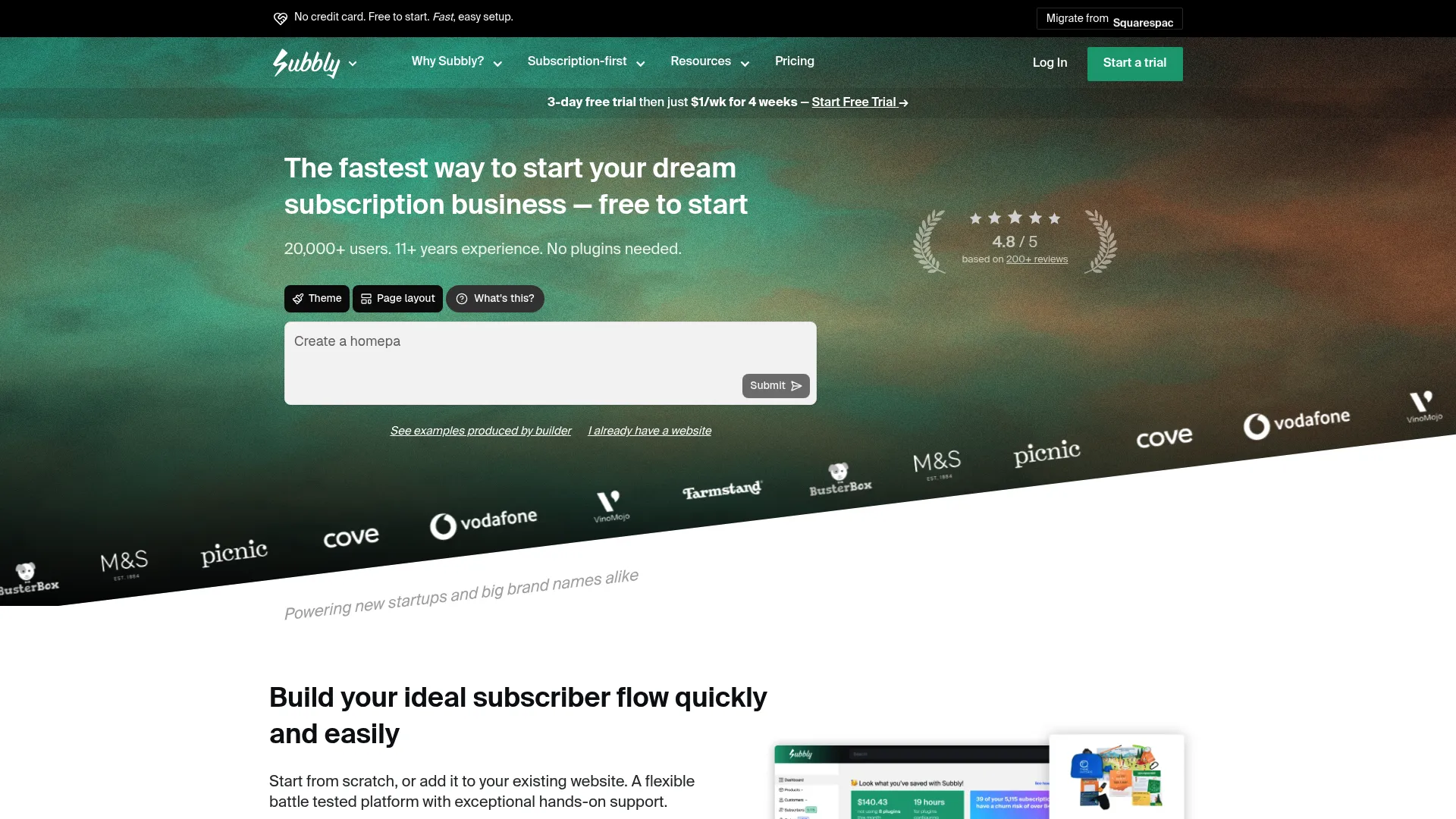
Subbly is a subscription-first commerce platform built for subscription businesses from the ground up. Where most tools bolt subscriptions onto a general cart, Subbly starts with the recurring model and works outward. You get a no-code website builder, a custom checkout, and support for subscription, one-time, and add-on purchases in one system. That makes it a strong fit for founders who want subscription-native infrastructure rather than a stack of plugins.
The platform covers the full subscriber lifecycle. Automation, analytics, and retention tools handle renewals, dunning, and win-back flows without a separate billing layer. Multi-language support and an embeddable checkout give you room to grow across markets and surfaces. For a founder building a repeatable operation, the appeal is fewer moving parts and one place to manage the whole subscription-first commerce motion.
Best for: Subscription box brands that want an all-in-one storefront and checkout without wiring together separate tools.
Key strengths
- No-code website builder
- Embeddable, custom checkout
- Subscription, one-time, and add-on purchases
- Multi-language support
- Automation, analytics, and retention tools
Why choose Subbly: If your business is subscriptions first and storefront second, Subbly matches that priority natively. You spend less time gluing systems together and more time on the subscriber experience.
Subbly pricing: Plans start at $14/month (Lite), then $29/month (Basic), $59/month (Subbly), and $119/month (Advanced). Subbly X starts from $499/month. A 14-day free trial is available.
2. Recurly
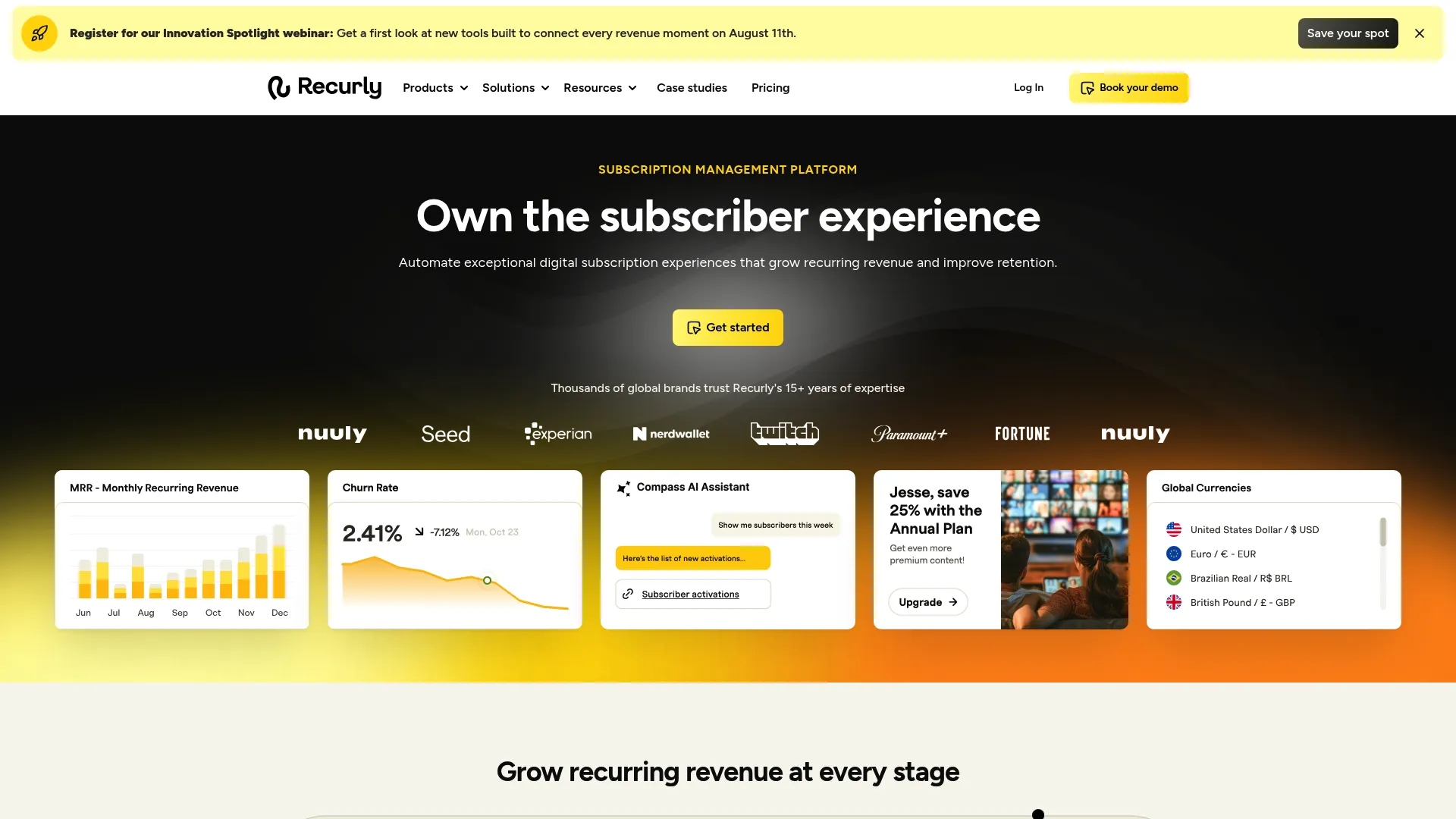
Recurly is a subscription management and recurring billing platform for businesses that need serious billing, payments, and revenue operations. It is less a storefront and more the engine behind one. If your subscription box business has grown into complex plans, multiple currencies, and revenue recognition requirements, Recurly is built for that reality.
The strength here is retention and recovery. Dunning and churn-prevention tools chase failed payments automatically, which directly protects recurring revenue. Flexible plans and pricing, multiple payment gateways, custom reporting, and revenue recognition round out a platform aimed at operators who treat billing as core infrastructure. A Shopify integration lets it sit alongside an existing storefront rather than replace it. For a founder trying to fix churn and clean up billing data before a fundraise, that depth matters.
Best for: Subscription businesses that need a scalable recurring billing and revenue operations platform.
Key strengths
- Automated global subscription billing
- Flexible plans and pricing
- Dunning and churn-prevention tools
- Multiple payment gateways and methods
- Custom reporting and analytics
- Revenue recognition and compliance
Why choose Recurly: Choose Recurly when billing complexity and payment recovery are the bottleneck, not storefront design. It is the layer that keeps recurring revenue clean at scale.
Recurly pricing: The Starter plan is $249 per month plus 0.9% of billing volume. Higher tiers include Engage at $1,600 per month and RevRec at $850 per month, billed annually. All-Access plans are priced as a percentage of billing volume.
3. Shopify

Shopify is a commerce platform for building and running online and in-person stores. It is not subscription-native on its own, but it is the base that many subscription businesses build on because of its reach and app ecosystem. You add recurring functionality through a Shopify subscription app, then keep the broader commerce, checkout, and POS layer that Shopify handles well.
That is the tradeoff to understand up front. You get strong brand control, a huge integration ecosystem, and a checkout many buyers already trust. In exchange, your subscription logic lives in an app layer rather than the core platform, so the depth depends on the app you choose. For teams already committed to Shopify with moderate subscription needs, that path keeps one commerce stack instead of two.
Best for: Merchants that want one platform for ecommerce, checkout, and POS, with subscriptions added on top.
Key strengths
- Online store builder with themes and apps
- Large app and integration ecosystem
- Shopify POS for in-person selling
- Shopify Checkout and Shopify Payments
Why choose Shopify: Pick Shopify when broad commerce flexibility matters more than subscription-native depth. It is the safe base when subscriptions are one part of a wider store.
Shopify pricing: Basic is $29/month, Grow is $79/month, and Advanced is $299/month on yearly billing. Plus starts at $2,300/month. Shopify offers a 3-day free trial, then $1/month for the first three months.
4. WooCommerce
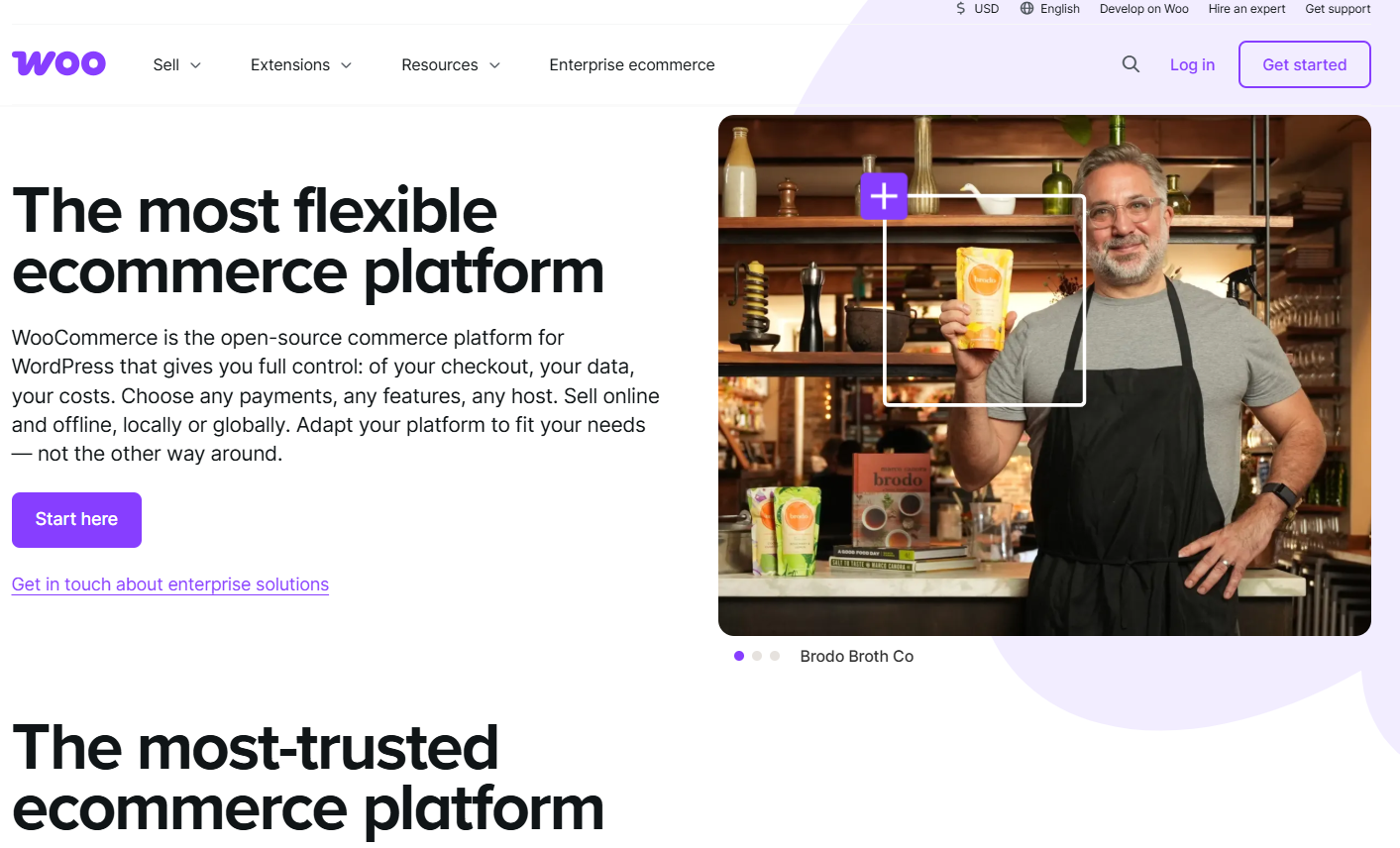
WooCommerce is an open-source ecommerce platform for WordPress. It gives you the most control of any tool on this list, because you own the code and the hosting. Subscriptions come through official and third-party extensions, so you assemble the exact stack your workflows need rather than accepting a fixed feature set.
That control is the point and the cost. WooCommerce fits teams with technical resources who want custom storefront behavior, custom checkout, and full data ownership. Payments, shipping, tax, and multi-currency support are all available, and the plugin ecosystem is deep. Because it is self-hosted, migration and maintenance sit with you, which is a feature for teams that want to avoid platform lock-in and a real consideration for those without engineering bandwidth.
Best for: WordPress-based businesses that want a flexible, self-hosted store with full customization.
Key strengths
- Free, open-source core platform
- Customizable design and extensions
- Payments, shipping, tax, and multi-currency support
- Deep plugin ecosystem
- Full data and code ownership
Why choose WooCommerce: Choose WooCommerce when custom control and ownership outweigh convenience. It rewards teams that have the technical resources to build and maintain their own stack.
WooCommerce pricing: The core platform is free. Real costs come from hosting at $25 to $350/month and optional extensions at $29 to $299/year, plus payment processor fees.
5. Cratejoy
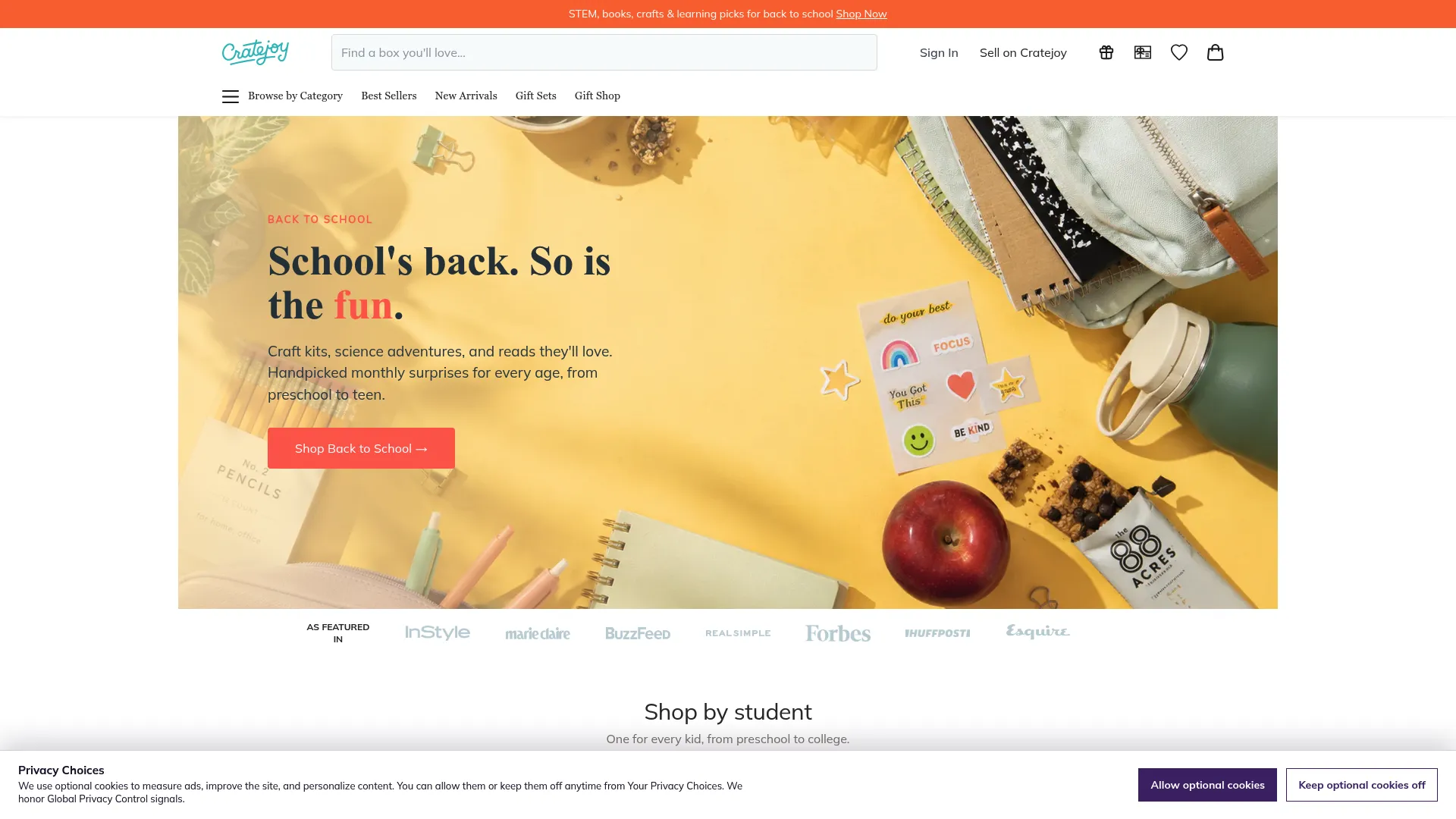
Cratejoy is an all-in-one subscription box marketplace and platform for selling subscription boxes. Its distinguishing feature is discovery. Beyond hosted commerce tools, Cratejoy runs a marketplace where shoppers actively browse for boxes, which gives new brands exposure they would otherwise have to buy.
That marketplace exposure is the reason to consider it and the reason to think carefully. You get a custom website and checkout plus renewal, shipping, and customer management tools, all purpose-built for the box model. The marketplace path is attractive when you want a channel for acquisition on day one. Brand control matters more when you want customers to know you rather than the marketplace. Many operators use both, listing on the marketplace while building a branded storefront alongside it.
Best for: Subscription box businesses that want marketplace discovery alongside hosted commerce tools.
Key strengths
- Subscription box marketplace exposure
- Custom website and checkout
- Renewal, shipping, and customer management
- App integrations
- Advanced dunning on higher tiers
Why choose Cratejoy: Choose Cratejoy when discovery through a marketplace is worth pairing with your own storefront. It gives box brands an acquisition channel most platforms cannot.
Cratejoy pricing: Essentials is $59/month paid yearly, and Advanced is $159/month paid yearly. Both plans add 1.25% plus $0.10 transaction fees. Advanced adds TaxJar integration, advanced dunning, a referral app, and priority support.
6. Bold Commerce

Bold Commerce is commerce software focused on checkout, subscriptions, pricing, and upsell tools, primarily for Shopify merchants. Its value is additive. If you already run a store and want to add recurring revenue without rebuilding, Bold's subscription app plugs into your existing storefront and product pages.
That makes it a good fit for merchants testing subscriptions as a new revenue line rather than betting the whole business on the model. Bold sells a range of products, including headless and agentic checkout, subscriptions, memberships, upsell, custom pricing, discounts, and bundles. Because each product has its own scope, you adopt only the piece you need. Developer docs and integrations support teams that want to extend beyond the defaults. For a lightweight recurring model layered onto an existing catalog, that flexibility keeps the change small.
Best for: Shopify merchants adding subscriptions and pricing controls without rebuilding their storefront.
Key strengths
- Checkout products including headless and agentic checkout
- Shopify subscription and membership apps
- Upsell, custom pricing, discounts, and bundles
- Accounting integrations including QuickBooks and Xero sync
- Developer docs and integrations
Why choose Bold Commerce: Choose Bold when you want to add subscriptions and checkout controls to an existing store with minimal disruption. It layers on rather than replacing what works.
Bold Commerce pricing: Pricing varies by product. Bold Discounts, for example, offers a free Sandbox and Dev Shop tier and a paid Basic tier at $19.99/month. Other Bold products carry separate pricing pages.
7. PayWhirl
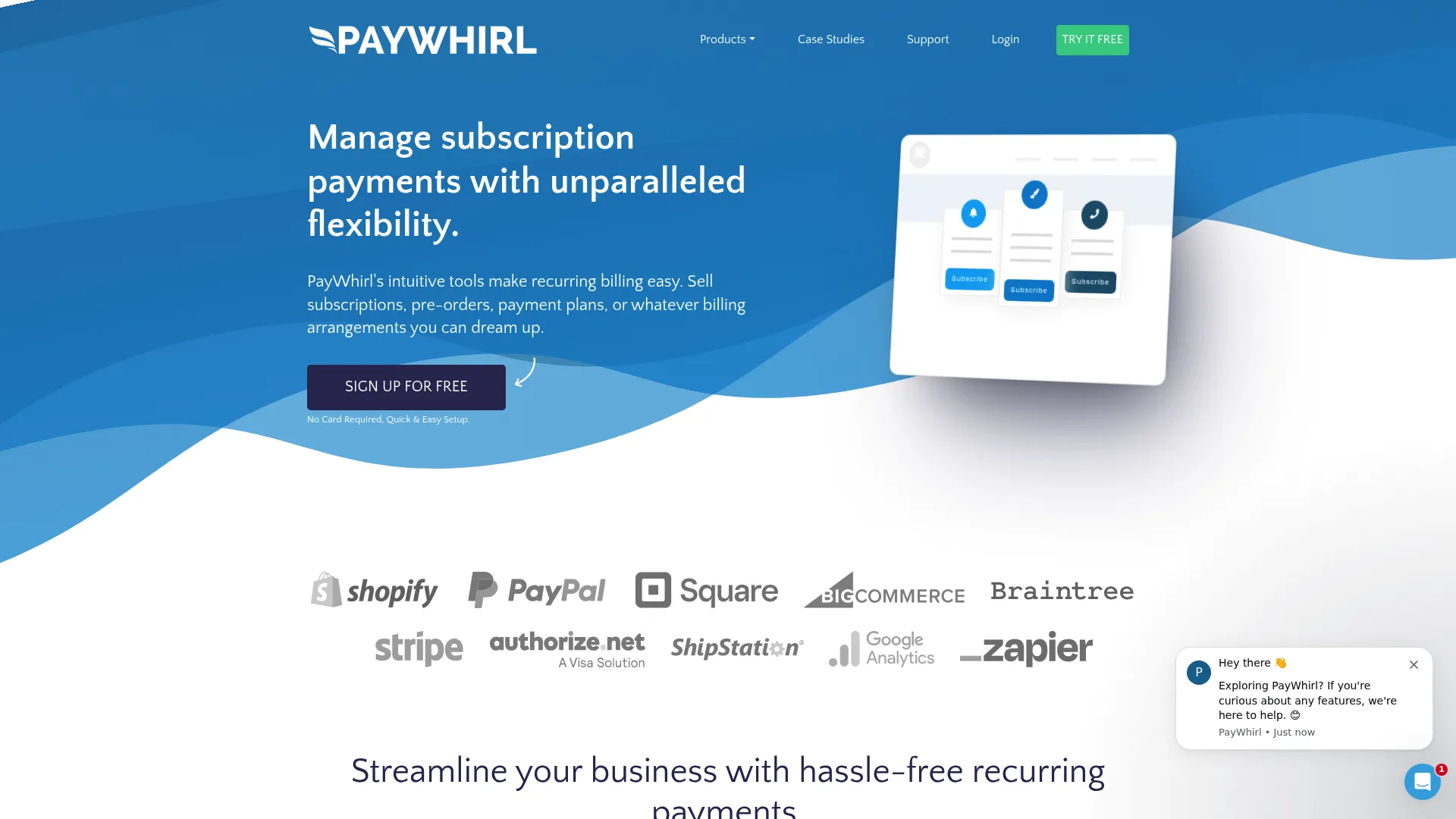
PayWhirl is a recurring billing and subscription payments platform aimed at businesses that want straightforward recurring revenue without heavy overhead. It focuses on the payment layer: recurring billing, one-time payments, embedded payment widgets, and customer self-service. That makes it a clean fit for smaller teams or simpler subscription operations.
The appeal is simplicity and a low starting cost. Embeddable checkout widgets drop into an existing site, and customer self-service reduces the support load of managing subscriptions manually. For a founder running a lean operation who needs reliable recurring payments and a way for customers to manage their own plans, PayWhirl covers the essentials without the complexity of a full revenue operations platform. As needs grow, higher tiers add capacity.
Best for: Businesses needing subscription billing with embeddable checkout and customer self-service.
Key strengths
- Recurring billing and subscriptions
- One-time payments
- Embedded payment widgets and checkout
- Customer self-service portal
Why choose PayWhirl: Choose PayWhirl when you want recurring payments and self-service without a full platform migration. It keeps simple subscription operations simple.
PayWhirl pricing: The Starter plan is free. Paid plans are Business Pro at $49/month, Business Plus at $149/month, and Business Ultimate at $249/month. Enterprise is custom priced. Transaction fees apply on plans.
Considerations
Before you commit, run each shortlisted platform against the criteria that decide long-term fit, not just launch speed.
Check checkout flexibility
Your checkout is where sign-ups convert or die. Verify whether the platform gives you branded, no-code checkout control or locks you into a fixed flow. Test whether you can add trials, gifts, add-ons, and custom fields without a developer. A rigid checkout looks fine at launch and costs conversions at scale.
Evaluate retention and billing recovery
Involuntary churn is the churn you can actually fix with software. Confirm the platform runs dunning, smart retry logic, and payment recovery for failed cards. Check for pause, skip, and swap flows that give subscribers an alternative to canceling. These mechanics protect recurring revenue you already earned.
Map the platform to your commerce stack
Your platform has to fit the stack you already run. If you are on Shopify, weigh a Shopify subscription app against a dedicated platform. If you are on WordPress, WooCommerce keeps everything in one place. Map integrations to your fulfillment, analytics, and finance tools before you sign.
Look at API and extensibility depth
No-code is enough for most launch and growth stages. But as you add custom logic, you will hit the edge of what a visual builder allows. Check for API and webhook support so your team can automate and extend later. The right ceiling now prevents a forced migration later.
Confirm migration effort
Migration is the cost nobody budgets for. Ask how subscriber data, payment tokens, and active plans transfer. Confirm whether the vendor provides migration support or templates, and estimate time to launch honestly. The cleaner the migration path, the lower the risk of choosing wrong.
Conclusion
The right pick depends on the stage you are building toward. For a subscription-first business that wants one native system, Subbly is the cleanest all-in-one choice. For complex recurring billing, dunning, and revenue recognition at scale, Recurly is the engine. If you are committed to Shopify, extend it with a subscription app; if you want full control and own your stack, WooCommerce delivers it. Cratejoy adds marketplace discovery, Bold Commerce layers subscriptions onto existing stores, and PayWhirl keeps simple recurring payments simple.
The wrong choice is rarely wrong at launch. It becomes wrong at 5,000 subscribers, when migration is expensive and churn is compounding. Pick for the operation you are scaling into.
Your next step is short: shortlist two platforms that match your stack, run their free trials, and test the checkout and retention flows with real sign-up scenarios before you commit.
Start your journey with Guideflow today!
FAQs
For a small business launching fast, Subbly is the strongest all-in-one choice because storefront, checkout, and billing come in one subscription-native system starting at $14/month. If you only need recurring payments on an existing site, PayWhirl's free Starter plan is a lighter option. Match the tool to your stack and stage, not to the longest feature list.
Yes, with a caveat. Shopify is not subscription-native, so you add recurring functionality through a Shopify subscription app. That works well when you want a broad commerce base with strong brand control and moderate subscription needs. If subscriptions are the core of your business, a subscription-first platform may fit the model more directly.
Prioritize checkout customization, subscriber lifecycle automation, and churn reduction through dunning and payment recovery. These three decide whether subscribers sign up, stay, and keep paying when cards fail. Integration depth and API and webhook support matter more as you scale and add custom logic.
Yes, though effort varies. The key questions are how subscriber data, payment tokens, and active plans transfer to the new platform. Ask each vendor about migration support and templates before you commit. The cleaner the migration path, the lower the risk of switching costs later.
They help most with involuntary churn, which comes from failed payments rather than unhappy customers. Platforms with dunning, smart retry logic, and payment recovery win back revenue you already earned. Pause, skip, and swap flows also give subscribers an alternative to canceling outright.
Subbly offers an embeddable, no-code custom checkout built for subscriptions. WooCommerce gives full checkout control for teams with technical resources. Bold Commerce and PayWhirl provide embeddable checkout that layers onto existing stores, while Shopify's checkout customization depends on the subscription app you add.
Subscription box software usually covers the full stack: storefront, checkout, and recurring billing built around the box model. Billing software, such as recurring billing software or subscription billing software, focuses on the payment and revenue layer only. Platforms like Recurly and PayWhirl lead with billing, while Subbly and Cratejoy bundle billing into a complete commerce platform.