Business travel spending is forecast to reach $1.71 trillion globally in 2026, according to the Global Business Travel Association. That number is useful context for one reason: Most of that spend runs through employees booking flights on personal cards, submitting receipts a week later, and waiting for reimbursement while finance tries to reconcile the burn report.
At Series B, this stops being an inconvenience and starts being an operational problem. Sixty percent of travel managers say their companies are increasing compliance with prescribed booking processes specifically to control costs, per Deloitte's 2025 corporate travel study. The founder who is still approving trips in Slack and chasing card statements is not building a scalable operating system. The one who picked the right business travel software stopped doing that in week one.
Travel management software gives finance visibility before spend happens, gives employees self-service booking within guardrails, and gives leadership clean data for board-ready reporting. Getting the choice wrong means another tool nobody adopts. Getting it right means one fewer operational bottleneck.
What's inside
This guide is for founders, finance leads, and operations leaders evaluating corporate travel management software for scaling SaaS teams.
- 15 platforms compared across booking, policy, expenses, reporting, and support
- How each tool fits different company stages: Ad hoc, policy-managed, and mature travel programs
- Comparison table with verified pricing and G2 ratings
- Selection criteria: Booking coverage, policy controls, expense workflow, finance integrations, and traveler adoption
Tools were chosen based on verified feature coverage, current G2 ratings, publicly available pricing, and relevance to scaling SaaS teams ranging from 30 to 500 employees.
TL;DR
- Best overall for modern business travel: Navan combines booking, corporate cards, expense management, and policy controls in one workflow, making it a strong default for Series B teams moving off ad hoc travel.
- Best for flexible travel programs: TravelPerk (now Perk) offers broad global inventory with a free starter plan and per-booking fees, good for teams that want flexibility before committing.
- Best for HR-connected travel and spend: Rippling ties travel and expense to HR, payroll, and approvals for companies already standardizing on its operating platform.
- Best for enterprise-grade programs: SAP Concur suits larger companies with complex policies, multi-region compliance, and ERP connectivity requirements.
- Best for hotel-heavy or project-based travel: Engine focuses on lodging and has a free base plan, while Roomex specializes in workforce accommodation for crews and field teams.
- Best free-tier expense option: Zoho Expense starts free for up to three users, with paid plans from $3 per user per month billed annually.
What is travel management software?
Travel management software is a business platform that helps companies book employee travel, enforce travel policy, manage approvals, track expenses, support travelers, and report on travel spend.
The category spans several distinct workflows:
- Booking inventory: Flights, hotels, cars, and rail, sometimes meeting space
- Traveler profiles: Loyalty numbers, documents, preferences, and payment methods
- Policy controls: Budget thresholds, approval routing, booking rules, and exception handling
- Expense management: Receipt capture, reimbursements, corporate cards, and accounting sync
- Reporting: Spend by team, traveler, project, and vendor
- Duty of care: Traveler location tracking, disruption alerts, and safety support
- Integrations: HRIS, ERP, accounting, payroll, and corporate card systems
There are three broad sub-types to understand before you buy:
Travel booking software focuses on search, booking, itinerary management, and traveler support. The expense workflow happens downstream, often in a different tool.
Travel and expense platforms combine booking with cards, receipt capture, reimbursements, and finance reporting in one system. This is where most scaling SaaS teams land.
Managed travel platforms add a travel management company layer: Dedicated agents, negotiated rates, and high-touch disruption support. These suit teams with executive travel complexity or global programs where software alone is not enough.
Knowing which sub-type fits your stage matters. A 40-person company with occasional travel has different needs than a 200-person team sending field reps and sales engineers to prospects every week.
When to use travel management software
Control spend before it hits the card statement
Finance should not be discovering travel budget leakage at month-end close. Travel management software puts policy controls before the booking happens: Budget thresholds, preferred supplier rules, approval routing, and real-time spend visibility. If your current state is employees booking on consumer sites and submitting receipts two weeks later, that is the clearest signal to act.
Give employees self-service booking without losing guardrails
Employees need to book, change, and manage trips without pinging a founder, assistant, or finance lead for every decision. The company still needs to know what is being spent, by whom, against which budgets. Good travel software handles both: A clean booking experience for the traveler, and policy-gated controls for finance.
Build board-ready travel reporting
Series B teams need travel data that connects to burn rate, department budgets, and gross margin conversations. Travel software that integrates with your accounting system, ERP, and HRIS means leadership sees spend patterns without stitching together card exports. Your new finance lead should be able to pull a clean travel spend report on day one, not after two months of setup.
Travel management software comparison
The table below covers practical buying criteria for scaling companies: Booking coverage, policy controls, expense workflows, and fit by stage. Pricing and G2 ratings reflect verified figures from each vendor's pricing page and G2 listing.
| # | Product | Best for | Key differentiator | Pricing | G2 rating |
|---|---|---|---|---|---|
| 1 | Navan | All-in-one travel and expense | Booking, cards, expenses, and policy in one workflow | Free for eligible companies; Expense from $15/user/mo | 4.6/5 |
| 2 | TravelPerk | Flexible global travel programs | Broad inventory, free starter plan, per-booking fees | Free plan + 5% per booking; Premium from $99/mo | 4.6/5 |
| 3 | Rippling | HR-connected travel and spend | Travel and expense tied to HR, payroll, and approvals | From $8/employee/mo (custom quote) | 4.8/5 |
| 4 | SAP Concur | Enterprise travel and expense | Mature global compliance, multi-level approvals, ERP connectivity | From $7 per expense report | 4.0/5 |
| 5 | Amex GBT Egencia | Managed corporate travel | High-touch global servicing with online booking tools | Custom pricing | N/A on G2 |
| 6 | Engine | Hotel-heavy business travel | Free base plan, lodging focus, group travel, Engine X card | Free; FlexPro at $299/mo or $2,999/yr | 4.4/5 |
| 7 | Zoho Expense | Cost-conscious expense-led teams | Free tier, AI receipt capture, travel desk management | Free up to 3 users; paid from $3/user/mo (annual) | 4.5/5 |
| 8 | TravelBank | Budget-aware travel with incentives | Savings incentives, corporate cards, 24/7 agent support | Plans from $5,000; custom enterprise pricing | 4.5/5 |
| 9 | Coupa | Procurement-led spend control | Travel and expense inside a broader spend management suite | Custom pricing | 4.2/5 |
| 10 | Emburse | Expense automation for finance teams | AP automation, cards, reimbursements across distributed teams | From $8/user/mo (Emburse Spend) | 4.4/5 |
| 11 | Webexpenses Travel | Mid-market booking and expense control | Pre-trip approvals, policy enforcement, carbon tracking | From £7.50/user/mo | 5.0/5 |
| 12 | Routespring | Centralized company-paid booking | Admin-led controls, company-paid travel, no employee fronting | Free up to 5 bookings/mo; from $49/mo | 4.9/5 |
| 13 | AmTrav | US business travel with agent support | Online booking plus US-based travel advisors available 24/7 | Custom pricing per customer | 4.8/5 |
| 14 | ITILITE | Travel and expense automation | Per-trip pricing, savings incentives, no platform fees | From $7/trip (with wallet); expense from $6/user/mo (annual) | 4.5/5 |
| 15 | Roomex | Workforce accommodation management | Free platform, lodging focus for crews and field teams | Free to sign up; selected hotels may incur fees | 5.0/5 |
Best 15 travel management software tools for 2026
1. Navan
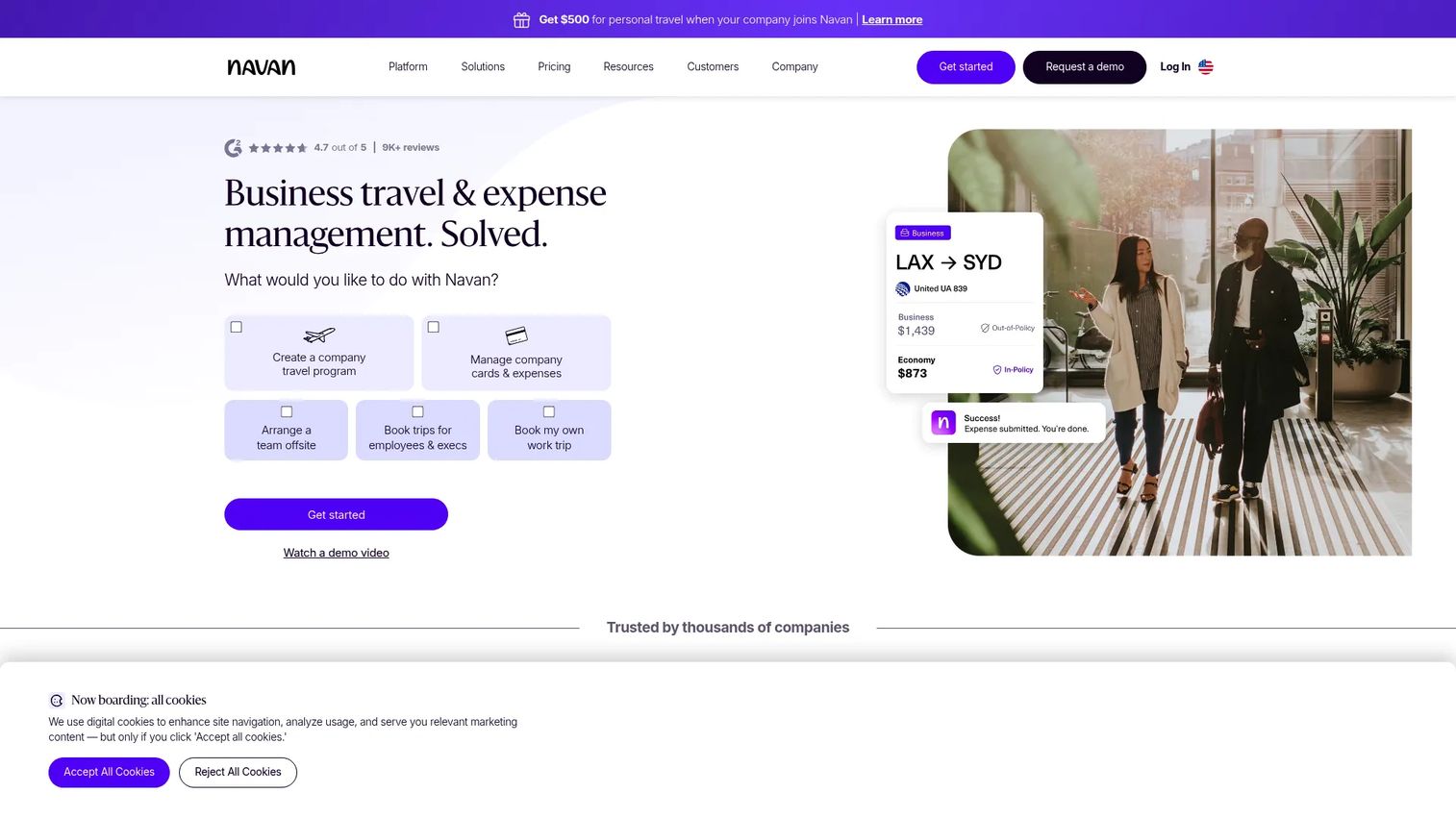
Navan is an AI-powered business travel and expense management platform that puts booking, policy controls, corporate cards, expense reporting, and spend analytics in one workflow. It is built for companies that want to stop managing travel through a patchwork of consumer booking sites, card exports, and spreadsheet reconciliations. Navan serves teams from small companies through enterprise accounts.
Best for: Series B and mid-market SaaS teams that want booking and expense data in one operating workflow, with strong traveler adoption.
Key features
- Flight, hotel, car, and rail booking with real-time policy checks
- Corporate cards and expense management with receipt scanning
- Approval workflows and real-time spend visibility
- Traveler support and itinerary management
- ERP and HRIS integrations for finance reporting
Why choose Navan: Navan makes sense when finance wants to eliminate the gap between booking and expense reporting. For a founder who is still the bottleneck on travel approvals, it replaces that loop with automated policy enforcement.
Navan pricing: Navan Travel is free for eligible companies with up to 300 employees. Navan Expense is free for the first five monthly expensing users, then $15 per user per month. Enterprise plans are quote-based.
G2 rating: 4.6/5.
2. TravelPerk
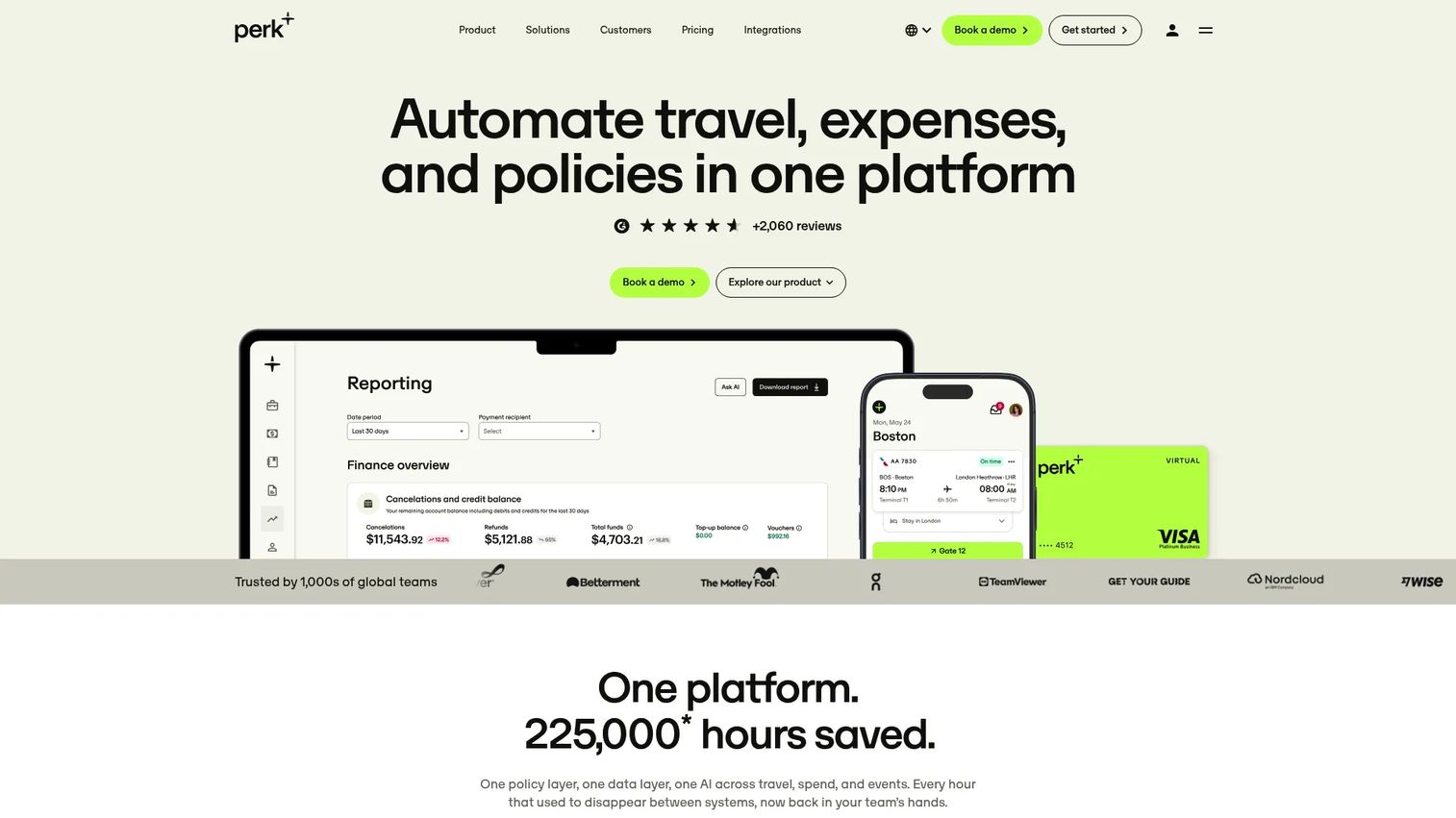
TravelPerk (rebranded to Perk) is a business travel and spend management platform covering flights, hotels, trains, and car rentals, with built-in policy controls, approval workflows, expense processing, and traveler care. It has one of the broader global booking inventories in the category and offers add-on flexibility protection through FlexiPerk, which lets travelers cancel trips and recover a portion of the cost. It fits distributed teams that want employee-friendly booking alongside finance-grade controls.
Best for: Companies that want global travel inventory, traveler flexibility, and a low-friction way to get employees booking within policy.
Key features
- Flights, hotels, trains, and car booking with policy guardrails
- Travel alerts, disruption rebooking, and duty of care
- Expense processing, receipt matching, and ERP integrations
- FlexiPerk for flexible cancellations
- Carbon reporting for sustainability tracking
Why choose TravelPerk: TravelPerk fits founders who want employees booking independently without routing every trip through an office manager or assistant. The free plan is a genuine starting point, not a feature-stripped demo.
TravelPerk pricing: The Starter plan is free with a 5% fee per booking. Premium runs $99 per month plus 3% per booking, and Pro is $299 per month plus 3% per booking. Per-user Travel and Spend plans are also available: Premium from $6 per active user per month plus 3% per booking.
G2 rating: 4.6/5.
3. Rippling
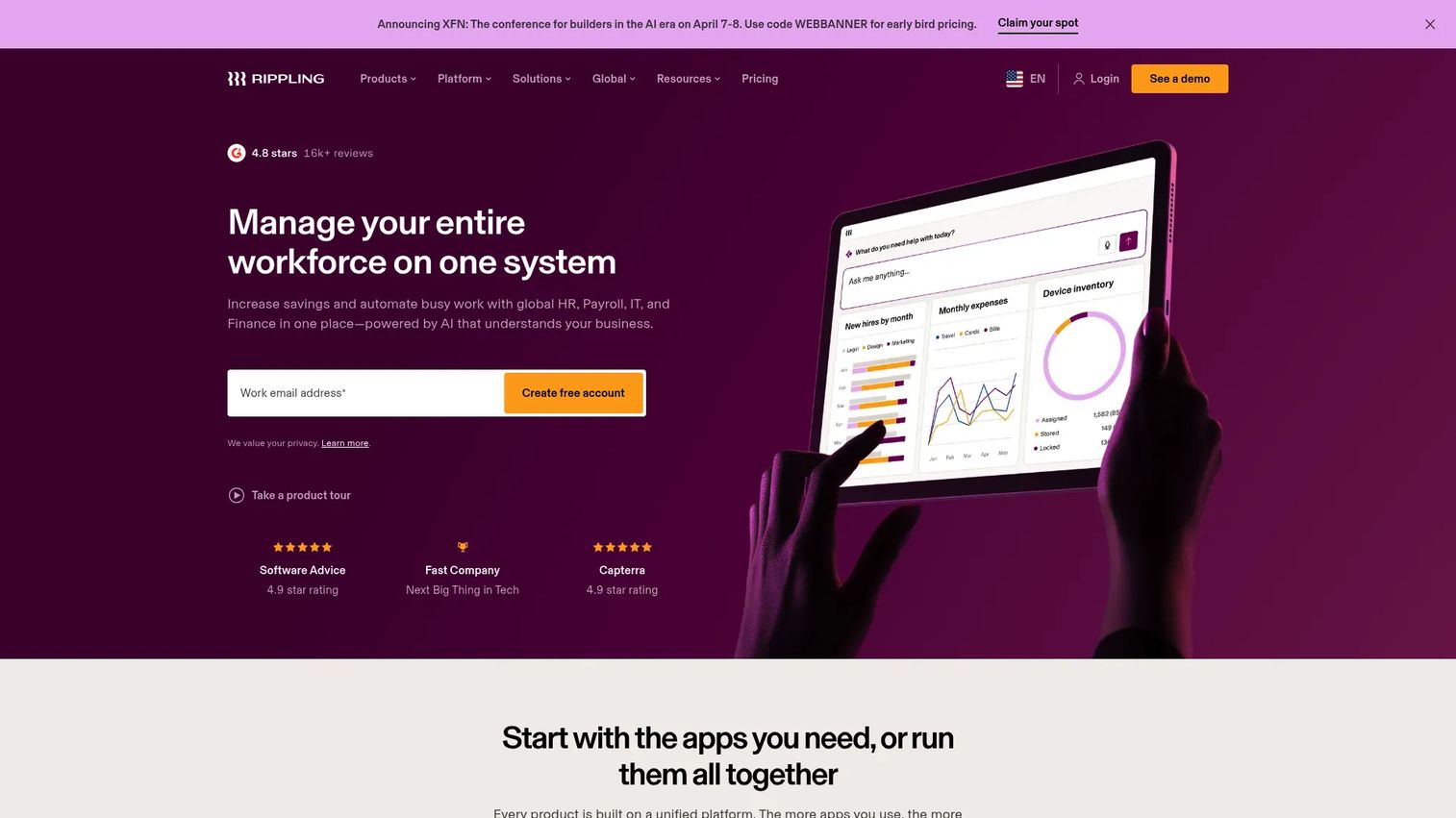
Rippling is a unified workforce management platform that covers HR, payroll, IT, and finance, with travel and expense management as part of its broader suite. Corporate cards, expense workflows, bill pay, and procurement sit alongside HRIS, benefits, and device management in one data model. For companies already standardizing on Rippling, adding travel and expense avoids another tool in the stack and keeps employee data connected to approval routing and spend controls.
Best for: SaaS companies that want travel and spend controls tied to HR and payroll, and are evaluating Rippling as a broader operating system.
Key features
- Corporate cards and expense management within the Rippling platform
- HR-connected approval workflows tied to employee roles and cost centers
- Payroll and accounting integrations for clean spend reporting
- Employee policy automation across travel, spend, and IT
- Global payroll and ERP connectivity for multi-entity companies
Why choose Rippling: The consolidation argument is the strongest case for Rippling travel. If your HR, payroll, and finance workflows already live there, adding travel and expense avoids integration overhead and keeps employee lifecycle data connected to spend.
Rippling pricing: Plans start at $8 per employee per month. Travel and expense are modular add-ons; the total cost depends on which products you select and team size. Request a custom quote from Rippling's sales team.
G2 rating: 4.8/5.
4. SAP Concur
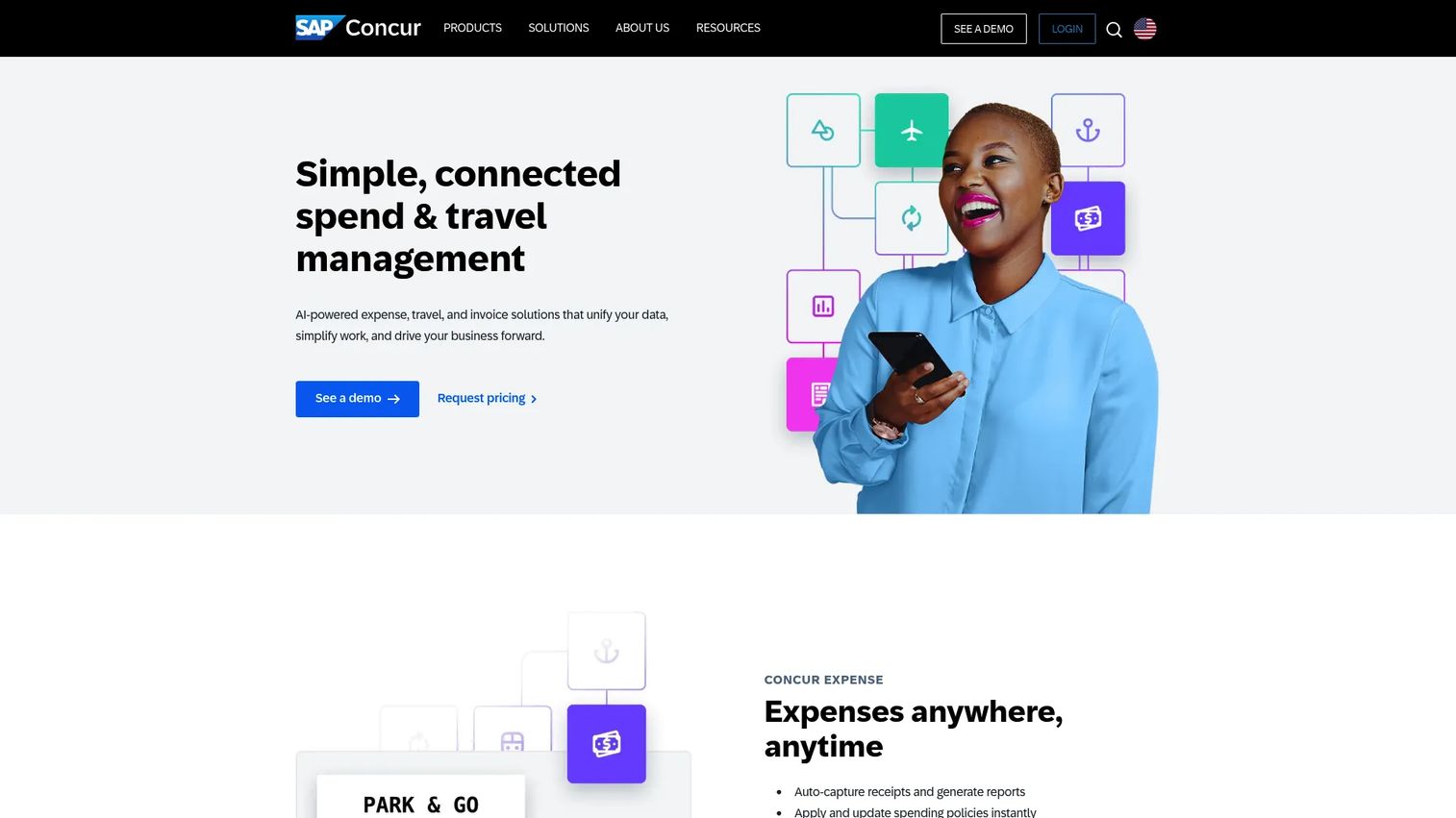
SAP Concur is a mature cloud-based platform that automates travel booking, expense reporting, invoice management, and spend controls. It covers multi-level approvals, compliance checks, audit trails, and ERP connectivity for companies with complex finance operations. SAP Concur is one of the most established tools in corporate travel management and suits organizations with global programs, regional compliance requirements, and finance teams that need auditability.
Best for: Larger companies with complex travel policies, global operations, and finance teams that require robust auditability and ERP integration.
Key features
- Corporate travel booking with policy enforcement and supplier integrations
- Expense reports, receipt capture, and automated reimbursements
- Multi-level approval workflows and compliance controls
- ERP and finance system integrations for accounting sync
- Audit trails and reporting across regions and entities
Why choose SAP Concur: SAP Concur is the enterprise-safe choice when auditability, global compliance, and ERP connectivity matter more than fast setup or low per-seat cost. For a Series B team, the question is whether the implementation weight is worth it at your stage.
SAP Concur pricing: The Base plan runs $7 per expense report. Plus is $11 per report and adds ExpenseIt and reporting. Premium includes Concur Travel and is priced by custom quote. Pricing can vary with monthly commitment.
G2 rating: 4.0/5.
5. Amex GBT Egencia
Amex GBT Egencia is a managed corporate travel platform combining an online booking tool with global traveler support, travel policy management, reporting, and risk management. It suits companies that want a traditional travel management company model augmented by software, including 24/7/365 servicing and dedicated support for disruptions, executive travel, and multi-region programs.
Best for: Companies that need high-touch managed travel and global traveler support beyond what a self-serve booking tool provides.
Key features
- Online booking for air, hotel, car, and rail
- Travel policy management and approval workflows
- Traveler risk management with tracking and alerts
- 24/7/365 customer support
- Reporting and travel program analytics
Why choose Amex GBT Egencia: Egencia fits when travel disruption, executive itineraries, and global servicing are real operational pain points, not just nice-to-haves. The human support layer is the differentiator compared to software-only platforms.
Amex GBT Egencia pricing: Egencia directs prospective customers to request a demo for pricing. Expect quote-based pricing driven by travel volume, service model, regions, and program complexity.
6. Engine
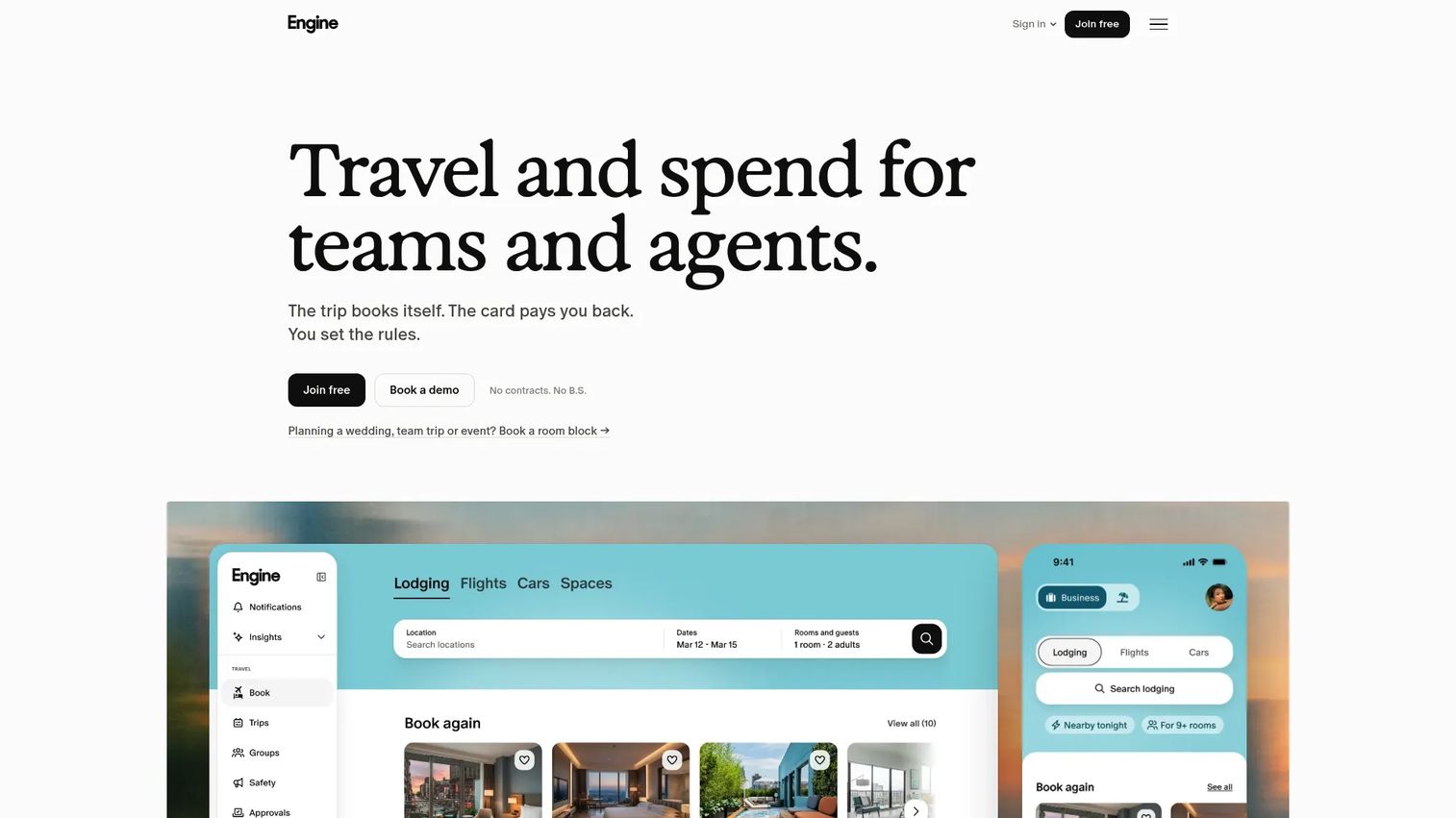
Engine is a business travel and spend management platform with a particularly strong lodging inventory, alongside flights, cars, group travel, and the Engine X business card. The free base plan covers core booking, and FlexPro adds last-minute changes and cancellations without fees. Engine works well for SaaS companies with field teams, customer site visits, or recurring event travel where hotel spend is the dominant cost.
Best for: Teams with hotel-heavy travel patterns, field operations, group events, or project-based lodging needs.
Key features
- Hotel, flight, and car booking with direct billing options
- Group travel management and rewards
- Engine X business card with spend controls
- Travel policies and real-time spend visibility
- Traveler support and meeting space booking
Why choose Engine: Engine is a practical choice when your travel spend skews heavily toward accommodation. The free tier is genuinely usable, and FlexPro makes sense for teams where itinerary changes are frequent.
Engine pricing: The base Engine plan is free. FlexPro costs $299 per month or $2,999 per year and covers last-minute booking changes and cancellations without fees.
G2 rating: 4.4/5.
7. Zoho Expense
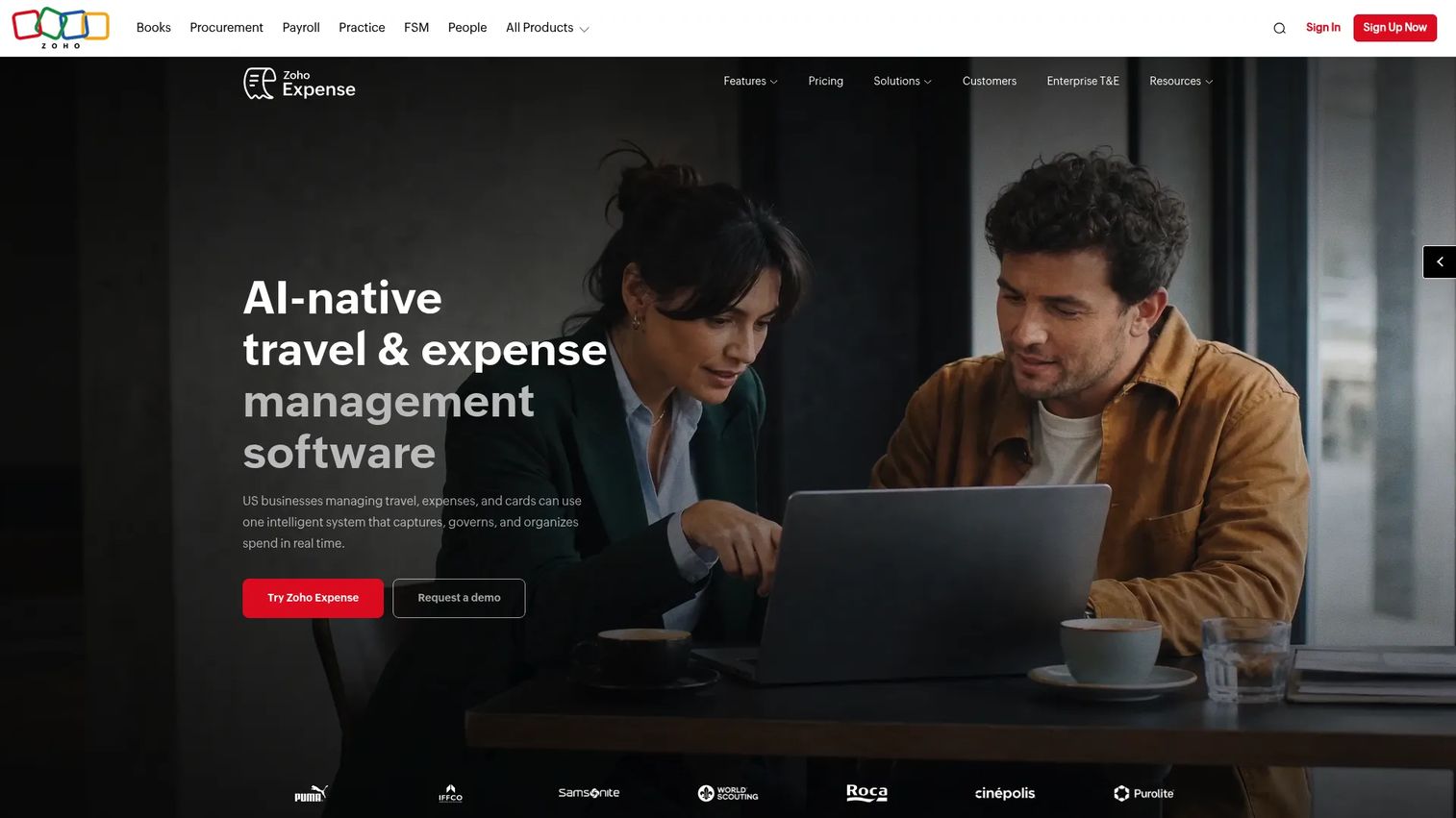
Zoho Expense is an AI-native travel and expense management platform covering receipt capture, expense reports, reimbursements, corporate card reconciliation, mileage tracking, travel booking, and accounting integrations. It is strongest as an expense-first system, with travel booking available through its travel desk management module. For cost-conscious teams that need clean expense workflows before investing in a full travel management program, Zoho Expense is a practical starting point.
Best for: Cost-conscious teams that need expense management with travel booking support, especially those already in the Zoho ecosystem.
Key features
- AI-powered OCR receipt scanning and expense reporting
- Travel requests, approvals, and travel desk management
- Corporate card reconciliation and mileage tracking
- Multi-currency expense management
- Accounting, ERP, and payroll integrations
Why choose Zoho Expense: Zoho Expense is practical when expense control is the primary pain and full travel booking is secondary. The free plan for up to three users lets small teams get clean expense workflows in place quickly.
Zoho Expense pricing: Free for up to three users. Standard is $4 per user per month billed monthly, or $3 billed annually. Premium is $6 per user per month billed monthly, or $5 billed annually. Custom plans are available by contacting sales.
G2 rating: 4.5/5.
8. TravelBank
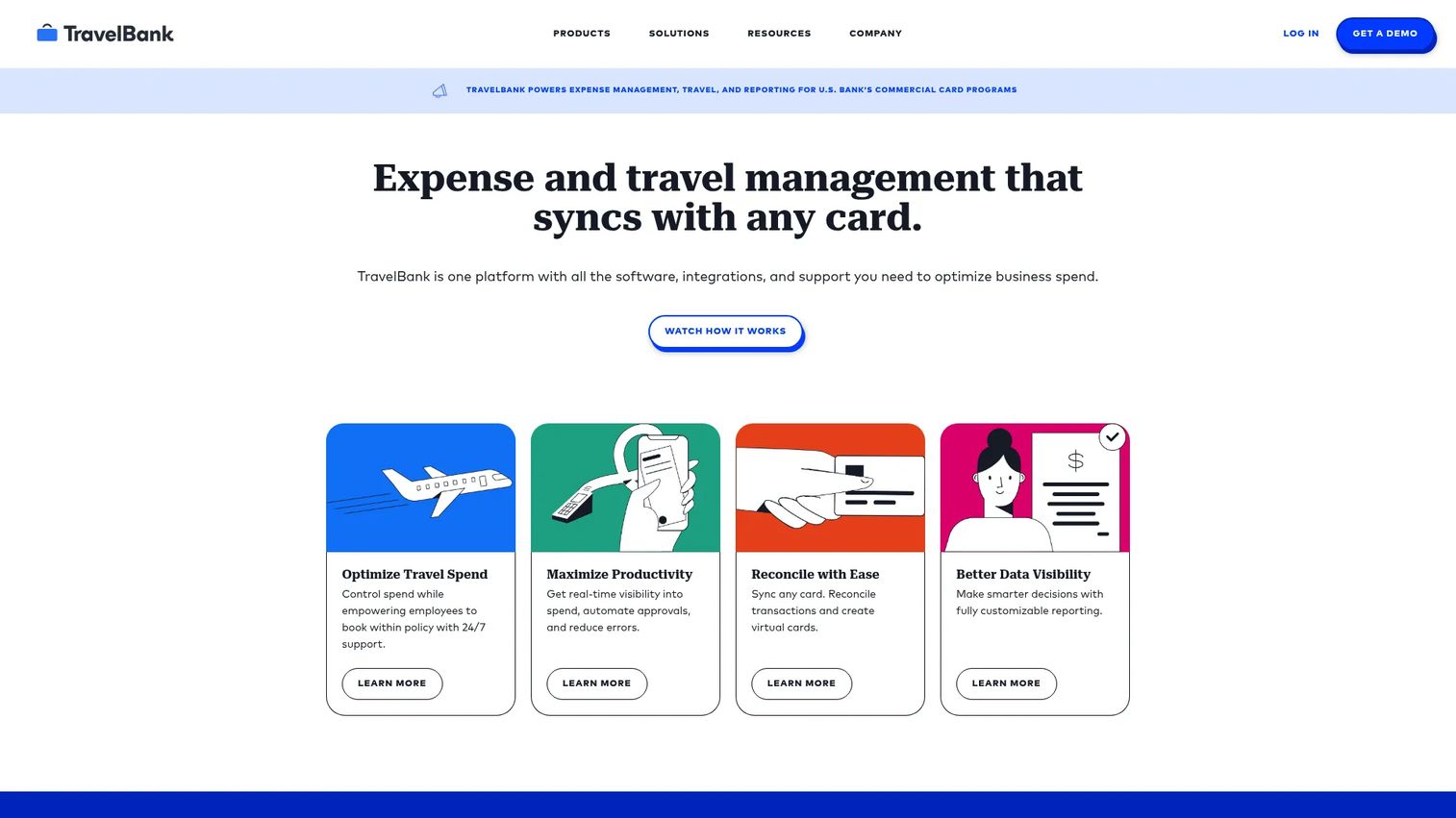
TravelBank is a travel and expense platform covering flight, hotel, and car booking alongside expense tracking, corporate card management, customizable policies, and spend analytics. One distinguishing feature is its savings incentives model: Employees can see their spending against budgets and earn rewards for booking under threshold. For founders watching burn multiple, that behavioral angle can matter. TravelBank also includes 24/7 travel agent support on all plans.
Best for: Teams that want budget-aware travel booking with employee savings incentives and corporate card controls.
Key features
- Flight, hotel, and car booking with budget tracking
- Expense reports, receipts, and automated approvals
- Corporate card management with virtual cards
- Savings incentives for under-budget bookings
- Custom analytics and 24/7 agent support
Why choose TravelBank: TravelBank makes sense when finance wants employees to internalize cost discipline in their booking behavior, not just comply with limits. The savings incentive model is the most distinctive aspect of the platform.
TravelBank pricing: The Premium plan starts at $5,000 (billing frequency not specified on the pricing page). Elite runs $10,000 with premium analytics, dedicated customer success, and custom rates. A $250,000 minimum travel spend in the TravelBank app is required to qualify for rebates. Corporate Custom pricing is available by contacting the team.
G2 rating: 4.5/5.
9. Coupa
Coupa is an enterprise spend management platform covering procurement, sourcing, contracts, supplier management, invoicing, AP automation, and expense management. Travel and expense sit within this broader suite rather than as the primary focus. Coupa suits organizations where travel is one line item in a larger spend governance initiative, and where procurement, supplier management, and AP workflows all need to operate from the same data layer.
Best for: Procurement-led teams that want travel and expense management inside a comprehensive spend management platform.
Key features
- Travel and expense workflows within the Coupa platform
- Procurement, sourcing, and supplier management
- Invoice-to-pay and AP automation
- Spend analytics and enterprise reporting
- Approval policy automation across spend categories
Why choose Coupa: Coupa makes sense when travel is part of a larger spend governance decision, not a standalone procurement. If your team is already evaluating Coupa for procurement or AP, travel and expense inclusion is a meaningful consolidation benefit.
Coupa pricing: Pricing is quote-based and driven by modules, users, integrations, and enterprise support requirements.
G2 rating: 4.2/5.
10. Emburse
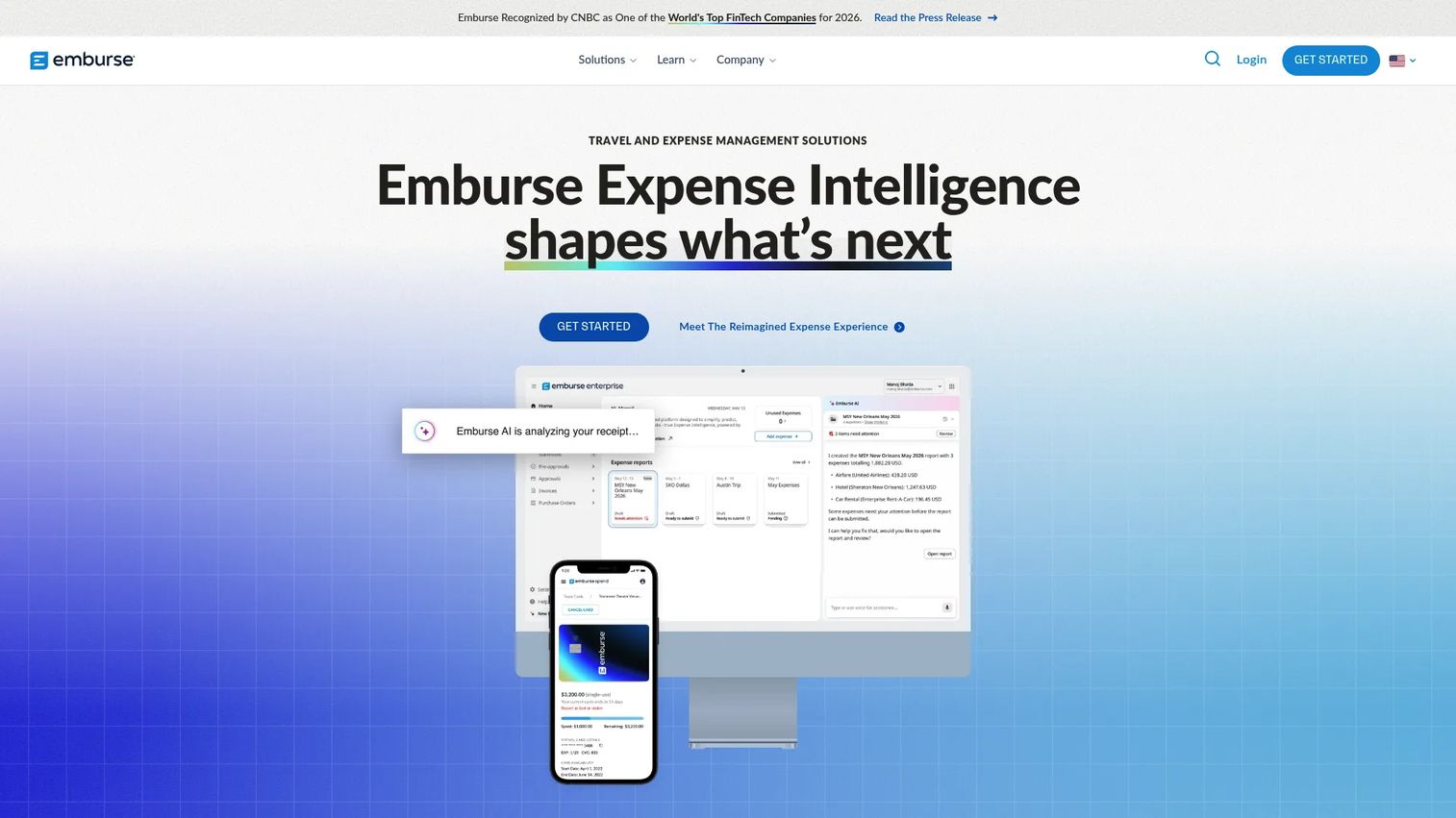
Emburse provides travel, expense, AP, payments, cards, and compliance software for organizations managing complex employee spend. Its Emburse Spend product covers real-time spend visibility, AI-powered expense categorization, receipt validation, and corporate card management, with published pricing for teams up to 100 employees. Other Emburse products target mid-market and enterprise finance teams with custom pricing.
Best for: Finance teams that prioritize expense automation and reimbursement control across distributed or multi-entity organizations.
Key features
- AI-powered expense categorization and receipt validation
- Corporate card management and real-time spend visibility
- AP automation and payments
- Multi-currency and global expense support
- Approval workflows and audit trails
Why choose Emburse: Emburse is an expense-first option for teams where travel is one part of a broader employee spend problem. Verify the depth of travel booking capability against your needs before buying: Emburse's core strength is on the expense and finance side.
Emburse pricing: Emburse Spend Basic starts at $8 per user per month, and Plus at $12 per user per month, for teams up to 100 employees. A 30-day free trial is available. Other Emburse products use custom pricing.
G2 rating: 4.4/5.
11. Webexpenses Travel
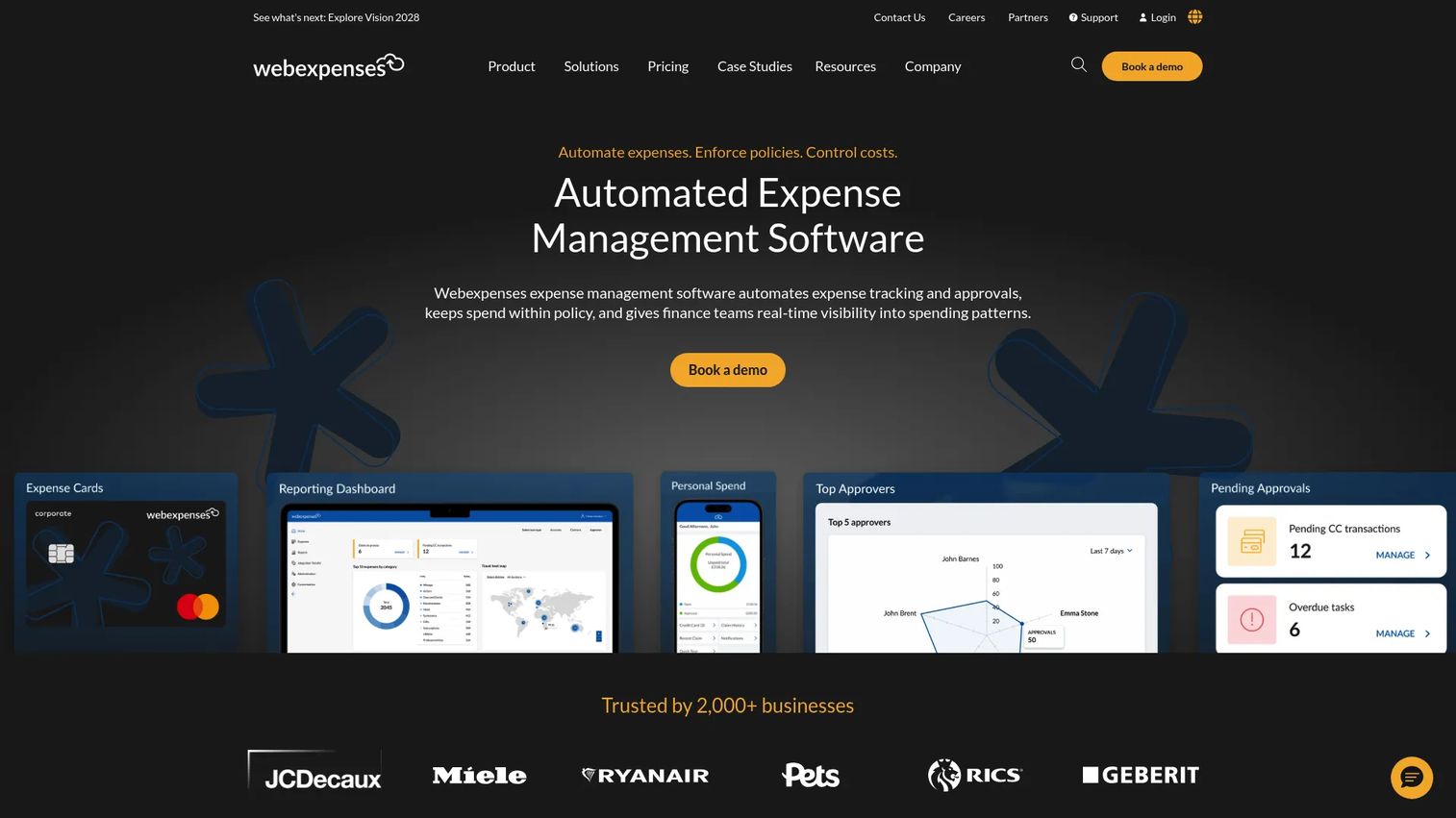
Webexpenses Travel provides a single online portal for building business trips, managing pre-trip approvals, estimating travel spend, and tracking expenses against company policy. It includes mileage calculation with interactive route mapping and carbon-footprint tracking for car, train, and air travel. Webexpenses Travel is a feature within the broader Webexpenses expense management platform and suits mid-market teams that need booking visibility and process control without adopting a large enterprise suite.
Best for: Mid-market teams that need booking visibility, pre-trip approvals, and expense process control in one platform.
Key features
- Single portal for booking and trip building
- Pre-trip approval with estimated travel spend
- Mileage calculation and interactive route mapping
- Carbon-footprint tracking for travel modes
- Policy checking and expense capture
Why choose Webexpenses Travel: Webexpenses Travel works when finance wants travel and expense workflows connected, and the company is not ready for a heavy enterprise rollout. The per-user pricing model scales cleanly for teams in the 20 to 200 employee range.
Webexpenses Travel pricing: Pricing is in GBP. Essential starts at £7.50 per user per month, Scale at £9, and Pro at £13. Expense cards are included at every tier; direct reimbursement comes with Pro.
G2 rating: 5.0/5.
12. Routespring
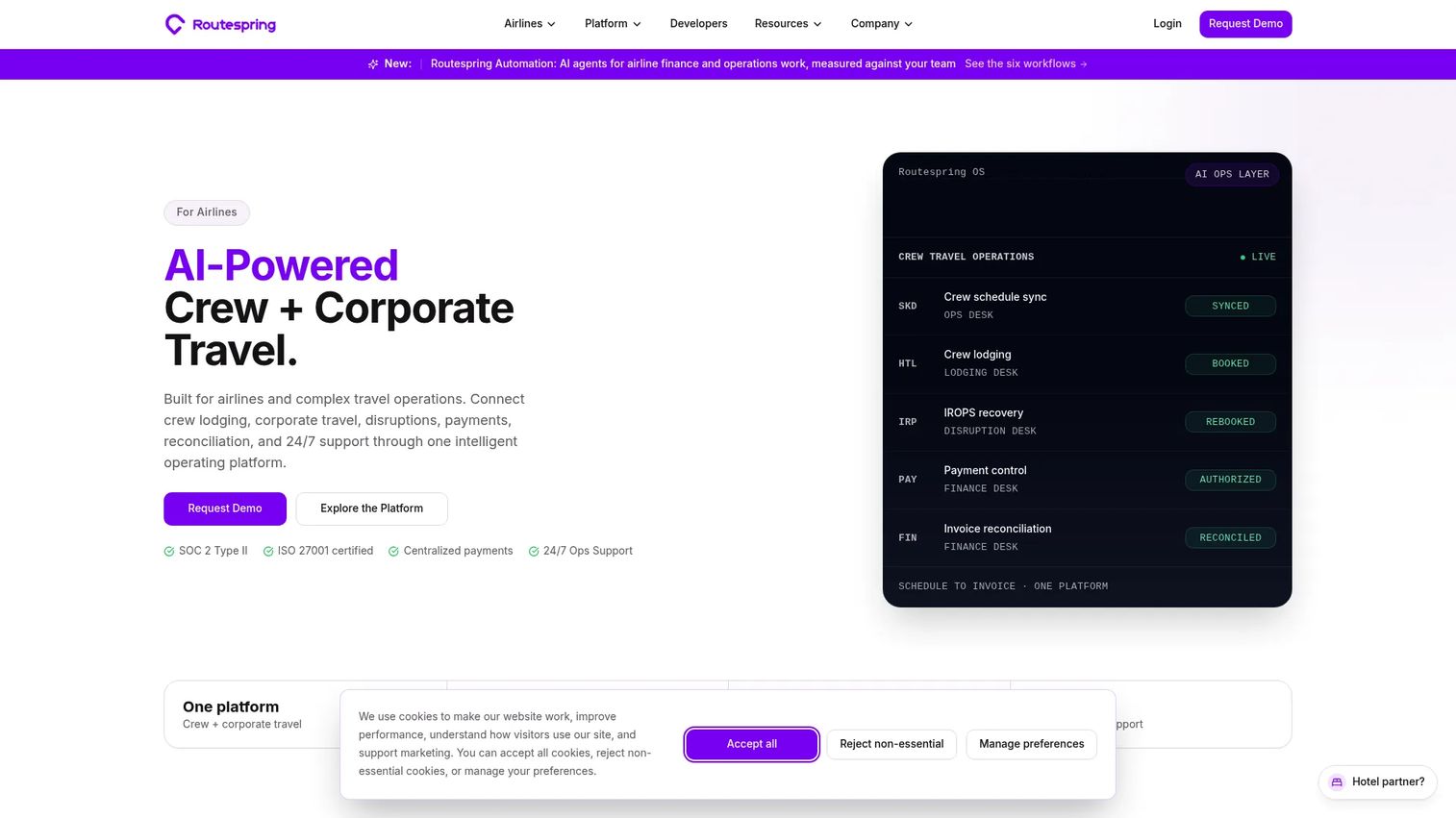
Routespring is an AI-powered travel platform covering centralized booking, company-paid travel, admin controls, policy compliance, and analytics. Its core value proposition is eliminating the employee expense-and-reimburse loop: The company pays directly at the time of booking, which removes the need for employees to front travel costs and reduces reimbursement processing. It has a free plan covering five bookings per month, with paid plans for higher volumes.
Best for: Growing teams that want centralized booking and company-paid travel without requiring employees to front costs.
Key features
- Centralized travel booking with admin-led controls
- Company-paid reservations (no employee out-of-pocket)
- Travel policy and approval workflow management
- Traveler profiles and reporting
- Analytics and operational controls
Why choose Routespring: Routespring makes the most sense when employees fronting travel costs on personal cards creates reimbursement lag, finance reconciliation work, or cash flow friction for the employee. The direct-pay model removes that loop entirely.
Routespring pricing: The Basic plan is free for up to five bookings per month, with a 3% per-booking fee thereafter. Economy runs $49 per month with a 2% fee per booking. Business is $349 per month with a 1% fee. Professional pricing is custom.
G2 rating: 4.9/5.
13. AmTrav
AmTrav is a US-focused business travel management platform combining online booking with 24/7 access to US-based travel advisors. It covers flights, hotels, cars, rail, and group travel, alongside travel policy controls, real-time reporting, virtual cards, and expense management integrations. The human support layer is the differentiating factor: When trips change or disruptions happen, travelers reach a real advisor rather than a bot.
Best for: US-based companies that want a practical booking platform with accessible human travel agent support when things go wrong.
Key features
- Flight, hotel, car, rail, and group travel booking
- Travel policy rules and compliance controls
- Real-time reporting and dashboards
- Virtual cards and expense management integrations
- 24/7 US-based travel advisor support
Why choose AmTrav: AmTrav suits teams that want the self-serve efficiency of online booking without giving up human backup when itineraries change on short notice. For companies where executive travel disruption is a genuine operational concern, that support model matters.
AmTrav pricing: Contact their team for a quote; pricing reflects your travel volume, support requirements, and program scope.
G2 rating: 4.8/5.
14. ITILITE
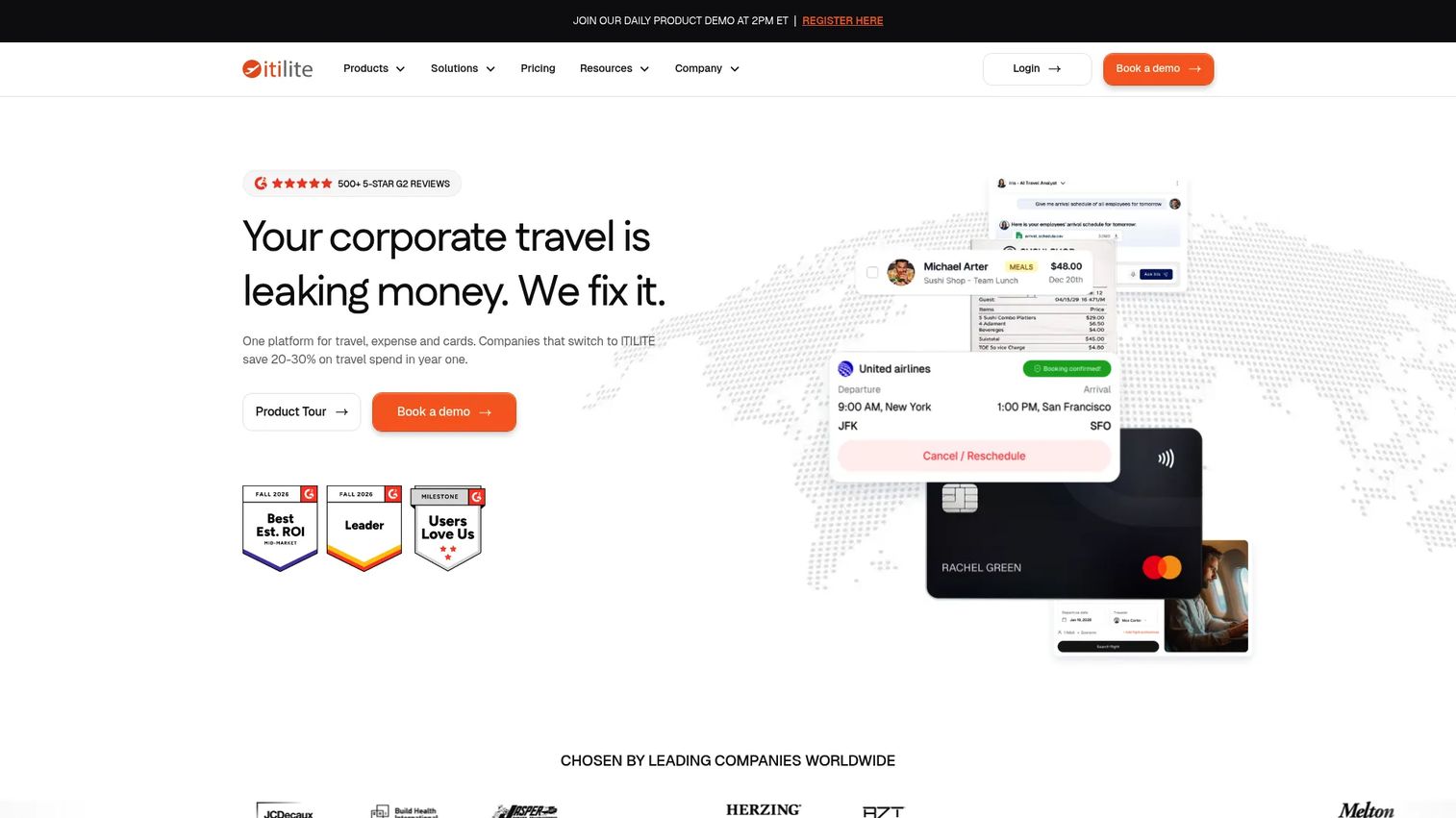
ITILITE is an all-in-one platform for corporate travel booking, expense management, and corporate cards, with per-trip pricing that makes costs predictable at lower travel volumes. It includes savings incentives to encourage cost-conscious booking, automated policy checks, expense capture, and reimbursement workflows. The platform also charges no platform or support fees, which reduces total cost for teams with moderate travel activity.
Best for: Mid-market companies that want travel savings incentives, automated expense workflows, and transparent per-trip pricing without platform fees.
Key features
- Corporate travel booking for flights, hotels, and rental cars
- Savings incentives and policy automation
- Expense capture, reimbursement, and approval workflows
- Corporate cards with spend limits and reconciliation
- Spend analytics with no platform or support fees
Why choose ITILITE: The per-trip model works in your favor at lower travel volumes compared to flat monthly fees. For a Series B team sending employees on 30 to 50 trips a month, ITILITE's transparent pricing makes budget forecasting straightforward.
ITILITE pricing: Travel is $10 per trip, or $7 per trip with the ITILITE wallet. Expense management is $9 per active user per month billed monthly, or $6 billed annually. Corporate cards are free.
G2 rating: 4.5/5.
15. Roomex
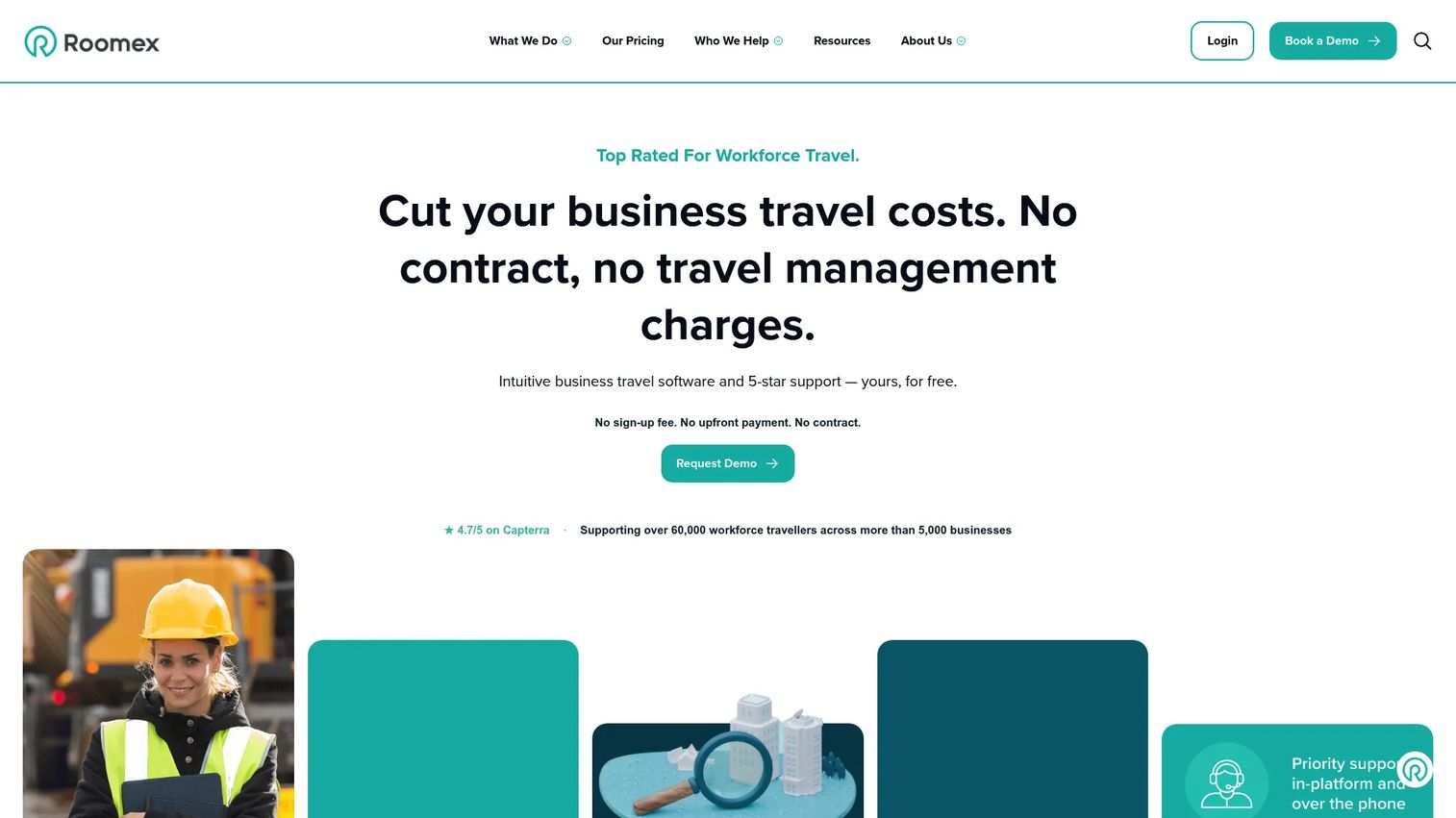
Roomex is workforce lodging and accommodation management software for companies booking stays for crews, contractors, field teams, and project-based workers. It covers centralized accommodation booking, consolidated invoicing, policy compliance, carbon reporting, and duty of care tracking. Rail booking with split-ticketing is also included. Roomex is not the broadest travel platform, but it solves a specific operational problem: Companies that manage accommodation at scale across multiple locations or long-duration projects.
Best for: Companies with crew lodging, contractor travel, field teams, or project-based accommodation needs at volume.
Key features
- Workforce accommodation booking and centralized management
- Consolidated invoicing and expense management
- Booking approvals and travel-policy compliance
- Duty of care tracking and carbon reporting
- Rail booking with split-ticketing
Why choose Roomex: Roomex belongs on the shortlist when accommodation is the dominant spend category and flight booking is secondary or occasional. For SaaS companies with field operations, construction-adjacent clients, or large-scale events, the lodging depth is the differentiator.
Roomex pricing: The platform is free to sign up and book. Selected hotels and services may incur fees. RoomexInsights Pro has an optional monthly fee; contact Roomex for that figure.
G2 rating: 5.0/5.
Considerations when choosing travel management software
Match the tool to your travel program stage
A 40-person SaaS team with occasional sales travel and a 200-person company sending field engineers on weekly trips need very different systems. Ad hoc travel programs can start with a free or per-booking plan. Policy-managed programs need approval workflows and spend controls. Mature programs need ERP connectivity, multi-entity reporting, and administrator governance. Buying for your current stage is the right call; migrating in 18 months is manageable.
Decide whether booking or expense control is the primary pain
Some tools are booking-first: They do flight and hotel search well and handle expense downstream. Others are expense-first: They do receipt capture, reimbursements, and card reconciliation well, with travel booking as an add-on. The right starting point depends on whether your biggest problem is out-of-policy booking or post-trip expense chaos.
Check how policy enforcement works before money is spent
The most valuable control in travel management software is the one that prevents out-of-policy spend before it happens, not after. Evaluate whether the platform enforces budget thresholds, preferred supplier rules, and approval routing at the booking step. A policy that triggers an approval email after the hotel is booked is not a control; it is a notification.
Verify integrations with your finance and HR systems
For a scaling SaaS company, the system should connect to your accounting tool, ERP or GL, HRIS, payroll, and corporate card provider. Without those integrations, finance still ends up reconciling exports manually. Ask each vendor specifically which ERP and HRIS integrations are native versus require a middleware tool.
Test traveler adoption before committing
A platform that finance loves but employees avoid will not solve the problem. Before signing a contract, have two or three frequent travelers, one executive assistant, and one finance team member run a real booking, submit a receipt, and test a trip change. Adoption failure is the most common reason travel software fails to deliver ROI.
Conclusion
For most Series B SaaS teams, the shortlist comes down to a few real decisions.
Navan is the strongest default for teams that want booking, expenses, and corporate cards in one workflow without building a custom stack. TravelPerk is a natural fit when employee flexibility and global inventory matter and you want to start on a free plan. Rippling is compelling if you are already standardizing HR and finance on their platform and want to consolidate further.
SAP Concur and Amex GBT Egencia suit more mature, compliance-heavy programs with enterprise requirements. Engine and Roomex cover specific patterns: Lodging-heavy travel and workforce accommodation, respectively.
For finance-led teams where expense control is the primary pain, Zoho Expense, Emburse, and ITILITE all deserve evaluation before committing to a full travel platform. Routespring solves the employee fronting-costs problem specifically, and AmTrav adds human support for US teams that need it.
The next step is practical: Pick three tools that match your travel maturity, run one real trip through each, and have finance compare the policy control, reimbursement flow, and reporting output. The right system is the one your team will use without needing founder escalation.
Start your journey with Guideflow today!
FAQs
Travel management software is a business platform that helps companies book employee travel, enforce travel policy, manage approvals, track expenses, support travelers, and report on travel spend. It typically combines booking inventory (flights, hotels, cars, rail), policy controls, approval routing, expense capture, and finance integrations in one system.
For most scaling SaaS teams, Navan, TravelPerk, and Rippling are the strongest starting shortlist. Navan offers the most complete travel-plus-expense workflow. TravelPerk fits teams that want global booking flexibility and a low-cost entry point. Rippling makes sense when HR and finance consolidation is already a goal. The right choice depends on whether your primary pain is booking control, expense workflows, or stack consolidation.
Travel management software handles the booking and trip operations side: Search, reservations, itineraries, policy enforcement before the trip, and traveler support. Expense management software handles spend after or during the purchase: Receipts, reimbursements, card reconciliation, and accounting sync. Some platforms, like Navan and ITILITE, combine both. Others, like Zoho Expense and Emburse, are primarily expense tools with travel booking available as a secondary feature.
Small businesses typically need it when travel becomes frequent enough that consumer booking creates policy leakage, or when reimbursement processing slows down month-end close. For occasional travel, a free-tier expense tool like Zoho Expense may be enough. When employees are booking weekly trips across multiple people, the administrative overhead of consumer booking plus manual expense reporting usually costs more in staff time than a travel management platform does.
Core features to evaluate include booking inventory (flights, hotels, cars, rail), travel policy controls and approval workflows, traveler profiles with loyalty numbers and preferences, expense capture and receipt scanning, corporate card support, spend reporting by team and project, duty of care with traveler location tracking, and integrations with accounting, ERP, and HRIS systems.
Pricing models vary widely across the category. Per-trip pricing (like ITILITE at $7 to $10 per trip) works for lower-volume travel. Per-user monthly pricing (like Zoho Expense from $3 to $6 per user, or Emburse Spend from $8 to $12 per user) suits expense-focused tools. Flat monthly plans with per-booking fees (TravelPerk from $99 per month plus 3% per booking) work for travel-first platforms. Enterprise tools like SAP Concur, Coupa, and Amex GBT Egencia are quote-based, with price driven by users, modules, regions, and integration complexity.
The primary mechanism is pre-trip policy enforcement: Booking rules, budget thresholds, preferred supplier restrictions, and approval routing that trigger before money is spent. Secondary controls include virtual cards with preset limits, consolidated billing to reduce reimbursement lag, and real-time spend reporting by team or project. The combination shifts finance from reactive (discovering overages at month-end) to proactive (seeing spend patterns as they develop).
For a scaling SaaS company, the highest-priority integrations are accounting software or ERP for GL sync, HRIS for employee data and cost center assignment, corporate card providers for transaction reconciliation, and payroll systems for reimbursement processing. Secondary integrations worth checking include SSO identity providers for user provisioning, communication tools for approval notifications, and CRM for attributing travel spend to customer accounts or opportunities.