Your development team has thousands of constituent records. The major-gift officers are asking which names deserve attention this quarter. The prospect research staff is buried.
The underlying problem is not a data shortage. According to the CCS Philanthropy Pulse (2025), 54% of organizations say inaccurate or incomplete data hinders their use of donor data, and 55% struggle to determine which analyses to run or lack the training to do it. The data pile grows; the prioritization does not.
Strong prospect research combines capacity, philanthropic affinity, relationship context, and timing. A high net-worth estimate alone tells a fundraiser nothing about who will actually engage. Getting all four signals into one usable view, without asking researchers to stitch together property records, giving histories, and corporate filings by hand, is exactly what donor prospect research software is built to do.
This guide covers 10 tools across the full spectrum of donor intelligence, from full screening platforms to adjacent fundraising research options.
What's inside
This guide is built for nonprofit development leaders, advancement operations teams, major-gift officers, and operators evaluating fundraising intelligence infrastructure. Each tool was selected based on:
- Data depth and screening quality for major-gift and portfolio prioritization
- Workflow fit: How research moves from a screen to a gift officer's active portfolio
- CRM compatibility and data governance considerations
- Pricing transparency, including which vendors require a quote versus publish entry prices
- G2 ratings and verified feature coverage, checked October 8, 2026
TL;DR
- Best overall for donor prospect research: DonorSearch, for broad wealth screening, donor intelligence, and fundraising workflow support across nonprofit sizes
- Best for deep researcher workflows: iWave, for teams that need rich 360-degree profiles, predictive scores, and structured research data before assigning prospects
- Best for household wealth intelligence: Windfall, rated 4.8/5 on G2, for enriching large constituent files with net-worth and propensity data
- Best for predictive donor scoring: Dataro, starting at $15,000/year, for data-oriented teams that want ranked donor priorities and campaign response modeling
- Best for adjacent grant research: Instrumentl, starting at $299/month with a 14-day free trial, for nonprofits that need grant prospecting alongside donor work
- Best for matching-gift identification: Double the Donation, with an Essentials tier free for the first year, for increasing corporate giving revenue from existing donors
- One caution: Every screening platform requires a defined workflow after the screen. A ranked list with no clear research-to-gift-officer handoff does not create fundraising value.
What is donor prospect research software?
Donor prospect research software helps nonprofits identify, assess, and prioritize potential donors by combining wealth indicators, philanthropic history, biographic information, relationship data, and predictive scores.
It is not a CRM. It is not a grant database. It is not a matching-gift tool. Those categories handle adjacent fundraising jobs, and some appear in this list as useful complements. A full donor prospect research platform does something distinct: It helps researchers build a defensible case for whether a constituent has the capacity, affinity, and relational context to merit major-gift cultivation.
Core capabilities
| Capability | What it does |
|---|---|
| Wealth screening | Estimates capacity using property, business ownership, securities holdings |
| Philanthropic affinity | Identifies prior gifts, board service, cause interests |
| Donor profiles | Consolidates multi-source records into a single research view |
| Predictive prioritization | Scores prospects by estimated likelihood to give or upgrade |
| Portfolio workflow | Supports segmentation, assignment, and review meeting prep |
| Data enrichment | Appends contact, household, employment, and relationship updates |
What this category does not replace
- A nonprofit CRM stores gift history and relationship activity
- A grant database identifies institutional funding sources
- A matching-gift tool identifies employer programs
- A public-record aggregator provides evidence but requires manual interpretation
The distinction matters at purchase time. Tools 1 through 8 below are prospect research platforms or donor intelligence tools. Tools 9 and 10 serve adjacent fundraising workflows. Evaluate them separately against different jobs.
When to use donor prospect research software
Prioritize a major-gift portfolio
Gift officers often inherit hundreds of constituent names without evidence of who merits immediate attention. Screening and scoring narrows that field to a smaller, more qualified set. The key word is "guides": A score should direct researcher attention, not replace a fundraiser's judgment about relationships and readiness.
Run a wealth-screening refresh before a campaign
Before a capital campaign, board-outreach push, or major-gift pipeline review, a batch screen updates capacity estimates, flags new philanthropic activity, and surfaces constituents whose wealth indicators have changed. Record cleanup and deduplication matter here as much as the screen itself.
Reduce manual preparation before cultivation calls
Researchers and gift officers use donor profiles and engagement alerts to shorten the time spent preparing for discovery calls and stewardship meetings. A good profile gives the officer context on prior giving, relationship connections, and capacity estimates before they walk into the conversation.
Donor prospect research software comparison
Use this table to narrow the field before reading each entry. Pricing and G2 ratings were verified October 8, 2026.
| # | Product | Best for | Key differentiator | Pricing | G2 rating |
|---|---|---|---|---|---|
| 1 | DonorSearch | Broad nonprofit wealth screening | Donor intelligence, AI scoring, and fundraising workflow support | Custom pricing | 4.6/5 |
| 2 | iWave | Deep prospect profiles and research workflows | 360 profiles, screening, scoring, and philanthropic data | Custom pricing | 4.6/5 |
| 3 | WealthEngine | Wealth intelligence and prospect segmentation | Wealth, demographic, and philanthropic data with look-alike modeling | Custom pricing | 4.3/5 |
| 4 | ResearchPoint | Blackbaud-centered advancement teams | WealthPoint screening, AI predictive models, Raiser's Edge NXT integration | Custom pricing | 4.3/5 |
| 5 | Windfall | Household wealth estimates and data enrichment | Net-worth and propensity signals across large constituent files | Custom pricing | 4.8/5 |
| 6 | Dataro | Predictive fundraising analytics | Ranked donor priorities and campaign response modeling | From $15,000/year | Not listed on G2 |
| 7 | GivingDNA | Donor analytics and segmentation | Donor persona development, wealth, and affinity modeling | Custom pricing | Not listed on G2 |
| 8 | Prospect Visual | Relationship-focused prospect mapping | Visual donor and board relationship networks | Custom pricing | Not listed on G2 |
| 9 | Instrumentl | Grant prospecting alongside donor research | Grant discovery, tracking, and post-award management | From $299/month | 4.9/5 |
| 10 | Double the Donation | Matching-gift identification | Employer matching-gift automation and corporate giving database | From $300/year (Essentials) | 4.7/5 |
Best 10 donor prospect research software tools for 2026
1. DonorSearch
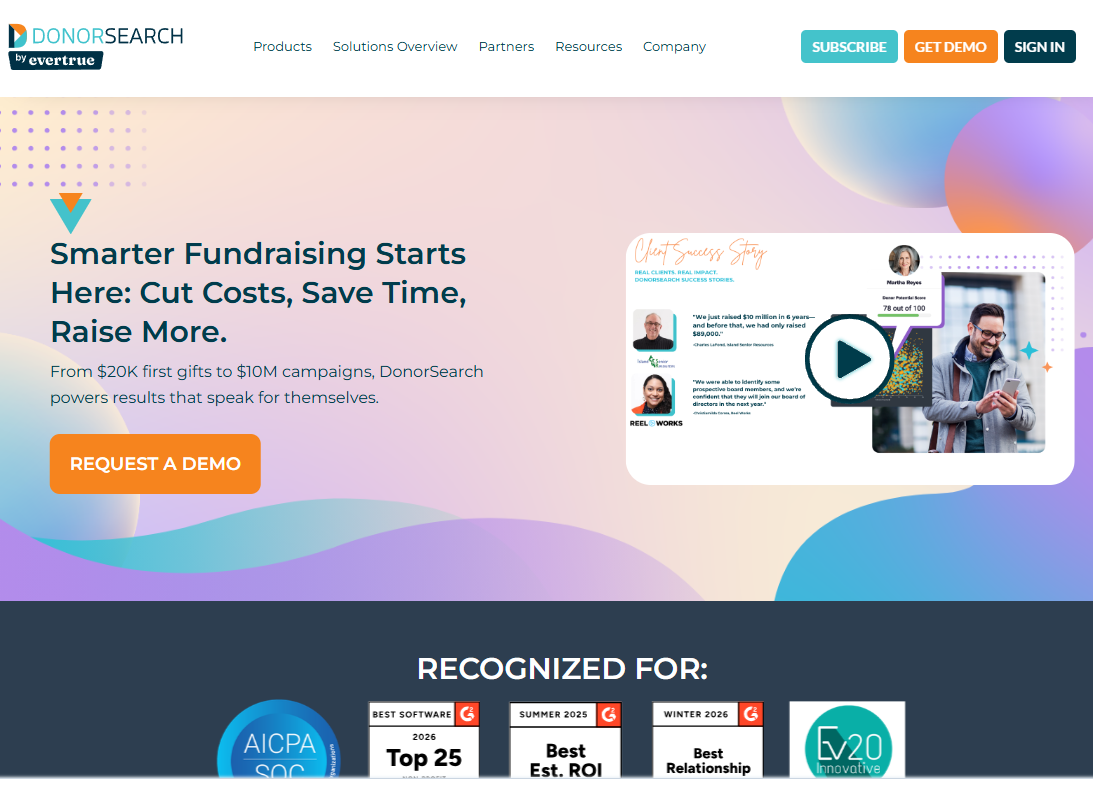
DonorSearch is a core donor intelligence and prospect research platform built for nonprofit fundraising and development teams. It combines wealth screening, philanthropic data, AI-powered scoring, CRM integrations, and data appends into a single research workflow. Teams use it to identify new prospects, enrich existing constituent files, and prioritize major-gift outreach based on capacity and giving affinity.
Best for: Nonprofits that need a full prospect research platform covering wealth screening, donor intelligence, and CRM-connected fundraising workflows.
Key features
- Wealth and philanthropic screening across multiple data sources
- Predictive and generative AI donor scoring
- Donor prospect profiles with capacity and affinity indicators
- Batch screening workflows for large constituent files
- CRM integrations and data enrichment appends
Why choose DonorSearch: It fits organizations that want screening and donor intelligence in one place, with AI-assisted prioritization that helps researchers move faster. Success depends on a clear process for handing research findings to gift officers once a screen is complete.
DonorSearch pricing: DonorSearch sells by quote. Record volume, integrations, and screening scope drive the final number. Contact their sales team directly to get a figure for your file size.
G2 rating: 4.6/5
2. iWave
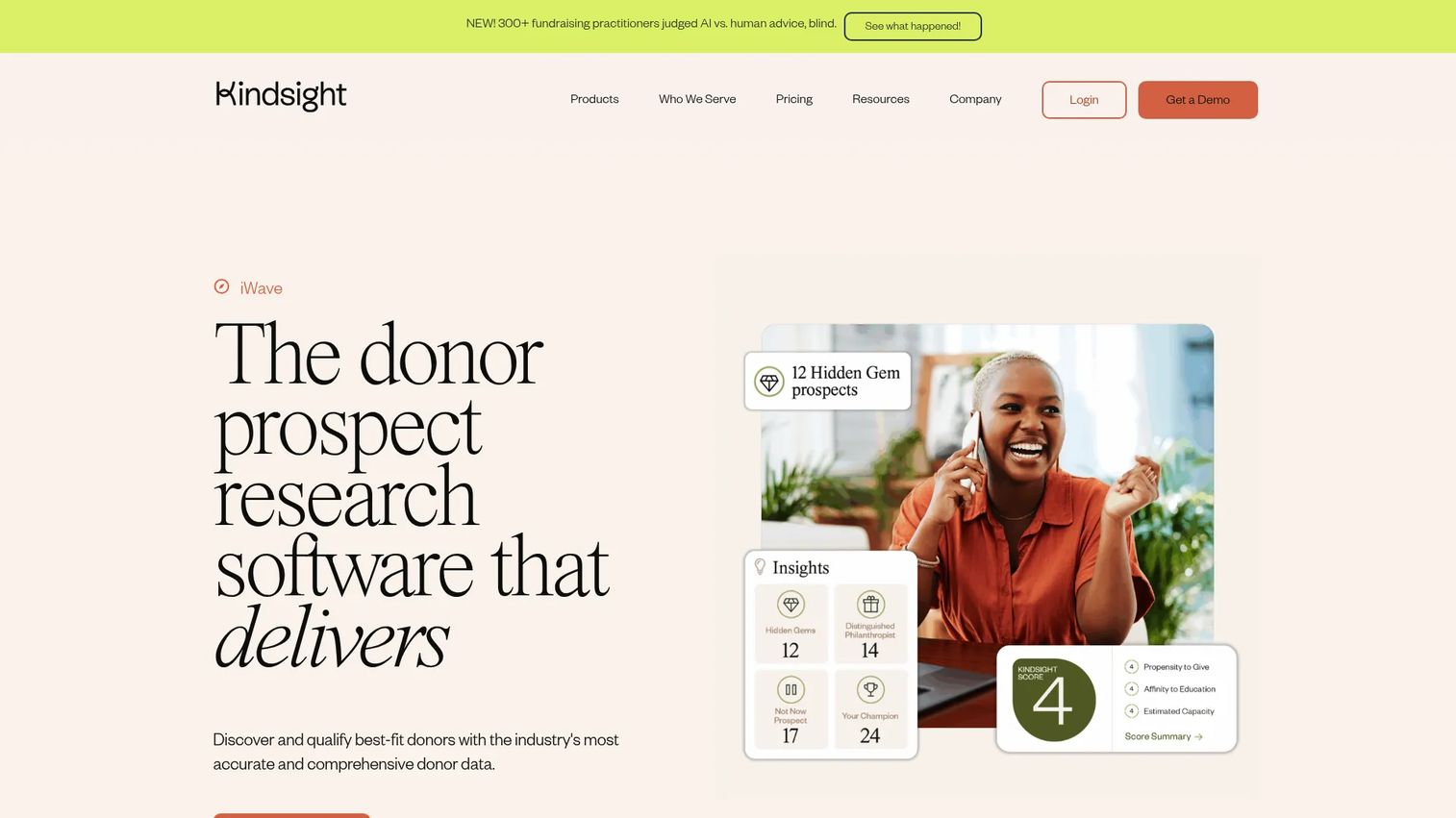
iWave is a nonprofit prospect research and donor intelligence platform designed for teams that need research depth before assigning prospects to a portfolio. It pulls together wealth screening, philanthropic history, real estate data, foundation affiliations, biographical records, and predictive giving scores into a single 360-degree profile view. Higher education, healthcare foundations, and major-gift operations often favor it for the breadth of its North American research coverage.
Best for: Research teams that need rich donor profiles, screening data, and portfolio-ready context before major-gift cultivation begins.
Key features
- 360-degree prospect research profiles combining multiple data sources
- Wealth and philanthropic screening with capacity, propensity, and affinity scores
- Predictive giving models for major gifts, planned giving, and capital campaigns
- Foundation and corporate research data
- CRM integration options for common nonprofit systems
Why choose iWave: The depth of its profile data makes it a strong fit when researchers need to build a complete picture, not just a wealth estimate, before a gift officer takes a name into active cultivation.
iWave pricing: iWave requires a sales conversation to get a quote. The brief currently lists Starter at approximately $4,500 per user per year and Professional at approximately $5,800 for three users per year, sourced from G2 reviewer reporting. Verify both figures directly with iWave before budgeting, as seat-based pricing can shift.
G2 rating: 4.6/5
3. WealthEngine
WealthEngine provides wealth intelligence and prospect research tools for identifying and segmenting high-capacity constituents. Its core offering combines wealth indicators, demographic signals, lifestyle data, and philanthropic giving history. Teams use it for prospect search, record enrichment, look-alike modeling, and predictive segmentation. A developer API lets organizations access wealth and giving attributes in real time for integration with CRM and data management systems.
Best for: Established fundraising programs that need wealth intelligence and donor segmentation as part of a larger data strategy, not a standalone research workflow.
Key features
- Wealth and asset indicators alongside demographic and lifestyle data
- Philanthropic history and giving behavior data
- Prospect segmentation, look-alike modeling, and predictive scoring
- CRM and data management system integrations including Salesforce and Ellucian
- Developer API for real-time wealth attribute access
Why choose WealthEngine: It suits teams that need to enrich a large existing donor file with financial intelligence and segment it before a campaign or portfolio review. Buyers should test matching accuracy on a representative sample before committing to a full file run.
WealthEngine pricing: WealthEngine prices by quote. The API access page notes that sandbox access is free; production access requires contacting their team, and API pricing is usage-based by returned profile and volume plan. Request a demo through their site for a current organizational quote.
G2 rating: 4.3/5
4. ResearchPoint
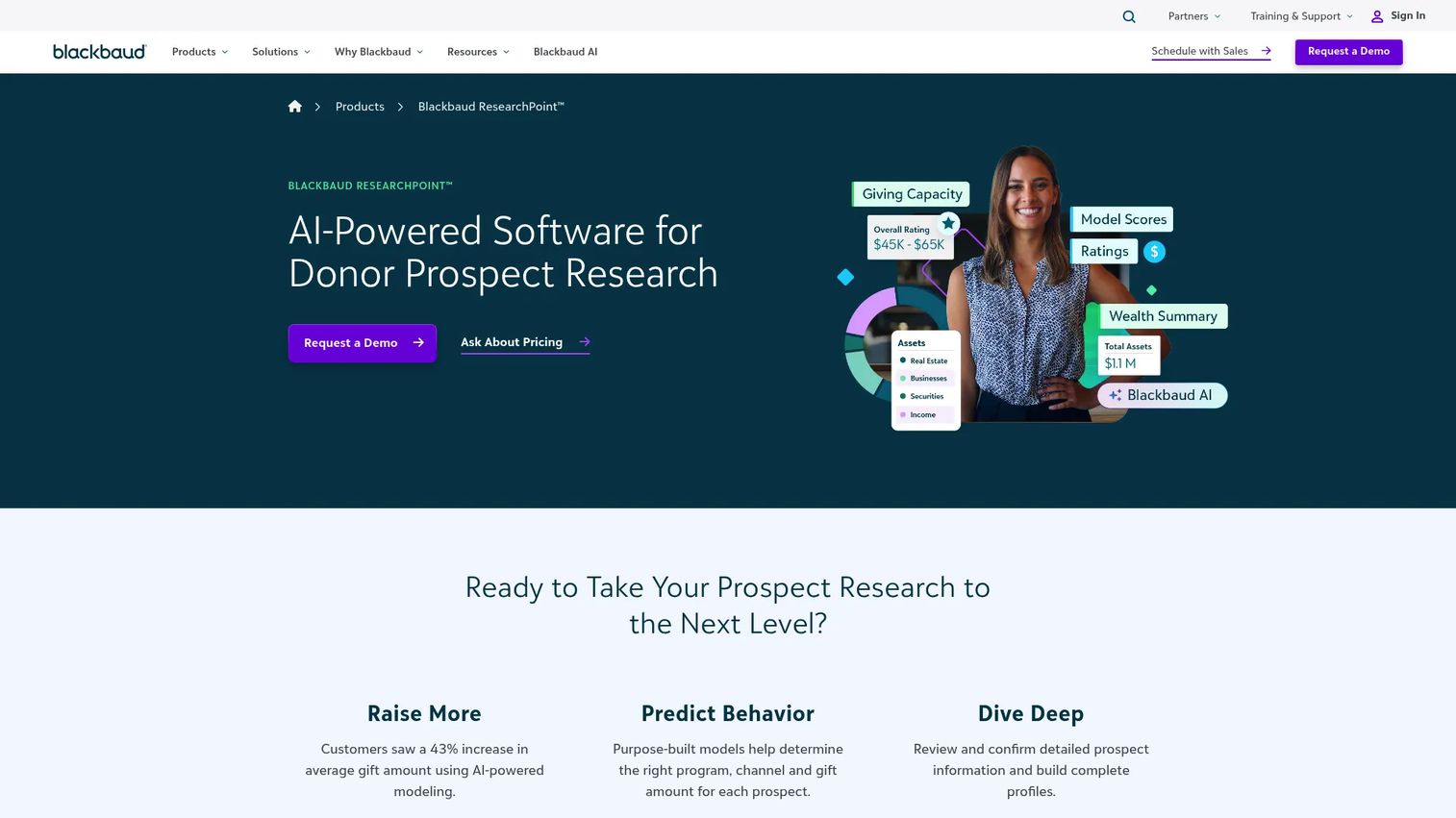
ResearchPoint is Blackbaud's prospect research product, designed for advancement teams already running their fundraising operations on the Blackbaud stack. It connects wealth screening, predictive modeling, philanthropic data, and donor profiling directly into Raiser's Edge NXT, which reduces the data-movement burden for teams already committed to that environment. AI-powered predictive models (ProspectPoint) help surface major-gift candidates from within a constituent file.
Best for: Advancement teams using Blackbaud fundraising products that want prospect research connected to their existing system of record.
Key features
- WealthPoint wealth screening with publicly identifiable wealth indicators
- Affluence Insight donor persona segmentation
- ProspectPoint AI-powered predictive prospect models
- Blackbaud Giving Search philanthropic gift database
- Native integration with Raiser's Edge NXT
Why choose ResearchPoint: The integration case is the main argument: Staying within the Blackbaud environment reduces field-mapping work, duplicate records, and staff training overhead. Evaluate it on its own feature merits, not only because it came bundled with another Blackbaud contract.
ResearchPoint pricing: Blackbaud directs all prospects to request a personalized quote. Pricing is not displayed on their site. Expect the conversation to cover seats, database size, module bundling, and contract term.
G2 rating: 4.3/5 based on 11 reviews
5. Windfall
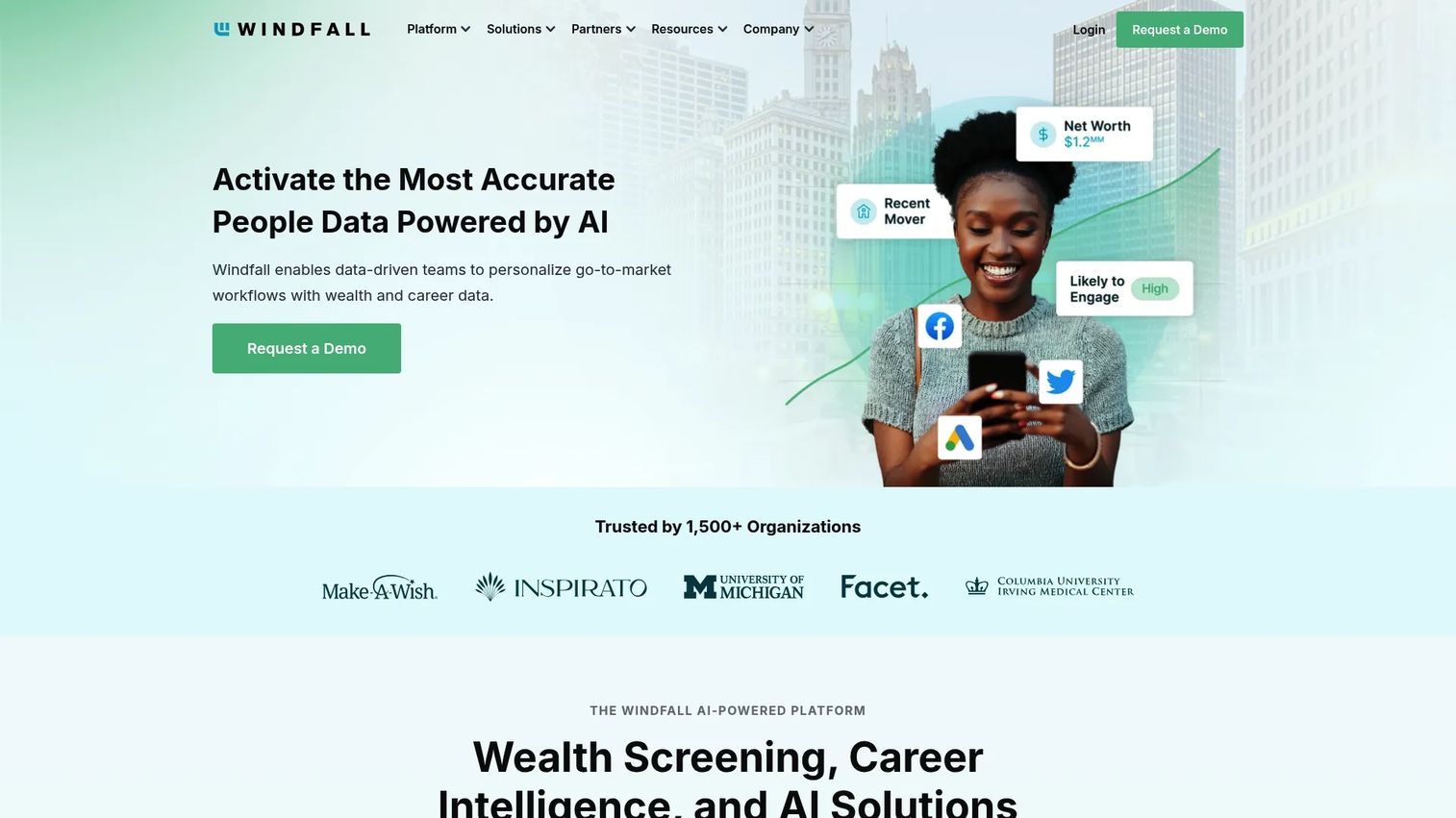
Windfall is a people intelligence and AI platform that gives fundraising and go-to-market teams household-level wealth estimates, philanthropic signals, career data, and propensity modeling. For nonprofits, it is most useful when a development team has a large constituent file that needs prioritization before a campaign or portfolio assignment. It also functions as an enrichment layer that appends updated household and professional data to existing donor records.
Best for: Nonprofits that need household-level wealth signals and enriched donor data to focus outreach across a large file.
Key features
- Household-level net-worth estimates using proprietary modeling
- Philanthropic and career data enrichment
- Propensity modeling and machine-learning segmentation
- Nonprofit CRM integrations
- Audience segmentation tools for campaign targeting
Why choose Windfall: Its 4.8/5 G2 rating reflects strong satisfaction among organizations that use it for wealth intelligence and enrichment at scale. Run a sample match against a known subset of your file before a full rollout to validate coverage and household-matching accuracy.
Windfall pricing: Windfall prices by quote, structured around organizational needs. Request a demo through windfall.com to receive current pricing for your file size and use case.
G2 rating: 4.8/5
6. Dataro
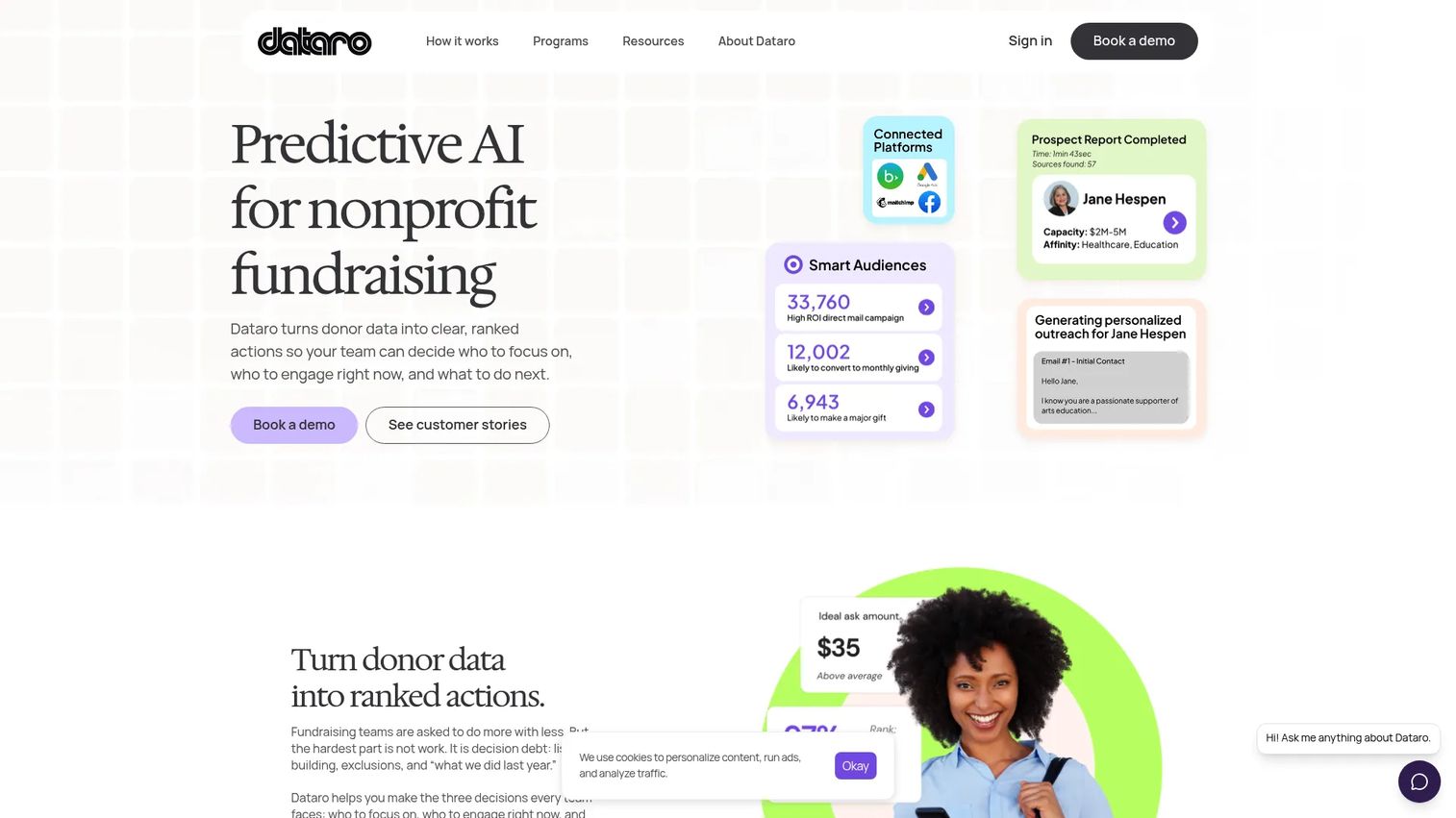
Dataro is a predictive AI fundraising analytics platform. Rather than screening for wealth, it focuses on ranked donor priorities: Who is most likely to give, upgrade, lapse, or respond to a specific campaign, based on patterns in the organization's own historical data. It produces segmented audiences, campaign response models, and recommended actions that fundraising teams can act on without additional data science capacity.
Best for: Data-oriented fundraising teams with enough donor history to support predictive modeling and a team capable of adjusting campaign targeting based on scores.
Key features
- Predictive donor scores for giving likelihood, upgrade potential, and lapse risk
- Campaign response modeling and audience segmentation
- AI-assisted content and campaign recommendations
- CRM and marketing platform integrations
- Prospect research and donor profile views
Why choose Dataro: It fits organizations whose primary bottleneck is prioritization, not data acquisition. A predictive score that sits unused in a dashboard does not improve fundraising outcomes; the team needs a defined process for acting on ranked outputs.
Dataro pricing: Essentials starts at $15,000/year plus $0.10 per active donor, billed annually. Growth runs $25,000/year plus $0.12 per active donor. Enterprise is custom pricing plus $0.14 per active donor. No free tier; pricing verified October 2026 from dataro.io/pricing.
7. GivingDNA
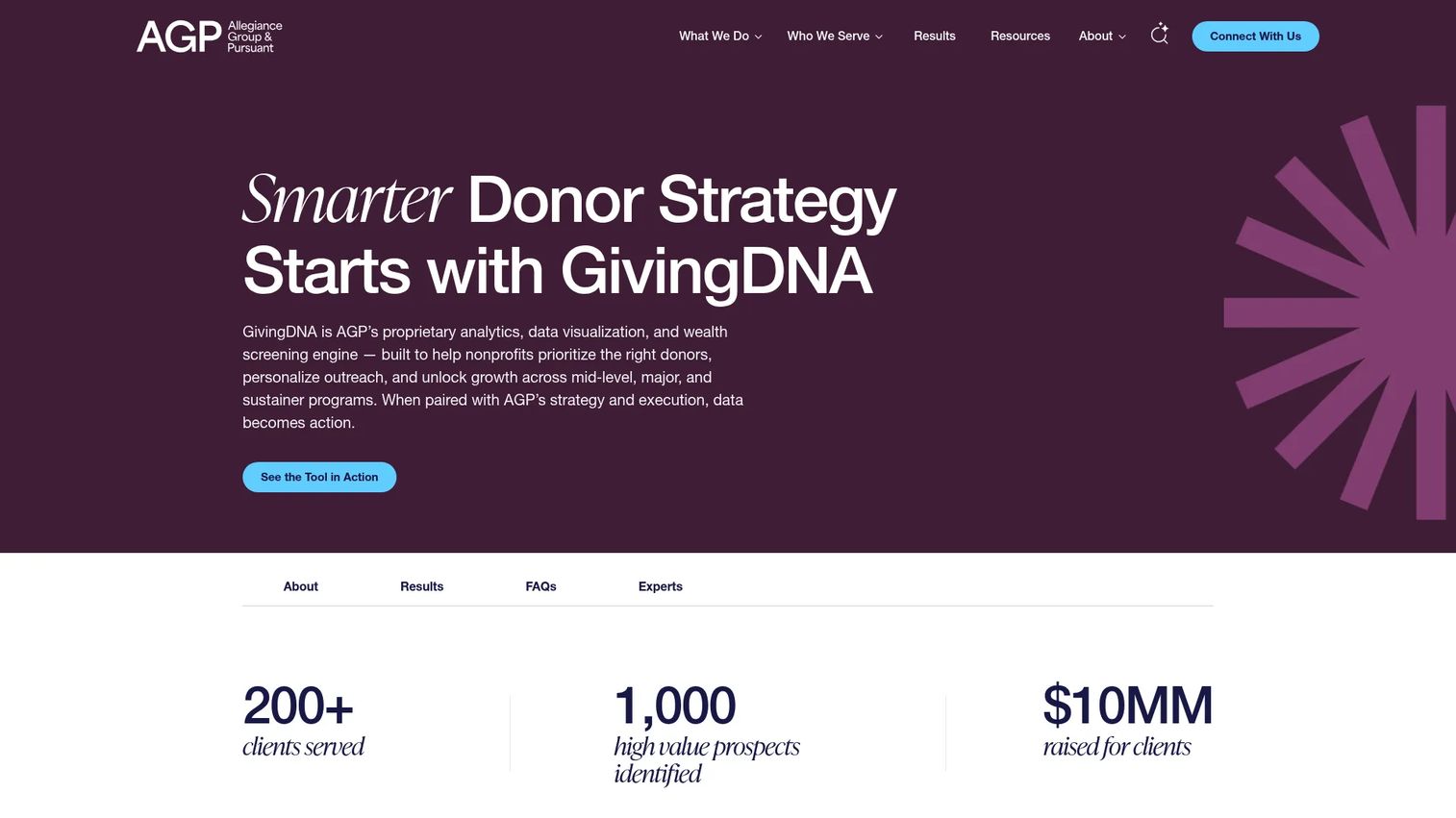
GivingDNA is a donor analytics and wealth-screening engine developed by AGP (Alexander Haas). It centers on donor persona development, behavioral segmentation, and major-gift prospect identification. Rather than producing a one-time batch screen, it is designed for ongoing analytics work: Monthly data refreshes, dashboards that track donor health over time, and portfolio optimization recommendations tied to capacity and affinity signals.
Best for: Fundraising organizations that want continuous donor analytics, persona development, and major-gift prioritization rather than a single batch screen.
Key features
- Donor prioritization and next-best-action recommendations
- Personalized insights using demographic, behavioral, and channel data
- Dashboards for donor health, campaign results, and portfolio progress
- Major-gift prospect identification and portfolio optimization
- Monthly data refreshes with CRM-compatible donor segments
Why choose GivingDNA: It suits teams that want more than a wealth file: Persona context and behavioral segmentation that helps fundraising, marketing, and development teams coordinate around the same donor picture. Segmentation work requires upfront agreement on how each team will use the resulting groups.
GivingDNA pricing: Pricing is not displayed on the GivingDNA or AGP sites. Contact the team directly for a quote; expect the conversation to cover database size and engagement scope.
8. Prospect Visual
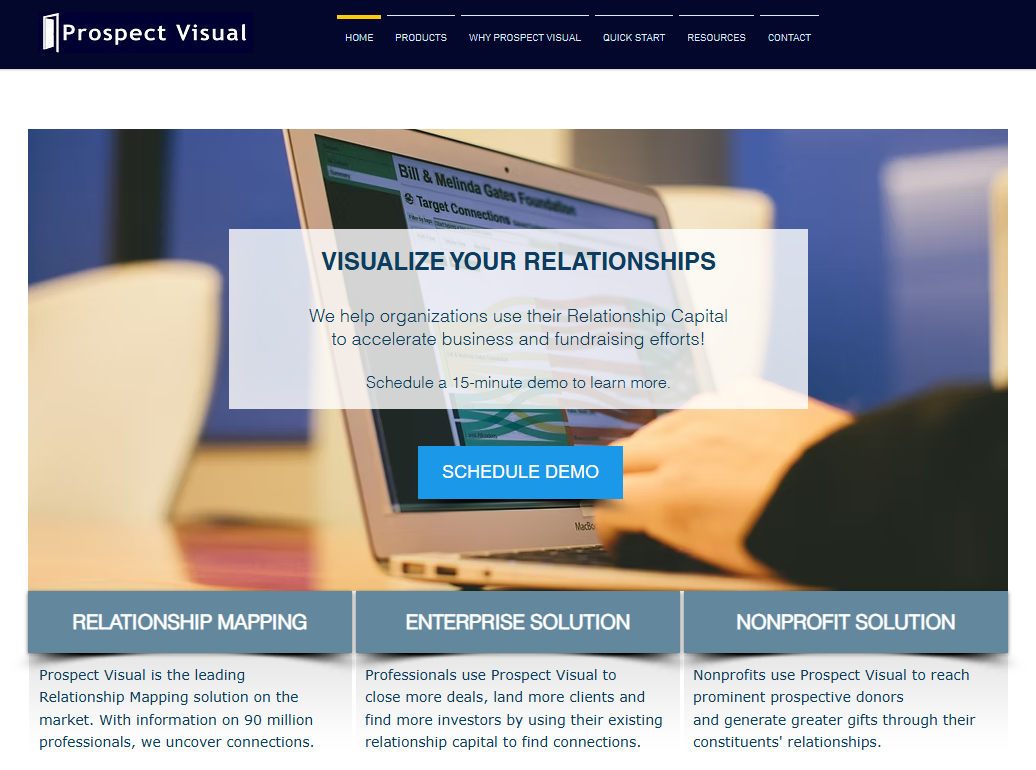
Prospect Visual is a relationship mapping tool for fundraising and business development teams. Its differentiator is visualization: It maps warm introduction paths between an organization's existing contacts and target prospects, revealing which board members, donors, or staff have existing connections to the names on a prospect list. The output is a relationship map, not a wealth screen.
Best for: Teams that rely on relationship-based cultivation and want to see connection paths before designing a major-gift strategy.
Key features
- Visual relationship mapping across donors, board members, and organizations
- Warm introduction path identification
- Customizable connection and path reports
- Research data visualization for cultivation planning
Why choose Prospect Visual: It adds something most wealth screens cannot: Clarity about who knows whom. For organizations where board introductions drive major gifts, seeing those paths before a cultivation meeting changes the conversation strategy. It does not replace a full capacity or philanthropic screen; use it alongside a core research platform.
Prospect Visual pricing: Pricing was not accessible on the official site during our research period. Contact Prospect Visual directly for current subscription terms, which may vary by organization size.
9. Instrumentl
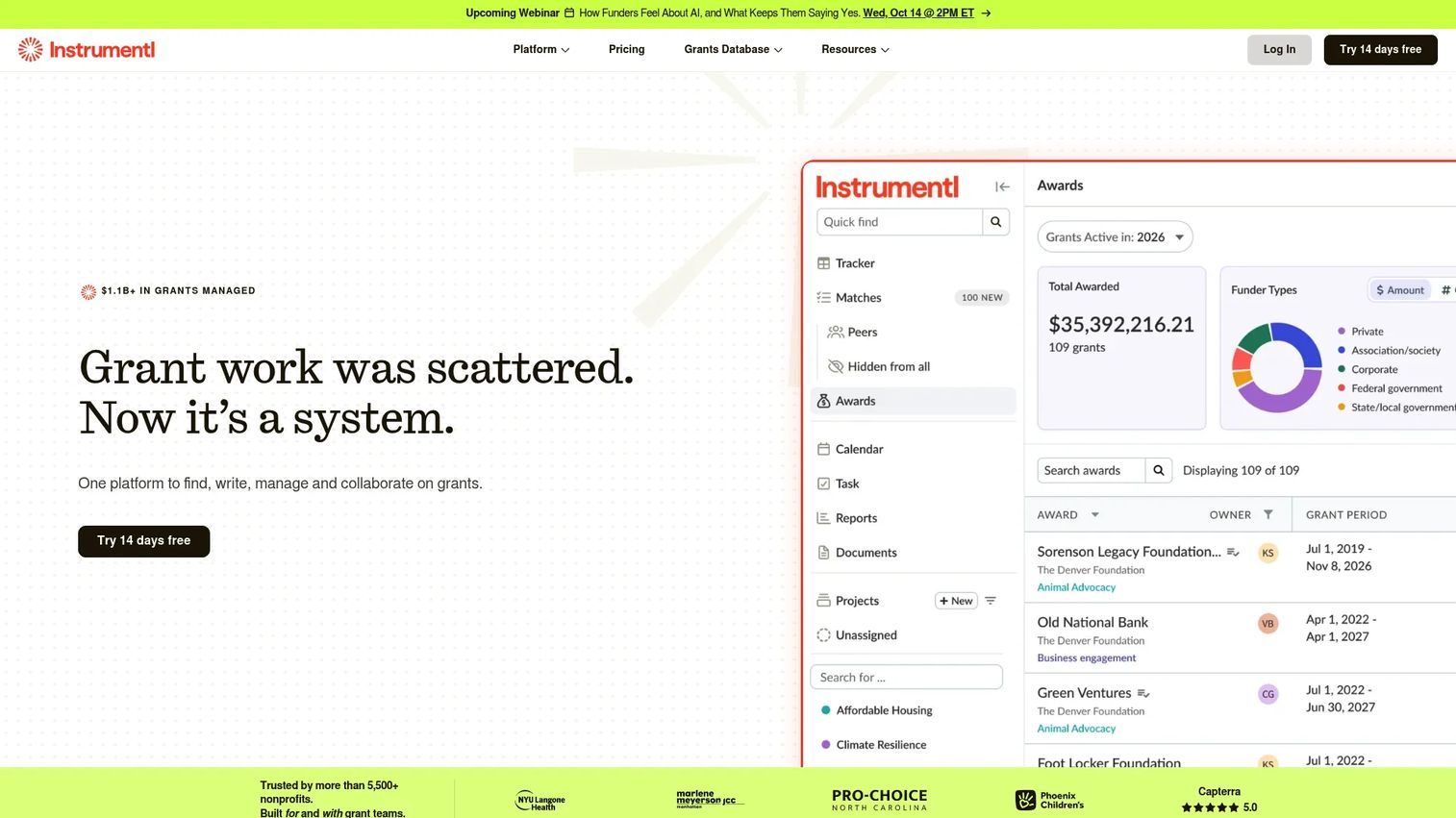
Instrumentl is a grant prospecting and management platform, not a donor prospect research tool. It helps nonprofits discover relevant foundation and government grant opportunities, track applications, manage deadlines, collaborate on submissions, and report on post-award finances. It belongs in this list as an adjacent fundraising intelligence tool for organizations whose revenue strategy includes institutional grants alongside individual major gifts.
Best for: Nonprofits and grant professionals who need grant discovery, application tracking, and post-award management in one place, alongside, not instead of, individual donor prospect research.
Key features
- AI-matched grant and funder discovery
- Grant pipeline tracking with task management and deadline reminders
- Application collaboration and AI-assisted drafting
- Post-award spend tracking, accounting integrations, and budget-versus-actual reporting
Why choose Instrumentl: It is the right addition when your funding strategy includes foundations and government grants. Instrumentl does not screen donors, estimate capacity, or prioritize major-gift portfolios; treat it as a separate infrastructure investment for a distinct funding stream.
Instrumentl pricing: Discover starts at $299/month (paid annually; $326/month paid monthly). Pre-Award is $499/month annually, adding application collaboration, CRM integrations, and AI drafting. Full Lifecycle is $999/month annually, adding post-award financial management. Enterprise is custom. All plans include a 14-day free trial. No credit card required for the trial. Pricing verified October 2026.
G2 rating: 4.9/5
10. Double the Donation
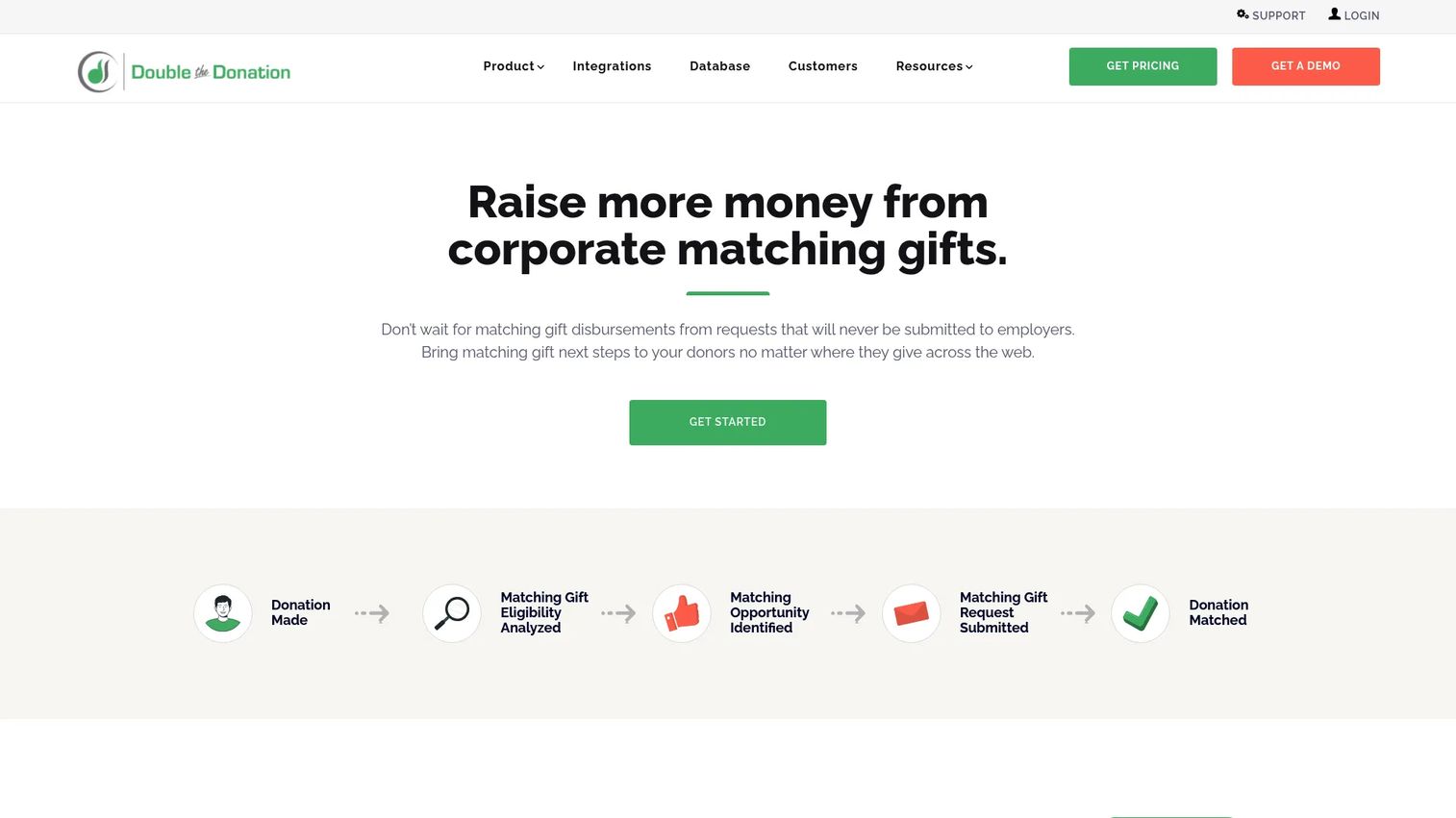
Double the Donation is a workplace giving platform that helps nonprofits and schools identify matching-gift opportunities, automate donor follow-up, and increase revenue from employer matching programs, volunteer grants, and payroll giving. Like Instrumentl, it belongs in this list as an adjacent tool. It does not screen for wealth or prioritize major-gift prospects; it creates additional gift value from donors who have already shown interest.
Best for: Fundraising teams that want to increase matching-gift participation and capture employer-based giving from an existing donor base.
Key features
- Automated matching-gift donor identification with personalized follow-up emails
- Embeddable matching-gift, volunteer, and payroll-giving search plugins
- Integrations with donation platforms and nonprofit CRMs
- Reporting on donations, matching activity, and email engagement
- Corporate giving database covering matching gifts, volunteer grants, and payroll giving
Why choose Double the Donation: It creates value after a donor has already given or expressed intent, not before. The Essentials tier's usage-based structure means smaller organizations can start without a large upfront commitment. It should not be counted as a substitute for major-donor prospect research.
Double the Donation pricing: Essentials is usage-based: Free for the first year or the first $2,000 in match-eligible dollars, then $300 for up to $2,000, $500 for up to $5,000, $1,200 for up to $15,000, and $4,000 for up to $50,000. Standard starts at $999/year. Enterprise starts at $30,000/year, adding custom APIs, SMS automation, and parent/child accounts. Pricing verified October 2026.
G2 rating: 4.7/5 based on 18 reviews
Considerations when choosing donor prospect research software
Data coverage and matching quality
Run any prospect research platform against a small, known set of donor records before committing. Check false positives, household matching, geographic coverage, asset accuracy, philanthropic record depth, and how recently data was refreshed. A system with broad coverage but poor match rates creates more researcher work, not less.
Research workflow after the screen
A batch screen produces a ranked file. What happens next is the question vendors rarely answer in a demo. Evaluate how the platform supports scoring review, portfolio assignment, preparation for cultivation strategy meetings, and CRM record updates. If your team cannot describe that handoff process today, design it before you buy the tool.
CRM and data governance
Confirm which CRMs the platform integrates with, whether sync is bidirectional or export-only, how duplicate or outdated research records get corrected, and who owns field definitions. Poor data governance after a screen creates messy records that slow gift officers rather than helping them.
Explainability of predictive scores
Ask every vendor: Which inputs drive a prospect's score, how often the model refreshes, and how a gift officer can challenge a result. A score that cannot be explained cannot be defended to a leadership team or board. Scores should prioritize researcher attention, not replace it.
Cost relative to active fundraising capacity
Compare total platform cost against the number of active gift officers, prospect researchers, records screened per year, and projected gifts the system should help influence. A large database license makes poor economics sense if no one owns the follow-up process.
Conclusion
The best donor prospect research platform is the one that fits the job that follows the research, not just the screen itself.
For broad nonprofit screening with AI-assisted prioritization, DonorSearch is the most complete starting point. Teams that need researcher-depth profiles before portfolio assignment should evaluate iWave. Windfall is the right fit when household-level wealth intelligence and enrichment across a large file are the primary need. For teams where prioritization and campaign targeting matter more than data acquisition, Dataro and GivingDNA offer distinct approaches worth comparing. ResearchPoint makes sense for organizations whose development operations run on the Blackbaud stack. Prospect Visual adds relationship-mapping context for cultivation-heavy teams.
Instrumentl and Double the Donation solve real fundraising problems, but they address different funding streams. Treat them as separate budget and implementation decisions.
The practical next step: Shortlist two core platforms, run a sample file through each, compare match quality and profile depth against known donors, then map the handoff from research output into your CRM. The screen is only as useful as what your team does with it the following week.
Request two sample screenings and compare results against known donor records.
FAQs about donor prospect research software
Donor prospect research software combines wealth, giving, biographic, relationship, and engagement signals to help nonprofits identify and prioritize potential donors. It supports researcher judgment rather than replacing it, giving gift officers a defensible starting point for cultivation decisions.
Wealth screening focuses on financial capacity indicators: Property, securities, business ownership. Prospect research goes further by adding philanthropic giving history, board affiliations, cause interests, relationship connections, and biographic context. A capacity estimate tells you whether someone can give; a full research profile gives you evidence for whether they might.
Most enterprise-tier platforms price by database size, screening volume, seats, CRM integration, and predictive model scope. Vendors including DonorSearch, iWave, WealthEngine, ResearchPoint, Windfall, and GivingDNA require a sales conversation. Dataro publishes entry pricing starting at $15,000/year. Instrumentl starts at $299/month. Double the Donation offers an Essentials tier that starts free for the first year.
Small teams should evaluate minimum contract terms, data coverage for their geographic constituency, batch-screening options, and the staff time required to act on results. A lower-cost tool that produces more researcher work may not save money overall. Dataro's per-active-donor pricing and Double the Donation's usage-based Essentials tier both scale down for smaller organizations.
Many platforms offer integrations or data-export workflows with common nonprofit CRMs. Before purchasing, verify which specific CRMs are supported natively, whether sync is bidirectional or one-way, how record matching is handled, how often data refreshes, and whether integration adds to the base cost. Get these answers in writing during the sales process.
Accuracy depends on the quality of the underlying data, the inputs used to build the model, the coverage of your constituent base, and how often the model refreshes. Scores perform best when the organization validates them against known outcomes, adjusts campaign targeting accordingly, and treats them as prioritization guidance rather than certainty.
Prospect research typically draws on real estate records, business ownership, publicly traded securities, philanthropic giving history, board service affiliations, employment history, relationship networks, and prior engagement with the organization. Data use should align with the organization's privacy policies and applicable data governance requirements.
Some platforms surface planned-giving indicators as part of a broader prospect profile. Matching-gift identification is a separate workflow, handled by dedicated tools like Double the Donation. Both are related to fundraising, but neither is a substitute for full major-donor prospect research. Evaluate each against the specific revenue stream it supports.