Last updated: October 2026
ARR can look healthy while your finance team is still chasing invoice corrections, rebuilding deferred revenue schedules, and arguing over whose forecast is right. The issue is rarely one broken dashboard. It is the gap between contracts, usage, invoices, payments, and the general ledger.
The subscription billing management market reached $8.48 billion in 2025 and is growing at 17.2% annually, according to Fortune Business Insights (2025). That growth reflects how many scaling companies are hitting the same wall: Billing systems built for simpler times, metrics that differ depending on who built the spreadsheet, and a close process that depends on one person's model.
Poor finance infrastructure hides churn, delays decisions, and makes board reporting fragile. Failed payments create avoidable revenue leakage. Manual proration and mid-cycle amendments slow the finance team right when leadership needs faster answers.
Which recurring revenue finance platform fits your pricing model and operating complexity? That is the question this guide answers.
What's inside
This guide covers eight recurring revenue finance software platforms evaluated for SaaS founders preparing to hand off finance infrastructure to a new controller, CFO, or VP of Finance.
- Who this is for: Series B SaaS founders shortlisting tools before delegating technical evaluation to Finance, RevOps, and Product
- How items were chosen: Verified pricing, G2 ratings, and current product capabilities across billing, collections, revenue recognition, and reporting
- Selection criteria:
- Pricing-model flexibility (subscriptions, usage, hybrid, contracts)
- Finance workflow depth (revenue recognition, dunning, close support)
- Integration fit with CRM, ERP, and data systems
- Implementation risk relative to company stage
TL;DR
- Best for Stripe-native SaaS: Stripe Billing, for companies already processing payments through Stripe that want billing and revenue recognition inside that same stack
- Best for B2B SaaS finance operations: Maxio, for contract-heavy businesses that need billing, SaaS metrics, and revenue recognition close together
- Best for flexible subscription management: Chargebee, for multi-model billing with broad payment gateway options and built-in RevRec
- Best for complex enterprise monetization: Zuora, for global, high-volume, or hybrid revenue models with order-to-revenue controls
- Best for failed-payment recovery: Recurly, where retention and dunning automation are central operating priorities
- Best for usage-based pricing: Orb, for product teams that need granular event-based metering and flexible rating logic
- Best for configurable enterprise billing: BillingPlatform, for complex product catalogs, custom rating rules, and deep billing operations
- Best for accounting-led finance: Sage Intacct, for finance teams that want recurring revenue visibility close to core accounting
What is recurring revenue finance software?
Recurring revenue finance software connects how a company sells recurring products with how it bills, collects, recognizes, reports, and forecasts that revenue.
The category spans a wide surface. A basic billing tool charges customers and collects payments. A recurring revenue finance platform goes further: It connects those billing events to contracts, collections workflows, revenue recognition schedules, and the reporting your board, auditors, and finance team depend on.
What this software typically handles
- Subscription lifecycle management (upgrades, downgrades, cancellations, renewals)
- Product catalog and pricing rules
- Usage metering and rating
- Automated invoicing and payment collection
- Proration, amendments, credits, and refunds
- Dunning management and payment retry workflows
- Revenue recognition schedules (ASC 606 and IFRS 15)
- MRR, ARR, NRR, churn, and cohort reporting
- General ledger and accounting-system integrations
- Forecasting inputs and cash collection visibility
The finance metrics founders should understand
- MRR: Monthly recurring revenue from active subscriptions
- ARR: Annualized recurring revenue, useful for planning but not identical to cash
- Gross retention: Revenue retained before expansion
- NRR: Retained revenue after expansion and contraction
- Churn: Lost customers or lost recurring revenue, measured separately
- CAC and LTV: Unit-economics measures that signal growth quality
- Deferred revenue: Cash invoiced before the related service is recognized as revenue
Billing software versus recurring revenue finance software
Basic billing tools charge customers. Recurring revenue finance platforms connect those billing events to contracts, collections, revenue recognition, and reporting. Some platforms provide both in one system. Others fit into a connected stack alongside an ERP and a dedicated revenue recognition module.
The architecture that fits your company depends on two questions: How complex is your monetization model, and does your finance team need operational billing, accounting-grade revenue recognition, or both? Review our guides on cash flow management software and best revenue operations software for adjacent category context.
When to use recurring revenue finance software
Move beyond spreadsheet-based billing and board reporting
When Finance spends days reconciling customer data, invoices, credits, and revenue schedules before each board pack, a dedicated platform stops being optional. The trigger is usually the moment when recurring revenue reporting requires manual exports or depends on one operator's model to stay accurate.
Introduce usage-based or hybrid pricing
Base subscription plus usage, seat-based plans with overages, contracted minimums, and prepaid credit balances all create billing complexity that a basic payment subscription setup was not built for. This is where usage-based billing and hybrid billing requirements expose gaps in early-stage tooling. If your roadmap includes any of those pricing structures, evaluate the platform before you ship the pricing change, not after.
Prepare for a finance hire, audit, or fundraise
Hiring a controller or VP Finance typically surfaces every gap in the close process. They need defensible revenue schedules, clean collections data, and ARR reporting that matches the general ledger. Preparing board materials, responding to diligence, or closing books without rebuilding revenue schedules every month all depend on the same underlying infrastructure. For more on the cash-planning layer, see our guide to cash flow forecasting software.
Recurring revenue finance software comparison
The right tool hinges on two questions: How complex is your monetization model, and does your team need billing, revenue recognition, or both? The table below covers verified pricing and G2 ratings as of October 2026.
| # | Product | Best for | Key differentiator | Pricing | G2 rating |
|---|---|---|---|---|---|
| 1 | Stripe Billing | Stripe-native SaaS | Billing, payments, and revenue recognition in one Stripe stack | From 0.7% of billing volume | 4.4/5 |
| 2 | Chargebee | Flexible subscription operations | Multi-model billing with built-in RevRec | From 0.80%/month (Flow plan) | 4.4/5 |
| 3 | Maxio | B2B SaaS finance teams | Billing, revenue recognition, and SaaS metrics for contract-led businesses | From $599/month | 4.3/5 |
| 4 | Zuora | Enterprise monetization complexity | Order-to-revenue controls for global and hybrid models | Custom pricing | 3.9/5 |
| 5 | Recurly | Subscription retention and recovery | Dunning and subscriber lifecycle management | From $249/month + 0.9% | 4.0/5 |
| 6 | Orb | Usage-based SaaS | Granular event-based metering and flexible rating | Custom pricing | 5.0/5 |
| 7 | BillingPlatform | Configurable enterprise billing | Product catalog, pricing rules, and billing workflow depth | Custom pricing | 4.4/5 |
| 8 | Sage Intacct | Accounting-led finance operations | Core financial management with recurring revenue workflows | Custom pricing | 4.3/5 |
Pricing and G2 ratings verified October 2026 from each vendor's official pricing page and live G2 listing.
Best 8 recurring revenue finance software tools for 2026
1. Stripe Billing
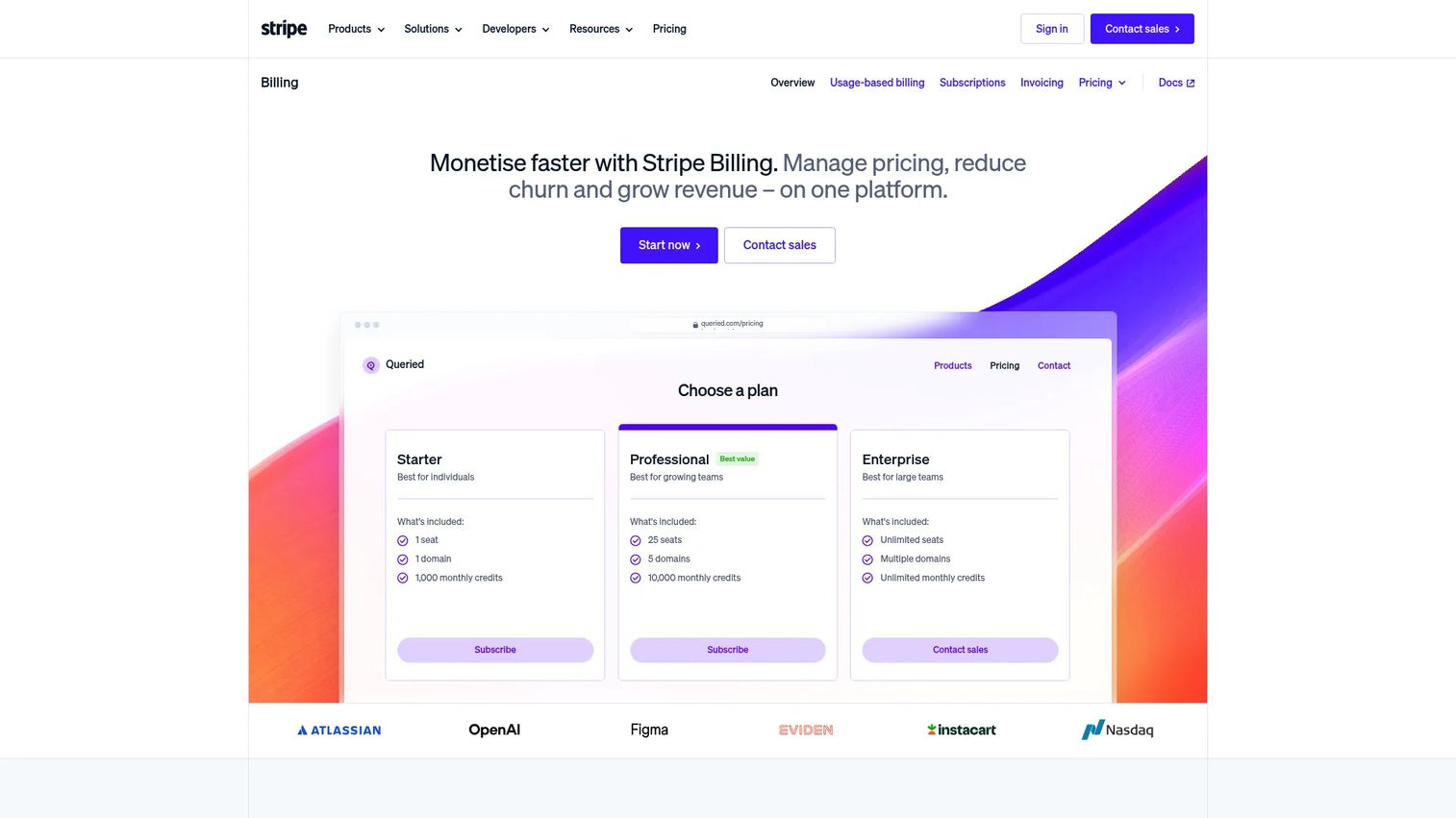
Stripe Billing is a subscription and invoicing platform built directly into the Stripe payments stack. It handles recurring billing, usage-based charging, invoice generation, payment recovery, and revenue recognition reporting for businesses already running payments through Stripe. The finance stack stays inside one ecosystem, which reduces the number of data handoffs between payment processor, billing system, and reporting layer.
Best for: Founders running a Stripe-native self-serve or hybrid SaaS motion who want to consolidate payments and billing early.
Key features
- Recurring subscription and invoice management
- Usage-based billing via metered billing support
- Automated Smart Retries for failed payments
- Revenue recognition reporting
- Multiphase subscription schedules and quotes
Why choose Stripe Billing: When Stripe is already your payment processor, keeping billing and revenue recognition inside the same platform eliminates a reconciliation step that Finance otherwise handles manually. The caution worth naming: If you anticipate switching payment processors, that dependency becomes a migration project.
Stripe Billing pricing: Stripe charges 0.7% of billing volume on a pay-as-you-go basis. Monthly plan subscriptions start at $620/month for up to $100,000 in monthly billing volume and go up to $5,750/month for up to $1,000,000 in monthly billing volume. Higher volumes require a custom contract.
G2 rating: 4.4/5 (verified October 2026).
2. Chargebee
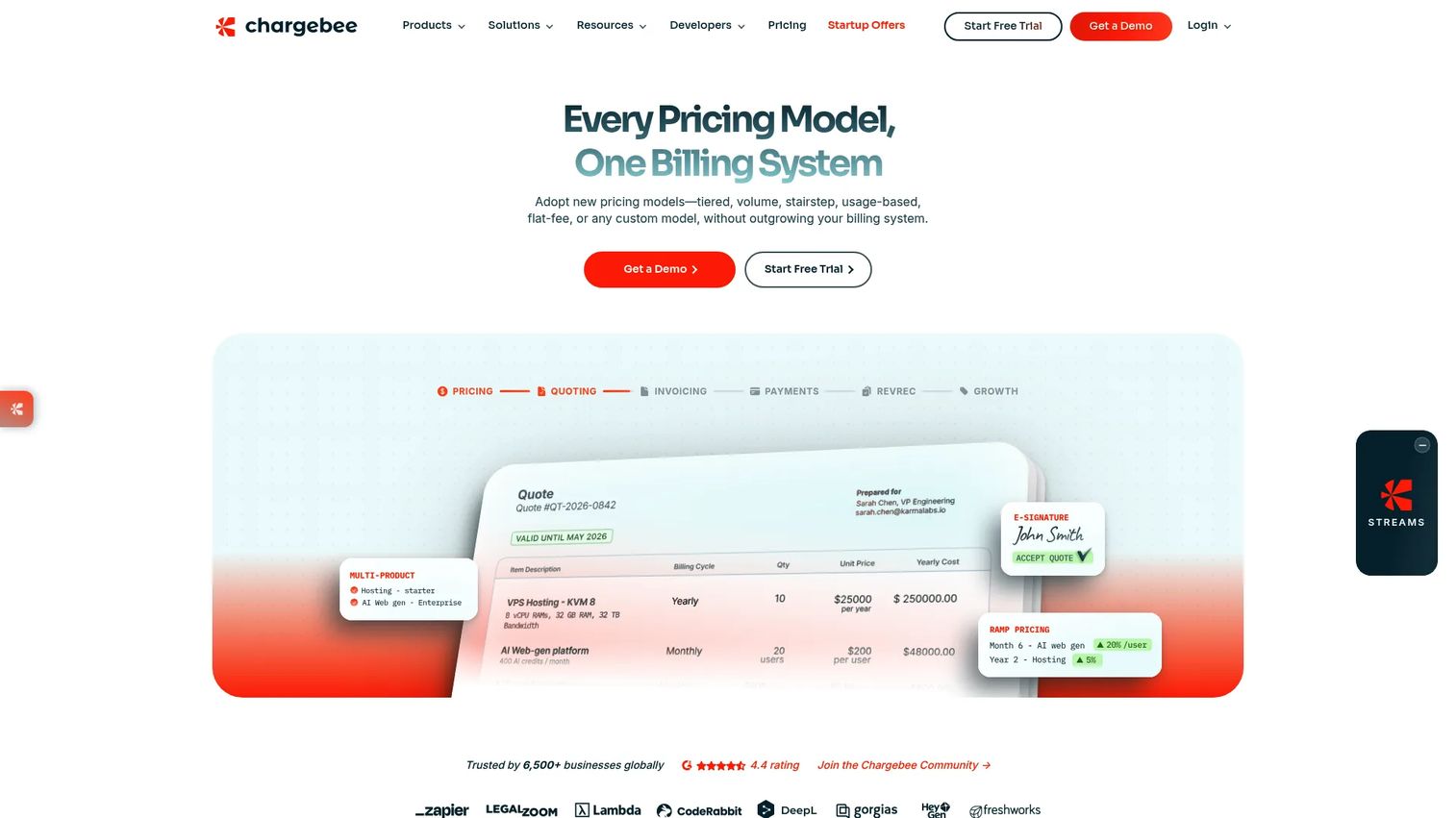
Chargebee is a billing and monetization platform built for subscription, usage-based, and hybrid revenue models. It supports multi-model billing, a wide range of payment gateways, dunning workflows, and revenue recognition under ASC 606 and IFRS 15 through its RevRec product. Companies moving beyond simple monthly subscriptions typically choose Chargebee when they need gateway flexibility alongside finance-grade reporting.
Best for: SaaS teams adding tiered, hybrid, or multi-currency billing without committing to a payment-processor-only architecture.
Key features
- Subscription and usage-based billing
- Multi-gateway payment support
- Dunning and automated payment retry workflows
- Revenue recognition aligned with ASC 606 and IFRS 15
- CPQ and quote management available as add-ons
Why choose Chargebee: It fits a growing SaaS company that expects pricing changes, regional expansion, or payment-provider flexibility over the next 18 to 24 months. RevRec is an additional product rather than included by default, so confirm which tier covers your finance requirements before signing.
Chargebee pricing: The Flow plan starts at 0.80% of billing volume per month and includes 100M usage events. Enterprise plans use custom pricing. RevRec Enterprise and the Growth engagement products are quoted separately. CPQ Lite is free for the first 50 quotes for Chargebee Billing customers.
G2 rating: 4.4/5 (verified October 2026).
3. Maxio
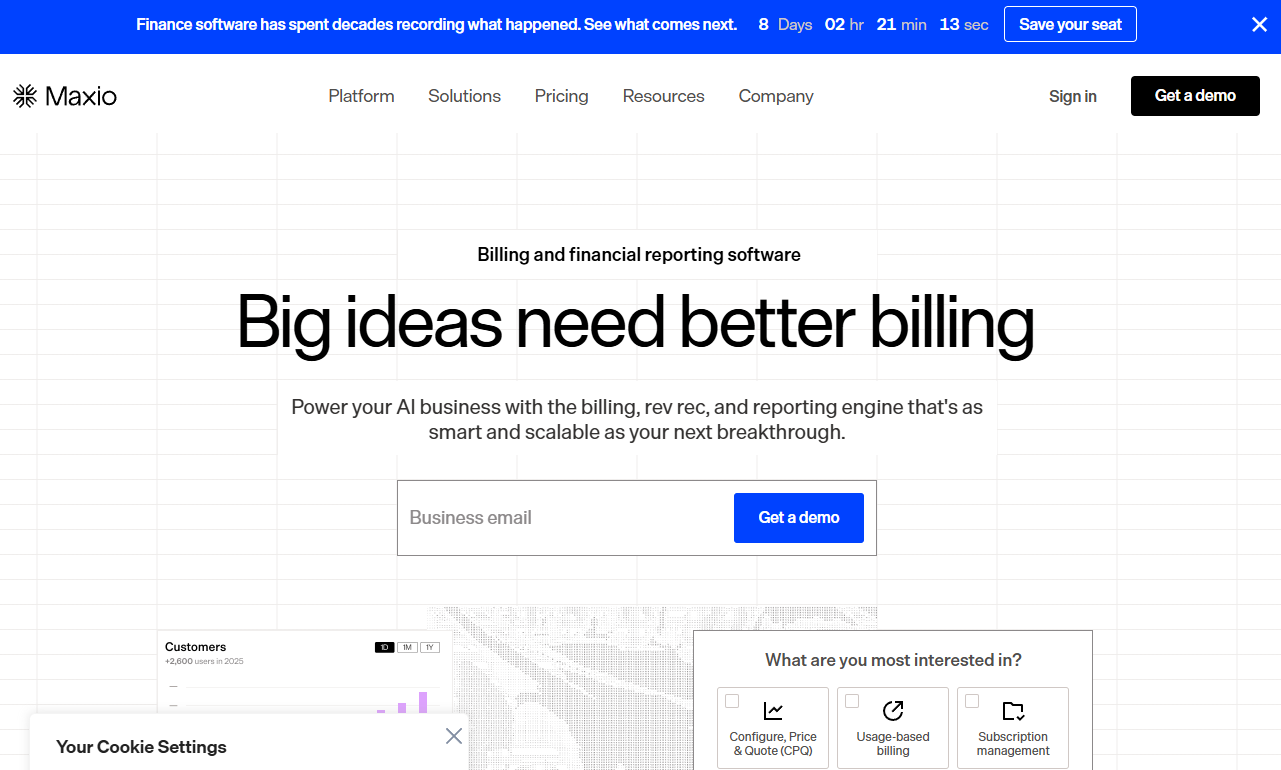
Maxio is a financial operations platform built specifically for B2B SaaS and AI companies. It covers billing, payments, revenue recognition, collections, and SaaS metrics reporting from a single system. For founders who just hired or are about to hire a controller, Maxio gives that person a finance-ready platform rather than a billing layer that still requires spreadsheet support. The best contract lifecycle management software guide covers related tooling for the upstream contract workflow.
Best for: Contract-heavy B2B SaaS companies that want finance, billing, and SaaS metrics to operate from a connected system without adding separate reconciliation steps.
Key features
- Contract-driven subscription and usage billing
- Revenue recognition and deferred revenue scheduling
- SaaS metrics: ARR, MRR, NRR, churn, and cohort reporting
- Automated collections and dunning management
- 20+ payment gateway integrations plus accounting and ERP connectivity
Why choose Maxio: It fits businesses where negotiated contracts, amendments, and finance reporting create more operational risk than checkout complexity. If your deals include annual prepayments, contract modifications, or custom terms, Maxio's billing logic reflects that complexity without requiring manual workarounds.
Maxio pricing: The Grow plan is $599/month and covers businesses up to $100,000 in monthly billings. The Scale plan is quoted for businesses above that threshold. No free tier is offered.
G2 rating: 4.3/5 (verified October 2026).
4. Zuora
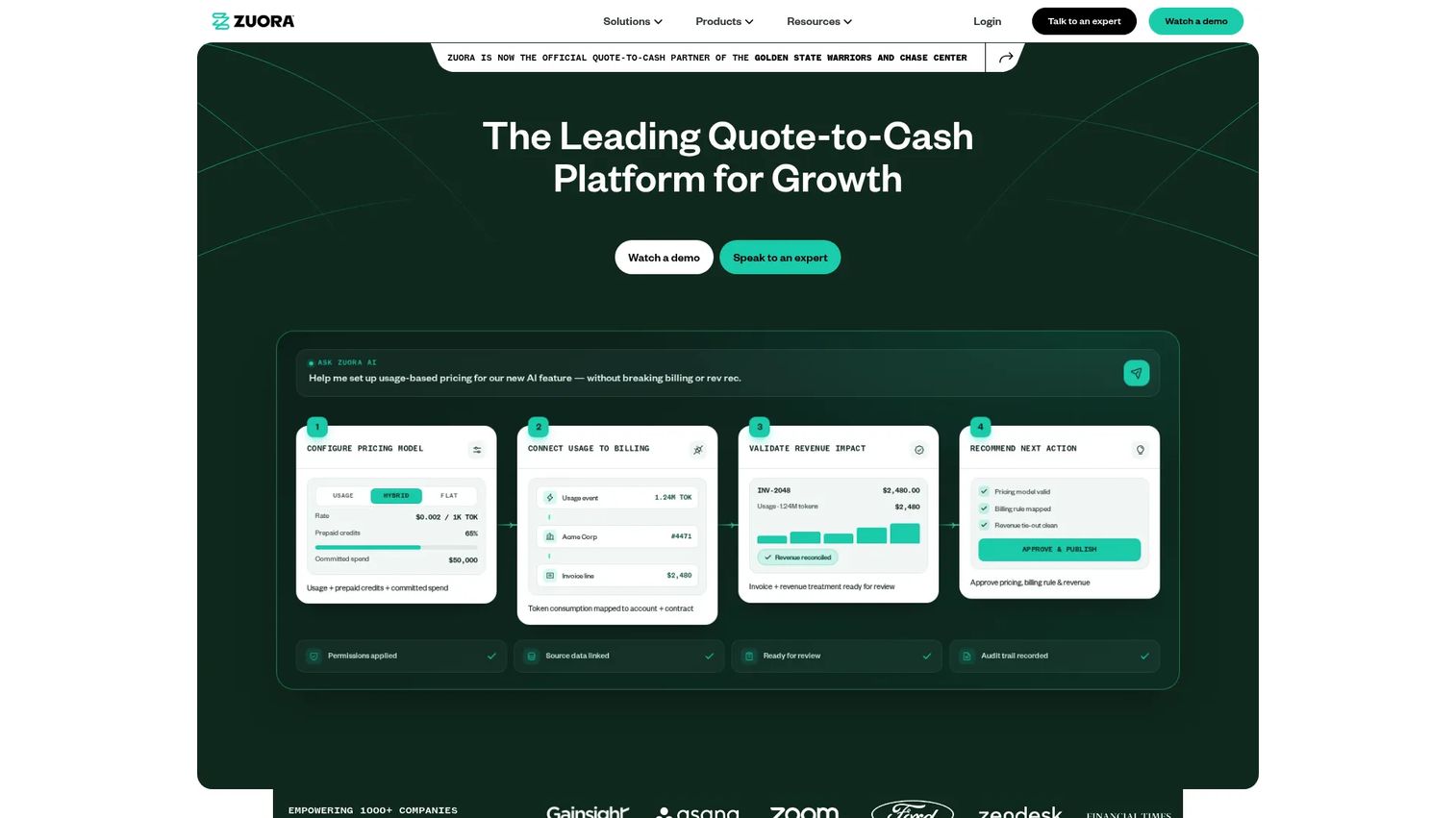
Zuora is a quote-to-cash and monetization platform for subscription, usage-based, and hybrid revenue models at scale. It covers billing, revenue recognition automation, global payment orchestration, collections, and flexible pricing configuration. Companies choose Zuora when their billing rules have become complex enough to resemble a finance system rather than a simple checkout flow. Implementation typically requires a dedicated program, and that cost should factor into the evaluation.
Best for: Larger SaaS businesses with complex contracts, high billing volume, global requirements, or multiple monetization models running simultaneously.
Key features
- Configurable product catalog with flexible pricing and packaging
- Recurring and usage-based billing
- Revenue recognition controls aligned with ASC 606 and IFRS 15
- Collections and accounts receivable automation
- CRM and ERP connectivity
Why choose Zuora: Its depth pays off when the pricing engine itself needs enterprise-grade configuration and finance needs auditability from the billing layer outward. For companies not yet operating at that scale, the implementation investment may outweigh the fit. Explore best quote management software to understand what sits upstream of a Zuora deployment.
Zuora pricing: Zuora does not display tier pricing. The quote depends on products selected, transaction volume, business model, regions, and implementation needs. Contact Zuora's sales team directly to scope a proposal.
G2 rating: 3.9/5 (verified October 2026).
5. Recurly
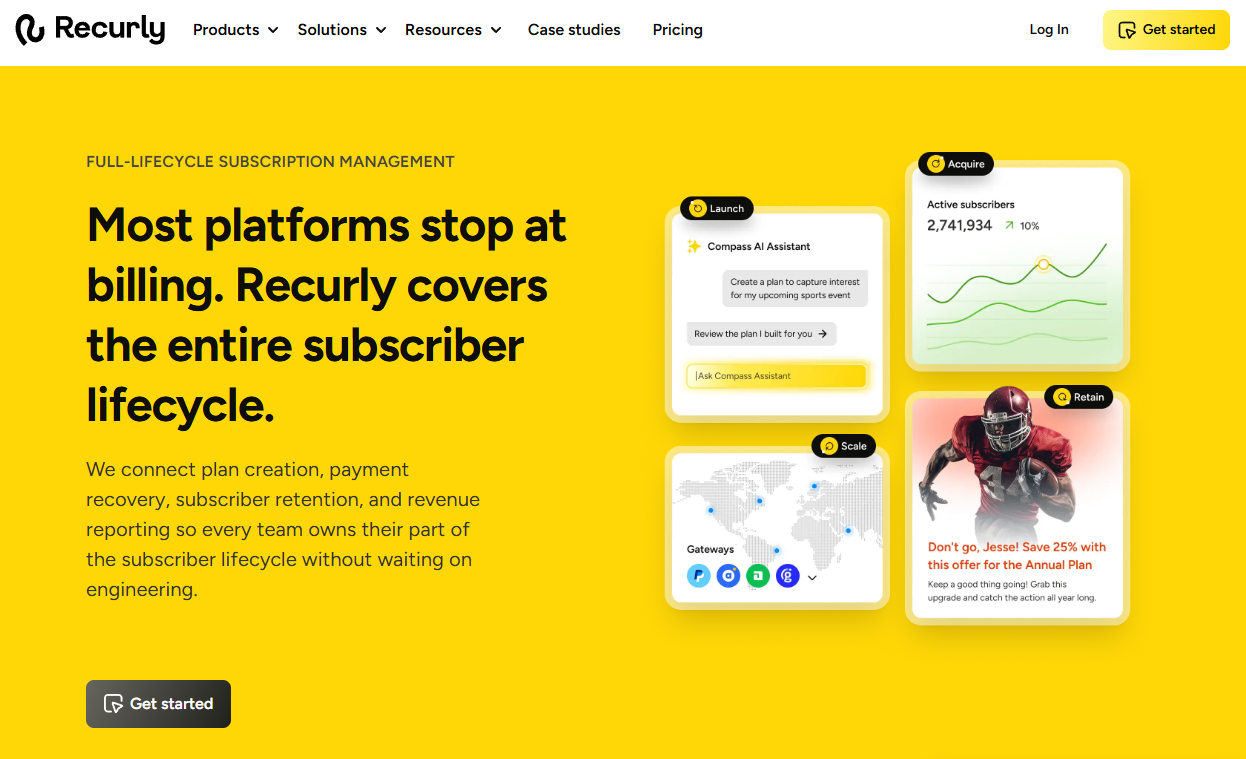
Recurly is a subscription management and recurring billing platform focused on subscriber lifecycle management, payment recovery, and churn reduction. Its dunning engine is a first-class feature, not an afterthought: It automates retry logic, account-updater workflows, and multi-step dunning campaigns to recover revenue that would otherwise be lost to failed payments. For subscription businesses where involuntary churn is a meaningful revenue risk, that focus is a genuine differentiator.
Best for: Subscription businesses focused on reducing payment-related churn and improving recurring revenue recovery across a global subscriber base.
Key features
- Subscriber lifecycle management (plans, promotions, upgrades, cancellations)
- Automated payment retry and dunning workflows
- Churn management and revenue recovery analytics
- Global payments orchestration across 20+ gateways
- RevRec module available as a separate plan
Why choose Recurly: Choose it when the finance problem centers on revenue recovery and subscriber operations rather than complex contract accounting. If most of your revenue risk lives in failed card payments, Recurly's retry and dunning automation addresses that more directly than a contract-billing platform would.
Recurly pricing: The Starter plan is $249/month plus 0.9% of billing volume. The All-Access plan is billed annually and priced at less than 1% of billing volume, requiring a $1M annual billing minimum. The Engage plan starts at $1,600/month billed annually. RevRec starts at $850/month billed annually.
G2 rating: 4.0/5 (verified October 2026).
6. Orb

Orb is a revenue design platform built for usage-based billing, granular event metering, and flexible pricing workflows. It ingests usage events in real time, applies configurable rating logic, and generates invoices without requiring finance or engineering to reconcile usage data manually. For founders introducing API-call pricing, compute-based charges, or seat-plus-usage hybrid models, Orb removes the manual layer between usage data and the invoice.
Best for: SaaS companies with granular usage events and an engineering-led monetization model where pricing must evolve quickly without breaking billing.
Key features
- Real-time event ingestion and usage metering
- Flexible rating logic for hybrid and usage-based billing
- Automated price changes and pricing workflow management
- Invoicing, payment collection, and dunning
- Integrations with Salesforce, NetSuite, data warehouses, and tax systems
Why choose Orb: When product usage itself determines what customers owe, the billing system must be as flexible as the pricing team's roadmap. Orb is built for that case. Finance and RevOps teams also benefit from the tight integration with accounting and data warehouse systems, which reduces the export-and-reconcile cycle.
Orb pricing: All three plans (Core, Advanced, Enterprise) use custom pricing quoted by Orb's sales team. No free tier is available. Advanced adds data warehouse, Salesforce, and NetSuite integrations; Enterprise adds enterprise SLAs and dedicated support.
G2 rating: 5.0/5 (verified October 2026, based on a small review count).
7. BillingPlatform
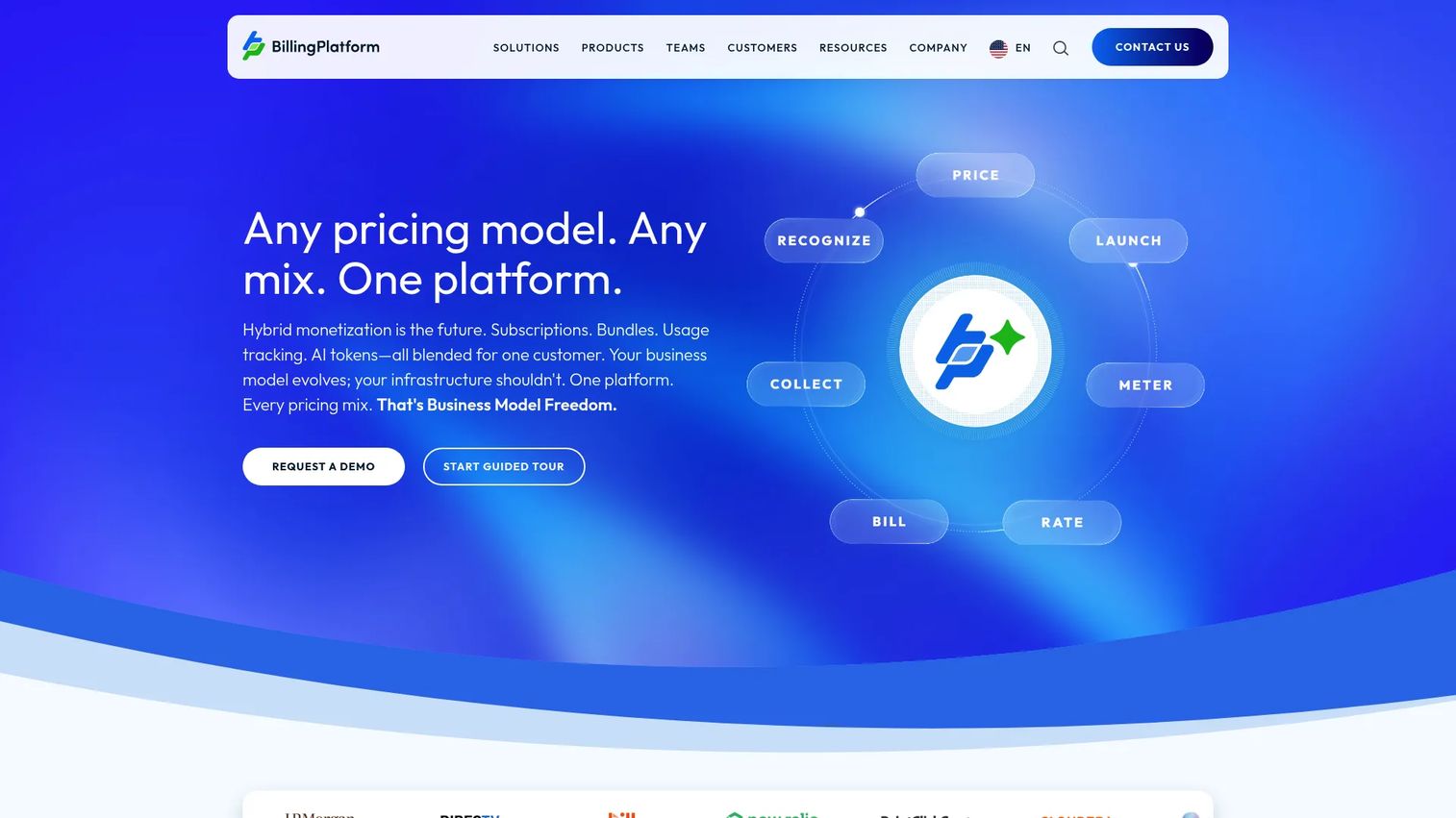
BillingPlatform is an enterprise revenue lifecycle and monetization platform that handles subscription, usage-based, hybrid, and dynamic billing across complex product catalogs and customer structures. Its center of gravity is billing operations: Configurable rating rules, multi-currency invoicing, collections management, and revenue recognition supporting ASC 606 and IFRS 15. Companies with many pricing exceptions, multiple product lines, or enterprise-grade auditability requirements tend to find the configuration depth worth the investment.
Best for: Enterprises and upper-mid-market companies managing complex billing logic across products, customers, and pricing models where auditability is a hard requirement.
Key features
- Configurable product catalog with pricing, rating, packages, and bundles
- Complex rating rules including usage-based and dynamic billing
- Automated invoicing, payments, and collections management
- Revenue recognition aligned with ASC 606 and IFRS 15
- Quote-to-cash integrations and customer self-service workflows
Why choose BillingPlatform: It fits when the pricing engine itself requires deep configuration and Finance needs a traceable audit trail from the billing layer through to revenue recognition. If your billing scenarios include multi-element arrangements, contract modifications, and multiple pricing structures within a single account, BillingPlatform is built for that operating reality.
BillingPlatform pricing: Three plans (Core Platform, Core Platform plus Revenue Recognition, Core Platform plus Collections) are offered on annual contracts. Amounts are not displayed. Contact BillingPlatform directly to scope a quote based on catalog complexity and volume.
G2 rating: 4.4/5 (verified October 2026).
8. Sage Intacct
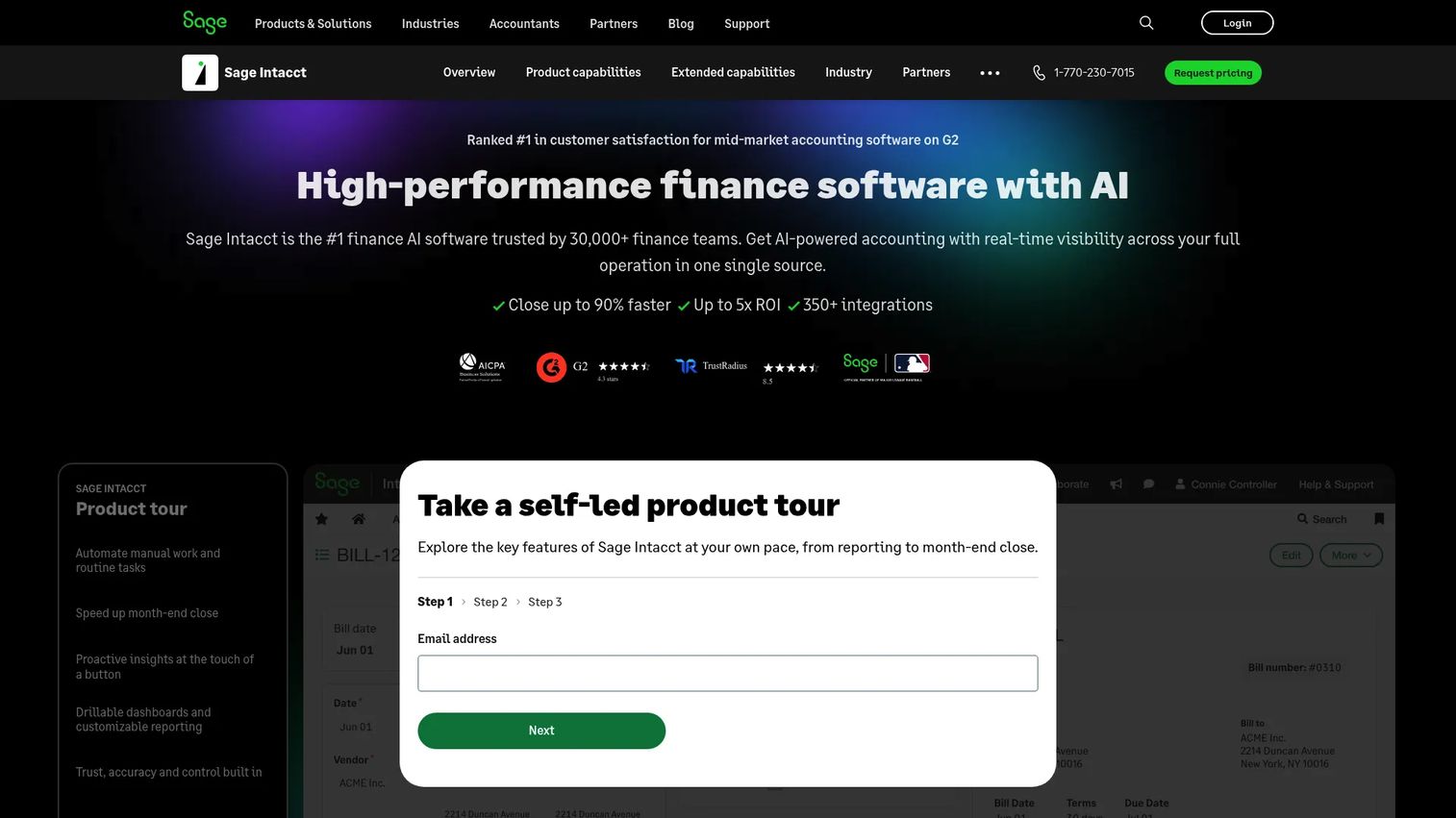
Sage Intacct is cloud accounting and financial management software for growing and mid-sized organizations. It provides core financial management, multi-entity accounting and consolidation, AI-assisted close workflows, and multi-dimensional reporting. Recurring revenue workflows sit inside a full accounting system, which makes it a strong fit for finance teams that need the general ledger and subscription reporting to live together. When billing complexity exceeds what Sage Intacct handles natively, it typically connects to a specialized billing platform upstream. For context on the broader RevOps layer, see best revenue operations software.
Best for: SaaS companies whose immediate priority is stronger accounting operations, multi-entity reporting, and a defensible close process rather than billing-layer configurability.
Key features
- Multi-entity accounting and consolidation
- AI-powered close automation, AP automation, and finance intelligence
- Multi-dimensional reporting and real-time financial dashboards
- Revenue recognition workflows
- 350+ integrations and open APIs including CRM and billing systems
Why choose Sage Intacct: Choose it when the finance organization needs accounting depth first, and specialized billing can remain connected upstream. A new controller or CFO typically wants a system of record that survives audit scrutiny before optimizing the billing layer.
Sage Intacct pricing: Sage customizes pricing to the organization's size and module requirements. Annual subscription plans are standard. Contact Sage's sales team for a quote.
G2 rating: 4.3/5 (verified October 2026).
Considerations when choosing recurring revenue finance software
Match the tool to your pricing model
Before booking demos, inventory every pricing rule currently in production and every rule planned for the next 12 months. Seat changes, proration, usage events, credits, discounts, contract amendments, annual prepayments, minimum commitments, and multi-currency invoices all behave differently across platforms. A tool that handles simple monthly subscriptions may require engineering workarounds the moment hybrid pricing enters the roadmap.
Decide who owns the system
Finance, RevOps, and Engineering each touch a recurring revenue platform for different reasons. Finance owns revenue schedules, close, controls, and board reporting. RevOps owns contract handoffs from the CRM and quote workflow. Engineering owns event metering and integration reliability. A platform with no clear internal owner drifts. Assign ownership before signing, not after go-live. Related context appears in our best contract lifecycle management software guide.
Map the system of record before migration
A data-flow map covering CRM, CPQ, billing, payment processor, ERP, tax engine, data warehouse, and board reporting is the deliverable Finance needs before any migration starts. Without it, implementation timelines slip and reconciliation problems surface after cutover rather than during testing.
Price the implementation, not only the subscription
Migration and data cleanup, integration work, consultant or implementation-partner costs, staff time, a parallel-run period, and process redesign all add to the total cost of switching. A platform at $599/month with a $40,000 implementation is a different investment than its subscription fee suggests. Build that into the evaluation before shortlisting finalists.
Test the close process before you sign
Run one difficult scenario in the evaluation: A mid-cycle upgrade, a usage overage, a contract amendment, a failed payment, a credit memo, and the revenue-recognition impact of each. That sequence reveals whether the platform supports your actual operating reality or only the demo path. Platforms that handle it cleanly during evaluation save Finance weeks every quarter.
Conclusion
Recurring revenue finance software should make revenue clearer, not create another source of conflicting metrics. The strongest picks from this list align by operating model: Stripe Billing for Stripe-native teams; Chargebee for flexible subscription operations; Maxio for B2B SaaS finance workflows; Zuora for enterprise monetization complexity; Recurly for retention and recovery; Orb for usage-led pricing; BillingPlatform for configurable billing operations; and Sage Intacct for accounting-led finance control.
The practical next step is to map your current revenue data flows, identify where contracts, usage events, invoices, and payments lose fidelity before reaching the general ledger, and shortlist two or three platforms based on your current monetization model and your next 24-month plan. Then run the difficult scenario test described in the considerations section above.
A finance system that survives a board pack, a diligence request, and a pricing change without requiring a reconciliation sprint is the asset worth buying. The tools above each get you closer to that outcome in different ways.
Start your journey with Guideflow today!
FAQs
Recurring revenue finance software connects recurring billing, payment collection, revenue recognition, reporting, and forecasting into a coordinated system. One platform may cover all of those functions, or a company may use connected specialist tools: For example, a billing platform feeding an ERP alongside a dedicated revenue recognition module.
Subscription billing software calculates what customers owe and collects payment. Revenue recognition software determines when invoiced or collected amounts appear as recognized revenue under the company's accounting policies, typically ASC 606 or IFRS 15. The two functions are related but distinct. Many recurring revenue platforms now bundle both, but finance leadership still needs to define the accounting policy that governs recognition timing.
A company typically needs dedicated revenue recognition support when it has annual prepayments, contract modifications, usage billing, bundled products, credits, multi-element arrangements, audit requirements, or a close process that still depends on spreadsheets. Finance leadership must define the accounting policy; software automates execution against that policy but does not replace the judgment behind it. For related infrastructure context, see our guide on cash flow forecasting software.
The answer depends on the operating model. Stripe Billing fits Stripe-native self-serve SaaS. Maxio fits contract-heavy B2B SaaS where Finance needs billing, SaaS metrics, and revenue recognition from one system. Chargebee fits companies with pricing-model flexibility as a priority. Zuora fits larger businesses with global or multi-model complexity. Orb fits usage-led businesses where metering accuracy drives invoice accuracy. The shortlist should start with the two questions: What does your pricing model require today, and what will it require in 24 months?
Most billing and subscription platforms are not general-ledger systems. They handle monetization operations: Billing, collections, revenue recognition schedules. An ERP remains the core accounting system and system of record for the balance sheet, payroll, and consolidated financials. The best architecture depends on whether finance needs one suite (such as Sage Intacct covering both) or integrated systems (such as a billing platform feeding an ERP via API). Explore best revenue operations software for the RevOps layer that sits between CRM and billing.
Involuntary churn comes from failed payments, not customer dissatisfaction. Dunning management tools automate payment retries, apply account-updater logic where supported, and run multi-step communication sequences to recover revenue before a subscription lapses. Recurly and Chargebee both treat dunning as a core workflow. Customer satisfaction and product-market fit problems are separate issues that billing tools cannot address.
Beyond ARR and MRR, the metrics worth tracking regularly include NRR (net revenue retention), gross retention, logo churn, revenue churn, CAC payback period, gross margin, deferred revenue balance, overdue receivables, and cash collection timing. Each of these gives a different signal: Gross retention shows whether the customer base is stable before expansion; deferred revenue shows how cash and recognized revenue diverge; overdue receivables show where collections pressure is building.
Implementation timelines depend on catalog complexity, historical data quality, the number of integrations required, the depth of pricing rules, and whether revenue recognition needs to be rerun on historical contracts. Simple implementations with clean data and a straightforward catalog can go live in six to eight weeks. Complex deployments involving historical data migration, ERP integration, and custom billing logic often run four to six months. A staged plan with a parallel close or invoice run before full cutover reduces the risk of post-go-live reconciliation problems.