Pharmacy operations fail quietly before they fail visibly. A dispensing queue backs up. An inventory reorder misses. A claim gets rejected and nobody catches it until end-of-month reconciliation. By the time these problems surface on a report, they've already cost margin, staff hours, and patient trust.
The global medication dispensing systems market was valued at US$1.70 billion in 2025 and is projected to reach US$3.30 billion by 2033, according to Grand View Research. That growth reflects how seriously operators are taking the operational layer underneath prescription fulfillment. A pooled analysis across 62 studies, published by AHRQ PSNet in 2024, found a global dispensing error prevalence of 1.6%. At scale, that number isn't a rounding error. It's a liability.
The right pharmacy management software doesn't just process prescriptions. It becomes the workflow layer connecting orders, patients, payers, staff, audit trails, and inventory into something a team can actually run without the owner in every room.
What's inside
This guide compares 12 medication dispensing software and pharmacy management platforms for 2026. Items were selected based on:
- Dispensing workflow fit: prescription intake, DUR, labeling, and queue management
- Coverage depth: inventory, claims, compliance support, and reporting
- Setting relevance: retail, long-term care, hospital, and physician-office workflows
- Integration readiness: EHR, e-prescribing, POS, wholesaler, and automation hardware
Pricing and G2 ratings must be verified before publication since many pharmacy software vendors use quote-based models.
TL;DR
- Best for large retail pharmacy operations: McKesson EnterpriseRx suits multi-location chains that need centralized management with a broad services ecosystem
- Best for dispensing automation with hardware: ScriptPro connects pharmacy management software directly to robotic dispensing and barcode-driven workflows
- Best for independent pharmacies: BestRx, Rx30, ComputerRx, QS/1, Datascan, SuiteRx, and Winpharm all deserve evaluation based on workflow fit and integration requirements
- Best for Canadian pharmacy teams: Kroll, now part of TELUS Health, is the established platform for Canadian community pharmacy operations
- Best for long-term care pharmacy: FrameworkLTC and SoftWriters as the company behind it offer purpose-built LTC workflows including cycle fills, facility management, and billing
What is medication dispensing software?
Medication dispensing software is a pharmacy software system that helps teams process prescriptions, verify patient and medication data, manage inventory, bill payers, document dispensing activity, and maintain audit-ready records.
The category sits at the intersection of several operational systems: Patient profiles, prescriber networks, pharmacy staff workflows, payer adjudication, wholesaler feeds, and dispensing hardware. In practice, the boundary between medication dispensing software and pharmacy management software is blurry. Most enterprise platforms handle both.
What differs is the setting:
- Retail and community pharmacies need prescription queues, refill automation, claims adjudication, POS integration, and patient communication
- Hospital pharmacies typically connect to EHR workflows and automated dispensing cabinets, with tighter integration into clinical order management
- Long-term care pharmacies must handle cycle fills, facility packaging, delivery coordination, MAR or eMAR interfaces, and recurring high-volume medication schedules
- Physician-office dispensing requires point-of-care inventory, PDMP reporting, drug utilization review, and reimbursement workflows
Key capabilities to look for
- Prescription intake and processing
- Patient profiles and medication history
- Drug utilization review (DUR)
- Inventory management and purchasing
- Claims submission and reimbursement
- Barcode scanning and label printing
- EHR or EMR integration
- Audit trails and access controls
- Operational reporting and dashboards
- Dispensing automation support
A standalone pill-dispenser app handles a narrow slice of this. Enterprise medication dispensing software manages the full operational chain.
When to use medication dispensing software
Process prescriptions without workflow bottlenecks
High-volume dispensing requires queue management, refill handling, DUR checks, label printing, patient records, and staff visibility. A spreadsheet or disconnected system breaks once daily fill volume passes a few hundred prescriptions. Pharmacy workflow automation closes that gap by routing prescriptions through defined stages, flagging exceptions, and giving staff a clear view of what needs attention.
Control inventory before it becomes a margin leak
Inventory errors in pharmacy are cash leaks. NDC-level visibility, reorder points, expiration tracking, controlled-substance oversight, and supplier feeds keep stock where it needs to be. For multi-location operators, centralized medication inventory software means one stock view, not seven spreadsheets.
Connect dispensing to claims, compliance, and reporting
Payer adjudication, reimbursement workflows, audit logs, PDMP reporting, and documentation all compound in complexity as volume grows. Pharmacy compliance software can support audit-ready workflows, but it doesn't replace your legal or regulatory review. The goal is a system where the documentation exists, is consistent, and can be pulled quickly.
Medication dispensing software comparison
The table below gives a fast reference. Most pharmacy software vendors use quote-based pricing, so the figures shown reflect what's publicly confirmed. Verify ratings at the tool's current G2 listing before making decisions.
| # | Product | Best for | Key differentiator | Pricing | G2 rating |
|---|---|---|---|---|---|
| 1 | McKesson EnterpriseRx | Multi-location retail chains | Centralized enterprise pharmacy management | Custom pricing | N/A |
| 2 | ScriptPro | Automation-heavy dispensing | Integrated robotics and software workflow | Custom pricing | 3.9/5 |
| 3 | BestRx | Independent pharmacies | Full pharmacy management for independents | Custom pricing | N/A |
| 4 | Kroll | Canadian pharmacy teams | Regionally established Canadian platform | Custom pricing | N/A |
| 5 | Rx30 | Community pharmacies | Integrated POS and clinical opportunity tools | Custom pricing | 3.8/5 |
| 6 | ComputerRx | Independent and community pharmacies | Xpress Fill automation and billing workflows | Custom pricing | 3.5/5 |
| 7 | FrameworkLTC | Long-term care pharmacies | Purpose-built LTC workflow automation | Custom pricing | N/A |
| 8 | QS/1 | Retail and institutional pharmacies | Multi-setting pharmacy software coverage | Custom pricing | 3.4/5 |
| 9 | Datascan Pharmacy Software | Independent community pharmacies | High-rated POS, mobile, and delivery platform | Custom pricing | 4.9/5 |
| 10 | SuiteRx | Independent, LTC, and specialty pharmacies | Flexible platform with published introductory pricing | From $25,000 (SRx+) | 4.5/5 |
| 11 | Winpharm | Hospital pharmacies | Drug distribution, EMAR, and EHR integration | Custom pricing | 4.9/5 |
| 12 | SoftWriters FrameworkLTC | LTC pharmacy operators | Vendor specialization in long-term care | Custom pricing | 4.4/5 |
Best 12 medication dispensing software for 2026
1. McKesson EnterpriseRx
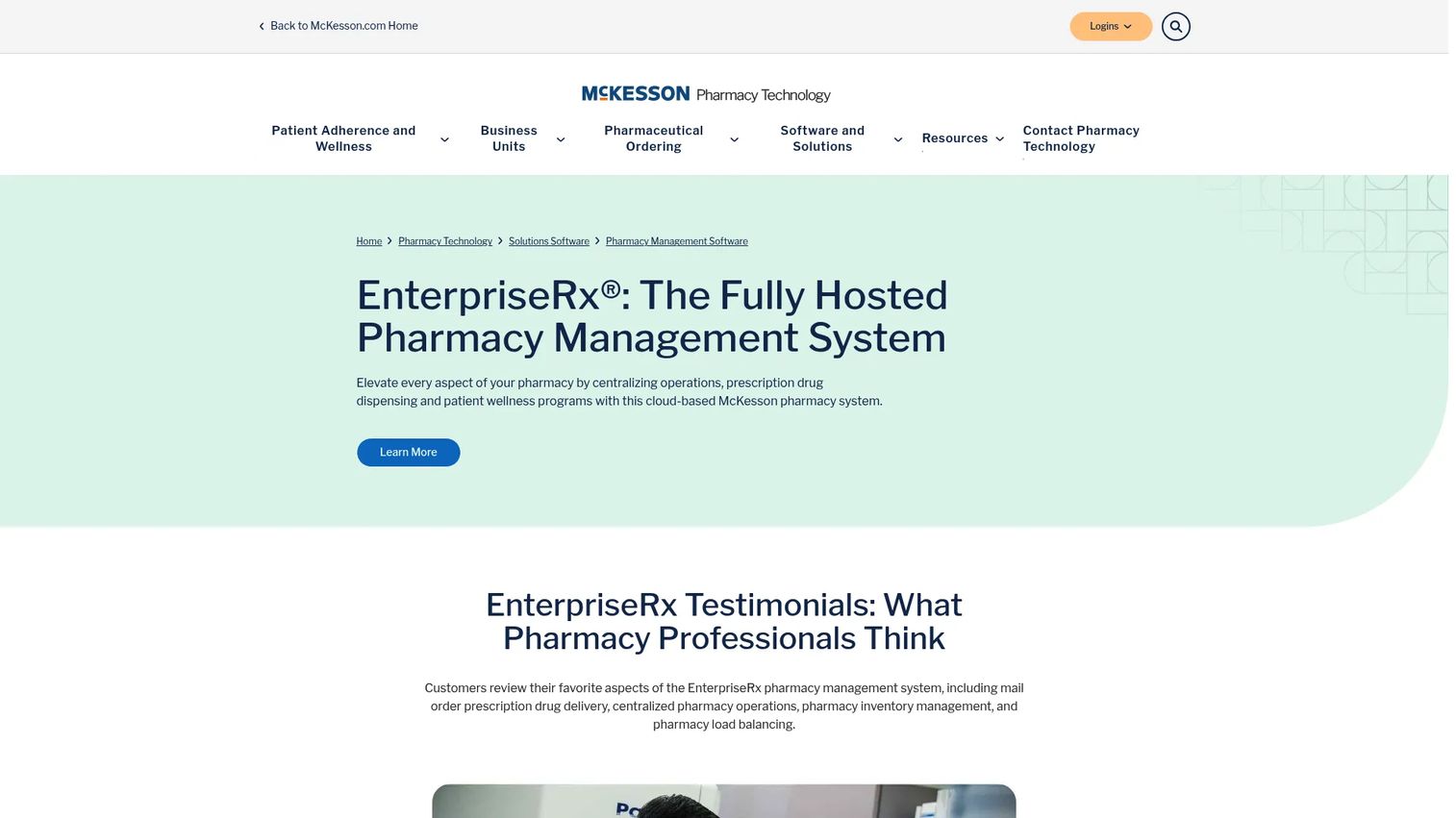
McKesson EnterpriseRx is a fully hosted, cloud-based pharmacy management system designed for centralized enterprise operations. It covers prescription dispensing, clinical programs, operational reporting, and workflow management across locations. The platform connects into McKesson's broader services ecosystem, which includes adherence programs, POS, mobile delivery, consulting, and implementation support. Pharmacy teams that want software and services from one relationship tend to find this structure useful.
Best for: Multi-location retail pharmacies and health-system pharmacy networks that want centralized operations with vendor-backed services.
Key features
- Centralized pharmacy operations and real-time enterprise management
- Customizable workflow with web-based refill programs
- Clinical programs and medication synchronization tools
- Data Insights reporting with interactive dashboards
- Central fill, mail-order, and specialty medication support
Why choose McKesson EnterpriseRx: The case for EnterpriseRx is consolidation. If you're running multiple locations and want prescription dispensing, adherence programs, and operational services from one vendor relationship, this platform is built for that model. The implementation is enterprise-grade, so plan for a structured rollout.
McKesson EnterpriseRx pricing: Expect a quote-based engagement covering software, implementation, services, and ongoing support. Ask for each cost line separately so you can model total cost across year one.
2. ScriptPro
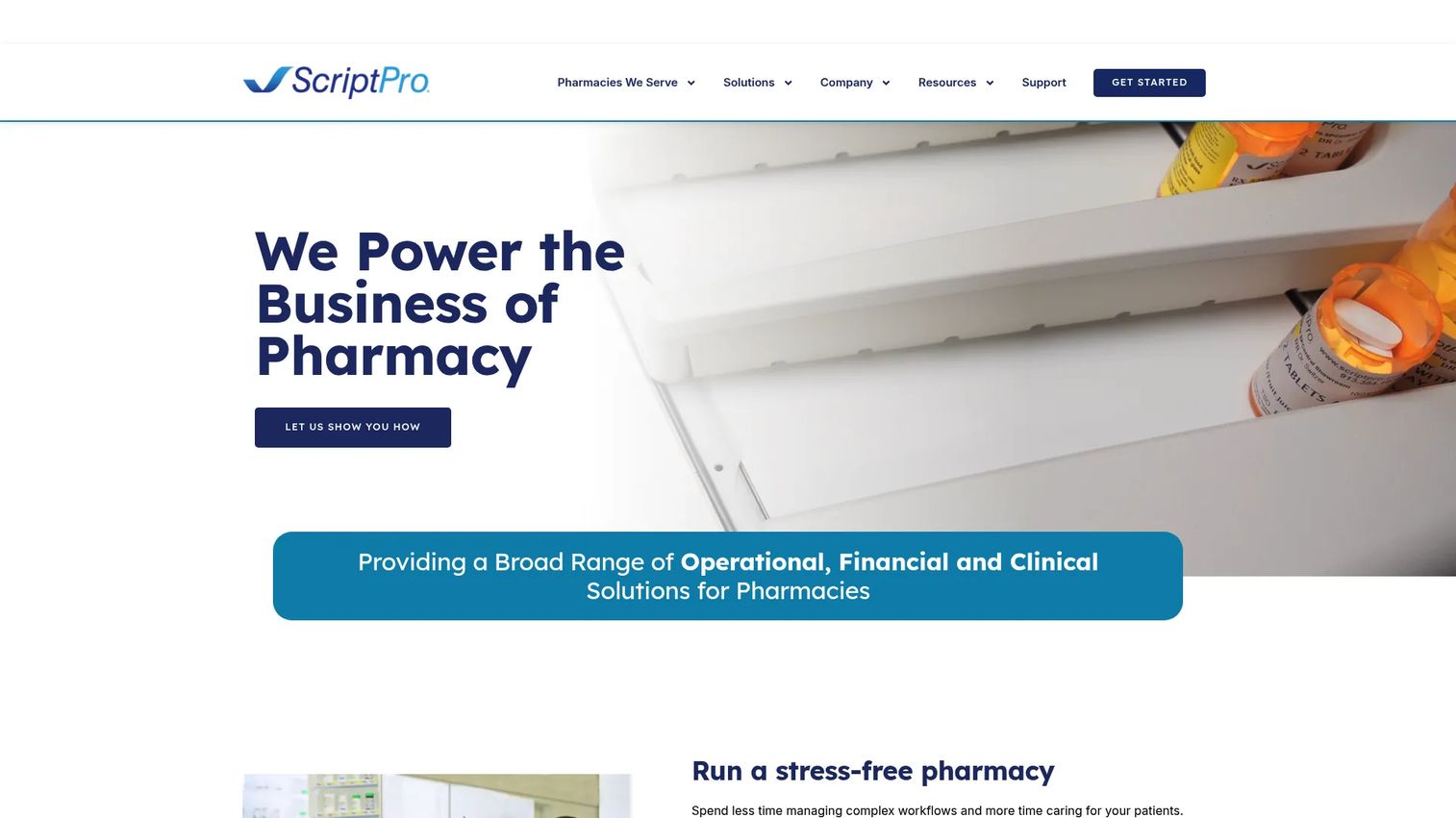
ScriptPro combines pharmacy management software with robotic dispensing systems and workflow automation hardware. The platform covers prescription intake through dispensing and payment, with barcode controls, batching, and audit reports built into the workflow layer. ScriptPro also handles 340B eligibility, inventory separation, and claims management, alongside integrations with EHR systems, e-prescribing networks, and IVR. The hardware-software integration is what distinguishes it from pure-software pharmacy management systems.
Best for: High-volume retail pharmacies, central-fill operations, and health-system pharmacies that need software and robotic dispensing in a single vendor relationship.
Key features
- Prescription intake through dispensing and payment workflows
- Barcode-controlled batching and audit reporting
- Integrated inventory management with automated ordering
- 340B eligibility, inventory separation, and claims reconciliation
- EHR, IVR, e-prescribing, and pharmacy robotics integrations
Why choose ScriptPro: ScriptPro is built for operations where automation throughput matters. If your dispensing volume justifies robotic filling and you want the software managing the workflow around it, this platform avoids the integration work of connecting separate vendors.
ScriptPro pricing: ScriptPro requires a direct quote. Because the platform combines software and automation hardware, ask sales to break out the software license, robotics, implementation, and ongoing support as separate line items.
G2 rating: 3.9/5
3. BestRx
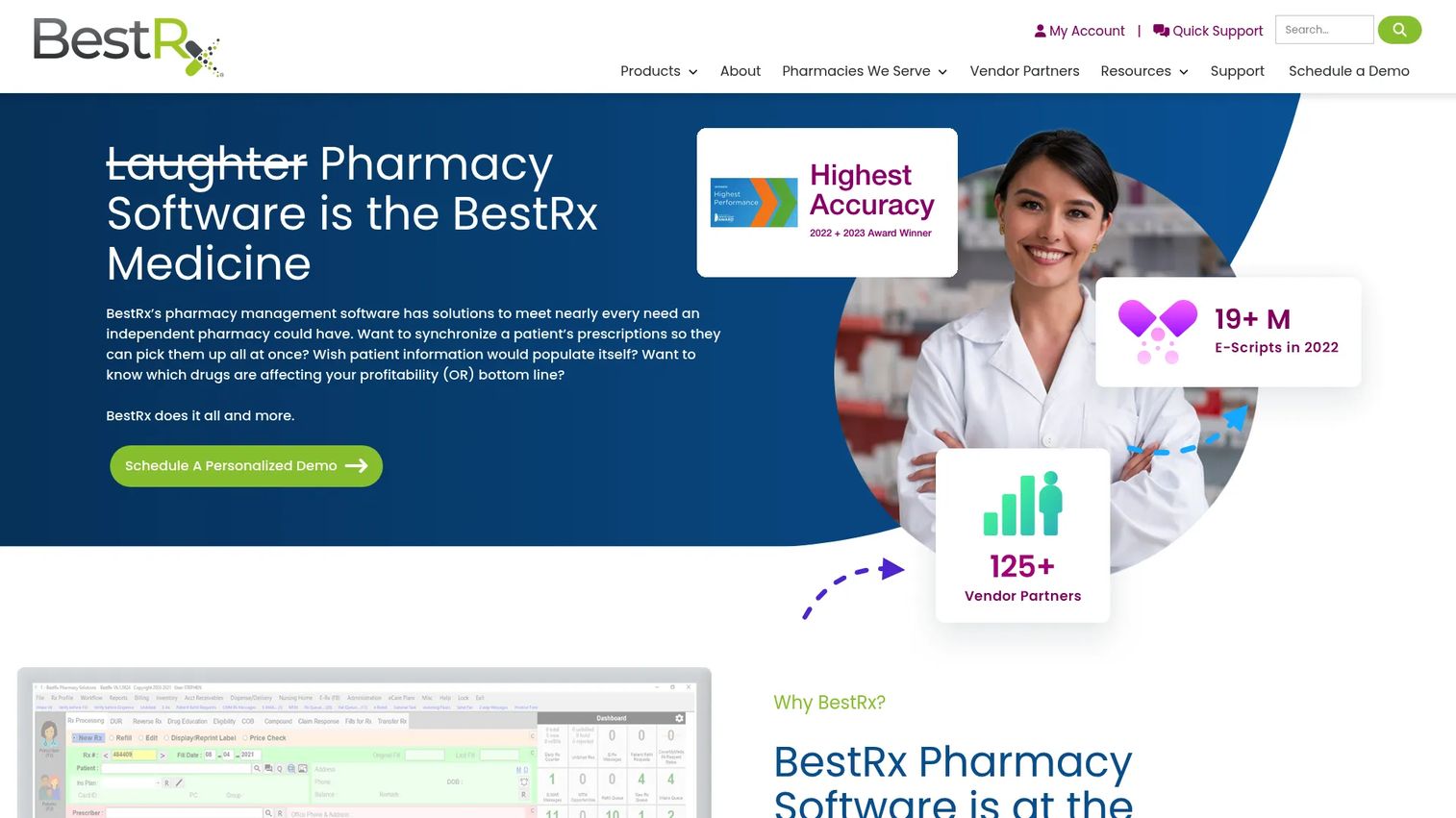
BestRx is pharmacy management software built specifically for independent pharmacies. It handles prescription filling, e-prescribing, workflow automation, refill management, inventory, and patient engagement in one platform. The system includes cloud backups, delivery tools, eCare plans, and wholesaler integrations alongside billing, claims, and compliance tools. Independent pharmacy owners who want a complete pharmacy software system without enterprise-scale complexity tend to evaluate BestRx early.
Best for: Independent pharmacy owners who want a complete pharmacy management system covering dispensing, claims, inventory, and patient communication.
Key features
- Prescription filling and e-prescribing
- Automated refills and workflow automation
- Inventory management with wholesaler integration
- Patient profiles and engagement messaging
- Billing, claims, cloud backups, and delivery tools
Why choose BestRx: BestRx is built around the independent pharmacy workflow. The platform doesn't require you to configure enterprise modules you won't use. If you're running one or two locations and want a system designed for how independent pharmacies actually operate, this is worth evaluating closely.
BestRx pricing: Pricing requires a direct quote from BestRx. Contact sales with your dispensing volume and integration needs to get an accurate figure.
4. Kroll
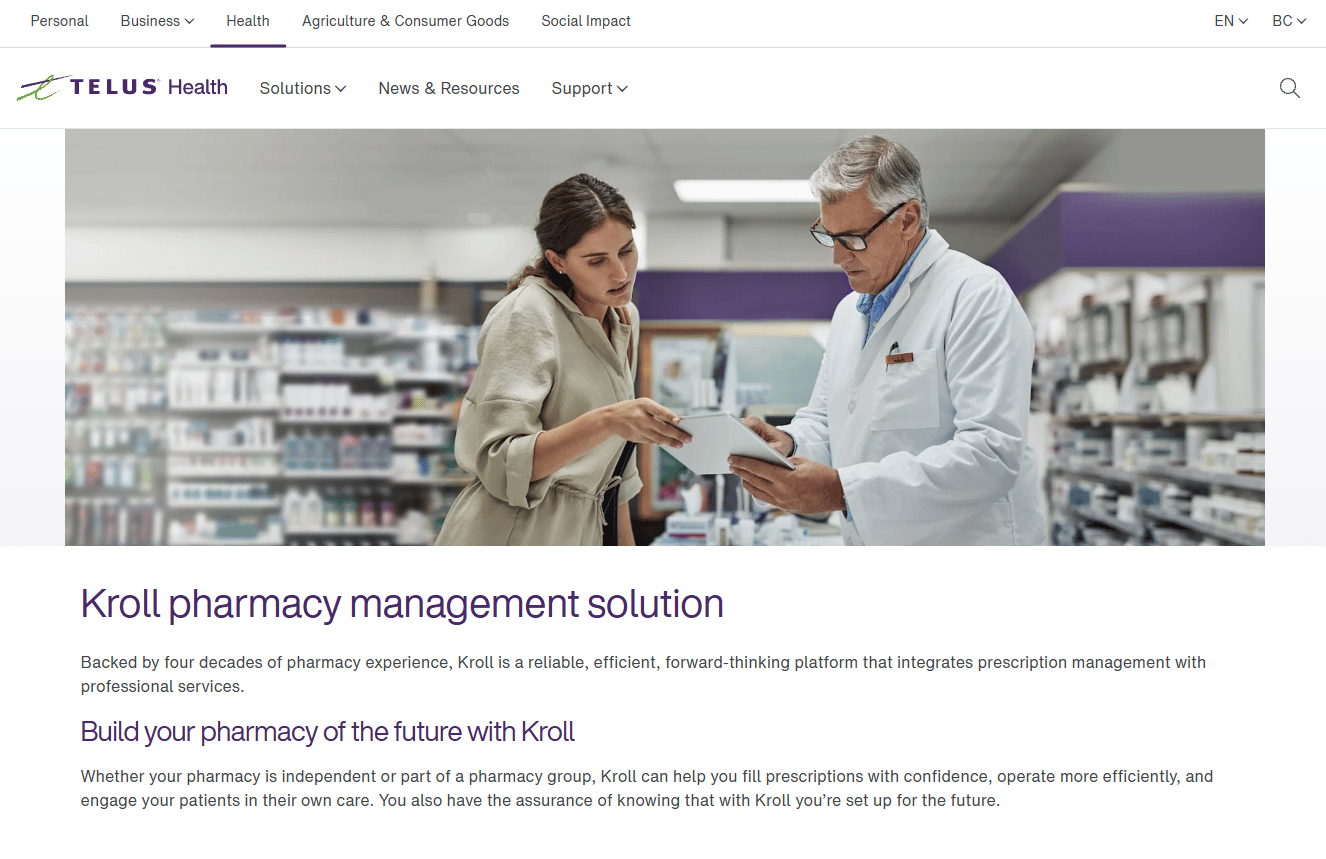
Kroll, now distributed through TELUS Health, is a configurable pharmacy management system with deep roots in Canadian pharmacy operations. The platform covers prescription management, drug interaction checking, adverse drug event detection, allergy and medical-condition flagging, and barcode verification. PharmaConnect, Kroll's patient engagement layer, handles prescription refills and online appointment booking. Canadian pharmacy groups that need a regionally established platform with provincial workflow support tend to reach for Kroll first.
Best for: Canadian community pharmacies and pharmacy groups that need prescription management, clinical safety tools, and patient engagement built for Canadian healthcare workflows.
Key features
- Prescription management and dispensing workflow
- Drug interaction checking and adverse drug event detection
- Allergy, medical-condition, and barcode verification support
- Patient engagement through PharmaConnect
- Configurable workflow for Canadian provincial requirements
Why choose Kroll: The case for Kroll is regional fit. If you're running pharmacy operations in Canada and need a platform built for Canadian payer networks, provincial compliance workflows, and local patient engagement patterns, Kroll has the established track record. Teams outside Canada should evaluate other options.
Kroll pricing: Request a quote directly and ask for software, configuration, training, and support costs itemized separately..
5. Rx30
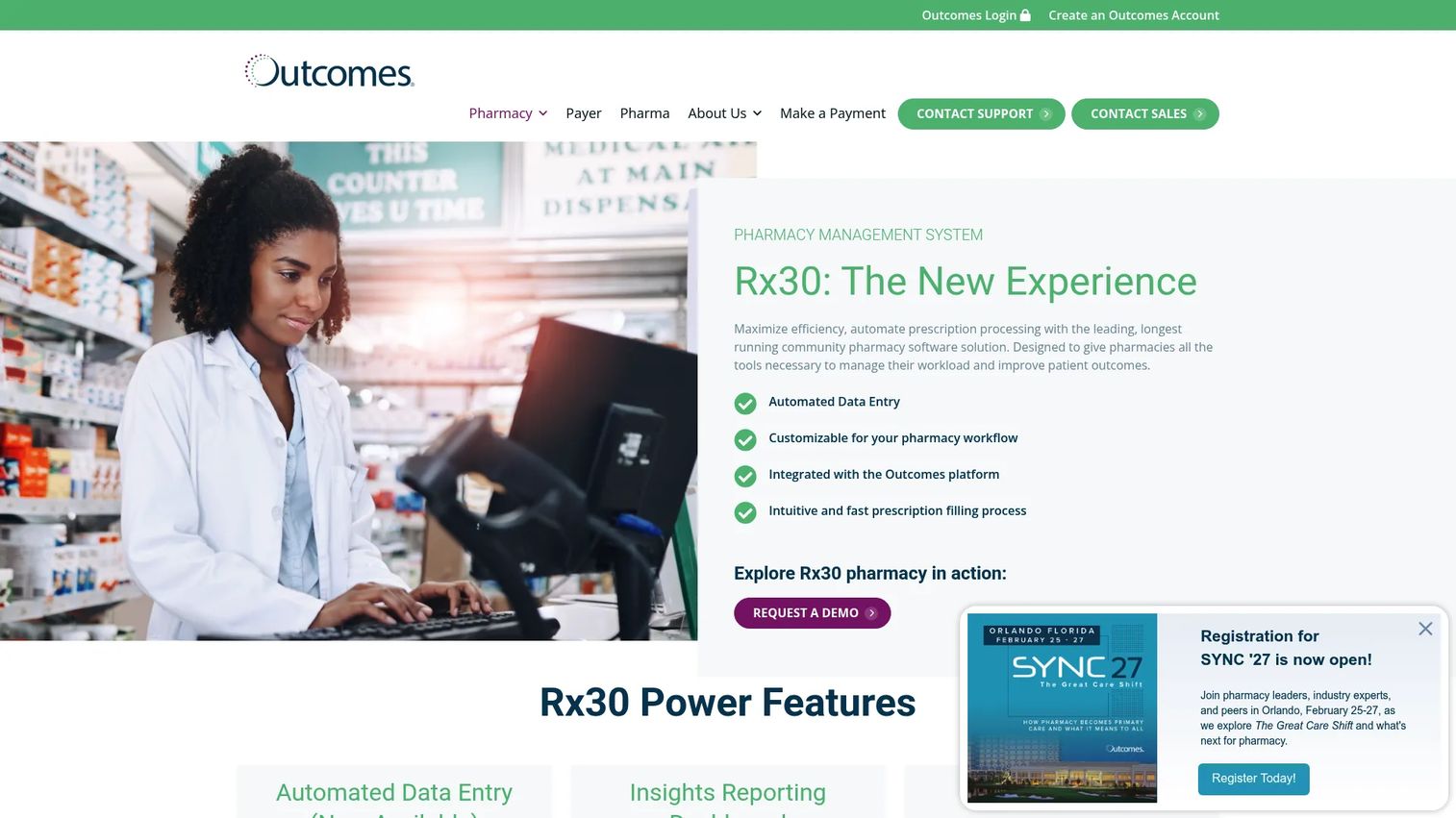
Rx30 is a pharmacy management system for independent and community pharmacies, now part of the Outcomes platform. Beyond prescription processing, it includes a Clinical Opportunity Indicator that surfaces opportunities like medication therapy management, immunizations, and adherence outreach directly within the dispensing workflow. The integrated POS covers electronic signature, ID scanning, gift cards, and customer loyalty. Mobile integration rounds out the operational footprint for teams managing delivery and patient engagement.
Best for: Independent pharmacies that want pharmacy management software with built-in clinical opportunity tools and an integrated point-of-sale system.
Key features
- Clinical Opportunity Indicator integrated with the Outcomes platform
- Fully integrated point-of-sale with electronic signature and ID scanning
- Inventory tracking and drill-down reporting
- Customer loyalty and gift card programs
- Mobile integration for delivery and patient services
Why choose Rx30: If clinical programs matter to your pharmacy's revenue model, Rx30 surfaces those opportunities at the dispensing workflow level rather than requiring a separate tool. The Outcomes integration adds network-level clinical data that independent pharmacies often can't access otherwise.
Rx30 pricing: Contact Outcomes or the Rx30 sales team for a quote. Ask to understand what's included in the base license versus add-on modules like the clinical tools or mobile features.
G2 rating: 3.8/5 on G2.
6. ComputerRx
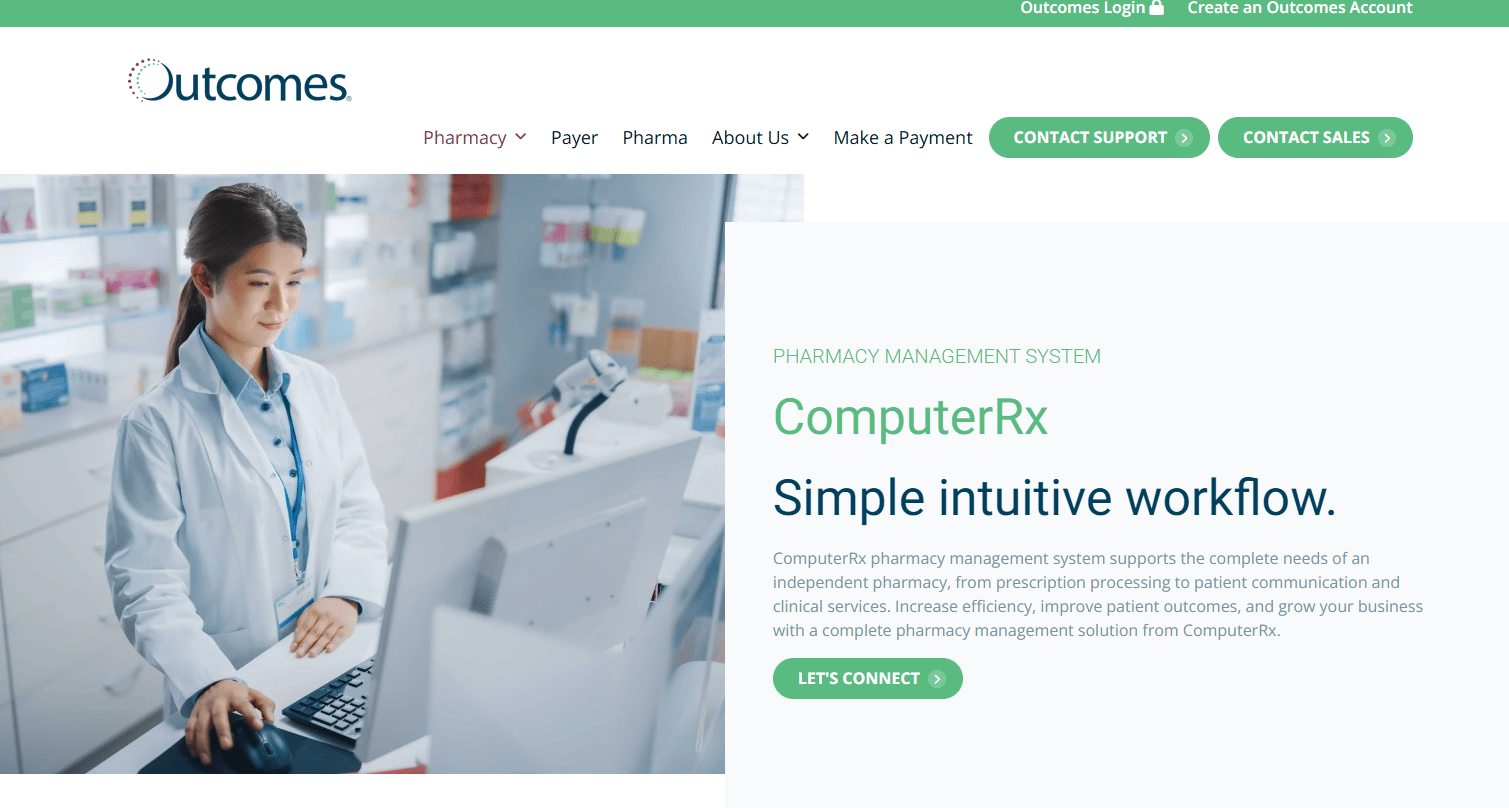
ComputerRx, also part of the Outcomes family, is pharmacy management software for independent and community pharmacies. The platform covers prescription processing with customizable workflows, Xpress Fill automation for refills, claims adjudication, and label printing. Dispensing, billing, POS, and patient engagement capabilities are built into the platform rather than sold as separate modules. Pharmacies that want operational consolidation under one system tend to find ComputerRx straightforward to evaluate.
Best for: Independent and community pharmacies that want prescription dispensing, billing, and POS in a single integrated platform.
Key features
- Prescription processing with customizable workflow steps
- Xpress Fill automation for refills, claims adjudication, and label printing
- Dispensing, billing, and POS integration
- Patient engagement capabilities
- Retail pharmacy workflow support
Why choose ComputerRx: ComputerRx suits pharmacies that want their dispensing, billing, and point-of-sale running from one system without configuring integrations between separate tools. The Xpress Fill automation is a time-saver for high-refill operations.
ComputerRx pricing: ComputerRx pricing requires a direct quote. Contact Outcomes to confirm current packaging and what's included in the base system versus optional add-ons.
G2 rating: 3.5/5 on G2.
7. FrameworkLTC
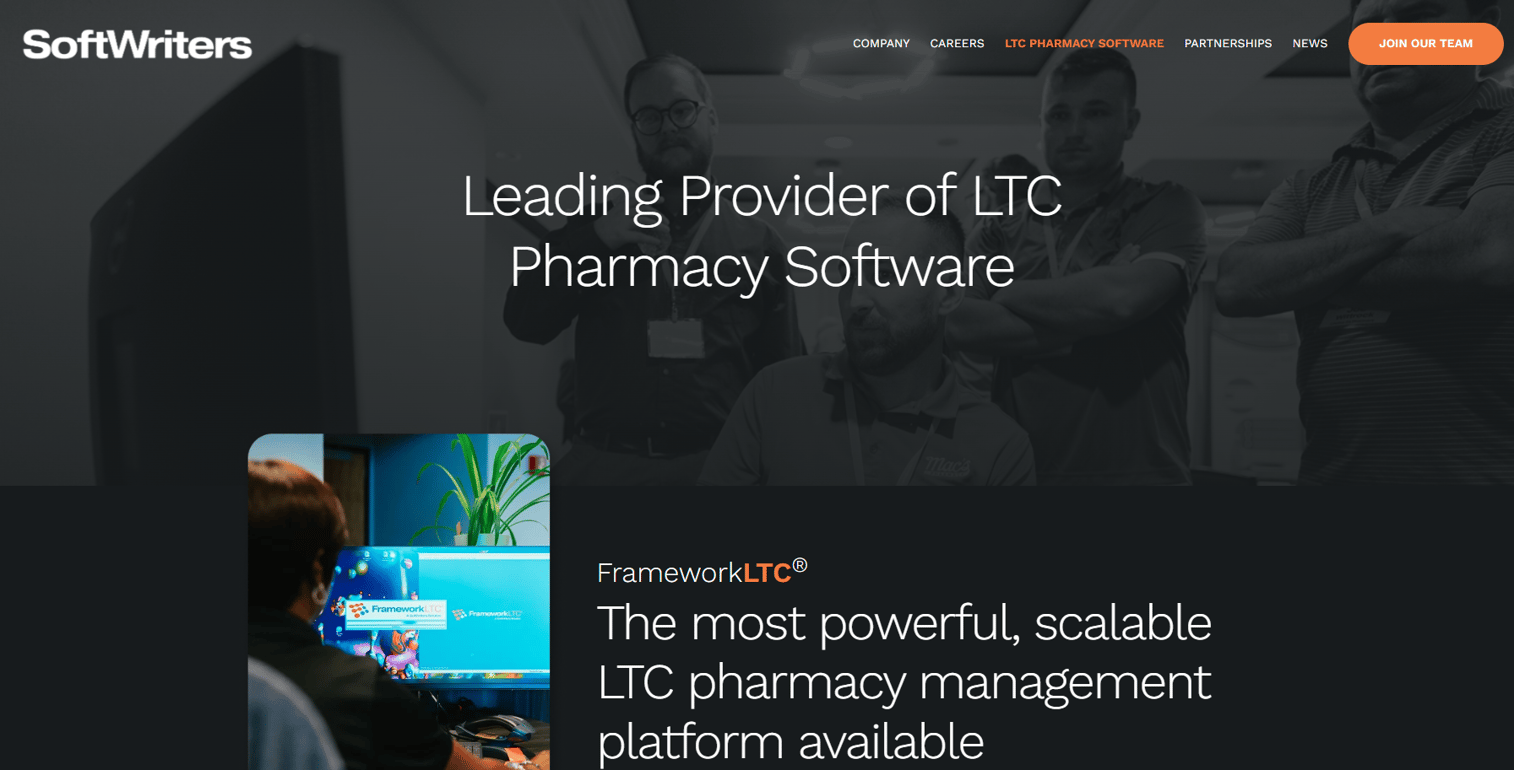
FrameworkLTC, built by SoftWriters, is pharmacy management software designed specifically for long-term care pharmacies. It automates workflows, centralizes operational data, and delivers real-time dashboards across the LTC dispensing cycle. The platform addresses the specific demands of LTC pharmacy: Facility-based dispensing, cycle fill management, packaging, medication accuracy, and compliance documentation. Teams serving nursing homes, assisted living facilities, or similar care environments need a system that understands those operational patterns, not a retail pharmacy tool adapted to fit.
Best for: Long-term care pharmacies serving facilities that require cycle fill management, automated workflows, and compliance-ready documentation.
Key features
- Customized automated LTC workflows
- Real-time dashboards for data visibility and operational insight
- Database management designed to reduce dispensing errors
- Compliance support for pharmacy regulations
- Integrations with pharmacy technology partners
Why choose FrameworkLTC: Retail pharmacy software can be adapted for LTC workflows, but the operational mismatch creates friction. FrameworkLTC is built from the ground up for the cycle fill model, the facility relationships, and the documentation requirements that LTC pharmacies actually deal with daily.
FrameworkLTC pricing: Request a quote from SoftWriters and ask for software, implementation, data migration, and ongoing support as separate figures. LTC implementations typically involve configuration work tied to your specific facility relationships.
8. QS/1
QS/1 is pharmacy management software covering retail community, hospital outpatient, specialty, and long-term care settings. The platform handles pharmacy workflow management, claims processing, inventory control, and reporting alongside integrations with POS, IVR, web refill, and other pharmacy services. One important note: QS/1's NRx product is sunsetting on December 31, 2027, with QS/1 directing users toward alternatives including PioneerRx, PrimeRx, BestRx, and PrimeCare. If you're evaluating QS/1, clarify which product you'd be buying and confirm its long-term roadmap before committing.
Best for: Retail community and institutional pharmacy teams comparing established pharmacy software systems with multi-setting coverage.
Key features
- Pharmacy workflow management across multiple settings
- Claims processing and billing workflows
- Inventory control and stock management
- Integrations with POS, IVR, and web refill tools
- Clinical workflows and operational reporting
Why choose QS/1: QS/1 covers multiple pharmacy settings from one platform, which matters if you're operating across retail, specialty, and institutional environments. Given the NRx sunset, ask QS/1 directly about which product fits your timeline and what migration support they provide.
QS/1 pricing: Request a quote and confirm which QS/1 product applies to your pharmacy type, particularly in light of the NRx sunset timeline.
G2 rating: 3.4/5 on G2.
9. Datascan Pharmacy Software
Datascan Pharmacy Software is pharmacy management software built for independent community pharmacies. The platform covers medication synchronization, medication therapy management, adherence dashboards, automatic refill processing, and automatic patient communication alongside a SIGIS-certified POS system. A patient mobile app supports refill requests and two-way chat. The mobile delivery app includes driver routing and delivery alerts. Datascan positions itself as a complete operational platform for independent pharmacies that need dispensing, patient engagement, and delivery management in one system.
Best for: Independent community pharmacies that want an integrated platform covering dispensing, POS, patient mobile app, and delivery workflows.
Key features
- Medication synchronization and adherence dashboard
- Automatic refill processing and patient communication
- SIGIS-certified point of sale with pseudoephedrine tracking
- Patient mobile app with refill requests and two-way chat
- Mobile delivery app with driver routing and delivery alerts
Why choose Datascan: Datascan's combination of dispensing software, mobile patient tools, and delivery management sets it apart from pharmacy management systems that stop at the counter. For independent pharmacies that compete on patient experience and delivery, this operational breadth is worth evaluating.
Datascan pricing: Request a quote. The company's first-party pricing page outlines what drives the cost, so use it as a framework for your conversation with their sales team.
G2 rating: 4.9/5 on G2.
10. SuiteRx
SuiteRx provides pharmacy management software for independent retail, long-term care, specialty, and combination pharmacies. The platform includes document management, adherence reporting, inventory management, cycle fill management, shipping integration, and custom forms. SuiteRx is one of the few vendors in this category with a publicly posted introductory price point, through its SRx+ product, which makes early-stage budget modeling more practical than it is with fully quote-based competitors.
Best for: Independent retail, LTC, specialty, and hybrid pharmacies that want an integrated pharmacy management platform and prefer transparent introductory pricing.
Key features
- Document management and custom forms
- Adherence reporting and cycle fill management
- Inventory management and shipping integration
- Multi-setting support: Retail, LTC, specialty, and combination
- Patient profile management
Why choose SuiteRx: SuiteRx suits pharmacies that operate across more than one dispensing model. The LTC and specialty workflow support alongside retail capabilities means a combination pharmacy doesn't need separate systems. The published SRx+ price gives buyers a starting point for financial modeling before engaging sales.
SuiteRx pricing: SRx+ carries a publicly listed introductory one-time investment of $25,000 plus a monthly SaaS price structured per active patient. The monthly price is not shown publicly. A minimum one-year contract applies. Contact SuiteRx to confirm current pricing and what's included at each stage.
G2 rating: 4.5/5 on G2.
11. Winpharm
Winpharm is a hospital pharmacy drug distribution, control, and electronic medication administration record system built for Windows. It covers patient admission, discharge, transfer, and archiving; medication order entry and automatic dose calculation; unit-dose, bulk medication, IV, and TPN management; inventory management with automated ordering; and an optional EMAR module. EHR integration is built in. HIPAA/HITECH compliance and multi-level security are core to the platform, which is relevant for health systems managing clinical and regulatory obligations simultaneously.
Best for: Hospitals and healthcare facilities that need pharmacy drug distribution, medication administration records, and EHR integration in a purpose-built hospital pharmacy system.
Key features
- Patient admission, discharge, transfer, and archiving
- Medication order entry with order templates and automatic dose calculation
- Unit-dose, bulk medication, IV, and TPN management
- Automated inventory ordering and receiving
- EHR integration with optional EMAR module
Why choose Winpharm: Winpharm is built for the hospital pharmacy context, not adapted from a retail platform. The EMAR module, EHR integration, and clinical order management features address workflows that community pharmacy software doesn't support. For health-system pharmacy teams, the specificity matters.
Winpharm pricing: Winpharm customizes pricing based on required options, facility bed count, and concurrent users. Request a custom quote and ask for the full cost breakdown including optional modules like EMAR, EHR integration, and any implementation or training fees.
G2 rating: 4.9/5 on G2
12. SoftWriters FrameworkLTC

SoftWriters is the company behind FrameworkLTC, the long-term care pharmacy management platform covered in item 7. This entry takes the vendor-level view: SoftWriters as an organization specializing in LTC pharmacy technology, with FrameworkLTC as the flagship product. The platform now includes AI-powered prescription order entry alongside the customized workflows, real-time dashboards, database management, and compliance support described earlier. For buyers where vendor specialization and long-term product investment in LTC-specific development matters to their evaluation, SoftWriters' focus on this segment is relevant context.
Best for: LTC pharmacy operators who want a vendor with singular focus on long-term care pharmacy technology and an actively developed platform.
Key features
- Customized and automated LTC pharmacy workflows
- Real-time operational dashboards and data visibility
- AI-powered prescription order entry
- Database management to reduce dispensing errors
- Compliance support for pharmacy regulations
Why choose SoftWriters FrameworkLTC: The difference between this entry and item 7 is the lens. If your buying decision includes vendor stability, LTC specialization, and product roadmap confidence, SoftWriters' organizational focus on LTC pharmacy is worth factoring in. This isn't a horizontal pharmacy software vendor that added an LTC module. It's a company whose entire business is built around this workflow.
SoftWriters FrameworkLTC pricing: Contact SoftWriters directly. Ask for software, implementation, configuration, data migration, and support costs as separate line items to model the full year-one investment.
G2 rating: 4.4/5 on G2 (based on 34 reviews for FrameworkLTC).
Considerations when choosing medication dispensing software
Workflow fit by pharmacy type
Retail, hospital, LTC, and physician-office dispensing workflows are operationally different. A platform built for independent retail may not handle cycle fills, facility-based packaging, or clinical order management. Start your evaluation by matching the platform's core design to your pharmacy setting, not to a feature checklist.
Integration depth
The platforms that cause the most post-implementation regret are the ones that looked complete on a demo but couldn't connect to the EHR, the payer switch, or the wholesaler feed without custom work. Before signing, confirm integrations with your specific EHR or EMR, e-prescribing network, payer adjudication system, wholesaler, POS hardware, and any dispensing automation equipment. Ask vendors to show those integrations in a live environment using your actual workflow, not a scripted demo.
Compliance and audit readiness
Pharmacy compliance software can support audit trails, access controls, PDMP reporting, controlled-substance documentation, and HIPAA-related workflows. It doesn't replace your legal, regulatory, or compliance review. Verify that the platform generates the records your audits actually require, not just records it claims to generate. Run a test scenario using a real audit request pattern before go-live.
Implementation and migration burden
This is where pharmacy software ROI evaporates. Data migration, label configuration, payer setup, inventory import, staff training, and hardware provisioning all carry real cost and time. For a SaaS operator evaluating this category from the outside, the implementation risk matters as much as the feature list. Ask every vendor for a realistic go-live timeline with named milestones and a list of what your team needs to own versus what they handle.
Total cost of ownership
The subscription price is the smallest number. Add implementation, hardware, support tiers, claim-switch fees, payer setup, training, integrations, and multi-location rollout. For platforms without posted pricing, build a cost model by requesting each line item separately before you get a bundled quote.
Conclusion
The right starting point for this category is pharmacy setting, not feature count. McKesson EnterpriseRx suits large retail chains and health-system pharmacy networks that want a mature vendor relationship alongside the software. ScriptPro is the choice when robotic dispensing automation and software need to run from the same system. For independent and community pharmacy operations, BestRx, Rx30, ComputerRx, QS/1, Datascan, and SuiteRx each offer different tradeoffs around workflow depth, clinical programs, POS integration, and pricing transparency. Kroll is the established option for Canadian pharmacy teams. FrameworkLTC and SoftWriters address long-term care specifically, and Winpharm handles hospital pharmacy distribution with EMAR and EHR integration built in.
The next step is shortlisting by pharmacy type, then pressure-testing each vendor on integrations, implementation timeline, support model, and total cost. Ask vendors to demo your actual dispensing workflow, not a scripted walkthrough. That's where the operational gaps show up.
Start your journey with Guideflow today!
FAQs
Medication dispensing software is a pharmacy software system that processes prescriptions, manages patient medication histories, tracks inventory, submits claims to payers, prints labels, documents dispensing activity, and maintains audit-ready records. The category overlaps significantly with pharmacy management software, with most enterprise platforms handling both dispensing workflow and broader business operations.
Dispensing software focuses specifically on the medication fulfillment workflow: Prescription intake, drug utilization review, labeling, verification, and documentation. Pharmacy management software is broader and typically includes POS, inventory ordering, claims adjudication, adherence programs, operational reporting, and patient engagement. Most platforms on the market today handle both, but the emphasis differs by vendor and pharmacy setting.
BestRx, Rx30, ComputerRx, Datascan, QS/1, SuiteRx, and Winpharm all serve independent pharmacy workflows. The right fit depends on whether you need clinical opportunity tools (Rx30), delivery and mobile patient apps (Datascan), LTC and specialty alongside retail (SuiteRx), or a focused independent pharmacy system (BestRx). Verify pricing, support model, integrations, and migration workload with each vendor before shortlisting.
FrameworkLTC and SoftWriters as the company behind it are built specifically for LTC pharmacy operations. Both address cycle fills, facility-based dispensing, packaging, delivery coordination, billing, and compliance documentation in ways that retail pharmacy platforms don't. SuiteRx also supports LTC workflows within a broader multi-setting platform. Evaluate which approach fits your facility relationships and billing complexity.
A complete pharmacy dispensing platform should include prescription processing and intake, patient medication history, drug utilization review, inventory management and purchasing, payer claims submission, barcode scanning and label printing, audit trails and access controls, operational reporting, and EHR or e-prescribing integration. For specific settings, add dispensing automation support, PDMP reporting, cycle fill management, or EMAR functionality depending on your pharmacy type.
Most pharmacy software vendors in this category use quote-based pricing. When requesting quotes, ask for separate line items covering software license or subscription, implementation, data migration, training, hardware, payer setup fees, integrations, and ongoing support. This prevents a low headline number from obscuring the real year-one cost. SuiteRx's SRx+ product is a notable exception with a publicly listed introductory one-time investment, though the monthly SaaS component is not posted.
For hospital and health-system pharmacies, EHR integration is typically required for clinical order management and medication administration records. Physician-office dispensing also needs EMR connectivity for prescribing workflows and PDMP reporting. Retail and community pharmacies primarily need e-prescribing network integration, payer adjudication, and wholesaler feeds. Confirm that the specific EHR or EMR your organization uses is on the vendor's supported integration list, not just a general claim of EHR compatibility.
Pharmacy compliance software can support audit-ready documentation through access controls, controlled-substance workflows, audit log generation, PDMP reporting interfaces, and operational records. What it cannot do is guarantee regulatory compliance. Your legal, compliance, and licensing review remains separate. Use the platform to ensure the documentation is consistent, complete, and retrievable. Confirm with the vendor which specific compliance workflows their system addresses and test those scenarios before go-live.