Your devices are deployed in factories, vehicles, retail stores, and remote facilities. Every time a sensor reading has to travel to the cloud before triggering a local action, you pay in latency, bandwidth, and reliability. When connectivity drops, cloud-dependent logic stops. Field teams get called in. Support queues fill up. And your product's reputation takes the hit.
IDC forecast global edge computing spending would reach nearly $261 billion in 2025, a figure that reflects how urgently organizations are pushing compute closer to devices. But spending alone does not solve the architecture problem. You still need a software layer that handles runtime, updates, security, and observability across a fleet you cannot physically touch.
This guide compares 15 IoT edge software platforms on exactly those dimensions: How they deploy workloads, manage devices, handle connectivity gaps, and fit into your existing engineering and cloud stack.
What's inside
This guide is for product managers and platform engineers evaluating IoT edge infrastructure. Tools were selected to cover the full architectural range: Hyperscaler runtimes, open-source frameworks, Kubernetes-native systems, industrial IoT suites, and device-fleet platforms.
Selection criteria:
- Edge workload deployment and runtime management
- Device fleet operations and remote updates
- Local analytics, edge AI, and protocol handling
- Security posture, observability, and release cadence support
Pricing and G2 ratings were verified against live sources.
TL;DR
- Best for Azure teams: Azure IoT Edge provides a familiar cloud-managed runtime for Microsoft-centered organizations
- Best for AWS teams: AWS IoT Greengrass fits teams already running on AWS IoT Core and Lambda-style components
- Best open-source foundation: EdgeX Foundry suits industrial gateways and protocol-heavy environments without vendor lock-in
- Best for Kubernetes-native edge: KubeEdge and Red Hat OpenShift fit teams standardizing workloads around Kubernetes patterns
- Best for fleet operations: balena, ZEDEDA, and Particle focus on remote device management and OTA software delivery
- Best for industrial IoT: Cumulocity IoT, Siemens Insights Hub, and Litmus Edge connect OT assets to analytics and application layers
What is IoT edge software?
IoT edge software is the runtime, management, and orchestration layer that lets connected devices process data, run applications, and make decisions near where data is generated instead of sending every event to the cloud.
IoT devices collect signals from physical environments: Temperatures, pressures, video feeds, machine vibrations, and location data. Edge devices process, filter, aggregate, or act on that data locally. IoT edge software coordinates the runtime that executes workloads, the update pipeline that keeps software current, the security controls that protect distributed nodes, and the synchronization mechanism that keeps cloud systems informed.
Cloud infrastructure still matters. Fleet management dashboards, long-term storage, model training, and system-wide governance typically live in the cloud. But the practical norm is a hybrid architecture: Cloud for orchestration and analytics at scale, edge for low-latency decisions and offline resilience.
Key capabilities to evaluate:
- Local data processing and rules execution
- Containerized workload deployment and runtime management
- Device provisioning and over-the-air updates
- Offline operation with cloud synchronization on reconnect
- Edge analytics and machine learning inference
- Protocol translation for industrial environments (Modbus, OPC-UA, MQTT, BACnet)
- Monitoring, logging, and remote observability
- Identity management and secure update signing
Three related concepts to distinguish:
IoT device software runs directly on sensors or microcontrollers. Edge computing infrastructure provides compute at an intermediate layer between device and cloud. IoT edge software connects both into an operational system that can be managed, updated, and monitored at scale without field visits.
For product managers, the right platform determines your release cadence for physical products, your support load when deployments break, and your engineering team's opportunity cost on every update cycle.
When to use IoT edge software
Process data before it hits the cloud
Video analytics, machine vibration monitoring, and energy management all generate data volumes that make cloud-only architectures expensive and slow. Local filtering, aggregation, and anomaly detection reduce cloud traffic by handling high-frequency signals at the edge. Manufacturing plants and energy facilities commonly use edge analytics to flag equipment anomalies in milliseconds rather than waiting for a cloud round-trip.
Keep products working during weak connectivity
Remote sites, delivery vehicles, oil and gas facilities, and rural retail locations all experience intermittent connectivity. When the network drops, cloud-dependent logic stops and devices fail in unpredictable ways. Edge software with strong offline operation keeps local rules, models, and processes running. Reconnection triggers synchronization rather than a failure cascade, which directly reduces support burden and customer trust issues.
Deploy software across distributed device fleets
Managing software updates on thousands of field devices without edge tooling means manual processes, inconsistent versions, and rollback nightmares. IoT edge platforms provide OTA update pipelines, staged rollouts, rollback mechanisms, and observability. For a product manager, this is essentially release management for physical products: The same discipline your engineering team applies to SaaS, applied to hardware in the field.
IoT edge software comparison
The table below covers all 15 platforms reviewed in this guide. Pricing reflects verified figures from each vendor's pricing page. G2 ratings are from each tool's current G2 listing.
| # | Product | Best for | Key differentiator | Pricing | G2 rating |
|---|---|---|---|---|---|
| 1 | Azure IoT Edge | Azure-first edge deployments | Cloud-managed modules with offline runtime | Free runtime; IoT Hub fees apply | 4.1/5 |
| 2 | AWS IoT Greengrass | AWS-connected edge fleets | Open-source runtime plus AWS-managed deployment | $0.16/device/month | 4.1/5 |
| 3 | EdgeX Foundry | Open-source industrial gateways | Vendor-neutral microservice framework | Free, open source | N/A |
| 4 | balena | Linux device fleet management | Container deployment with remote device ops | Free tier; paid from $159/month | 4.8/5 |
| 5 | KubeEdge | Kubernetes-native edge workloads | Extends Kubernetes to edge nodes | Free, open source | N/A |
| 6 | ThingsBoard | IoT dashboards plus edge processing | Integrated device management and visualization | Free tier; paid from $49/month | 4.5/5 |
| 7 | ZEDEDA Edge Orchestration | Distributed edge infrastructure | Zero-trust orchestration for heterogeneous edge nodes | Custom pricing | 4.6/5 |
| 8 | Red Hat OpenShift | Enterprise Kubernetes at the edge | Enterprise platform with GitOps and automation | From $0.076/4vCPU/hour | 4.5/5 |
| 9 | Cumulocity IoT | Industrial IoT application enablement | Device management, streaming analytics, and digital twins | From €215/month | 4.3/5 |
| 10 | PTC ThingWorx | Industrial connected products | Industrial app development and asset modeling | Custom pricing | 5.0/5 |
| 11 | Siemens Insights Hub | Manufacturing and industrial operations | Siemens industrial ecosystem and predictive analytics | Custom pricing | 4.5/5 |
| 12 | Litmus Edge | OT data collection and edge analytics | Industrial connectivity and edge data normalization | From $1,500/month | 3.8/5 |
| 13 | Particle | Connected product teams | Device OS, connectivity, and fleet management packaged together | Free tier; paid from $299/month per block | 4.5/5 |
| 14 | ClearBlade | Enterprise IoT edge applications | Usage-based edge-native platform with offline sync | Free up to 250 MB/month | N/A |
| 15 | EMQX | MQTT messaging at the edge | Scalable MQTT broker with rule engine and 50+ integrations | Free tier; Dedicated Flex from $234/month | 4.6/5 |
Best 15 IoT edge software platforms for 2026
1. Azure IoT Edge
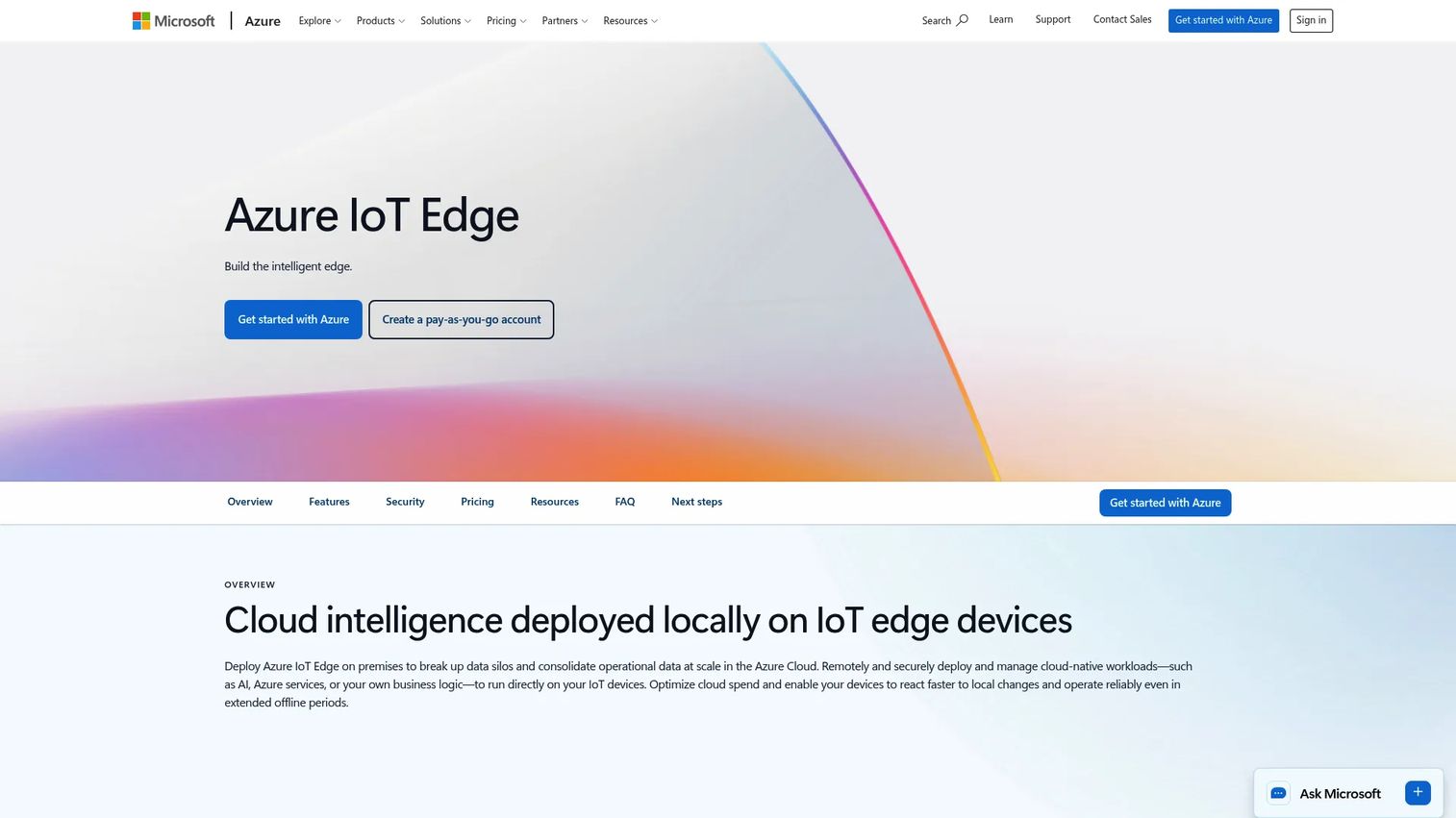
Azure IoT Edge is Microsoft's cloud-to-edge runtime for deploying AI, analytics, and custom business logic onto IoT devices. It runs containerized workloads locally on Linux or Windows IoT devices and connects back to Azure IoT Hub for secure device management and telemetry. The runtime is open source under the MIT license, making it auditable and free to deploy on eligible hardware.
Best for: Organizations already invested in Azure who need to run cloud workloads and local analytics on IoT devices, including environments with intermittent connectivity.
Key features
- Cloud-managed edge modules: Deploy Azure and partner workloads to devices remotely
- Offline runtime: Continues executing local logic when network connectivity drops
- Azure IoT Hub integration: Zero-touch provisioning and remote device management
- Containerized workloads: Docker-compatible modules for custom and Azure services
- Azure Monitor hooks: Observability through existing Microsoft monitoring infrastructure
Why choose Azure IoT Edge: If your team already runs on Azure and uses services like Azure Machine Learning or Azure Stream Analytics, this removes the integration overhead that separate edge platforms would require. The main cost variable is IoT Hub tier and message volume.
Azure IoT Edge pricing: The IoT Edge runtime itself is free. Costs accrue through Azure IoT Hub: A free tier covers 8,000 messages per day, while S1, S2, and S3 tiers are priced per unit per month based on message volume.
G2 rating: 4.1/5
2. AWS IoT Greengrass
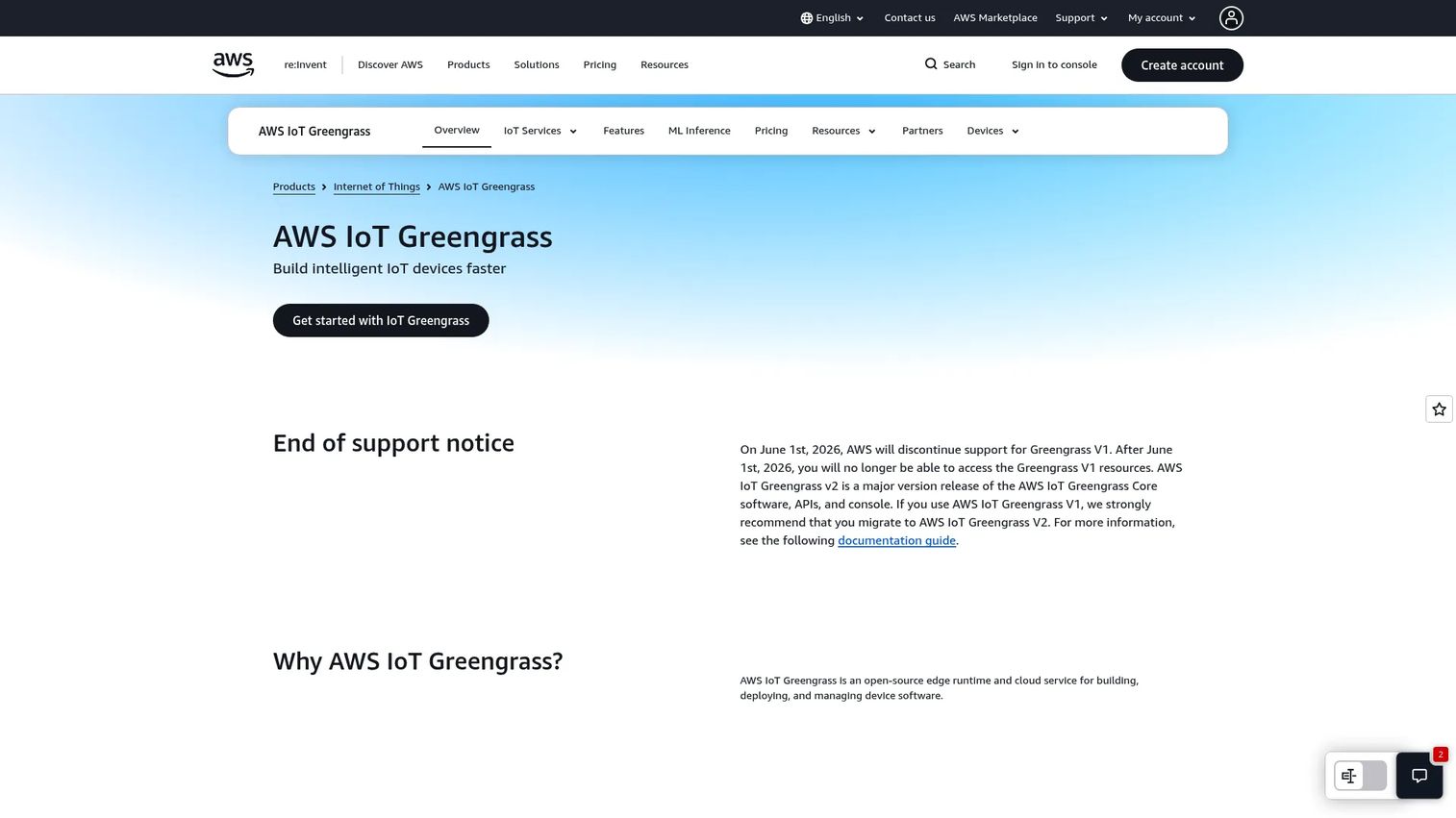
AWS IoT Greengrass is an open-source edge runtime and cloud service for building, deploying, and managing IoT device software. It uses a component-based model for deploying local logic, messaging, and machine learning inference. Greengrass V1 reached end of support on October 7, 2026; current deployments run on Greengrass V2.
Best for: Organizations building edge applications on AWS infrastructure who want remote fleet management with local compute and machine learning inference.
Key features
- Component deployment model: Modular, versioned edge application delivery
- Local message broker: MQTT messaging without cloud round-trips
- AWS IoT Core integration: Connects edge fleets to cloud services and dashboards
- Machine learning inference: Run models locally for real-time classification
- Secrets management: Hardware security integration for credential storage
Why choose AWS IoT Greengrass: Teams standardized on AWS get native integration with Lambda-style execution, IoT Core, and S3 data export. The per-device pricing model scales predictably for large fleets.
AWS IoT Greengrass pricing: $0.16 per active Core device per month. The first three devices are free for 12 months under the AWS Free Tier. Additional AWS IoT Core and service charges apply depending on message volume and cloud integrations.
G2 rating: 4.1/5
3. EdgeX Foundry
EdgeX Foundry is a Linux Foundation project providing a vendor-neutral, open-source edge platform built on a microservice architecture. Device services handle protocol translation across Modbus, BACnet, REST, MQTT, SNMP, RFID, and camera interfaces. Core services manage data persistence, device commands, metadata, and internal messaging. Application services export processed data to enterprise systems, cloud platforms, or other endpoints.
Best for: Industrial IoT teams building flexible gateway software across heterogeneous device environments who want to avoid cloud vendor lock-in.
Key features
- Device service layer: Protocol connectors for Modbus, BACnet, MQTT, ONVIF cameras, and more
- Microservice architecture: Independently deployable services for each functional layer
- Protocol abstraction: Normalize data from disparate industrial devices
- Application services and SDKs: Route edge data to any enterprise or cloud destination
- Vendor-neutral design: No dependency on a single cloud or hardware vendor
Why choose EdgeX Foundry: The microservice architecture means teams can adopt individual components without committing to the full stack. For industrial gateways with 10 or more different device protocols, this flexibility reduces integration engineering significantly. Commercial support and implementation partners are available through LF Edge ecosystem members.
EdgeX Foundry pricing: The software is free and open source. Hosting, implementation, and commercial support costs come from infrastructure and ecosystem partners.
4. balena
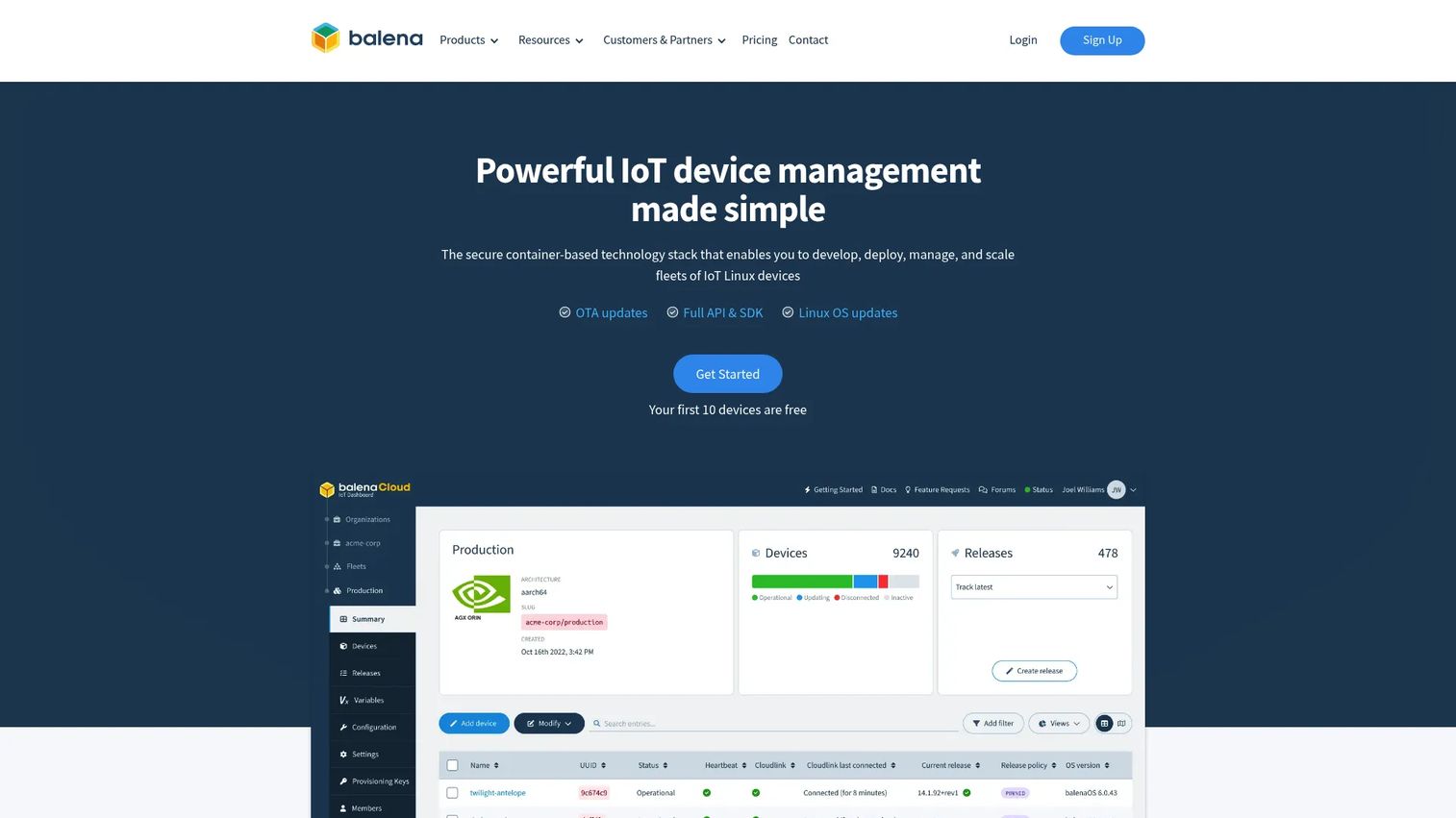
balena is a container-based IoT device management platform designed for teams shipping and operating Linux-based connected devices at scale. It provides over-the-air application and OS updates, remote fleet monitoring, secure device access, and a container-optimized operating system. The platform supports over 100 device types, covering Raspberry Pi, Nvidia Jetson, Intel NUC, and a wide range of industrial gateways.
Best for: Product teams shipping Linux-based connected devices who need reliable remote updates, fleet observability, and secure remote access without field intervention.
Key features
- OTA application and OS updates: Deploy new versions to any subset of your fleet
- Remote fleet monitoring: Logs, device vitals, and status across all devices
- Remote SSH access: Diagnose and fix devices without sending a technician
- Container-optimized OS: Stripped-down Linux built for IoT reliability
- Full API and SDK: Automate fleet operations from your own tooling
Why choose balena: For teams whose primary challenge is keeping device software current across a large, distributed fleet, balena's combination of fleet grouping, staged rollouts, and remote access covers most of the release management surface area without requiring a Kubernetes platform. The free tier handles up to 10 devices, which covers proof-of-concept and pilot phases. This is the kind of platform that reduces the engineering opportunity cost of maintaining deployed devices.
balena pricing: Free tier covers up to 10 devices. Paid plans start at $159/month (Prototype, monthly) for expanded device counts, rising to $329/month for Pilot and $1,439/month for Production. Annual plans are available at $1,720, $3,588, and $15,588 per year respectively.
G2 rating: 4.8/5
5. KubeEdge
KubeEdge is a CNCF-graduated open-source project that extends Kubernetes to edge environments. Its CloudCore component runs in the cloud and coordinates with EdgeCore agents running on each edge node. Edge nodes can operate autonomously during cloud disconnection, maintaining local workloads and device states. The framework supports HTTP and MQTT applications with a stated memory footprint starting around 70 MB on constrained edge hardware.
Best for: Kubernetes platform teams who want consistent orchestration patterns across cloud and edge without learning a separate edge management system.
Key features
- Kubernetes-native orchestration: Deploy and manage edge workloads with standard Kubernetes APIs
- CloudCore and EdgeCore: Bidirectional metadata and data communication between cloud and edge
- Autonomous edge operation: Edge nodes continue running during cloud disconnection
- Device twin support: Shadow state management for physical devices
- Native ARM support: Runs on ARMv7 and ARMv8 hardware alongside x86
Why choose KubeEdge: If your platform team already uses Kubernetes and GitOps pipelines for cloud workloads, KubeEdge extends those patterns to edge nodes rather than introducing a parallel management system. Implementation and hosting costs are the main operational expense.
KubeEdge pricing: Free and open source under Apache 2.0, available for personal or commercial use.
6. ThingsBoard
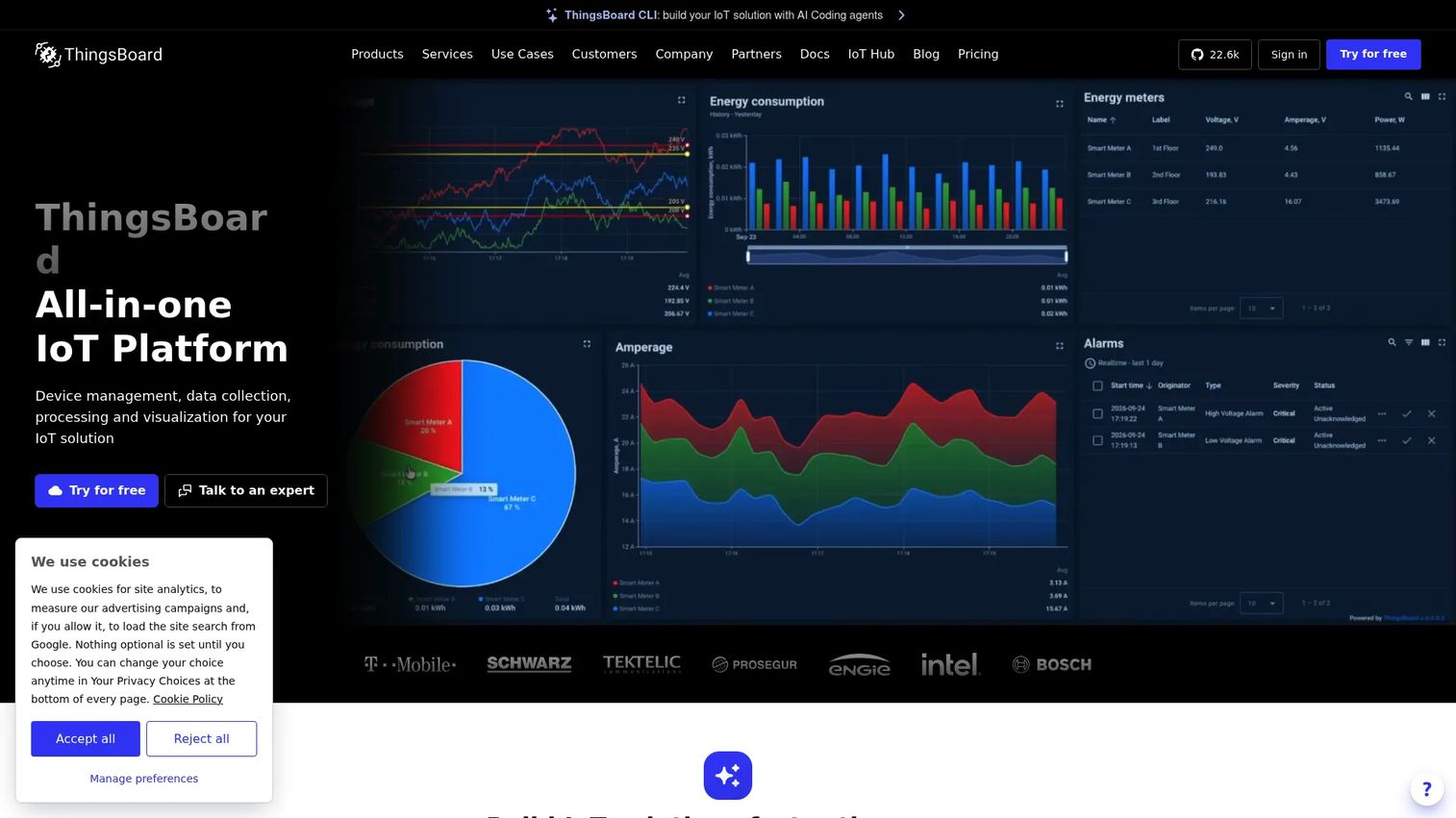
ThingsBoard is an open-source IoT platform that combines device management, telemetry processing, visualization, and a rule-chain engine in one stack. Its ThingsBoard Edge component extends local processing and cloud synchronization to gateway devices. The platform includes over 600 built-in dashboard widgets and supports multi-tenancy for SaaS or enterprise deployments.
Best for: Teams that need IoT dashboards, device management, rule-based data processing, and edge processing under one platform without assembling separate tools.
Key features
- Rule chain engine: Event-driven processing, alarms, and calculated fields
- 600-plus dashboard widgets: Real-time and historical data visualization
- ThingsBoard Edge: Local processing with cloud synchronization
- Device and asset management: Multi-tenant device hierarchy and metadata
- Alarm management: Threshold-based alerting and escalation rules
Why choose ThingsBoard: When a product team needs both device-state visibility and edge data processing, ThingsBoard avoids the integration work of connecting separate dashboard and edge tools. The community edition is free for self-managed deployments, which suits teams with the infrastructure capacity to run it.
ThingsBoard pricing: Cloud plans start at $0/month (Free, up to 5 devices), rising to $49/month for Prototype, $149/month for Pilot, $399/month for Startup, and $749/month for Business. Self-managed Community Edition is free.
G2 rating: 4.5/5
7. ZEDEDA Edge Orchestration
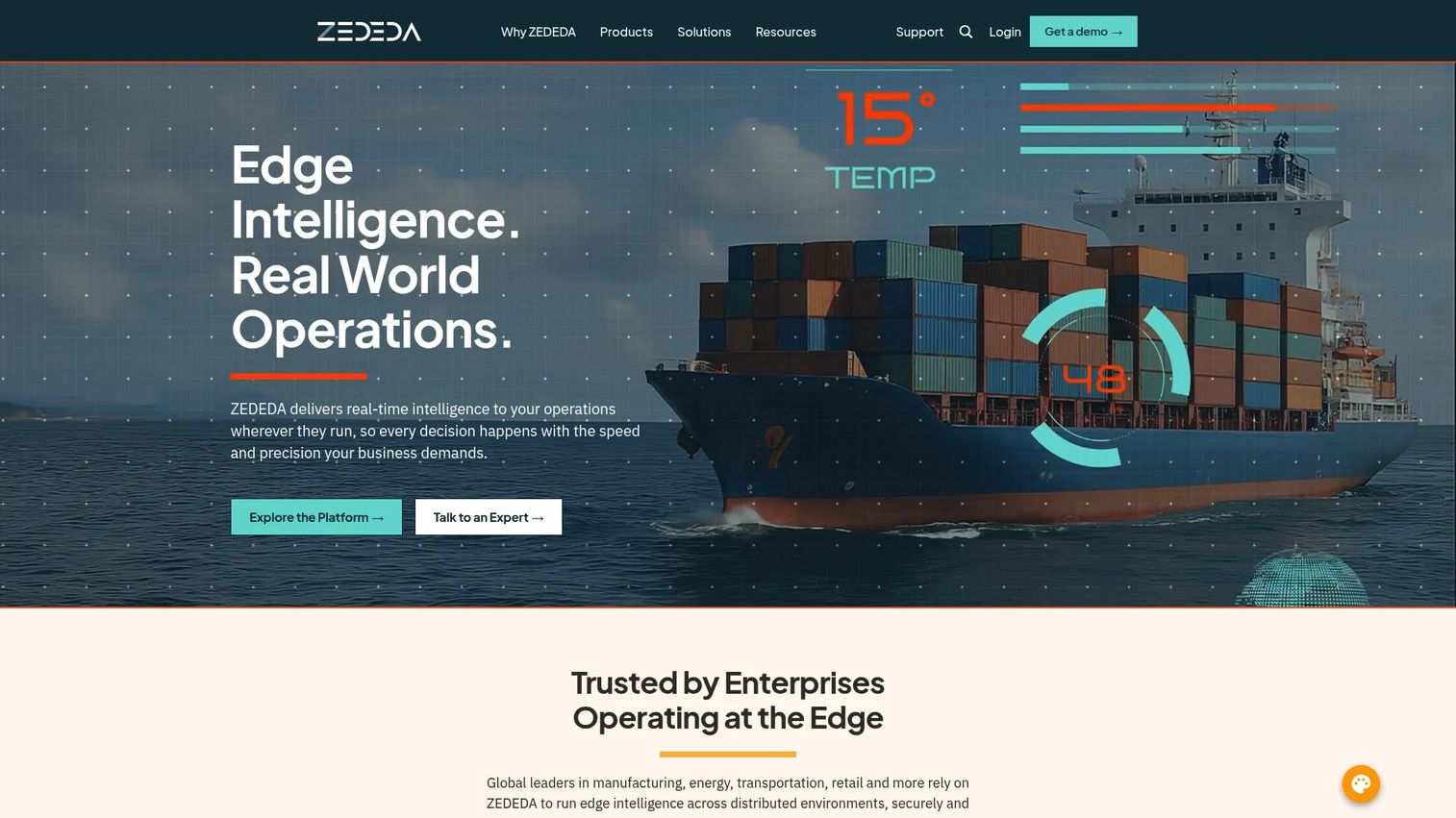
ZEDEDA provides cloud-native orchestration and lifecycle management for edge infrastructure across distributed physical sites. It manages VMs, containers, Kubernetes clusters, and legacy workloads from a central control plane. Zero-trust security is built on hardware root-of-trust with TPM, measured boot, full-disk encryption, firewall isolation, and role-based access control.
Best for: Enterprises managing heterogeneous edge infrastructure across many physical sites where hardware variety, security posture, and remote lifecycle management are primary concerns.
Key features
- Zero-touch provisioning: Enroll and configure edge nodes without manual on-site setup
- Virtualization and container support: Run VMs, containers, and Kubernetes alongside legacy workloads
- Hardware-rooted zero-trust security: TPM, measured boot, encryption, and RBAC
- Remote lifecycle management: Fleet-wide updates, monitoring, and rollback
- Multi-cloud edge support: Connect edge infrastructure to multiple cloud providers
Why choose ZEDEDA: For enterprises where edge nodes sit in locations without reliable IT staff, the combination of zero-touch provisioning and hardware-enforced security removes the operational dependency on field teams. The centralized observability dashboard gives product and operations teams visibility across all edge sites. Contact ZEDEDA directly for pricing, as cost scales with node count and support level.
ZEDEDA pricing: Custom pricing. Contact ZEDEDA for a quote. Cost drivers include edge node count, deployment scale, and support tier.
G2 rating: 4.6/5
8. Red Hat OpenShift
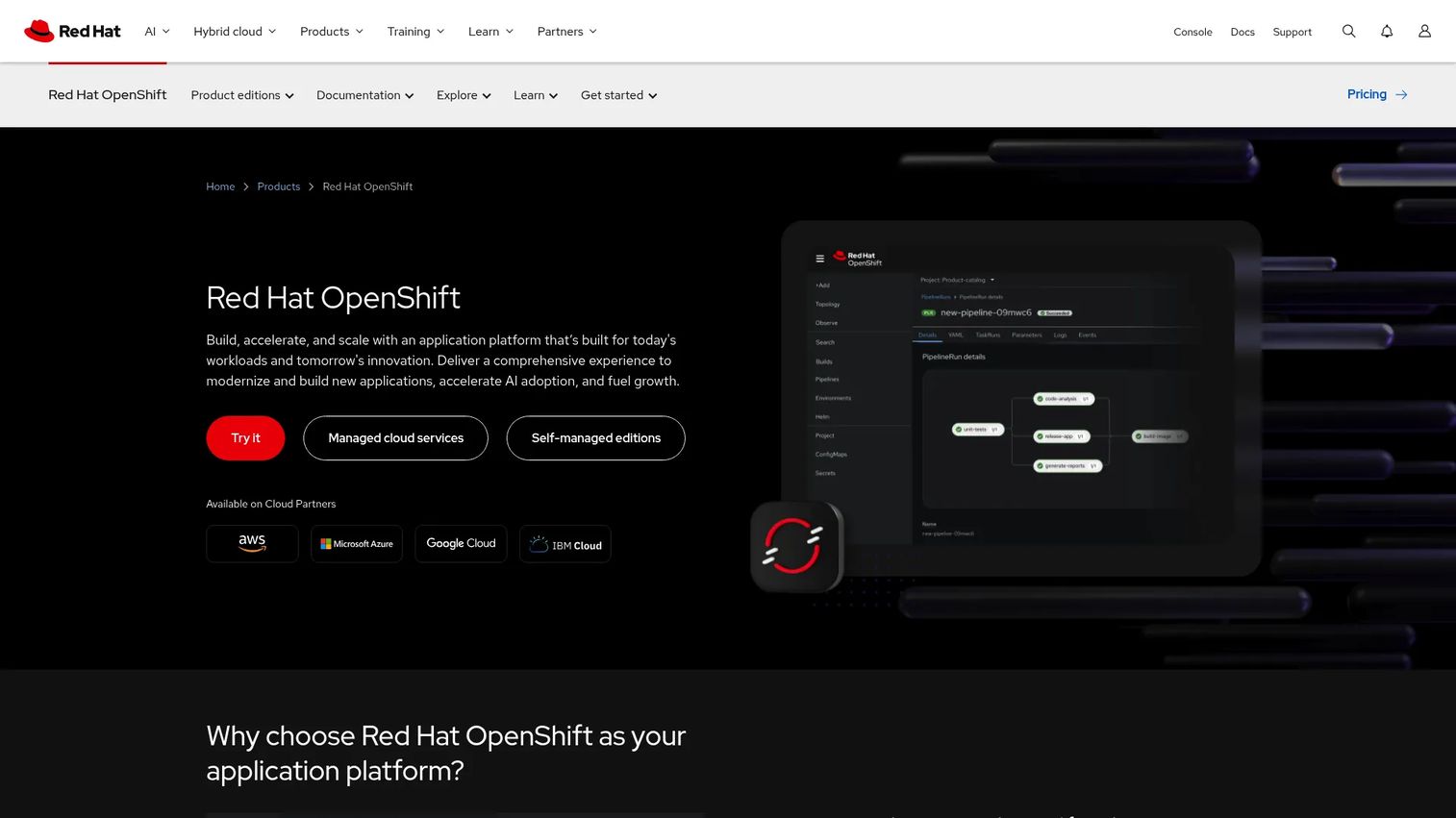
Red Hat OpenShift is an enterprise Kubernetes platform that extends to edge deployments through its single-node OpenShift and remote worker node configurations. It integrates with Red Hat Enterprise Linux and Ansible Automation Platform for consistent application delivery across cloud, datacenter, and edge. GitOps workflows, integrated CI/CD, service mesh, and multi-cluster management are part of the core platform.
Best for: Enterprise platform teams running Kubernetes workloads across hybrid environments who need a governed, automation-first approach to edge deployment.
Key features
- Enterprise Kubernetes: Production-grade container orchestration with integrated security
- Edge cluster support: Single-node and remote worker node configurations for constrained sites
- GitOps workflows: Declarative application and configuration management
- Ansible Automation Platform fit: Automate edge infrastructure provisioning and compliance
- Integrated developer tooling: CI/CD, service mesh, monitoring, and persistent storage
Why choose Red Hat OpenShift: Organizations that have standardized on Red Hat's portfolio get a consistent operational model from datacenter to edge. The governance, security patching, and audit trail capabilities satisfy compliance requirements that simpler edge runtimes do not address. The managed Dedicated option provides the clearest public pricing for teams evaluating cost before a sales conversation.
Red Hat OpenShift pricing: OpenShift Dedicated starts at $0.171 per 4vCPU/hour on an hourly basis, dropping to $0.114/hour on a one-year commitment and $0.076/hour on a three-year commitment. Self-managed editions (Platform Plus, Container Platform, Kubernetes Engine) are priced through Red Hat subscriptions.
G2 rating: 4.5/5
9. Cumulocity IoT
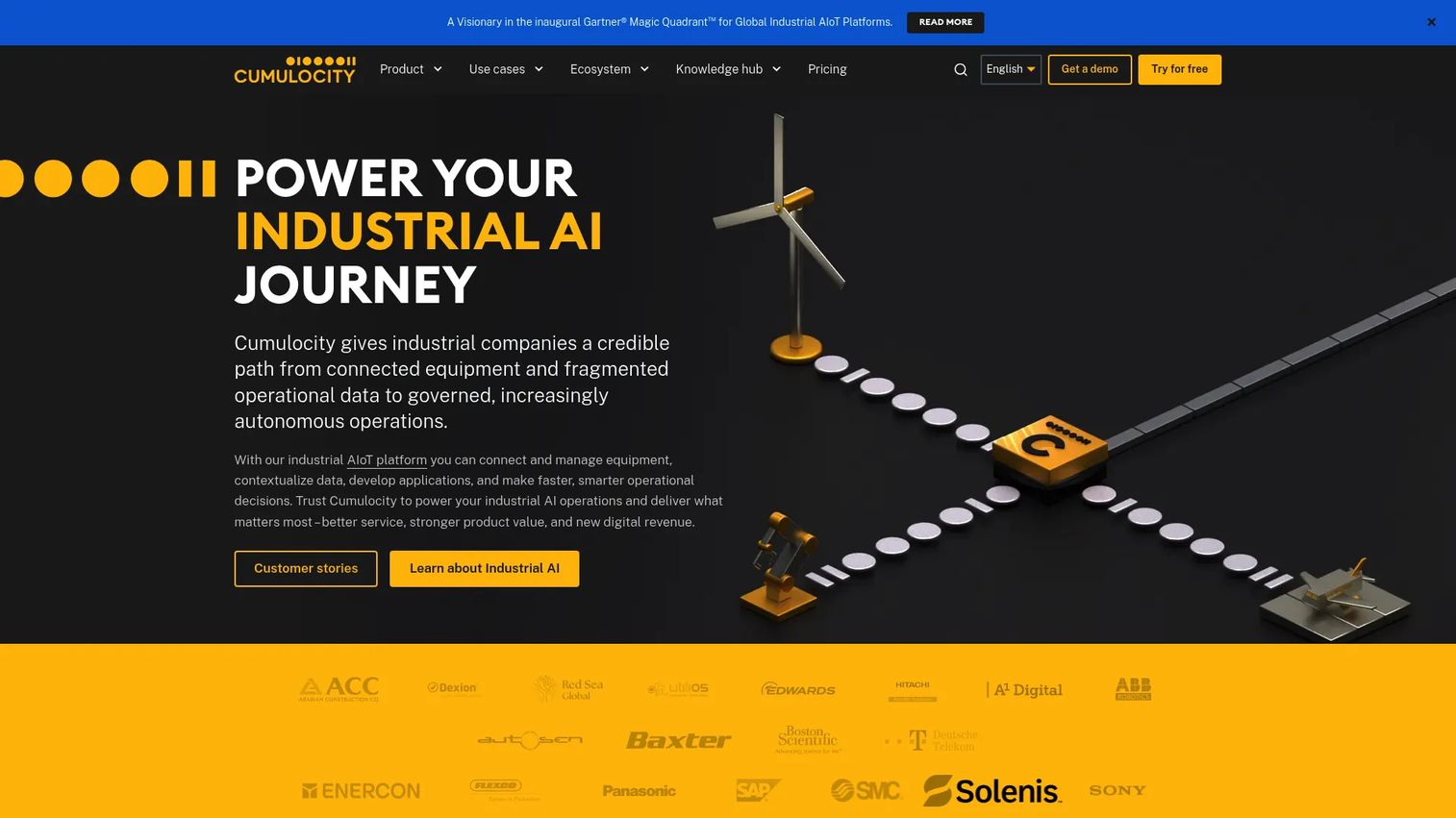
Cumulocity IoT is an enterprise-grade industrial AIoT platform for connecting, managing, and operationalizing data from connected assets. It covers device integration and lifecycle management, real-time and historical data handling, streaming analytics, digital twin management, and application enablement. Cloud and on-premises edge deployment options are supported.
Best for: Industrial and enterprise organizations that need device management and application enablement together, including streaming analytics and digital twin capabilities.
Key features
- Device connectivity and lifecycle management: Provision, monitor, and retire connected assets
- Streaming analytics and AI/ML integration: Process data in motion and run inference models
- Digital twin management: Model asset state and relationships
- IoT application builder: Build dashboards and operational applications without starting from scratch
- Cloud and edge deployment: Run on Cumulocity's cloud or deploy on-premises
Why choose Cumulocity IoT: The platform suits product teams building IoT applications on top of connected industrial assets, where the job is both managing devices and delivering analytics applications to operators. A 30-day free trial is available. For teams evaluating at the Starter tier, the per-message pricing model scales predictably.
Cumulocity IoT pricing: Starter plan is €215/month billed annually, covering up to 2.5 million messages per month, one tenant, 30-day data retention, and up to three analytics models. Business, Enterprise, Connected, and Air-Gapped tiers are priced through custom quotes.
G2 rating: 4.3/5
10. PTC ThingWorx
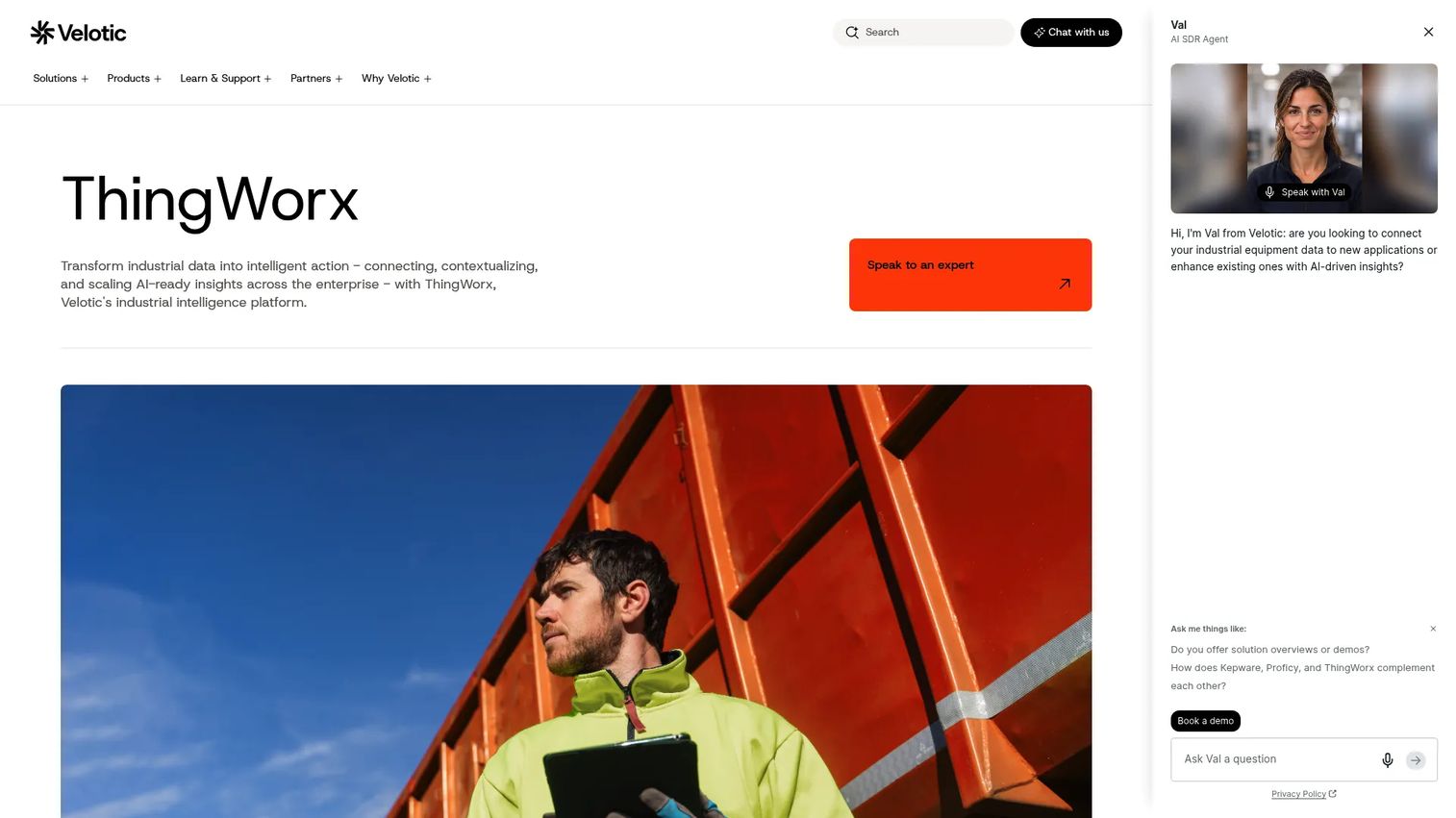
ThingWorx, now offered through Velotic, is an industrial IoT and AI platform for connecting industrial data, building connected-asset applications, and delivering operational analytics. It supports asset modeling, industrial connectivity across devices and applications, real-time data analysis, and AI agents with Model Context Protocol support.
Best for: Industrial organizations building connected-product and manufacturing applications that require asset modeling, industrial connectivity, and embedded AI capabilities.
Key features
- Industrial connectivity: Integrate devices, controllers, and enterprise applications
- Asset modeling: Define and manage relationships between physical and digital assets
- Industrial app builder: Pre-built tools for manufacturing and service application development
- Real-time operational analytics: Analyze production and asset data at speed
- AI agents with MCP support: Embed AI-driven decision support into industrial workflows
Why choose PTC ThingWorx: Teams building complex connected-product applications in manufacturing, service, or engineering contexts benefit from ThingWorx's depth of industrial connectivity and application development tooling. PTC divested ThingWorx; verify current packaging and support with Velotic before committing.
PTC ThingWorx pricing: Contact Velotic or PTC for a quote.
G2 rating: 5.0/5
11. Siemens Insights Hub
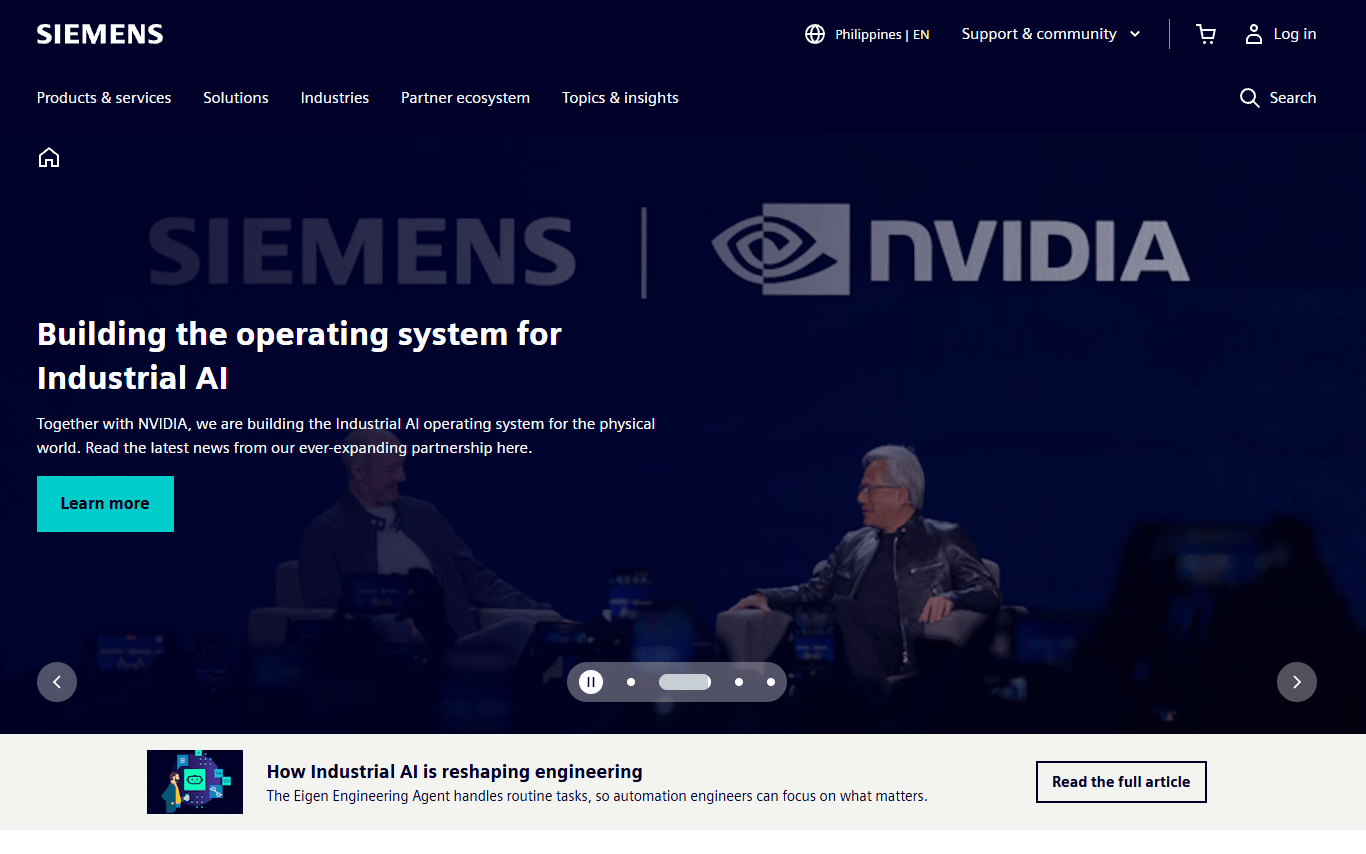
Siemens Insights Hub is Siemens' industrial IoT software platform for connecting assets and operational data to generate actionable insights for manufacturing and industrial operations. Capabilities include industrial asset and system connectivity, real-time monitoring, customized dashboards, advanced analytics and machine learning, predictive maintenance, quality prediction, and low-code application development.
Best for: Manufacturers and industrial operators already invested in Siemens industrial technology who need connected asset monitoring and predictive analytics.
Key features
- Industrial asset connectivity: Integrate Siemens and third-party industrial systems
- Real-time monitoring and dashboards: Track machine and line performance live
- Predictive maintenance: Flag equipment anomalies before failure using ML models
- Quality prediction: Use production data to identify quality deviations early
- Low-code application development: Build operational apps without deep engineering work
Why choose Siemens Insights Hub: For manufacturers with Siemens automation infrastructure already in place, Insights Hub reduces integration effort and benefits from deep ecosystem context around asset data. A free Start for Free program is available for partners. Main product pricing requires contacting Siemens.
Siemens Insights Hub pricing: Contact Siemens for a quote. A partner Start for Free program provides unlimited-time free access for qualifying partners.
G2 rating: 4.5/5
12. Litmus Edge
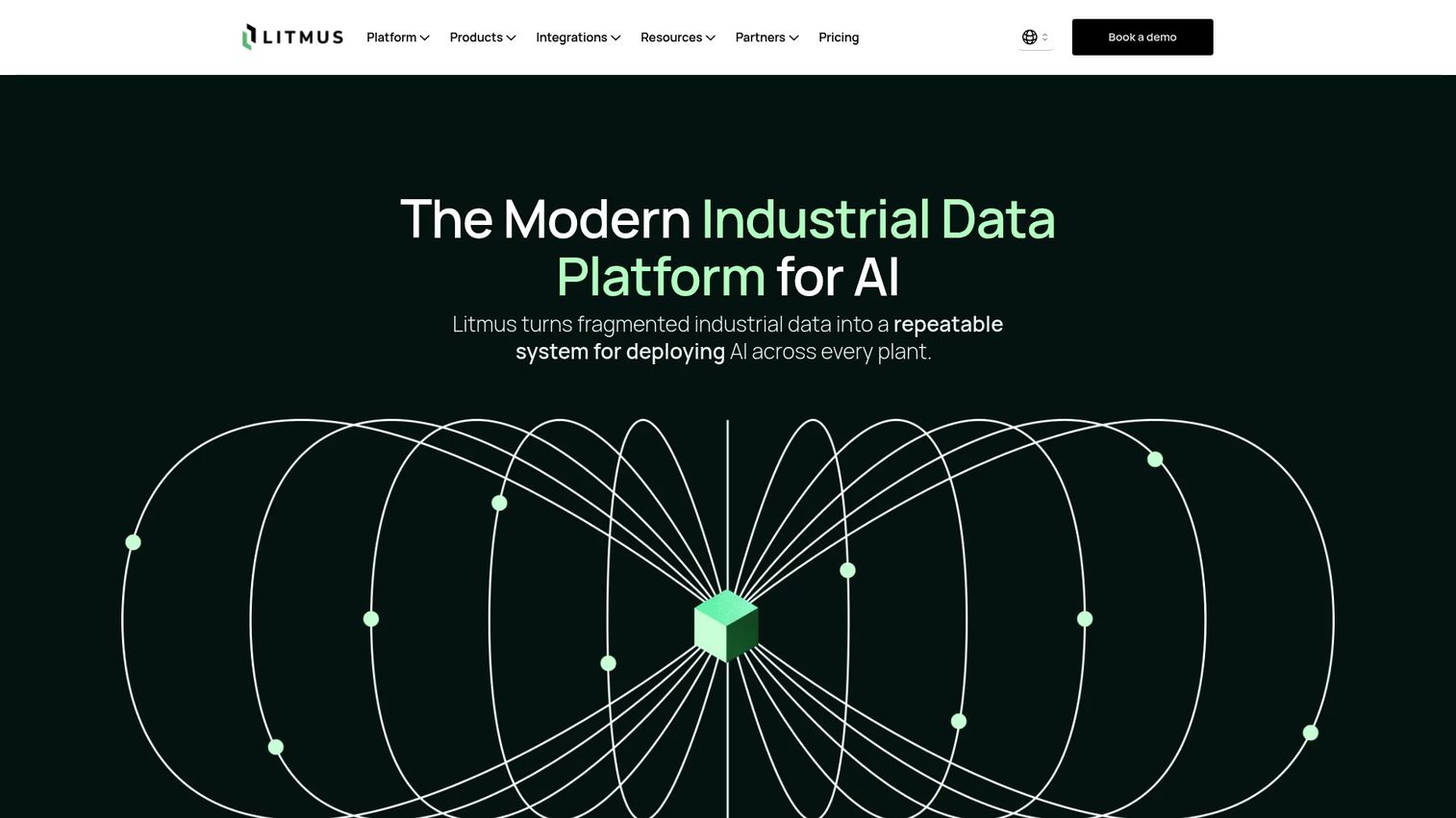
Litmus Edge is an industrial edge data platform focused on connecting heterogeneous industrial systems and operationalizing machine data. Native connectors support Modbus, OPC-UA, MQTT, SNMP, Ethernet/IP, and other protocols. The platform handles data normalization and contextualization locally, runs containerized edge applications, and routes processed data to enterprise and cloud systems.
Best for: Manufacturers needing to collect and normalize data from PLCs, SCADA systems, historians, and industrial equipment before sending it to analytics or cloud platforms.
Key features
- Native industrial protocol connectors: 250-plus drivers for PLCs, controllers, and industrial systems
- Data normalization and contextualization: Transform raw machine signals into structured operational data
- Local time-series storage: Retain data at the edge during cloud connectivity gaps
- Containerized edge applications: Deploy analytics and AI inference at the machine level
- Enterprise data integration: Route edge data to ERP, MES, data lakes, and cloud services
Why choose Litmus Edge: For industrial product teams whose core challenge is getting usable, normalized data out of legacy OT equipment, Litmus Edge reduces the time-to-data dramatically compared to custom connector development. Growth and Scale tiers add analytics, AI serving, and advanced access controls.
Litmus Edge pricing: Foundation plan starts at $1,500/month. Growth and Scale tiers are priced through custom quotes. Cost drivers include the number of sites, assets, and industrial connectors required.
G2 rating: 3.8/5
13. Particle
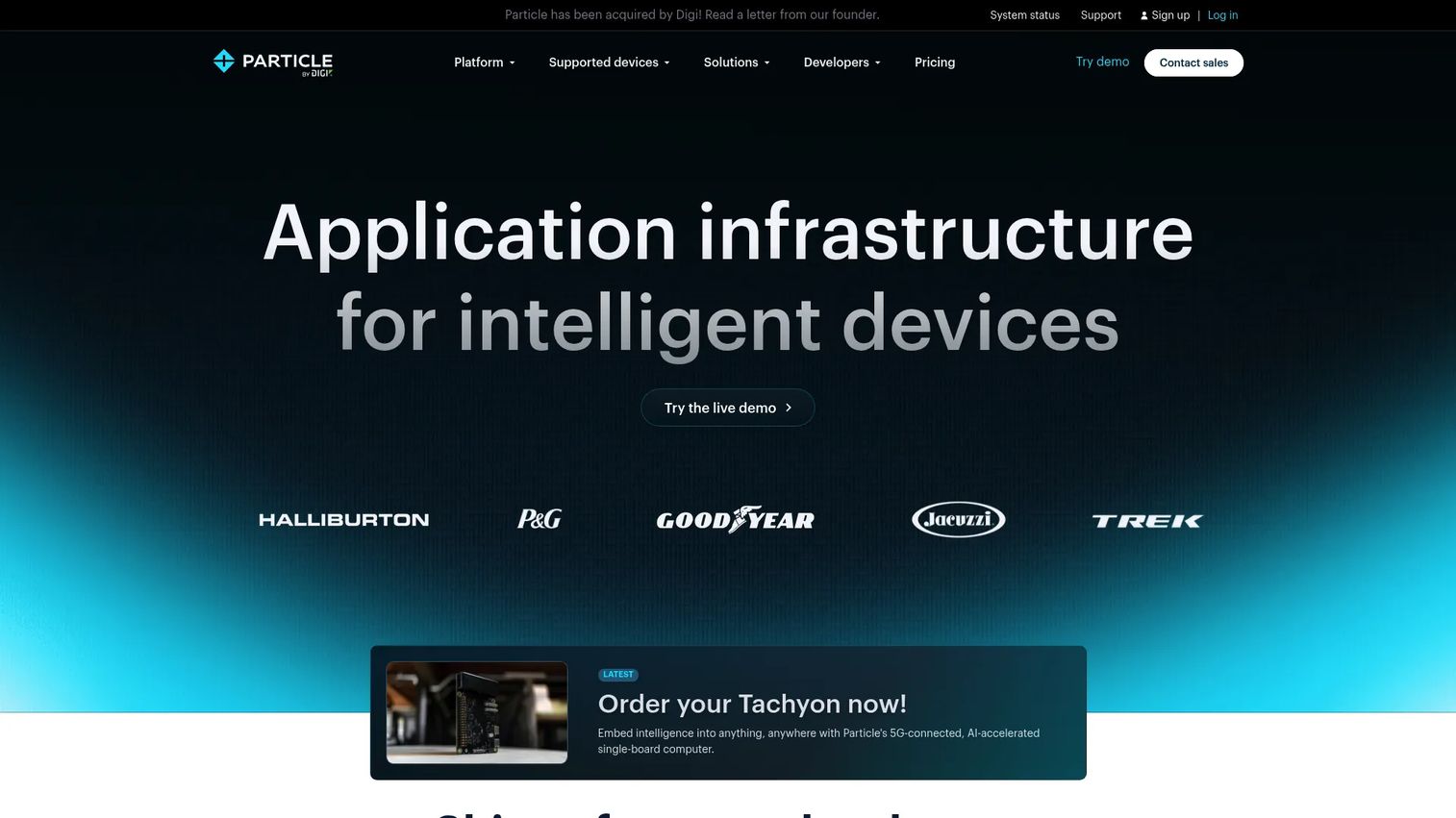
Particle is an integrated IoT platform-as-a-service combining device OS, cellular connectivity via EtherSIM, cloud device management, and data pipeline tooling. Fleet management runs through the Particle Console with software releases and device vitals tracking. OTA updates, edge computing capabilities, and developer tools round out the platform.
Best for: Connected product teams building IoT devices who want device OS, connectivity, and fleet management in one integrated platform rather than assembling separate vendors.
Key features
- Device OS with OTA firmware updates: Manage software across cellular and Wi-Fi devices
- EtherSIM cellular connectivity: Multi-network connectivity without SIM swaps
- Fleet management and device vitals: Track device health, software versions, and connectivity
- Data pipeline and Logic: Process device data and trigger actions without cloud detours
- Location Fusion: Multi-signal location for devices without GPS hardware
Why choose Particle: For product teams building connected hardware, Particle's integration across OS, connectivity, and cloud management reduces the vendor coordination overhead that comes with assembling separate components. The free tier covers up to 100 devices, which suits early development. Each paid block covers 100 devices.
Particle pricing: Free tier covers up to 100 devices and 100,000 Data Operations per month. Basic plan is $299/month per block (100 devices, 720,000 Data Operations). Plus is $599/month per block with 5 million Data Operations. Professional and Enterprise tiers are custom-priced on annual contracts.
G2 rating: 4.5/5
14. ClearBlade
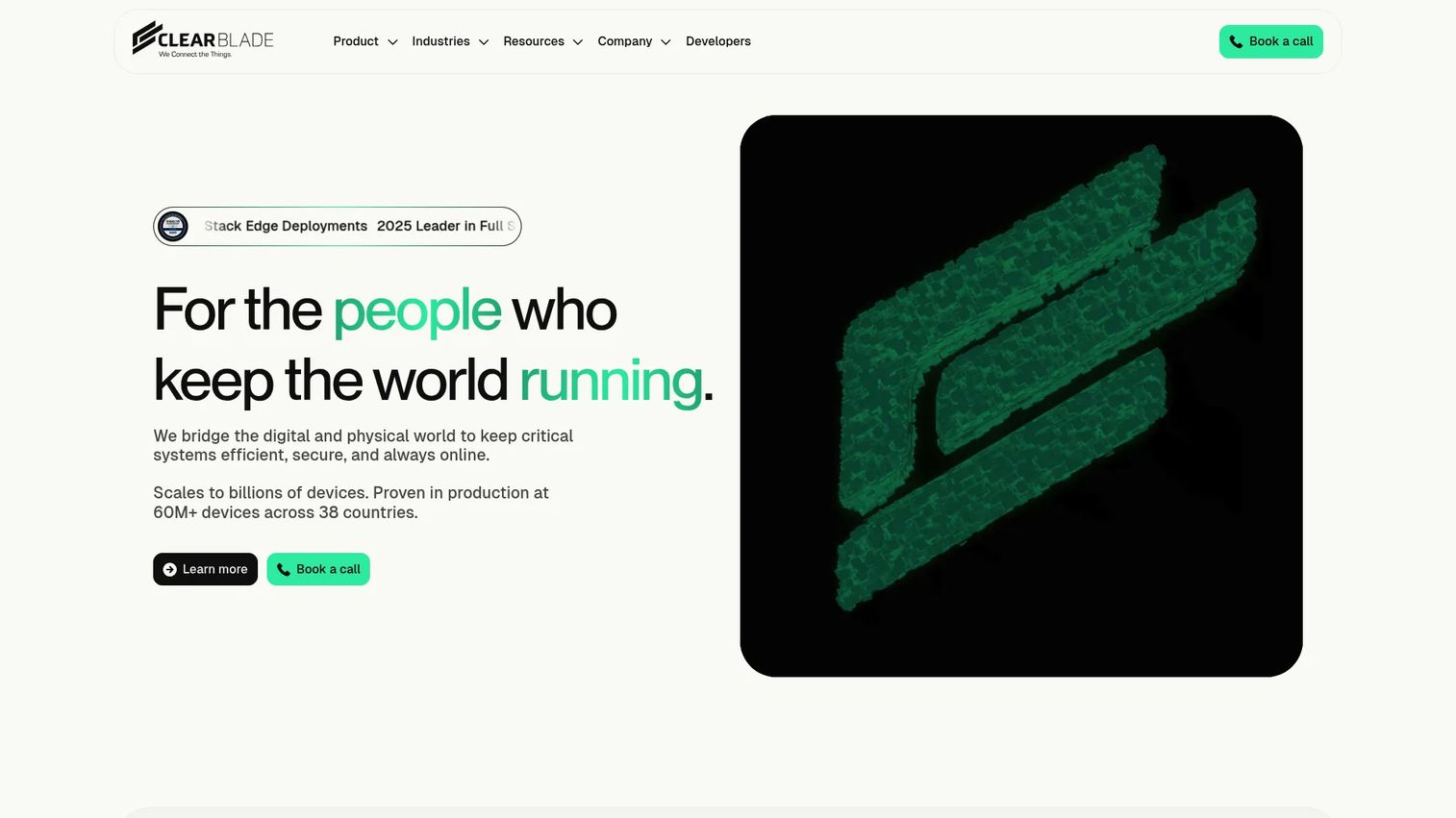
ClearBlade provides enterprise IoT, edge AI, and connected digital-twin solutions for industrial operations. The platform handles real-time IoT data ingestion, edge computing with offline continuity, device and data orchestration, business rules, and no-code digital twins. Protocol support spans MQTT, HTTP, REST, and WebSockets.
Best for: Enterprises building industrial IoT applications, edge-native AI, and real-time asset monitoring across transportation, industrial, and smart infrastructure deployments.
Key features
- Edge computing with offline sync: Continue local processing during connectivity gaps, sync on reconnect
- No-code digital twins and dashboards: Model and monitor connected assets without custom development
- Business rules and automation: Trigger actions based on device data or threshold crossings
- MQTT and REST protocol support: Connect a wide range of device types and enterprise systems
- Device and edge orchestration: Coordinate deployment and state across distributed environments
Why choose ClearBlade: The usage-based pricing model makes ClearBlade predictable for teams with variable data volumes. The platform's offline continuity and digital-twin capabilities suit industrial and transportation applications where connectivity is intermittent and asset modeling matters.
ClearBlade pricing: Usage-based pricing on monthly data volume. The first 250 MB per month is free. From 250 MB to 250 GB, the rate is $0.0045 per MB. From 250 GB to 5 TB, $0.0020 per MB. Above 5 TB, $0.00045 per MB. Cloud Pub/Sub charges apply separately.
15. EMQX
EMQX is a unified MQTT platform for IoT and AI data streaming. It handles MQTT messaging at the edge and cloud layers, supporting MQTT 3.1.1 and 5.0, MQTT over QUIC and WebSocket, and a SQL-based rule engine for data routing and transformation. Over 50 data integrations connect EMQX to Kafka, databases, cloud services, and analytics platforms.
Best for: Teams that need scalable, reliable MQTT messaging between IoT devices, edge gateways, and cloud systems, rather than a full edge application or fleet management platform.
Key features
- MQTT 3.1.1 and 5.0 support: Handle modern IoT messaging protocols
- SQL-based rule engine: Route, filter, and transform messages without custom code
- 50-plus data integrations: Connect to Kafka, databases, and cloud services
- TLS/SSL and X.509 security: Encrypt and authenticate device connections
- Prometheus and OpenTelemetry observability: Monitor broker performance and message flows
Why choose EMQX: EMQX excels as messaging infrastructure rather than a full edge application platform. Teams that already have edge compute and fleet management covered, but need reliable, scalable MQTT at the data transport layer, fit this profile. The Serverless plan lets you start without upfront commitment.
EMQX pricing: Serverless plan starts at $0/month with a free monthly quota (usage-based billing above the quota). Dedicated Flex starts at $234/month with a 14-day trial. BYOC and Enterprise tiers are custom-priced.
G2 rating: 4.6/5
Considerations
Match the runtime to your deployment model
A hyperscaler runtime like Azure IoT Edge or AWS IoT Greengrass makes sense when most of your cloud workloads already live in that provider's ecosystem. An open-source framework like EdgeX Foundry or KubeEdge makes sense when you need to avoid vendor lock-in or already use Kubernetes. Industrial suites like Cumulocity IoT or Litmus Edge make sense when OT connectivity and analytics matter more than cloud-native integration patterns. Map this to your engineering team's existing skills before evaluating features.
Check offline behavior before you scale
Offline operation is easy to claim and hard to test. Before committing to a platform, run a proof of concept with the network disconnected: Verify which local rules keep executing, whether device twins stay current, how the reconnection and sync sequence behaves, and whether policy updates propagate correctly after reconnect. Discovering gaps at scale is a support burden and customer trust problem that is expensive to fix.
Evaluate update and rollback workflows
For product managers, OTA updates on physical devices carry more risk than a SaaS deployment: You cannot instantly roll back a firmware change if it bricks a fleet segment. Evaluate staged rollout support, rollback trigger mechanisms, and observability across update batches. The platform's update model directly affects your release cadence and your on-call anxiety for every production deployment.
Validate security and access control early
Distributed edge devices expand the attack surface compared to a centralized cloud deployment. Evaluate device identity management, certificate rotation, signed update packages, audit logs, and least-privilege remote access models. ZEDEDA's hardware-rooted zero-trust approach is worth understanding even if you choose a different platform, as it sets a useful reference point for what security depth looks like at the edge.
Price the full operating model
License or runtime cost is rarely the dominant expense. Factor in cloud service charges (IoT Hub, IoT Core), data transfer, support contracts, implementation time for industrial protocol connectivity, monitoring infrastructure, and the engineering opportunity cost of ongoing maintenance. Litmus Edge at $1,500/month may be cheaper than six months of custom connector development. Evaluate total cost across a 24-month horizon, not just license price.
Conclusion
The right IoT edge software comes down to operating model, not brand recognition.
Azure IoT Edge and AWS IoT Greengrass serve teams whose cloud stack is already committed to one hyperscaler. EdgeX Foundry and KubeEdge suit teams that want open-source control and Kubernetes-native patterns. balena, ZEDEDA, and Particle address the fleet management and remote update problem that every connected product team faces. Cumulocity IoT, Siemens Insights Hub, PTC ThingWorx, and Litmus Edge cover the industrial segment where OT connectivity and operational analytics are the primary jobs. EMQX handles the messaging infrastructure layer for teams that need reliable MQTT without a full platform.
A practical next step: Shortlist three platforms by architecture type, run a time-boxed proof of concept on one representative device class, and test offline behavior, rollback, and data flow before broadening the rollout. The evaluation questions in the Considerations section above will surface the gaps that marketing pages do not.
For teams selling complex IoT or edge platforms, interactive demos can help buyers understand technical workflows before a live call. If your team needs a clearer way to show complex software, Start your journey with Guideflow today!
FAQs
IoT edge software is the runtime, management, and orchestration layer that enables connected devices to process data, run applications, and make decisions locally rather than relying entirely on cloud processing. It typically covers containerized workload deployment, device provisioning, over-the-air updates, offline operation, edge analytics, and cloud synchronization. For product managers, it is the infrastructure layer that determines how reliably your devices behave in the field and how much engineering effort each update requires.
General IoT software may focus on cloud-side device connectivity, telemetry ingestion, dashboards, or device management from a central platform. IoT edge software specifically runs logic near the device, handling local processing and decisions without requiring a cloud round-trip. The practical distinction matters when connectivity is intermittent, latency requirements are tight, or data volumes make cloud-only processing expensive. Many architectures use both: Cloud for fleet governance, edge for local execution.
For industrial environments, the answer depends on the primary job. Litmus Edge excels at OT data collection from PLCs, SCADA systems, and industrial equipment. Cumulocity IoT suits teams building IoT applications on top of connected industrial assets. Siemens Insights Hub fits Siemens-heavy manufacturing environments. PTC ThingWorx addresses connected-product and factory application development. EdgeX Foundry works well for teams building vendor-neutral gateway software with complex protocol requirements. See the best predictive analytics software tools guide for the analytics layer that often sits above these platforms.
Neither is universally better. Azure IoT Edge fits teams whose workloads, identity, and monitoring infrastructure already run on Azure. AWS IoT Greengrass fits teams already using AWS IoT Core, Lambda-style execution, and AWS cloud services. The runtime model, pricing structure, and integration path differ, but both cover containerized workloads, offline operation, and remote fleet management. The better choice comes down to which cloud your engineering and operations teams live in.
Kubernetes adds value when your team already uses it for cloud workloads and wants consistent orchestration patterns at the edge. KubeEdge and Red Hat OpenShift extend existing Kubernetes skills and GitOps pipelines to edge nodes. For smaller or simpler device fleets, Kubernetes introduces operational overhead that simpler runtimes like balena or Particle avoid. The honest evaluation question is whether your engineering team's Kubernetes expertise is a sunk investment to build on or an overhead to avoid.
Most platforms support local processing and delayed synchronization during connectivity gaps. Azure IoT Edge, AWS IoT Greengrass, ThingsBoard Edge, KubeEdge, balena, and ClearBlade all document offline operation modes. What differs between platforms is exactly what continues working offline: Local rules may keep running while cloud policy updates pause, or device twins may stay current while telemetry queues for later upload. Test the specific offline behavior of your candidate platform in a disconnected environment before scaling deployment.
Focus on the dimensions that map to your PM responsibilities: Activation time for new devices, instrumentation depth at the edge, release cadence support for OTA updates, support burden when deployments fail, engineering opportunity cost for ongoing maintenance, security review requirements for your customer base, and maintainability across frequent product releases. The best AI orchestration platforms guide covers related infrastructure decisions for teams also evaluating AI workflow management. Avoid platforms that require heavy implementation work for every protocol change or update cycle.
Open-source platforms like EdgeX Foundry and KubeEdge carry no license cost but incur hosting, implementation, and operational expenses. Hyperscaler runtimes like AWS IoT Greengrass charge per active device ($0.16/device/month) plus cloud service usage. Fleet management platforms like balena range from free (10 devices) to $1,439/month for production scale. Industrial platforms like Litmus Edge start at $1,500/month for the Foundation tier. Enterprise and industrial suites like Cumulocity IoT, ZEDEDA, PTC ThingWorx, and Siemens Insights Hub are priced through sales conversations. Total cost across a 24-month horizon, including implementation, cloud services, and support, almost always exceeds the license line item. For more infrastructure software comparisons, see the best AI security posture management tools guide.