


Your loan book grew. Your systems did not.
You started with a servicing tool, a spreadsheet for exceptions, and a couple of manual handoffs between origination and collections. It worked at 500 loans. At 5,000, the rekeying, the reconciliation errors, and the audit gaps became the drag that slows every new product launch and every board conversation about efficiency.
That drag is not a rounding error anymore. The global loan management software market is projected to grow from $12 billion in 2025 to $26.94 billion in 2030, a 17.5% CAGR, according to The Business Research Company (2024). Lenders are spending because manual loan operations do not scale, and because auditors, regulators, and buyers all expect a clean trail from origination to servicing.
The hard part is choosing. A loan management system that fits a regional bank running syndicated credit is the wrong fit for a fintech launching a new consumer product every quarter. So this guide compares eight platforms by the criteria that actually decide the outcome: lifecycle coverage, API depth, compliance posture, and how each one fits your operating model.
What's inside
This guide is for lenders, banks, and fintech operators evaluating a loan management system that can carry origination through servicing, collections, and reporting without manual glue in between.
We selected the eight platforms based on:
- Operational breadth across the loan lifecycle
- API and integration depth for connecting to core banking and payments
- Security posture and compliance and audit trail support
- Market validation across different lender types (enterprise banks, mid-market lenders, and modern fintechs)
Every tool here earns its place for a specific kind of lender. None of them is right for everyone.
TL;DR
- Best overall for enterprise loan lifecycle coverage: Finastra Loan IQ, for complex corporate and syndicated servicing.
- Best for configurable, modern lending architecture: LoanPro, an API-first loan servicing platform for fintechs and modern lenders.
- Best for mid-market lenders needing flexible deployment: HES LoanBox, with no-code workflow configuration.
- Best for all-in-one lending automation: TurnKey Lender, covering origination, servicing, and collections with AI in lending workflows.
- Best for banking-stack fit: Temenos or nCino, when lending must tie into a wider digital banking stack.
- Best for composable cloud-based loan platform architecture: Mambu, for teams building modern lending products via APIs.
What is loan management software
Loan management software is a system that tracks and automates the full loan lifecycle, from origination through servicing, collections, and reporting, in one platform instead of across spreadsheets and disconnected tools.
A loan management system is the operational backbone for lenders. It replaces manual rekeying with structured workflows, and it gives finance, risk, and operations teams one source of truth for every loan on the book.
Core capabilities most lending software includes:
- Payment schedules and amortization: automated calculation of principal, interest, and payment timing across loan types
- Borrower communication: statements, reminders, and self-serve portals
- Delinquency and collections handling: automated flags, workflows, and treatment paths
- Compliance and audit trails: a defensible record of every action taken on a loan
- Integrations: connections to core banking, payments, credit bureaus, and accounting systems
- Reporting and portfolio management: real-time visibility into performance, risk, and delinquency
The distinction that matters: loan origination software handles the front end, application through funding. Loan servicing software and loan administration software cover everything that happens after the loan is booked. The strongest platforms in this list cover origination to servicing in one system, so nothing gets lost in the handoff.
When to use loan management software
Not every lender needs to replace their stack today. These three triggers usually mean the cost of staying manual now exceeds the cost of migrating.
When manual servicing creates operational drag
You feel this first in headcount. Every new loan product means more manual reconciliation, more rekeying between systems, and more people spent on exception handling instead of growth. The cost of staying manual is linear headcount growth against a loan book you want to scale non-linearly. A loan servicing platform converts that manual work into automated workflows, which is where operating leverage comes from.
When you need one system across origination to collections
Fragmented tools create gaps. A loan approved in one system, serviced in another, and collected in a third means data gets rekeyed at every boundary, and every boundary is a source of error and delay. The cost is slow launches and reconciliation headaches at month-end close. A single lending management system carries the loan from application to payoff without a handoff tax.
When auditability and integrations matter more than spreadsheets
Spreadsheets do not survive an audit, and they do not integrate with your core banking or payments stack. When regulators, investors, or acquirers start asking for a clean trail, weak audit trails become a genuine risk, not just an inconvenience. A platform with structured logging and API-driven integrations turns audit prep from a fire drill into a query.
Comparison table
Use this table to narrow the shortlist by fit, deployment style, and core differentiation before reading the full sections. Most of these platforms use quote-based pricing tied to portfolio size, so treat pricing as a signal of the sales motion, not a sticker price.
| # | Product | Best for | Key differentiation | Pricing | G2 rating |
|---|---|---|---|---|---|
| 1 | Finastra Loan IQ | Complex corporate and syndicated lending | End-to-end servicing depth for specialized credit | Custom, quote-based | 3.2/5 |
| 2 | LoanPro | Fintechs and modern lenders | API-first configurable lending core | Custom, volume-based | 4.4/5 |
| 3 | HES LoanBox | Mid-market lenders | No-code workflow configuration | Custom, quote-based | 4.8/5 |
| 4 | TurnKey Lender | All-in-one lending automation | AI-assisted full lifecycle coverage | Custom, portfolio-based | 4.7/5 |
| 5 | Temenos | Banks modernizing core banking | Lending tied to a full banking stack | Custom, quote-based | 4.5/5 |
| 6 | nCino | Salesforce-native bank lending | CRM-native lending workflows | Custom, subscription | 4.2/5 |
| 7 | Fiserv LoanServ | Enterprise retail loan servicing | Consolidated retail portfolio servicing | Custom, quote-based | 4.3/5 |
| 8 | Mambu | Composable cloud lending | Cloud-native, API-driven components | Custom, quote-based | 3.8/5 |
1. Finastra Loan IQ
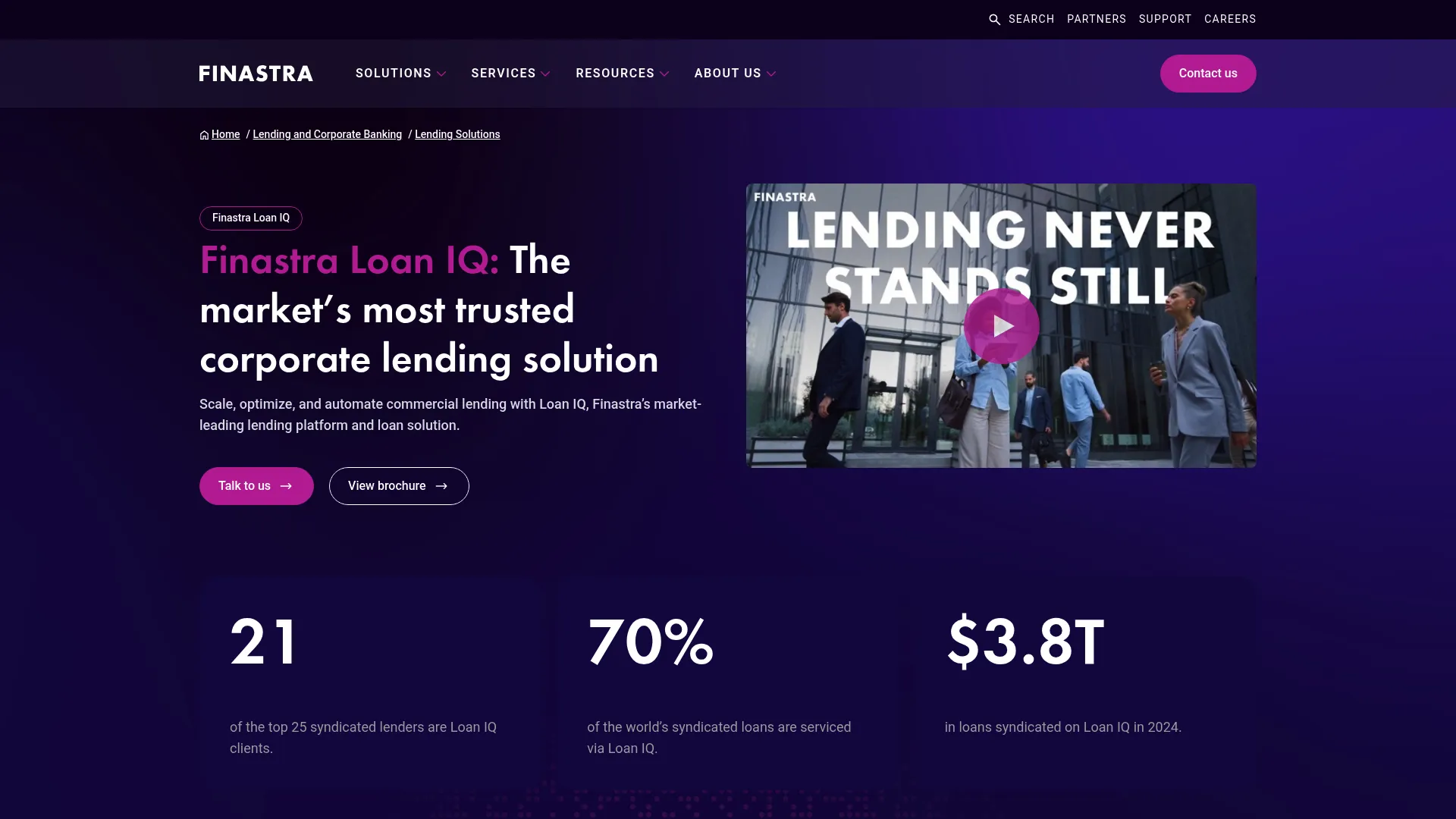
Finastra Loan IQ is a commercial and corporate loan servicing platform built for the most complex end of lending: syndicated, bilateral, SME, and specialized credit portfolios. It is the platform large banks reach for when a loan is not a single line item but a structure with participants, tranches, and transaction workflows that have to reconcile cleanly.
Best for: Banks and lenders managing complex corporate, syndicated, and specialized credit loan portfolios.
Loan IQ handles end-to-end loan servicing and portfolio management, with automation for booking, servicing, and transaction workflows. Its integration layer, Loan IQ Nexus, connects it into the wider banking stack. For a bank running billions in commercial credit, the depth here is the point: the platform is built to model complexity most lighter tools do not attempt.
That depth is also the buyer consideration. This is enterprise infrastructure, and implementation reflects that scope. Plan for a project, a dedicated team, and a timeline that matches the complexity of the portfolio you are moving onto it. This is a platform you commit to, not one you trial.
Key features
- End-to-end loan servicing and portfolio management
- Automation for booking, servicing, and transaction workflows
- Integration layer via Loan IQ Nexus
Why choose Finastra Loan IQ: Choose it when your portfolio is genuinely complex, corporate, syndicated, or specialized credit, and lighter platforms cannot model the structures you service.
Finastra Loan IQ pricing: Pricing is not publicly listed. Finastra uses a contact-sales, quote-based model for Loan IQ.
2. LoanPro
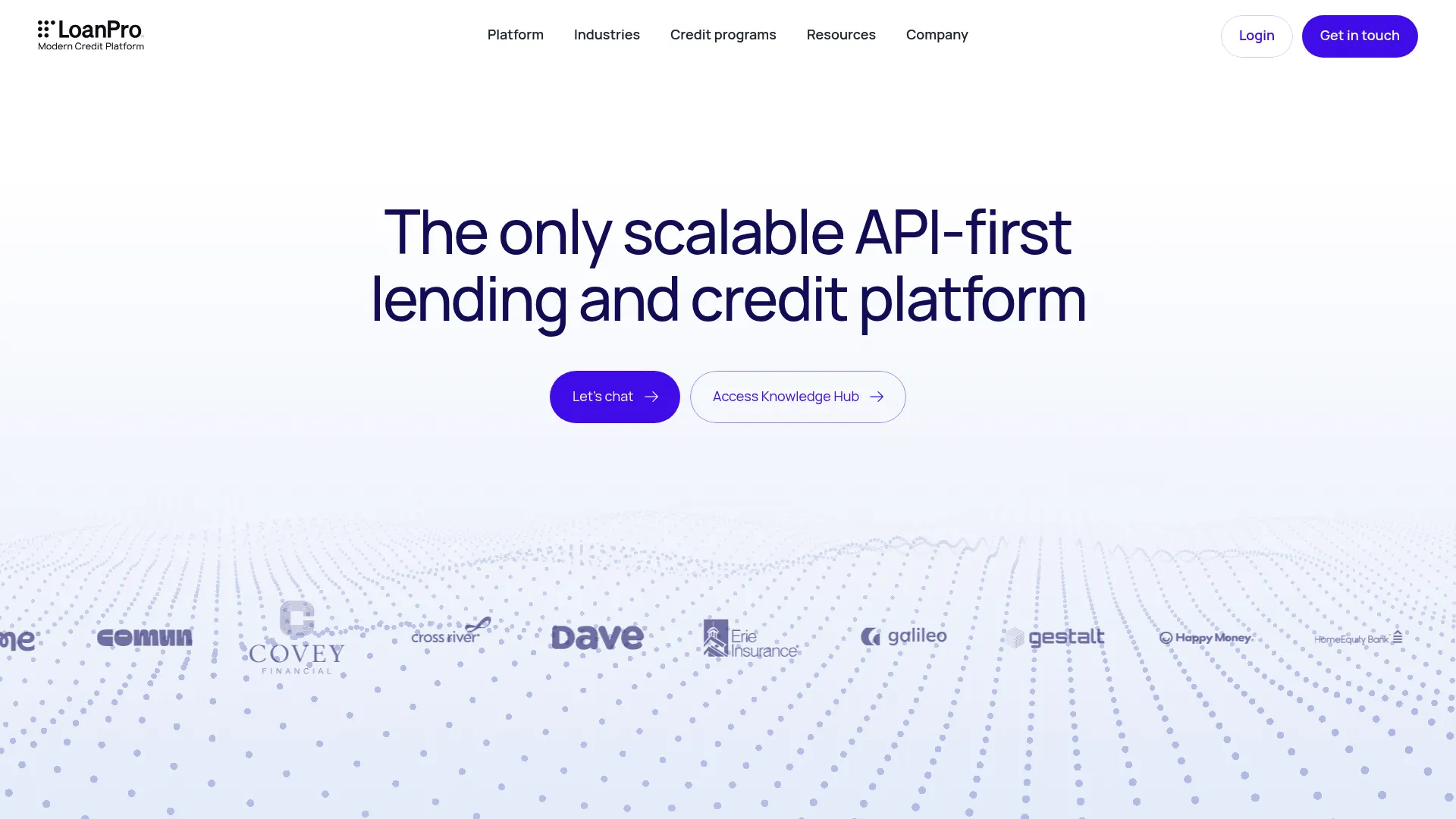
LoanPro is an API-first modern lending and credit platform covering origination, servicing, collections, and payments. It is built for fintechs and lenders that want to launch and iterate on loan products fast, without waiting on a monolithic core to catch up.
Best for: Financial institutions and lenders needing a configurable loan management platform.
The differentiator is architecture. LoanPro leads with an API-first design, direct database access, and automations plus webhooks, which means your engineering team can build lending products on top of it rather than around it. The suite spans origination, servicing, collections, and payments, so a fintech can run the full loan lifecycle on one configurable core. For teams with limited developer bandwidth who still want control, that combination of breadth and API depth is the reason LoanPro shows up on most modern lending shortlists.
If your operating model is "ship new loan products quickly and wire them into the rest of our stack," this is the loan servicing platform built for that motion.
Key features
- API-first architecture
- Origination, servicing, collections, and payments suites
- Automations, webhooks, and direct database access
Why choose LoanPro: Choose it when you want a configurable, API-driven lending core that your team can build on, not a closed system you have to work around.
LoanPro pricing: Pricing is not publicly listed. LoanPro bases pricing on account volume and the level of service and support agreement, and directs prospects to sales.
3. HES LoanBox
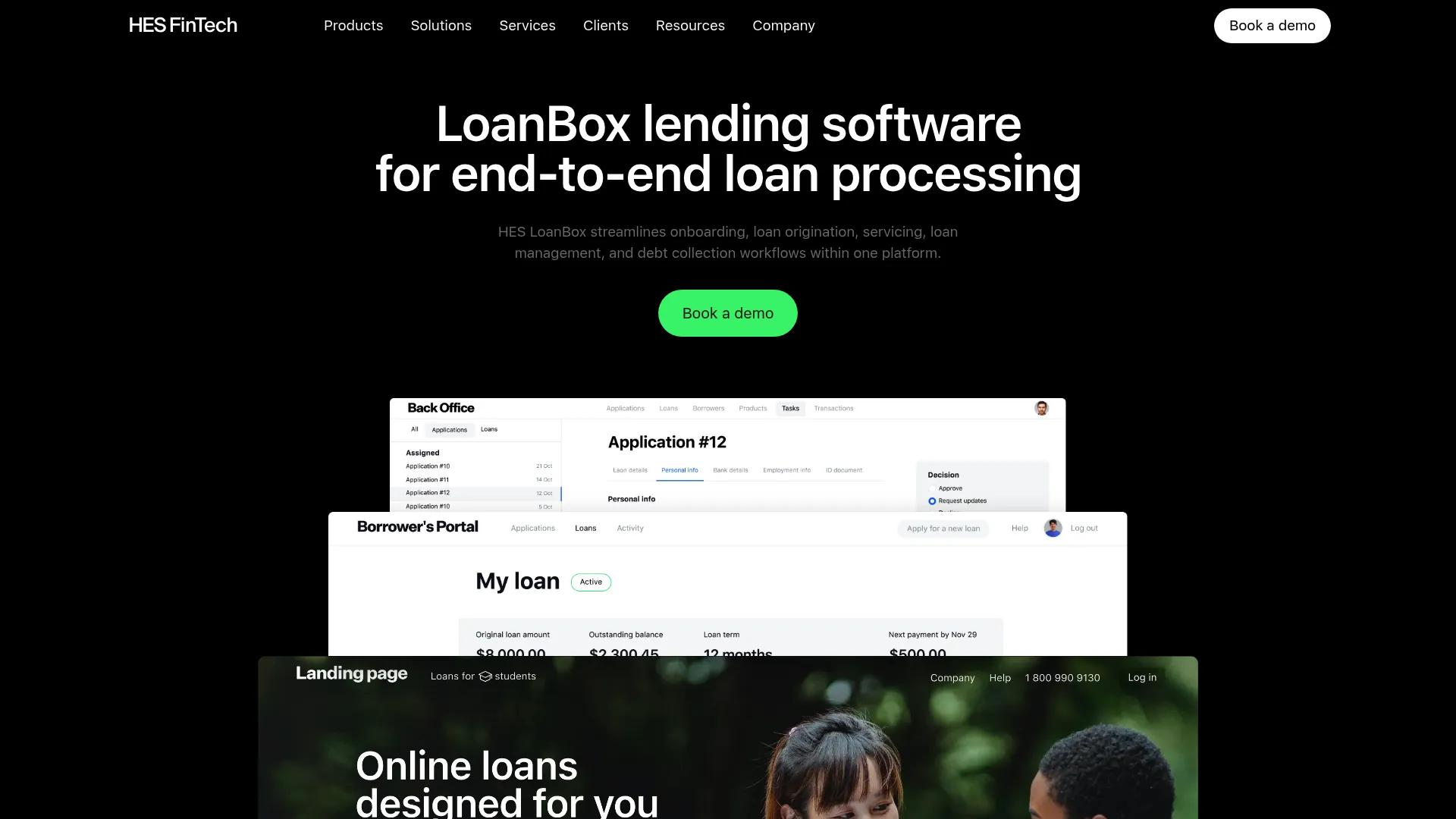
HES LoanBox is a modular loan origination and loan management platform for lenders and fintechs that want configuration over custom development. It targets the mid-market gap: more flexible than a heavyweight enterprise core, more structured than building your own.
Best for: Lenders needing a configurable enterprise lending platform with automation and integrations.
The standout is the no-code workflow builder. Lenders with varied products, and the need to change a workflow without a development cycle, can configure origination and servicing paths directly. LoanBox covers loan origination and servicing, and ships with a borrower portal and back office, so the borrower-facing and operational sides run on one platform. For a mid-market lender managing several loan types, that configurability is what makes the platform adapt to the business instead of the other way around.
Before committing, map your integration requirements and confirm the configuration model fits how your team works day to day. The flexibility is real, and it pays off most when someone owns the workflow configuration internally.
Key features
- No-code workflow builder
- Loan origination and servicing
- Borrower portal and back office
Why choose HES LoanBox: Choose it when you run varied loan products and want to configure workflows quickly without a heavy development project for every change.
HES LoanBox pricing: Pricing is not publicly listed. HES says pricing depends on the chosen plan and additional features, and directs visitors to contact sales.
4. TurnKey Lender
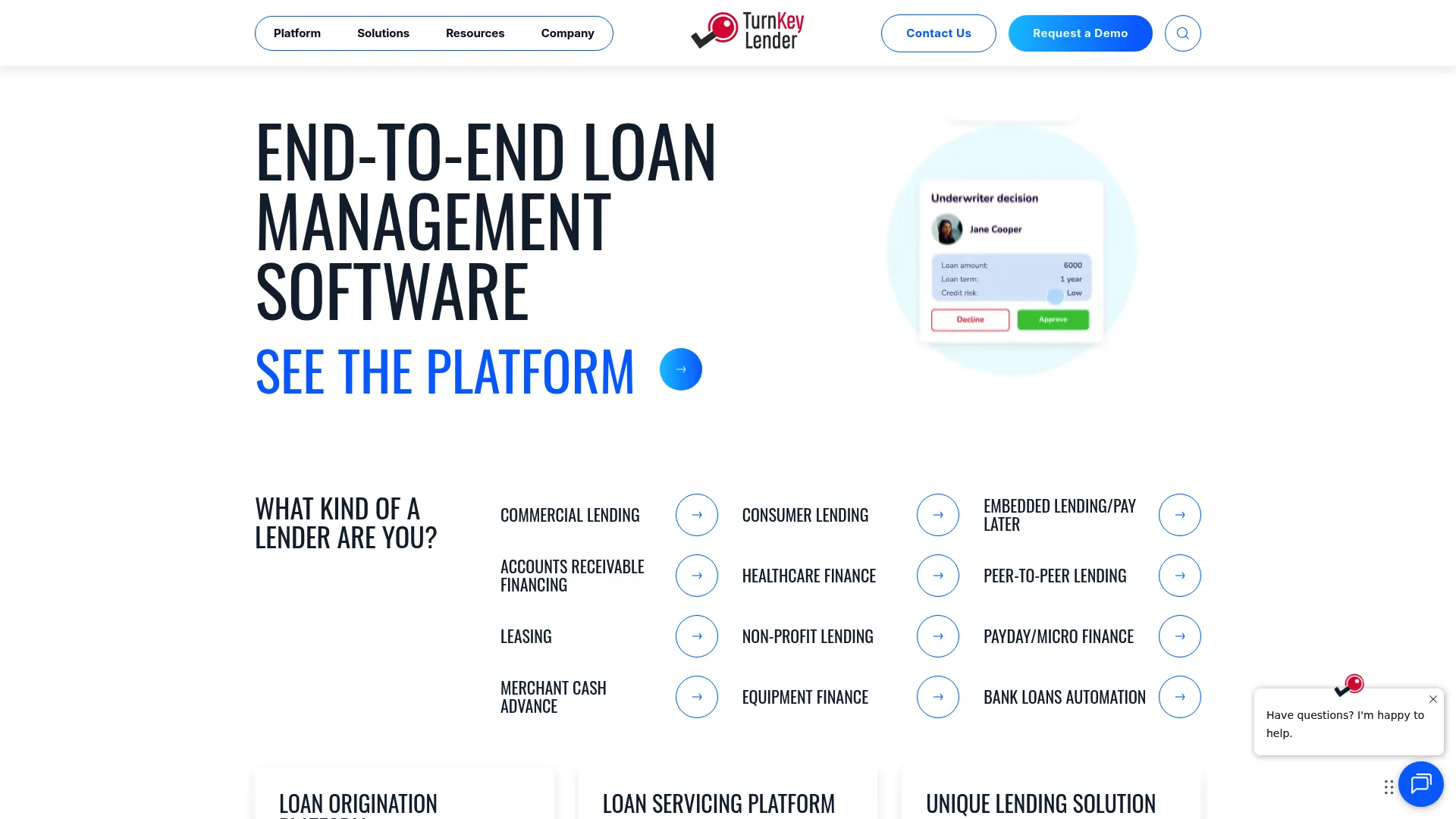
TurnKey Lender is a cloud-based AI lending automation platform covering the full loan lifecycle in one system. It sits between the do-it-yourself fintech stack and the heavyweight enterprise core, aimed at lenders that want end-to-end coverage without stitching together five tools.
Best for: Lenders needing an end-to-end, configurable lending automation platform.
TurnKey Lender covers loan origination, loan servicing, and debt collection, with credit decisioning, a borrower portal, configurable workflows, and API integrations. The AI in lending angle is built into the workflow, not bolted on: credit decisioning and automation run through the same platform that handles servicing and collections. For a lender that wants one vendor accountable for the whole lifecycle, that consolidation is the draw.
Where it fits better than a heavyweight enterprise system is scope and speed. If you do not need the syndicated-credit depth of a bank platform, but you do need real automation across origination to collections, TurnKey Lender covers that middle ground.
Key features
- Loan origination, servicing, and debt collection
- Credit decisioning and configurable workflows
- Borrower portal and API integrations
Why choose TurnKey Lender: Choose it when you want a single, AI-assisted platform to run the whole loan lifecycle instead of integrating separate origination, servicing, and collections tools.
TurnKey Lender pricing: Pricing is not publicly listed. TurnKey Lender uses several licensing models based on portfolio size and platform functionality, and directs prospects to contact sales.
5. Temenos
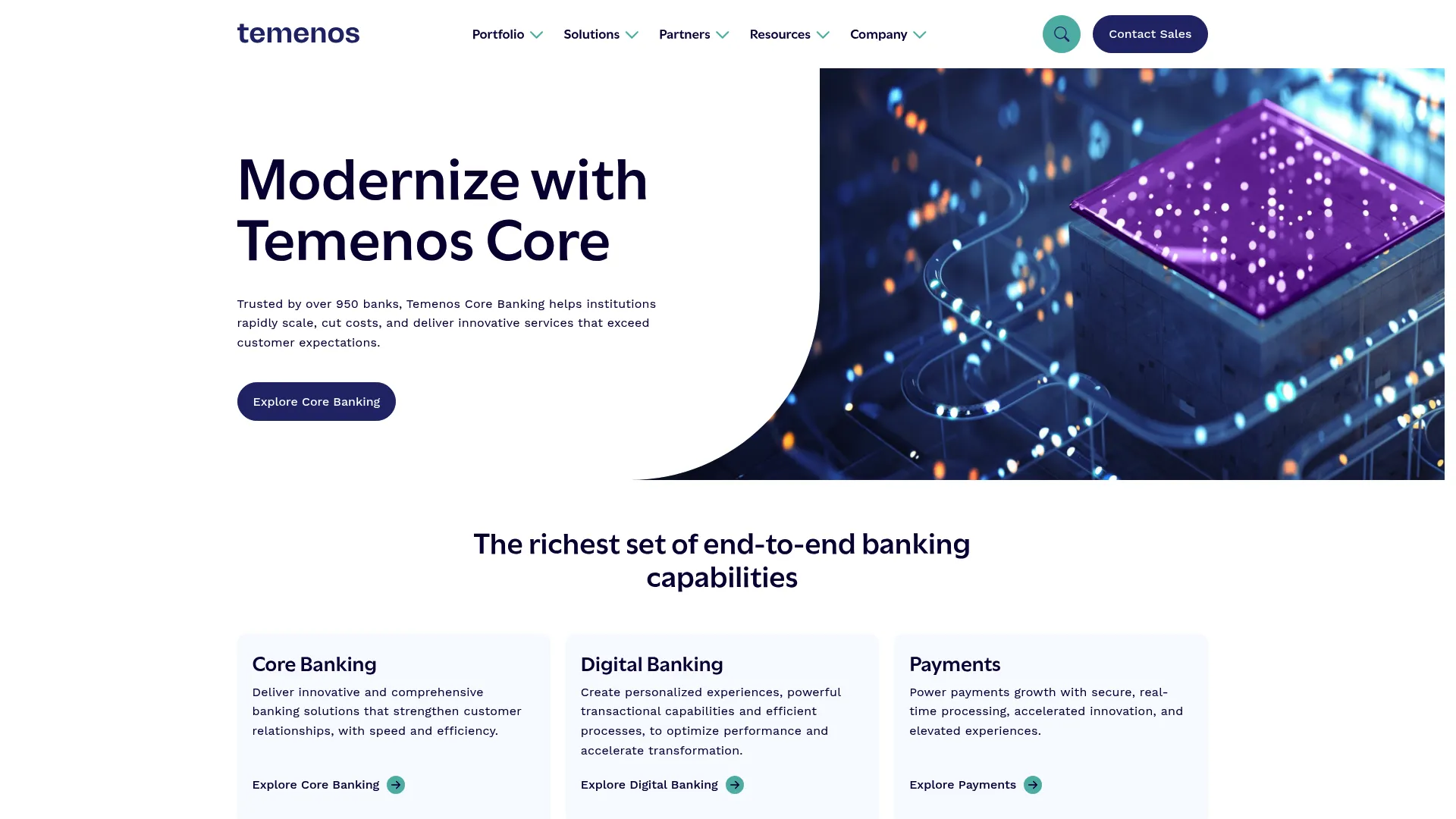
Temenos is a banking software vendor offering core, digital, payments, wealth, and financial crime mitigation, with lending as one workflow inside a wider stack. For banks, the value is not a standalone loan tool but lending that is native to the core.
Best for: Banks and financial institutions modernizing core and digital banking stacks.
Temenos covers core banking across retail, business, corporate, treasury, and wealth, plus digital banking, payments, and financial crime mitigation. When lending lives inside the core, a loan is not a record you sync from an external system, it is part of the same platform your deposits, payments, and customer data already run on. For a bank pursuing a broader modernization, tying lending to that stack removes an entire category of integration work.
The consideration is scope. A core banking modernization is a governance and change-management project, not a point purchase. Weigh the integration surface, the internal ownership required, and the change-management effort against the payoff of a unified stack.
Key features
- Core banking for retail, business, corporate, treasury, and wealth
- Digital banking and omnichannel customer experiences
- Payments, wealth management, and financial crime mitigation
Why choose Temenos: Choose it when lending is part of a wider core banking modernization and you want it native to the same platform as deposits, payments, and customer data.
Temenos pricing: Pricing is not publicly listed. Temenos uses a contact-sales model.
6. nCino
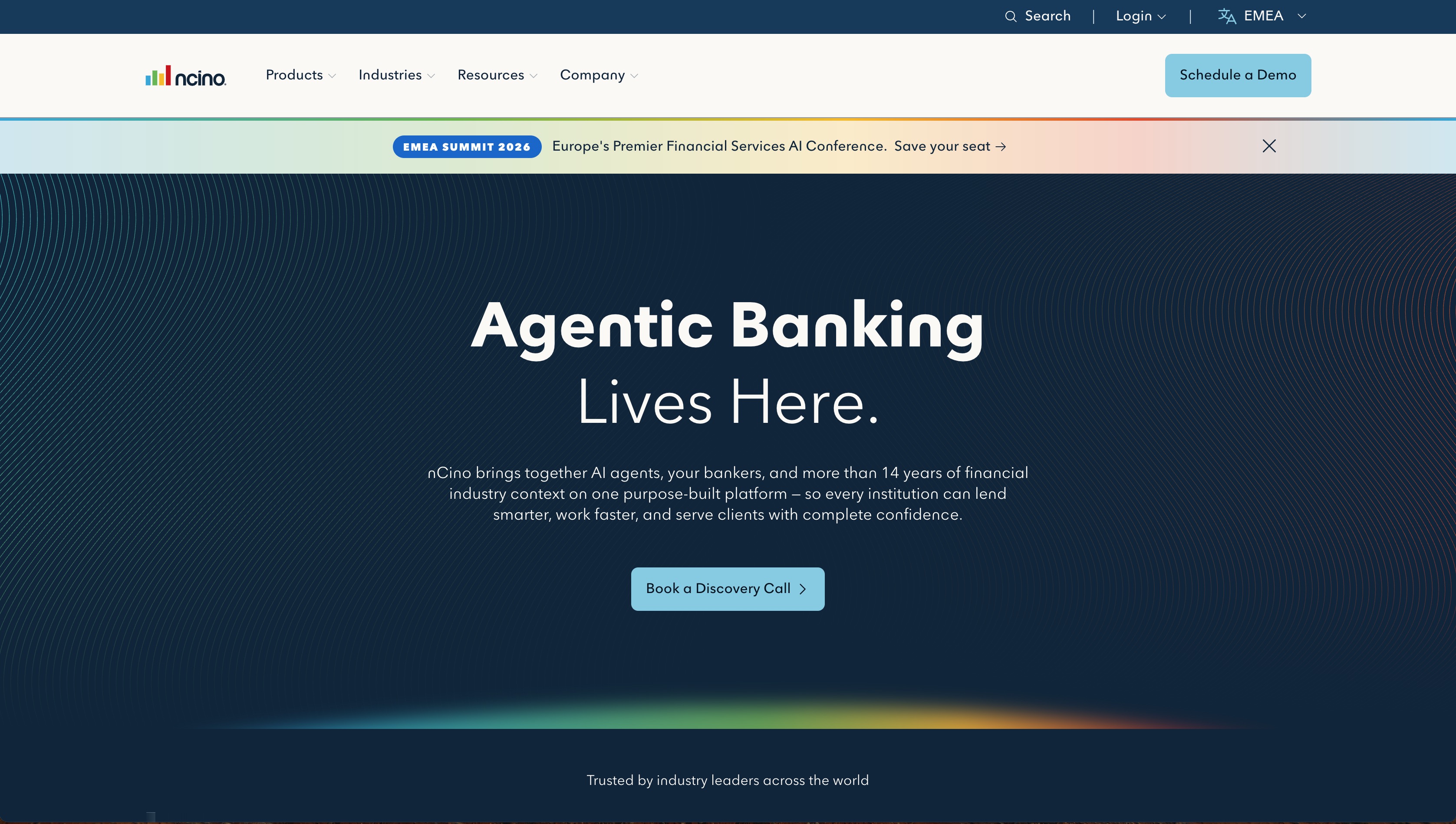
nCino is an AI banking software platform built on Salesforce, giving financial institutions lending workflows inside the CRM their teams may already use. For banks embedded in Salesforce, that native fit is the reason it lands on the shortlist.
Best for: Financial institutions needing a unified cloud banking platform for lending and digital banking workflows.
nCino covers commercial, consumer, small business, and mortgage lending workflows, plus digital account opening and onboarding, and AI and analytics capabilities. Because it is Salesforce-native, lending process automation lives alongside the CRM data your relationship managers work in, which is a genuine advantage for teams standardized on Salesforce.
The consideration is the flip side of that strength: nCino is tied to the broader Salesforce stack. That is an asset if you are committed to Salesforce and a factor to weigh if you are not. Confirm how the platform fits your existing licensing and administration model before committing.
Key features
- Commercial, consumer, small business, and mortgage lending workflows
- Digital account opening and onboarding
- AI, analytics, and banking advisor capabilities
Why choose nCino: Choose it when your bank runs on Salesforce and you want lending workflows native to the same CRM your relationship managers already use.
nCino pricing: Pricing is not publicly listed. nCino uses a demo-led, subscription model with multi-year contracts, and directs prospects to request a demo.
7. Fiserv LoanServ
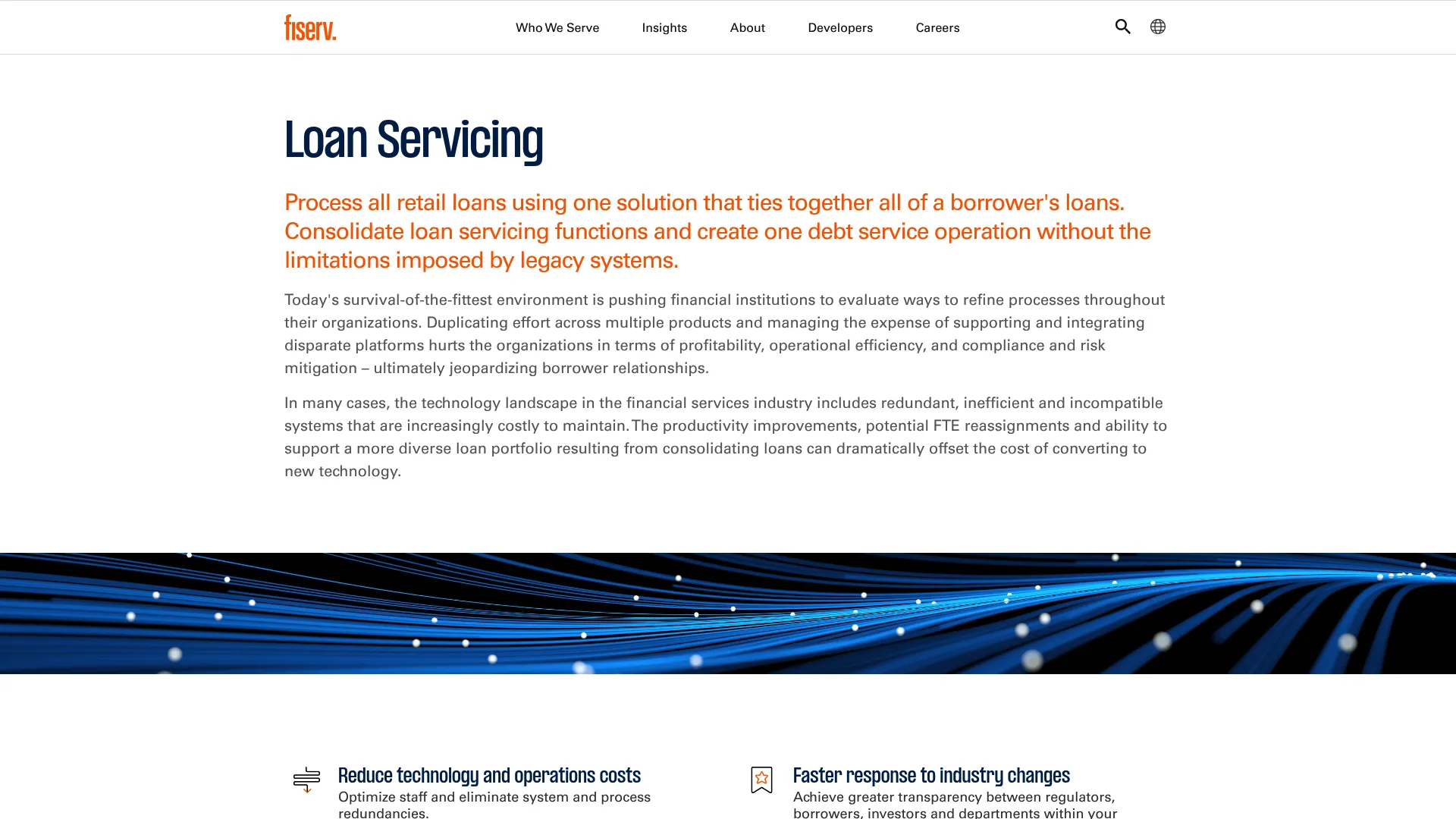
Fiserv LoanServ is loan servicing software for financial institutions that need to consolidate and manage retail loan portfolios on one platform. It is built for the servicing side of institutional lending, where the challenge is administering many loan types at scale.
Best for: Banks, credit unions, and lenders needing enterprise loan servicing.
LoanServ supports retail loan products including mortgages, home equity loans and lines of credit, personal loans and lines of credit, and installment loans. It centralizes borrower data in one place for servicing and risk management, and provides multi-channel borrower engagement and digital lending support. For an institution running a mixed retail book across several product types, consolidating servicing onto one platform is the operational win.
As enterprise servicing infrastructure, expect an implementation and integration effort that matches the scale of the portfolio. Map how it connects to your existing systems and what internal ownership the servicing workflows will require.
Key features
- Supports mortgages, home equity, personal loans, lines of credit, and installment loans
- Centralized borrower data for servicing and risk management
- Multi-channel borrower engagement and digital lending support
Why choose Fiserv LoanServ: Choose it when you need to consolidate a mixed retail loan portfolio onto one enterprise servicing platform with centralized borrower data.
Fiserv LoanServ pricing: Pricing is not publicly listed. Fiserv uses a quote-based model for LoanServ.
8. Mambu
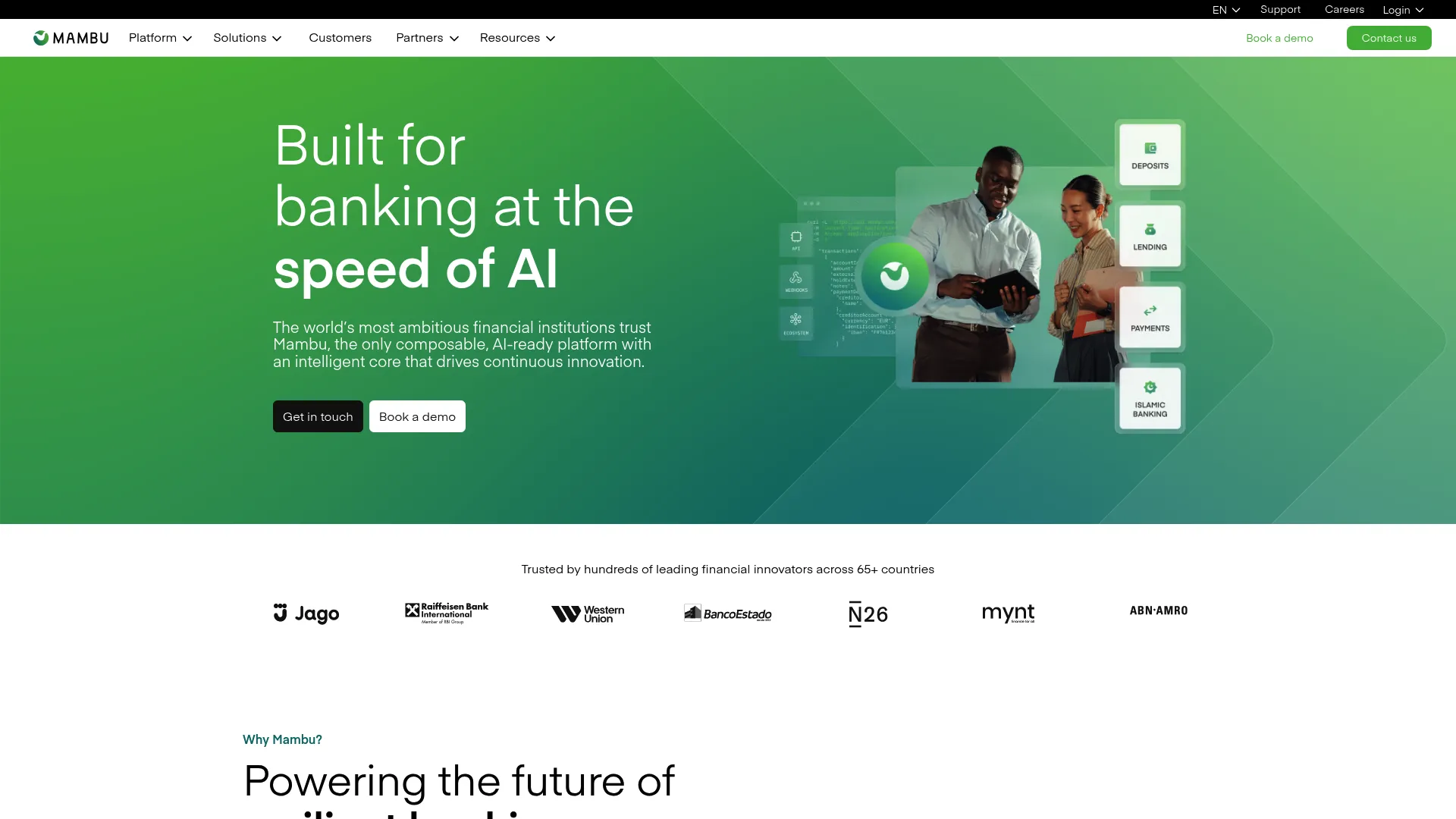
Mambu is a cloud-native composable banking platform for deposits, lending, and payments. Rather than a monolithic core, it offers modular lending components you assemble into the product you want, which suits teams building modern lending from parts.
Best for: Financial institutions modernizing core banking, lending, or payments infrastructure.
Mambu ships modular lending components with RESTful APIs, webhooks, configuration as code, and an audit trail. The composable model is the differentiator: you connect Mambu's lending pieces with the rest of your architecture instead of adopting one closed system end to end. For a team building a new lending product on modern, API-driven lending infrastructure, that flexibility is exactly the point.
Mambu is best used as part of a broader architecture, not as a single tool that does everything out of the box. It shines when you have the engineering capacity to compose services and want a cloud-based loan platform that bends to your product roadmap.
Key features
- Cloud-native core for deposits, lending, and payments
- RESTful APIs, webhooks, and configuration as code
- Built-in audit trail
Why choose Mambu: Choose it when you are building modern lending products from composable, API-driven components and want a cloud-native core rather than a closed monolith.
Mambu pricing: Pricing is not publicly listed. Mambu routes prospects to contact sales or book a demo.
Considerations
Before you commit to any lending management system, run every shortlisted platform against this checklist with your actual loan scenarios, not a generic demo.
Loan types and lifecycle coverage
Confirm the platform supports every loan type you offer today and plan to offer in the next two years. Then verify how much of the lifecycle it covers natively, origination, servicing, collections, and reporting, versus what needs a second system. Gaps here become manual work later.
API and integration depth
Check exactly how the platform connects to your core banking, payments, credit bureaus, and accounting systems. Ask about REST APIs, webhooks, and whether integrations are prebuilt or custom. API-driven lending platforms give you flexibility, but only if the endpoints cover what you actually need to sync.
Compliance and audit trail needs
Ask what gets logged, how long it is retained, and how you export it for an audit or regulator. A defensible compliance and audit trail is the difference between an audit that takes a query and one that takes a quarter. Verify this against your specific regulatory obligations.
Deployment model and implementation effort
Decide between cloud-based and on-prem based on your regulatory constraints and internal ownership. Then get an honest implementation timeline. Loan migration from a legacy system is the part most teams underestimate, so scope it early.
Scalability and internal ownership
Confirm the platform scales with your loan book and that you know who owns it internally. Configuration-heavy platforms reward a dedicated internal owner. Match the tool to the operating model you can actually staff.
Conclusion
The right loan management software depends less on a feature checklist and more on the kind of lender you are.
For enterprise banks running complex credit, Finastra Loan IQ and Fiserv LoanServ bring the servicing depth that specialized portfolios demand, while Temenos and nCino make sense when lending needs to tie into a wider banking stack. For modern fintech lenders, LoanPro and Mambu offer the API-first, composable architecture that lets you launch and iterate fast. For mid-market teams that want configuration without a heavyweight core, HES LoanBox and TurnKey Lender cover origination to servicing with room to adapt.
The decision comes down to loan complexity, your integration stack, and operational maturity. Do not choose on the demo alone. Shortlist two or three platforms, then run a real workflow test: take an actual loan scenario, push it through origination, servicing, and a delinquency path, and see which system handles it with the least manual glue. That test tells you more than any sales deck.
FAQs
Loan management software is a platform that tracks and automates the loan lifecycle, from origination through servicing, collections, and reporting, in one system. It replaces spreadsheets and disconnected tools with structured workflows, giving lenders one source of truth for every loan on the book.
Loan origination software handles the front end: application, underwriting, decisioning, and funding. Loan management and servicing software cover everything after the loan is booked, payments, statements, delinquency, and reporting. Many modern platforms cover both, so the loan never leaves one system from origination to servicing.
Yes. Most platforms connect to core banking, payment rails, credit bureaus, and accounting systems through APIs and webhooks. The depth varies, so confirm whether the integrations you need are prebuilt or require custom development before you commit to any lending software.
Look for a platform that logs every action taken on a loan, retains those records for your required period, and lets you export them cleanly for auditors or regulators. A strong compliance and audit trail turns audit prep from a fire drill into a query. Always verify the logging against your specific regulatory obligations.
AI in lending typically shows up in credit decisioning, risk scoring, delinquency prediction, and workflow automation. Platforms like TurnKey Lender build AI-assisted decisioning into the lifecycle, and others surface analytics that flag risk earlier. The value is in operational control: catching problem loans and automating routine work before it consumes headcount.
Loan migration is the part teams most often underestimate. Moving loan data, payment histories, and in-flight loans from a legacy system requires careful mapping, testing, and reconciliation. Scope it early, ask vendors for a realistic timeline, and plan for a parallel-run period before you cut over.
It depends on your regulatory constraints and internal ownership. Cloud-based deployment accounts for 58.4% of global loan management software revenue, per MarketIntelo (2024), because it reduces infrastructure overhead and scales faster. On-prem still makes sense where data residency or specific compliance rules require it. Match the model to your obligations, not the trend.
Modern platforms support a wide range, mortgages, home equity, personal loans, lines of credit, installment loans, and commercial or syndicated credit, though no single platform is equally strong across all of them. Confirm the platform covers every loan type you offer today and plan to offer, then run a real scenario through it before you decide.