A stockout costs you a sale you already earned. Overstock ties up cash you needed elsewhere. Both trace back to the same root cause: a forecast that missed, then a planning process too slow to correct it.
Most planning teams still run on spreadsheets stitched together across finance, supply chain, and operations. Versions drift. Bias creeps in. By the time anyone notices the forecast was off, the purchase order is already placed. That is the pattern demand forecasting software exists to break.
The category is growing fast because the pain is real. The global demand planning software market was estimated at $4.11 billion and is projected to reach $8.25 billion by 2033, a 12.3% CAGR from 2024 to 2033, according to Research and Markets (2025). Buyers are not chasing dashboards. They are chasing forecast accuracy, fewer stockouts, and a planning motion that responds to change without a fire drill.
This guide compares seven demand planning software platforms for teams evaluating forecasting, scenario planning, and inventory outcomes. Some are built for connected enterprise planning. Others are spreadsheet-native, finance-first, or purpose-built for inventory optimization at SMB and mid-market scale. The right pick depends on your data environment and your planning motion, not on which vendor has the loudest analyst mentions.
What's inside
This guide is for operations, supply chain, finance, and planning teams comparing supply chain forecasting software against real buying criteria. We chose the shortlist based on four factors that matter to planning buyers: forecast accuracy and bias reduction, scenario planning depth, AI and automation support, and inventory or replenishment fit. Popularity alone did not earn a spot.
You will find a comparison table near the top, individual breakdowns for each tool with pricing and G2 context where publicly verified, a buyer's checklist, and a FAQ section. Pricing and ratings shift, so confirm current figures on each vendor's site before you sign anything.
TL;DR
- Best for enterprise connected planning: Anaplan, for cross-functional scenario modeling at scale.
- Best for spreadsheet-native finance teams: Cube, a bridge between Excel and dedicated planning software.
- Best for broad enterprise planning: Board, for multidimensional financial and operational modeling.
- Best for finance and FP&A workflows: Workday Adaptive Planning, for connected budgeting and forecasting.
- Best for inventory-heavy SMBs: Netstock, for inventory optimization and replenishment.
- Best for lightweight forecasting teams: Streamline, for fast, focused demand planning.
- Best for retail and replenishment complexity: Logility Solutions, for AI-driven end-to-end supply chain planning.
What is demand forecasting software?
Demand forecasting software is a category of supply chain and business planning software that predicts future product demand using historical sales data, statistical models, and AI, then connects those forecasts to inventory, replenishment, and cross-functional planning decisions.
The strongest platforms move beyond a single forecast number. They reduce bias, flag exceptions, and let teams model what-if scenarios before committing to a plan. Core capabilities across demand planning and forecasting software include:
- Historical and statistical forecasting: Baseline models built on sales history, seasonality, and trend detection.
- AI and ML automation: AI forecasting that selects models, detects patterns, and reduces manual tuning.
- Scenario planning: What-if modeling so teams can test demand shifts before they commit inventory.
- External data integration: Demand sensing that pulls in signals like promotions, weather, and market data.
- Inventory and replenishment support: Inventory optimization, safety stock logic, and replenishment recommendations.
- Collaborative planning and visibility: A shared model that aligns finance, supply chain, and operations.
Demand planning and forecasting software sits at the center of modern supply chain planning. It turns raw demand signals into decisions about what to buy, make, and hold, and it gives cross-functional teams one version of the plan instead of five competing spreadsheets. Cloud adoption is accelerating this shift: cloud computing and storage across supply chain technologies is expected to reach 91% within five years, per the MHI Annual Industry Report cited in Research and Markets (2025).
When to use demand forecasting software
Not every team needs a full planning platform on day one. These three patterns signal it is time.
Improve forecast accuracy without manual spreadsheet cleanup
When your forecast lives across a dozen spreadsheets, drift is inevitable. Versions diverge, formulas break, and bias goes unmeasured because no one owns the number. If your planning leaders spend more time reconciling files than analyzing demand, dedicated software gives you consistent inputs and measurable bias reduction. That is the point where accuracy stops being a guessing game.
Connect demand signals to inventory and replenishment
Stockouts and overstock rarely come from bad luck. They come from forecasts that never reach the replenishment decision in time. Supply chain forecasting software closes that gap by linking demand signals directly to inventory optimization and reorder logic. The outcome you want is not a prettier dashboard. It is fewer stockouts, less excess, and safety stock set by data instead of gut feel.
Support cross-functional scenario planning
When finance, supply chain, and operations each plan from their own numbers, alignment breaks at the worst moments. A shared planning model lets every team run what-if analysis against the same assumptions. Scenario planning turns "what happens if demand jumps 20%" from a week of spreadsheet work into a modeled answer in minutes, so you respond to change instead of reacting to it.
Comparison table
The table below sorts by relevance to demand forecasting and planning buyers. Pricing for most enterprise platforms is quote-based, so verify current figures and forecast accuracy claims directly with each vendor.
| # | Product | Intent | Key differentiation | Pricing | G2 rating |
|---|---|---|---|---|---|
| 1 | Anaplan | Enterprise connected planning | AI-driven scenario modeling across finance, supply chain, and operations | Quote-based | 4.6/5 |
| 2 | Cube | Spreadsheet-native FP&A | Bi-directional sync with Excel and Google Sheets | Quote-based (Bronze, Silver, Gold) | Not disclosed |
| 3 | Board | Broad enterprise planning | Multidimensional financial and operational planning | Quote-based | 4.4/5 |
| 4 | Workday Adaptive Planning | Finance and FP&A workflows | Connected planning with unlimited what-if scenarios | Quote-based, 30-day trial | 4.3/5 |
| 5 | Netstock | Inventory-heavy SMBs | Inventory optimization and predictive planning | Starts at $900/month | 4.6/5 |
| 6 | Streamline | Lightweight forecasting teams | Data-driven demand planning with a free plan | Free plan available | 4.4/5 |
| 7 | Logility Solutions | Retail and supply chain complexity | AI-driven end-to-end supply chain planning | Quote-based | Not disclosed |
1. Anaplan
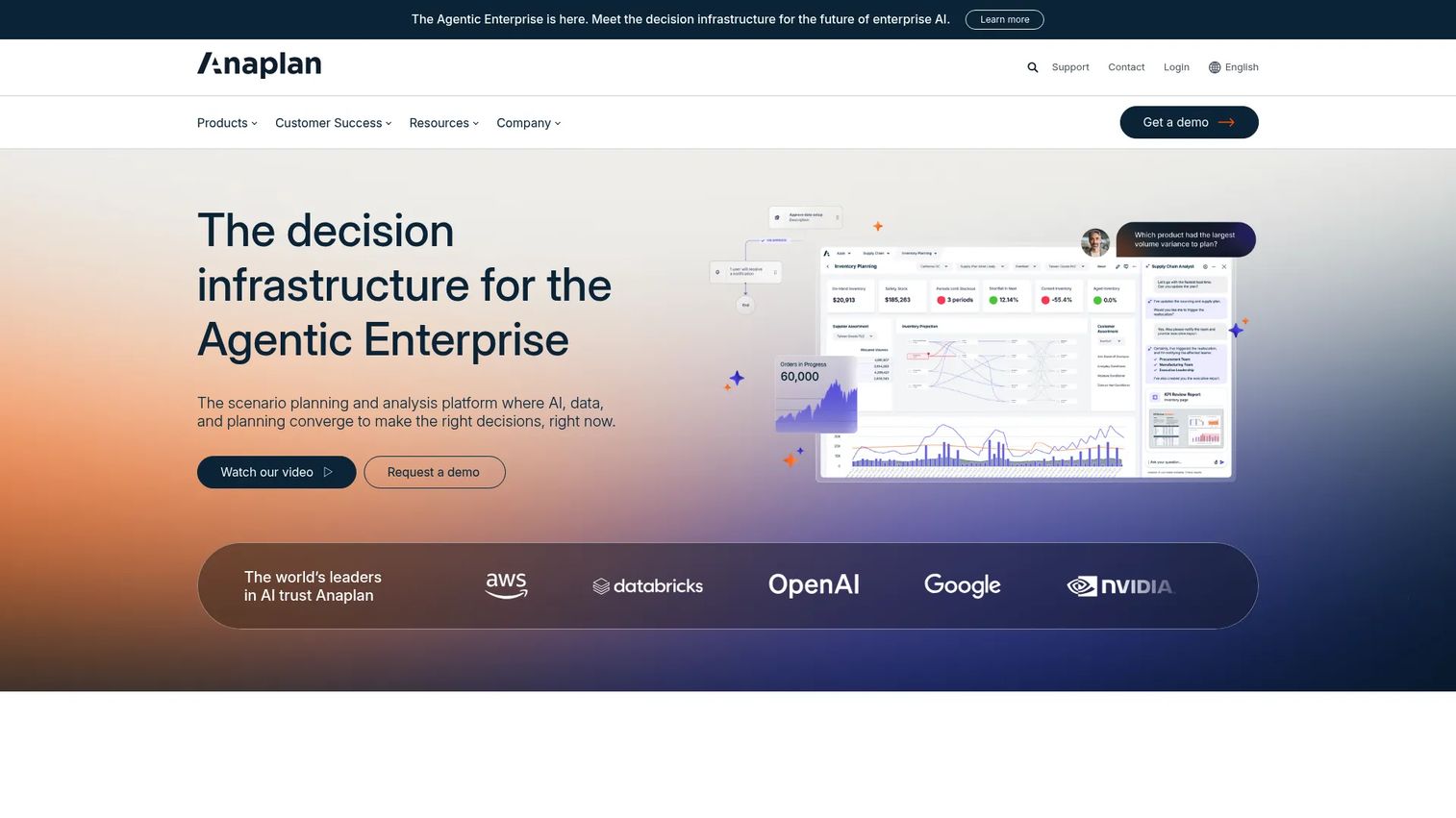
Anaplan is an AI-driven scenario planning and analysis platform built for enterprise decision-making. It connects planning across finance, supply chain, sales, HR, and operations in one model, so a change in demand flows through to supply, revenue, and headcount without exporting data between systems. For large organizations, that connected planning approach is the core draw.
Where Anaplan stands out is scenario modeling at scale. Planning teams can build detailed what-if scenarios, compare outcomes side by side, and see how demand shifts ripple across the business. Its governance, auditability, and collaboration features keep large planning workflows controlled, which matters when hundreds of people touch the same plan.
Best for: Large enterprises needing connected, cross-functional planning and deep scenario modeling.
Key strengths
- AI-driven scenario planning: Model demand shifts and compare outcomes across the full plan.
- Connected planning: Link finance, supply chain, sales, HR, and operations in one shared model.
- Governance and auditability: Keep large, multi-team planning workflows controlled and traceable.
Why choose Anaplan: Anaplan fits complex planning orgs where demand, supply, and financial plans have to stay in sync across many teams. It rewards organizations with the data maturity and planning discipline to build detailed connected models. Lighter teams that need a fast, focused forecast may find more platform here than the job requires.
Anaplan pricing: Anaplan does not publish public pricing. Access is sales-led and quote-based, scaled to the size and complexity of your planning deployment. Contact Anaplan directly for a quote tailored to your model count, user seats, and modules. It holds a 4.6/5 rating on G2.
2. Cube
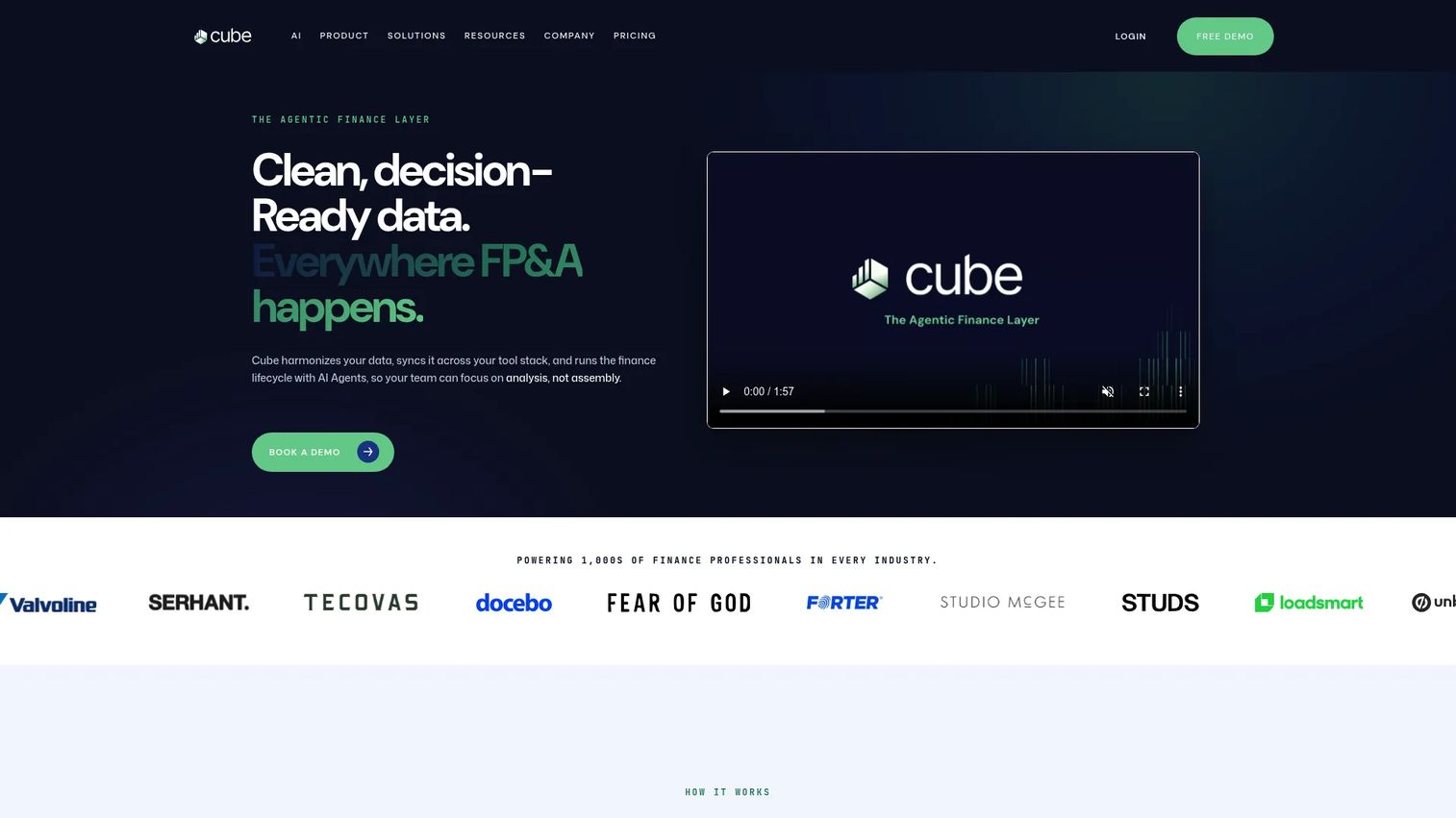
Cube is an FP&A platform that lets finance teams centralize data, plan, forecast, report, and collaborate without leaving the spreadsheets they already use. Its patented bi-directional sync with Excel and Google Sheets is the differentiator: teams keep their spreadsheet workflows while Cube adds a governed data layer, version control, and consolidation underneath.
For finance-led planning teams, Cube acts as a bridge between spreadsheets and dedicated planning software. It adds AI agents and an MCP Server for finance workflows, plus dashboards, variance analysis, scenario modeling, and reporting. Teams that live in Excel but have outgrown its version chaos are the natural fit.
Best for: Finance teams needing spreadsheet-native FP&A planning, reporting, and scenario modeling.
Key strengths
- Bi-directional spreadsheet sync: Keep Excel and Google Sheets workflows while adding governed data.
- AI agents and MCP Server: Automate repetitive finance workflows inside the tools teams know.
- Scenario modeling and reporting: Run variance analysis and what-if scenarios from a single source.
Why choose Cube: Finance-heavy teams often compare Cube with dedicated demand tools when the bottleneck is finance planning, not deep supply chain modeling. It fits teams that want structure without abandoning spreadsheets. If your primary need is inventory optimization and replenishment, a supply-chain-native tool will map more directly to that job.
Cube pricing: Cube's public pricing page lists Bronze, Silver, and Gold plans but does not display prices, directing visitors to request a custom quote. Contact Cube for pricing scaled to your team size and feature needs.
3. Board
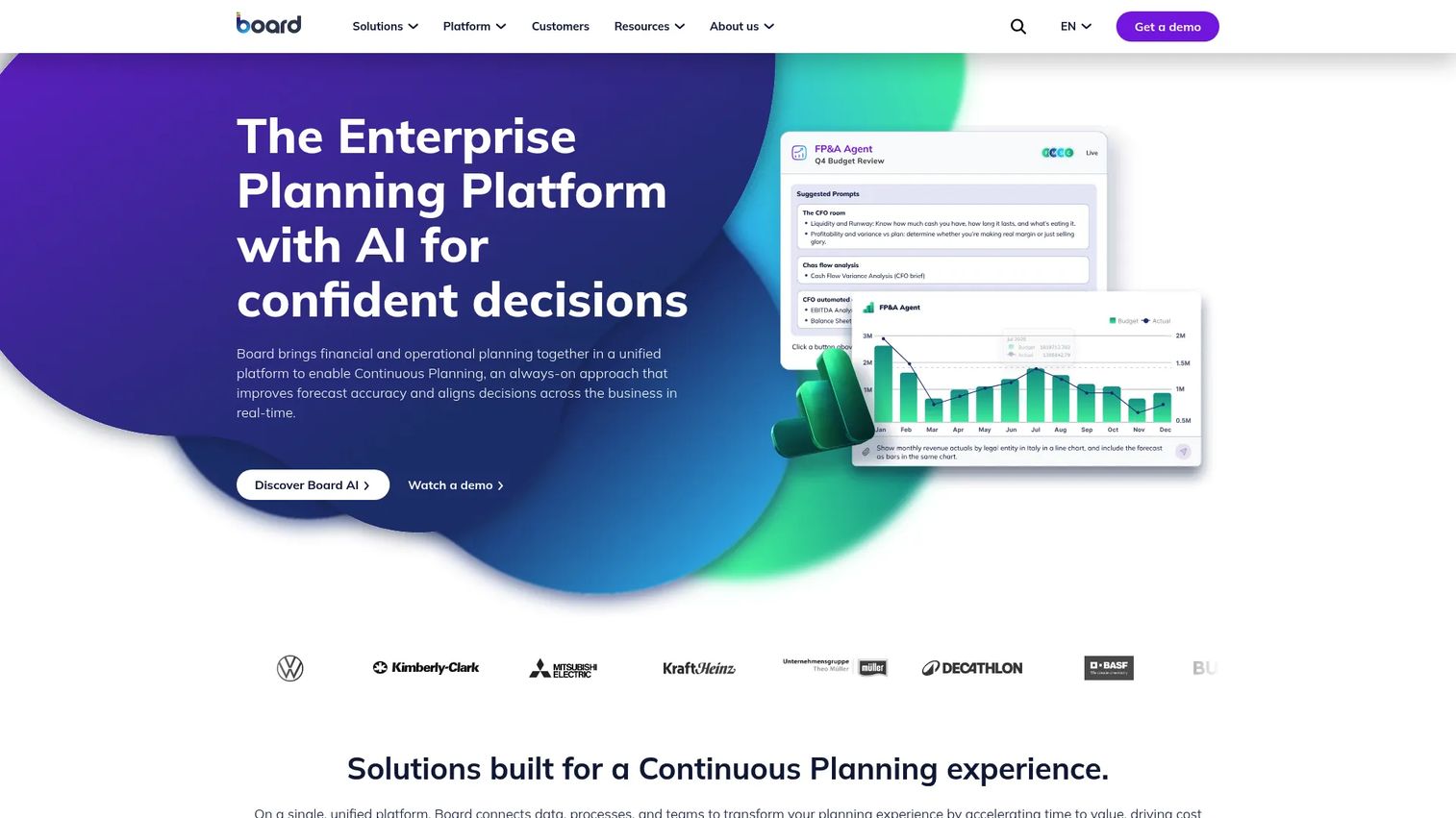
Board is an enterprise planning platform that unifies financial and operational planning in one environment. It combines multidimensional planning, continuous forecasting, and analytics, so teams can model demand, finance, and supply chain scenarios against the same data. For large organizations that want one platform across planning domains, that breadth is the appeal.
Board leans into decision-making depth. Its data connectivity and integration pull operational data into the planning model, and its governed AI and analytics layer supports forecasting alongside business intelligence. That combination suits teams that treat planning as a continuous, cross-functional discipline rather than a quarterly exercise.
Best for: Large organizations needing unified financial and operational planning.
Key strengths
- Multidimensional planning: Model demand, finance, and operations across many dimensions.
- Continuous forecasting: Update forecasts as new data arrives instead of on a fixed cycle.
- Governed AI and analytics: Combine forecasting with BI under controlled governance.
Why choose Board: Board fits organizations that want planning depth and cross-functional modeling in a single platform. It rewards teams ready to invest in a unified planning environment. Simpler teams focused only on demand forecasting may not need the full breadth of what Board offers, and a more focused tool could get them there faster.
Board pricing: Board does not publish public pricing. Its pricing page provides customized quotes and prompts visitors to request pricing per solution area. Contact Board directly for a quote. Board holds a 4.4/5 rating on G2.
4. Workday Adaptive Planning
Workday Adaptive Planning is cloud-based enterprise performance management software for financial, workforce, and operational planning. It brings AI-powered planning and forecasting into connected budgeting, forecasting, and consolidation workflows, which makes it a natural fit for finance-led planning programs that also touch operations.
Its standout capability is unlimited what-if scenarios and versions. Finance teams can model different demand and revenue assumptions without version limits, then roll the best case into the operating plan. Because it spans financial, workforce, operational, and consolidation planning, it supports multi-department planning from one system.
Best for: Mid-size to enterprise finance teams needing integrated planning, forecasting, and consolidation.
Key strengths
- AI-powered forecasting: Automate forecast generation across financial and operational plans.
- Unlimited scenarios and versions: Model as many what-if cases as the plan requires.
- Multi-department planning: Connect financial, workforce, operational, and consolidation planning.
Why choose Workday Adaptive Planning: It belongs on the shortlist for finance-led planning programs that want scenario planning and consolidation in one connected system. It fits teams anchored in FP&A that need operational planning alongside it. Teams whose primary need is inventory optimization and replenishment will find supply-chain-native tools map more directly.
Workday Adaptive Planning pricing: Workday does not display public monetary pricing. It offers a 30-day free trial and two quote-based plans, Workday Adaptive Planning and Workday Adaptive Planning & Consolidation, both listed as "Pricing varies." Contact Workday for a quote. It holds a 4.3/5 rating on G2.
5. Netstock
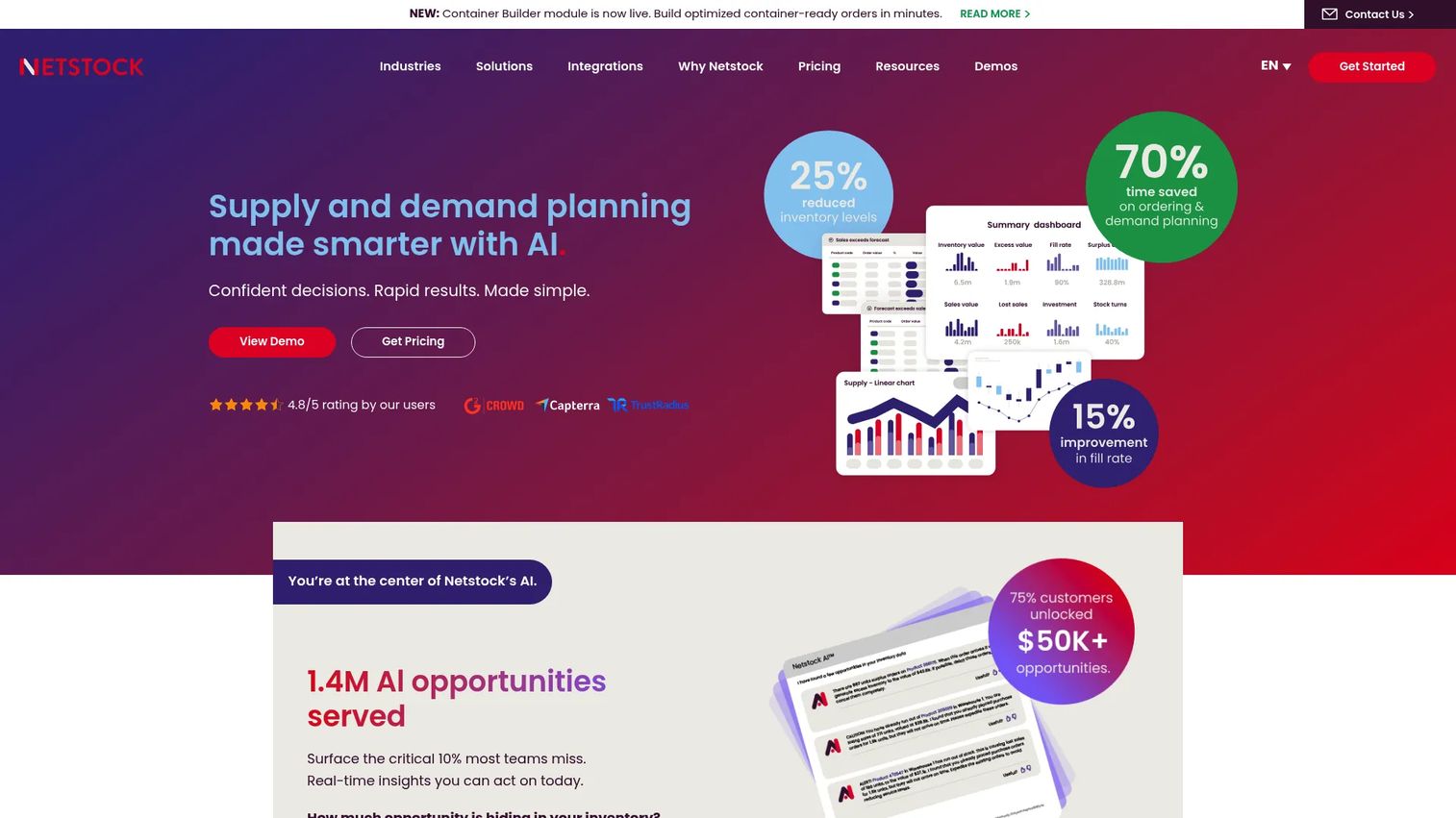
Netstock is AI-powered inventory planning and demand and supply planning software built for SMBs. It connects to your ERP and turns demand forecasts into inventory optimization and ordering decisions, which is exactly what smaller operations teams need when stockouts and excess are eating margin. This is the most inventory-centric pick on the list.
Netstock focuses on the operational outcome, not the theory. Its inventory optimization, demand planning, and inventory ordering features work together to set the right stock levels and trigger replenishment. For SMBs and mid-market teams that need predictive planning across ERP-connected operations, it delivers a focused, practical workflow rather than a broad enterprise platform.
Best for: SMBs needing inventory optimization and predictive planning across ERP-connected operations.
Key strengths
- Inventory optimization: Set data-driven stock levels to cut both stockouts and excess.
- Demand planning: Forecast demand and feed it directly into ordering decisions.
- Inventory ordering: Trigger replenishment recommendations based on the forecast.
Why choose Netstock: Netstock is strong for teams whose core problem is stockout prevention and reducing excess inventory. It fits ERP-connected SMBs that want practical results without an enterprise planning rollout. Larger orgs needing deep cross-functional financial planning may need a broader platform alongside it.
Netstock pricing: Netstock core pricing starts at $900 per month on an annual subscription. A Demand Planner add-on is available with a custom quote. Confirm current packaging on Netstock's site. It holds a 4.6/5 rating on G2.
6. Streamline

Streamline offers demand planning, collaboration, and data-driven forecasting for teams that want a focused planning workflow without heavy implementation. It emphasizes speed to value: connect your data, generate forecasts, and start planning without a months-long rollout. For lightweight forecasting teams, that practicality is the draw.
Streamline suits teams that want dependable demand planning and collaboration without the overhead of a full enterprise suite. It is a fit for smaller and mid-market operations that need a reliable forecast and a shared planning workflow more than they need multidimensional modeling. Its accessible free plan lowers the barrier to getting started.
Best for: Smaller and mid-market teams wanting fast, focused demand planning and collaboration.
Key strengths
- Data-driven forecasting: Generate demand forecasts from connected data quickly.
- Collaborative planning: Share the forecast and plan across the team in one place.
- Fast implementation: Get to a working forecast without a long deployment cycle.
Why choose Streamline: Streamline benefits teams that want a simpler, more focused planning stack and a quick path to value. It fits operations that need reliable forecasting without enterprise complexity. Teams needing deep connected financial planning or advanced governance may outgrow a lightweight tool over time.
Streamline pricing: G2 lists a free plan for Streamline, though the brand's own site does not publicly display paid pricing. Confirm current tiers and what the free plan includes directly with Streamline before committing. It holds a 4.4/5 rating on G2.
7. Logility Solutions
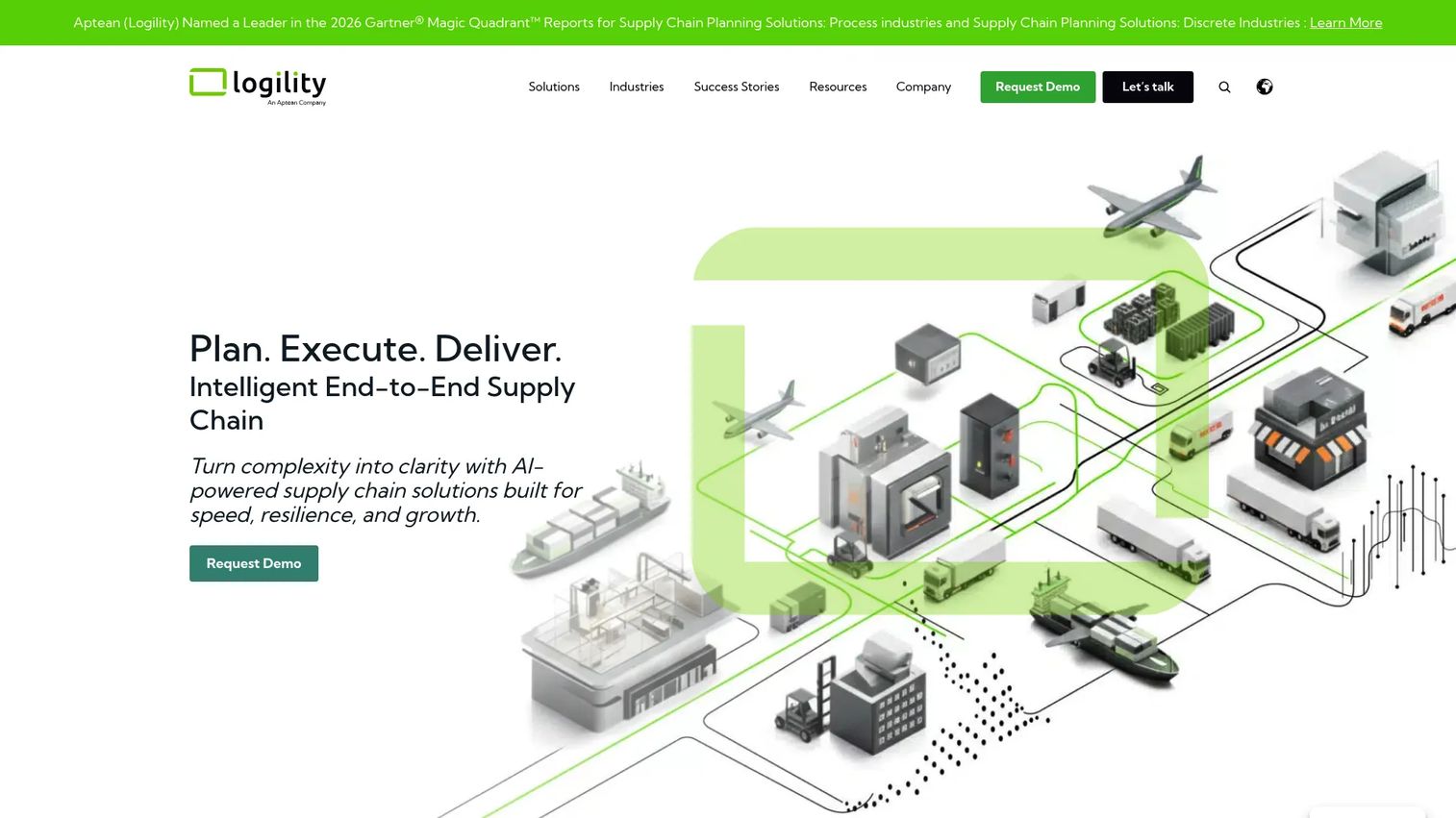
Logility Solutions is AI-powered supply chain planning and execution software built for complex operations. Its Decision Intelligence Platform spans end-to-end supply chain planning, from demand forecasting through inventory and execution, and applies AI and machine learning to forecasting and optimization. For retail and multi-echelon supply chains, that integrated depth is the differentiator.
Logility handles complexity that trips up lighter tools. Its capabilities include Product Lifecycle Management, allocation and deployment, and advanced analytics, so retail and distribution teams can manage assortment, forecast accuracy, and inventory optimization in one platform. Demand sensing and AI forecasting sharpen the forecast where seasonality and promotions make demand hard to predict.
Best for: Enterprises needing AI-driven supply chain planning across demand, inventory, and execution.
Key strengths
- Decision Intelligence Platform: Plan end-to-end across demand, inventory, and execution.
- AI and ML forecasting: Apply machine learning to forecasting and optimization at scale.
- PLM and allocation: Manage product lifecycle, assortment, and deployment in one system.
Why choose Logility Solutions: Logility is a strong fit for retail and complex supply chain scenarios that need integrated planning depth. It rewards teams managing assortment, allocation, and replenishment across many locations. Smaller operations with a straightforward SKU set may find a more focused inventory tool matches their needs faster.
Logility Solutions pricing: Logility does not publish public pricing; access is quote-based through sales. Contact Logility directly for a quote scaled to your supply chain complexity and deployment scope.
Considerations before you buy
The right demand forecasting software depends on your data, your planning motion, and who owns the number. Work through this checklist before committing.
Forecast accuracy and bias reduction
Ask vendors how they measure accuracy and surface bias, not just whether they "use AI." A tool that flags consistent over- or under-forecasting by product, region, or planner is worth more than one that hides bias behind a single headline number. Request accuracy benchmarks from customers with data profiles like yours.
Scenario planning and exception management
Strong platforms let you model what-if scenarios and route exceptions to the right owner. Exception management matters because no team can review every SKU by hand. Confirm the tool surfaces the forecasts that need attention and lets you run scenario planning without exporting to a spreadsheet.
Integration and external data
Check how the tool connects to your ERP, data warehouse, and demand signals. External data integration and demand sensing only help if the pipes actually work with your stack. Verify supported connectors and how much engineering effort setup requires before you assume it fits.
Inventory and replenishment fit
If stockout prevention is the goal, confirm the platform links forecasts to inventory optimization and replenishment logic, not just reporting. Sales and operations planning and multi-echelon inventory support matter for distributed operations. Ask to see the path from forecast to reorder recommendation.
Total cost and time to value
Most enterprise business planning software is quote-based, so model the full cost including implementation, seats, and ongoing maintenance. Weigh that against how quickly the tool produces a usable forecast. A faster path to value often beats a marginally more capable platform that takes two quarters to deploy.
Conclusion
The best demand forecasting software comes down to what your planning motion actually needs. If you need connected, cross-functional planning at enterprise scale, Anaplan and Board lead on scenario depth and multidimensional modeling. If finance owns the forecast, Cube and Workday Adaptive Planning bring spreadsheet-native and FP&A-first planning. If inventory outcomes are the priority, Netstock and Logility Solutions map most directly to inventory optimization and replenishment, with Logility built for retail and multi-echelon complexity. Streamline is the practical pick when speed to value matters more than breadth.
Start with the tool that fits your data environment and your planning motion, not the one with the most features. Run a scoped evaluation against your own historical data, measure forecast accuracy and bias reduction, and confirm the tool connects cleanly to your ERP before you scale. The right supply chain planning platform reduces manual work and gives your team one version of the plan to act on.
FAQs
Demand forecasting software predicts future product demand using historical data, statistical models, and AI, then connects those forecasts to inventory, replenishment, and planning decisions. It replaces manual spreadsheet forecasting with consistent, measurable inputs and reduces bias across the planning process. Most modern tools also support scenario planning and demand sensing.
Demand forecasting focuses on predicting future demand as accurately as possible. Demand planning software is broader: it takes the forecast and turns it into decisions about inventory, replenishment, and supply. In practice, most demand planning and forecasting software tools cover both, so the distinction matters less than whether the platform connects the forecast to the decisions you actually make.
Prioritize forecast accuracy and bias reduction, scenario planning, external data integration, and inventory or replenishment support. AI forecasting helps automate model selection and pattern detection, while exception management keeps planners focused on the forecasts that need attention. The right mix depends on whether your priority is finance planning or inventory outcomes.
For inventory-centric planning, Netstock is strong for ERP-connected SMBs focused on inventory optimization and stockout prevention. Logility Solutions fits enterprises and retail operations with complex, multi-echelon supply chains. Both link forecasts directly to replenishment decisions rather than stopping at reporting.
It can, though many teams keep spreadsheets in the workflow. Tools like Cube add a governed data layer and version control while preserving Excel and Google Sheets, which bridges the gap for finance teams. Dedicated supply chain forecasting software usually moves the forecast off spreadsheets entirely to reduce drift and bias.
AI forecasting often improves accuracy for demand patterns with many variables, seasonality, and external signals like promotions or weather. Statistical forecasting still works well for stable, predictable products. The strongest platforms combine both, selecting the right model per product rather than forcing one method across the catalog.
Evaluate connected planning breadth, scenario planning depth, governance and auditability, integration with your ERP and data warehouse, and total cost including implementation. Enterprise tools like Anaplan, Board, and Workday Adaptive Planning differ most in how they connect finance, supply chain, and operations. Run a scoped pilot against your own data before committing.
Finance teams should prioritize spreadsheet compatibility, consolidation, unlimited scenario planning, and clean integration with their existing business planning software. Cube and Workday Adaptive Planning are common shortlist picks because they lead with FP&A workflows. Confirm the tool connects the financial plan to operational and demand signals so the forecast stays aligned across teams.