You already maintain a sitemap, robots.txt, and an SEO reporting stack. Now AI search visibility brings another request to your backlog.
Choosing an llms txt generator should start with a practical question. Can it produce a useful file that your team can publish and maintain?
The broader pressure is understandable. McKinsey reported that 88% of organizations regularly used AI in at least one business function in 2025. That adoption figure, however, says nothing about whether an llms.txt file will improve your traffic.
Treat this as a contained experiment. Generate llms.txt from accurate source content, review the output, and assign ownership before publishing. Keep acquisition reporting separate from assumptions about AI crawler behavior.
There’s another complication. Some products associated with this category are documentation platforms or analytics services rather than dedicated generators. A credible evaluation needs to distinguish those jobs before adding another AI SEO tool to your budget.
What’s inside
This guide examines 16 products associated with llms.txt workflows, including direct generators and supporting infrastructure. It’s written for digital marketers, SEO operators, and documentation owners.
- Workflow fit: File generation, crawl automation, documentation publishing, and measurement
- Selection criteria: Documented capabilities, output control, publishing ownership, and cost
- File guidance: How llms.txt differs from llms-full.txt, robots.txt, and sitemap.xml
- Buyer safeguards: Inactive websites, unconfirmed generator capabilities, and platform prices that cover broader products
Product findings use research dated November 24, 2026. Several entries need important qualifications, which appear beside their descriptions rather than disappearing behind a recommendation.
TL;DR
- Best documented starting point for generation and audits: llmstxt.studio combines llms.txt creation with a free plan and a 41-check readiness audit.
- Best for lean marketing teams: Altheo includes llms.txt generation alongside broader organic marketing tools.
- Best for developer-controlled extraction: Firecrawl provides crawling and Markdown output for building an automated workflow.
- Best for documentation-led publishing: Mintlify explicitly supports llms.txt. Evaluate other documentation platforms against your publishing requirements.
- Best for measuring AI visibility: LLMrefs tracks citations and rankings. RecoProof focuses on recommendation audits rather than confirmed file generation.
- Important availability warning: The supplied llms.txt Generator domain was parked during research, preventing a supported recommendation.
What is llms txt generator?
An llms.txt generator creates a Markdown file that organizes important website links and explanatory context for AI systems.
How llms.txt works
The conventional location is /llms.txt. Its purpose is to give a model or agent a curated starting point for understanding a website.
A useful file identifies the organization and describes its main content areas. It can point readers toward product information, documentation, pricing pages, and support material.
Think of an llms.txt example as an editorial index. Each link should explain what the destination contains and when it matters.
The companion llms-full.txt provides fuller content rather than primarily directing the reader to other pages. That makes it relevant to workflows requiring deeper context.
Searches for an “llm.txt generator” often refer to the same concept. The filename used in this convention is llms.txt, with an “s.”
A generic “llm text generator” is different. That phrase usually describes software that writes text rather than software that prepares a website index.
Key features to look for
Evaluate capabilities against the job you need completed.
- Website URL or sitemap input
- Curated URL selection
- Editable Markdown output
- Accurate page descriptions
- Section grouping
- Companion full-content generation
- Link and formatting checks
- Publishing instructions
- Regeneration controls
- API or repository integration
These are evaluation criteria, not capabilities shared by every product below. An llms.txt validator also serves a different function from a generator.
How it differs from robots.txt and sitemap.xml
The robots.txt vs llms.txt distinction concerns access instructions versus content context. The sitemap.xml vs llms.txt distinction concerns URL discovery versus an explanatory index.
| File | Primary job | Audience | Format | Use case |
|---|---|---|---|---|
| llms.txt | Organize important links and context | AI systems and agents | Markdown | Curated site index |
| llms-full.txt | Supply fuller content | AI ingestion workflows | Markdown | Deeper reference material |
| robots.txt | Provide crawler access instructions | Crawlers | Plain text | Crawl-path management |
| sitemap.xml | List discoverable URLs | Search engines | XML | URL discovery |
Adoption varies by AI system. Treat AI crawler discoverability as an experiment, not a guaranteed ranking benefit or substitute for improving source pages.
When to use
Create an AI-readable starting point
Start here when your team wants to organize existing public content without rebuilding the website. Pick the pages that explain the business and its most important customer questions.
Keep the experiment proportionate to the expected operational benefit. A short, reviewed file is a sensible initial deliverable.
Define who approves descriptions before anyone generates them. Marketing should own the narrative, while the publishing owner confirms where the file belongs.
Turn a sitemap into a curated file
A sitemap.xml to llms.txt workflow makes sense when your URL inventory already reflects the site accurately. Use it as the source list, then decide which destinations deserve emphasis.
For ecommerce, distinguish evergreen category content from temporary promotions. SaaS teams should review product documentation and pricing destinations carefully.
Avoid treating every indexed URL as equally useful. Remove duplicate destinations and descriptions that repeat navigation labels without explaining the page.
Support documentation and product education
Consider this workflow when implementation details live outside your main marketing site. Documentation may contain the answers that an AI-assisted buyer needs during evaluation.
Coordinate with the team responsible for releases. A generation process should follow content changes rather than depend on someone remembering another maintenance task.
Fix outdated explanations before exporting them. Better formatting cannot correct inaccurate source material.
Llms txt generator tools comparison
This llms txt generator comparison separates direct generation from adjacent jobs. A crawler extracts content, a documentation platform publishes it, and an analytics service measures visibility.
Prices below refer to the named product’s documented offering. They should not be interpreted as fees for a dedicated generator unless that relationship is established.
G2 ratings describe the broader products, not their llms.txt capabilities. “N/A” means the research did not establish a relevant rating or a usable price.
The list retains products with availability problems so you can recognize them during your search. Those entries are status assessments, not endorsements.
| # | Product | Best for | Key differentiator | Pricing | G2 rating |
|---|---|---|---|---|---|
| 1 | llms.txt Generator | Availability assessment | Supplied domain parked during research | N/A | N/A |
| 2 | Firecrawl | Automated content extraction | Crawling and clean Markdown output | Free; Hobby from $16/month annually | 4.7/5 |
| 3 | LLMrefs | AI visibility measurement | Citation and keyword tracking | $79/month; trial available | N/A |
| 4 | Writesonic | Content and visibility operations | Monitoring with content optimization | From $79/month annually | 4.7/5 |
| 5 | llmstxt.studio | Generation and readiness audits | Documented llms.txt creation | Free plan | N/A |
| 6 | FreeToolr | General browser utilities | Free tools without required accounts | Free | N/A |
| 7 | Altheo | Lean organic marketing teams | Generation alongside SEO analysis | Free; Pro $97/month | N/A |
| 8 | RecoProof | Recommendation audits | Buyer-question and citation analysis | Free self-check; monitoring $149/month | N/A |
| 9 | Mintlify | Documentation-led publishing | Agent-ready docs with llms.txt | Free; Pro from $450/month annually | 4.6/5 |
| 10 | GitBook | Collaborative documentation | Visual editing and Git synchronization | Free; Essential from $65/site/month plus users annually | 4.7/5 |
| 11 | ReadMe | API documentation | API references and usage analytics | Free; Pro $250/month annually | 4.5/5 |
| 12 | Docusaurus | Engineering-owned documentation | Open-source framework with plugins | Free framework | N/A |
| 13 | VitePress | Vue-based documentation | Markdown publishing with Vite integration | Free framework | N/A |
| 14 | Apify | Recurring extraction jobs | Scheduled Actors and data workflows | Free; Starter $19/month plus usage | 4.7/5 |
| 15 | Keploy | API testing | Testing platform; generator capability unconfirmed | Free; Pro $19/user/month plus usage | 4.9/5 |
| 16 | PlainSignal | Website measurement | Privacy-focused analytics | From $10/month; trial available | N/A |
Best 16 tools for llms txt generator workflows
1. llms.txt Generator
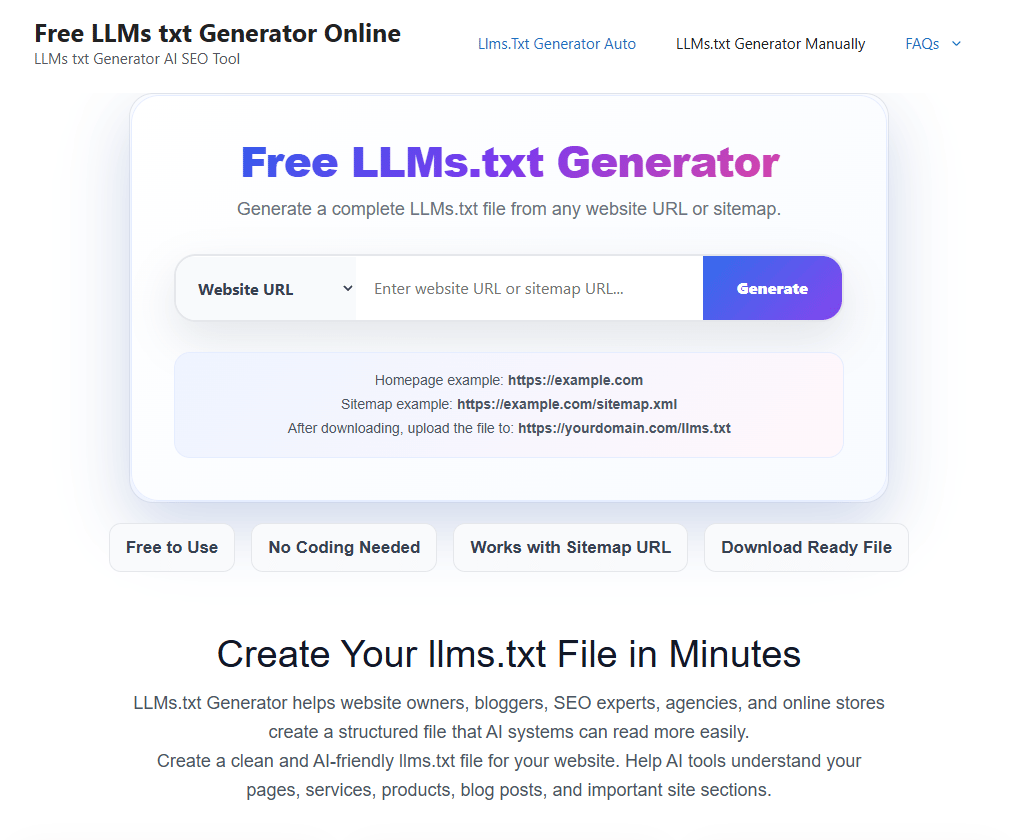
llms.txt Generator needs an availability warning before any feature discussion. Its supplied domain redirected to a GoDaddy parked page during research. An active product offering could not be established at that address.
Best for: Readers checking whether this specific domain remains a usable option.
Key features
No active feature documentation was accessible for the supplied website.
Why choose llms.txt Generator: There isn’t enough evidence to recommend this address for a production workflow. Use an accessible product with documented generation capabilities instead.
A product name that matches the keyword closely can look authoritative in search results. It does not establish who operates the service or whether it remains available.
Avoid substituting a similarly named website without checking its identity. Different domains may belong to unrelated operators, with different data handling and commercial terms.
For your shortlist, require an accessible interface and a downloadable sample before discussing rollout. Test whether the output represents your selected pages accurately.
2. Firecrawl
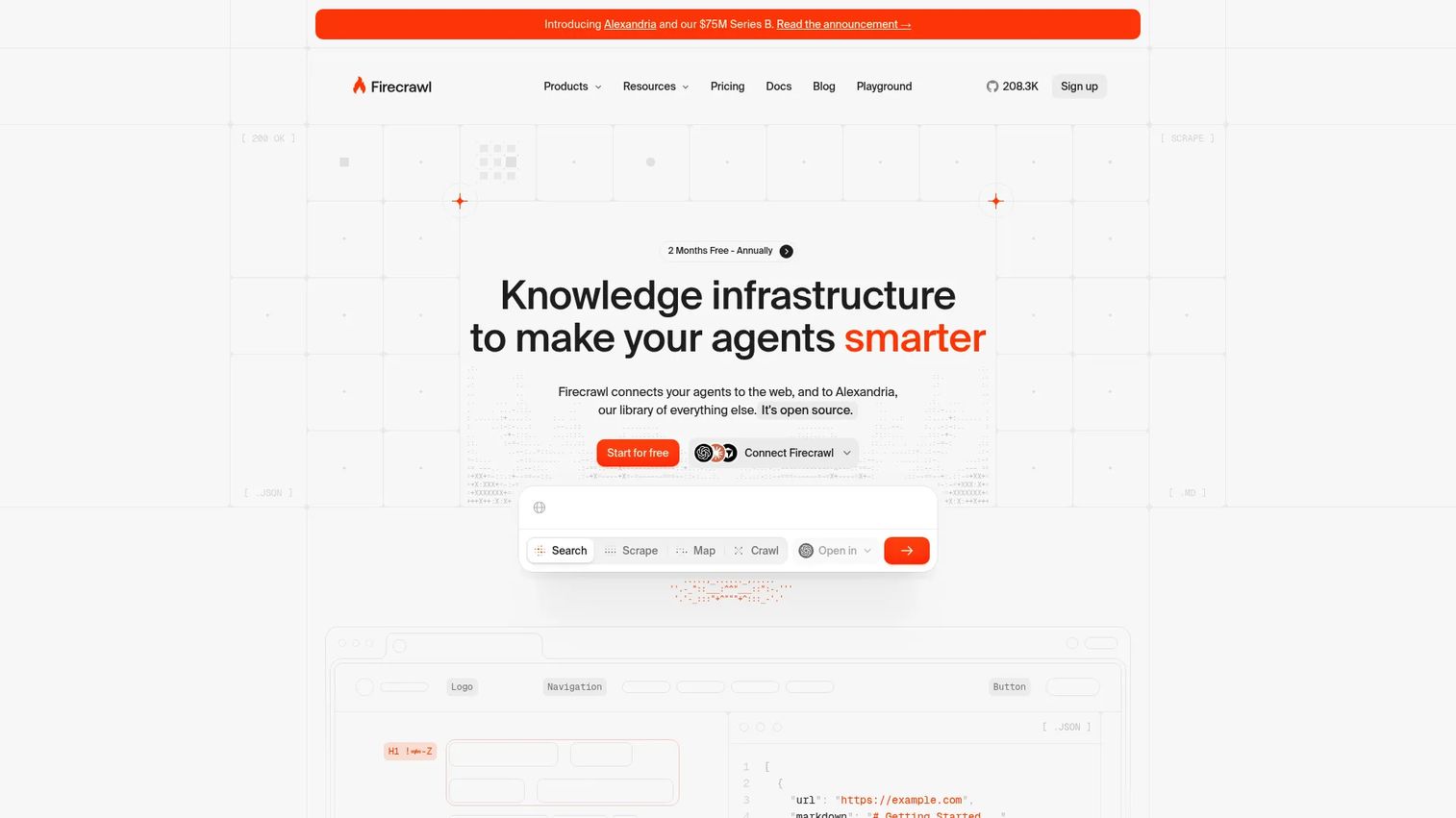
Firecrawl provides web data infrastructure for AI workflows. It extracts page content into Markdown and other formats, with site crawling and mapping capabilities. That makes it useful infrastructure for a custom llms.txt process.
Best for: Technical marketers working with developers on repeatable content extraction.
Key features
- Website crawling and mapping
- Markdown and structured data extraction
- Search with page content
- Document parsing
- Browser interaction
Why choose Firecrawl: Choose it when your team needs control over which pages get extracted and how the output becomes a maintained artifact.
Extraction and generation are separate steps. Your workflow still needs editorial selection, section organization, and publication rules.
Ask engineering to demonstrate the complete path from source URL to approved output. Include a changed page in that evaluation, rather than testing only the first successful crawl.
For llms-full.txt work, Markdown extraction provides useful source material. Decide how the implementation will remove navigation clutter and exclude irrelevant content before combining pages.
The documented capabilities support this infrastructure recommendation. They do not establish a current standalone llms.txt generator endpoint or a specific migration tool.
Firecrawl pricing: Free includes 1,000 monthly credits. Hobby costs $16/month billed annually or $19/month billed monthly.
G2 rating: 4.7/5.
3. LLMrefs
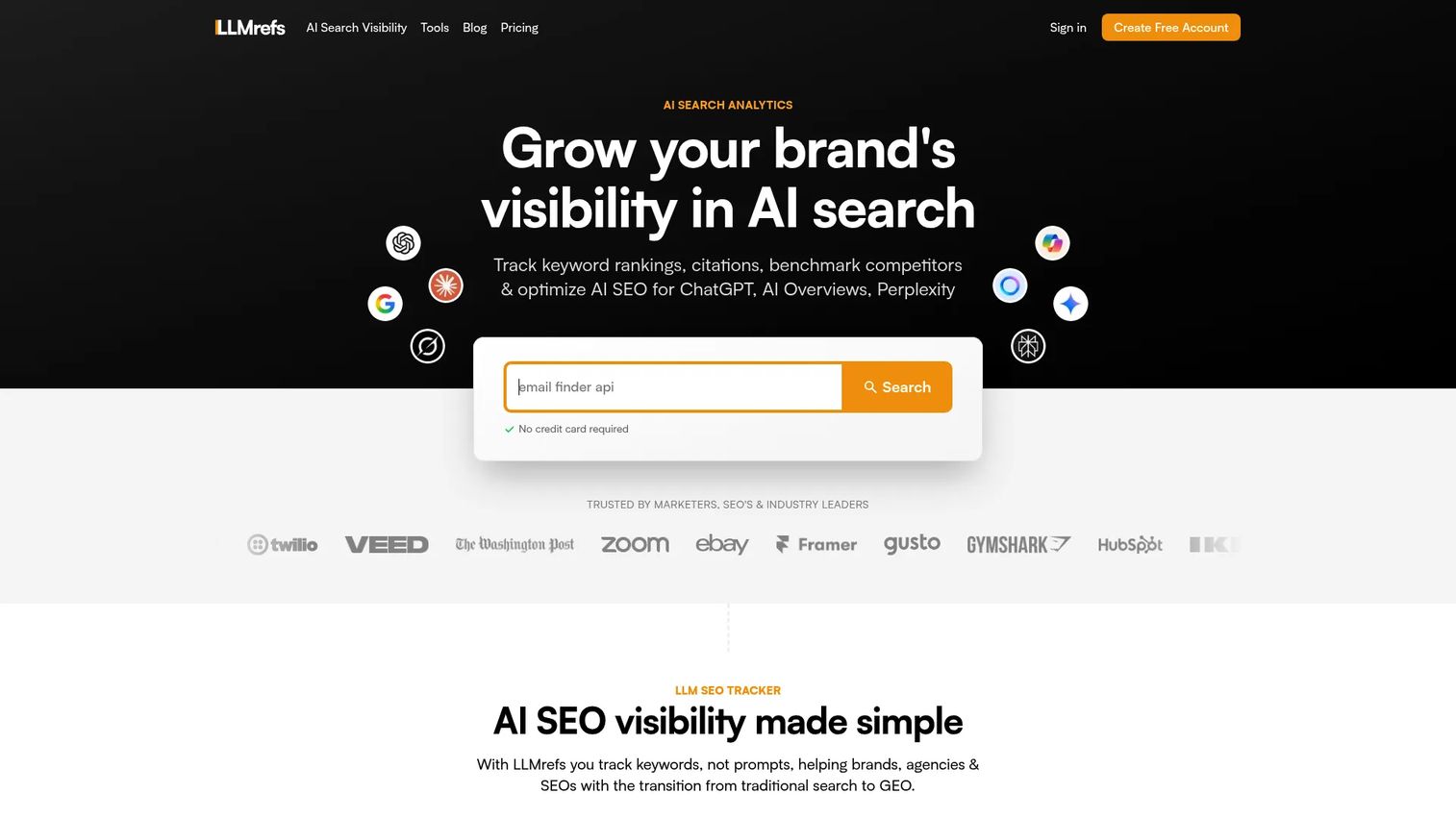
LLMrefs is an AI search analytics platform. Its documented offering covers keyword rankings and cited source URLs across generative search experiences. The current evidence supports measurement, rather than a dedicated generator recommendation.
Best for: Marketing teams that need a baseline for AI search visibility.
Key features
- Keyword ranking tracking
- Citation and source URL reporting
- Competitor share-of-voice analysis
- Country and language targeting
- CSV exports and API access
Why choose LLMrefs: Use it when the unanswered question concerns visibility, rather than file creation. Its reporting can support an ongoing measurement program.
Build a stable set of commercially relevant queries before changing your website. Include questions about your category and the buying problems your product addresses.
Keep those prompts consistent while reviewing results over time. Otherwise, a changed question set can look like performance movement.
The platform also supports unlimited projects and team members. Agencies should evaluate whether that operating model fits their client reporting process.
A citation change does not isolate the effect of publishing llms.txt. Record other content updates and campaign activity alongside the deployment date.
LLMrefs pricing: All in One costs $79/month. A seven-day free trial is available.
4. Writesonic
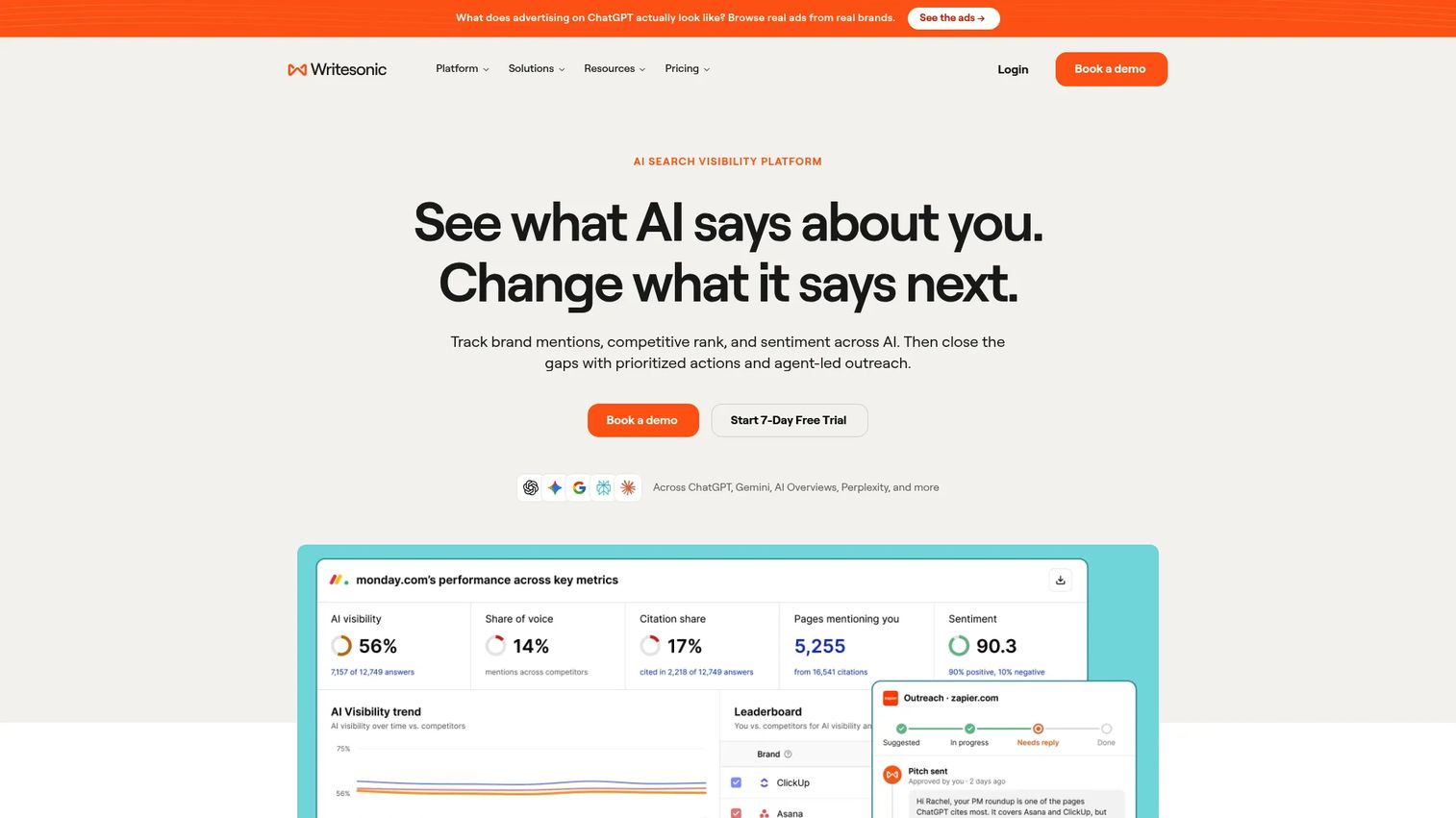
Writesonic combines AI visibility monitoring with content production and optimization. Its documented platform includes site audits and prioritized improvement workflows. The research does not establish the current availability or terms of a separate free llms.txt generator.
Best for: Content marketers evaluating a broader AI search operating workflow.
Key features
- AI visibility monitoring
- Article generation and optimization
- Site audits
- Prioritized Action Center
- Ads monitoring and sentiment analysis
Why choose Writesonic: Consider it when content execution and visibility reporting already justify a platform evaluation. Buying the broader subscription solely to create a Markdown index would need a separate business case.
Start with the work your team currently performs across several tools. Identify which reporting or production tasks you expect to replace.
Then evaluate the output against your editorial standards. A useful audit should lead to changes your team can implement and measure.
Keep generator access separate from subscription assumptions. A free utility, when offered independently, does not establish that the full platform has a free tier.
The current pricing evidence lists paid self-service plans. Avoid using historical free-tool descriptions to estimate platform costs.
Writesonic pricing: Starter costs $79/month billed annually. Basic costs $199/month and Growth costs $399/month on annual billing.
G2 rating: 4.7/5.
5. llmstxt.studio
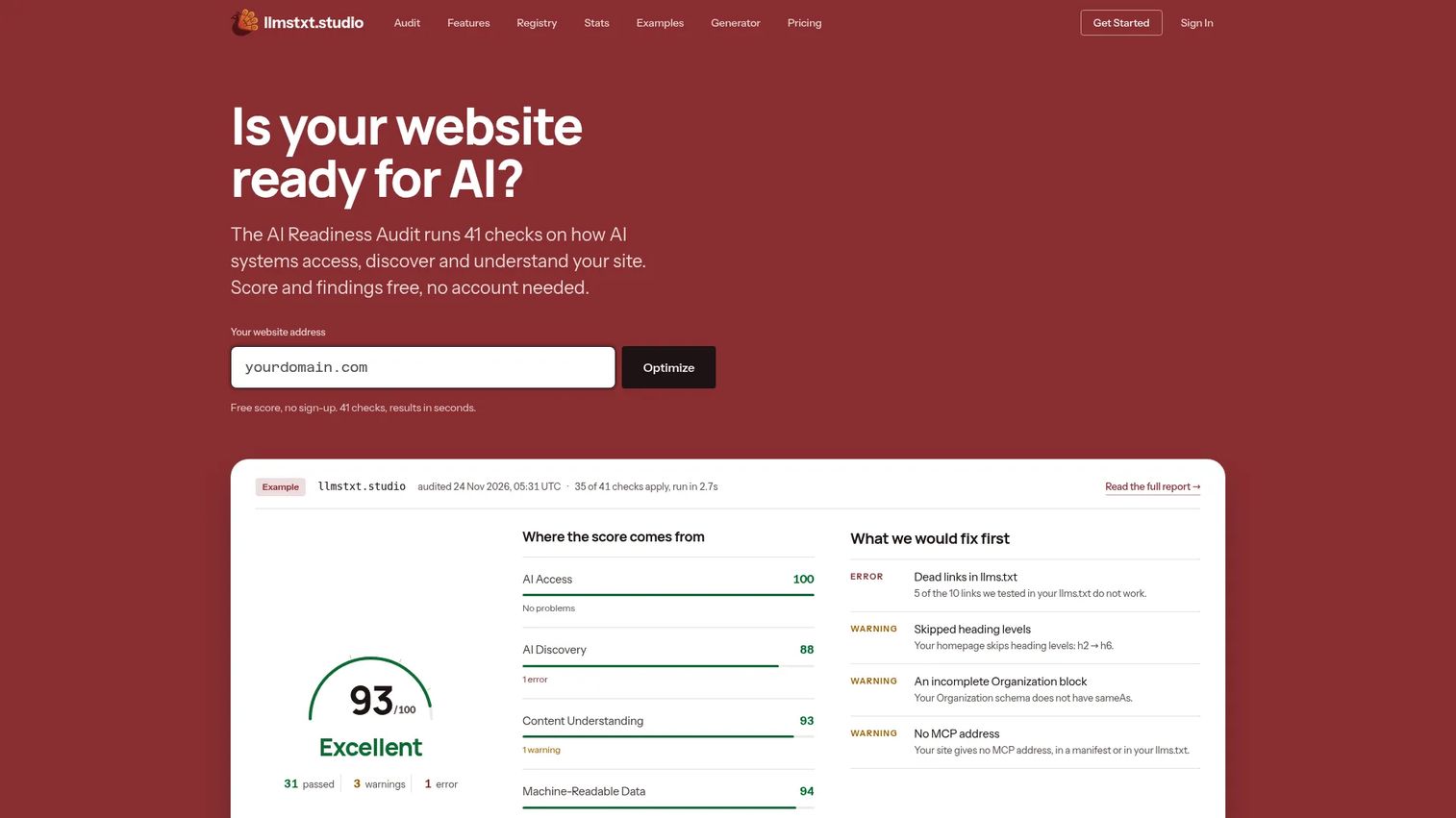
llmstxt.studio directly addresses file creation and website readiness. Its documented capabilities include spec-compliant llms.txt generation and an audit. Additional offerings cover deeper crawling and ongoing visibility monitoring.
Best for: Marketers who want generation and an organized review process.
Key features
- Spec-compliant file generation
- AI readiness audit
- Deep site crawling
- Citation checks
- Monitoring and content recommendations
Why choose llmstxt.studio: It provides the clearest documented combination of generation and evaluation in this shortlist. Start here when your immediate deliverable is a file rather than a new documentation system.
Treat an AI readiness score as a diagnostic aid. Review the underlying findings before translating a score improvement into a business claim.
For your pilot, compare generated descriptions against the pages they represent. Look for vague summaries and missing context that would confuse someone unfamiliar with your company.
Next, assign each finding to an owner. A publishing issue belongs with the web team, while inaccurate positioning needs marketing review.
The platform’s broader monitoring capabilities are a separate buying decision. Establish whether those reports replace existing work before expanding the subscription.
llmstxt.studio pricing: The Free plan includes one site, three AI-written generations, and 50 citation checks. Pro and Premium purchase options are available through checkout or sales.
6. FreeToolr
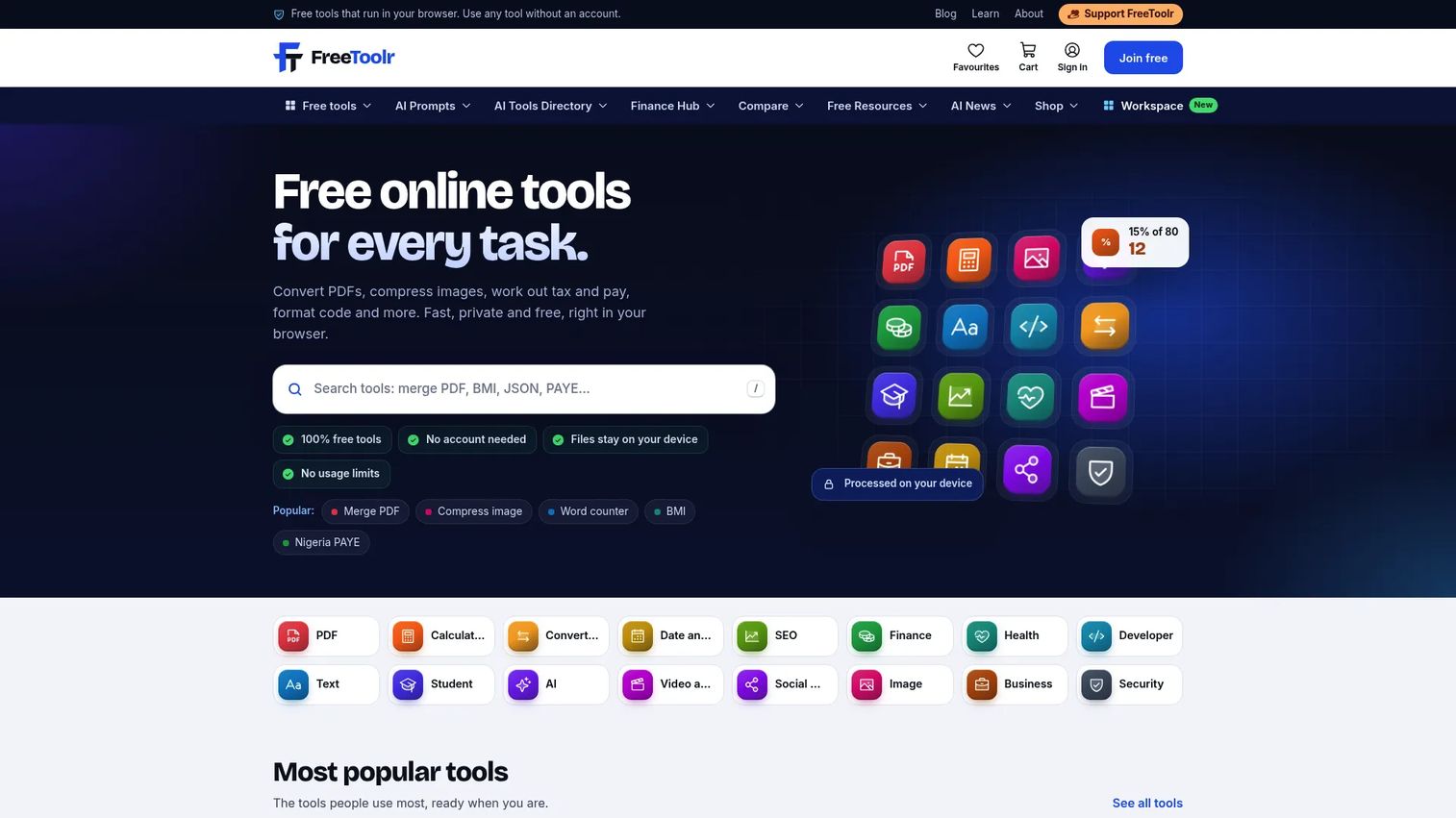
FreeToolr operates a broad collection of browser utilities. The documented offering includes text tools and development resources without required accounts. A dedicated llms.txt generation workflow was not established in the research.
Best for: Marketers looking for general-purpose utilities around content preparation.
Key features
- Browser-based utility collection
- Text and development tools
- No required account
- Saved results and favorites
- Workspace notes and tasks
Why choose FreeToolr: Consider it for supporting utility tasks, rather than assuming it provides a full generator. Evaluate the specific tool page before designing a process around it.
For a small website, manual curation can be a reasonable approach. The important work is choosing useful destinations and writing descriptions that add context.
A browser utility can support preparation, but the final file still needs an owner. Decide where you will store the approved version and how changes reach production.
Avoid giving a general tools directory credit for capabilities that belong to an individual application. Sitemap crawling and link validation each require their own evidence.
This distinction matters when you compare a free utility with a paid crawler. They may address different parts of the workflow rather than offer interchangeable packages.
FreeToolr pricing: All tools are free, with no subscriptions or premium tier.
G2 rating: N/A.
7. Altheo
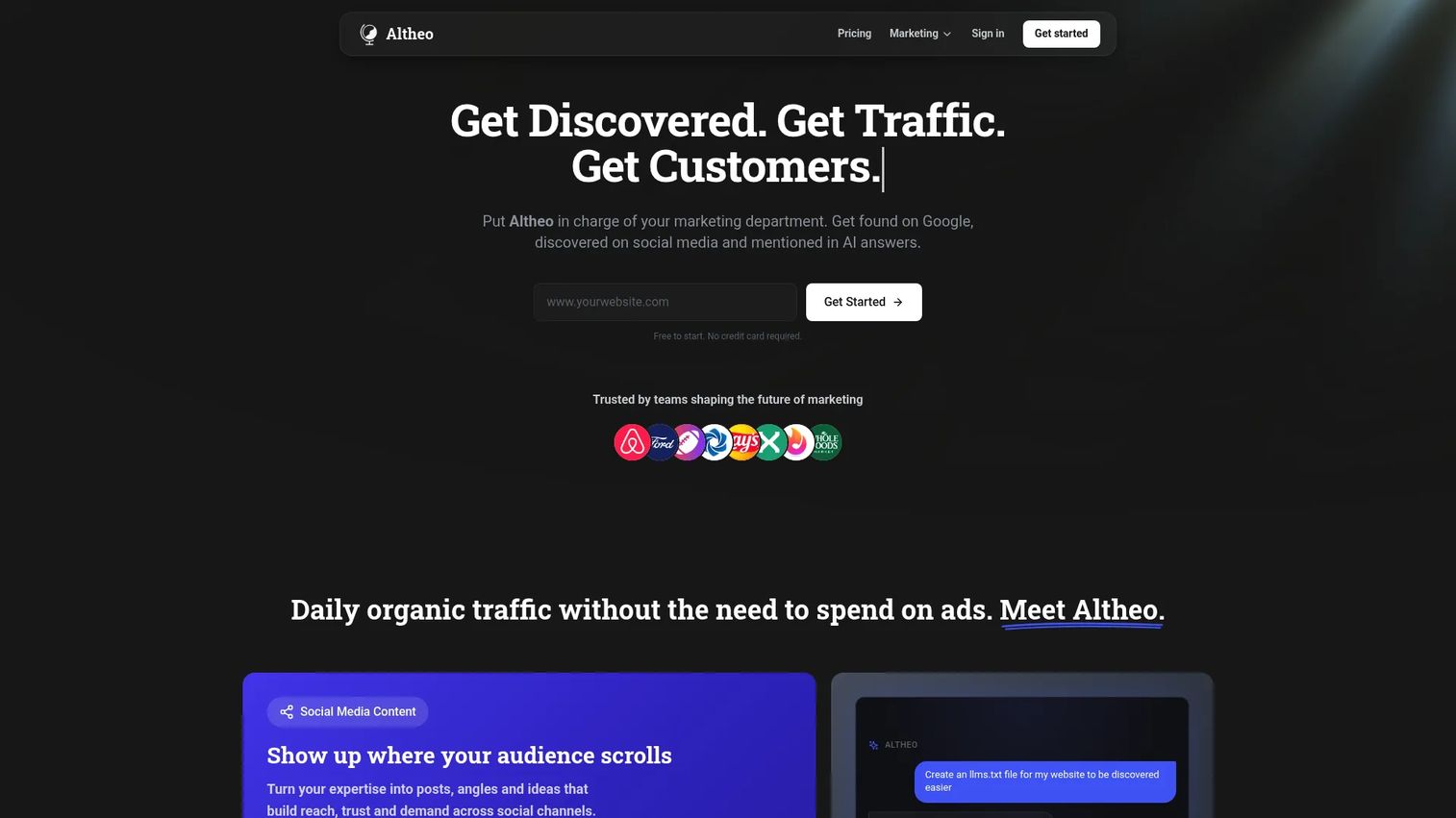
Altheo combines llms.txt generation with organic marketing analysis. Its broader platform covers technical SEO and content planning, with website conversion reviews. That makes it relevant to lean teams managing several marketing responsibilities.
Best for: Founders and small marketing teams seeking generation alongside existing SEO work.
Key features
- llms.txt generation
- Sitemap and technical SEO analysis
- Content cluster planning
- Website conversion reviews
- Social content generation
Why choose Altheo: Its appeal is workflow consolidation. Evaluate it when you also need help prioritizing organic marketing changes.
Begin with a limited project rather than adopting every capability at once. Generate the file, review the source selection, and record the time required to publish it.
Then assess whether the adjacent recommendations are useful enough to replace another recurring task. A broader feature list alone does not establish savings.
The documented free offering includes sitemap analysis and generators. The research does not establish a no-signup workflow, so avoid treating account-free access as a selection criterion.
For teams without dedicated SEO support, the key evaluation question is practical. Can the recommendations become clearly assigned work without creating another interpretation layer?
Altheo pricing: Altheo Free costs $0. Pro costs $97/month.
8. RecoProof
RecoProof provides AI visibility audits for B2B SaaS teams. It tests buyer questions and traces recommendations to cited URLs. Current evidence supports an audit service, not the previously associated generator-and-validator description.
Best for: Teams seeking evidence about how AI systems recommend their products.
Key features
- High-intent buyer-question testing
- Cited source URL analysis
- Competitor benchmarking
- Prioritized action plans
Why choose RecoProof: Use it when leadership needs an explanation of recommendation patterns and concrete next actions. It addresses measurement and diagnosis rather than a documented file-production workflow.
Frame the audit around questions that occur during buying decisions. A branded query alone may reveal less than a comparison or implementation question.
Ask which cited sources influence the answers and who controls those pages. The resulting work may involve your documentation, external coverage, or clearer product descriptions.
Keep that action plan separate from any claim about llms.txt effectiveness. A recommendation audit examines a broader set of signals.
The commercial model also differs from self-service software. Evaluate deliverables and minimum commitments alongside the price, especially if you already pay for monitoring elsewhere.
RecoProof pricing: The AI Visibility Self-Check is free. Managed Monitoring costs $149/month with a three-month minimum.
9. Mintlify
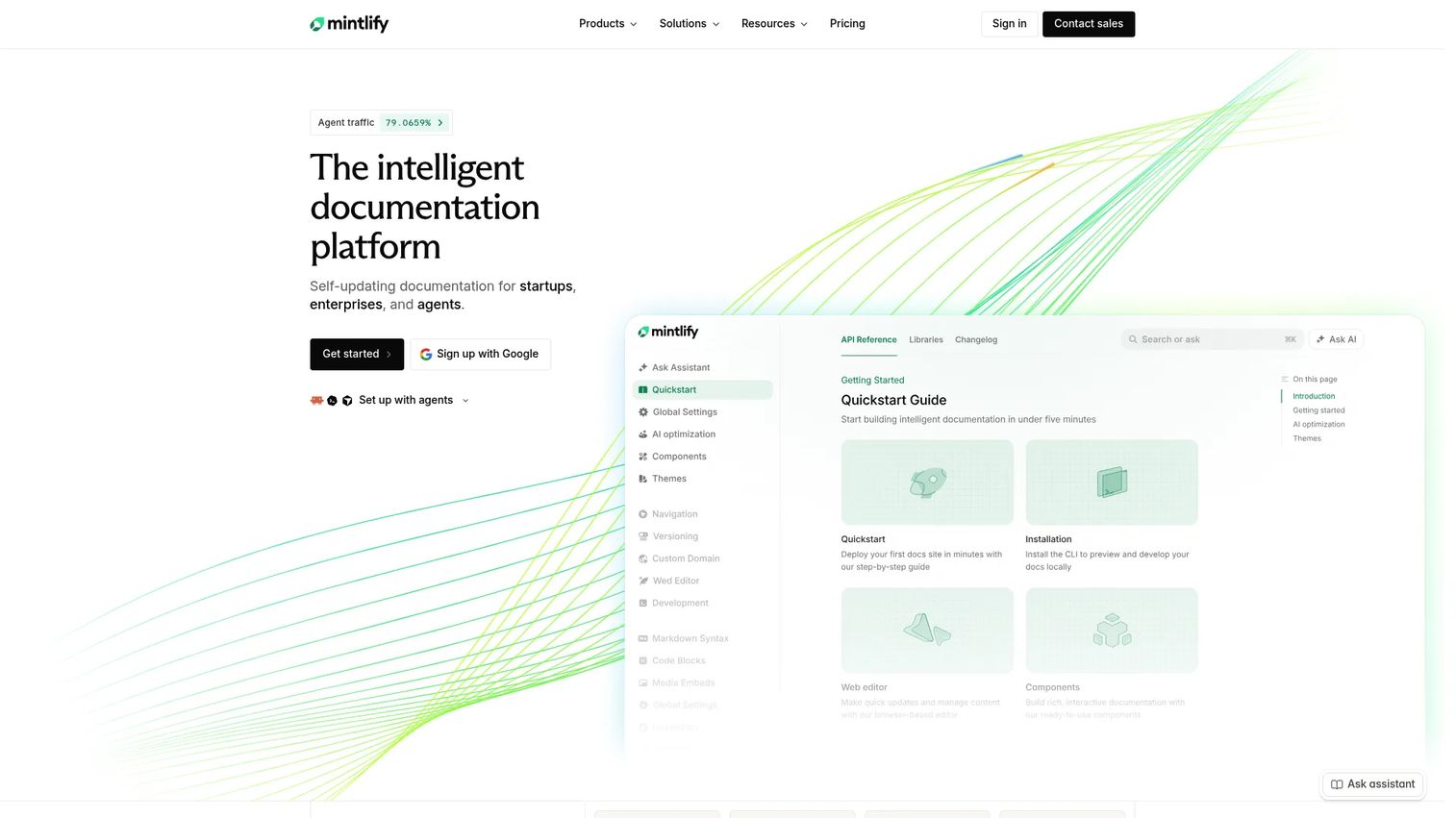
Mintlify is a documentation platform with explicit llms.txt support. Its offering combines publishing tools with agent-ready documentation and MCP capabilities. It belongs on the shortlist when product documentation is the content surface you need to maintain.
Best for: Developer-focused teams managing public product and API documentation.
Key features
- Agent-ready documentation with llms.txt
- Collaborative web editor
- Git synchronization
- Automatic deployments
- API references and playgrounds
Why choose Mintlify: It connects the file requirement to the documentation publishing process. That is a stronger fit than maintaining a disconnected export beside frequently updated docs.
Evaluate the documentation platform as a whole. Migration effort and editorial ownership matter more than whether one additional file can be produced.
Ask the documentation owner to show how a changed page moves through review and deployment. Then inspect the resulting AI-facing content for consistency.
The research confirms llms.txt support but does not establish the exact llms-full.txt behavior. Treat companion-file availability as a specific implementation question.
For marketing, the operational benefit is shared ownership. Product explanations can remain close to the people responsible for maintaining them.
Mintlify pricing: A Free plan is available. Pro costs $450/month billed annually or $540/month billed monthly.
G2 rating: 4.6/5.
10. GitBook
GitBook supports collaborative product and API documentation. It combines a visual editor with Git synchronization and AI assistance. The research establishes those documentation capabilities, but not specific llms.txt or llms-full.txt output behavior.
Best for: Teams already maintaining product knowledge in a collaborative documentation platform.
Key features
- Visual editor with Markdown support
- GitHub and GitLab synchronization
- API documentation and playgrounds
- AI search and assistance
- Version history and reusable content
Why choose GitBook: Evaluate it when documentation ownership and collaboration need improvement. A standalone file requirement is too narrow a reason to migrate an established knowledge base.
Existing customers should begin with their current publishing setup. Ask the administrator which AI-facing outputs are available and how updates propagate.
For a new purchase, test the review process with both marketing and engineering. Each group should be able to correct its own content without creating competing versions.
Account for both site charges and user costs when estimating spend. That pricing structure matters for agencies or teams operating several documentation properties.
Keep capability questions precise. Markdown authoring does not, by itself, establish automatic publication at /llms.txt.
GitBook pricing: Free is available; Essential costs $65/site/month plus $12/user/month on annual billing. Monthly billing costs $79/site/month plus $15/user/month.
G2 rating: 4.7/5.
11. ReadMe
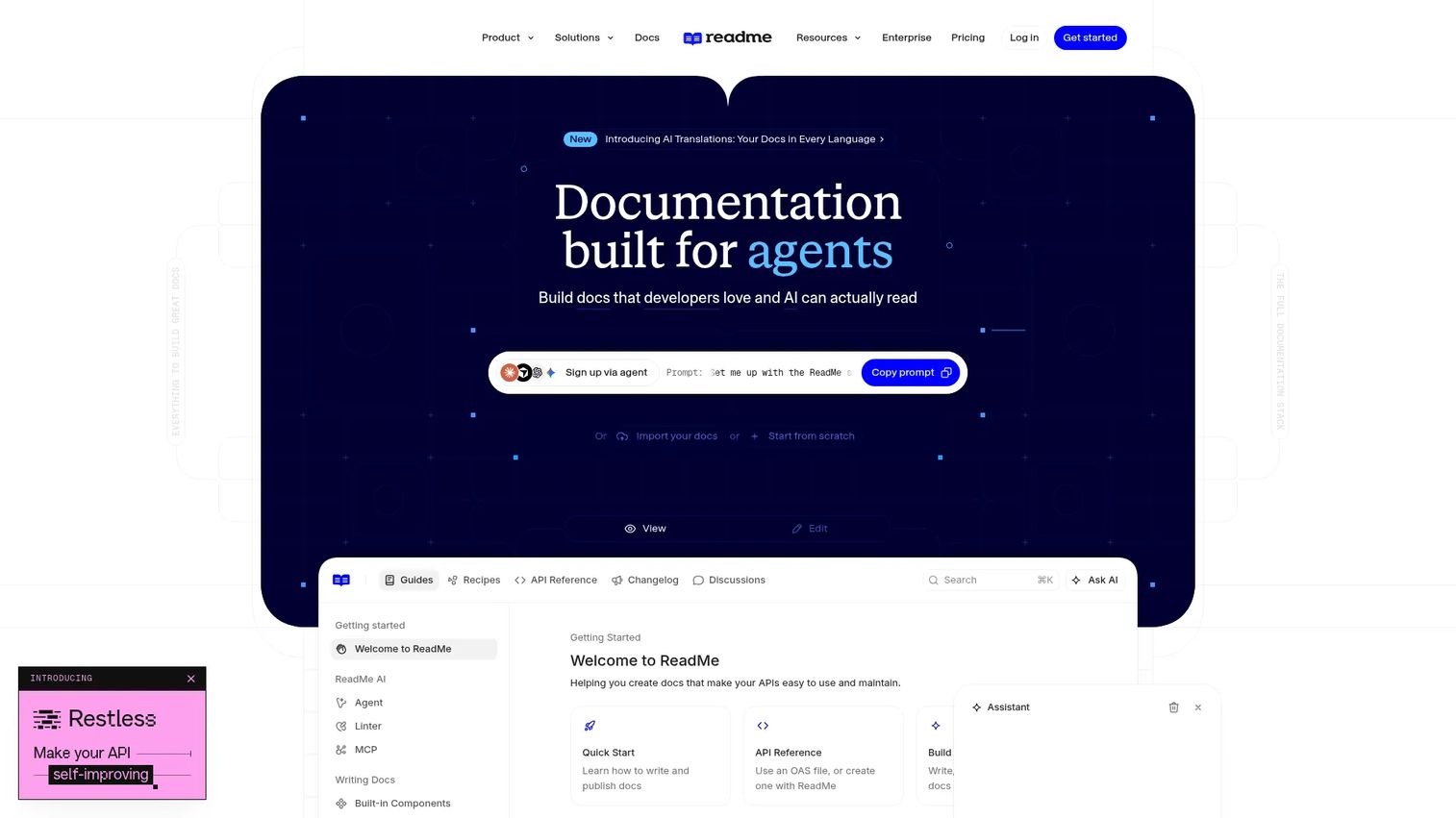
ReadMe focuses on API and developer documentation. Its documented platform includes an interactive API reference and collaborative review workflows. Specific llms.txt and MCP support were not established by the research.
Best for: API businesses whose product education depends on accurate developer documentation.
Key features
- Interactive API reference
- GitHub and GitLab synchronization
- Usage analytics
- Branching and reviews
- AI writing and linting tools
Why choose ReadMe: Consider it when developer documentation is the primary publishing problem. Assess file-generation requirements separately from the platform’s broader API experience.
For developer marketing, accuracy is a practical conversion issue. An explanation must match the implementation a technical evaluator encounters.
Use the buying process to test ownership across the API reference and supporting guides. Review how the team handles changes before release.
Avoid assuming that an AI writing feature includes every AI-readable publishing format. Request a working example of the exact output your implementation requires.
Budget for optional capabilities separately. The research identifies Ask AI as an additional charge, rather than part of the starting subscription.
ReadMe pricing: Starter is free, and Pro costs $250/month billed annually. Ask AI adds $150/month.
G2 rating: 4.5/5.
12. Docusaurus
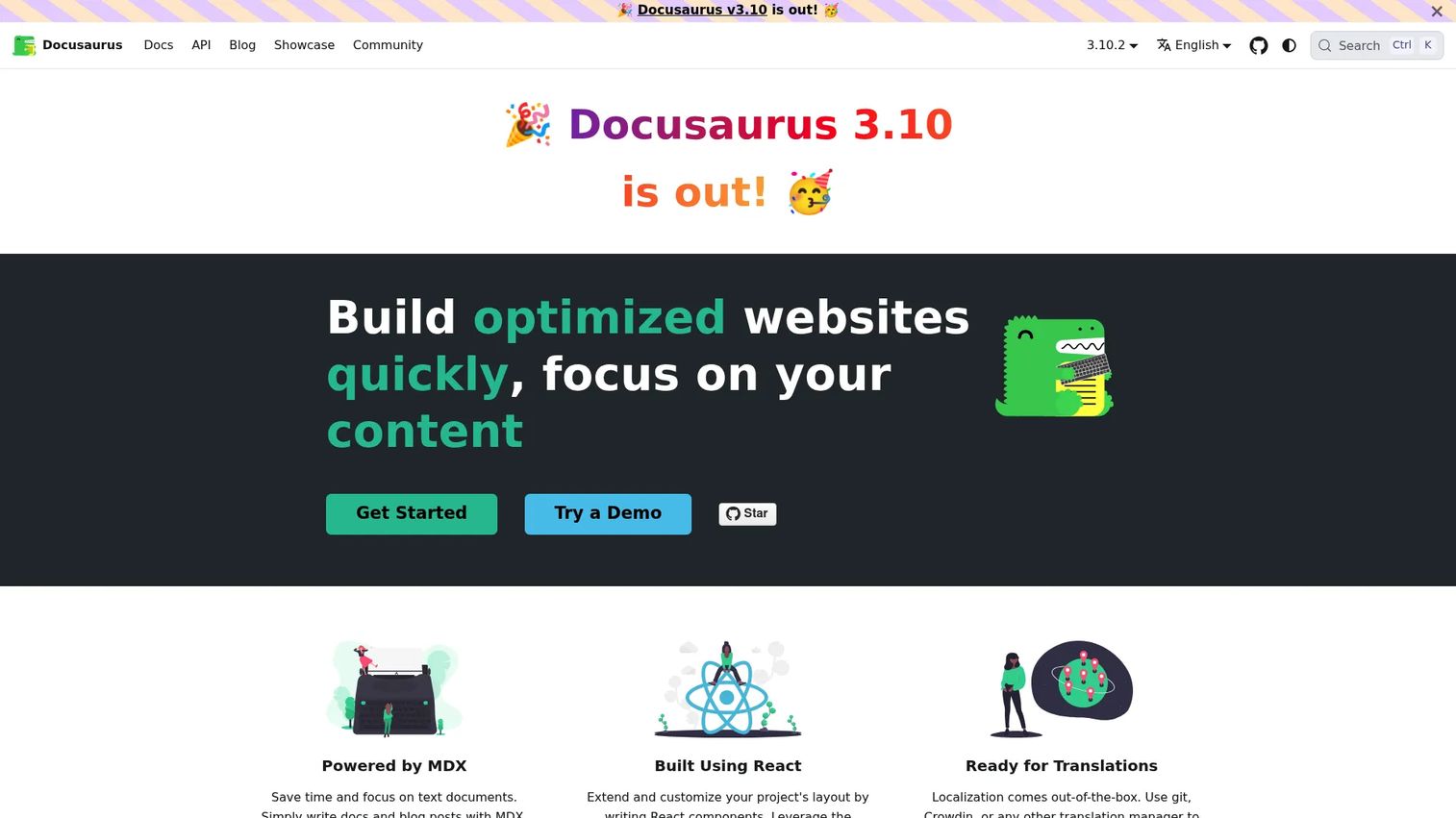
Docusaurus is an open-source static-site generator for documentation. It supports Markdown and MDX, with React customization and a plugin architecture. An llms.txt workflow requires a separately evaluated implementation rather than an assumption about built-in generation.
Best for: Engineering-owned documentation with source-controlled publishing.
Key features
- Markdown and MDX authoring
- Documentation versioning
- Internationalization
- Search integration
- React customization and plugins
Why choose Docusaurus: Keep it central when your team already publishes documentation through the framework. Adding a build step may fit better than introducing a separate hosted service.
The research does not establish a specific community plugin. Ask engineering to assess maintenance activity and compatibility before adopting one.
Your acceptance criteria should include the generated artifact, not simply a successful build. Review which versioned pages enter the output and how obsolete references disappear.
Marketing can own descriptions while engineering owns deployment. Document that division so updates do not stall between teams.
Free software also needs operational capacity. Include implementation and maintenance time in your comparison with hosted products, without treating those costs as vendor subscription fees.
Docusaurus pricing: Free and open source.
13. VitePress
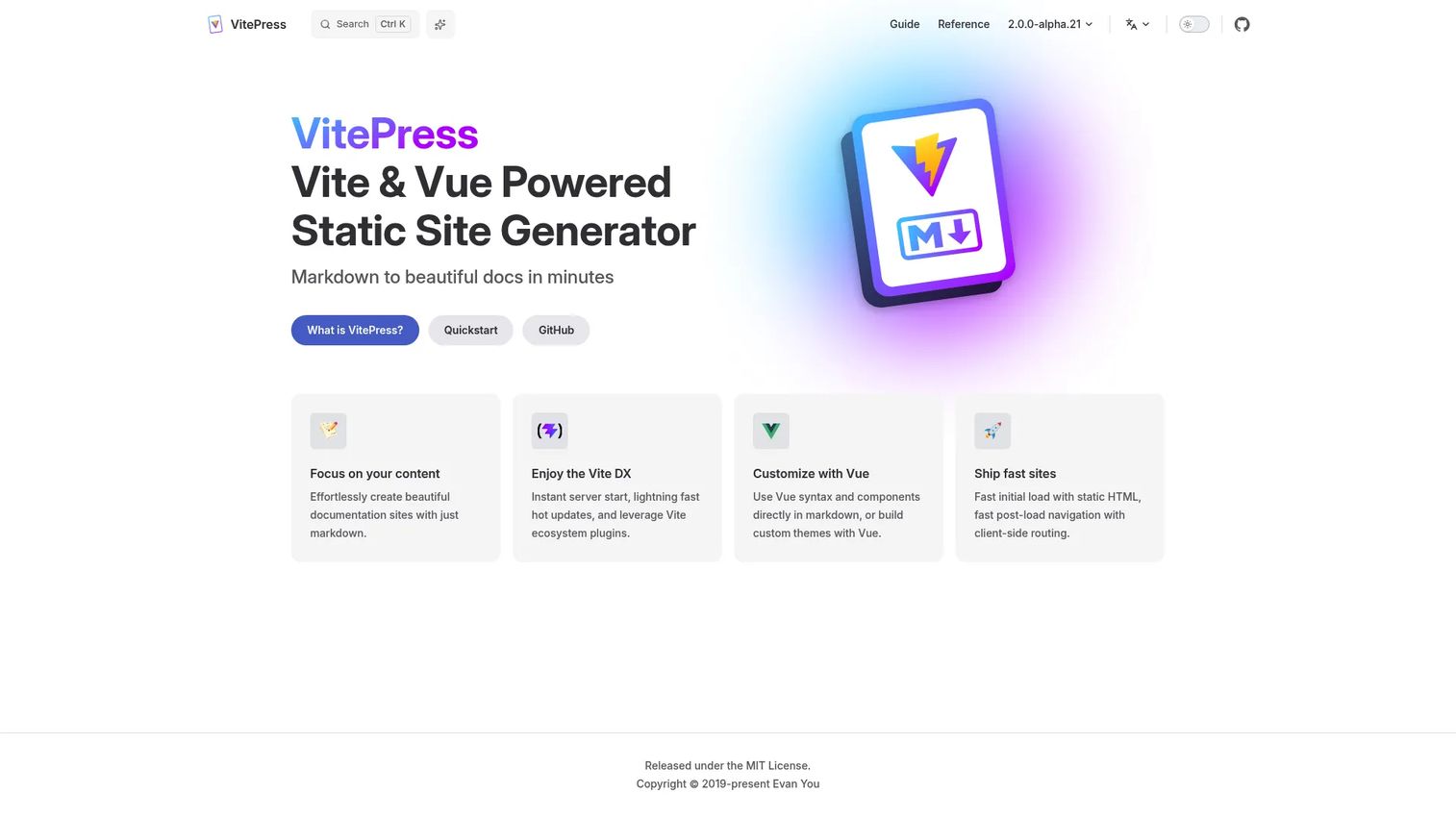
VitePress builds content-focused websites from Markdown using Vite and Vue. Its documented capabilities include static deployment and plugin integration. The available evidence does not identify a specific llms.txt generation plugin.
Best for: Developer-led documentation teams already using Vue or Vite.
Key features
- Markdown-to-static-HTML generation
- Vue components in Markdown
- Custom themes
- Vite plugin integration
- Static deployment support
Why choose VitePress: It fits teams that want file generation to live beside the documentation source. Evaluate an implementation within that workflow rather than adding a disconnected publishing task.
Start by defining which source files belong in the index. Exclude content that should not be part of the public documentation narrative.
For versioned or multilingual content, establish selection rules before automation. Otherwise, the output may contain several destinations that appear to answer the same question.
Ask the developer to show how the file reaches the deployed site. A locally generated artifact is only part of the delivery process.
This is a framework decision with an additional generation requirement. It is not a ready-made browser generator for marketers without repository access.
VitePress pricing: Free and open source under the MIT License.
14. Apify
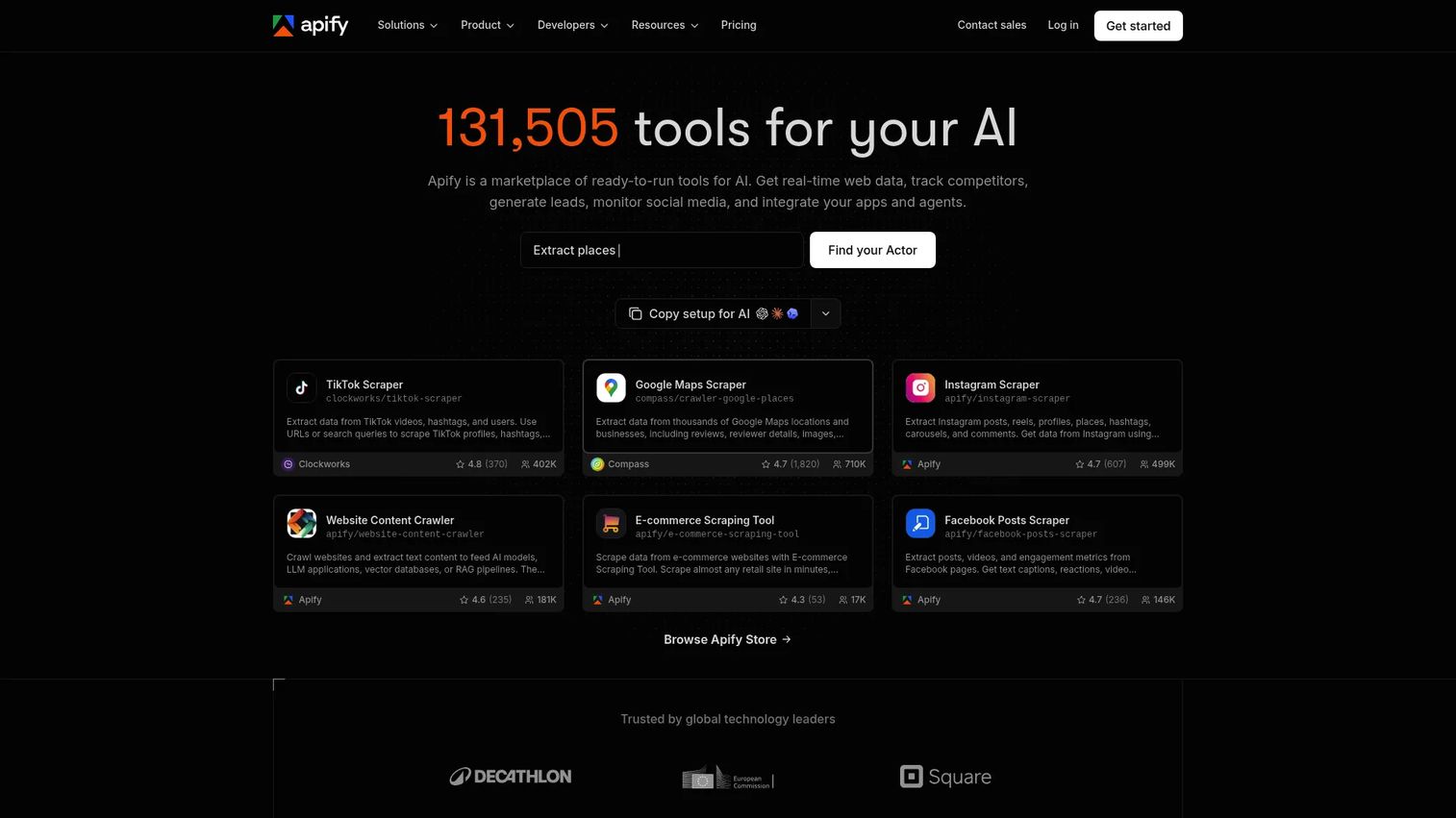
Apify provides a marketplace and cloud platform for scraping and automation. Teams can run ready-made Actors or deploy custom workflows. Its scheduling and data infrastructure are relevant to recurring extraction jobs.
Best for: Teams that need repeatable crawling without building the entire execution infrastructure.
Key features
- Ready-made and custom Actors
- Scheduled execution
- Datasets and request queues
- APIs and webhooks
- Monitoring and integrations
Why choose Apify: Evaluate it when the workflow spans multiple sites or recurring updates. The value comes from running an operational process, rather than producing one file once.
The research does not establish a specific llms.txt Actor. Assess the selected application’s documented output and commercial terms separately from the platform.
A useful pilot should include reruns after content changes. Check whether the result is predictable enough for editorial review.
Define an approval step before publication. Scheduled extraction should not automatically turn every discovered page into an endorsed reference.
Cost estimates need more than the subscription line. Compute and storage can contribute to spending, alongside proxies, data transfer, and individual Actor charges.
Apify pricing: A Free plan is available. Starter costs $19/month plus pay-as-you-go usage.
G2 rating: 4.7/5.
15. Keploy
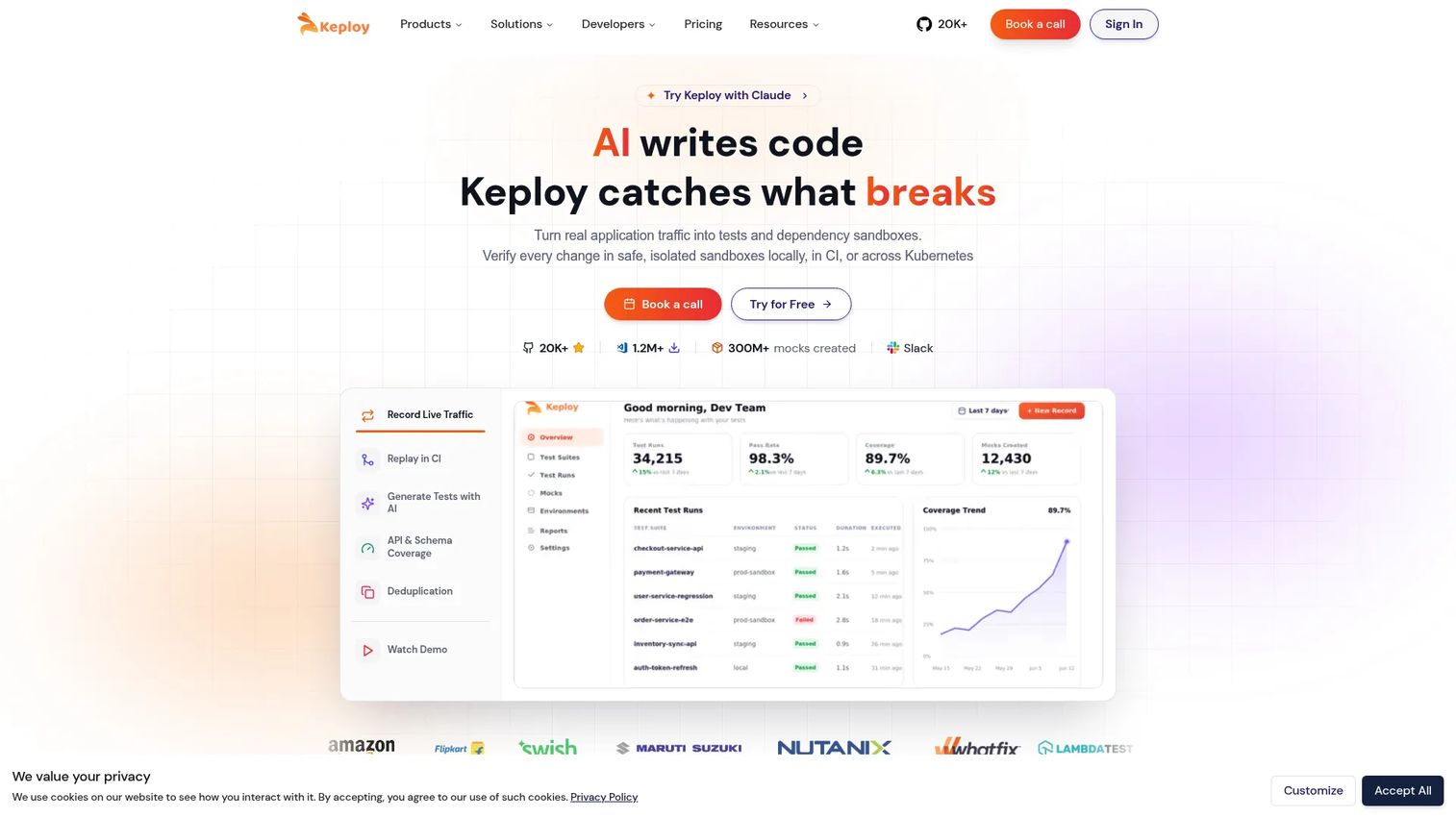
Keploy is an API testing platform. Its documented capabilities concern test generation and dependency mocking. The research did not establish the sitemap-to-llms.txt converter associated with this name.
Best for: Engineering teams evaluating API testing, rather than a supported generator recommendation.
Key features
- API test generation
- OpenAPI and Postman inputs
- Dependency mocking
- Deterministic test replay
- CI/CD integration
Why choose Keploy: Evaluate it for its documented testing job. Do not interpret its subscription or review score as evidence about llms.txt generation.
A company may operate a separate utility outside its main product. That utility needs its own capability and pricing evidence before it belongs in a production plan.
For marketers, the practical distinction is budget ownership. API testing expenditure belongs to a different business case than AI discoverability work.
If you encounter a converter under this brand, assess that exact page. Check the input format and inspect the downloaded output before requesting implementation.
The pricing below applies to the testing platform. It should not be used to estimate the cost of a separate sitemap conversion service.
Keploy pricing: Playground is free. Pro costs $19/user/month plus additional usage.
G2 rating: 4.9/5 for the testing platform, corroborated by G2 category research.
16. PlainSignal
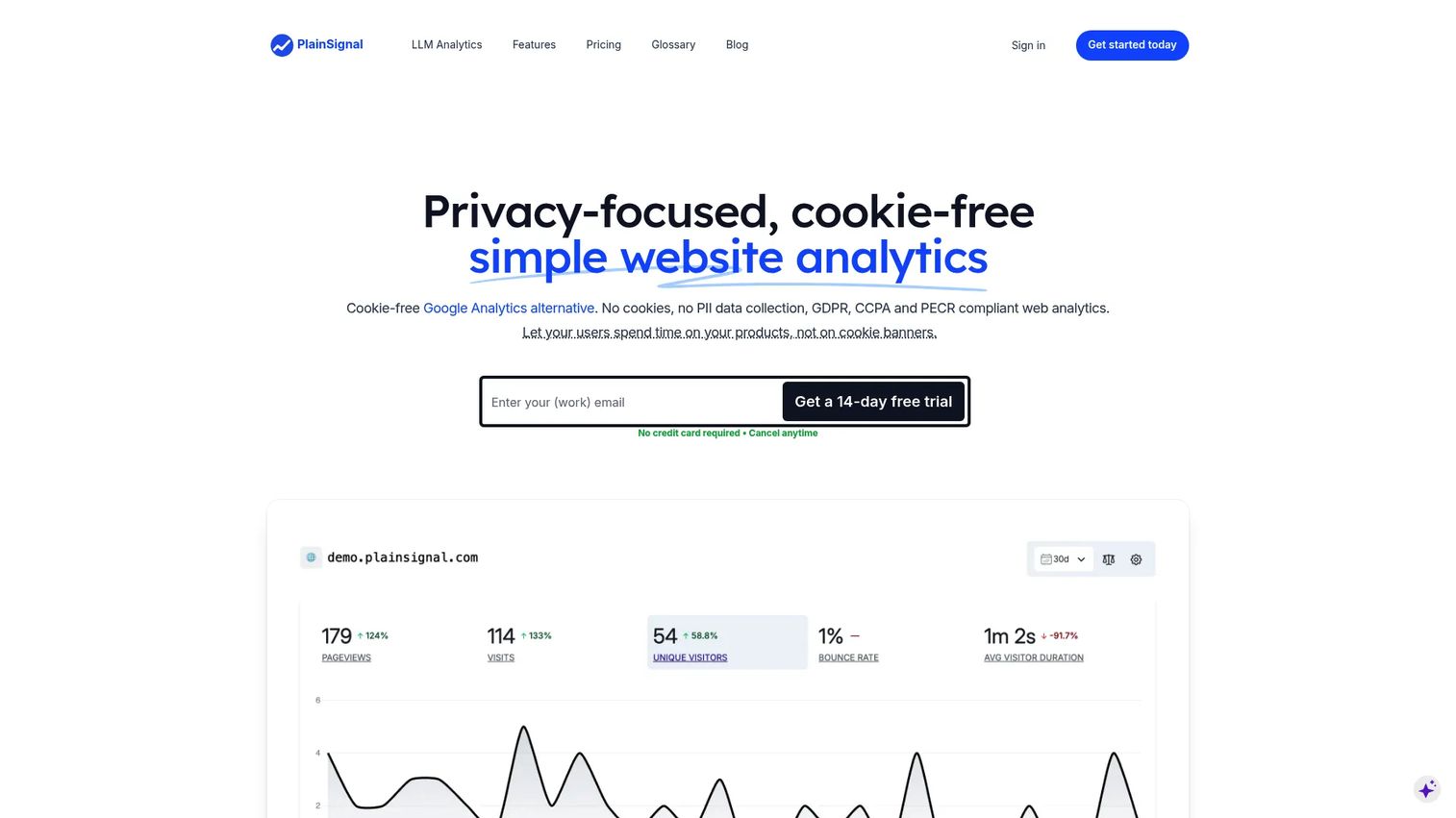
PlainSignal is a privacy-focused website analytics product. It supports UTM reporting and multiple-site measurement. The supplied domain does not establish the Chrome extraction extension described elsewhere under this name.
Best for: Teams evaluating website analytics alongside an AI visibility experiment.
Key features
- UTM tracking
- Web vitals reporting
- CSV data export
- Ecommerce revenue reports
- Multiple website management
Why choose PlainSignal: Consider it for its documented measurement role. It should not be purchased on the assumption that it generates llms.txt.
For your experiment, define the website outcomes you need to observe. Separate visits and conversions from changes in AI answer appearances.
Analytics reporting can support that evaluation, but it does not prove which file an AI system consulted. Keep crawler requests and citation monitoring as distinct evidence sources.
The platform also offers access controls and regional datacenter choices. Those details matter when a broader analytics replacement is already under consideration.
If your current reporting covers the required outcomes, adding another dashboard may create more reconciliation work than value. Establish the replacement case before evaluating a subscription.
PlainSignal pricing: Basic costs $10/month, Team costs $29/month, and Growth costs $99/month. A 14-day free trial is available.
Considerations when choosing an llms txt generator
Input source
Choose sitemap input when your URL inventory is clean and maintained. For repository-owned documentation, evaluate generation within the existing build process.
Require an explicit selection step before a crawl becomes a published index.
Output quality
Read the file as someone unfamiliar with your company. Titles and descriptions should explain each destination without repeating generic marketing copy.
Remove duplicates and check that pricing references match the linked pages.
Validation
Look for broken links and missing descriptions, then inspect Markdown structure and file size. An llms.txt validator should make its checks understandable.
After deployment, open the root URL directly and confirm that the expected content is accessible.
Publishing workflow
Assign a publishing owner before choosing software. Include the approved file and its intended destination, /llms.txt, in the engineering handoff.
For llms.txt for WordPress or Shopify, confirm how your specific hosting setup serves that path. For llms.txt for Next.js or static sites, agree on deployment ownership.
Measurement
Record the publication date and establish a baseline. Track crawler requests and AI referrals separately from citation appearances and branded-answer visibility.
Document concurrent site changes. A rise in traffic after publication does not establish that the file caused it.
Conclusion
Choose the workflow before choosing the subscription.
For a first experiment, start with a documented generator that offers a free entry point. llmstxt.studio and Altheo provide supported generation capabilities in this research.
Firecrawl and Apify fit teams building repeatable extraction processes. Docusaurus and VitePress belong in the discussion when engineering already owns documentation publishing.
Mintlify explicitly supports llms.txt within its documentation offering. Evaluate GitBook and ReadMe for their broader publishing value, with file-specific requirements assessed separately.
LLMrefs and RecoProof address visibility measurement. Writesonic combines monitoring with content operations, while PlainSignal serves website analytics.
Be cautious about product names that appear relevant but lack accessible supporting documentation. Neither a parked domain nor an unrelated platform rating provides enough evidence for a generator recommendation.
Your next step is a small, reviewable deliverable. Select important pages, approve the descriptions, and publish through an owner who can maintain the result. Measure AI search visibility afterward without promising an outcome the file alone cannot guarantee.
FAQs
An llms txt generator creates a Markdown index of website content for AI systems. Depending on the implementation, inputs can include a website URL, sitemap, selected links, or documentation source files.
If you’re researching how to make llms.txt, start with content selection and useful descriptions. Searches for “llm.txt” often refer to this convention, but the intended filename is llms.txt.
llms.txt is an emerging convention rather than a universally adopted official web standard. AI system usage varies, and publishing the file does not establish that a particular service will consume it.
Treat it as a supplementary content-access experiment. Keep your existing technical SEO work and documentation maintenance in place.
The evidence supporting this comparison does not establish Google Search’s use of llms.txt. Do not make the file a prerequisite for AI Overviews visibility or present it as a Google ranking factor.
Continue prioritizing crawlable pages and accurate source content. Any claim about Google-specific adoption needs current guidance from Google rather than a generator vendor’s marketing.
robots.txt provides crawler access instructions, while llms.txt supplies an organized content reference. They can coexist because they address different jobs.
Adding an llms.txt file does not replace decisions about which paths crawlers should access. Review the linked destinations against your existing crawl rules before publishing.
sitemap.xml lists URLs for discovery; llms.txt adds Markdown context and editorial prioritization. A sitemap can supply the starting inventory for a generator.
When evaluating an llms txt generator, inspect how it turns that inventory into useful descriptions. Copying every URL into another file does not provide the same value as a curated index.
llms-full.txt is a companion file containing fuller content for AI workflows that need more context. An llms.txt index primarily helps identify useful destinations, while the fuller file supplies more material directly.
Because it can be larger, review duplication and irrelevant content before publication. Availability and generation behavior vary by tool, so inspect a working output rather than assuming support.
Update it when important source content changes, including product releases, documentation revisions, pricing updates, or retired pages. Active sites should consider regeneration tied to their publishing process.
Assign an owner and validate the deployed output after each revision. If you host llms.txt separately from your content system, include it explicitly in the release checklist.
It may provide useful context to an AI system that consumes it, but ChatGPT citations and Perplexity citations are not guaranteed. The quality and accessibility of the underlying content remain essential.
Track citation presence alongside crawler activity and referral traffic over time. Record other changes during the experiment so you avoid attributing every movement to the file.