Calling a model API is easy. Shipping something that reliably routes prompts, retrieves the right context, manages state across steps, calls external tools, and recovers gracefully when something breaks is a different problem entirely.
According to McKinsey's 2025 AI survey, 88% of organizations regularly use AI in at least one business function, and 62% are already experimenting with AI agents. The gap between "we ran a demo" and "we have a working system in production" is exactly where orchestration software lives. Without a coordination layer, you end up patching together custom glue code that nobody else can maintain, evaluation is guesswork, and debugging a failed chain at 2 a.m. becomes your team's new hobby.
This guide cuts through the noise. It compares seven LLM orchestration frameworks and platforms on workflow fit, production readiness, and practical tradeoffs, so you can pick the right one for what you're actually building, not just what's most popular on GitHub.
What's inside
This guide is for developers, solutions engineers, and AI platform evaluators comparing LLM orchestration tools for production use. Each tool was selected based on:
- Workflow fit: Does it handle routing, chaining, retrieval, state, and agent coordination?
- Production readiness: Observability, evaluation, deployment, and governance support
- Ecosystem depth: Native integrations, model support, and community or enterprise backing
- Transparency: Open-source availability, pricing clarity, and licensing terms
TL;DR
- Best for general-purpose orchestration: LangChain, the broadest framework with the deepest agent and tool ecosystem
- Best for data-grounded workflows: LlamaIndex, purpose-built for document parsing, indexing, and RAG pipelines
- Best for Microsoft-aligned enterprise teams: Microsoft Semantic Kernel, open-source with native C#, Python, and Java support
- Best for production observability and routing: Orchestra, focused on trace-based evaluation and model cost reduction
- Best for search and retrieval-heavy apps: Haystack, pipeline-first orchestration built for RAG and document QA
- Best for prompt optimization: DSPy, replaces hand-tuned prompt templates with structured signatures and automated optimizers
- Best for multi-agent experiments: AutoGen, conversational multi-agent coordination with low-code prototyping via AutoGen Studio
What is LLM orchestration software
LLM orchestration software is a framework or platform that coordinates language model calls, tools, retrieval systems, memory, routing logic, and agent workflows into a coherent, repeatable application.
A raw API call returns a completion. An orchestrated workflow decides which model to call, what context to retrieve first, which tool to invoke based on the output, how to handle a failed step, and what state to persist for the next turn. The difference matters most in production, where reliability and observability are non-negotiable.
Core capabilities you should expect from any LLM orchestration tool:
- Routing and chaining: Directing inputs through multi-step pipelines or conditional paths based on output or intent
- Tool calling: Connecting the model to APIs, databases, calculators, search indexes, or custom functions
- Retrieval-augmented generation (RAG): Pulling relevant documents or records before generation to ground the response in real data
- State management: Persisting conversation history, intermediate results, or agent context across turns
- Agent coordination: Orchestrating multiple agents with different roles, tools, or specializations
- Tracing and evaluation: Logging steps, scoring outputs, and iterating on pipeline quality systematically
- Multi-agent orchestration: Running agent-to-agent communication patterns for collaborative or hierarchical task completion
How LLM orchestration differs from a model API:
A model API gives you inference. Orchestration software gives you the control plane above inference: The routing, the memory, the retrieval, the tool dispatch, and the feedback loops that make a model useful in a real workflow. If your application does more than send a single prompt and display the response, you need an orchestration layer.
For teams evaluating these tools in a presales or technical validation context, the question is usually whether the orchestration layer can handle your data sources, your latency constraints, and your security requirements without requiring a full engineering sprint to prove fit.
When to use LLM orchestration software
Build a production AI feature with multiple steps
A single model call works for simple completions. The moment your feature involves classifying an input, retrieving relevant records, generating a response, and routing the result to a downstream action, you need something to coordinate those steps. LLM workflow orchestration handles the sequencing, error handling, and state between each step so you don't have to wire it manually in application code.
Ground answers in external knowledge
If your model needs to answer questions about your product documentation, internal records, or a knowledge base, retrieval-augmented generation orchestration is what connects the model to those sources. The orchestration layer manages the retrieval query, the ranking, and the prompt construction so the model works with current, specific information rather than relying on training data alone.
Coordinate multiple agents or tools
Multi-agent orchestration becomes the right choice when a single model can't handle the full scope of a task. Breaking work across specialist agents, each with its own tools and instructions, then coordinating their outputs requires a framework that can manage agent-to-agent communication, state passing, and failure recovery. This pattern is increasingly common in AI-assisted workflows that span discovery, drafting, validation, and action.
LLM orchestration software comparison
The table below summarizes the seven tools covered in this guide. Pricing reflects figures from each vendor's official pricing page. G2 ratings are from each tool's current G2 listing. Tools without a G2 rating have insufficient review data at the time of publication.
| # | Product | Best for | Key differentiator | Pricing | G2 rating |
|---|---|---|---|---|---|
| 1 | LangChain | General-purpose agent and workflow orchestration | Broadest ecosystem with LangGraph stateful runtime | Free (Developer); $39/seat/mo (Plus) | 4.5/5 |
| 2 | LlamaIndex | RAG pipelines and document-heavy workflows | Structured extraction and retrieval for 50+ file types | Free; $50/mo (Starter) | 4.3/5 |
| 3 | Microsoft Semantic Kernel | Enterprise teams in the Microsoft stack | Open-source SDK for C#, Python, and Java with plugin support | Free (open-source) | 4.0/5 |
| 4 | Orchestra | Production observability and model routing | Trace-based evaluation with specialist model training | Contact for pricing | N/A |
| 5 | Haystack | Search and retrieval-heavy applications | Modular pipeline components with enterprise governance | Free (Studio); Custom (Enterprise) | 4.4/5 |
| 6 | DSPy | Prompt optimization and programmatic control | Structured signatures replace hand-written prompt templates | Free (MIT license) | N/A |
| 7 | AutoGen | Multi-agent conversation and experimentation | Event-driven multi-agent framework with AutoGen Studio | Free (MIT license) | N/A |
Best 7 LLM orchestration software tools for 2026
1. LangChain
LangChain is an open-source framework for building, deploying, evaluating, and governing AI agents. The core framework handles prompt routing, tool calling, memory, and chaining, while LangGraph extends it into a stateful orchestration runtime that supports persistence, checkpointing, streaming, and human-in-the-loop workflows. LangSmith, the commercial platform layer, adds observability, tracing, evaluation, and team governance on top of everything the open-source framework handles.
Best for: Developers and teams building production AI agents who need a broad framework with an active ecosystem and commercial observability tooling.
Key features
- Pre-built agent architectures with model and tool integrations
- LangGraph stateful runtime: Persistence, checkpointing, and streaming
- Middleware for guardrails, dynamic context injection, and human review
- LangSmith tracing and evaluation for production monitoring
Why choose LangChain: If your team is building something that spans multiple steps, tools, and agent patterns, LangChain's ecosystem means you're less likely to hit a capability wall early. The tradeoff is that the abstraction layer adds complexity for simpler use cases.
LangChain pricing: The LangSmith Developer plan starts free for one seat. The Plus plan runs $39 per seat per month with unlimited seats. Enterprise pricing uses custom terms.
G2 rating: 4.5/5
2. LlamaIndex
LlamaIndex is an applied AI platform built around document parsing, structured extraction, indexing, and retrieval for enterprise data. Where LangChain treats retrieval as one capability among many, LlamaIndex treats it as the primary job. The platform supports agentic workflows that operate over parsed documents, with native support for multi-step reasoning over enterprise knowledge bases and RAG pipelines.
Best for: Teams building production AI applications where the workflow starts with structured or unstructured documents, enterprise records, or knowledge bases.
Key features
- Document parsing for 50+ file types including complex layouts and multi-page tables
- LLM-powered structured extraction with schema-based output
- Document splitting, classification, indexing, and retrieval for RAG
- Local open-source parsing with LiteParse
Why choose LlamaIndex: When your application's value proposition is grounded in real documents, LlamaIndex's retrieval depth and parsing fidelity are hard to match. Teams that need routing and chaining across many agent patterns may find LangChain a better fit for the orchestration side of their stack.
LlamaIndex pricing: The Free plan includes 10,000 parsing credits per month at no cost. The Starter plan adds 40,000 credits for $50 per month. The Pro plan covers 400,000 credits for $500 per month. Enterprise pricing is custom.
G2 rating: 4.3/5
3. Microsoft Semantic Kernel
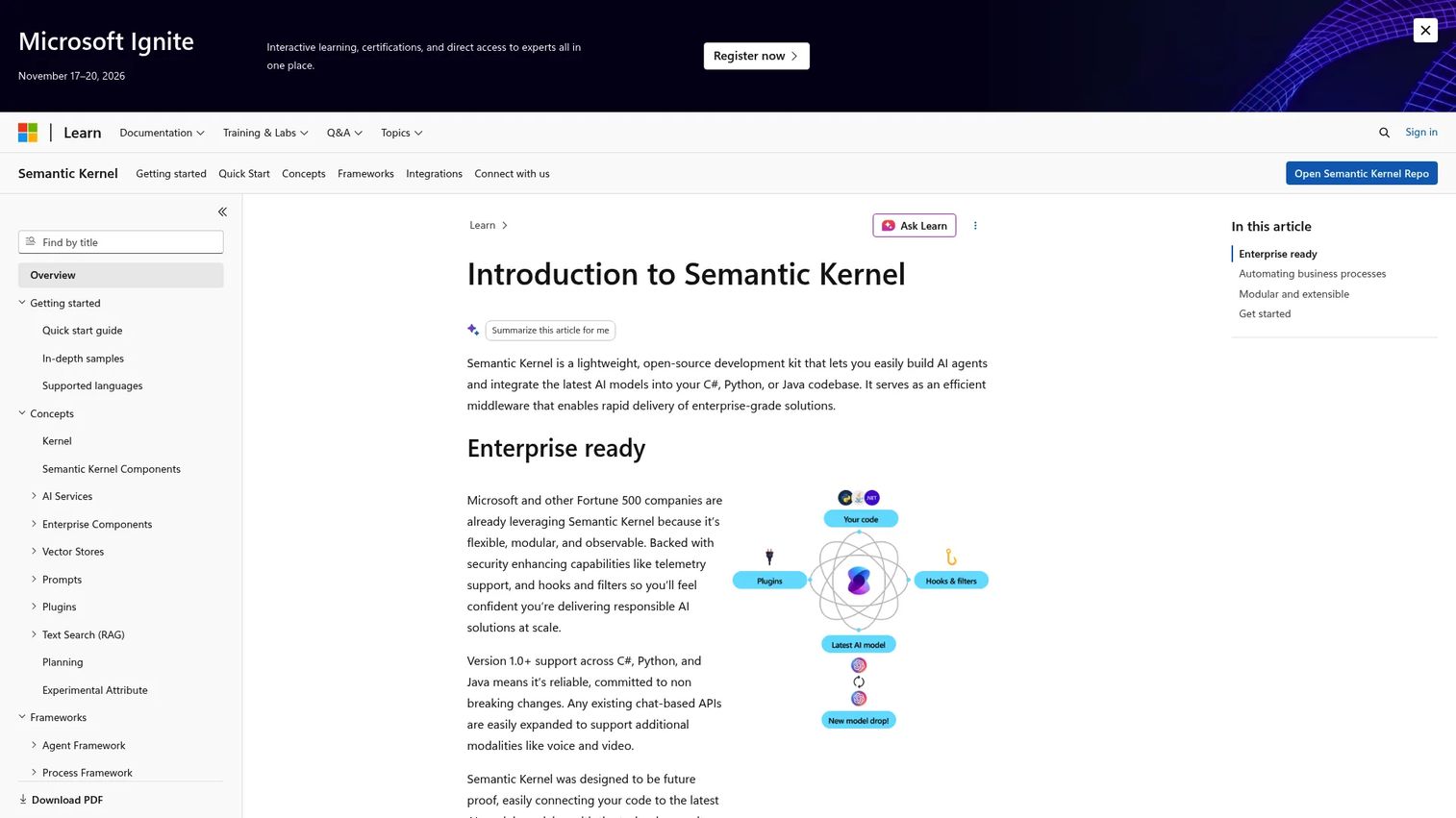
Microsoft Semantic Kernel is an open-source SDK for building AI agents and integrating language models with existing applications in C#, Python, and Java. It supports plugins, native functions, and OpenAPI integrations alongside automatic function calling, vector-store connectors, and prompt templates with hooks and filters. For enterprise teams already in the Microsoft stack, Semantic Kernel fits naturally into existing application code without requiring a separate orchestration service.
Best for: Developers and enterprise teams that want to add AI agent capabilities to existing C#, Python, or Java applications while staying within the Microsoft development ecosystem.
Key features
- Plugins, native functions, and OpenAPI integrations
- Automatic function calling with swappable AI service connectors
- Vector-store and memory connectors for retrieval
- Prompt templates with hooks, filters, and OpenTelemetry support
Why choose Microsoft Semantic Kernel: If your team builds in .NET or Java and needs orchestration that integrates cleanly with Azure services and existing enterprise infrastructure, Semantic Kernel removes most of the integration friction. Teams outside the Microsoft stack may find community support thinner compared to LangChain.
Microsoft Semantic Kernel pricing: Semantic Kernel is open-source with no paid tiers. You pay only for the model and Azure service usage your application generates.
G2 rating: 4.0/5
4. Orchestra
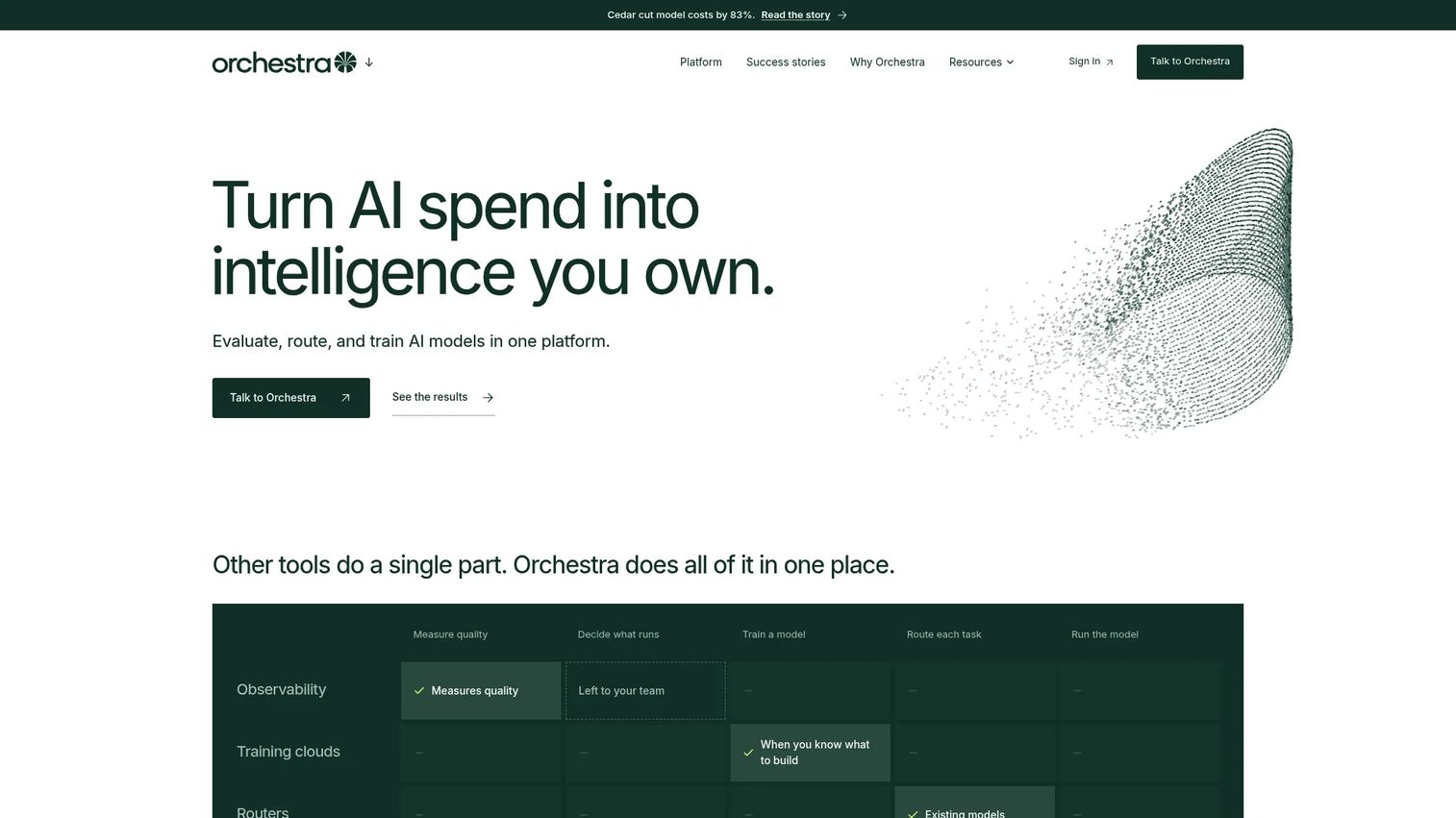
Orchestra is a platform for evaluating, routing, training, and serving AI models for recurring production workflows. Its focus is on the operational layer above model inference: Observability through trace-based evaluation, model comparison and routing across providers to reduce cost and latency, and specialist model training from accepted traces and expert corrections. For teams running high-volume or latency-sensitive AI workflows, Orchestra's routing and cost controls address the production economics that most frameworks leave unmanaged.
Best for: Teams running production AI workflows at volume who need to control inference cost and latency through intelligent model routing and trace-driven evaluation.
Key features
- Production observability with trace-based evaluation and scoring
- Model comparison and routing across providers
- Specialist model training from accepted traces and expert corrections
Why choose Orchestra: Orchestra is the right fit when your priority shifts from building new workflows to making existing ones cheaper and more reliable. It addresses production economics directly, whereas most LLM orchestration frameworks treat routing and cost as secondary concerns.
Orchestra pricing: Contact Orchestra directly for pricing.
5. Haystack
Haystack is deepset's open-source AI orchestration framework for building production-ready agents, multimodal applications, and advanced RAG systems. The framework uses a modular pipeline design where retrieval components, routers, generators, evaluators, and memory components can be swapped in or out without rewiring the entire graph. The enterprise platform adds visual pipeline building, deployment, observability, and governance through a managed interface.
Best for: Technical teams building customizable, production-grade RAG systems, search-centric assistants, or AI agents where modular pipeline composition and component interchangeability matter.
Key features
- Modular pipelines combining retrieval, routing, memory, tools, evaluators, and generators
- Model-agnostic integrations with interchangeable components
- Visual pipeline building and deployment via the Haystack Enterprise Platform
- Observability and governance for enterprise deployments
Why choose Haystack: Haystack's pipeline model gives teams fine-grained control over each component in the chain without locking into a single vendor's model or storage layer. For search-heavy applications and document QA systems, it handles retrieval orchestration more explicitly than general-purpose frameworks do.
Haystack pricing: The Studio plan is free and includes one workspace, one user, 100 pipeline hours, and 50 files. Enterprise pricing is custom with unlimited workspaces, users, files, and pipelines.
G2 rating: 4.4/5
6. DSPy
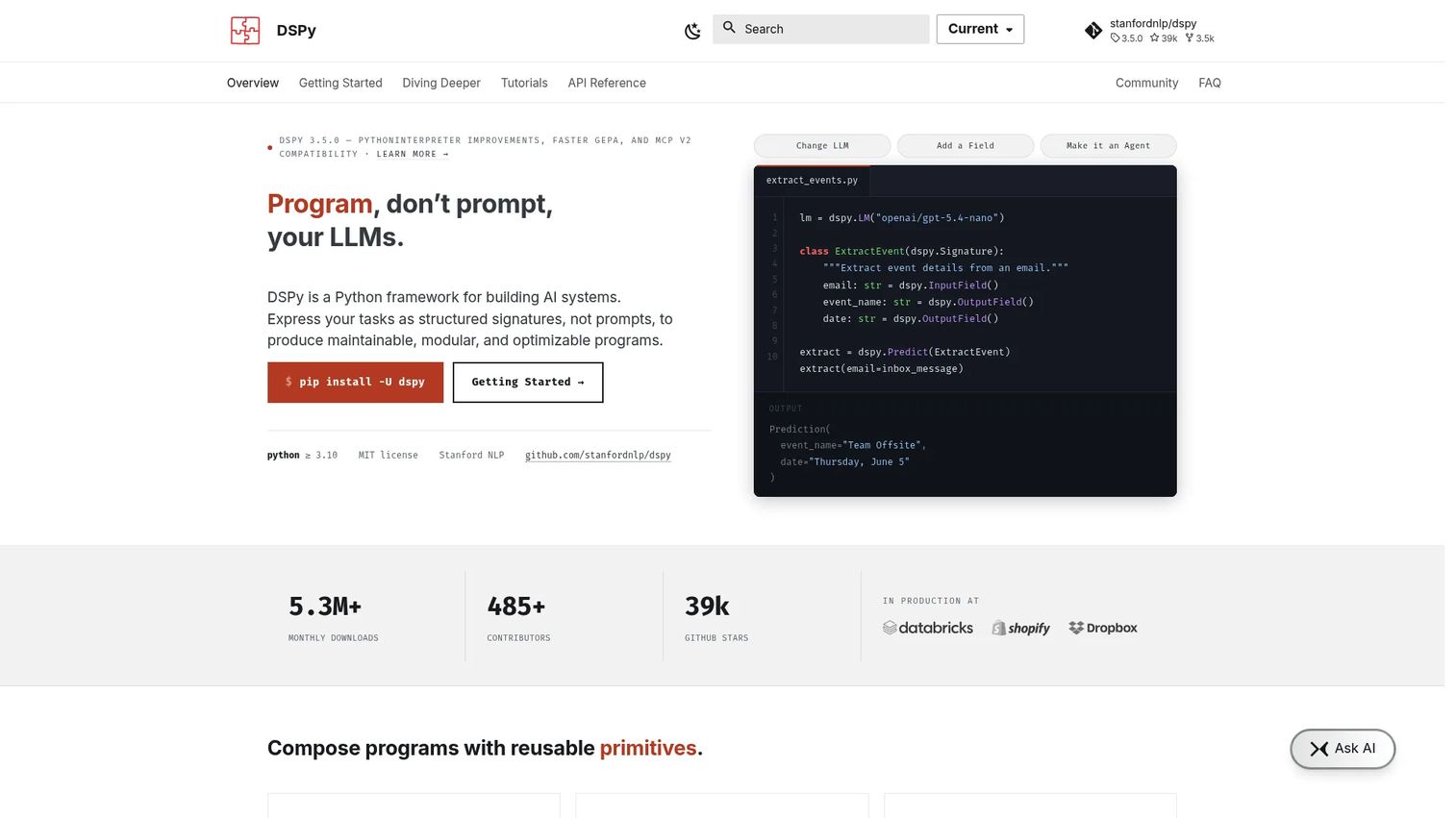
DSPy is a Python framework for building maintainable, modular, and optimizable AI systems using structured signatures instead of hand-written prompts. Rather than engineering the exact phrasing of each prompt manually, DSPy programs declare what inputs and outputs each step should produce, then use optimizers and metrics to automatically find the prompt or fine-tuned weights that perform best. The result is an AI program that can be improved systematically by measuring outputs against a metric rather than by trial and error on prompt text.
Best for: Developers building modular LLM applications in Python who want to optimize model behavior through metrics and program structure rather than manual prompt iteration.
Key features
- Structured signatures defining language-model inputs and outputs
- Composable modules for multi-step programs and agents
- Prompt and program optimization using metrics-driven optimizers
Why choose DSPy: DSPy fits teams that have already defined what good output looks like and want to push optimization further without rewriting prompts by hand. If your team doesn't have evaluation metrics or labeled examples to train against, DSPy's optimizer won't have much to work with and a standard orchestration framework will serve you better for now.
DSPy pricing: DSPy is MIT-licensed and free to use. Infrastructure costs for the models and compute your programs call are your own.
7. AutoGen
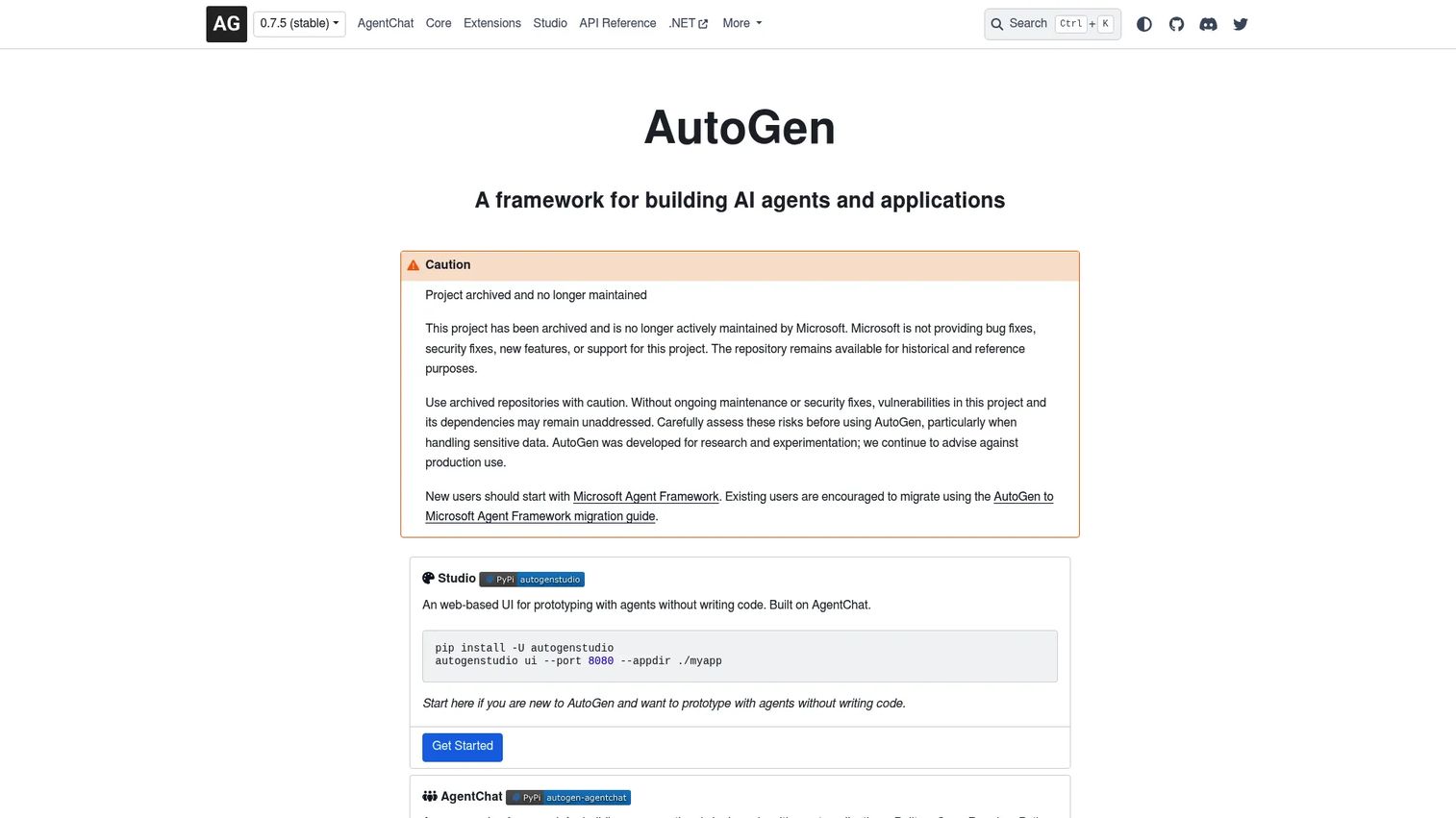
AutoGen is an open-source programming framework from Microsoft for building multi-agent AI applications that can operate autonomously or alongside humans. It supports event-driven, distributed, scalable multi-agent systems alongside a conversational application pattern for single or multi-agent workflows. AutoGen Studio provides a low-code visual interface for prototyping agent configurations without writing framework code directly. Note: Microsoft has archived the AutoGen repository and recommends its Microsoft Agent Framework for new production projects, so evaluate accordingly if you need long-term maintenance commitments.
Best for: Developers and research teams experimenting with multi-agent conversation patterns, agent-to-agent coordination, and collaborative agent workflows in Python or .NET.
Key features
- Event-driven, distributed multi-agent systems
- Conversational single- and multi-agent application framework
- Low-code visual prototyping with AutoGen Studio
- Tool, model, human-in-the-loop, and code-execution integrations
- Python and .NET interoperability
Why choose AutoGen: AutoGen is the fastest way to prototype a multi-agent system where agents hand off tasks, critique each other's output, or divide work across specialist roles. For new production workloads, evaluate whether the archived repository status and Microsoft's shift toward the Agent Framework affects your team's support and maintenance expectations.
AutoGen pricing: AutoGen is free under the MIT license. Model provider costs are separate.
Considerations
Choosing an LLM orchestration framework isn't just a technical decision. Here's what to evaluate before committing to one for production use.
Workflow pattern first
Identify whether your application is primarily an agent workflow, a retrieval pipeline, or a prompt optimization problem. LangChain and Semantic Kernel cover general agent orchestration well. LlamaIndex and Haystack are purpose-built for retrieval-heavy patterns. DSPy addresses optimization workflows specifically. Starting from the wrong pattern means refactoring later.
Observability and evaluation requirements
Production AI workflows need tracing, logging, and output evaluation to catch regressions and improve over time. LangSmith adds this layer for LangChain users. Haystack's Enterprise Platform covers it for deepset deployments. Orchestra addresses it directly for routing workflows. If your chosen framework doesn't cover observability natively, budget for integrating a separate AI governance tool or evaluation layer.
Enterprise deployment and security
Open-source frameworks like DSPy, AutoGen, and Semantic Kernel give you full control over where code runs, which matters for data privacy and security review. Managed platforms add convenience but require security diligence. For enterprise AI orchestration, confirm SOC 2 coverage, data residency options, and access controls before the procurement conversation starts.
Team skill set and framework complexity
LangChain's abstraction layer accelerates development for teams building complex agents, but it adds surface area to debug. DSPy assumes familiarity with evaluation metrics and optimization concepts. AutoGen fits teams comfortable with event-driven patterns. Match the framework's mental model to your team's existing knowledge, or factor in onboarding time realistically.
Maintenance and support trajectory
AutoGen's archived status is a concrete example of why the support trajectory matters. Frameworks backed by commercial entities (LangChain via LangSmith, Haystack via deepset's Enterprise Platform) have clearer support paths than purely community-driven projects. If this will run in a customer-facing production environment, verify the maintenance commitment before you're six months into a build.
Conclusion
The right LLM orchestration software depends on what your workflow actually requires. LangChain is the strongest general-purpose choice for teams building complex agent pipelines with broad tooling needs. LlamaIndex is the sharper tool when the workflow starts and ends with documents and enterprise data. Semantic Kernel fits Microsoft-stack teams who need agent capabilities embedded in existing applications. Haystack is the most explicit about retrieval pipeline composition for search-heavy systems.
For teams focused on the production economics of AI, Orchestra's routing and trace-based evaluation address cost and latency directly. DSPy is the right choice if you're optimizing model behavior systematically rather than refining prompts by hand. AutoGen is the fastest path to prototyping multi-agent patterns, with the caveat that its archived repository status requires careful evaluation for new production workloads.
If you're building AI-powered products and also need to show prospects what those products do without scheduling a live call for every evaluation, Start your journey with Guideflow today!
FAQs
An LLM framework is a programming library that provides abstractions for working with language models, such as prompt templates, chain patterns, and tool integrations. Orchestration software adds the operational layer: Routing, state management, evaluation, tracing, and coordination across multiple models or agents. Many tools, like LangChain, function as both. Some, like Orchestra, focus specifically on the orchestration and observability layer without providing the agent development framework beneath it.
A single-turn chatbot that sends a prompt and displays the response doesn't require an orchestration layer. Once your chatbot needs to remember context across turns, retrieve information from a knowledge base, or call an external API based on the user's intent, an orchestration framework saves significant engineering effort compared to building state management and tool dispatch from scratch.
Both handle retrieval-augmented generation, but with different emphasis. LlamaIndex is built around document parsing, structured extraction, and retrieval as primary capabilities, which makes it stronger when the data pipeline is complex. LangChain treats RAG as one pattern within a broader agent and workflow system, which is more flexible when retrieval is one step in a larger chain rather than the core job. Teams with complex document sources tend to reach for LlamaIndex; teams combining RAG with broader agent logic often use LangChain or pair the two.
Prioritize tracing and observability so you can debug failed steps, evaluate output quality, and iterate systematically. Check that the framework supports your data sources natively rather than requiring custom connectors for each integration. Confirm that state management handles your session requirements, whether that's short conversation history or long-running agentic processes. For agentic AI platforms in regulated or enterprise environments, audit logging, access controls, and data residency options are worth confirming before the security review.
For specific use cases, yes. Multi-agent orchestration performs best when a task can be decomposed into distinct sub-tasks handled by specialist agents, such as a research agent that gathers information and a writing agent that structures it, or an orchestrator that delegates to function-specific agents based on input classification. For tasks that don't benefit from decomposition, a single well-orchestrated agent is simpler to debug and maintain. The overhead of multi-agent coordination is only worth it when the task complexity genuinely requires it.
Start by mapping your specific workflow requirements: Routing, retrieval, state, tool calling, agent coordination, or some combination. Test each framework against a representative task from your production use case, not just the tutorial examples. Measure against concrete criteria like latency, cost per workflow run, and output quality on a small evaluation set. Check the tracing and observability story for each option, since you'll need that immediately once you're in production. For a broader view of related tooling, the guide to best AI orchestration platforms covers adjacent categories worth comparing.
Open-source frameworks like LangChain, Haystack, Semantic Kernel, DSPy, and AutoGen are running in enterprise production environments across many organizations. The question isn't open source versus commercial but whether the framework has an active maintenance path, a viable support option, and security controls that satisfy your InfoSec and procurement requirements. Frameworks with commercial tiers, like LangChain via LangSmith and Haystack via deepset's Enterprise Platform, provide structured support and governance. Pure community projects require more internal ownership. For teams exploring how AI agents or AI model deployment fit into their broader stack, those resources cover adjacent decisions worth reviewing alongside the orchestration layer choice.