Most fraud teams get judged on one number: losses. Chargebacks, stolen cards, fraudulent refunds. So they tighten the rules. The decline rate climbs. Everyone feels safer.
Then someone runs the math on the other side of the ledger.
According to the MRC 2026 Global Payments and Fraud Report, merchants lose about 3.2% of total annual global ecommerce revenue to payment fraud. That number is real, and it hurts. But the quieter cost is the good customer you turned away at checkout because a rule flagged a slightly unusual order. Those are false declines, and they rarely show up on the fraud team's scorecard. They show up as lost revenue, abandoned carts, and a churned customer who is now buying from a competitor.
That is the actual problem ecommerce fraud protection software solves. Not just "stop fraud" but "approve more good orders while stopping fraud," in real time, without adding checkout friction that punishes the wrong people. The best tools treat fraud prevention as a revenue protection system, not a security cost center.
This guide is for the people who own that tradeoff: ecommerce operators, fraud and risk managers, and product managers who care how a tool affects conversion, approval rate, support load, and retention. If you are also evaluating how interactive experiences shape conversion elsewhere in the funnel, our roundups on ab testing tools and AI customer service software cover adjacent decisions. For now, we are focused on one job: choosing fraud protection for ecommerce that protects margin without quietly killing growth.
What's inside
This guide compares the best ecommerce fraud protection software for 2026, ranked by fit for ecommerce and SaaS teams running real checkout volume. We selected and ordered tools on four criteria that matter when you actually have to defend the decision:
- Fraud signal depth: does it combine identity, device, behavioral, and historical signals, or just shallow rules?
- Real-time decisioning: can it approve, decline, or step up at checkout speed?
- Journey coverage: does it cover account creation and login, not only the payment moment?
- Buying fit: pricing model, integrations, and implementation effort against your stack.
For each tool you will see who it fits, what makes it different, pricing guidance, and a G2 rating where one is published. You will also get a buyer's checklist and FAQs at the end.
TL;DR
- Best overall for ecommerce teams: Signifyd, for guaranteed fraud protection and approval optimization at high volume.
- Best for identity and device intelligence: LexisNexis Risk Solutions, for layered identity, fraud, and compliance signals.
- Best for high-velocity decisioning: Forter, for instant, identity-led decisions across global commerce.
- Best for flexible fraud ops: Sift, for machine learning scoring with configurable review workflows.
- Best for SMB and fast setup: NoFraud, with a free Lite tier and published starter pricing.
- Best for chargeback-heavy stores: ClearSale, for AI plus human analyst review with a chargeback guarantee. Teams focused purely on dispute recovery often pair these with a tool like Chargeflow.
What is ecommerce fraud protection software?
Ecommerce fraud protection software is a system that detects and prevents fraudulent transactions, accounts, and behaviors across the shopper journey, ideally while approving as many legitimate customers as possible.
The category is broader than checkout screening. Modern ecommerce fraud detection software covers the full journey, from account creation and login to payment and post-purchase refunds. Strong platforms combine multiple signal types into real-time decisioning, then expose that logic so analysts can tune it.
Here are the fraud modes ecommerce fraud management has to handle:
- Account takeover: attackers hijack existing customer accounts, often via credential stuffing.
- New account fraud: fake accounts created to abuse promos, launder cards, or stage future attacks.
- Payment fraud: stolen card details used to push orders through checkout.
- Chargeback abuse and friendly fraud: legitimate purchases disputed after delivery, driving chargeback costs.
- Promo abuse and loyalty abuse: exploiting discounts, referrals, and points programs at scale.
- Bot abuse: automated traffic probing checkout, testing cards, or scraping inventory.
The capabilities that separate serious tools from shallow ones:
- Identity intelligence: linking emails, phones, addresses, and prior history to a real person.
- Device intelligence: fingerprinting devices to spot spoofing, emulators, and repeat offenders.
- Behavioral signals: how a session moves, types, and navigates compared to known patterns.
- Real-time decisioning: approve, decline, or escalate in milliseconds at checkout.
- Risk-based authentication: apply dynamic friction, like step-up verification, only when risk is high.
One distinction worth keeping straight. Fraud detection is identifying risk after or as it happens. Fraud prevention is the wider system: rules, real-time decisions, step-up authentication, and workflow controls that stop loss before it lands. Risk-based authentication sits inside prevention, adding friction only when signals justify it. The same way agentic ai tools for sales automate judgment calls reps used to make manually, fraud platforms automate the approve-or-decline call at scale.
When to use ecommerce fraud protection software
Protect checkout conversion without opening the door to more fraud
This is the core tension. Tighten rules and you block fraud, but you also decline good customers and add checkout friction. Loosen them and approval rates climb alongside losses. Ecommerce fraud prevention software exists to move both metrics at once, raising approval rates while lowering fraud. This matters most when cart abandonment is high, when you are expanding internationally into unfamiliar risk patterns, or when chargebacks are climbing faster than revenue.
Stop account abuse before it becomes revenue leakage
Checkout is not the only attack surface. Account takeover, credential stuffing, and new account fraud all happen before a payment is ever attempted. By the time fraud shows up at the payment step, the account may already be compromised. Watching login and account creation, not just checkout, catches abuse earlier and protects loyalty balances, stored cards, and customer trust.
Reduce manual review and support load
Manual review does not scale. As volume grows, teams need automation, clear reviewer workflows, and explainable decisions analysts can act on without guessing. The MRC 2026 report notes that 62% of merchants report rising first-party misuse disputes, which means more review work, not less. Good tooling deflects routine decisions, routes only genuine edge cases to humans, and frees the team for higher-value work.
Comparison table
The table below compares each option by intent, primary use case, pricing model, and G2 rating so you can shortlist fast. Treat it as a starting filter for ecommerce fraud prevention software, then read the sections for detail. Pricing for most of these is custom and quote-based, which is normal in this category.
| # | Product | Intent | Key use case | Pricing | G2 rating |
|---|---|---|---|---|---|
| 1 | Signifyd | Best overall | Guaranteed fraud protection and approval optimization | Custom quote | Not published |
| 2 | Riskified | Chargeback protection at scale | Automated decisioning with chargeback guarantee | Custom quote | 4.4/5 |
| 3 | Forter | High-velocity decisioning | Instant identity-led fraud and payment decisions | Custom quote | 4.5/5 |
| 4 | Sift | Flexible fraud ops | ML risk scoring with review workflows | Custom quote | 4.6/5 |
| 5 | NoFraud | SMB and fast setup | Fraud screening with chargeback protection | Free Lite tier; from $250/mo | 4.7/5 |
| 6 | ClearSale | Managed review | AI plus human analyst review and chargeback guarantee | From $250/mo | 4.7/5 |
| 7 | Kount | Broad fraud visibility | Device and identity signals with risk scoring | Custom quote | 4.8/5 |
| 8 | SEON | Configurable risk rules | API-first fraud prevention and AML | From $699/mo | 4.6/5 |
| 9 | LexisNexis Risk Solutions | Identity intelligence | Layered fraud, identity, and compliance | Custom quote | 4.4/5 |
| 10 | Ping Identity | Trust-first prevention | Authentication and adaptive risk | From $35k/yr | 4.4/5 |
| 11 | Mastercard Identity Review 360 | Identity review | Manual identity review at scale | Custom quote | 4.5/5 |
1. Signifyd
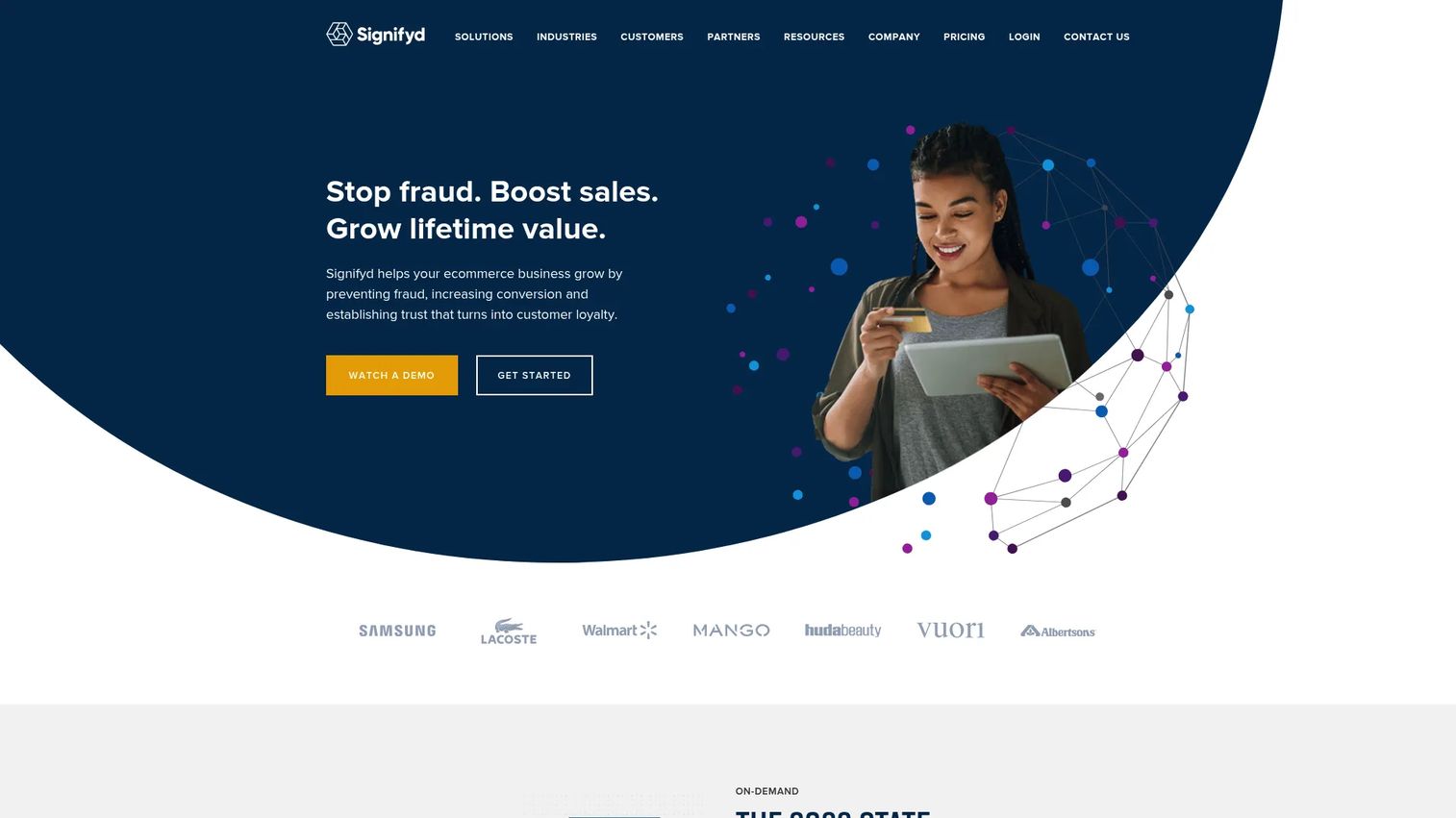
Signifyd positions itself around growth, not just defense. The pitch is to prevent fraud, increase conversion, and build trust that turns into customer loyalty. Its headline feature is guaranteed fraud protection: Signifyd takes on chargeback liability for orders it approves, which shifts the financial risk off your books and aligns the vendor's incentives with your approval rate.
That guarantee changes the conversation. Instead of asking "how much fraud did we stop," you can ask "how many good orders did we approve that we would have declined," because the vendor is now financially exposed to its own false declines. For high-volume merchants facing complex fraud pressure, that is a strong fit.
Best for: ecommerce merchants needing fraud prevention with chargeback liability protection at scale.
Key strengths
- Guaranteed fraud protection: Signifyd absorbs chargeback liability on approved orders, turning fraud loss into a fixed, predictable cost.
- Automated order decisioning: real-time approve or decline calls that reduce manual review and protect conversion.
- Seamless integrations: connects to major ecommerce and payment platforms so data flows without heavy engineering.
Why choose Signifyd: if you want a partner that puts money behind its decisions and optimizes for approving good orders rather than just blocking bad ones, Signifyd is the most complete option. The financial guarantee removes the usual fraud-versus-conversion standoff, which matters for teams measured on both chargeback reduction and revenue.
Signifyd pricing: pricing is custom and quote-based. Signifyd states that cost varies by product, vertical, order volume, and average ticket price, and asks merchants to request a quote. No public starting price is published.
2. Riskified
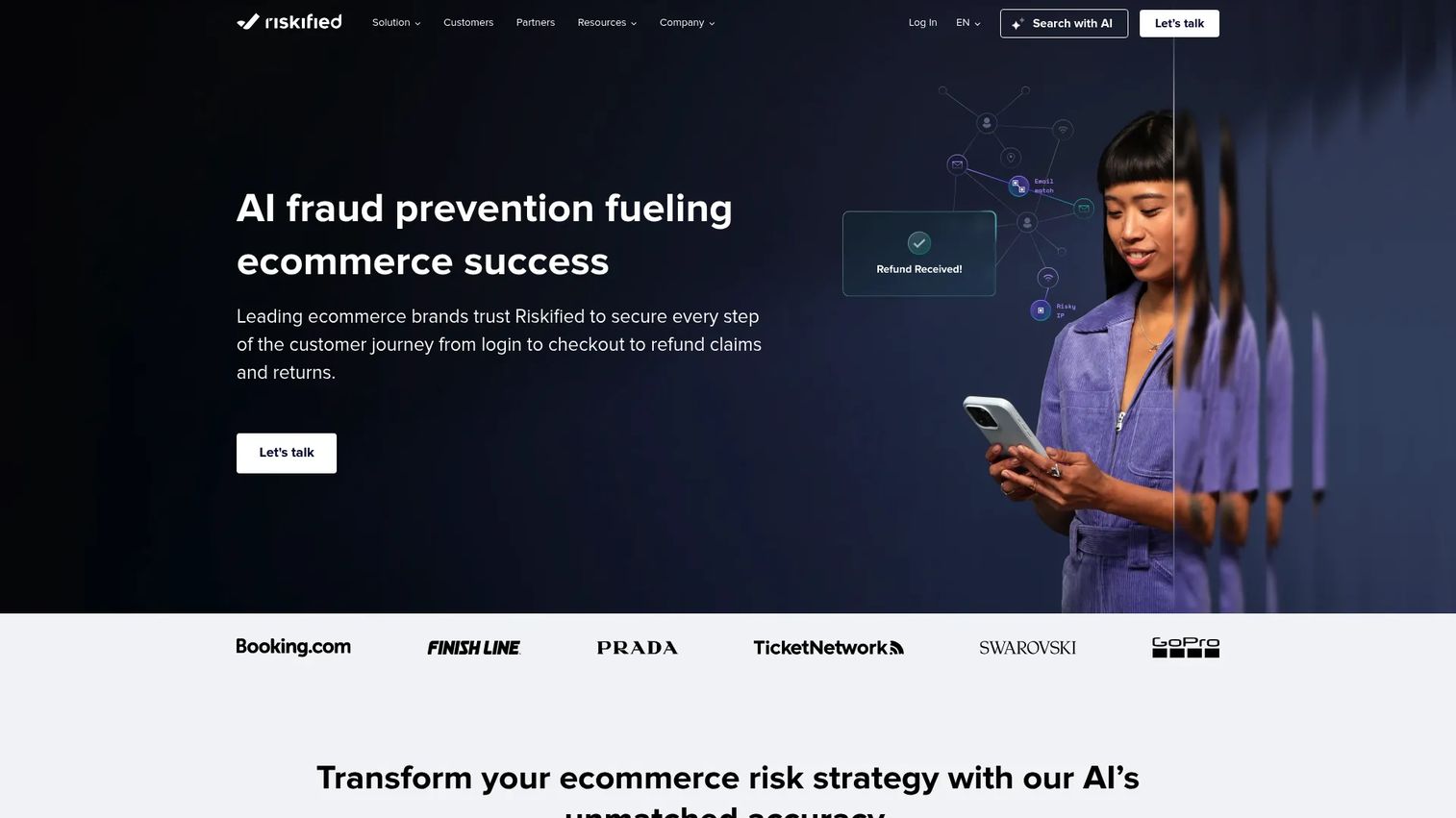
Riskified secures every step of the customer journey, from login to checkout to refund claims and returns. The platform pairs automated fraud decisioning with a chargeback guarantee, so approved orders that turn out fraudulent become Riskified's liability rather than yours. That structure suits teams that need to approve at scale without expanding the review team.
Riskified leans into revenue protection. Its Policy Protect and Account Secure modules extend coverage beyond payment fraud into return abuse and account takeover, which matters as first-party misuse and policy abuse climb across the category.
Best for: ecommerce merchants that need automated fraud decisions and chargeback protection at scale.
Key strengths
- Chargeback Guarantee: Riskified takes on liability for fraudulent orders it approves, converting variable loss into predictable cost.
- Policy Protect: flags refund, return, and policy abuse that traditional payment screening misses.
- Account Secure: monitors logins and account activity to catch takeover before checkout.
Why choose Riskified: for merchants whose fraud problem has spread past the payment step into returns and account abuse, Riskified's broader coverage and guarantee reduce both loss and review burden. It fits teams that want decisions made automatically rather than queued for analysts.
Riskified pricing: Riskified does not publish public pricing. The site routes prospects to a demo or sales conversation, and pricing is quoted based on volume and risk profile. Riskified holds a 4.4 out of 5 rating on G2.
3. Forter
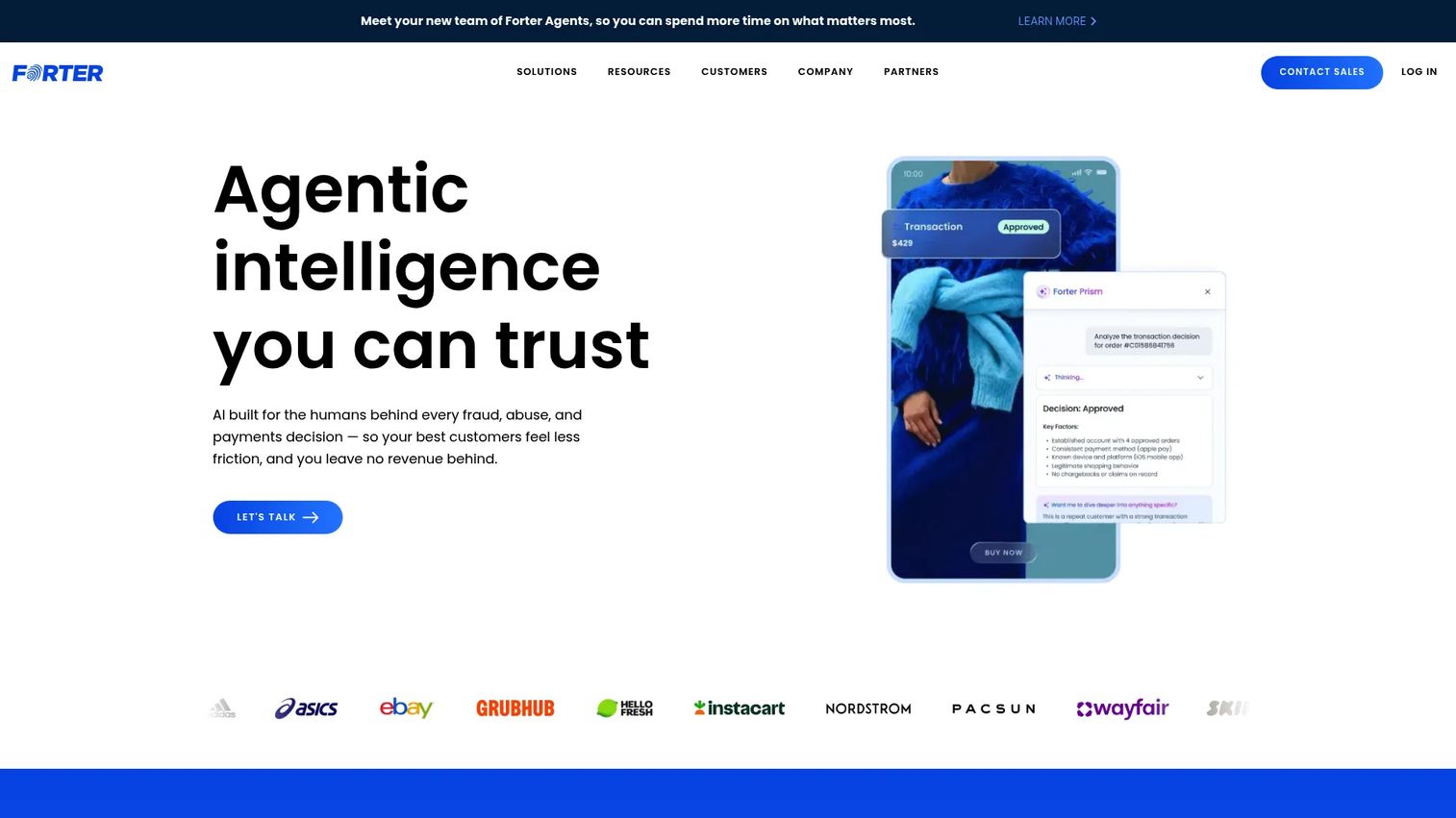
Forter is a commerce trust platform built for instant, identity-led decisioning. It combines fraud prevention, payment optimization, and chargeback recovery in one system, making real-time approve or decline calls across global commerce volume. Forter reports processing $350 billion in gross merchandise value across more than 200,000 businesses in a 12-month window, which is the kind of network scale that sharpens identity matching.
Forter's structure is agent-based. Its Analytics Agent reads traffic, the Payments Agent optimizes authorization rates and routing, and the Dispute Agent handles chargeback workflows and evidence collection. Forter reports that enterprises moving to its platform cut chargeback rates by 72% and false declines by 46% on average.
Best for: enterprise merchants needing fraud, payments, and dispute decisioning in a single platform.
Key strengths
- Analytics Agent: reads traffic in real time to separate trusted shoppers from risk before checkout.
- Payments Agent: optimizes payment authorization rates and routing to recover revenue lost to bank declines.
- Dispute Agent: automates chargeback workflows and evidence collection to recover disputed revenue.
Why choose Forter: if you run complex, high-volume global commerce and want fraud, payment authorization, and disputes handled by one decisioning engine, Forter's network scale and instant decisions fit. The reported false-decline reduction speaks directly to the approval-versus-fraud tradeoff.
Forter pricing: pricing is custom and quote-based, with no public price listed. Forter asks merchants to request a quote scoped to their volume and needs. Forter holds a 4.5 out of 5 rating on G2.
4. Sift
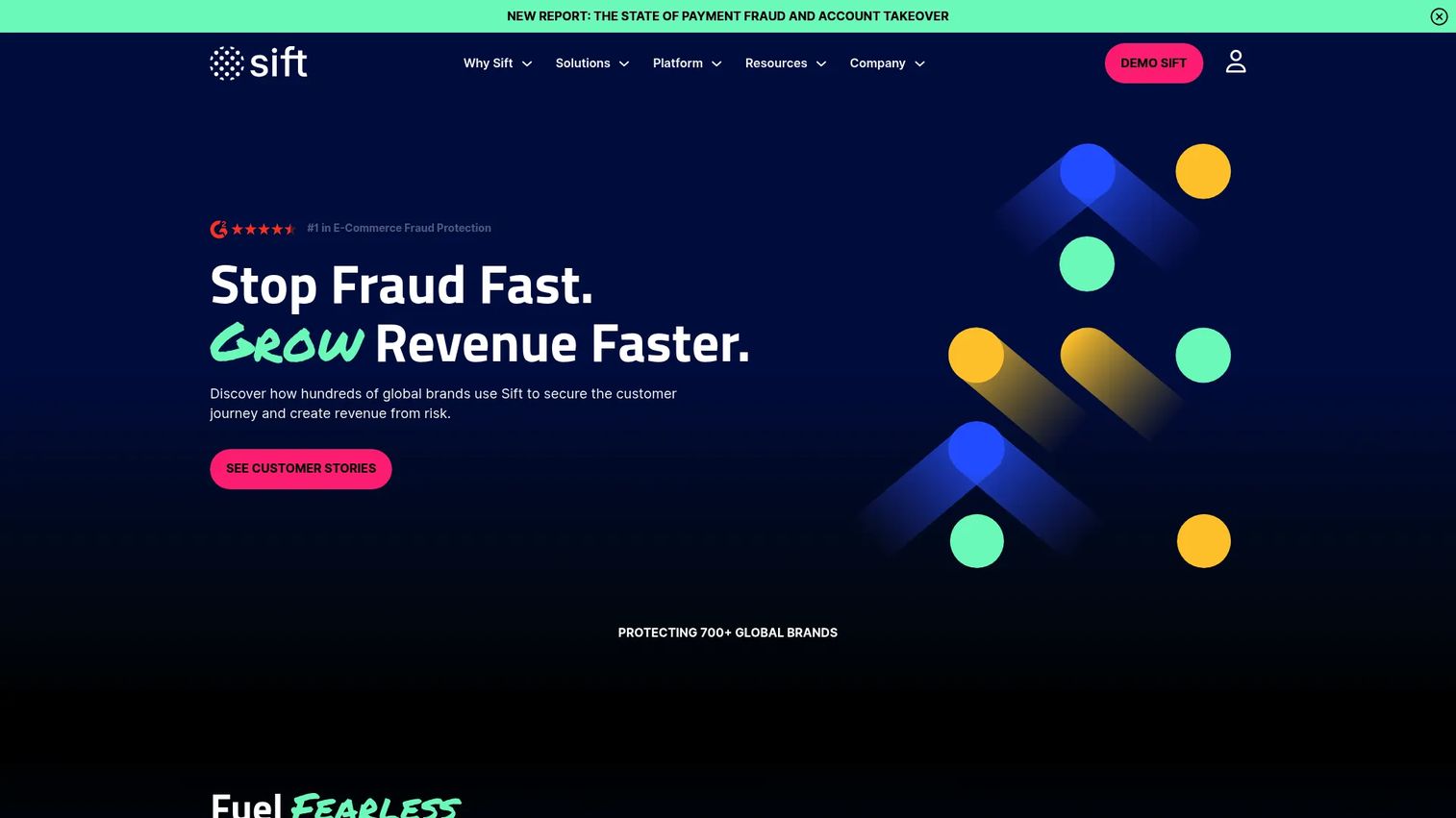
Sift is an AI-powered fraud decisioning platform built around machine learning risk scoring and configurable workflows. It protects signup, login, payments, and post-transaction events, processing roughly a trillion events a year across more than 700 global brands. That data volume feeds models that score risk in real time and adapt to new fraud patterns.
What teams like is the balance. Sift delivers automated scoring plus the review tooling and workflow flexibility analysts need to investigate edge cases and tune logic. It covers account takeover, payment fraud, content integrity, and dispute management in one platform, which suits fraud teams that want both automation and control.
Best for: businesses needing enterprise fraud prevention across signup, login, payments, and post-transaction workflows.
Key strengths
- Real-time risk decisioning: machine learning scores every event in milliseconds and adapts to emerging fraud.
- Account takeover and payment protection: covers the full journey from login to checkout, not just payment.
- Content integrity and dispute management: extends protection to spam, scam content, and chargeback workflows.
Why choose Sift: for fraud teams that want machine learning detection but refuse to give up reviewer control and workflow customization, Sift hits the middle. The setup rewards teams willing to invest in tuning, and the payoff is scoring that improves as your data grows.
Sift pricing: Sift does not publish public pricing; it operates on a contact-sales model scoped to volume and use case. Sift holds a 4.6 out of 5 rating on G2.
5. NoFraud
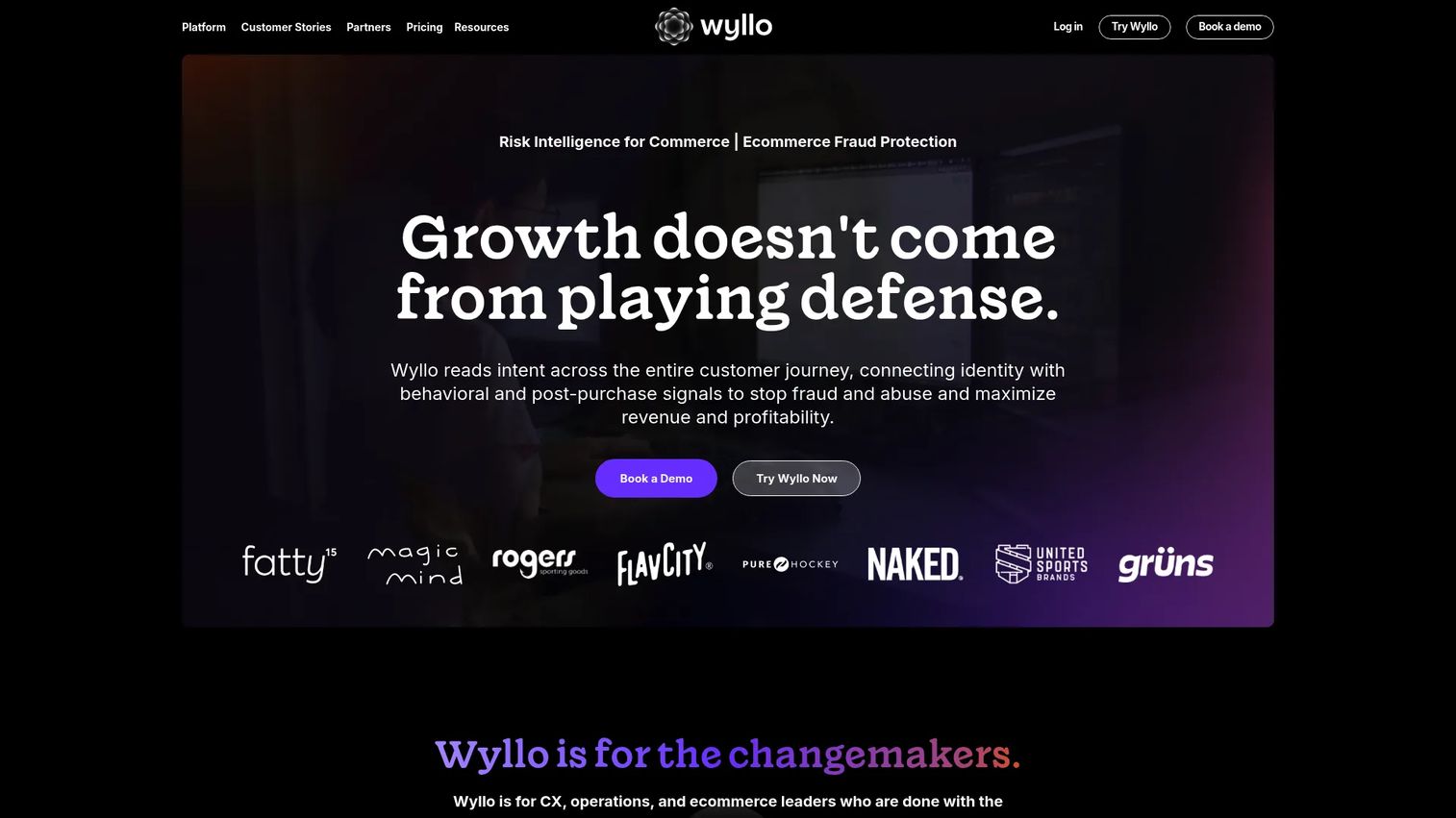
NoFraud is the practical pick for merchants that want fraud screening live fast without heavy operational drag. It combines real-time fraud screening, chargeback protection, and manual analyst review, so automated decisions handle the bulk and humans catch the edge cases. For smaller teams or straightforward stacks, that mix removes the need to staff a full fraud operation.
NoFraud also stands out for pricing transparency in a category that hides it. A free Lite tier covers up to 100 screened orders a month, and published starter plans give SMBs a clear entry point before they scale into custom pricing.
Best for: ecommerce merchants that want fraud screening, chargeback protection, and human analyst review without building an internal team.
Key strengths
- Real-time fraud screening: automated decisions at checkout speed to approve good orders and stop fraud.
- Chargeback protection: financial coverage on approved orders to make fraud loss predictable.
- Manual analyst review: human reviewers handle ambiguous orders so you do not over-decline.
Why choose NoFraud: for SMB and mid-market merchants who want fast setup, published pricing, and human review built in, NoFraud removes the usual friction of evaluating fraud tooling. It fits teams that value time-to-value and a clear cost structure over deep enterprise configurability.
NoFraud pricing: NoFraud publishes its starter plans. A free Lite tier covers up to 100 screened orders per month. Paid tiers start at a $250 monthly minimum, with Tier 2 at $350 and Tier 3 at $450. Businesses processing more than $50,000 per month move to custom pricing. NoFraud holds a 4.7 out of 5 rating on G2.
6. ClearSale
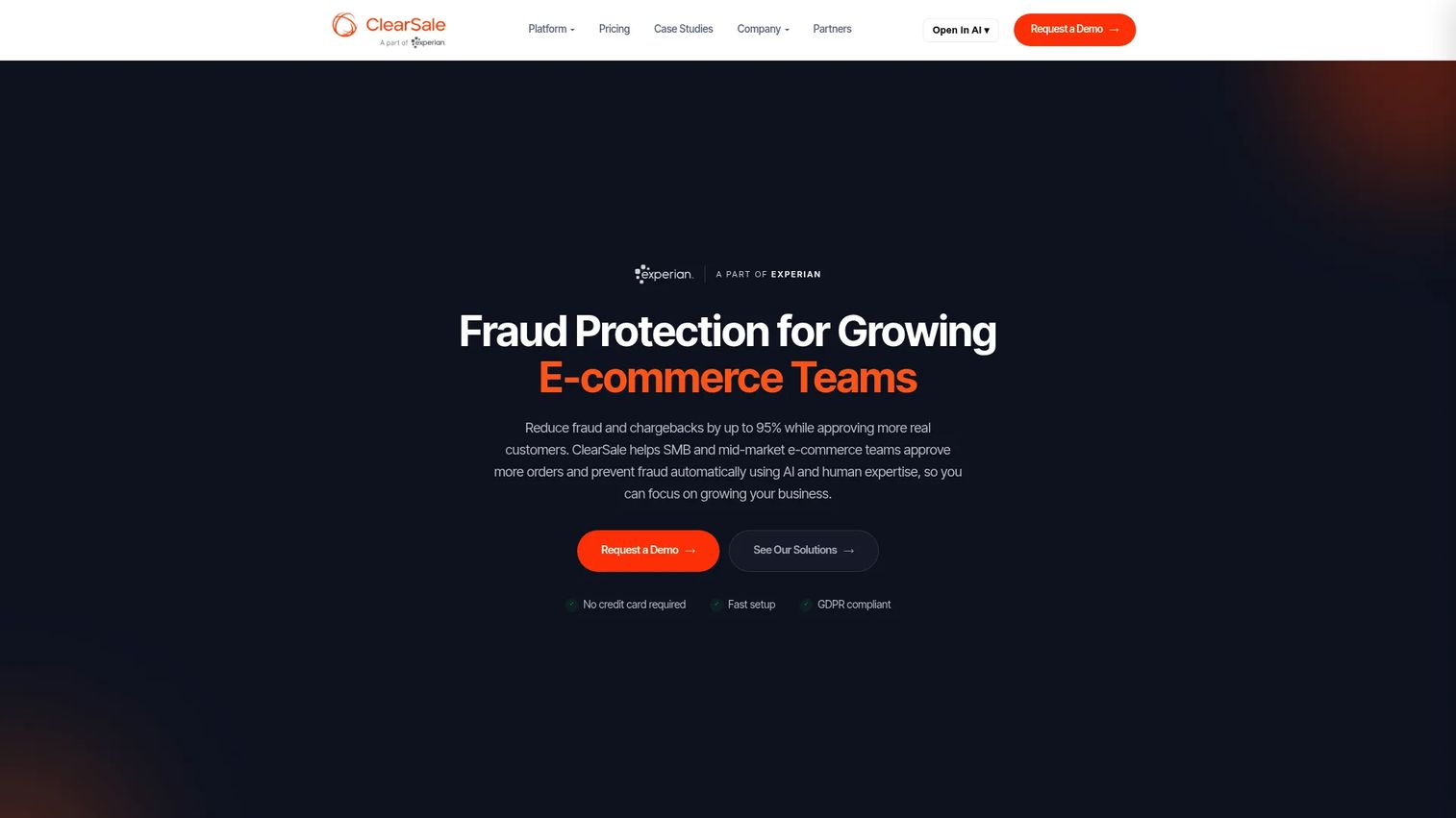
ClearSale pairs AI-driven order review with a large team of human fraud analysts, founded in 2001 and protecting over 100,000 ecommerce merchants with more than 1,100 expert analysts. That blend appeals to merchants who want automation but do not trust a black box to make every call. When the model is uncertain, a human reviews rather than auto-declining a good customer.
ClearSale's pitch centers on false-decline reduction. Because analysts review borderline orders, the platform aims to approve customers that pure automation would reject, protecting conversion. It also offers a chargeback guarantee on approved orders, putting financial weight behind its decisions.
Best for: ecommerce merchants that want automated fraud prevention backed by human review and chargeback protection.
Key strengths
- AI-enabled order review: machine learning scores orders and routes only the uncertain ones to humans.
- Human fraud analyst review: a large analyst team reviews borderline orders to cut false declines.
- Chargeback Guarantee: financial protection on approved orders converts fraud loss into a known cost.
Why choose ClearSale: if your priority is approving more good customers and you value human judgment on edge cases, ClearSale's hybrid model fits. It suits merchants in higher-risk verticals or international markets where automated rules alone over-decline.
ClearSale pricing: ClearSale uses usage-based pricing. Growth plans with the chargeback guarantee start at $250 per month, and enterprise or custom solutions are quoted based on transaction volume, risk profile, and business needs. ClearSale holds a 4.7 out of 5 rating on G2.
7. Kount
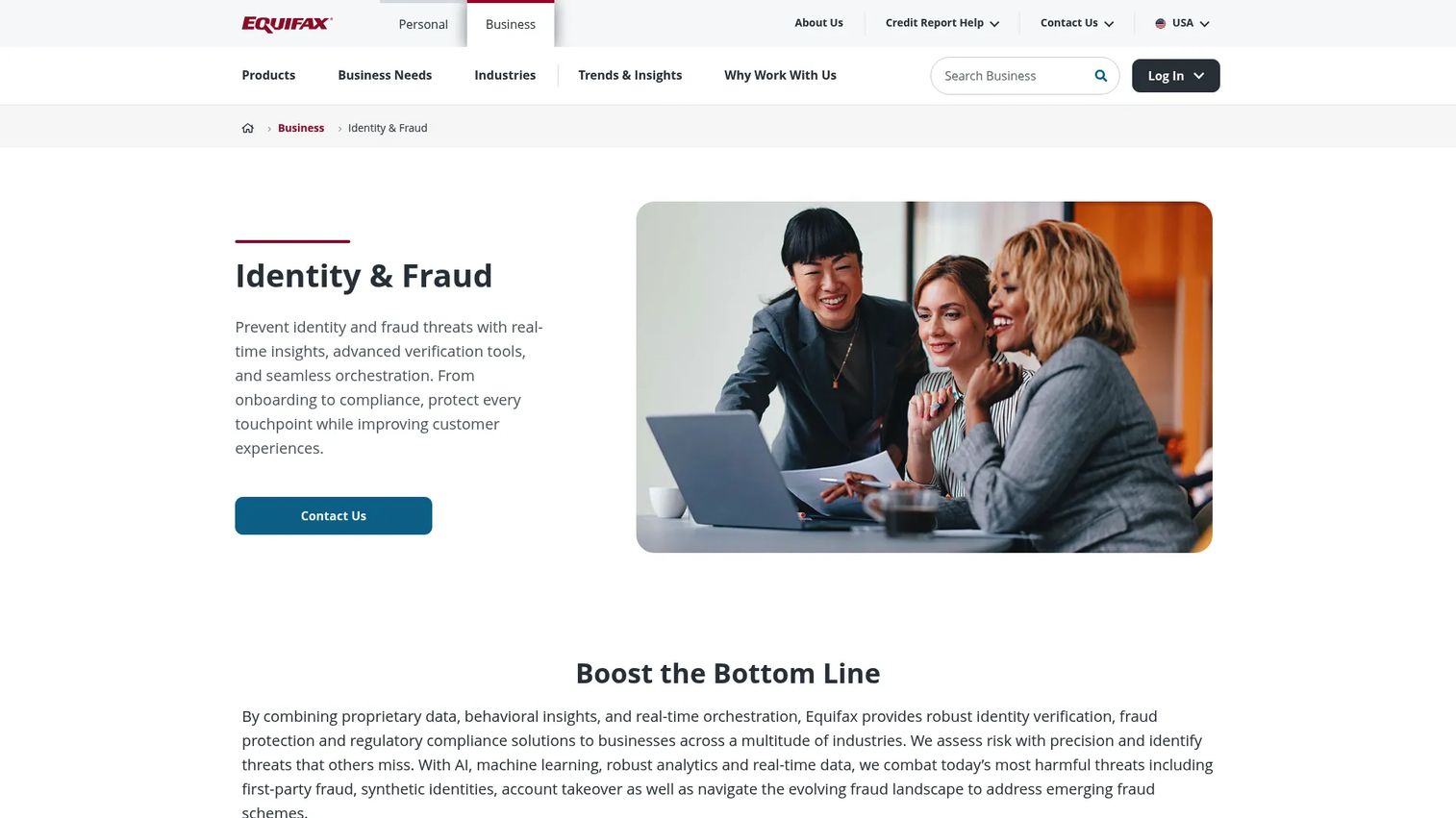
Kount, now part of Equifax, has been building fraud prevention technology since 1999 and protects more than 9,000 businesses. It combines device intelligence, identity signals, and configurable risk scoring, giving teams broad fraud visibility across the ecommerce journey. The Equifax backing adds identity and credit data depth that pure fraud vendors do not have.
Kount covers transaction fraud, account protection, and identity proofing, drawing on device, email, phone, and address insights. Its configurable controls let teams tune risk thresholds rather than accept fixed rules, which suits operators who want to own their fraud strategy.
Best for: merchants needing configurable fraud and identity risk controls with broad signal coverage.
Key strengths
- Device intelligence: fingerprints devices to catch spoofing, repeat offenders, and emulator-based attacks.
- Identity proofing and account protection: verifies identities and guards against account takeover.
- Configurable risk scoring: tune thresholds and rules to match your risk appetite across order types.
Why choose Kount: for teams that want broad fraud visibility, deep identity data through Equifax, and the freedom to configure their own risk logic, Kount fits. It covers chargebacks, account takeover, and payment fraud in one configurable platform.
Kount pricing: pricing is custom and quote-based, scoped to business goals and transaction volume. No public price is published. Kount holds a 4.8 out of 5 rating on G2, among the highest in this list.
8. SEON
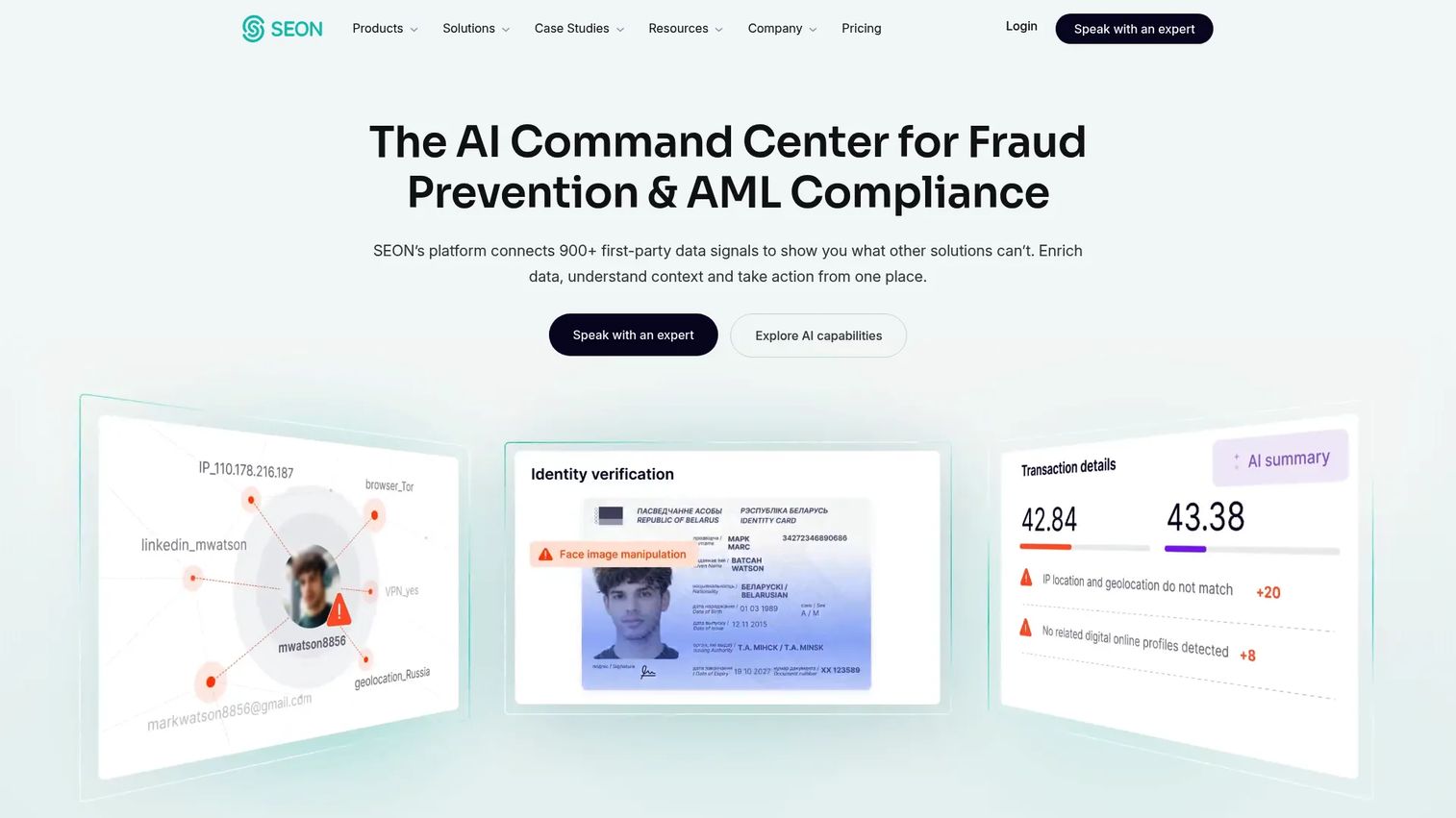
SEON is an API-first fraud prevention and AML platform built for teams that want speed, visibility, and configurable risk rules. Its platform connects more than 900 first-party data signals, including digital footprint analysis that enriches a single email or phone number into a full risk picture. SEON reports its AI tools cut manual review time by up to 50%.
SEON suits digital businesses running multi-signal fraud operations. It combines fraud prevention, AML compliance, identity verification, and case management, with AI rules and model tuning that analysts can configure directly. SEON reports customers averaging 14 days from implementation to impact.
Best for: teams that need a flexible, API-first fraud prevention and [AML platform with deep custom rules.
Key strengths
- 900+ first-party data signals: enriches emails, phones, and devices into a real-time risk profile from a single input.
- Configurable AI rules: analysts tune rules and models directly without waiting on a vendor.
- AML compliance and case management: extends beyond fraud into compliance screening](https://www.finra.org/rules-guidance/key-topics/aml) and investigation workflows.
Why choose SEON: for fraud and risk teams that want an API-first platform, transparent data signals, and the freedom to build their own rules, SEON delivers configurability and speed. It fits digital-first businesses and fintechs as much as traditional ecommerce.
SEON pricing: SEON publishes its pricing. The Starter plan is $699 per month and includes platform and API access, 2,500 fraud checks per month, 10 users, and 50 custom rules. The Premium plan is custom-priced with unlimited API calls, users, and rules, plus case management and AML compliance. SEON holds a 4.6 out of 5 rating on G2.
9. LexisNexis Risk Solutions
LexisNexis Risk Solutions brings deep identity intelligence and behavioral analytics to layered risk mitigation across account opening, login, and payment authorization. It is a data analytics and risk decisioning provider, not a single-purpose fraud tool, which means it supports fraud, identity, and compliance workflows from one vendor. For enterprises that need broad coverage rather than point solutions, that breadth is the draw.
The platform spans fraud and identity risk solutions, financial crime compliance screening, and risk orchestration and investigation tools. Because it decisions across the full journey, it catches risk at account opening before it reaches checkout, then applies risk-based authentication where signals warrant.
Best for: enterprises needing risk analytics for fraud, identity, and compliance decisioning in one place.
Key strengths
- Fraud and identity risk solutions: links identity data across the journey to score risk at every step.
- Financial crime compliance screening: adds AML and sanctions screening alongside fraud decisioning.
- Risk orchestration and investigation: routes cases and gives analysts tools to investigate efficiently.
Why choose LexisNexis Risk Solutions: for enterprises that need identity intelligence, fraud prevention, and compliance under one roof, the depth of data and layered coverage is hard to match with point tools. It fits regulated and high-volume businesses that decision risk across the full lifecycle.
LexisNexis Risk Solutions pricing: public pricing is not published. Product pages route to sales, with a free trial offered for the WorldCompliance online search tool. LexisNexis Risk Solutions holds a 4.4 out of 5 rating on G2.
10. Ping Identity
Ping Identity approaches fraud from a trust-first angle, anchored in authentication and adaptive risk rather than transaction screening alone. Its fraud prevention tools monitor odd login behavior for red flags like new devices, unfamiliar locations, or unusual times, then apply step-up authentication when risk is high. This matters most around login and account protection, the surfaces transaction-only tools miss.
Ping is fundamentally an identity security and IAM platform, covering single sign-on, multi-factor authentication, identity orchestration, lifecycle management, and directory. One leading fashion retailer reported a $20 million revenue uplift alongside a $5 million reduction in fraud after implementing Ping's prevention approach, which shows the upside of continuous verification done well.
Best for: large enterprises needing customer identity and access management with adaptive, risk-based authentication.
Key strengths
- Adaptive multi-factor authentication: applies dynamic friction and step-up verification only when login risk is high.
- Identity orchestration: builds risk-based authentication flows without hard-coding logic per app.
- Continuous verification: monitors device, location, and timing signals to catch account takeover early.
Why choose Ping Identity: if your fraud exposure is concentrated at login and account access rather than payment, Ping's IAM-rooted approach protects the surface other tools overlook. It fits enterprises that want continuous verification and adaptive friction across the customer login experience.
Ping Identity pricing: Ping publishes some pricing. PingOne for Customers Essential starts at $35,000 annually, and PingOne for Workforce Essential is listed at $3 per user per month. Other packages route to sales. Ping Identity holds a 4.4 out of 5 rating on G2.
11. Mastercard Identity Review 360
Mastercard Identity Review 360 is a manual review SaaS tool for assessing identity risk, approving good transactions, and investigating fraud at scale. It expedites the experience for good applicants to help meet acquisition goals, while blocking bad actors using fraudulent identities. In a broader fraud stack, it sits as the review and investigation layer that human analysts work inside.
The tool delivers global identity risk scoring with both positive and negative signals, an interactive dashboard with a distance map and network risk signals, plus reporting, analytics, admin tools, and workflow integrations. For enterprises that run a dedicated review function, it gives analysts the context to decide quickly.
Best for: businesses needing structured manual identity review and fraud decisioning at scale.
Key strengths
- Global identity risk scoring: weighs positive and negative signals to rank applicant and transaction risk.
- Interactive review dashboard: distance maps and network risk signals give analysts context at a glance.
- Reporting and workflow integrations: admin tools and analytics fit the review layer into existing operations.
Why choose Mastercard Identity Review 360: for enterprises that keep a human review team and want a purpose-built workspace for identity decisioning, this tool structures that work. It complements automated screening by giving analysts a focused environment for the cases that need judgment.
Mastercard Identity Review 360 pricing: public pricing is not published; the product offers a book-a-demo path scoped to enterprise needs. Mastercard Identity Review 360 holds a 4.5 out of 5 rating on G2.
Considerations before you buy
Fraud signal quality
Ask what the tool actually sees. A platform leaning on device, identity, behavioral, and historical signals will make sharper calls than one running shallow rules on billing address and order value. Richer risk models adapt to new fraud patterns; static rule sets decay. Verify the signal depth before the demo dazzles you.
False declines and customer trust
Rejecting a good customer is expensive twice: lost revenue now and lost lifetime value later. Evaluate how each tool handles approval optimization and whether its decisions are transparent enough to audit. Tools that put a chargeback guarantee behind approvals have a financial incentive to minimize false declines, which aligns the vendor with your conversion goals.
Workflow and manual review
Automation handles volume, but edge cases still need humans. Check the review queue experience, escalation logic, and how efficiently analysts can work. As you scale, the difference between routing 2% of orders to review versus 8% is real headcount. Explainable decisions let reviewers act fast instead of guessing.
Integration fit
Model quality means little if data cannot flow. Confirm native connections to your ecommerce platform, payment gateway, CRM, analytics, and where relevant your IAM stack. Cross-system data sharpens decisions, since identity, behavioral, and payment signals together beat any single source. Implementation complexity often lives here, not in the model.
Pricing and ROI
Pricing models vary: transaction-based, decision-based, and enterprise contracts. Compare cost against chargeback reduction and conversion lift, not in isolation. A tool that costs more but approves 3% more good orders can pay for itself many times over. Factor time-to-value too, since faster onboarding starts the ROI clock sooner.
Conclusion
The best ecommerce fraud protection software does two jobs at once: it cuts fraud loss and protects conversion, refusing to trade one for the other. That is the lens that should drive your shortlist.
If you want guaranteed protection and approval optimization at high volume, Signifyd is the strongest overall pick. For deep identity and compliance coverage, LexisNexis Risk Solutions leads. Forter fits high-velocity global decisioning, Sift suits teams that want machine learning with reviewer control, and NoFraud and ClearSale serve merchants who want fast setup or human review at an accessible price.
Do not buy on the demo alone. Shortlist two or three tools, then test their decision quality against your own real transaction patterns. Watch both numbers: fraud caught and good orders approved. The right fraud detection software for ecommerce will move both in the direction your P&L cares about, and the wrong one will quietly cost you customers you never knew you lost.
Run a parallel pilot, measure approval rate and chargebacks side by side, and let the data pick the winner.
Start your journey with Guideflow today!
FAQs
It is software that detects and prevents fraudulent transactions, accounts, and behaviors across the shopper journey, before loss occurs. Ecommerce fraud detection software analyzes signals like identity, device, and behavior to approve good orders and block bad ones in real time. The best tools protect revenue and conversion, not just reduce chargebacks.
It uses real-time risk scoring built on identity intelligence, device intelligence, and behavioral signals, so it can tell a slightly unusual but legitimate order apart from genuine fraud. Shallow rule systems decline anything that looks odd; richer models approve more good orders. Fraud detection software for ecommerce that carries a chargeback guarantee has a direct financial incentive to minimize false declines.
The main modes are account takeover, new account fraud, payment fraud, chargeback abuse, friendly fraud, promo abuse, loyalty abuse, and bot abuse. Return abuse and first-party misuse are rising fast, with 62% of merchants reporting more first-party disputes in the MRC 2026 report. Strong ecommerce fraud management covers all of these, not just payment screening.
No. Detection identifies risk as or after it happens. Prevention is the wider system: rules, real-time decisions, step-up authentication, and workflow controls that stop loss before it lands. Risk-based authentication sits inside prevention, applying dynamic friction only when signals justify it.
Common models are transaction-based, decision-based, and enterprise contracts, and most vendors quote custom pricing rather than publishing rates. NoFraud, ClearSale, SEON, and Ping Identity publish at least some pricing, while Signifyd, Riskified, Forter, Sift, Kount, and others quote based on volume and risk. Compare cost against chargeback reduction and conversion lift, since transaction volume and review automation drive real ROI.
Prioritize native connections to your ecommerce platform, payment processor, CRM, analytics stack, and, where account fraud matters, your IAM system. Cross-system data improves decisions because identity, device, behavioral, and payment signals together beat any single source. Weak integrations create blind spots no model can fix.
Timelines vary by data access, rule complexity, and who owns the project internally. Some platforms report impact within about two weeks, while enterprise deployments with heavy tuning take longer. Confirm onboarding and tuning expectations up front, and align product, risk, and engineering before you sign, since implementation complexity usually lives in data flow, not the model itself.