Your fleet has 50,000 devices across four countries. Three carriers. Two billing cycles that never align. And a prospect asking in a POC call whether you can diagnose a failed connection without raising a support ticket.
That question exposes the gap between a carrier portal and a real IoT connectivity management platform. Carrier portals show you what one provider sees. When SIMs span multiple networks, regions, and plans, you need a single place to activate, monitor, troubleshoot, and control costs. The global IoT connectivity management platform market reached $10.16 billion in 2025, according to Research and Markets (2026), driven by exactly this problem at scale. GSMA Intelligence (2026) forecasts 40.8 billion IoT connections by 2030, with enterprise applications accounting for 65% of them.
The list below is a practical shortlist for presales, solutions engineers, and IoT operations teams evaluating platforms for technical validation, RFP support, or fleet deployment decisions.
What's inside
This guide compares 20 IoT connectivity management software options for 2026, selected across SIM and eSIM lifecycle management, multi-carrier visibility, billing controls, API monitoring tools, diagnostics, and enterprise scalability.
- Who it's for: Presales engineers, solutions consultants, IoT operations teams, and technical buyers at the shortlist stage
- Selection criteria: Verified SIM/eSIM lifecycle depth, multi-carrier or global connectivity support, IoT connectivity API access, diagnostics and reporting quality
- What you'll get: Per-tool overviews, pricing (verified from live sources), G2 ratings, and buyer considerations for POCs and RFPs
TL;DR
- Best overall enterprise CMP: Cisco IoT Control Center for large operator and enterprise cellular IoT deployments
- Best for global low-bandwidth IoT: 1NCE for simple, prepaid global connectivity with predictable economics
- Best for developer-led teams: SORACOM for programmable connectivity and cloud integrations starting at $0.06/day per active SIM
- Best for managed enterprise IoT: KORE ConnectivityPro for teams that want platform visibility plus connectivity operations support
- Best for eSIM-first architecture: floLIVE CMP and Giesecke+Devrient CMP for teams with remote provisioning requirements
- Best for presales validation: Ask vendors to demonstrate SIM activation, eSIM provisioning, diagnostics, billing thresholds, and API calls in a test account before shortlisting
What is IoT connectivity management software?
IoT connectivity management software is a platform for managing the network connectivity of connected devices, covering SIMs, eSIMs, carrier profiles, data usage, connection status, billing, alerts, diagnostics, and automation workflows.
The software sits between connected devices, mobile networks, billing systems, and enterprise operations teams. It replaces the manual work of logging into separate carrier portals as deployments scale to hundreds, thousands, or millions of SIMs. Verizon's 2025 State of the IoT report found that 66% of surveyed U.S. organizations already have a fully deployed cellular IoT system, which means most teams are past the "one carrier, one portal" stage.
Depending on vendor scope, a connectivity management platform (CMP) can support cellular IoT across 2G, 3G, 4G/LTE-M, NB-IoT, and 5G. Some platforms extend to eSIM orchestration, private network management, roaming control, and multi-tenant operations for operators and service providers.
For technical buyers, CMPs matter during validation because they let you prove uptime, control, security, and cost predictability before rollout. Buyers asking about global expansion or carrier redundancy need this visibility before they sign.
Key capabilities to look for
- SIM and eSIM lifecycle management: Activation, suspension, deactivation, plan changes, and bulk operations
- Device and connection status monitoring: Real-time session data, signal quality, and event logs
- Multi-carrier and global connectivity control: Carrier switching, roaming policies, and regional coverage management
- Usage analytics and anomaly detection: Data consumption reports, threshold-based alerts, and cost anomalies
- Billing, rating, and cost allocation: Invoice detail, pooled data, overage visibility, and customer-level cost reporting
- Alerts, thresholds, and automated workflows: Rule-based triggers and API-driven actions
- IoT connectivity API access: REST APIs, webhooks, and enterprise integrations with CRM and ERP systems
- Diagnostics and troubleshooting tools: Session logs, over-the-air commands, APN validation, and network event data
- Role-based access control and security governance: SSO, audit logs, and permission management
- Multi-tenant or white-label management: For operators, MVNOs, and service providers managing customer accounts
When to use IoT connectivity management software
Manage a fleet across more than one carrier
Carrier-specific portals break down when teams need one view across countries, SIM types, device groups, and service plans. A connectivity management platform gives presales teams a single dashboard to show buyers during technical validation. When a prospect asks "how do you handle coverage failover in Germany and Japan simultaneously?", a CMP with multi-carrier IoT connectivity is what gives you a live answer.
Control usage, billing, and overage risk
IoT connectivity cost control becomes hard to manage once devices generate different traffic patterns. The right platform lets you set usage thresholds per SIM or group, trigger alerts before overages accumulate, and show customers a device-level cost breakdown. This matters in POCs where buyers want to see how the platform behaves before an invoice arrives.
Troubleshoot device connectivity before support escalates
Diagnostics, session data, network events, over-the-air commands, and API responses are what buyers actually ask about during technical validation. A strong CMP lets you answer "what happens when a device stops reporting?" with a live walkthrough of the diagnostics interface, not a slide. IoT network diagnostics built into the platform reduce the time between a failed connection and a resolved cause.
IoT connectivity management software comparison
The table below is a practical shortlist, not a universal ranking. Match each vendor to your deployment model: Operator-backed portals suit teams tied to a carrier; API-first platforms suit engineering-led IoT products; managed connectivity providers suit teams that want operational support. Pricing and G2 ratings were verified from live vendor sources and G2 listings.
| # | Product | Best for | Key differentiator | Pricing | G2 rating |
|---|---|---|---|---|---|
| 1 | Cisco IoT Control Center | Large-scale cellular IoT operations | Mature CMP for operators and enterprises | Custom pricing | 4.2/5 |
| 2 | Telefónica Kite | Telefónica-connected IoT deployments | Operator-backed connectivity portal and global IoT services | Custom pricing | N/A |
| 3 | Verizon ThingSpace | U.S.-centric enterprise IoT fleets | Verizon network management and device services | From $0.75/device/month | 4.5/5 |
| 4 | 1NCE | Low-bandwidth global IoT deployments | Prepaid flat-rate connectivity model | $14 one-time (10 years) | 2.5/5 |
| 5 | Aeris | Connected vehicle and enterprise IoT | Managed IoT connectivity and eSIM lifecycle | Custom pricing | 4.9/5 |
| 6 | Airlinq | Automotive and enterprise IoT fleets | AI-driven anomaly detection and multi-CMP orchestration | Custom pricing | N/A |
| 7 | COMARCH CMP | Operators and service providers | Telecom-grade BSS-aligned connectivity management | Custom pricing | N/A |
| 8 | Cubic Telecom | Automotive OEM connectivity | Software-defined connected vehicle connectivity (now Cubic³) | Custom pricing | N/A |
| 9 | emnify IoT SuperNetwork | Cloud-native IoT teams | API-first cellular and satellite connectivity | Custom pricing | 4.9/5 |
| 10 | Eseye Infinity | Enterprise IoT deployments | Managed global connectivity with dynamic network switching | Custom pricing | 4.4/5 |
| 11 | floLIVE CMP | eSIM and cloud-native connectivity | Distributed core and eUICC lifecycle management | Custom pricing | 4.7/5 |
| 12 | KORE ConnectivityPro | Managed enterprise IoT connectivity | Platform plus IoT connectivity operations expertise | Custom pricing | N/A |
| 13 | SORACOM | Developer-led IoT products | Programmable connectivity and cloud integrations | From $0.06/day | N/A |
| 14 | Tata Communications MOVE | Global enterprise mobility and IoT | Global mobile network enablement across 160+ countries | Custom pricing | N/A |
| 15 | Deutsche Telekom TMSP | European enterprise IoT | Telecom-grade SIM lifecycle management | Custom pricing | N/A |
| 16 | Vodafone CMP | Global operator-led IoT | Vodafone GDSP global IoT connectivity footprint | Custom pricing | N/A |
| 17 | Wireless Logic SIMPro | Managed multi-network connectivity | Practical SIM estate management with published license pricing | £2.50/active user | N/A |
| 18 | BICS | Global IoT and roaming use cases | International connectivity with SIM, eSIM, and iSIM support | Custom pricing | N/A |
| 19 | Giesecke+Devrient CMP | eSIM and SIM lifecycle management | GSMA-compliant remote SIM provisioning heritage | Custom pricing | N/A |
| 20 | Telit Cinterion CMP | Hardware plus connectivity programs | IoT modules and CMP from a connected device vendor | From $0.89/month (bundled) | N/A |
Best 20 IoT connectivity management software tools for 2026
1. Cisco IoT Control Center
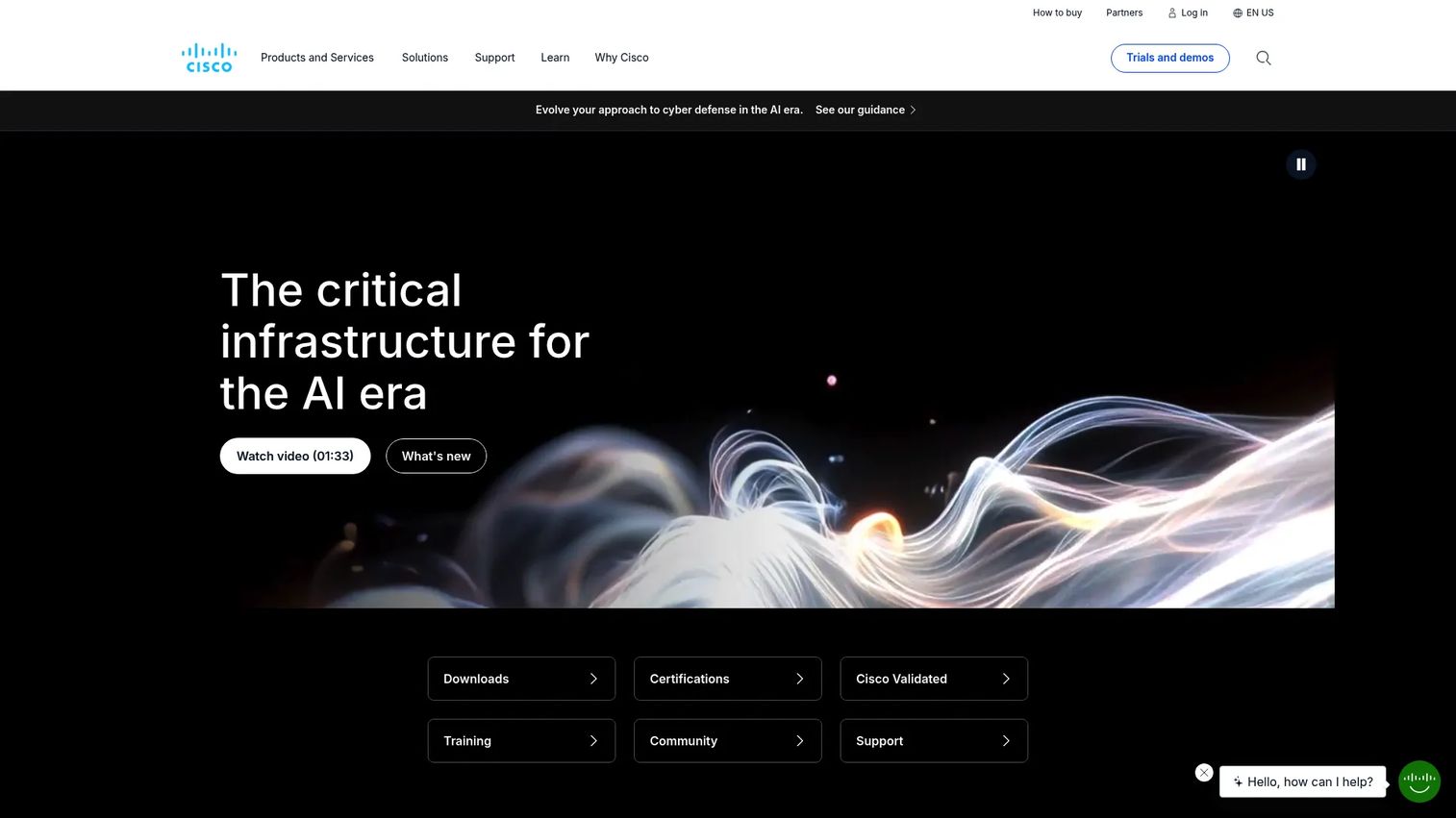
Cisco IoT Control Center is a cloud-based SaaS connectivity management platform for provisioning, monitoring, securing, and managing IoT device and SIM lifecycles at scale. It is one of the most established CMPs in the market, used by communication service providers and enterprises running connected vehicle, fleet, smart meter, and asset management programs. The platform handles SIM lifecycle workflows, real-time network visibility, billing controls, and eSIM remote provisioning from a single interface.
Best for: Telecom service providers and large enterprises managing tens of thousands to millions of cellular IoT SIMs.
Key features
- Automated provisioning and lifecycle-aware SIM configuration
- Real-time network visibility, diagnostics, and anomaly detection
- Multi-factor authentication, granular access controls, and SIM security
- Flexible rate plans, billing, and usage analytics
- eSIM remote provisioning and management
Why choose Cisco IoT Control Center: Choose it when the buyer needs a proven CMP with deep operator relationships, mature compliance documentation, and the ability to demonstrate SIM lifecycle workflows at fleet scale. It carries the weight of enterprise security review discussions.
Cisco IoT Control Center pricing: Cisco documents platform fees, device fees, and optional add-on fees, with pricing structured around deployment scale and carrier relationship. Contact Cisco or a channel partner for a quote.
G2 rating: 4.2/5
2. Telefónica Kite

Telefónica Kite is a managed IoT connectivity platform for remotely controlling and monitoring connected devices through cloud software, a web portal, or APIs. It supports 5G, NB-IoT, and LTE-M connectivity backed by Telefónica's global network footprint and includes real-time device monitoring, automated alerts for anomalous behavior, and security controls such as private APNs, VPNs, and SIM-level device controls.
Best for: Enterprises running IoT deployments that rely on Telefónica connectivity in Europe, Latin America, or other Telefónica-served regions.
Key features
- Real-time remote management and monitoring of IoT devices
- Cellular connectivity support including 5G, NB-IoT, and LTE-M
- Alerts and automated actions for anomalous SIM behavior
- Security controls: Private APNs, VPNs, alarms, and SIM device controls
- Cloud-hosted web portal and API access
Why choose Telefónica Kite: Strong choice when the buyer's IoT program already runs on Telefónica network infrastructure and they want operator-backed support tied to their existing carrier relationship. It simplifies commercial conversations when both connectivity and platform come from one provider.
Telefónica Kite pricing: Custom pricing. Contact Telefónica's enterprise IoT team for a quote tied to connectivity volume and service scope.
3. Verizon ThingSpace
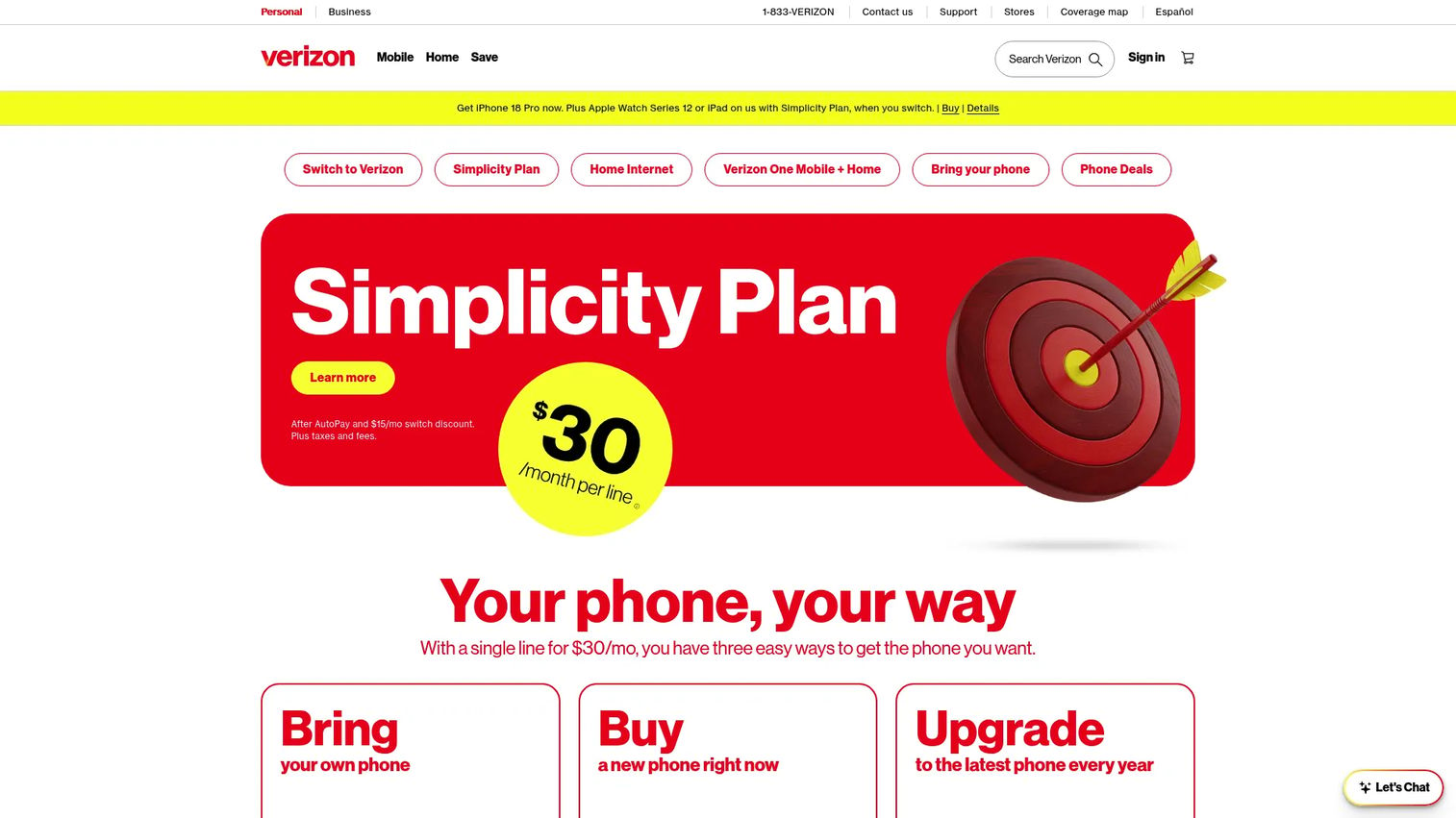
Verizon ThingSpace is Verizon's IoT platform for prototyping, connecting, monitoring, and managing cellular-connected devices, with published connectivity plans in the ThingSpace Marketplace. It covers device onboarding, connectivity management, software and firmware over-the-air updates, location services, geofencing, usage analytics, and SIM security. REST API access is available for teams integrating ThingSpace into existing enterprise workflows.
Best for: Developers and U.S.-focused enterprises that need Verizon network alignment alongside a structured device management and IoT connectivity API layer.
Key features
- Device activation, onboarding, and connectivity management
- Software and firmware over-the-air management
- Location services and geofencing
- Usage analytics and network or device status monitoring
- REST API and SIM security controls
Why choose Verizon ThingSpace: Best when Verizon is already the primary carrier, or when U.S. coverage and Verizon's enterprise support model matters to the buyer's security or procurement review. Published pricing makes early cost modeling straightforward during POC planning.
Verizon ThingSpace pricing: Published plans in the ThingSpace Marketplace start at $0.75/device/month for Unlimited NB-IoT, $14.00/device/month for the 1MB Connectivity plan, and $60.00/device/month for the 10GB Connectivity plan. Developer plans are also available from $5/year plus $1/device/month for 10MB.
G2 rating: 4.5/5
4. 1NCE
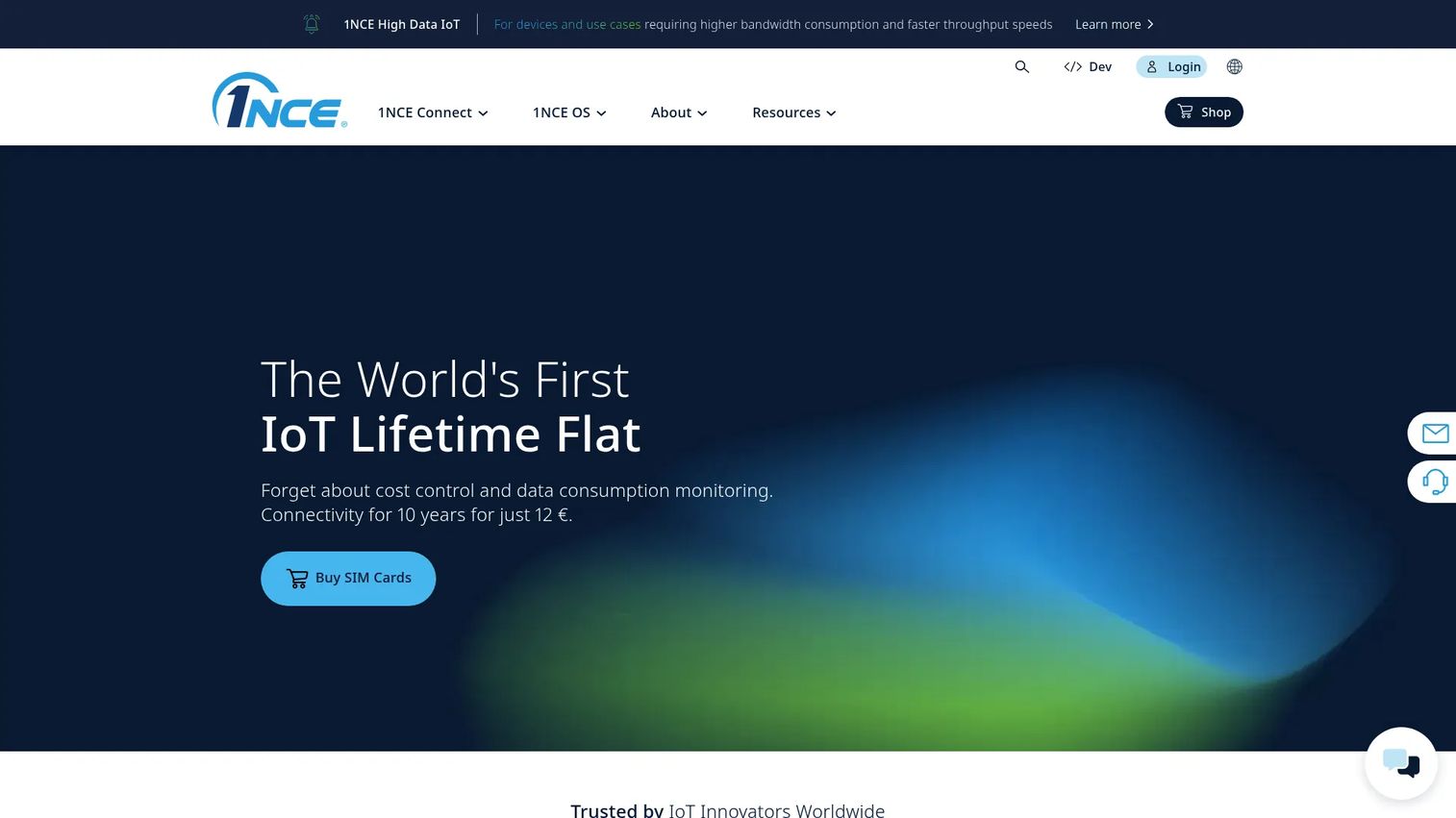
1NCE provides global cellular IoT connectivity and software tools for connecting, integrating, and managing IoT device fleets. Its model centers on a single prepaid plan with 500 MB data and 250 SMS included, covering 170+ countries and 2G through 5G-ready networks. The 1NCE OS adds tools including IoT Integrator, Device Locator, Energy Saver, and Device Authenticator alongside a customer portal and REST API.
Best for: Businesses deploying large fleets of low-to-medium-bandwidth IoT devices that need predictable, long-term cellular connectivity without per-carrier commercial complexity.
Key features
- Global cellular coverage across 170+ countries and multiple network generations
- 500 MB data and 250 SMS included in the base plan
- Customer portal and REST API for SIM management
- OpenVPN, IMEI Lock, monthly data limits, and eUICC support
- 1NCE OS tools: IoT Integrator, Device Locator, Energy Saver, Device Authenticator
Why choose 1NCE: Choose it when the buyer's devices send small, predictable data payloads and the deployment spans multiple countries. The fixed-cost model makes budget conversations at the board level straightforward. For high-throughput or complex multi-tenant programs, verify that the plan scope matches the actual traffic profile before committing.
1NCE pricing: The 1NCE IoT Lifetime Flat starts at $14 as a one-time payment for 10 years of service with 500 MB and 250 SMS. Data top-ups cost $10 per additional 500 MB. High Data Option pricing runs $5/GB on a usage basis.
G2 rating: 2.5/5
5. Aeris
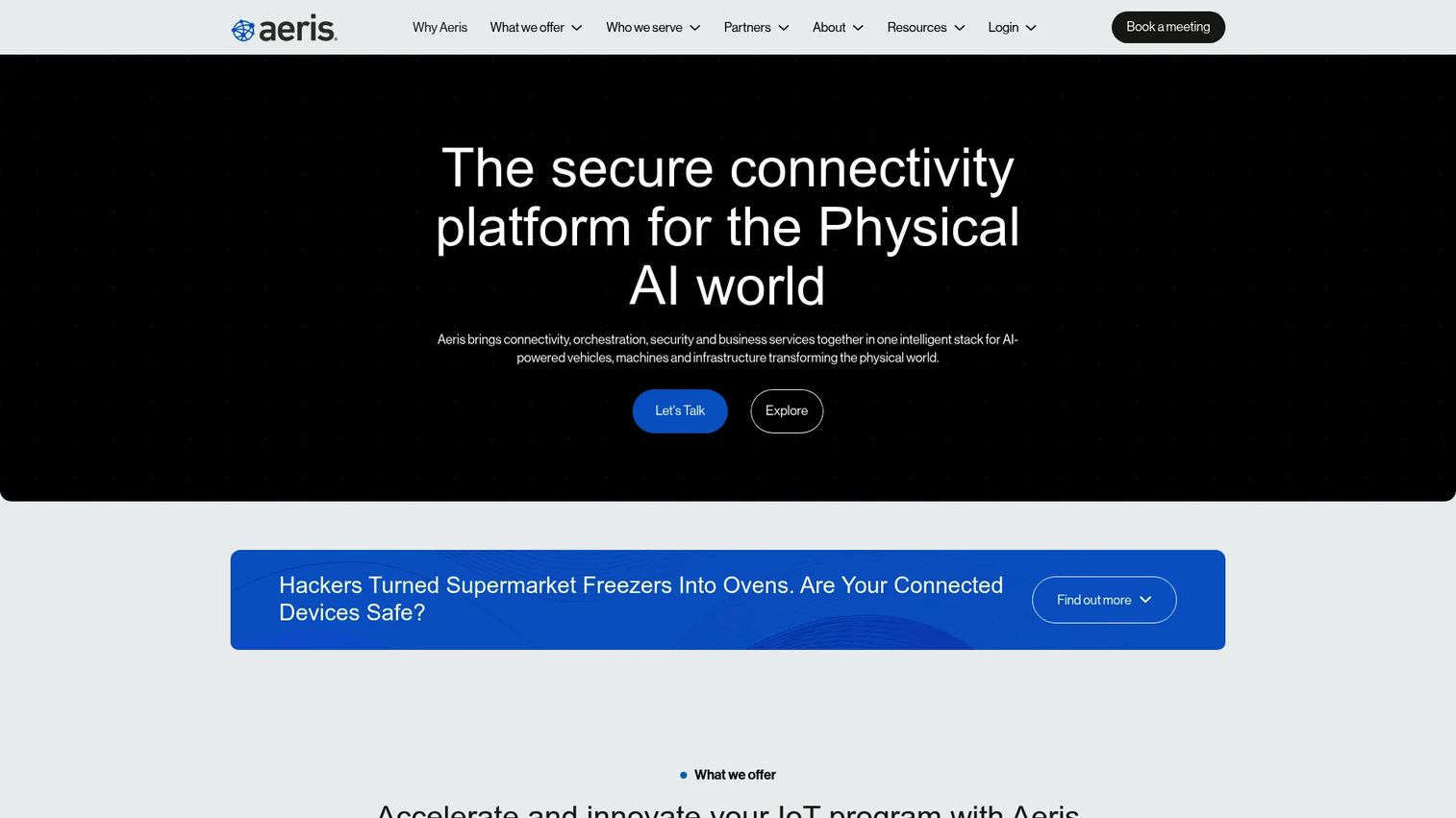
Aeris provides cellular IoT connectivity, device and eSIM management, IoT security, and connected-vehicle platforms for enterprise programs. Its platform covers global connectivity management, unified device management, eSIM lifecycle management with automated provisioning, and real-time IoT visibility including threat detection and zero-trust security controls. Aeris is well-positioned for programs where connectivity, security, and vehicle or asset lifecycle intersect.
Best for: Enterprise IoT teams and connected vehicle programs that need managed connectivity alongside operational expertise rather than a self-serve connectivity portal.
Key features
- Global connectivity management and unified device management
- eSIM lifecycle management and automated provisioning
- Real-time IoT visibility and zero-trust security controls
- Threat detection and connectivity analytics
- Connected vehicle and mobility use case support
Why choose Aeris: Good fit when the buyer wants more than a portal and needs a provider that can support deployment operations, carrier relationships, and eSIM orchestration under one contract. G2 reviewers rate the platform highly for enterprise IoT use cases.
Aeris pricing: Custom pricing. Contact Aeris for a quote tied to device count, regions, carrier configuration, and managed service scope.
G2 rating: 4.9/5
6. Airlinq
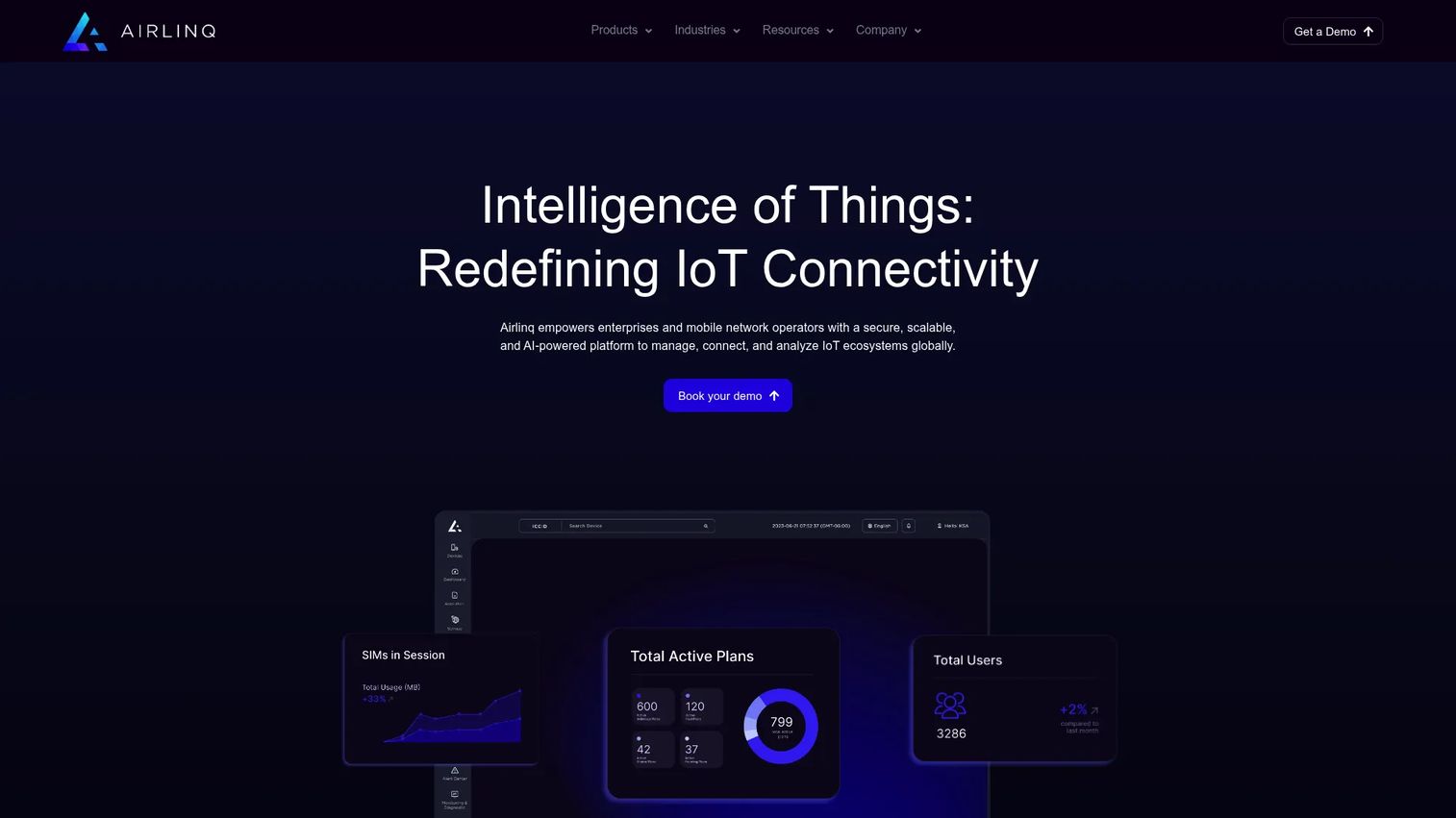
Airlinq is an enterprise IoT platform for managing, connecting, and analyzing global IoT ecosystems across telecommunications, automotive, utilities, and enterprise use cases. It offers a unified dashboard and metrics layer across multiple connectivity management platforms, AI-driven anomaly detection, SIM and device lifecycle management, enterprise API orchestration, and connectivity diagnostics. Airlinq can deploy on public, private, hybrid, or on-premises environments, which matters for buyers with data residency requirements.
Best for: Mobile network operators, automotive OEMs, utilities, and enterprises managing large-scale connected-device deployments that span multiple existing CMPs.
Key features
- Unified dashboard across multiple connectivity management platforms
- AI-driven anomaly detection, alerts, and SLA tracking
- SIM and device lifecycle management with global inventory oversight
- Enterprise API orchestration and connectivity diagnostics
- Cloud-agnostic deployment: Public, private, hybrid, or on-premises
Why choose Airlinq: Useful when a buyer already has existing carrier relationships and CMPs but needs a single orchestration layer above them. The multi-CMP visibility model addresses the "too many portals" pain without requiring a full platform migration.
Airlinq pricing: Custom pricing. Contact Airlinq through the request-a-demo form on their site for commercial details.
7. COMARCH CMP
COMARCH builds telecom-grade business support systems and connectivity management platforms for operators, MVNOs, and service providers. COMARCH CMP aligns closely with BSS-layer commercial operations, covering provisioning workflows, rating and billing, partner management, service orchestration, and multi-tenant support. For teams that need connectivity management tied tightly to telecom billing and service operations, COMARCH's depth in that stack is a differentiator.
Best for: Telecom operators and service providers that need connectivity management integrated with existing BSS infrastructure rather than a standalone IoT portal.
Key features
- Provisioning and SIM lifecycle workflows
- Rating and billing engine aligned with telecom BSS
- Partner and customer account management
- Service orchestration across carrier relationships
- Multi-tenant architecture for managed service operations
Why choose COMARCH CMP: Strong fit for operators and MVNOs where connectivity management, billing, and partner settlements need to run through a unified commercial stack. Less suited for a lean enterprise IoT team that only needs SIM visibility and diagnostics.
COMARCH CMP pricing: Custom pricing. Contact COMARCH's enterprise sales team for scope and quote.
8. Cubic Telecom
Cubic Telecom, now operating as Cubic³, provides global connectivity for software-defined vehicles and high-value mobile assets. Its platform covers connectivity across 200+ countries and 550+ mobile networks, eSIM remote management, SIM orchestration, dynamic profile switching, fleet migration, real-time diagnostics, monitoring, reporting, and regulatory-compliance support. The automotive OEM focus is reflected in every layer of the platform.
Best for: Automotive and agricultural OEMs managing global connected vehicles or mobile assets that require cross-border connectivity operations and regional compliance support.
Key features
- Global connectivity across 200+ countries and 550+ mobile networks
- eSIM remote management, SIM orchestration, and dynamic profile switching
- Fleet migration and cross-border connectivity management
- Real-time diagnostics, monitoring, and reporting
- Regulatory-compliance support across regions
Why choose Cubic Telecom: Choose it when the connected vehicle or OEM program needs a provider built from the ground up for automotive-scale global connectivity. The platform handles the multi-region eSIM complexity that generic CMPs treat as an edge case.
Cubic Telecom pricing: Custom pricing. Contact Cubic³ for commercial details tied to vehicle program scope and regional coverage requirements.
9. emnify IoT SuperNetwork
emnify is a cloud-native global IoT connectivity platform providing managed cellular and satellite connectivity through a single SuperNetwork. It gives access to 540+ networks across 180+ countries, supports 2G through 5G including LTE-M, NB-IoT, and satellite, and includes automated SIM provisioning, activation, and deactivation alongside API-first integrations with cloud and analytics platforms. The platform suits software-led IoT teams that need programmable IoT connectivity automation rather than a carrier portal with limited API access.
Best for: IoT businesses that need scalable, global, multi-network connectivity with strong API access for integrating connectivity data into existing cloud and analytics workflows.
Key features
- Access to 540+ networks across 180+ countries
- Global eSIM connectivity: 2G, 3G, 4G, LTE-M, NB-IoT, 5G, and satellite
- Automated SIM provisioning, activation, configuration, and deactivation
- Real-time network insights, usage monitoring, and incident data
- API-first cloud and analytics platform integrations
- IoT security: IMEI lock, MFA, private IPs, and VPN options
Why choose emnify IoT SuperNetwork: Best when the IoT product team wants to treat connectivity as a programmable resource and integrate SIM data directly into existing engineering workflows. A free trial is available to test the API layer before committing.
emnify pricing: Custom pricing across Standard, Plus, and Pro packages. Pricing factors include deployment size, data usage, coverage, SIM form factor, and selected features. A free trial is available.
G2 rating: 4.9/5
10. Eseye Infinity
Eseye Infinity is Eseye's IoT connectivity management platform for managing devices, SIMs, networks, subscriptions, security, reporting, and integrations from one system. It covers SIM provisioning, activation, suspension, and termination alongside dynamic network switching, over-the-air device updates, security controls including IMEI locking and private APNs, and subscription and billing reporting. Two tiers are documented: Infinity Flex for mid-sized deployments and Infinity Enterprise for global or more complex programs.
Best for: Enterprise and mid-sized organizations managing global IoT device estates across multiple cellular networks and contracts that want operational support alongside platform access.
Key features
- SIM provisioning, activation, suspension, and termination
- Dynamic network switching and multi-network connectivity
- Over-the-air device lifecycle management
- Security: IMEI locking, firewalls, private APNs, and VPNs
- Subscription, billing, SLA reporting, and API integrations
Why choose Eseye Infinity: Suits teams that want managed global connectivity help alongside the software tools, not just a portal. The Infinity Flex and Infinity Enterprise structure lets buyers size the commitment to their deployment phase.
Eseye pricing: Pricing is quote-based across Infinity Flex and Infinity Enterprise tiers. Contact Eseye for commercial terms tied to device count, regions, and support model.
G2 rating: 4.4/5
11. floLIVE CMP
floLIVE is a cloud-based IoT connectivity management platform for MNOs, MVNOs, enterprises, and IoT service providers. Its architecture centers on a distributed core network with eUICC support, SM-DP, SM-SR, and SGP.32 readiness for eSIM orchestration. Features include real-time SIM status and diagnostics, Multi-IMSI lifecycle management, connectivity policies, QoS controls, roaming rules, an integrated rating and billing engine, multi-tenant role-based access, REST APIs, and a white-label management console.
Best for: Organizations launching or operating large-scale global IoT connectivity services that need eSIM management, multi-tenancy, and billing inside a single cloud-native platform.
Key features
- Real-time SIM status, usage, location, and performance monitoring
- SIM, eSIM, and Multi-IMSI lifecycle management
- eUICC support: SM-DP, SM-SR, and SGP.32
- Integrated rating and billing engine
- Multi-tenant architecture with white-label console and REST APIs
Why choose floLIVE CMP: One of the stronger options when remote SIM provisioning and eSIM management are first-class requirements rather than an add-on. The distributed core design is relevant for buyers running connectivity services across multiple countries and customer accounts.
floLIVE CMP pricing: The license includes core network, BSS, and connectivity management with no per-SIM or per-IMSI fees. Custom pricing. Contact floLIVE for scope and commercial terms.
G2 rating: 4.7/5
12. KORE ConnectivityPro
KORE ConnectivityPro is KORE's centralized IoT connectivity management platform for activating, managing, monitoring, and integrating SIM connectivity across multiple carriers and geographies. It offers real-time SIM provisioning and lifecycle management, usage monitoring with rule-based actions, customizable data visualization and reporting, diagnostics, network traffic monitoring, an API library, and hierarchical account management. KORE pairs the platform with its broader managed IoT connectivity operations expertise.
Best for: Enterprise IoT organizations managing large, distributed device fleets across multiple carriers that want fewer direct carrier relationships to manage internally.
Key features
- Real-time SIM provisioning and lifecycle management
- Usage monitoring with rule-based actions and alerts
- Customizable dashboards and reporting
- Diagnostics and network traffic monitoring
- API library and hierarchical account management
Why choose KORE ConnectivityPro: Best when the buyer wants the platform and the carrier relationship management under one provider rather than building a multi-carrier procurement function internally. KORE's operational coverage fills gaps that software alone cannot.
KORE ConnectivityPro pricing: Custom pricing. Contact KORE for commercial terms tied to device count, carrier configuration, and managed service scope.
13. SORACOM
SORACOM is a cloud-native IoT platform providing cellular and satellite connectivity, cloud integrations, networking, device management, and analytics platforms. It supports multi-carrier cellular, satellite, and Wi-Fi/Ethernet connectivity, SIM lifecycle management through console, API, and CLI, and private networking with secure cloud routing, remote device access, and packet capture. The IoT connectivity API layer is extensive, with published developer documentation and usage-based pricing that makes early-stage cost modeling transparent.
Best for: Businesses deploying and managing connected IoT devices globally with cellular or satellite connectivity and a need for programmable, cloud-integrated networking.
Key features
- Multi-carrier cellular, satellite, and Wi-Fi/Ethernet connectivity
- SIM lifecycle management via console, API, and CLI
- Private networking and secure cloud routing
- Remote device access and packet capture
- Usage-based pricing with published developer documentation
Why choose SORACOM: Choose it when the IoT team is engineering-led and wants to treat SIM management as a software operation. The API documentation and published pricing make it one of the more transparent options for presales teams running cost estimates in a POC.
SORACOM pricing: Usage-based. The plan01s starts at $0.06/day per active SIM. The plan-NA1-package runs $0.99/month for a 3MB U.S./Canada monthly package. See SORACOM's developer documentation for full regional pricing.
14. Tata Communications MOVE

Tata Communications MOVE is an enterprise IoT connectivity and management platform for connecting, orchestrating, securing, and analyzing devices, vehicles, and industrial assets globally. It covers IoT fleet connectivity across 160+ countries, an eSIM hub with multi-network connectivity orchestration, single-pane-of-glass dashboards and reporting, AI-driven connectivity optimization, APIs for asset and SIM management, and zero-trust security architecture.
Best for: Large enterprises, automotive OEMs, MVNOs, and IoT operators that need globally managed connectivity and device orchestration across a wide geographic footprint.
Key features
- Global IoT connectivity and management across 160+ countries
- eSIM hub and multi-network connectivity orchestration
- AI-driven connectivity optimization and network switching
- APIs for asset, device, connection, SIM, and eSIM management
- Zero-trust security and regulatory compliance architecture
Why choose Tata Communications MOVE: Strong fit for multinational enterprise programs where global coverage, carrier-grade reliability, and managed service support are non-negotiable. Presales teams can use the global footprint and eSIM hub to answer coverage and failover questions in a POC.
Tata Communications MOVE pricing: Custom pricing. Contact Tata Communications for commercial terms tied to device volume, regions, and service scope.
15. Deutsche Telekom TMSP
Deutsche Telekom TMSP (Telekom M2M Service Portal 3.0) is a web portal for monitoring and managing IoT SIM connectivity, usage, costs, and security within Deutsche Telekom's network infrastructure. It covers SIM status and usage monitoring, SIM ordering and activation, tariff assignment, usage limits, abnormal-usage detection, encrypted IPsec tunnels, user rights management, reports, and API integration with enterprise IT systems.
Best for: Businesses managing large-scale global IoT deployments that use Deutsche Telekom as a primary carrier and want operator-grade connectivity oversight and monitoring.
Key features
- IoT SIM status, usage, and cost monitoring
- SIM ordering, activation, and tariff assignment
- Usage limits and abnormal-usage detection
- Encrypted IPsec tunnels and user rights management
- Reports and API integration with enterprise IT systems
Why choose Deutsche Telekom TMSP: A solid choice when Deutsche Telekom is already the primary carrier and the buyer wants a portal deeply integrated with that network relationship. European enterprise programs benefit from Deutsche Telekom's regulatory familiarity and operational footprint.
Deutsche Telekom TMSP pricing: Custom pricing. Contact Deutsche Telekom's enterprise IoT team for commercial terms.
16. Vodafone CMP

Vodafone CMP (represented by Vodafone's GDSP Managed IoT Connectivity Platform) provides global IoT connectivity management and control. It gives centralized visibility and control over IoT SIMs, remote SIM activation and deactivation, and customizable reporting, alerts, and diagnostic tools across Vodafone's global network footprint. SIM and eSIM management, international IoT connectivity, usage reporting, and API integration are core to the platform.
Best for: Enterprises and global programs that want operator-backed IoT connectivity management with Vodafone's international network reach as the foundation.
Key features
- Centralized IoT SIM visibility and control
- Remote SIM activation and deactivation
- SIM and eSIM management
- Customizable reporting, alerts, and diagnostic tools
- API integration
Why choose Vodafone CMP: Best for buyers that are already operating on Vodafone's network and want the connectivity management layer aligned with that carrier relationship. The global footprint simplifies cross-border IoT fleet conversations.
Vodafone CMP pricing: Custom pricing. Contact Vodafone's IoT team for commercial terms tied to connectivity volume and geographic scope.
17. Wireless Logic SIMPro
Wireless Logic SIMPro is a secure, cloud-based IoT connectivity management platform for managing SIMs, eSIMs, devices, usage, billing, and automation across networks. It covers SIM and eSIM activation, suspension, status management, roaming controls, SMS, and SIM swaps alongside custom dashboards, real-time usage and session data, location tracking, usage alerts, a REST API, advanced rules, workflow integration, and live support chat. An optional DevicePro add-on extends device management capabilities.
Best for: Organizations deploying and managing IoT SIM estates across multiple networks and countries that want practical estate management tools with published license pricing.
Key features
- SIM and eSIM activation, suspension, roaming controls, and SIM swaps
- Custom dashboards, real-time usage and session data, and location tracking
- Usage alerts and REST API access
- Advanced rules and workflow integration
- Optional DevicePro device management add-on
Why choose Wireless Logic SIMPro: One of the few platforms in this category with a publicly listed license price, which simplifies early-stage budget conversations with buyers. Practical multi-network estate management without the complexity of full operator-tier CMPs.
Wireless Logic SIMPro pricing: The SIMPro Licence is listed at £2.50 per Active User in the official Wireless Logic price list. Connectivity charges apply separately.
18. BICS
BICS is a global communications enabler providing cloud communications, IoT connectivity, roaming, messaging, voice, and network services. Its IoT capability covers global connectivity with SIM, eSIM, and iSIM support across 2G through 5G, NB-IoT, and LTE-M. BICS provides APIs for SIM management, IoT connectivity services, number management, ordering, porting, reporting, and regulatory workflows, backed by 24/7 multilingual support and global monitoring.
Best for: Telecommunications providers, enterprises, and IoT businesses needing global carrier-grade connectivity with strong roaming and international network expertise.
Key features
- Global IoT connectivity: SIM, eSIM, and iSIM across 2G through 5G, NB-IoT, and LTE-M
- APIs for SIM management, number management, ordering, and reporting
- Global roaming and international connectivity services
- Regulatory workflow support
- 24/7 multilingual support and global network monitoring
Why choose BICS: Choose BICS when the buyer's IoT program requires cross-border roaming expertise at a carrier wholesale level, or when they are building a telecommunications platform that needs BICS as a wholesale connectivity layer.
BICS pricing: Usage-based, wholesale, and contract-based pricing. Contact BICS for commercial terms.
19. Giesecke+Devrient CMP

Giesecke+Devrient's IoTgo® Control is a connectivity management platform for administering IoT connectivity, eSIMs, lifecycle management, and remote SIM provisioning. It covers centralized IoT connectivity and device management, eSIM and iSIM lifecycle management, remote SIM provisioning supporting GSMA standards SGP.02, SGP.22, SGP.32, and SGP.42, real-time analytics, usage tracking and diagnostics, full API access, and built-in IoT security with encryption and authentication.
Best for: Enterprises, device manufacturers, automotive companies, and IoT operators where GSMA-compliant remote SIM provisioning and secure eSIM lifecycle control are first-class requirements.
Key features
- Centralized IoT connectivity and device management
- eSIM and iSIM lifecycle management
- Remote SIM provisioning: SGP.02, SGP.22, SGP.32, and SGP.42
- Real-time analytics, usage tracking, and diagnostics
- Full API access and built-in security with encryption and authentication
Why choose Giesecke+Devrient CMP: One of the few platforms with explicit GSMA multi-standard remote SIM provisioning coverage. When buyers are evaluating eSIM orchestration depth during technical validation, G+D's heritage in SIM and secure element manufacturing makes the security and standards conversation straightforward.
Giesecke+Devrient CMP pricing: Custom pricing. Contact G+D for commercial terms based on deployment scale and provisioning requirements.
20. Telit Cinterion CMP

Telit Cinterion provides an IoT connectivity management platform for monitoring, provisioning, controlling, and optimizing connected-device deployments, aligned with its NExT Connected Module hardware program. The platform covers device activation and deactivation, real-time visibility into device and connection status, and subscription lifecycle management and provisioning controls. For teams buying IoT modules from Telit Cinterion, the CMP is available as part of bundled NExT Connected Module packages.
Best for: Enterprise IoT deployments that use or plan to use Telit Cinterion IoT modules and want hardware and connectivity management from a single vendor relationship.
Key features
- Device activation and deactivation
- Real-time device, usage, and connection status visibility
- Subscription lifecycle management and provisioning controls
- Diagnostics support
- API automation
Why choose Telit Cinterion CMP: Best for teams that want to reduce the number of vendor relationships by getting IoT hardware and connectivity management from the same provider. The module-plus-platform model simplifies procurement for buyers running hardware-led IoT programs.
Telit Cinterion CMP pricing: NExT Connected Module packages with the CMP included start at $0.89/month. Standalone CMP pricing requires a quote from Telit Cinterion's sales team.
Considerations when choosing IoT connectivity management software
Match the platform to your connectivity model
Operator-backed portals fit teams with a single primary carrier and regional deployments. API-first platforms suit engineering-led teams building connected products. Managed connectivity providers suit teams that want operational support alongside the software. Telecom-grade CMPs fit operators, MVNOs, and multi-tenant service provider programs. Know which model your buyer is building before shortlisting.
Validate SIM and eSIM lifecycle depth
Ask vendors to show activation, suspension, deactivation, plan changes, remote provisioning, profile switching, and bulk operations in a test environment. SIM lifecycle management depth varies considerably across platforms. For eSIM management, verify GSMA standard support (SGP.22, SGP.32) and ask which carriers and device types are compatible before a POC.
Test diagnostics before rollout
Run the platform against failed connections, unreachable devices, roaming configuration issues, APN misconfiguration, and data spikes before deployment. IoT network diagnostics built into the platform should give you a root cause, not just a connection status flag. Platforms that require a support ticket to investigate a device event add friction to both POCs and production operations.
Check billing and cost-control workflows
Verify usage thresholds, pooled data controls, overage alerts, invoice detail, and customer-level cost allocation. IoT connectivity billing becomes a board-level problem when fleet scale exposes unexpected overages. Ask vendors to show the cost reporting interface with realistic device counts during your evaluation.
Review APIs, integrations, and access controls
Confirm REST API scope, webhook availability, CRM and ERP integration paths, SSO support, role-based access controls, audit logs, and multi-tenant account structure. These requirements surface in security reviews and RFPs, so verify them early rather than discovering a gap after a POC commitment. Reviewing API development tools and access control software in your broader presales stack can help you frame integration questions more precisely.
Conclusion
The right IoT connectivity management platform depends on the shape of your deployment. Operator-backed platforms like Cisco IoT Control Center, Telefónica Kite, Verizon ThingSpace, Deutsche Telekom TMSP, and Vodafone CMP fit buyers tied to a carrier footprint. API-first platforms like SORACOM and emnify IoT SuperNetwork fit engineering-led IoT products. Managed connectivity providers like KORE ConnectivityPro, Aeris, and Eseye Infinity fit teams that want operational help alongside software access. Telecom-grade CMPs like floLIVE, COMARCH, and Giesecke+Devrient CMP fit operators, MVNOs, and programs where eSIM orchestration or multi-tenancy is core.
For presales teams running technical validation, the practical next step is to shortlist three to five platforms, then ask each vendor to demonstrate SIM activation, eSIM provisioning, diagnostics on a failed connection, usage alerts, billing reports, and API automation in a test account. Run a small POC against your actual device traffic patterns before committing to a commercial model.
Need to show your own IoT product to buyers during that validation process? Start your journey with Guideflow today!
FAQs
IoT connectivity management software is a platform for managing the network connectivity of connected devices across SIMs, eSIMs, carrier profiles, data usage, connection status, billing, alerts, diagnostics, and automation. Enterprise teams reach for a CMP when carrier portals and spreadsheets stop scaling as deployments grow across regions, carriers, and device types. The software replaces manual per-carrier portal work with centralized control.
A carrier portal typically shows connectivity data for one provider's network. A connectivity management platform offers broader lifecycle control, multi-carrier visibility, automation, reporting, and enterprise integrations depending on the vendor. The gap becomes visible when a fleet spans multiple carriers or countries and teams need one consistent view for diagnostics, billing, and SIM lifecycle operations.
Global IoT connectivity management requires multi-carrier coverage, eSIM support, roaming control, regional compliance support, usage alerts, and clear commercial terms that hold across currencies and jurisdictions. Platforms like emnify IoT SuperNetwork (540+ networks, 180+ countries), Tata Communications MOVE (160+ countries), 1NCE (170+ countries), and Cubic Telecom (200+ countries, 550+ networks) cover wide geographic scope. Match the choice to whether the buyer needs self-serve connectivity, managed operations support, or eSIM-first orchestration.
Many do, but eSIM management depth varies significantly. Some platforms provide full remote SIM provisioning aligned with GSMA standards including SGP.22, SGP.32, and SGP.42, as Giesecke+Devrient CMP does. Others support eSIM activation and profile management at a more basic level. During technical validation, verify remote provisioning capability, profile management workflows, multi-IMSI support, supported carriers, and device compatibility rather than accepting a general "yes" to eSIM.
Platforms provide usage thresholds, overage alerts, plan optimization tools, invoice visibility, pooled data management, device-level usage reports, and anomaly detection. These capabilities stop late invoice surprises by flagging cost anomalies before they reach billing. IoT connectivity cost control is especially valuable for large fleets where individual device behavior varies unpredictably across regions and traffic patterns.
Test SIM activation and suspension, eSIM provisioning and profile switching, device diagnostics on a simulated failed connection, APN configuration, usage threshold alerts, API calls and response payloads, reporting exports, role permissions across account levels, and billing visibility tied to realistic device counts. These are the workflows buyers will ask to see live during technical evaluation, so verifying them in a test account before a formal POC saves significant time.
Most CMPs focus on cellular IoT including SIM and eSIM connectivity across 2G through 5G, LTE-M, and NB-IoT. Some platforms extend to satellite connectivity (emnify, SORACOM), private network management, Wi-Fi or Ethernet-connected devices, or cloud IoT platform integrations. Verify the specific connectivity scope against your buyer's deployment architecture rather than assuming all CMPs cover the same network types.
Pricing across this category typically includes platform fees, per-SIM or per-device fees, data usage charges, carrier contract costs, managed service fees, API volume, and enterprise support tiers. 1NCE offers a flat $14 one-time fee for 10 years per SIM. SORACOM publishes usage-based pricing starting at $0.06/day per active SIM. Verizon ThingSpace publishes per-device monthly plans from $0.75. Most enterprise CMPs require a quote. When comparing vendors, give each the same device count, regions, data traffic profile, and support model to get a comparable commercial picture.