You do not need more headlines. You need sources you can trust enough to cite, monitor, and return to.
Most news consumers are not starved for information. The problem is evaluating it. According to the Reuters Institute for the Study of Journalism (2025), only 18% of people across 20 countries paid for online news in the past year, yet the volume of sources competing for their attention has never been higher. For a digital marketer tracking issue narratives, building a media relations list, or sourcing credible context for thought leadership, the question is not where to find coverage. It is which outlets have transparent ownership, original reporting, and a clear editorial mission worth citing.
Independent journalism is not a guarantee of accuracy. It is a structural description: These outlets operate outside large corporate, state, or partisan ownership. That independence matters for source evaluation, but it does not replace checking the evidence yourself.
This guide gives you a curated shortlist of 20 independent media platforms for 2026, organized for practical use by researchers, communications teams, and growth marketers who need better sources, not more of them.
What's inside
This guide covers 20 independent media platforms selected for 2026. Each was evaluated against four criteria:
- Original reporting or verified databases: The outlet publishes its own journalism, not only aggregation
- Editorial independence: Ownership and funding structures are documented and separate from major corporate or state control
- Topic authority: Each platform has a defined beat where it goes deeper than general news
- Format and workflow fit: Coverage is accessible via newsletters, databases, audio, or video for different research needs
The list spans investigative newsrooms, nonprofit outlets, climate and education publications, campaign finance research tools, and media watchdog organizations.
TL;DR
- Best overall for investigative reporting: ProPublica, with deep investigations backed by original documents and public databases
- Best for independent broadcast and global democracy coverage: Democracy Now!, with daily video, audio, and full transcripts
- Best for public accountability research: Center for Public Integrity, covering inequality and institutional power
- Best for criminal justice reporting: The Marshall Project, with the deepest single-beat focus on U.S. prisons and courts
- Best for climate and environment coverage: Inside Climate News for investigative depth, Grist for climate solutions and culture
- Best for local policy tracking: CalMatters for California, The Texas Tribune for Texas statehouse coverage
- Best for media criticism and bias analysis: Fairness and Accuracy in Reporting
What are independent media platforms?
Independent media platforms are news outlets, nonprofit newsrooms, broadcasters, watchdog organizations, and public-interest publications that operate with editorial independence from large corporate, state, or partisan ownership structures.
The defining characteristic is not political stance or journalistic style. It is the separation between editorial decisions and ownership influence. Most platforms on this list are nonprofit, funded by reader donations, foundation grants, or membership models rather than advertising revenue from large corporate sponsors.
Key characteristics of independent media platforms include:
- Transparent ownership and funding: The outlet discloses its ownership structure and major funders
- Original reporting or source databases: Content is produced through original journalism, expert analysis, or verified public-record research
- Clear editorial mission: A stated focus area, whether investigative accountability, climate, criminal justice, or education
- Public-interest orientation: Coverage prioritizes civic value over commercial audience maximization
- Topic or regional expertise: Each platform tends to go deeper on a specific beat than general-interest publications
- Accessible formats: Newsletters, podcasts, video, databases, and explainers serve different reader workflows
- Corrections and ethics policies: Editorial standards are documented and publicly visible
One important distinction: Independent does not automatically mean neutral, unbiased, or more accurate than mainstream sources. Many outlets on this list have explicit editorial viewpoints. Readers still need to evaluate sourcing, evidence quality, corrections practices, and the separation between reported news and opinion. What these platforms offer is documented independence from corporate ownership chains, which is one factor in a larger source evaluation process.
| Format | Mainstream corporate media | Independent media platform |
|---|---|---|
| Ownership | Large media conglomerates or publicly traded companies | Nonprofit, donor, or foundation funded |
| Revenue driver | Advertising, subscriptions, or parent company | Reader donations, grants, or membership |
| Editorial accountability | Corporate leadership | Board governance and editorial independence policies |
| Coverage scope | Broad general interest | Often narrow, deep beat focus |
| Transparency | Varies widely | Often more explicit about mission and funders |
When to use independent media platforms
Track issues before they reach mainstream coverage
Niche independent outlets frequently publish investigations into policy, labor, criminal justice, and local government months before general-interest publications pick up the story. ProPublica's database journalism and The Marshall Project's prison reporting are consistent examples of original work that surfaces systemic issues before they become national headlines. If your team monitors policy narratives for campaign research or public affairs work, these outlets function as early-signal sources.
Build a more diverse source list for research and outreach
Marketers and communications teams often over-rely on a handful of national outlets when building background research or media relations lists. Source diversity reduces blind spots in your understanding of how an issue is being covered across different communities and stakeholders. Adding specialized outlets for climate, education, campaign finance, or regional policy gives you context that general publications often compress or miss entirely.
Find expert reporting on specific beats
Many independent platforms are strongest in one narrow area. Open Secrets is the go-to source for campaign finance data. Chalkbeat covers K-12 education with local bureau depth. The Conversation provides academic expert analysis on specific research topics. Choosing by beat fit rather than general reputation gives you more precise, citable information for reports, briefings, or thought leadership content.
Independent media platforms comparison
The table below is a practical selection guide by reporting strength, format, and use case. It is not a ranking of trustworthiness from most credible to least. Every platform listed has documented editorial standards, but readers should verify sourcing and corrections policies independently before citing.
Pricing reflects access model, not software subscription cost. G2 ratings are N/A across the board: These are media organizations, not software products with G2 profiles.
| # | Product | Best for | Key differentiator | Pricing | G2 rating |
|---|---|---|---|---|---|
| 1 | ProPublica | Investigative journalism | Public-interest investigations with original databases | Free with donations | N/A |
| 2 | Democracy Now! | Independent broadcast news | Daily program with video, audio, and full transcripts | Free with donations | N/A |
| 3 | Center for Public Integrity | Accountability reporting | Investigations into inequality and public systems | Free with donations | N/A |
| 4 | The Marshall Project | Criminal justice reporting | Deepest single-beat focus on U.S. criminal justice | Free with donations | N/A |
| 5 | Inside Climate News | Climate journalism | Nonprofit, Pulitzer-recognized climate investigations | Free with donations | N/A |
| 6 | Reveal | Investigative audio | Long-form investigations in radio, podcast, and digital | Free with donations | N/A |
| 7 | The 19th News | Gender and politics coverage | Nonprofit newsroom for women and LGBTQ+ communities | Free with donations | N/A |
| 8 | The Conversation | Expert analysis | Academics writing research-backed journalism for public audiences | Free | N/A |
| 9 | Open Secrets | Money in politics research | Campaign finance and lobbying data and searchable records | Free with donations | N/A |
| 10 | Grist | Climate and climate justice | Climate solutions and culture with policy context | Free with donations | N/A |
| 11 | Chalkbeat | Education reporting | Local bureau coverage of U.S. public education | Free with donations | N/A |
| 12 | CalMatters | California policy coverage | State policy, politics, and explainer journalism | Free with donations | N/A |
| 13 | The Texas Tribune | Texas politics and policy | Statehouse reporting, data tools, and public events | Free with donations | N/A |
| 14 | Mother Jones | Investigative and political reporting | Magazine-style investigations with reader-supported model | Free plus subscription or donation | N/A |
| 15 | The Nation | Progressive politics and culture | Long-running political magazine with archive back to 1865 | Subscription from $24.95/year | N/A |
| 16 | Common Dreams | Progressive news and commentary | Advertising-free independent news and Progressive Newswire | Free with donations | N/A |
| 17 | Truthout | Social justice reporting | Paywall-free independent journalism on movements and politics | Free with donations | N/A |
| 18 | The Intercept | National security and accountability | Investigations into power, surveillance, and civil liberties | Free with donations | N/A |
| 19 | The Real News Network | Independent video journalism | Video-first reporting on labor, climate, and social movements | Free with donations | N/A |
| 20 | Fairness and Accuracy in Reporting | Media criticism | Watchdog analysis of media bias, sourcing, and framing | Free with donations | N/A |
Best 20 independent media platforms for 2026
1. ProPublica
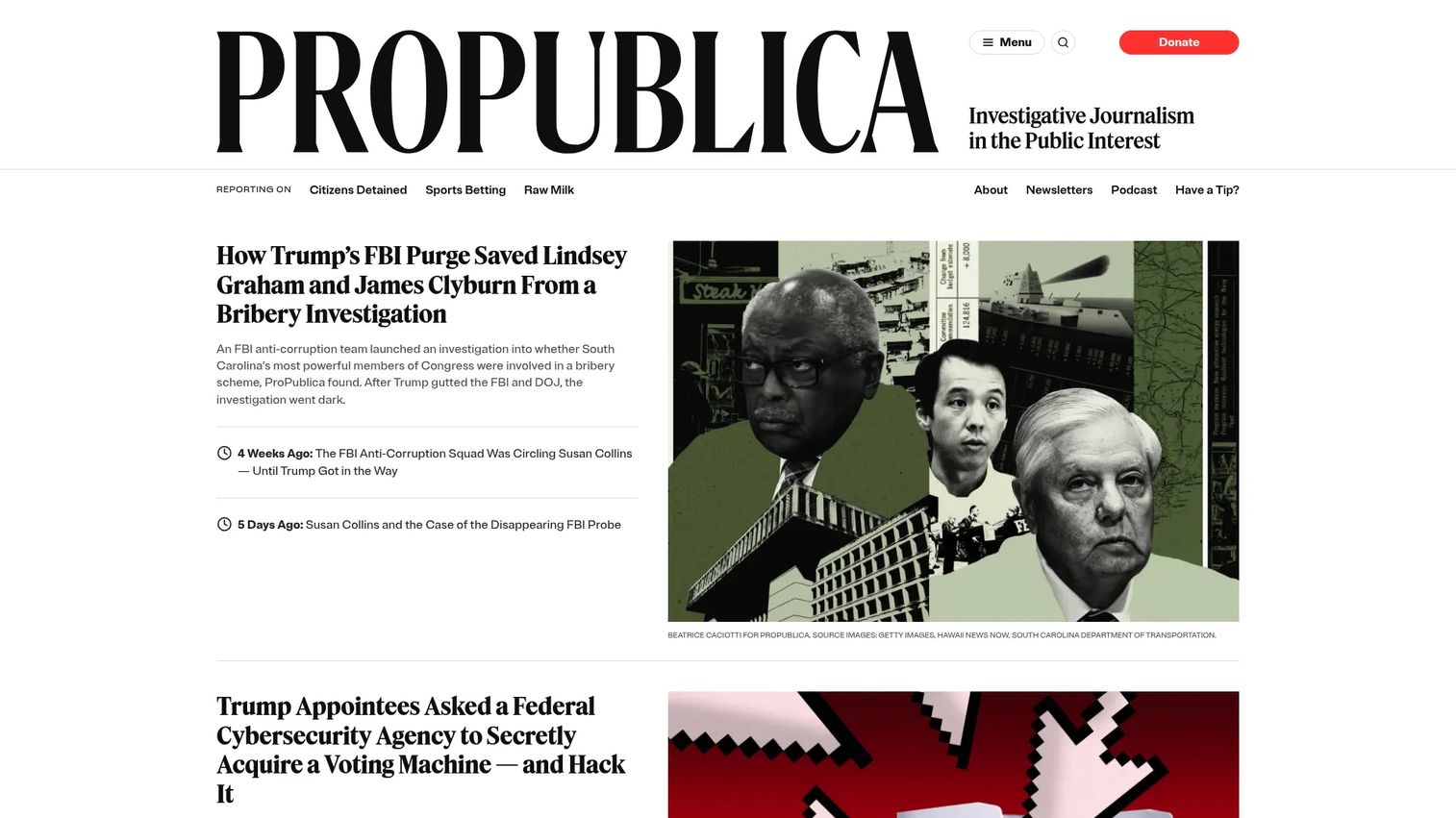
ProPublica is a nonprofit investigative newsroom built around one principle: Journalism that exposes abuses of power. It covers federal and state government, business, criminal justice, health care, immigration, education, and technology through long-form investigations backed by documents, public records, and original data work. Its Nonprofit Explorer is one of the most practical public tools available for anyone researching organizations, giving access to financial filings, employee data, and searchable records.
Best for: Researchers, journalists, and marketers who need deeply documented investigations into institutions, policy, and corporate accountability.
Key features
- Investigations across government, business, criminal justice, and health care
- Nonprofit Explorer with financial data and document search
- Visual explainers and data visualizations alongside reporting
- Newsletters, podcasts, and tip submission pathways
- Local newsroom partnerships extending geographic coverage
Why choose ProPublica: It is the strongest pick when a topic requires evidence, not only narrative. The combination of original investigations and publicly searchable databases makes it genuinely useful for background research, not just reading.
ProPublica pricing: Free to read, donation-supported. There are no paid tiers or subscription fees for access to reporting or databases.
G2 rating: N/A.
2. Democracy Now!
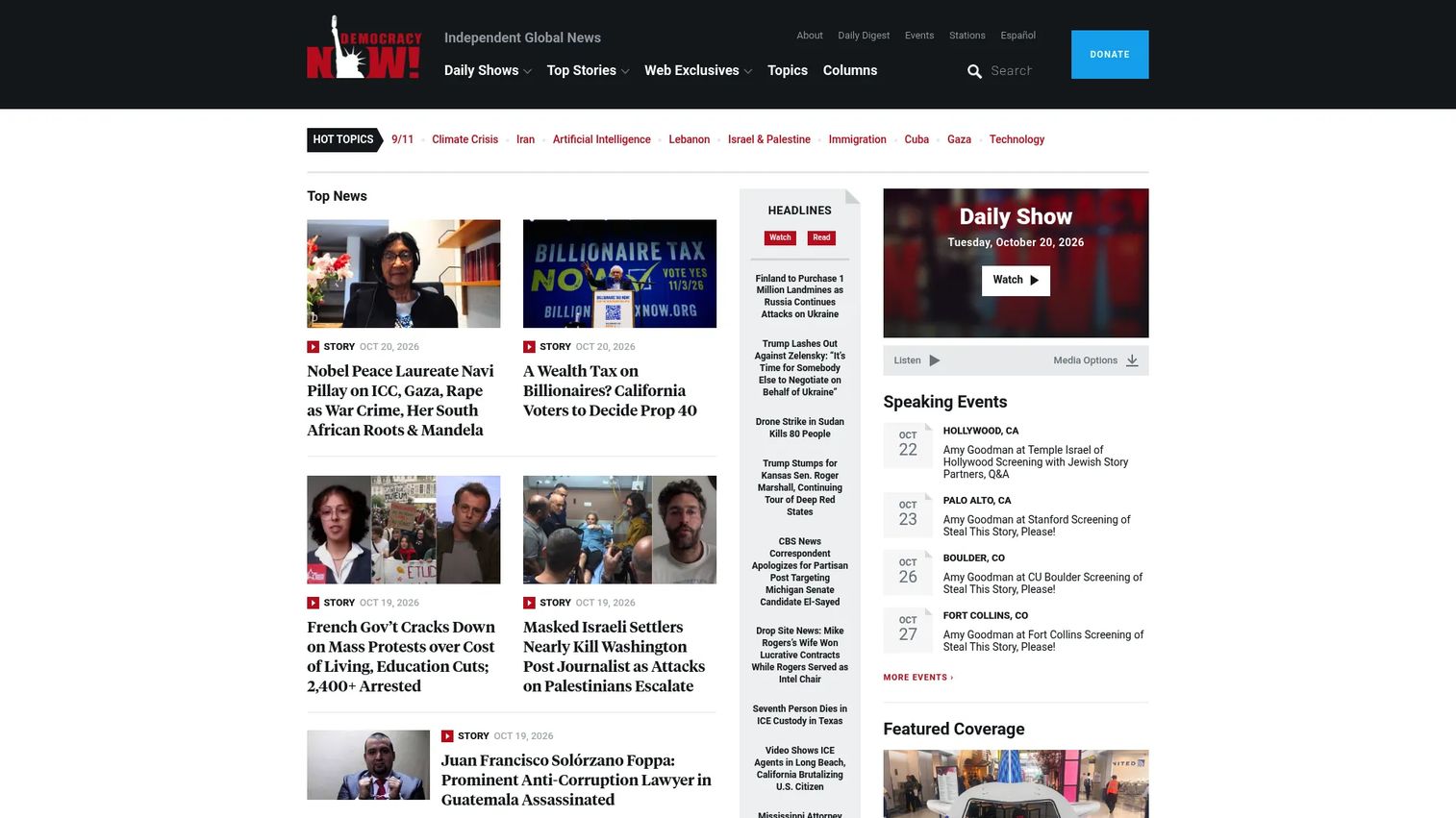
Democracy Now! is an independent, nonprofit, daily news program covering global democracy, labor, climate, human rights, and social movements through interviews, breaking headlines, and in-depth reporting. What sets it apart from text-based outlets is the format: Full video, audio downloads, and complete transcripts for every broadcast. For researchers and communications teams tracking how activist communities frame policy issues, the transcript archive is a practical research tool.
Best for: Audiences, educators, and researchers who need video, audio, and searchable transcripts of independent global news coverage.
Key features
- Daily broadcast in video and audio formats
- Full transcripts for every episode
- Spanish-language headlines available
- Breaking news alongside long-form interview reporting
- Educational resources and broadcaster support for redistribution
Why choose Democracy Now!: Choose it when format matters as much as story. The transcript archive makes it searchable and citable in ways that broadcast competitors rarely support.
Democracy Now! pricing: Free to access, donation-supported. No paywall or subscription required.
G2 rating: N/A.
3. Center for Public Integrity

Center for Public Integrity is a nonprofit, nonpartisan investigative news organization focused specifically on confronting inequality in the United States. Its journalism targets systems: How power operates, where public money flows, and who bears the costs of policy failures. Coverage spans democracy, criminal justice, climate, health care, and economic inequality, with investigations built on public records and FOIA reporting.
Best for: Readers and policy researchers who need evidence-rich accountability reporting on institutions, not event coverage.
Key features
- Investigative journalism with a nonpartisan, nonprofit structure
- FOIA-based and public-records reporting
- Data journalism projects across multiple beats
- Long-form story packages on systemic issues
- Donation-supported with no paywall
Why choose Center for Public Integrity: It fits when you need well-documented background on how a policy or institution actually functions, rather than a news summary of what happened yesterday.
Center for Public Integrity pricing: Free to read, supported entirely by donations and member contributions. Reading requires no registration or payment.
G2 rating: N/A.
4. The Marshall Project
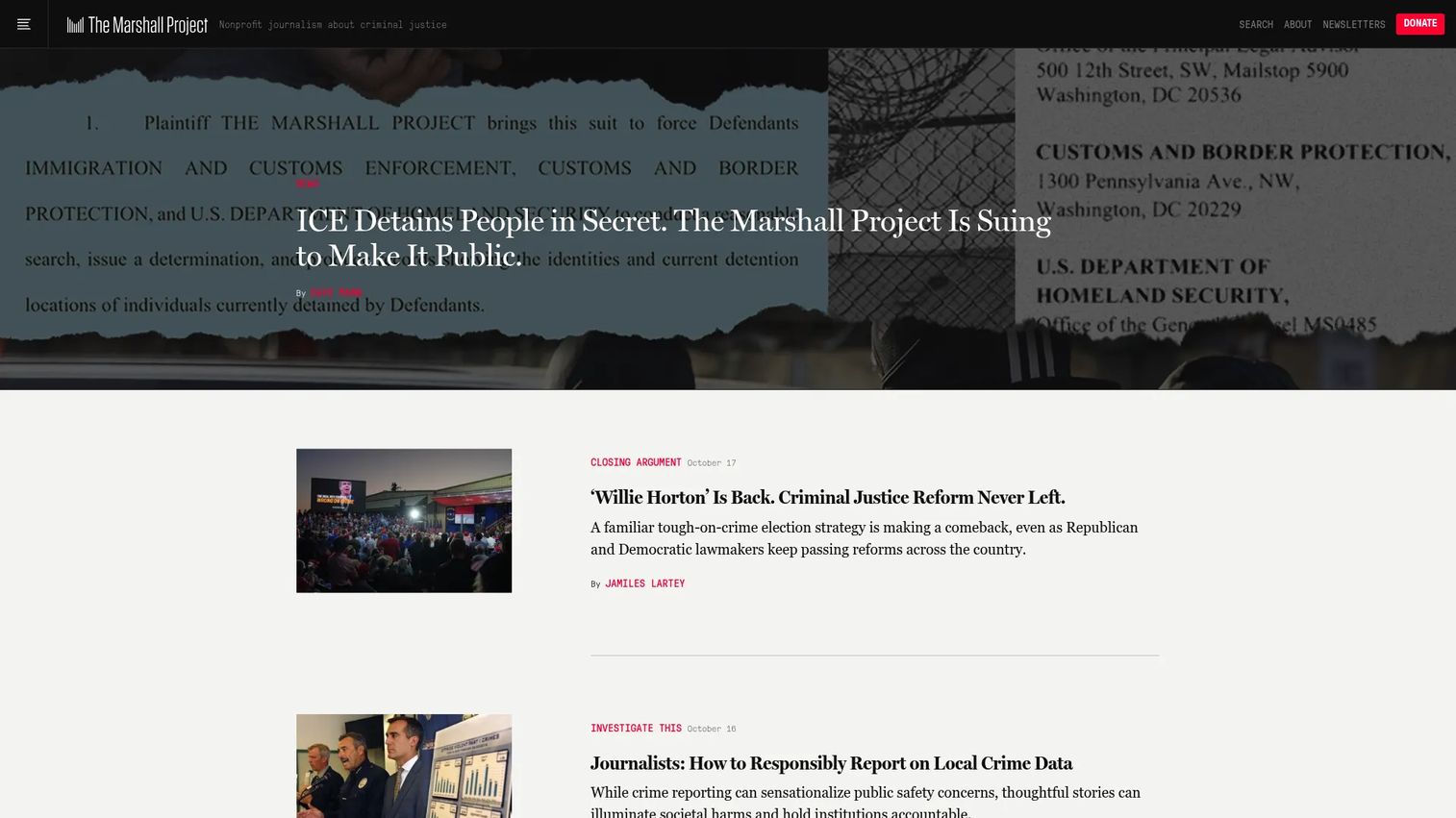
The Marshall Project is a nonprofit newsroom with one beat: America's criminal justice system. Policing, prisons, sentencing, courts, immigration detention, and reentry are all covered with a depth that general-interest outlets rarely sustain. Its reporting pairs narrative journalism with data projects and local coverage partnerships, and it produces newsletters targeted at specific audiences inside and affected by the criminal justice system.
Best for: Policy teams, legal researchers, nonprofits, and advocacy organizations tracking U.S. criminal justice issues at a systemic level.
Key features
- Deep investigative focus on U.S. criminal justice
- Data-driven reporting and interactive projects
- Local and national story partnerships
- Newsletters segmented by audience and topic
- Explainer journalism alongside investigations
Why choose The Marshall Project: When criminal justice is the beat, nothing else on this list goes as deep. A general news source simply cannot match the institutional knowledge built into a focused newsroom.
The Marshall Project pricing: Free to read, donation-supported. No access restrictions on reporting or newsletters.
G2 rating: N/A.
5. Inside Climate News
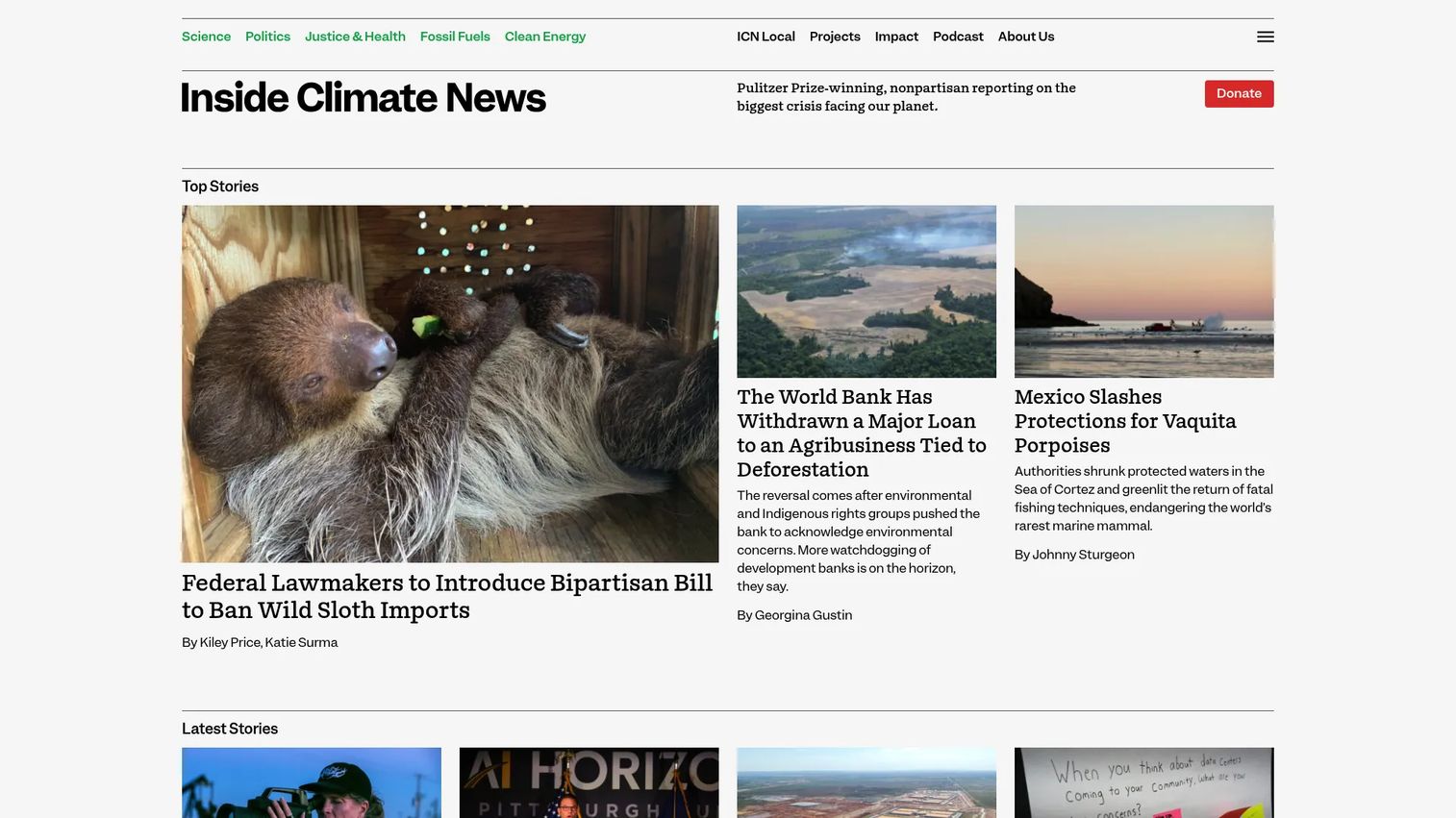
Inside Climate News is a nonprofit, nonpartisan news organization reporting on climate change, energy policy, and environmental justice. It has received Pulitzer Prize recognition for its climate and environment reporting. Coverage includes fossil fuel accountability, climate science, environmental justice communities, and the policy landscape shaping energy transitions. Newsletters include ICN Weekly, Inside Clean Energy, and local coverage editions, alongside a podcast.
Best for: Sustainability marketers, ESG researchers, policy teams, and anyone tracking climate science and fossil fuel accountability at an investigative level.
Key features
- Nonprofit climate and energy journalism with Pulitzer recognition
- Investigative reporting on fossil fuel industries and policy
- Multiple newsletters including local coverage and clean energy focus
- Inside Climate podcast for audio access
- Environmental justice coverage alongside science and policy
Why choose Inside Climate News: It stays tightly focused on one high-stakes beat, which produces more investigative depth per article than a general news outlet covering climate alongside everything else.
Inside Climate News pricing: Free to access, reader donation-supported. All reporting and newsletters are available without payment.
G2 rating: N/A.
6. Reveal
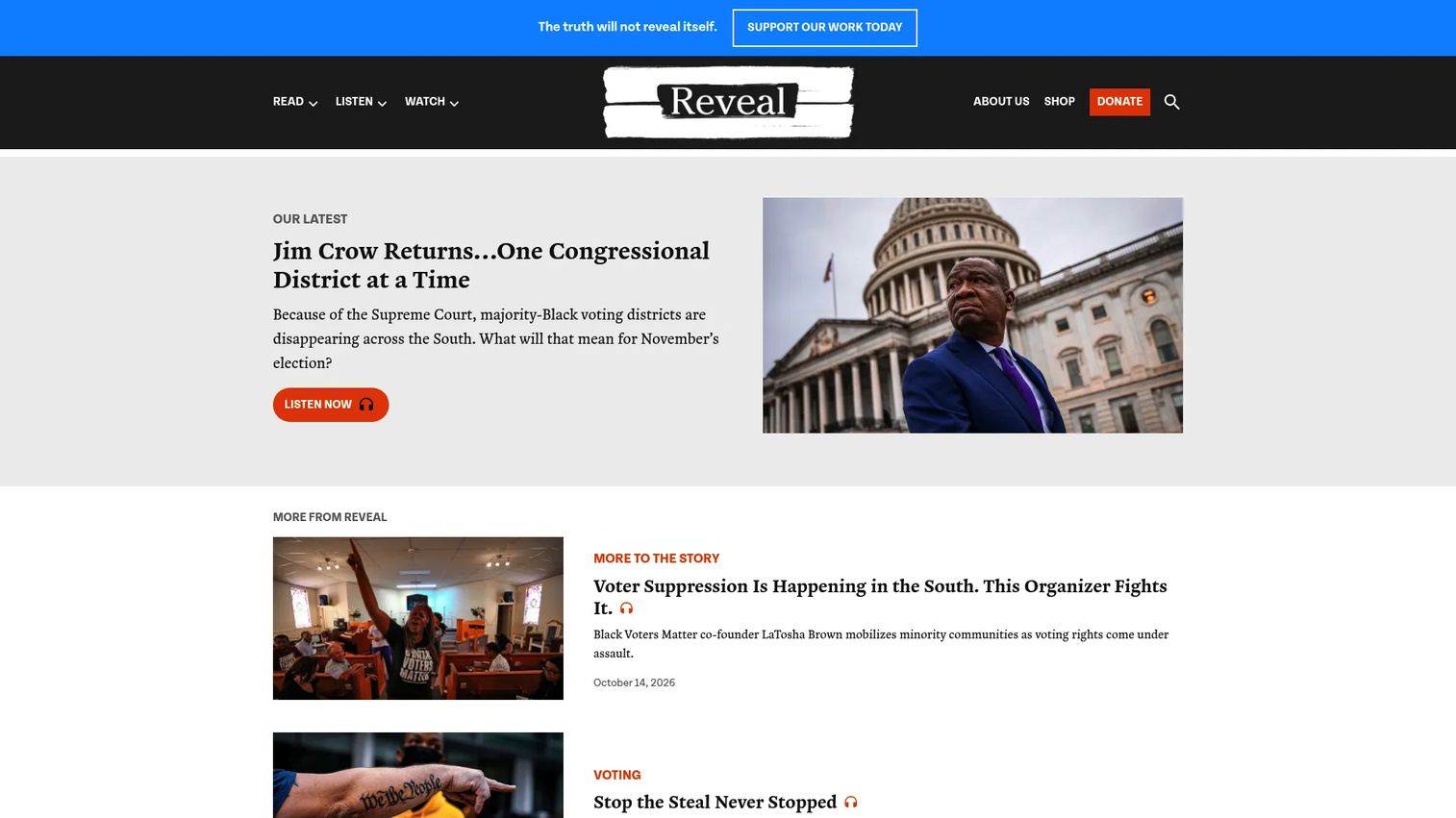
Reveal, produced by the Center for Investigative Reporting and PRX, is a nonprofit investigative journalism newsroom with an audio-first distribution model. It produces investigations into social justice, public safety, democracy, corporate accountability, and labor across a public radio program, podcast, and digital publication. The radio and podcast format makes Reveal particularly useful for audiences who want investigations they can share and revisit outside a reading workflow.
Best for: Listeners and researchers seeking narrative investigations on social justice and accountability topics in radio and podcast formats.
Key features
- Investigative journalism in radio and podcast distribution
- Documentary-style long-form storytelling
- Collaborative journalism with partner newsrooms
- Digital investigation archive alongside audio
- Donation-supported nonprofit model
Why choose Reveal: It is useful when you want investigations built for sharing and listening rather than only reading. The audio format reaches audiences that text-only reporting misses, and the archive is searchable for background research.
Reveal pricing: Free to access, donation-supported. No subscription or paywall on radio, podcast, or digital content.
G2 rating: N/A.
7. The 19th News

The 19th News is a nonprofit newsroom publishing journalism and information focused on women, women of color, and LGBTQ+ people. Its editorial mission centers on the intersection of gender, politics, and policy, covering democracy, health care, representation, and economic issues through that specific lens. The outlet produces an online newsletter and hosts events alongside its news reporting.
Best for: Researchers and marketers tracking how policy affects women and LGBTQ+ communities, particularly in politics and healthcare.
Key features
- Gender-focused political and policy journalism
- Nonprofit newsroom with a documented editorial mission
- Online newsletter distribution
- News and policy events programming
- Audience-centered reporting on underrepresented communities
Why choose The 19th News: Mainstream political coverage frequently compresses or misses how specific policies affect women and LGBTQ+ communities. The 19th News fills that gap with reported journalism rather than opinion commentary.
The 19th News pricing: Free to read, donation-supported. No paywall or access restrictions on news or newsletters.
G2 rating: N/A.
8. The Conversation
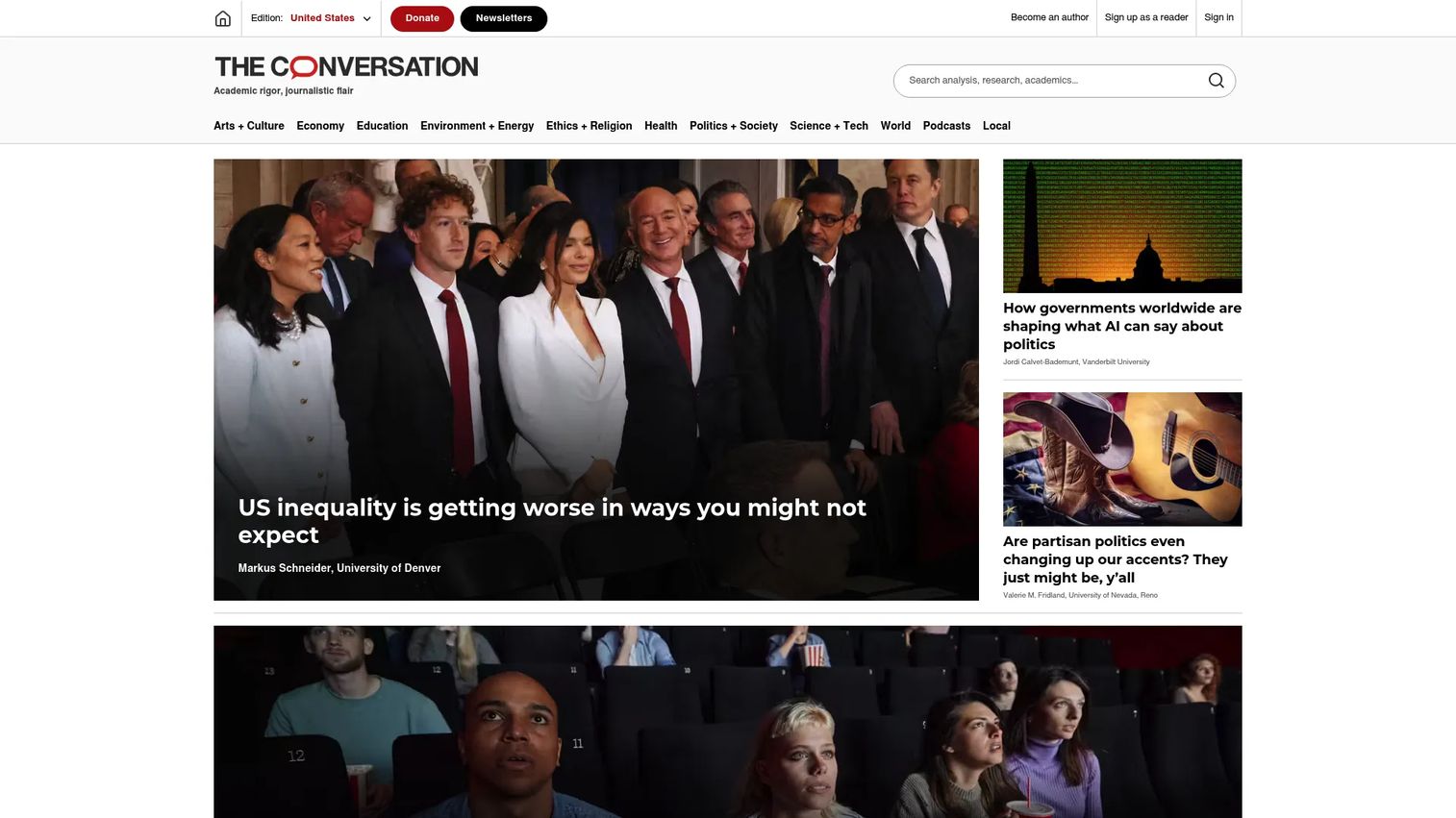
The Conversation is a nonprofit publisher that operates on a distinctive editorial model: Academic and research experts write articles directly, supported by journalist editors who help translate specialized knowledge for general audiences. Content spans every major topic area and is both free to read and free to republish under Creative Commons license. It is funded by donations, foundations, and university partners rather than advertising.
Best for: Educators, publishers, and researchers who need credible, expert-authored analysis that can be legally republished or cited with transparent sourcing.
Key features
- Research-based journalism written by academics and researchers
- Journalist editing and fact-based review for readability
- Free to read and republish under Creative Commons
- Coverage spanning science, health, politics, business, and culture
- Newsletters and distribution through republishing media partners
Why choose The Conversation: Choose it when a topic needs expert explanation rather than breaking-news coverage, and when transparent sourcing matters for citations or republication. The republish-friendly model is practically useful for content teams.
The Conversation pricing: Free to read and republish. Funded by donations, grants, and university partnerships.
G2 rating: N/A.
9. Open Secrets
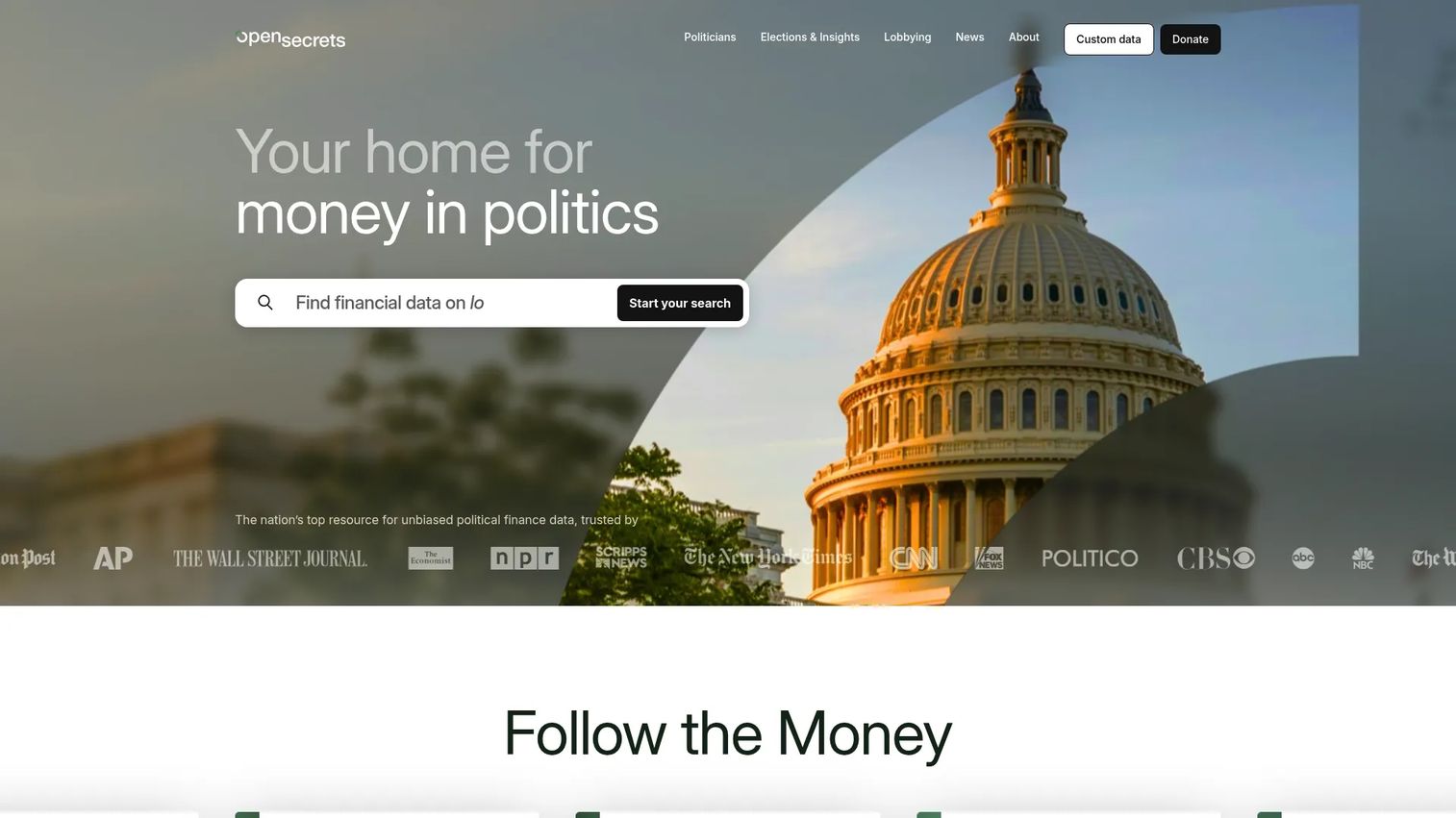
Open Secrets is a nonprofit research organization that tracks money in U.S. politics through searchable databases covering campaign finance, lobbying spending, donor records, and political expenditures. Unlike most outlets on this list, it is primarily a data resource rather than a publication. Journalists, researchers, policy teams, and citizens use it to verify political money trails rather than to read narrative reporting.
Best for: Researchers, journalists, and policy analysts who need verifiable source data on campaign finance, lobbying, and political spending.
Key features
- Campaign finance data and searchable donor records
- Lobbying research and political spending databases
- Political reporting and investigation projects
- Publicly accessible records from FEC and other filings
- Nonprofit model with donation-supported access
Why choose Open Secrets: Choose it when you need data, not interpretation. It gives you a way to verify political money connections directly rather than relying on secondary reporting about them.
Open Secrets pricing: Free to use for core research and database access, donation-supported. No subscription required.
G2 rating: N/A.
10. Grist
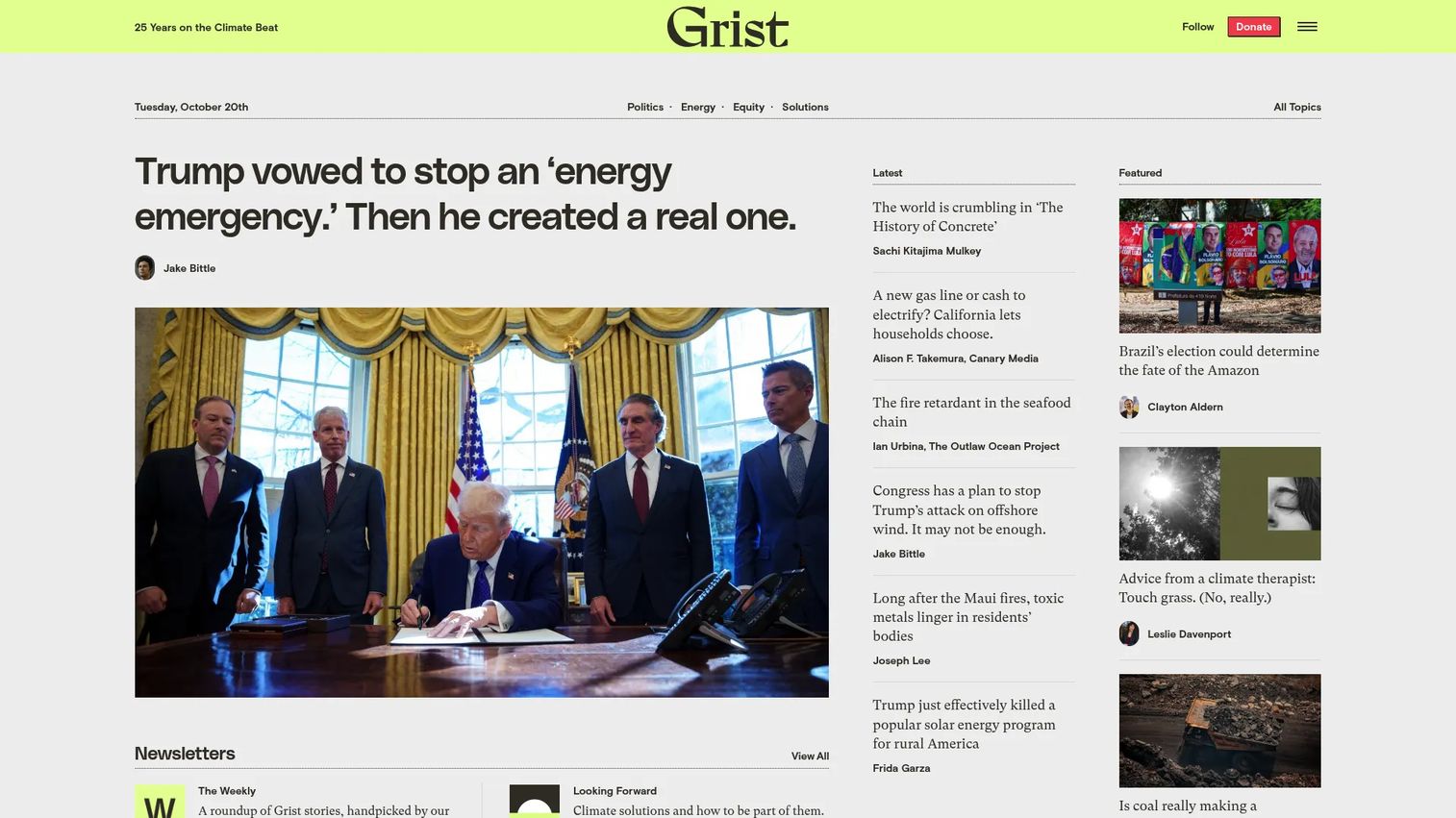
Grist is an independent nonprofit media organization covering climate change, environmental justice, and climate solutions. Where Inside Climate News tends toward investigative and policy depth, Grist brings a broader cultural lens: Climate solutions reporting, consumer behavior, environmental justice communities, and the political and cultural contexts shaping the climate conversation. It publishes free email newsletters alongside its core digital journalism.
Best for: Readers and organizations tracking climate narratives across consumer, nonprofit, and policy contexts with accessible, solutions-oriented framing.
Key features
- Climate journalism with solutions and culture coverage
- Environmental justice reporting alongside policy analysis
- Free email newsletters in multiple topic areas
- Investigative reporting and visual storytelling
- Funded by donations, grants, and sponsorships
Why choose Grist: It pairs climate urgency with accessible framing, which makes it useful beyond policy specialists. For marketers tracking how climate narratives move into consumer and mainstream cultural conversation, Grist often reflects that shift earlier than harder-news outlets.
Grist pricing: Free to read, supported by donations, grants, advertising, and sponsorships.
G2 rating: N/A.
11. Chalkbeat
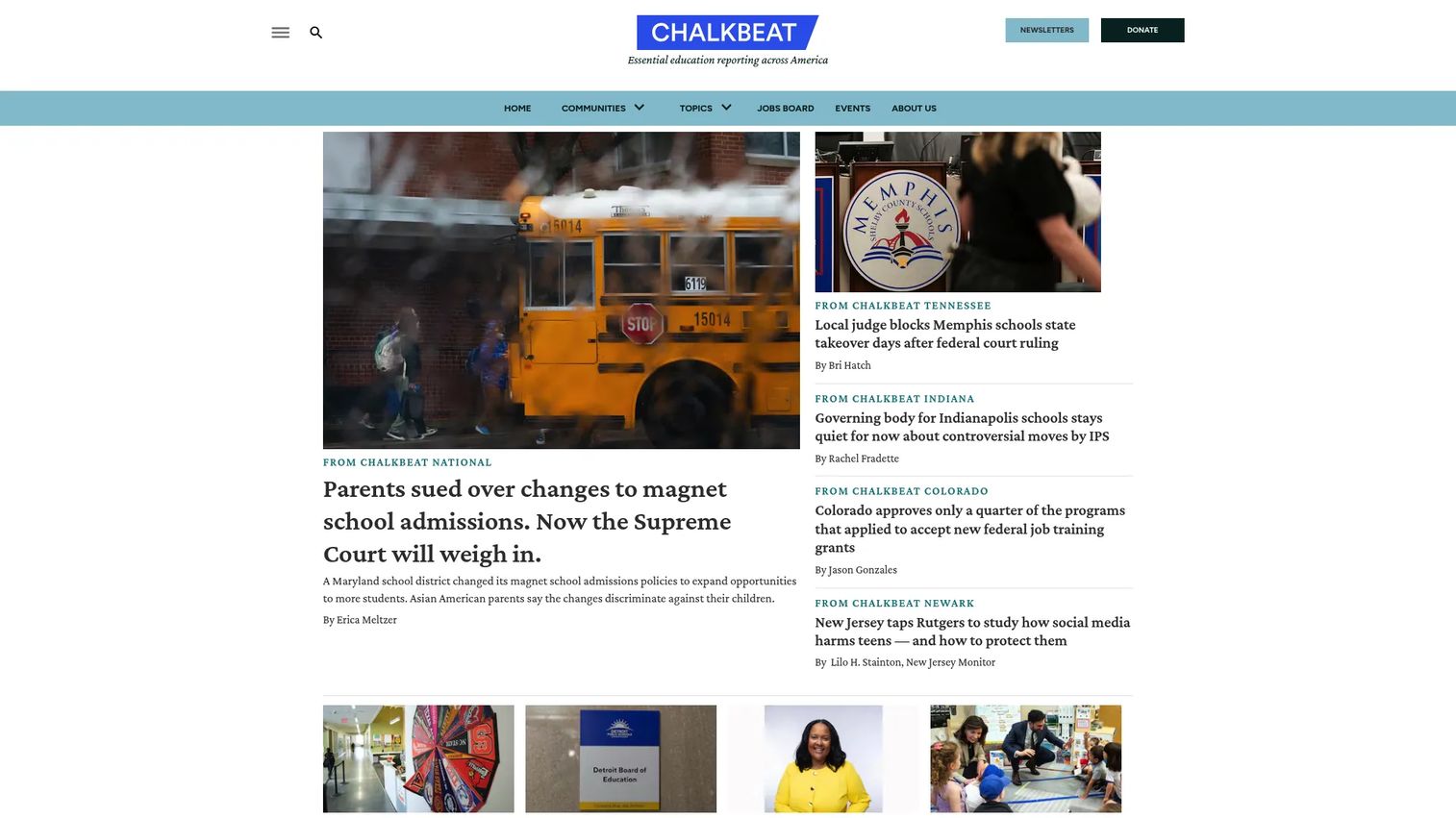
Chalkbeat is a nonprofit newsroom providing local, independent reporting about public education across eight U.S. communities. Each bureau covers local school systems, education policy, and equity issues with the depth that only a beat-focused local team can sustain. Articles are republishable under Creative Commons license, and Chalkbeat publishes daily newsletters alongside community events.
Best for: Education marketers, edtech teams, nonprofits, and policy researchers who need local context for K-12 education issues rather than national generalizations.
Key features
- Local education journalism across eight community bureaus
- Daily newsletters per bureau for monitoring
- Story republishing under Creative Commons license
- Policy explainers and community-focused reporting
- Open-source impact-tracking tools for newsrooms
Why choose Chalkbeat: Education coverage needs local context to be useful. A national headline about school policy tells you what happened in Congress; Chalkbeat tells you what it means in Denver, Chicago, or Detroit specifically.
Chalkbeat pricing: Free to read, donation-supported. Content is available without paywall or registration.
G2 rating: N/A.
12. CalMatters
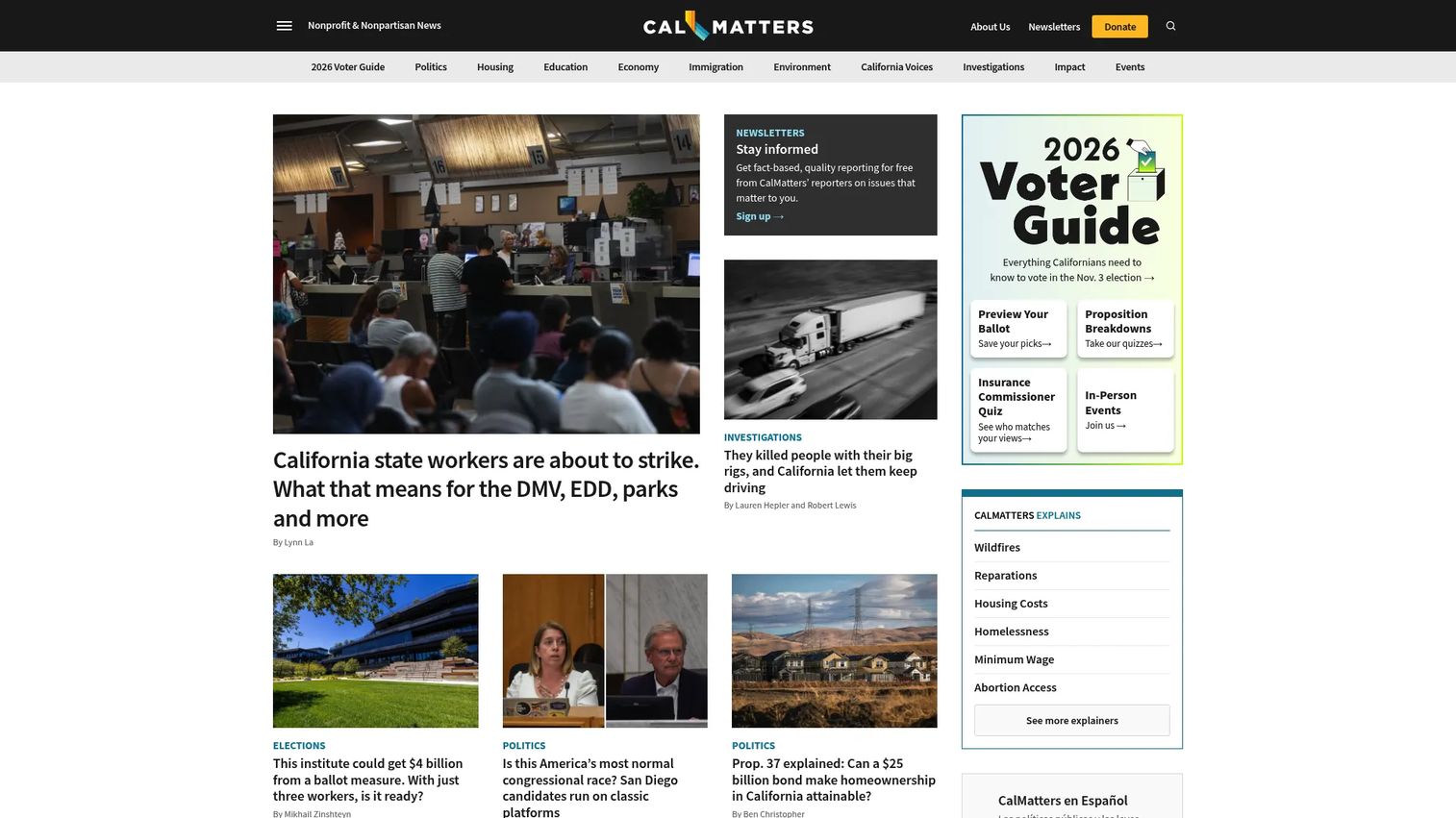
CalMatters is a nonprofit, nonpartisan newsroom explaining California state government, politics, policy, and quality-of-life issues to Californians. It covers the state legislature, housing, climate, education, and elections through reported journalism, explainers, voter guides, and newsletters. For anyone tracking California regulatory changes or public affairs, it gives statehouse-level coverage without requiring readers to monitor legislative calendars directly.
Best for: California-focused marketers, public affairs teams, and policy researchers tracking state government, regulation, and elections.
Key features
- California state government and policy reporting
- Investigative and accountability journalism
- Voter guides and election coverage
- Newsletters and text-message news alerts
- Free access with optional reader support
Why choose CalMatters: It is the practical choice for anyone whose work is affected by California policy. There is no comparable free, nonpartisan alternative for statehouse-level coverage across the full scope of state government.
CalMatters pricing: Free to read. Readers can support through optional donations or membership. No paywall.
G2 rating: N/A.
13. The Texas Tribune
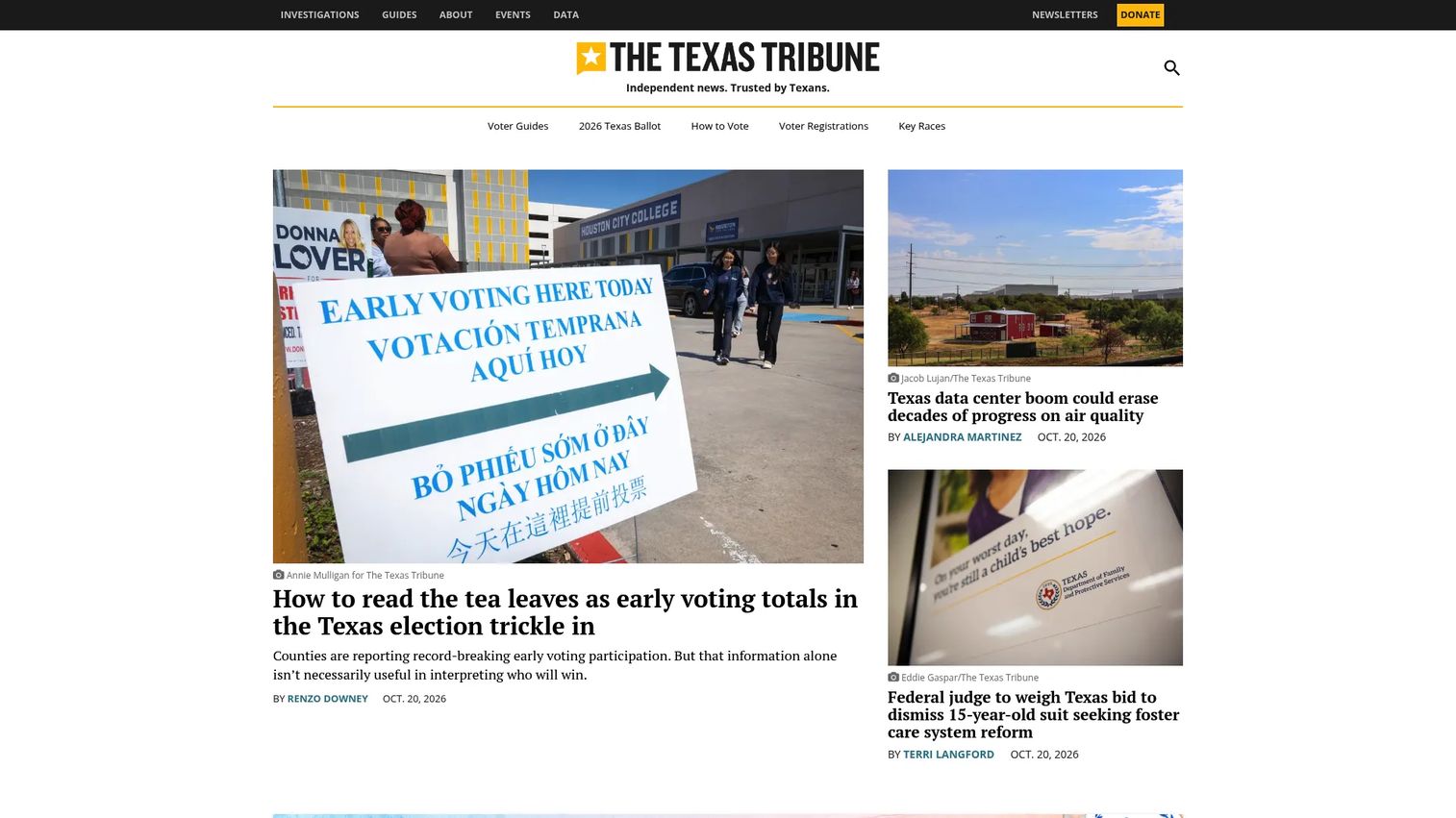
The Texas Tribune is a nonpartisan, nonprofit digital-first media organization covering Texas politics, government, and public policy with no paywall. It operates with full editorial independence and publishes news reporting, data tools, public-information databases, and live event programming for civic audiences. Its journalism spans immigration, energy, education, health care, and elections.
Best for: Marketers and researchers following Texas public policy, elections, energy, and state government across any sector affected by Texas-specific regulatory changes.
Key features
- Texas statehouse reporting without a paywall
- Public-information databases and data journalism tools
- Livestreamed and archived public events
- Policy explainers across immigration, energy, and education
- Membership-based support with no minimum donation
Why choose The Texas Tribune: Texas policy decisions affect markets and communities far beyond state borders. For any team tracking energy, immigration, or state-level legislative trends with national implications, the Tribune's database tools give searchable access to public records alongside its reporting.
The Texas Tribune pricing: Free to read. No paywall on news, multimedia projects, or events. Membership is donation-based with no minimum.
G2 rating: N/A.
14. Mother Jones
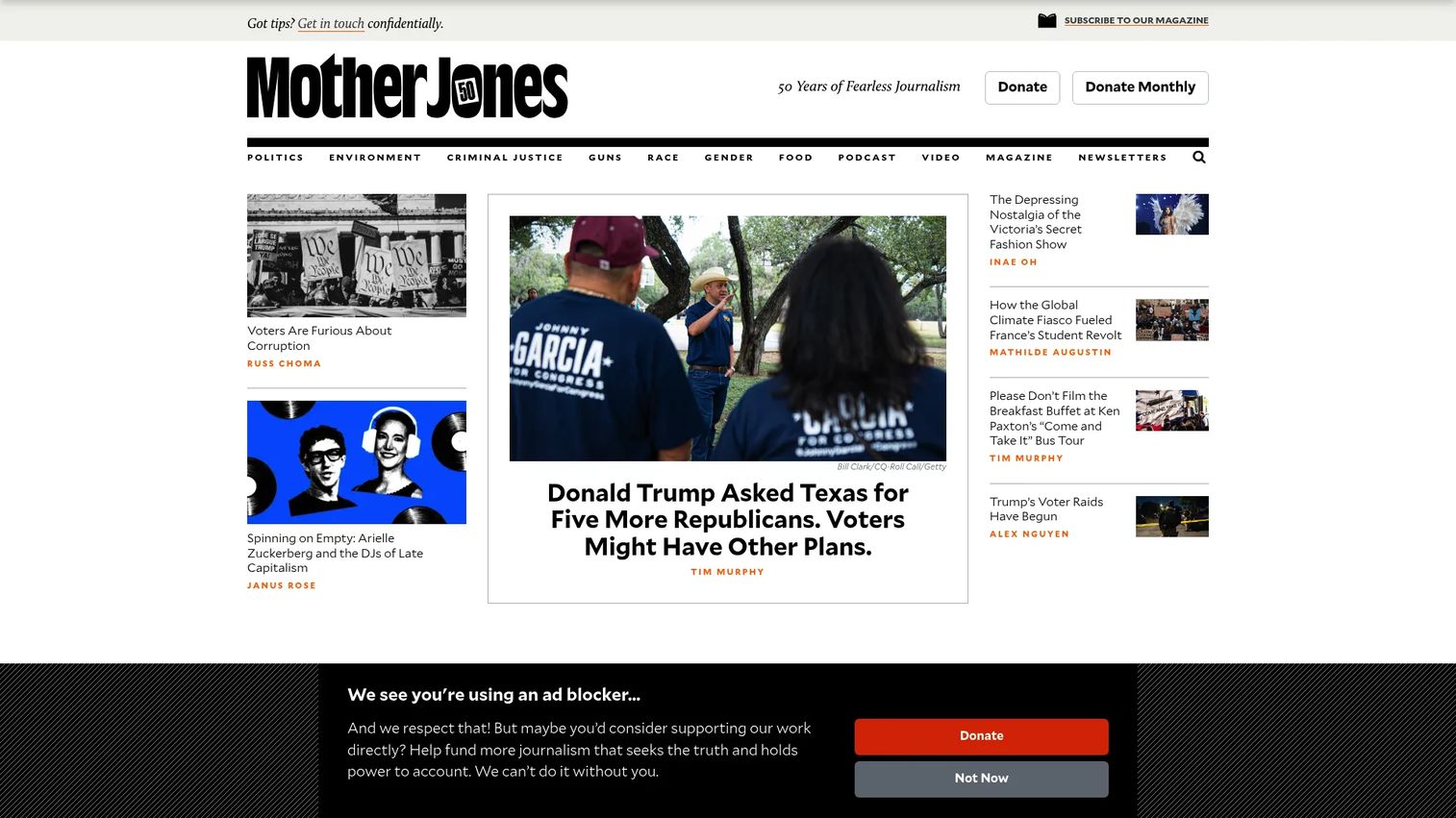
Mother Jones is a nonprofit news outlet and reader-supported magazine covering politics, climate, education, food, and other public-interest issues. It combines investigative reporting with magazine-style narrative journalism, producing long-form features, political analysis, podcasts, and newsletters. The outlet has a clear progressive editorial identity and is transparent about it, which makes it more useful to readers who understand the framing than to those expecting an ideologically neutral source.
Best for: Readers who want investigations with strong editorial voice, magazine-level narrative depth, and transparency about the outlet's perspective.
Key features
- Investigative and narrative magazine-format journalism
- Political, climate, and corporate accountability reporting
- Podcasts and newsletters
- Reader-supported model with subscription and donation options
- Transparent progressive editorial identity
Why choose Mother Jones: It works well when readers want investigations paired with strong writing and a defined editorial standpoint. It is a less useful source for topics where ideological neutrality is the evaluation criterion.
Mother Jones pricing: Free articles available without registration. Subscription and donation support options exist for readers who want to contribute. Specific subscription pricing requires checking the current site.
G2 rating: N/A.
15. The Nation
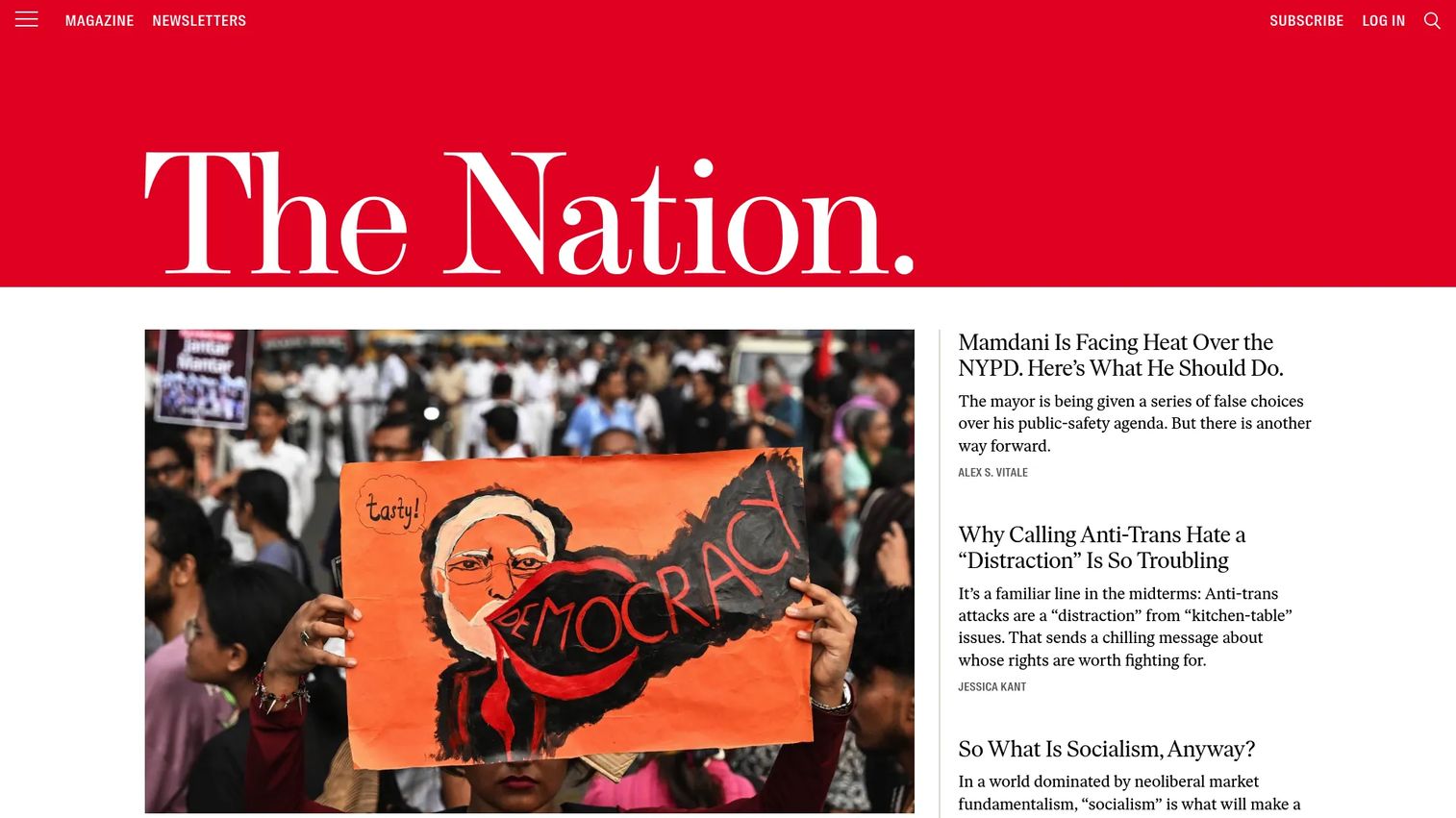
The Nation is a reader-supported progressive magazine and digital publication covering politics, world affairs, labor, civil rights, and culture. Founded in 1865, it maintains one of the longest-running digital archives in American political journalism. Non-subscribers can read a limited number of free articles per month. The outlet covers international affairs, labor rights, and domestic politics with analysis and commentary rather than primarily investigative news.
Best for: Readers seeking progressive political analysis, historical context, and commentary with access to a deep magazine archive.
Key features
- Progressive political and cultural analysis
- Digital archive dating back to 1865
- Subscriber-only app access on iOS and Android
- Unlimited online access for subscribers
- International affairs and labor coverage alongside domestic politics
Why choose The Nation: Choose it for political analysis and commentary with historical continuity. Its depth of archive is genuinely useful for researchers tracing how particular policy debates have evolved over decades.
The Nation pricing: Digital-only annual subscription starts at $24.95 per year. Digital plus print annual is $29.95. Monthly digital access is $3.99. Non-subscribers can read three free articles within a 30-day period.
G2 rating: N/A.
16. Common Dreams

Common Dreams is a reader-supported, nonprofit independent news outlet that has operated since 1997. It publishes free progressive journalism, commentary, and video alongside its Progressive Newswire, which distributes press releases, statements, and action alerts from advocacy organizations. Content is fully ad-free, which distinguishes it from outlets that blend advocacy content with commercial advertising.
Best for: Researchers and communications teams monitoring which stories and narratives are resonating across progressive advocacy communities.
Key features
- Ad-free independent progressive journalism
- Breaking news and original commentary
- Progressive Newswire for advocacy statements and press releases
- One-time and monthly donation support options
- No paywall on any content
Why choose Common Dreams: It is useful for tracking which stories are gaining traction in progressive and advocacy communities before they cross into mainstream coverage. The Progressive Newswire is particularly practical for communications teams monitoring the advocacy landscape.
Common Dreams pricing: Free to read, supported by reader donations. No subscription fees or paywall.
G2 rating: N/A.
17. Truthout
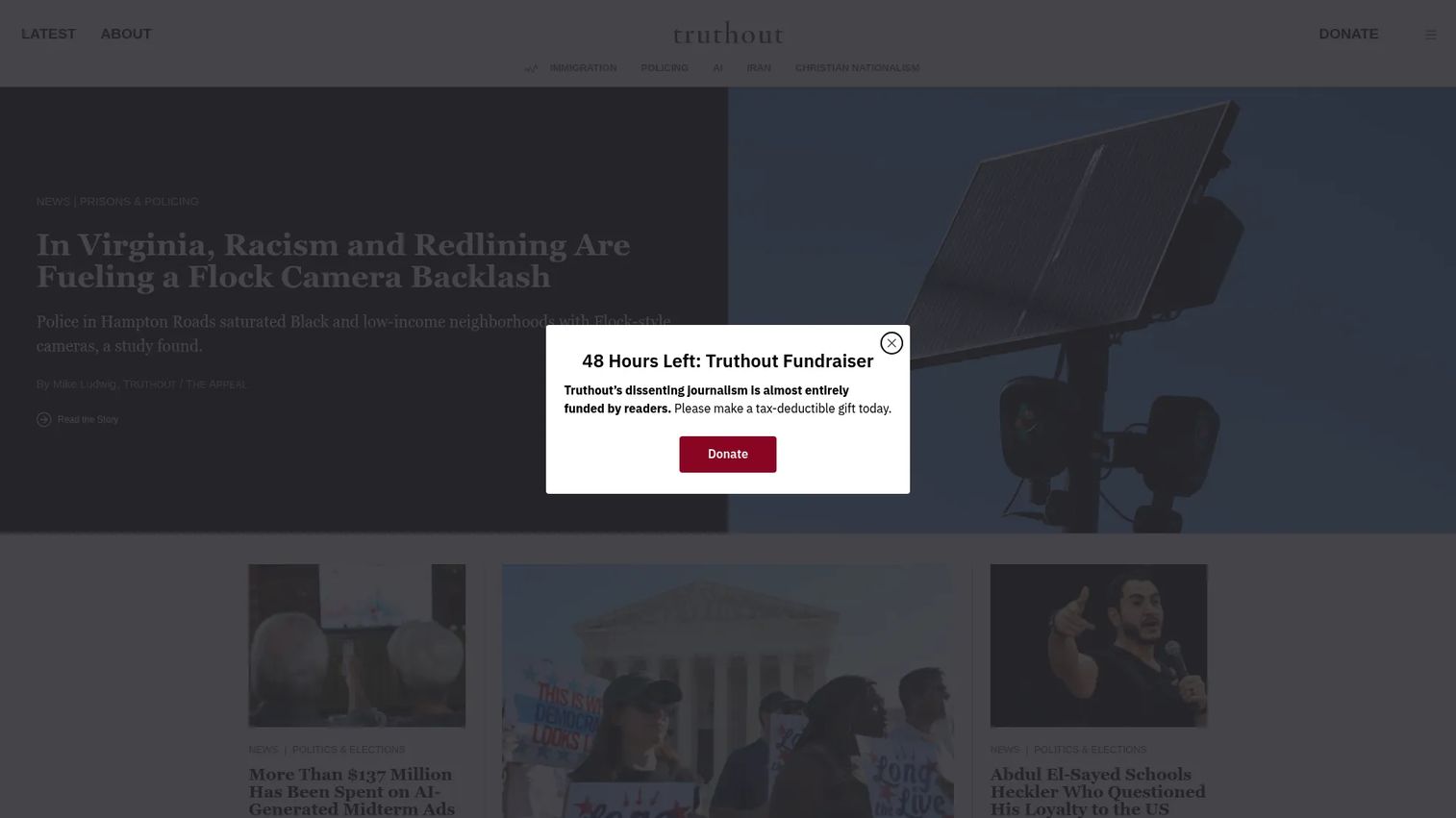
Truthout is a nonprofit news organization providing independent reporting and commentary on social justice, politics, human rights, climate, and economic issues. It explicitly operates without a paywall or subscription requirement, stating that access to journalism should not be contingent on financial ability. Content includes investigative reporting, critical analysis, audio, video, serialized projects, and podcasts.
Best for: Readers tracking grassroots policy narratives, social movements, and issue-based journalism on labor, climate justice, and economic inequality.
Key features
- Investigative reporting and critical analysis on social justice topics
- Audio, video, and serialized investigative projects
- Podcasts alongside text reporting
- Fully paywall-free with donation-supported funding
- Coverage of labor, climate justice, policing, prisons, and inequality
Why choose Truthout: It follows social movements closely and covers issue developments that general news outlets often treat as secondary. For teams monitoring movement narratives before they reach policy or mainstream media attention, it provides reliable early coverage.
Truthout pricing: Free to access, supported entirely by reader donations. No paywall or subscription fees.
G2 rating: N/A.
18. The Intercept

The Intercept is an investigative outlet covering national security, surveillance, civil liberties, politics, and accountability. Its journalism takes an adversarial stance toward state and corporate power, with document-driven reporting on intelligence agencies, military operations, and political institutions. It publishes newsletters alongside its core reporting and is donation-supported.
Best for: Policy, security, media, and civil liberties researchers who need adversarial accountability reporting on government power and institutional secrecy.
Key features
- National security and surveillance investigations
- Civil liberties and accountability reporting
- Document-driven investigative stories
- Political reporting with adversarial editorial approach
- Newsletter distribution alongside digital content
Why choose The Intercept: It fits readers who need reporting that specifically challenges government and institutional secrecy. For general policy monitoring it may be narrower than needed, but for national security, surveillance, and civil liberties beats it goes deeper than alternatives.
The Intercept pricing: Free to read, donation-supported. No paywall on reporting or newsletters.
G2 rating: N/A.
19. The Real News Network
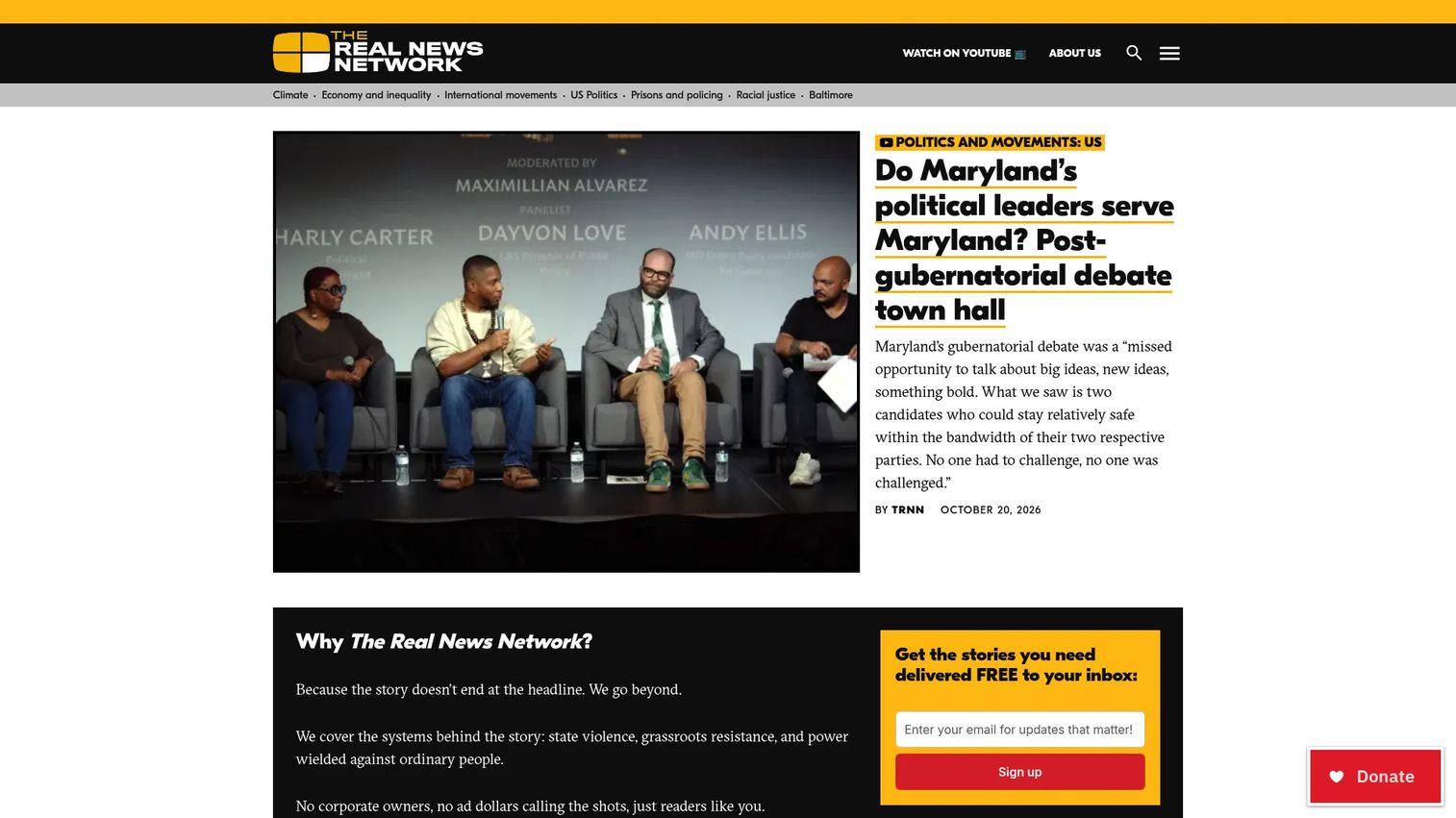
The Real News Network is a viewer-supported nonprofit news organization producing independent journalism focused on social justice, democracy, and frontline movements. Its primary format is digital video, covering climate, labor, international movements, U.S. politics, racial justice, and policing through shows and podcasts including the Marc Steiner Show, Rattling the Bars, Police Accountability Report, and Working People. According to Edison Research (2025), 55% of Americans 12 and older are monthly podcast consumers, which reflects the audience reach that audio and video journalism formats now command.
Best for: Researchers and advocacy organizations who need independent news in video and audio formats, particularly covering labor and social movement developments.
Key features
- Digital video journalism as primary content format
- Shows and podcasts covering labor, policing, climate, and racial justice
- U.S. politics and international movement coverage
- Donation-supported with no content paywalls
- Baltimore-specific local coverage alongside national reporting
Why choose The Real News Network: Choose it when the audience needs independent news in a format built for watching and sharing, particularly around labor, social movements, and policing issues where video documentation carries distinct value.
The Real News Network pricing: Free to watch, supported by viewer donations. No subscription or access restrictions.
G2 rating: N/A.
20. Fairness and Accuracy in Reporting
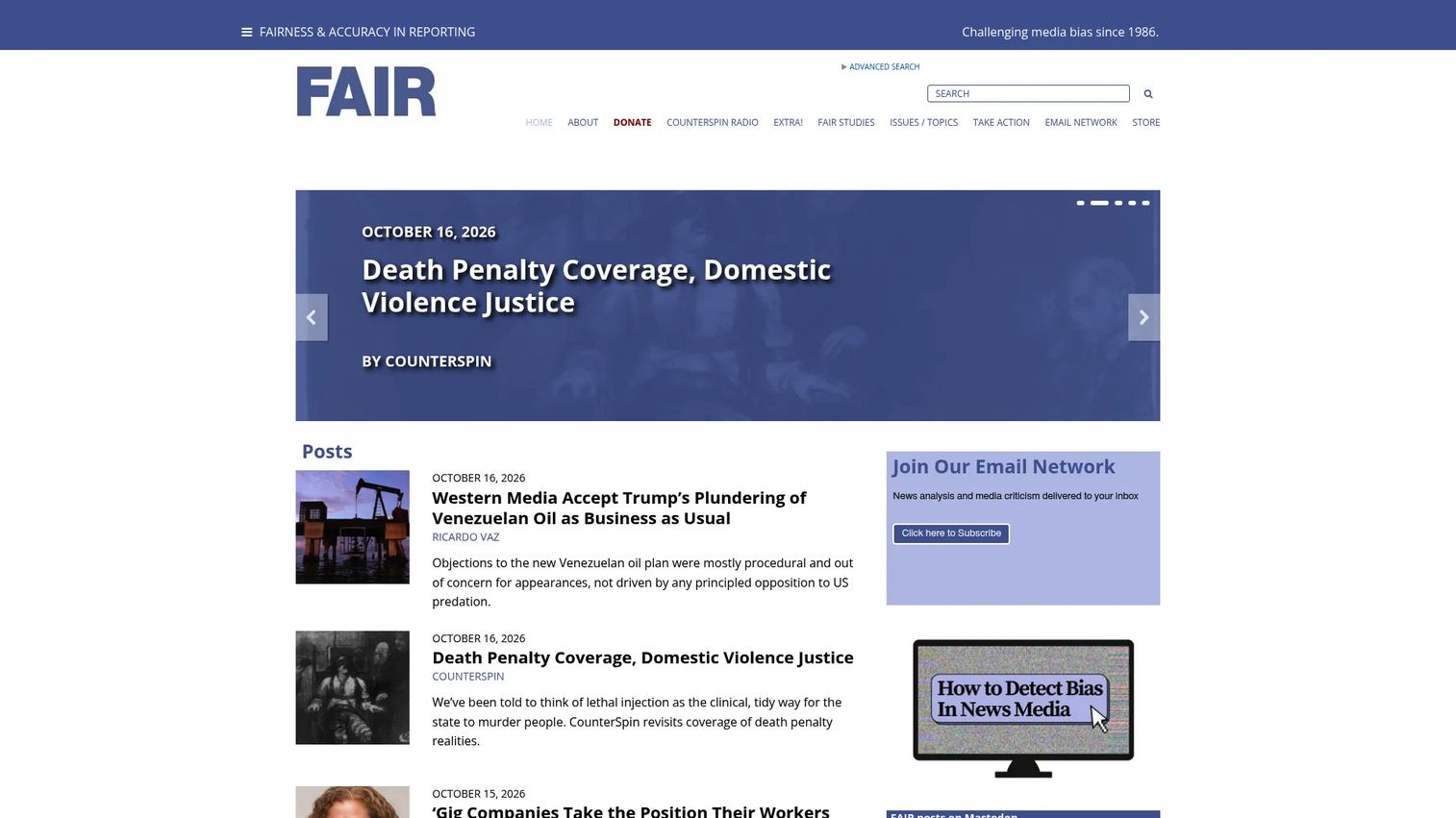
Fairness and Accuracy in Reporting (FAIR) is a nonprofit media watchdog organization, not a general news outlet. Its purpose is to critique media bias, censorship, sourcing practices, and framing across mainstream news organizations. It publishes the Extra! newsletter, produces the CounterSpin weekly radio program, and researches media practices at a structural level. For marketers and communications professionals studying how narratives are built, repeated, and contested in the press, FAIR provides a different kind of analytical tool than any reporting outlet on this list.
Best for: Researchers, media relations professionals, and communications teams who need to understand how media bias operates and how specific stories are framed across outlets.
Key features
- Media-bias criticism and structural analysis
- CounterSpin weekly radio program
- Extra! newsletter on media practices
- Advocacy resources for media literacy and accuracy
- Research on sourcing, omission, and framing patterns
Why choose Fairness and Accuracy in Reporting: It helps readers evaluate how media narratives are constructed rather than simply consuming them. For a digital marketer building a source evaluation framework or studying how coverage of a topic diverges across outlets, FAIR's analysis provides the kind of meta-level context that no reporting outlet can offer about itself.
Fairness and Accuracy in Reporting pricing: Free to access, donation-supported. No paywall on newsletters, radio content, or research.
G2 rating: N/A.
Considerations when choosing independent media platforms
Ownership and funding transparency
Before adding any outlet to a source list, check who owns it and where its money comes from. Most platforms on this list publish donor policies or annual reports. A nonprofit newsroom that takes large grants from a single foundation with a specific policy agenda has a different independence profile than one with thousands of small donors. Neither is automatically disqualifying, but the distinction matters for how you interpret the coverage.
Editorial standards and corrections policies
Look for a public corrections page, bylined reporting with source links, and a documented separation between news and opinion. Outlets that blur reported facts and editorial commentary without clear labeling require more careful reading. The presence of corrections is actually a positive sign: It reflects a functioning editorial process, not a credibility problem.
Original reporting versus aggregation and commentary
Several platforms on this list combine original reporting with curated aggregation or commentary. Common Dreams and Truthout, for example, publish both. Neither approach is inferior, but they serve different research purposes. Use original investigations for primary source citation. Use commentary and aggregation to understand how issues are being framed and discussed within specific communities.
Beat depth and the specific research question
Choosing by beat fit gives you more precise information than choosing by general reputation. The Marshall Project covers criminal justice at a depth no general outlet matches. Open Secrets is the definitive source for campaign finance data. Chalkbeat provides local education coverage that national publications compress into single paragraphs. Before adding a source to your monitoring rotation, ask whether it covers your specific topic or only adjacent ones.
Format and workflow fit
Marketers need different formats for different tasks. Newsletters work for daily monitoring. RSS feeds support alert-based workflows. Databases support direct research. Podcasts reach audiences outside reading workflows. Video is useful for social listening and tracking how stories are being told to non-reading audiences. Build your source list based on how the format fits your actual research process, not just on outlet reputation.
Conclusion
The 20 platforms in this guide represent a practical shortlist rather than a comprehensive directory. For investigative reporting on public institutions, start with ProPublica and Center for Public Integrity. Criminal justice research points to The Marshall Project. Climate coverage splits between Inside Climate News for investigative depth and Grist for solutions and cultural framing.
State-level policy tracking works best with dedicated outlets: CalMatters for California, The Texas Tribune for Texas. For campaign finance verification, Open Secrets is the data source rather than a publication. Media criticism and source evaluation belong with Fairness and Accuracy in Reporting.
Build your source list by beat, not by name recognition. Pick three outlets that match your current research priorities. Subscribe to their newsletters for monitoring, check their corrections pages before citing, and revisit the list when your topic focus shifts.
For related research on social media analytics tools, social media management tools, or content marketing tools, those guides follow the same selection framework applied here.
FAQs
An independent media platform is a news outlet, nonprofit newsroom, broadcaster, or watchdog organization that operates with editorial independence from large corporate, state, or partisan ownership structures. Independence refers to the ownership and funding structure, not to political neutrality or the absence of a point of view. Readers still need to evaluate sourcing, evidence quality, and the separation between reported news and opinion when using these outlets.
Reliability depends on sourcing, corrections practices, editorial standards, and evidence quality, not on ownership structure alone. Independent status removes certain commercial pressures but does not eliminate editorial bias or errors. Some independent outlets maintain rigorous fact-checking and corrections processes; others publish commentary and advocacy alongside or in place of reported news. Evaluate each outlet's specific practices rather than treating independence as a trust guarantee.
ProPublica, Center for Public Integrity, Reveal, The Marshall Project, and Mother Jones each produce strong investigative journalism, but they work in different areas. ProPublica covers the widest range of beats with the deepest database infrastructure. Center for Public Integrity focuses on inequality and institutional accountability. Reveal specializes in audio-first investigations. The Marshall Project owns criminal justice. Mother Jones combines investigations with magazine-style narrative reporting.
Inside Climate News and Grist are the two strongest options, and they serve different needs. Inside Climate News is better for investigative reporting on fossil fuel industries and climate policy, with Pulitzer-recognized journalism and a tighter factual focus. Grist covers climate solutions, environmental justice, and the cultural dimensions of the climate conversation with more accessible framing for general audiences. Both operate without paywalls and are donation-supported.
Digital marketers can use independent media platforms for media monitoring before stories reach mainstream coverage, building diverse source lists for campaign research and public affairs tracking, sourcing credible expert reporting for thought leadership content, and identifying which outlets have audience trust in specific communities. The key constraint is treating any single outlet as a complete picture of a topic. Build monitoring across multiple outlets with different ownership models and editorial approaches.
Independent media refers to ownership and editorial structure: Outlets that operate outside large corporate, state, or partisan control. Alternative media usually refers to coverage that falls outside mainstream editorial norms, prioritizing stories, angles, or communities underserved by major publications. The categories overlap significantly, but they are not identical. An outlet can be independently owned and still follow mainstream editorial conventions, or it can be technically owned by a media conglomerate but cover alternative topics. Most outlets described as alternative media are also independently owned.
Use a practical checklist: Documented ownership and major funders, bylined reporting with source links, a public corrections page, clear separation between news and opinion, expert quotes with named credentials, methodology notes on data journalism, an editorial independence policy, and consistent publication over time. No single factor determines credibility, but an outlet that documents all of these is more usable for citation and research than one that documents none.
Usually, but not automatically. A nonprofit structure reduces commercial pressure, but a nonprofit newsroom still needs transparent governance, editorial independence from major donors, and documented standards to qualify as genuinely independent. Some nonprofit newsrooms receive large grants from foundations with specific policy agendas and may reflect those priorities in coverage decisions. Check the donor policy, the board governance structure, and whether major funders are disclosed before treating nonprofit status as a complete independence signal.